
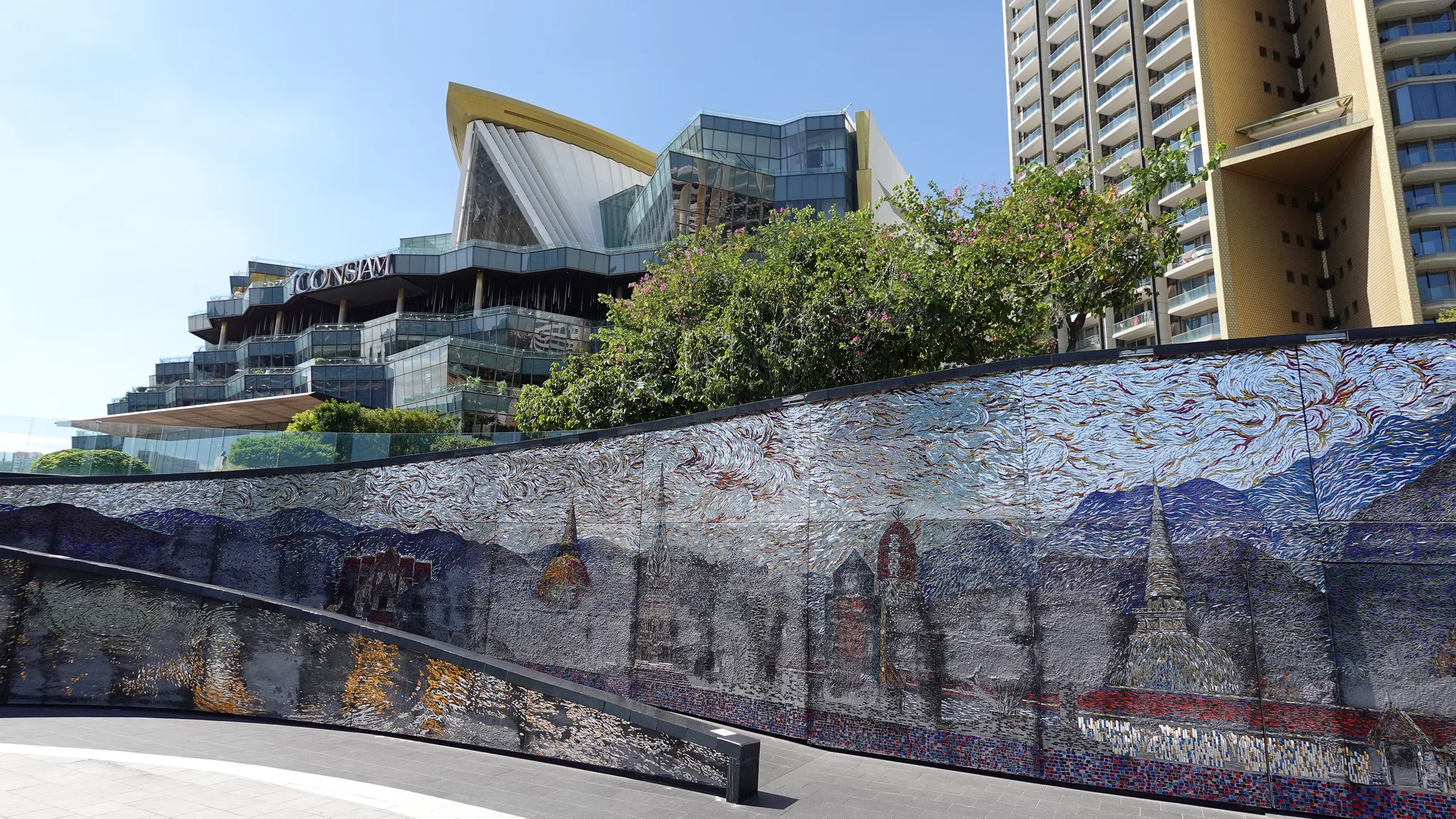
 In the foreground at ICONSIAM, a curved mosaic mural depicts chedis, prangs and mountains beneath a swirling sky; behind it, the terraced glazed building with its golden roof stands beside a residential tower.© Eric Monteil
Cultural & creative centre
ICONSIAM
On the Thonburi bank, facing old Bangkok, a shopping complex opened in 2018 has shifted the city’s centre of gravity westwards and made Thai art and craftsmanship one of its principal attractions.
Heritage family · Arts, aesthetics and creation
- Destination
- Bangkok (Khlong San)
- Heritage Family
- Arts, aesthetics and creation
- Typology
- Cultural & creative centre
- Visit
- Available tours →
ICONSIAM is a mixed-use complex bringing together a large shopping centre and two luxury residential towers on the west bank of the Chao Phraya River in Bangkok, opposite the capital’s historic centre. Opened in 2018, it turned the hitherto quiet neighbourhoods of Khlong San and Charoen Nakhon into a hub of the city, served by a metro line that its owners had proposed as early as 2015. Its designers conceived it as a showcase of ‘Thainess’, Thai cultural identity: a trail of eight monumental artworks, the creations of more than a hundred artists, a gallery devoted to the provinces and floors set aside for the country’s craftspeople and designers. Its pleated glass façade, inspired by floating offerings, is its signature.
Key facts
- Destination
- Bangkok
- Heritage Family
- Arts, aesthetics and creation
- Typology
- Cultural & creative centre
- Places
- Chao Phraya River
- Khlong San
- Thonburi
- Periods
- —
- People
- Princess Maha Chakri Sirindhorn
- Taksin
- Communities
- —
- Events
- Opening (2018)
- Opening of the Gold Line (2020)
- Heritage
- —
- Glossary
- Khlong
- San
- Teochew
- Ancient monument
- Krathong
- Keywords
- —
- Date
- —
- Collections
- —
Practical info
Practical information about this site is taken from its Google Maps page. We advise you to check it before visiting.
- Address
- 299 Charoen Nakhon Rd, Khwaeng Khlong Ton Sai, Khet Khlong San, Krung Thep Maha Nakhon 10600
- Phone
- Website
A complex facing old Bangkok
Retail, residences and the river
ICONSIAM brings several functions together on a single site: a large shopping centre, two residential towers and a park opening onto the river. This is what is known as a mixed-use complex, a place where one can live, shop, eat, attend a performance or simply stroll by the water. The whole development rises on the west bank of the Chao Phraya River, on the Thonburi side, directly opposite the historic and commercial centre of Bangkok.2
The scale of the project accounts for part of its impact. The complex covers some three quarters of a million square metres of built floor area, more than half of it given over to retail, and its car parks hold several thousand vehicles. Its developers present it as the largest commercial property project ever undertaken in Thailand, a claim the international press has repeated while attributing it to them. Beyond these figures, it is the choice of riverbank that gives the place its significance: by settling in Thonburi, the complex turned this bank into a commercial hub.2
Khlong San, an old riverside district
The site lies in the district of Khlong San, one of the oldest in Bangkok. Its name comes from a canal, the Khlong San, also known as Khlong Prasan, the word khlong meaning a canal. The district has changed its administrative name several times: it was first called Bang Lamphu Lang, then Buppharam, before taking in 1916 the name of Khlong San, which it still bears.16
Shortly before the complex arrived, Khlong San and the neighbouring area of Charoen Nakhon were regarded as quiet districts that the major property developers had long overlooked.5
The birth of a project
Three Thai groups in partnership
ICONSIAM was born of an alliance between three Thai groups brought together in a joint venture: Siam Piwat, Magnolia Quality Development Corporation (MQDC) and Charoen Pokphand Group. Siam Piwat dates the presentation of the project’s vision to the early 2010s.10
The investment runs to several tens of billions of baht. The figures vary: around 50 billion baht announced at the outset, 54 billion (about 1.5 billion dollars) in 2018, and more than 60 billion (over 1.8 billion dollars) in 2025.8
An international design team
The architecture of the complex is first and foremost the work of Urban Architects, a Thai practice founded in 1988, credited with the design of the buildings as well as the graphics and the interior architecture. The firm Benoy also features among the designers associated with the project. Around this core a large team was assembled, commensurate with the scale of the undertaking: a landscape architect, PLandscape; several lighting designers, among them L’Observatoire International; a structural engineering firm, KCS & Associates; and façade specialists such as Ove Arup.13
This division of roles says a great deal about the nature of the place. A complex of this kind is no longer the gesture of a single architect: it results from the coordination of many forms of expertise, overseen by project managers and by cost and schedule controllers. The Thai signature of Urban Architects nonetheless retains a central place, particularly in the treatment of the most visible façade.
November 2018: the opening
The complex was officially inaugurated on 9 November 2018, the day the shopping centre opened its doors to the public. Princess Sirindhorn presided over the opening ceremony. The Apple Store in the main building opened on the same day.1
Development did not stop there. On 11 January 2023, an extension building, named ICS, was added to the ensemble.8
An architecture of glass and folds
The krathong as a motif
What one notices first, from the river or from the street, is the long glazed wall of ICONLUXE, the luxury-brand wing, made up of three buildings. Its façade appears as a vast surface of glass folded in a zigzag, some 300 metres long and, at its highest point, 24 metres tall.11
This motif carries meaning. The folds are inspired by the krathong, the floating offering made of folded banana leaves. Urban Architects conceived the whole as a ‘colossal window’ running across three levels and alluding to traditional Thai culture. A familiar gesture, the folding of a banana leaf, is thus transposed to the scale of a contemporary building.13
A suspended glass curtain
The engineering of this façade is as distinctive as its design. Rather than resting on the ground, it is suspended from the building’s ceiling. It consists of large glass panels 16 metres high, set in a zigzag and inclined in two directions, supported by glass fins.11
At the top, the façade projects four metres and serves as a balustrade for the rooftop garden, so that the glazed envelope also plays a part in the use of the terraces. The firm Seele fabricated and installed the structure in thirteen months. The choice of this technical feat for the most prestigious wing of the complex makes the façade a showcase in the literal sense: the image the place presents of itself.11
The main building and the towers
The main building houses the major retailers and the shared facilities. Here are Siam Takashimaya, a department store, the Apple Store, and a three-thousand-seat auditorium and exhibition hall. This concentration makes the building a venue for performances and exhibitions as much as for retail.9
The complex also includes residential towers. The Magnolia Waterfront Residences has seventy storeys and 379 apartments; the complex also includes The Residences at Mandarin Oriental, Bangkok. The complex does not include a hotel. Along the bank, a riverside park, the River Park, opens the complex onto the Chao Phraya River.2
Art and Thainess at the heart of the complex
Thainess, the project’s guiding thread
ICONSIAM stands apart from other large shopping centres in the place it gives to culture. Its developers built it around ‘Thainess’, a term denoting the quality of being Thai: an identity made up of history, beliefs, skills and ways of life. The complex adopted it as its motto, ‘Embracing the Power of Thainess’, and aims to present this identity to future generations and to visitors from all over the world. The building itself was conceived as a modern, monumental and assertive work of architecture: its upper central section represents the prow of a flagship facing east, evoking General Taksin’s arrival by river at Thonburi in 1767, after he had retaken Ayutthaya, reduced to ashes, from the Burmese armies; it was there, on the Thonburi bank where ICONSIAM now stands, that he moved the capital of Siam and had himself crowned king. The place thus functions as an instrument of soft power: before the world, it affirms a Thai culture proud of its history and its creativity.
Art Hunting Journey: eight major works
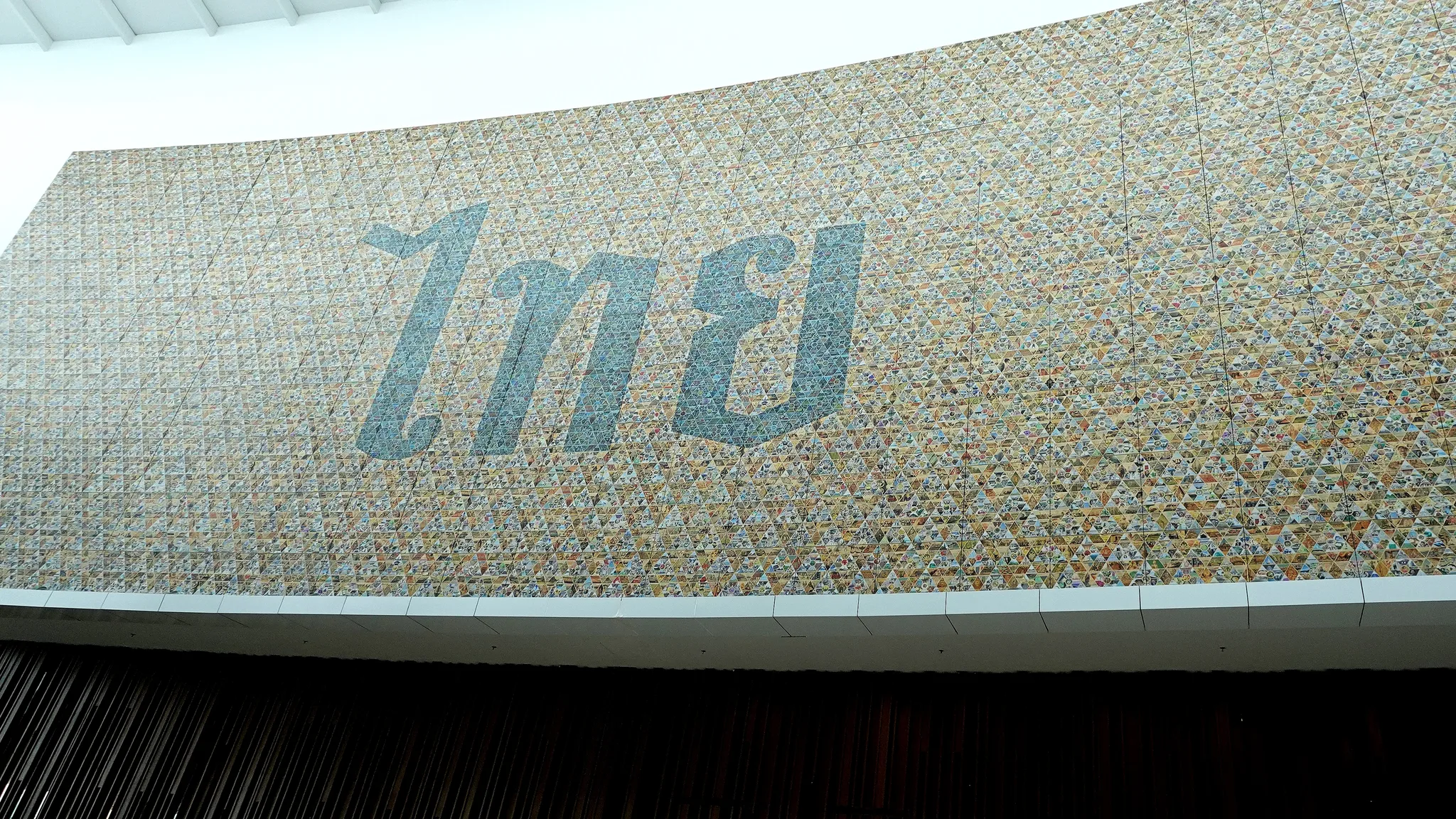
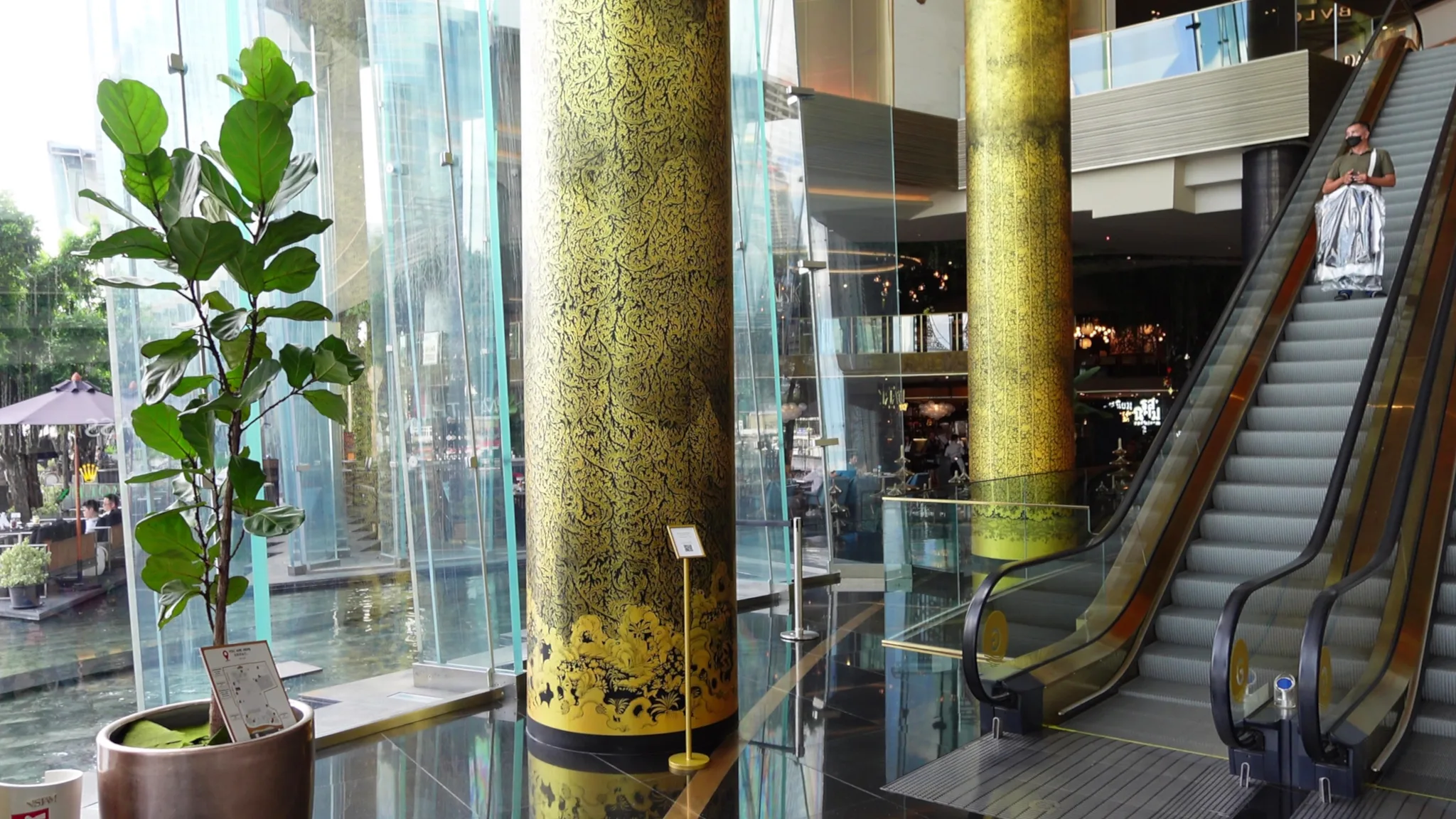
An art trail, the ‘Art Hunting Journey’, invites visitors to discover eight major works, from the ground floor to the seventh. They include four 16-metre golden pillars, Inscription of Suvarnabhumi, by National Artist Preecha Thaothong, which recount the country’s history from Ban Chiang onwards; sculptures with kanok motifs by the British studio Haberdashery; a chandelier in the form of a flower garland by Petra Junová for the Czech glassmaker Lasvit; jars and wall motifs from the Thai regions; the Golden Teardrop by Arin Rungjang, shown at the Venice Biennale in 2013; eight auspicious pillars adorned with gold leaf, by Thavorn Ko-udomvit; and The Light of Siam, a coloured-glass wall more than sixty metres long, by Sitthivut Yavichai. The trail ends on the seventh floor, in the Suralai Hall, with ICONSIAM The Makers (Power of United Thainess) by Prateep Suthathongthai, a giant collage of more than 35,000 images that reveals the many faces of Thailand.
More than a hundred artists, floors for creators
These eight works represent only part of the collection. From the opening, the complex called on more than a hundred artists, mostly Thai, from every region and every discipline, among them several National Artists; their works are scattered throughout the building. Today’s creators have their place too: on the fourth and fifth floors, ICONCRAFT brings together across 2,500 square metres the work of more than 800 craftspeople, designers and communities from across the country. Since 2024, the ICONSIAM Art & Culture programme, run with the Office of Contemporary Art and Culture of the Ministry of Culture, has extended this ambition through exhibitions spread across the complex, under the banner ‘The Best of Thailand meets The Best of the World’.
Terraces over the river
Two terraces offer sweeping views over the river and the eastern bank of Bangkok: the Tasana Nakorn Terrace, on the sixth floor, and the Napalai Terrace, on the seventh, which also hosts exhibitions. Inside, a fifteen-metre waterfall completes the staging.
SookSiam: the provinces on the ground floor
On the ground floor, a vast themed area of some 16,000 square metres, SookSiam, is devoted to the arts, culture and cuisine of Thailand’s 77 provinces. Visitors wander among stalls that evoke the country’s regional diversity, its culinary specialities and its crafts. A small indoor floating market, modelled on the markets where vendors sell their goods from boats, is one of its most visible features.2
This choice gives the complex a distinctive dimension. At the heart of a place devoted to international brands, the designers reserved a prominent place for a portrayal of the whole country, its regions and its practices. SookSiam thus makes Thai cultural heritage one of the attractions of the place, staging it for an audience of city dwellers and travellers.
A new hub on the west bank
A metro line to serve the bank
The complex’s effect on the city is seen first in transport. In July 2015, even before the opening, ICONSIAM’s owners proposed the creation of a public transport line to serve the site, which had not featured in Bangkok’s first transport master plan. This project became the Gold Line, an automated light metro whose first section entered service on 16 December 2020.15
Charoen Nakhon station, which belongs to the Bangkok Metropolitan Administration, directly adjoins the complex: its exits lead to the ICS building, to a footbridge and to the main building. That a private player should have initiated a metro line later incorporated into the public network speaks to the weight ICONSIAM has acquired in the organisation of this part of the city.14
The river as a means of access
The Chao Phraya River remains the complex’s other main gateway. Four piers have been built on the site, serving both private boats and public ferries.8
The complex has also made commitments beyond its own boundaries. ICONSIAM is working with the Urban Design and Development Center (UDDC) of Chulalongkorn University, the Marine Department and the Bangkok Metropolitan Administration to renovate several of the river’s piers, among them Sathorn, Ratchawong and Tha Dindaeng.
A transformed neighbourhood, a debated model
Within a few years, Khlong San and Charoen Nakhon went from being peaceful neighbourhoods to ‘golden zones’ for property. The developer reports land values tripling along Charoen Nakhon Road and a rise of more than 60% in riverside businesses. This transformation was not without tensions: as early as 2020, local residents were voicing concern about the construction work that accompanied this development.5
The complex sparked debate from the moment it opened. On 17 November 2018, the journalist Pravit Rojanaphruk published a critical opinion piece in Khaosod English entitled ‘Is Iconsiam an Icon of Prosperity or Disparity?’. In the world of commercial property, by contrast, recognition has been broad: the complex was named the world’s best shopping centre at the MAPIC Awards in 2019, then ranked in 2025, at the same event in Cannes, among the three most influential retail property projects of the past thirty years. Now in operation, enlarged by the ICS building and connected to the metro, ICONSIAM has established itself as one of the landmarks of the Thonburi bank.8
Understanding
ICONSIAM is not an ancient monument but a recent place that has already changed the face of Bangkok. Set on the Thonburi bank, opposite the historic centre, this private complex combines shops, homes and cultural spaces, and has turned long-quiet neighbourhoods into a hub of the capital, served by a metro line and by the river. Its importance also lies in the way it draws on culture: a trail of monumental works devoted to Thainess, more than a hundred artists and hundreds of the country’s craftspeople, the provinces staged at SookSiam, a façade that transposes the fold of the krathong. This blend makes it a witness to the way contemporary Thailand tells the story of its heritage. Its future lies between international recognition in the world of retail and the questions it raised, from its opening, about inequality and about the transformation of a neighbourhood whose residents have seen land values rise. Can a place designed for commerce become, in time, part of the heritage it now puts on display?
Art Hunting Journey: hunting for artworks at ICONSIAM
Launched in 2022, the Art Hunting Journey trail, “the hunt for artworks”, invites visitors to ICONSIAM to explore the complex as a public art space. From floor to floor, works by Thai artists, several of them National Artists, and by foreign creators tell the story of Thainess, Thai cultural identity, through sculpture, stained glass, ceramics, printmaking and photographic collage.
The trail is structured around eight stages. It begins, on the Chao Phraya side, with four gilded pillars sixteen metres high by Preecha Thaothong, National Artist, which trace the history of Suvarnabhumi from the Ban Chiang culture onwards. It ends on the seventh floor with a collage of more than 35,000 photographs gathered around the word “Thai”. Between these two works come a sculpture of kanok flames, a chandelier inspired by garlands of rak and jasmine flowers, Arin Rungjang’s Thong Yod sculpture, shown at the Venice Biennale, pillars engraved with imprints of leaves from auspicious trees, and a sixty-metre stained-glass wall whose colours shift with the daylight.
Beyond these eight stages, works by more than a hundred artists are found throughout the complex, even in the toilets, which are adorned with ceramic jars from Ratchaburi and murals devoted to the different regions of Thailand.
We wish you an enjoyable exploration of these original creations.
 Work no. 1Symbols of Suvarnabhumi embody the light of wisdomDiscover →
 Work no. 2Mae NamDiscover →
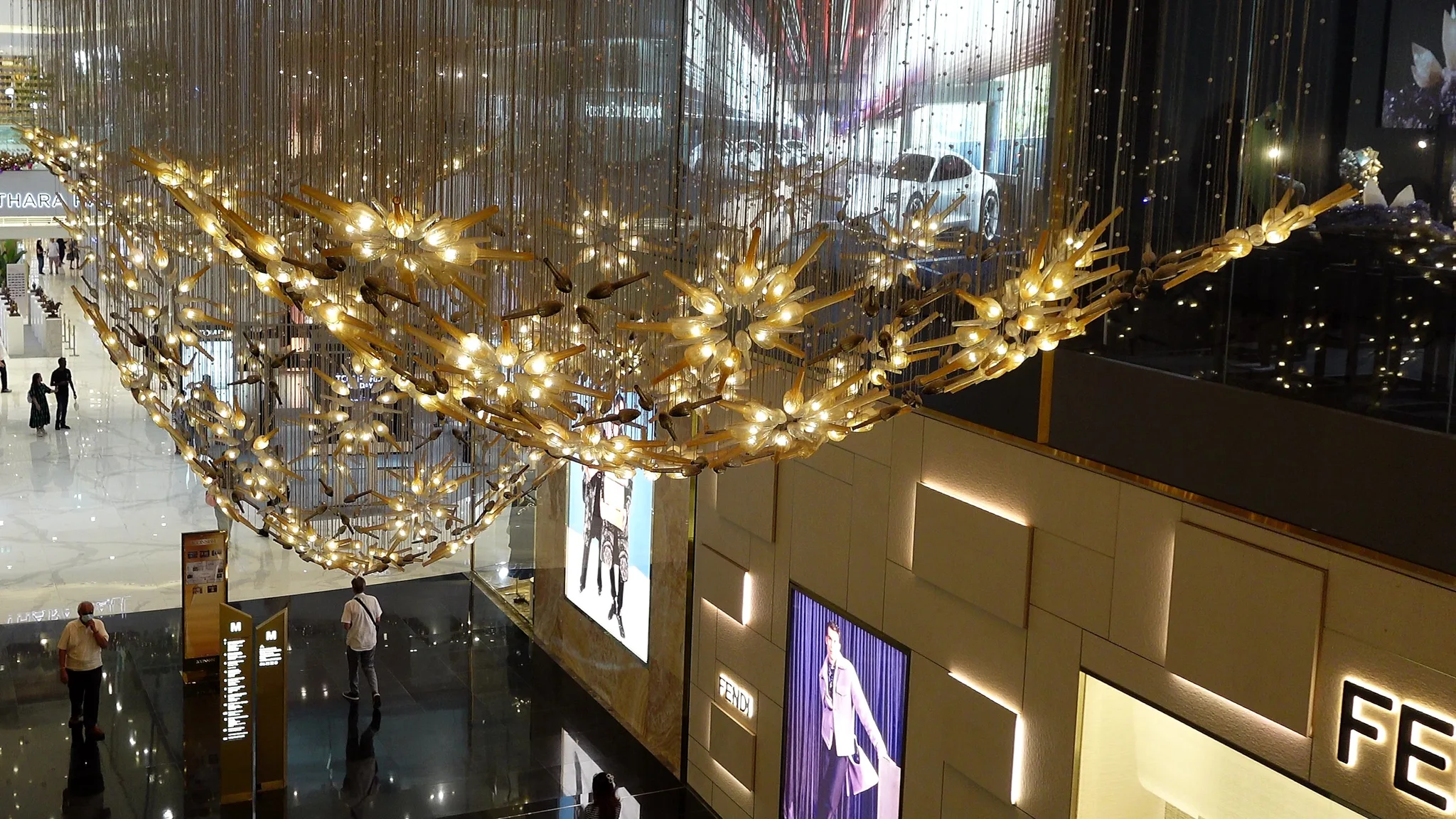 Work no. 3Phuang Malai: The Chandelier of Kindness and AffectionDiscover →
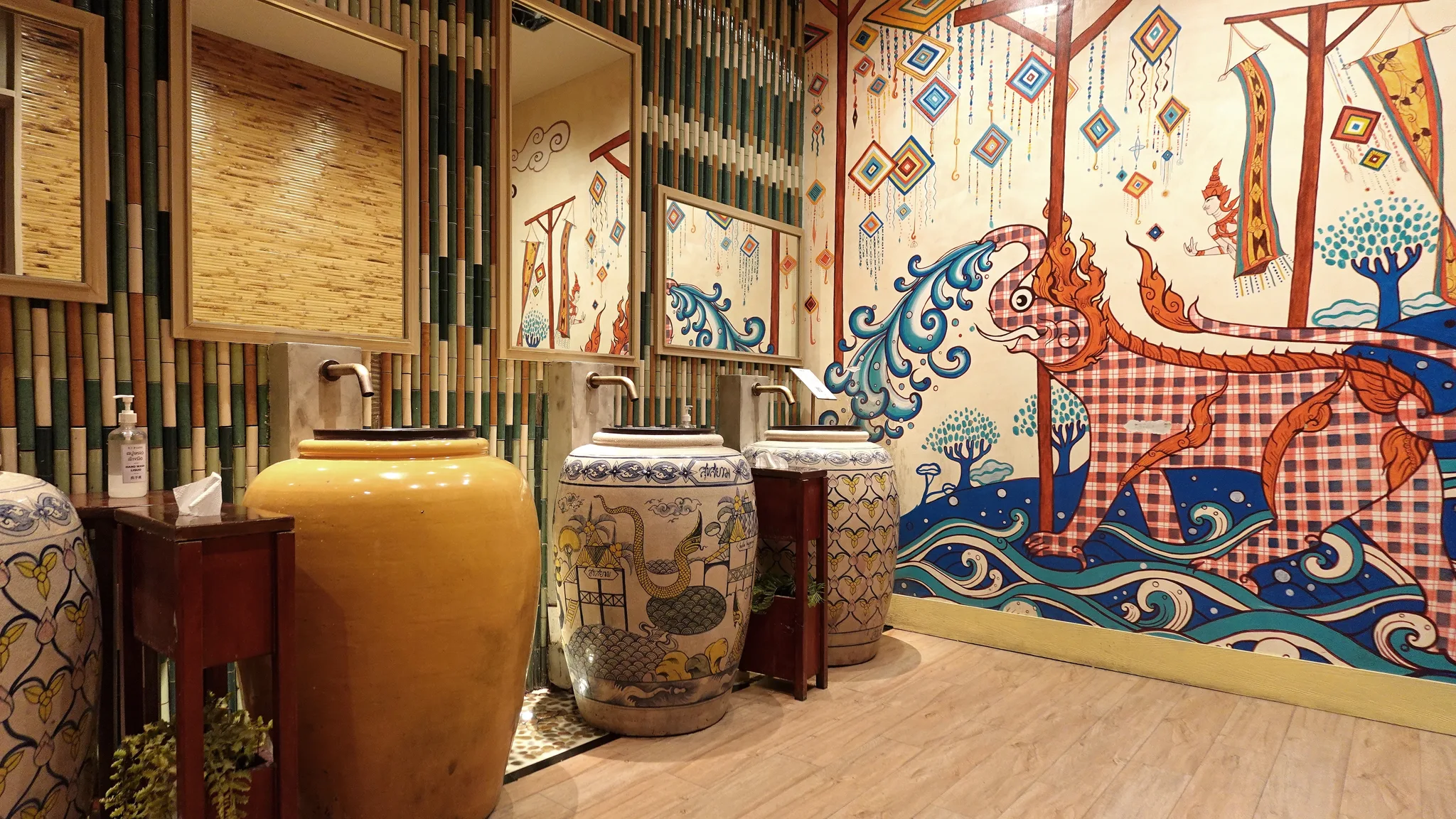 Work no. 4Jars and murals: a journey through the regions of ThailandDiscover →
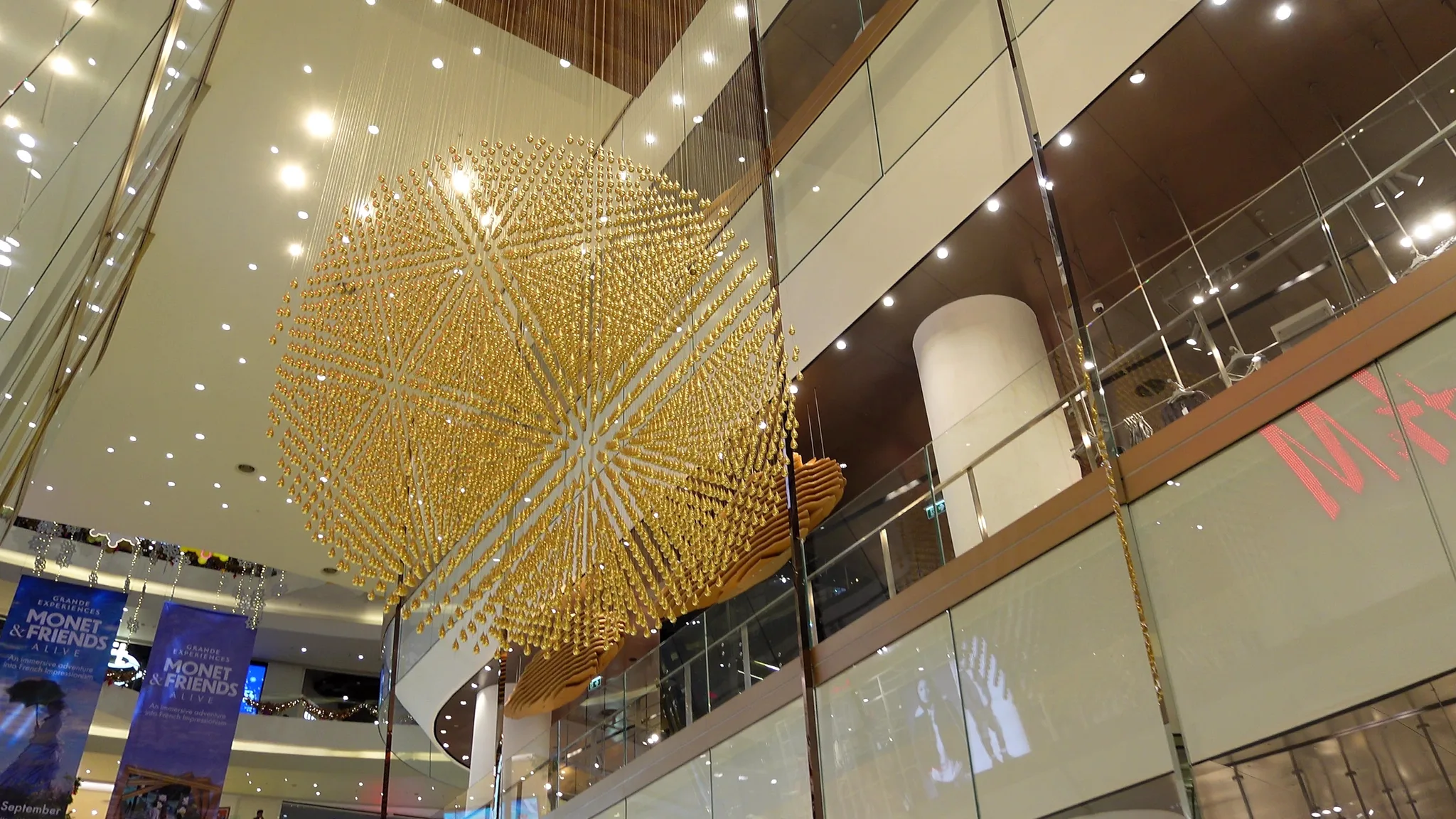 Work no. 5Thong Yot (Golden Teardrop)Discover →
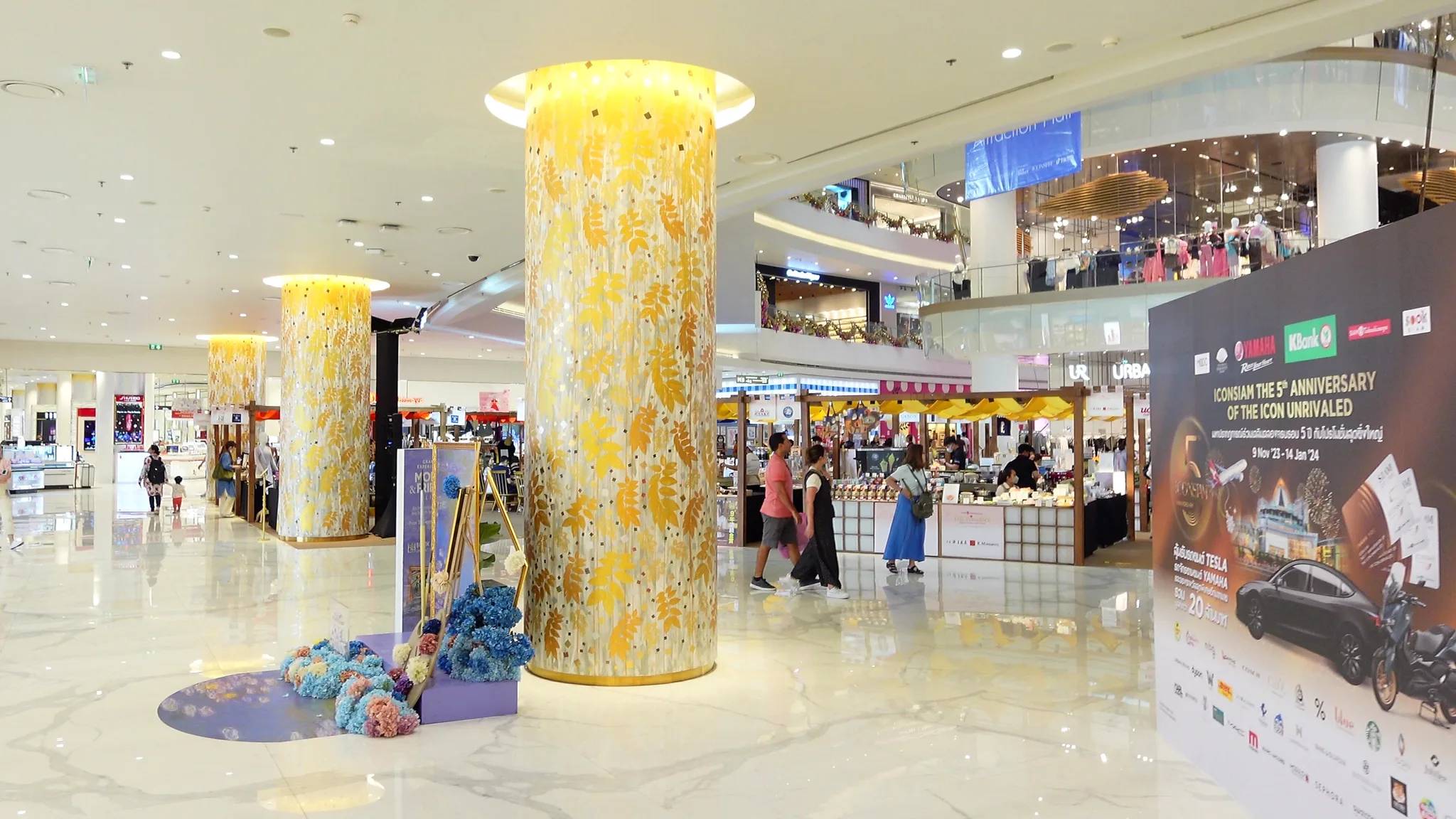 Work no. 6Pillars of ProsperityDiscover →
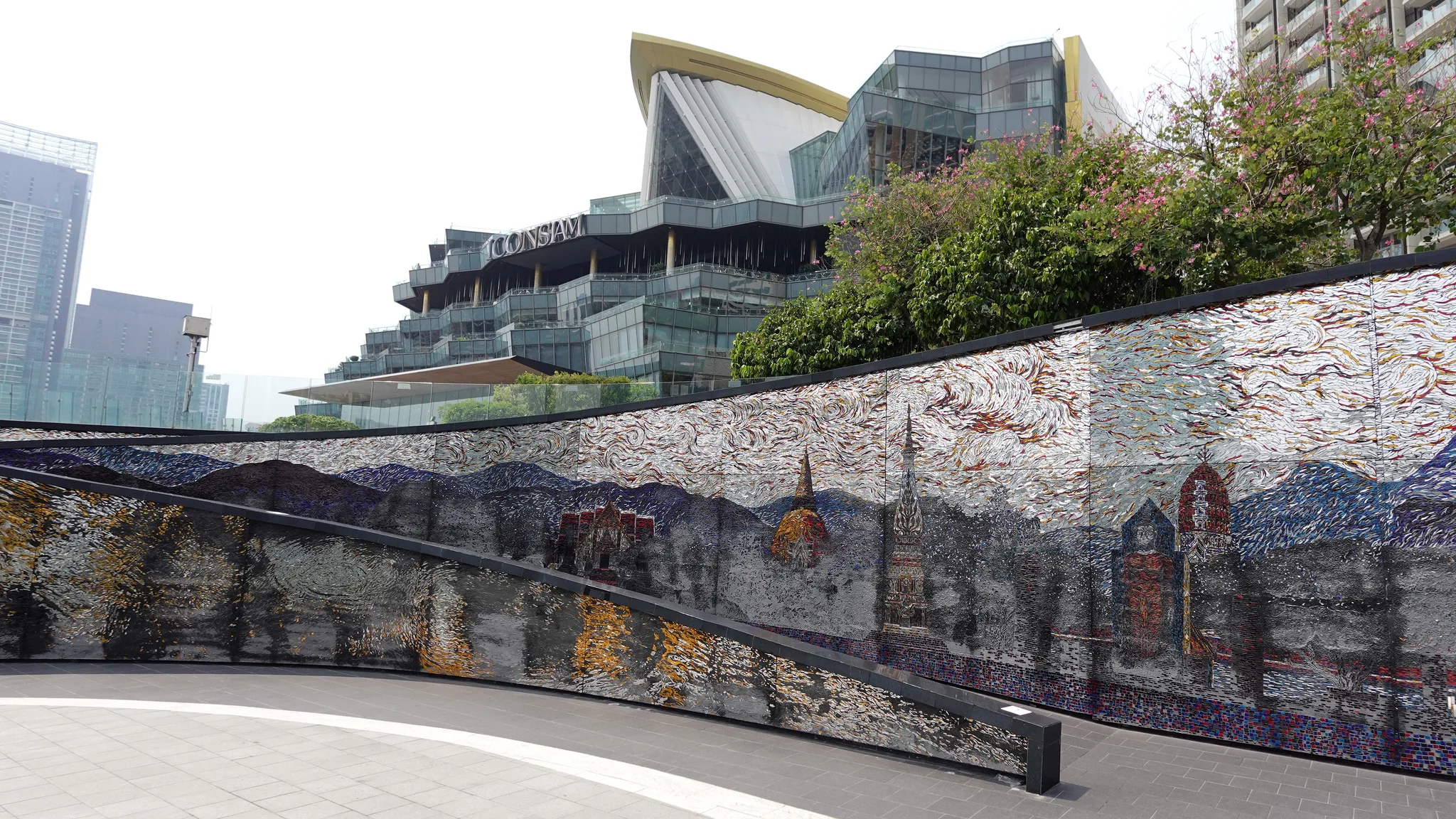 Work 7Light of SiamDiscover →
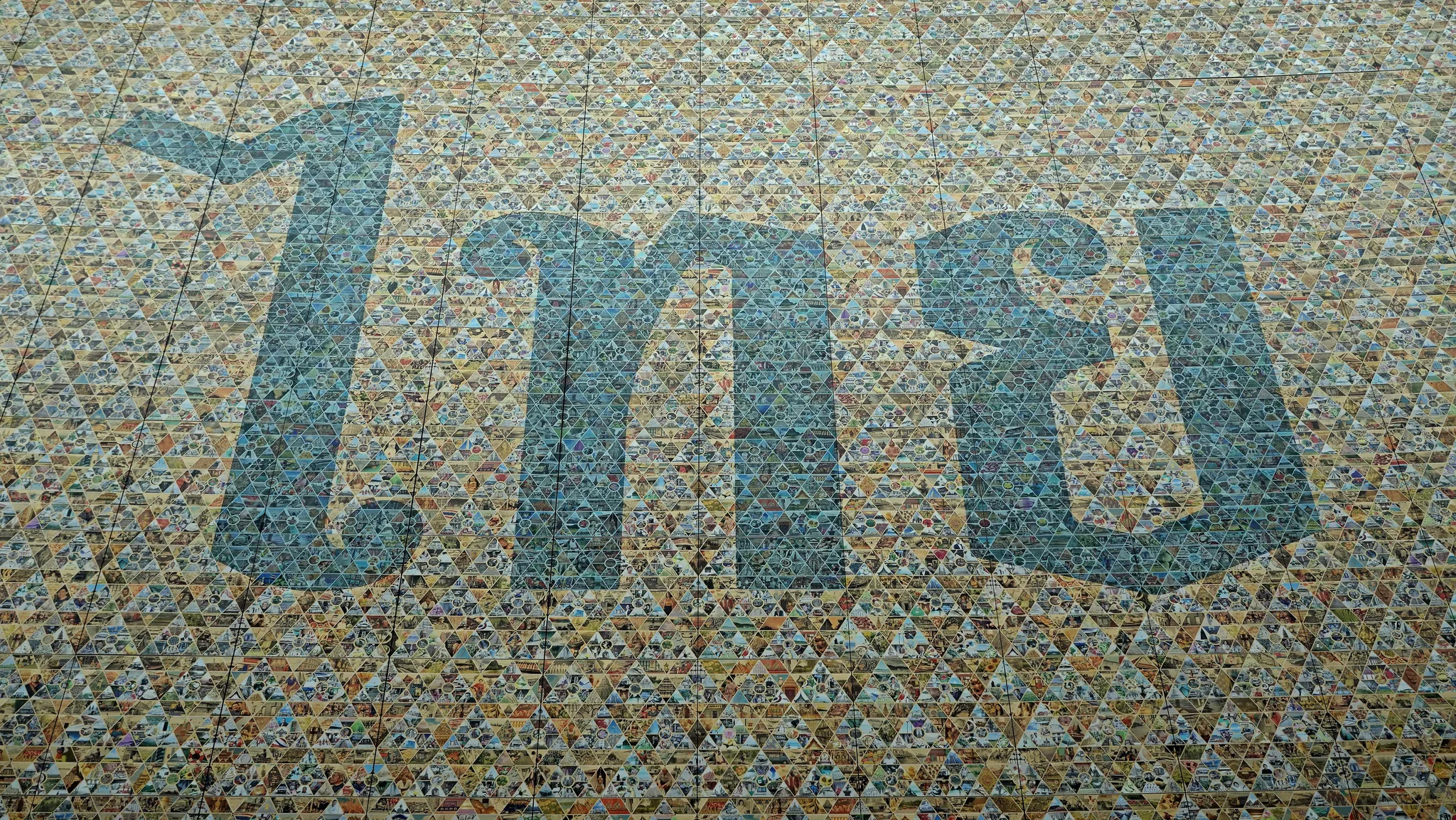 Work 8ICONSIAM “The Artisans” (The Strength of Thai Unity)Discover →
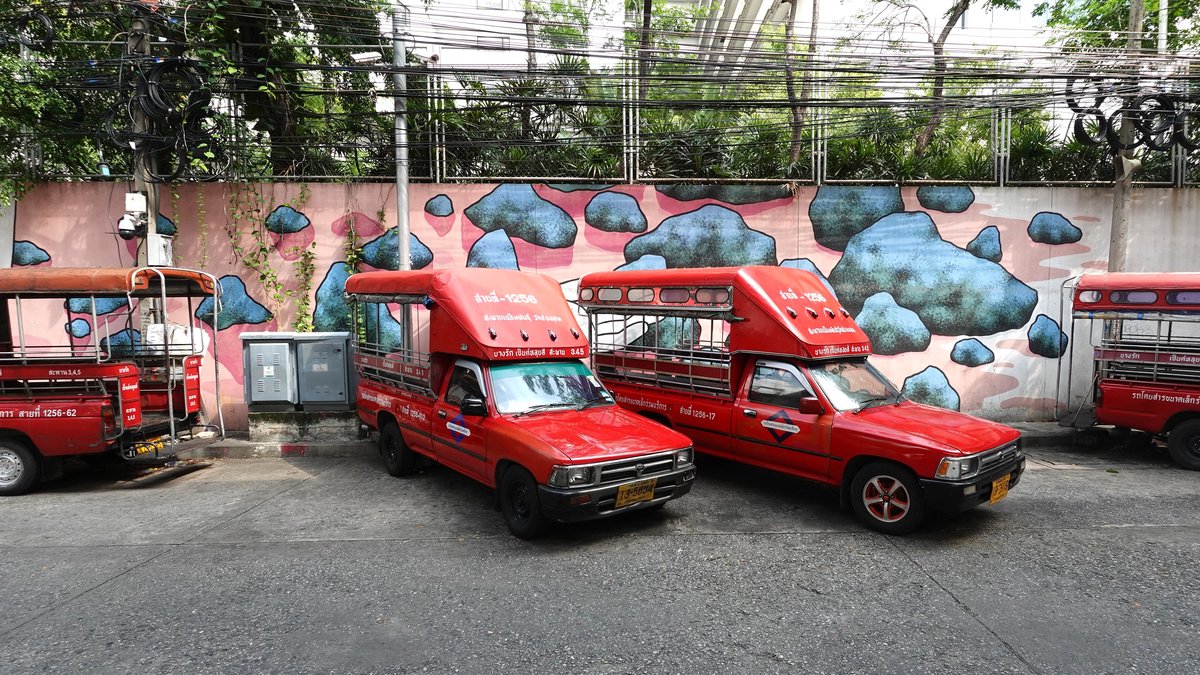
Through Bangkok's creative districts, between street art, architecture, design and new uses of the city.
- Khlong
- Canal or waterway, natural or man-made, which long played a major role in transport, irrigation and the organisation of settlements and territories in Thailand.
- San
- In Thailand, a small shrine where worship is offered to a deity, a spirit or a protective figure.
- Teochew
- Chinese dialect group originating from the Chaozhou area, in eastern Guangdong, southern China. It forms the largest component of the Chinese community in Thailand.
- Ancient monument
- In Thailand, a legal category (boran sathan) that places a building or site under State protection as heritage.
- Krathong
- A small floating offering traditionally made of folded banana leaves and decorated with flowers, candles and incense sticks, which is placed on the water, notably during the Loy Krathong festival.
Primary sources
- 1Contributeurs Wikidata, ICONSIAM (Q20585880), Wikidata ↗
Studies
- 2Inside Bangkok's newest mega attraction, Iconsiam, CNN Travel, 2018 ↗
- 3Major museum to anchor IconSiam development, Inside Retail Asia, 2016 ↗
- 4Siam Piwat's IconSiam earns high recognition at Mapic Awards 2025, Inside Retail Asia, 2025 ↗
- 5Monorail ushers in hope, Bangkok Post, 2020 ↗
- 6Check out this new museum floating on the Chao Phraya River, BK Magazine (Asia City), 2018 ↗
- 7New Bangkok Museum Dedicated for King Taksin at ICONSIAM, SEAArch – Southeast Asian Archaeology (d'après FTN News), 2020 ↗
Reference works
- 8Contributeurs Wikipédia, Iconsiam, Wikipedia (en) ↗
- 9Contributeurs Wikipédia, Iconsiam (miroir de l'article Wikipédia), Wikiwand ↗
- 10Siam Piwat, ICONSIAM Makes Global History! Ranked as One of the World's Top 3 Most Influential Retail Property Projects of the Past 30 Years at the MAPIC Awards 2025, Siam Piwat Co., Ltd., 2025 ↗
- 11seele, Largest Pleated Glass Front in the World: ICONSIAM in Bangkok, seele GmbH ↗
- 12seele, ICONSIAM by seele, Architizer, 2018 ↗
- 13ICONSIAM Mixed-Use Complex, FMG Fabbrica Marmi e Graniti (Iris Ceramica Group) ↗
- 14Contributeurs Wikipédia, Charoen Nakhon station, Wikipedia (en) ↗
- 15Contributeurs Wikipédia, Gold Line (Bangkok), Wikipedia (en) ↗
- 16Contributeurs Wikipédia, Khlong San district, Wikipedia (en) ↗
Contemporary views
ICONSIAM today
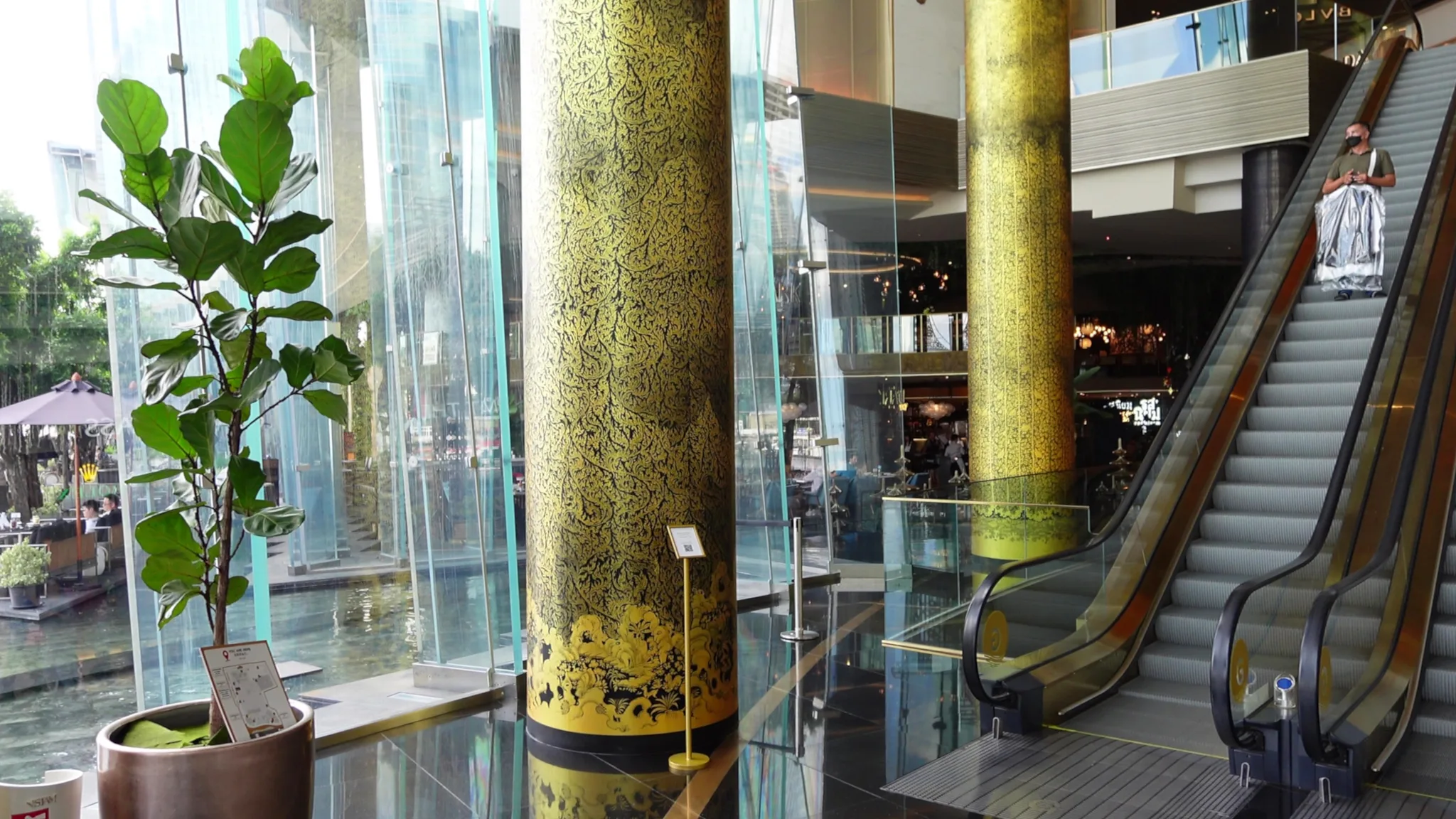
In the hall of ICONSIAM, tall columns clad in gilded scrollwork on a black ground frame the escalators; the glazed façade reveals a pool and an outdoor terrace, near an information panel set on a stand.© Eric Monteil 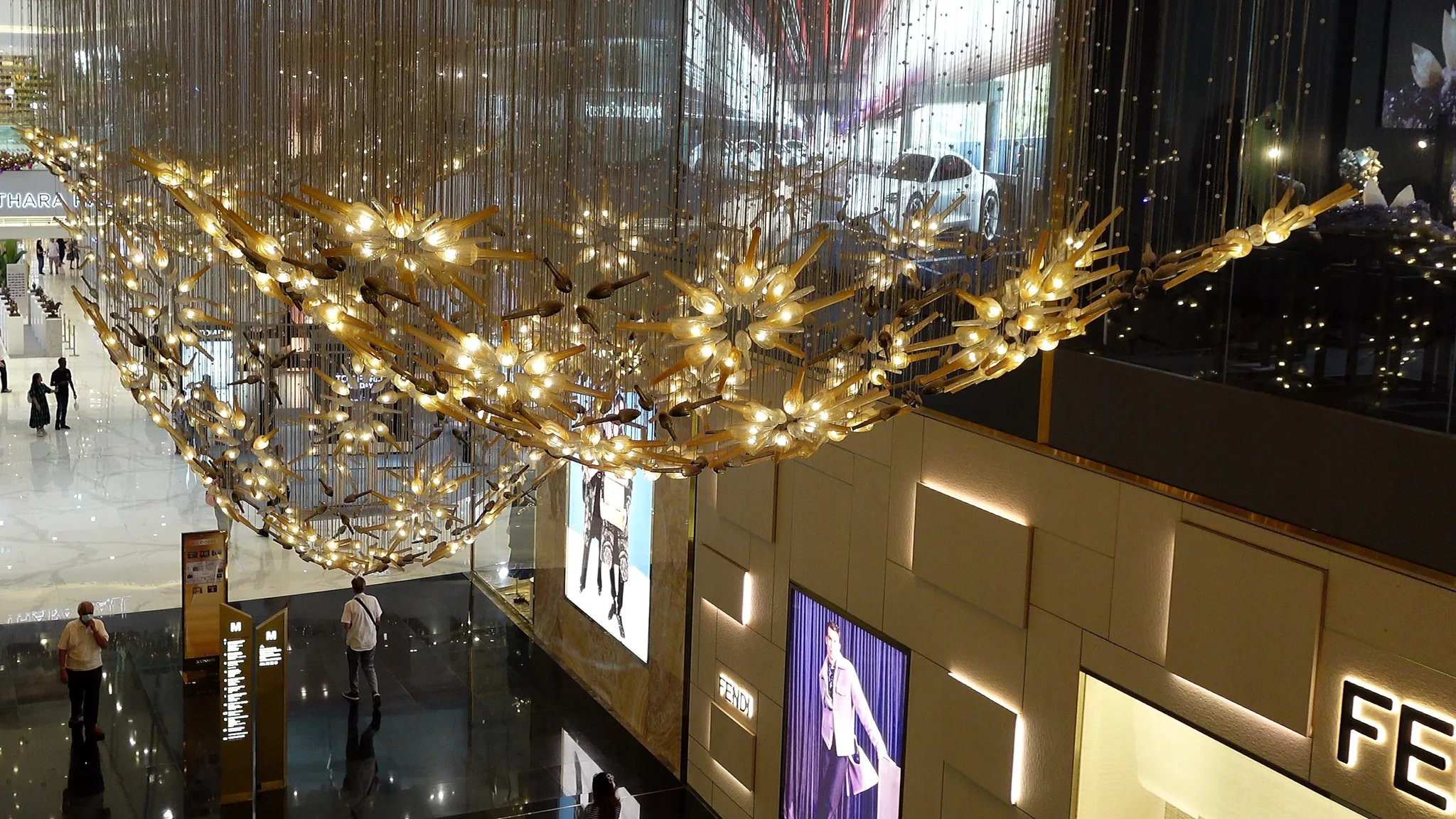
At ICONSIAM, a vast illuminated hanging installation of threaded curtains and gilded motifs stretches above an atrium; below, a few visitors walk between signage panels and lit shop façades.© Eric Monteil
Architecture and decoration
Explore the heritage
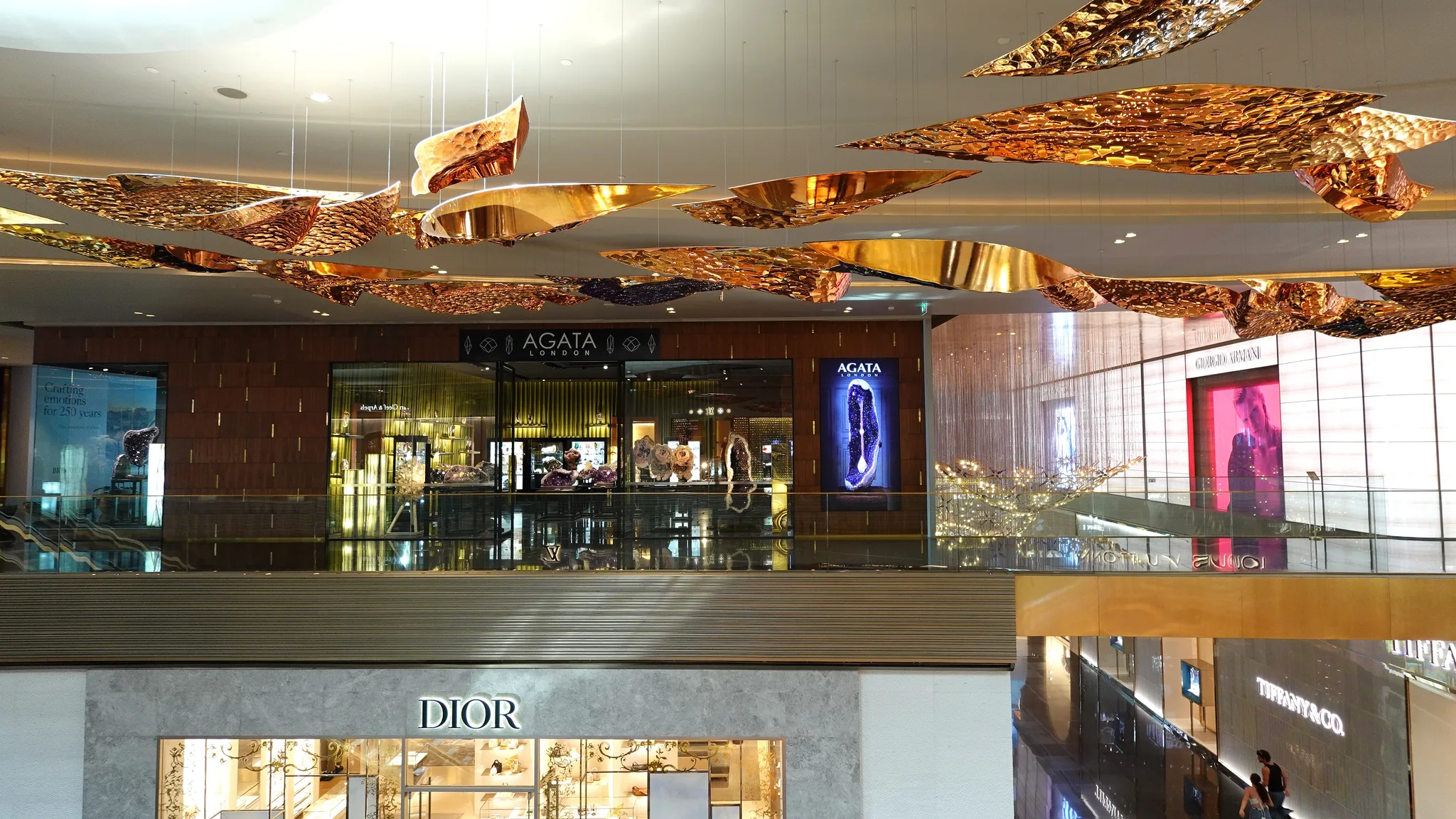
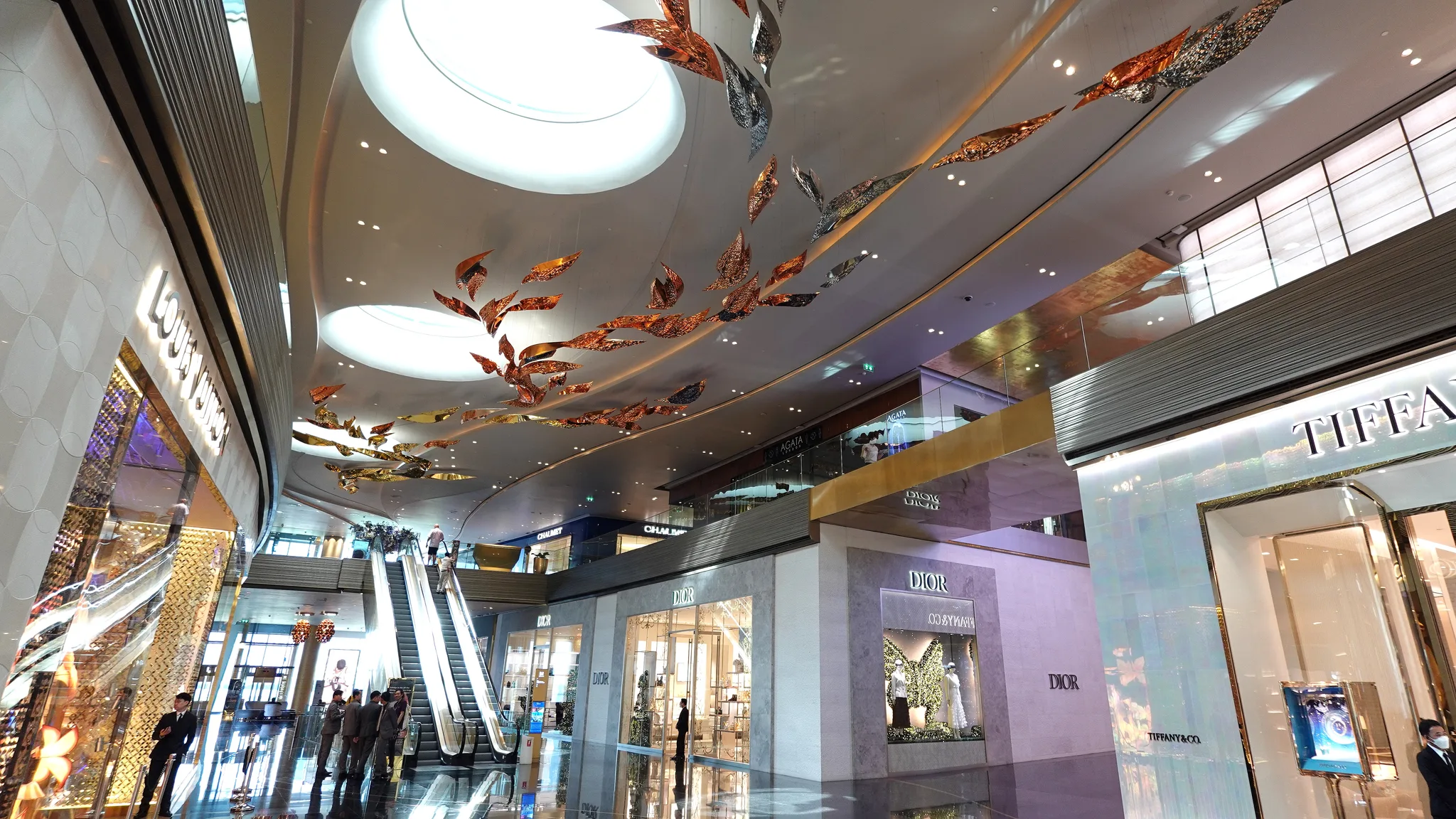
At ICONSIAM, an installation of hammered golden metallic forms suspended from the ceiling dominates an atrium lined with glass-balustraded galleries housing a succession of luxury boutiques.© Eric Monteil 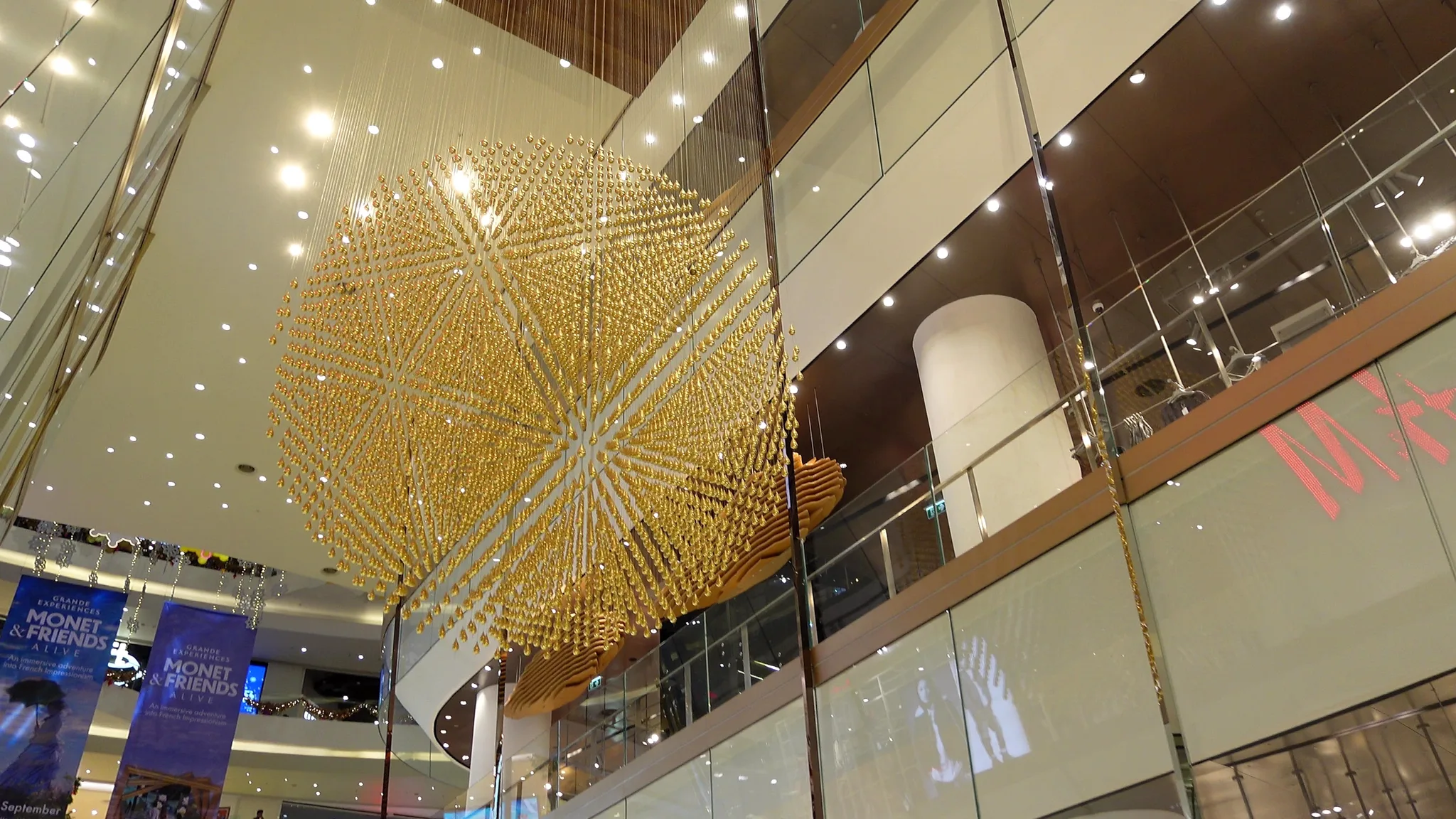
In the atrium of ICONSIAM, a monumental sphere made of hundreds of golden beads hung on fine wires fills the central void, framed by galleries with glass balustrades, wood-panelled walls and exhibition banners.© Eric Monteil