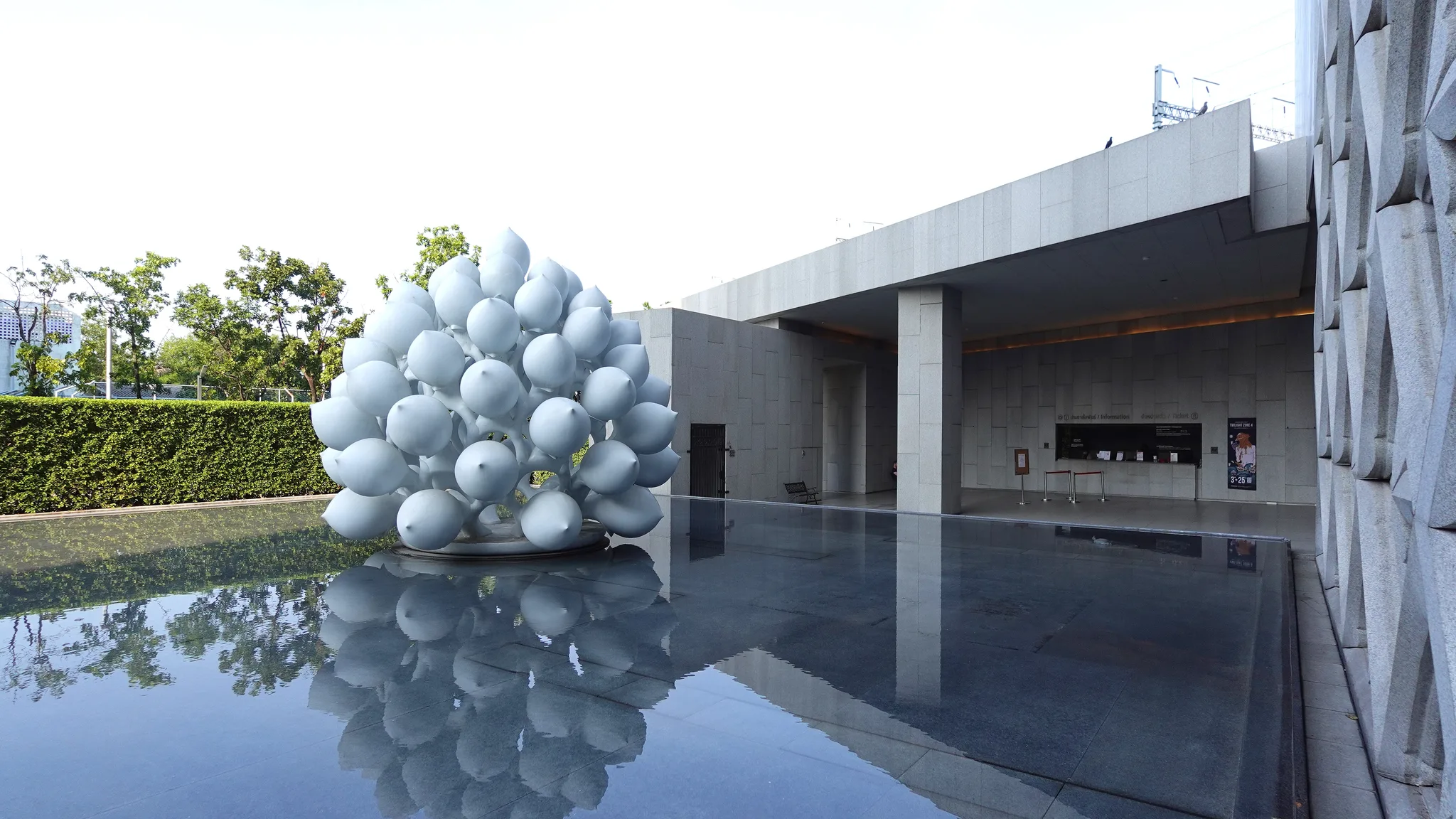
 Devant l’entrée du MOCA Bangkok, une sculpture faite de sphères claires se reflète dans un bassin miroir bordé de haies, face au portique couvert et aux façades revêtues de pierre grise.© Eric Monteil
Museum
MOCA Bangkok
Opened in 2012 by the collector Boonchai Bencharongkul, MOCA Bangkok (Museum of Contemporary Art of Bangkok) tells the story of modern and contemporary Thai art floor by floor, and today opens its doors to artists from the current scene.
Heritage family · Arts, aesthetics and creation
- Destination
- Bangkok (Chatuchak)
- Heritage Family
- Arts, aesthetics and creation
- Typology
- Museum
- Visit
- Available tours →
MOCA Bangkok (Museum of Contemporary Art of Bangkok) is a private museum devoted to modern and contemporary Thai art, opened in 2012 in the north of the capital. It presents a major collection of Thai art, assembled over several decades by a single man, the businessman Boonchai Bencharongkul, who intended it as an introduction to Thai artistic creation. Founded to honour King Bhumibol Adulyadej and the master Silpa Bhirasri, the museum makes Thai identity the thread of its narrative. Its route climbs from floor to floor, from the pioneering sculptors to the great canvases of Thawan Duchanee, in a vast granite building carved with a jasmine motif.
Key facts
- Destination
- Bangkok
- Heritage Family
- Arts, aesthetics and creation
- Typology
- Museum
- Places
- —
- Periods
- —
- People
- Bhumibol Adulyadej
- Boonchai Bencharongkul
- Silpa Bhirasri
- Thawan Duchanee
- Communities
- —
- Events
- Opening (2012)
- Heritage
- —
- Glossary
- Khit
- Panya
- National Artist
- Keywords
- —
- Date
- —
- Collections
- —
Practical info
Practical information about this site is taken from its Google Maps page. We advise you to check it before visiting.
- Address
- 499 Kamphaeng Phet 6 Rd, Khwaeng Lat Yao, Khet Chatuchak, Krung Thep Maha Nakhon 10900
- Phone
- Website
From a private collection to a museum
A businessman trained in painting
Before it was a museum, the place was a collection, and that collection belonged to a single man. Boonchai Bencharongkul made his fortune in telecommunications: he founded the operator Dtac before selling it. In the 1970s he studied both painting and management in Illinois, in the United States.1
The starting point is well known. In 1980 he bought his first painting directly from the artist, Panya Vijitthanasarn. It is an abstract work, a red triangle presented as a Buddhist allegory. The canvas never left the collection: more than thirty years after its acquisition, it was among the works on display in the newly opened museum.1
Buying without ever selling
Boonchai Bencharongkul is described as a collector who buys and never sells. This principle gives the collection its shape: it has grown acquisition by acquisition, without being reshaped by sales, and it preserves the trace of his successive choices. This assembling spanned two decades before the museum opened. More than four hundred works were on display at the opening, and the collection numbers more than eight hundred works.1
The opening of April 2012
MOCA Bangkok (Museum of Contemporary Art of Bangkok) opened its doors to the public on 18 April 2012. Its Thai name, พิพิธภัณฑ์ศิลปะไทยร่วมสมัย, means “museum of contemporary Thai art”. The founder assigned it a precise role: to be an “introduction to contemporary Thai art”. Accounts differ on the span the route covers: an overview of the last sixty years of Thai art according to the founder in 2012, nearly a century of Thai art ten years later. The holdings themselves, as we shall see, extend beyond the strict limits of the contemporary. From the opening, the museum was heralded as one of Bangkok’s future major art venues, and its collection was hailed as an important body of contemporary Thai art.1
A granite building in the north of Bangkok
A building constructed for the collection
The museum occupies a building constructed for it in the north of Bangkok. It stands on Vibhavadi-Rangsit Road, close to Bang Khen station on the Red Line and not far from Don Mueang Airport. The building covers a floor area of around 20,000 m². Accounts differ: it has six storeys, or five exhibition levels, which visitors move through floor by floor. Seen from outside, the building resembles an enormous block of granite set on the ground.4
Granite, jasmine and lotus
The façade gives the building its character. Its granite is hand-carved with a jasmine motif, presented as a mark of Thai identity. The motif is not merely ornamental: its openwork lets in natural light, which enters the building and changes the atmosphere with the seasons.5
In front of the entrance stands a sculpture entitled “Piti Suk” (ปิติสุข), in the shape of a lotus bud, which the museum has adopted as its symbol. Placed on the threshold, it is the first work visitors encounter, even before they step through the door. Together with the façade, it forms an entrance where architecture and sculpture jointly affirm the Thai identity that the route inside sets out to recount.6
A journey through Thai art, floor by floor
The threshold of Silpa Bhirasri
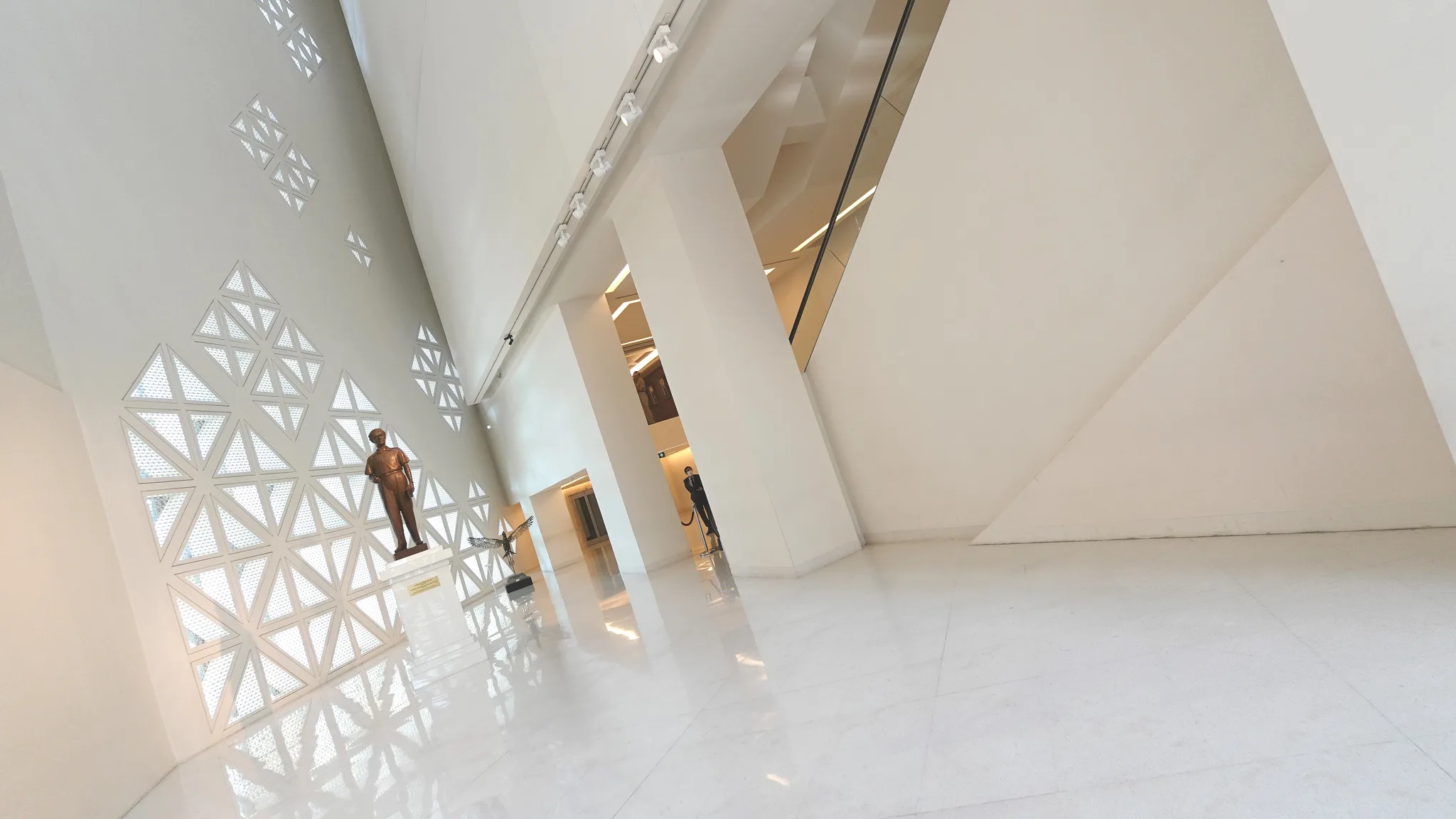
The visit begins in the ground-floor hall, before a statue of Silpa Bhirasri, regarded as the father of contemporary Thai art. This choice places the entire route under the sign of a lineage: before seeing the works, visitors pay their respects to the master whom modern Thai art claims as its own. The route then progresses floor by floor, up to the fifth level.6
Sculptors and masters of the ground floor
The ground floor is devoted to two figures, each with a room of their own. The first brings together the sculptures of Paitun Muangsomboon, honoured as National Artist in the field of sculpture. The second presents the paintings and sculptures of Professor Chalood Nimsamer.5
From Buddhism to the imagination
The upper floors broaden the scope. The second is devoted to contemporary art, and Chalermchai Kositpipat holds an important place there. Named National Artist in 2011, he is known for his works on Buddhist themes. The third floor explores the imaginary and the fantastic in contemporary Thai art. The fourth is dominated by a single figure, discussed further below. On the fifth and final level, Thai works are shown alongside works by artists from many countries.2
The works that make the museum
The Thawan Duchanee floor
One artist dominates the collection: Thawan Duchanee, also honoured as National Artist. From the opening, more than a hundred of his works were on display in several areas of the museum, and he occupies most of the fourth floor. The highlight of this floor is a set of three very large paintings entitled “The Three Kingdoms – Heaven, Earth, and Hell”, the three realms of heaven, earth and hell. Through their scale and their subject, these canvases form the centre of the floor.5
Masks, puppets and the limits of the contemporary
The collection is not limited to contemporary painting and sculpture. The museum also holds traditional masks, shadow puppets and string puppets, together with their accessories. These objects come from Thailand and other Asian countries. Their presence makes the “contemporary” label in the museum’s name partly inaccurate.2
A patron’s project
Honouring a king and a master
The main reason for founding the museum was to honour two figures: King Bhumibol Adulyadej and Silpa Bhirasri. This dual dedication sheds light on the statue in the entrance hall, which is not simply one tribute among others but one of the two foundations of the project. To associate the sovereign with the master of modern art is to inscribe a private collection within a national history, that of a Thai art which acknowledges a founding figure and pays tribute to the king.5
Lorenzo de’ Medici as a model
Boonchai Bencharongkul says he wishes to follow the example of Lorenzo de’ Medici as a patron. He goes so far as to compare his museum to the Uffizi Gallery in Florence, while acknowledging that it is not its equal. The reference reveals how he sees himself: as a patron rather than an investor, as confirmed by his principle of never selling. A generous collector of long standing, he makes the museum the public culmination of a private practice.1
The museum today
The second generation
In 2022 the museum celebrated its tenth anniversary. It was then directed by Kanachai Bencharongkul, nicknamed “Khit”, the founder’s son, while Boonchai Bencharongkul remained an influential figure for the institution. The permanent collection remains the heart of the place, with its floor-by-floor route, and it is accompanied by a programme of temporary exhibitions.2
Regular temporary exhibitions
Temporary exhibitions follow one another at a regular pace, and are often monographic. From July to October 2024, “Misfit” traced the career of the textile artist Ploenchan Vinyaratn, known as “Mook”. In November 2024, “NONENTITY 2nd” presented works made by Chatchawan Rodklongtan between 2018 and 2024, marked by Buddhist philosophy. The museum also hosts outside galleries: from September to October 2024, the Tang Contemporary Art gallery presented “No Heart Here”, a solo exhibition by the artist Gongkan. These programmes bring artists from the current scene into the building, alongside the masters of the permanent collection, and give the museum a role as an exhibition venue as much as a place of conservation.7
The Four Seasons Art Space
Some of the exhibitions are held at a second venue, the Four Seasons Art Space. From October 2024 to January 2025, “Untamed Melody Part I”, curated by Rirkrit Tiravanija, presented the work of the artist Thaiwijit there; a second part, “Untamed Melody Part 2”, was shown from 7 December 2024 to 25 January 2025. On 20 September 2025, the museum presented, with the Four Seasons Hotel Bangkok at Chao Phraya River and Archives Design, the exhibition “Unveiling Leather: Modularity”. From December 2025 to March 2026, “THAIPOGRAPHY” brings together fifteen artists around Thai identity through letters and language. This latest project returns to the question that runs through the whole museum from its jasmine façade onwards: what it means to be Thai in art, posed this time through letters and language.8
Understanding
MOCA Bangkok (Museum of Contemporary Art of Bangkok) was born of the taste of a collector who bought without selling and who wished to offer the public an introduction to Thai art. Its strength lies in this personal coherence: a route placed under the authority of Silpa Bhirasri and dedicated to the king, floors entrusted to the great recognised masters, an architecture that proclaims Thai identity down to its very stone. It is a history of Thai art told through one gaze, that of a patron who takes Lorenzo de’ Medici as his model. At ten years old, the museum is directed by the founder’s son and also lives through its temporary exhibitions, its hosting of outside galleries and the Four Seasons Art Space, where artists in turn question Thai identity. The place is thus moving from a pantheon fixed by a collector to a stage open to art in the making. Should it remain the testimony of a personal vision of Thai art, or become the place where this narrative is rewritten with each generation?
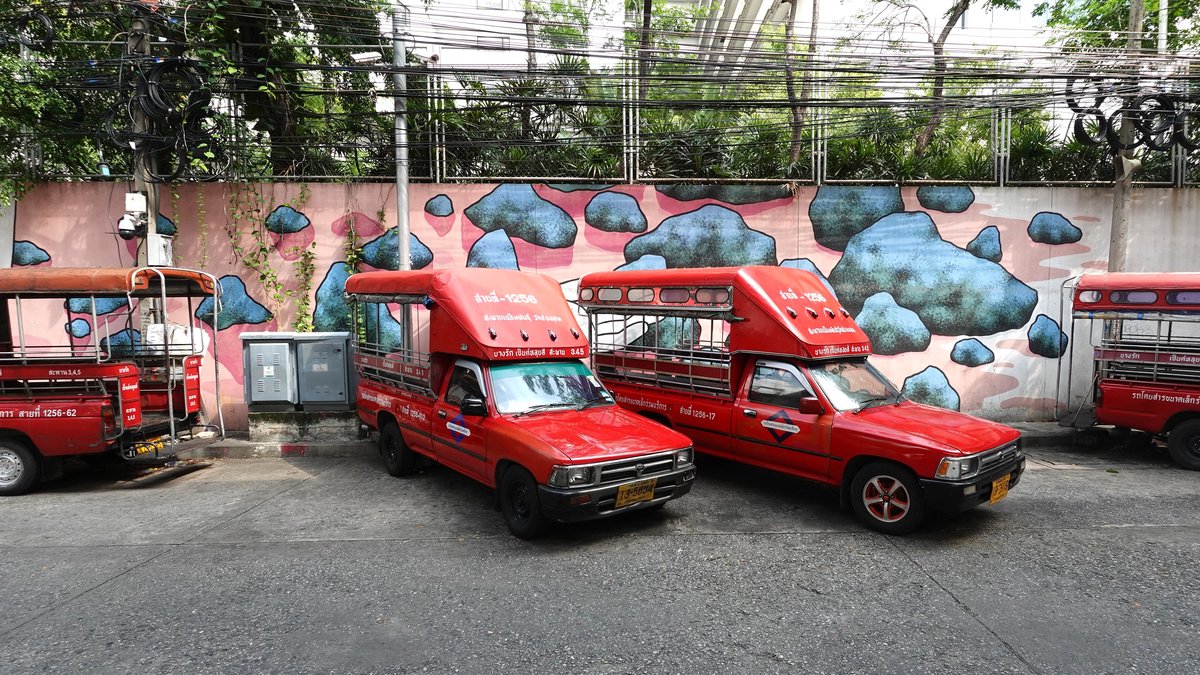
Through Bangkok's creative districts, between street art, architecture, design and new uses of the city.
- Khit
- Traditional Thai decorative patterns, used in particular in bamboo basketry.
- Panya
- Thai term for a hipped roof with four sloping sides that meet at ridges.
- National Artist
- Honorary title conferred by the Thai state since 1985 on leading creators in fields such as the visual arts, the performing arts or literature, in recognition of their body of work.
Studies
Reference works
- 4Museum of Contemporary Art opened in Bangkok, Asia-Europe Foundation (ASEF) – culture360, 2012 ↗
- 5Museum of Contemporary Art, Museum Thailand ↗
- 6พิพิธภัณฑ์ศิลปะไทยร่วมสมัยกรุงเทพมหานคร (MOCA), DASTA – CBT Thailand ↗
- 7Collections & exhibitions, MOCA BANGKOK ↗
- 8Temporary Exhibition (Four Seasons Art Space) / Temporary exhibition, MOCA BANGKOK ↗
- 9No Heart Here: Gongkan solo exhibition at MOCA BANGKOK, Artsy / Tang Contemporary Art, 2024 ↗
Contemporary views
MOCA Bangkok today
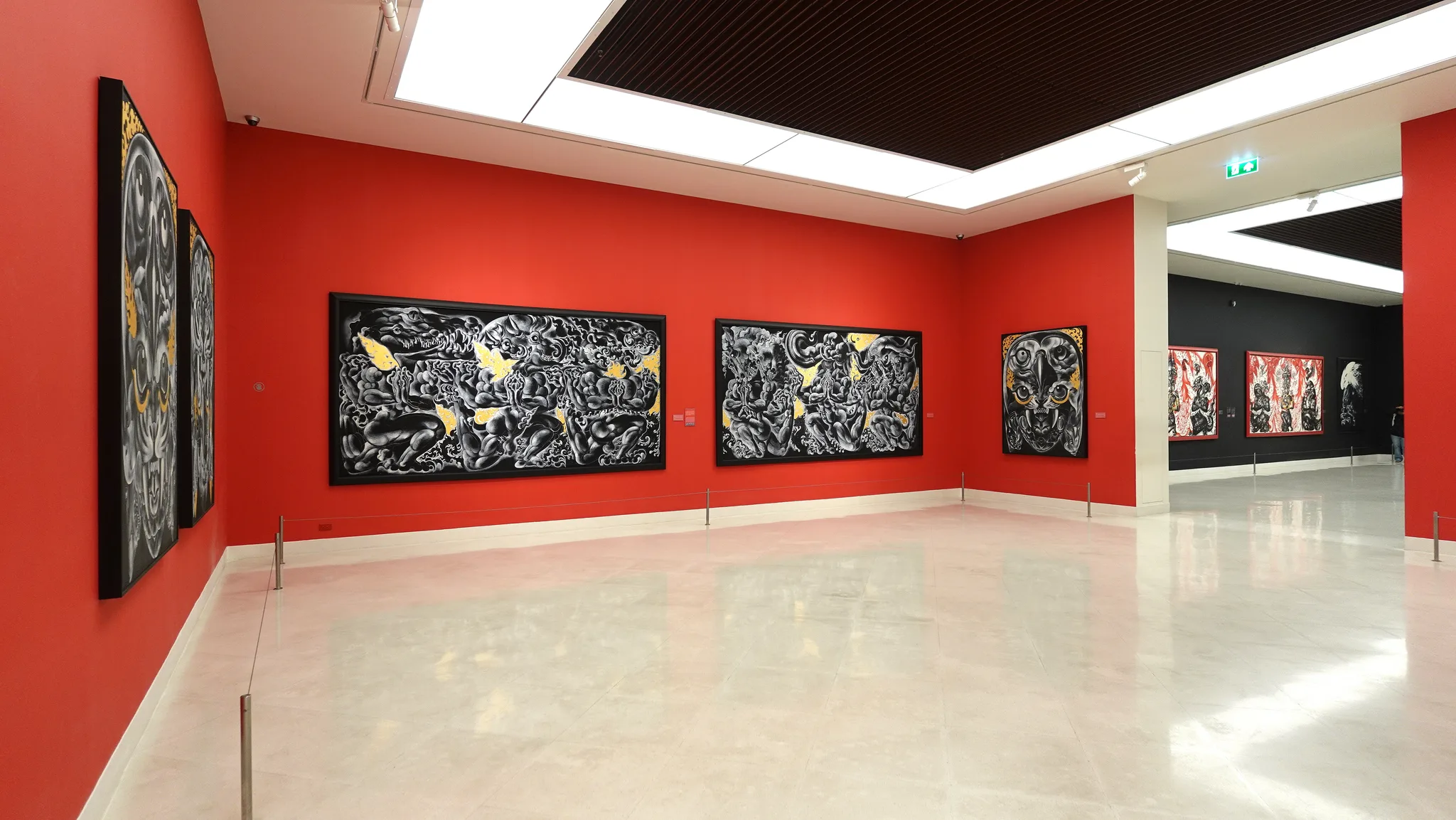
Au MOCA Bangkok, une salle aux murs rouges présente de grandes toiles en noir, blanc et or peuplées de figures tourmentées, tenues à distance par un cordon, sous un éclairage zénithal.© Eric Monteil 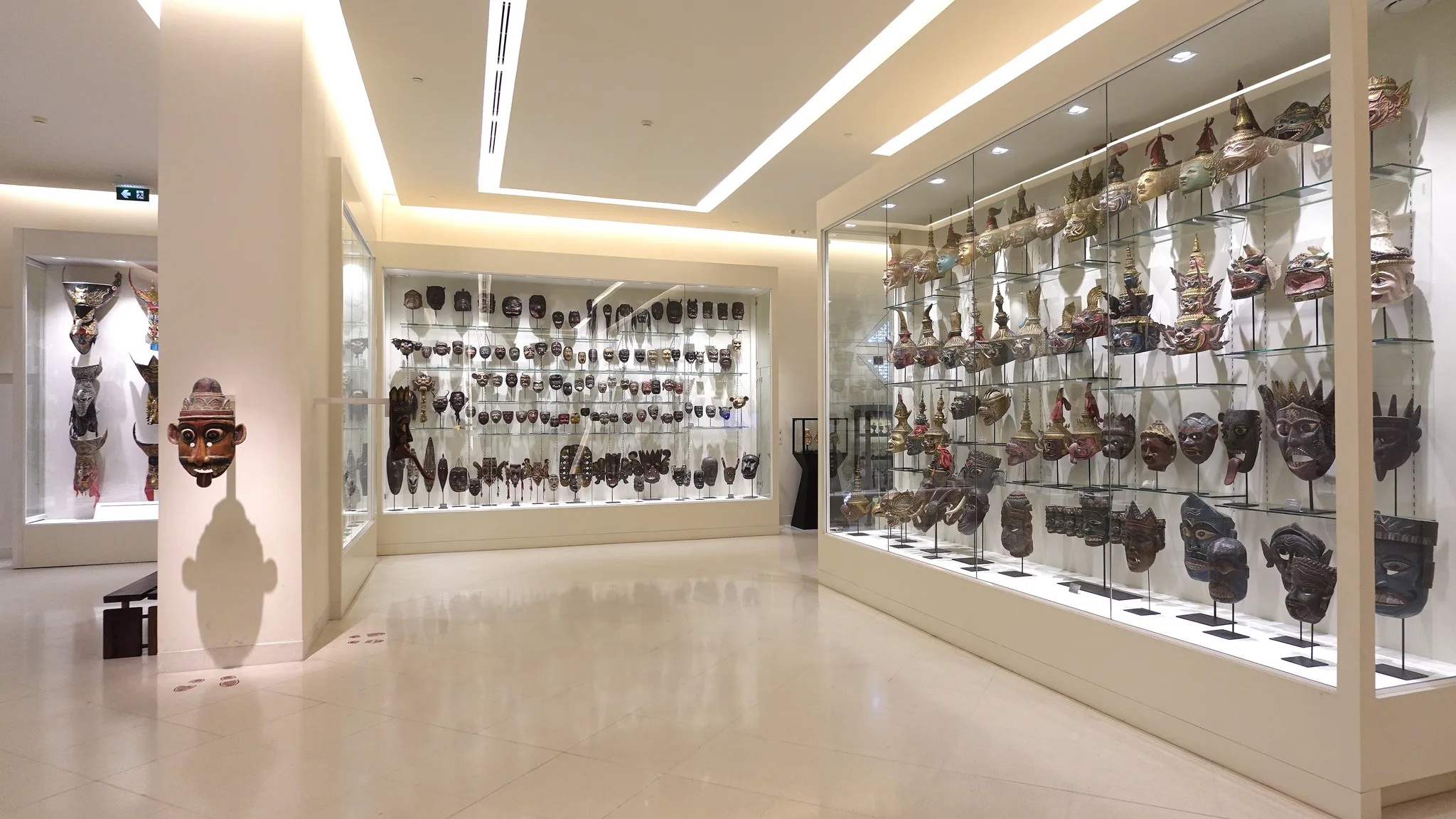
Au MOCA Bangkok, une salle aux murs clairs réunit dans de grandes vitrines vitrées une collection de masques, dont des coiffes dorées à pointe, des visages peints et des masques sculptés en bois.© Eric Monteil
Architecture and decoration
Explore the heritage
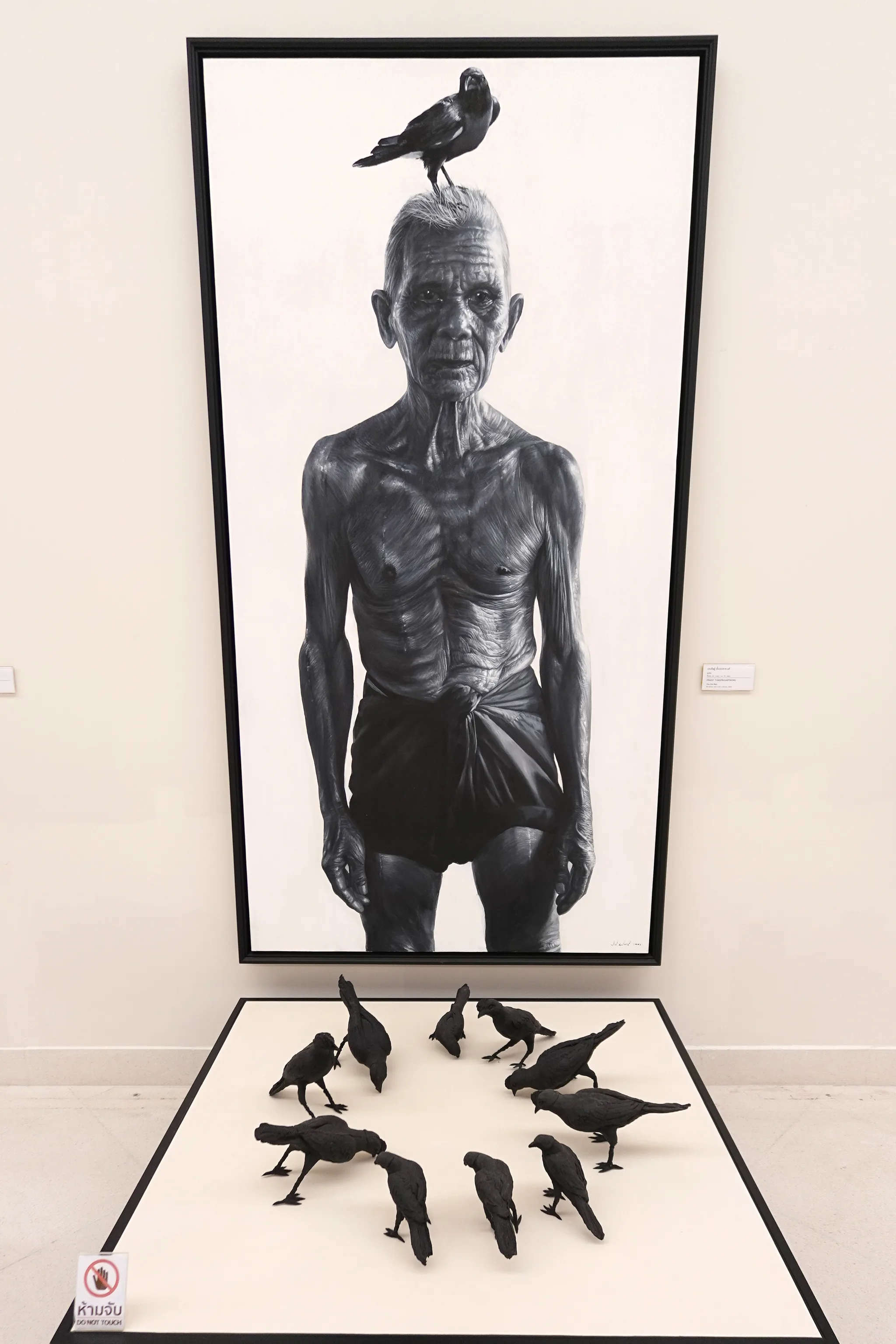
Au MOCA Bangkok, un grand tableau hyperréaliste en noir et blanc représente un vieil homme en pagne, un corbeau posé sur la tête ; devant lui, sur un socle, des corbeaux sculptés noirs forment un cercle.© Eric Monteil 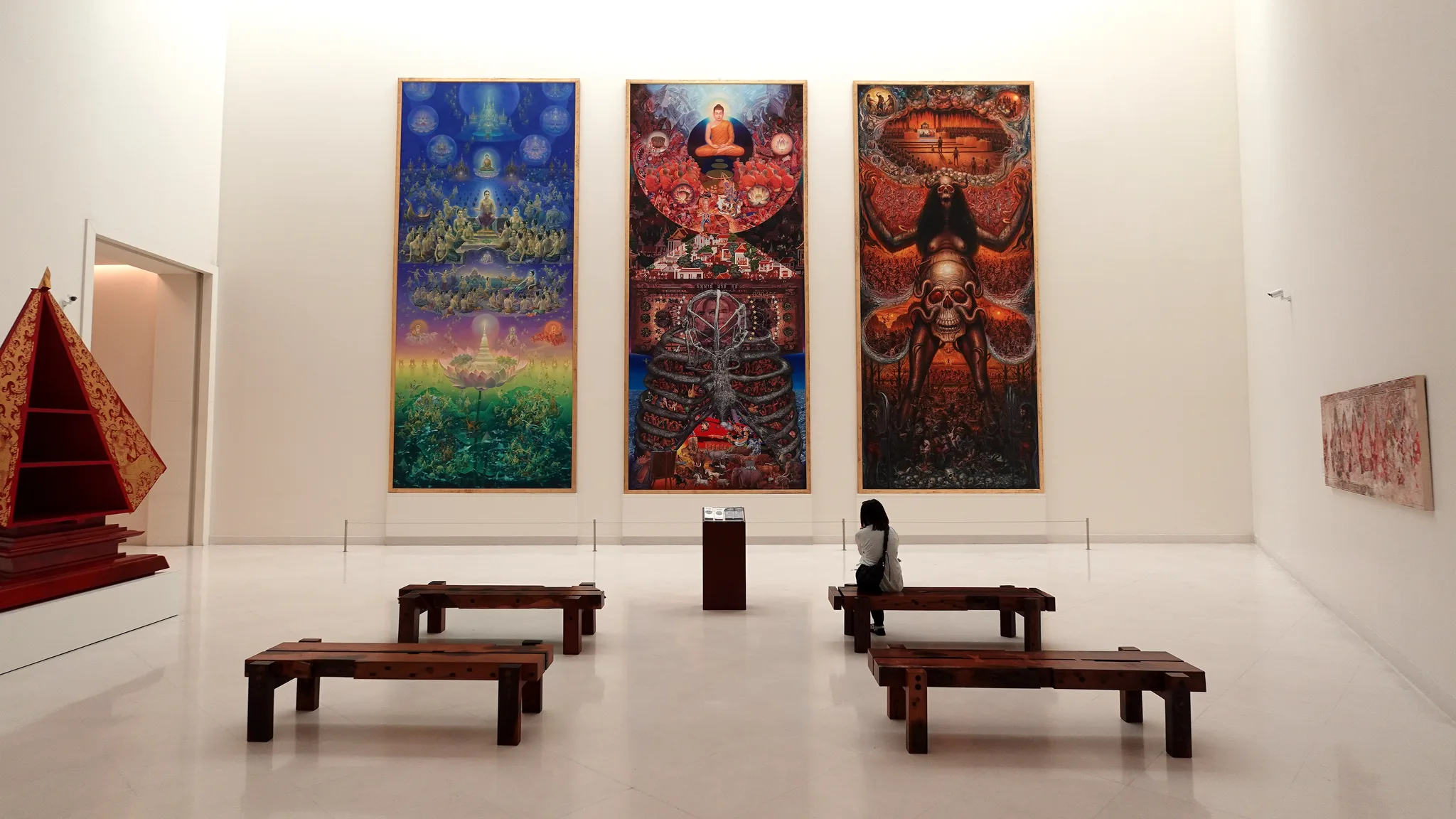
Au MOCA Bangkok, un triptyque de grandes toiles à motifs bouddhiques, dont un Bouddha assis et un squelette, occupe le mur d'une salle blanche haute de plafond, meublée de bancs en bois sombre.© Eric Monteil