
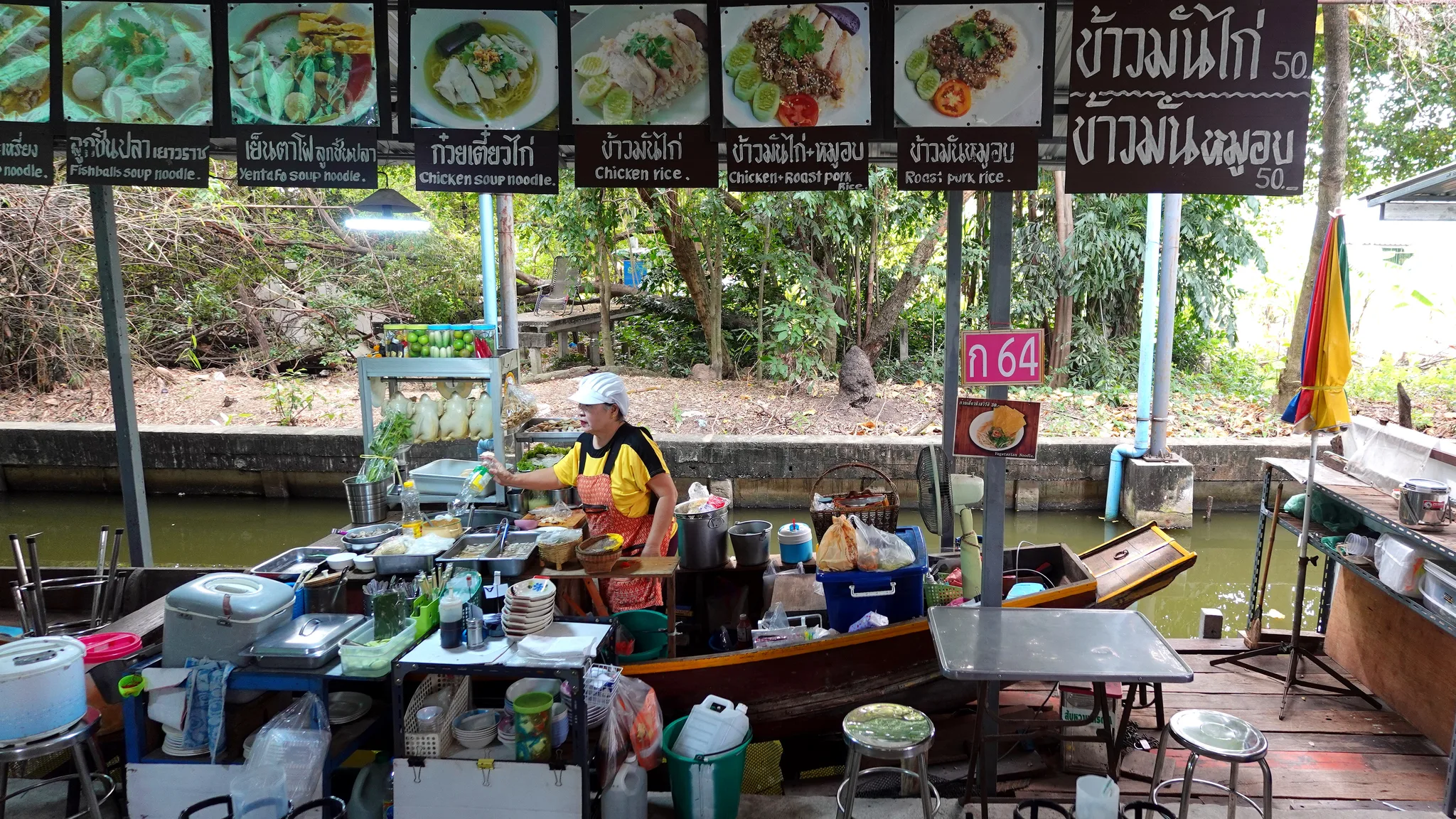
 At Bang Nam Phueng Floating Market, a cook prepares noodle soups and chicken rice in a boat moored along the canal; metal stools and tables seat customers on the wooden landing stage.© Eric Monteil
Dining & street food
Bang Nam Phueng Floating Market
Born of a residents’ initiative in 2004, Bang Nam Phueng Floating Market sustains the orchards and kitchens of a subdistrict of Bang Kachao, on the doorstep of Bangkok.
Heritage family · Gastronomy and food cultures
- Destination
- Samut Prakan (Phra Pradaeng)
- Heritage Family
- Gastronomy and food cultures
- Typology
- Dining & street food
- Visit
- Available tours →
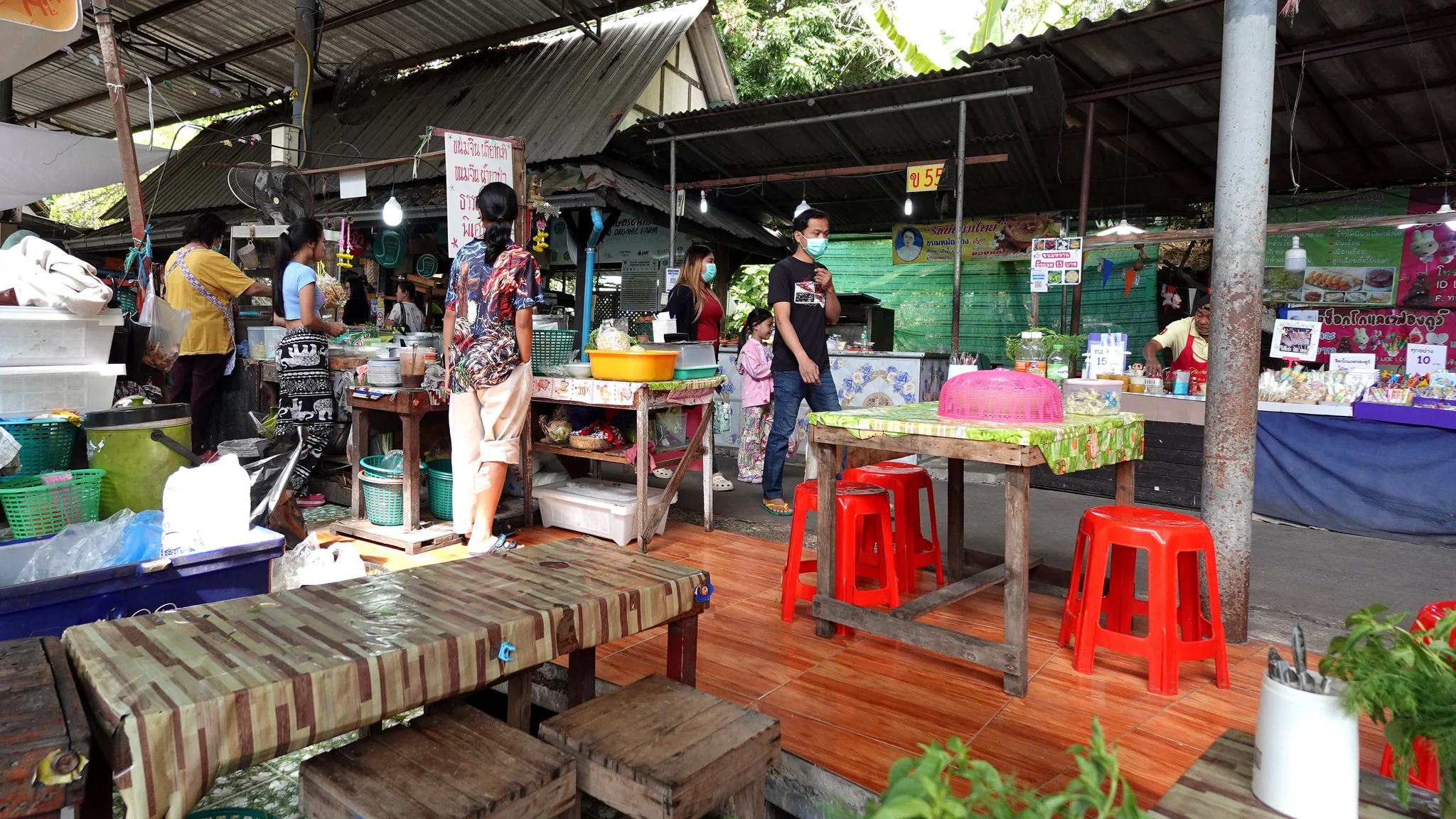
Bang Nam Phueng Floating Market is a community market open at weekends in the subdistrict of Bang Nam Phueng, Phra Pradaeng District, Samut Prakan Province, at the heart of the green area of Bang Kachao. The residents created it in 2004 to tackle local unemployment and to give orchard families an outlet for their fruit, sweets and dishes. It also serves as a starting point for tourism centred on discovering the local way of life. Its stalls line a long covered walkway that follows the small canals linked to the Chao Phraya River.1
Key facts
- Destination
- Bang Nam Phueng
- Heritage Family
- Gastronomy and food cultures
- Typology
- Dining & street food
- Places
- Khlong Bang Nam Phueng
- Bang Krachao
- Periods
- —
- People
- —
- Communities
- Bang Nam Phueng community
- Events
- Opening (2004)
- Heritage
- —
- Glossary
- Bang
- Tambon
- Chao Phraya
- Phraya
- Wat
- Sri
- Keywords
- —
- Date
- —
- Collections
- —
Practical info
Practical information about this site is taken from its Google Maps page. We advise you to check it before visiting.
- Address
- 98 Tambon Bang Nam Phueng, Amphoe Phra Pradaeng, Chang Wat Samut Prakan 10130
- Phone
An orchard subdistrict on the riverbank
Bang Nam Phueng within Bang Kachao
Bang Nam Phueng is one of the six tambon, or subdistricts, that make up Khung Bang Kachao. This area lies in a bend of the Chao Phraya River, opposite Bangkok, and its inhabitants nickname it “Krapho Mu”, the pig’s stomach. The other five subdistricts are Bang Kachao, Bang Yo, Bang Krasop, Bang Ko Bua and Song Khanong. Fresh water from the river and salt water meet here, leaving their mark on both the landscape and the crops.1
Bang Nam Phueng is an orchard community, settled on the plain bordering the Chao Phraya River. It is crossed by the Khlong Bang Nam Phueng, a canal some one and a half kilometres long that joins the river. The canal irrigates the land and makes the soil fertile, well suited to fruit trees. The market grew out of this network of canals and gardens: it took root on the water, in the midst of a residential neighbourhood, rather than on a square or a road.2
The name and what it denotes
In Thai, the place is called ตลาดน้ำบางน้ำผึ้ง. The word “bang” denotes a settlement on the water’s edge, and “nam phueng” means “honey”. The name of the subdistrict thus brings together water and sweetness, but the origin of the name remains unknown.
The term “floating market” also calls for clarification. In central Thailand, it evokes traders selling from their boats. At Bang Nam Phueng, trade takes place mainly on the bank, along a covered walkway at the water’s edge. The canal serves as a setting, a route for strolling and a link with the orchards, more than as a place of sale. This nuance helps in understanding the market: it extends the life of the canals rather than recreating trade on the water.
A creation of the residents
Answering unemployment through the garden
The market is not the direct heir of an old canal market. It is the outcome of a collective decision. Faced with the unemployment affecting the subdistrict, members of the community drew up a plan of action together. The first step was not trade but production. The residents distributed vegetable seedlings and fruit tree saplings to every household, so that families could grow part of their own food and cut their expenses.1
This starting point sheds light on the nature of the market. Before welcoming visitors, the project aimed to strengthen the household economy of the residents by building on what the subdistrict already knew how to do: cultivate orchards and gardens along the canals. The market came afterwards, to provide an outlet for this produce and bring income into the households.
The 2004 opening
Bang Nam Phueng Floating Market opened for the first time on 28 February 2004. The Provincial Administrative Organisation, the elected local authority at provincial level, supported the project financially. The residents took the initiative; the local public authorities backed it.1
The stated aim was twofold: to develop tourism in the subdistrict and to enable villagers to earn an income by selling produce from their own holdings. Official presentations in Thai speak of “conservation tourism” and of strengthening the community. The market is thus meant both to support families and to preserve a way of life bound up with orchards and canals.6
The subdistrict’s territory falls under the Bang Nam Phueng Subdistrict Administrative Organisation, the basic tier of local government. The market has no identified founder: it is presented as the collective work of the residents of the time.11
What there is to see and taste
A covered walkway along the canals
The market takes the form of a covered walkway more than two kilometres long. It follows small secondary canals that branch off the Chao Phraya River and run into the residents’ farmland. Visitors therefore walk with the water on one side and the stalls on the other, sheltered from sun and rain, alongside the gardens from which part of the produce comes.5
This linear layout sets the place apart from a market held on a square or in a market hall. It is not a facility built in a single piece, but a route that follows the network of canals and passes through the inhabited neighbourhood. The vendors come from Bang Nam Phueng and neighbouring subdistricts, and the walkway serves as a shared showcase for a whole small orchard region.7
Orchard fruit and time-honoured sweets
Produce from the subdistrict’s gardens takes pride of place on the stalls: green coconuts, mangoes of the nam dok mai variety, strongly fragrant hom bananas and chomphu mamiao rose apples, small, crisp red fruits. Ornamental plants and fish, grown and bred locally, are also on sale.8
Local confectionery plays an important part. There are khanom thuai, small coconut-cream custards cooked in little cups, and khanom chak, a paste of glutinous rice and coconut grilled in a palm leaf. Fried bananas, known as kluai khaek, are also sold, as are ma ho, morsels of fruit topped with a sweet-and-savoury filling. The desserts of the “thong” family are made from egg yolk, kalamae is a sweet of coconut and palm sugar, and foi ngoen is made of egg white poached in syrup. The market also offers mi krop, fried and caramelised rice vermicelli, prepared in the traditional way. This presence of old recipes gives the market its gourmand character and ties it to a domestic culture of sweet-making handed down within families.8
Savoury dishes and local products
The savoury offering is less varied, but it carries the same idea. Kuai tiao lui suan, a noodle soup whose name means “orchard noodles”, and traditional sausages are among the specialities. As early as 2007, savoury dishes processed according to local know-how were also reported there.8
Finally, the market serves as a central sales point for OTOP products, the acronym of the national “One Tambon, One Product” programme that promotes the goods made in each subdistrict. Those of Bang Nam Phueng and neighbouring subdistricts find a regular showcase here. Crafted objects and processed foods thus complement the fresh fruit and desserts, and the market becomes the place where a local economy of small-scale production becomes visible.3
A gateway to local life
Fireflies and local life in 2007
A few years after its opening, the market became the anchor of a broader offering. In 2007, the regional office of the Tourism Authority of Thailand responsible for the Central region and the subdistrict of Bang Nam Phueng launched ecotourism activities and activities for discovering the local way of life. The aim was to revive this traditional way of life and to offer new places to visit around the market.3
The fireflies on the banks of the Chao Phraya River became one of the attractions of this programme. Watching them by boat at dusk extends the visit beyond market hours and turns attention to the natural environment of the canals and riverbanks. The market is no longer merely a place of sale: it becomes the starting point for exploring the subdistrict.3
Boats, bicycles and homestays
Around the stalls, residents offer a whole range of services: rowing boats on the canals, traditional massage, bicycle hire for exploring the paths between the orchards, homestay accommodation and boat trips to see the fireflies. These activities carry forward the intention of the original project, which sought to let families benefit directly from the arrival of visitors.
They also show how a market for local produce has turned into a small hospitality economy. The boat, once an ordinary means of getting about on the canals, becomes a way of discovering the landscape. The bicycle makes it possible to reach the gardens that the covered walkway merely skirts.
The market today
Closure and reopening
Like many gathering places in Thailand, the market closed temporarily during the Covid-19 epidemic. In early October 2021, it reopened for the first time since this interruption, with strict health measures. It then welcomed the public on Saturdays, Sundays and public holidays.4
This weekend rhythm has defined the market from the outset. During the week, the walkway returns to its role as an inhabited neighbourhood; the market only comes alive when city dwellers have free time. This calendar is a reminder that the place lives above all from the arrival of visitors, and that the vendors remain residents whose main occupation lies elsewhere, in the gardens and the households.
On sustainable tourism routes
The market now features prominently in the official tourism promotion of the province and of the Ministry of Tourism and Sports. In 2020, as part of a ministry project carried out with the Tourism Authority of Thailand and the Designated Areas for Sustainable Tourism Administration (DASTA), a trip intended in particular for foreign residents was organised to revive domestic tourism in Khung Bang Kachao. The market was one of its stops, together with Wat Bang Nam Phueng Nai, a temple near the market, the homestay of the Bang Nam Phueng community enterprise and Sri Nakhon Khuean Khan Park and Botanical Garden.9
The Designated Areas for Sustainable Tourism Administration also publishes a guide to the subdistrict’s routes, in Thai and English. The market is therefore no longer presented on its own, but as one element of a wider visitor experience combining a temple, gardens, homestays and the green spaces of Bang Kachao.10
Under the protection of the green area
The market enjoys no heritage designation of its own. It does, however, depend on the fate of Bang Kachao, often called the “green lung” of Bangkok. After the death of King Bhumibol Adulyadej (1927–2016) in October 2016, the military government announced its intention to preserve this area. The Royal Forest Department, Kasetsart University and the oil company PTT carried out a three-year programme to renovate public green spaces and shield a large part of the island from urban development.12
This protection is indirect, but it matters for the market. The orchards, canals and green setting that give it its value are precisely what the preservation of Bang Kachao seeks to maintain, on the doorstep of an expanding metropolis.
Understanding
Bang Nam Phueng Floating Market is no ancient relic: it is the result of a recent decision taken by an orchard subdistrict. The residents first replanted their gardens, then opened along their canals a walkway on which to sell fruit, family desserts and local products. Its interest lies in this direct link between cultivated land, home cooking and the welcoming of visitors, at the heart of one of the last large green spaces on the doorstep of Bangkok. Today, the market lives to the rhythm of weekends and of the sustainable tourism routes that link it to the neighbouring temple, the botanical gardens and homestays. It came through the closure caused by the epidemic and reopened, but its raison d’être depends on keeping the orchards and canals that the protection of Bang Kachao seeks to preserve. Should the subdistrict’s gardens recede, could the market still express the life of a place, or would it become merely the showcase of a vanished way of life?
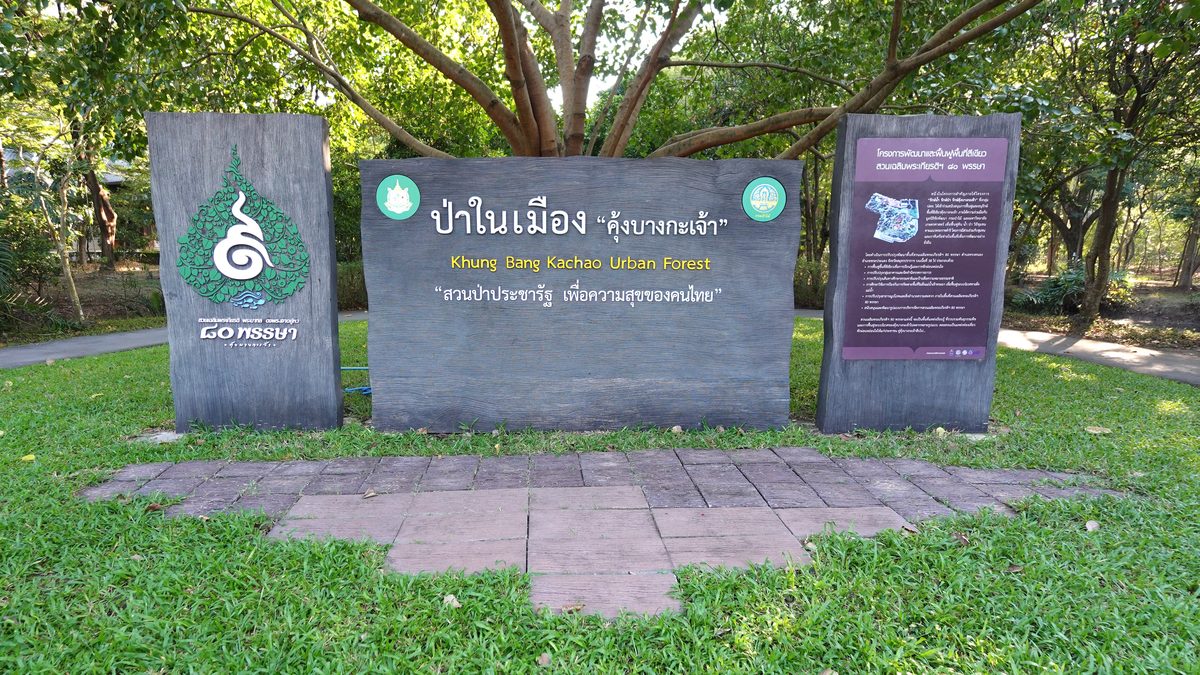
Bang Krachao, the "green lung" of Bangkok, between canals, Mon heritage, temples, biodiversity and sustainable initiatives.
- Bang
- Thai word for a village or settlement established at the water’s edge, along a river or canal. It forms part of a great many place names in the central plain.
- Tambon
- A Thai administrative subdivision grouping several villages, ranking below the district.
- Chao Phraya
- Highest title of the Siamese nobility, held by senior dignitaries of the court.
- Phraya
- Rank of the Siamese court nobility, immediately below that of chao phraya; it precedes the dignitary’s title name.
- Wat
- Buddhist monastic complex that brings together, within a single enclosure, several religious buildings, monks’ quarters and ancillary buildings; the word does not refer to a single building.
- Sri
- Word of Sanskrit origin expressing glory, prestige and prosperity, used in Thai as an honorific element in the names of places, buildings and people.
- Khlong
- Canal or waterway, natural or man-made, which long played a major role in transport, irrigation and the organisation of settlements and territories in Thailand.
- Kalamae
- Thai confection made from glutinous rice and coconut, cooked and stirred at length in large vessels. Its preparation is a communal task that often involves many participants.
- Provincial Administrative Organisation
- Thai local government body with a council elected at provincial level, responsible for local services and development projects, distinct from the provincial administration answerable to the State.
- Nam dok mai
- Thai mango variety with sweet, fragrant yellow flesh, generally eaten ripe.
- Hom banana
- Banana variety grown in Thailand, valued for its strong fragrance; ‘hom’ means ‘fragrant’ in Thai.
- Chomphu mamiao
- Variety of rose apple grown in Thailand, bearing small, crisp red fruit.
- Kuai tiao lui suan
- Thai rice-noodle dish whose name means ‘orchard noodles’, associated with garden vegetables and herbs.
- Khanom thuai
- Thai dessert consisting of a rice-flour and coconut-cream custard, steamed in small cups.
- Khanom chak
- Thai sweet made of a glutinous rice, coconut and sugar paste, wrapped in a palm leaf and then grilled.
- Kluai khaek
- Thai snack of sliced bananas coated in a rice-flour and coconut batter, then fried.
- Ma ho
- Traditional Thai morsel made of a piece of fruit, often pineapple or orange, topped with a sweet-and-savoury filling.
- Thong
- Family of Thai desserts based on egg yolk and sugar, whose name means ‘gold’.
- Foi ngoen
- Thai sweet made of egg white poached in fine threads in a sugar syrup.
- Mi krop
- Thai dish of fried rice vermicelli coated in a sweet caramelised sauce.
- OTOP
- Thai national ‘One Tambon, One Product’ programme, which supports and markets the craft and food products specific to each subdistrict.
- Subdistrict Administrative Organisation
- Basic local government body in Thailand, with an elected council, administering the territory of a tambon that has not been made a municipality.
Primary sources
Studies
Reference works
- 5ตลาดน้ำบางน้ำผึ้ง, Thailand Tourism Directory, ministère du Tourisme et des Sports ↗
- 6Bang Nam Phueng Market, Thailand Tourism Directory, ministère du Tourisme et des Sports ↗
- 7ตลาดน้ำบางน้ำผึ้ง, Province de Samut Prakan (samutprakan.go.th) ↗
- 8ตลาดน้ำบางน้ำผึ้ง, Bureau des relations publiques de Samut Prakan, Public Relations Department ↗
- 9TAT International Public Relations Division, To boost domestic tourism, expatriates urged to visit Khung Bang Kachao, the "Lung of Bangkok", TAT Newsroom, Tourism Authority of Thailand, 2020 ↗
- 10Khung Bang Kachao Travel Guide in Thai and English, Designated Areas for Sustainable Tourism Administration (DASTA) ↗
- 11Bang Nam Phueng, Wikipédia en anglais ↗
- 12Bang Kachao, Wikipedia ↗
Contemporary views
Bang Nam Phueng Floating Market today
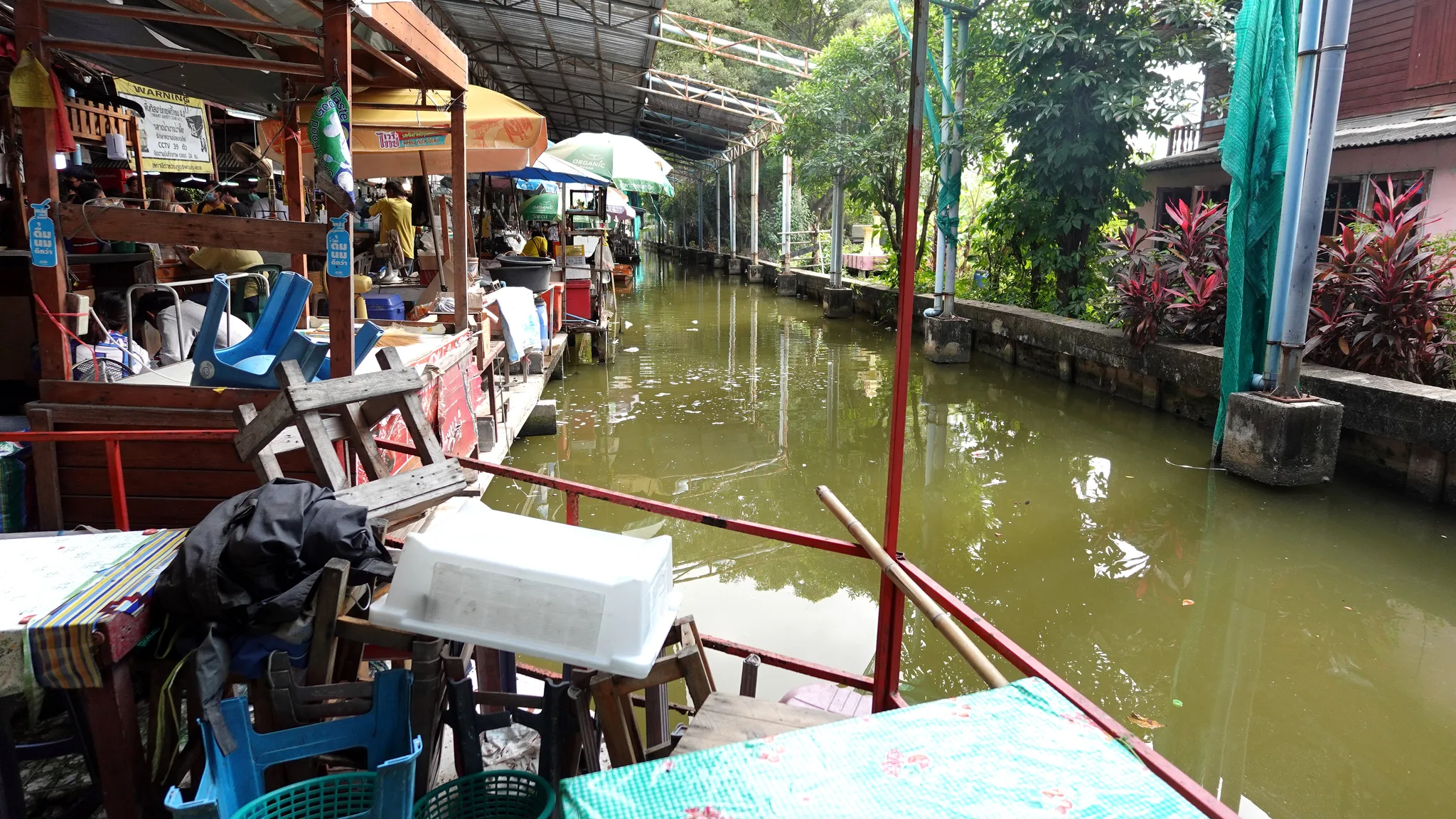
At Bang Nam Phueng Floating Market, stalls under corrugated roofing and parasols line the left bank of the canal, while the opposite masonry bank is planted with cordylines and trees.© Eric Monteil 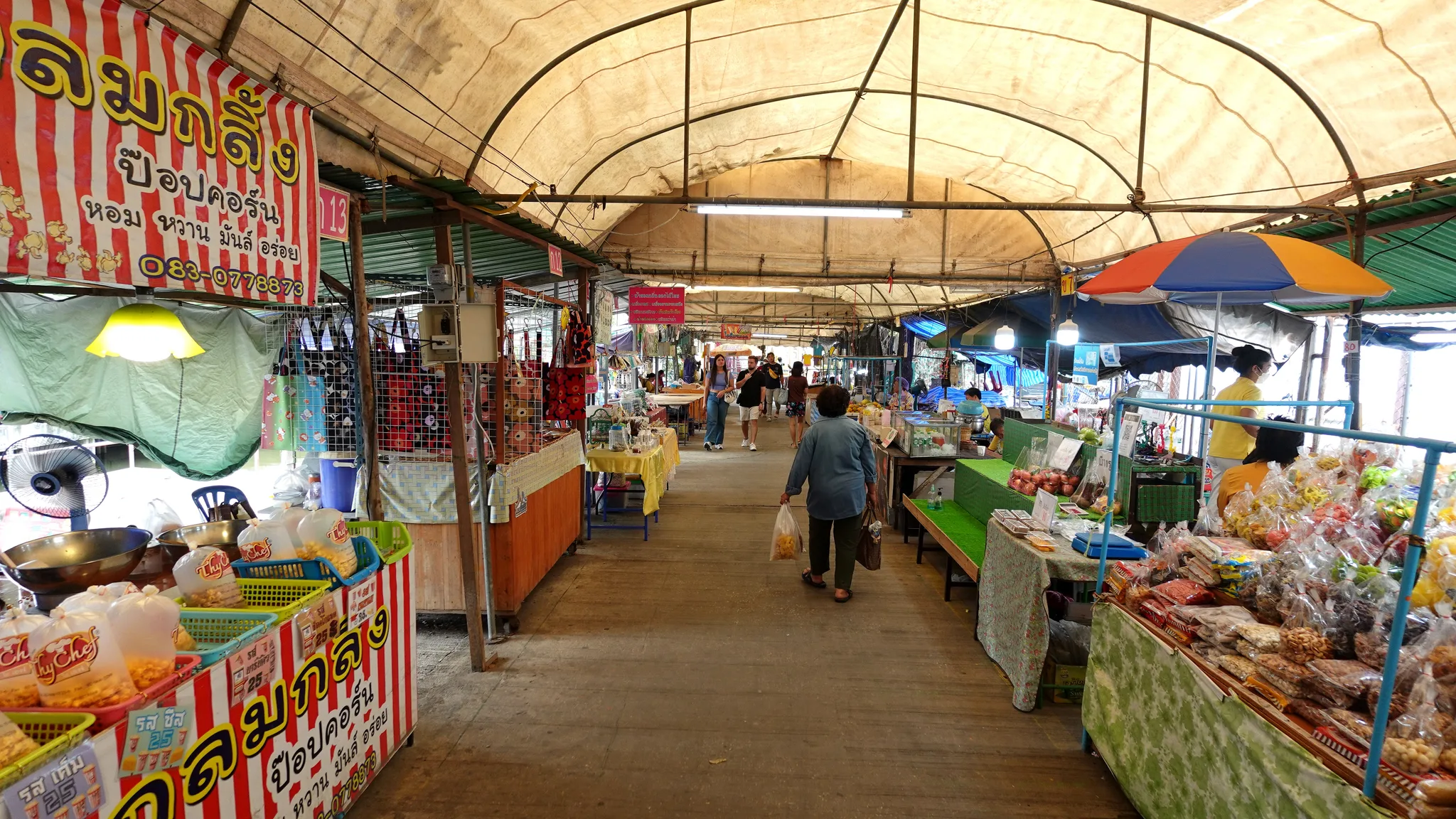
Beneath a canvas roof stretched over metal arches, an aisle at Bang Nam Phueng Floating Market is lined with stalls selling popcorn, bagged snacks and assorted goods, with a few visitors passing through.© Eric Monteil
Architecture and decoration
Explore the heritage
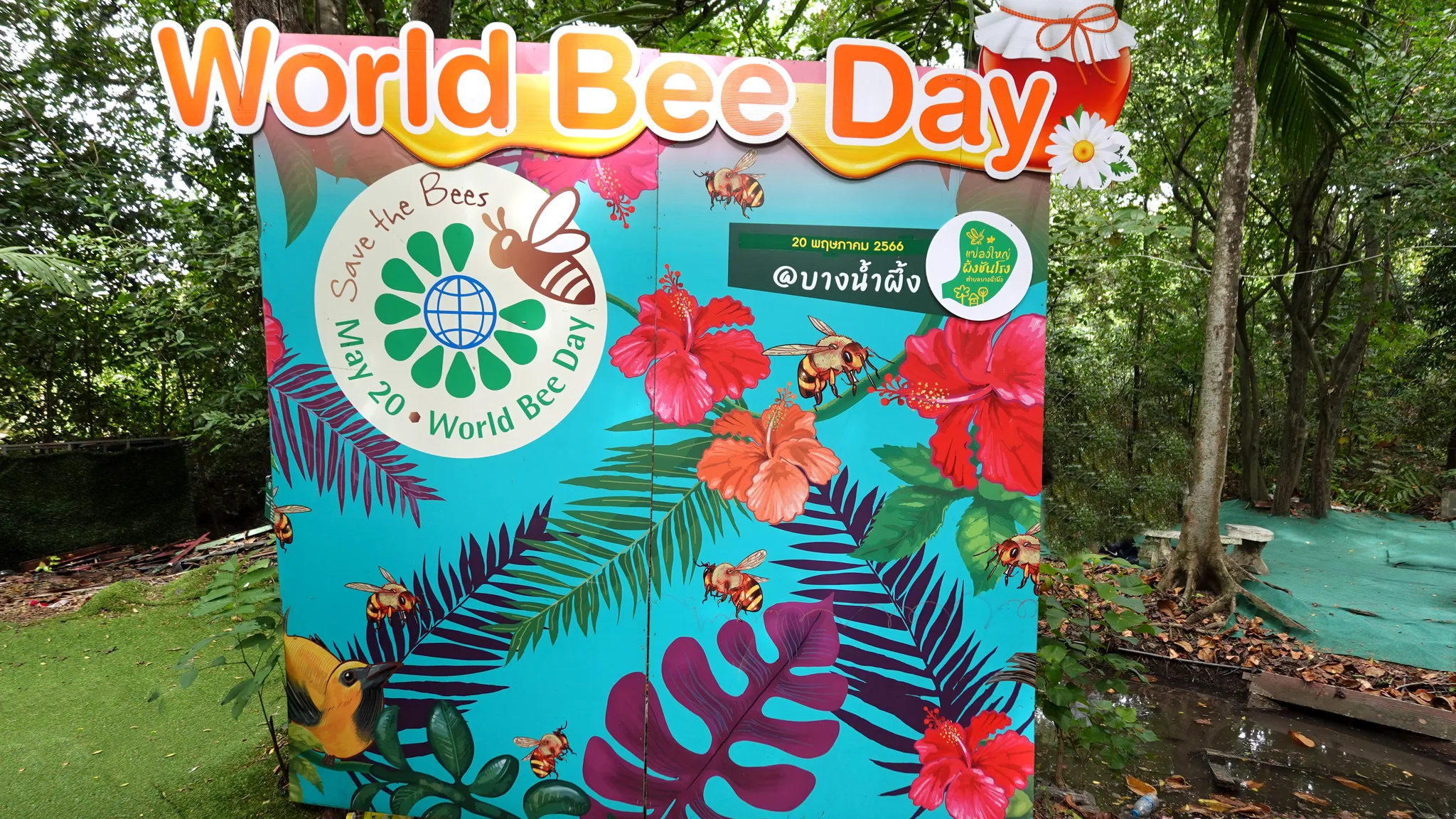
At Bang Nam Phueng Floating Market, a painted panel devoted to World Bee Day combines bees, red hibiscus, palm fronds and monstera leaves on a turquoise ground, set among trees beside a pool of water.© Eric Monteil 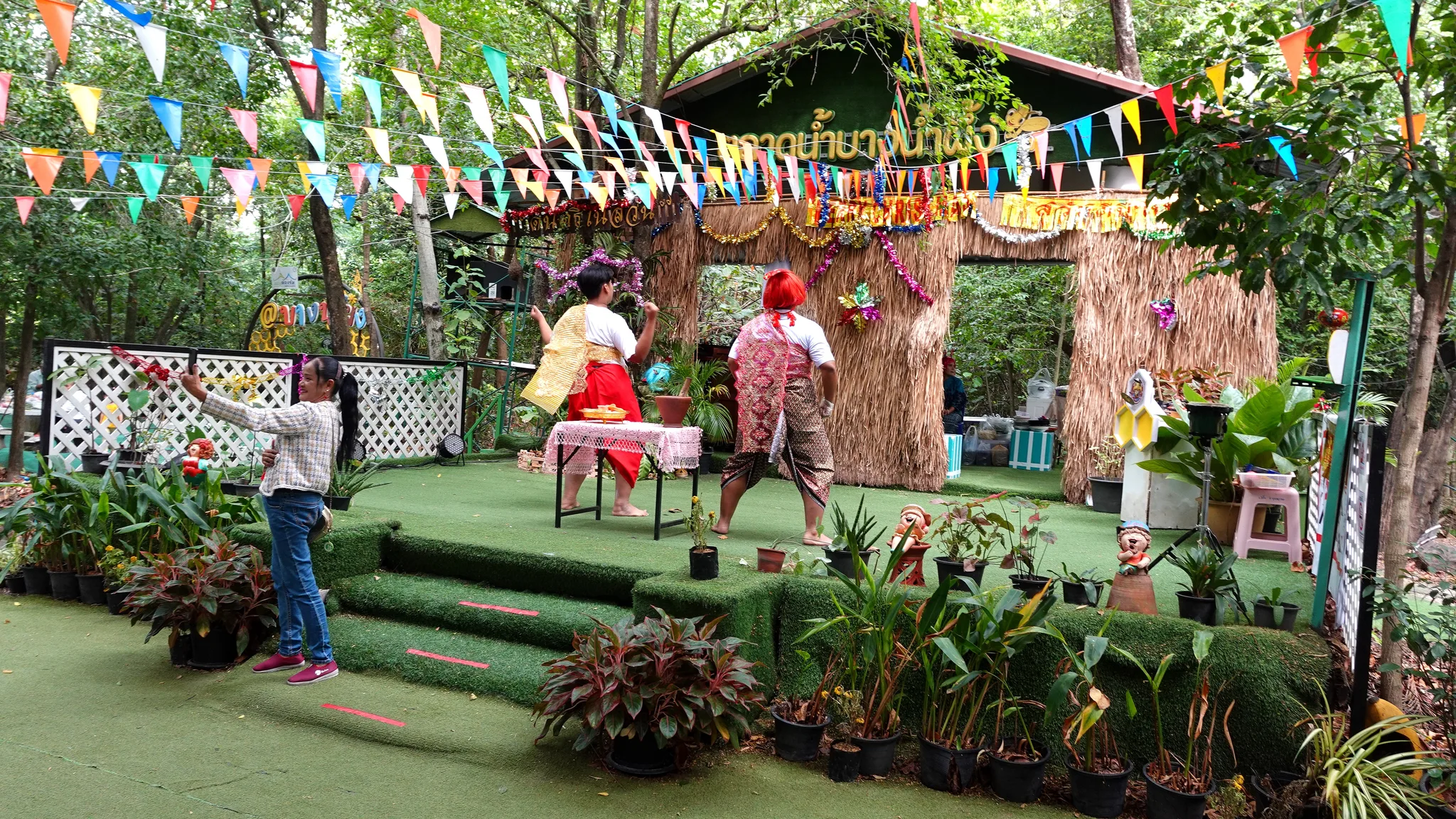
At Bang Nam Phueng Floating Market, two performers in traditional-style costume appear on an open-air stage, before a thatched backdrop bearing the market’s name in Thai, amid bunting, garlands and potted plants.© Eric Monteil