
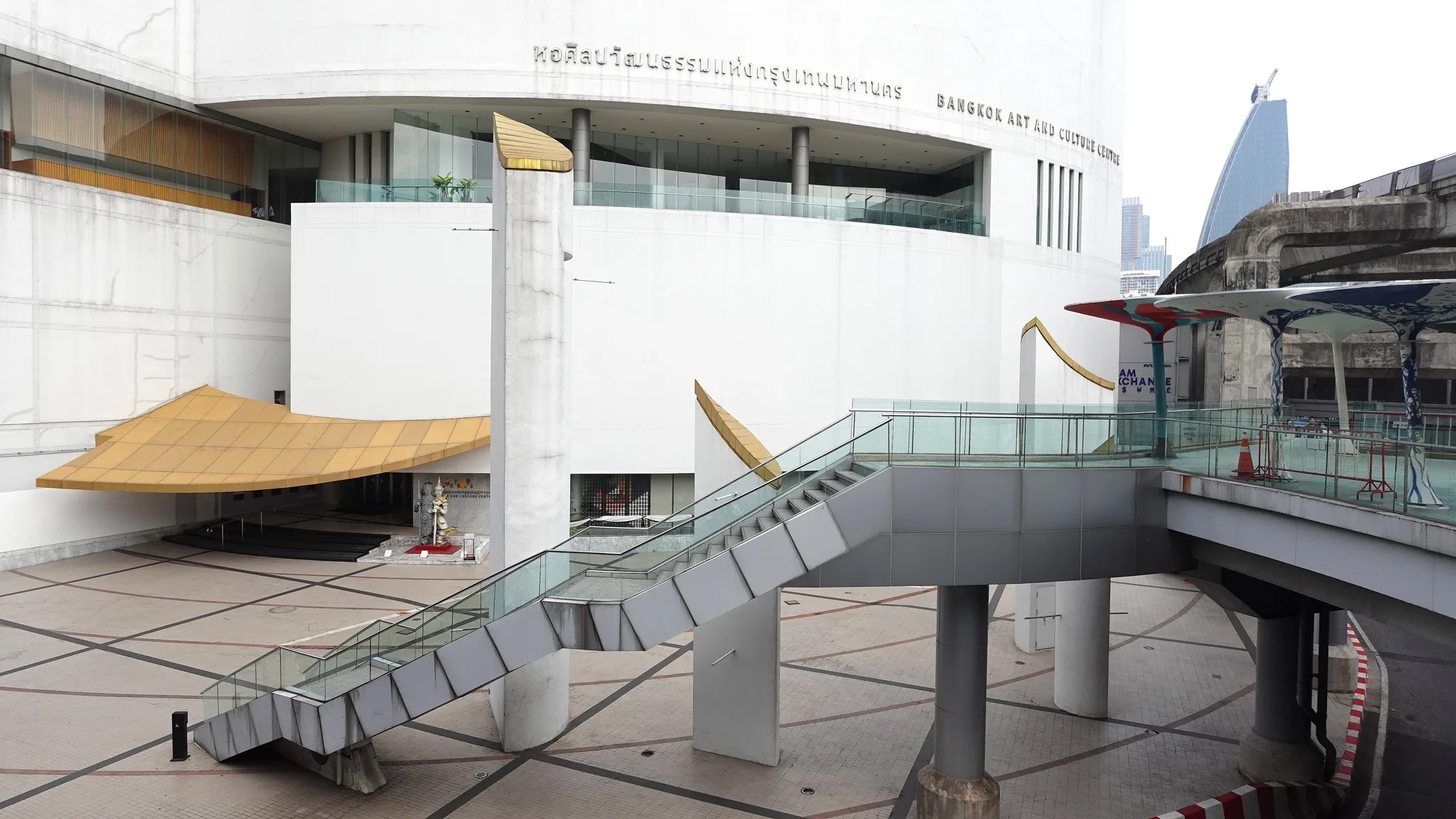
 Le BACC présente une façade blanche aux volumes courbes, portant son nom en thaï et en anglais, un auvent doré au-dessus de l’entrée et un escalier vitré qui relie le parvis dallé à une passerelle surélevée.© Eric Monteil
Cultural & creative centre
BACC
Born of a campaign by Bangkok’s artists and residents, the contemporary art centre at Pathumwan has remained, since 2008, a place of creation and a point of contention between the city, the foundation that runs it and the art world.
Heritage family · Arts, aesthetics and creation
- Destination
- Bangkok (Pathum Wan)
- Heritage Family
- Arts, aesthetics and creation
- Typology
- Cultural & creative centre
- Visit
- Available tours →
The Bangkok Art & Culture Centre (BACC) is the city of Bangkok’s contemporary art centre, set at the Pathumwan intersection in the Siam shopping district. It matters because it grew out of a long campaign by artists, students and citizens, who persuaded the Bangkok Metropolitan Administration to build, and then support, a public venue devoted to creative work. Conceived in the mid-1990s, halted and then revived, it opened in 2008 and has remained ever since a point of contention between municipal authority, the managing foundation and artists. Without a permanent collection, it is organised around a cylindrical atrium and hosts exhibitions, performances and the Bangkok Art Biennale.14
Key facts
- Destination
- Pathum Wan
- Heritage Family
- Arts, aesthetics and creation
- Typology
- Cultural & creative centre
- Places
- —
- Periods
- —
- People
- Apirak Kosayodhin
- Bhichit Rattakul
- Bhumibol Adulyadej
- Robert George Boughey
- Samak Sundaravej
- Communities
- —
- Events
- Bangkok Art Biennale
- Bangkok Declaration on Art and Culture
- Censorship of the Constellation of Complicity exhibition
- Art Vote
- Opening of the Bangkok Art and Culture Centre
- Projet de reprise en gestion directe par la ville (2018)
- Heritage
- —
- Glossary
- Royal project
- Mara
- Ho
- Keywords
- —
- Date
- —
- Collections
- —
Practical info
Practical information about this site is taken from its Google Maps page. We advise you to check it before visiting.
- Address
- 939 Rama I Rd, Khwaeng Wang Mai, Pathum Wan, Krung Thep Maha Nakhon 10330
- Phone
- Website
A house of the arts at the heart of the city
A place of creation without a collection
The Bangkok Art & Culture Centre (BACC) is a contemporary art centre conceived, built and supported by the city of Bangkok. Its Thai name, Hô Sinlapa Watthanatham haeng Krung Thep Maha Nakhon, can be read almost word for word: hô denotes a hall or building, sinlapa art, watthanatham culture, and Krung Thep Maha Nakhon is the Thai name of the capital. It therefore means ‘Bangkok house of arts and culture’. A short form, Hô Sin Krung Thep, also exists, as does the acronym BACC. Before it took shape, the project went by other names, Bangkok Contemporary Art Centre or Bangkok Metropolitan Art Centre.14
It is not a museum in the conventional sense. The centre holds no permanent collection: it presents temporary exhibitions of modern and contemporary art and hosts concerts, theatre, film, design and cultural and educational activities, in spaces designed both for exhibition and for performance. It describes itself as a place for learning about modern and contemporary art and as a place of creation. It was conceived as a space for cultural exchange, capable of giving Bangkok a foothold on the international art scene. Its purpose therefore lies less in the works it owns than in those it brings into circulation, the artists it hosts and the audiences it brings together.10
At the Pathumwan intersection
The centre occupies a corner of the Pathumwan intersection, in the Siam district of central Bangkok. It is reached via National Stadium station on the BTS, the capital’s elevated railway. The intersection is one of the city’s hubs of urban commerce, and siting an art centre here is no trivial matter: it brings contemporary art into direct contact with popular culture and consumption. The centre is today presented as the only art and culture centre located in the heart of Bangkok and as a landmark in the city.10
This setting has weighed on its entire history. So central a plot attracts projects other than a cultural venue, and the question of the place of commerce, beside or within the building, has followed the centre from its conception to its present management. It was on this very ground, in the literal sense, that the long battle preceding its birth was fought.
A troubled birth
The idea of a municipal art centre
The project was born in 1996, when the Governor of Bangkok, Bhichit Rattakul, decided to build a city-owned contemporary art centre at the Pathumwan intersection. He took this decision together with the committee of the royal project ‘Art of the Ninth Reign’.3
It was also during Bhichit Rattakul’s term that the design of the building was settled. The winning entry was that of the Bangkok-based practice Robert G. Boughey and Associates. The centre itself credits the governor with having laid the foundations of the undertaking. But the initial momentum did not survive the change of governor.3
The 2001 halt and the artists’ response
In 2001, Samak Sundaravej became Governor of Bangkok and halted the project. He wished to give the scheme a more commercial character, with a share of retail space, and the idea of turning the Pathumwan plot into a car park was then in circulation.14
The response came from the art world. Students and artists mobilised against the abandonment and defended the winning design. A ‘people’s network for the Bangkok Art and Culture Centre’ was formed and organised a gathering entitled ‘Art Vote’ on the Pathumwan plot, which had in the meantime been laid out as a public park. The centre today presents its own origins as the fruit of this campaign by artists, networks and citizens.10
The revival and the Bangkok Declaration
The revival came through a new governor, Apirak Kosayodhin, to whom the network presented the project and who approved it. On 19 August 2005, in Benjasiri Park, before some five hundred people from the art world, he officially announced the construction of what he presented as the country’s first international-standard art centre. The organising committee chose to revert to the original design by Robert G. Boughey and Associates: the campaign had not only saved the idea of a centre, it had also preserved the building the artists had defended.10
The campaign left another legacy, the ‘Bangkok Declaration on Art and Culture’, signed in Benjasiri Park between the Bangkok Metropolitan Administration and an alliance of art and cultural organisations. Apirak Kosayodhin had agreed to it in principle. The centre presents it as the first declaration of its kind to be drafted and signed in Thailand.11
Reading the building
Robert G. Boughey’s design
The centre’s architect, Robert George Boughey, is an American born in 1936 who settled in Bangkok in 1973 and founded his practice there. Construction was entrusted to the firm Sino-Thai Engineering and Construction. During preparation, the projected cost rose markedly owing to the addition of lifts and air conditioning, before the Bangkok Metropolitan Council approved the construction budget.2
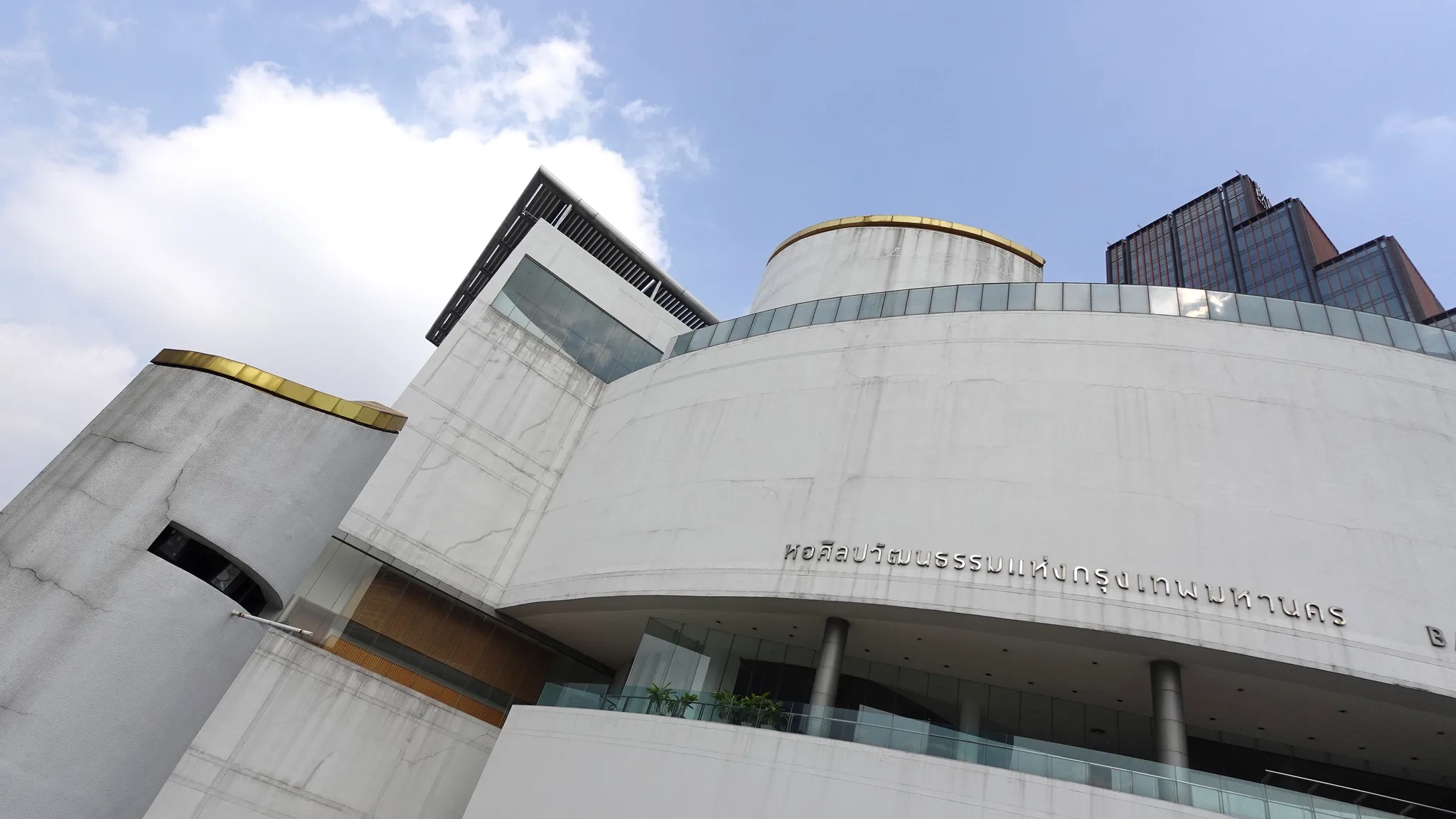
The building is constructed of stone and concrete in a contemporary, modernist style. Its floor area is around 23,000 square metres on a plot of some 4,800 square metres: the programme therefore unfolds vertically. The number of storeys varies, depending on the stage of the project and on the description, between seven and eleven.2
A cylindrical atrium at its heart
The building is conceived as a cylinder. Its principal feature is a central atrium, that is, a large interior space open across several levels, ringed by balconies running all the way round. This space also serves as a stage: performances take place there.2
The design principles set out by the centre emphasise the height of the spaces, intended to accommodate the works, and an architecture meant to support the art on display. Three notions sum them up: flexibility, diversity and interest.10
Commerce in the service of the programme
Commerce, which Samak Sundaravej had sought to bring into the scheme in 2001, did eventually find its place in the building, but on different terms. From 2005, the project planned to devote nearly a third of the floor space to commercial activities intended to fund the centre, among them an art gallery and an art library. The logic was reversed: retail space no longer replaced the cultural venue, it kept it alive.17
The centre houses cafés, commercial galleries, bookshops, craft shops and a specialist library, the BACC Art Library. The commercial zone is called artHUB, and its rents are among the centre’s sources of income. The seventh and ninth floors host exhibitions and performances.14
Opening the centre and bringing it to life
An opening in two stages
The centre opened its doors on 29 July 2008, after numerous delays. Accounts differ: for some, this date marks the official opening; for others, the official opening took place on 19 August 2009, four years to the day after Apirak Kosayodhin’s announcement in Benjasiri Park.14
That same year, the centre published, with the Bangkok Metropolitan Administration and its Culture, Sports and Tourism Department, a report tracing its creation and presenting its building, its logo, its mission and its first year of exhibitions. The text of the cultural cooperation agreement between the city and the artists’ network is included in it.1
A network rather than a closed institution
The centre presents a continuous programme of exhibitions and offers a variety of educational activities, but it does not devise them alone. Independent groups, educational institutions, government bodies, civil society organisations and businesses programme their own projects there. Among these partners are Friends-of-the-Arts, a foundation devoted to the performing arts, and BIPAM, a performing arts meeting that became biennial in 2020.12
This network-based way of working extends the history of the place. Born of a campaign by artists and organisations, the centre hosts the projects of numerous partners. The atrium, the exhibition galleries and the performance spaces thus host, in turn, projects led by established institutions and by independent collectives.
A major venue of the Bangkok Art Biennale
This openness to the outside world can also be measured by the centre’s place in the Bangkok Art Biennale, an international contemporary art event held every two years at several venues across the city. The centre hosted it in 2018, then in 2020, and again for the 2024 edition, held from 24 October 2024 to 25 February 2025, with an introductory section entitled ‘The Prelude’.
The fifth edition, entitled ‘Angels & Mara’, runs from 29 October 2026 to 28 February 2027. The centre is one of the eleven main venues of this edition, and its seventh and ninth floors host exhibitions and performances.8
An independence under strain
A foundation funded by the city
The centre is run by the Bangkok Art and Culture Centre Foundation, a non-profit foundation, but it was created by the Bangkok Metropolitan Administration, which remains its principal funder. The rest of its income comes from artHUB rents and the hire of spaces, the sale of merchandise, corporate sponsorship, including from banks such as Siam Commercial Bank and UOB Thailand and from the auction house Christie’s Thailand, private foundations and public donations.
Under this arrangement, the city pays and the Bangkok Art and Culture Centre Foundation manages. A contract binds the Bangkok Metropolitan Administration to the Bangkok Art and Culture Centre Foundation, expiring in 2021. But the centre’s financial dependence on the city makes this balance fragile, and its first decade of activity put it to the test on several occasions.14
The crises of the first decade
Towards the end of its first ten years, the centre learnt that the Bangkok Metropolitan Administration would not pay its annual subsidy in the following financial year, a first in ten years. Its director, Pawit Mahasarinand, made the decision public: the subsidy had chiefly covered running costs and accounted for more than half of the annual budget. He warned that the centre could stay open only until the middle of the following year, and cut opening hours and the number of exhibitions. The decision was at the time attributed to the military government in power.4
In May 2018, the Governor of Bangkok, Aswin Kwanmuang, announced that the Bangkok Metropolitan Administration would take over direct management of the centre and entrust it to its Culture, Sports and Tourism Department. The city pointed to the Bangkok Art and Culture Centre Foundation’s annual deficit, and the governor considered leasing out the ground floor to limit losses. Artists protested vigorously on social media, while the Bangkok Art and Culture Centre Foundation defended a management it considered professional. The tenth anniversary thus unfolded on a knife-edge, between private interests and municipal power. In the face of the protests, the governor postponed any change to the governance until 2021, when the contract between the city and the Bangkok Art and Culture Centre Foundation was due to expire. For the second time, the art world’s mobilisation weighed on the fate of the centre.5
The 2025 exhibition and the question of censorship
Freedom of programming in turn became a source of conflict in 2025. On 24 July, the centre opened the exhibition ‘Constellation of Complicity: Visualising the Global Machinery of Authoritarian Solidarity’, devoted to solidarity between authoritarian regimes. The Bangkok Metropolitan Administration then asked the centre to remove or censor content deemed offensive to China, notably that concerning the treatment of minorities, including the Uyghurs, failing which the exhibition would be closed. Representatives of the organisation Human Rights Watch saw this as a form of Chinese ‘transnational repression’, and the Committee for Freedom in Hong Kong Foundation likewise criticised the censorship.16
The centre nonetheless continues to operate under the management of the Bangkok Art and Culture Centre Foundation, with the support of the Bangkok Metropolitan Administration. A Thai government website linked to the 2026 meetings highlights it as a creative space open to all, and it is among the eleven main venues of the fifth Bangkok Art Biennale.10
Understanding
The Bangkok Art & Culture Centre (BACC) is neither a collection-based museum nor a mere municipal facility: it is a place of creation that artists, students and citizens wrested from other uses of the Pathumwan plot, before entrusting it to a city-funded foundation. Its cylindrical building, organised around an atrium that also serves as a stage, hosts temporary exhibitions, performances, an art library and projects led by a wide network of partners, up to and including the Bangkok Art Biennale. Its importance lies as much in what it shows as in the way it came into being. Since its opening, this origin has continued to weigh: the withdrawal of a subsidy, the city’s planned takeover in 2018 and the censorship request of 2025 have each time called into question the balance between those who fund the place and those who bring it to life. At the heart of a district given over to commerce, can a city-funded house of the arts remain the space for free expression that its defenders had envisaged?
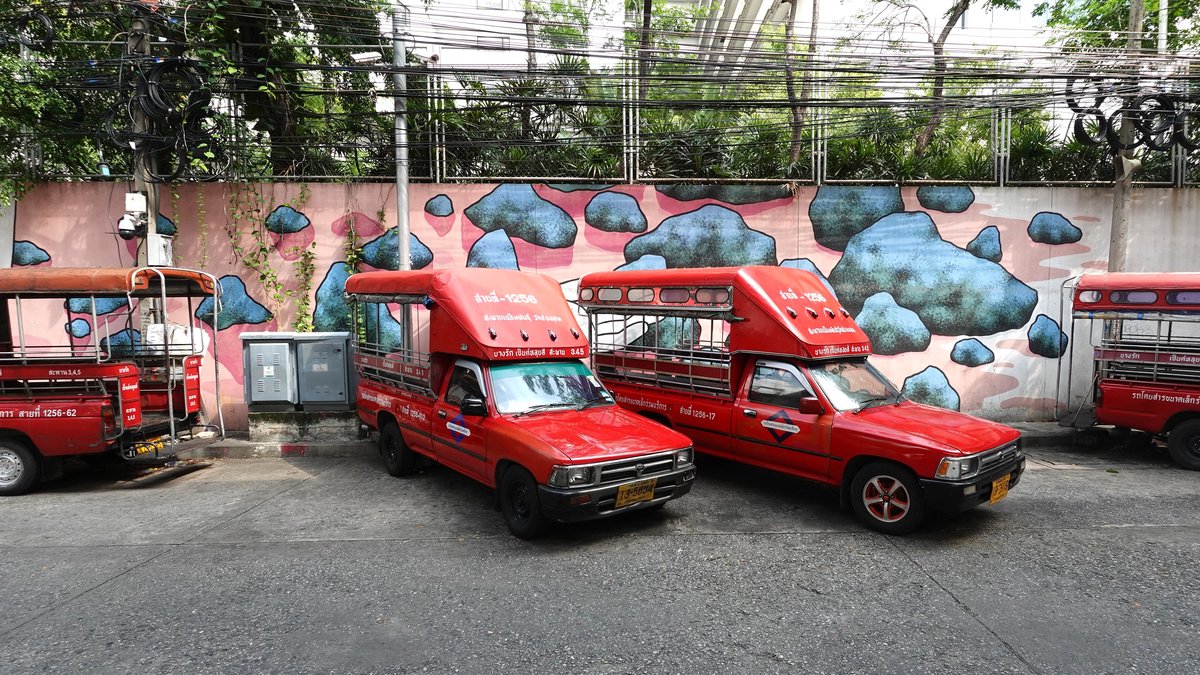
Through Bangkok's creative districts, between street art, architecture, design and new uses of the city.
- Royal project
- Development project launched on the initiative of the King or a member of the Thai royal family, often intended to improve the living conditions of rural populations.
- Mara
- In Buddhism, the demon of illusion and desire who tried to prevent the Buddha from attaining Enlightenment.
- Ho
- Thai word denoting a hall or building, often a separate pavilion, which forms part of the names of many structures, such as a monastery’s scripture library (ho trai) or the bell tower (ho rakhang).
Primary sources
- 1Bangkok Art and Culture Centre ; Bangkok Metropolitan Administration, Culture Sports and Tourism Department, Bangkok Art and Culture Centre (rapport, notice de bibliothèque), Asia Art Archive, 2009 ↗
- 2Society of Architectural Historians, Bangkok Art and Culture Center (BACC) – SAHARA collection, Artstor / JSTOR ↗
Studies
- 3n.d., Bangkok Art and Cultural Centre (Ideas – compilation de presse), Asia Art Archive ↗
- 4n.d., Bangkok Art & Culture Centre cutting back hours after government funding cut off, Coconuts Bangkok ↗
- 5n.d. (d’après The Nation), Thai artists criticise plans for management takeover of Bangkok Art and Culture Centre, culture360.ASEF.org (Asia-Europe Foundation), 2018 ↗
- 6n.d., 10 ปี หอศิลป์กรุงเทพ บนปากเหวกลุ่มทุน-กทม., Thai PBS ↗
- 7n.d., หอศิลปกรุงเทพฯ กับประวัติศาสตร์ ศิลปะ และการเมืองไทย, Happening and Friends ↗
- 8n.d., Bangkok Art Biennale 2026 Opens Across the ‘City of Angels’, Thai PBS World, 2026 ↗
- 9n.d., See 72 artists and collectives tackle temptation at Bangkok Art Biennale, Time Out Bangkok, 2026 ↗
Reference works
- 10Bangkok Art and Culture Centre, About – Bangkok Art and Culture Centre, Bangkok Art and Culture Centre Foundation ↗
- 11Bangkok Art and Culture Centre, เกี่ยวกับเรา – หอศิลปวัฒนธรรมแห่งกรุงเทพมหานคร, Bangkok Art and Culture Centre Foundation ↗
- 12Bangkok Art and Culture Centre, BACC’s Arts Network, Bangkok Art and Culture Centre Foundation ↗
- 13Bangkok Art and Culture Centre, Support Us – Bangkok Art and Culture Centre, Bangkok Art and Culture Centre Foundation ↗
- 14Contributeurs de Wikipédia, Bangkok Art and Culture Centre, Wikipedia (en) ↗
- 15Contributeurs de Wikipédia, หอศิลปวัฒนธรรมแห่งกรุงเทพมหานคร, Wikipedia (th) ↗
- 16Contributeurs de Wikipédia, Bangkok Art and Culture Centre censorship incident, Wikipedia (en), 2025 ↗
- 17Jirawan Prasomsab, Bangkok art centre gets the green light (article reproduit sur forum), SkyscraperCity (reproduction d’un article de presse) ↗
- 18Bangkok Art Biennale, Bangkok Art and Culture Center – Bangkok Art Biennale 2018, Bangkok Art Biennale, 2018 ↗
- 19Bangkok Art Biennale, BACC – Venue (Bangkok Art Biennale 2024), Bangkok Art Biennale, 2024 ↗
- 20n.d., หอศิลปวัฒนธรรมแห่งกรุงเทพมหานคร – Explore Bangkok, am2026thailand.go.th (site gouvernemental thaïlandais) ↗
- 21Bangkok Art Biennale, Venues – Bangkok Art Biennale 2020, Bangkok Art Biennale, 2020 ↗
Contemporary views
BACC today
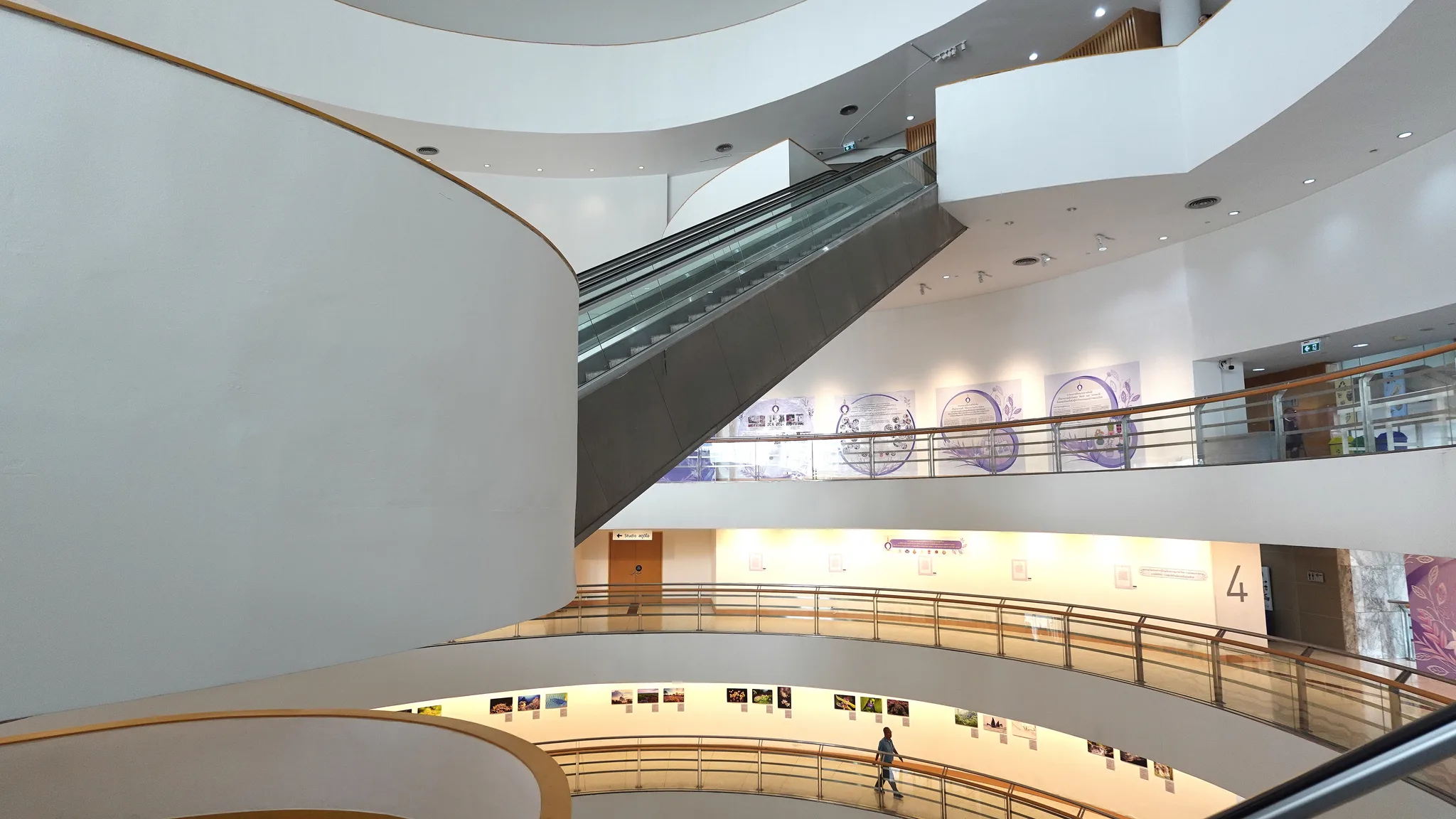
L’atrium du BACC superpose des galeries aux parois blanches et courbes, bordées de garde-corps vitrés et reliées par un escalator ; des photographies et des panneaux sont exposés le long des coursives.© Eric Monteil 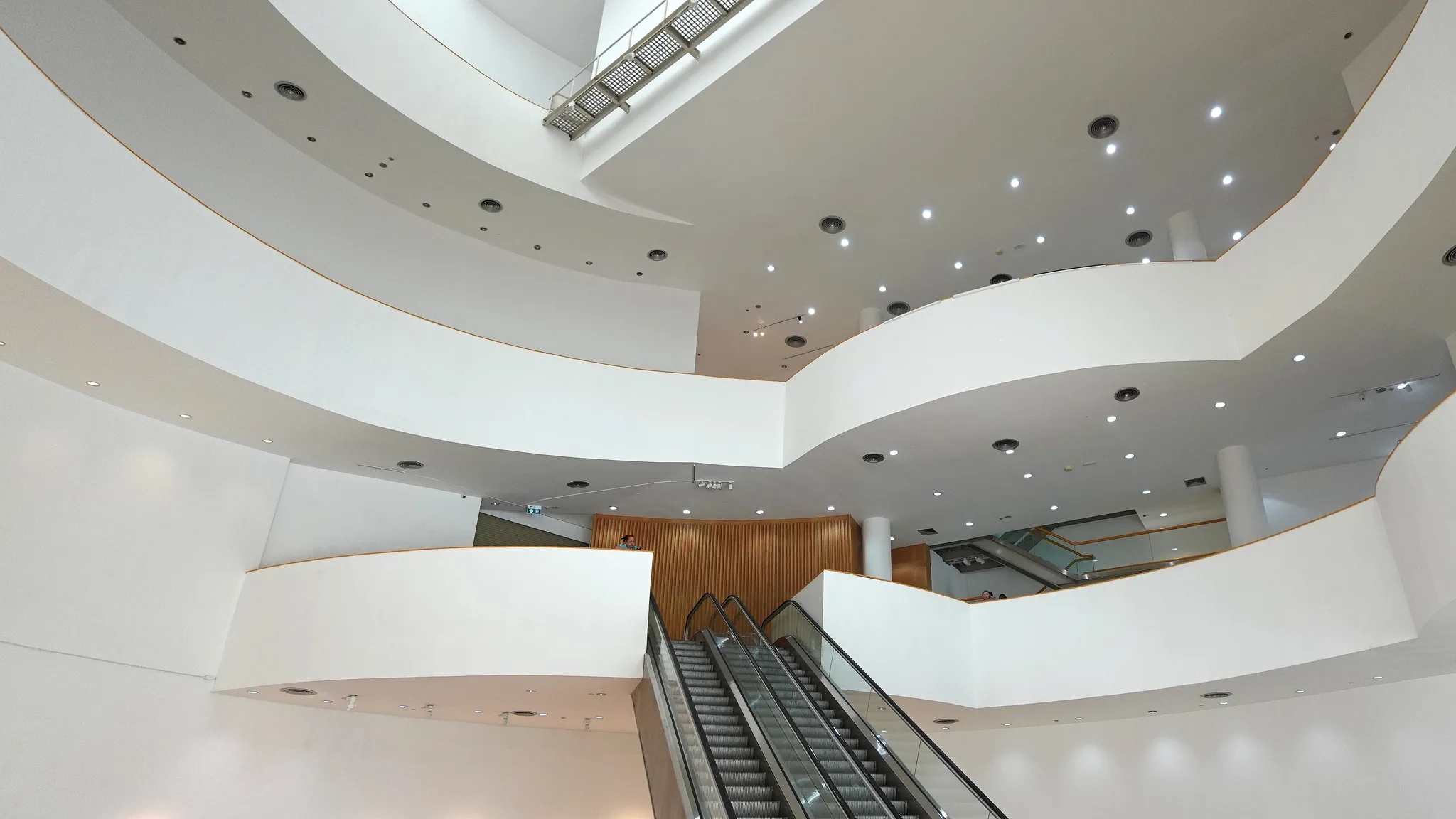
L’atrium du BACC s’élève sur plusieurs niveaux de balcons courbes aux parois blanches, ponctués de spots encastrés ; des escaliers mécaniques mènent vers un mur habillé de lattes de bois.© Eric Monteil
Architecture and decoration
Explore the heritage
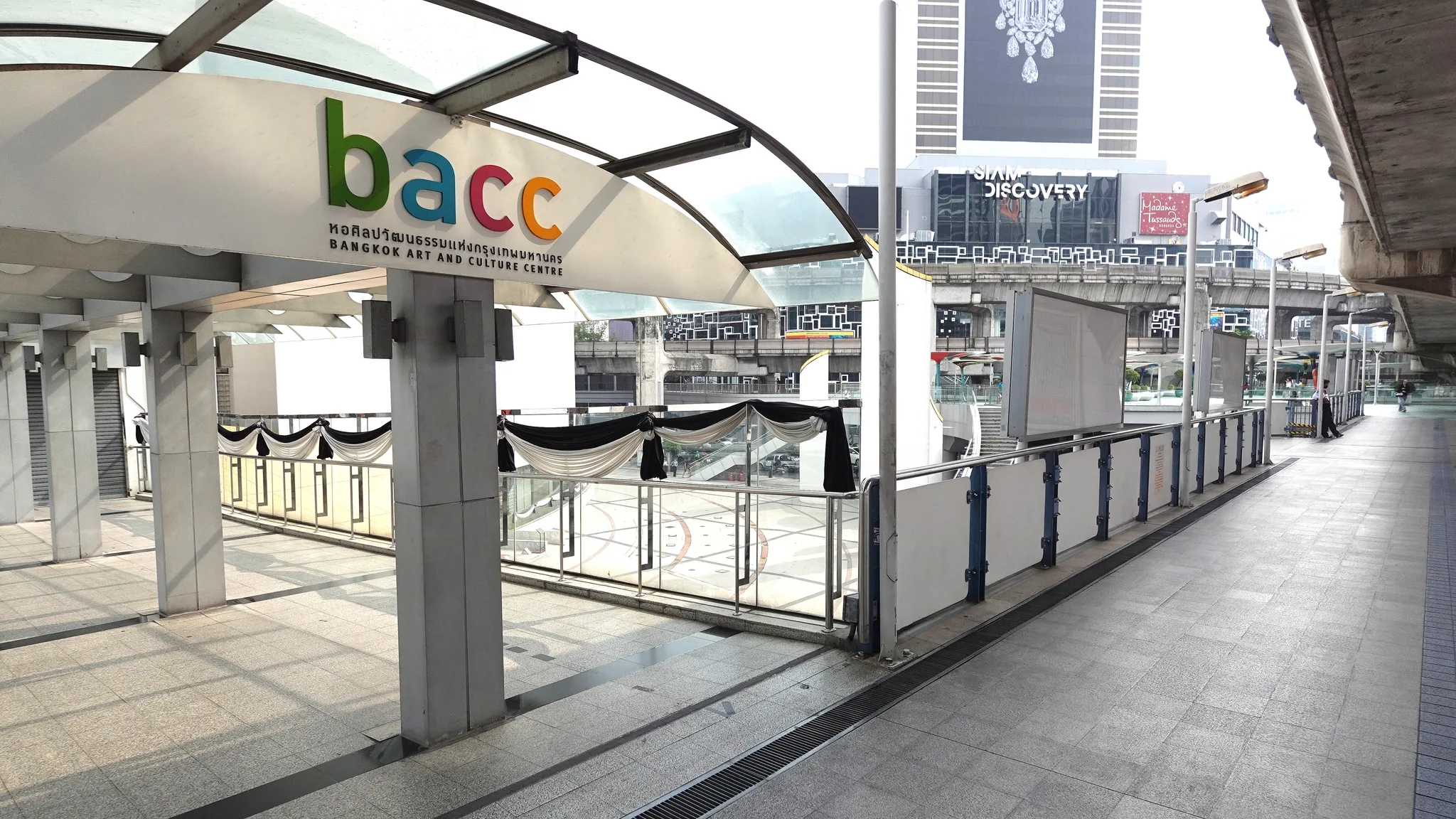
Auvent courbe vitré du BACC, portant le logo et le nom en thaï et en anglais, sur la passerelle surélevée ; des draperies noires et blanches ornent les garde-corps, face au centre commercial Siam Discovery.© Eric Monteil 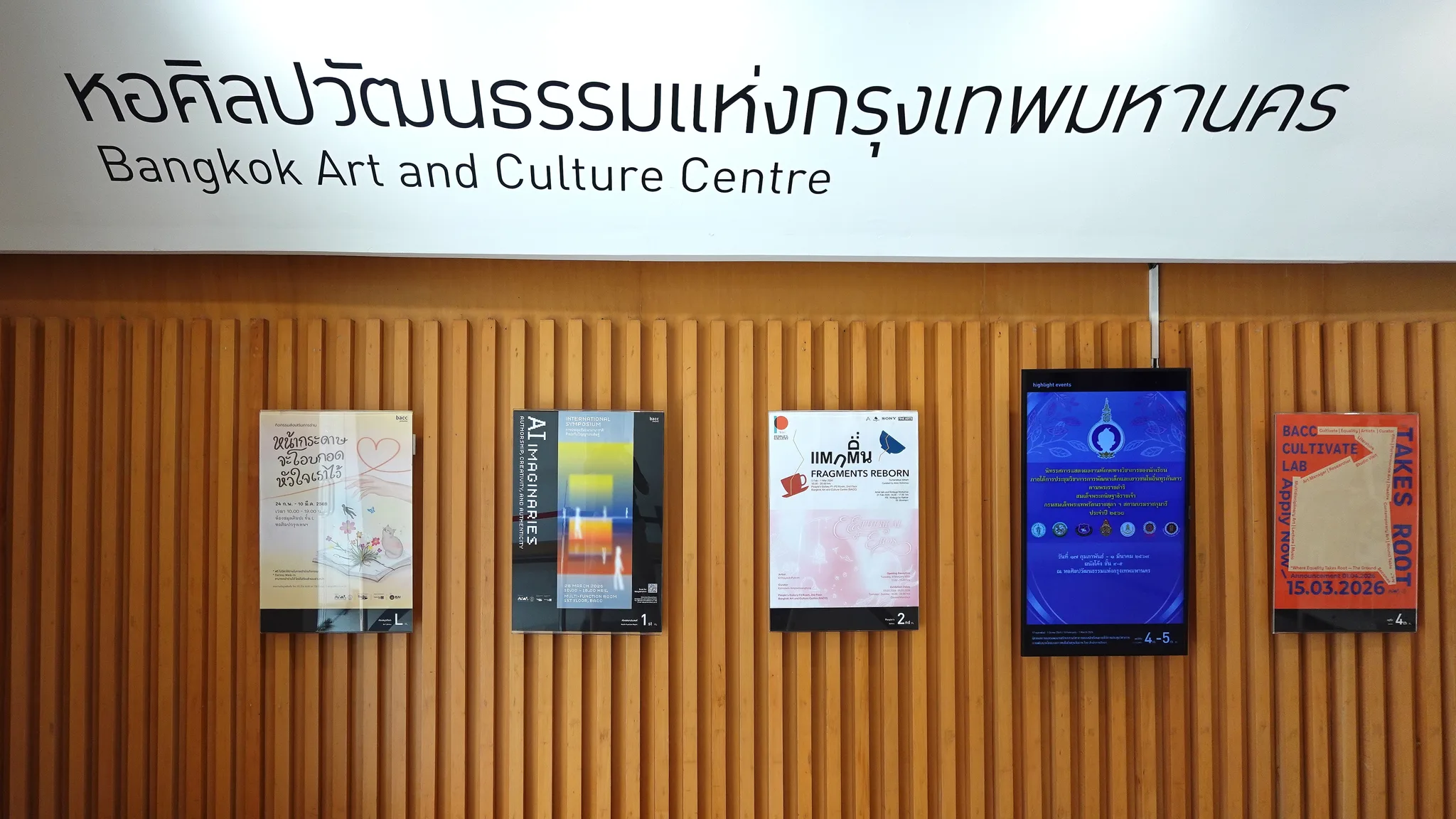
Au BACC, une enseigne blanche en thaï et en anglais surmonte un parement de lattes de bois verticales où sont accrochés quatre affiches et un écran signalant les programmes par étage.© Eric Monteil