
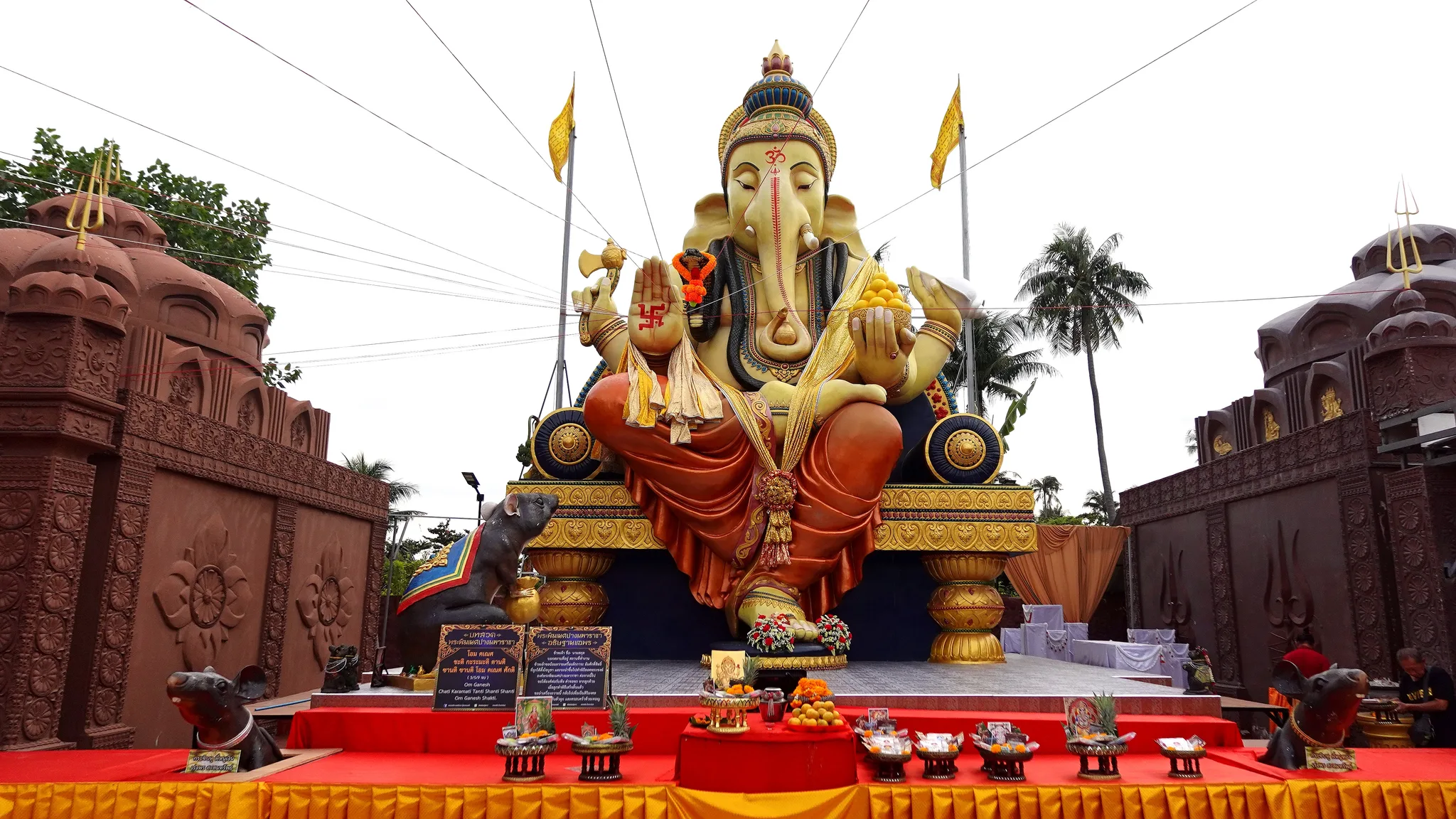
 At Mahadevalai Ganesha, a colossal statue of a seated Ganesh, draped in orange and wearing a gilded crown, towers over an offering table laden with fruit and flowers, between two buildings with carved façades topped by tridents.© Eric Monteil
Brahmanical & Hindu shrine
Mahadevalai Ganesha
On the Bang Kachao peninsula, a recently founded private Hindu shrine shows how devotion to Ganesha, centred on success, is shaping new places of worship in Thailand today.
Heritage family · Buddhism, religions and spiritualities
- Destination
- Samut Prakan (Phra Pradaeng)
- Heritage Family
- Buddhism, religions and spiritualities
- Typology
- Brahmanical & Hindu shrine
- Visit
- Available tours →
The Mahadevalai Ganesha is a private Hindu shrine dedicated to Ganesha, known in Thai as Phra Phikhanet. It stands on the Bang Kachao peninsula, in a bend of the Chao Phraya River close to Bangkok. Recently founded on the initiative of a single individual, it matters less for its age than for what it reveals: the place of Brahmanical cults in present-day Thailand and the rise of a devotion centred on success and good fortune. Having become within a few years a spiritual landmark of Phra Pradaeng district, it is organised around a large statue of a seated Ganesha and a rite in which the devotee passes beneath the statue to make a wish.3
Key facts
- Destination
- Phra Pradaeng
- Heritage Family
- Buddhism, religions and spiritualities
- Typology
- Brahmanical & Hindu shrine
- Places
- Chao Phraya River
- Bang Krachao
- Periods
- —
- People
- Ajarn Be Ommastra
- Communities
- —
- Events
- Founding
- Heritage
- —
- Glossary
- Chao Phraya
- Phraya
- Buddhist cosmology
- Mutelu
- Brahmin
- Ancient monument
- Keywords
- —
- Date
- —
- Collections
- —
Practical info
Practical information about this site is taken from its Google Maps page. We advise you to check it before visiting.
- Address
- Bang Kachao, Phra Pradaeng District, Samut Prakan 10130
- Phone
A Ganesha shrine on the doorstep of Bangkok
A temple of the gods dedicated to Phra Phikhanet
The Mahadevalai Ganesha is a Hindu place of worship of recent construction, established in Phra Pradaeng district, Samut Prakan province. It is dedicated chiefly to Ganesha, the elephant-headed Hindu deity whom Thais call Phra Phikhanet. Its full Thai name, Maha Thewalai Phra Phikhanet Khung Bang Krachao, which is also the name under which the shrine presents itself to the public, reads almost like a definition. “Maha” means great; “thewalai”, the Thai equivalent of devalaya, denotes the dwelling of the gods, that is, the temple; “Khung Bang Krachao” refers to the bend of the river in which it stands. The name also circulates in several romanised spellings, including Mahadevalai Ganesha.7
The site belongs to the Brahmanical and Hindu cults as they are practised in Thailand. It is neither a Buddhist monastery nor an ancient sanctuary inherited from a royal court: it is a thewalai, a temple of the gods, where Brahmins, priests responsible for conducting the rites, officiate for the faithful. This character accounts for its appearance and its customs, which centre on prayer addressed to Hindu gods rather than on the life of a monastic community.
The Bang Kachao river bend
The shrine occupies a distinctive territory. Bang Kachao is a broad bend of the Chao Phraya River, nicknamed “kraphao mu”, the “pig’s stomach”, on account of its shape. Close to Bangkok yet still retaining extensive green spaces, it is known for its walks and nature-discovery activities.5
The Mahadevalai Ganesha lies not far from the Bang Nam Phueng floating market, one of the busiest spots on the peninsula. These surroundings shape the way people come here: the shrine forms part of a landscape valued for its scenery, and those who make their way to it leave the dense city behind for a greener setting.3
A foundation of our time
Ajarn Be Ommastra, the shrine’s founder
The shrine owes its existence to Ajarn Be Ommastra — “ajarn” being a Thai title given to a master or teacher — who is presented as a spiritual guide and whom the press also describes as the head of a business. In an interview published in the mid-2020s, Ajarn Be Ommastra states that the site was built with personal resources and names Ganesha as the origin of the founder’s faith.2
This account makes the Mahadevalai Ganesha the product of personal conviction rather than of a religious institution, a long-established community or official patronage. The shrine thus bears the imprint of its founder: the founder’s devotion to Ganesha determines its principal deity, and the founder’s presence also makes them the public face of the site.
A history of only a few years
The shrine’s history is measured in years, not centuries. In the early 2020s it was described as having been founded some ten years earlier, which places its creation around the early 2010s. It has therefore not gone through the successive phases — rebuildings, restorations or changes of status — that give the country’s old temples their depth.1
Its trajectory is above all one of growing renown. During the 2020s the national press devoted articles and interviews to it, while visitors’ posts multiplied on social media, where the shrine’s official page draws a wide audience. This visibility, more than any building campaigns, marks the stages of its young history.
The great Ganesha and his divine entourage
The posture of the great king
At the heart of the shrine stands a monumental statue of Ganesha, shown seated in the posture known as “pang maharacha”. In Thai iconography, “pang” denotes the attitude in which a deity is depicted; “maharacha” means “great king”. The height usually given is about nine metres, the equivalent of a three-storey building: the statue dominates the site and governs the route taken by the faithful, since the principal rite takes place at its feet.1
The shrine and those who promote it present this Ganesha as the first in the world, and the only one in Thailand, in this posture. Such claims belong to the site’s own account of itself; they convey the importance the shrine attaches to the royal posture of its statue and the way it sets itself apart from other places of devotion to Ganesha.4
The other venerated figures
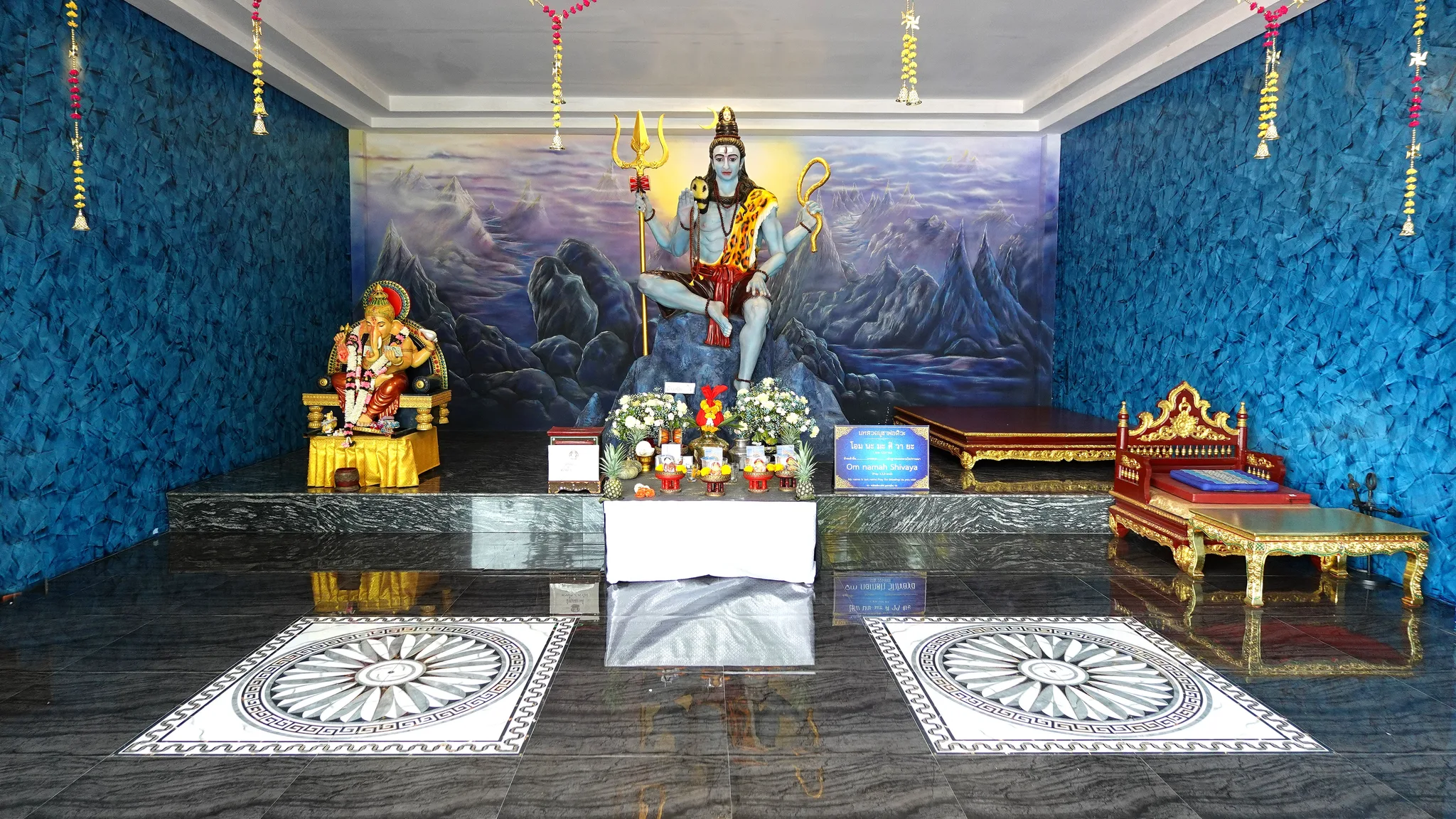
Ganesha is not alone. Around him are honoured Shiva, known in Thai as Phra Siwa, and Uma, his consort in the Hindu tradition, as well as Thao Wetsuwan (Vessavaṇa), one of the world guardians of Buddhist cosmology. The shrine also houses two nāga figures, serpent deities, Chao Pu Si Suttho and Chao Ya Si Pathumma.6
This gathering of Hindu deities, a figure drawn from Thai Buddhism and nāga shows that the site is not confined to a strictly Hindu pantheon. It brings together figures already present in the country’s popular devotion, to whom the faithful turn with concrete requests. The deities on display have, moreover, varied over time, a sign of a shrine still taking shape.
Praying for success
A devotion centred on luck
People come to the Mahadevalai Ganesha to ask for success, professional achievement and fortune. The shrine is part of the phenomenon known in Thai as “sai mu” or “mutelu”, a devotion centred on luck, which leads many Thais to places reputed to favour their undertakings.1
Ganesha holds a prominent place in this devotion, and the shrine makes him its focus. It draws part of its appeal from this: its renown has grown in step with the taste for places of prayer where specific wishes are made, and it is from this angle that the press most often presents it.
Passing beneath the statue
The principal rite, called “phithi lot tai phra chong”, consists of passing beneath the legs of the statue of Ganesha. A Brahmin conducts it according to a precise sequence. On the first pass, the devotee holds their breath and entrusts to the deity their sorrows and whatever they wish to leave behind. On the second, they breathe normally and make a single wish.3
This limit stems from a belief handed down on site: asking for more would be seen as greed, which the deity would not reward. The rite thus combines two movements, shedding a burden and then expressing a hope, and gives the wish a measured form. The gesture, simple and guided by the officiant, largely explains the number of people who visit the site.3
Offerings for the home
Prayer is accompanied by offerings. The devotee chooses a set suited to their wish, and these objects may then be taken home for domestic worship. Devotion therefore does not stop at the boundaries of the shrine: it continues within the home, where the offerings brought back serve as a focus for daily prayer.1
A spiritual landmark of today
Worshippers and visitors
The Mahadevalai Ganesha is today an active site, where visits and rites follow one another every day. It is becoming one of the spiritual landmarks of the Phra Pradaeng area and attracts worshippers as well as people in search of serenity.3
Its popularity rests both on its religious reputation and on its location on the Bang Kachao peninsula. Some come to make a wish, others discover the shrine during an outing to the river bend, and many then share their visit online. The site thus lives on a circulation between devotion, leisure and public image.9
What the shrine reveals
As a recent private foundation, the Mahadevalai Ganesha does not belong to the country’s ancient heritage. Its heritage interest is of another kind: it makes visible the Brahmanical and Hindu cults as they are practised in Thailand today, the place of Ganesha in popular devotion and the rise of the mutelu phenomenon.
The shrine also bears witness to the way places of worship come into being today: through one person’s initiative, a monumental statue, a rite that is easy to share and an openly embraced presence in the media and on social networks. Bound to a territory valued for its natural spaces, it shows how a landscape close to Bangkok is hosting new forms of religiosity.
Understanding
The Mahadevalai Ganesha is neither an ancient monument nor a Buddhist monastery: it is a Hindu place of worship recently founded by a private individual, where Brahmins conduct the rites every day before Ganesha and the deities around him. Its significance lies in what it makes visible: a contemporary Thai devotion that turns to the Hindu gods for success and fortune, and that finds its most widely shared form in a simple gesture — passing beneath a statue to lay down one’s sorrows and then make a single wish. Its future remains tied to this movement. The shrine owes its recent renown to the press, to social media and to the appeal of Bang Kachao, and it is beginning to count among the spiritual landmarks of Phra Pradaeng. Yet it remains a young foundation, bound to the faith of its founder and carried by an enthusiasm whose duration no one can foretell. Can a place born of the pursuit of luck become, over the generations, a true religious heritage?
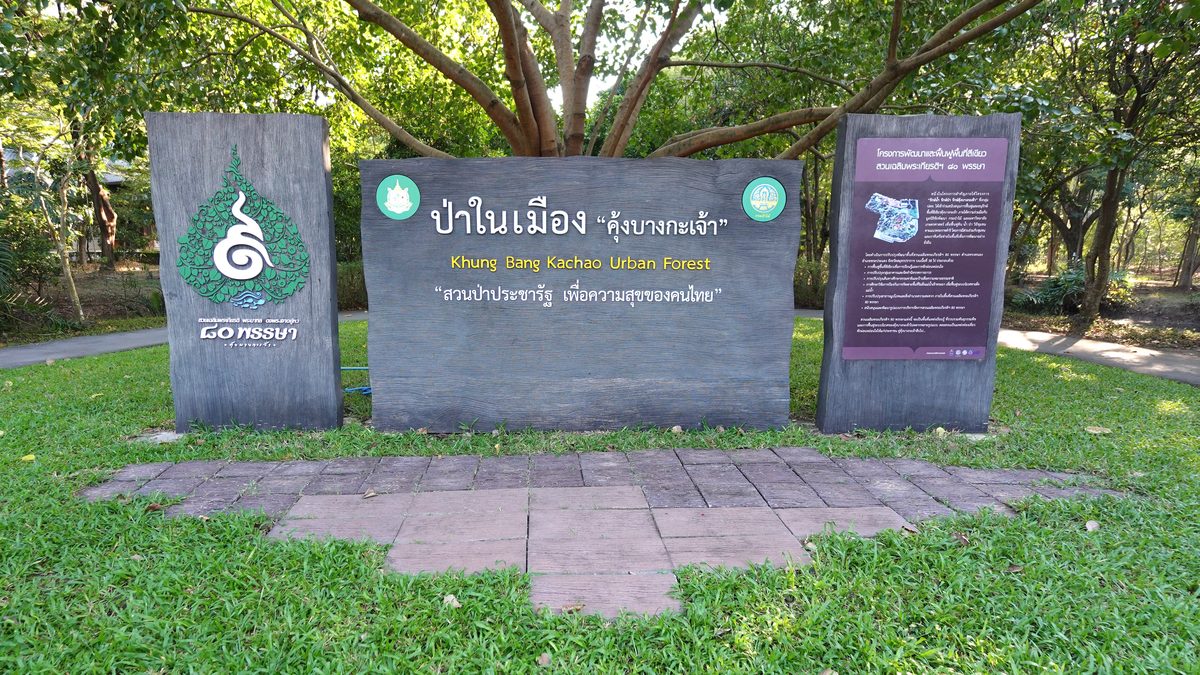
Bang Krachao, the "green lung" of Bangkok, between canals, Mon heritage, temples, biodiversity and sustainable initiatives.
- Chao Phraya
- Highest title of the Siamese nobility, held by senior dignitaries of the court.
- Phraya
- Rank of the Siamese court nobility, immediately below that of chao phraya; it precedes the dignitary’s title name.
- Buddhist cosmology
- Buddhist representation of the universe, organised around Mount Meru and made up of continents, oceans, mountain ranges and superimposed worlds.
- Mutelu
- The set of good-luck beliefs and practices (wishes, offerings, amulets, divination) widespread in contemporary Thailand.
- Brahmin
- In Thailand, an officiant heir to the Hindu tradition, attached to the court, who conducts or assists royal rites of Brahmanical origin alongside the Buddhist clergy.
- Ancient monument
- In Thailand, a legal category (boran sathan) that places a building or site under State protection as heritage.
- Sangha
- The body of monks who reside in a monastery and live there according to religious discipline; in Buddhism it is called the sangha.
- Phra Phikhanet
- Thai name for Ganesha, the elephant-headed Hindu deity, venerated in Thailand as patron of the arts, learning and success.
- Thewalai
- Thai word, equivalent of the Sanskrit devalaya, meaning the abode of the gods, that is, a temple dedicated to Hindu deities.
- Ajarn
- Thai title of respect given to a master, teacher or spiritual guide.
- Pang maharacha
- So-called ‘great king’ posture in Thai iconography, in which a deity is depicted seated.
- Pang
- In Thai iconography, the codified attitude or posture in which a deity or the Buddha is depicted.
- Thao Wetsuwan
- Thai name of Vessavaṇa, one of the guardians of the world in Buddhist cosmology.
- Sai mu
- Thai expression which, like mutelu, refers to a devotion focused on luck, leading worshippers to places reputed to favour their undertakings.
- Phithi lot tai phra chong
- Thai rite consisting of passing beneath the legs of a deity’s statue, led by a Brahmin, in order to make a wish.
Studies
Reference works
- 3'พระประแดง': มหาเทวาลัยพระพิฆเนศปางมหาราชา แห่งแรกของ..., OKMD Knowledge Portal (สำนักงานบริหารและพัฒนาองค์ความรู้) ↗
- 4มหาเทวลัยพระพิฆเนศ ไหว้ขอพร พระพิฆเนศปางมหาราชา สมุทรปราการ, TrueID Travel ↗
- 5เที่ยวสมุทรปราการ พระประแดง บางกระเจ้า พระพิฆเนศปางมหาราชา (Ganesha), iok2u.com ↗
- 6มหาเทวาลัย พระพิฆเนศ – fiche et avis, Wongnai ↗
- 7Mahadevalai Ganesha, มหาเทวลัย - พระพิฆเนศ คุ้งบางกระเจ้า (page officielle), Facebook ↗
- 8Travel Guide for Maha Devalaya Hindu Temple (contenus de visiteurs), Trip.com Moments ↗
- 9ไหว้พระพิฆเนศ บางกระเจ้า (ใกล้ตลาดน้ำบางน้ำผึ้ง) องค์ใหญ่ 9 เมตร + พิธีลอดขอพร (et publications de visiteurs associées), Lemon8 ↗
- 10Bang Krachao: Cycling Bangkok's Green Lung, Visit Thailand Today ↗
Contemporary views
Mahadevalai Ganesha today
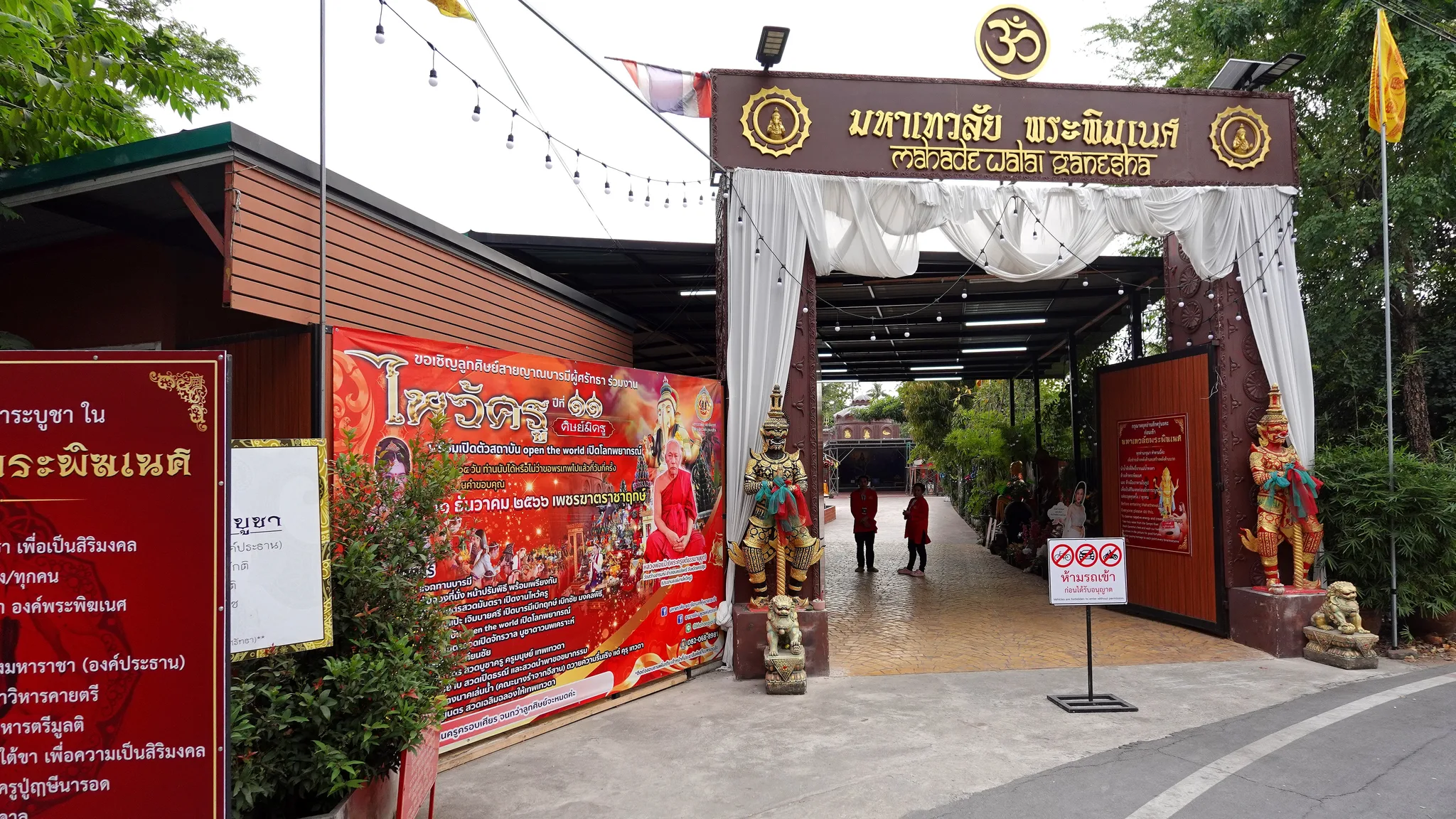
The entrance to Mahadevalai Ganesha opens beneath a wooden gateway topped by the Om symbol and an inscription in Thai and Latin script, guarded by two giant statues and lions; a covered walkway leads into the shrine.© Eric Monteil 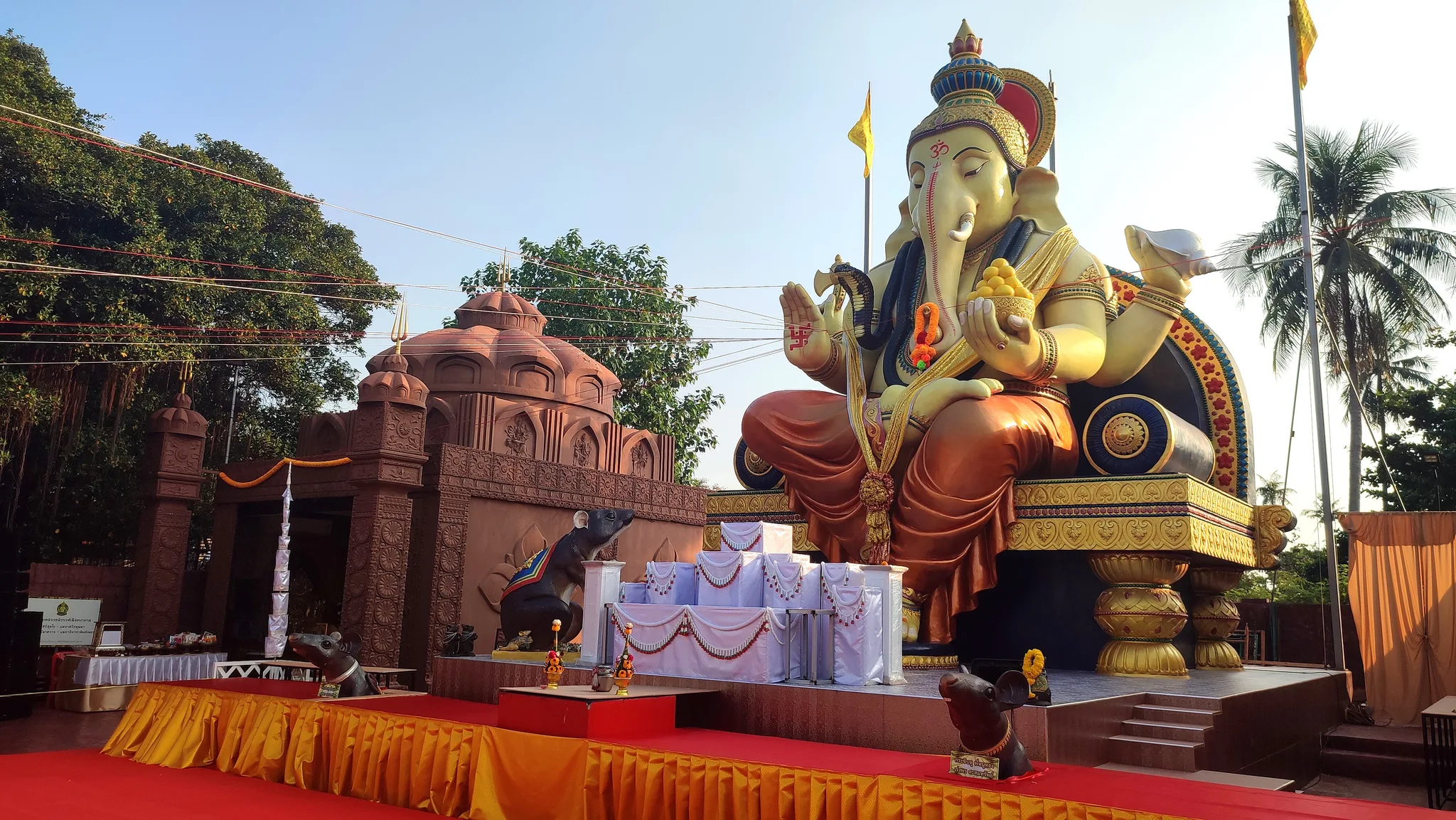
At Mahadevalai Ganesha, a colossal seated Ganesha, clad in orange and holding a conch and offerings, towers over a platform draped in red and gold; to the left stand a carved shrine and statues of rats, his mount.© Eric Monteil
Architecture and decoration
Explore the heritage
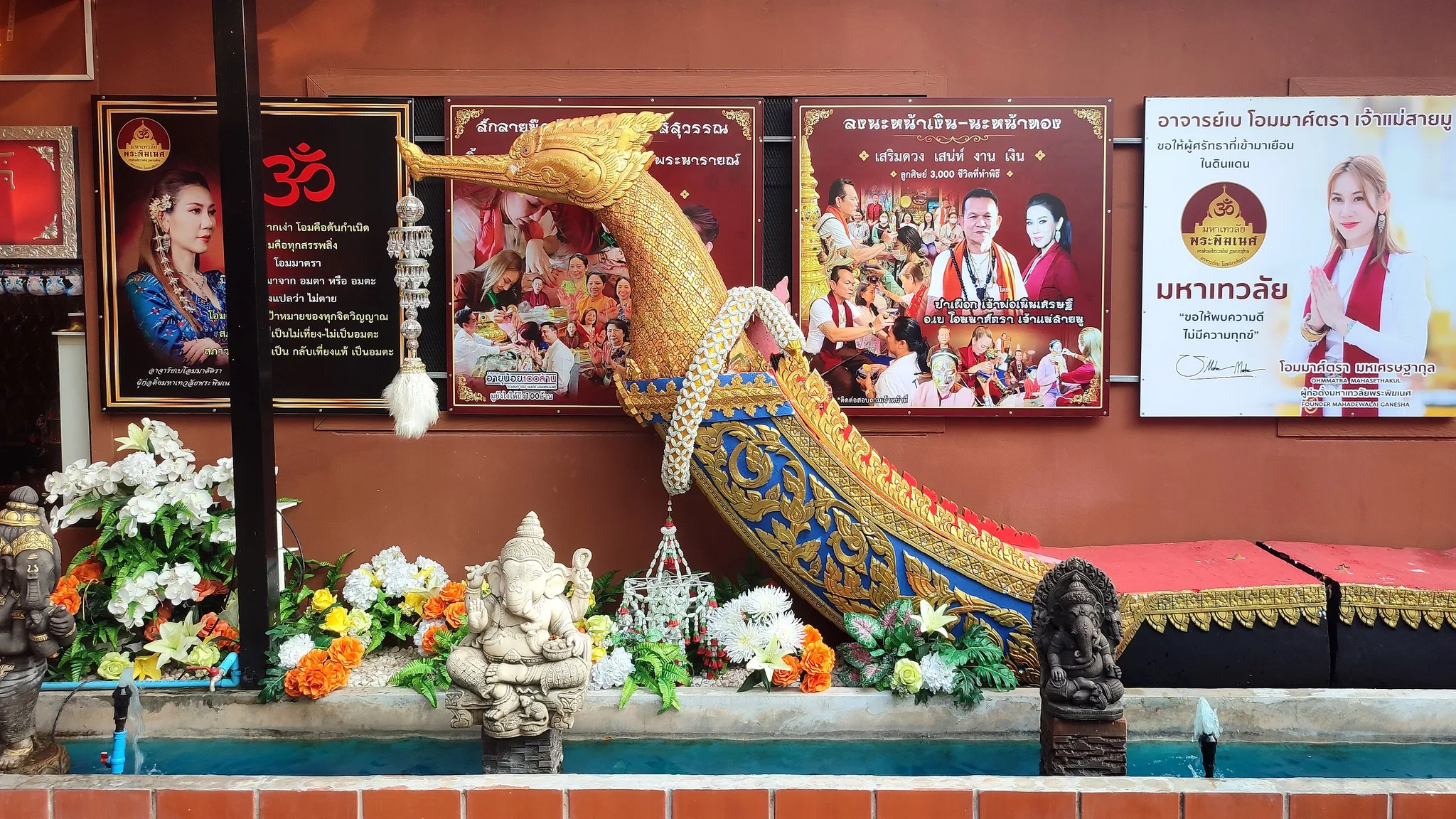
At Mahadevalai Ganesha, a gilded and blue boat prow adorned with a jasmine garland rises above a pool lined with Ganesha statues and flowers, in front of panels in Thai.© Eric Monteil 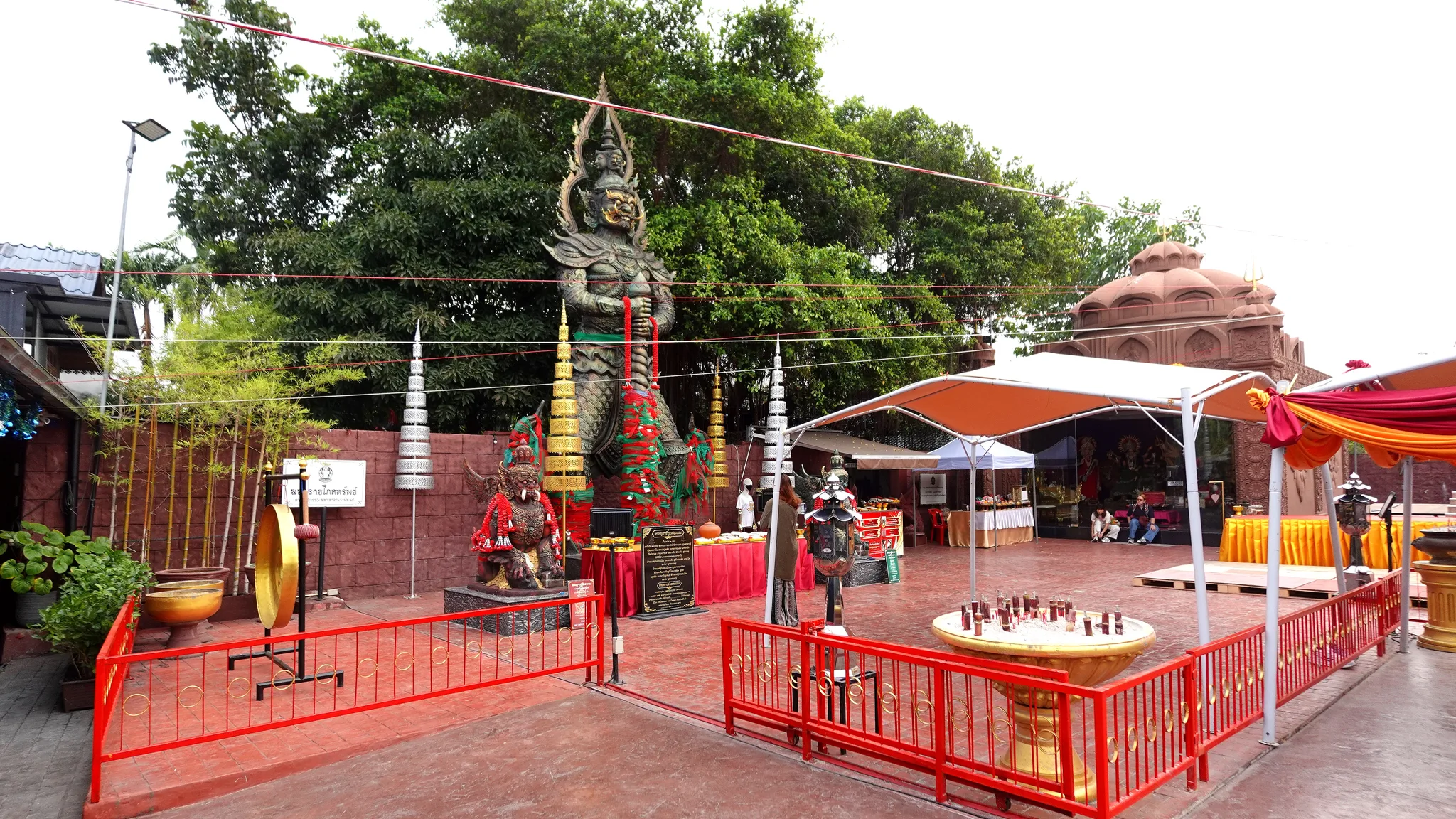
In the courtyard of Mahadevalai Ganesha, a large guardian statue adorned with garlands stands between golden tiered parasols, near a gong, a candle stand and a shrine with an ornate pink-toned dome.© Eric Monteil