
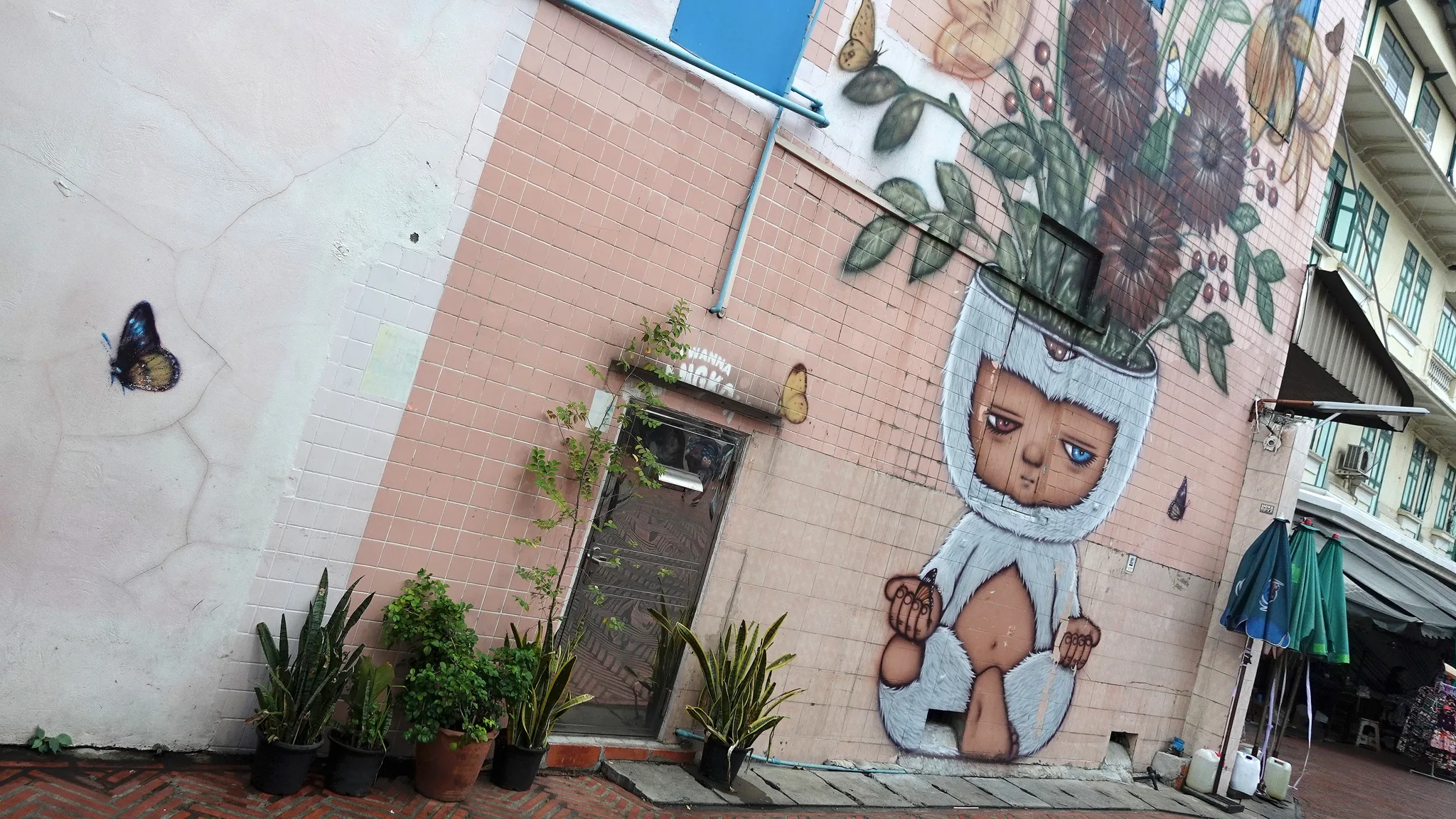
 On a pink tiled wall, Alex Face Mural Art depicts a child in a white furry suit holding a butterfly, the hood serving as a pot for a bouquet of flowers; potted plants line the pavement.© Eric Monteil
- Destination
- Bangkok (Phra Nakhon)
- Heritage Family
- Arts, aesthetics and creation
- Typology
- Public art & street art
- Visit
- Available tours →
Alex Face Mural Art is a street painting by the Thai artist Alex Face, executed on a wall beside Khlong Ong Ang in the old centre of Bangkok, between Phahurat and Chinatown. It matters because it places in public space the work of one of the artists who brought Thai street art to audiences abroad, together with his emblematic character, Mardi. This character was born of a father’s anxiety about his daughter’s future. Here the three-eyed child is shown in meditation, in a work that belongs to an art conceived to be ephemeral.9
Key facts
- Destination
- Bangkok
- Heritage Family
- Arts, aesthetics and creation
- Typology
- Public art & street art
- Places
- Khlong Ong Ang Street Art
- Khlong Ong Ang
- Phahurat Market
- Phra Nakhon
- Periods
- —
- People
- Alex Face
- Communities
- —
- Events
- —
- Heritage
- —
- Glossary
- Khlong
- Wang
- San
- Keywords
- —
- Date
- —
- Collections
- —
Practical info
Practical information about this site is taken from its Google Maps page. We advise you to check it before visiting.
- Address
- PGV3+J2J, Wang Burapha Phirom, Phra Nakhon, Bangkok 10200
A wall beside Khlong Ong Ang
Between Phahurat and Chinatown
Alex Face Mural Art occupies a wall in Phra Nakhon district, the historic heart of Bangkok, on the banks of Khlong Ong Ang. The Thai word khlong means a canal; this one runs here between the Wang Burapha Phirom area and the area of Phahurat and Chinatown. The work is to be found neither in a museum nor in a gallery, but in the ordinary fabric of the city, on a wall visible from the canal banks.9
Such a setting is that of street art, the art that takes the walls of public space as its support. The painting belongs to the street, it offers itself to anyone who passes, and it shares the street’s vicissitudes too: a wall can be repainted, altered or demolished. To understand Alex Face Mural Art, then, is to look at once at an image, at the artist who painted it and at the way this art regards its own lifespan.
Mardi in meditation
The painting depicts Mardi, the character Alex Face has been painting since 2009: a child recognisable by its three eyes. In the artist’s other works, Mardi’s expression usually ranges from drowsy to suspicious. Beside Khlong Ong Ang, it is the attitude of meditation that has been chosen.10
From Patcharapol Tangruen to Alex Face
A name drawn from the tag
Alex Face is the pseudonym of Patcharapol Tangruen (born 1981), a Thai artist from Chachoengsao province who lives and works in Bangkok. His first graffiti signed with this name dates from 2002: he sprayed it on an old car. The pseudonym comes from his practice of tagging, the spray-painted signature that graffiti writers repeat from wall to wall. He would tag sometimes his name, sometimes his face, sometimes motifs chosen at random – hence the name Alex Face.2
His early work is marked by a graphic design showing half of his face. He then made a habit of drawing his self-portrait in place of the usual tag.19
From abandoned buildings to festivals
Patcharapol Tangruen trained at King Mongkut’s Institute of Technology, where he obtained a bachelor’s degree in the department of fine and applied arts. His interest in architecture led him to explore Bangkok’s abandoned buildings, which became his first surfaces.13
In 2012, the exhibition ‘The Underground Adventure Part 1’ was the first in which every work found a buyer. The following year, together with the artist Mue Bon, known as Bon, he painted a mural beside Khlong San Saep, another Bangkok canal, as part of the Bukruk street art festival.18
An international audience
Also in 2013, Alex Face was invited to a street art festival in Yangon, Myanmar. In 2014 he stayed in Norway to teach street art to young people, then spent around three months creating work across Europe. His murals can be found in London, Tokyo and Berlin, and in 2019 he took part in the Peinture Fraîche festival in Lyon.1
He is among the artists who brought Thai street art to audiences abroad. One of his works belongs to the permanent collection of MOCA Bangkok, the capital’s museum of contemporary art.4
Mardi, the three-eyed child
The face of a newborn
Mardi was born in 2009, after the birth of the artist’s daughter. The newborn’s face struck him as grumpy, as if the child were already worried about its future, and it is this impression that he carried over into his character. Since that birth, he explains, he has worried about the future of his city, his country and the planet.3
The character thus springs from a father’s intimate experience, yet from the outset it carries a wider anxiety. The painted child is not merely a family portrait: it becomes the vehicle for a gaze upon the world in which this girl will grow up.
The rabbit, the third eye and the city
Mardi is a child dressed in a rabbit costume, or in a fluffy animal outfit. For the artist, the rabbit represents the victim in today’s world, and children themselves are presented as victims of the media, marketing, education and society. The third eye, always on the alert, watches what the other two avoid: it lends the character a vigilance that the softness of the costume would not lead one to expect.3
Beyond the artist’s daughter, Mardi is presented as the voice of the ordinary inhabitants of Bangkok and the neighbouring provinces.16
Painting for the street
A spray can wielded like a brush
Alex Face paints his walls with aerosol spray paint, but he uses it gently enough that his street paintings seem to have been made with a giant brush and recall gallery painting. He has also mastered techniques of the European Old Masters.1
This attention to finish brings the wall closer to the canvas. For him, the street is not a place for a quick sketch but a painting surface in its own right, where the character must retain the same presence as in an exhibition.
2020, the year of flowers
At the end of 2020, Alex Face presented ‘Monument of Hope’ at BANGKOK CITYCITY GALLERY. The series shows luminous flowers emerging from the child’s pot-shaped head. It evokes the fragility of life and the potential of Thailand’s younger generation, with an allusion to the country’s political situation, and also echoes the pandemic.12
The Khlong Ong Ang painting was in place during the same period.9
An art of the ephemeral
Accepting being painted over
Street art is ephemeral by nature, and Alex Face has made this a subject of reflection. In Phuket, a painting of Mardi on the former Standard Chartered building in the old town provoked opposition: a meeting voted for its removal, and the artist erased it himself. He stated at the time that street artists accept that their works will be painted over sooner or later.6
This episode sheds light on the condition of Alex Face Mural Art. The work is not made to endure like a monument: it exists for as long as the wall, the neighbourhood and those who frequent it allow it to exist, and its creator embraces this precariousness as part of his art.
The work and its creator today
Beside Khlong Ong Ang, the painting was still visible in February 2022. That same year, the retrospective ‘20th Year Alex Face’ in Bangkok celebrated twenty years of his career, since the first graffiti of 2002.10
The artist remains active: in 2025 he was hosted in residence at The Holdout Art Farm in Portugal, where he presented the exhibition ‘Caminhos Esquecidos’. Alex Face Mural Art thus forms part of a body of work still in motion, of which Mardi remains the common thread, while the fate of the wall itself depends on the life of the street.7
Understanding
Alex Face Mural Art brings into the old centre of Bangkok, beside Khlong Ong Ang, the best-known figure of an artist who has helped make Thai street art known beyond the country’s borders. Here Mardi carries what Patcharapol Tangruen has entrusted to him since 2009: a father’s anxiety about the future of his child, his city and the planet, and the voice of ordinary inhabitants. Its importance lies less in its age than in what it says about an era and a generation, captured in shared space rather than in an exhibition hall. Yet the work belongs to an art that accepts being painted over, and its creator demonstrated this himself by erasing a contested Mardi in Phuket. Its presence depends on the wall, the neighbourhood and the gaze of those who pass by, while the artist pursues his work elsewhere. Can a painting made to disappear become heritage, and what, then, would we preserve: the image itself, or the gesture of having offered it to the street?
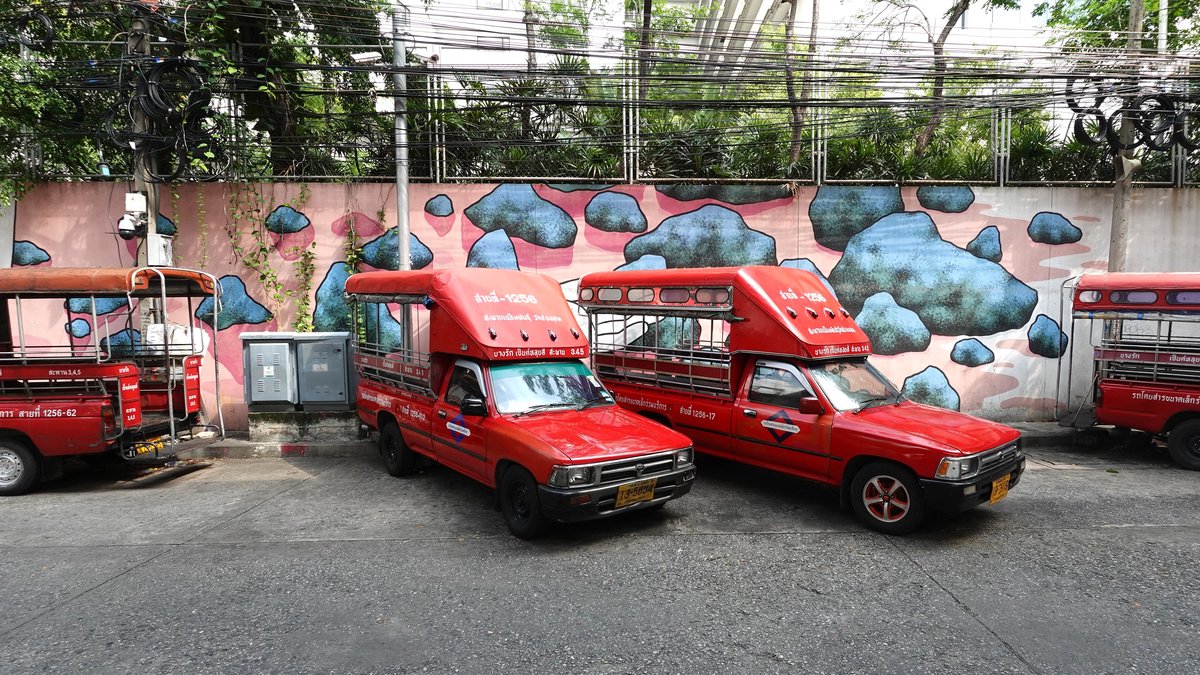
Through Bangkok's creative districts, between street art, architecture, design and new uses of the city.
- Khlong
- Canal or waterway, natural or man-made, which long played a major role in transport, irrigation and the organisation of settlements and territories in Thailand.
- Wang
- Thai word for a palace, particularly the residence of a prince or a member of the royal family.
- San
- In Thailand, a small shrine where worship is offered to a deity, a spirit or a protective figure.
Studies
- 1Faceto Alex Face, Bangkok Post ↗
- 2Crossing boundaries, Bangkok Post, 2022 ↗
- 3Bangkok Street Artist Alex Face on Making Friends (and Enemies) Through Graffiti, BK Magazine ↗
- 4‘ผมอยากเห็นสังคมที่ปลอดภัย’: Alex Face ศิลปินสตรีทอาร์ต และพ่อที่ขอเป็นเบาะในวันที่ลูกล้ม, The Potential ↗
- 5Alex Face’s Alive: การกลับมาของศิลปินกราฟิตี้และเด็กหญิงสามตาของเขา, Sanook, 2016 ↗
- 6Bye-bye Mardi: Alex Face removes controversial Phuket street mural, The Phuket News ↗
- 7Alex Face “Caminhos Esquecidos”: Forgotten Paths in Portugal, Brooklyn Street Art, 2025 ↗
Reference works
- 8Alex Face Art, Mindtrip ↗
- 9A mural by Thai artist Alex Face featuring his three-eyed character Mardi meditating; by Klong Ong Ang, Phahurat / Chinatown area, Bangkok (2DATGAN), Alamy, 2020 ↗
- 10A mural by artist Alex Face featuring his three-eyed character Mardi meditating; by Klong (canal) Ong Ang, Phahurat/Chinatown area (2HTNFT9), Alamy, 2022 ↗
- 11Alex Face — artist, BANGKOK CITYCITY GALLERY ↗
- 12Monument of Hope — Alex Face, BANGKOK CITYCITY GALLERY, 2020 ↗
- 13Alex Face, Volery Gallery ↗
- 14ALEX FACE - Biography, Dorothy Circus Gallery ↗
- 15Alex Face, Dippin' Dusk — 24/7 Hong Kong, Lot 50, Phillips, 2019 ↗
- 16Alex Face (biographie) ; Peace for Bangkok — artwork #11758, street-artwork.com ↗
- 17Alex Face (พัชรพล แตงรื่น), Baramee of Art ↗
- 18Gabriel Camelin (photographie), Bon & Alex Face — Bukruk Festival 2013, Google Arts & Culture, 2013 ↗
- 19Street Art Guide To Bangkok And Interview With Local Artist Alex Face, Splatrs (Medium) ↗
- 20Talking about Ephemerality with Alex Face, BLocal ↗
Contemporary views
Alex Face Mural Art today
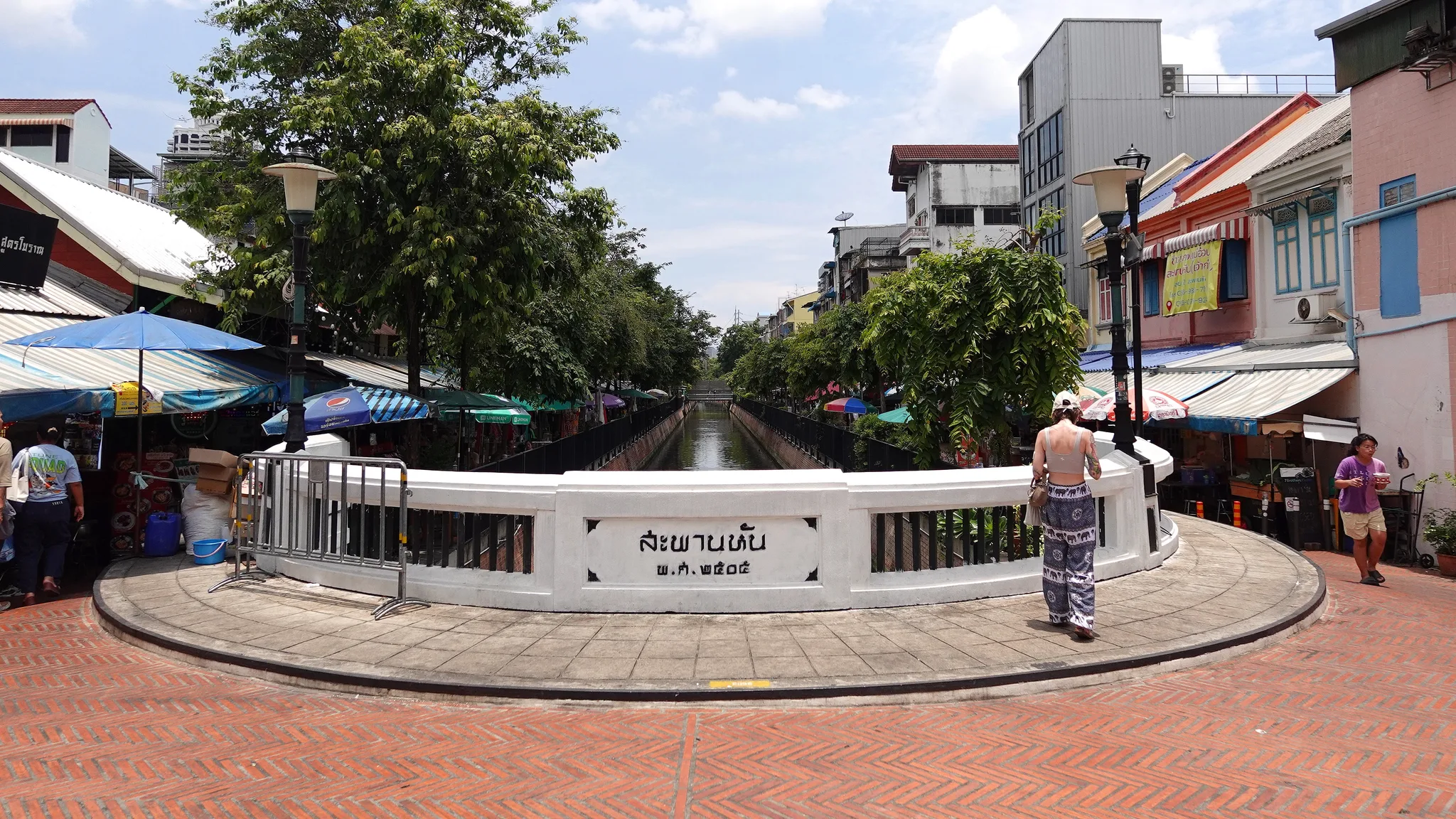
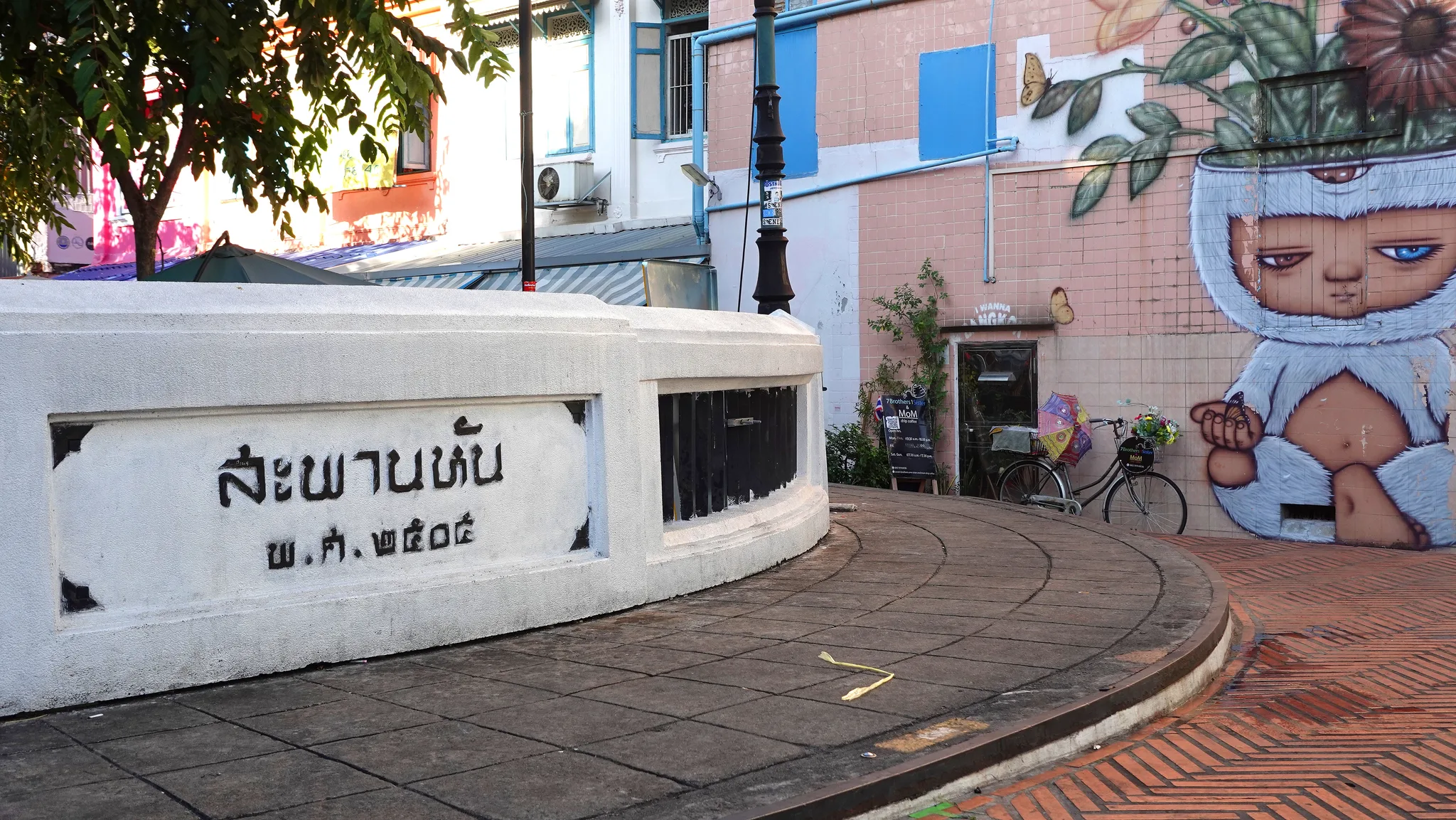
From the brick-paved forecourt, the white parapet of Saphan Han bridge, inscribed in Thai, opens onto the Khlong Ong Ang canal, lined with trees, shops and parasols, in the Alex Face Mural Art area.© Eric Monteil 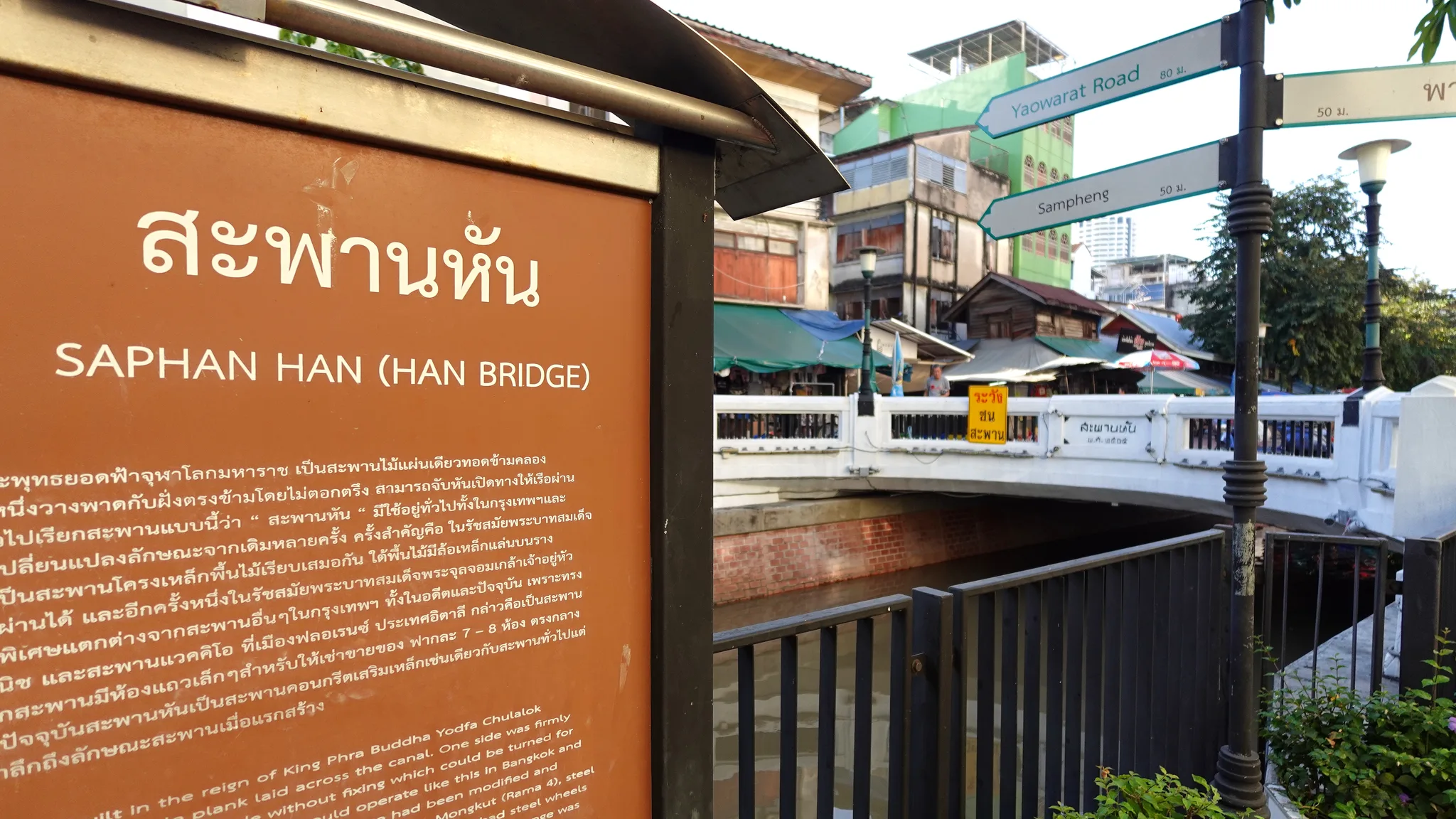
Bilingual Thai-English sign for Saphan Han (Han Bridge) in front of the white-balustraded bridge spanning the canal; signposts point to Yaowarat Road and Sampheng, in the area of Alex Face Mural Art.© Eric Monteil
Architecture and decoration
Explore the heritage
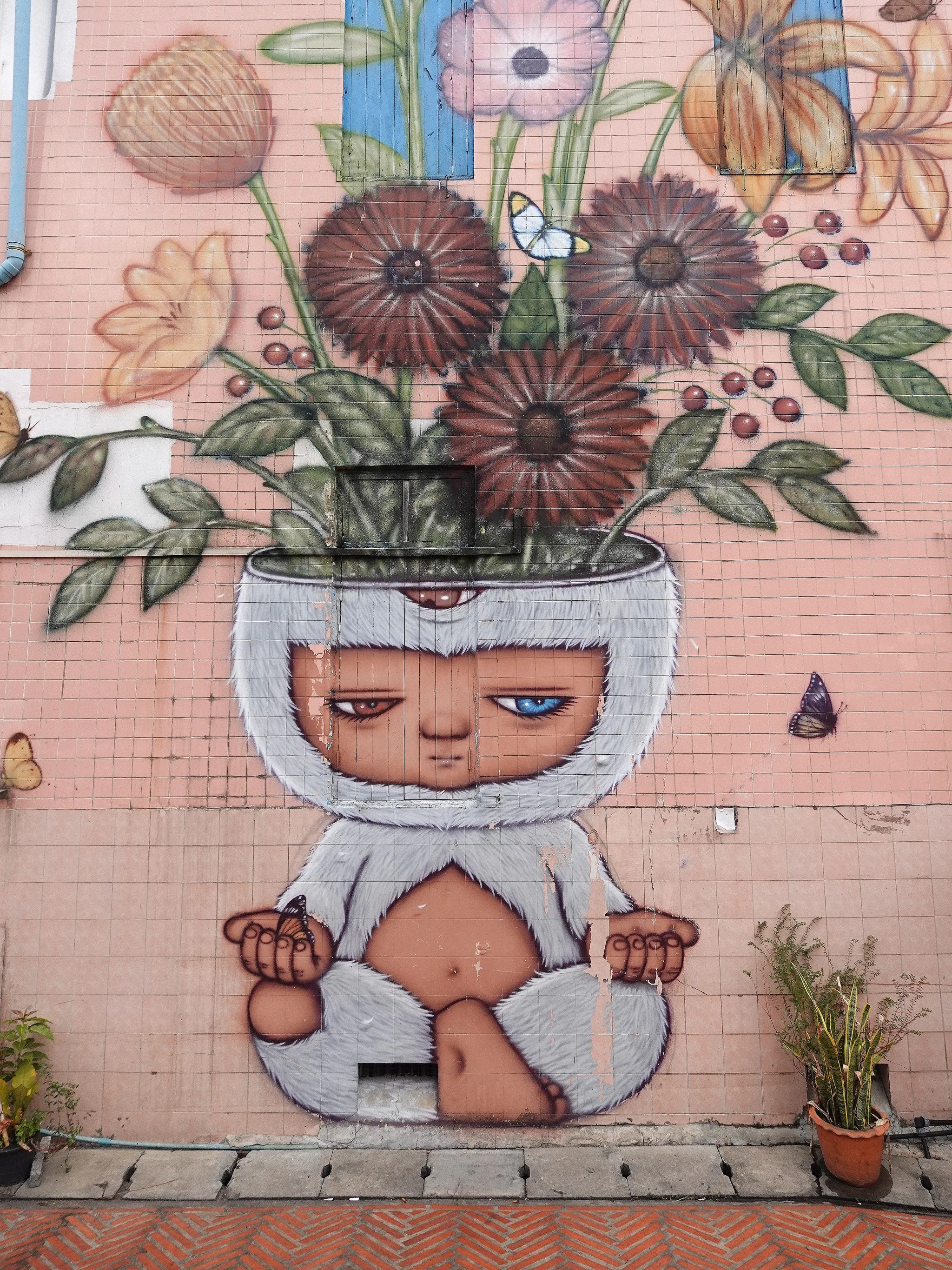
Alex Face Mural Art covers a pink tiled wall: a child with odd-coloured eyes, dressed in white fur, holds a butterfly, his open head bearing a bouquet of flowers that incorporates the façade’s windows and shutters.© Eric Monteil 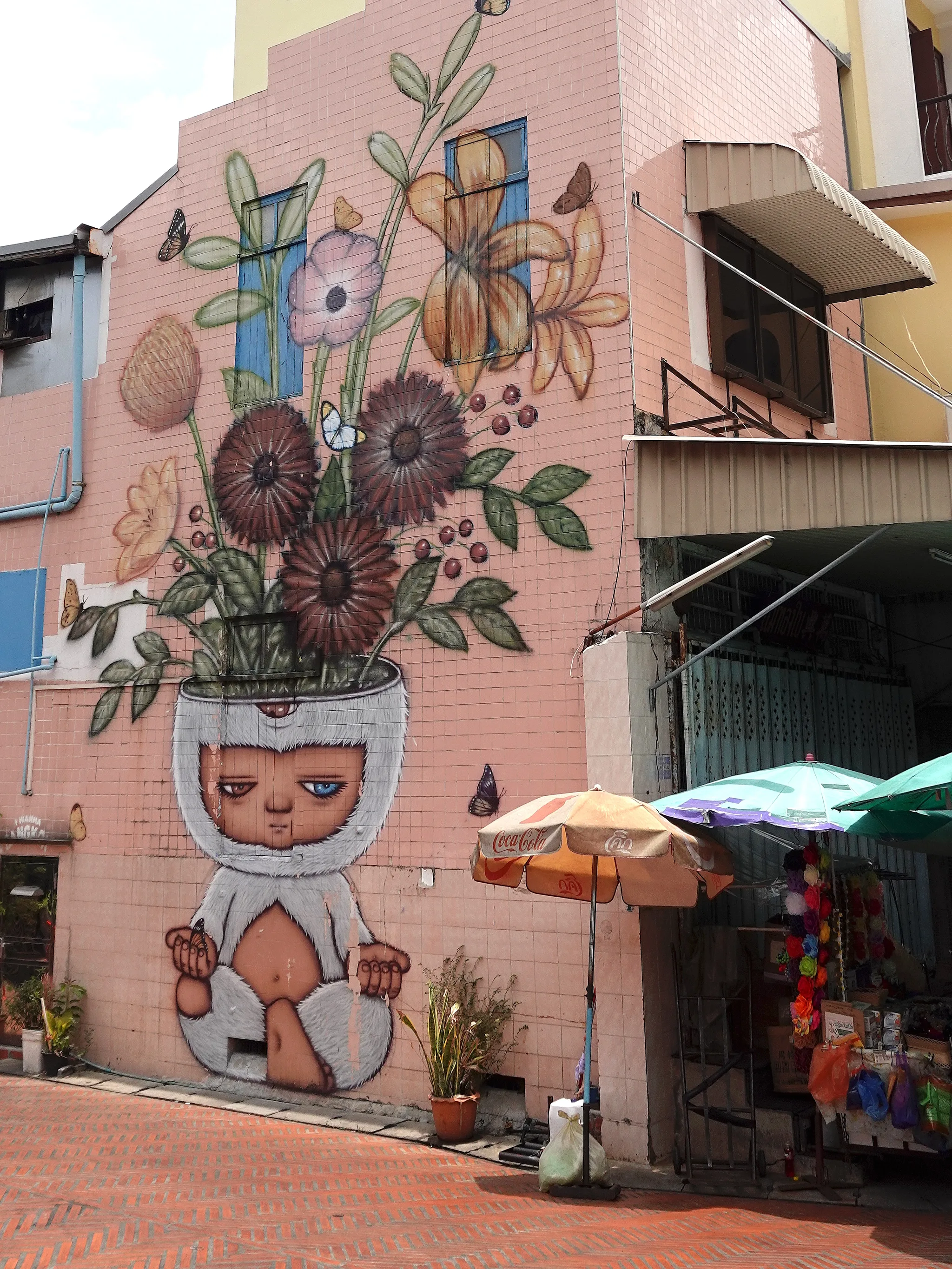
Alex Face Mural Art covers the tiled gable of a building: a child with odd-coloured eyes, dressed in white fur, bears a bouquet of flowers and butterflies that takes in the blue windows. At the foot of the wall stands a stall under parasols.© Eric Monteil