
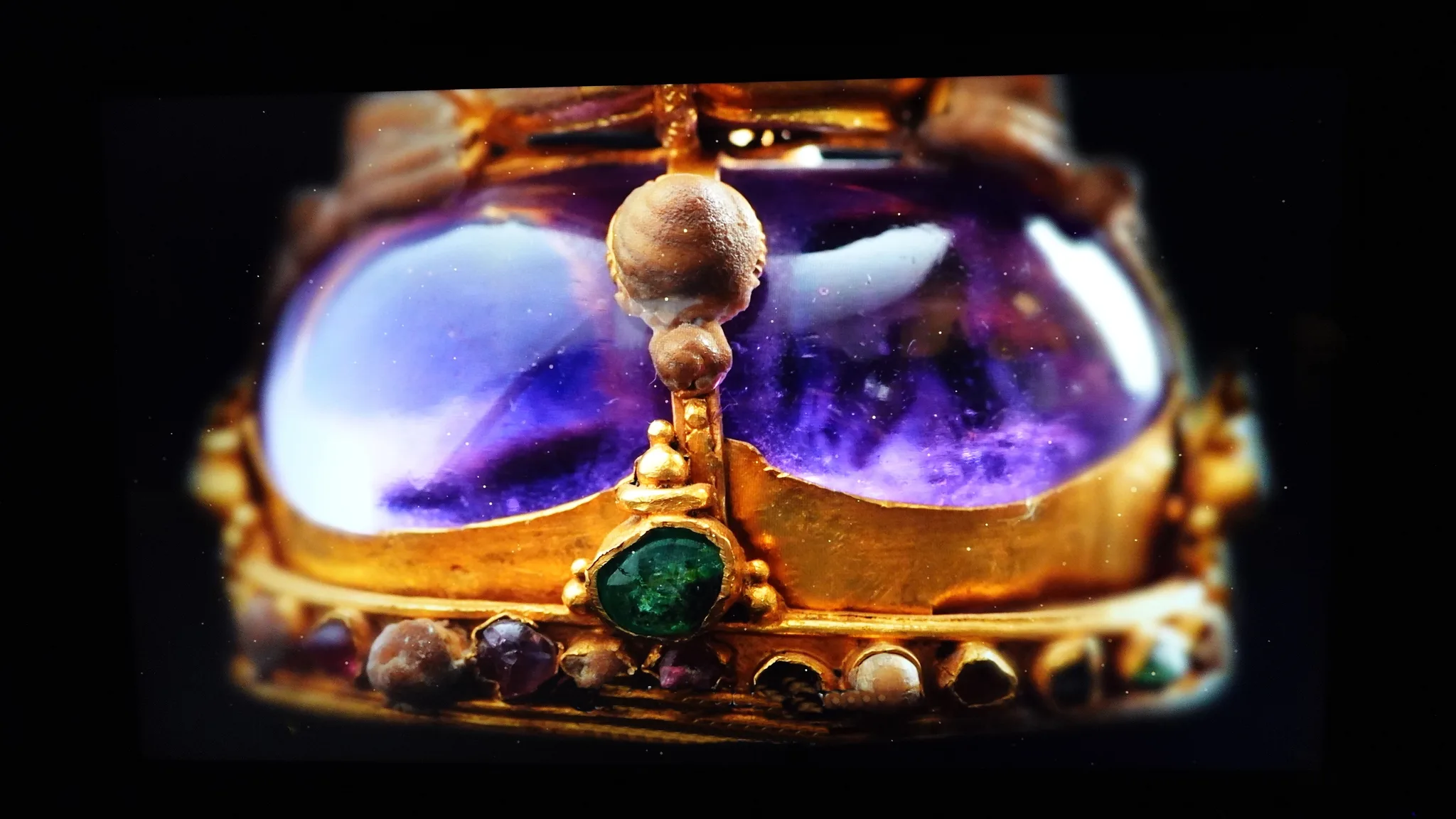
 Vue rapprochée d’un objet d’orfèvrerie présenté au Pavillon d’exposition des trésors d’or d’Ayutthaya : une large pierre violette polie est enchâssée dans une monture en or, rehaussée d’une pierre verte, de granulations et d’une rangée de petites gemmes.© Eric Monteil
Museum
Ayutthaya Gold Treasure Exhibition Building
Born of the looting of a royal crypt in the 1950s, the Ayutthaya Gold Treasure Exhibition Building has, since 2022, brought together the gold of royalty, offerings to the Buddha and relics from the great monuments of the former capital.
Heritage family · Arts, aesthetics and creation
- Destination
- Ayutthaya (Phra Nakhon Si Ayutthaya)
- Heritage Family
- Arts, aesthetics and creation
- Typology
- Museum
- Visit
- Available tours →
The Ayutthaya Gold Treasure Exhibition Building is a permanent exhibition pavilion opened in 2022 within the grounds of the Chao Sam Phraya National Museum, in Phra Nakhon Si Ayutthaya. For the first time, it gathers in a single place the gold objects unearthed from the great monuments of the former capital, in particular the treasure from the crypt of Wat Ratchaburana. Its story begins with the looting of that crypt in the 1950s, which also gave rise to the museum. Set over two floors, in a contemporary Thai architectural style, the displays distinguish between the gold of royalty, the gold offered to the Buddha and the relics.14
Key facts
- Destination
- Phra Nakhon Si Ayutthaya
- Heritage Family
- Arts, aesthetics and creation
- Typology
- Museum
- Places
- —
- Periods
- People
- Borommarachathirat II
- Communities
- —
- Events
- Excavations on Ayutthaya Island (1956-1958)
- Opening of the Ayutthaya Gold Treasure Exhibition Building
- Looting of the Wat Ratchaburana crypt
- Foundation stone of the Ayutthaya Gold Treasure Exhibition Building
- Heritage
- —
- Glossary
- Wat
- Prang
- Buddha image
- Reliquary
- Crypt
- Relic
- Keywords
- —
- Date
- —
- Collections
- —
Practical info
Practical information about this site is taken from its Google Maps page. We advise you to check it before visiting.
- Address
- 108 Thanon Rochana, Tambon Pratuchai, Amphoe Phra Nakhon Si Ayutthaya, Chang Wat Phra Nakhon Si Ayutthaya 13000
A treasure brought out of the earth
The crypt of Wat Ratchaburana
The story of this building begins several centuries before it was built, beneath a monastery on the island of Ayutthaya, Wat Ratchaburana. King Borommarachathirat II (died 1448), ruler of the Ayutthaya Kingdom, also known as Chao Sam Phraya, had this monastery raised together with its prang, a tall, slender reliquary tower that dominates the whole complex. Beneath this tower, a crypt – that is, a closed masonry chamber in which relics and offerings were deposited – held a collection of exceptional richness. Most of the pieces on display today come from there.17
This deposit comprised gold objects, gemstones, Buddha images – the term used in Thailand for statues of the Buddha – and votive tablets, small moulded plaques bearing his likeness. The crypt was arranged on several levels, the uppermost of which held mainly images and tablets. The gold objects found there date for the most part from the fifteenth century, the era of the founding king. They bear witness to a time when the royal power of Ayutthaya affirmed its piety by burying, beneath the monuments it raised, regalia, ornaments and offerings intended to accompany the relics.8
From looting to excavation
In the mid-1950s, the crypt of Wat Ratchaburana was discovered and then looted. The thieves were arrested, but only part of the stolen objects was recovered. The affair revealed how much the ruins of the former capital still concealed, and spurred the authorities into action. Between 1956 and 1958, the Fine Arts Department of Thailand (Krom Sinlapakon), the government body responsible for monuments, museums and archaeology, carried out a campaign of survey and excavation on the island of Ayutthaya.17
These excavations focused on Wat Ratchaburana and Wat Mahathat. They yielded gold objects, gemstones, Buddha images and hundreds of thousands of votive tablets. For want of a suitable home, this collection was at first divided between the Bangkok National Museum, Ayutthaya town hall, a police station and several temples. The treasure had been saved, but it was scattered. The looting thus set in motion an institutional history that culminated, more than sixty years later, in the present building: without it, neither the Chao Sam Phraya National Museum nor its gold pavilion would have come into being.15
A first home for the treasure
A museum funded by the crypt
To house the finds on site, a museum was built in Ayutthaya and opened at the turn of the 1950s and 1960s. It is presented as the first national museum to open outside Bangkok. Its funding was itself tied to the treasure, since votive tablets from the crypt of Wat Ratchaburana were handed to the public in exchange for sums of money earmarked for the construction.4
Accounts differ as to the form this operation took. Some speak of an auction of the tablets, others of donations from the public, each donor receiving a tablet from the crypt by way of thanks. In both versions, part of the sacred deposit circulated among the faithful and collectors so that the rest could be preserved and displayed. This choice sheds light on the particular status of votive tablets, produced in very large numbers and sought after for their protective value, alongside the gold pieces, which remain in the national collections.1
The name of the founding king
By royal permission, the museum was given the name Chao Sam Phraya. This choice links the institution to the very origin of its collections: the king who had Wat Ratchaburana and its prang raised becomes the patron of the place charged with displaying what the crypt had held. The name thus places the museum in continuity with a fifteenth-century act of royal foundation, rather than in the memory of the looting alone.1
For decades, the Chao Sam Phraya National Museum preserved and displayed part of the treasure. Another part of the gold objects from Wat Ratchaburana remained at the Bangkok National Museum. The buildings and displays of the Ayutthaya museum underwent no thorough renovation after its opening, so that at the beginning of the twenty-first century the whole still reflected the museography of its early days.6
Building for the gold
The decision of 2014
In 2014, the Fine Arts Department of Thailand decided to renovate the Chao Sam Phraya National Museum entirely. Rather than spreading the gold objects through a general display, it chose to give them pride of place and devote a building of their own to them. The project formed part of a reorganisation of the whole museum, of which it is the centrepiece.9
This choice served two aims. The first was to preserve and display, in better conditions, the Ayutthaya-period gold objects found at the province’s archaeological sites. The second was to make this heritage better known to the public, as Phnombootra Chandrajoti, Director-General of the Fine Arts Department of Thailand, emphasised at the inauguration. The new building also made it possible to reunite what had been scattered: the gold objects from Wat Ratchaburana held at the Bangkok National Museum returned to Ayutthaya, and all the gold objects from the province’s excavations are presented in the same place for the first time.4
From building site to inauguration
The foundation stone was laid on 2 August 2017 by Vira Rojpojchanarat, then Minister of Culture, in the presence of Anan Chuchot, Director-General of the Fine Arts Department of Thailand at the time. The works stretched over several years. Before the opening, Itthiphol Kunplome, by then Minister of Culture, came to ensure that the building was ready to receive the public.10
The inauguration ceremony took place on 29 December 2022, and the building opened its doors to visitors the very next day. It has since been managed by the Fine Arts Department of Thailand, which comes under the Ministry of Culture, through its Ayutthaya regional office. The objects it houses belong to the national collections.14
Contemporary Thai architecture
The building adopts the style known in Thailand as ‘applied Thai’, a contemporary architecture that takes up and adapts forms from traditional architecture. It rises over two floors and offers just over 3,000 m² of usable floor space. This architecture places the pavilion in the lineage of Thai public buildings that seek to reconcile modern functions with references to the national heritage.14
Inside, these spaces house 2,244 objects. Their number, like the floor area devoted to them, reflects the change in scale of the project: what was once shown in a few rooms of the 1961 museum now has an entire building, designed for it.14
A display in three parts
The gold of royalty
The display opens with the gold objects from Wat Ratchaburana connected with royalty. Here are regalia – that is, the insignia of royal power – insignia of high rank, utensils intended for the sovereign, and ornaments. This first section brings together what belongs to the secular world: objects owned by the king or associated with his person.2
Their presence in a crypt beneath a religious monument is significant in itself. These objects were not intended for the everyday use of the court but were deposited alongside the relics. They show how, in Ayutthaya, the emblems of royalty could be offered to Buddhism and buried beneath a prang, uniting in a single deposit the image of the sovereign and that of the Buddha.
The gold offered to the Buddha
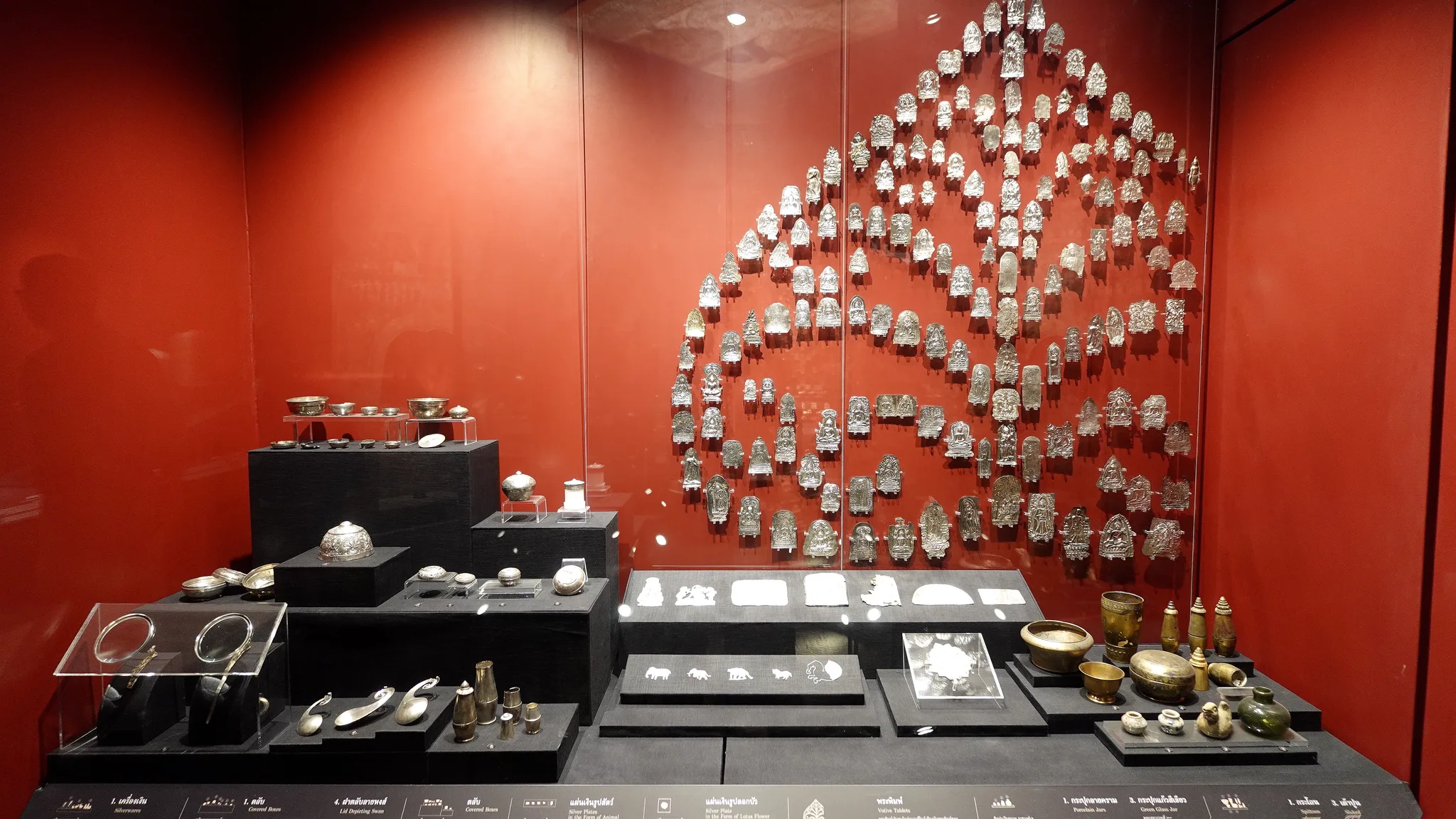
The second section presents the gold objects from Wat Ratchaburana intended for Buddhist worship: offerings, votive objects and relics, together with votive tablets, amulets and Buddha images, some of them in gold. Moving from the first part to the second makes it clear that the treasure is not a mere heap of riches but an organised whole, in which each category of object serves a function.
This section includes a reconstruction of the crypt of Wat Ratchaburana as it appeared before the excavations, with the gold objects and relics in place. It reveals a space that visitors can no longer discover at the site itself, as the crypt is no longer open to the public. Visitors thus grasp the arrangement of the deposit, which display cases by their very nature break up.12
Relics from the monuments of Ayutthaya
The third part widens the view beyond Wat Ratchaburana. It sets out the ideas connected with the enshrinement of relics – that is, their ritual deposit at the heart of a monument – and presents relics and objects found in other buildings in the province: the prang of Wat Phra Ram, the prang of Wat Mahathat, the chedi of Wat Phra Si Sanphet and the Chedi Si Suriyothai. The chedi is a bell-shaped reliquary monument, the Thai version of the Indian stupa.13
This juxtaposition shows that the practice observed at Wat Ratchaburana was not an isolated one. From one monument to another, and across several periods of the kingdom’s history, relics of the Buddha were sealed together with precious objects inside prang and chedi. The final section thus turns the presentation of a treasure into a reading of the city itself, whose great monuments emerge as so many caskets for relics.
Looking at the objects
Swords, a crown and a royal elephant
Among the highlighted pieces is the Phra Saeng Khan Chai Si sword, a ceremonial weapon associated with royalty. Beside it stands a scale model of a mounted royal elephant, the sovereign’s mount for war and pageantry, rendered here in gold. Other gold swords, head ornaments, a crown and a gold miniature of the regalia of Siam complete this group, which reveals the kingship of Ayutthaya through its attributes.10
The religious offerings strike a more intimate note. Fine sheets of gold bear depictions of the Buddha, worked in metal thin enough to be cut and stamped. Between the monumentality of the royal insignia and the delicacy of these sheets, visitors can gauge the range of skills of the fifteenth-century goldsmiths.4
A gem-set reliquary
A stupa-shaped reliquary illustrates the place of precious stones in these deposits. Its gems are set in three tiers: at the bottom a lilac-coloured stone, at the top red spinels, rare stones whose colour is not found in Thailand’s deposits. The sides of the base are adorned with emeralds and zircons.8
The interior continues this decoration. Further gems are lined up inside, among them spinels and garnets, around a small gold box containing a relic of the Buddha. The object makes the logic of enshrinement clear: the relic, at the centre, is surrounded by ever more precious materials, like a monument in miniature. The presence of stones from elsewhere is also a reminder that Ayutthaya had access to materials brought from afar.8
Light and display cases
The presentation relies on redesigned lighting, multimedia installations and display cases that allow the objects to be seen from every angle. The work on lighting improves the legibility of pieces whose brilliance depends on how they are lit, and 360-degree viewing reveals details of goldsmithing that were once hidden.15
These choices mark the difference from the museum of the 1960s. The objects are no longer simply shown as treasures; they are placed in an order that distinguishes the royal from the religious, linked to their monuments of origin and made visible in their detail. The building thus completes the journey that began with the looting of the crypt: objects scattered after their discovery find, in Ayutthaya, a single place where they can be understood together.
Understanding
The Ayutthaya Gold Treasure Exhibition Building is the culmination of a story that began with an act of looting. The deposit that a king had sealed beneath the prang of Wat Ratchaburana, with its royal insignia, its offerings and its relics, was scattered, partly lost, then gathered together by the State in a museum that bears that sovereign’s name. The pavilion opened in 2022 brings together for the first time the gold from the province’s great monuments and presents it in an order that makes royalty, Buddhist piety and the practice of enshrining relics legible. It makes these objects a common good, open to the gaze of all and tied to the history of the city. Yet these pieces were not made to be seen: they accompanied relics at the heart of sealed monuments. By lighting them from every angle, the museum changes their nature. Do these objects remain sacred offerings, or have they become above all the emblems of a national history?
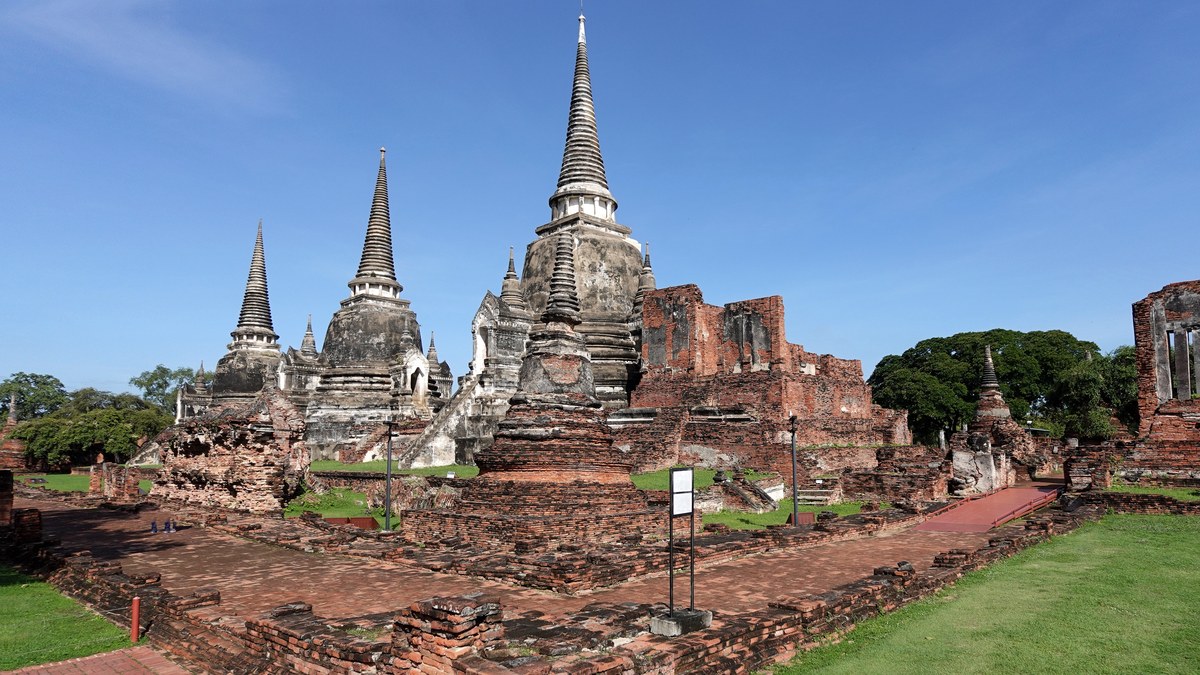
To the origins of Ayutthaya: royal temples, sacred treasures and foreign trading posts at the heart of the former capital of Siam.
- Wat
- Buddhist monastic complex that brings together, within a single enclosure, several religious buildings, monks’ quarters and ancillary buildings; the word does not refer to a single building.
- Prang
- Tower-sanctuary rooted in Khmer architectural tradition, later adopted and transformed in Siamese and Thai architecture; depending on the context, it serves a religious function or acts as a reliquary.
- Buddha image
- In Thai Buddhism, a devotional representation of the Buddha, most often a statue, venerated as an object of worship.
- Reliquary
- A container intended to hold and protect one or more relics.
- Crypt
- A closed masonry chamber built beneath a monument, in which relics and offerings are deposited.
- Relic
- Bodily remains of, or objects associated with, the Buddha or a holy figure, preserved and venerated.
- Applied Thai
- A contemporary Thai architectural style that takes up and adapts forms from traditional Thai architecture.
- Regalia
- The set of insignia and objects symbolising royal power.
- Amulet
- A small object worn or kept for its protective value.
- Enshrinement
- The ritual deposit of relics at the heart of a monument, often accompanied by precious objects.
- Chedi
- A bell-shaped reliquary monument, the Thai version of the Indian stupa.
- Stupa
- A Buddhist monument of Indian origin intended to house relics.
- Gold sheet
- A thin sheet of gold that can be cut and stamped to depict a motif or an image.
Primary sources
- 1พิพิธภัณฑสถานแห่งชาติ เจ้าสามพระยา, Museum Thailand ↗
Studies
- 2พิพิธภัณฑ์เจ้าสามพระยา เปิดอาคารแสดง “เครื่องทองอยุธยา”, Daily News (เดลินิวส์), 2022 ↗
- 3ส.สต., พิพิธภัณฑ์เครื่องทองอยุธยา, Post Today, 2017 ↗
- 4Going for gold, Thai PBS World, 2023 ↗
- 5Treasures of the past, Bangkok Post, 2023 ↗
- 6โฉมใหม่! นิทรรศการ “เครื่องทอง” อยุธยา ณ พิพิธภัณฑสถาณแห่งชาติ เจ้าสามพระยา, ศิลปวัฒนธรรม (Silpa Wattanatham), 2022 ↗
- 7เครื่องทองโบราณ พิพิธภัณฑ์เจ้าสามพระยา เบื้องหลังภาพสะท้อนกรุงศรีฯ, ศิลปวัฒนธรรม (Silpa Wattanatham), 2023 ↗
- 8ผู้จัดการออนไลน์, งามล้ำค่า “นิทรรศการเครื่องทองอยุธยา” ณ พิพิธภัณฑสถานแห่งชาติ เจ้าสามพระยา อาคารเครื่องทองที่ใหญ่ที่สุดในไทย, MGR Online (ผู้จัดการออนไลน์), 2023 ↗
- 9ถอดรหัสเครื่องทองอยุธยา จากกรุวัดราชบูรณะแตก ถึงการสร้างอาคารเครื่องทองที่ใหญ่ที่สุดในไทย, Sanook, 2023 ↗
- 10เปิดแล้ววันนี้ “อาคารเครื่องทองอยุธยา” ชมสมบัติล้ำค่าของแผ่นดิน, กรุงเทพธุรกิจ (Bangkokbiznews), 2022 ↗
- 11ชมความอลังการสุดยอด'เครื่องทองอยุธยา', ไทยโพสต์ (Thai Post), 2022 ↗
- 12Explore the Ayutthaya Gold Treasure Exhibition Building at the Chao Sam Phraya National Museum, Sawasdee (Thai Airways), 2023 ↗
- 13ยลโฉมเครื่องทองล้ำค่า ที่อาคารนิทรรศการเครื่องทอง พิพิธภัณฑ์แห่งชาติ เจ้าสามพระยา, Sawasdee (Thai Airways), 2023 ↗
Reference works
- 14กลุ่มเผยแพร่และประชาสัมพันธ์ กรมศิลปากร, กรมศิลปากรพร้อมเปิดให้บริการอาคารเครื่องทองอยุธยา พิพิธภัณฑสถานแห่งชาติ เจ้าสามพระยา, Fine Arts Department (กรมศิลปากร), 2022 ↗
- 15Ayutthaya’s gold treasures on display at the newly-refurbished Chao Sam Phraya Museum, SEAArch – Southeast Asian Archaeology, 2023 ↗
- 16Chao Sam Phraya National Museum, Wikipedia ↗
- 17Wat Ratchaburana, Ayutthaya, Wikipedia ↗
- 18ชมเครื่องทองอยุธยากัน, จังหวัดพระนครศรีอยุธยา (go.ayutthaya.go.th), 2023 ↗
Further reading
Contemporary views
Ayutthaya Gold Treasure Exhibition Building today
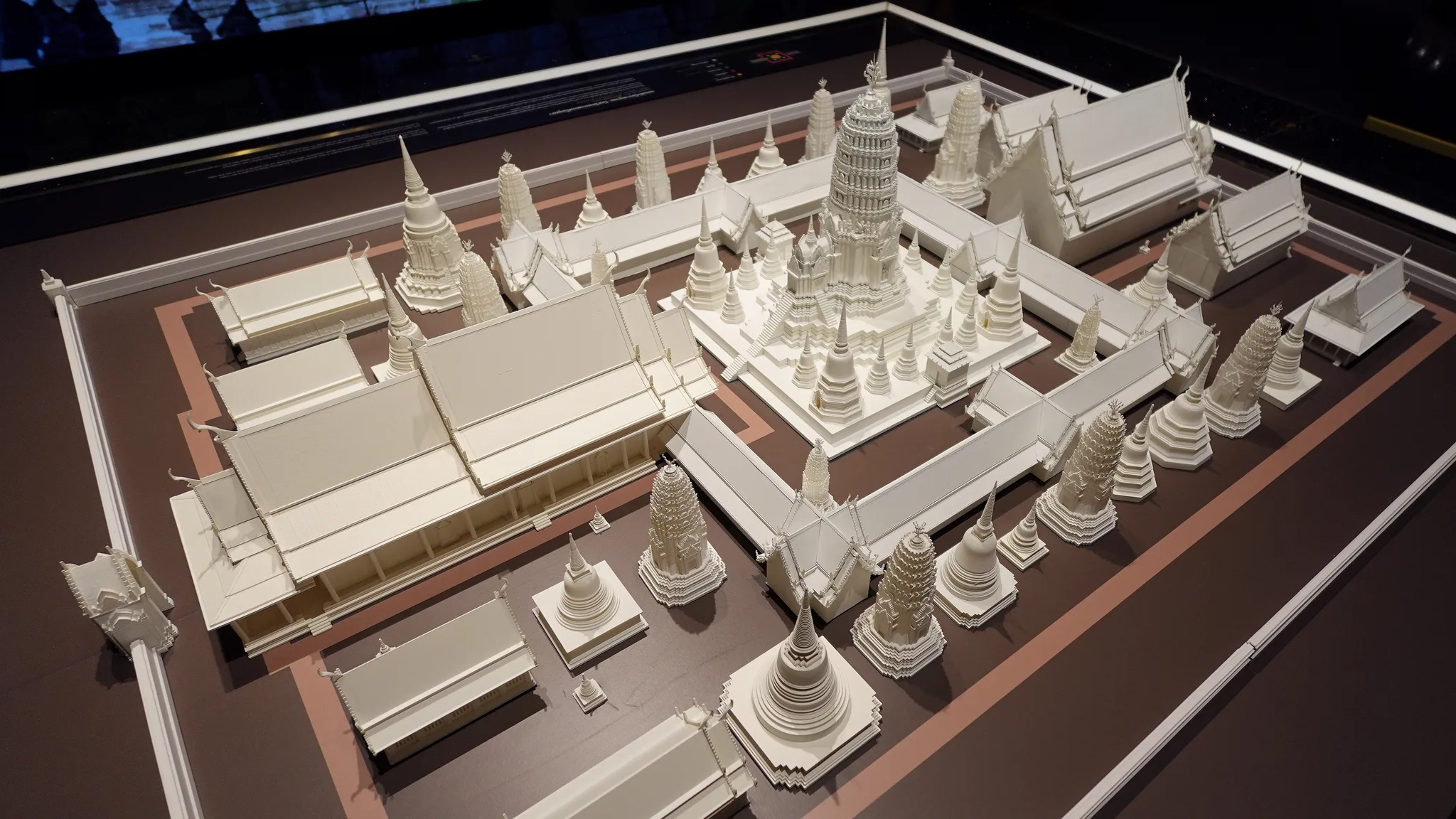
Au Pavillon d’exposition des trésors d’or d’Ayutthaya, une maquette blanche restitue un ensemble monastique : prang central sur terrasse ceint d’une galerie, chedis de formes variées et salles à toits étagés.© Eric Monteil 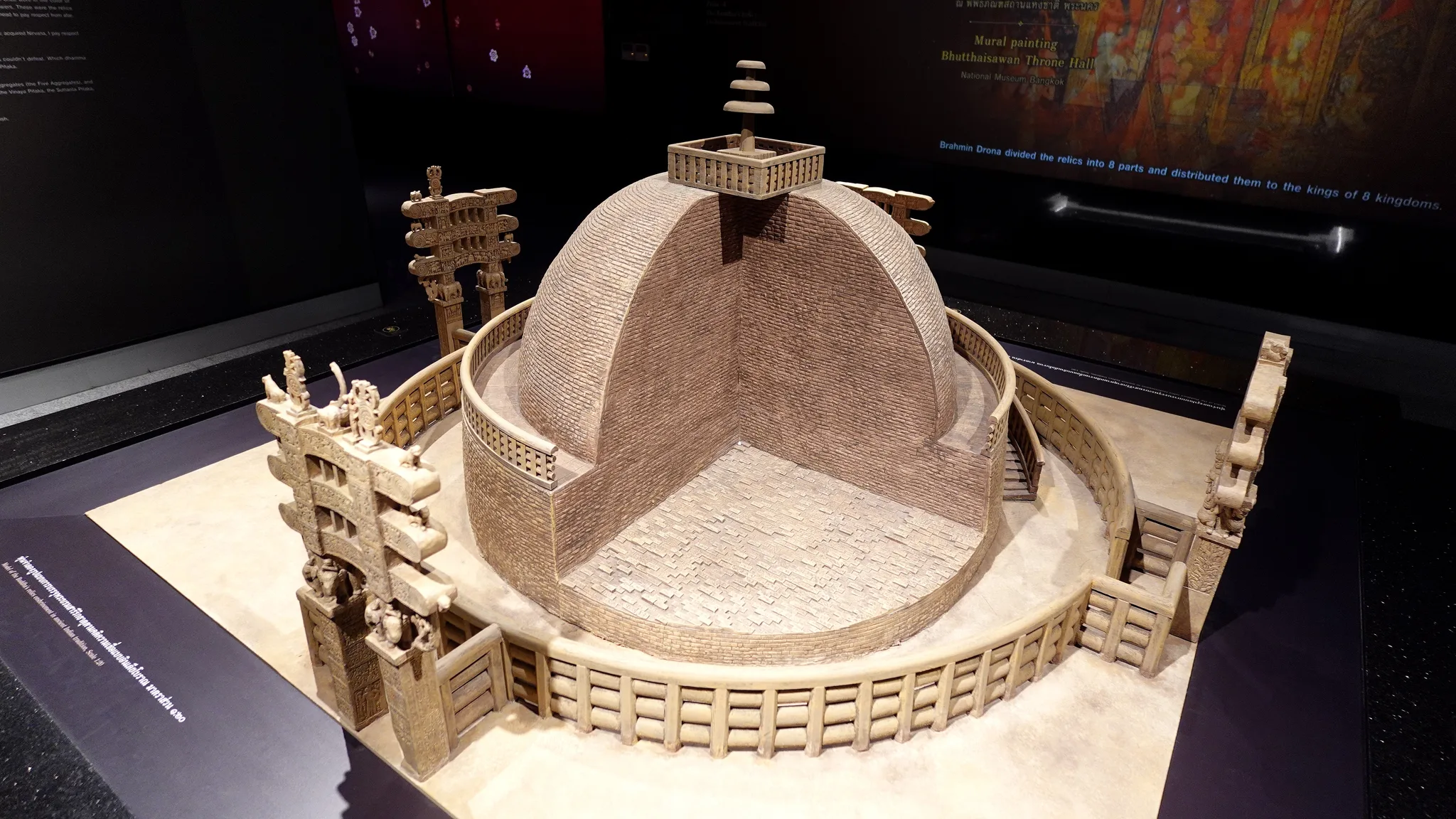
Dans une salle du Pavillon d’exposition des trésors d’or d’Ayutthaya, une maquette de stupa coupée en quart révèle la maçonnerie de briques du dôme, entouré d’une balustrade et de portails sculptés ; au fond, un panneau reproduit une peinture murale.© Eric Monteil
Architecture and decoration
Explore the heritage
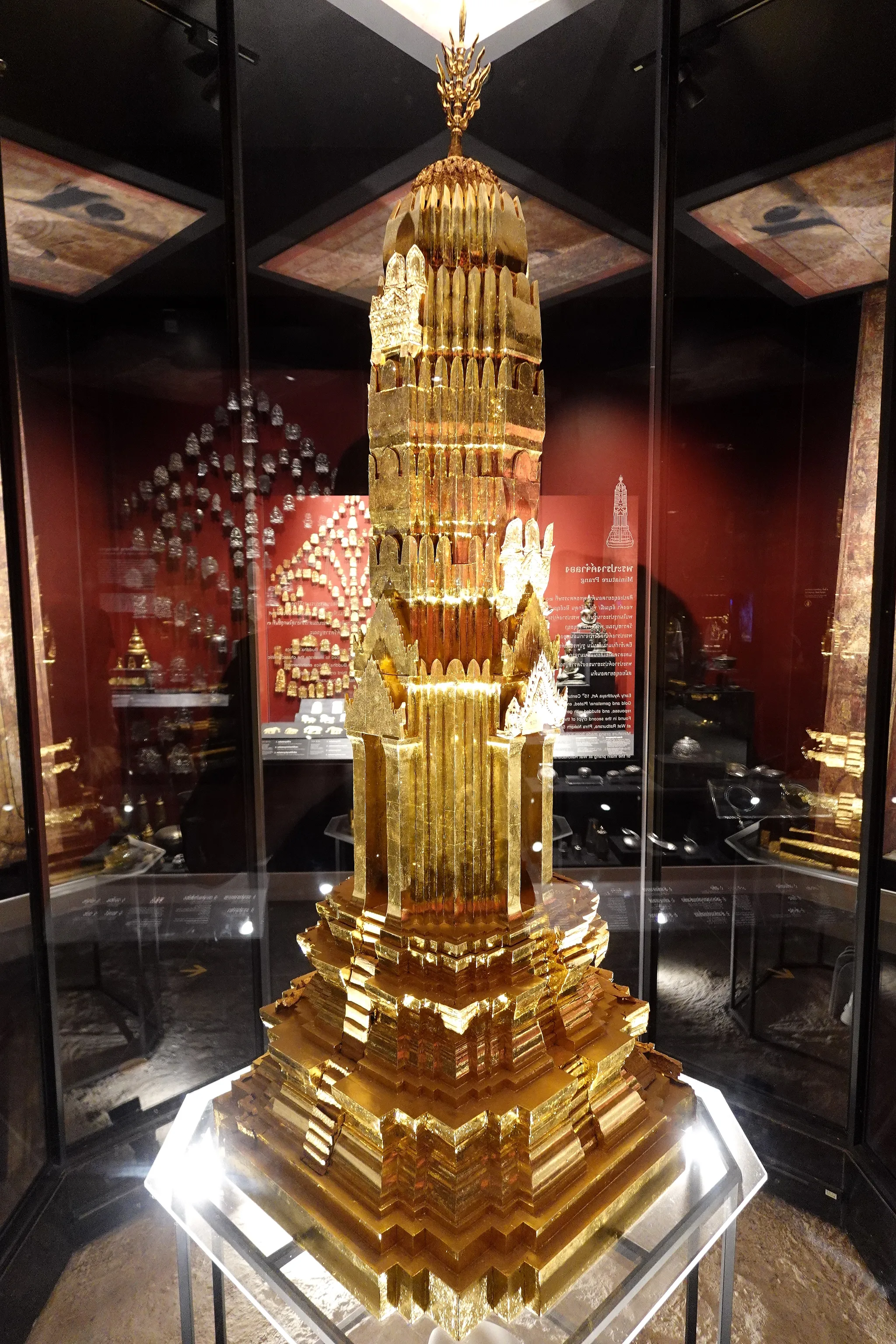
Dans une vitrine du Pavillon d’exposition des trésors d’or d’Ayutthaya, un prang miniature doré reproduit soubassements à redans, frontons et sommet en épi ; à l’arrière-plan, des tablettes votives ornent un mur rouge.© Eric Monteil 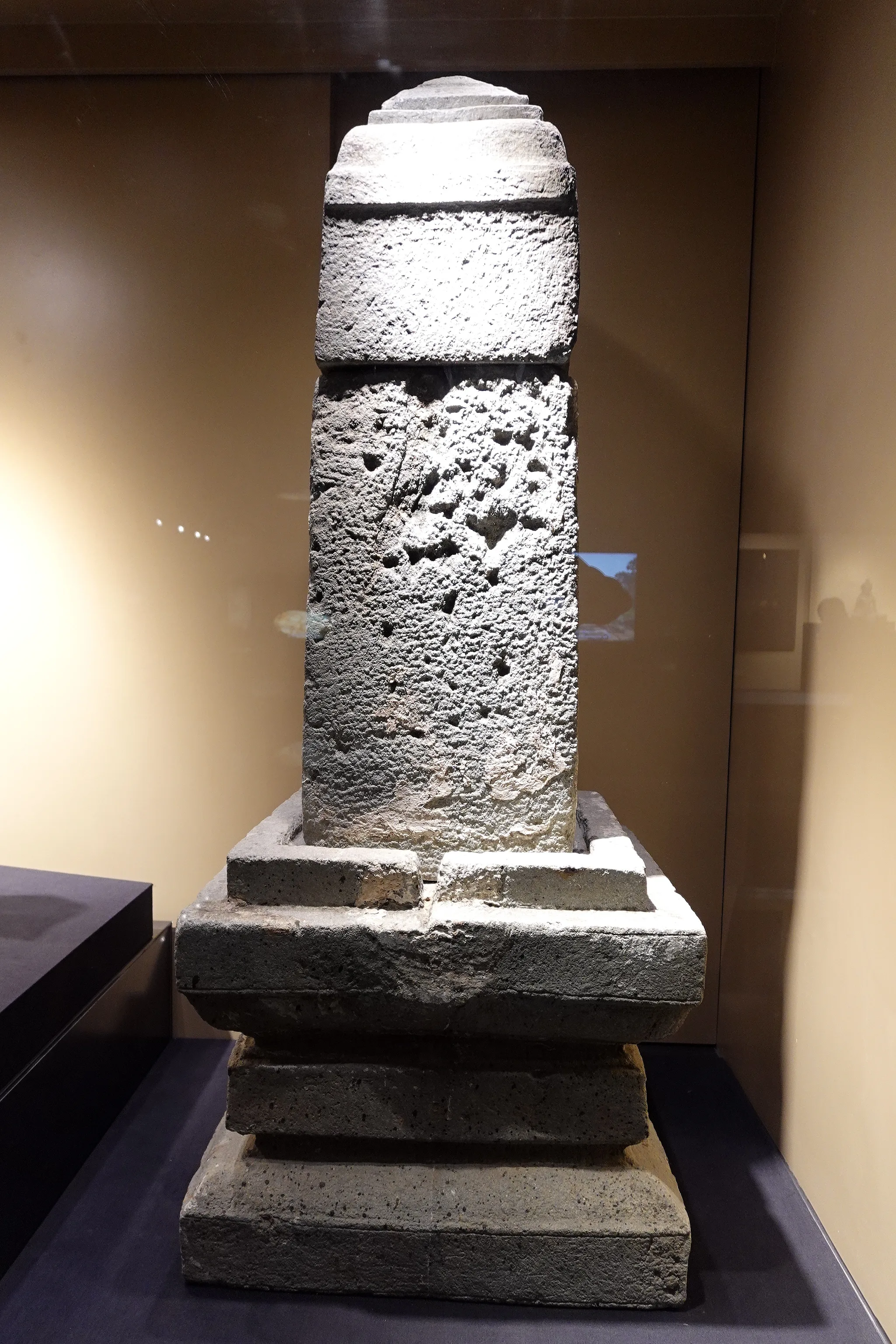
Dans une vitrine du Pavillon d’exposition des trésors d’or d’Ayutthaya, un bloc de pierre grise à surface alvéolée, couronné de gradins, repose sur un socle carré mouluré formé de plusieurs assises.© Eric Monteil