
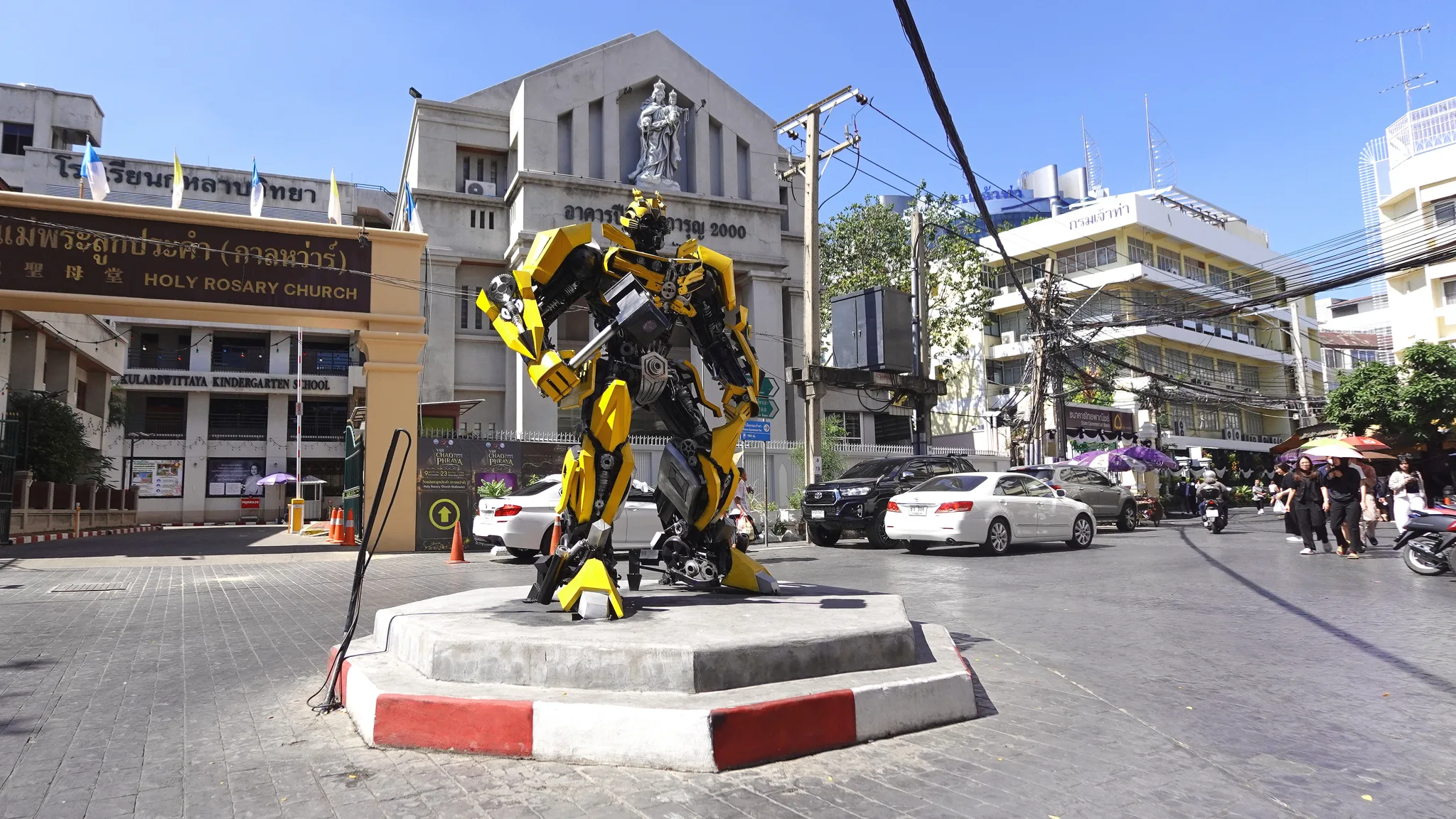
 Bumblebee, a robot made of yellow and black metal parts, stands on an octagonal plinth edged in red and white at a busy crossroads, facing the Holy Rosary Church gateway and a façade adorned with a statue of the Virgin and Child.© Eric Monteil
- Destination
- Bangkok (Samphanthawong)
- Heritage Family
- Arts, aesthetics and creation
- Typology
- Public art & street art
- Visit
- Available tours →
Bumblebee is a large statue of the robot of the same name, a character from the Transformers film franchise, standing on a small roundabout in Talat Noi, an old merchant quarter of Bangkok. It is in no sense an ancient monument, but it helps to make sense of the district around it. Talat Noi grew up around Chinese trade and the wharves. It is also home to workshops and spare-parts shops and, since the 2010s, has been presented as one of the principal centres of street art in Bangkok. A landmark for walkers and a familiar image, sometimes mocked, Bumblebee sets global popular culture in the midst of an old urban fabric.4
Key facts
- Destination
- Bangkok
- Heritage Family
- Arts, aesthetics and creation
- Typology
- Public art & street art
- Places
- —
- Periods
- —
- People
- —
- Communities
- —
- Events
- Bukruk II Urban Arts Festival
- Colour of Charoenkrung
- Heritage
- —
- Glossary
- Soi
- Khlong
- Wat
- Buddha image
- Ancient monument
- Trok
- Keywords
- —
- Date
- —
- Collections
- —
Practical info
Practical information about this site is taken from its Google Maps page. We advise you to check it before visiting.
- Address
- 84 Soi Chareonkrung 22, Khwaeng Talat Noi, Khet Samphanthawong, Krung Thep Maha Nakhon 10100
A film robot in a back lane
A character from Transformers
The name Bumblebee is simply the English word for the insect. It denotes one of the robots of the Transformers film franchise. The Talat Noi statue reproduces this cinematic figure on a large scale, in the manner of a replica. It is known simply by the character’s name, and that name owes nothing to the Thai language or to Thai traditions.2
This origin sets it apart from most elements of Bangkok’s heritage. It is neither a sacred image, in the Thai sense of a cult statue, nor a commemorative monument. It belongs to the public art of today, which borrows its motifs from international popular culture and places them in the street, in full view of all.
A roundabout at the end of Soi Wanit 2
To reach the statue, one walks up Soi Wanit 2, one of the lanes of Talat Noi. In Thai, a soi is a side street branching off a main thoroughfare. Bumblebee stands on a small roundabout. Together with Soi Charoen Krung 22, also known as Trok Talat Noi (a trok is an alley), and Soi Chao Sua Son, Soi Wanit 2 is one of the district’s main lanes.4
This location goes a long way towards explaining its role. In a network of passageways that all look alike, a junction marked by so recognisable a figure helps people find their bearings. The statue serves as a landmark. To understand it properly, then, one must look at the district around it.
Talat Noi, a district of wharves and workshops
A district born of Chinese trade
Garages and spare parts
Part of the district has long been occupied by motorcycle repair workshops and spare-parts shops. Some of these workshops do more than carry out repairs: they assemble salvaged parts into works of art.4
This mechanical know-how, geared towards reuse, makes the presence of a giant robot in these streets less strange than it might seem. Bumblebee is a machine figure, set down in the midst of a district of machines.
The district becomes an open-air gallery
From the Bukruk festival to Colour of Charoenkrung
Since the 2010s, Talat Noi has been presented as one of the principal centres of street art in Bangkok. Street art here means the murals and interventions made directly on the city’s walls. The Bukruk festival, in 2016, marked a milestone by leaving three large murals on Song Wat Road.3
The movement continued in 2020 with the Colour of Charoenkrung project. The district, long known for its trade and its workshops, now also draws visitors for its painted scenery.3
A sculpture among the murals
The Thai authorities now present Talat Noi and Song Wat as an old district brought back to life by street art. The streets can be explored freely and at no cost, at any hour. The district has thus become a kind of open-air gallery, where one moves from one image to the next by following the lanes.6
Bumblebee holds a place of its own within this whole. It is not a mural but a sculpture in the round, set in the centre of a junction rather than painted on a wall. Yet it shares the same principle as the murals: a striking image, placed in public space, that changes the way one looks at the street.
A popular and debated landmark
A stop on the walk
Accounts of walks through Talat Noi make Bumblebee both a landmark and a stopping point. People pause there, photograph it, then set off again towards the neighbouring lanes. By November 2023, the statue was already featuring in guides to the district. Installed before that date, it has since been part of visitors’ usual route.2
This role as a landmark is an urban function in its own right. The statue helps people find their way. It also gives an instantly recognisable face to a district whose charm lies rather in an accumulation of discreet details.
A contested popularity
This fame also has its critics. One travel journalist describes it as “infamous” and urges walkers not to stop at it but rather to discover the streets around it. This judgement sets the spectacular image, easy to recognise and to photograph, against a district whose value reveals itself more slowly.1
The debate sheds light on Bumblebee’s singular place. The statue is attached to no local tradition. Yet it has taken root in a place shaped by metalwork that has become a centre of urban creativity. It thus allows one to trace a recent transformation of Talat Noi: the district of wharves and workshops is now also a place to visit.
Understanding
Bumblebee is neither a temple, nor a sacred image, nor a historic monument. It is the large statue of a film robot, installed at a junction in Talat Noi. It has become one of the familiar landmarks of a district born of Chinese trade and the wharves, which is also home to mechanics’ workshops. Its interest lies in what it reveals about this place: a taste for salvage and metal, the arrival of street art since the 2010s, and the use of the street as a space of shared images. It bears witness to a living heritage, one that is taking shape before our eyes rather than being handed down from generation to generation. It also carries the tensions of a district that has become a place to visit. Some make it a stop on their walk; others urge people to move past it and discover the lanes. As Talat Noi changes, can this figure borrowed from an international film become, for residents and visitors alike, an acknowledged part of the district’s memory?
Through Bangkok's creative districts, between street art, architecture, design and new uses of the city.
- Soi
- Thai word for a lane or side street branching off a main road; soi are often numbered after the main street from which they branch.
- Khlong
- Canal or waterway, natural or man-made, which long played a major role in transport, irrigation and the organisation of settlements and territories in Thailand.
- Wat
- Buddhist monastic complex that brings together, within a single enclosure, several religious buildings, monks’ quarters and ancillary buildings; the word does not refer to a single building.
- Buddha image
- In Thai Buddhism, a devotional representation of the Buddha, most often a statue, venerated as an object of worship.
- Ancient monument
- In Thailand, a legal category (boran sathan) that places a building or site under State protection as heritage.
- Trok
- Thai word for an alley, that is, a narrow passage between buildings, generally narrower than a soi.
Studies
- 1From scrap metal to street art: The unlikely cool of Talat Noi, a Bangkok neighbourhood that can't be curated, The Nightly, 2025 ↗
- 2Santos, Talat Noi: The SPOT.ph Guide to Bangkok's Street Art Capital, SPOT.ph, 2023 ↗
- 3These murals highlight Talad Noi's rise as Bangkok's hub of street art, BK Magazine, 2021 ↗
Contemporary views
Bumblebee today
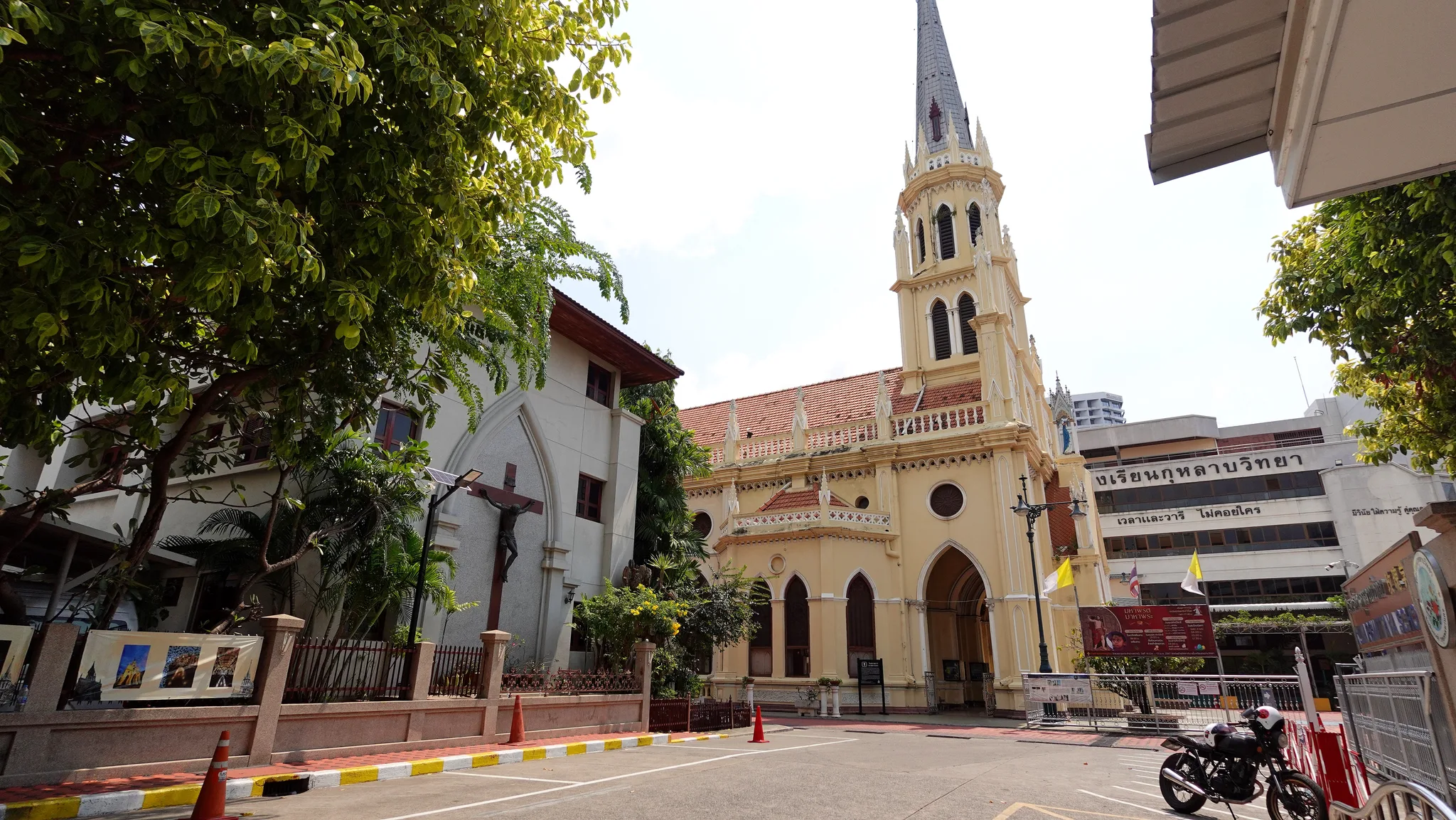
Surroundings of Bumblebee: Holy Rosary Church shows a yellow façade with pointed arches, an oculus and a spired bell tower, facing a forecourt lined by a large crucifix and school buildings.© Eric Monteil 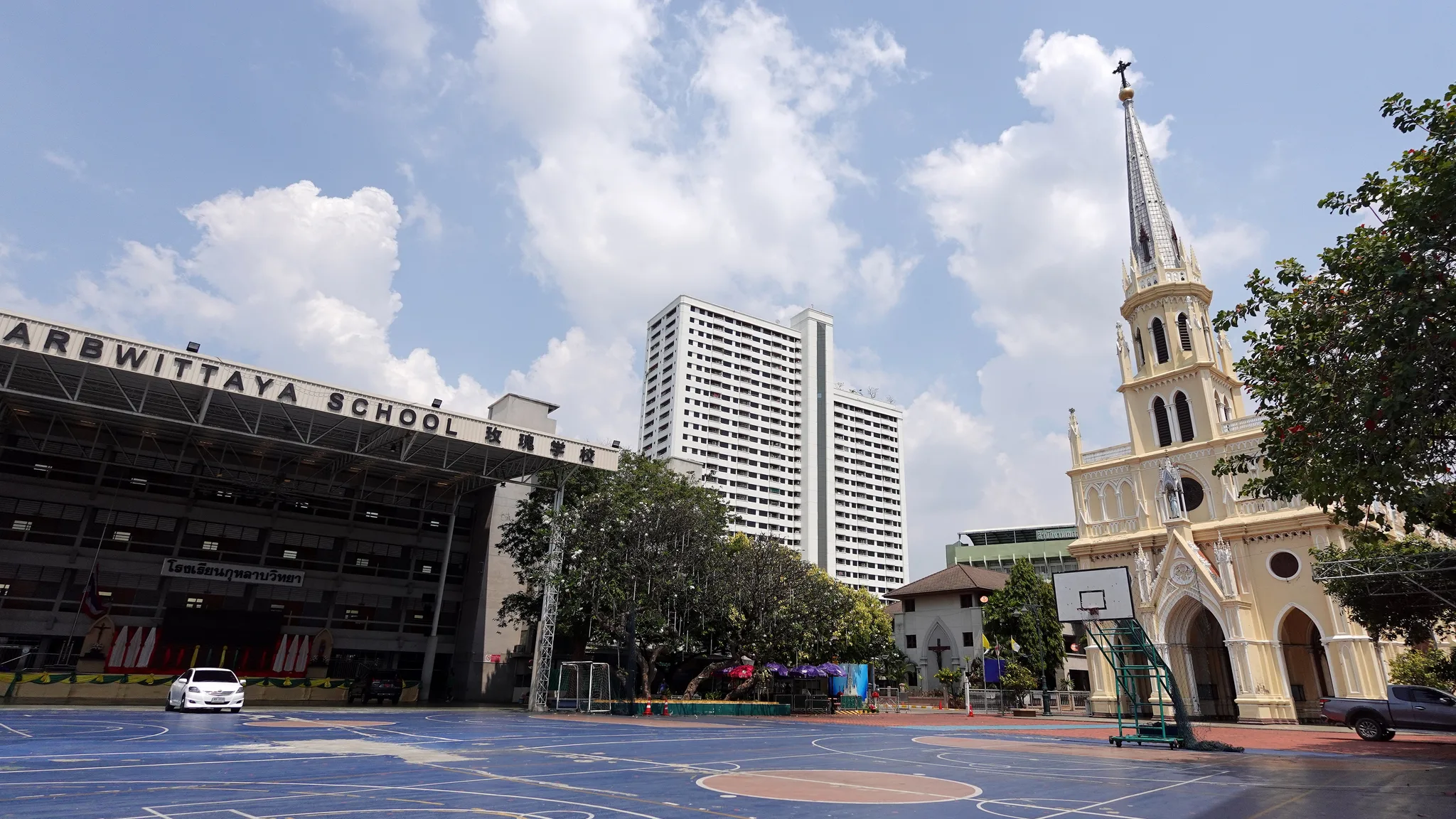
Bumblebee: from the blue sports court of Kularb Wittaya School, a view of the cream and yellow Gothic Revival façade of Holy Rosary Church and its openwork spire, between trees and residential blocks.© Eric Monteil
Architecture and decoration
Explore the heritage
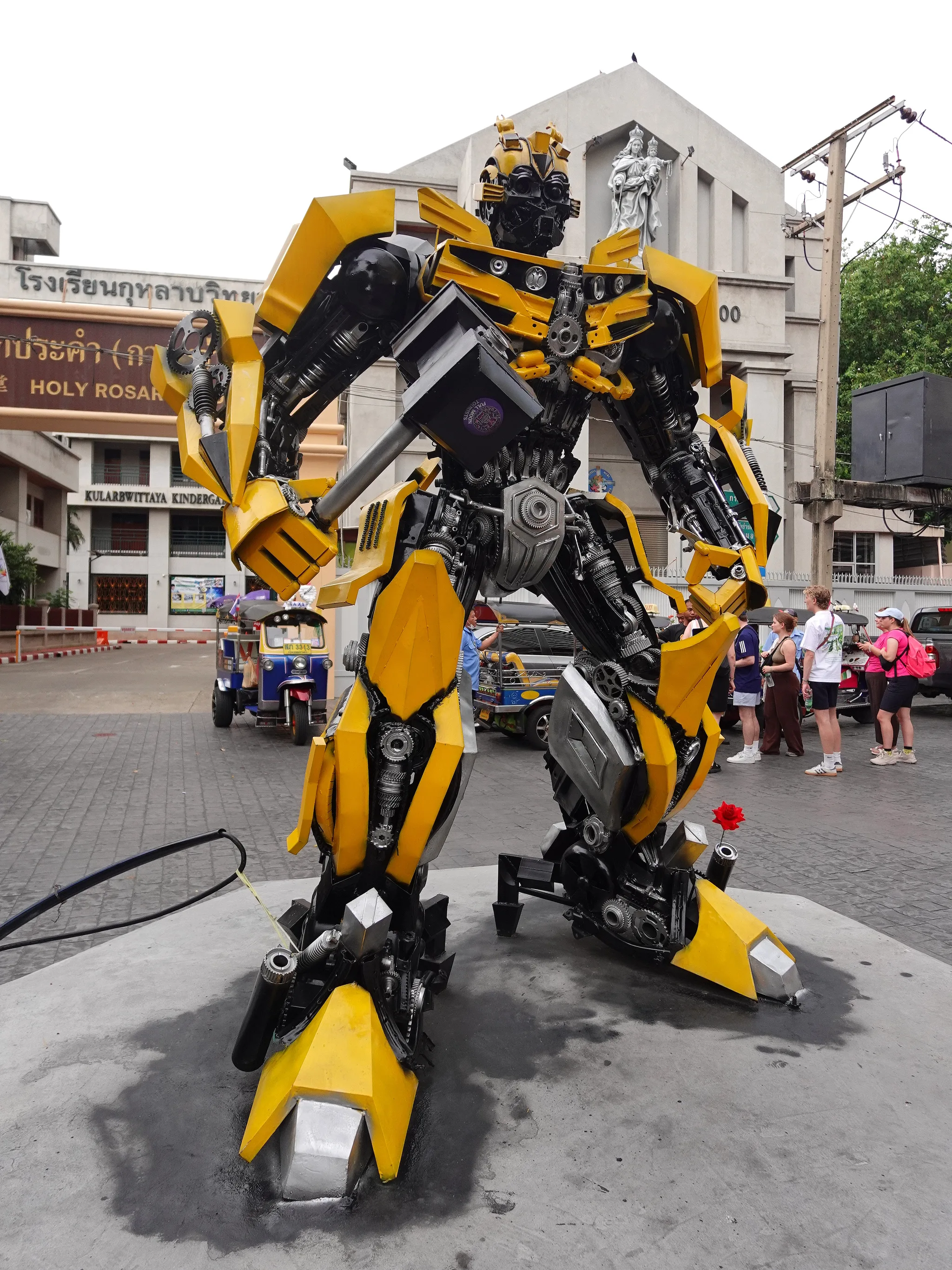
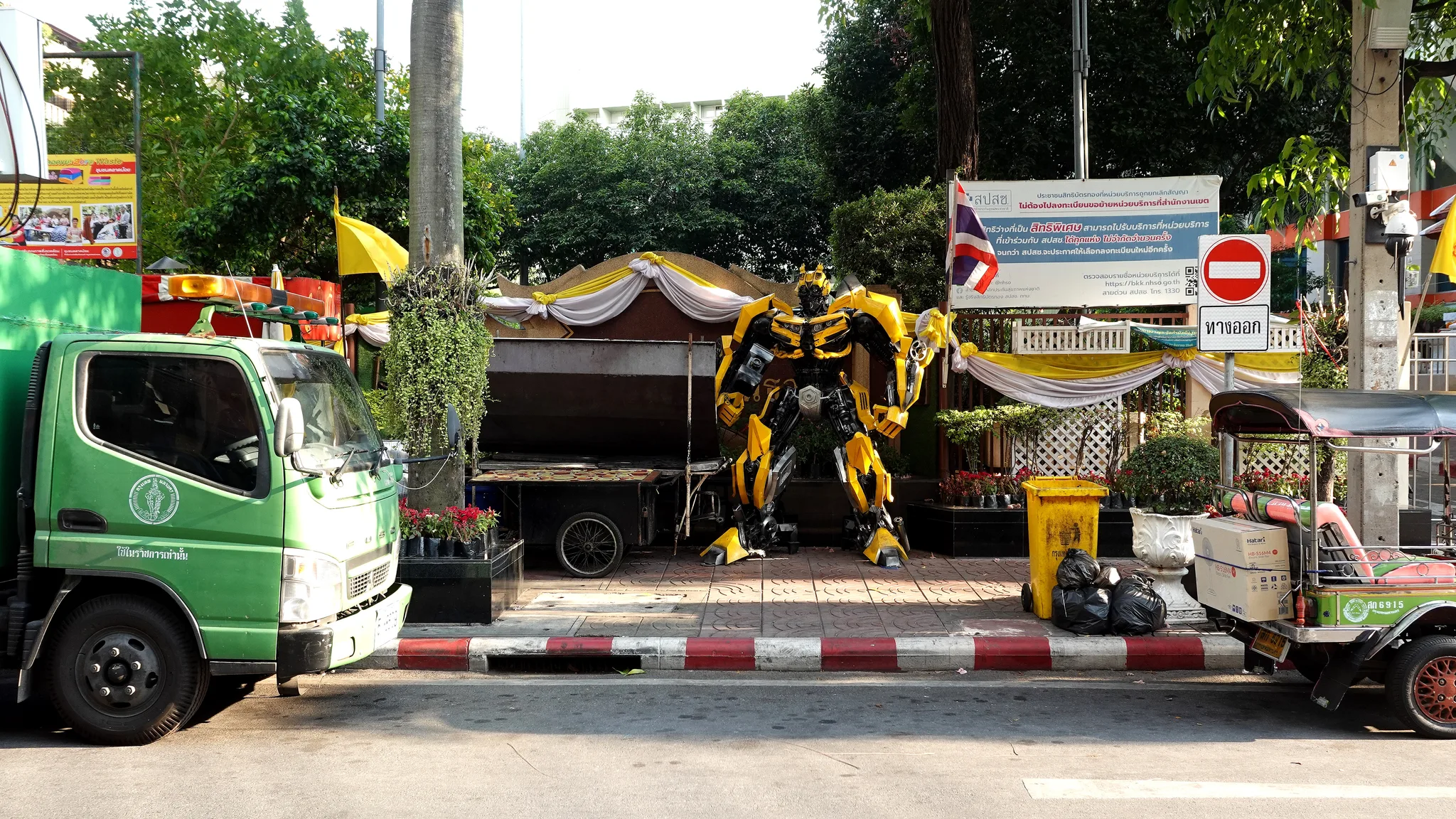
The Bumblebee sculpture combines gears, springs and metal plates painted yellow and black. In the background stand a façade topped by a statue of the Virgin and Child, tuk-tuks and a group of visitors.© Eric Monteil 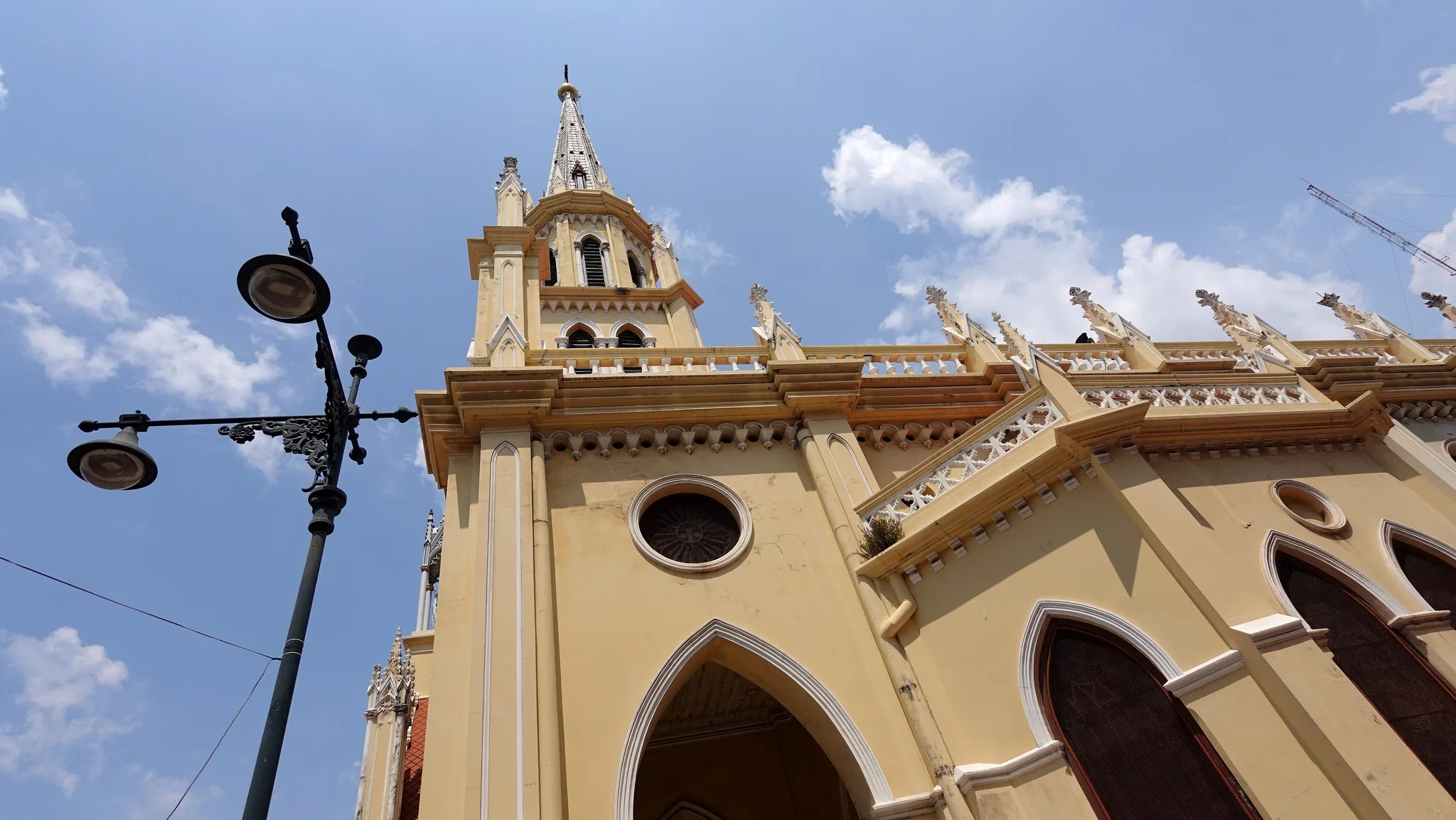
Bumblebee: cream-rendered façade of a Neo-Gothic church, punctuated by pinnacles, pointed arches, pierced balustrades and oculi, and crowned by a spired bell tower; an ornate cast-iron street lamp stands in the foreground.© Eric Monteil