
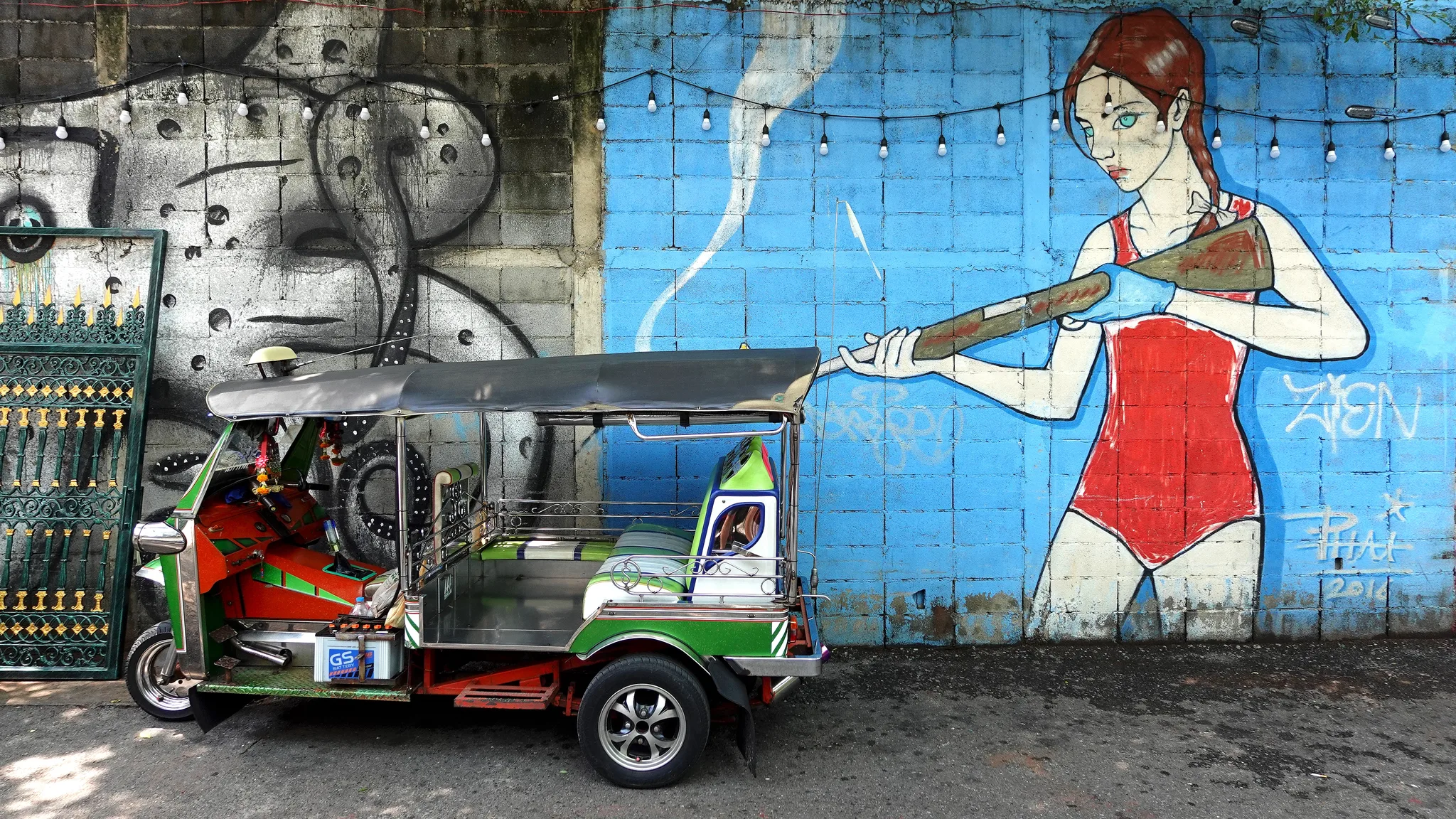
 Charoen Krung 32 Street Art: on a breeze-block wall painted blue, a woman in a red swimsuit wields a bat beside a black-and-white graffiti piece; a parked tuk-tuk and a string of light bulbs complete the street scene.© Eric Monteil
- Destination
- Bangkok (Bang Rak)
- Heritage Family
- Arts, aesthetics and creation
- Typology
- Public art & street art
- Visit
- Available tours →
Charoen Krung 32 Street Art is a group of murals painted in the open air along a side street in the Bang Rak district of Bangkok. It is often described as the place in the neighbourhood where the works are most numerous. It is also a lasting trace of the Bukruk Urban Arts Festival, which in January 2016 invited Thai and European artists to paint the walls of the Charoen Krung creative district, beside the Chao Phraya River. Several signatures can be recognised on these walls, among them Alex Face's three-eyed character and the animals of Bonus TMC.2
Key facts
- Destination
- Bangkok
- Heritage Family
- Arts, aesthetics and creation
- Typology
- Public art & street art
- Places
- Bang Rak
- Periods
- —
- People
- Alex Face
- Bonus TMC
- Communities
- —
- Events
- Bukruk II Urban Arts Festival
- Heritage
- —
- Glossary
- Soi
- Buddha image
- Projection mapping
- Keywords
- —
- Date
- —
- Collections
- —
Practical info
Practical information about this site is taken from its Google Maps page. We advise you to check it before visiting.
- Address
- PGG7+XR6, Soi Charoen Krung 32, Khwaeng Bang Rak, Khet Bang Rak, Krung Thep Maha Nakhon 10500
A painted side street in the heart of Bang Rak
An ensemble rather than a monument
Charoen Krung 32 Street Art does not refer to a single work. It is a group of murals painted on the walls of a soi, the name given in Thailand to the side streets that branch off a main road. Soi Charoen Krung 32 leads off Charoen Krung Road, in the Bang Rak district. Along the whole length of the side street, a long wall is covered with murals signed by several artists, both Thai and foreign. What one finds here, then, is not an isolated object: one walks past a sequence of images, each by a different hand and in a different style.9
The very name of the ensemble reflects this collective nature. “Charoen Krung 32 Street Art” is a name in common use, found in Thai as “สตรีทอาร์ต ซอยเจริญกรุง 32”, literally the street art of Soi Charoen Krung 32. The English term street art refers to urban art, that is, works painted directly on the walls of the city and open to the gaze of passers-by. The name refers to no artist, no particular work and no institution. It designates a place, a side street, and what artists have painted there.9
Charoen Krung, a creative district beside the Chao Phraya River
These murals belong to a neighbourhood whose image changed over the course of the 2010s. The area around Charoen Krung Road and the Bang Rak district, along the Chao Phraya River, came at that time to be presented as Bangkok's “creative district”. This reputation was built in stages. Bars and galleries first settled in the neighbourhood. Then, in 2017, the Thailand Creative and Design Center (TCDC) moved into the building of the district's former post office.5
The murals of Soi Charoen Krung 32 are part of this movement. They are indeed one of its most visible signs, since they occupy the street itself rather than the inside of a gallery. To understand how these walls came to be painted, one must go back to the festival that gave rise to them.
Bukruk, a festival for the walls of Bangkok
A first edition in 2013
The Bukruk Urban Arts Festival was born in 2013. Its first edition brought together European and Thai artists around mural painting and the urban arts. From the outset the festival rested on an encounter between muralists from Europe and the Thai scene, and this orientation would be reflected in the make-up of the walls of Soi Charoen Krung 32.11
Two years later, in the autumn of 2015, street art had become a widely accepted, almost mainstream practice in Thailand since that first edition. What might have passed for a marginal practice was becoming a supported project, announced on a city-wide scale.1
Bukruk II, nine days in January 2016
The second edition, known as Bukruk II, was held from 23 to 31 January 2016 in the creative district bordering the Chao Phraya River. Its programme went beyond mural painting alone. Exhibitions were shown in seven partner galleries, a mobile print workshop travelled around, and an opening party took place at the Jam Factory. The festival closed with a projection mapping, a projection of animated images adapted to the architecture of a façade, created by the artist Motomichi Nakamura on Bangkok's General Post Office.2
At the centre of this programme were the walls. The Tourism Authority of Thailand announced at the time that the public would be able to go from one wall to the next to watch artists at work, such as the Spaniard Aryz and the Belgian Roa, two invited European muralists. The organisation also presented the event as a means of strengthening Bangkok's image as a “city of the arts”. Mural painting was therefore no mere decoration: it played a part in the way the city wished to present itself.7
Organisers and supporters
Myrtille Tibayrenc, of the Toot Yung Art Center, organised the festival. David Robinson, of the Bangkok River organisation, also played an important role in setting up Bukruk II. At the end of 2015, the European Union was the event's main sponsor, and both the Bangkok Metropolitan Administration and the Tourism Authority of Thailand said they were interested in lending their support.1
This European support, with which the Thai authorities said they were interested in associating themselves, matched the aims of the festival, conceived as an exchange between artists from Europe and Thailand. The exact number of participants varies from one announcement to another, from around twenty to around thirty artists from Thailand, other Asian countries and Europe. This variation does not alter the essential point: within a few days, a group of artists from different backgrounds lastingly transformed the appearance of several side streets in the neighbourhood.1
Soi Charoen Krung 32, the heart of the trail
The walls painted in 2016
The murals of Soi Charoen Krung 32 are associated with the 2016 edition. It was on the occasion of Bukruk II that the walls of the side street were covered. Soi Charoen Krung 32 was then the centre of the action, the place where the artists' work was at its densest. Neighbouring side streets, notably Soi Charoen Krung 28, also received works, but it is Soi Charoen Krung 32 that is most often cited as the place where the paintings are concentrated.9
A long wall covered with murals runs the whole length of the side street. Accounts differ: the paintings occupy both sides of the soi, or are concentrated mainly on one side. Each work retains its author's own world.12
A trail through the neighbourhood
The 2016 paintings were not conceived as isolated works. From the time of the festival, they were meant to allow people to move from one wall to the next, and in 2018 they still formed, together, a trail through the Charoen Krung neighbourhood. Soi Charoen Krung 32 is its main stop, the one where the walker encounters the greatest number of works gathered together.4
In nearby Soi Charoen Krung 30, another project, “Krung Thep Creative Streets”, also had murals painted. Mural painting has thus become a lasting feature of the landscape of the side streets running down from Charoen Krung Road, and Soi Charoen Krung 32 remains its point of reference.6
Reading the murals
Mardi, Alex Face's three-eyed child
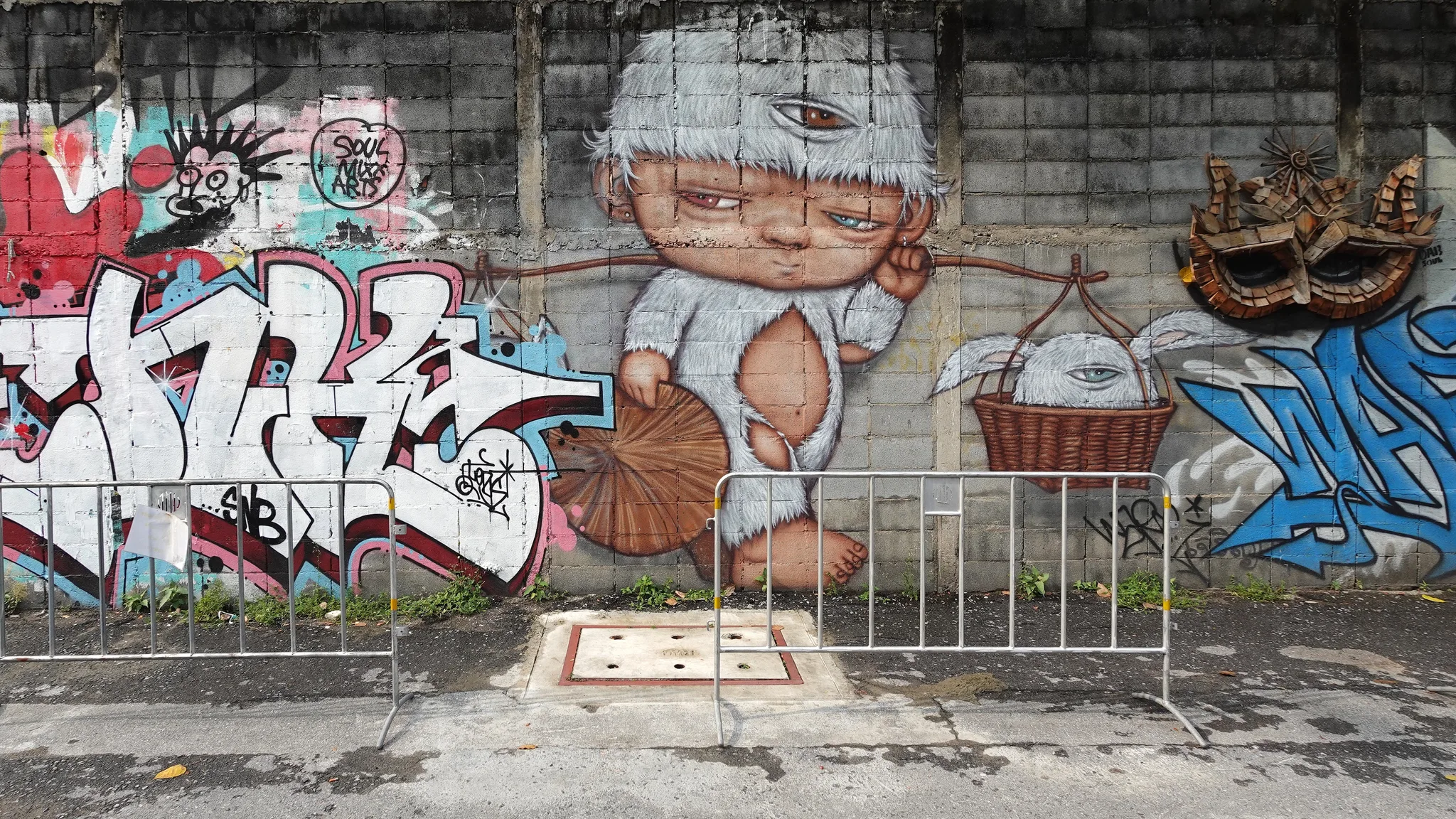
The most frequently cited work in the side street is by Alex Face, a Thai artist known for a character he created and reproduces on walls: Mardi, a three-eyed creature. In Soi Charoen Krung 32, Mardi takes the form of a sullen-looking child selling goods in the manner of a street vendor.12
The character is familiar to street-art enthusiasts in Bangkok, but the scene casts it in a role specific to the city. Painted in a side street, Mardi sells there like a street vendor.
The bestiary of Bonus TMC
Bonus TMC, another Thai artist, is known for his large animals caught up in surreal scenes, where they find themselves in impossible situations. His works in Soi Charoen Krung 32 offer a good example. Two tigers fly there, riding armed hammerhead sharks. Another animal, a dog or perhaps a bear, wears a diving mask and snorkel and holds pistols.10
At least one of Bonus TMC's paintings in the side street is dated 2016, which links it directly to the festival. Bears and tigers recur from one mural to the next.15
Other signatures, Thai and foreign
Other artists complete the ensemble. Lolay, a Thai artist invited to Bukruk II, was interviewed during the festival about his vision of street art. Kult, an illustrator based in Bangkok, also painted in the side street. Thibaud Tchertchian, a French painter based in Bangkok, is represented there too.3
Thai artists and foreign residents thus sit side by side on the same wall, in keeping with the aims of the festival. No common style is imposed: characters, animals and portraits follow one another without hierarchy. The visitor passes from one world to another in a few steps, and it is this juxtaposition, far more than any single work, that gives Soi Charoen Krung 32 its character.
A recent and exposed heritage
The trace of a festival and a decade
Bukruk II lasted only nine days, but the paintings have remained. Charoen Krung 32 Street Art now bears witness to the festival and, more broadly, to the rise of street art in Bangkok in the 2010s. It recalls the moment when a practice still seen as marginal was invited in by the organisers, supported by a foreign institution and presented by the tourism authorities as an asset for the city's image.
Its heritage value therefore stems neither from age nor from remarkable architecture. It stems from the story the place tells: the transformation of an old Bangkok neighbourhood into a creative district, and the new place that street art has come to occupy there. Soi Charoen Krung 32 is its densest site, the one cited first whenever the neighbourhood's murals are mentioned.
Fragile walls
Painted in the street, these works remain exposed. An episode in neighbouring Soi Charoen Krung 30 illustrates this: murals from the “Krung Thep Creative Streets” project there were sprayed over by young people, before being restored by a team of artists. The incident concerns another side street, but it shows the fragility of any mural in the neighbourhood.6
It also shows who looks after them. The restoration there was carried out not by a conservation service but by artists, a reminder that these works depend first and foremost on those who make them. The murals of Soi Charoen Krung 32 share the same status: a recent heritage, born of a festival, whose survival depends on the attention paid to it by artists, residents and the city.
Understanding
Charoen Krung 32 Street Art comes down to a long painted wall in a side street in Bang Rak, where Thai and European artists left, in 2013 and 2016, characters, animals and unrelated scenes. Its importance lies neither in age nor in rarity. It comes from the story it tells: the moment when street art emerged from the margins to become, in Bangkok, a project that was supported, displayed and embraced, and the moment when an old neighbourhood beside the Chao Phraya River reinvented itself as a creative district. Yet this heritage remains fragile. These paintings remain exposed to the street, as shown by the vandalism suffered by the murals in the neighbouring side street, later restored by artists rather than by an institution. Their future therefore depends on the attachment people feel for them more than on any official status. Can paintings born of a nine-day festival become part of a neighbourhood's heritage in the same way as its old buildings?
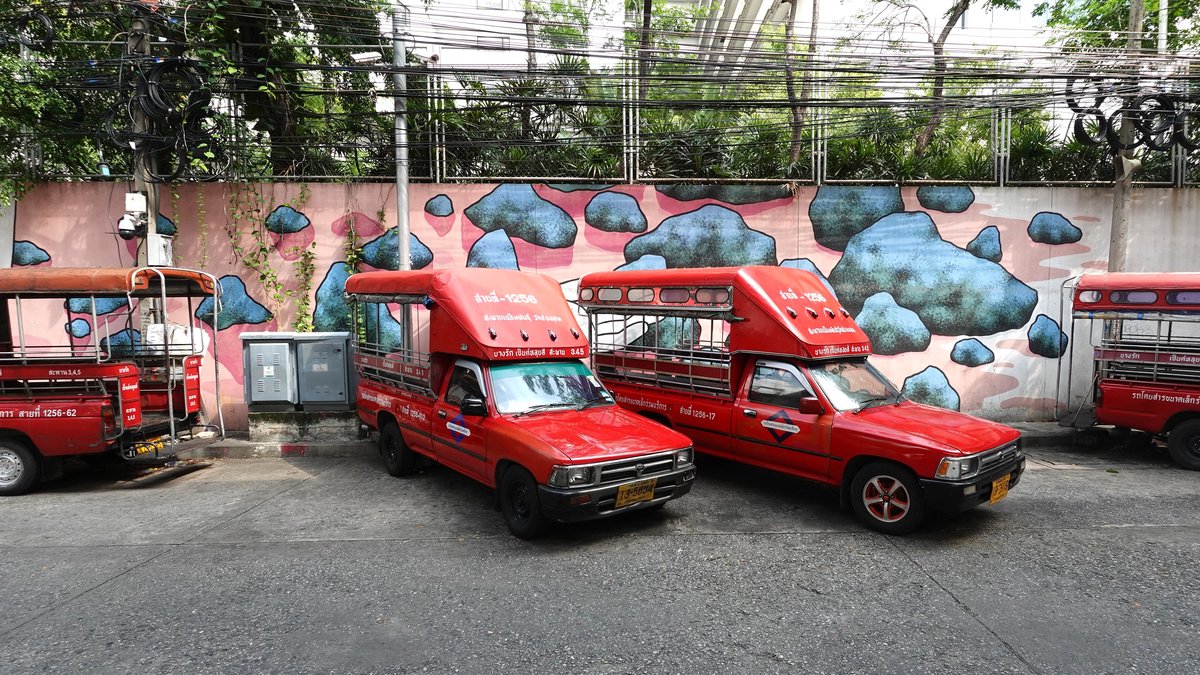
Through Bangkok's creative districts, between street art, architecture, design and new uses of the city.
- Soi
- Thai word for a lane or side street branching off a main road; soi are often numbered after the main street from which they branch.
- Buddha image
- In Thai Buddhism, a devotional representation of the Buddha, most often a statue, venerated as an object of worship.
- Projection mapping
- A technique for projecting images, often animated, that are fitted to the relief and outlines of a surface, particularly a building façade, which thus serves as a screen.
Studies
- 1Bangkok the Canvas for Urban Art to Shine for 10 Days of 'Bukruk II', Khaosod English, 2015 ↗
- 2The art of trespassing, The Nation (Thailand), 2016 ↗
- 3David Fernandez, BUKRUK II Urban Arts Festival | Four artists share their views on Street Art, ASEF culture360 (Asia-Europe Foundation), 2016 ↗
- 4Charoen Krung, a River of Creation, Magazine Latitudes, 2018 ↗
- 5Ariane Sutthavong, Foresight on four sites, Bangkok Post, 2018 ↗
- 6Bangkok's defaced mural restored, Thai PBS World ↗
Reference works
- 7Bukruk II Urban Arts Festival to enhance the image of Bangkok as the city of arts, Tourism Authority of Thailand (TAT Newsroom), 2016 ↗
- 8Bukruk Urban Arts Festival, Urban Arts Festival Bukruk 23 to 31 Jan 2016 – présentation, ASEF culture360 (document hébergé), 2015 ↗
- 9Charoenkrung32 Street Art, Warehouse 30 ↗
- 10Admin Manager, Bukruk Urban Arts Festival (explore neighborhood), Warehouse 30, 2020 ↗
- 11Contributeurs Wikipédia, Bukruk Urban Arts Festival, Wikipédia (fr) ↗
- 12เสพศิลป์ สตรีทอาร์ต ที่ซอยเจริญกรุง 32, BKK Now Connect ↗
- 13Canvas City: Two Walks for the Street Art Lover in Bangkok, Remote Lands ↗
- 14Street Art near Hua Lamphong Station in Bangkok, Thailand, Kathmandu & Beyond ↗
- 15Street Art: Bangkok ; Street art (Soi Charoen Krung 32), Sailingstone Travel ; Qvedo ↗
Contemporary views
Charoen Krung 32 Street Art today
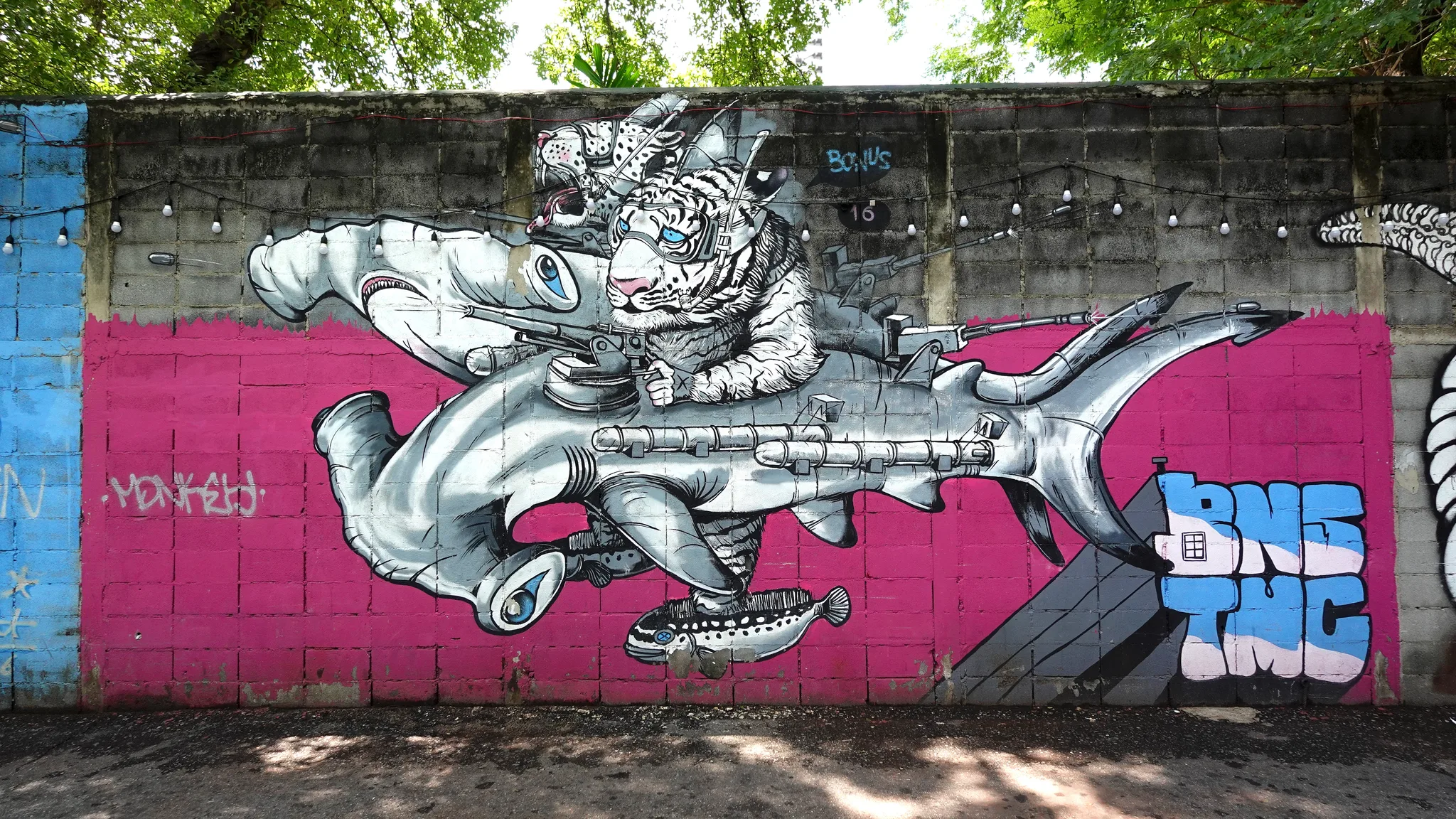
On a breeze-block wall at Charoen Krung 32 Street Art, a black-and-white mural on a pink background shows a helmeted tiger riding a hammerhead shark fitted with cannons, beneath a string of light bulbs and trees.© Eric Monteil 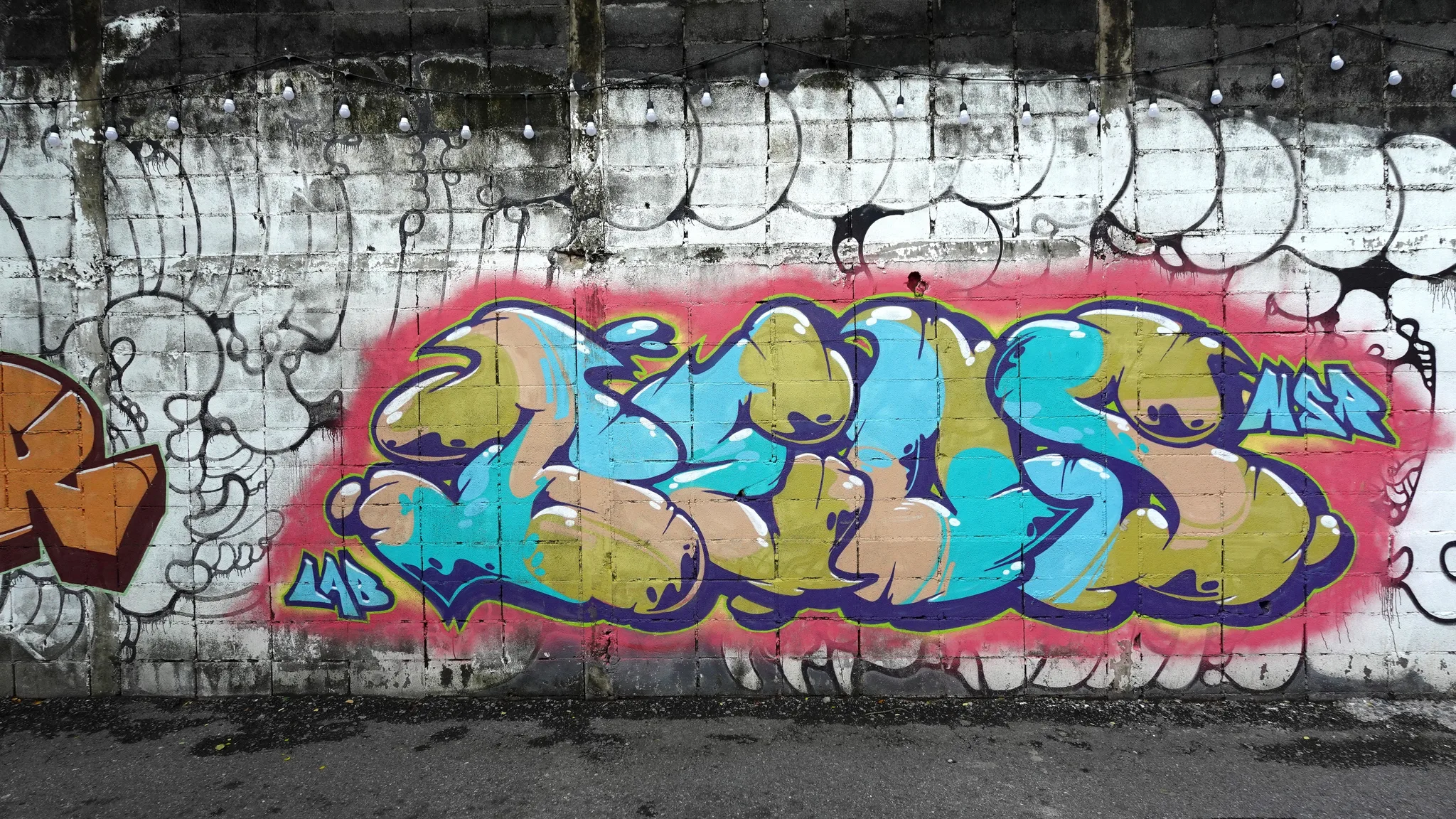
Charoen Krung 32 Street Art: a graffiti lettering piece with rounded forms, outlined in purple on a pink halo, covers a weathered breeze-block wall, topped by a string of light bulbs and older black outlines.© Eric Monteil
Architecture and decoration
Explore the heritage
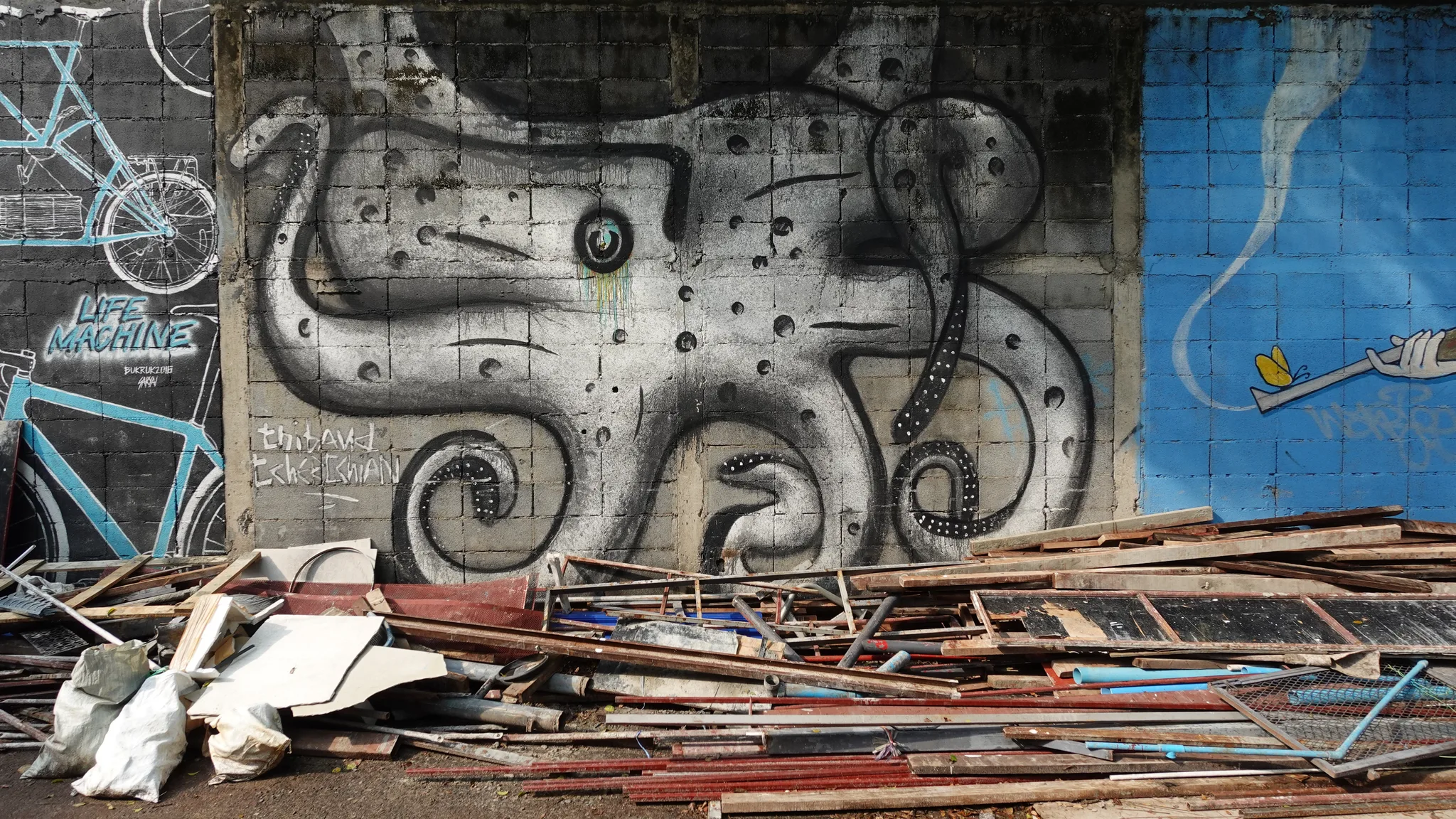
Charoen Krung 32 Street Art: a monochrome octopus with coiled tentacles covers a breeze-block wall, between a bicycle drawn on a black ground and a blue panel; salvaged materials are piled in front.© Eric Monteil