
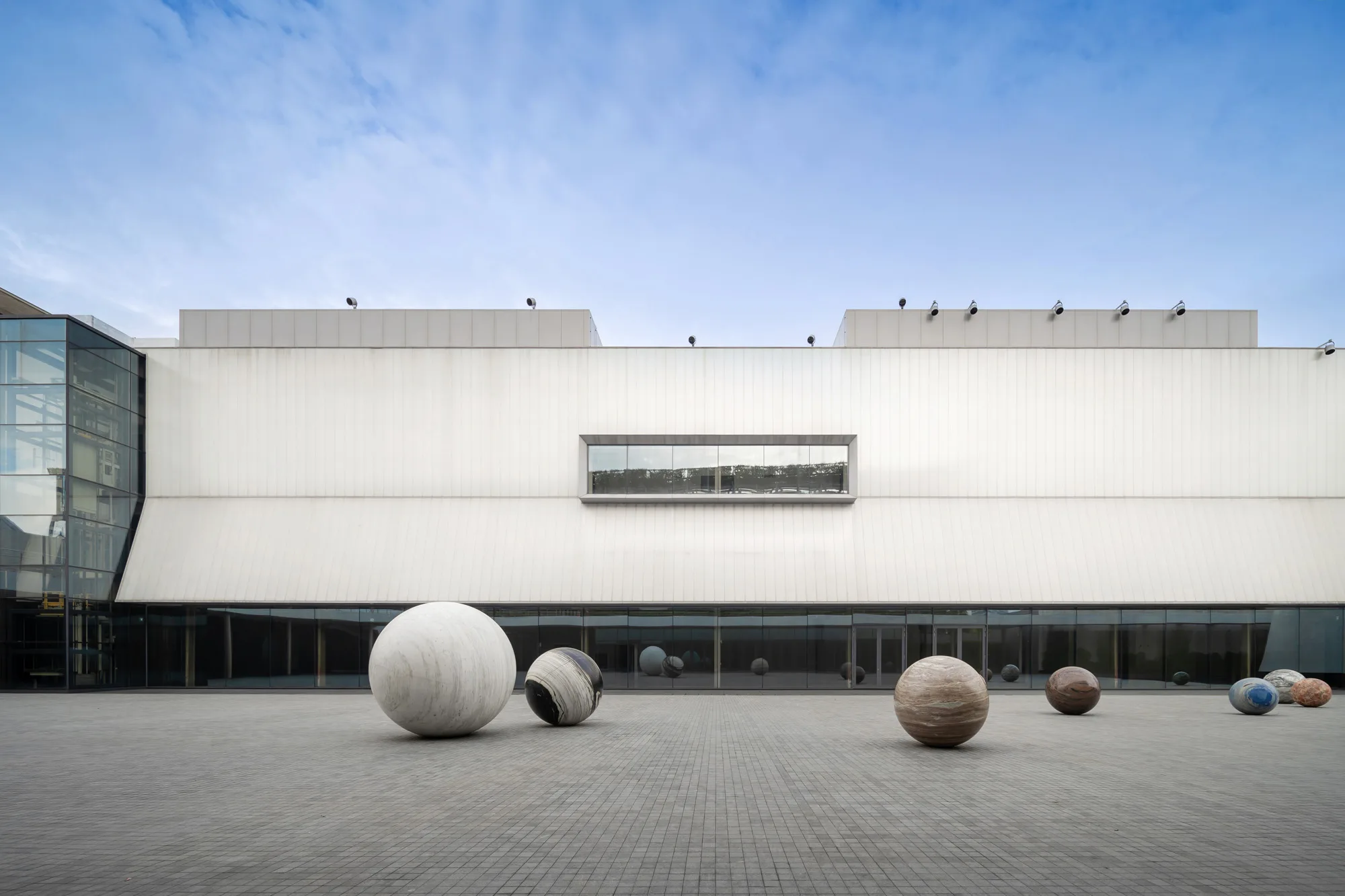
 The paved forecourt of DIB Bangkok holds stone spheres of varied veining and colour, set before a façade clad in pale panels, pierced by a ribbon window and opened at ground level by a glazed wall.© Unknown
- Destination
- Bangkok (Khlong Toei)
- Heritage Family
- Arts, aesthetics and creation
- Typology
- Museum
- Visit
- Available tours →
Dib Bangkok is a private, non-profit museum devoted to international contemporary art, which opened in Bangkok in December 2025. It makes accessible to the public a family collection that long remained private, assembled over some thirty years by the businessman Petch Osathanugrah and then carried through to museum status by his son after his death. Its aim is to show Thai artists and major international figures on an equal footing. Housed in a former industrial warehouse near the port, converted by the architect Kulapat Yantrasast, it brings together eleven galleries, a courtyard, a sculpture garden and a permanent installation by James Turrell.14
Key facts
- Destination
- Bangkok
- Heritage Family
- Arts, aesthetics and creation
- Typology
- Museum
- Places
- Khlong Toei
- Periods
- —
- People
- Kulapat Yantrasast
- Miwako Tezuka
- Petch Osathanugrah
- Purat "Chang" Osathanugrah
- Surat Osathanugrah
- Communities
- —
- Events
- (In)visible Presence exhibition
- Opening of Dib Bangkok
- Heritage
- —
- Glossary
- Khlong
- Buddha image
- Soi
- Awakening
- Sino-Thai
- Skyspace
- Keywords
- —
- Date
- —
- Collections
- —
Practical info
Practical information about this site is taken from its Google Maps page. We advise you to check it before visiting.
- Address
- 111 Soi Sukhumvit 40, Khwaeng Phra Khanong, Khet Khlong Toei, Krung Thep Maha Nakhon 10110
- Website
A collection that became a museum
A family affair
Dib Bangkok is, first and foremost, the culmination of a family story. Petch Osathanugrah (1960–2023) belonged to a Thai business dynasty: heir to Osotspa, the company founded by his grandfather Surin Osathanugrah and known for its M-150 energy drink, he served as its chairman and chief executive until 2022. He also presided over Bangkok University, founded by his father in 1962, and pursued a parallel career as a pop music producer and performer. Yet it is as a collector of contemporary art that he left his most lasting mark: over some thirty years, he assembled the body of work that today forms the core of the museum.6
This collection is not the work of one man alone. His father, Surat Osathanugrah, a businessman turned street photographer, published in 2002, at the age of seventy-two, a book of photographs entitled Vanishing Bangkok, devoted to a city in the process of disappearing. He built part of the collection with his son, and his images are among the works in the inaugural exhibition. From its opening, then, the museum brings together the gaze of several generations: the one that photographed Bangkok, the one that collected, and the one that opened the doors.6
A project thirty years in the making
The idea of a museum has accompanied the collection almost from the outset. The project had been talked about for thirty years, and Petch Osathanugrah’s son has recounted that his father was already mentioning it when he was a child. The intention was clear: to redress the meagre presence of Thai art on the international stage by giving it a place where it would be seen alongside artists recognised the world over.14
One anecdote captures the length of this wait. In 1995, Petch Osathanugrah bought from the sculptor Somboon Hormtientong a work made up of columns. With nowhere to house it, the artist kept the columns at his home for more than twenty years, waiting for the museum to be built. A work acquired in the mid-1990s thus found its permanent place only at the opening, three decades later.14
Finishing without the founder
Petch Osathanugrah did not live to see his project completed. He died of a heart attack on 14 August 2023, aged sixty-three, while construction was still unfinished. His son, Purat Osathanugrah, known by the nickname Chang, took over: as founding president of the museum, he saw the project through to completion and opened a hitherto private collection to the public.8
This passage from a personal collection to a public institution changes the nature of the whole. Purat Osathanugrah describes the museum as a place that collects, preserves, restores, educates and tells the story of contemporary art – in other words, as a fully fledged institution rather than a showcase for private taste. He also hopes that the museum will eventually exist beyond the name of the family that founded it.2
A site by the port
At the end of Soi Sukhumvit 40
The museum has settled in a district never intended for art. Its entrance lies at the southern end of Soi Sukhumvit 40, one of the side streets, known as soi, that branch off the great thoroughfare of Sukhumvit, set back from Rama IV Road, close to the Khlong Toei port area. The building that houses it is a former steel warehouse built in the 1980s, a utilitarian structure that nothing had destined to receive works of art.3
This choice gives the museum part of its identity. Rather than erect a new building, the Osathanugrah family chose to transform an industrial structure tied to the city’s commercial activity. The site’s past has not been erased: it remains legible in the materials, the frame and the shape of the roof, and the conversion of the warehouse is the only major transformation in its history.
A name that speaks of the raw
The museum’s name extends this choice. “Dib”, pronounced like the English word “dip”, is a Thai word translated as “raw”, in the sense of something rough or crude, in its natural state. The museum sees in it both an image of Bangkok’s energy and the idea of returning art to its original state, stripped of whatever encumbers it.15
The word suits a building whose industrial character was deliberately retained. During the project phase, the institution bore the longer name Dib Bangkok Museum of Contemporary Art; it was the short form, Dib Bangkok, that prevailed at the opening.6
Reading the architecture
An industrial framework and the idea of awakening
The conversion of the warehouse was entrusted to Kulapat Yantrasast, a Thai-born architect and founder of the practice WHY Architecture, working with the Thai firm Architects 49. The chosen approach rests on a dialogue between the existing structure and a religious inspiration: the architect refers to awakening, the state of understanding and clarity that Buddhism places at the end of the spiritual path.4
This reference does not take the form of religious decoration. Instead, it is expressed through architectural gestures, inserted into the industrial framework, that work with light, passages and the way visitors rise through the building. The warehouse retains its frame and volumes, but it becomes a route leading from the half-light of concrete to the brightness of the upper galleries.1
Three levels, three atmospheres
This movement can be read from one floor to the next. On the ground floor, a minimal concrete aesthetic recalls the building’s industrial past: the surfaces are bare, and visitors can still sense the warehouse beneath the museum. The first floor offers more intimate spaces, more conducive to contemplation; an original Sino-Thai window grille is displayed there, a witness to an urban tradition born of the mingling of Chinese and Thai cultures, which anchors the site in the city’s architectural history.4
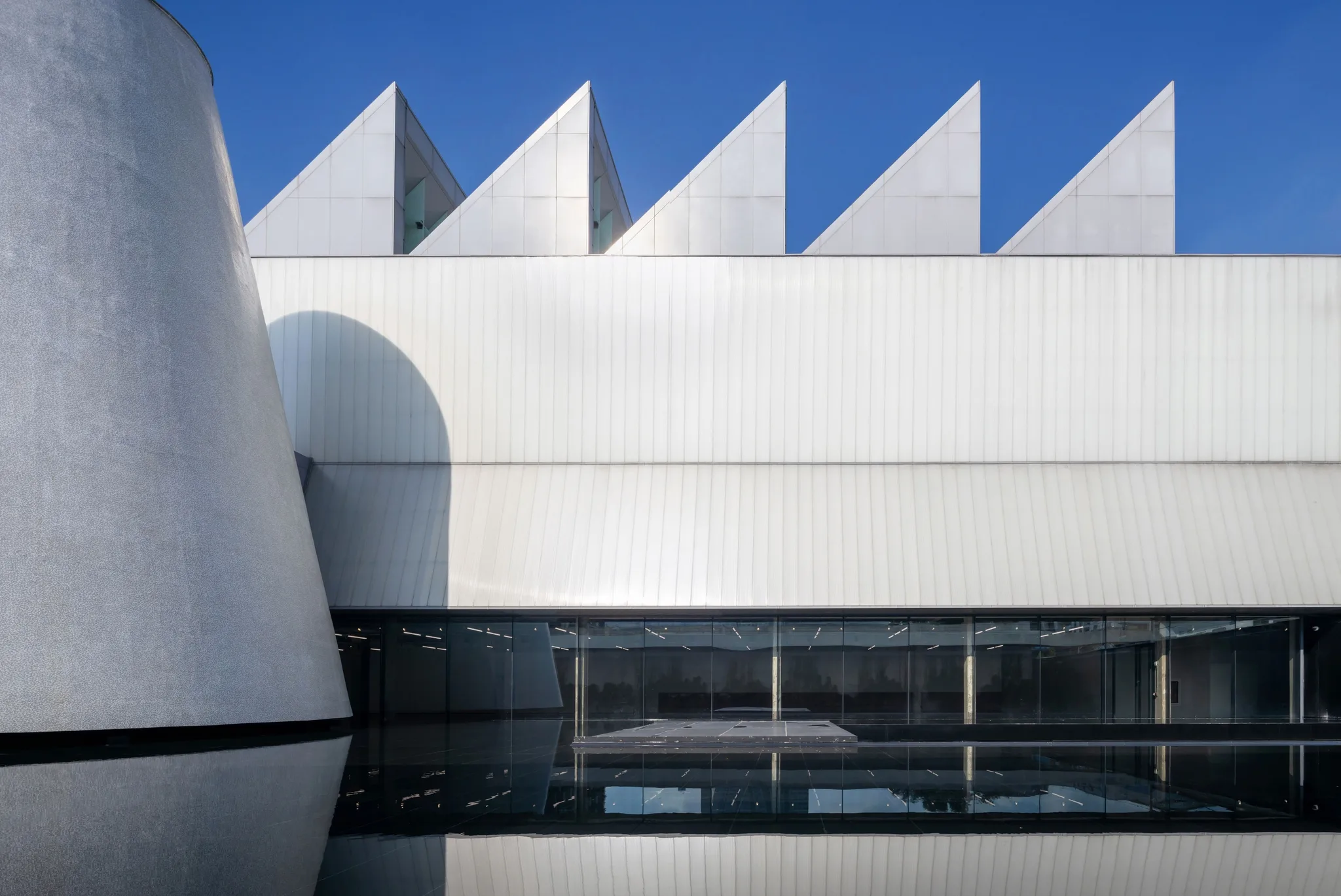
The second floor, by contrast, offers “white cube” rooms – galleries with white, neutral walls that efface the architecture in favour of the works. They are lit by light wells cut into the roof and, to the north, are covered by the warehouse’s sawtooth roof, the serrated covering typical of industrial buildings that admits an even light. The ascent through the museum thus accompanies the passage from the industrial past to the contemporary exhibition space.4
Courtyard, garden and places to linger
Around the eleven galleries, the museum is organised around a large open central courtyard and an outdoor sculpture garden, which bring sky and greenery into a once-enclosed complex. A penthouse for events and a bistro-bar with a restaurant complete the programme, making the museum a place to spend time as much as to visit.12
The whole covers some 6,500 to 7,000 square metres, the figures varying according to whether one counts the entire building or the galleries alone. This scale places Dib Bangkok among the city’s major cultural venues, without the former warehouse losing its silhouette.1
The collection and its highlights
Thai and international artists on the same footing
The collection numbers more than a thousand works by more than two hundred artists, Thai and international. It includes artists from the Thai scene such as Montien Boonma, Rirkrit Tiravanija and Kawita Vatanajyankur, and international figures such as Damien Hirst, Frank Stella, Takashi Murakami and Pablo Picasso. This coexistence lies at the heart of the project: the museum intends to present the great names of world art and Thai artists on the same footing, with no hierarchy between a centre and a periphery.1
This principle also guides the programming. During its first years, the museum plans to show its collection, new commissions and collaborations, highlighting one or two artists in each exhibition. Rather than following a chronology or national schools, the curators arrange the displays by theme, which allows works of very different origins to be brought together.2
Straight Up, a tower turned towards the sky
The museum’s most visible work is a building in its own right. Straight Up, created in 2025 by the American artist James Turrell, is a permanent installation in the form of a free-standing tower whose silhouette recalls a silo. Visitors climb a staircase to a skyspace, a room designed by the artist for looking at the sky, pierced by an oculus – a circular opening in the ceiling that frames a fragment of sky.11
The experience relies on natural light and on time: the colour of the sky, seen through the oculus, changes with the hour and the weather. The work is presented sometimes as James Turrell’s first in South-East Asia, sometimes, more cautiously, as his first major permanent structure in Thailand. Either way, it echoes the idea of awakening and clarity that guides the museum’s architecture.11
Works laden with memory
Montien Boonma occupies a central place in the display. His 1991 sculpture Full Moon is in the museum, and a dozen of his works are brought together on the second floor, in dialogue with those of the German artist Anselm Kiefer. Among them, a sound installation of five hundred terracotta bells makes sound a material of the work, on a par with form.12
The columns by Somboon Hormtientong, long kept by the artist, were installed in an unusual way. Before they were put in place, the sculptor performed a funeral rite for the columns with fourteen monks, as if to close their long life of waiting before entering the museum. This gesture shows how a contemporary work can carry Thai religious practices, and how the museum welcomes works that have a history even before they are exhibited there.14
Opening the museum
A long-awaited opening
The founder’s death and the scale of the works repeatedly pushed back the opening date, first announced for spring 2025, then for the autumn. In the meantime, the museum acquired a leadership. In February 2024, Miwako Tezuka left New York for Bangkok to become its first director. An art historian specialising in post-war Japanese art, with a doctorate from Columbia University, she had headed the Japan Society Gallery in New York before becoming associate director of the Reversible Destiny Foundation.18
The choice of a director from the New York art scene who specialises in Asia reflects the project’s international ambition. The museum was inaugurated at an official evening event on 20 December 2025 and opened to the public the following day. Its opening was presented as one of the most eagerly awaited in Asia since that of the M+ museum in Hong Kong, a measure of the attention it attracted far beyond Thailand.2
(In)visible Presence: memory and the invisible
The inaugural exhibition, (In)visible Presence, on show from 21 December 2025 to 3 August 2026, is drawn from the collection: it brings together eighty-one works by forty artists. Its curator, the Thai artist Ariana Chaivaranon, conceived it under the artistic direction of Miwako Tezuka as an exploration of memory and of what eludes the eye, engaging several senses at once: sound, smell and light.10
The exhibition brings together artists from diverse backgrounds, from Lee Bul to Hiroshi Sugimoto, from Apichatpong Weerasethakul to Pinaree Sanpitak, from Alicja Kwade to Paloma Varga Weisz, whose sculpture Bumpman on a Tree Trunk features in the display. The photographs of Surat Osathanugrah find their place here, a reminder that the memory the exhibition addresses is also that of the family who assembled the collection and of the city it has watched change.
A new institution in Bangkok’s landscape
Dib Bangkok presents itself as the first major Thai museum devoted to international contemporary art. In the capital it joins two already established institutions, the Bangkok Art and Culture Centre and the Museum of Contemporary Art in Bangkok, known by the acronym MOCA. As a private, non-profit institution, it is part of a trend particular to Asia, where major museums arise from the initiative of individuals from business dynasties rather than from that of public authorities.5
This status sheds light on the nature of the place. The building, a recent warehouse, enjoys no known heritage protection; its value lies less in its age than in what it houses and in the way it has been transformed. By making a port warehouse the home of an international collection, the Osathanugrah family has given Bangkok a museum that tells at once the story of a collection, that of an industrial city, and that of the place Thai art seeks to occupy in the world.
Understanding
Dib Bangkok was born of a family collection patiently assembled by Petch Osathanugrah and his father, then opened to the public by his son after the founder’s death. In a former port warehouse whose framework it retains, it exhibits Thai artists and major international figures side by side, with the intention of making visible an art long left on the margins of global circuits. Its significance lies in this twofold ambition: to give Bangkok a fully fledged institution that preserves, displays and passes on, and to make the country a place where contemporary art is looked at rather than a place it departs from. Yet its future hinges on its very nature. A private museum born of a business dynasty, it still bears the name and the taste of a family, even though its current founder hopes it will eventually break free of them. Can a museum born of a private passion become, for Thais, a common good that tells of their own view of the world’s art?
Through Bangkok's creative districts, between street art, architecture, design and new uses of the city.
- Khlong
- Canal or waterway, natural or man-made, which long played a major role in transport, irrigation and the organisation of settlements and territories in Thailand.
- Buddha image
- In Thai Buddhism, a devotional representation of the Buddha, most often a statue, venerated as an object of worship.
- Soi
- Thai word for a lane or side street branching off a main road; soi are often numbered after the main street from which they branch.
- Awakening
- In Buddhism, the state of understanding and clarity reached at the end of the spiritual path, which frees one from ignorance and suffering.
- Sino-Thai
- Describes what stems from the blending of Chinese and Thai cultures, notably an architectural and urban tradition developed in Thailand by communities of Chinese origin.
- Skyspace
- A room designed by the artist James Turrell for viewing the sky through an opening in the ceiling.
- Oculus
- A circular opening in a ceiling, vault or wall that lets light through.
- White cube
- A type of exhibition room with white, neutral walls, designed to make the architecture recede in favour of the works.
- Sawtooth roof
- A sawtooth roof, typical of industrial buildings, whose glazed slopes let in even, regular light.
Studies
- 1First Dibs: Bangkok Opens New Contemporary Art Museum, Business Traveller, 2026 ↗
- 2Inside Dib Bangkok: Thailand’s most anticipated museum opening being watched by the global art world, Monocle, 2025 ↗
- 3Why modern art museum Dib Bangkok is a must-visit destination in Thailand, South China Morning Post (Style), 2026 ↗
- 4Daniel Jonas Roche, WHY Architecture completes the first international contemporary art museum in Thailand’s capital city, The Architect’s Newspaper, 2026 ↗
- 5Bangkok’s first international contemporary art museum, Dib Bangkok, opens to the public this Sunday, BK Magazine, 2025 ↗
- 6Anna Lentchner, Petch Osathanugrah, 1960–2023, ArtAsiaPacific, 2023 ↗
- 7Petch Osathanugrah – ARTnews Top 200 Collectors, ARTnews ↗
- 8Petch Osathanugrah, Collector Who Had Plans to Transform Thailand’s Art Scene, Dies at 63, ARTnews, 2023 ↗
- 9Dib Bangkok, Time Out Bangkok, 2026 ↗
- 10(In)visible Presence – Announcements, e-flux, 2025 ↗
- 11Exploring Light in the Heart of Bangkok by James Turrell, Bonart ↗
- 12Dib Bangkok Provides a Home for Contemporary Art in Thailand, Art & Object ↗
- 13Bangkok welcomes Dib, the city’s first contemporary art museum, Bangkok Post, 2025 ↗
- 14Na Tasukon, Dib Bangkok Opens as Thailand’s First International Contemporary Art Museum, Robb Report Thailand, 2026 ↗
Reference works
- 15DIB: Bangkok’s New Contemporary Art Museum, Istituto Italiano di Cultura di Bangkok, 2026 ↗
- 16Dib International Contemporary Art Museum, Wikipedia ↗
- 17Dib Bangkok: A New Perspective on Curating Asia, Asia Society Hong Kong Center, 2026 ↗
- 18Team, Oral History Archives of Japanese Art ↗
- 19Dib Bangkok – Directory, e-flux ↗
Contemporary views
DIB Bangkok today
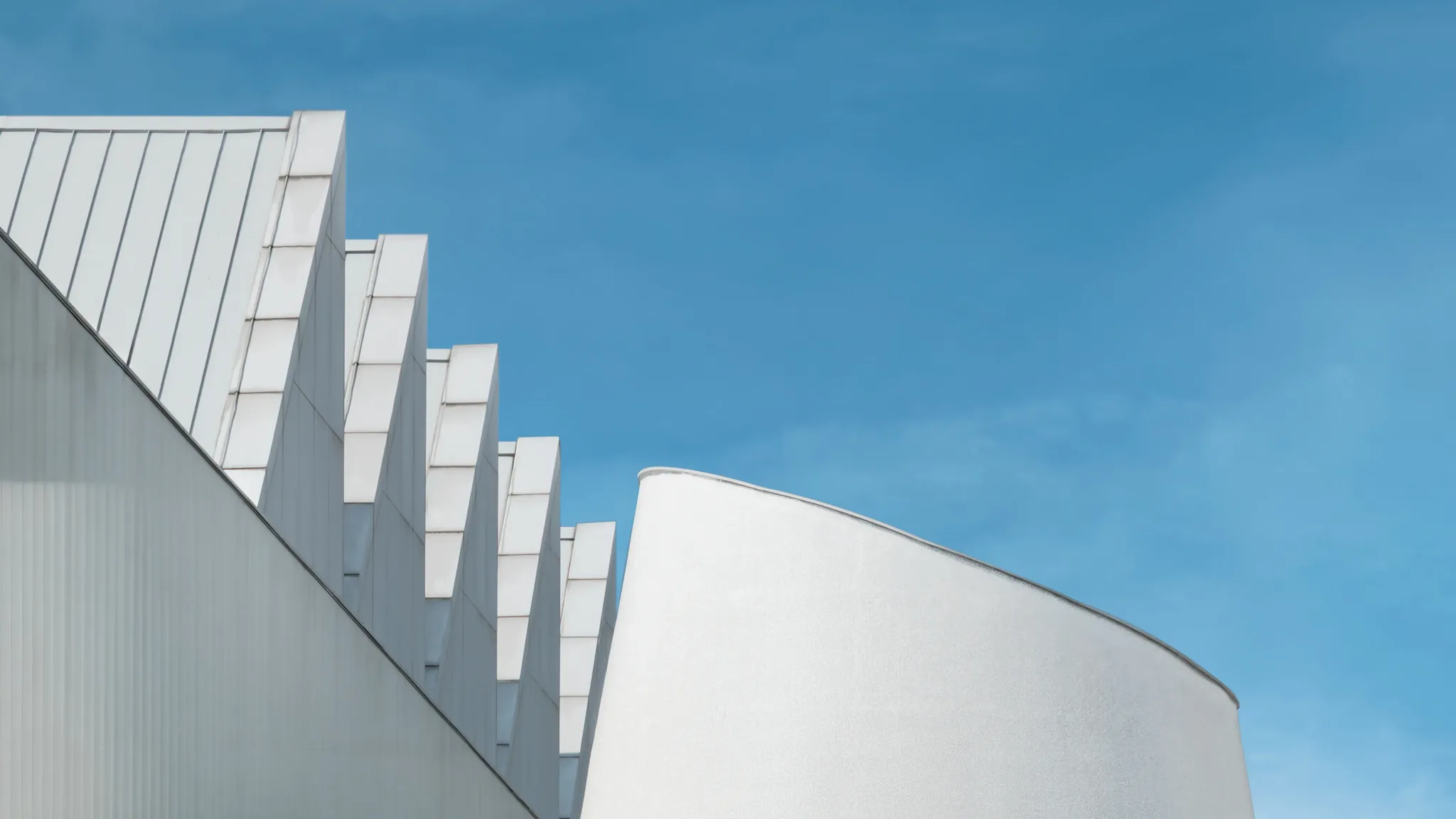
At DIB Bangkok, a succession of sawtooth roofs clad in white metal sits alongside a curved white rendered volume; the low-angle framing isolates these geometric forms against the blue sky.© Unknown 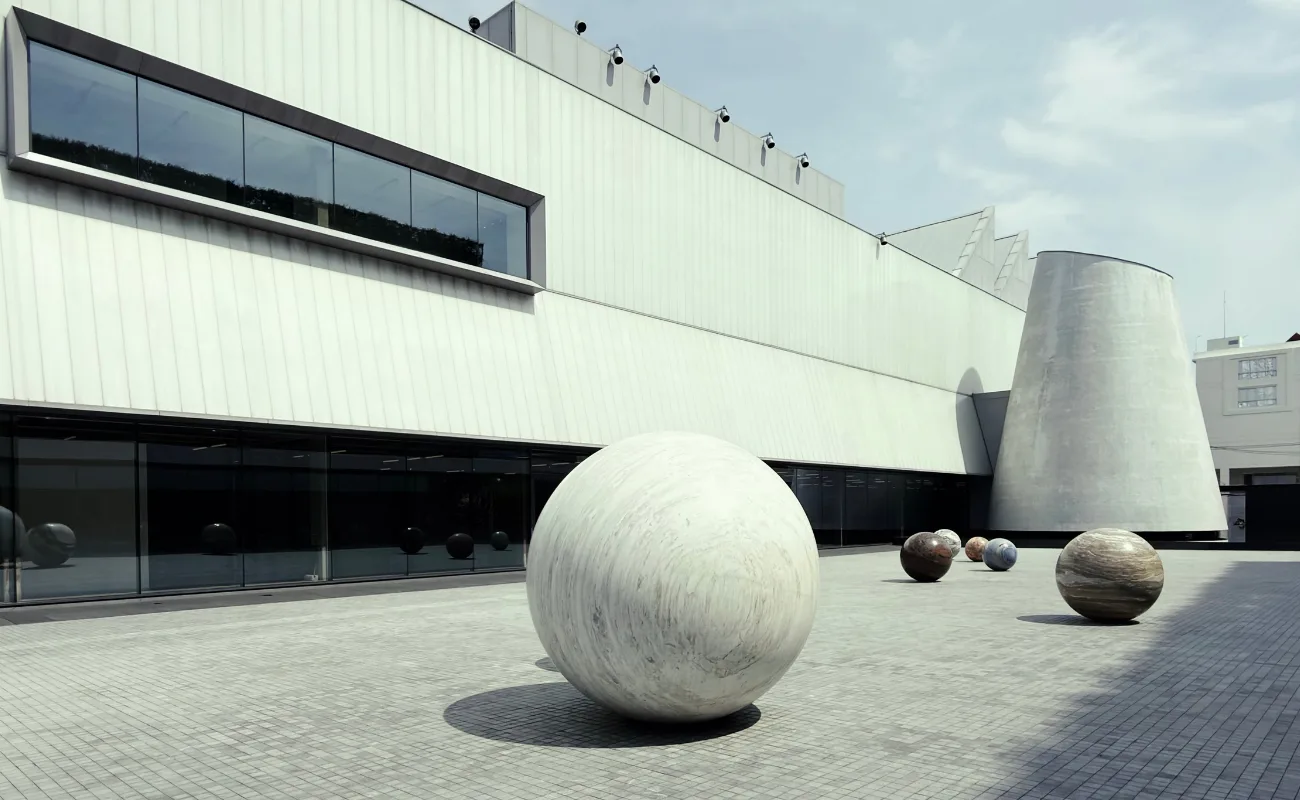
On the paved forecourt of DIB Bangkok, stone spheres with varied veining are arranged before a white façade with vertical cladding, pierced by glazed openings and extended by a conical concrete volume.© Unknown
Architecture and decoration
Explore the heritage
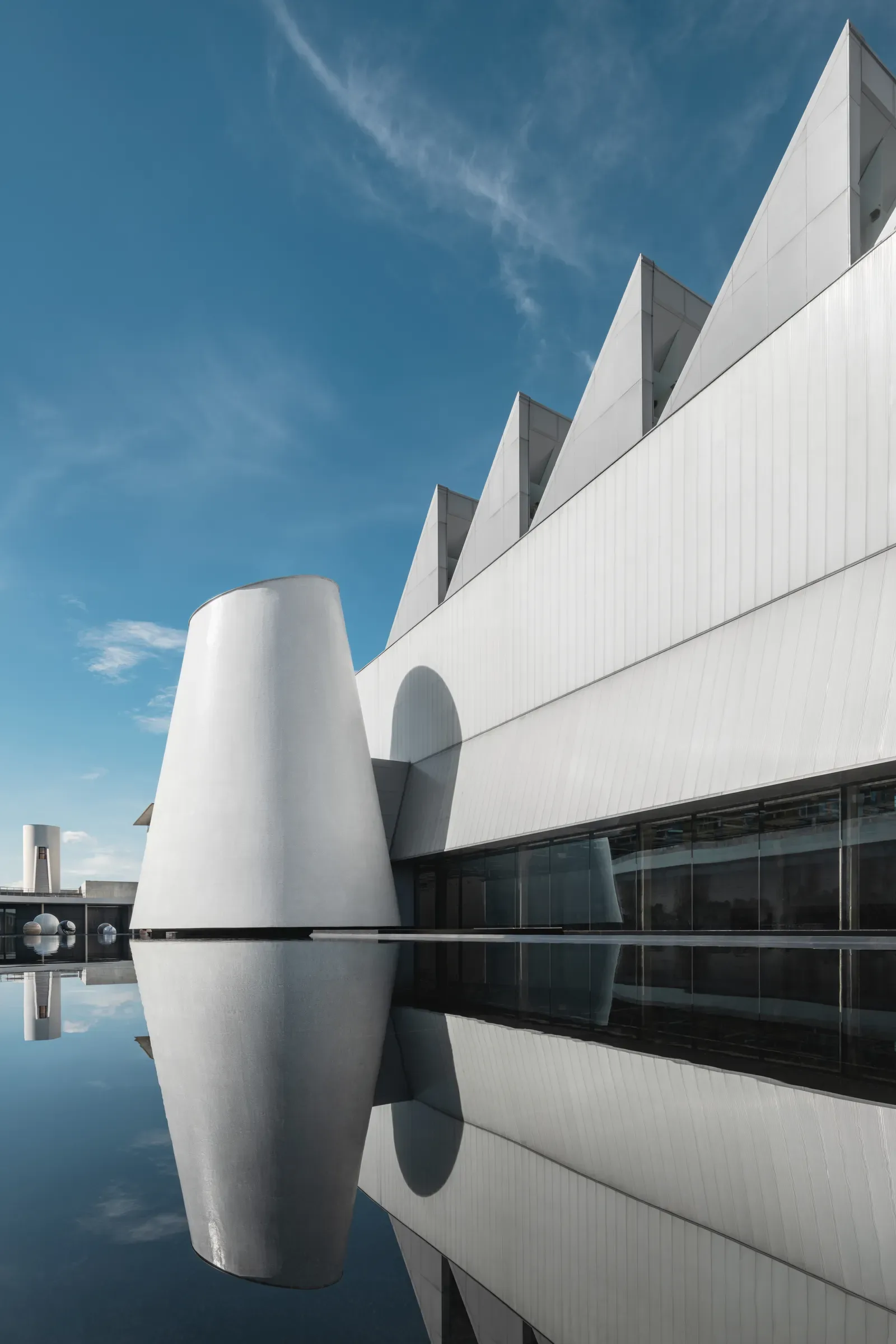
At DIB Bangkok, a white conical volume rises before a long façade with a sawtooth roof and a circular opening; the pool at the foot of the building reflects its geometric forms.© Unknown 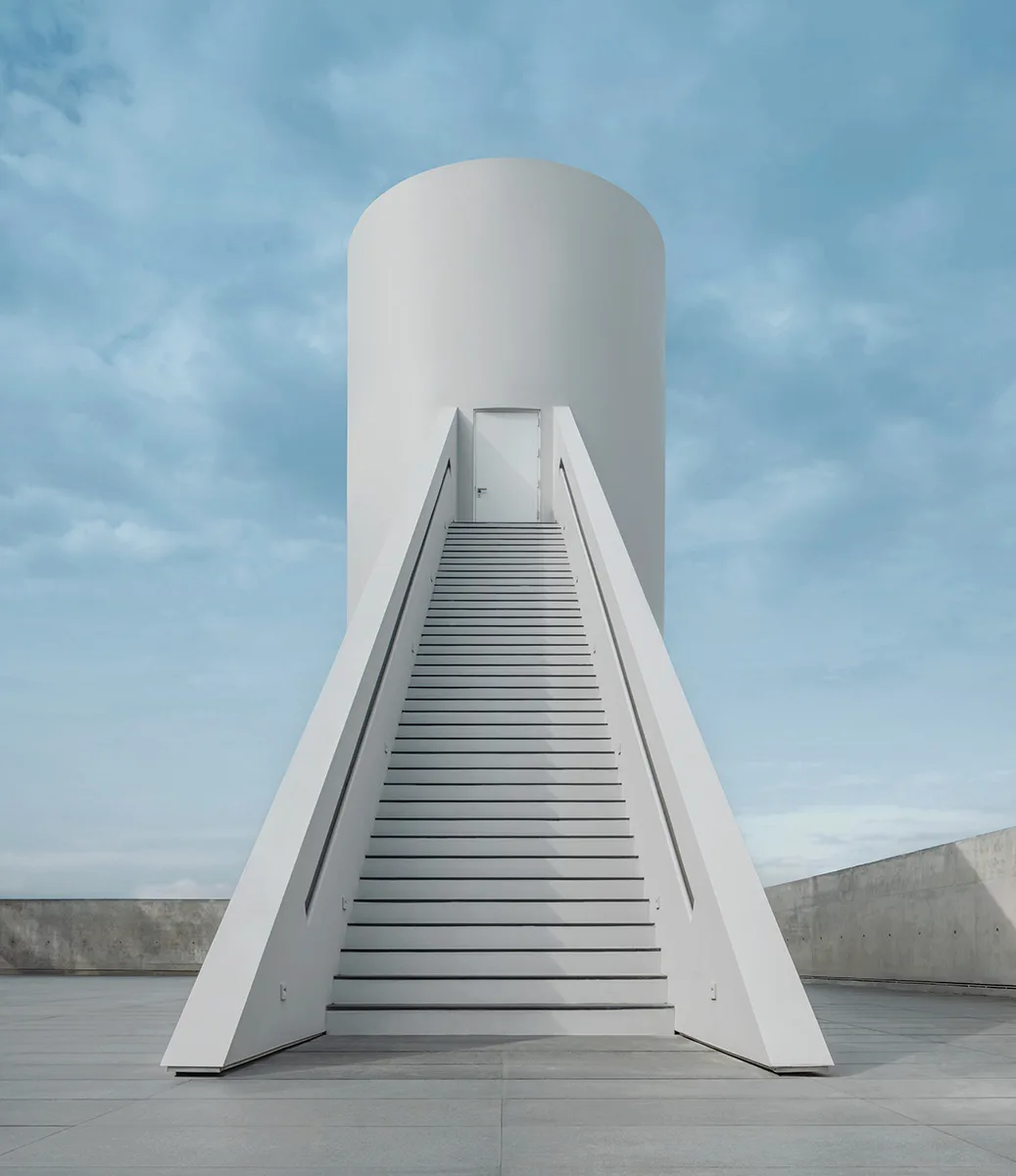
On the terrace of DIB Bangkok, a white staircase framed by oblique parapets rises to a door set in a cylindrical volume, between low walls of raw concrete: a stark, axial composition.© Unknown