
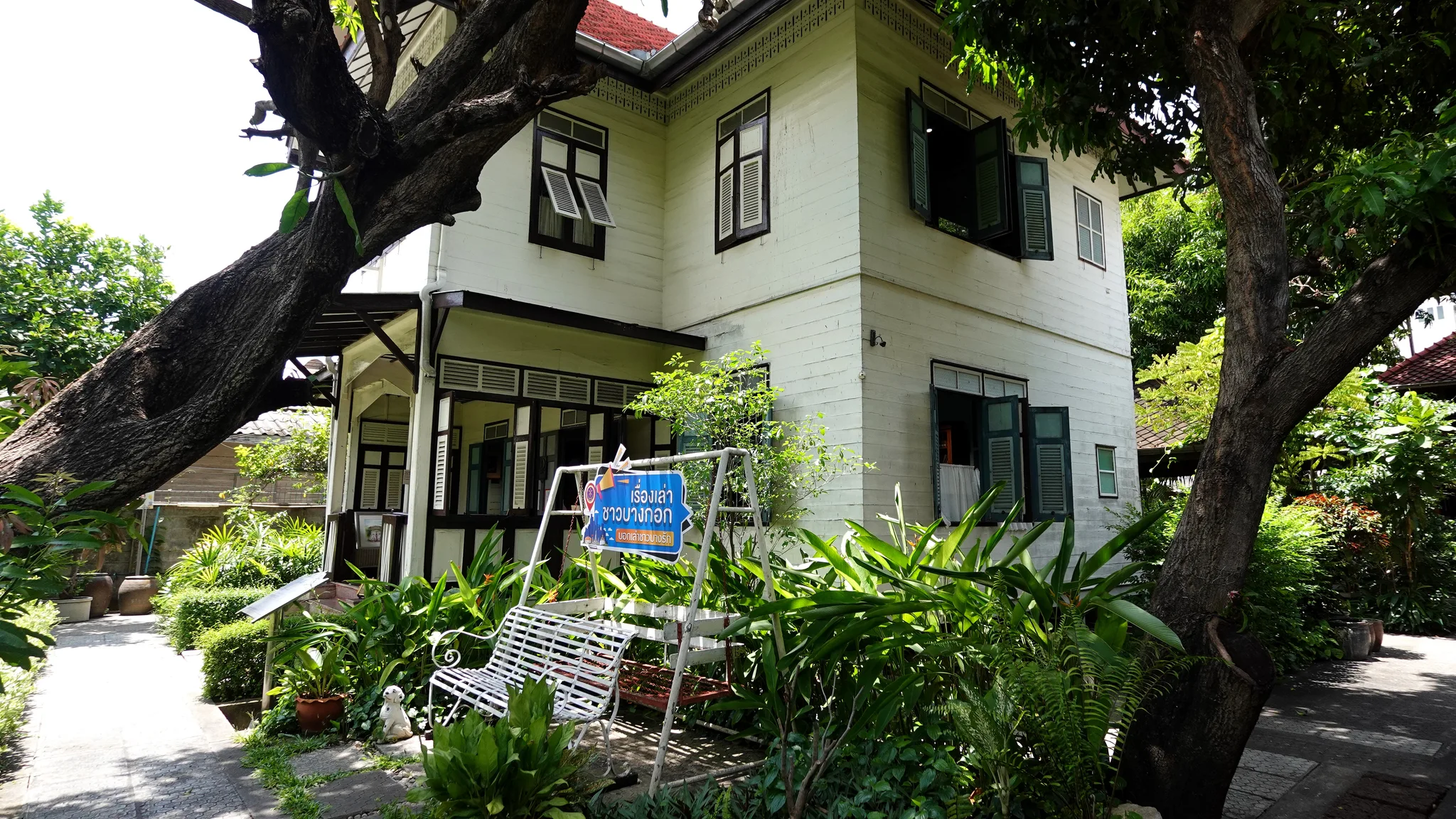
 At the Bangkokian Museum, a two-storey house of white-painted timber, with green louvred shutters and a pierced frieze beneath the roof, stands in a planted garden, with a swing seat and a Thai-language sign in the foreground.© Eric Monteil
- Destination
- Bangkok (Bang Rak)
- Heritage Family
- Architecture and built heritage
- Typology
- Museum
- Visit
- Available tours →
The Bangkokian Museum is a house museum set in former wooden family residences in the Bang Rak district of Bangkok. It reveals the daily life of the capital’s well-to-do middle class during and after the Second World War, in rooms whose furniture has remained in place. Waraporn Surawadee, an academic, turned her mother’s legacy into a place of learning, then gave it to the Bangkok Metropolitan Administration. The site also serves as the district’s local museum. Three houses, including a teak residence built in 1937, stand in a garden laid out around a pond.2
Key facts
- Destination
- Bang Rak
- Heritage Family
- Architecture and built heritage
- Typology
- Museum
- Places
- —
- Periods
- People
- Francis Christian
- Sa-ang Suravadi
- Waraporn Surawadee
- Communities
- —
- Events
- Démontage et remontage de la maison du docteur Francis Christian à Bang Rak
- Donation à l’Administration métropolitaine de Bangkok
- Heritage
- —
- Glossary
- Bang
- Ayutthaya Period
- Sala
- Keywords
- —
- Date
- —
- Collections
- —
Practical info
Practical information about this site is taken from its Google Maps page. We advise you to check it before visiting.
- Address
- 273 Soi Saphan Yao, Khwaeng Si Phraya, Khet Bang Rak, Krung Thep Maha Nakhon 10500
- Phone
A museum devoted to the people of Bangkok
Ordinary life as its subject
The Bangkokian Museum tells the story of neither the royal court nor the capital’s great monuments. Instead, it presents the home of a family of city dwellers. Its Thai name, Phiphithaphan Chao Bang Kok, literally means ‘museum of the people of Bangkok’. In English, it is also known as the Bangkok Folk Museum. The museum shows how the city’s well-to-do middle class lived in the years surrounding the Second World War: how they furnished their homes, entertained, cooked and kept their mementoes.11
The period it covers has somewhat blurred boundaries. The founder chiefly wished to evoke the late 1930s and the war years, roughly the decade following 1937. Accounts differ: the period covered is also given as running from 1937 to 1957, spanning the war and the post-war years. It is therefore not a reconstruction of one specific year. Rather, it is the state of a house that a family lived in and then handed down, together with the objects accumulated over time.1
Two names for one place
The museum bears a second Thai name, which may be translated as ‘Bangkok local museum, Bang Rak district’. In English, it takes the form Bangkok Local Museum Bang Rak. This second name reflects its role as the district’s local museum.10
The two roles still coexist. Visitors pass through the rooms of a family home, then come upon a display devoted to Bang Rak and its inhabitants. The museum is thus at once a house of memory and a neighbourhood museum.
Bang Rak, an outward-looking district
The museum occupies a plot of some 1,700 square metres near Charoen Krung Road, in the Bang Rak district. Three houses stand in a tropical garden, around a pond.2
Bang Rak is a residential district today, but it has had several lives. It has been a place of retreat and leisure, it has been home to an international community, and it has ranked among the city’s important business areas since the late Ayutthaya period, the Siamese kingdom that preceded the founding of Bangkok as capital. It was in this old and mixed district that a Bangkok family chose to present its own history.10
A family’s houses
Dr Francis Christian’s surgery
The oldest house in the museum was not built in Bang Rak. In 1929, Sa-ang Suravadi, née Tanboontek, had a two-storey wooden house built in Thung Maha Mek, on Soi Ngam Duphli. She intended it for her first husband, Dr Francis Christian, a physician who had studied surgery in England. Accounts differ as to his origins: he is said to have been of Indian or of British descent. The ground floor was to house his medical practice, and the upper floor was to serve as living quarters.1
The plan came to nothing: the doctor died before he could move in, and the house was subsequently let. It remained in the family and would join the museum only later, in circumstances that altered its form.1
The 1937 residence
The main house was built in 1937 for the Suravadi family. It is a two-storey teak residence, painted white, in a Western-influenced style of architecture. It has a hipped roof, that is, a roof with four sloping sides. Its seven rooms have kept the appearance they had more than eighty years ago.8
The interior of this house has not been rearranged. Most of the objects have stayed where they were during Sa-ang’s lifetime. What visitors see is therefore the setting of a family that genuinely lived in these rooms, not a reconstructed period interior.1
The heiress
Waraporn Surawadee, Sa-ang’s daughter, inherited her mother’s land and houses. An associate professor and a biologist by training, she chaired the In-Sat–Sa-ang Foundation, which partly bears her mother’s name. It was she who turned the property into a museum. That choice transformed a private estate into a place for passing on knowledge.4
From family property to municipal museum
The founder’s vision
The Bangkokian Museum began as a private museum, created by Waraporn Surawadee with the support of the In-Sat–Sa-ang Foundation. She wanted to make it a learning centre on the history of Bangkok.1
She was personally involved in the project. During her lifetime, she welcomed visitors and acted as their guide. She also asked the volunteers around her to pass this vision on to younger generations.4
A house dismantled and rebuilt
To fund the museum’s fitting-out, Waraporn Surawadee sold the Thung Maha Mek land but kept the house built for Dr Francis Christian. It was dismantled and then re-erected on the Bang Rak plot, at a reduced scale for lack of space. The 1929 house thus joined the family residence.6
This relocation raises a question: to what extent is the present building the original house? Accounts do not agree. Some describe the structure as a new building, made to resemble the original on a smaller scale. Others speak of a house that was moved. Between these two versions, the proportion of original materials retained remains difficult to gauge.9
The gift to the city
Waraporn Surawadee then gave the property to the Bangkok Metropolitan Administration, on 1 October 2004. In 2018, a museum volunteer summed up the gesture by saying that the teacher had ‘given the house to the Thai people’.10
The museum then joined a pilot programme of local museums launched by the Bangkok Metropolitan Administration, which was eventually meant to extend to the city’s districts. Its management was entrusted to the Bang Rak District Office, which receives an operating budget. This new mission is visible in the buildings: the upper floor of the third building houses an exhibition on the history of the people of Bang Rak, arranged around nine themes. A family’s museum also became a neighbourhood’s.1
Touring the three houses
A pre-war bourgeois interior
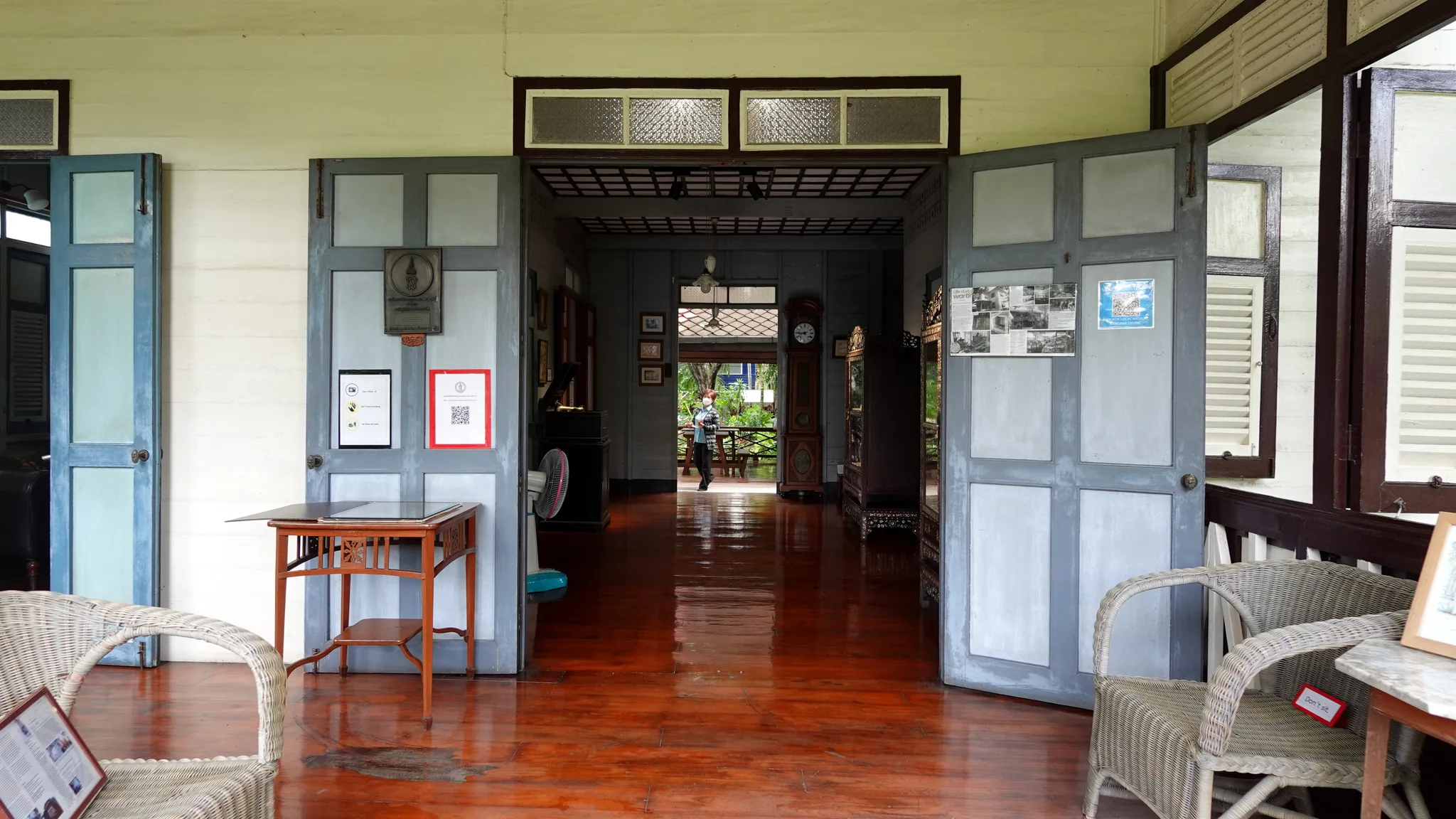
On the ground floor of the main house, visitors enter a drawing room where the piano was often played, then a dining room. The table rests on lion’s-paw feet, and the chair backs are carved with bows and bouquets in the Western manner. Wooden furniture, porcelain and many objects from family life before and after the war complete the setting. The house also retains original louvred shutters, four-poster beds and an upright piano.8
These rooms show how a well-to-do Bangkok family adopted, in the 1930s, forms and customs from Europe: a dining room furnished in the Western style, a piano in the drawing room, four-poster beds. A reconstruction of a wartime Bangkok kitchen completes the tour.11
A doctor’s mementoes
In Dr Francis Christian’s rebuilt house, the tour changes tone. Here one sees medical textbooks, medical instruments, diplomas, old photographs and Western furniture. These objects evoke a doctor trained in surgery in England and the surgery he never occupied.8
This house adds a personal story to the museum, one of an interrupted plan and of bereavement.
Everyday objects and the history of the district
A long building at the far right of the plot displayed old Bangkok household implements: winnowing baskets, those wide, flat baskets used to separate grain from its husk, stone mortars and basins, as well as farming tools such as hoes, spades and sickles. It also held objects brought back from abroad and a section devoted to the history of Bang Rak. This building had to close because of construction work on the neighbouring plot, which caused cracks throughout its structure.8
The museum also displays the family’s household objects, the rare books collected by Waraporn Surawadee and a permanent exhibition focused on Bang Rak, entitled ‘Overview Images of Bangkok Metropolis’. In the garden stand a sala, an open pavilion for shelter and rest, and a souvenir shop. Rapeepat Ketkosol, secretary of the Thai Tourism Society, described the whole as a ‘living museum’.2
The museum today
After the founder’s death
In January 2017, Waraporn Surawadee died at the age of 80, following a fall. Her death raised an immediate question: what becomes of a museum she had run herself? The Bangkok Metropolitan Administration confirmed the same year that it would continue to manage the site, still through the Bang Rak District Office. The city funds the routine upkeep of the wooden houses, and additional funds were requested in 2017 for repairs.3
The museum has continued to operate. It remains open to the public, and admission is free. It is one of Bangkok’s municipal museums and serves as the district’s local museum.1
A record of urban life
The value of the Bangkokian Museum lies in its testimony to the domestic life of Bangkok’s well-to-do city dwellers between the late 1930s and the 1950s. It is among the capital’s historic houses open to visitors. These are houses that a family genuinely lived in, with their furniture, utensils and mementoes left in place.11
The site thus brings together several stories: that of a mother connected with two houses built eight years apart, that of a doctor who died before moving into his surgery, that of a daughter who sought to pass on this way of life, and that of a district whose past the museum now presents. A private residence has become a public institution, and this transition explains both what the museum preserves and the way it presents it.
Understanding
The Bangkokian Museum is neither a palace nor a religious monument, but a family property in Bang Rak whose houses have kept their furniture, utensils and mementoes. It shows how a well-to-do Bangkok family lived around the Second World War, attentive to models from Europe while remaining bound up with the ordinary life of the city. Its history is also one of handing on: a daughter turned her mother’s legacy into a place of learning, then entrusted it to the Bangkok Metropolitan Administration, which also made it the district’s museum. Since its founder’s death in 2017, the museum can no longer rely on the voice of the woman who once welcomed visitors herself. It now depends on the district office, on maintenance funding for fragile wooden houses and on volunteers tasked with passing on its vision. Can a house that told a family’s story remain alive when no one from that family is left to tell it?
A fully personalised itinerary, shaped to your wishes, between districts, heritage and local life.
- Bang
- Thai word for a village or settlement established at the water’s edge, along a river or canal. It forms part of a great many place names in the central plain.
- Ayutthaya Period
- Era of Siamese history during which the kingdom had Ayutthaya as its capital, from 1351 until the fall of the city in 1767.
- Sala
- A pavilion for communal use, often open-sided, where people gather, rest or listen to sermons, particularly within monastery grounds.
Primary sources
- 1พิพิธภัณฑ์ชาวบางกอก (fiche de la base de données des musées), Princess Maha Chakri Sirindhorn Anthropology Centre (SAC) ↗
Studies
- 2A place to treasure, Bangkok Post ↗
- 3เศร้า "รศ.วราพร สุรวดี" ผู้ก่อตั้งพิพิธภัณฑ์ชาวบางกอก เสียชีวิตแล้ว, Thai PBS, 2017 ↗
- 4แนวทางบริหารพิพิธภัณฑ์ชาวบางกอก หลังสิ้น รศ.วราพร, Thai PBS, 2017 ↗
- 5ปิ่น บุตรี, “พิพิธภัณฑ์ชาวบางกอก” มรดกทรงคุณค่า จาก “รศ.วราพร” ผู้ล่วงลับ, MGR Online (Manager), 2017 ↗
- 6หยุดเวลา ย้อนหาอดีตชาวกรุง ที่ "พิพิธภัณฑ์ชาวบางกอก", MGR Online (Manager), 2016 ↗
- 7กทม.ยืนยันดูแลพิพิธภัณฑ์ชาวบางกอกต่อ, Komchadluek, 2017 ↗
- 8พิพิธภัณฑ์ชาวบางกอก (บางรัก) บ้านไม้หลังเก่าบอกเล่าความเป็นมาของชาวกรุงเทพฯ, Gourmet & Cuisine Magazine ↗
- 9ย้อนเวลา เรียนรู้ที่มาชีวิตชาวกรุง ณ พิพิธภัณฑ์ชาวบางกอก, Nisit Journal, 2018 ↗
Contemporary views
Bangkokian Museum today
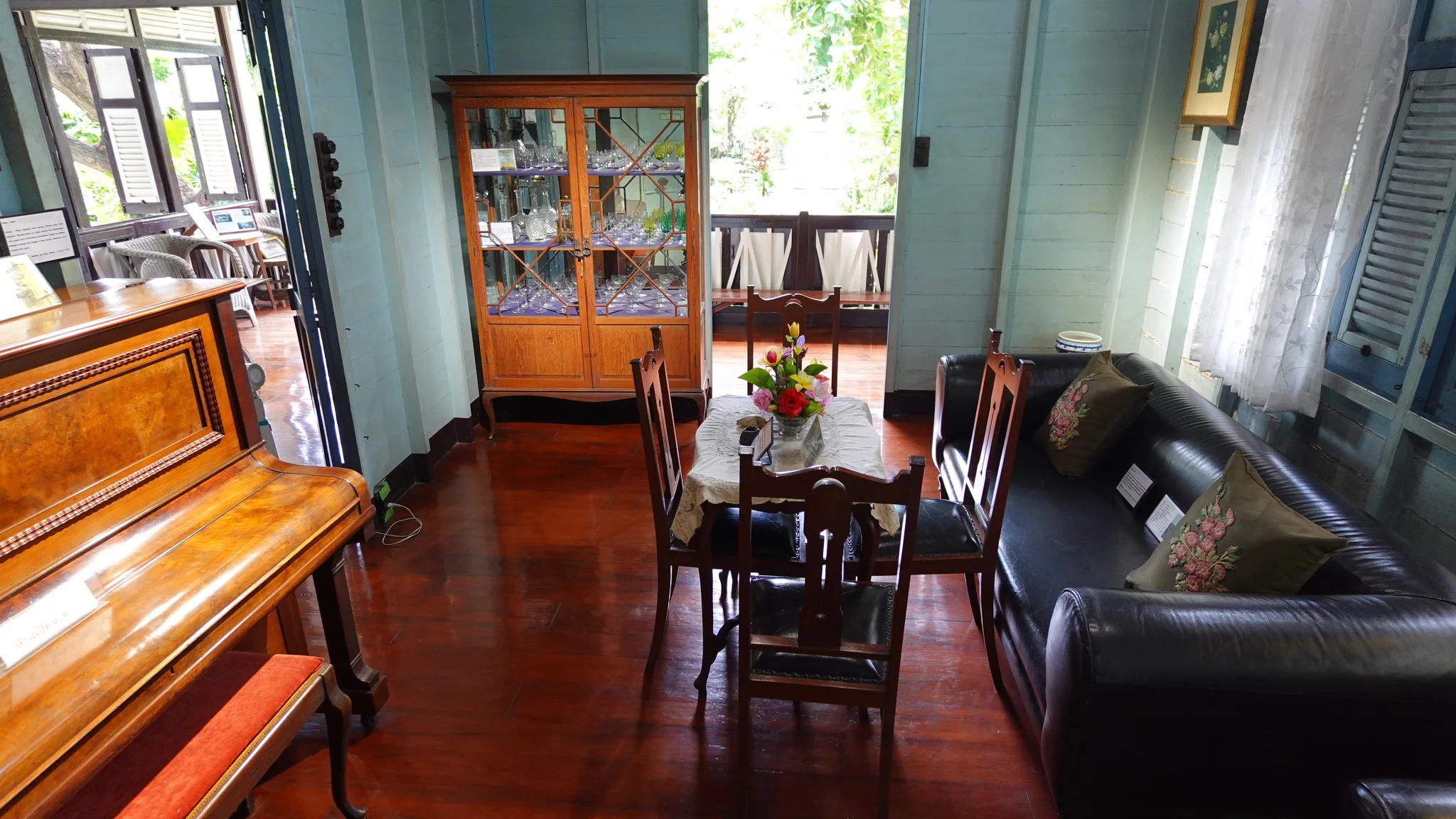
At the Bangkokian Museum, a sitting room with pale blue painted plank walls and polished floorboards brings together an upright piano, a table with flowers and chairs, a leather sofa and a glassware cabinet, opening onto a veranda and greenery.© Eric Monteil 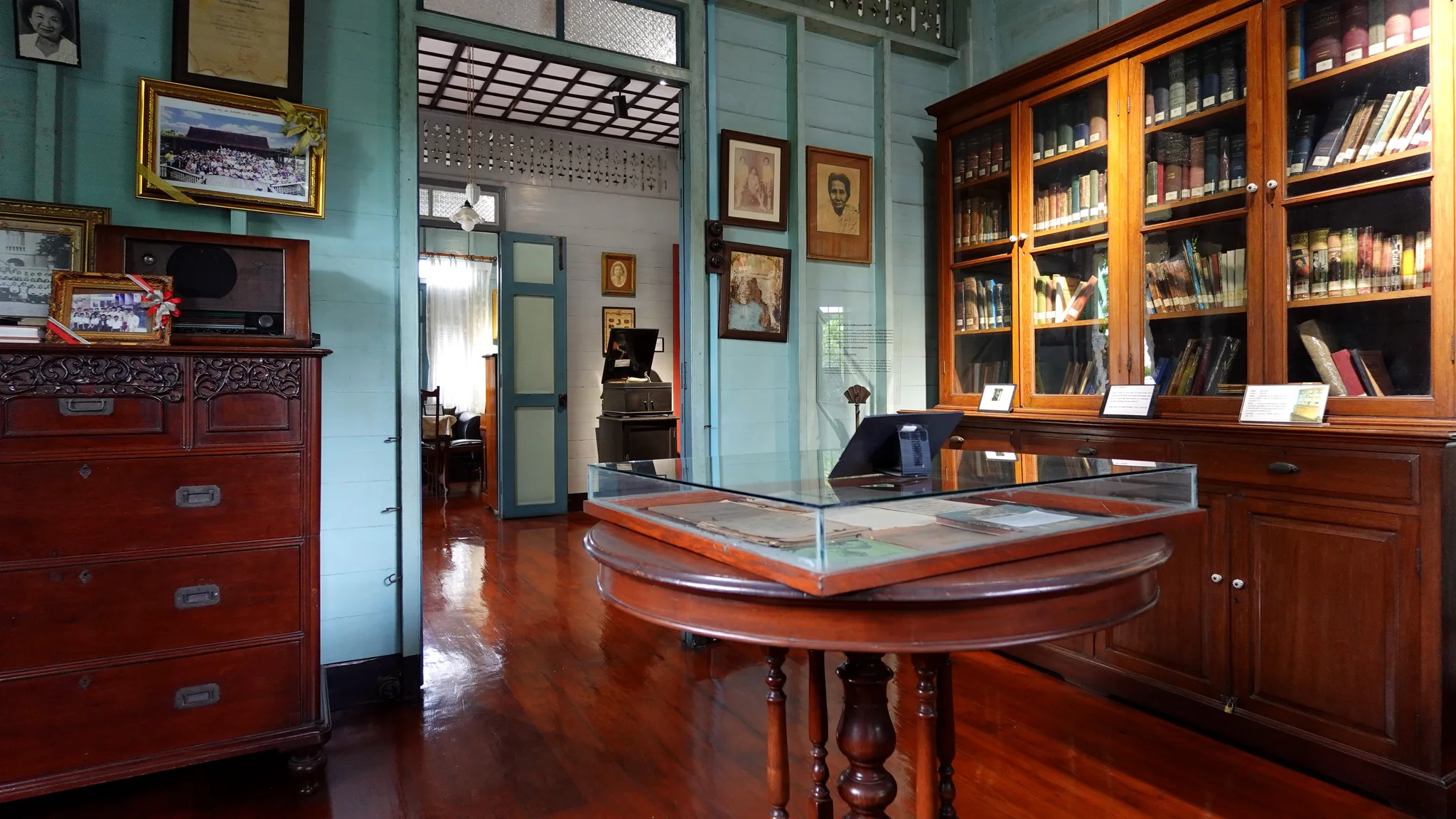
At the Bangkokian Museum, a room in the timber house retains its furnishings: a glazed bookcase filled with books, a carved chest of drawers, an old radio, framed portraits and a display case set on a round table, on a polished wooden floor.© Eric Monteil
Architecture and decoration
Explore the heritage
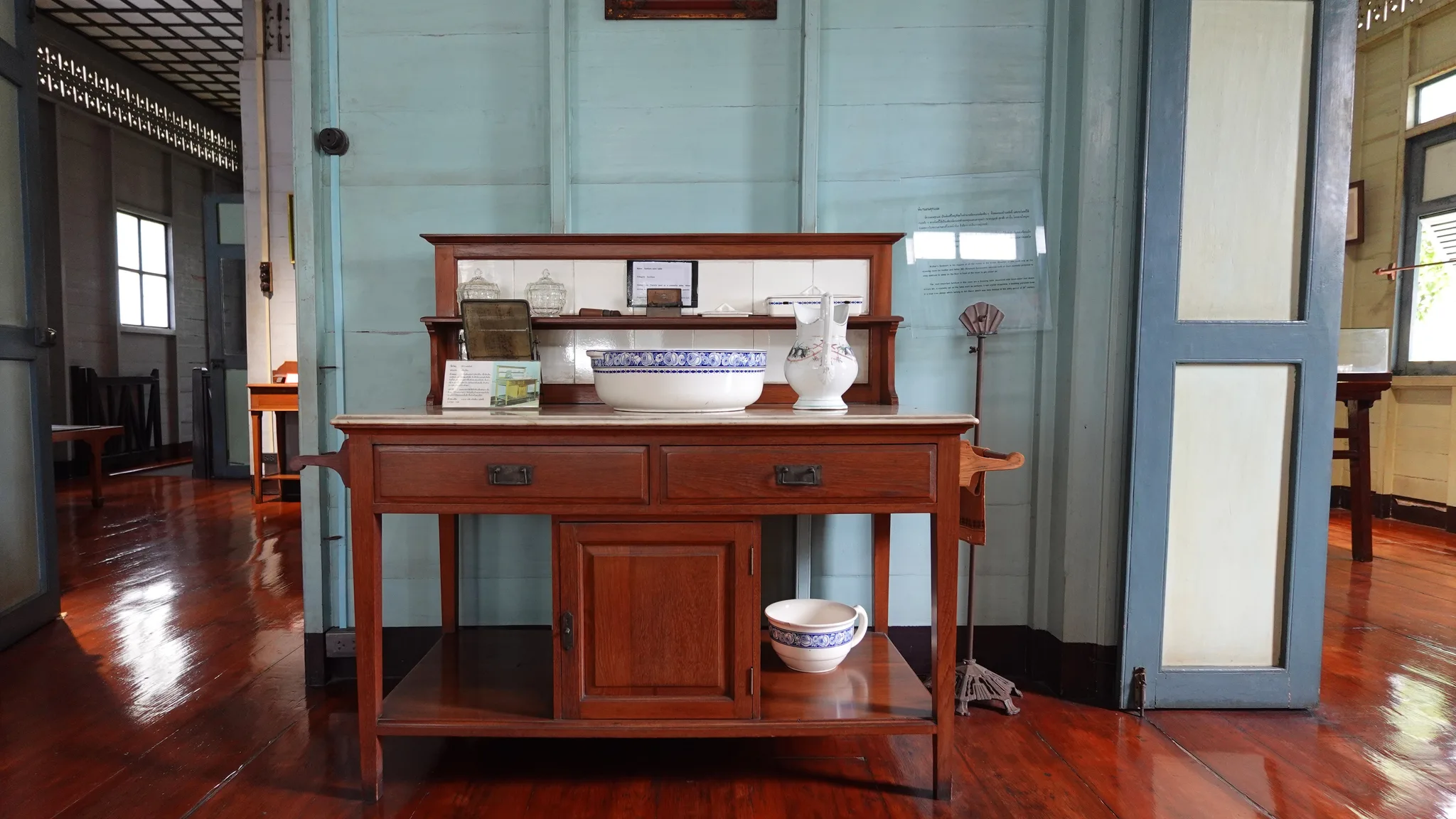
At the Bangkokian Museum, a wooden washstand with a pale top holds a blue and white ceramic basin and jug, set before a pale blue painted plank partition and on a polished wooden floor.© Eric Monteil 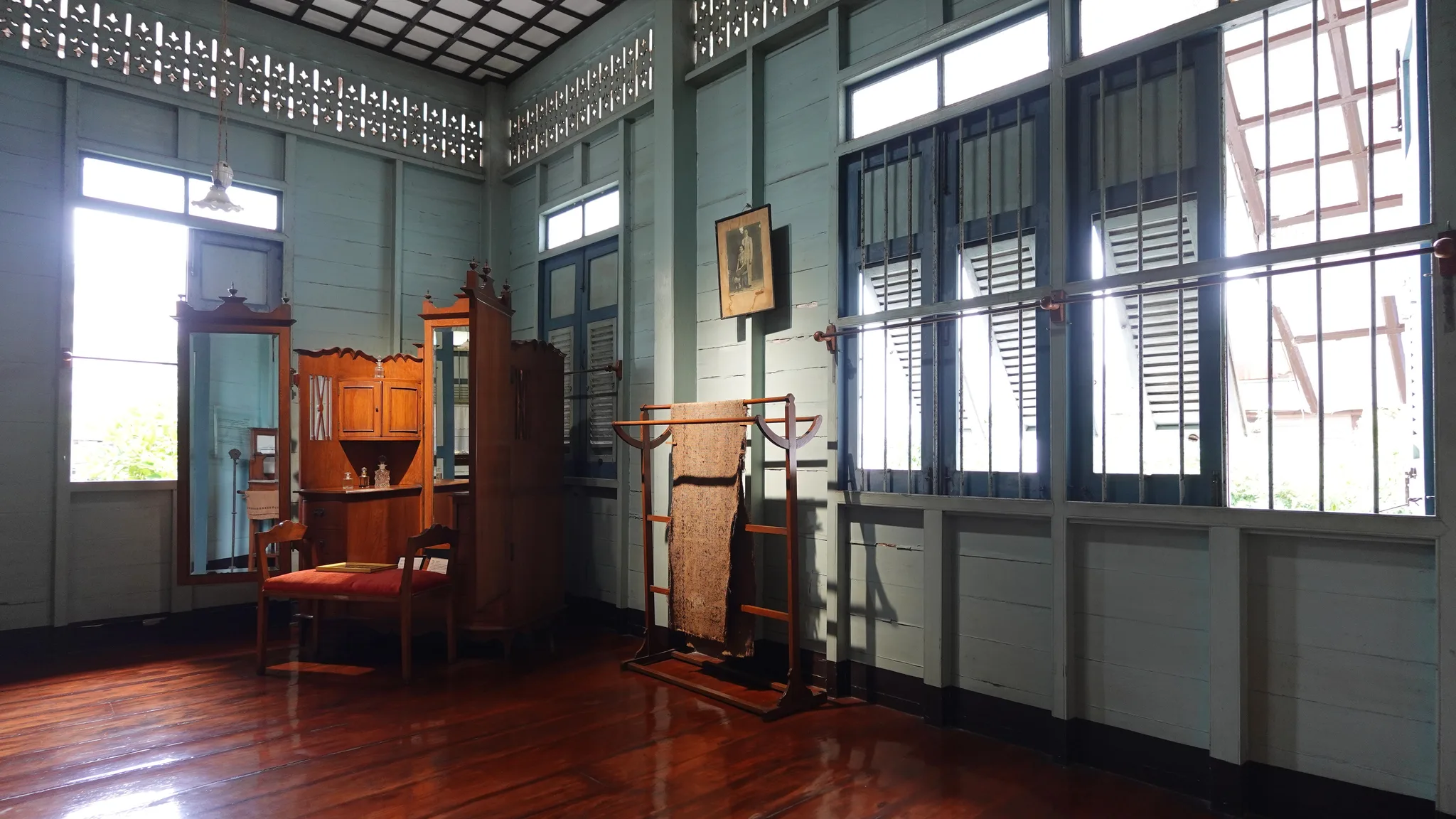
At the Bangkokian Museum, a bedroom in the timber house displays period furniture: a dressing table, mirrored wardrobe, chair and cloth rack. Painted plank walls, pierced fretwork friezes, louvred windows and a polished floor make up the setting.© Eric Monteil