
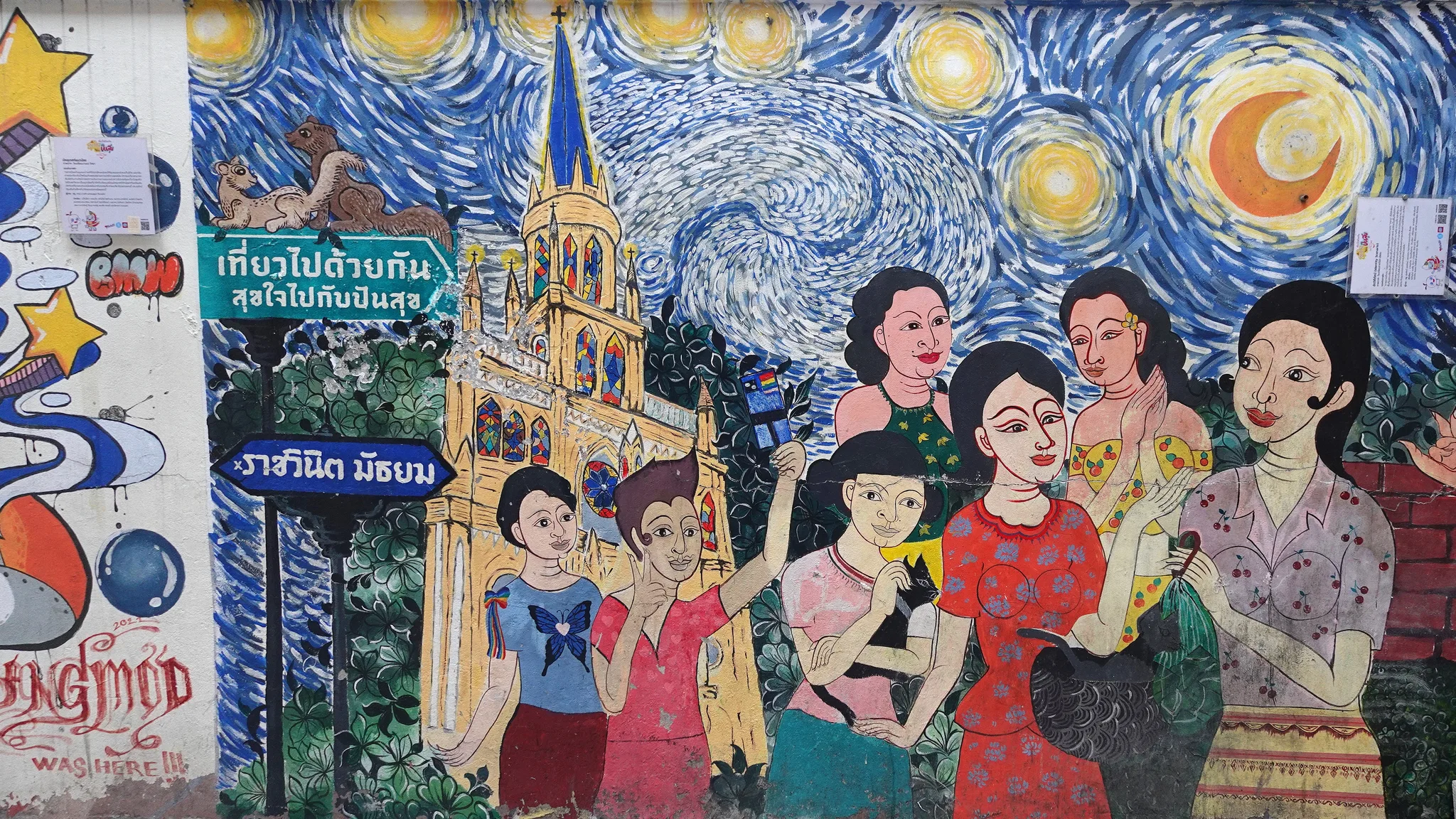
 On this wall of Talat Noi Street Art, a group of women and children in colourful clothing stands before a Gothic Revival church beneath a swirling starry sky inspired by Van Gogh, alongside painted Thai signs.© Eric Monteil
Public art & street art
Talat Noi Street Art
Born of a street art festival in 2016, Talat Noi Street Art covers the walls of a former Chinese quarter of mechanics’ workshops which, within a few years, has become one of Bangkok’s hubs of creativity.
Heritage family · Arts, aesthetics and creation
- Destination
- Bangkok (Samphanthawong)
- Heritage Family
- Arts, aesthetics and creation
- Typology
- Public art & street art
- Visit
- Available tours →
Talat Noi Street Art refers to the body of murals and artistic interventions that occupy the lanes of Talat Noi, a former merchant quarter on the east bank of the Chao Phraya River in Bangkok. It is not a single work but a scattered trail. It was born of a street art festival in 2016 and has helped to turn this ‘little market’ into a centre of contemporary creativity. Painted on shophouses and warehouses, amid mechanics’ workshops and Chinese shrines, these works belong to the setting of a community that has welcomed, in turn, the Portuguese, the Vietnamese and the Chinese.3
Key facts
- Destination
- Bangkok
- Heritage Family
- Arts, aesthetics and creation
- Typology
- Public art & street art
- Places
- Chao Phraya River
- Samphanthawong
- Periods
- —
- People
- —
- Communities
- Talat Noi Lovers Community
- Talat Noi community
- Events
- Bangkok Design Week
- Bangkok Design Week 2026
- Bukruk II Urban Arts Festival
- Heritage
- —
- Glossary
- Hokkien
- Wat
- Soi
- Trok
- Teochew
- Hakka
- Keywords
- —
- Date
- —
- Collections
- —
Practical info
Practical information about this site is taken from its Google Maps page. We advise you to check it before visiting.
- Address
- 1172 Soi Chareonkrung 22, Khwaeng Talat Noi, Khet Samphanthawong, Krung Thep Maha Nakhon 10100
A merchant quarter by the river
The little market of communities
Talat Noi, whose name means ‘little market’, stretches along the east bank of the Chao Phraya River, in Samphanthawong District, south of Yaowarat, Bangkok’s great Chinatown. It is an old Chinese community, but the period in which it took shape is debated. Some trace it back to the founding of Bangkok, others further still, to the Ayutthaya period, the kingdom whose capital preceded Bangkok.13
Over time, the quarter has been home to successive populations: Catholic Portuguese, Vietnamese, then Hokkien, Teochew and Hakka Chinese. Poosak Posayachinda, owner of the So Heng Tai house, sees Talat Noi as Bangkok’s ‘original’ Chinatown.14
From trade to mechanics
The quarter came to specialise in the trade in steel and machine parts, as well as in second-hand engines and car parts, an activity known as ‘siang kong’. Even today, workshops equipped with lathes, machines that shape metal by rotating it, operate alongside hardware shops, and engine blocks are stacked in front of the façades.8
This working landscape of metal, oil and salvaged parts is no stage set: it is the daily life of a craft quarter. Yet it is precisely what gives the murals their particular character. The artists did not work in an empty or redeveloped space, but on the very walls of this activity, which they sometimes incorporated into their works.
Houses, a church and shrines
The painted lanes lie in the immediate vicinity of several monuments that tell the quarter’s history. The So Heng Tai house is a nineteenth-century Chinese residence in the Hokkien style, arranged around an inner courtyard, which still belongs to a Thai-Hokkien family. Nearby, the Holy Rosary Church, founded in 1787, recalls the long-standing Catholic presence.13
The Chinese communities also have their shrines. The Rong Kueak Shrine is a Hakka place of worship whose name, through the Thai word ‘kueak’, meaning shoes, refers to Hakka shoemaking. The Chow Sue Kong Shrine, for its part, belongs to the Hokkien community. The alley leading to the former, by the river, is one of the places where the murals are concentrated.8
January 2016: the arrival of the murals
The Bukruk festival
The story of Talat Noi Street Art begins in January 2016. The Bukruk festival, also written Buk Ruk, a festival devoted to urban art, that is, works created in public space, on walls and in the street, then invited Thai artists and artists from thirteen countries, notably from Europe, to paint several walls across the city. Some of these interventions spread around Talat Noi, along Charoen Krung Road and Song Wat Road.4
The quarter’s first murals date from this festival, and it is credited with setting the phenomenon in motion. Several large works were produced there on that occasion. Other interventions, notably by local artists, have been added over the years.3
The festival’s major pieces
On Song Wat Road, next to the lanes of Talat Noi, the festival left some of its most striking works. The Romanian artist Aitch painted a large pink floral composition there, past Wat Pathumkhongka, a Buddhist monastery in the area. Further on, ROA depicted two upturned elephants in monochrome, while Aryz painted two deconstructed bicycles whose parts seem to come apart on the wall.3
During the same period, the Romanian artist Saddo painted a composition of birds. He explains that he drew inspiration from floral motifs and Islamic art, and his style has been likened to that of the French naïve painter Henri Rousseau. Some of the 2016 works have already lost their brilliance, such as Saddo’s, which is rather faded.3
A trail through the lanes
An ensemble without clear boundaries
Talat Noi Street Art is not visited like a monument. The paintings are scattered across a network of lanes whose three main thoroughfares are Soi Charoen Krung 22, also known as Trok Talat Noi, Soi Wanit 2 and Soi Chao Sua Son. They occupy the passages around Soi Charoen Krung 22 and the alley leading to the Rong Kueak Shrine on the banks of the Chao Phraya, and continue along Song Wat Road with the large works from the 2016 festival.16
A landmark at 1172 Soi Charoen Krung 22 serves as the address for the whole ensemble, which is open at all times and free of charge. This point is merely a gateway: the trail is followed on foot, wandering through the lanes, and the names given to it vary, from ‘Talat Noi Street Art’ to ‘Talat Noi & Song Wat Street Art’. This absence of precise limits is one of the ensemble’s defining features, as it merges with the quarter itself.19
Around the Rong Kueak Shrine
The paintings are set on old shophouses, those narrow buildings combining a shop on the ground floor with living quarters above, and on warehouse walls. Their quality and tone vary greatly: amateur or nationalist-inspired paintings sit alongside modern and more radical pieces. This heterogeneity reflects the way the ensemble came together, through successive additions rather than a single commission.15
Near the Rong Kueak Shrine, several works draw on the quarter’s Chinese culture. The artist Taeogawa painted Caishen, the Chinese god of wealth, there. Studio Dialogue opted for a retro register inspired by Chinese propaganda. A few steps from a Hakka place of worship, these images are a reminder that Talat Noi Street Art engages with the community’s Chinese identity as much as with the international scene.3
Scrap metal, engines and salvage
The quarter’s mechanical trade has given artists both a setting and a material. The local artist Len painted the walls of a former warehouse for car parts and boat engines that became the Mother Roaster café. His compositions incorporate window shutters and used car parts, so that the industrial object becomes part of the work.3
The same logic of salvage can be found in sculpture. On a roundabout in Soi Wanit 2, a local craftsman, Heng Seng Junior, assembled a statue of Bumblebee, the robot from the Transformers franchise, out of scrap metal from the neighbouring workshops. Elsewhere, a rusty car abandoned in a lane has become a symbol of the quarter without any artist having conceived it as a work: its visibility on online maps is what turned it into an essential stop for visitors. Between painting, sculpture and found objects, the line between art and the quarter’s everyday life remains blurred.12
From workshop quarter to creative district
The arrival of the creatives
The murals appeared just as the Charoen Krung area, of which Talat Noi is part, was beginning to change. In 2017, the Thailand Creative & Design Center (TCDC), a public institution devoted to design and creativity, moved to the Charoen Krung district. Its arrival marked a turning point: it drew creatives and entrepreneurs to an area hitherto dominated by trade and craft.11
In Talat Noi, this movement has taken the form of new cafés, art spaces and shops, often housed in old buildings. Mother Roaster, which opened in late 2019 on the upper floor of a former warehouse, is one example: the venue preserves the memory of the mechanical trade while welcoming a new clientele. The murals accompany this transformation and have become its most visible image.6
Bangkok Design Week
Bangkok Design Week, an annual event devoted to design and creativity, has given the quarter institutional recognition. It is organised by the Creative Economy Agency, the public agency responsible for the creative economy, which also supports the modernisation of the district with public, private and community partners. In 2022, an event entitled ‘Talad Noi Neighbourhood’ was held alongside the festival and took over the quarter.6
The following year, in 2023, Charoenkrung–Talad Noi was presented as Bangkok Design Week’s first ‘creative district’ and became its main exhibition area. It retains this central role at the 2026 edition. Within a few years, a quarter of mechanics’ workshops has thus become one of the showcases of Bangkok’s creative policy, and murals born of a festival now find themselves part of an event backed by the public authorities.17
The question of gentrification
This transformation has not escaped critical analysis. As early as 2017, Charoen Krung and Talat Noi were studied as a case of gentrification, that is, the transformation of a working-class neighbourhood through the arrival of wealthier residents, driven here by the ‘creative class’ of artists, designers and entrepreneurs. The question raised was whether these newcomers cooperate with the cultural resources of the local community or impose themselves upon it.4
The debate has continued within Bangkok Design Week itself. In 2023, an expert panel there addressed the balance between preserving the quarter’s identity and urban development. The position put forward at the time saw gentrification as a phenomenon that can remain positive as long as diversity endures and long-standing and new residents continue to live side by side. The murals, at once a sign of renewal and an attraction for new audiences, lie at the heart of this tension.17
Talat Noi today
Works amid the workshops
Today, the mechanics’ workshops remain in operation alongside the works. Visitors, often young, wander the lanes to photograph the murals, while craftsmen go on dismantling engines and sorting parts. The Thai authorities themselves present Talat Noi, Song Wat Road and the Rong Kueak Shrine alley as living communities, where contemporary art coexists with houses, shrines and hardware shops.19
The new venues have settled into the old buildings. The café, bar and gallery 965bkk occupies a shophouse described as two hundred years old. At the So Heng Tai house, the courtyard pool is now used for diving lessons. These unexpected uses extend the logic of the murals: reinvesting what already exists rather than replacing it. In 2026, Time Out magazine ranked Talat Noi among the ‘coolest’ neighbourhoods in the world, a sign of a reputation that has become international.9
An ephemeral heritage
Talat Noi Street Art stands apart from the quarter’s other heritage through its fragility. The works age quickly, and some of the 2016 pieces are already faded. The ensemble changes from year to year: paintings fade away, others appear, with no overall plan or inventory.3
This instability is part of the very nature of street art, made for the street rather than for conservation. Yet it raises a new question in a quarter whose old houses and shrines carry several centuries of history: what place, in the memory of a place, can be held by recent works, born of a festival and destined to disappear?
Understanding
Talat Noi Street Art is neither a museum nor a collection, but a way of looking at a quarter. The murals that appeared in 2016 cast a fresh eye on an old Chinese quarter by the Chao Phraya, its shophouses, its shrines and its mechanics’ workshops, without erasing them. Their importance lies less in any single work than in this shifting ensemble, where scrap metal, shutters and figures from Chinese culture become artistic material, and where craftsmen and visitors cross paths every day. Since then, the quarter has become a creative district backed by the public authorities, at the centre of Bangkok Design Week, and known far beyond Thailand. This success comes with a debate on gentrification and on the place of long-standing residents in the face of newcomers, while the works themselves fade with time. Will these paintings one day belong to the memory of a craftsmen’s quarter, or to the image of a creative Bangkok turned towards the world?
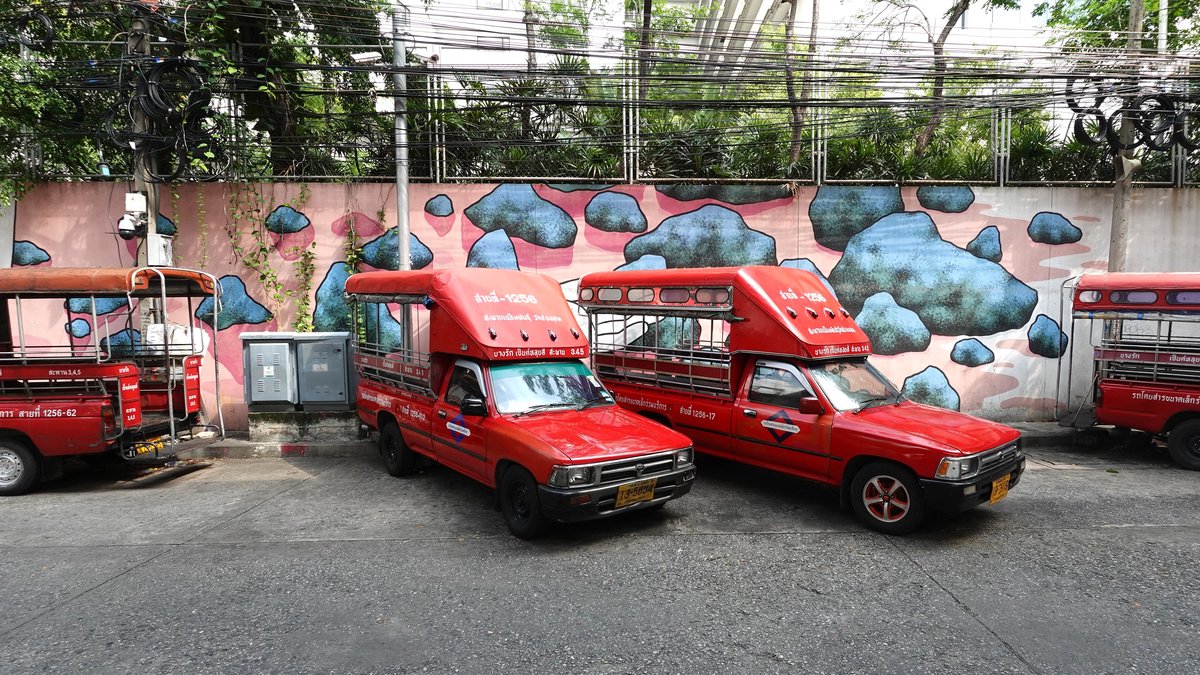
Through Bangkok's creative districts, between street art, architecture, design and new uses of the city.
- Hokkien
- Chinese group originating from the south of Fujian province, many of whose members emigrated to Southeast Asia, notably as merchants.
- Wat
- Buddhist monastic complex that brings together, within a single enclosure, several religious buildings, monks’ quarters and ancillary buildings; the word does not refer to a single building.
- Soi
- Thai word for a lane or side street branching off a main road; soi are often numbered after the main street from which they branch.
- Trok
- Thai word for an alley, that is, a narrow passage between buildings, generally narrower than a soi.
- Teochew
- Chinese dialect group originating from the Chaozhou area, in eastern Guangdong, southern China. It forms the largest component of the Chinese community in Thailand.
- Hakka
- A Chinese language and cultural group originating in southern China, part of which emigrated to Southeast Asia, notably to Thailand.
- Siang kong
- Expression used in Thailand to refer to the trade in second-hand engines and car parts, which are salvaged and then resold.
- Caishen
- Chinese god of wealth, a familiar figure among merchants, venerated in Chinese communities.
Primary sources
- 1Bukruk Urban Arts Festival, Urban Arts Festival Bukruk 23 to 31 Jan 2016 – présentation, ASEF culture360 (document hébergé), 2015 ↗
Studies
- 2Talat Noi turns to street art to save its community walls, Bangkok Post ↗
- 3These murals highlight Talad Noi's rise as Bangkok's hub of street art, BK Magazine, 2021 ↗
- 4Nipaporn Huabcharoen ; D. Ellsmore, Creative Class and Gentrification: The Case of Old Bangkok Foreigner Communities, Charoenkrung and Talad Noi Neighbourhood, Veridian E-Journal (International), Université Silpakorn, vol. 10 n°5, 2017 ↗
- 5Exploring Bangkok's Creative District, Fused Magazine ↗
- 6Design week comes to the old community of Talad Noi, Thai PBS World, 2022 ↗
- 7Explore Bangkok Design Week 2026: Must-Visit Iconic Malls and Historic Districts for Art Lovers, Thairath English, 2026 ↗
- 8Old Bangkok, New Cool, Thai PBS World ↗
- 9Bangkok's Talat Noi named one of the world's coolest neighbourhoods for 2026, Time Out Bangkok, 2026 ↗
- 10Lost in Transformation, Brown Political Review ↗
- 11Things to do in Charoenkrung, Time Out Bangkok ↗
- 12From scrap metal to street art: The unlikely cool of Talat Noi, a Bangkok neighbourhood that can't be curated, The Nightly, 2025 ↗
- 13So Heng Tai Mansion and the History of Talat Noi, Thai Enquirer ↗
- 14Cultural melting pot, Bangkok Post ↗
- 15Talat Noi: Bangkok's Street Art Capital, The Beat Asia ↗
Reference works
- 16Contributeurs de Wikipédia, Talat Noi, Wikipedia (en) ↗
- 17Charoenkrung-Talad Noi: The Older, The Better, Bangkok Design Week / Creative Economy Agency, 2023 ↗
- 18So Heng Tai Mansion, Wikipedia ↗
- 19Thailand 2026 Annual Meetings Team, Talat Noi & Song Wat Street Art, Thailand 2026 Annual Meetings (am2026thailand.go.th), 2025 ↗
- 20Bangkok Design Week redefines "design" beyond beautifying the city, THAILAND.GO.TH, 2026 ↗
- 21Bangkok Design Week, Wikipedia ↗
Contemporary views
Talat Noi Street Art today
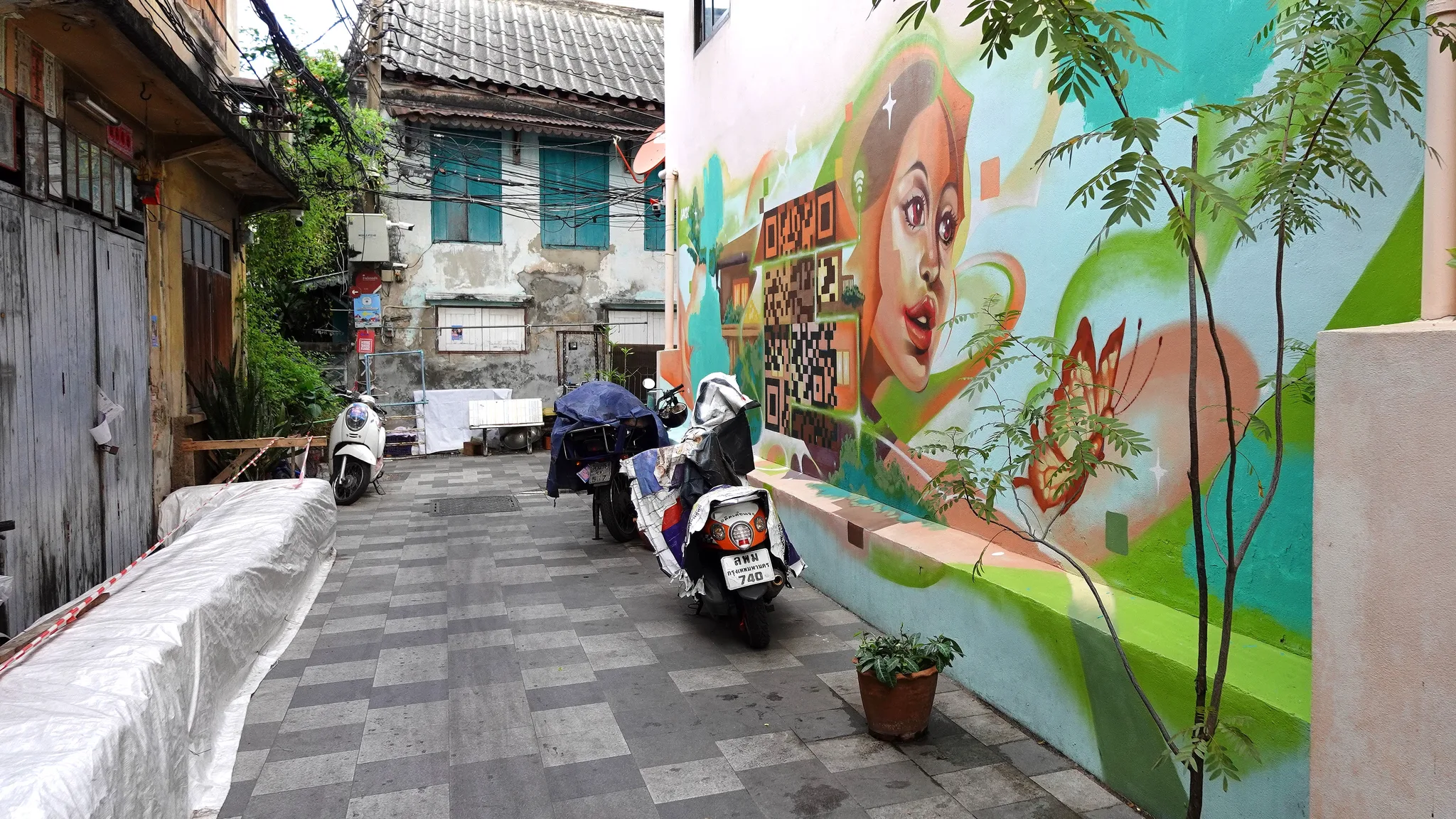
In a paved alley of Talat Noi Street Art, a mural in green and orange tones shows a woman’s face, a butterfly and chequered motifs, opposite parked scooters and old houses with blue shutters.© Eric Monteil 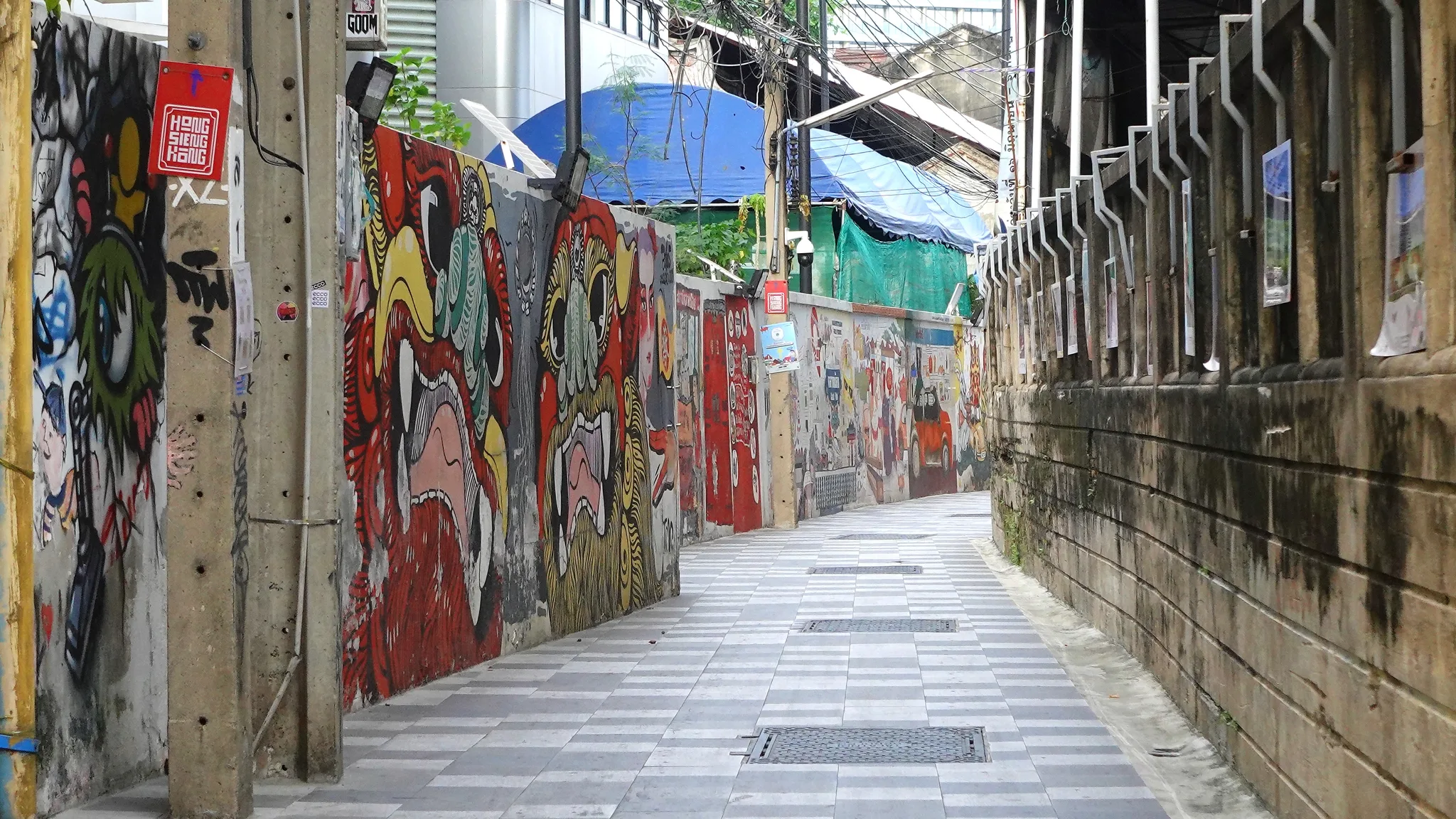
A pedestrian alley of Talat Noi Street Art: on the left, murals of fanged demon faces and painted scenes; on the right, an old damp-stained brick wall topped with white railings.© Eric Monteil
Architecture and decoration
Explore the heritage
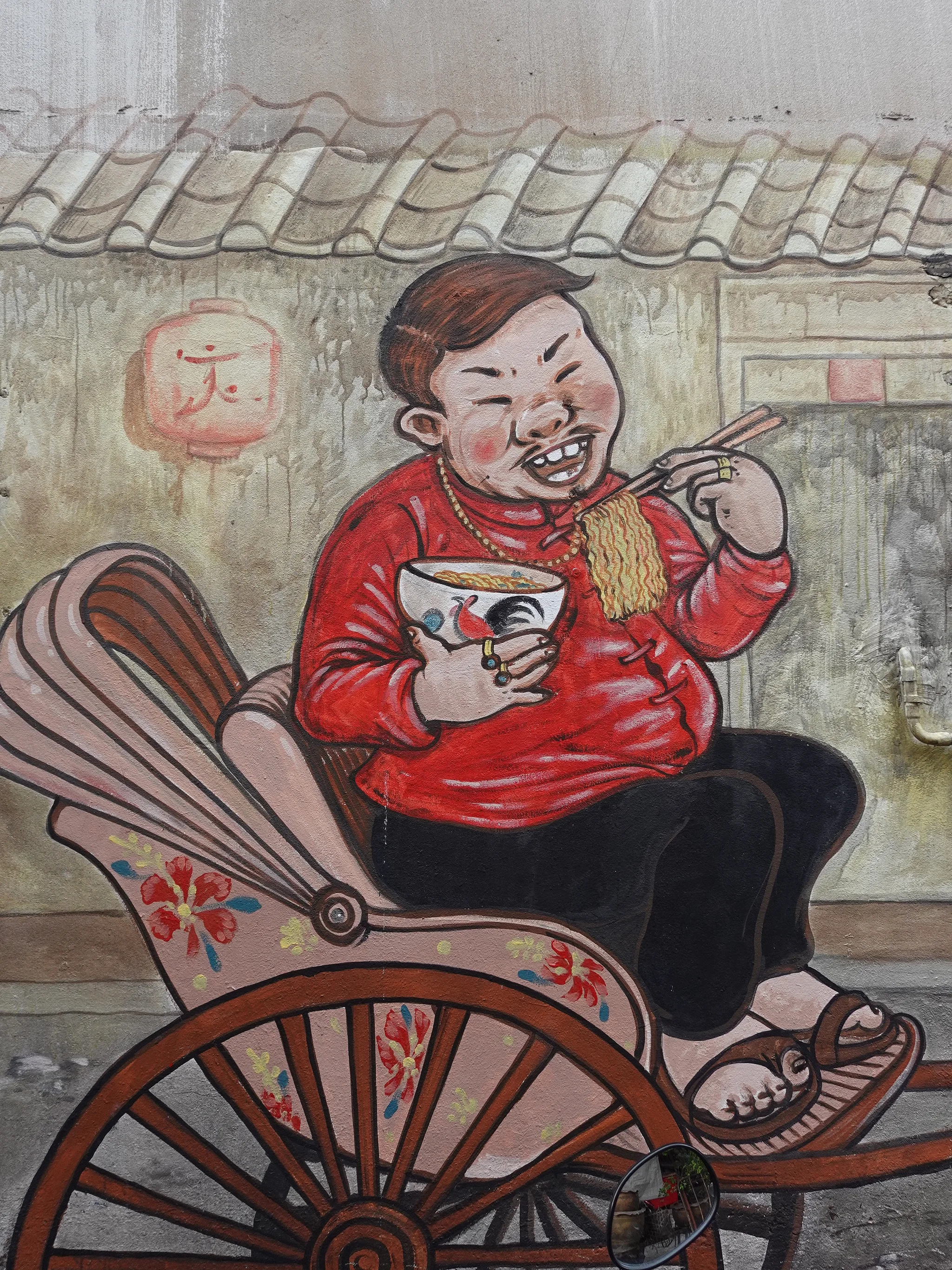
Mural at Talat Noi Street Art depicting a man in a red tunic with frog fastenings, holding a rooster bowl and chopsticks, seated in a flower-painted rickshaw before a tile-roofed house with a lantern.© Eric Monteil 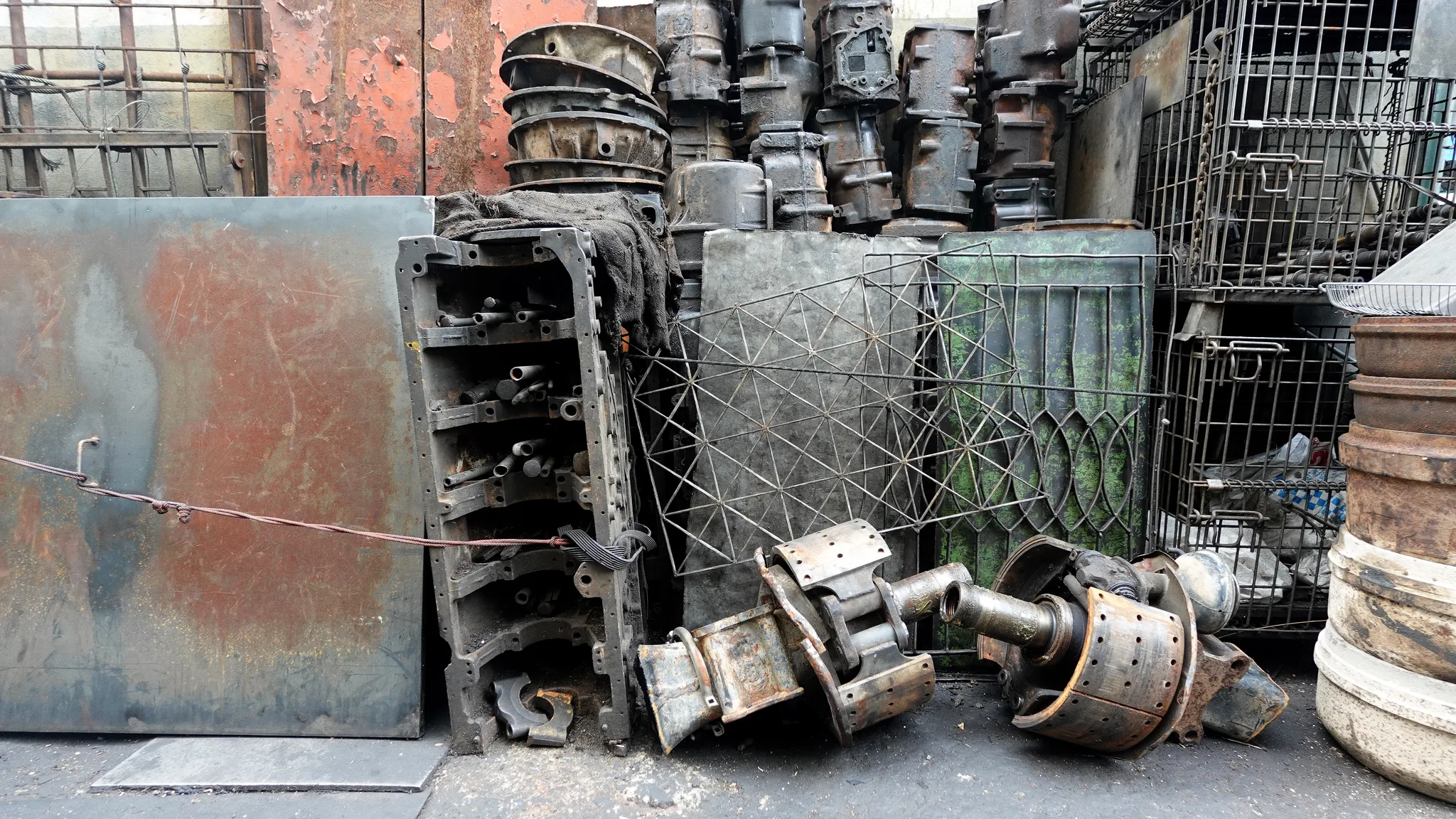
In an alley at Talat Noi Street Art, an engine block, stacked casings, brake drums and a metal grille lean against oxidised sheets and wire cages, evidence of a trade in salvaged car parts.© Eric Monteil