
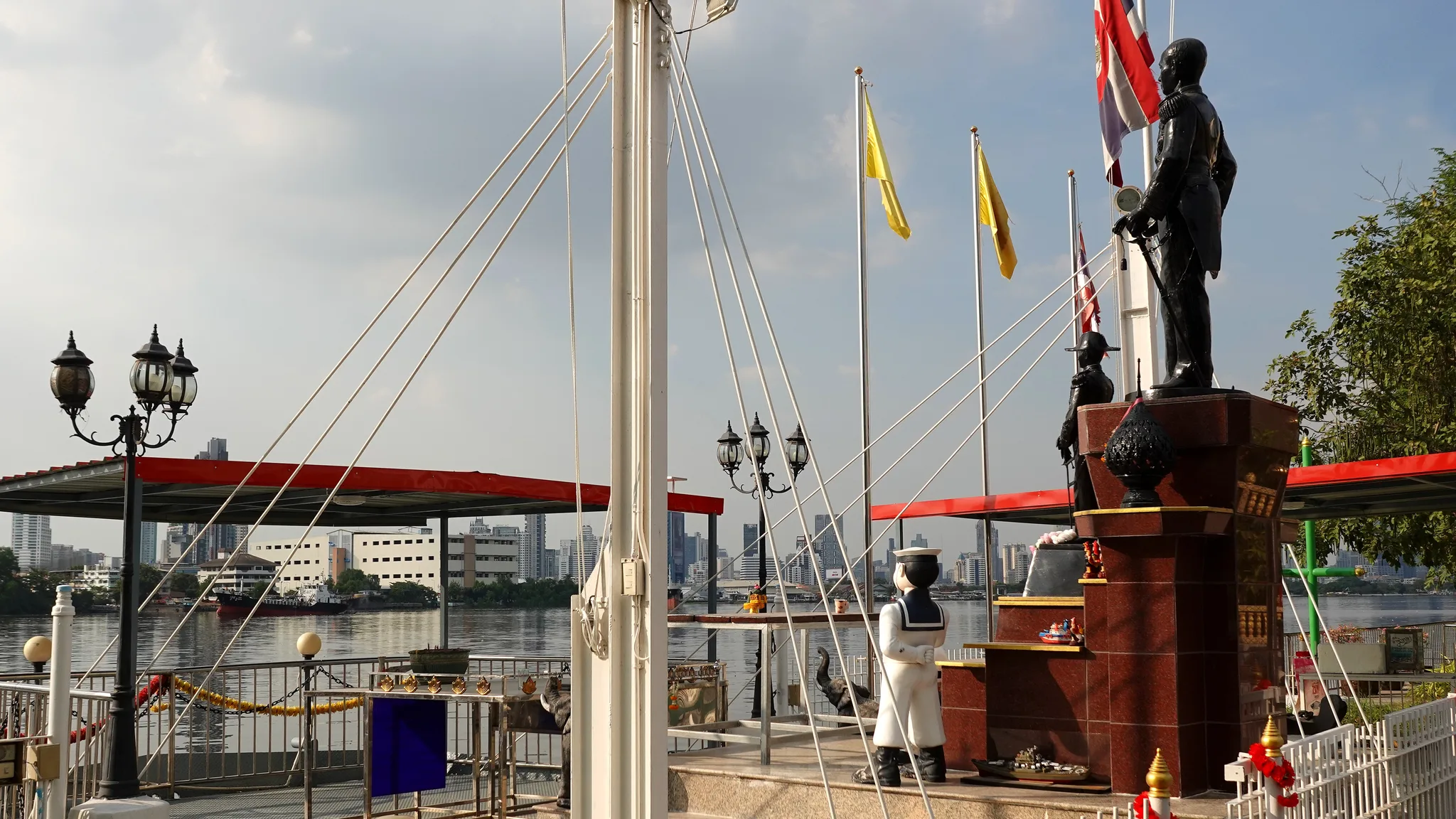
 Au Mémorial du prince de Chumphon, la statue en uniforme se dresse sur un socle de granit rouge garni d’offrandes, près d’un mât haubané, de drapeaux et de figurines de marins, face au fleuve et aux tours de la rive opposée.© Eric Monteil
Commemorative monument
Prince of Chumphon Memorial
Where the Khlong Bang Krachao meets the river, a tribute to Prince Abhakara Kiartivongse, architect of the modern Siamese navy, whose memory belongs at once to official history and to popular devotion.
Heritage family · History, kingdoms and the making of Siam
- Destination
- Samut Prakan (Phra Pradaeng)
- Heritage Family
- History, kingdoms and the making of Siam
- Typology
- Commemorative monument
- Visit
- Available tours →
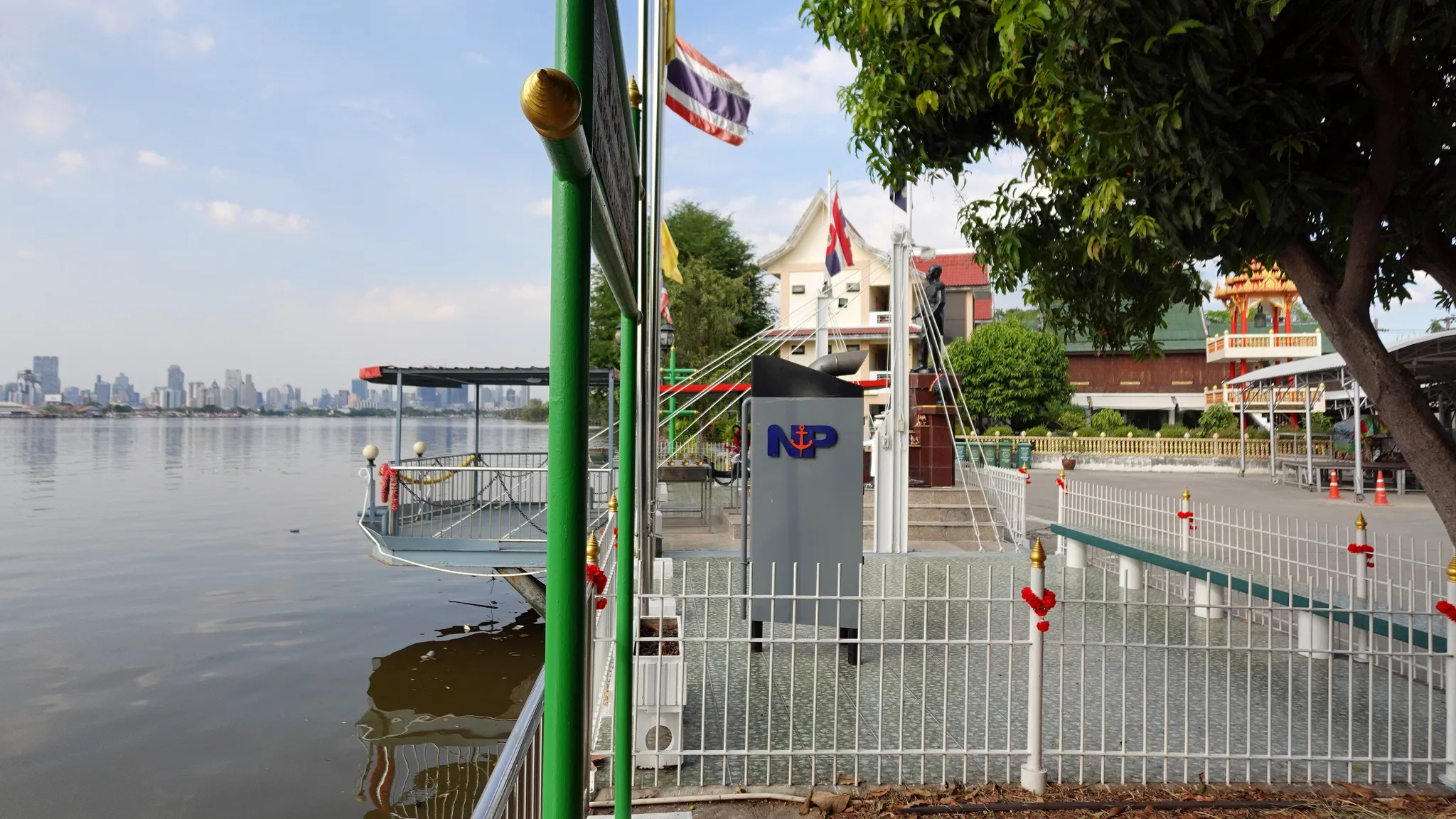
The Prince of Chumphon Memorial (Father of Thai Navy) is a commemorative monument near the Wat Bang Krachao Nok pier in Bang Yo, on the bank of the Chao Phraya River that gives access to the Khung Bang Kachao loop. It honours Prince Abhakara Kiartivongse, son of King Chulalongkorn and architect of the modernisation of the Siamese navy, whom the Royal Thai Navy officially proclaimed “Father of the Thai Navy”. It belongs to a vast constellation of shrines and monuments in which the official tribute paid to the admiral mingles with a popular fervour that has raised him to the status of a sacred figure, readily invoked by those who travel on the water.
Key facts
- Destination
- Bang Yo
- Heritage Family
- History, kingdoms and the making of Siam
- Typology
- Commemorative monument
- Places
- Chao Phraya River
- Khlong Bang Krachao
- Wat Bang Krachao Nok
- Phra Pradaeng
- Samut Prakan
- Bang Krachao
- Periods
- People
- Prince Abhakara Kiartivongse, Prince of Chumphon
- Rama V
- Communities
- Communauté monastique du Wat Bang Krachao Nok
- Events
- Attribution royale du wisungkhamsima au Wat Bang Krachao Nok (1971)
- Fondation du Wat Bang Krachao Nok (vers 1910)
- Phuk phatthasima et construction de l’ubosot du Wat Bang Krachao Nok (1977)
- Proclamation of the Prince of Chumphon as Father of the Thai Navy (1993)
- Heritage
- Abhakara Memorial Day
- Glossary
- Tambon
- Chao Phraya
- Phraya
- Khlong
- Wat
- San
- Keywords
- —
- Date
- —
- Collections
- —
Practical info
Practical information about this site is taken from its Google Maps page. We advise you to check it before visiting.
- Address
- MHQ3+PWM, Bang Yo, Phra Pradaeng District, Samut Prakan 10130
At the mouth of the Khlong Bang Krachao
A riverbank facing Bangkok
The memorial stands in the tambon of Bang Yo, a subdistrict of Phra Pradaeng district in Samut Prakan province. Bang Yo covers part of Khung Bang Kachao, the loop formed by the Chao Phraya River. River crossings link it to the Bangkok bank.
The Wat Bang Krachao Nok pier is one of the landing points for these crossings. Boats arrive here from the nearby pier by the Bangkok Bank’s Rama III branch, and others from the Chong Nonsi pier (Khlong Ta Roek) — a khlong being, in Thailand, a canal or minor waterway. It is at this crossing point between the city and the loop that the prince’s memory has found its place.
Wat Bang Krachao Nok, the temple at the river mouth
The monastery that gives the pier its name belongs to the Mahanikaya order. It is bounded to the west by the Chao Phraya and to the east by the Khlong Bang Krachao; lying at the mouth of this khlong, it is known to local people as Wat Pak Khlong Bang Krachao, the “temple at the mouth of the Khlong Bang Krachao”. It was founded around 1910; its founder is unknown.
Its history is marked by several milestones. In 1971, the king granted it the wisungkhamsima, the consecrated ground. In 1977 came the phatthasima, the ritual demarcation of the ordination precinct with sacred boundary stones, and the ubosot, the hall in which ordinations and the principal acts of the monastic community take place, was built in the same year. The temple has two kuti, the monks’ living quarters.
A prince in the service of the navy
A son of King Chulalongkorn educated abroad
Abhakara Kiartivongse was born on 19 December 1880. He was the twenty-eighth child of King Chulalongkorn (Rama V). His full Thai title is long, and usage has settled on a shortened form, Krom Luang Chumphon, rendered in English as “Prince of Chumphon”: it is by this name that collective memory most often refers to him.5
At the end of 1893, his father sent him to study abroad together with one of his brothers.5
Modernising the Siamese navy
On his return to Siam, the prince joined the Royal Siamese Navy and made a marked contribution to its modernisation. There he succeeded, as Minister of the Navy, Prince Bhanurangsi Savangwongse, who had led the navy before him and whose daughter, Mom Chao Dibyasambandh (1885–1908), he had married. Among the children of this union were Prince Aditya Dibabha and Prince Rangsiyakorn Abhakara.10
His career reached its height when he was honoured as “commander-in-chief, admiral and father” of the Siamese navy. Shortly after this crowning recognition, his health forced him to resign.5
Death at Hat Sai Ri
In retirement, the prince sought treatment at Hat Sai Ri, a beach in Chumphon province. It was in Chumphon that he died on 19 May 1923, at the age of forty-two. The place and the date of his death would become, over the decades, the two anchors of his memory, one in space, the other in the calendar.5
From admiral to sacred figure
The Father of the Thai Navy
The Royal Thai Navy made 19 May, the anniversary of his death, an annual day of commemoration bearing his name, Abhakara Memorial Day. In 1993, it officially conferred on him the title “Father of the Thai Navy”. This institutional recognition fixed the prince’s place in national history: that of the founder of the modern navy.5
Sadet Tia, a protective presence
Alongside this official tribute, another form of memory has grown up. Many Thais call the prince by an affectionate nickname, Sadet Tia. He is among the members of the royal family who have been raised to the status of sacred figures, and shrines (san, in Thai) are dedicated to him throughout the country.2
Two shrines appeared between the late 1930s and the 1960s, accompanied by accounts of miracles.
Nang Loeng, a Chinese shrine that became his own
Among these places, the shrine at Nang Loeng market in Bangkok is the one whose historical lineage is best known. It was originally a Chinese shrine, next to the prince’s palace. After his death, Chinese devotees who venerated him asked to build a large shrine there equipped with siam si, a form of oracle drawing. People also came there to obtain holy water against illness and to make wishes.2
The shrine houses an oil portrait of the prince which tradition attributes to Khun Ranong Nakharanukit, an officer attached to his household. The neighbouring palace met a different fate: since 1948 it has housed a commercial school, which has since become faculties of Rajamangala University of Technology Phra Nakhon. At Nang Loeng, then, the two faces of the prince’s memory can be read side by side, one turned towards devotion, the other towards the institution.2
A network of places of memory
Hat Sai Ri, where he died
The most famous of the shrines dedicated to the prince is at Hat Sai Ri, where he was receiving treatment before his death. Chumphon province presents it as the memorial to the founder of the modern navy. On a hill to the north of the beach stands a commemorative pavilion, a tamnak.6
From the Pattaya bronze to the Bang Taboon shrine
The prince’s memory also takes the form of figurative monuments. In Pattaya, he is depicted in a bronze statue. Other tributes are more recent and led by local authorities: in 2014, the municipality of Bang Taboon, in Phetchaburi province, completed a shrine at the river mouth, with the twofold aim of protecting navigation and supporting tourism.9
This last example sheds light on a role that recent shrines often entrust to the prince: that of protector of seafarers. It is within this ensemble, ranging from the great historic shrines to neighbourhood tributes, that the Prince of Chumphon Memorial (Father of Thai Navy) takes its place, on the bank of the Chao Phraya.
The memorial today
On the way to Khung Bang Kachao
The Wat Bang Krachao Nok pier is today a busy crossing point. The boats from the Bangkok bank bring visitors, often cyclists, to the green spaces of the loop, including Sri Nakhon Khuean Khan Park.
The memorial therefore lies on the route of visitors who make these crossings.
A memory kept alive every 19 May
Every year, on 19 May, the Royal Thai Navy commemorates the prince nationwide.5
Understanding
The Prince of Chumphon Memorial (Father of Thai Navy) pays tribute to a son of King Chulalongkorn who modernised the Siamese navy before dying young in Chumphon in 1923. His memory follows two paths that constantly intersect: that of the institution, which proclaimed him Father of the Thai Navy and honours him every 19 May, and that of devotion, which has raised him to the status of a sacred figure under the familiar name of Sadet Tia and entrusts him with the protection of those who travel on the water. Set at the pier of a village temple on the bank of the Chao Phraya, this place shows how a national figure takes root in an ordinary landscape. Khung Bang Kachao today draws walkers and cyclists from Bangkok, while some recent tributes to the prince are led by local authorities that also see in them a tourist attraction. For these new audiences, will the Prince of Chumphon remain a protector to be invoked, or will he become above all a historical figure discovered in passing?
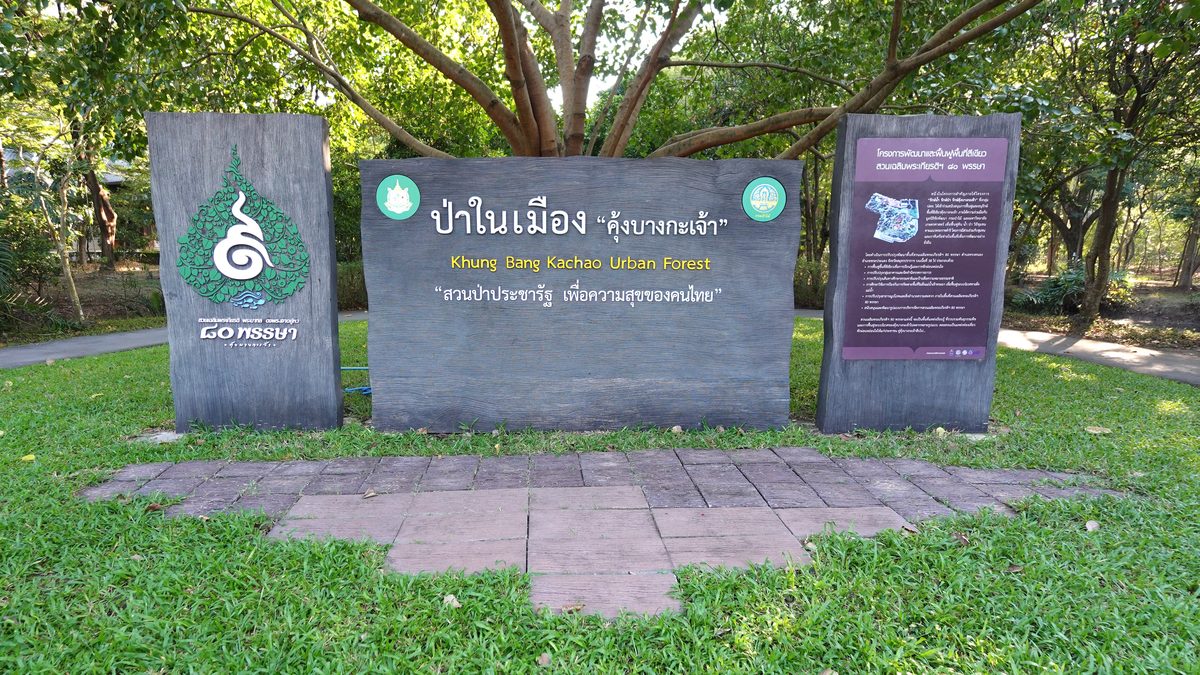
Bang Krachao, the "green lung" of Bangkok, between canals, Mon heritage, temples, biodiversity and sustainable initiatives.
- Tambon
- A Thai administrative subdivision grouping several villages, ranking below the district.
- Chao Phraya
- Highest title of the Siamese nobility, held by senior dignitaries of the court.
- Phraya
- Rank of the Siamese court nobility, immediately below that of chao phraya; it precedes the dignitary’s title name.
- Khlong
- Canal or waterway, natural or man-made, which long played a major role in transport, irrigation and the organisation of settlements and territories in Thailand.
- Wat
- Buddhist monastic complex that brings together, within a single enclosure, several religious buildings, monks’ quarters and ancillary buildings; the word does not refer to a single building.
- San
- In Thailand, a small shrine where worship is offered to a deity, a spirit or a protective figure.
- Mom Chao
- Modest princely rank of the Thai royal family, held by birth.
- Sri
- Word of Sanskrit origin expressing glory, prestige and prosperity, used in Thai as an honorific element in the names of places, buildings and people.
- Wisungkhamsima
- A royal grant of the consecrated ground on which a monastery may build an ordination hall.
- Ordination
- Ceremony by which a layperson is admitted as a novice or as a monk into the Buddhist community.
- Ubosot
- Consecrated ordination hall of a wat: the ritually central building, marked out by sacred boundary stones, where monastic ordinations take place.
- Sangha
- The body of monks who reside in a monastery and live there according to religious discipline; in Buddhism it is called the sangha.
- Kuti
- Cell or dwelling of a Buddhist monk within the precinct of a monastery.
- Krom Luang
- A rank in the Thai hierarchy of princely titles (krom) conferred by the king on certain members of the royal family; it stands above the rank of Krom Muen.
- Siam si
- A divination practice of Chinese origin: a container holding numbered sticks is shaken until one falls out, its number referring to a written oracle.
- Tamnak
- A Thai term for the residence of a member of the royal family, often a pavilion or a dwelling used for stays.
Studies
- 1ศาลเจ้าพ่อกรมหลวงชุมพร ที่ขึ้นชื่อเรื่องความศักดิ์สิทธิ์ แห่งแรกตั้งอยู่ที่ไหน?, ศิลปวัฒนธรรม (Silpa Watthanatham) ↗
- 2“เสด็จเตี่ย” กรมหลวงชุมพรฯ ตอนที่ ๖๘ – ศาลเสด็จเตี่ย, สารคดี (Sarakadee), 2022 ↗
- 3เปิดพระตำหนักกรมหลวงชุมพรเขตอุดมศักดิ์ พร้อมประวัติที่น่าสนใจ, ไทยรัฐ (Thairath), 2025 ↗
- 4รู้จัก ศาลหนึ่งเดียว "ศาลเสด็จเตี่ย" กลาง ตลาดนางเลิ้ง ศูนย์รวมจิตใจ, คมชัดลึก (Komchadluek) ↗
Reference works
- 5Contributeurs Wikipédia, Abhakara Kiartivongse, Wikipedia (en) ↗
- 6ศาลกรมหลวงชุมพร, องค์การบริหารส่วนจังหวัดชุมพร ↗
- 7ความเป็นมาในการก่อสร้างศาลกรมหลวงชุมพรบริเวณปากอ่าวบางตะบูน, เทศบาลตำบลบางตะบูน ↗
- 8Contributeurs Wikipédia, Dibyasambandh, Wikipedia (en) ↗
- 9Contributeurs Wikipédia, Abhakara Kiartivongse monument, Pattaya, Wikipedia (en) ↗
- 10Contributeurs Wikipédia, Bhanurangsi Savangwongse, Wikipedia (en) ↗
Contemporary views
Prince of Chumphon Memorial today
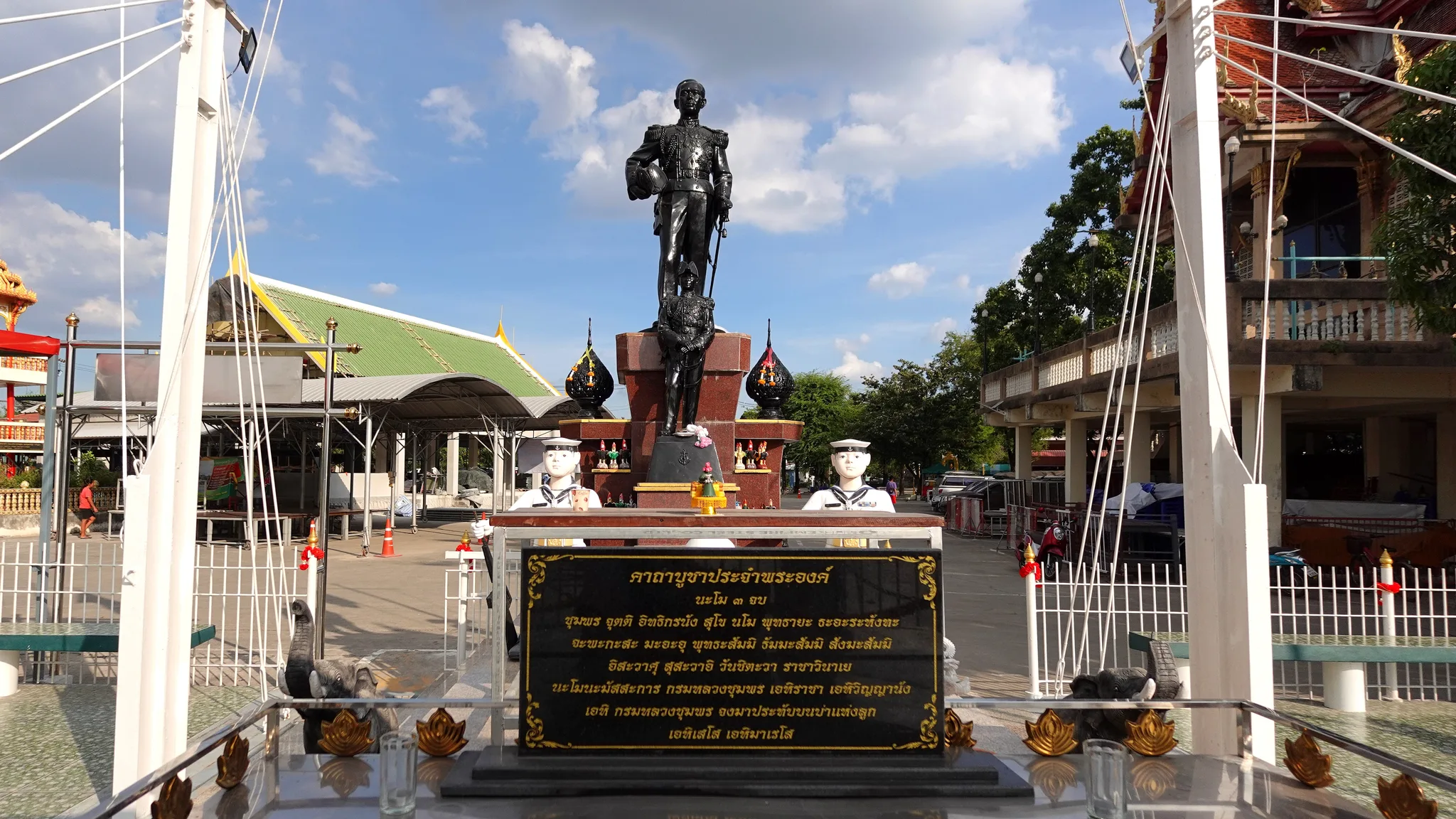
Au Mémorial du prince de Chumphon, la statue en uniforme se dresse sur un socle rouge encadré de figures de marins en blanc, derrière une plaque noire gravée de texte thaï et de mâts blancs.© Eric Monteil 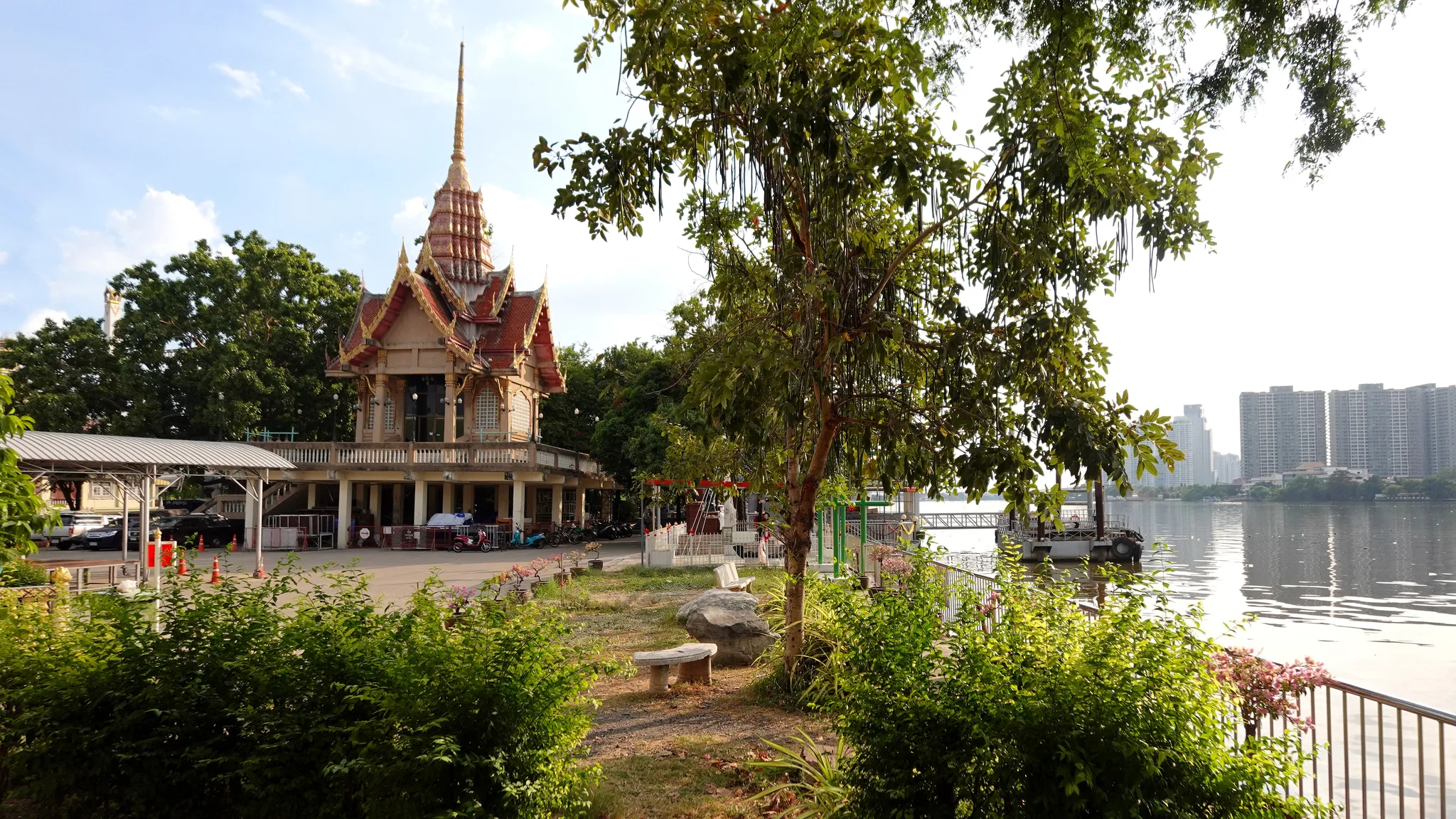
Le Mémorial du prince de Chumphon s’élève sur une terrasse à balustrade, coiffé de toits rouges étagés et d’une flèche dorée. Un jardin le sépare de la berge, où un ponton fait face aux immeubles de la rive opposée.© Eric Monteil
Architecture and decoration
Explore the heritage
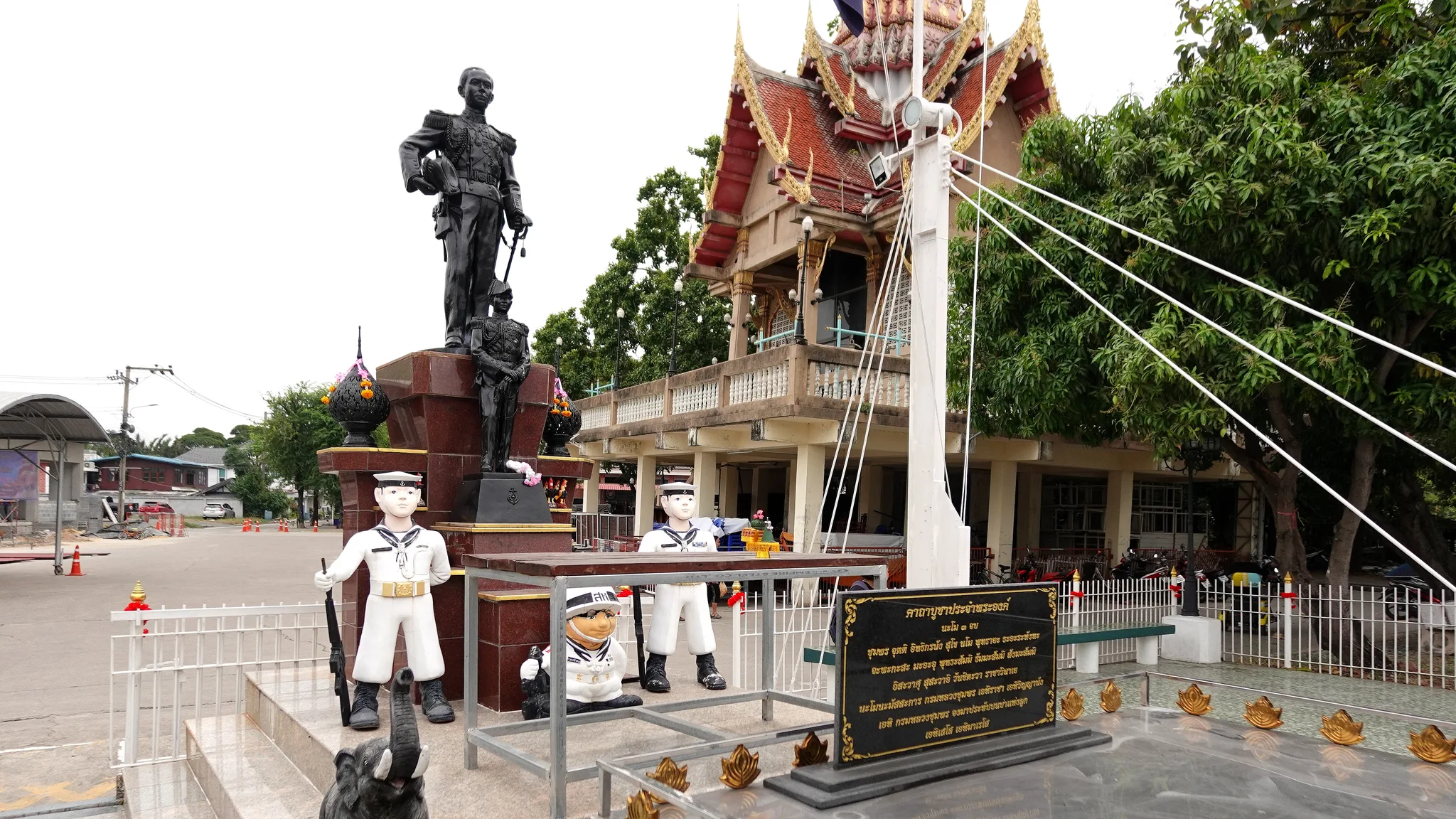
Au Mémorial du prince de Chumphon, la statue noire du prince en uniforme se dresse sur un socle rouge, entourée de figurines de marins en tenue blanche, d’une plaque inscrite en thaï et d’offrandes florales.© Eric Monteil 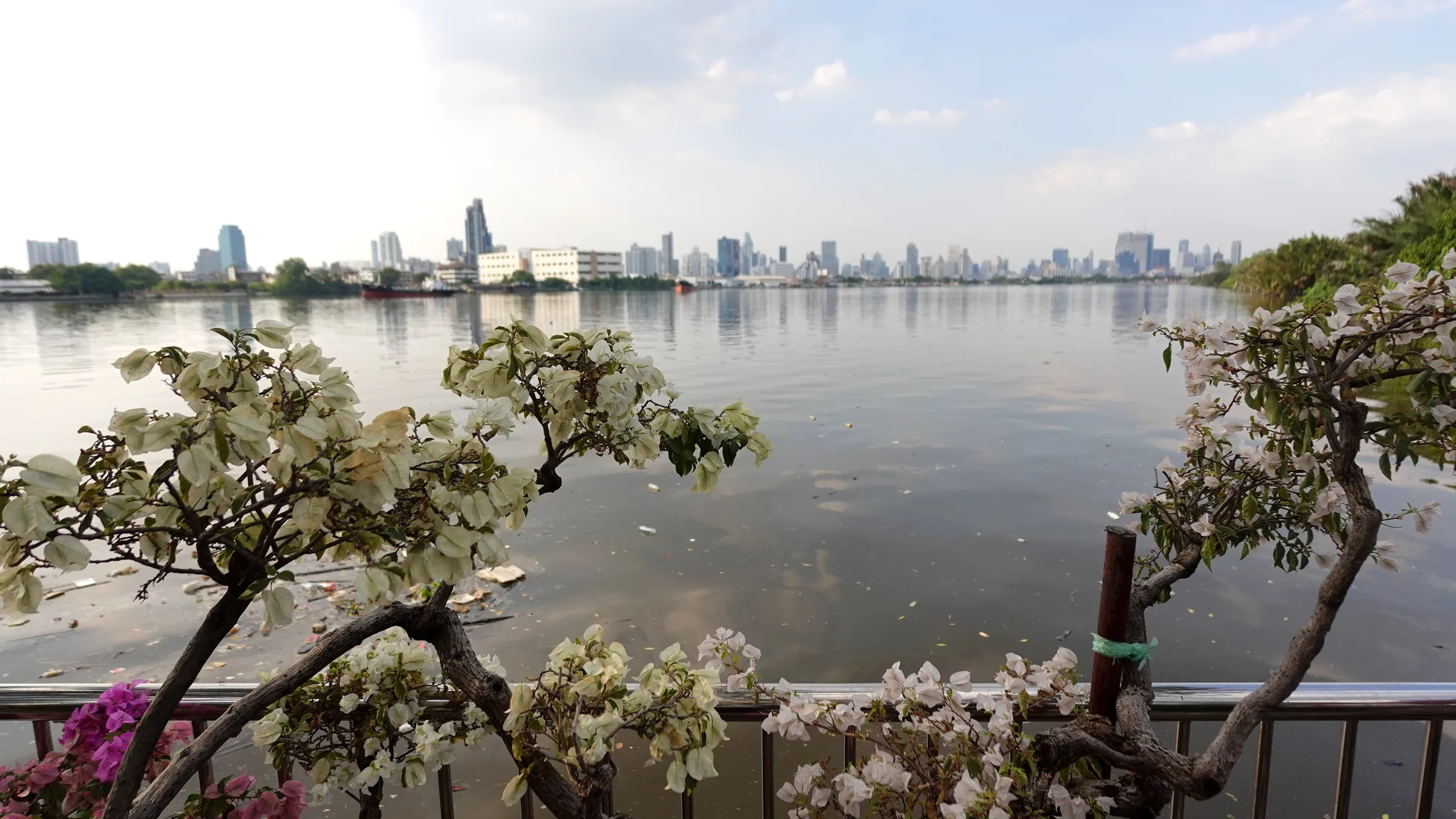
Au Mémorial du prince de Chumphon, des bougainvilliers blancs et roses bordent une rambarde métallique ouvrant sur le large fleuve, avec une ligne de tours sur la rive opposée.© Eric Monteil