
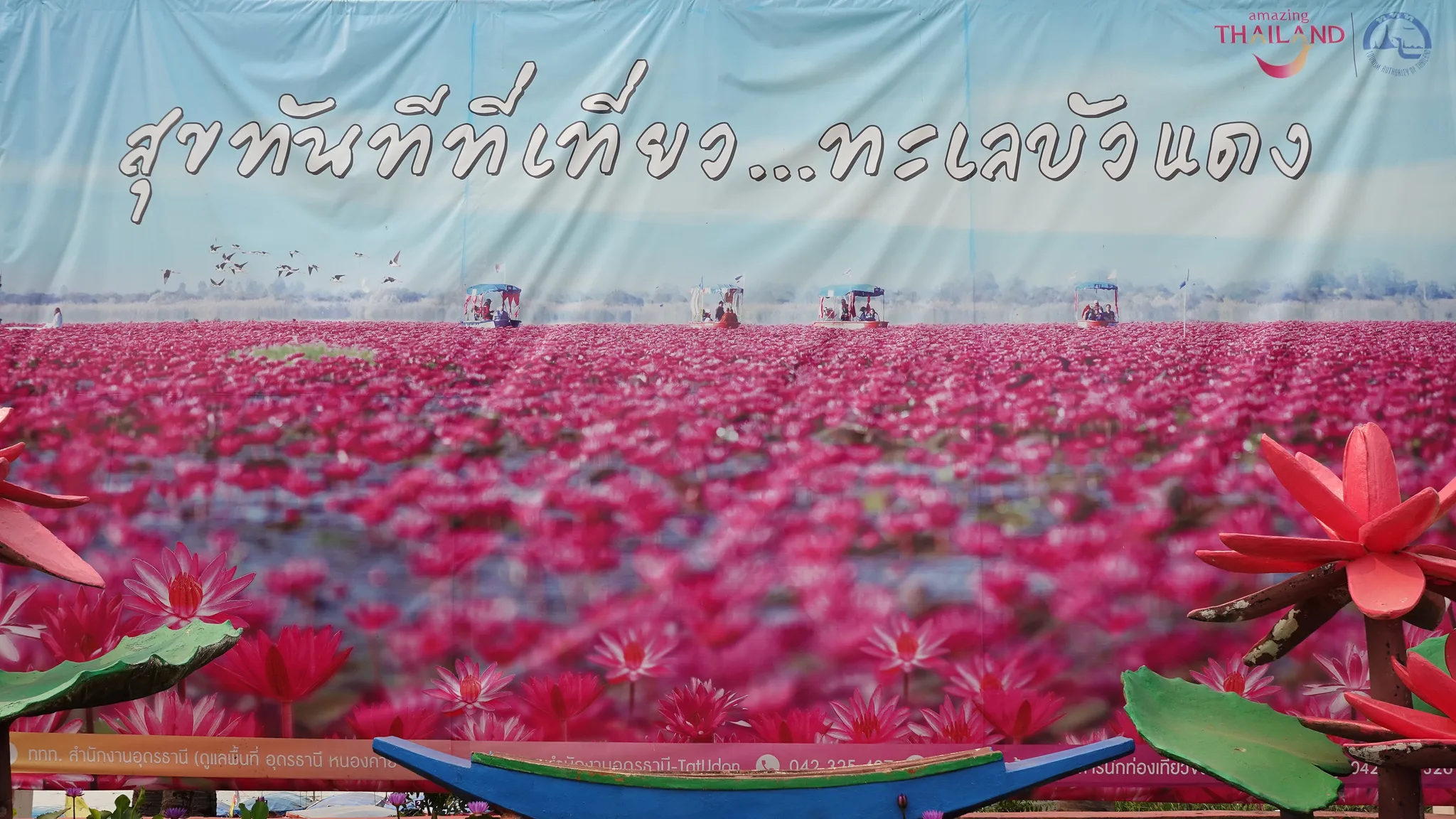
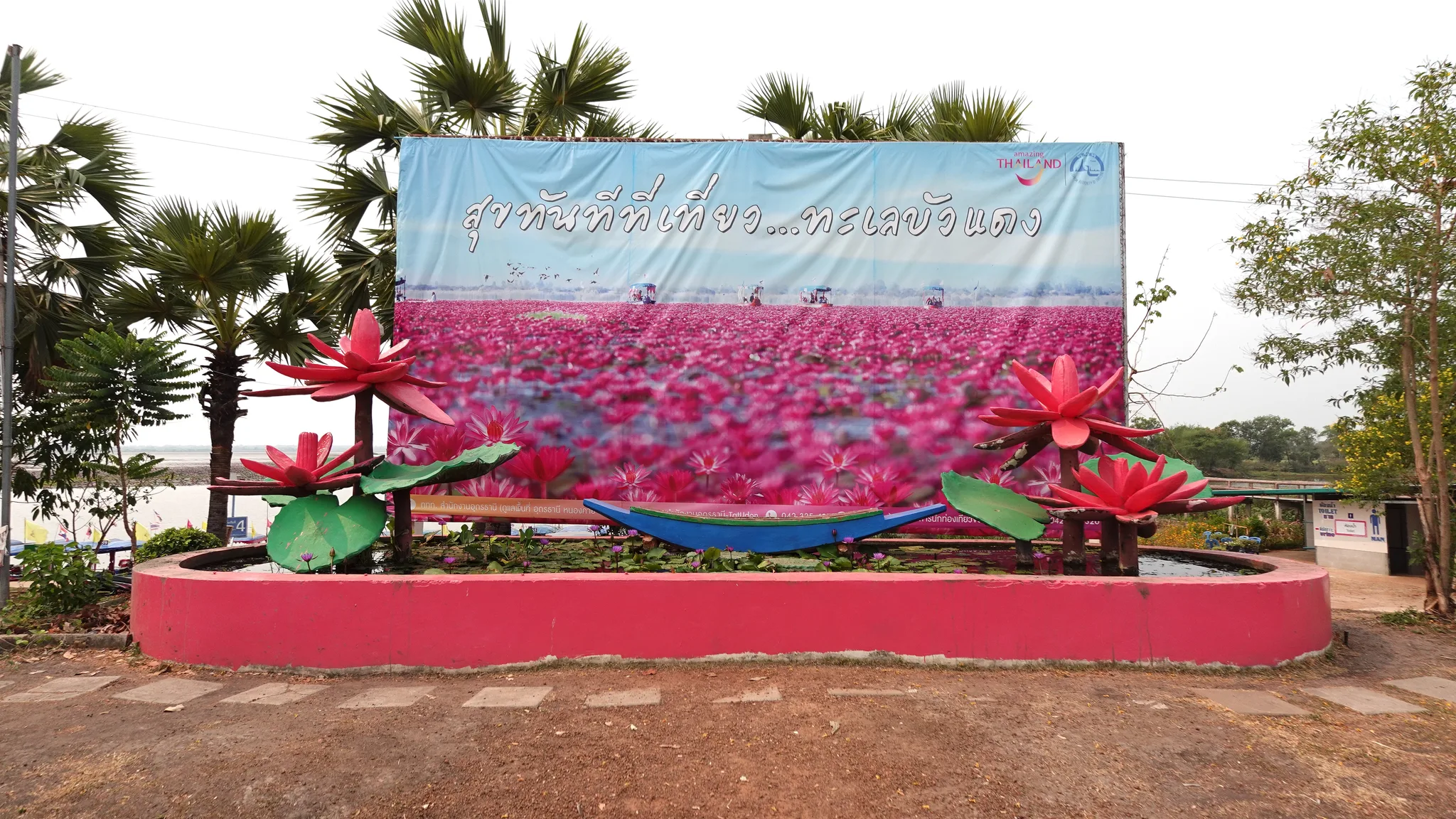
 Decorative banner depicting the Red Lotus Lake (Kumphawapi): a stretch of water covered with pink water lilies and crossed by boats, beneath the Thai inscription « ทะเลบัวแดง ». In the foreground, sculpted lotuses and a blue boat.© Eric Monteil
- Destination
- Udon Thani (Kumphawapi)
- Heritage Family
- Nature, biodiversity and ecosystems
- Typology
- Wetland, lake & marsh
- Visit
- Available tours →
The Red Lotus Sea (Kumphawapi Lake) is the flowering and most visited part of Nong Han Kumphawapi, a natural wetland in Udon Thani Province, in north-eastern Thailand. Each season, vast stretches of water here are covered with pinkish-red flowers that draw visitors. Yet the lake matters far beyond this spectacle. Formed some ten thousand years ago under the influence of a stronger monsoon, it preserves in its sediments one of the rare archives of Isan’s ancient climate. Shallow, fringed with marshes and floating mats of vegetation, it is explored by boat, from December to February.3
Key facts
- Destination
- Kumphawapi District
- Heritage Family
- Nature, biodiversity and ecosystems
- Typology
- Wetland, lake & marsh
- Places
- Udon Thani
- Nong Han Kumphawapi
- Periods
- —
- People
- —
- Communities
- Communautés riveraines de Nong Han Kumphawapi
- Events
- Campagnes de carottage de Nong Han Kumphawapi (2009-2010)
- Projet de conservation et de restauration de la zone humide de Nong Han Kumphawapi
- Heritage
- —
- Glossary
- Rai
- Bueng
- Phytolith
- Russian corer
- Keywords
- —
- Date
- —
- Collections
- —
Practical info
Practical information about this site is taken from its Google Maps page. We advise you to check it before visiting.
- Address
- Unnamed Rd, Tambon Chiang Wae, Chiang Haeo, Kumphawapi District, Udon Thani 41110
- Phone
A sea of flowers on an Isan lake
A name for a seasonal landscape
In Thai it is called Talay Bua Daeng, the ‘sea of red lotuses’. Bua daeng means ‘red lotus’, and the word talay, the sea, conveys the impression left by water entirely covered with pinkish-red flowers. The name does not refer to a place with fixed boundaries, but to a landscape that appears each year on part of the lake and fades away at the end of the flowering. Other names say the same thing through other images: ‘Red Lotus Lake’ in English-language publications, or Thung Dok Bua Daeng, the ‘field of red lotus flowers’, as if the expanse of water had become a meadow.10
The Red Lotus Sea (Kumphawapi Lake) is therefore not a site separate from the lake that holds it. It is the lake’s most flower-covered and most visited part, counted, together with Thale Noi in Phatthalung Province, among the two best-known red lotus fields in Thailand. To understand what people come here to see, one must first look at the lake itself, its history and the way it was formed.9
Nong Han Kumphawapi, the lake that holds it
This lake is called Nong Han Kumphawapi, often shortened to Nong Han. It lies north of the town of Kumphawapi, in the district of the same name, about 45 kilometres from the city of Udon Thani, in Isan, the great region of the North-East. Locally it is described as a bueng, that is, a vast natural body of water. Shallow, with an average depth of less than two metres, it is fed mainly by a stream, the Huai Phai Chan Yai, and drains into the Lam Pao.11
It measures at most 7 kilometres in length and 3 kilometres in width, with a surface area of 1.7 square kilometres, or 4.1 square kilometres including the wetland. Its rank among the country’s lakes varies from one account to another. It is sometimes presented as the second natural lake of the North-East, sometimes as one of the largest natural freshwater lakes in Thailand, or even as the largest. It should not be confused with another Nong Han, in Sakon Nakhon Province: that is a separate lake, whose history and data do not apply to the one at Kumphawapi.11
A lake born of the monsoon
Ten thousand years ago, a basin fills
Nong Han Kumphawapi is not an artificial reservoir but a natural lake, whose history is measured in millennia. It formed about ten thousand years ago, at the start of the Holocene, the geological epoch that began at the end of the last glaciation and continues today.3
Its formation has a climatic cause. At that time the summer monsoon, the wind system that each year brings the heavy rains to South-East Asia, grew in intensity. Run-off and humidity increased, and water accumulated permanently in the basin: the lake was born of the climate. The layers of mud that have built up on its bed ever since preserve the traces of variations in that same climate.3
A disputed date of birth
The lake’s exact age is nonetheless a matter of debate. In the 1990s, the researcher D. Penny dated the base of a sediment core, designated KUM.3, to more than twelve thousand radiocarbon years. A core is a long cylinder of sediment extracted vertically, whose successive layers can be read like the pages of a register. Penny had obtained his date from concentrated pollen extracted from these deposits.4
The teams who returned to the site in the late 2000s place the start of sedimentation slightly later, a little over ten thousand years ago. They questioned Penny’s date by considering that the dated pollen may have been reworked, that is, eroded from older deposits before being redeposited on the lake bed, which would make it appear older than the layer containing it. Nothing allows the question to be settled entirely.4
An archive of ancient climate
From the first studies to the 2009 and 2010 campaigns
The lake has attracted scientists since the mid-1990s. At that time L. Kealhofer studied phytoliths, tiny particles of silica produced by plants that survive in the soil after the plants decompose. D. Penny, J. Grindrod and P. Bishop turned their attention to the microfossils preserved in the mud, and towards the end of the decade Penny published a study of several cores, designated KUM.1, KUM.2 and KUM.3.4
A new generation of research began in January 2009 and January 2010, with teams brought together around S. Chawchai, among others. The researchers worked from a platform set up on the water and extracted the sediments with a modified Russian corer, an instrument designed to retrieve loose, waterlogged deposits without deforming them. One of the cores, named CP4, comes from the southern part of the lake. These campaigns complement the earlier sequences and refine their interpretation.2
A reference for the history of the monsoon
These sequences have made Nong Han Kumphawapi a reference archive for understanding how the Asian monsoon and the natural environments of the North-East have evolved since the start of the Holocene. The lake is one of the few lake archives of the late Pleistocene, the long glacial period preceding the Holocene, and of the Holocene to have been studied in north-eastern Thailand.3
This rarity gives the site a value that cannot be perceived from the boat. Beneath the flowering surface that visitors come to see, layers of mud accumulated over millennia hold a memory of the region’s climate. The lake that offers its seasonal spectacle is also a scientific document.
The marsh landscape
Floating vegetation and birds
Around the open water, the lake extends into marshland. Its vegetation consists of herbaceous mats, floating or partly rooted, which form a shifting transition between water and land. Among the plants identified are a knotweed, Persicaria attenuata, and tall grasses of the genus Saccharum, related to sugar cane. Kealhofer and Penny also described epiphytic ferns there, which grow on other plants without drawing nourishment from them.4
This environment is home to many species of birds, which visitors can observe during the season. The site ranks among the most important wetlands of the North-East for its ecology. The pinkish-red flowers that give the place its name are thus only one moment in a wider ecosystem.7
The flowering season
The flowering lasts from December to February. The best period begins in late November or early December and continues into February. It is the annual return of the flowers that turns Nong Han Kumphawapi into a ‘sea of red lotuses’.9
This spectacle varies from year to year, in both duration and extent. In 2022 the flowering was more extensive than in previous years. In 2024 it lasted into March, which was considered exceptional. These variations are a reminder that the Red Lotus Sea (Kumphawapi Lake) is not a fixed backdrop: it is a living phenomenon that changes with every season.7
Visiting the sea of flowers
A boat trip
The large expanses of flowers lie away from the shore and are hard to see from the bank. To discover them, one must therefore take to the water. The boat trip, lasting roughly an hour to an hour and a half, is the site’s main activity: it takes visitors through the flowering expanse, right up to the pinkish-red blooms that cover the water.10
This way of visiting comes with a few rules, which visitors were reminded of in 2022: wear a life jacket throughout the trip and throw no rubbish into the water. These instructions are aimed at both the safety of passengers and the cleanliness of the lake.8
Nature tourism and lakeside communities
The site is presented as a destination for nature and community-based tourism, and it is promoted by the Udon Thani office of the Tourism Authority. The communities living on the shores of the lake take part in this activity.7
Tourism, however, is only one way of recognising the value of the place. A university study, based on fieldwork and interviews with specialists and members of the lakeside communities, attributes three values to it: nature and the environment; history, society and culture; and tourism.6
A marsh to protect
A conservation and restoration project
The preservation of the lake falls partly to the state. In 2017 the Department of Water Resources was running a project to conserve and restore the Nong Han Kumphawapi wetland, which Thailand presented among its actions in support of wetlands.1
What is at stake bears directly on the landscape that visitors come to see. The extent and duration of the flowering change from one season to the next.7
Four zones for a single lake
A piece of university research, based on the same fieldwork, proposed managing the wetland by distinguishing four levels of protection. The first corresponds to strict conservation. The second combines strong conservation with controlled use. The third provides for moderate conservation, and the last for low conservation, applied to the lakeside areas.6
This division reflects a way of thinking about the lake not as a uniform whole, but as a set of environments with different uses, from the heart of the marsh to the inhabited shores. It acknowledges a simple situation: the same expanse of water is at once an ecosystem, a living place for the lakeside communities and a tourist destination.
Understanding
The Red Lotus Sea (Kumphawapi Lake) is first and foremost a natural lake in Isan, Nong Han Kumphawapi, with its marshes, its floating vegetation, its birds and the villages that live along its shores. Its fame rests on its flowering, from December to February, when the water is covered with pinkish-red flowers and boats take visitors out onto the lake. But the lake is also a document: born some ten thousand years ago of a stronger monsoon, it keeps in its mud one of the rare archives of the North-East’s ancient climate. Its flowering changes from year to year, more extensive in 2022, longer in 2024, and the state has launched a project to conserve and restore the marsh, while a university study proposes organising its uses into more or less protected zones. Should this lake be seen first as a sea of flowers offered to visitors, or as the living memory of a region shaped by the monsoon for ten thousand years?
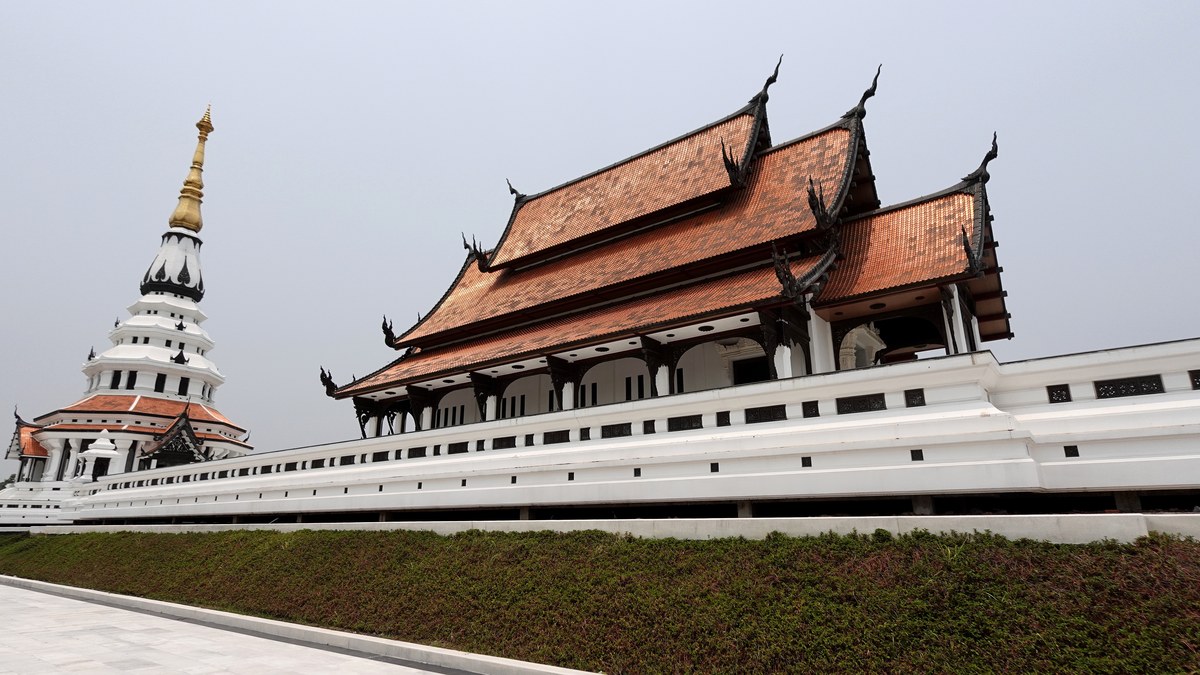
From Buddhist forests to red lotuses and Ban Chiang: two days at the heart of the landscapes and memories of Udon Thani.
- Rai
- Thai unit of land area, equivalent to 1,600 square metres.
- Bueng
- Thai term for a large natural body of water, such as a lake or a large pond.
- Phytolith
- Microscopic particle of silica formed in plant tissues, which survives in the soil after the plant decomposes; its study helps to reconstruct past vegetation.
- Russian corer
- Sampling instrument designed to extract soft, waterlogged sediments without compressing or deforming them.
Primary sources
- 1Gouvernement thaïlandais, Ramsar National Report to COP13 – Thailand, Ramsar Convention, 2018 ↗
Studies
- 2Chawchai S. et al., Lake Kumphawapi – an archive of Holocene palaeoenvironmental and palaeoclimatic changes in northeast Thailand, Quaternary Science Reviews (Elsevier / ScienceDirect), 2013 ↗
- 3Wohlfarth B. et al. (attribution déduite des renvois de S3, à confirmer), Holocene environmental changes in northeast Thailand as reconstructed from a tropical wetland, Global and Planetary Change (Elsevier / ScienceDirect), 2012 ↗
- 4non indiqués dans l'extrait consulté, Lake Kumphawapi revisited, The Holocene, vol. 26(4), p. 614-626 ↗
- 5non indiqués dans l'extrait consulté, Lake Kumphawapi - an archive of Holocene palaeoenvironmental and palaeoclimatic changes in northeast Thailand (notice ResearchGate), ResearchGate, 2013 ↗
- 6non indiqués dans l'extrait consulté, Sustainable Conservation Guidelines for Management and Utilization of Nong Han Kumphawapi Wetland (แนวทางการจัดการและการใช้ประโยชน์พื้นที่ชุ่มน้ำหนองหานกุมภวาปีเพื่อการอนุรักษ์อย่างยั่งยืน), Silpakorn University (DSpace) ↗
- 7ผู้จัดการออนไลน์, “ทะเลบัวแดง” อุดรธานี ปีงูใหญ่ไม่ธรรมดา บานชมพูสะพรั่งสวยงามยาวถึงมีนาคม, MGR Online, 2024 ↗
- 8non indiqués, “ทะเลบัวแดง” เปิดรับนักท่องเที่ยวแล้วเด้อ! กว้างกว่า 22,500 ไร่บานสะพรั่งมากกว่าทุกปี, MGR Online, 2022 ↗
- 9non indiqués, The famous red lotus fields in Thailand, Sawasdee Magazine (Thai Airways) ↗
Contemporary views
Red Lotus Lake (Kumphawapi) today
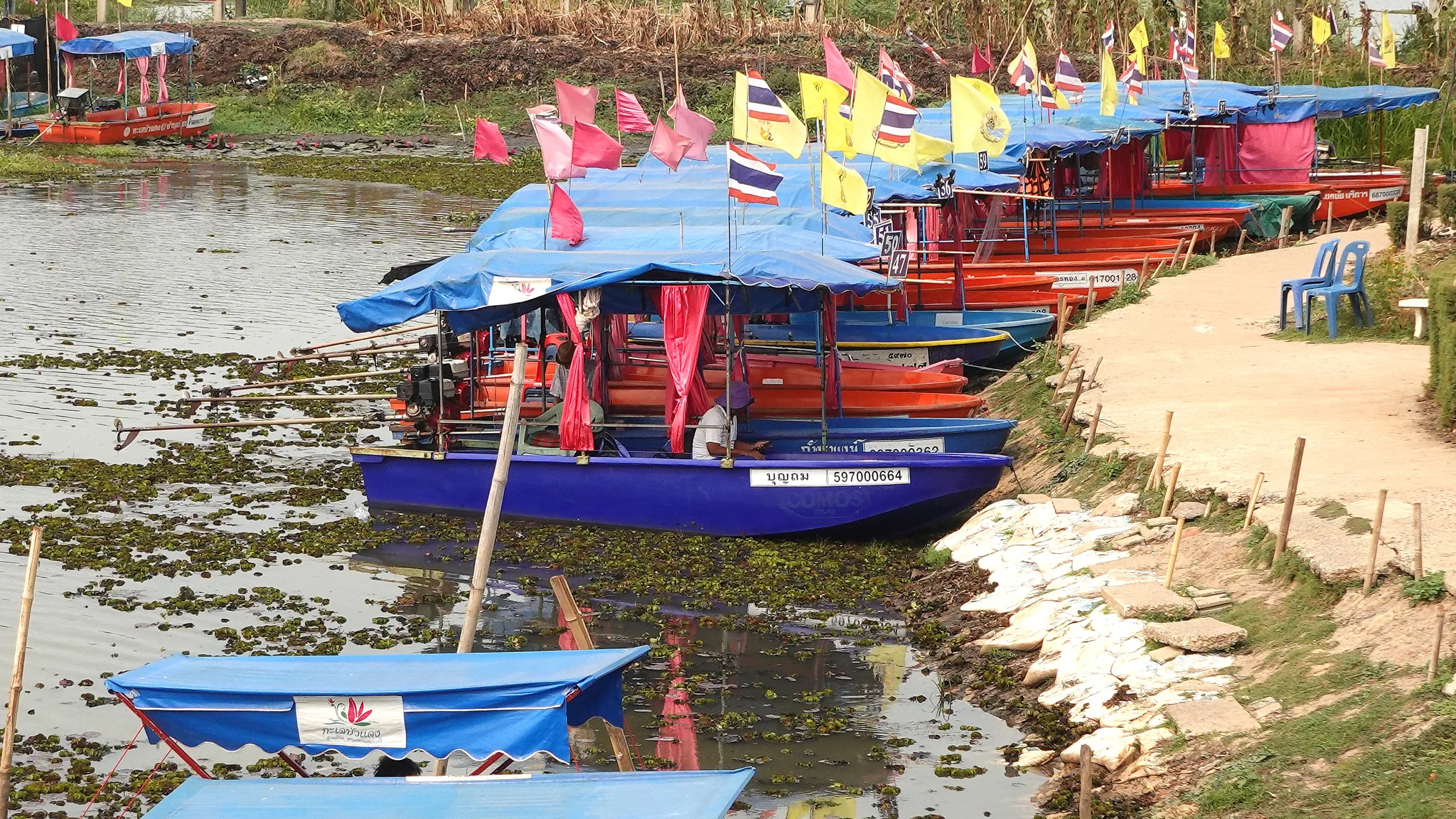
Red Lotus Lake (Kumphawapi): lined up on water dotted with floating vegetation, numbered boats with blue canopies, pink curtains and Thai flags await visitors at the foot of a bankside path.© Eric Monteil