
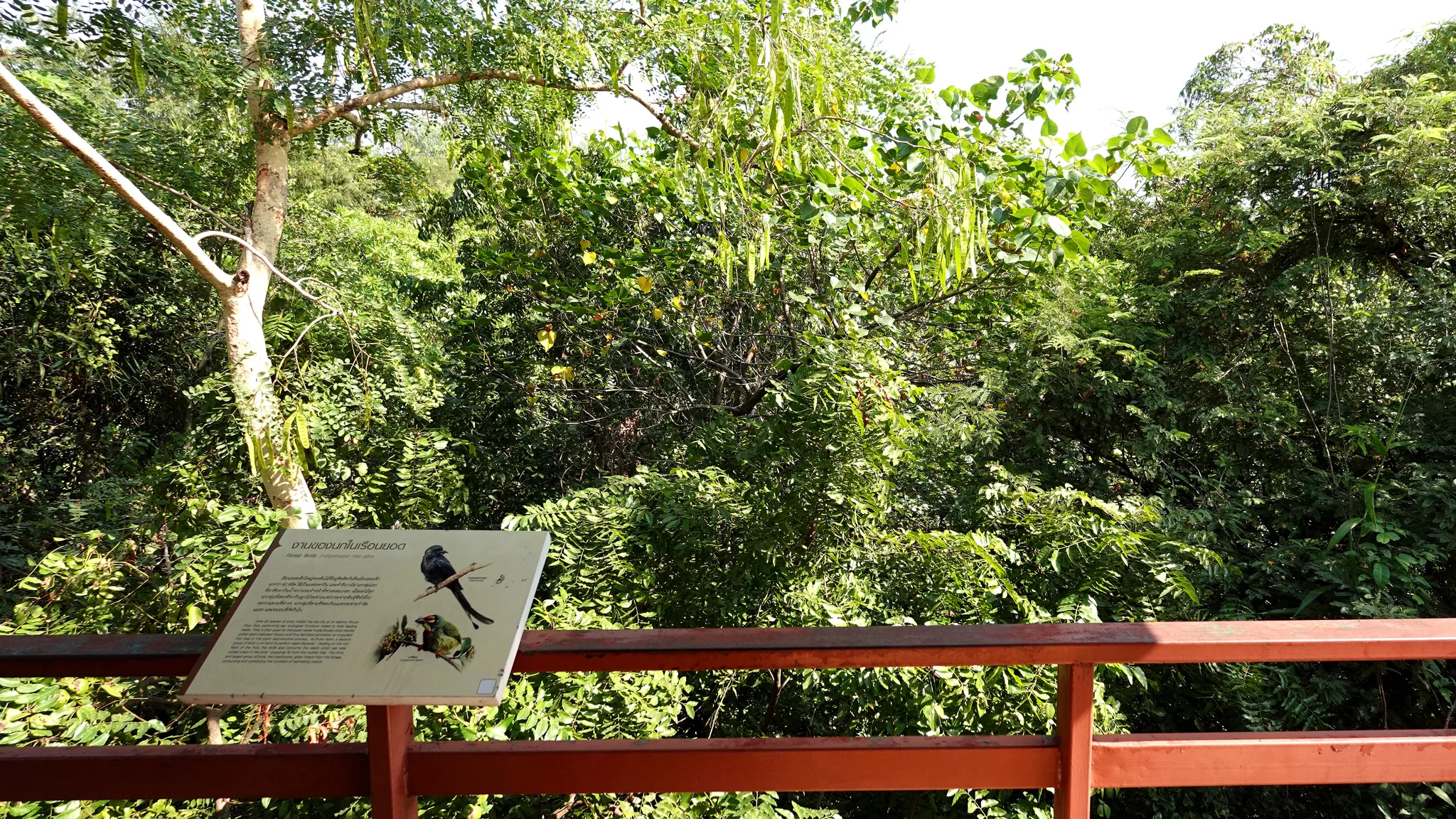
 From Si Nakhon Khuean Khan Bird Tower, a red wooden railing overlooks the tree canopy; a bilingual Thai-English panel illustrated with two birds helps visitors identify the species.© Eric Monteil
Wetland, lake & marsh
Si Nakhon Khuean Khan Bird Tower
A bird-watching tower rising in a royal park in Bang Kachao, from which one looks out over the treetops at one of the last natural spaces still preserved on the doorstep of Bangkok.
Heritage family · Nature, biodiversity and ecosystems
- Destination
- Samut Prakan (Phra Pradaeng)
- Heritage Family
- Nature, biodiversity and ecosystems
- Typology
- Wetland, lake & marsh
- Visit
- Available tours →
Si Nakhon Khuean Khan Park's Bird Watching Tower is an ornithological observation tower set in a public park and botanical garden in Bang Kachao, in Samut Prakan Province. Its importance lies in the place it reveals. Bang Kachao is a loop of the Chao Phraya River that has stayed green in the midst of the Bangkok conurbation. The State bought back part of it following King Bhumibol Adulyadej’s wish that it be preserved, then turned former orchards into a park. From the platform, the eye travels over the trees towards the marshes and ponds that are home to resident and migratory birds.6
Key facts
- Destination
- Bang Krachao
- Heritage Family
- Nature, biodiversity and ecosystems
- Typology
- Wetland, lake & marsh
- Places
- Sri Nakhon Khuean Khan Park
- Phra Pradaeng
- Samut Prakan
- Periods
- People
- Bhumibol Adulyadej
- Communities
- —
- Events
- Designation of Bang Kachao as an environmentally protected area (2019)
- Designation of Bang Kachao as a protected green area (1977)
- Suan Klang Mahanakhon programme (1991-1999)
- Restauration forestière du jardin botanique Sri Nakhon Khuean Khan (2013)
- Heritage
- —
- Glossary
- Chao Phraya
- Phraya
- Thong rong
- Royal project
- Hor du nok
- Sri
- Keywords
- —
- Date
- —
- Collections
- —
Practical info
Practical information about this site is taken from its Google Maps page. We advise you to check it before visiting.
- Address
- MHW9+F9V, Bang Kachao, Phra Pradaeng District, Samut Prakan 10130
A tower at the heart of the green lung
A lookout for the birds
In Thai, it is simply called hor du nok, ‘the tower for watching birds’. The name says everything about its purpose. Si Nakhon Khuean Khan Park's Bird Watching Tower is neither a monument nor an ornamental pavilion: it is a platform some seven metres high, designed to lift the visitor to the level of the treetops. It stands in the Si Nakhon Khuean Khan public park and botanical garden. People living nearby call it Suan Klang, and many refer to it simply as Bang Krachao park. Understanding the tower therefore means first understanding this park, and the territory it was created to protect.13
What people come here to do is simple: climb, wait, watch. Novice and experienced birdwatchers alike gather here all year round, for the park is home both to resident species and to birds that come to spend the winter. The tower is also a must-see stop for visitors and a place for photography. It is the most visible sign of the park’s purpose, which combines relaxation with the observation of nature.11
The Bang Kachao loop
The park occupies the north of Bang Kachao, a subdistrict of Phra Pradaeng District. Here the Chao Phraya River traces a wide loop that cuts off a peninsula of some twenty-four square kilometres, surrounded on all sides by the Bangkok conurbation. The widespread spelling Bang Krachao is, moreover, a source of confusion: it is also the name of another subdistrict, located in Samut Sakhon Province.9
This territory is the last remnant of the green belt that once surrounded Bangkok. Natural forest and farmland still take up most of the land, and local regulations prohibit both high-rise buildings and large factories. It is often nicknamed the capital’s ‘green lung’. The image describes a concrete role: the loop’s vegetation supplies the city with cool air for much of the year, depending on the seasonal winds. In 2006, Time magazine named Bang Kachao the best urban oasis in Asia.2
From abandoned orchards to a royal park
Buying back the river loop
The fate of Bang Kachao has long concerned the authorities: as early as 14 September 1977, the Council of Ministers adopted a resolution devoted to the loop. Conservation policy took shape in 1991, when the government launched a programme entitled ‘A Garden amid the Metropolis’ (Garden amid the Metropolis). A first phase ran until 1999. The land still had to be secured. Expropriation failed, and the State resolved to buy the land by agreement.4
King Bhumibol, the ninth monarch of the Chakri dynasty, had expressed the wish that the island be preserved. Following this wish, the Office of Environmental Impact Evaluation, then under the Ministry of Science, Technology and Environment, acquired 564 abandoned agricultural plots. Together they covered some two hundred hectares. Only a small part, of the order of twenty-four hectares, was given over to the park. The rest remains a reserve of farmland. The second phase of the programme, from 2000 to 2004, continued this effort: the Office of Natural Resources and Environmental Policy and Planning drew up a master plan for managing the loop’s green spaces.3
A name granted by the King
The park’s name is not a mere administrative designation. It was granted by King Bhumibol and means ‘public park that is the glory of Nakhon Khuean Khan’. The word sri expresses glory and prestige. The name links the park to the monarch whose wish lies at the origin of Bang Kachao’s preservation. The full official name in Thai combines the site’s two functions: public park and botanical garden.6
A birth with several dates
Accounts differ on the date of the park’s birth. The royal name is dated to 1992. Completion of the works is placed in 1997, yet the story of the park’s creation is also set within the second phase of the programme, between 2000 and 2004. Yet another chronology gives the year 2003. All of them, however, place the park’s creation between the early 1990s and the mid-2000s, during the two phases of the conservation programme: the park was born of this public policy, not of an isolated initiative.6
Reading the park’s landscape
From ornamental garden to former orchards
Visitors heading towards the tower pass through two successive landscapes. At the entrance lies a landscaped park, with its lawns, flower beds, large pool and waterside pavilions. Further on, the scenery changes: one enters former orchards whose ditches have been preserved. These ditches are called thong rong. Wooden footbridges now span them.6
The loop’s agricultural past thus remains legible in the very layout of the park. A demonstration area preserves coconut groves and plantations of areca palms, the palm that yields the areca nut, inherited from the former orchard. The park does not erase the history of the land bought back by the State: it displays it. The park covers some twenty-four hectares.6
Water, marshes and boardwalks
Water shapes the whole park. Islets, ponds, canals and a large lake make up a wetland landscape. This habitat is one of the three characteristic ecosystems of Bang Kachao that the park sets out to conserve. A wooden boardwalk runs alongside the marsh.7
The botanical garden has more than a hundred plant species. Along the paths, signs in Thai and English explain how the plants are used in cooking or in traditional medicine.12
What can be seen from the tower
Above the canopy
Once at the top, visitors look down on the canopy, that is, the upper storey of the trees. On an island where regulations prohibit high-rise buildings, no building seems to rise above the trees. Yet the Bangkok conurbation encircles the loop on every bank.
The tower’s height serves above all for watching the birds of the canopy.11
Resident and wintering birds
More than a hundred bird species, resident or migratory, frequent the park. Among them are the peregrine falcon, the little egret, the verditer flycatcher, the common myna, bulbuls and the pink-necked green pigeon. Most of these species are protected under Thailand’s wildlife protection law. The peregrine falcon is among the winter visitors, as are the Asian paradise flycatcher, the blue-winged pitta and the ashy drongo.5
The records of amateur birdwatchers give an idea of this diversity. On 10 December 2024, their lists counted between 26 and 34 species there, among them the purple heron, the little egret, the common kingfisher and the yellow-bellied prinia.1
Wildlife of the water and banks
Birds are only part of the fauna. The marshes and canals shelter reptiles such as the Asian water monitor, the oriental garden lizard and the reticulated python, as well as numerous fish, from the Java barb to the archerfish. The park offers these animals an area for feeding, for spawning, that is, the laying of fish eggs, and for refuge. In all, more than a hundred native animal species have been recorded in the park.5
The park today
A forest restored for learning
Since 2013, the company PTTEP has been running a forest restoration project in the botanical garden. A forest of some six hectares has been recreated there to bring together all of Bang Kachao’s ecosystems in a single place. The project is also intended to make the park a ‘nature classroom’, a place for study and learning.7
The results are measurable: the number of plant species, around ninety in 2014, exceeded a hundred three years later. The company also trains ‘young guides’ from among pupils at local schools, who learn how to show visitors around the park. Birdwatching from the tower finds an educational extension here: looking at nature also serves to make it known.7
Walks, bicycles and school trips
Today the park is a place for walking and relaxation. People walk, cycle and rest here. Admission is free. Bicycles can be hired at the entrance and at other points around the loop, and the park is one of the sights to discover in Bang Kachao, along with the Bang Nam Phueng floating market and a gallery devoted to the Siamese fighting fish.14
Schools and universities also organise outings here, and the park welcomes several hundred thousand visitors each year. Amid these varied uses, the tower remains the rallying point for enthusiasts of urban birdwatching: it is a reminder that this garden on the doorstep of Bangkok is also a natural habitat.7
Management and protection
The park stands on public land belonging to the Royal Forest Department. It is managed by the Si Nakhon Khuean Khan Green Space and Eco-Management Centre, which comes under the department’s Office of Royal and Special Projects. The Royal Forest Department owns about a tenth of the land in Bang Kachao. It encourages farming there and prohibits construction, which protects the landscape in which the tower stands.4
On 28 February 2019, the government adopted environmental regulations making the six subdistricts of Bang Kachao a protected area. This status strengthens the loop’s purpose, but it has also raised questions: its critics fear that, in some cases, the new rules may run counter to the very conservation objective they pursue. The debate shows that the loop’s preservation remains an open question, nearly thirty years after the conservation programme was launched.3
Understanding
Si Nakhon Khuean Khan Park's Bird Watching Tower is first and foremost an instrument for looking. It takes on its full meaning within the park that surrounds it. This park was born of former orchards bought back by the State after the royal wish to preserve Bang Kachao, and it bears a name granted by the King. It preserves the ditches of former cultivation, marshes, a restored forest and more than a hundred bird species. The tower makes visible what gives the loop its value: a fragment of Bangkok’s green belt that has stayed alive in the midst of the conurbation. Today the site draws walkers, cyclists, schoolchildren and birdwatchers, while the entire loop is now designated a protected area. This status is contested.
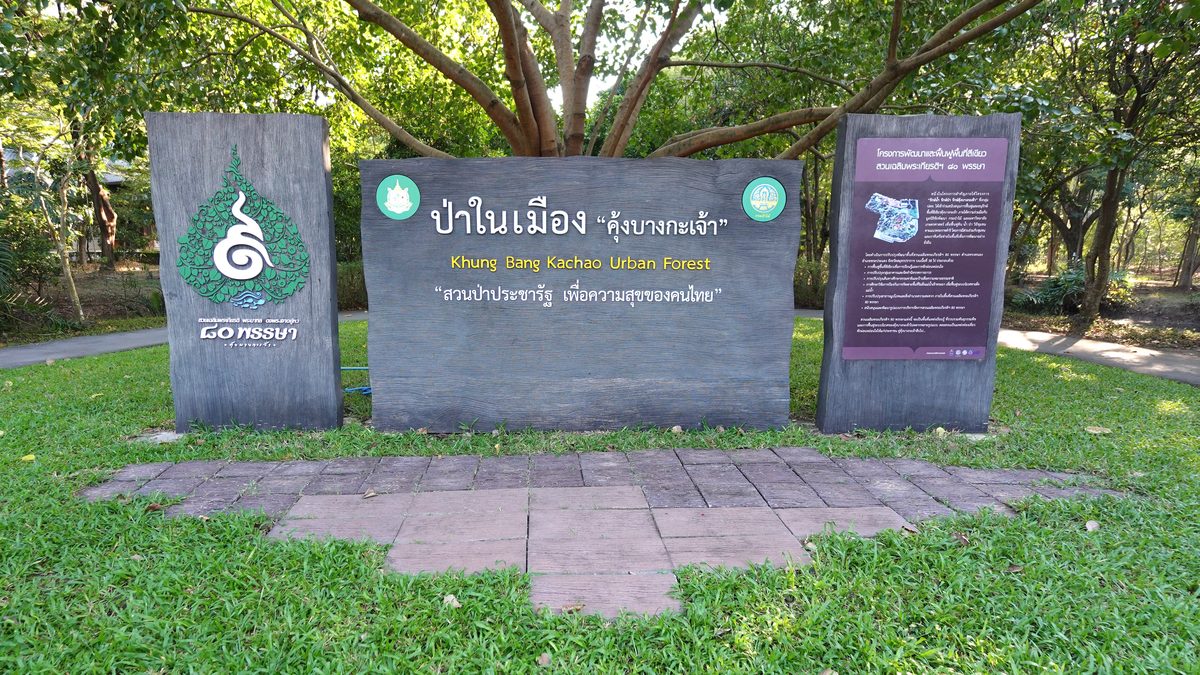
Bang Krachao, the "green lung" of Bangkok, between canals, Mon heritage, temples, biodiversity and sustainable initiatives.
- Chao Phraya
- Highest title of the Siamese nobility, held by senior dignitaries of the court.
- Phraya
- Rank of the Siamese court nobility, immediately below that of chao phraya; it precedes the dignitary’s title name.
- Thong rong
- A cultivated raised earth bed, separated from neighbouring beds by water-filled ditches, typical of traditional Thai orchards; this arrangement allows fruit trees to be irrigated and the soil to be drained.
- Royal project
- Development project launched on the initiative of the King or a member of the Thai royal family, often intended to improve the living conditions of rural populations.
- Hor du nok
- Thai expression for a bird-watching tower or platform, raised to bring the observer up to the level of the treetops.
- Sri
- Word of Sanskrit origin expressing glory, prestige and prosperity, used in Thai as an honorific element in the names of places, buildings and people.
- Royal name
- In Thailand, a name granted by the King to a place, building or institution, conferring a particular dignity upon it and linking it lastingly to the sovereign.
Primary sources
- 1Bang Kachao--Sri Nakhon Khuean Khan Park (eBird Hotspot L3554521), eBird / Cornell Lab of Ornithology, 2024 ↗
Studies
Reference works
- 4Overview – Sri Nakhon Khuean Khan Park Bang Kachao, suansri-bangkachao.com (site consacré au parc) ↗
- 5Nature in Sri Nakhon Khuean Khan Park, Sri Nakhon Khuean Khan Park (site officiel du parc) ↗
- 6สวนศรีนครเขื่อนขันธ์ (Srinakorn Khuaenkhan Park), Office provincial du Tourisme et des Sports de Samut Prakan (ministère du Tourisme et des Sports) ↗
- 7The Forest Restoration for Eco-learning at Sri Nakhon Khuean Khan Park Project, PTTEP (PTT Exploration and Production) ↗
- 8Si Nakhon Khuean Khan Park and Botanical Garden, Wikipedia ↗
- 9Bang Kachao, Wikipedia ↗
- 10บางกะเจ้า, Wikipedia (th) ↗
- 11Sri Nakhon Khuean Khan Park, Birdingplaces.eu ↗
- 12สวนศรีนครเขื่อนขันธ์ จ.สมุทรปราการ I ปอดของคนกรุงเทพฯ, Travel Thai Blog, 2020 ↗
- 13สวนศรีนครเขื่อนขันธ์ สวนสาธารณะบางกะเจ้า สมุทรปราการ, Ceediz ↗
- 14Si Nakhon Kheun Khan Park, Lonely Planet ↗
- 15Sri Nakhon Khuean Khan Park, Paknam.com ↗
- 16Sri Nakhon Khuean Khan Park, TakeMeTour ↗
Contemporary views
Si Nakhon Khuean Khan Bird Tower today
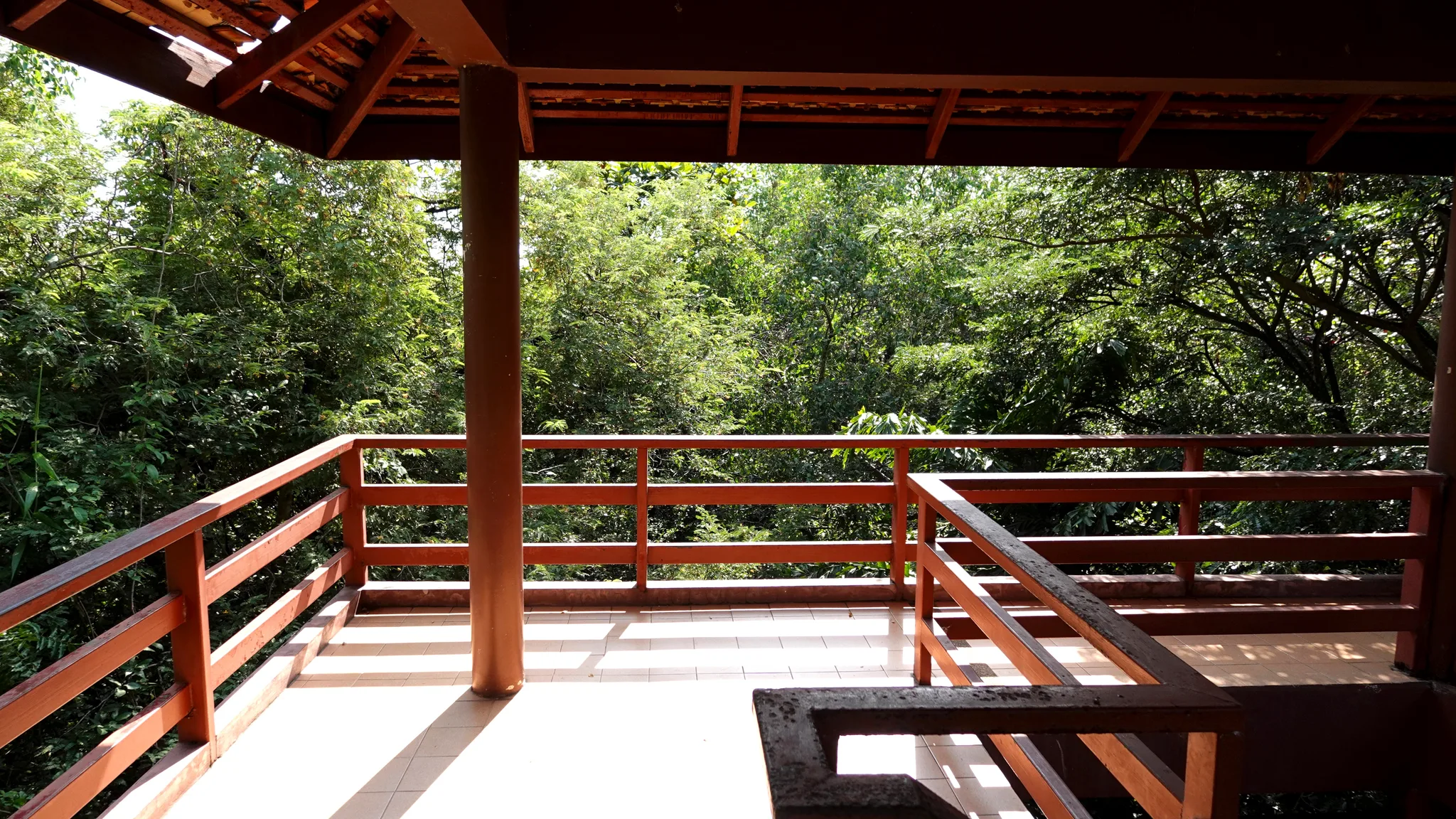
Upper platform of Si Nakhon Khuean Khan Bird Tower: beneath a roof with exposed timber framing, a tiled floor edged with red wooden railings opens out at the level of the dense canopy.© Eric Monteil 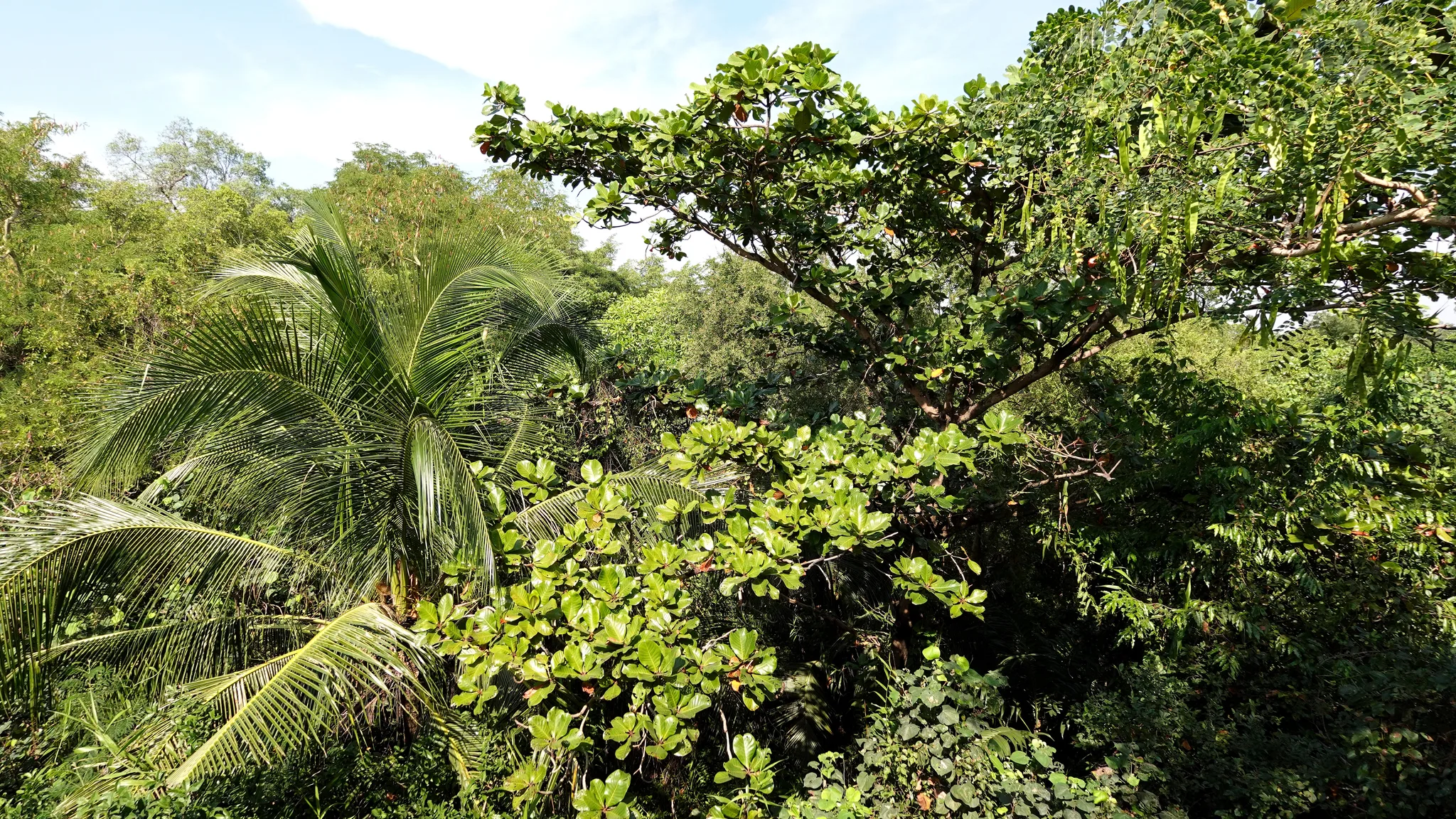
From Si Nakhon Khuean Khan Bird Tower, the view looks down over lush vegetation where palms, tropical almond trees and trees with hanging pods intermingle, forming a continuous canopy.© Eric Monteil
Architecture and decoration
Explore the heritage
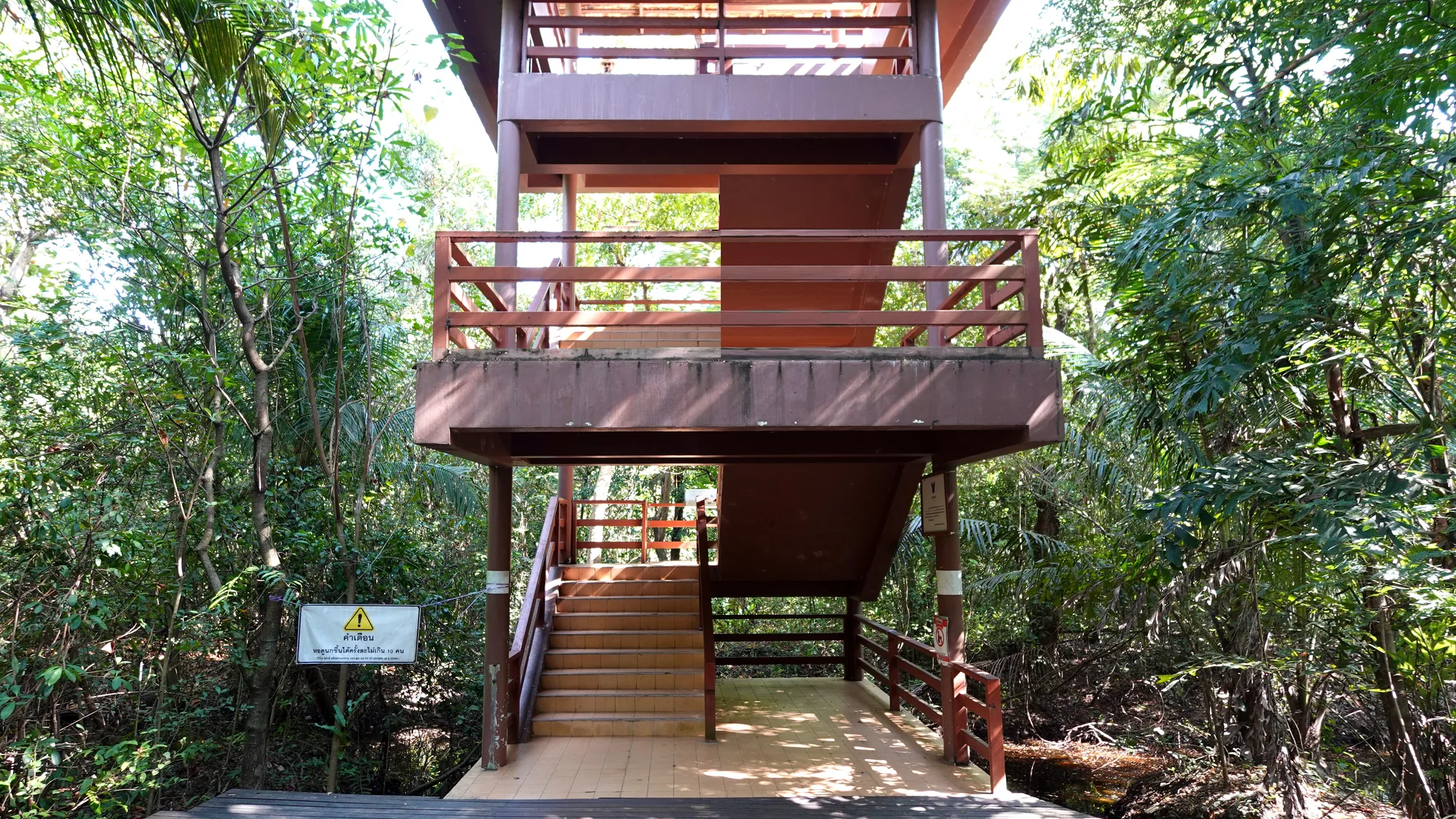
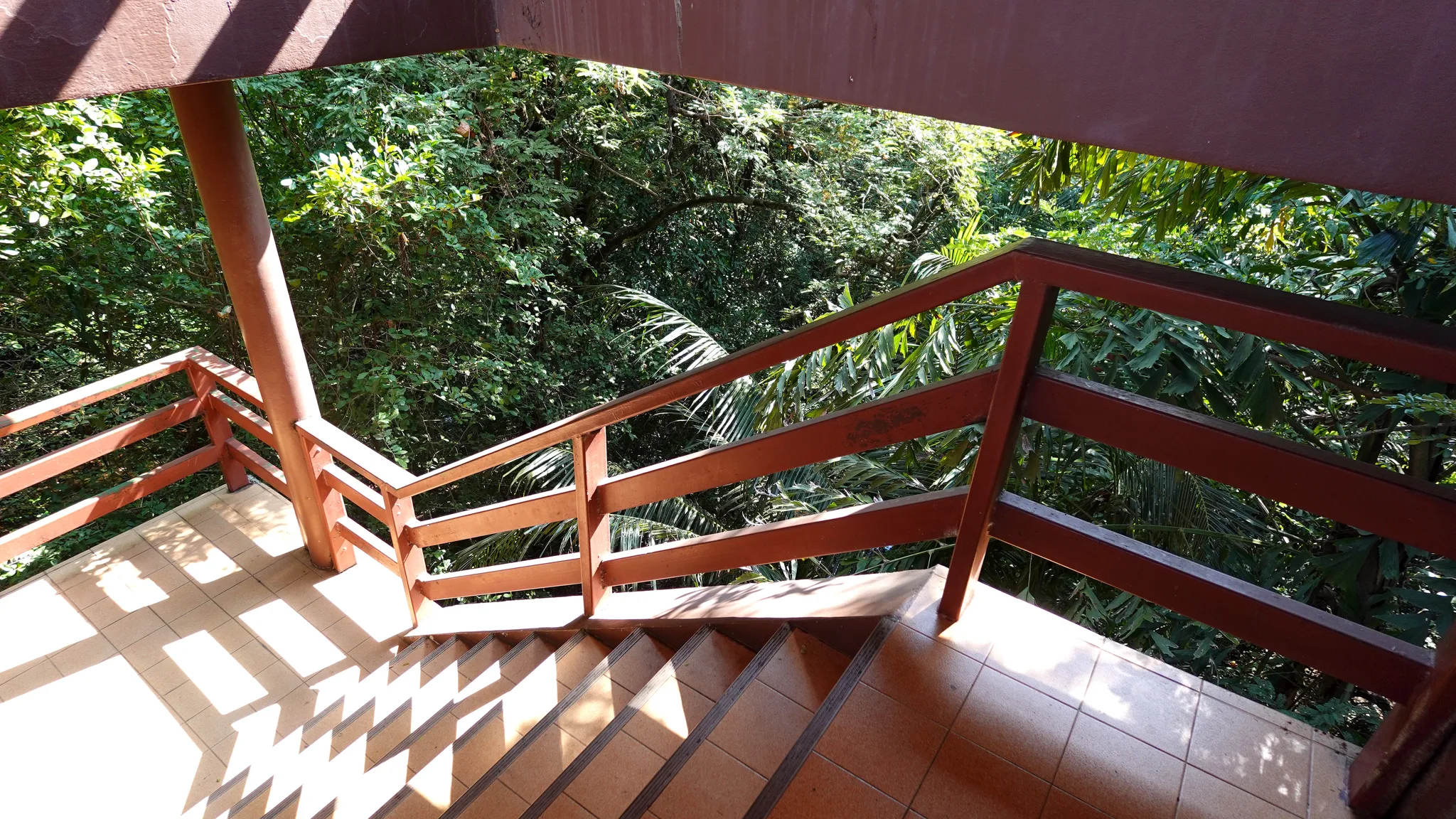
Si Nakhon Khuean Khan Bird Tower rises over several levels of painted concrete landings, linked by flights of stairs and edged with red railings, at the end of a walkway surrounded by trees and palms.© Eric Monteil 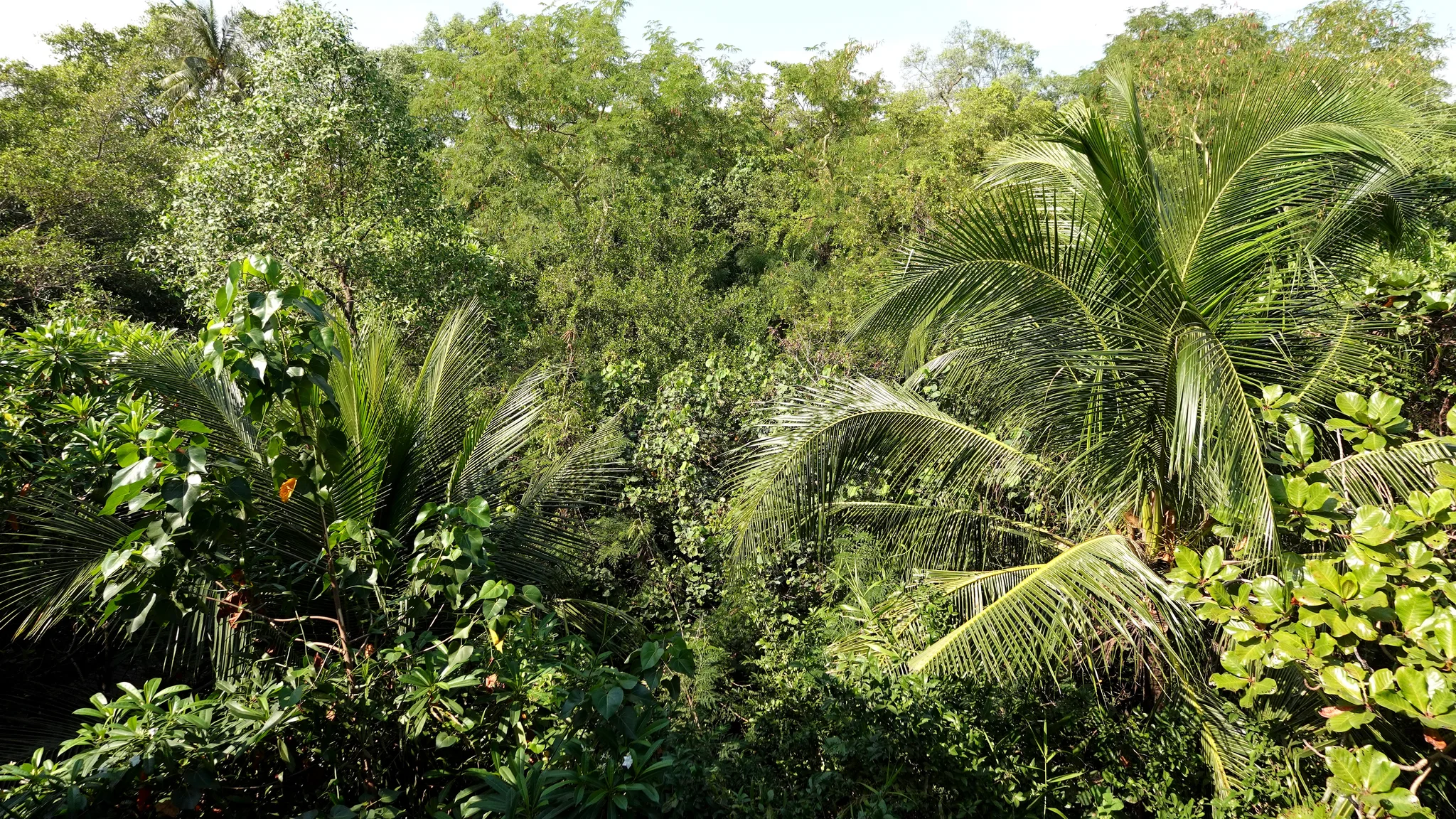
From Si Nakhon Khuean Khan Bird Tower, the view looks down over dense tropical vegetation, where coconut palms, broad-leaved shrubs and tall trees form a continuous canopy.© Eric Monteil