
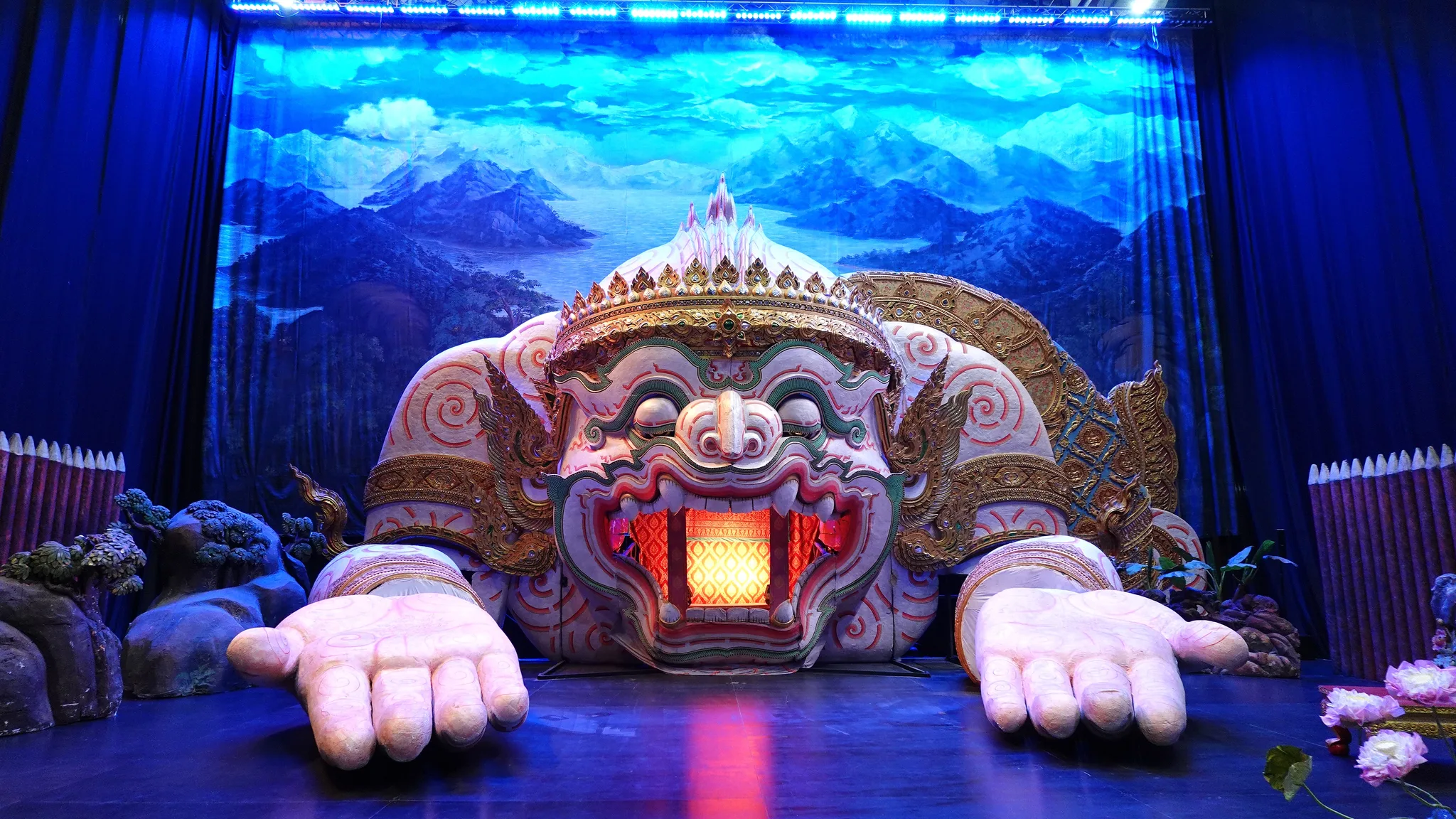
 Au Centre d’apprentissage du khon, un décor monumental inspiré des masques du khon, singe blanc couronné aux mains tendues et à la bouche ouverte éclairée, occupe la scène, encadré de rideaux bleus et d’une toile peinte de montagnes.© Eric Monteil
Cultural & creative centre
Khon Learning Center
At Ko Kerd, in Ayutthaya province, a SUPPORT Foundation building displays the masks, costumes and monumental sets of royal khon, and shows how the skills behind this masked dance drama are handed down.
Heritage family · Traditions, festivals and living heritage
- Destination
- Ayutthaya (Bang Pa-in)
- Heritage Family
- Traditions, festivals and living heritage
- Typology
- Cultural & creative centre
- Visit
- Available tours →
The Khon Learning Center is a place of exhibition and transmission devoted to khon, the masked dance drama of Thailand. Housed within the Ko Kerd Arts and Crafts Centre, in Bang Pa-in district, it is run by the SUPPORT Foundation. Queen Sirikit had created this foundation to revive traditional arts and crafts, among them khon, which was then in decline. Khon has been inscribed by UNESCO as Intangible Cultural Heritage of Humanity. The building preserves and displays the fruits of its revival: masks, headdresses, costumes and the monumental sets of royal khon. It also explains the crafts that make this spectacle possible.2
Key facts
- Destination
- Bang Pa-in
- Heritage Family
- Traditions, festivals and living heritage
- Typology
- Cultural & creative centre
- Places
- —
- Periods
- —
- People
- Queen Sirikit
- Communities
- —
- Events
- Inscription of Khon on the Representative List of the Intangible Cultural Heritage
- Heritage
- Khon
- Glossary
- Khon
- Royal project
- Ramakien
- Ayutthaya period
- Intangible cultural heritage
- Ramayana
- Keywords
- —
- Date
- —
- Collections
- —
Practical info
Practical information about this site is taken from its Google Maps page. We advise you to check it before visiting.
- Address
- 6G7W+M8P, Ko Koet, Bang Pa-in District, Phra Nakhon Si Ayutthaya 13160
- Phone
A place devoted to khon
At the heart of the Ko Kerd Arts and Crafts Centre
The Khon Learning Center is an exhibition and learning building given over entirely to khon, the masked dance drama of Thailand. It stands within the Ko Kerd Arts and Crafts Centre, in Bang Pa-in district, Phra Nakhon Si Ayutthaya province. The Arts of the Kingdom museum occupies the same complex.2
The building is run by the SUPPORT Foundation, the institution that each year produces the major khon performances staged under royal patronage. It presents, first and foremost, khon as this foundation has reconstructed it and keeps it alive on stage.2
It should not be confused with two places that share its theme. The Bang Sai Royal Folk Arts and Crafts Centre, in the same province, teaches among other things the making of khon masks. In Bangkok, the Queen Sirikit Museum of Textiles devotes an activity room to khon.12
A name that sets out a programme
The building’s Thai name, อาคารเรียน-รู้-เรื่องโขน, is transcribed ‘Ahkahn Rian Roo Reuang Khon’. It literally means ‘building for learning about khon’. In English, the place is referred to variously as ‘All About Khon’, ‘All About Khon Learning Center’ or ‘Khon Learning Centre’.7
The Thai spelling adds a nuance. Hyphens separate the three words of the expression เรียน-รู้-เรื่อง: to learn, to know, to understand.2
Khon, an art revived by the SUPPORT Foundation
A masked dance drama
To understand what the building preserves, one needs to know what khon is. It is a masked dance drama. Its episodes come from the Ramakien. The origins of khon are traced back to the Ayutthaya period (1350–1767). It is in the province of this former capital that the Khon Learning Center stands today.4
Khon is not merely a dance. It brings together music, song, literature, dance, ritual and craftsmanship. A performance also depends on the making of costumes and masks and on stage design. It is this chain of crafts that the building makes visible.4
The work of Queen Sirikit
The revival of khon on display at Ko Kerd is linked to Queen Sirikit, who later became Queen Mother. In 1976 she founded the SUPPORT Foundation (Foundation for the Promotion of Supplementary Occupations and Related Techniques). The Queen saw khon declining at the time. She wished to revive it and asked for the costumes and props to be remade in the old style, while modernising the performances.10
This twofold choice explains what visitors discover today. The Queen’s work revived the art of costume, make-up, dance postures and staging. The initiative also established an annual recruitment of young performers, which ensures a new generation on stage.13
From royal khon to UNESCO inscription
From 2007 onwards, the SUPPORT Foundation has regularly staged khon performances. Known as ‘royal khon’, they fulfil the Queen’s wish. The Khon Learning Center preserves and displays the sets and props from these performances.9
On 29 November 2018, UNESCO inscribed ‘Khon, masked dance drama in Thailand’ on the Representative List of the Intangible Cultural Heritage of Humanity. The building at Ko Kerd celebrates this international recognition. King Maha Vajiralongkorn has expressed the wish that khon be preserved and passed on to younger generations. On 2 November 2025, together with Queen Suthida, he attended the premiere of ‘Bali's Unbreakable Oath’ at the Thailand Cultural Centre. The sets of this production are on display at the Khon Learning Center.1
Exploring the building
A façade peopled with characters from the Ramakien
The Ramakien is present from the outside of the building. The pillars of the front balcony bear figures of its characters, so that visitors meet the heroes and demons of the epic before they even step inside. This decoration heralds the route within, organised around the objects that give these characters form on stage.7
Inside, the building extends over several levels, served by a lift. There are large stage sets, masks, costumes, stage chariots known as rajarot and numerous props. Videos trace the history of khon, and members of staff guide visitors. The objects are thus set back within the performance to which they belong.7
The room of masks and headdresses
The sets of royal khon
The sets form the most spectacular part of the visit. They were used in the SUPPORT Foundation’s performances and bear witness to the scale that its revival has given khon. Those from the episode ‘Satya Pali’, Bali’s oath, are displayed in the building following the 2025 performances. These sets combine several arts, foremost among them painting.2
The short interval between stage and exhibition is telling. A set created for the 2025 season is shown to the public in the very same year.
The great sets of the Ramakien
Hanuman Swallowing the Pavilion
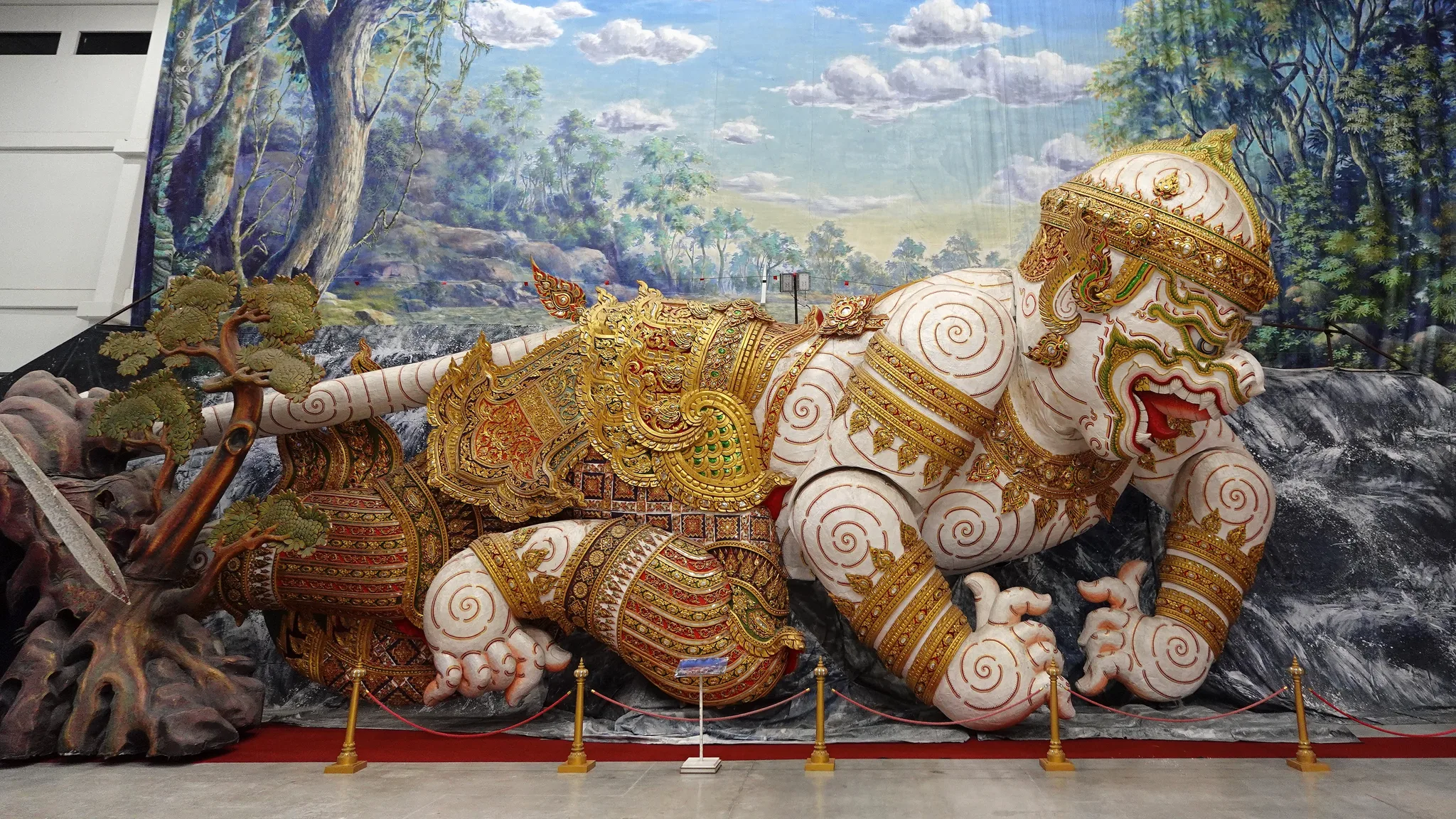
Among the sets preserved, one is particularly striking: Hanuman Swallowing the Pavilion (หนุมานอมพลับพลา). This set comes from the Maiyarap episode (‘ศึกไมยราพ’). It depicts the immense monkey holding a pavilion in his mouth. Its dimensions are such that visitors can walk inside this giant Hanuman.9
On display at Ko Kerd, this giant Hanuman is promoted by the Tourism Authority of Thailand.8
Phiphek’s royal junk
Another monumental set, the royal junk (เรือสำเภาหลวง), comes from the episode of Phiphek’s submission (‘พิเภกสวามิภักดิ์’). This great stage vessel shows the variety of royal khon sets. These may depict creatures as well as boats or buildings, according to what each episode demands.9
The stage objects and stage chariots show the same concern for scale. Seen together, these sets make clear that each SUPPORT Foundation production involves a genuine undertaking by craftspeople. The building keeps a record of it once the performances are over.
Passing on a craft
The crafts behind the stage
The Khon Learning Center does not merely display finished objects. It seeks to convey how they are made. The visit explains the making of costumes and masks and the design of the sets. It presents these skills as a heritage handed down from generation to generation.8
Khon is presented here as a complete art. Choreography, music, costumes and masks are explained together, with demonstrations and interactive displays. Visitors can thus connect a mask to the character who wears it, then to the codified gestures of the dance and to the music that sets the rhythm of its movements. This approach matches the definition of khon recognised by UNESCO: an art in which literature, dance, music, ritual and craftsmanship are inseparable.3
As much a school as a museum
The building has several missions: to preserve and pass on the art of khon, to conserve the sets and props from the SUPPORT Foundation’s performances, and to welcome the public so that they may discover this heritage. Across several levels it brings together archives and knowledge. It also functions as a working school, where new generations train in this art.1
This dual function sets the place apart from a conventional museum. The objects on display remain bound to a practice that continues.
Ko Kerd, a place open to the public
A cultural hub on Bangkok’s doorstep
The Khon Learning Center is open to the public. The Tourism Authority of Thailand has included it in a cultural programme entitled ‘KOH KERD’. This programme links the building and the Arts of the Kingdom museum in a single itinerary. In 2026, the Authority is running a free shuttle from Bangkok until 26 December. The programme pays tribute to the Queen Mother on the occasion of her birthday, 12 August.3
Free-admission campaigns accompany this effort, notably in November 2025 and then until 29 November 2026.9
Preserving the traces of a living art
The building is in a particular position: it preserves the material traces of an art that, by its very nature, exists fully only on stage. A mask on display is separated from the dancer who wears it, from the music and from the story. The visit seeks to make up for this separation. Videos, demonstrations and guided tours restore to khon the part that objects alone cannot show.
A foundation under royal patronage revived an art then in decline, both its crafts and its performances. Today it displays the results. The Khon Learning Center shows that the revival of khon was a comprehensive project, one that brought together craftspeople, performers and the public alike.
Understanding
The Khon Learning Center is neither simply a museum nor simply a school. It is the place where the SUPPORT Foundation gathers the fruits of a revival set in motion by Queen Sirikit: masks made of many layers, finely chased headdresses, costumes remade in the old style and monumental sets. Alongside them, it explains the crafts that produce them and the gestures that bring them to life. Its importance lies in this link between craftsmanship and the stage, and between conservation and practice. Now part of a cultural itinerary accessible from Bangkok and supported by free-admission campaigns, the place is open to the public. Khon, recognised by UNESCO, can also be seen here away from the stage, in the form of objects and explanations. The question remains what will become of a court art revived by royal will: a heritage that one visits, or an art that new generations will continue to bring to life and transform on stage?
Court arts, high-end craftsmanship and architecture under many influences: eight hours at the heart of Ayutthaya's artistic heritage.
- Khon
- Masked dance drama of the Thai court tradition, which stages the Ramakien.
- Royal project
- Development project launched on the initiative of the King or a member of the Thai royal family, often intended to improve the living conditions of rural populations.
- Ramakien
- Thai version of the Ramayana, the Indian epic of the hero Rama.
- Ayutthaya period
- Period of Siamese history, from the mid-fourteenth century to 1767, during which the kingdom had Ayutthaya as its capital.
- Intangible cultural heritage
- Practices, knowledge, expressions and skills passed down from generation to generation and recognised by communities as part of their cultural heritage.
- Ramayana
- Great Sanskrit epic of India recounting Prince Rama’s struggle against the king of the demons; it has inspired many versions in Southeast Asia, including the Thai Ramakien.
- Royal khon
- Name given to the large-scale khon performances staged under royal patronage, with costumes, sets and props made in the traditional style.
- Representative List of the Intangible Cultural Heritage of Humanity
- List maintained by UNESCO that records elements of intangible cultural heritage in order to ensure their visibility and raise awareness of their significance.
- Rajarot
- Stage chariot used in khon, built and decorated to represent the vehicle of the divine, royal or demonic characters of the epic.
Studies
- 1Inside All About Khon: Ayutthaya's Hidden Royal Mask Sanctuary, The Nation Thailand, 2026 ↗
- 2“อาคารเรียน-รู้-เรื่องโขน” แหล่งท่องเที่ยว-เรียนรู้เรื่องโขนชั้นดี เปิดให้ชมฟรีตลอดเดือน พ.ย. 68, MGR Online (ผู้จัดการออนไลน์), 2025 ↗
- 3Free shuttle brings Bangkok visitors to Ayutthaya cultural showcase, The Nation Thailand, 2026 ↗
- 4Yang Wanli, All about Khon, China Daily, 2024 ↗
- 5มหัศจรรย์งานศิลป์แห่งแผ่นดิน ผลงานชิ้นเอกจากช่างฝีมือ มูลนิธิส่งเสริมศิลปาชีพ … “โขน” ที่ศูนย์ศิลปาชีพเกาะเกิด จ.อยุธยา, JS100 (via LINE Today), 2025 ↗
- 6เฉลิมชัย ยอดมาลัย, อาคาร เรียน-รู้-เรื่องโขน ศูนย์ศิลปาชีพเกาะเกิด อำเภอบางปะอิน พระนครศรีอยุธยา, Naew Na (แนวหน้า), 2019 ↗
Reference works
- 7Khon Learning Centre, Thailex – Travel Encyclopedia ↗
- 8Experience a Giant Hanuman You Can Step Inside — A Fascinating Khon Experience Just Outside Bangkok, Tourism Authority of Thailand, 2026 ↗
- 9ศูนย์ศิลปาชีพเกาะเกิด เปิดให้เข้าชมอาคารเรียน-รู้-เรื่องโขน โดยไม่มีค่าใช้จ่าย ๑–๓๐ พฤศจิกายน ๒๕๖๘, Radio792, 2025 ↗
- 10Khon Performance by SUPPORT Foundation in Response to the Royal Aspirations of the Queen Mother, THAILAND.GO.TH (gouvernement thaïlandais), 2025 ↗
- 11ร้อยเรียงเรื่องโขน ณ เกาะเกิด, TrueID Travel, 2021 ↗
- 12Bang Sai Royal Folk Arts and Crafts Center, Province de Phra Nakhon Si Ayutthaya (Go Ayutthaya) ↗
- 13Inside the “Khon” activity room, Queen Sirikit Museum of Textiles / Google Arts & Culture ↗
- 14All About Khon, Phranakhon Si Ayutthaya, LoveThailand.org, 2025 ↗
Contemporary views
Khon Learning Center today
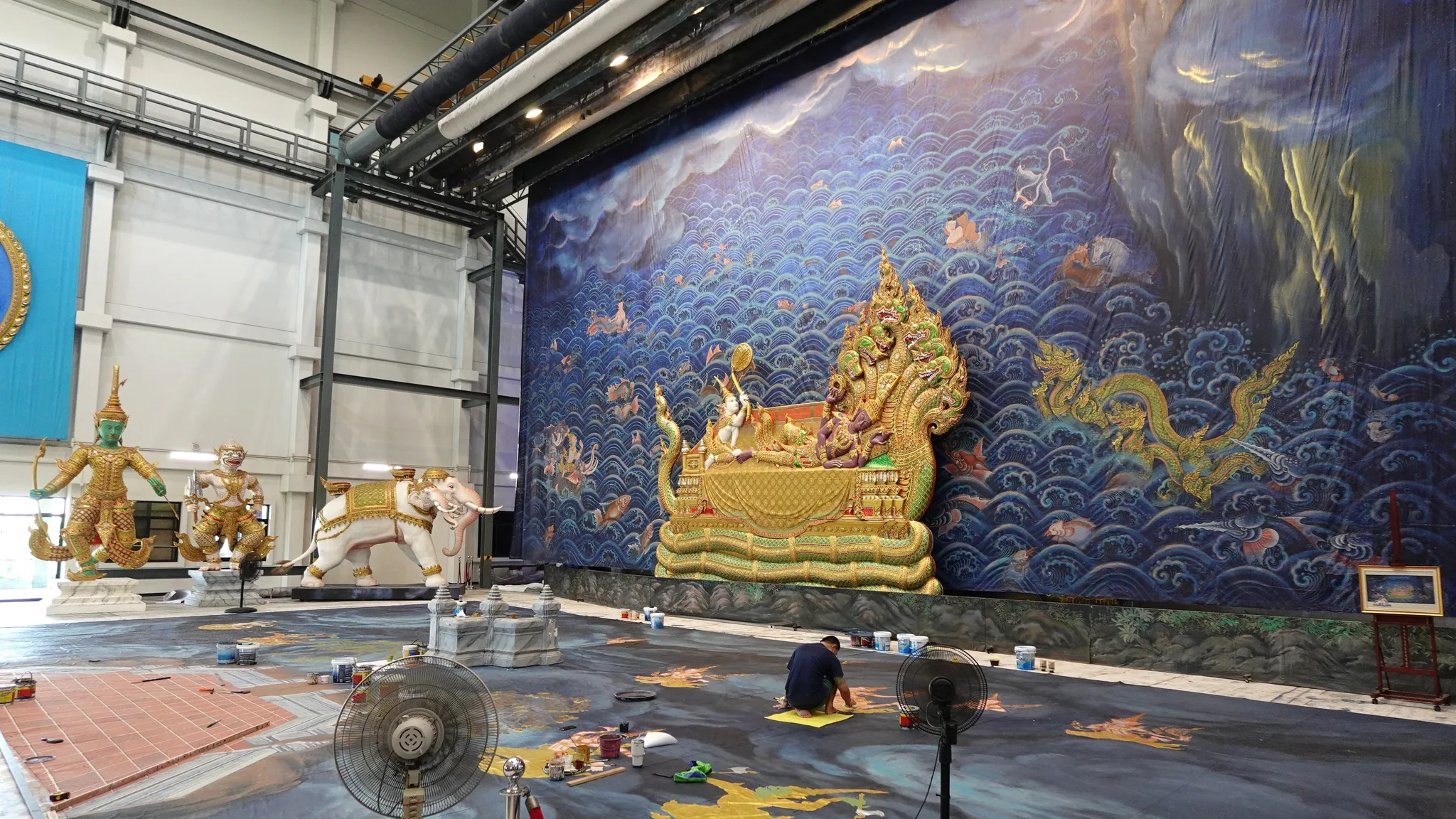
Dans un atelier du Centre d’apprentissage du khon, un peintre réalise au sol une toile de décor parmi les pots de peinture. Au fond, une toile d’océan porte une figure couchée sur un naga doré ; à gauche, des statues et un éléphant blanc.© Eric Monteil 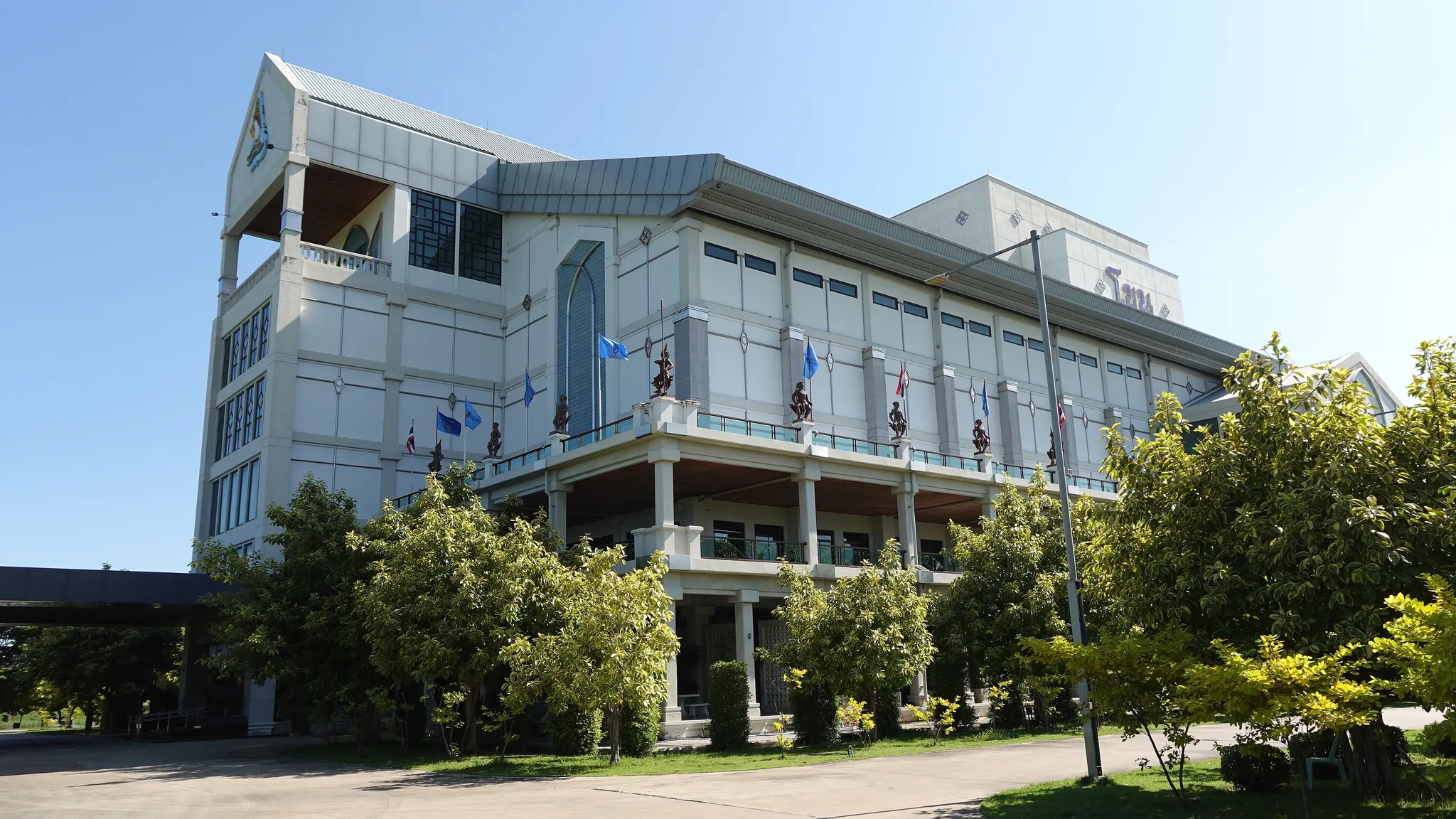
Le bâtiment du Centre d’apprentissage du khon, vu en contre-plongée : façade claire à pignon, grande terrasse à colonnes bordée de statues sombres et de drapeaux, arbres et pelouses au premier plan.© Eric Monteil
Architecture and decoration
Explore the heritage
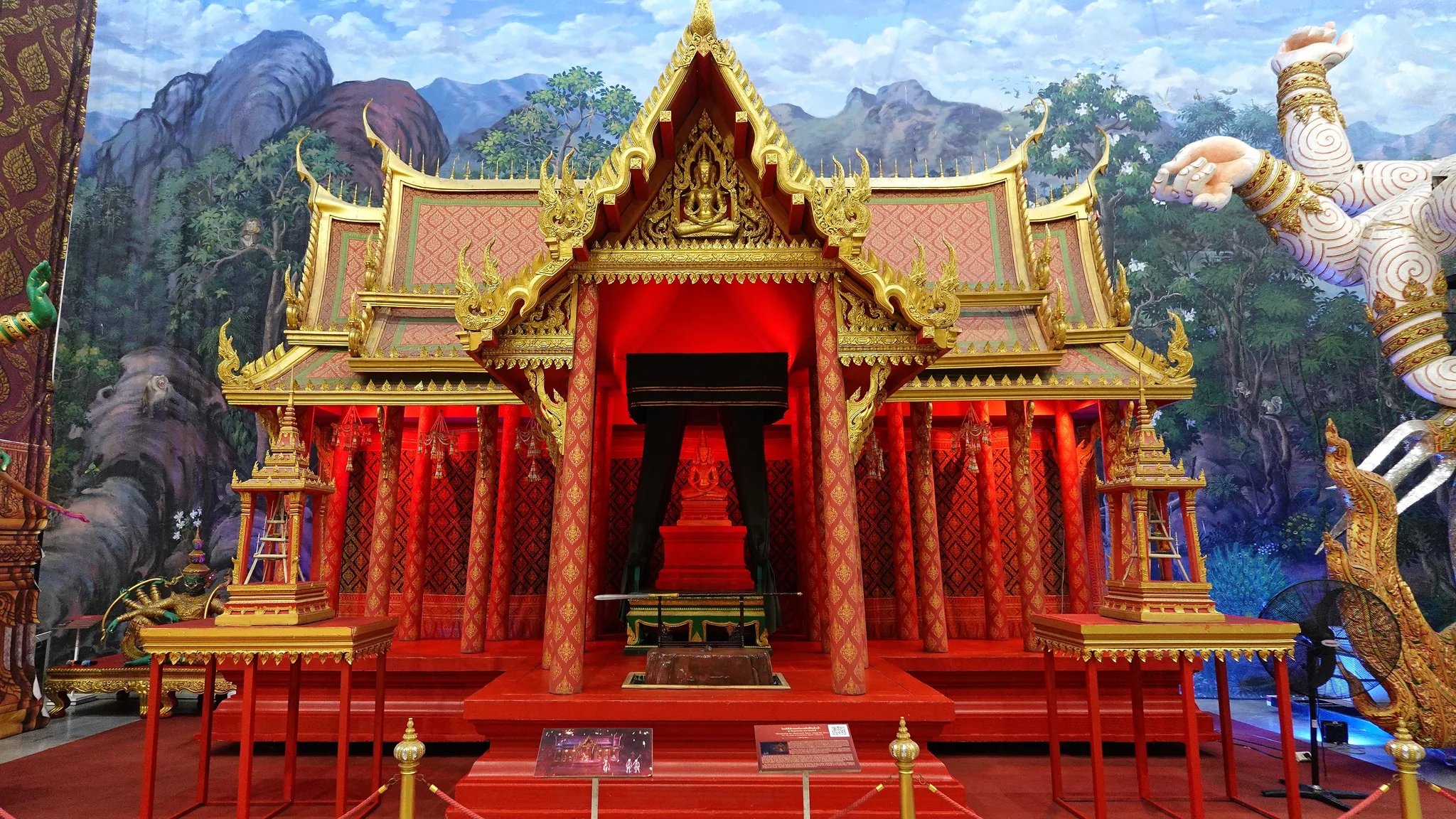
Au Centre d’apprentissage du khon, un pavillon de scène aux colonnes rouges et aux pignons dorés ornés d’une figure assise abrite un trône surmonté d’une statuette, devant une toile peinte de montagnes et de forêt.© Eric Monteil 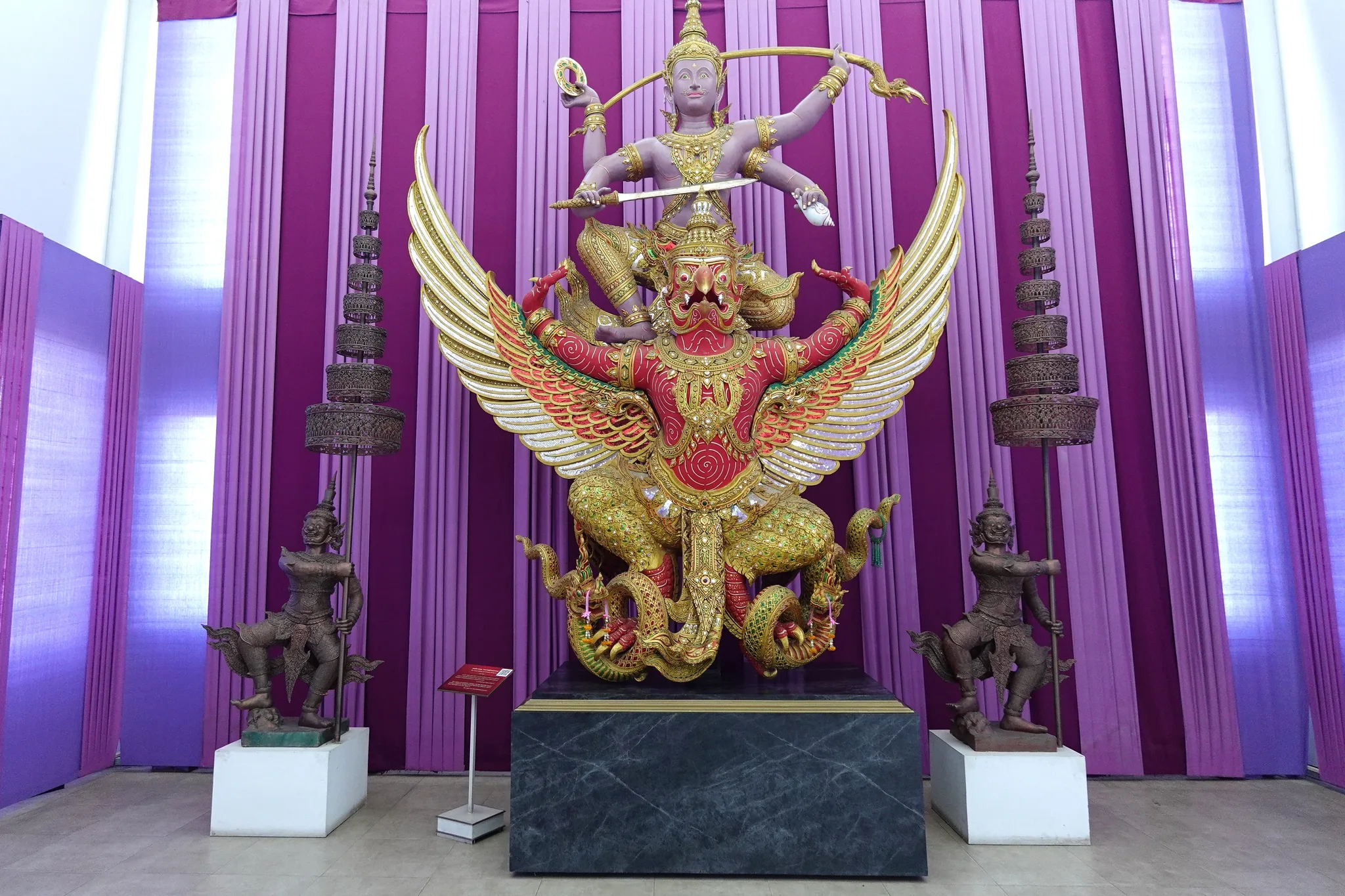
Au Centre d’apprentissage du khon, une divinité à quatre bras chevauche un Garuda rouge et or enserrant des nagas, sur un socle de marbre sombre ; deux gardiens tenant des parasols à étages l’encadrent devant des tentures violettes.© Eric Monteil