
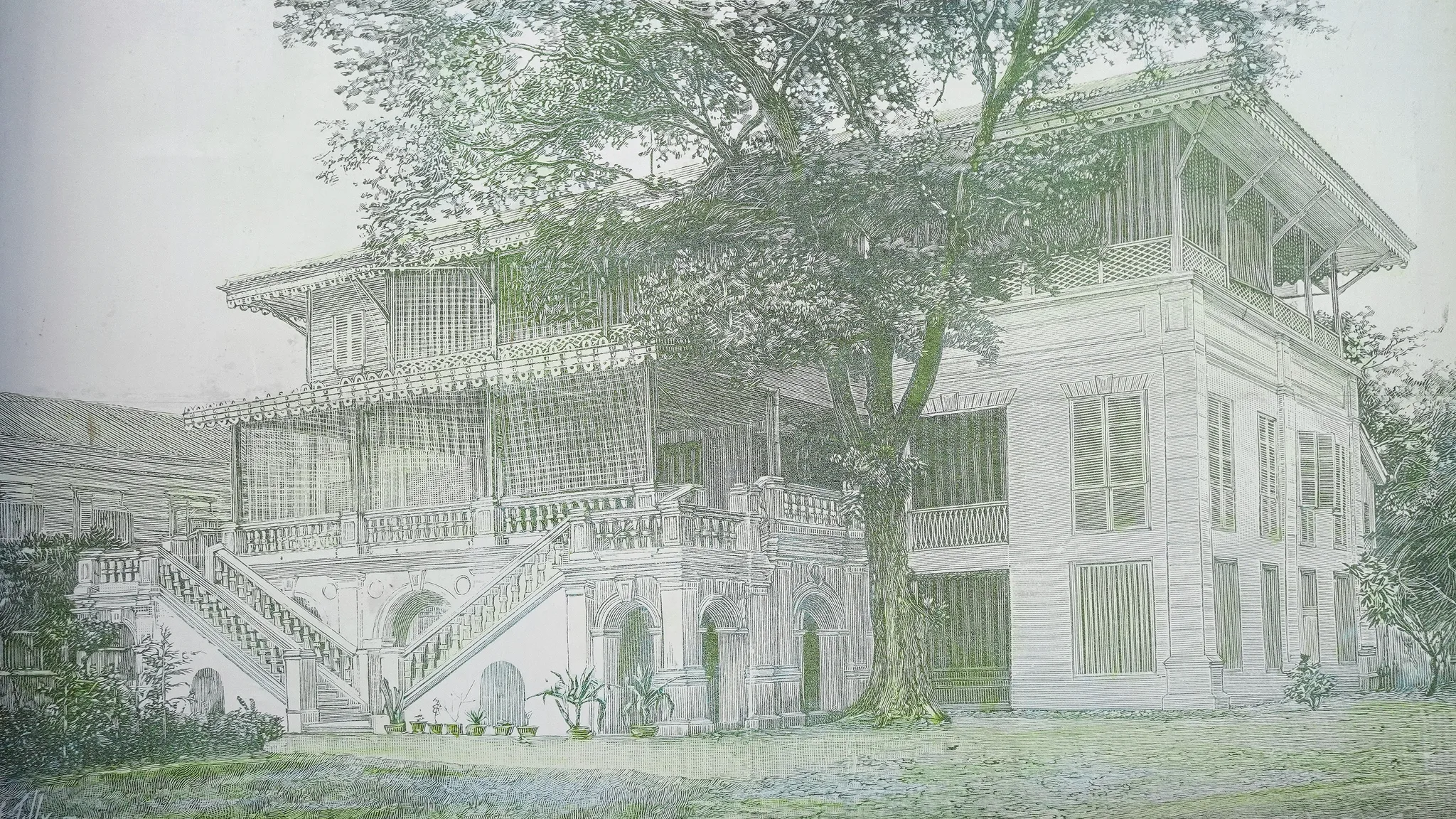
 Engraved depiction of a building of the Embassy of France: verandas with balustrades and fretwork valances, an arcaded ground floor, a double flight of stairs and louvred shutters, in front of a large tree.© Eric Monteil
Civic & institutional building
Embassy of France
On the banks of the Chao Phraya, in Bang Rak, a former customs house that became a consulate, then a legation and finally an embassy tells the story of more than a century and a half of relations between France and Siam.
Heritage family · Architecture and built heritage
- Destination
- Bangkok (Bang Rak)
- Heritage Family
- Architecture and built heritage
- Typology
- Civic & institutional building
- Visit
- Available tours →
The Embassy of France is France’s principal diplomatic mission in Thailand and one of the oldest in the country. Located in Bangkok, in the Bang Rak district, on the banks of the Chao Phraya, it occupies land placed at the disposal of the French by the King of Siam in the aftermath of the 1856 treaty, and then given to France in 1875. A former customs house, its historic building has served as a consulate, a legation and then an embassy, and has withstood several plans to move elsewhere. Today this teak mansion facing the river, the Résidence de France, stands alongside a modern office building.12
Key facts
- Destination
- Bangkok
- Heritage Family
- Architecture and built heritage
- Typology
- Civic & institutional building
- Places
- Chao Phraya River
- Bang Rak
- Periods
- People
- Charles de Montigny
- Rama IV (Mongkut)
- Rama V
- Communities
- —
- Events
- Franco-Siamese crisis of 1893 (Paknam incident)
- Don du terrain de la mission française par Rama V (1875)
- Franco-Siamese Treaty of 1856
- Travaux de la Résidence de France (1901)
- Heritage
- —
- Glossary
- Soi
- Rong phasi
- Sathan ekakkharatchathut
- Thamniap
- Keywords
- —
- Date
- —
- Collections
- —
Practical info
Practical information about this site is taken from its Google Maps page. We advise you to check it before visiting.
- Address
- 35 Soi Rong Phasi, Khwaeng Bang Rak, Khet Bang Rak, Krung Thep Maha Nakhon 10500
- Phone
- Website
A mission on the banks of the Chao Phraya
Two buildings on a plot in Bang Rak
The Embassy of France occupies a plot on the east bank of the Chao Phraya, the great river that flows through Bangkok. It lies in the district of Bang Rak, near Charoen Krung Road. The site, a little over half a hectare in area, brings together two very different buildings. The first is the old house, the ambassador’s official residence, known as the Résidence de France. The second is a modern administrative building, constructed right next to it and opened in 2015, which houses all the embassy’s departments.12
This juxtaposition sums up the history of the place. The old house existed before the French arrived. It has served in turn as a customs house, a trading house or warehouse, a consulate, a legation and then an embassy. Today it is devoted to receptions and official meetings. The modern building, for its part, was constructed on this historic site, which the mission never left despite the plans to move that were discussed in the twentieth century.12
Names that preserve the memory of the place
Street names retain traces of these successive functions. The lane serving the embassy is called Soi Rong Phasi, or Rong Phasi Kao. In Thai, rong phasi denotes a tax office, and kao means ‘old’. The name reflects the site’s original purpose: a collection post, at a time when trade and travel went by river. The street leading to the embassy, Soi Charoen Krung 36, also bears a French name, the rue de Brest, which is found even in its Thai designation.7
The Thai language also draws a clear distinction between the two functions of the site. It calls the embassy sathan ekakkharatchathut farangset, that is, the seat of the diplomatic mission. The historic house is called thamniap ekakkharatchathut farangset, that is, the ambassador’s residence. This distinction matches the one that exists on the ground between the offices and the representational residence.9
From customs house to consulate
A building older than the mission
Before it became a French site, the place was part of the administration of Siam, the former name of Thailand. The French did not build it: they moved into brick and timber customs buildings, generally dated to the 1840s–1850s. The complex comprised a large rectangular main building of five rooms, bordered by a gallery, and an annexe ten rooms long.13
Their location is explained by this function. In the mid-nineteenth century, this stretch of the bank could be reached only by river. The French mission inherited this layout, still reflected in the orientation of the house, which faces the river.7
The 1856 treaty and the French settlement
The French presence stems from the Treaty of Friendship, Commerce and Navigation signed on 15 August 1856 between France and Siam. Charles de Montigny, plenipotentiary of Emperor Napoleon III, signed it with Siamese representatives, and the treaty was ratified the following year. The text allowed French subjects to reside and to own land around Bangkok. It also granted French warships free access to the Siamese capital.17
Within this framework, King Mongkut, who reigned as Rama IV, granted the French in 1857 the use of the customs site to establish a consulate there. The Comte de Castelnau became French consul in Siam. The French mission thus settled in a building constructed for another purpose. It did not own it: it enjoyed its use by the will of the sovereign.12
A road opened on the landward side
In the early years, the consulate could be reached only by the Chao Phraya. In 1862, following a petition from the consuls, Charoen Krung Road was built, the country’s first modern road. It ran alongside the district and gave the mission access by land.18
Yet the new road did not change the logic of the site. The house continued to face the river and to turn its back on the land route. Even today, this orientation recalls the time when water was the city’s main thoroughfare.7
The legation years
The gift of 1875 and the transformation of the house
In 1875 King Chulalongkorn, who succeeded Mongkut as Rama V, gave the land and the building to France. The status of the site changed: the right of use granted in 1857 became ownership.14
Over the next two decades, the warehouse-house was extensively remodelled. It gained an outer veranda, a teak dining room and a porch. In 1892 the consulate became a legation.1
1893: the crisis seen from the river
The following year, the mission found itself at the heart of a crisis. During the Franco-Siamese crisis of 1893, also known as the Paknam incident, French ships sailed up the Chao Phraya and dropped anchor in front of the French mission. The free access of French warships to Bangkok, provided for by the 1856 treaty, then took on a very concrete meaning.12
The house preserves the memory of this episode. An 1893 engraving entitled ‘Le Conflit avec le Siam’ shows the ship Le Lutin moored in front of the residence; it now hangs on the first floor. The Résidence de France thus bears witness to relations between France and Siam in their periods of friendship as well as in their moments of tension.3
The works of 1901
At the beginning of the twentieth century, a new campaign of works transformed the site once again. In 1901 a teak building, a dining room and a veranda were constructed, together with a quay and a landing stage on the river. Chancery buildings, that is, the mission’s offices, were added to the complex. The landing stage confirms that the place remained oriented towards the Chao Phraya.13
These works explain why the age of the house varies depending on what is being dated. The original buildings go back to the mid-nineteenth century, but the structure seen today dates largely from 1901. Through successive building campaigns, the customs house was thus transformed into a kind of ‘little palace’.3
Staying by the river
Plans to move
In the first decades of the twentieth century, the mission’s continued presence on this site was called into question. In 1922 the British legation moved to Phloen Chit, and France in turn considered leaving. There was talk of selling the land and relocating towards Sathorn, Witthayu or Phloen Chit, where France owned a large plot. Even the demolition of the building was mooted.14
Several heads of mission nevertheless defended the historic site, among them the writer Paul Morand, who headed the French mission in Bangkok. In 1930 Charles Arsène-Henry, then head of the legation, consulted the French community on the relocation plan. It rejected it unanimously.14
Abandonment, reopening and embassy status
In 1945 all French staff were recalled, and the legation stood abandoned for two to three years. When it reopened, the building was badly deteriorated: the walls were damaged and the veranda roof leaked.6
The mission then resumed its place. In 1949 the legation became an embassy. From 1957 the historic house was assigned as the ambassador’s residence.12
Renovation and a new building
The residence’s last major renovation took place between 2000 and 2002. A decade later, another building project altered the balance of the site. From 2012 an office building was constructed within the compound. It opened in 2015 and brings together all the embassy’s departments.12
Resolutely contemporary in appearance, this building contrasts with the teak mansion. Yet it adopts the same orientation, facing the river with its back to the road. The consolidation of all departments in Bang Rak went hand in hand with the sale of another embassy site, in Sathorn.12
Reading the Résidence de France
A house facing the river
To understand the site, one must first look at it from the Chao Phraya. The residence and the modern building both face the river and turn their backs on Charoen Krung Road. Between the house and the bank lies a tropical garden. A prominent flagpole there marks the diplomatic presence.7
This arrangement recalls that people once travelled mainly by water. It was confirmed by the mission, which added a quay and a landing stage in 1901. For visitors arriving today by the lane, the entrance is therefore at the rear of an ensemble designed to be seen from the water.13
A European mansion in teak
The residence is a colonial-style mansion on three levels. It rests on hardwood and brick foundations and is built partly of teak. These local materials do not obscure its European plan. The most visible feature of this is the grand staircase, set at the centre of the house, which leads to the first floor and around which the rooms are arranged.3
The reception rooms lie at the heart of this layout: a large drawing room and a large wooden dining room. The dining table seats a dozen guests and can be extended to accommodate many more. Verandas were added during the successive remodellings.3
Traces of a diplomatic history
Some parts of the site have disappeared, but they shed light on what the mission once was. French nationals who committed offences in Siam could not be detained by the Siamese authorities. The compound therefore included a detention area for them, set up in an annexe of the residence that no longer exists.3
Other traces are found in the house itself. In addition to the 1893 engraving, a menu card from 1913 lies on the dining table. Old photographs of the residence, dated 1866 and 1966, make it possible to compare its successive states, a century apart.3
A shared heritage
A house open every September
Although it is a diplomatic residence, the house is not closed to the public. Every year, in September, it opens its doors for the European Heritage Days. In 2016 this open day was in its thirty-third edition. In 2018 free half-hour guided tours were offered there in Thai, French and English.4
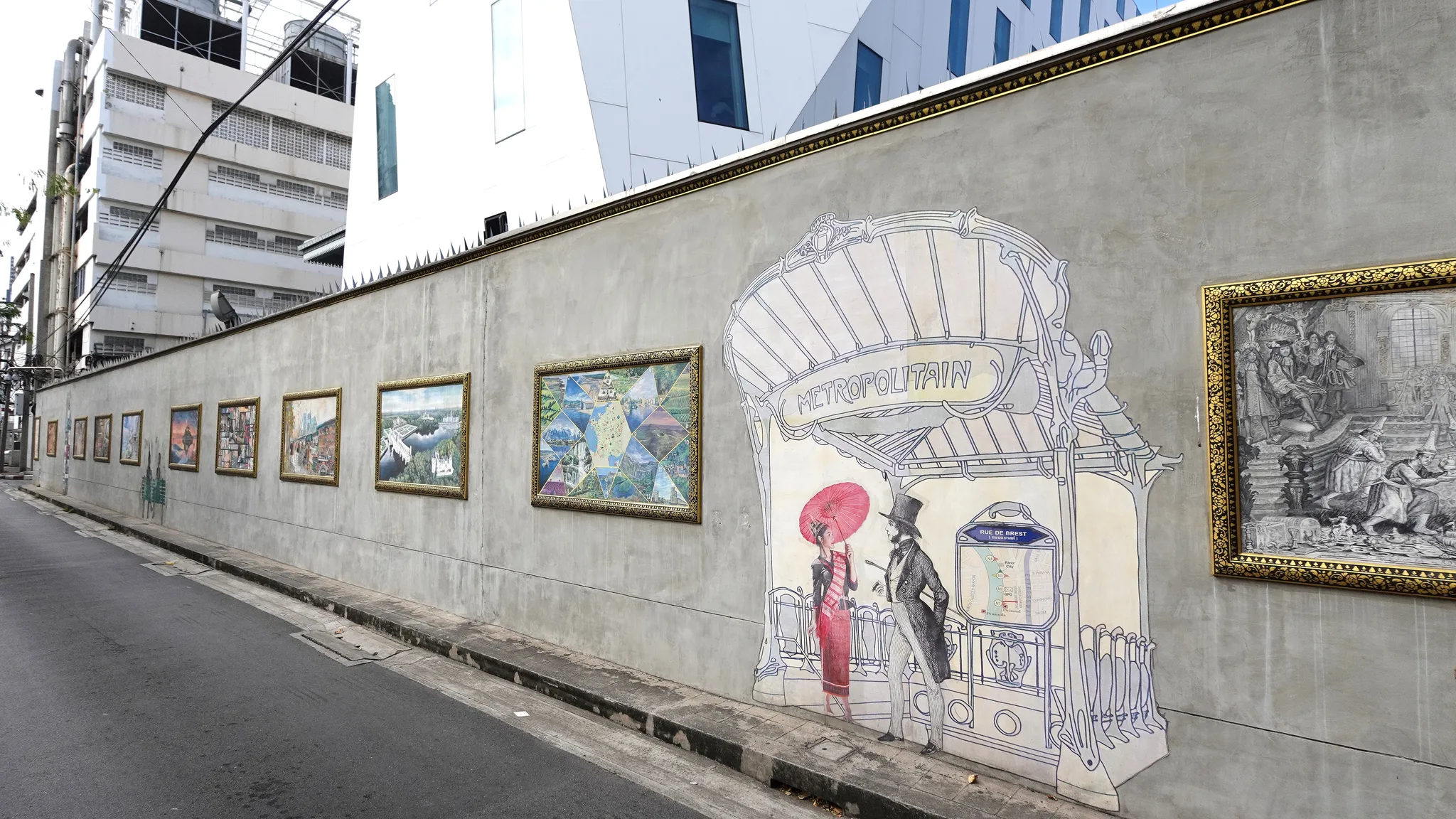
The link with the city also runs through the boundary wall. At the decision of Thierry Mathou, then French Ambassador to Thailand, more than twenty original works devoted to Franco-Thai relations are displayed on the outer wall. Passers-by in the lane can thus discover the history the house tells without entering the compound.8
Receptions, meetings and recognition
The Résidence de France remains above all a place of diplomatic work. Receptions, meetings and negotiations are held there. Princess Sirindhorn, a member of the Thai royal family, has been received there for dinner. The house also hosts cultural events: it recently provided the setting for a jewellery exhibition, ‘Baan Boucheron’.1
Its heritage value is widely recognised. It is counted among the most historically important ambassadorial residences in Bangkok. The Association of Siamese Architects has awarded it its Architectural Conservation Award. This distinction honours the condition of a house that has known the customs office, the royal gift of 1875, the crisis of 1893 and the debates over a departure, and which still serves diplomatic life.19
Understanding
What makes the Embassy of France unique is the continuity of a place. Since the mid-nineteenth century, France has occupied this site in Bang Rak, first granted and then given by the kings of Siam, despite two to three years of abandonment after 1945. The house has changed in function, rank and appearance, but it still looks out over the Chao Phraya. It preserves the memory of a diplomatic friendship, but also of the 1893 crisis and of a time when French nationals could not be detained by the Siamese authorities. Today the embassy’s departments work in a modern building. The teak mansion is devoted to receptions, official meetings, exhibitions and the annual public open day. It is recognised for the quality of its conservation, yet it still depends on a diplomatic function that keeps it alive. Its future therefore raises a question: can a house bound up with the history of Franco-Siamese relations, including their moments of tension, become for the people of Bangkok a heritage that belongs to them too?
Through Bangkok's creative districts, between street art, architecture, design and new uses of the city.
- Soi
- Thai word for a lane or side street branching off a main road; soi are often numbered after the main street from which they branch.
- Rong phasi
- Thai term for a tax office, a post where duties on goods were collected.
- Sathan ekakkharatchathut
- Thai term for an embassy, that is, the place where a diplomatic mission is based.
- Thamniap
- Thai term reserved for official residences, distinct from the term for an institution’s offices.
Studies
- 1La rédaction de Bangkok, JOURNÉES DU PATRIMOINE - L'ambassade de France entre histoire et modernité se découvre dimanche, Le Petit Journal Bangkok, 2014 ↗
- 2Venez donc passer le dimanche chez l'ambassadeur de France à Bangkok !, Le Petit Journal, 2017 ↗
- 3Historic French Ambassador's Residence Opens to Public Sunday, Khaosod English, 2018 ↗
- 4Invade French Ambassador Gilles Garachon's Home Sunday, Khaosod English, 2016 ↗
- 5Historical French embassy in Bangkok opened to the public, Thai Examiner, 2018 ↗
- 6ทำเนียบทูตฝรั่งเศส บ้านเก่าริมน้ำอายุ 150 ปีที่สร้างตั้งแต่สมัยรัชกาลที่ 4, The Cloud (readthecloud.co) ↗
- 7พาชม "บ้านท่านเอกอัครราชทูตฝรั่งเศส" ประจำประเทศไทย, Sanook Campus ↗
- 8คุยกับทูต : ตีแยรี มาตู มิตรภาพดีๆ มีอยู่รอบรั้ว, Matichon Weekly ↗
- 9สถานทูตฝรั่งเศสเปิดบ้านให้เที่ยวชมวันอาทิตย์นี้, MGR Online, 2012 ↗
- 10Jean-François Klein, Alexis Thuaux, Sophie Trelcat, ทําเนียบเอกอัครราชทูตฝรั่งเศส ณ กรุงเทพมหานคร = La Résidence de France à Bangkok, Éditions internationales du Patrimoine (Paris), 2015
- 11Bring the bling — Boucheron transforms the Residence of France for Bangkok jewellery showcase, Bangkok Post ↗
Reference works
- 12Contributeurs Wikipédia, Embassy of France, Bangkok, Wikipedia (en) ↗
- 13Contributeurs Wikipédia, Ambassade de France en Thaïlande, Wikipédia (fr) ↗
- 14The Residence of France in 2022, Sawasdee France, 2022 ↗
- 15สถานเอกอัครราชทูตต่างประเทศ ในประเทศไทย, THAILAND.GO.TH ↗
- 16Ambassade de France en Thaïlande — SIREN 179 921 903, Annuaire des entreprises (data.gouv.fr) ↗
- 17Contributeurs Wikipédia, Franco-Siamese Treaty of 1856, Wikipedia (en) ↗
- 18Contributeurs Wikipédia, Bang Rak subdistrict, Wikipedia (en) ↗
- 19บ้านพักเอกอัครราชทูตฝรั่งเศส - French Embassy Residence, ASA Architectural Conservation Award (Association of Siamese Architects) ↗
Further reading
Contemporary views
Embassy of France today
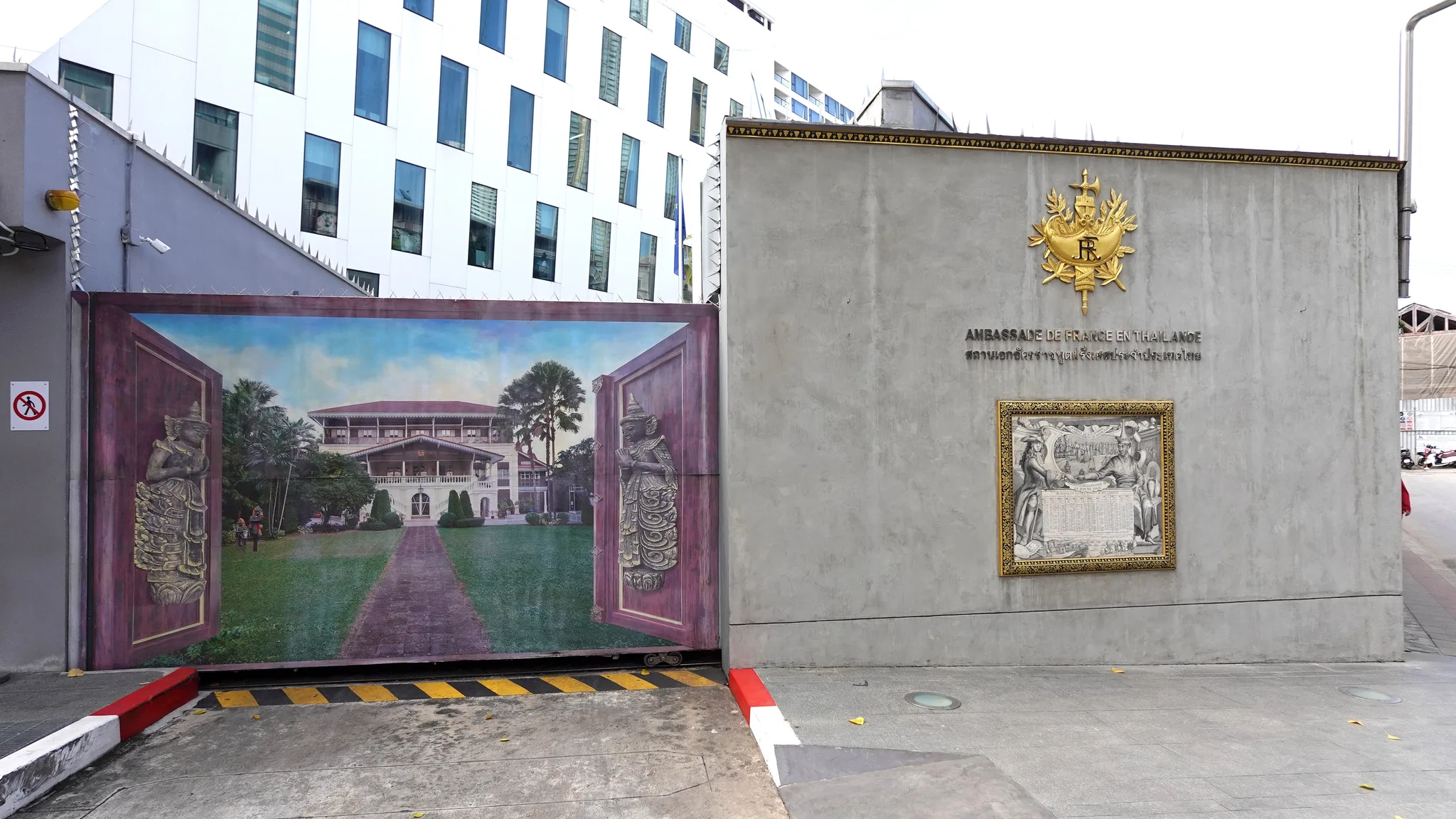
The gate of the Embassy of France is painted in trompe-l’œil: doors decorated with guardian figures open onto a galleried residence surrounded by lawns. The adjoining wall bears the gilded RF emblem, a bilingual inscription and a framed engraving.© Eric Monteil 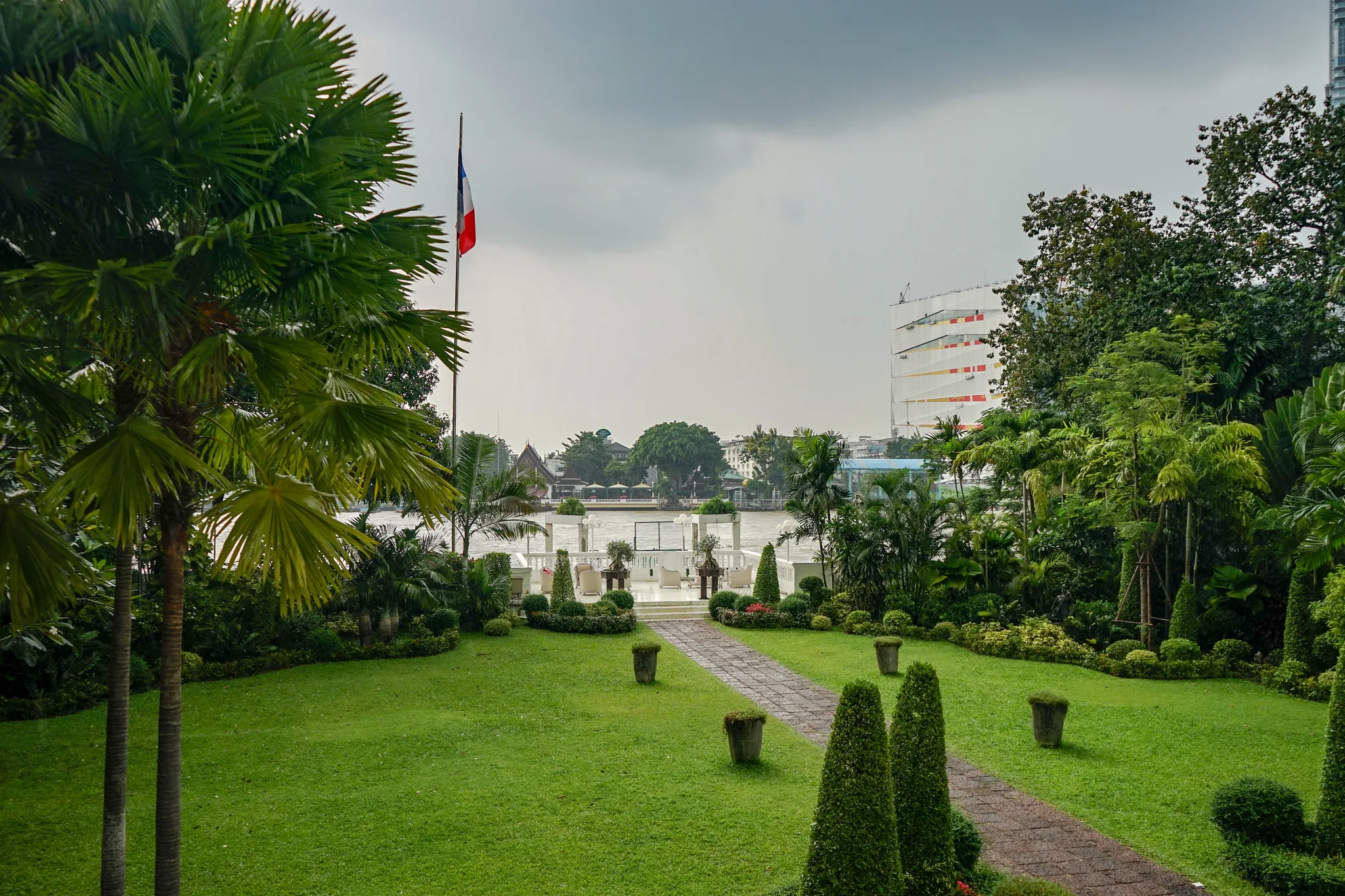
Embassy of France: a paved path crosses the lawn lined with palms, topiary and planters to a furnished white terrace overlooking the river; a flag flies on the left and buildings line the opposite bank.Nina R from Africa — Wikimedia Commons, CC BY 2.0
Architecture and decoration
Explore the heritage
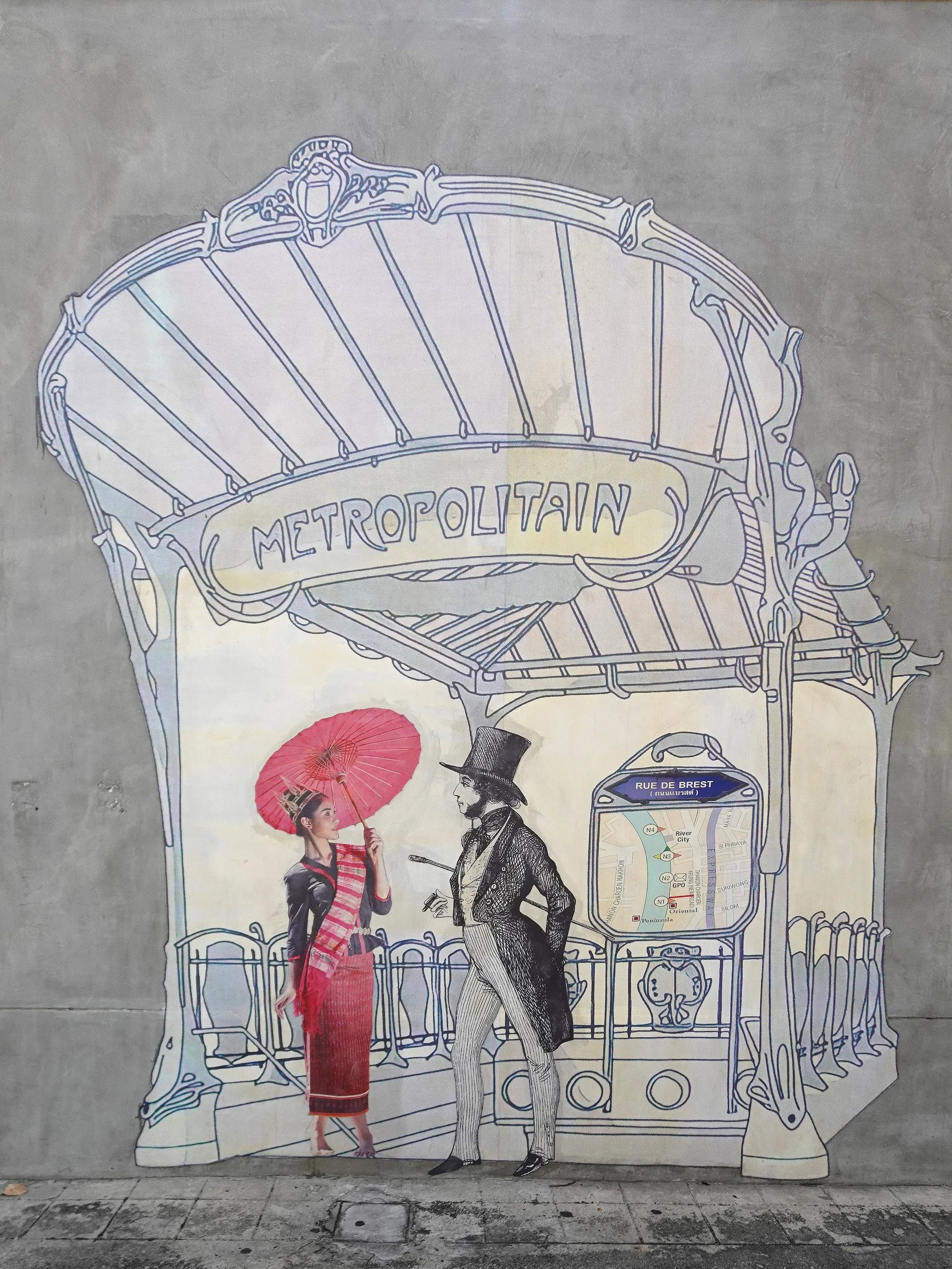
Near the Embassy of France, a mural depicts an Art Nouveau “Metropolitain” metro entrance, where a woman in Thai dress holding a red parasol meets a man in a top hat, beside a “Rue de Brest” map.© Eric Monteil 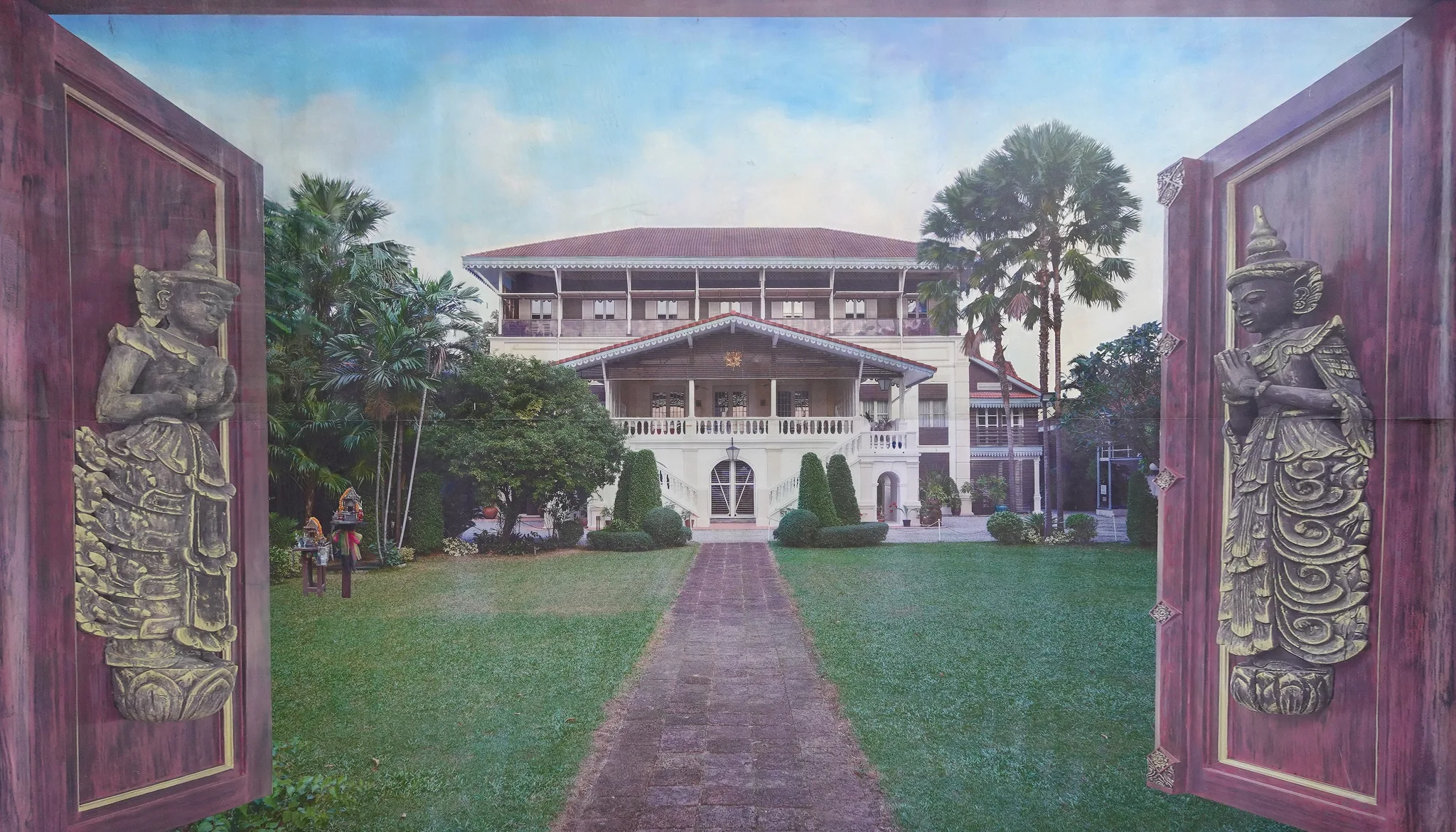
Trompe-l’œil mural: two red door leaves adorned with Thai deities in prayer open onto the Embassy of France, a white building with galleries and verandas, fronted by a lawn, a paved pathway and palm trees.© Eric Monteil
Archive
Memory of time passing
Historical images preserve the visual memory of places and of the ways they have changed.
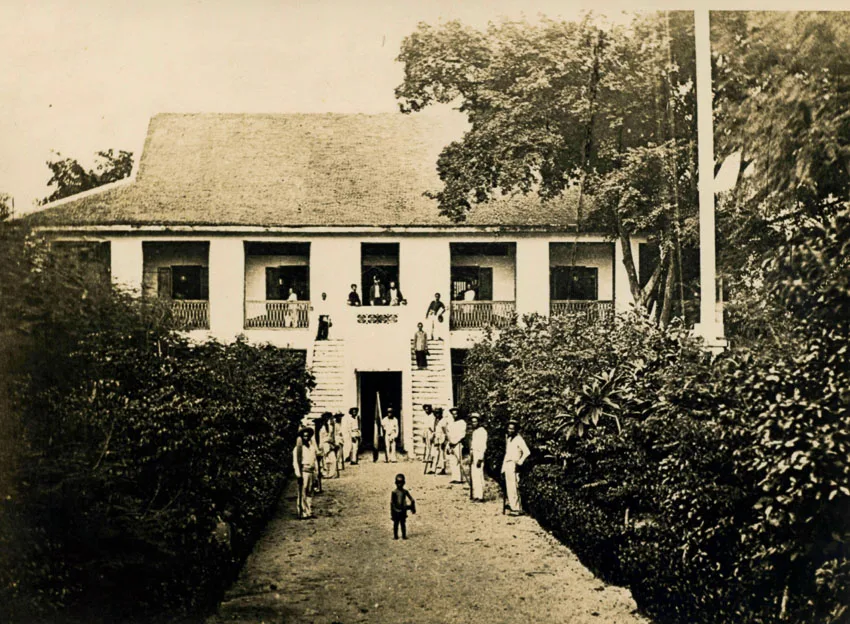
Embassy of France: two-storey building beneath a tall hipped roof, with a balustraded gallery and central twin staircase; men pose along the shrub-lined path, near a flagpole.Auteur inconnu — Wikimedia Commons, domaine public 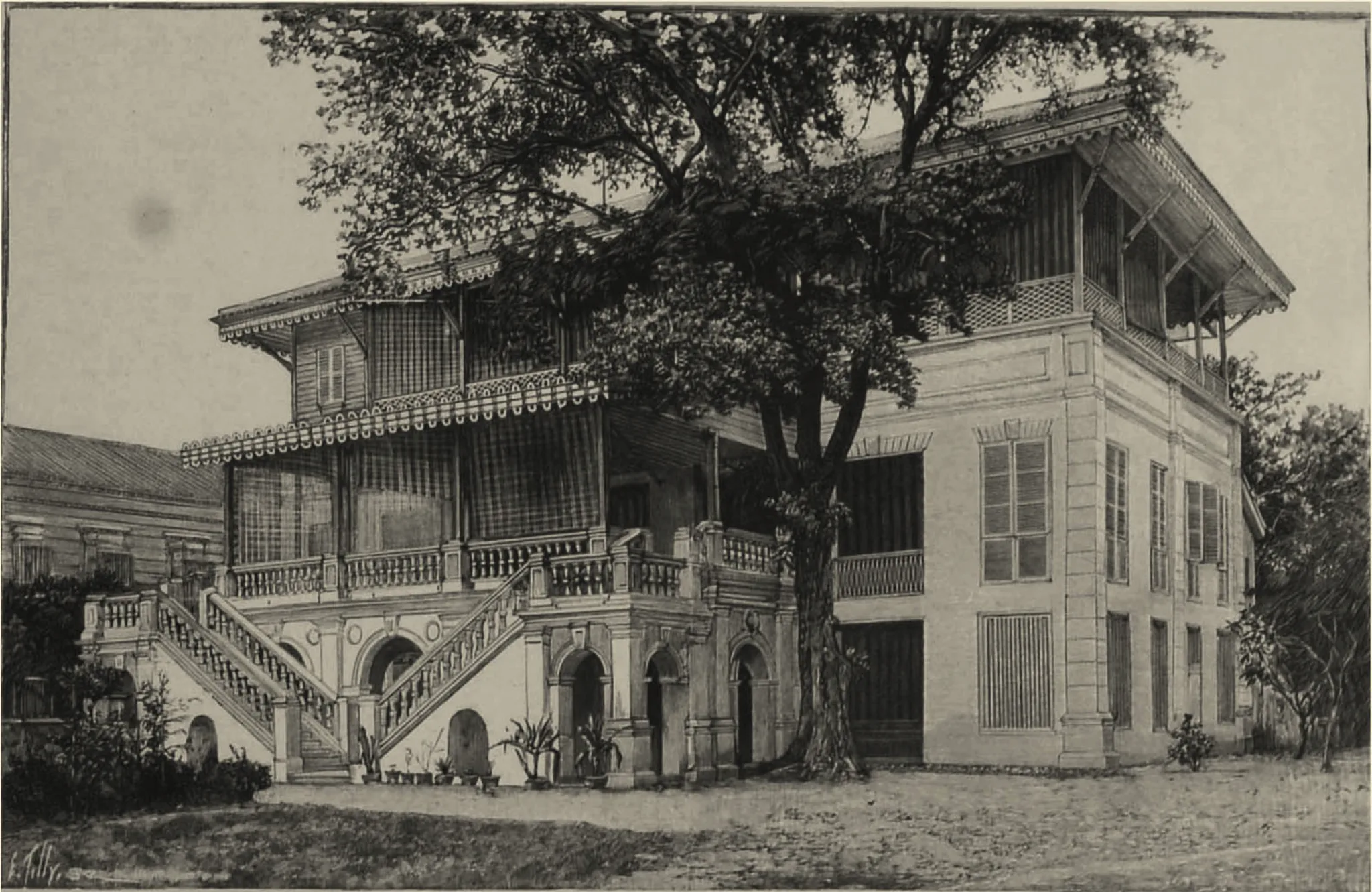
Engraving of the Embassy of France showing a two-storey building on an arcaded base, reached by a double balustraded staircase, with blind-screened verandas, eaves with fretwork valances and louvred windows, set in a wooded garden.E. Tilly; based on photograph by Lucien Fournereau — Wikimedia Commons, domaine public