
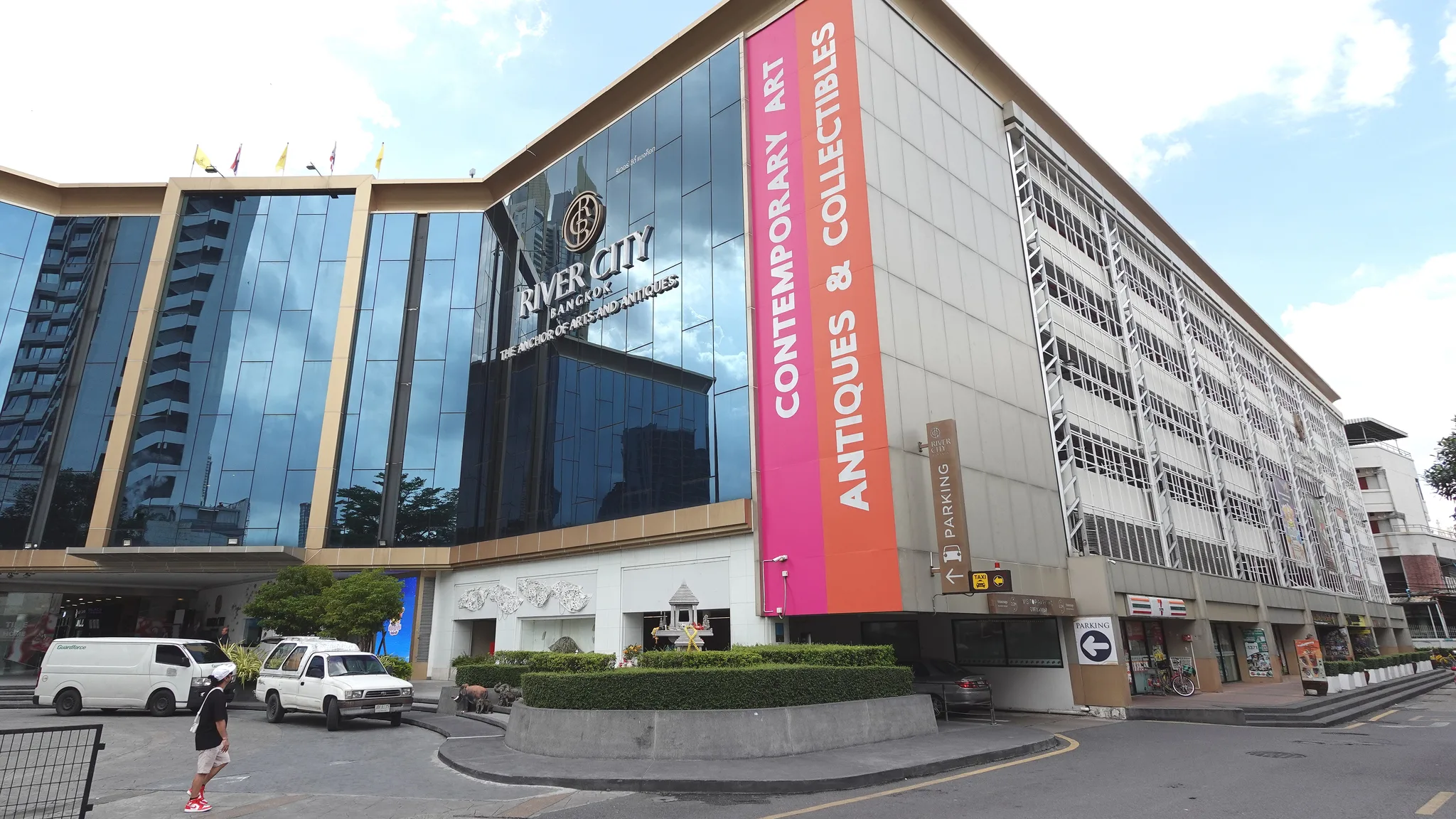
 The façade of River City Bangkok combines a glass curtain wall bearing the sign ‘The Anchor of Arts and Antiques’, a banner advertising contemporary art, antiques and collectibles, and a multi-storey car park.© Eric Monteil
- Destination
- Bangkok (Samphanthawong)
- Heritage Family
- Arts, aesthetics and creation
- Typology
- Cultural & creative centre
- Visit
- Available tours →
River City Bangkok is a private centre devoted to art and antiques, situated on the east bank of the Chao Phraya River, in the Talat Noi quarter of Bangkok. Opened in 1984 as an antiques shopping centre on the initiative of Adisorn Charanachitta, chief executive of the Italthai Group, it has for forty years accompanied the trade in old objects and the artistic life of the city. First an antiques market, then a venue for exhibitions and auctions, it now presents itself as an arts and culture centre. Galleries, an exhibition hall, an auction house, shops and riverside terraces together form a single complex.6
Key facts
- Destination
- Samphanthawong
- Heritage Family
- Arts, aesthetics and creation
- Typology
- Cultural & creative centre
- Places
- Chao Phraya River
- Periods
- —
- People
- Adisorn Charanachitta
- Communities
- —
- Events
- Opening of River City (1984)
- Renovation (2015-2016)
- Heritage
- —
- Glossary
- —
- Keywords
- —
- Date
- —
- Collections
- —
Practical info
Practical information about this site is taken from its Google Maps page. We advise you to check it before visiting.
- Address
- 23 Soi Charoen Krung 24, Khwaeng Talat Noi, Khet Samphanthawong, Krung Thep Maha Nakhon 10100
- Phone
- Website
An antiques market by the river
On the Talat Noi bank
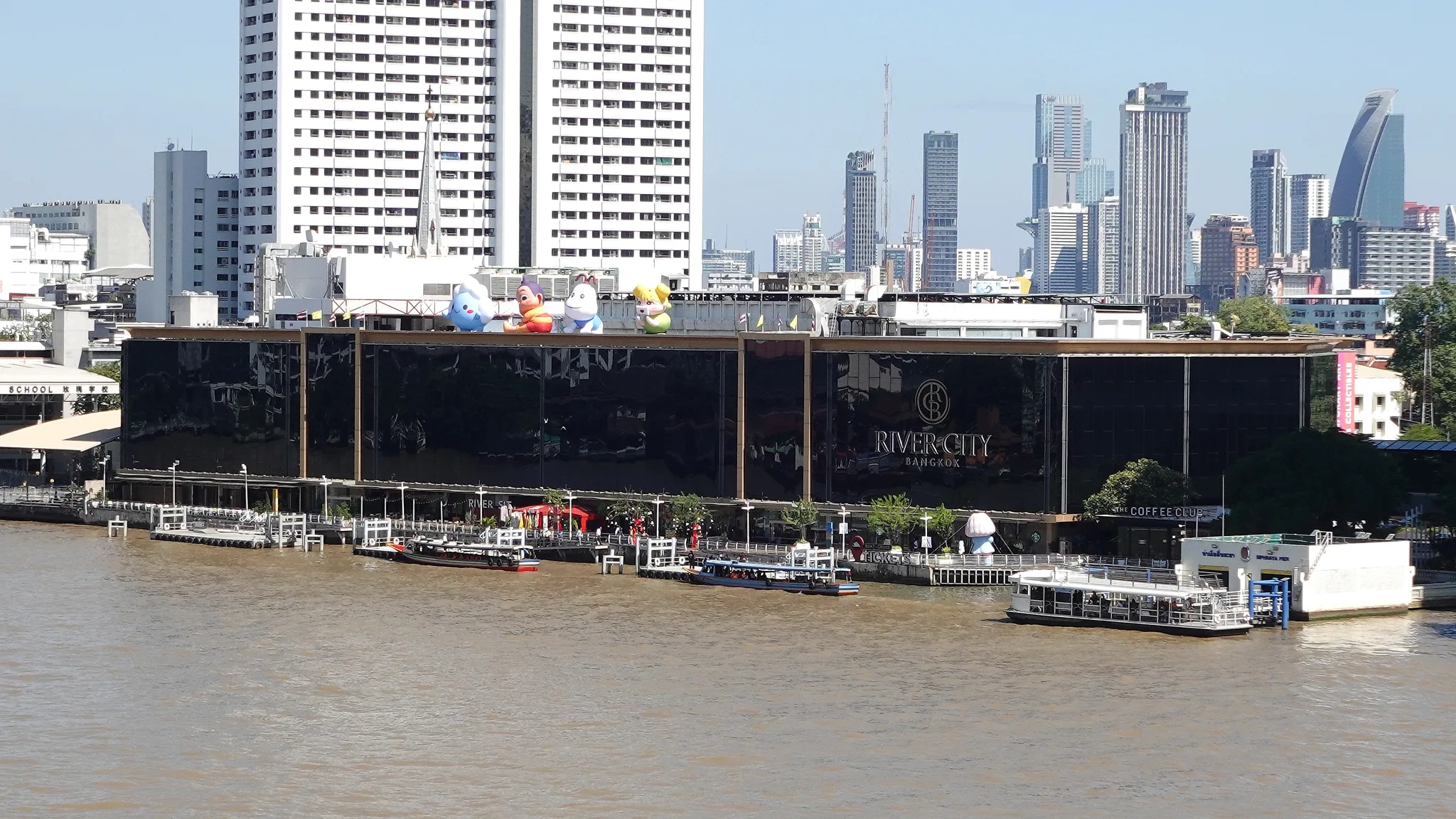
River City Bangkok stands on the east bank of the Chao Phraya, on the Phra Nakhon side, in the sub-district of Talat Noi, in the south of Samphanthawong district. This quarter is an old area of Chinese settlement in the capital. The centre lies close to Si Phraya pier and to several large hotels on the same bank.9
This position shapes the way one arrives. The centre can be reached by car, but also by boat, travelling up or down the Chao Phraya to the nearby pier. Its restaurants and cafés open onto terraces beside the river.6
An idea born in the markets of Paris
The project is attributed to the Italthai Group and the Mandarin Oriental Hotel Group; it bears the stamp of Adisorn Charanachitta, chairman and chief executive of the Italthai Group, who is presented as the founder of the venue. In the operator’s account of its origins, it was during travels in Europe in the 1980s that he became interested in the antiques markets of Paris and conceived the idea of an antiques centre on the banks of the Chao Phraya.6
This journey left material traces. The letters, personal belongings and notebooks in which Adisorn Charanachitta prepared the project were preserved, and later shown to the public for the centre’s fortieth anniversary. The venue opened on 1 December 1984 under the name River City; today it is known as River City Bangkok, often shortened to RCB.6
A shopping centre for art and antiques
The work of an architect who became governor
The design of the building is attributed to Krisda Arunvongse na Ayudhya. Trained at the Massachusetts Institute of Technology and the École des Beaux-Arts, he was at once architect, professor, officer and politician; a few years after the centre opened, he became Governor of Bangkok, a post he held from 1992 to 1996. He died in 2010.6
The building he designed is a vast four-storey complex with a total retail floor area of 47,567 square metres. Conceived from the outset as a shopping centre, it is served by a car park of some five hundred spaces.6
Antique dealers, craftsmen and restaurants
By the late 2000s, the centre brought together some one hundred and sixty shops. Most of them sold art and antiques; others offered what was then grouped under the term ‘lifestyle’: leather goods, silks, tailoring, furniture and decorative objects. Restaurants and cafés completed the whole.6
This mix says a good deal about the nature of the place. River City Bangkok is not a museum but a market, where old objects are looked at, compared and bought, alongside more everyday commercial crafts such as silk or made-to-measure tailoring. It is onto this commercial base that, over the decades, the activities that now form its cultural identity have been grafted.
The life of objects and works of art
Auctions and family estates
At the heart of this activity is the centre’s auction house, RCB Auctions, which by around 2023 had thirty-nine years of activity behind it. The lots it sells come from family estates from all over Thailand: Chinese and Thai porcelain, silverware, sculpture, jewellery and works of fine art.4
These sales give the venue a particular role in the life of the country’s antiques. Pieces long kept in private homes, handed down from one generation to the next, pass through public sale here and change hands.
From shops to galleries
The shops, for their part, offer antiques and works of art from Asia and beyond. As the centre has grown older, the line between commerce and exhibition has blurred: galleries have set up there, and the venue hosts temporary exhibitions mounted with international organisations.1
The first of these notable exhibitions was ‘EXODUS’, a body of images by the photographer Patrick Brown produced with UNICEF. Other exhibitions, designed for the public to take part in, followed with international partners. They place River City Bangkok in a register other than that of trade: that of a place where people come to look, and not merely to buy.1
Renovating and reorienting the venue
A new setting for the thirty-first anniversary
Between late 2015 and early 2016, the centre reopened after a major renovation, at the time of its thirty-first anniversary. The interiors were redesigned in a contemporary spirit: glass panels, high ceilings, a palette of black, white and gold. The restaurants and cafés have terraces over the river.3
The centre then had more than a hundred shops, selling antiques and works of art from Asia and beyond.3
Towards a place of learning
At the turn of the 2020s, the operator described the transformation of the venue into a ‘lifelong learning centre’. The phrase sums up a widening of its uses: visitors come to see galleries and international exhibitions, meet artists, attend talks, screenings and concerts, and still bid at the auctions.4
This shift has not done away with the antiques trade, which remains one of the pillars of the venue. It adds a public and educational dimension: the visitor is no longer merely a buyer or an informed collector, but a public invited to discover creative work and to discuss it with those who make it.
Forty years of art and antiques
The 2024 anniversary and the memory of the founder
In 2024, the centre celebrated its fortieth anniversary with a programme entitled ‘River City Bangkok: 40 Years of Magnificent Display of Art and Antiques’. An exhibition, ‘Ad Astra Per Aspera: Through Hardships to the Stars’, traced the history of the venue through the figure of Adisorn Charanachitta; his letters, personal belongings and the project notebooks were on display. It was installed at RCB Artery, the exhibition space on the first floor.2
The same anniversary brought six galleries together in a group exhibition, among them Tang Contemporary Art, Pagoda the Art Club and Number1gallery. By thus combining the memory of its founding with the contemporary art present within its walls, River City Bangkok presents itself as a player on the Thai art scene for four decades.2
An arts and culture centre
The anniversary year was also that of a new direction, announced by the managing director, Linda Cheng: to make the venue an arts and culture centre bringing together contemporary art, theatre, music, film and antiques. The chosen motto, ‘A Place Where Art Lives, Breathes, and Inspires’, puts living art to the fore, without abandoning the activity on which the centre was founded.5
The venue is in operation today and its programme continues. For 2026, it announces in particular ‘Jaspal x Jarb’, from 6 to 31 October, as well as ‘Worldbuilding: Macro / Micro’ and ‘Beyond the Rainbow’. The antiques centre imagined in the 1980s now hosts, on the same Talat Noi bank, exhibitions that belong as much to contemporary creation as to the market in old objects.10
Understanding
River City Bangkok is first and foremost a market: a private centre opened in 1984 on the banks of the Chao Phraya, in the old Chinese quarter of Talat Noi, to house antique dealers. Its importance lies in this role as intermediary. Through its shops and above all its auctions, porcelain, silverware, sculpture and jewellery kept by families throughout Thailand have found new owners, while galleries and exhibitions gradually gave contemporary art a place there. Over forty years, the venue has changed its appearance, with a renovation in 2015–2016, and then its direction: its management wants to make it an arts and culture centre where theatre, music, film, contemporary art and antiques meet. This choice shifts the site’s centre of gravity, from the trade in old objects towards living art and welcoming a broad public. In a place turned towards the creative work of today, what will remain of the memory of old objects that brought it into being?
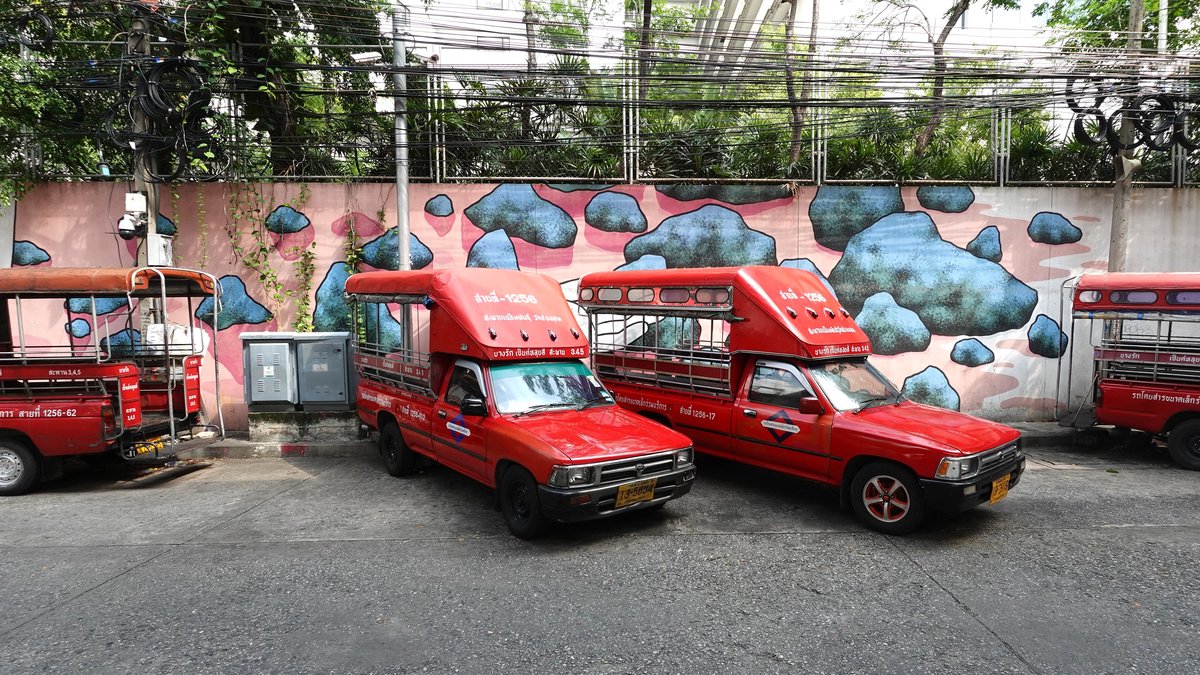
Through Bangkok's creative districts, between street art, architecture, design and new uses of the city.
Studies
Reference works
- 4River City Bangkok, About Us — River City Bangkok, River City Bangkok ↗
- 5Italthai Group, River City Bangkok Marks 40 Years of Magnificent Display of Art and Antiques, Italthai Group, 2024 ↗
- 6Contributeurs de Wikipédia, River City Bangkok, Wikipedia (en) ↗
- 7Contributeurs de Wikipédia, ริเวอร์ซิตี, Wikipedia (th) ↗
- 8Contributeurs de Wikipédia, Krisda Arunvongse na Ayudhya, Wikipedia (en) ↗
- 9Contributeurs de Wikipédia, Talat Noi, Wikipedia (en) ↗
- 10River City Bangkok, RIVER CITY BANGKOK (page d’accueil en thaï, programmation), River City Bangkok, 2026 ↗
Contemporary views
River City Bangkok today
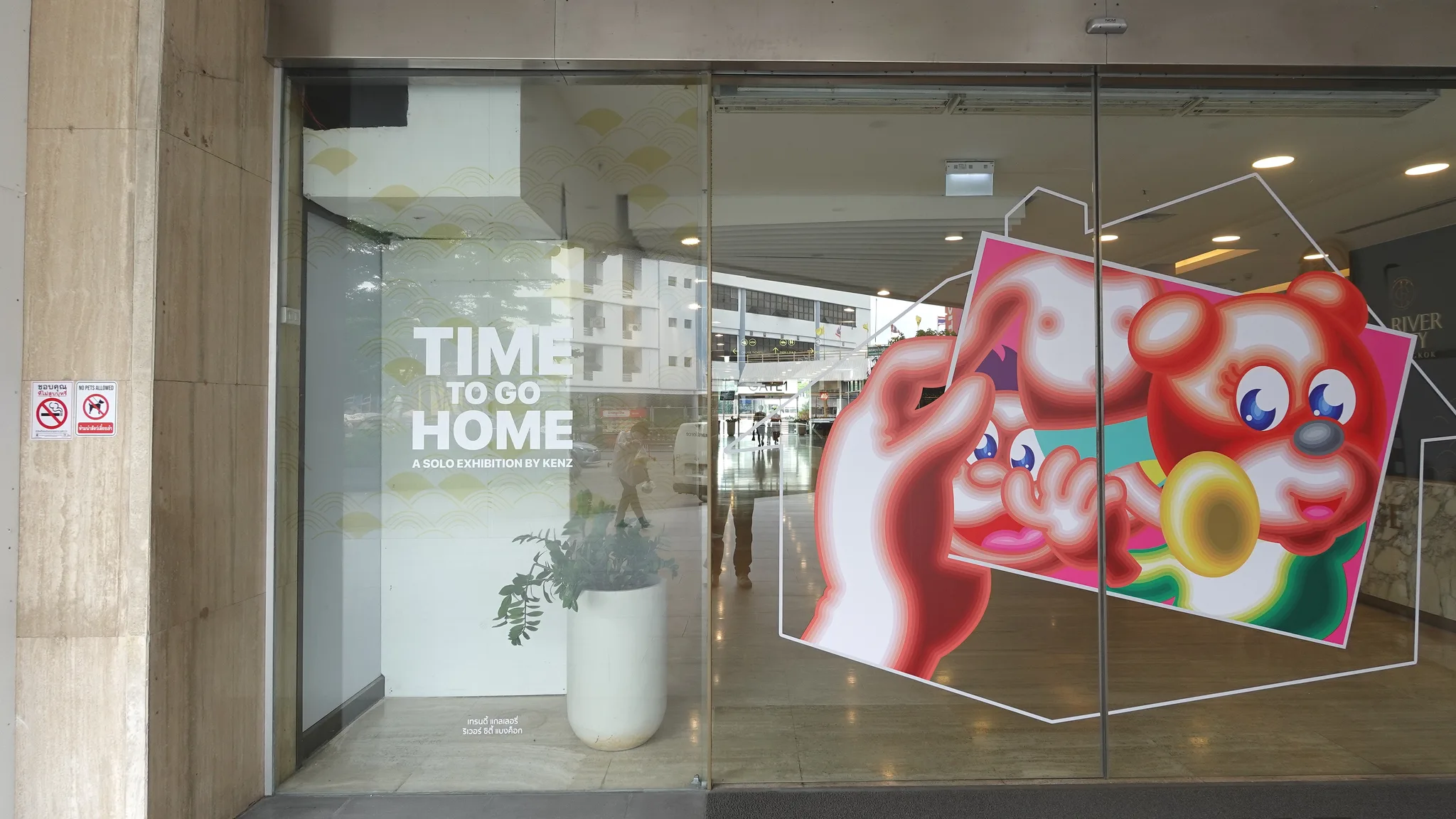
Glazed entrance of River City Bangkok dressed for Kenz’s solo exhibition ‘Time to Go Home’: a large illustration in red and pink tones sits alongside a tiled hall and a potted plant.© Eric Monteil 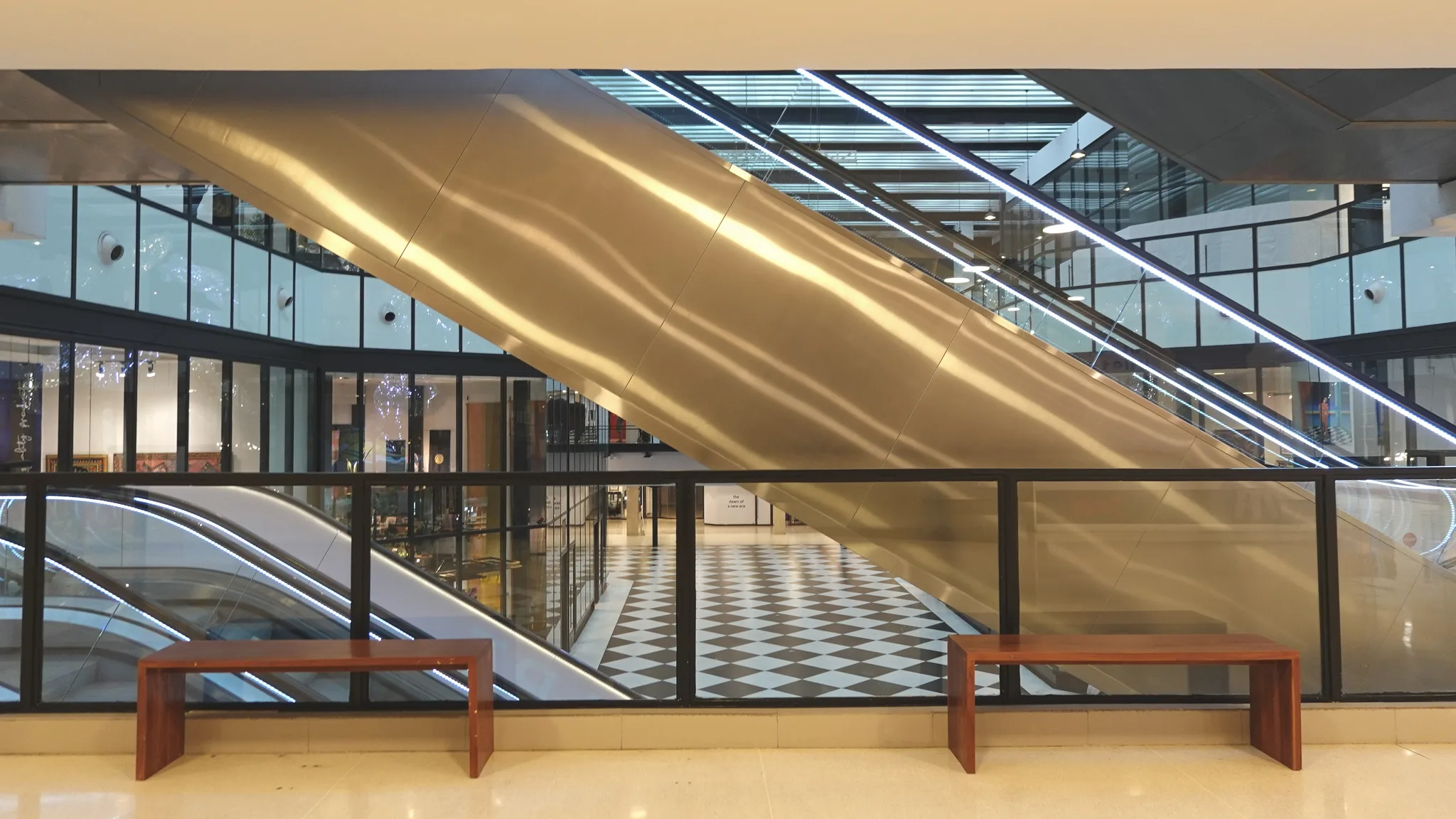
Interior gallery of River City Bangkok: an escalator clad in golden metal crosses the glazed atrium above a black-and-white chequerboard floor; in the foreground, two wooden benches line the balustrade.© Eric Monteil
Architecture and decoration
Explore the heritage
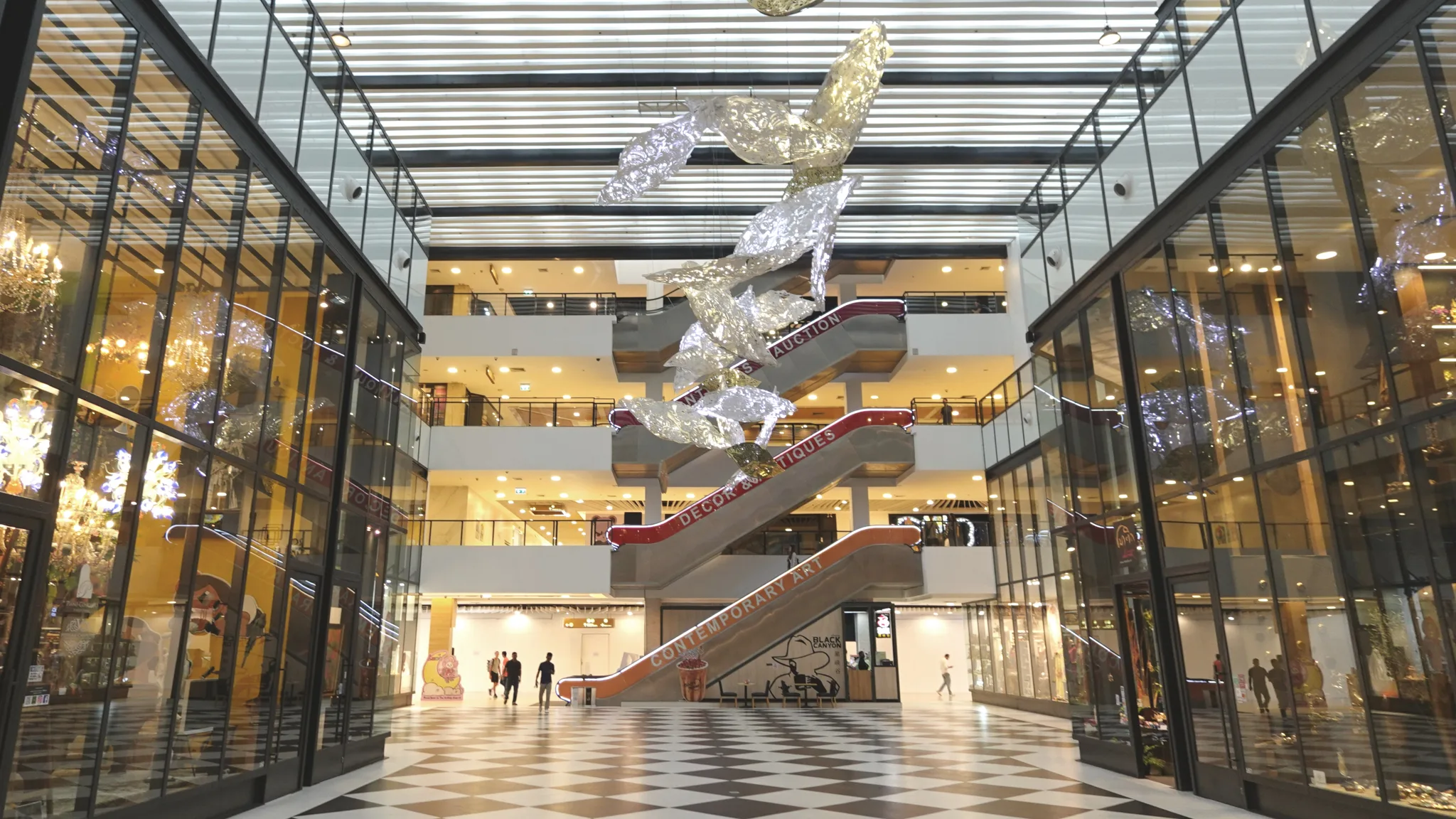
Atrium of River City Bangkok: stacked escalators bearing the words “Contemporary Art”, “Decor & Antiques” and “Auction”, a silver and gold suspended sculpture, glazed galleries and a chequered floor.© Eric Monteil 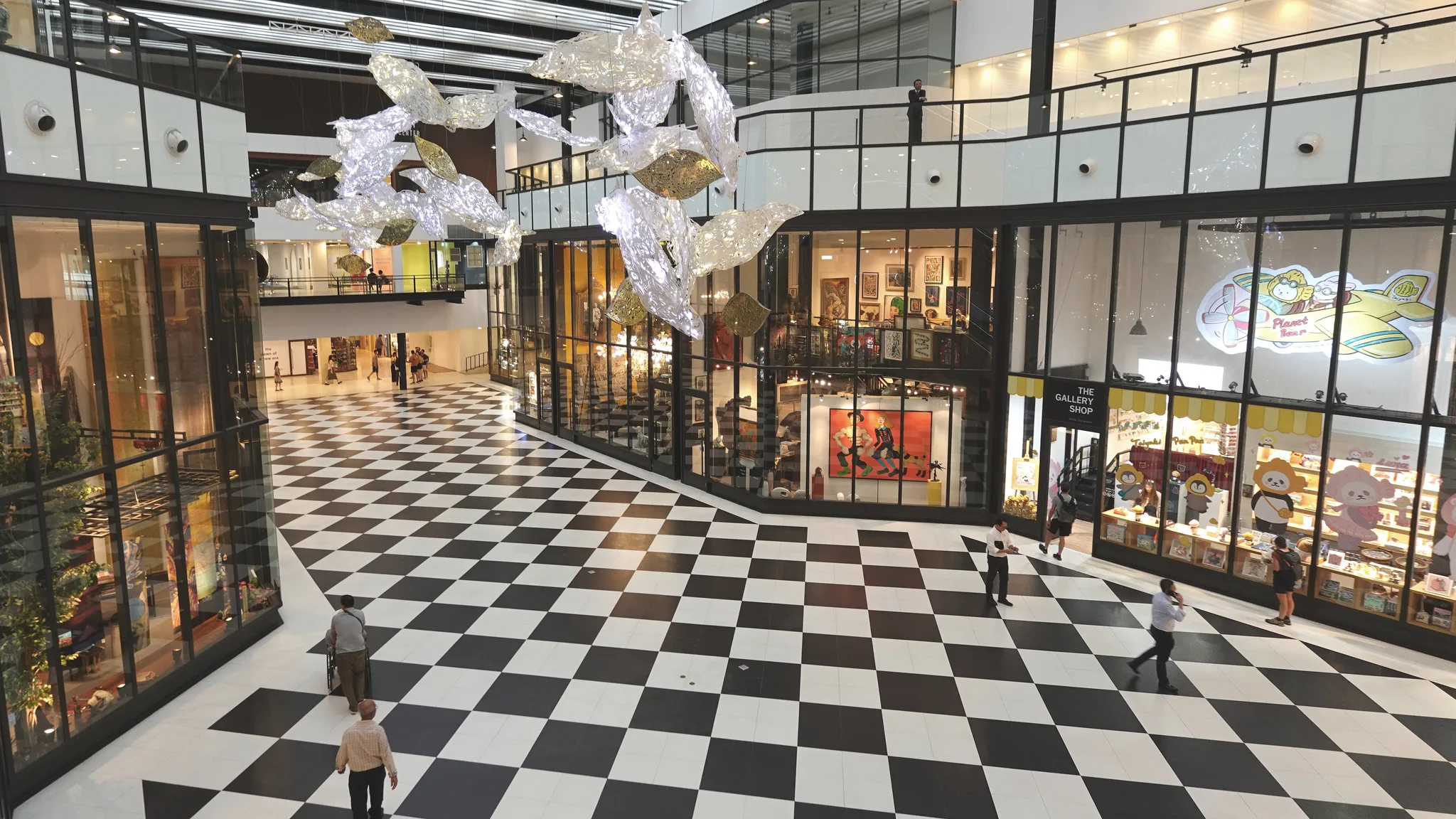
The atrium of River City Bangkok, seen from an upper gallery: a black and white chequered floor leads to shopfronts displaying paintings and objects, beneath a suspended installation of silver and gold birds.© Eric Monteil