
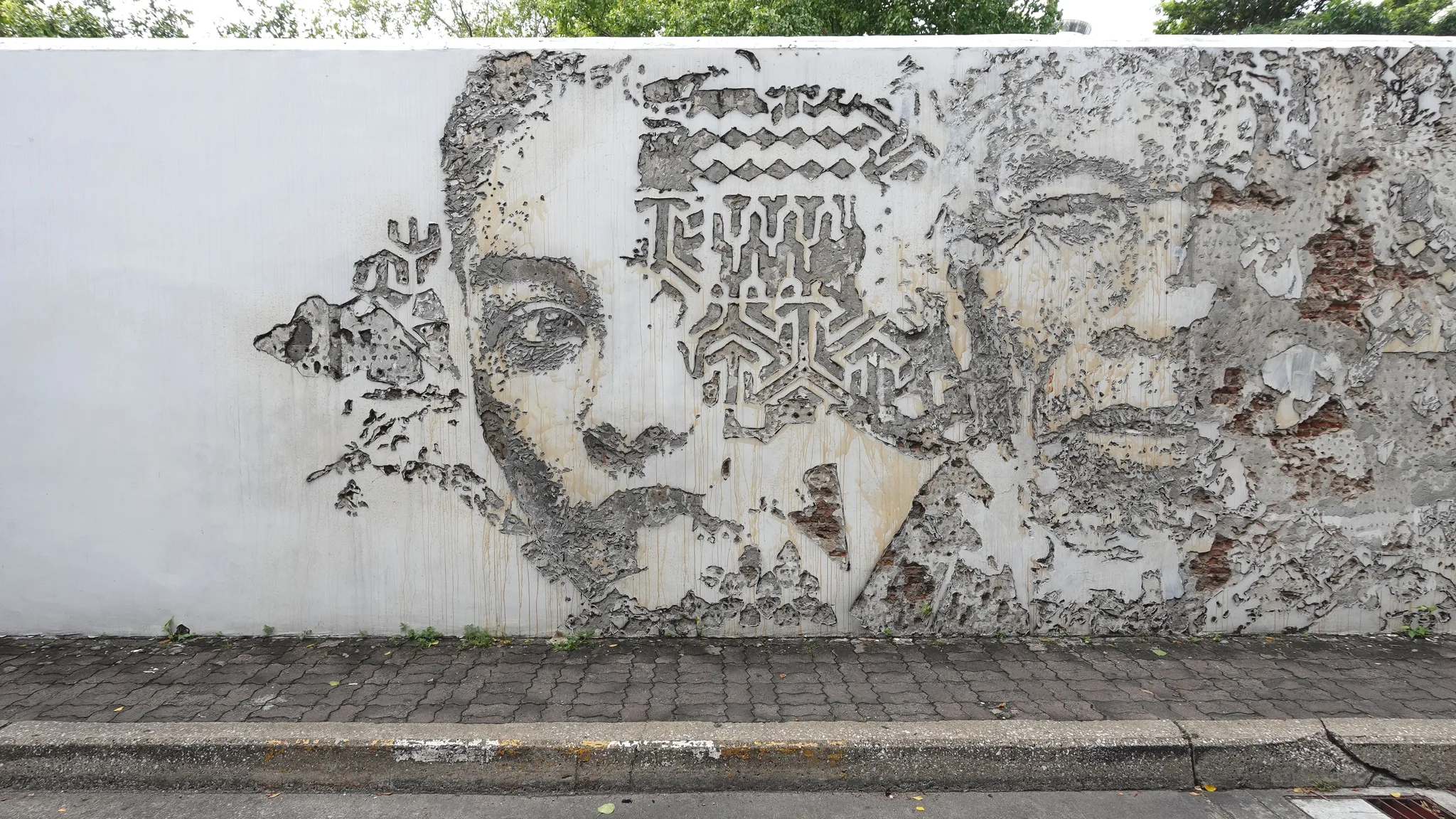
 Scratching the Surface by Vhils: on a long white wall, two faces and a geometric motif are created by carving the render down to the brick, a relief visible to passers-by from the paved pavement.© Eric Monteil
- Destination
- Bangkok (Bang Rak)
- Heritage Family
- Arts, aesthetics and creation
- Typology
- Public art & street art
- Visit
- Available tours →
Scratching the Surface by Vhils is a work of public art carved in 2017 by the Portuguese artist Vhils into the outer wall of the Embassy of Portugal in Bangkok, in the Bang Rak district. The artist’s first work in Thailand, it grew out of an initiative by the embassy to pay tribute to relations between Portugal and Thailand that go back more than five centuries. It stands on a site steeped in history, a plot of land given by King Rama II. The wall is not painted but carved: by removing layers of material, Vhils brings out three faces, those of Rosa Parks, Nelson Mandela and Barack Obama, and, above all, their gazes.6
Key facts
- Destination
- Bang Rak
- Heritage Family
- Arts, aesthetics and creation
- Typology
- Public art & street art
- Places
- Chao Phraya River
- Periods
- People
- Rama II
- Communities
- —
- Events
- Grant of the Portuguese Embassy land by Rama II (1820)
- Inauguration
- Heritage
- —
- Glossary
- Soi
- Buddha image
- Azulejo
- Keywords
- —
- Date
- —
- Collections
- —
Practical info
Practical information about this site is taken from its Google Maps page. We advise you to check it before visiting.
- Address
- 36 14 Charoen Krung 30, Khwaeng Bang Rak, Khet Bang Rak, Krung Thep Maha Nakhon 10500
A mural carved beside Charoen Krung
A work on an embassy wall
Scratching the Surface by Vhils occupies the outer wall of the Embassy of Portugal in Bangkok, next to the entrance of the diplomatic mission. It lies in the lane Soi Charoen Krung 30, also known as Captain Bush Lane, on the east bank of the Chao Phraya River, which flows through the capital. At the time of its creation, the embassy was a few minutes’ walk from Si Phraya Pier, served by the river’s express boats.13
The site, then, is not an anonymous wall chosen for its visibility, but the façade of an official building, part of the diplomatic and historical landscape of the district. The work can be seen from the street, freely and at any hour: one comes upon it while walking down the lane, as part of the wall itself rather than as an object added to it.
A name borrowed from a long-running project
The name by which the work is known does not, strictly speaking, refer to the Bangkok mural alone. ‘Scratching the Surface’ is the title of a project that Vhils has pursued for many years, of which the Bangkok work is one milestone. The title had already been used for an exhibition of the artist’s work in 2009, at the Lazarides gallery in London. The artist’s studio, for its part, lists the work under the more factual title ‘Embassy of Portugal in Thailand’.11
This plurality of names says something about the nature of the work: it belongs both to a personal approach, pursued from city to city, and to a specific place, to which it remains attached. The title of the project also sums up the artist’s method, which does not cover surfaces but cuts into them.
A site steeped in diplomatic history
Land given by Rama II
The wall on which Vhils worked belongs to a long-established ensemble. The land of the Embassy of Portugal in Bangkok was given in 1820 by King Rama II.11
For the artist, as for those who commissioned him, this historical depth is not mere backdrop. It gives the project its meaning, which sets out to honour relations between the two countries presented as more than five centuries old.2
The oldest embassy in Bangkok
The Embassy of Portugal in Bangkok is described as the oldest diplomatic mission in the city. The mural thus joins an already recognised heritage ensemble without transforming it: it is set into the fabric of an existing wall, beside the entrance, rather than into a new building.13
To carve an embassy wall is to work on a surface that has come down through the ages and that carries, in its successive layers, part of the history of the site. The choice of support and the choice of subject answer each other: the work speaks of the ties between two countries on the very wall where those ties took material form.
Vhils, an artist who carves into walls
From graffiti to the art of subtraction
Vhils is the artistic name of Alexandre Farto, a Portuguese artist based in London at the time he made the Bangkok work. He grew up in Seixal, Portugal, where he began with graffiti at around the age of 13, on walls and on trains. He went on to study fine art at Central Saint Martins, the London art school.6
Vhils practises a technique that sets him apart. Instead of adding paint to a wall, he removes layers of building materials from it, using tools such as the chisel, a steel blade for cutting into the surface. The image is thus born in negative, from material taken away rather than material applied: the reliefs, shadows and highlights result from the different depths reached in the wall.6
After Macao, Bangkok
The Bangkok intervention extends a series begun a few weeks earlier. In December 2016, Vhils had created in Macao, on the wall of the Portuguese diplomatic mission, a mural depicting the poet Camilo Pessanha. Bangkok thus became the second Portuguese diplomatic mission where he worked.3
This sequence brings together two Asian cities linked, each in its own way, to Portuguese history, and places the Bangkok work within a policy of cultural diplomacy that entrusts a recognised artist with making those ties visible. Unlike the Macao mural, devoted to a Portuguese literary figure, the Bangkok mural brings together three international figures of the struggle for civil rights and equality.
February 2017: the birth of the work
A commission in cultural diplomacy
The work is an initiative of the Embassy of Portugal in Bangkok and the Camões Portuguese Cultural Centre in Bangkok, with the support of Camões – Institute for Cooperation and Language, the Portuguese public body responsible for promoting the language and culture, and of Minor Group. The stated aim is twofold: to pay tribute to relations between Portugal and Thailand, and to give the city a work by a recognised artist, intended as much for the local population as for passing visitors.
This intention sheds light on the nature of the work. It is neither a spontaneous intervention, as the graffiti of the artist’s early days was, nor a piece destined for a museum, but a public gesture conceived as a gift to the city, set on an official building and visible to all.
Five days of work and an unveiling
The work was announced in early February 2017 as Vhils’s first in Thailand. The artist declined at the time to reveal its content. He created the mural in five days, in February 2017, directly on the embassy wall.6
The unveiling took place on the evening of 10 February 2017, at the embassy, before a few dozen guests, mostly Portuguese and Thai people and members of the diplomatic corps. The Portuguese ambassador, Francisco Vaz Patto, spoke on the occasion. The small circle of that evening contrasts with the fate of the work which, once unveiled, belongs to the street and its passers-by.3
Reading the work
Three faces: Rosa Parks, Nelson Mandela and Barack Obama
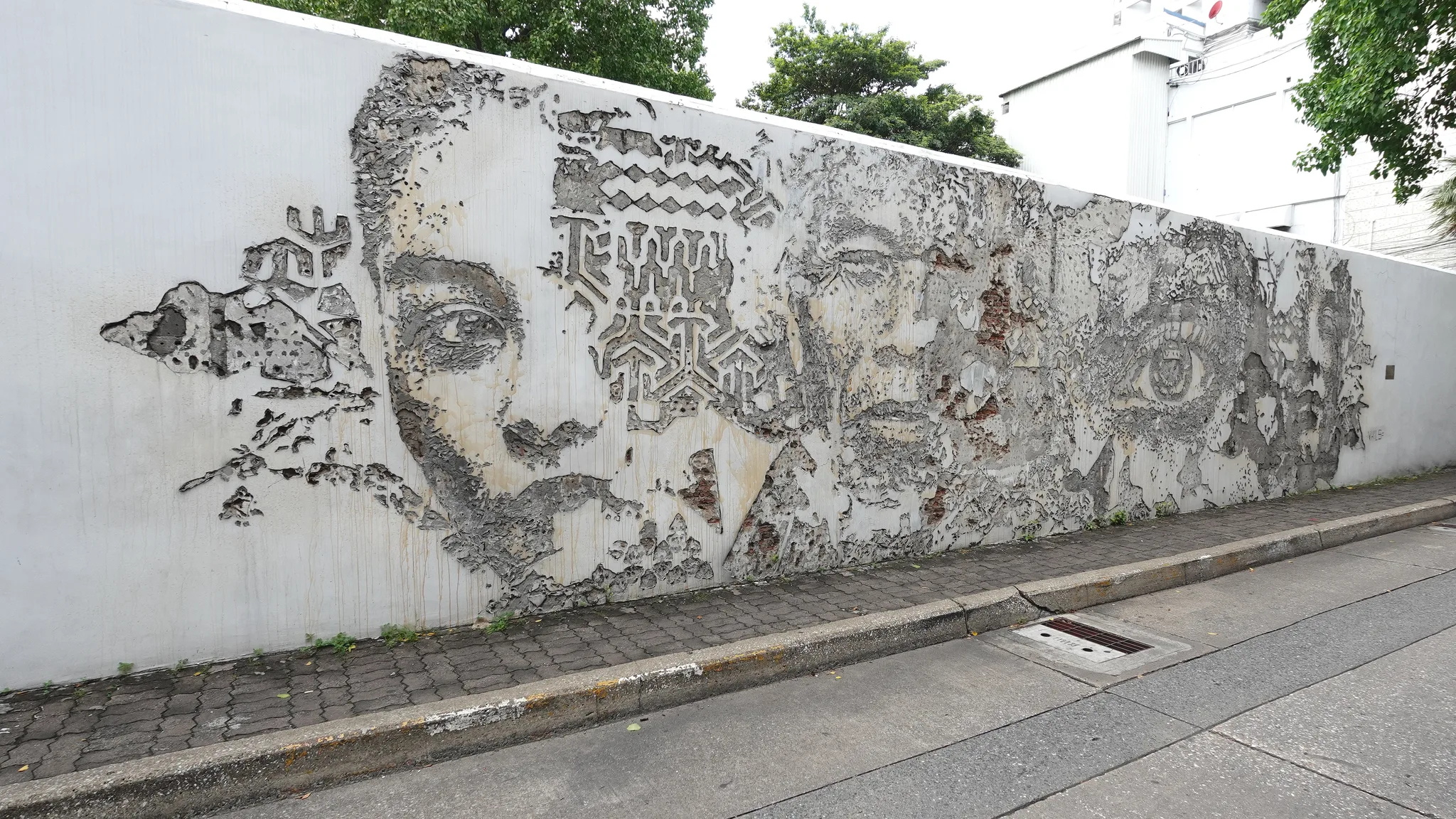
What one sees on the wall are three faces, rendered realistically and carved into a whitewashed wall. From left to right, facing the work, one recognises the American civil rights activist Rosa Parks, the South African president Nelson Mandela and the American president Barack Obama. The shift from portrait to wall transforms these images: the features are no longer printed but revealed by the incision, and the faces seem to emerge from the very thickness of the wall.12
The choice of these three figures gives the work its tone. On the wall of an embassy, it is figures associated with the struggle against segregation and for equality who look out onto the street, and the tribute to relations between the two countries takes on a more universal significance.
The eye, the iris and the azulejo
At the heart of the composition are the eyes, and more precisely the iris. Vhils presents it as what ‘humanises us all’ and as a point in common between the two cultures. The gaze thus becomes the place of encounter: whatever the origin of the person depicted, the iris points to a shared humanity.5
These faces enter into dialogue with references to azulejos, the decorated glazed tiles emblematic of Portuguese architecture. The artist speaks in this regard of a kind of ‘symbiosis’ between the two worlds. The reading of the work rests on this juxtaposition: a Portuguese decorative motif and three portraits brought together on the same wall, in the same carving technique.3
Making the layers of the wall speak
Vhils’s approach gives the technique an added meaning. By working the layers of the wall, the artist says he wants to make visible what is hidden within it, namely the history of the place, this wall having ‘lived through several moments’. Scratching the surface thus amounts to revealing what the successive states of the building have covered over.2
On the wall of an embassy whose land dates back to Rama II’s gift, this idea takes on a concrete significance. The work does not tell the history of relations between Portugal and Thailand through dates or scenes; it suggests it through material, making the depth of the wall an image of time passed through.
A work in the city
A stop on street art trails
Since its unveiling, Scratching the Surface by Vhils has become one of the stops on the street art trails of the Charoen Krung district, presented as Bangkok’s Creative District, and its surroundings towards Talad Noi. The work is reputed to be the most photographed in the district and accompanies the rise of street art in this old part of the city, on the banks of the Chao Phraya River.8
It can be reached, among other routes, by walking through Warehouse 30 to the lane Charoen Krung 30. The presence of the work thus helps to connect, in visitors’ experience, the district’s diplomatic heritage with its new creative spaces.9
A gift to the city
Free to access, by day and by night, the work fulfils the mission set for it by those who commissioned it: to speak to local people and visitors alike. It belongs to the city through its location, on a wall facing the street, and through its subject, faces that look out onto the street.12
Its heritage value lies in this twofold anchoring. It is Vhils’s first work in Thailand and a testimony to Portuguese cultural diplomacy; it joins a long-established ensemble, the Embassy of Portugal in Bangkok, whose history it extends in a contemporary language. Carved into the very fabric of the wall, it now shares its fate.
Understanding
Scratching the Surface by Vhils is first and foremost a gesture: a Portuguese artist carves, rather than paints, the wall of Bangkok’s oldest embassy to bring forth three gazes: those of Rosa Parks, Nelson Mandela and Barack Obama. The work draws its strength from this meeting between an old site, given by a king of Siam, and a contemporary technique that turns the material of the wall into memory. The faces, the iris and the echo of azulejos speak of a friendship between two countries, but they express it through the features of three figures of the struggle for civil rights and equality. Today, the work lives on above all as a stop on the street art trails of Charoen Krung, much photographed by passers-by. It shares the fate of the wall that bears it. Can a work born of an embassy commission become, over time, a heritage that the people of Bangkok fully recognise as their own?
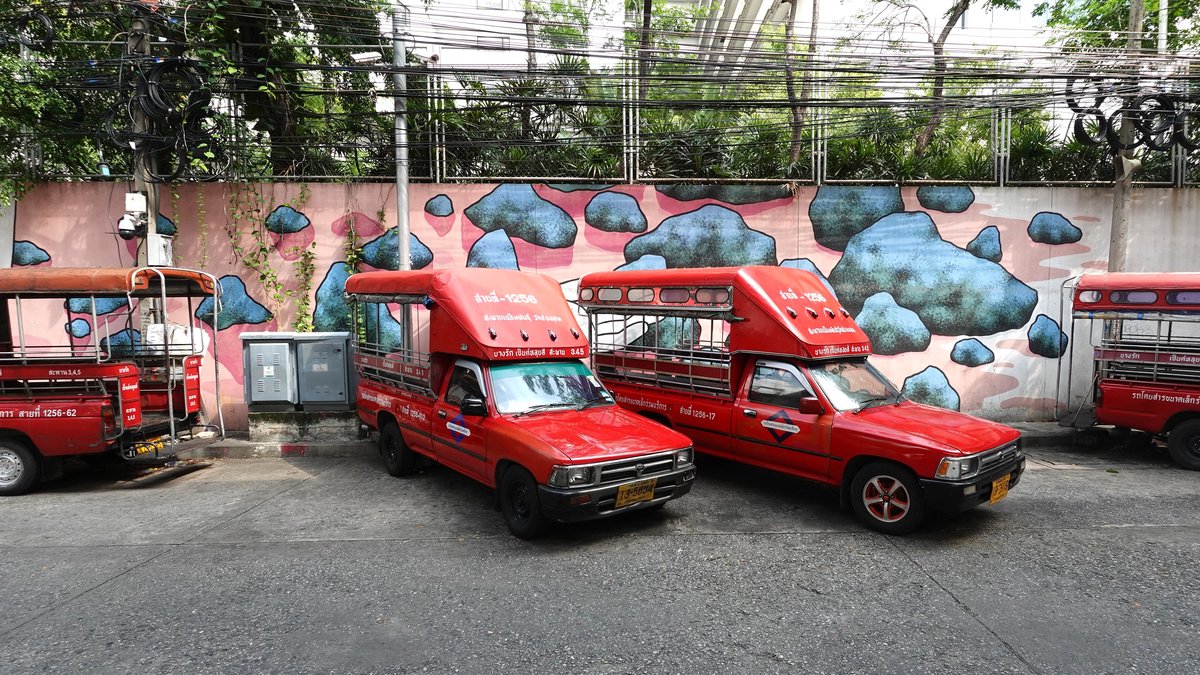
Through Bangkok's creative districts, between street art, architecture, design and new uses of the city.
- Soi
- Thai word for a lane or side street branching off a main road; soi are often numbered after the main street from which they branch.
- Buddha image
- In Thai Buddhism, a devotional representation of the Buddha, most often a statue, venerated as an object of worship.
- Azulejo
- A glazed and decorated earthenware tile, emblematic of Portuguese and Iberian architecture, used to clad interior walls and façades.
Studies
- 1Portuguese Artist 'Vhils' Makes His Mark on Charoen Krung Wall, Khaosod English, 2017 ↗
- 2Lusa, Já há um mural de Vhils em Banguecoque, Público (P3), 2017 ↗
- 3Lusa, Vhils homenageia relação antiga entre Portugal e Tailândia com mural em Banguecoque, RTP Notícias, 2017 ↗
- 4Lusa, Os olhos de Vhils homenageiam a relação entre Portugal e a Tailândia, Ponto Final (Macau), 2017 ↗
- 5Arte urbana: Vhils inaugura mural em Banguecoque, SAPO Viagens, 2017 ↗
- 6Vhils apresenta trabalho na embaixada portuguesa em Banguecoque, Hoje Macau, 2017 ↗
- 7Portugal e Tailândia, uma amizade de 500 anos. Vamos?, Visão, 2017 ↗
- 8Why You Should Visit Bangkok's Revived Creative District, Forbes Travel Guide ↗
- 9These murals highlight Talad Noi's rise as Bangkok's hub of street art, BK Magazine ↗
Reference works
- 10Studio Vhils, Embassy of Portugal in Thailand (Walls, 2017), vhils.com ↗
- 11Banguecoque: Vhils em Banguecoque – "Scratching the Surface Project", Camões – Instituto da Cooperação e da Língua, I.P., 2017 ↗
- 12Scratching the Surface, Time Out Bangkok ↗
- 13Contributeurs Wikipédia, Embassy of Portugal, Bangkok, Wikipedia ↗
- 14Contributeurs Wikipédia, Vhils, Wikipedia ↗
Further reading
Contemporary views
Scratching the Surface by Vhils today
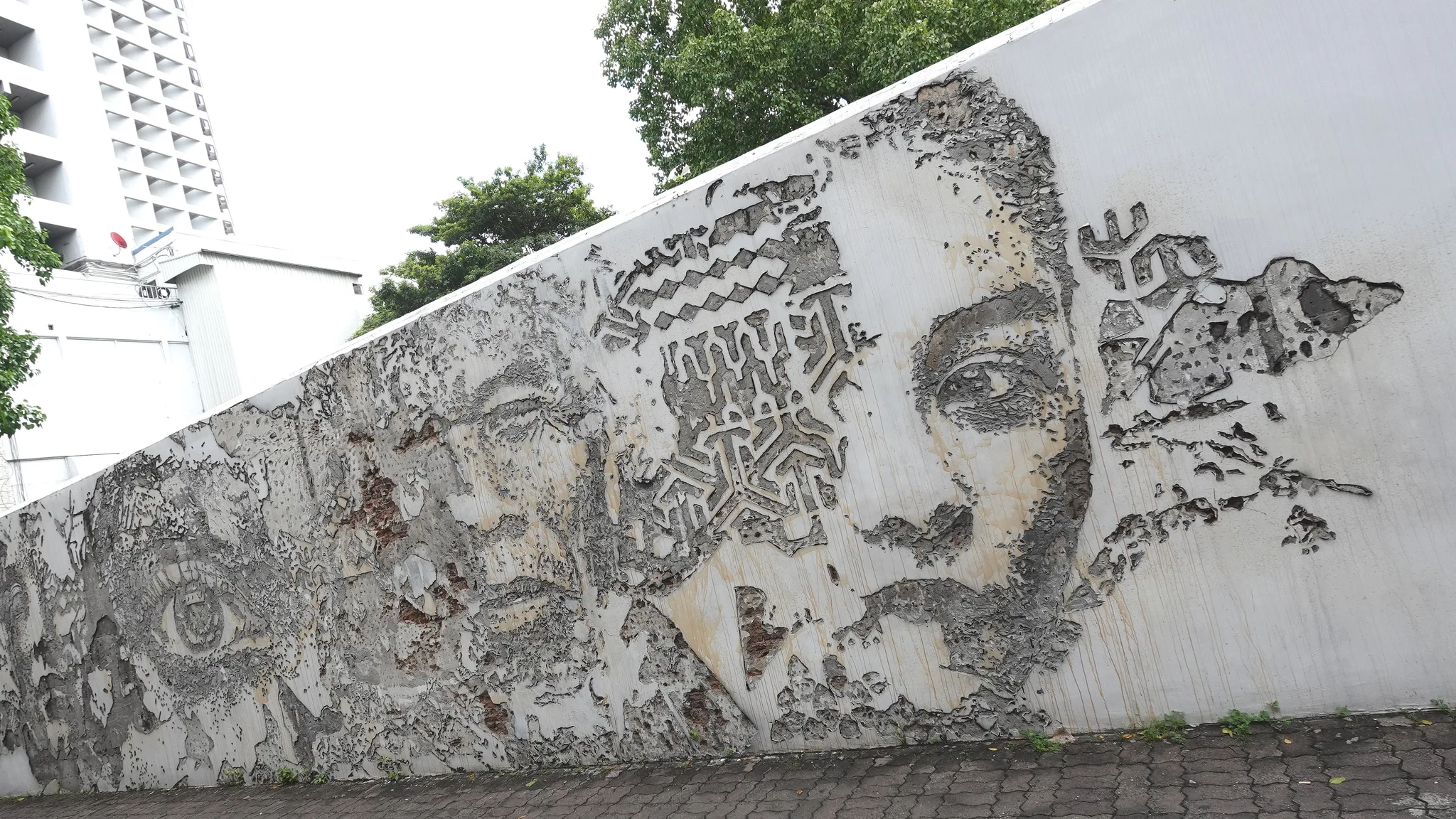
Scratching the Surface by Vhils: on a long white concrete wall, several faces and a close-up eye are carved into the surface, with geometric patterns and rust stains, in front of a tower block and trees.© Eric Monteil 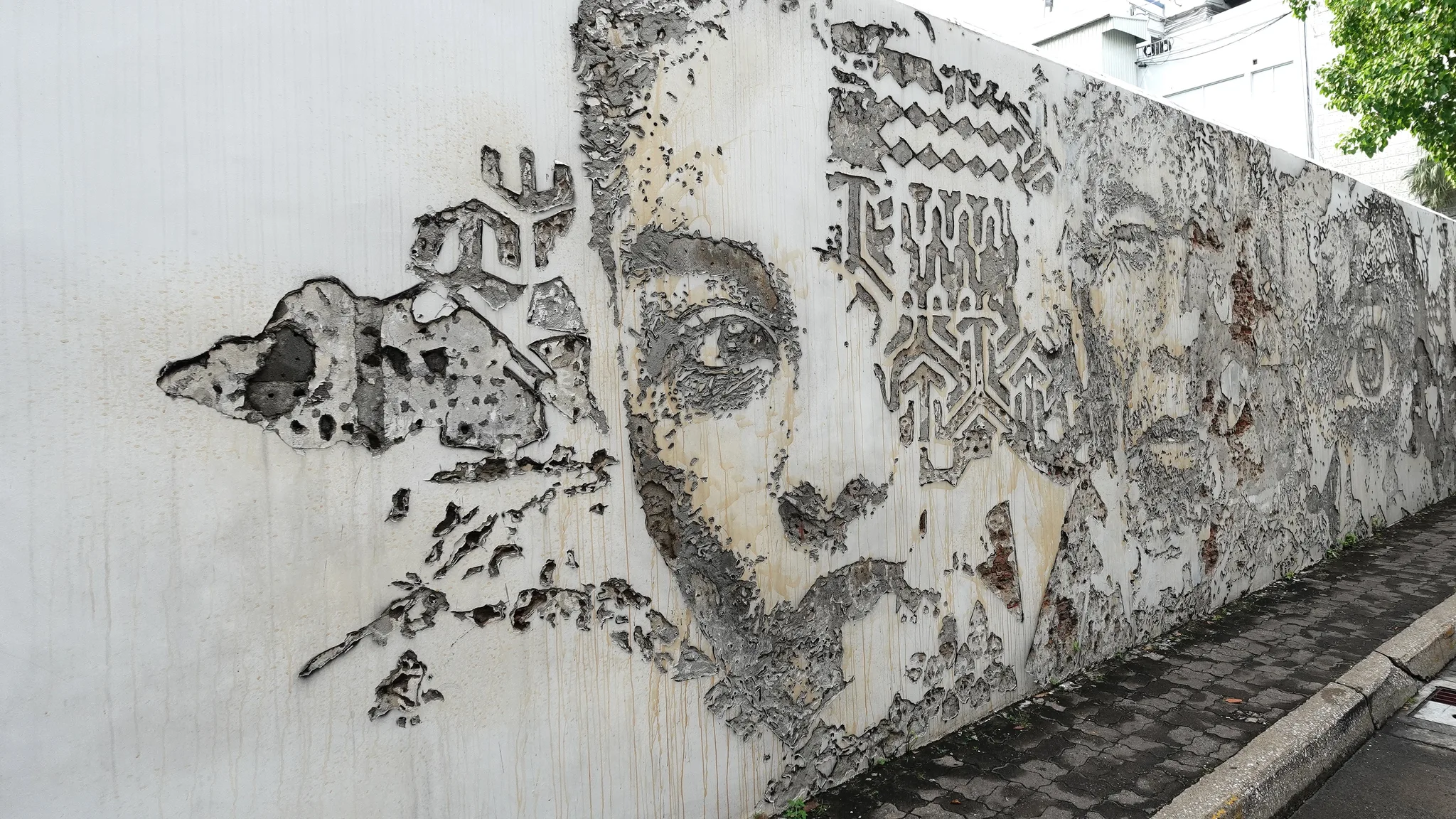
Scratching the Surface by Vhils: on a long white wall, faces and geometric motifs are formed by chiselling the plaster down to the concrete, a relief-carving technique that runs alongside a paved pavement.© Eric Monteil
Architecture and decoration
Explore the heritage
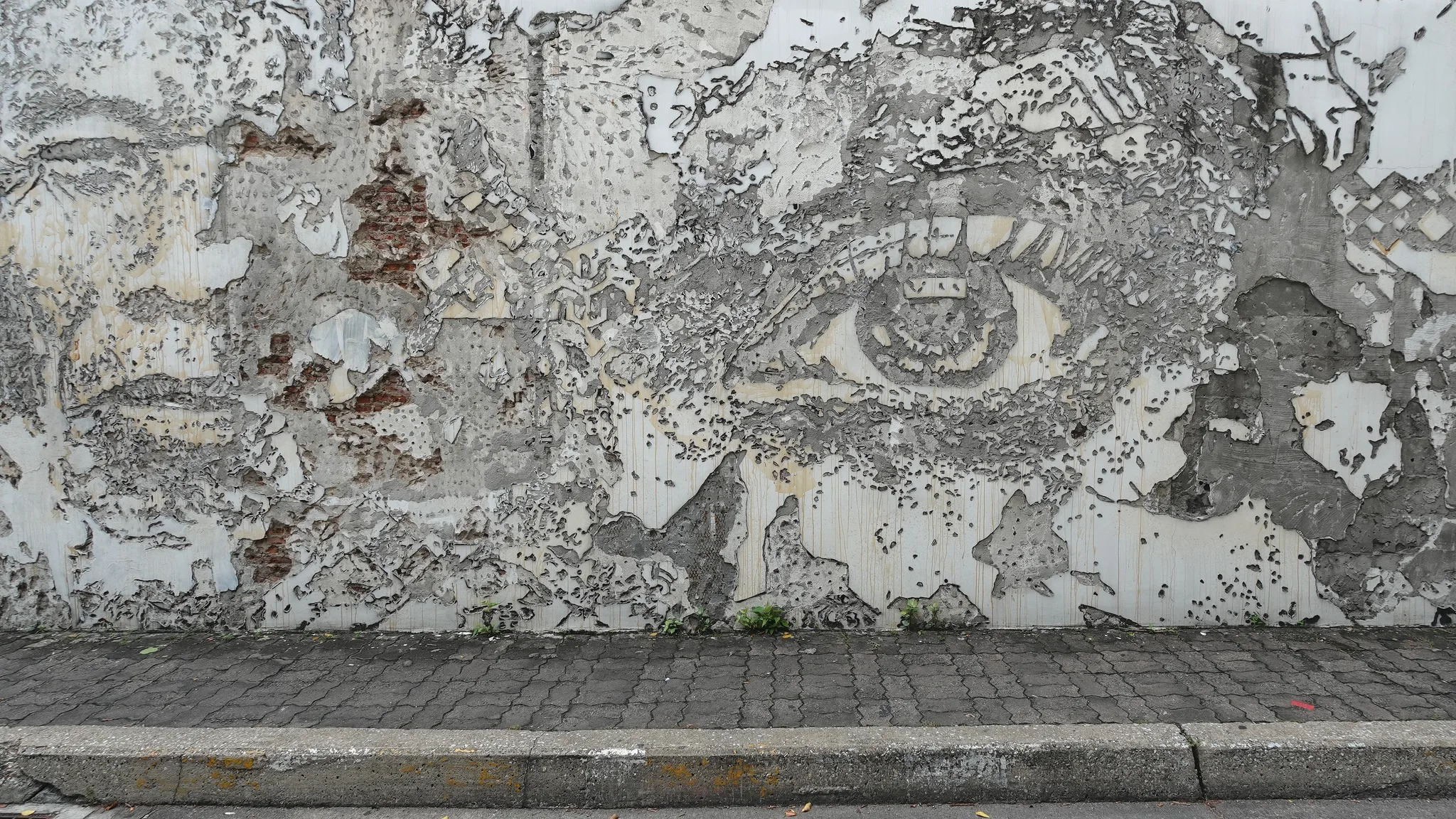
Scratching the Surface by Vhils: a face on the left and a large eye in the centre are carved into the wall’s white render, revealing the grey concrete and red brick beneath.© Eric Monteil 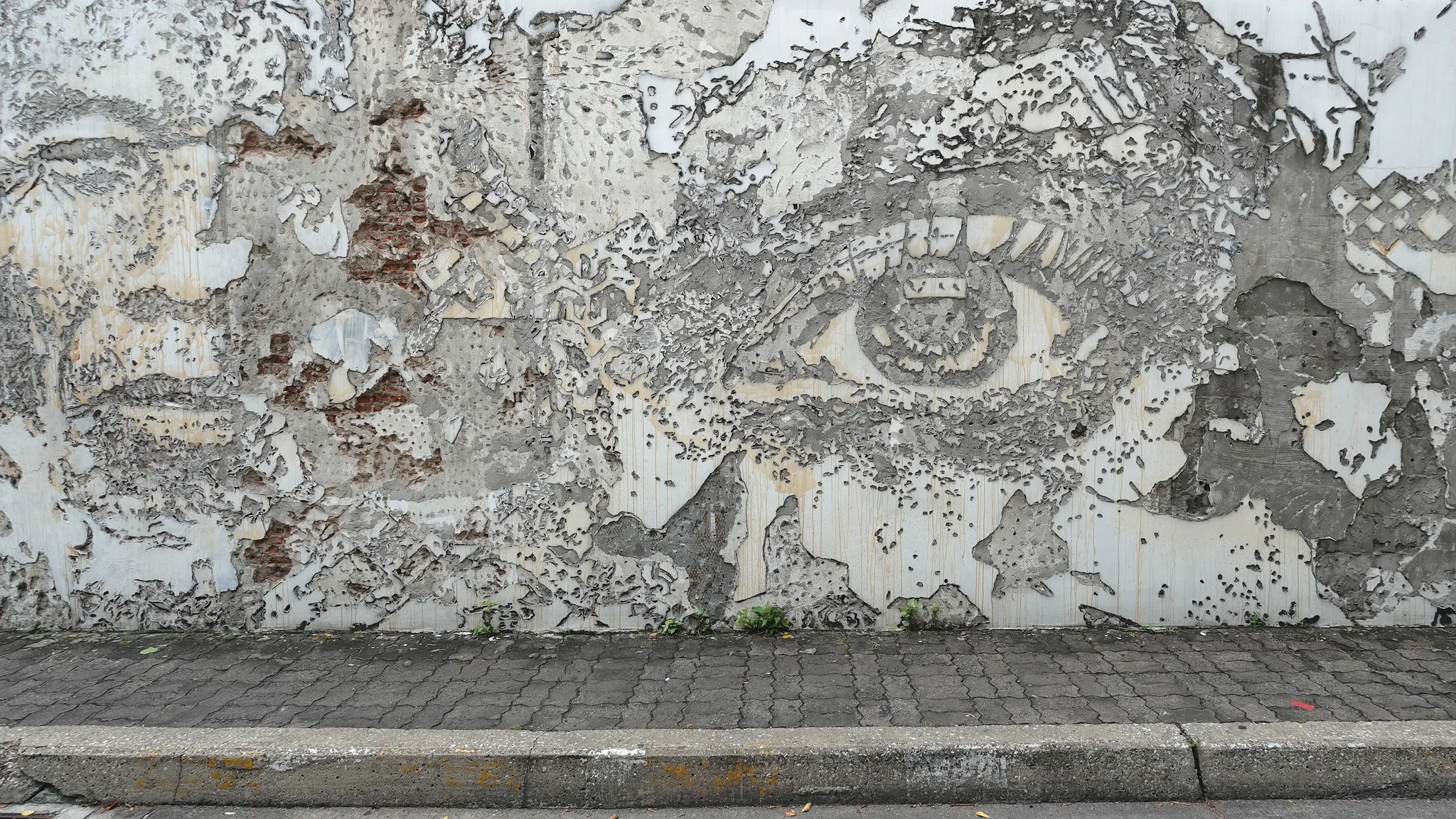
Scratching the Surface by Vhils: a face and a large eye emerge where the white render has been removed, revealing the grey concrete and, in places, the red brick of the wall, alongside a paved pavement.© Eric Monteil