
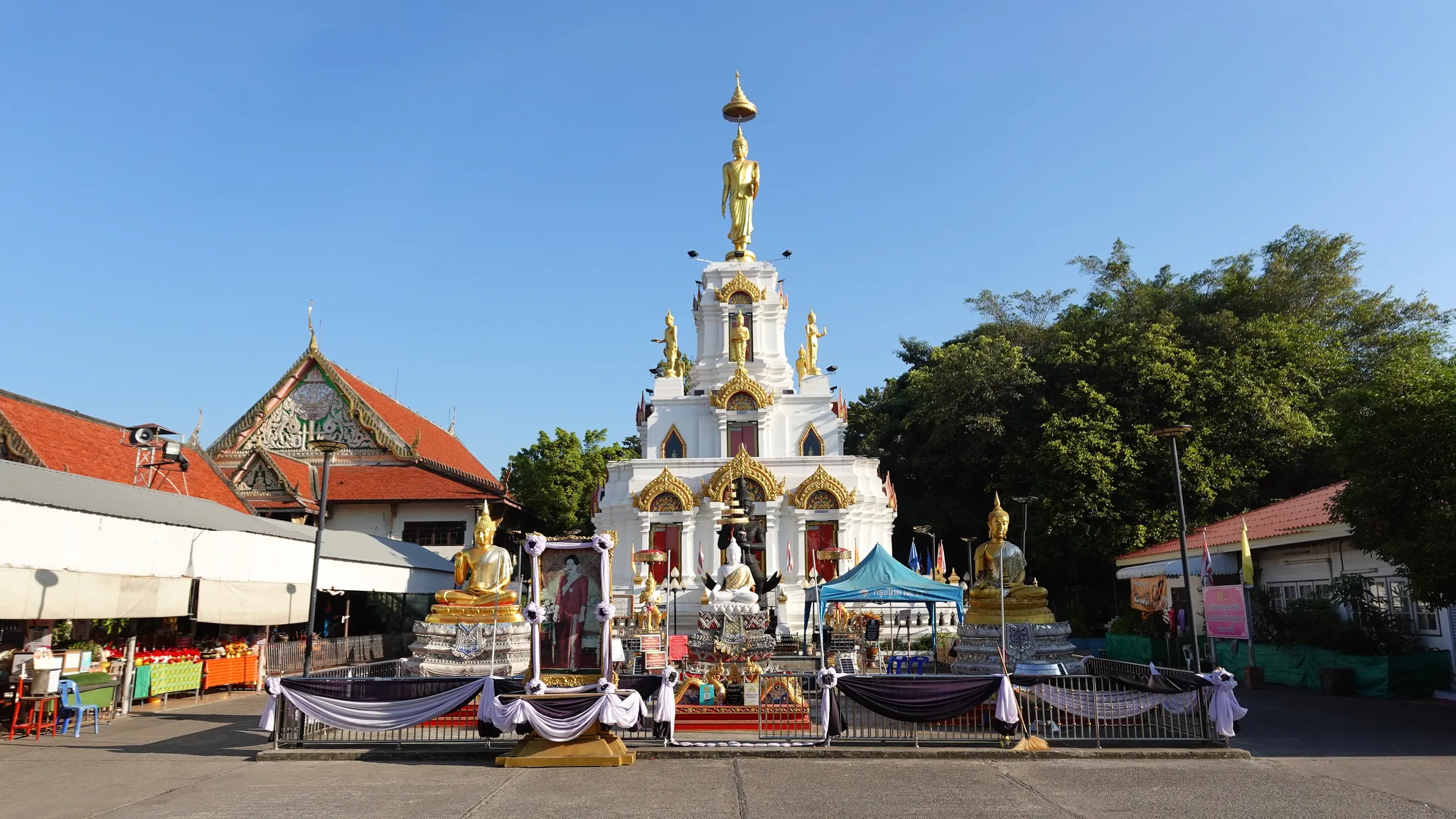
 At Wat Bang Nam Phueng Nai, a tiered white shrine crowned by a gilded standing Buddha rises between two seated gilded Buddhas; to the left stands a building with red-tiled roofs and a carved gable, to the right, trees.© Eric Monteil
Buddhist temple
Wat Bang Nam Phueng Nai
Founded in the early twentieth century within the Bang Kachao loop, this village monastery owes its value less to its architecture than to the community traditions it sustains.
Heritage family · Buddhism, religions and spiritualities
- Destination
- Samut Prakan (Phra Pradaeng)
- Heritage Family
- Buddhism, religions and spiritualities
- Typology
- Buddhist temple
- Visit
- Available tours →
Wat Bang Nam Phueng Nai is a Buddhist monastery in Phra Pradaeng district, Samut Prakan province, standing on the Bang Kachao ‘peninsula’ formed by a loop of the Chao Phraya River. A village temple rather than a royal foundation, it matters above all for the part it plays in the life of its community, which keeps up collective festivals and traditions there. Founded in the early twentieth century, it took its present name shortly afterwards. A local legend links it to the honey that gave the place its name. Around its ordination hall it gathers the buildings of a monastic community that remains active.4
Key facts
- Destination
- Bang Nam Phueng
- Heritage Family
- Buddhism, religions and spiritualities
- Typology
- Buddhist temple
- Places
- Phra Pradaeng
- Samut Prakan
- Bang Krachao
- Periods
- People
- Phra Khru Wibun Thammakhut (Tuan)
- Communities
- Communauté monastique
- Mon community of Bang Kachao
- Events
- Adoption du nom (1917)
- Fondation (vers 1907)
- Heritage
- Cuisson collective du kalamae de Bang Nam Phueng
- Honey alms offering
- Légende de la princesse et du miel
- Glossary
- Wat
- Tambon
- Chao Phraya
- Phraya
- Khlong
- Ordination
- Keywords
- —
- Date
- —
- Collections
- —
Practical info
Practical information about this site is taken from its Google Maps page. We advise you to check it before visiting.
- Address
- 21 หมู่ที่ 10 Tambon Bang Nam Phueng, Amphoe Phra Pradaeng, Chang Wat Samut Prakan 10130
- Phone
A monastery in the Bang Kachao loop
A village temple on a bend of the Chao Phraya
Wat Bang Nam Phueng Nai lies in the tambon, or subdistrict, of Bang Nam Phueng, within Phra Pradaeng district. It belongs to the vast meander of the Chao Phraya River known as the Bang Kachao ‘peninsula’, a stretch of land almost entirely encircled by the river. The monastery forms part of a village, Ban Khlong Bang Nam Phueng, whose name refers to Khlong Bang Nam Phueng.5
It is a Theravada Buddhist monastery belonging to the Mahanikai order. It holds the status of ‘wat rat’, that is, a non-royal temple: it does not come under the patronage of the Crown and is not among the great monasteries granted royal rank. This status at once sheds light on its nature. Wat Bang Nam Phueng Nai is neither a national pilgrimage shrine nor a state monument, but the place of worship and gathering of a rural community, whose history and rhythms it shares.5
Honey, inner and outer
The monastery’s name reads like an address. ‘Wat’ denotes the monastery; ‘bang’, a settlement on the water’s edge; ‘nam phueng’, honey. Bang Nam Phueng is therefore literally ‘the settlement of honey’, a name that links the subdistrict with honey and which, as we shall see, informs both the temple’s foundation legend and some of its rites.9
The last word, ‘nai’, means ‘inner’. It answers ‘nok’, ‘outer’, which appears in the name of another, older monastery in the same tambon, Wat Bang Nam Phueng Nok. The two temples thus form a pair of twin names, distinguishing two places of worship within the same tambon. This closeness calls for constant care: the two monasteries have different histories, buildings and statuses, and what holds true for one does not necessarily hold true for the other.
An early twentieth-century foundation
From Wat Dusitharam to Wat Bang Nam Phueng Nai
The monastery was founded around 1907. The name of its founder is not known. The temple first bore another name, Wat Dusitharam, under which it spent its early years.5
In 1917 the monastery adopted the name Wat Bang Nam Phueng Nai. The change came at a time when its leading figure was the monk Phra Khru Wibun Thammakhut, known as Tuan — ‘Phra Khru’ being an ecclesiastical title of rank conferred on certain monks.4
The consecrated ground for ordination
For a monastery to ordain monks, it needs a consecrated space, marked out by boundary stones, where ordination ceremonies are held. This ground is granted by royal decision: this is the wisungkhamasima, the grant of the consecrated land on which the ubosot, the ordination hall, stands. In the life of a temple, this step marks the passage from a mere foundation to a fully constituted monastery.
For Wat Bang Nam Phueng Nai, this grant came in 2010.5
The legend of the princess and the honey
A foundation story handed down in the village
Alongside this chronology, the people of Bang Nam Phueng tell of another origin. According to local tradition, the honey of the area is said to have cured a princess of an illness from which she had long suffered. In thanksgiving, a figure whom the story names Chao Sai Nam Phueng is said to have had Wat Bang Nam Phueng Nok built, while Queen Suchada is said to have had Wat Bang Nam Phueng Nai raised, at first called after her, ‘Wat Suchada’. The community is then said to have taken the name Ban Bang Nam Phueng, the ‘village of honey’.1
The story binds together, in a single gesture, the two twin monasteries, the name of the subdistrict and honey. It gives the temples prestigious founders drawn from the court, and turns honey from a mere product into a remedy and the occasion for a religious offering.
What tradition says about the place
This story is a legend: the figures of Chao Sai Nam Phueng and Queen Suchada are not historically attested. It fits neither a foundation around 1907 nor the former name Wat Dusitharam, and its ‘Wat Suchada’ corresponds to no name known from elsewhere. Nothing therefore allows it to be read as the memory of real events.
Its value lies elsewhere. It shows how a community tells itself the origins of its places of worship, linking them to what sets it apart — honey — and placing them under the protection of royal figures. It also sheds light on the pair formed by the two monasteries: in local memory they are not two independent foundations but two twin gestures, born of the same vow. Honey, moreover, does not belong solely to the temple’s legendary past: it recurs in one of the traditions the community still keeps up there.
Reading the monastic complex
The ordination hall and the preaching hall
Wat Bang Nam Phueng Nai spreads across low-lying, easily accessible flat land. It includes an ubosot, a hall reserved for ordinations and for the ritual acts of the community of monks, built of rendered brick.
To this is added a sala kanparian, the preaching hall, built of wood. Whereas the ubosot serves the monks first and foremost, the sala kanparian welcomes the faithful who come to listen to sermons and to take part in offerings and in the ceremonies of the religious calendar. The distinction between these two buildings reflects the temple’s twofold function: a place of monastic discipline on the one hand, a gathering place for the lay community on the other.
The spaces of monastic life
Another part of the compound is given over to the daily life of the monks. It brings together the kuti, the cells in which they live, most of them of wood, a few of masonry or combining wood and masonry. To these are added the facilities of a complete monastery: a ho rakhang, the bell tower whose bell marks the rhythm of the day, a chanting hall where the monks recite the texts together, and a library.
The whole forms the picture of a village monastery, dominated by wooden buildings, each serving a precise purpose. Its architectural interest is modest; the essence of its value lies elsewhere, in the practices it sustains.
Two monasteries not to be confused
This observation takes on its full meaning when set against Wat Bang Nam Phueng Nok. The latter retains an old ubosot and an old vihara — the hall housing the images venerated by the faithful — in the so-called ‘wilanda’ style, a term meaning ‘Dutch’, dated to the late Ayutthaya or early Rattanakosin period. In 2017 the Fine Arts Department, the Thai government body responsible for historic monuments, restored these two buildings.3
This restoration concerns Wat Bang Nam Phueng Nok alone, and not Wat Bang Nam Phueng Nai. The two neighbouring monasteries thus illustrate two forms of heritage: one is valued for its old buildings, the other for the life it shelters.
A religious and community life
A centre for the Mon community
Wat Bang Nam Phueng Nai is the religious centre and focal point of the Mon community of the Bang Kachao loop. The Mon, a people with their own language and traditions, have a strong presence in the Phra Pradaeng area, which they have made one of their homes in Thailand. For them the temple is not merely a place of prayer: it is where people meet, where they celebrate, where shared practices are handed down.4
The monastery also plays an educational role within the community.4
Kalamae, honey and Songkran
Several collective traditions endure around the temple. Among them is the communal cooking of kalamae, a confection of glutinous rice and coconut that must be stirred at length.4
The monastery also keeps up an alms-giving of honey, the tak bat nam phueng. The tak bat is the offering the faithful make to the monks; here it consists of honey, the resource that gave the village its name and holds a central place in its foundation legend. Finally, games are organised at Songkran, the traditional New Year. These practices anchor religious life in the calendar and identity of the community, and make the temple the place where the community becomes visible to itself.4
An active monastic community
The monastery is still inhabited. In 2025, 19 monks resided there during the Rains Retreat, the three months of the wet season during which monks remain in their monastery. That same year, the temple took part in a kathin campaign, the ceremony that follows the retreat and in which the faithful offer the monks robes and goods needed for monastic life.8
The current abbot is Phra Khru Panya Thiranuwat (Phaichon Sirithammo). The faithful also come to the monastery to venerate relics of the Buddha kept there, which make the temple a place of devotion beyond its own community.6
The monastery today
A village turned towards its floating market
The tambon of Bang Nam Phueng has a floating market, a community market set up along Khlong Bang Nam Phueng. Open on Saturdays, Sundays and public holidays, it is one of the subdistrict’s main tourist attractions.2
Wat Bang Nam Phueng Nai adjoins this floating market. It is among the recommended stops on local tours of Bang Kachao.5
A heritage carried by its practices
The value of Wat Bang Nam Phueng Nai lies less in its buildings than in what they shelter: an active monastic community, shared festivals, practices that the Mon people of Bang Kachao continue to perform. The monastery is a living heritage, defined by its practices rather than its stones, and its continuity depends on the vitality of those who keep it alive.
It thus fulfils a twofold function: a place of practice for the monks, a gathering place for the villagers. Between the legend of the princess cured by honey and the honey alms offered to the monks, between the Sunday market and the Rains Retreat, it brings together the different ways in which a village of the Bang Kachao loop understands itself and passes itself on.
Understanding
Wat Bang Nam Phueng Nai is no exceptional monument, and that is precisely what makes it significant. A village monastery founded in the early twentieth century, without royal patronage, it holds its place through the community that lives in and frequents it: monks who spend the Rains Retreat there, the faithful who come for the kathin, a Mon population that cooks kalamae there, offers honey to the monks and celebrates Songkran. Its foundation legend, which links it to honey and to a queen, shows how closely it is bound to the identity of the place. Today the temple adjoins the Bang Nam Phueng floating market, while the neighbouring temple, Wat Bang Nam Phueng Nok, is valued for its restored old buildings. Wat Bang Nam Phueng Nai, for its part, draws its value above all from its practices. What will become of the value of a heritage that rests entirely on the life of a community, if that community changes?
Bang Krachao, the "green lung" of Bangkok, between canals, Mon heritage, temples, biodiversity and sustainable initiatives.
- Wat
- Buddhist monastic complex that brings together, within a single enclosure, several religious buildings, monks’ quarters and ancillary buildings; the word does not refer to a single building.
- Tambon
- A Thai administrative subdivision grouping several villages, ranking below the district.
- Chao Phraya
- Highest title of the Siamese nobility, held by senior dignitaries of the court.
- Phraya
- Rank of the Siamese court nobility, immediately below that of chao phraya; it precedes the dignitary’s title name.
- Khlong
- Canal or waterway, natural or man-made, which long played a major role in transport, irrigation and the organisation of settlements and territories in Thailand.
- Ordination
- Ceremony by which a layperson is admitted as a novice or as a monk into the Buddhist community.
- Ubosot
- Consecrated ordination hall of a wat: the ritually central building, marked out by sacred boundary stones, where monastic ordinations take place.
- Kuti
- Cell or dwelling of a Buddhist monk within the precinct of a monastery.
- Viharn
- Assembly and devotional hall of a wat, used for ceremonies, teaching and the veneration of Buddha images; unlike the ubosot, it does not host monastic ordinations.
- Kra-thae-soe
- Thai brick building type whose gable walls rise in masonry up to the ridge beneath an overhanging roof, without a decorated pediment. Also called Wilanda, 'Dutch', it was common from late Ayutthaya to early Rattanakosin.
- Ayutthaya Period
- Era of Siamese history during which the kingdom had Ayutthaya as its capital, from 1351 until the fall of the city in 1767.
- Rattanakosin period
- Period of Thai history that began with the founding of Bangkok as the capital by King Rama I at the end of the eighteenth century. It takes its name from Rattanakosin Island, the heart of the royal city.
- Mon
- A people of mainland Southeast Asia, settled notably in Burma and Thailand, speaking a Mon-Khmer language, whose culture has shaped the history and Buddhism of the region.
- Rains retreat
- A period of about three months, during the rainy season, in which Theravada Buddhist monks remain in their monastery; it is followed by kathin ceremonies.
- Kathin
- Annual ceremony at which robes are offered to monks, after the rains retreat.
- Sangha
- The body of monks who reside in a monastery and live there according to religious discipline; in Buddhism it is called the sangha.
- Songkran
- Traditional Thai New Year, celebrated in mid-April, marked by water-sprinkling rites and merit-making.
- Theravada
- A branch of Buddhism whose canonical texts are written in Pali.
- Mahanikai
- One of the two main branches, or orders, of the Buddhist clergy of Thailand.
- Phra Khru
- Ecclesiastical title conferred on monks within the hierarchy of the Thai monastic community.
- Sala
- A pavilion for communal use, often open-sided, where people gather, rest or listen to sermons, particularly within monastery grounds.
- Panya
- Thai term for a hipped roof with four sloping sides that meet at ridges.
- Relic
- Bodily remains of, or objects associated with, the Buddha or a holy figure, preserved and venerated.
- Bang
- Thai word for a village or settlement established at the water’s edge, along a river or canal. It forms part of a great many place names in the central plain.
- Ho rakhang
- Bell tower of a Thai Buddhist monastery, housing the bell whose ringing marks the rhythm of the monks’ day.
- Kalamae
- Thai confection made from glutinous rice and coconut, cooked and stirred at length in large vessels. Its preparation is a communal task that often involves many participants.
- Tak bat
- Offering of food or goods made by the faithful to Buddhist monks, notably during their alms round. It is a central merit-making act of lay practice.
Primary sources
- 1บางน้ำผึ้ง, Sirindhorn Anthropology Centre (wiki communautaire) ↗
Studies
Reference works
- 4‘พระประแดง’: ศูนย์กลางหัวใจของชุมชนชาวมอญที่ยังเต้นอยู่ (notice sur Wat Bang Nam Phueng), OKMD Knowledge Portal (Office of Knowledge Management and Development) ↗
- 5วัดบางน้ำผึ้งใน, Wikipédia en thaï ↗
- 6วัดบางน้ำผึ้งใน ตำบลบางน้ำผึ้ง อำเภอพระประแดง จังหวัดสมุทรปราการ, Sangkhatikan.com ↗
- 7วัดบางน้ำผึ้งใน, ClassStart Books (Thai Buddhist Temples) ↗
- 8วัดบางน้ำผึ้งใน ต.บางน้ำผึ้ง อ.พระประแดง จ.สมุทรปราการ, DMC.tv, 2025 ↗
- 9Bang Nam Phueng, Wikipédia en anglais ↗
- 10Contributeurs Wikipédia, วัดบางน้ำผึ้งนอก, Wikipédia en thaï ↗
Contemporary views
Wat Bang Nam Phueng Nai today
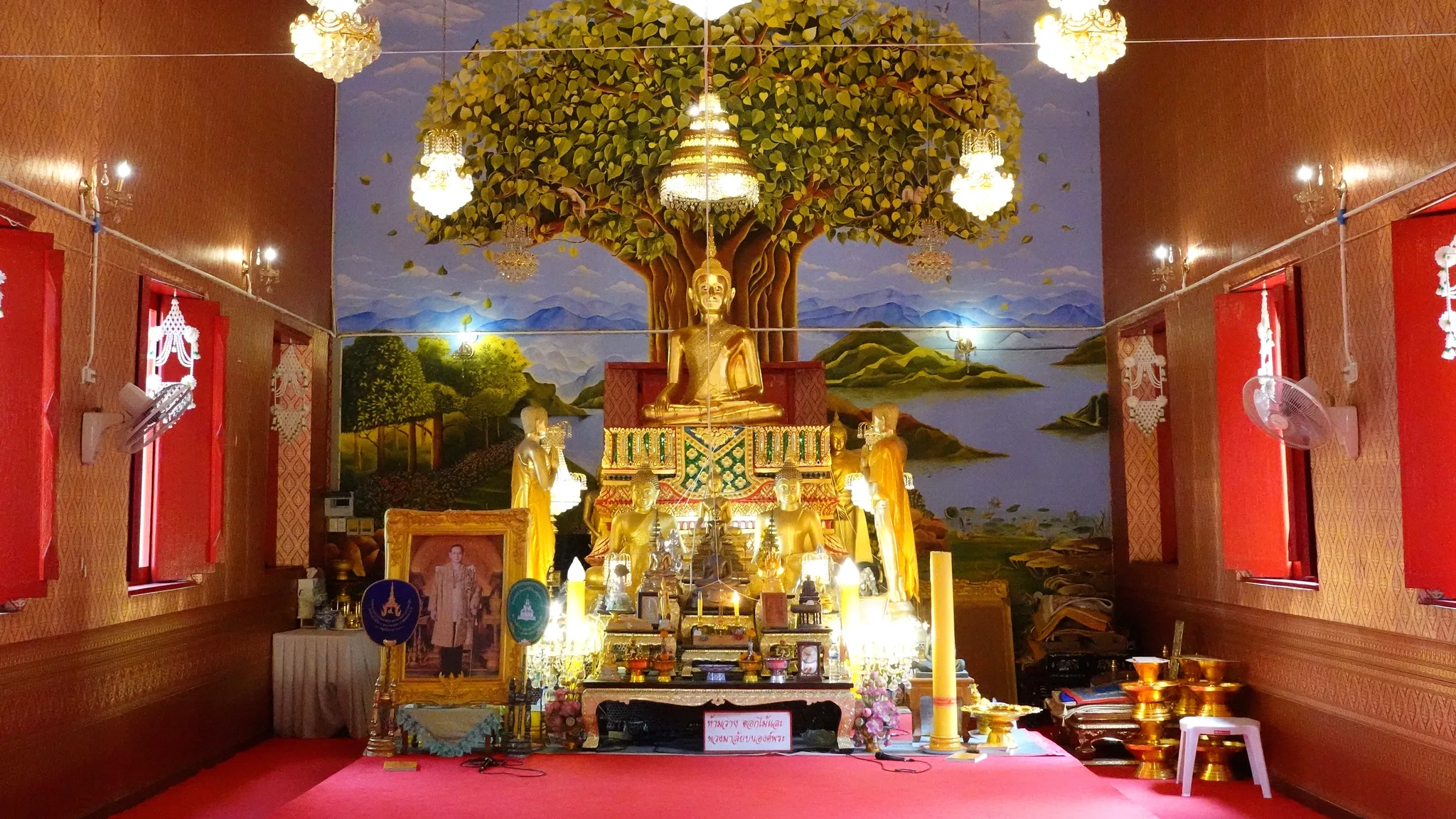
In the worship hall of Wat Bang Nam Phueng Nai, a gilded seated Buddha flanked by standing gilded statues dominates the altar before a mural of a tree and mountains; chandeliers and red shutters frame the scene.© Eric Monteil 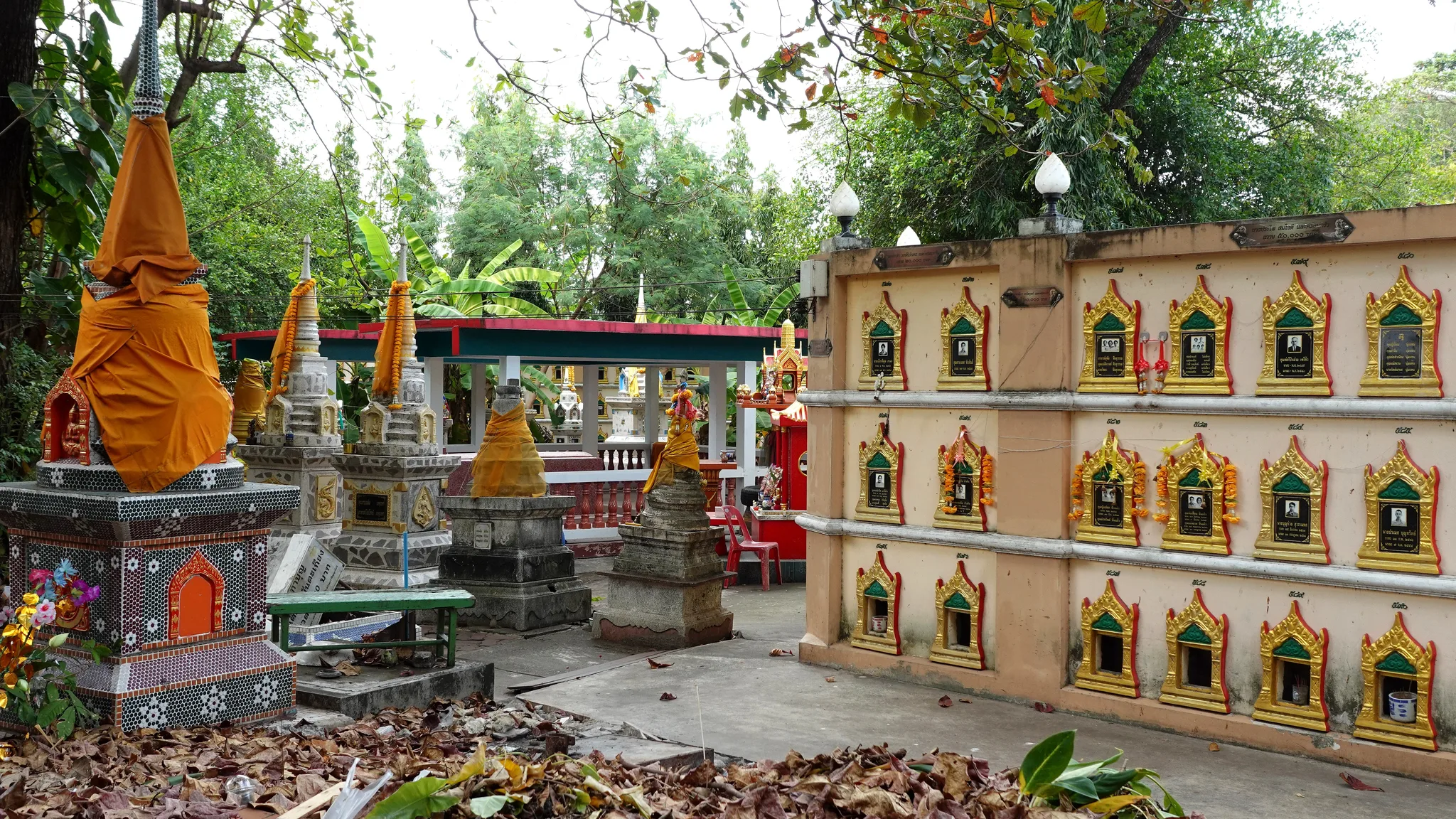
Within the grounds of Wat Bang Nam Phueng Nai, small funerary chedis with mosaic bases, draped in saffron cloth and marigold garlands, face a wall of gilt-framed niches holding portraits and urns.© Eric Monteil
Architecture and decoration
Explore the heritage
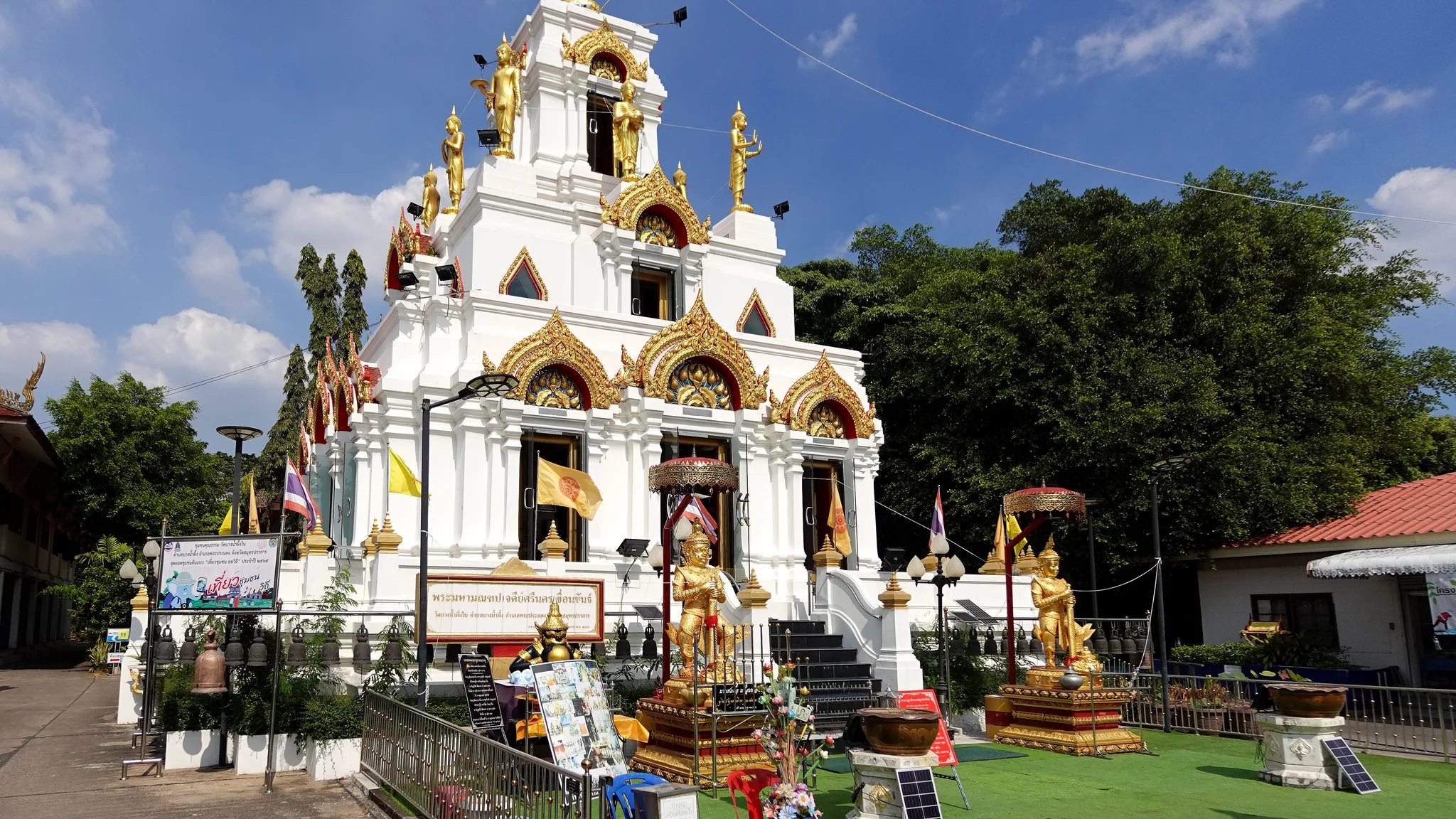
At Wat Bang Nam Phueng Nai, a white multi-tiered building bears gilded gables and golden statues; two golden giant guardians on plinths, rows of bells and flags frame the access by the staircase.© Eric Monteil 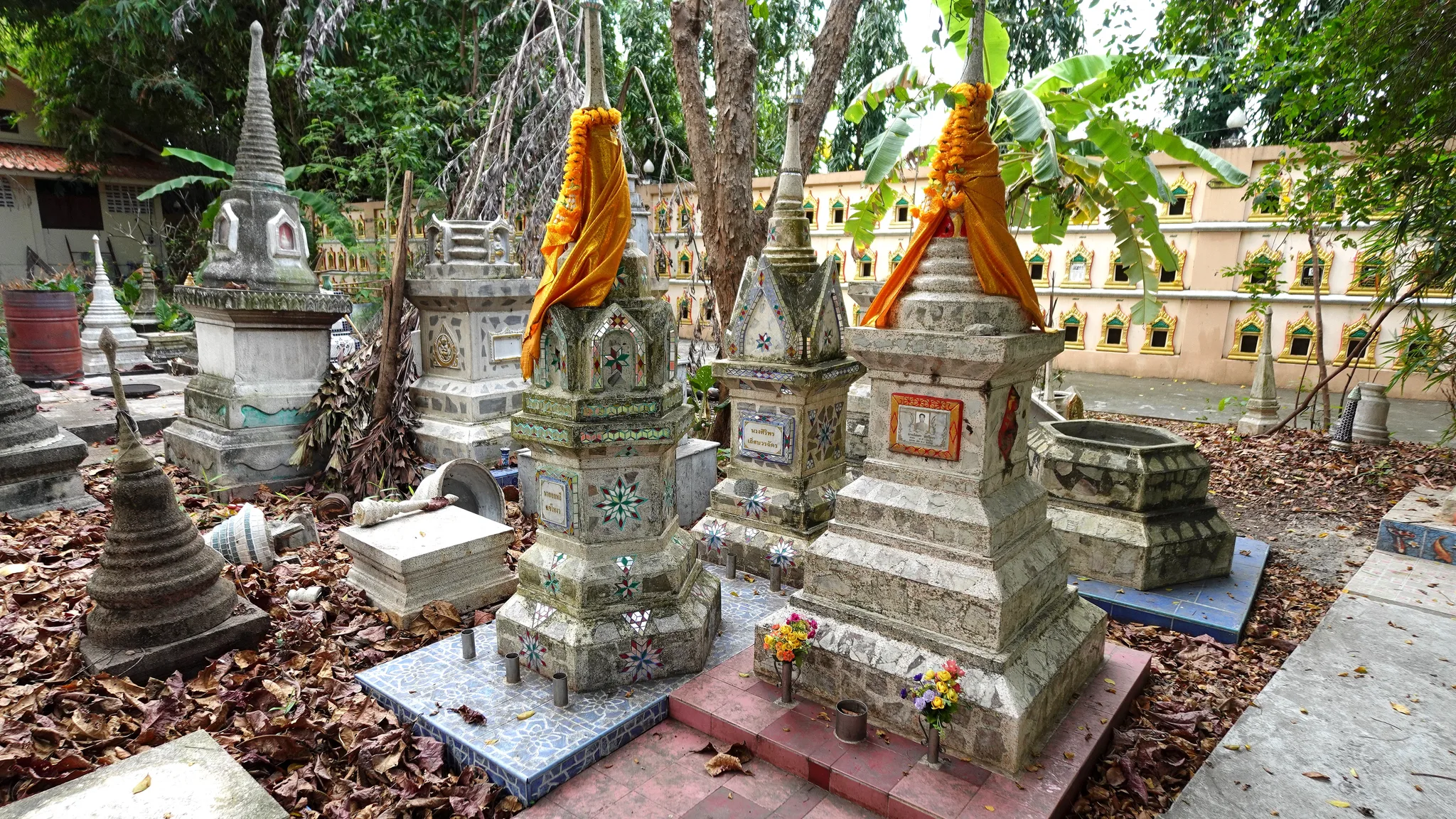
At Wat Bang Nam Phueng Nai, a group of small reliquary chedis with faces inlaid with ceramic fragments, some wrapped in orange cloth and marigold garlands, stands on tiled plinths before the niched enclosure wall.© Eric Monteil