
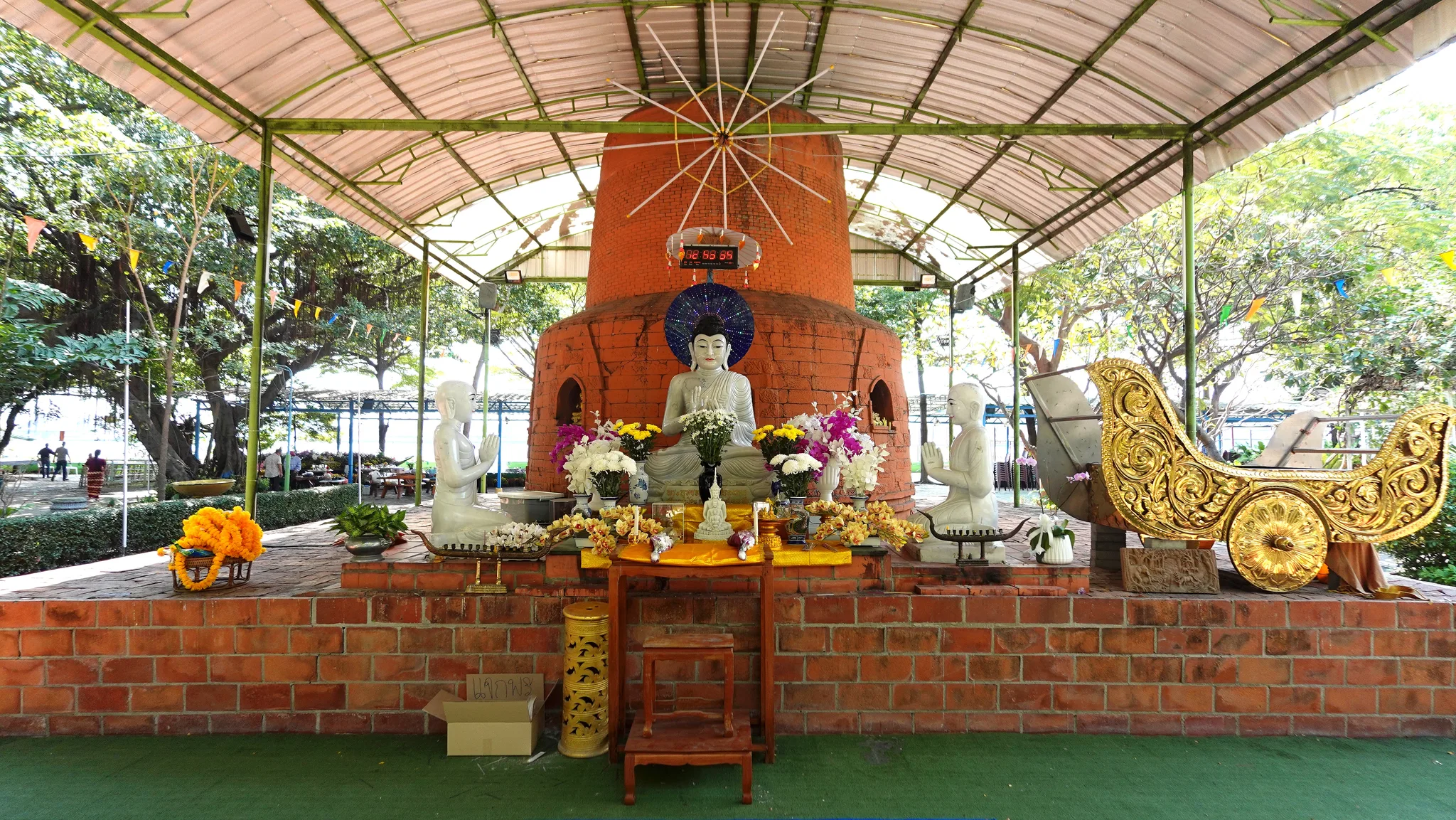
 At Wat Chak Daeng, a white seated Buddha with a blue halo, flanked by two kneeling disciples, stands before a sheltered brick structure. Floral offerings, an altar draped in yellow and a carved gilded chariot complete the ensemble.© Eric Monteil
Buddhist temple
Wat Chak Daeng
Founded in the late eighteenth century in the Bang Krachao loop, Wat Chak Daeng brings together the study of Pali texts, murals and replicas of the great sites of Indian Buddhism.
Heritage family · Buddhism, religions and spiritualities
- Destination
- Samut Prakan (Phra Pradaeng)
- Heritage Family
- Buddhism, religions and spiritualities
- Typology
- Buddhist temple
- Visit
- Available tours →
Wat Chak Daeng is a Buddhist monastery in Phra Pradaeng, Samut Prakan Province, set on the banks of the Chao Phraya River in the still-verdant loop of Bang Krachao. This community temple, founded around 1782, preserves an ancient Buddha statue found in its grounds, Luang Pho Hin, and an ubosot of 1858 decorated with murals. Its precinct also brings together replicas of Buddhist holy sites, including the Dhamek Stupa at Sarnath. Its significance lies above all in teaching: it has become a recognised centre for the study of Pali and the Abhidhamma, open to monks and laypeople alike.6
Key facts
- Destination
- Phra Pradaeng
- Heritage Family
- Buddhism, religions and spiritualities
- Typology
- Buddhist temple
- Places
- Chao Phraya River
- Samut Prakan
- Song Khanong
- Bang Krachao
- Periods
- People
- Phra Khru Thammathon Sumon Nanthiko
- Phra Maha Pranom Dhammalangkaro
- Communities
- Bang Kachao community
- Communauté monastique
- Entreprise communautaire
- Events
- Achèvement du pavillon communautaire (2022)
- Foundation
- Inauguration de la Sudhamma Sala (2015)
- Lancement de la campagne de collecte de bouteilles
- Mise au point de la nano-robe
- Heritage
- Luang Pho Hin
- Glossary
- Wat
- Tambon
- Chao Phraya
- Phraya
- Khlong
- Khlong lat
- Keywords
- —
- Date
- —
- Collections
- —
Practical info
Practical information about this site is taken from its Google Maps page. We advise you to check it before visiting.
- Address
- เลขที่ 16 หมู่ที่ 6 ถนน เพชรหึงษ์ ซอย 10 Tambon Song Khanong, Amphoe Phra Pradaeng, Chang Wat Samut Prakan 10130
- Phone
- Website
A monastery on the banks of the Chao Phraya
In the Bang Krachao loop
Wat Chak Daeng lies in Tambon Song Khanong, Phra Pradaeng District, Samut Prakan Province. It stands on the right bank of the Chao Phraya, not far from the Khlong Lat Pho canal and the Bhumibol Bridge. This stretch of shore belongs to Bang Krachao, a vast meander almost entirely encircled by the Chao Phraya. Its shape often earns it comparison with a stomach, sometimes even a ‘pig’s stomach’.6
Bang Krachao has remained a green area, and the monastery bears its imprint. Coconut groves surround it, and a canal that bears its name, Khlong Chak Daeng, runs along the western side of the precinct. The landscape has nonetheless changed: another canal, Khlong Mon, once ran alongside the temple. It was filled in, then replaced by a road. Accounts differ on the size of the precinct: around 12 rai according to some, 15 rai and 2 ngan according to others; the community has considered acquiring roughly 6 more rai.6
A name from elsewhere
The temple’s name may preserve the trace of a population movement. ‘Chak Daeng’ is said to derive from ‘Chak Daen’, a Thai expression meaning ‘come from another land’. It is thought first to have designated a village formed by people who had left their former homes in Ayutthaya, the old capital of the kingdom. Over time, the place name is said to have become distorted, before being adopted for the monastery. This etymology remains conjecture.6
A late eighteenth-century foundation
A community temple
Wat Chak Daeng was founded in 1782 or thereabouts. The monastery is a wat rat, literally a ‘people’s temple’, that is, a temple that does not belong to the category of royal temples. It comes under the Mahanikai order, one of the two main branches of the Thai Buddhist clergy.6
Another milestone marks its early years. The ground of the ubosot, the ordination hall where the principal acts of the monastic community take place, is the subject of a wisungkhamasima, a royal land grant that officially consecrates this space. The grant dates from around 1787, only a few years after the temple’s foundation.6
Luang Pho Hin and the ubosot
The monastery’s ancient object of worship is a Buddha statue known as Luang Pho Hin. In Thailand, a statue of the Buddha is referred to as an ‘image’, and the title Luang Pho, ‘venerable father’, is given to a temple’s most revered images. Accounts differ: Luang Pho Hin was unearthed near the old ubosot, or behind it. Together with the monastery’s age, this image accounts for the site’s heritage interest.6
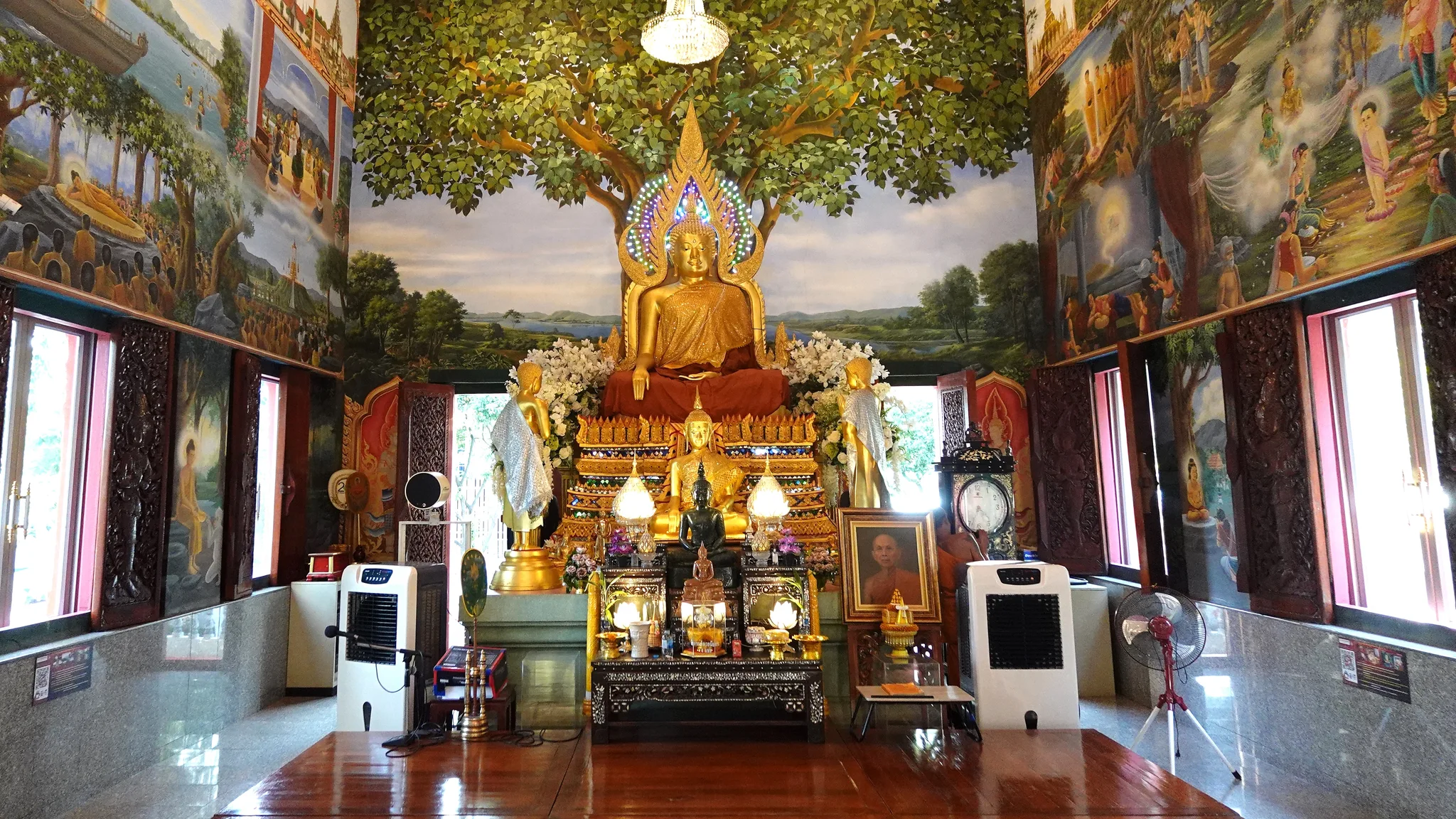
The present ubosot was built in 1858 and restored in 1961. It is an elongated building measuring 7.75 metres by 23.55 metres, its pediment decorated with blue-and-white porcelain. Three buildings, half masonry and half timber, serve as monks’ quarters, and a two-storey prayer hall completes the ensemble.
What can be seen at the monastery
The ubosot murals
The ubosot houses the monastery’s principal Buddha image and a series of murals. They tell the life of the Buddha, and a few scenes depict hell, where figures suffer the consequences of their misdeeds, according to the law of karma.5
On the upper part of the walls, further paintings celebrate the most sacred stupas of Thailand and neighbouring countries. The visitor thus passes from the narrative of the Buddha’s life to a geography of Buddhism’s holy places.5
Replicas of India’s holy sites
Near the river stands a circular brick chedi. It reproduces the Dhamek Stupa at Sarnath, in India, erected on the spot where, according to tradition, the Buddha delivered his first sermon. Its massive, cylindrical form sets it apart from the bell-shaped chedis usually seen in Thailand.5
A second, modern-style stupa overlooks the river, with an access stairway and a terrace. At the top of its four storeys, a hall houses a replica of the Buddha of the Mahabodhi Temple at Bodh Gaya, in India, the place where, according to tradition, the Buddha attained Awakening.5
The sala and the Phra Phuttha Chinnarat
Parallel to the ubosot, the sala kan parian, the hall where sermons are heard, measures 10.45 metres by 29 metres. It houses a large gilded Buddha statue, a replica of the Phra Phuttha Chinnarat, the emblematic image of Phitsanulok, often described as one of the most beautiful in Thailand.5
Its wooden floor and its proportions make it a place of contemplation and meditation. Together with the murals and the two stupas, it forms within the precinct a route linking a neighbourhood temple to the great sites of Buddhist memory.
The abbots and the community
The turning point of 1980
Between 1960 and 1979, three abbots succeeded one another at the head of the monastery. In 1980, at the request of the temple committee, Phra Thep Kitti Panyakhun, also known as Kittivuddho Bhikkhu, invited a monk to take charge of Wat Chak Daeng.
That same year saw the beginning of the abbacy of Phra Khru Thammathon Sumon Nanthiko, who holds the honorific title of Aggamahapandita. He led the monastery for nearly forty years, until 2019.
A builder monk
Since 2020, the monastery’s twelfth abbot has been Pranom Dhammalangkaro. Born in 1965 in Non Thai District, Nakhon Ratchasima Province, he entered as a novice on 26 February 1977. He received full ordination on 1 July 1986 at Wat Tha Mao, in Lampang. He holds the sixth grade of the Pali examinations, recalled by the designation placed after his name. Before leading Wat Chak Daeng, he served as its deputy abbot.8
In 2021, he received two ecclesiastical titles a few months apart: Phra Methi Wachirasophon in March, then Phra Ratchawatcharabandit in July, the name by which he is now known. He is nicknamed the ‘builder monk’ of Phra Pradaeng. He is also the initiator of the monastery’s waste management programme.7
A temple of study and practice
Pali and the Abhidhamma
Wat Chak Daeng owes its reputation first and foremost to the study of texts. It is both a temple of study and a temple of practice, and teaching holds a central place there. The monastery is a school of Abhidhamma, one of the three divisions of the Buddhist canon, devoted to the analysis of mind and phenomena. Pali, the language of the canonical texts, is also taught there intensively.10
Monks and novices follow the official curriculum of the clergy, known as Sanam Luang. The monastery also opens its doors to laypeople: at weekends, classes cover the Abhidhammatthasangaha, a manual summarising the Abhidhamma. In October 2015, Wat Chak Daeng was designated an ‘exemplary school of religious studies’, a distinction recognising the quality of this teaching.2
A curriculum for reading the canon
Beyond the official curriculum, the monastery offers a major Pali programme devoted to the Tipitaka, the Pali name for the Buddhist canon, and to ancient texts. This programme, called Tipitaka Sikkhalai, is open to monks, novices and laypeople. It comprises three levels: a one-year elementary Tipitaka, a two-and-a-half-year intermediate Tipitaka, then a two-year level of Dhammacariya, ‘master of the Dhamma’.6
This curriculum is attracting attention beyond Thailand. A delegation of Sri Lankan monks came to Wat Chak Daeng to learn how it is organised.9
Meditation in step with the festivals
Study goes hand in hand with practice. The temple organises retreats and meditation sessions during the major Buddhist festivals: Magha Puja, which commemorates the spontaneous assembly of disciples around the Buddha; Visakha Puja, which celebrates his birth, Awakening and extinction; Asalha Puja, which recalls his first sermon. Public holidays give rise to similar activities.6
The monastic community is a large one. In October 2024, it numbered some sixty-eight Thai monks and novices, joined by around ten elders from abroad.
The monastery today
New halls for the community
The precinct continues to evolve. On 8 March 2015, the community formally inaugurated a new hall, the Sudhamma Sala, funded by the donations of the faithful. Seven years later, in March 2022, a two-hundred-seat community pavilion designed by THANAWATCHU was completed.6
The pavilion hosts religious ceremonies, but also weddings and funerals. It shows how the monastery remains a place where the great moments in local people’s lives are lived.14
Recycling and visitors
Wat Chak Daeng is also known well beyond the region for its plastic waste recycling programme, which notably turns bottles into monks’ robes. This activity is the subject of a separate JARUK record, ‘Wat Chak Daeng Plastic Recycling Centre’.4
The Designated Areas for Sustainable Tourism Administration (DASTA), the public agency responsible for sustainable tourism, has included Wat Chak Daeng in a community tourism route in Tambon Song Khanong.
Understanding
Wat Chak Daeng is first and foremost a neighbourhood monastery, born in the late eighteenth century on the banks of the Chao Phraya, in the Bang Krachao loop. Its early history rests on few traces: a name perhaps derived from a settlement that came from Ayutthaya, a Buddha image unearthed from its soil, an ubosot of 1858 with murals of the life of the Buddha. Its community has made it a school where Pali and the Buddhist canon are studied, open to monks and laypeople alike, and a place of meditation in step with the great festivals. Its precinct also brings together replicas of the great holy sites of Indian Buddhism, the Dhamek Stupa at Sarnath and the Buddha of the Mahabodhi, as well as a copy of the Phra Phuttha Chinnarat. The monastery is also known for its plastics recycling, presented in a separate record. What will be remembered of this place tomorrow: a temple for the study of the canon, or a sanctuary that brings the holy places of Buddhist India to the banks of the Chao Phraya?
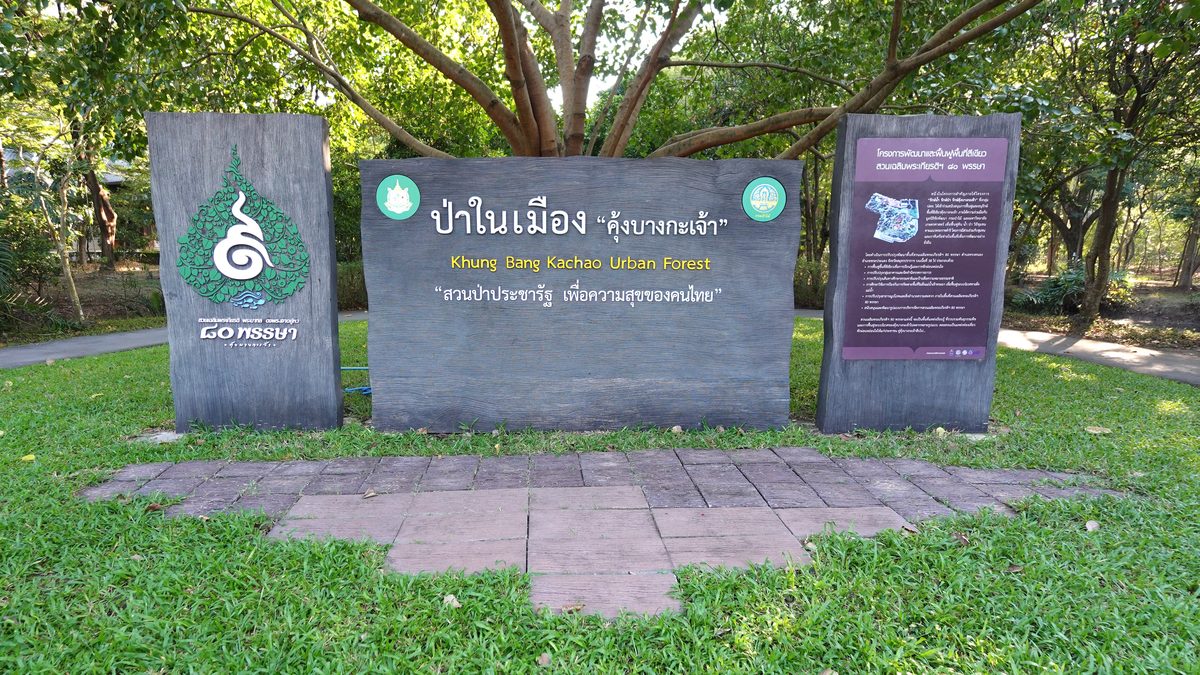
Bang Krachao, the "green lung" of Bangkok, between canals, Mon heritage, temples, biodiversity and sustainable initiatives.
- Wat
- Buddhist monastic complex that brings together, within a single enclosure, several religious buildings, monks’ quarters and ancillary buildings; the word does not refer to a single building.
- Tambon
- A Thai administrative subdivision grouping several villages, ranking below the district.
- Chao Phraya
- Highest title of the Siamese nobility, held by senior dignitaries of the court.
- Phraya
- Rank of the Siamese court nobility, immediately below that of chao phraya; it precedes the dignitary’s title name.
- Khlong
- Canal or waterway, natural or man-made, which long played a major role in transport, irrigation and the organisation of settlements and territories in Thailand.
- Khlong lat
- In Thai, a canal dug across the neck of a meander to cut off a river loop and shorten the route taken by water and boats.
- Bang
- Thai word for a village or settlement established at the water’s edge, along a river or canal. It forms part of a great many place names in the central plain.
- Royal temple
- In Thailand, a Buddhist temple founded, restored or patronised by the king or the royal family, and graded according to an official hierarchy of ranks and categories.
- Mahanikai
- One of the two main branches, or orders, of the Buddhist clergy of Thailand.
- Luang Pho
- Thai honorific title meaning 'venerable father', given both to respected monks and to the most highly revered images of the Buddha.
- Ubosot
- Consecrated ordination hall of a wat: the ritually central building, marked out by sacred boundary stones, where monastic ordinations take place.
- Dhamma
- Buddhist doctrine, that is, the teaching of the Buddha.
- Ordination
- Ceremony by which a layperson is admitted as a novice or as a monk into the Buddhist community.
- Pali
- The language of the canonical texts of Theravada Buddhism.
- Abhidhamma
- The part of Buddhist teaching that analyses the mind and phenomena.
- Tipitaka
- Canon of the scriptures of Theravada Buddhism, written in Pali and divided into three ‘baskets’: monastic discipline, discourses of the Buddha and the Abhidhamma.
- Awakening
- In Buddhism, the state of understanding and clarity reached at the end of the spiritual path, which frees one from ignorance and suffering.
- Sala
- A pavilion for communal use, often open-sided, where people gather, rest or listen to sermons, particularly within monastery grounds.
- Buddha image
- In Thai Buddhism, a devotional representation of the Buddha, most often a statue, venerated as an object of worship.
- Sangha
- The body of monks who reside in a monastery and live there according to religious discipline; in Buddhism it is called the sangha.
- Phra Khru
- Ecclesiastical title conferred on monks within the hierarchy of the Thai monastic community.
- Sri
- Word of Sanskrit origin expressing glory, prestige and prosperity, used in Thai as an honorific element in the names of places, buildings and people.
- Dhammacariya
- Pali term meaning ‘teacher of the Dhamma’, denoting a teacher of Buddhist doctrine and, by extension, the higher level of certain programmes of study of the canonical texts.
- Magha Puja
- Buddhist festival held on the full moon of the third lunar month, commemorating the spontaneous assembly of disciples who came to hear the Buddha.
- Visakha Puja
- The principal Buddhist festival, held on the full moon of the sixth lunar month, commemorating the birth, Awakening and final passing of the Buddha.
- Aggamahapandita
- Honorary Pali title, meaning ‘foremost great scholar’, awarded by the Burmese state to distinguished Theravada monks for their scholarship in the study and teaching of Buddhist texts.
- Sanam Luang
- Common name for the official curriculum of study and examinations of the Thai Buddhist clergy, in Dhamma and Pali, organised nationally; it is taken from the name of the royal esplanade in Bangkok.
- Abhidhammatthasangaha
- Pali manual attributed to Anuruddha that summarises the doctrine of the Abhidhamma; it serves as a basic text for the study of this part of the canon in Theravada Buddhism.
- Sanghati
- Outer robe of a Buddhist monk, of double thickness, one of the three garments of monastic dress prescribed by the discipline.
Primary sources
- 1วัดจากแดง ตำบลทรงคนอง จังหวัดสมุทรปราการ, Watstory ↗
Studies
Reference works
- 6Wat Chak Daeng, ประวัติ วัดจากแดง, watchakdaeng.com, 2017 ↗
- 7Wat Chak Daeng, ประวัติเจ้าอาวาสวัดจากแดง พระราชวัชรบัณฑิต (ประนอม ธมฺมาลงฺกาโร), watchakdaeng.com, 2020 ↗
- 8Wat Chak Daeng, ลำดับเจ้าอาวาส วัดจากแดง, watchakdaeng.com, 2020 ↗
- 9Wat Chak Daeng, พระเมธีวชิรโสภณ (ประนอม ธมฺมาลงฺกาโร ป.ธ.๖), watchakdaeng.com, 2021 ↗
- 10Wat Chak Daeng, วัดจากแดง อ.พระประแดง จ.สมุทรปราการ (page d'accueil), watchakdaeng.com ↗
- 11เส้นทางท่องเที่ยวโดยชุมชนตำบลทรงคนอง, DASTA (Designated Areas for Sustainable Tourism Administration) ↗
- 12วัดจากแดง, Municipalité de Pu Chao Saming Phrai ↗
- 13Contributeurs Wikipédia, วัดจากแดง, Wikipédia en thaï ↗
- 14THANAWATCHU, Wat Chak Daeng Community Pavilion, Archello, 2022 ↗
Contemporary views
Wat Chak Daeng today
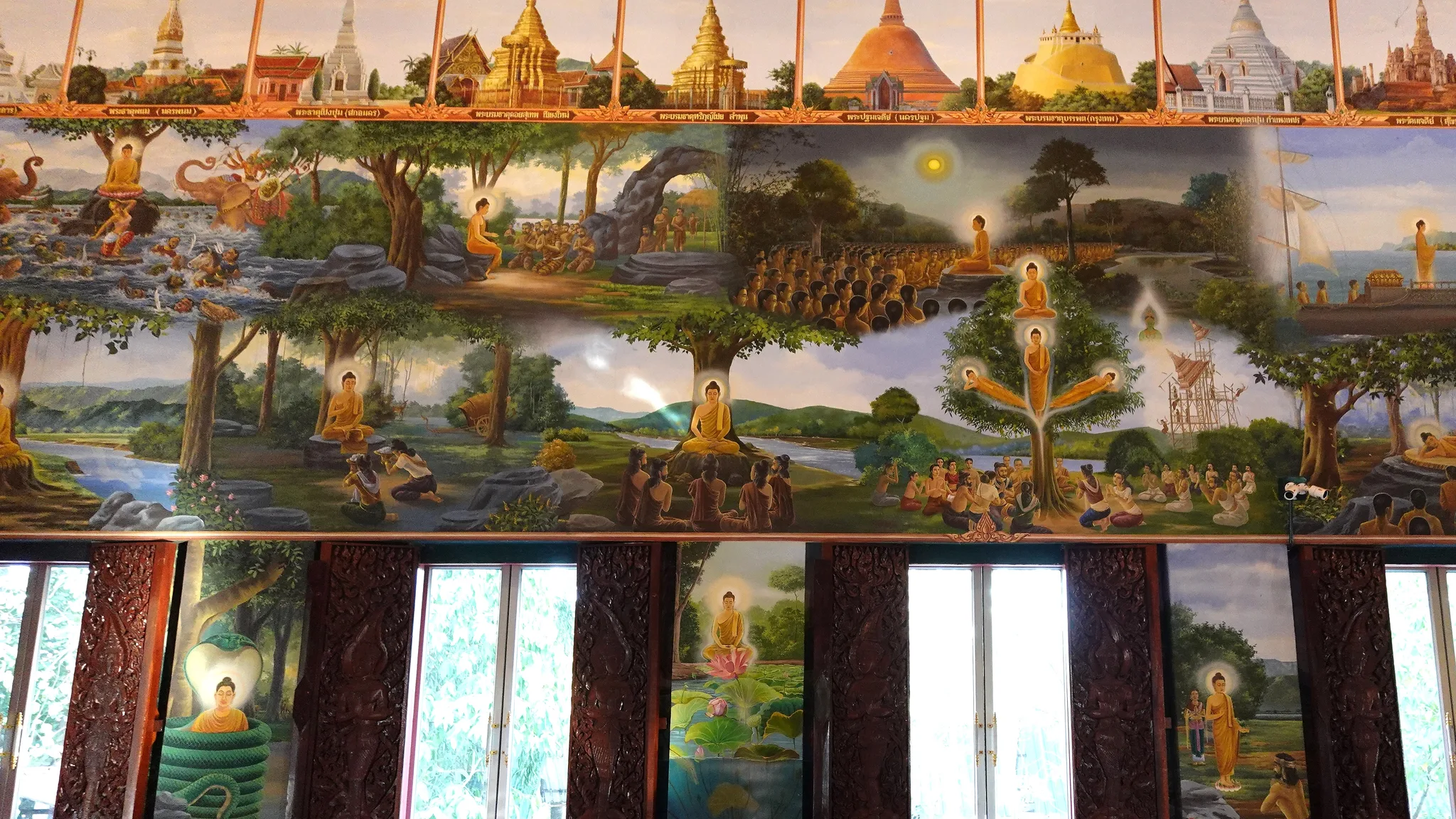
At Wat Chak Daeng, an interior wall bears mural paintings depicting episodes from the life of the Buddha, beneath a frieze of chedis; below, carved wooden shutters frame open windows.© Eric Monteil 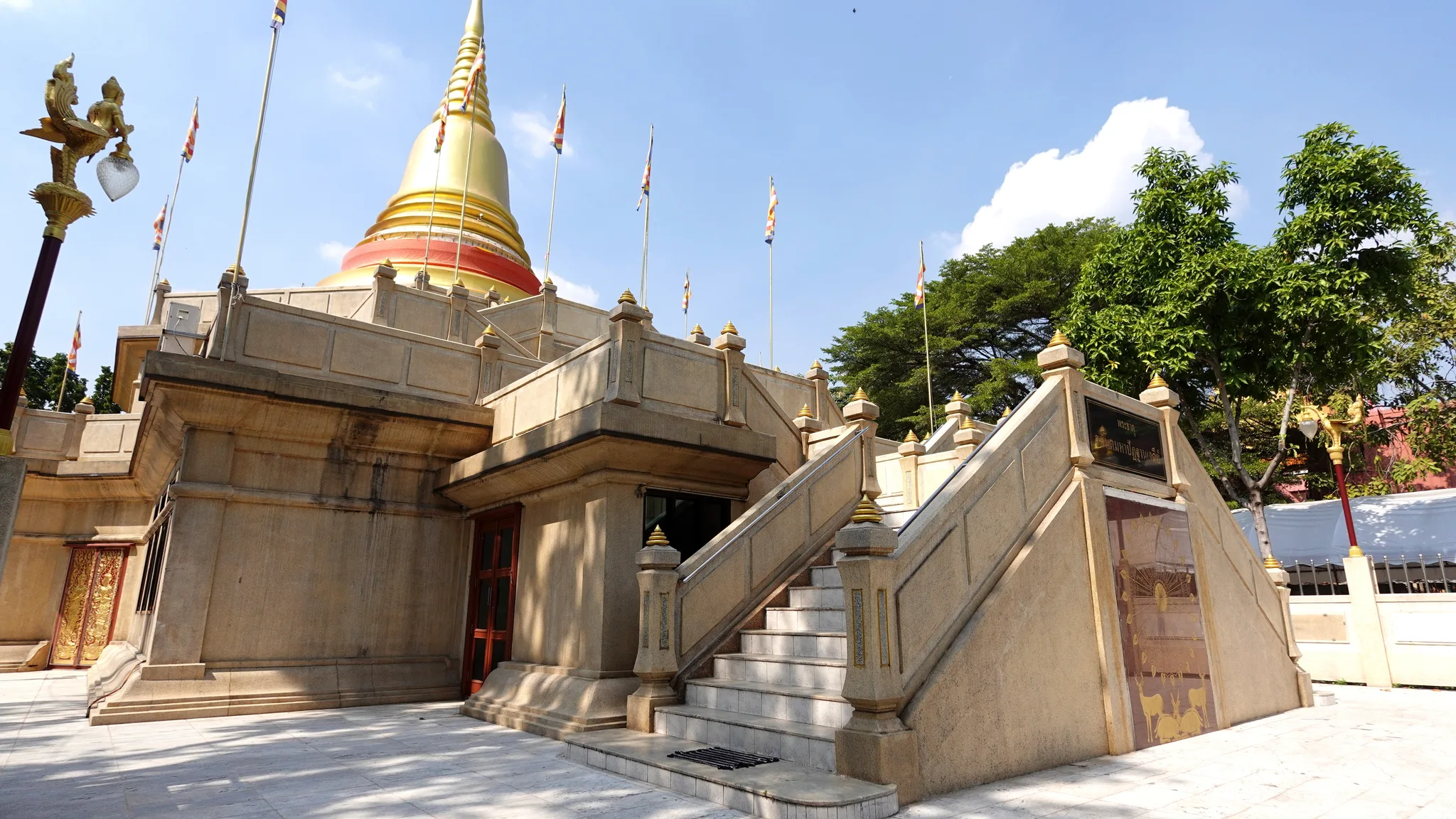
At Wat Chak Daeng, a staircase lined with balustrades leads to the terraces of the pale stone base of the golden chedi, ringed with a red band and surrounded by Buddhist flags; red and gilded doors open at ground level.© Eric Monteil
Architecture and decoration
Explore the heritage
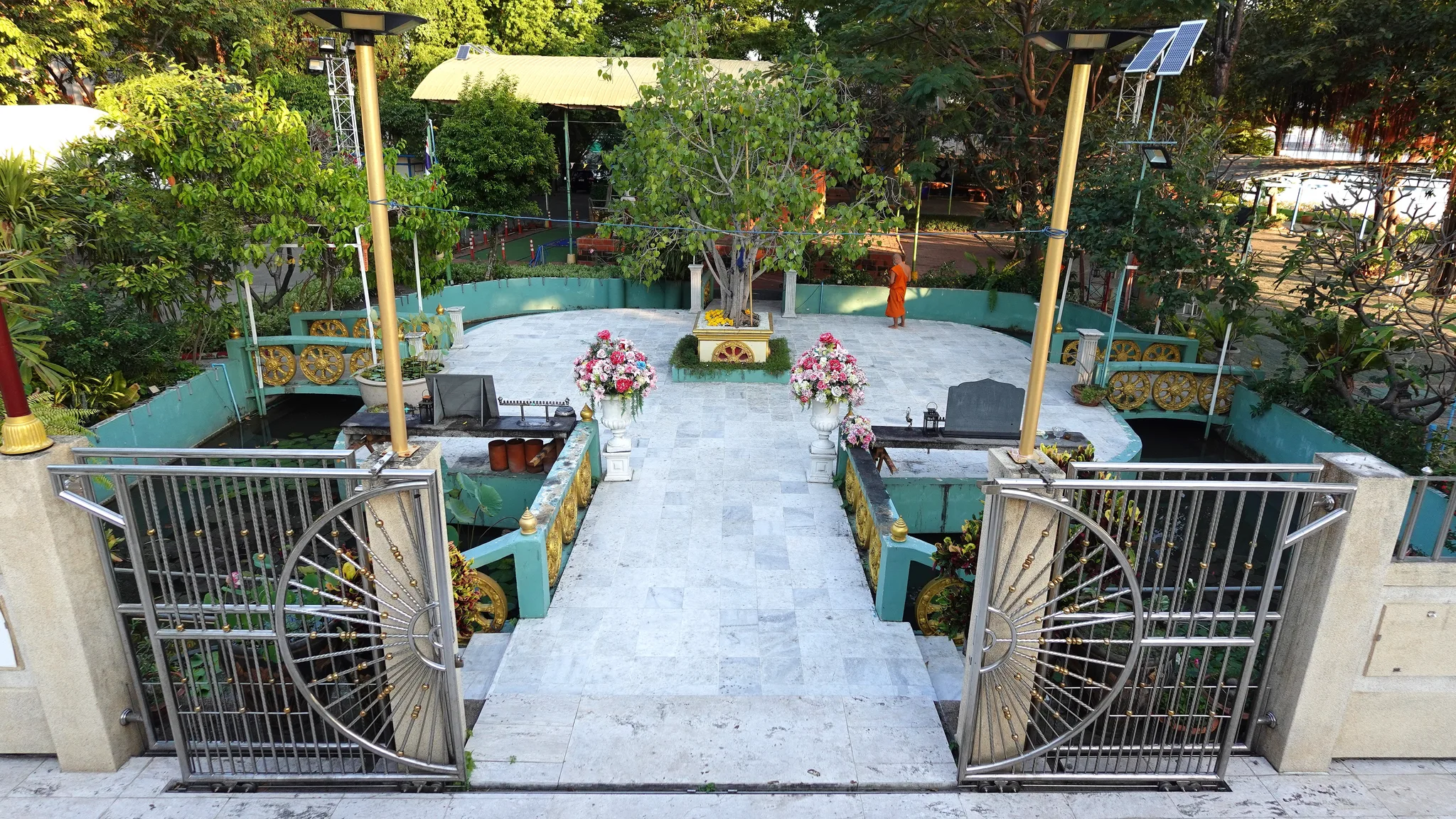
At Wat Chak Daeng, a metal gate opens onto a marble terrace bordered by ponds; turquoise balustrades adorned with golden wheels, flower-filled vases and offering tables surround a tree planted on a decorated base.© Eric Monteil 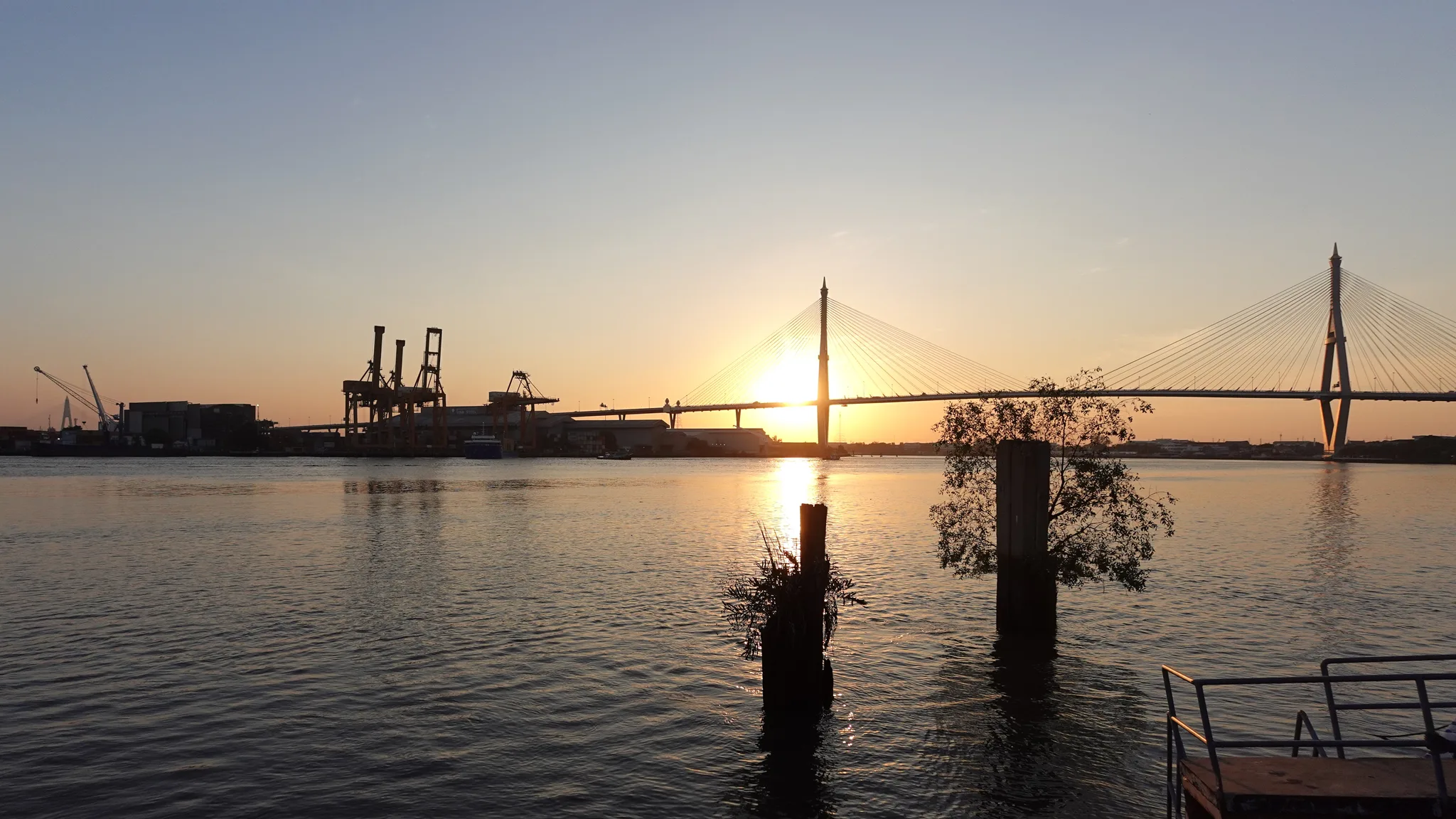
From the bank at Wat Chak Daeng, the setting sun lights the river, spanned in the distance by a cable-stayed bridge; port cranes rise on the opposite bank, while wooden piles and a pontoon occupy the foreground.© Eric Monteil