
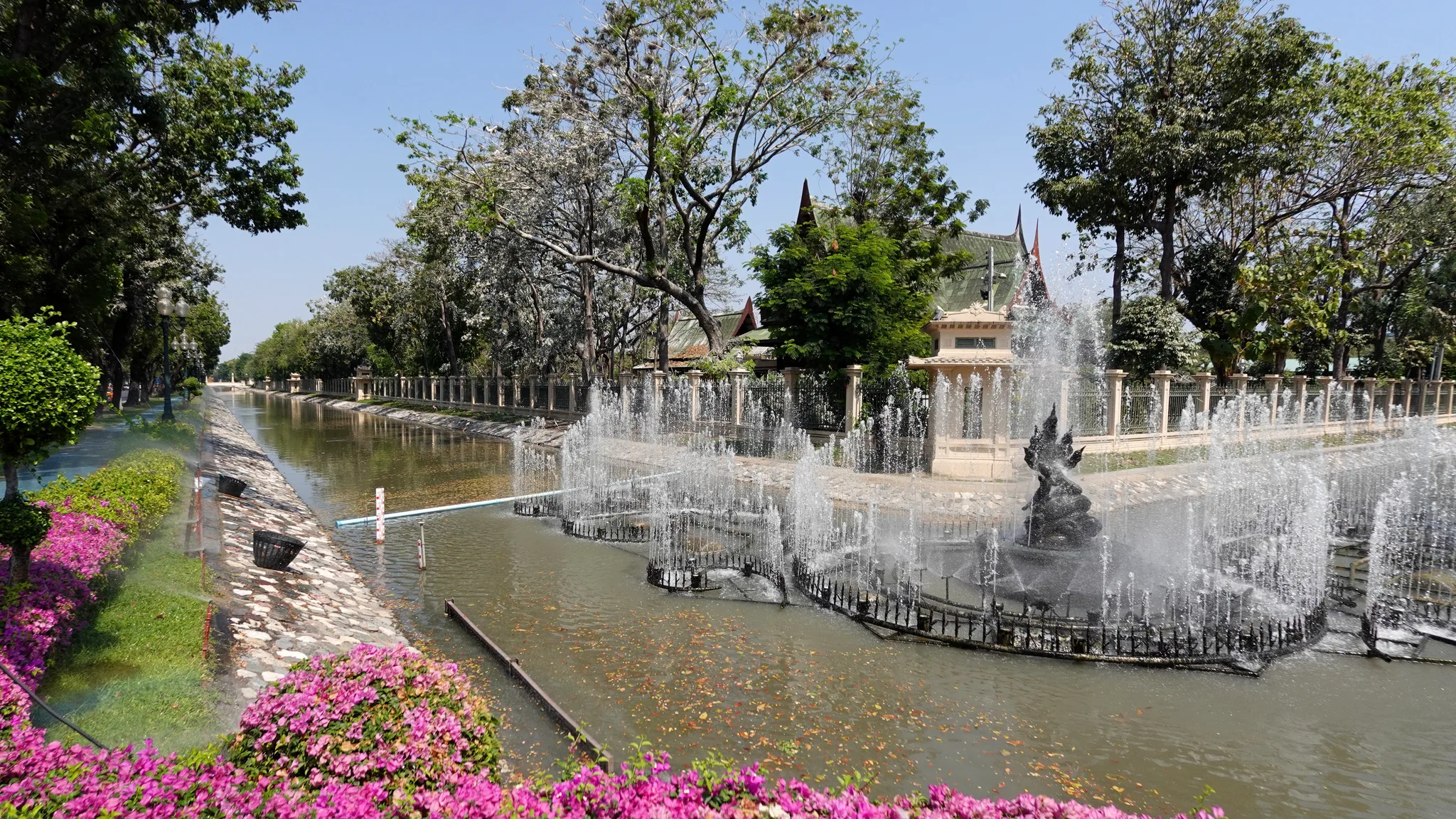
 In Dusit District, a straight canal lined with paved banks holds water jets around a dark statue; behind a long fence with pale pillars rise the pointed roofs of a Thai-style pavilion.© Eric Monteil
- Destination
- Bangkok (Dusit)
- Heritage Family
- Cities, territories and cultural landscapes
- Typology
- Neighbourhood & district
- Visit
- Available tours →
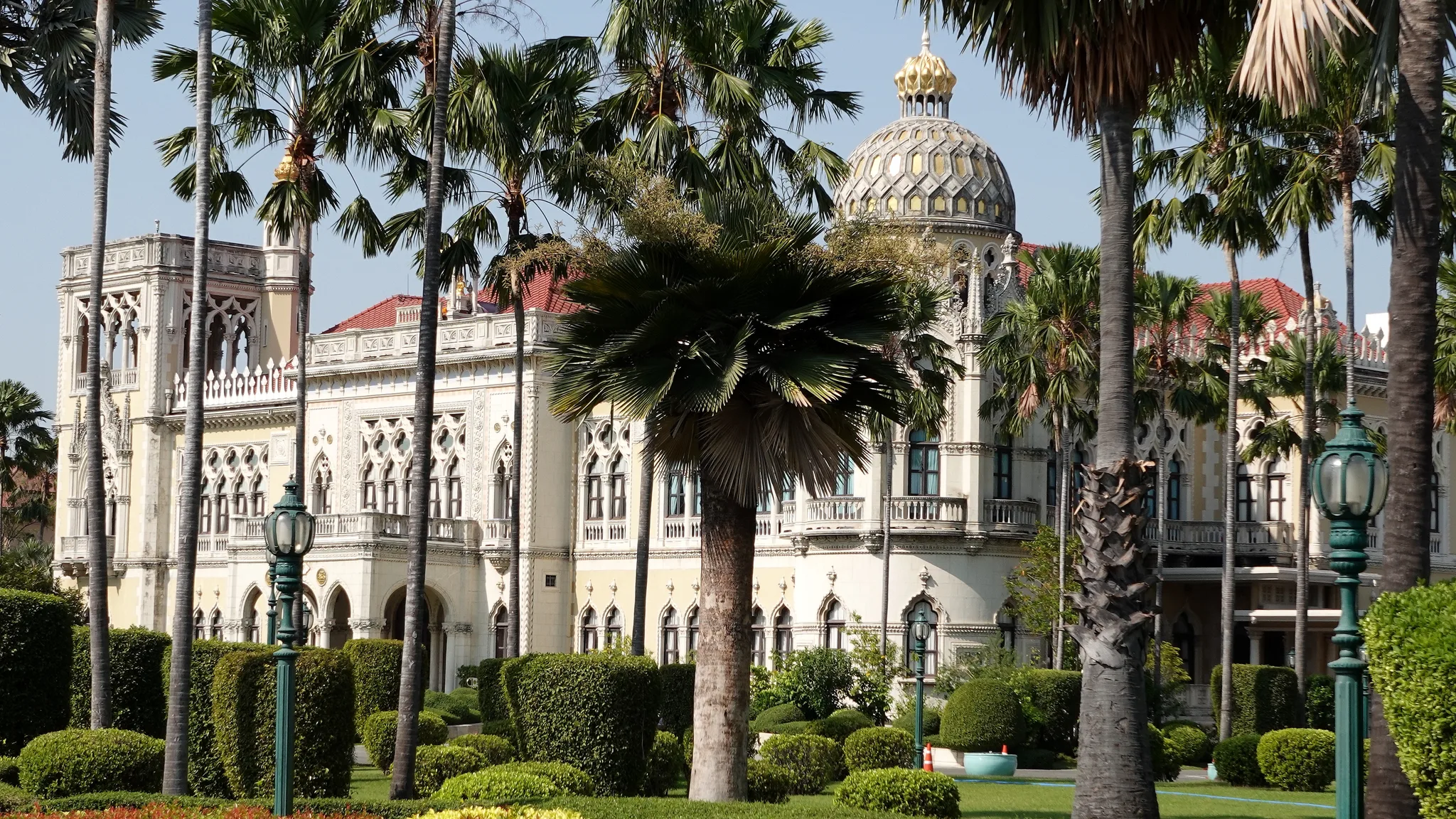
Dusit District is an administrative district of the Thai capital, lying north of its historic centre. It takes its name from a royal domain created in the late 19th century by King Chulalongkorn. The district marks the moment when Bangkok broke out of its walls and spread beyond the old city. It was also here that the revolution of 1932 and the granting of the country’s first permanent constitution took place. At once royal residence, ceremonial stage and political arena, it brings together Dusit Palace and its gardens, the Ananta Samakhom Throne Hall facing the Royal Plaza, and Wat Benchamabophit, the marble temple commissioned by the same monarch.4
Key facts
- Destination
- Bangkok
- Heritage Family
- Cities, territories and cultural landscapes
- Typology
- Neighbourhood & district
- Places
- —
- Periods
- People
- Bhumibol Adulyadej
- Maha Vajiralongkorn
- Rama V
- Prajadhipok (Rama VII)
- Vajiravudh (Rama VI)
- Queen Sirikit
- Communities
- —
- Events
- Construction of the Ananta Samakhom Throne Hall
- Closure of the Ananta Samakhom Throne Hall
- Diamond Jubilee of King Bhumibol
- Granting of the first permanent constitution
- Siamese revolution of 1932
- Heritage
- Equestrian Statue of King Chulalongkorn
- Glossary
- Royal project
- Phra thinang
- Wat
- Ubosot
- Ordination
- Khwaeng
- Keywords
- —
- Date
- —
- Collections
- —
Practical info
Practical information about this site is taken from its Google Maps page. We advise you to check it before visiting.
- Address
- Dusit District, Bangkok
A district born of a royal domain
Leaving Rattanakosin Island
In the late 19th century, Bangkok was still confined to Rattanakosin Island, the historic heart of the capital, protected by its walls. King Chulalongkorn, known as Rama V, resolved to cross these limits and to lay out a vast territory north of the island. Two projects made this movement possible, and then encouraged it: the building of Dusit Palace and the laying out of Ratchadamnoen Avenue. The district that today bears the name Dusit grew out of this royal project. Its name, its character and its principal monuments all stem from a monarch’s decision to live outside the old city.4
Dusit District is today a khet, that is, one of the capital’s administrative districts. It is divided into five khwaeng, or sub-districts, and its administrative seat is also called Dusit. This administrative framework overlays a landscape inherited from the court. The places that define its heritage identity – palace, throne hall, plaza and temple – almost all date from the two decades either side of 1900. To read the district, then, is first of all to understand how a royal domain became a piece of the city.4
From celestial garden to celestial residence
The name itself tells this story. Chulalongkorn first called the domain Suan Dusit, the ‘celestial garden’. The king took to living there. He went to the Grand Palace, the official residence of the kings on Rattanakosin Island, only for state and royal ceremonies. The garden then became Wang Dusit, the ‘celestial residence’. The palace was also originally known as Wang Suan Dusit, the ‘palace of the Dusit garden’.5
The shift from garden to palace reflects a change of status. A pleasure ground laid out on the outskirts became the monarch’s everyday home. The old palace, for its part, was gradually reserved for ceremonial. This division of roles between the old city and the new domain shapes the whole history of the district. It explains the concentration, in the north of Bangkok, of royal residences, gardens and reception venues.
Dusit Palace and its gardens
A residence conceived on the return from Europe
The idea of a royal residence surrounded by extensive gardens on the outskirts of the capital took shape during Chulalongkorn’s journey to Europe in 1897. On his return, the king set aside land for a royal garden. Dusit Palace was built between 1897 and 1901 on a vast site north of Rattanakosin Island. It is not a single building. It is an ensemble of residences and gardens, within which the Amphorn Sathan, dated to 1906, became the main residential building.5
Over successive reigns, Dusit Palace became the kings’ principal residence, without ever replacing the Grand Palace as the official one. After Chulalongkorn, King Vajiravudh, King Prajadhipok, King Bhumibol Adulyadej and King Maha Vajiralongkorn each lived there in turn. The domain conceived as a retreat thus became, for more than a century, the setting of the monarchy’s daily life.5
Vimanmek, a teak mansion reassembled
The best-known building in the domain is the Vimanmek Mansion. It is a large L-shaped teak residence in a style described as ‘Victorian-Thai’. Its material history is unusual. The building was constructed from the Munthatu Rattanaroj Residence, which belonged to the Phra Chuthathut Palace on the island of Ko Sichang, in Chonburi Province. That residence was dismantled and then reassembled in the Dusit garden. The dates put forward for the work range from 1897 to 1903. All of them, however, place it in the domain’s earliest years.8
The mansion went on to a second life. During the celebrations of Bangkok’s bicentenary, Queen Sirikit, consort of King Bhumibol, asked him to restore Vimanmek as a museum in memory of Rama V. The residence thus changed its function. Once a home of the court, it became a place of remembrance dedicated to the founder of the domain. It has been closed to the public since 21 July 2016.8
Expansion to the north
The domain continued to grow after the palace was completed. In 1908, returning from his second journey to Europe, Chulalongkorn extended it northwards with a private garden, Suan Sunandha. He named it in honour of his first consort, Queen Sunandha. The Suan Sunandha Palace, built within this extension, was intended for the queen, the royal consorts, and the princes and princesses.5
Five years later, in 1913, King Vajiravudh in turn created the Suan Chitralada garden, between Dusit Palace and Phaya Thai Palace. In some fifteen years, the north of Bangkok was thus covered with royal gardens and residences.5
Ananta Samakhom and the Royal Plaza
A throne hall for a reign anniversary
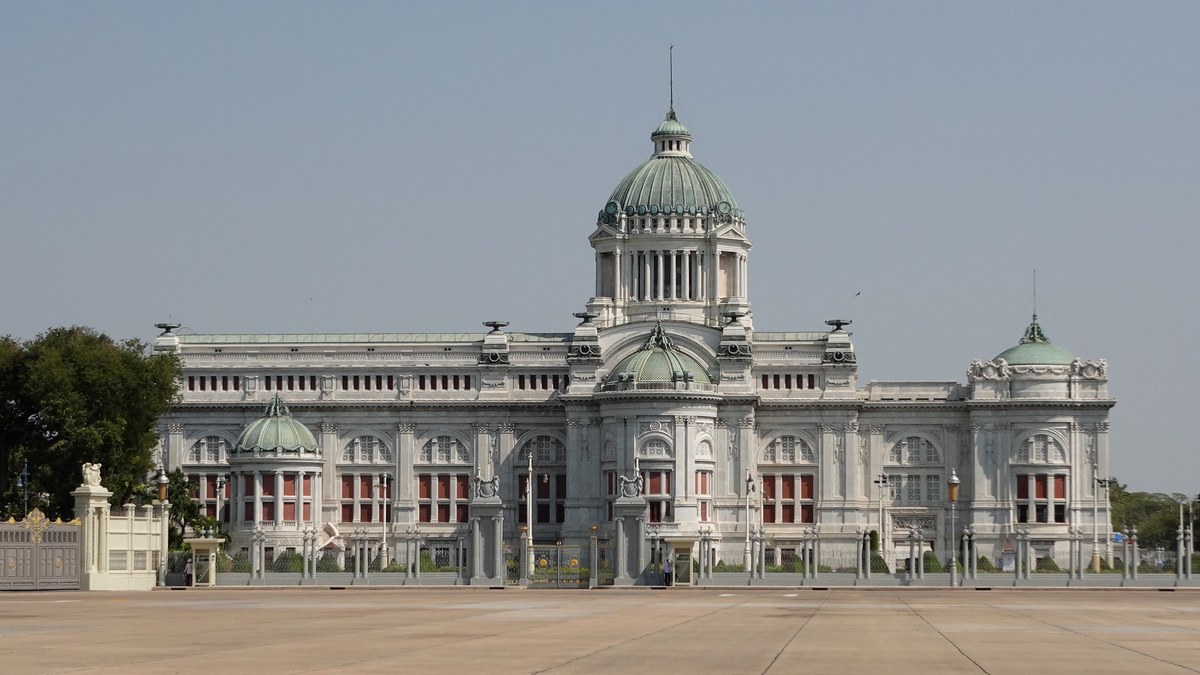
At the heart of the domain, Chulalongkorn had a throne hall built for major royal receptions. He laid its foundation stone on 11 November 1908, for the fortieth anniversary of his first coronation. Its Thai name, Phra Thinang Anantasamakhom, translates as ‘the place of the immense assembly’. The king took it from an older throne hall, which he had demolished so as to pass its name on to the new building. He did not live to see the work completed. He died in 1910, and the hall was not finished until 1915.7
The Ananta Samakhom Throne Hall is a domed neoclassical reception hall. Its painted decoration is the work of Galileo Chini and Carlo Riguli, two artists in the service of Rama V. The building thus combines a European style with the function of royal reception.7
A plaza before the throne hall
In front of the Ananta Samakhom Hall stretches the Royal Plaza, officially named Dusit Palace Plaza. It extends at the foot of what was once the reception hall of Dusit Palace. The equestrian statue of Chulalongkorn stands there, facing the building. Suan Amporn park adjoins the plaza. Together, the hall, the plaza, the statue and the park form the most open space in the domain. It is here that the monarchy, and later the power born of 1932, presented themselves to the crowd.6
Wat Benchamabophit, temple of the fifth king
A monastery attached to the palace
The royal domain also has its place of worship. Wat Benchamabophit Dusitvanaram is a wat, that is, a Buddhist monastery. It was built in 1900 at the behest of Rama V. Its name literally means ‘temple of the fifth king near Dusit Palace’. It thus ties the monastery both to the monarch and to his new residence. The king dedicated it to his royal maternal lineage.11
This link with the court can still be read within the precinct. It contains the Benchamabophit National Museum and two royal pavilions, Phra Thinang Song Phanot and Phra Thinang Song Tham. The monastery, still active and open to visitors, is regarded as a ‘living archive’ of the modern Thai era. Its buildings and objects indeed still bear the mark of the reign that shaped the district.9
Marble and the four-gabled plan
The principal building is the ubosot, the monastery’s ordination hall. It is built of white Italian marble. Yet it follows a traditional Thai four-gabled plan, known as chaturamuk. In a single building, an imported material thus meets a form inherited from the country’s religious architecture. A small canal runs alongside the ubosot.11
A statue cast from the metal of cannons
The temple houses a statue of the Buddha cast in Phitsanulok from decommissioned brass cannons. The casting ceremony began on 20 October 1901. The statue was installed in the temple on 13 December of the same year. It then underwent a so-called ‘eye-opening’ ritual, and was consecrated. The metal of former weapons thus became that of a sacred image, at the heart of a monastery founded by the king.9
1932: constitutional power at Dusit
The revolution and the first constitution
On 24 June 1932, the Royal Plaza and the Ananta Samakhom Hall were at the heart of the revolution of 1932, one of the major events in Thai history. The place designed for royal receptions became the setting for a change of regime. A few months later, on 10 December 1932, the country’s first permanent constitution was solemnly granted in the throne hall. The domain born of a courtly project was henceforth bound up with the nation’s constitutional history.6
Forty years of Parliament beneath the dome
The building then changed its use for the long term. From 1932 to 1974, Parliament sat in the Ananta Samakhom Hall. For more than forty years, the hall built to celebrate a reign anniversary hosted the debates of the people’s representatives. The name chosen by Chulalongkorn, ‘the place of the immense assembly’, took on a new meaning. The district now combined two functions: residence of the monarchy and seat of national representation.4
A plaza for the crowds
The Royal Plaza extends this political role into the open air. It has often hosted rallies organised by the government or by the palace, but also civil demonstrations. The great royal celebrations take place there too. In June 2006, as many as a million people gathered there for the Diamond Jubilee of King Bhumibol, marking sixty years of his reign.6
The Ananta Samakhom Hall itself is still used on occasion for major royal ceremonies. It was associated with the festivities of 2006, and later with the coronation of King Maha Vajiralongkorn in 2019.
Dusit today, seat of power
From the dome of Ananta Samakhom to the Sappaya-Sapasathan
In 1974, Parliament left the throne hall for a new building next to Dusit Zoo, where it sat until 28 February 2019. It then moved to the Sappaya-Sapasathan, the new Parliament of Thailand, built on the banks of the Chao Phraya River in the Kiak Kai area, still within Dusit District. Its name means ‘the auspicious place of assembly’ and echoes that of Ananta Samakhom, ‘the place of the immense assembly’. The project, selected through a competition won by the team of the architect Theerapol Niyom, was begun in 2013. Parliament has held its sessions there since August 2019, although parts of the building remain unfinished, and the official inauguration took place on 1 May 2021.
Two chambers under one roof
The Sappaya-Sapasathan houses both chambers of the Thai Parliament. The House of Representatives, elected by universal suffrage, sits in the Phra Suriyan Hall, the ‘Hall of the Sun’. The Senate sits in the Phra Chantra Hall, the ‘Hall of the Moon’. With some 424,000 m² of floor space on a site of around 300,000 m², the complex is often described as the largest parliament building in the world.
A district of institutions
The seat of government, Government House, is also in the district, as are several ministries and Dusit Palace. Dusit thus brings together every stage of the country’s parliamentary life since 1932: the throne hall where the first Assembly sat, the building that housed it from 1974 to 2019, and the parliament inaugurated in 2021. The district born of a royal domain is today the heart of national representation.4
A royal heritage facing the present
A throne hall withdrawn from view
The district’s monuments do not all have the same relationship with the public. The Ananta Samakhom Hall is now closed to visitors. It opens only for major royal ceremonies. Wat Benchamabophit, by contrast, remains an active monastery where people come both to pray and to visit. Two situations therefore coexist. The temple remains a place of practice open to all, while the great buildings of the court are increasingly beyond the reach of visitors.9
Dusit and heritage thinking in Bangkok
In Bangkok, thinking on urban conservation has centred on the Rattanakosin area, which has a master plan for conservation and development. Studies of this plan reveal its tensions. Its top-down design has been contested by local communities. The Rattanakosin Charter, the reference text for this policy, recognises only the heritage of ‘high culture’, from a royal and nationalist perspective. The so-called ‘historic urban landscape’ approach has also been applied there.3
These debates concern heritage of the same nature as that of Dusit District. Its major monuments – palace, throne hall, plaza and temple – all stem from royal commissions. Yet the district is also the site of the 1932 revolution, of parliamentary life and of civil demonstrations. Its history therefore goes beyond court culture alone, and it is in this gap that the question of how to pass it on is played out.
Understanding
Dusit District was born of a royal choice: that of Chulalongkorn to live outside the old city, in a domain of gardens and residences that drew Bangkok beyond its walls. Palace, throne hall, plaza and monastery form a coherent ensemble there, in which European references sit alongside forms inherited from Thai architecture. This courtly territory also became a place of political history. The 1932 revolution, the first permanent constitution and more than forty years of parliamentary life all unfolded there. Today the Ananta Samakhom Hall is closed to visitors and opens only for major royal ceremonies. Wat Benchamabophit, for its part, remains a living monastery. The Rattanakosin Charter recognises only the heritage of ‘high culture’. Should Dusit be passed on first and foremost as a royal domain, or as the place where a shared political memory was forged?
Rattanakosin, from the royal citadel of 1782 to the historic districts that shaped contemporary Bangkok.
- Royal project
- Development project launched on the initiative of the King or a member of the Thai royal family, often intended to improve the living conditions of rural populations.
- Phra thinang
- Thai term denoting a hall or pavilion reserved for the sovereign, notably a throne hall.
- Wat
- Buddhist monastic complex that brings together, within a single enclosure, several religious buildings, monks’ quarters and ancillary buildings; the word does not refer to a single building.
- Ubosot
- Consecrated ordination hall of a wat: the ritually central building, marked out by sacred boundary stones, where monastic ordinations take place.
- Ordination
- Ceremony by which a layperson is admitted as a novice or as a monk into the Buddhist community.
- Khwaeng
- An administrative subdivision of Bangkok, ranking below the district (khet), the urban equivalent of the tambon in the provinces.
- Victorian-Thai
- Architectural style of the late 19th and early 20th centuries combining the forms and fretwork timber ornament of Victorian architecture with Thai layouts and uses.
- Chaturamuk
- Thai architectural plan with four faces, whose gables face the four directions; the term, of Sanskrit origin, means ‘four-faced’.
- Eye-opening
- Buddhist ritual performed on a newly made Buddha image, preceding or accompanying its consecration and making it fit to receive veneration.
- Historic urban landscape
- Approach to urban conservation, adopted internationally in 2011, which views the city as a layering of historical, cultural and natural strata rather than as a collection of isolated monuments.
- Khet
- Thai name for the administrative districts of Bangkok, equivalent to the districts of the provinces; each khet is subdivided into khwaeng, or sub-districts.
Studies
- 1Applying the Historic Urban Landscape Approach to the Identification of […] (titre tronqué dans le résultat), NAKHARA: Journal of Environmental Design and Planning (ThaiJO) ↗
- 2Natsuko Akagawa, The Current Issues on Urban Conservation in Bangkok, CIB (base ICONDA / IRB) ↗
- 3Chatri Prakitnonthakan, Rattanakosin Charter: The Thai Cultural Charter for Conservation, Journal of the Siam Society, vol. 100, 2012 ↗
Reference works
- 4Contributeurs Wikipédia, Dusit district, Wikipedia (en) ↗
- 5Dusit Palace, Wikipedia ↗
- 6Contributeurs de Wikipédia, Royal Plaza (Bangkok), Wikipedia (en) ↗
- 7Contributeurs Wikipédia, Ananta Samakhom Throne Hall, Wikipedia (en) ↗
- 8Contributeurs de Wikipédia, Vimanmek Mansion, Wikipedia (en) ↗
- 9Contributeurs de Wikipédia, Wat Benchamabophit, Wikipedia (en) ↗
- 10Contributeurs de Wikipédia, List of Thai royal residences, Wikipedia (en) ↗
- 11Wat Benchamabophit (Marble Temple), AM2026 Thailand (site gouvernemental thaïlandais, domaine .go.th) ↗
- 12Ananta Samakhom Throne Hall, Lonely Planet ↗
Further reading
Contemporary views
Dusit District today
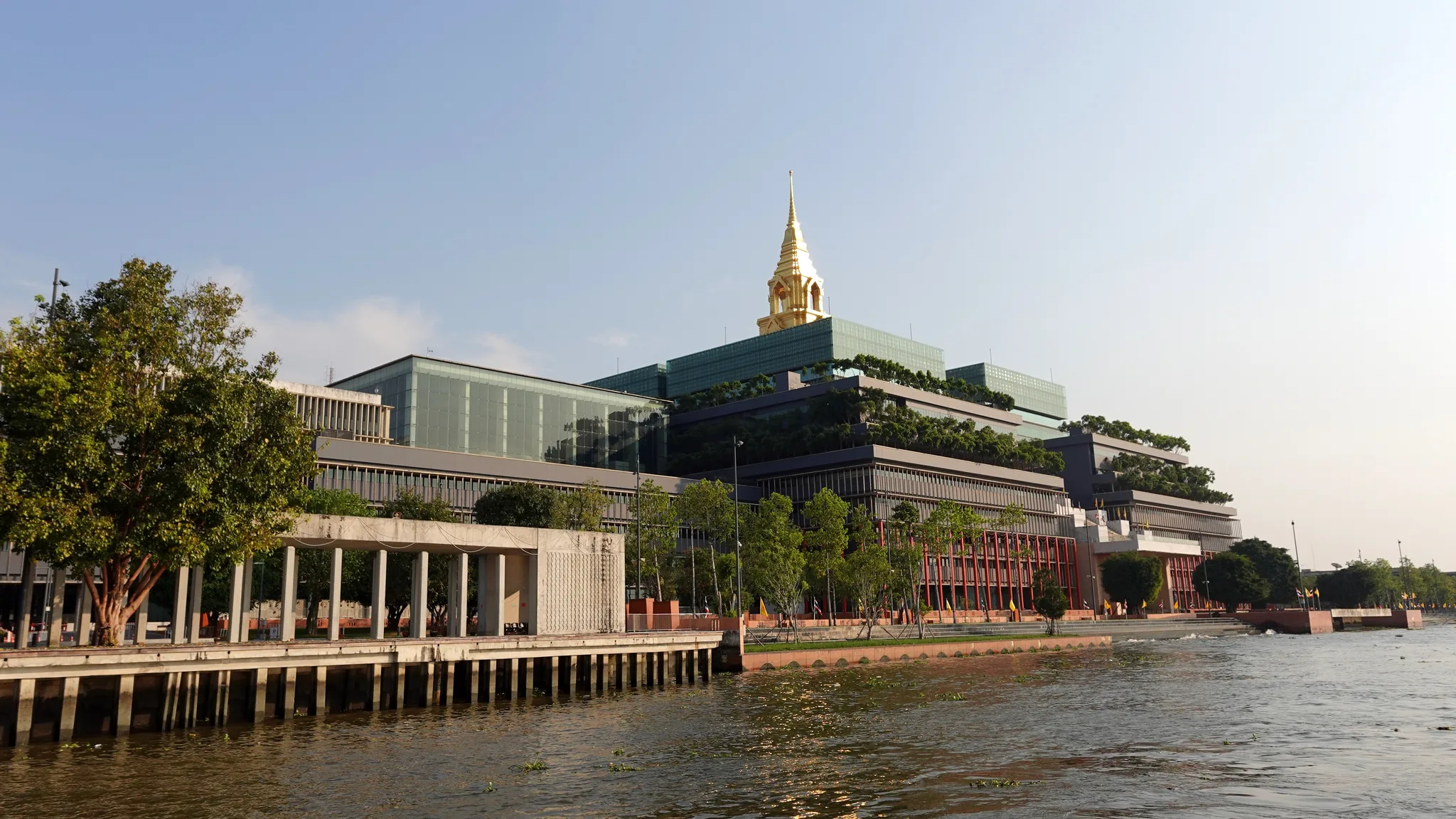
In Dusit District, the Sappaya-Sapasathan parliament stretches along the river with its planted terraces and glazed façades, crowned by a golden spire; in the foreground, a promenade on piles runs along the bank.© Eric Monteil 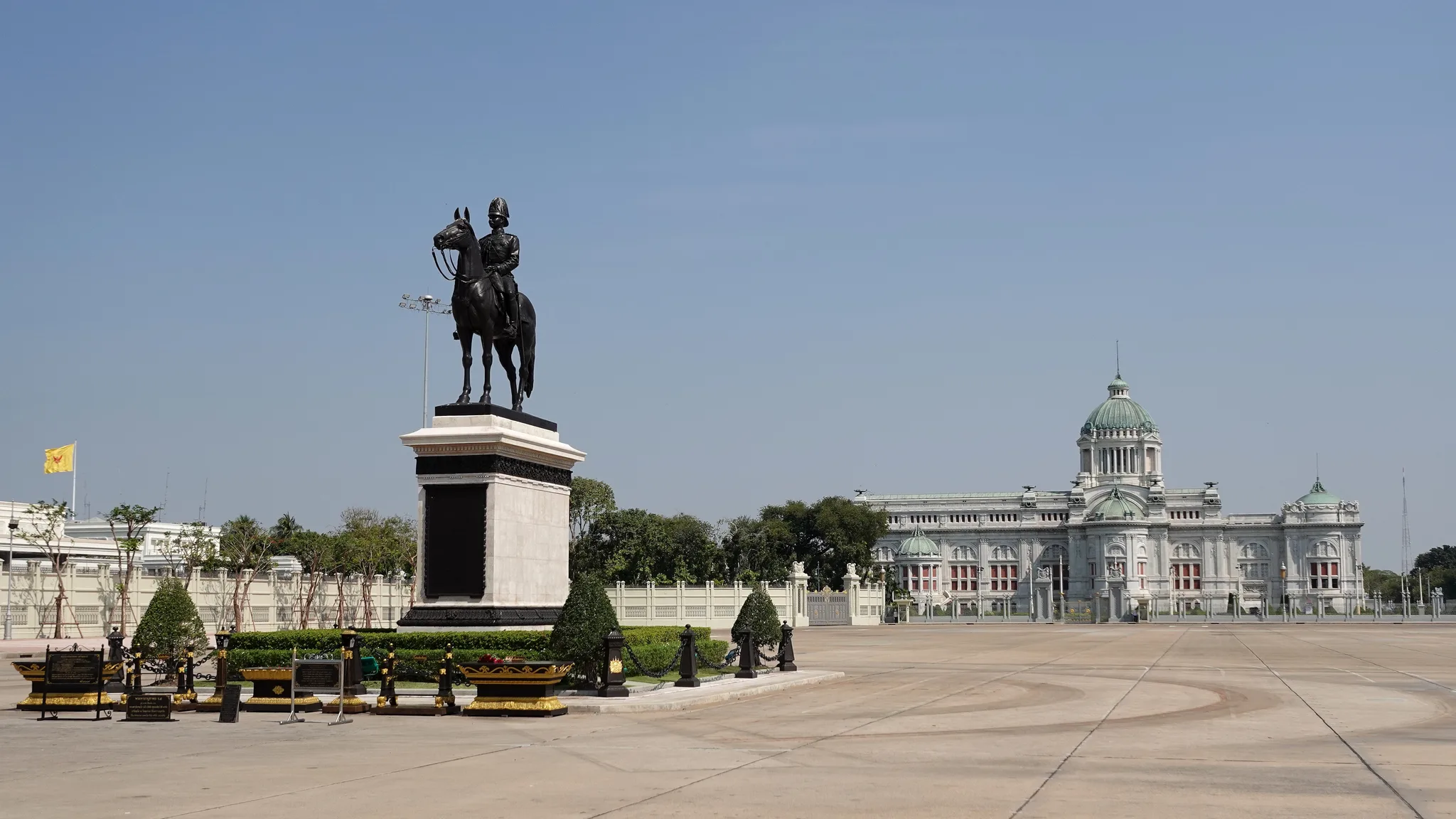
In Dusit District, the equestrian statue of King Chulalongkorn stands on a white pedestal at the centre of a vast, empty paved square. In the background, a white neoclassical palace crowned with green domes closes the vista.© Eric Monteil
Architecture and decoration
Explore the heritage
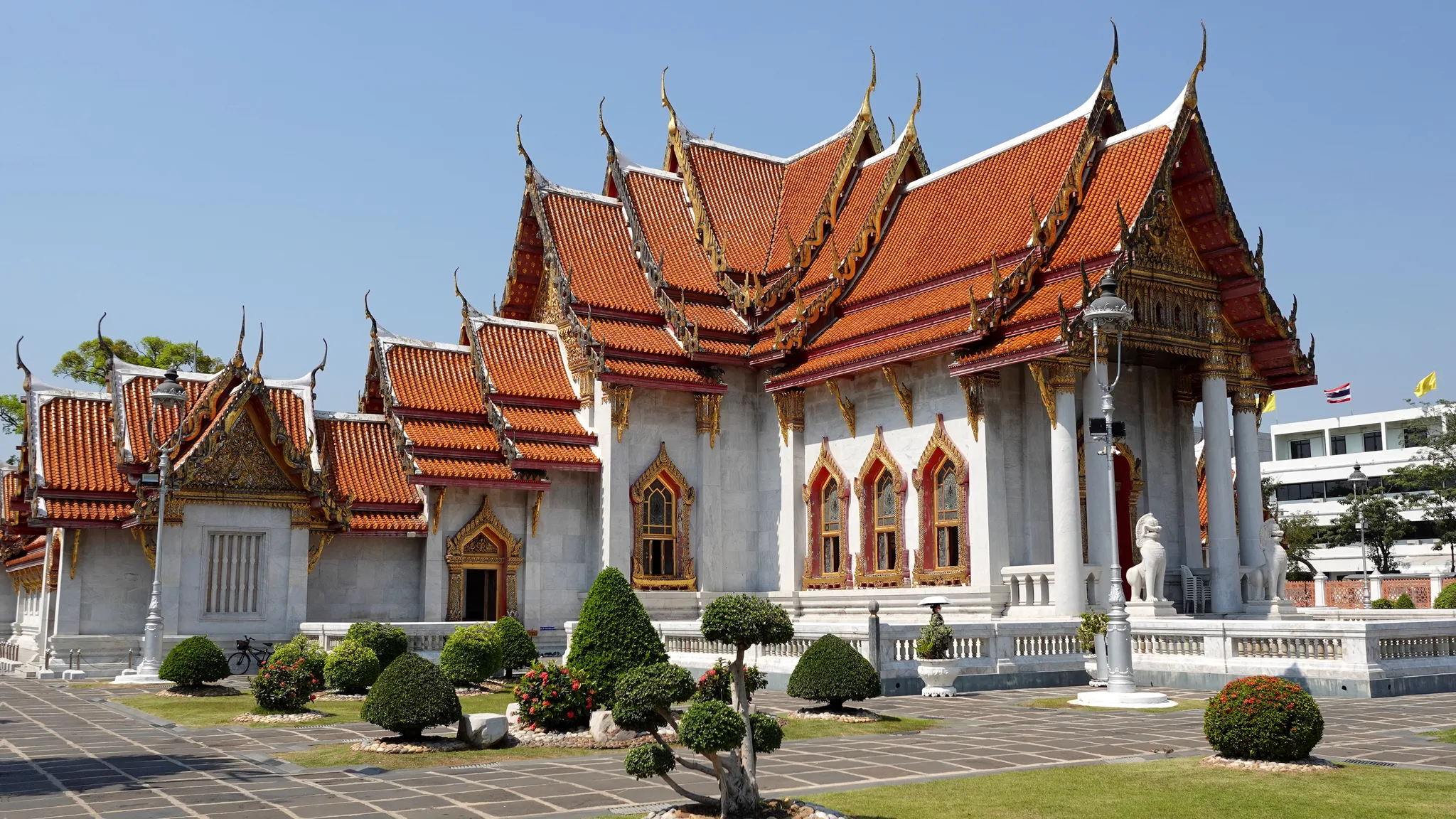
In Dusit District, a white marble ubosot with tiered orange-tiled roofs adorned with gilded chofa, gilt-framed windows, a columned portico and guardian lions, set amid a garden of clipped shrubs.© Eric Monteil 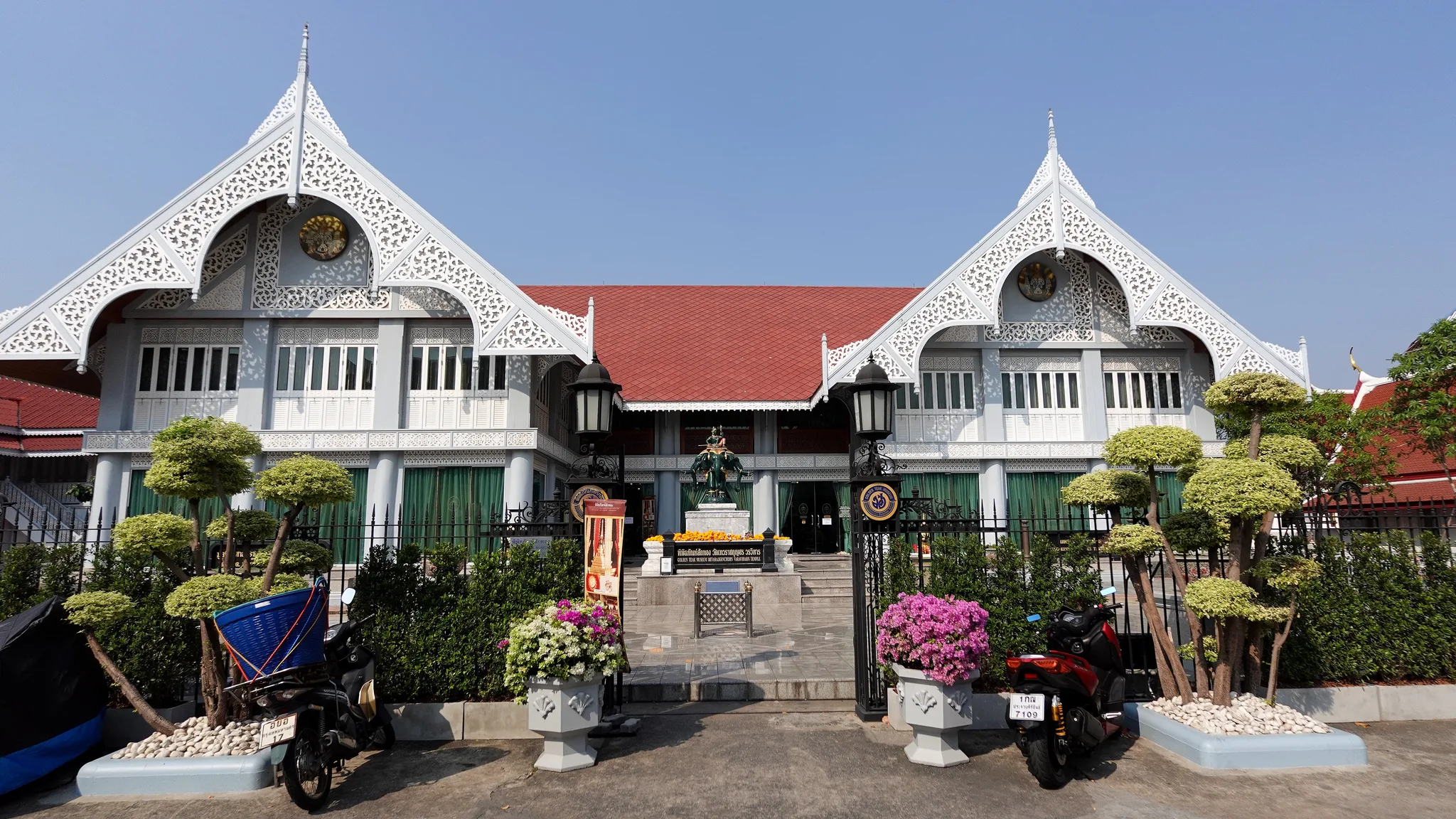
In Dusit District, a building with two pointed gables decorated with white fretwork timber frames a central section with a red-tiled roof; in front of the entrance stand a green statue, clipped shrubs and flowering urns.© Eric Monteil
Archive
Memory of time passing
Historical images preserve the visual memory of places and of the ways they have changed.
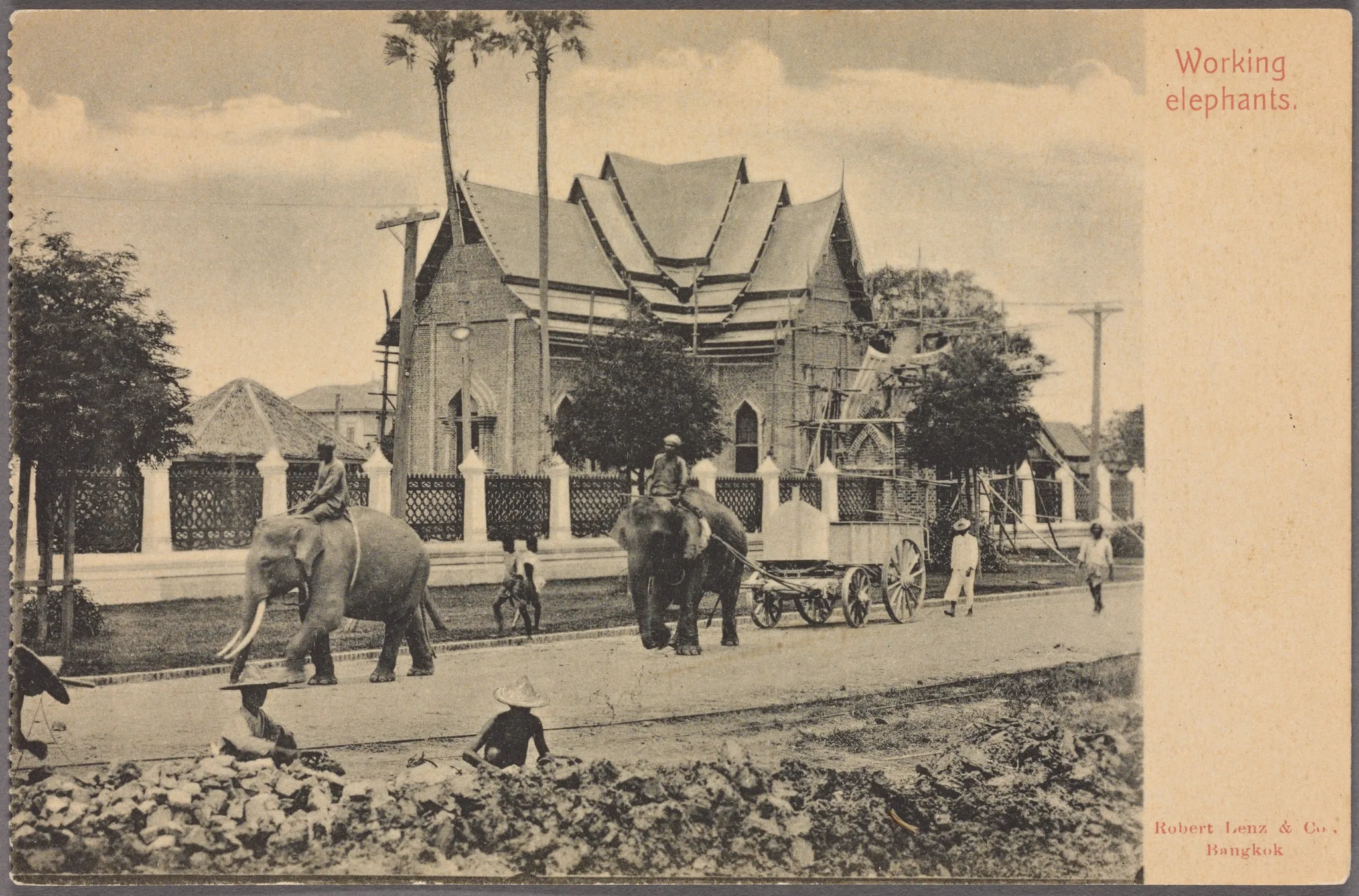
In Dusit District, two elephants guided by mahouts move along a road, one harnessed to a cart, in front of a building with tiered roofs surrounded by scaffolding. In the foreground, workers in conical hats beside rubble.Scan by NYPL — Wikimedia Commons, domaine public 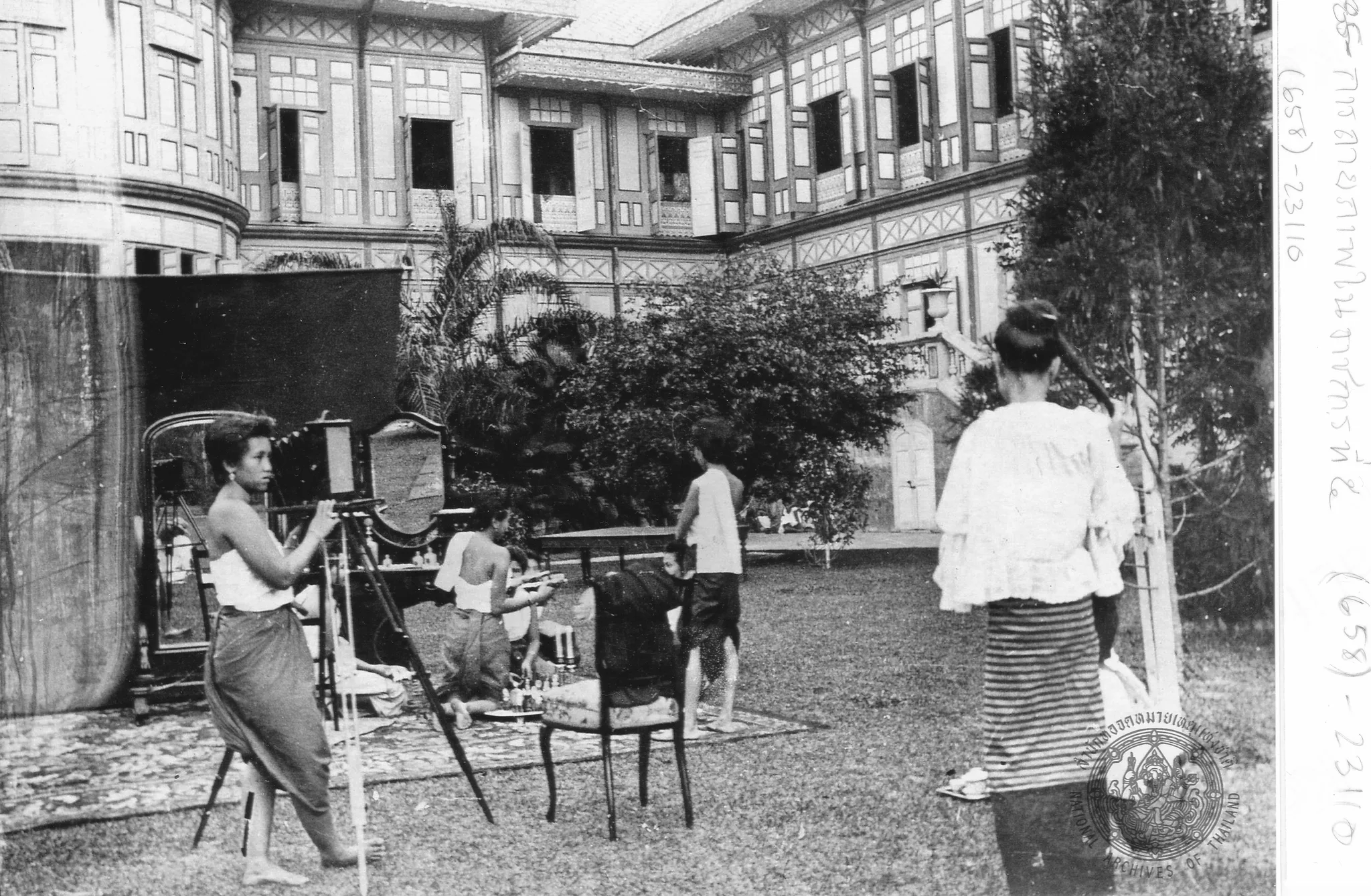
Black-and-white archive photograph: in a garden in Dusit District, a woman adjusts a camera on a tripod in front of a dark backdrop, while other women wait before a façade with shutters and decorated panels.Erb Bunnag (1879-1944), Bangkok, Thailand — Wikimedia Commons, domaine public 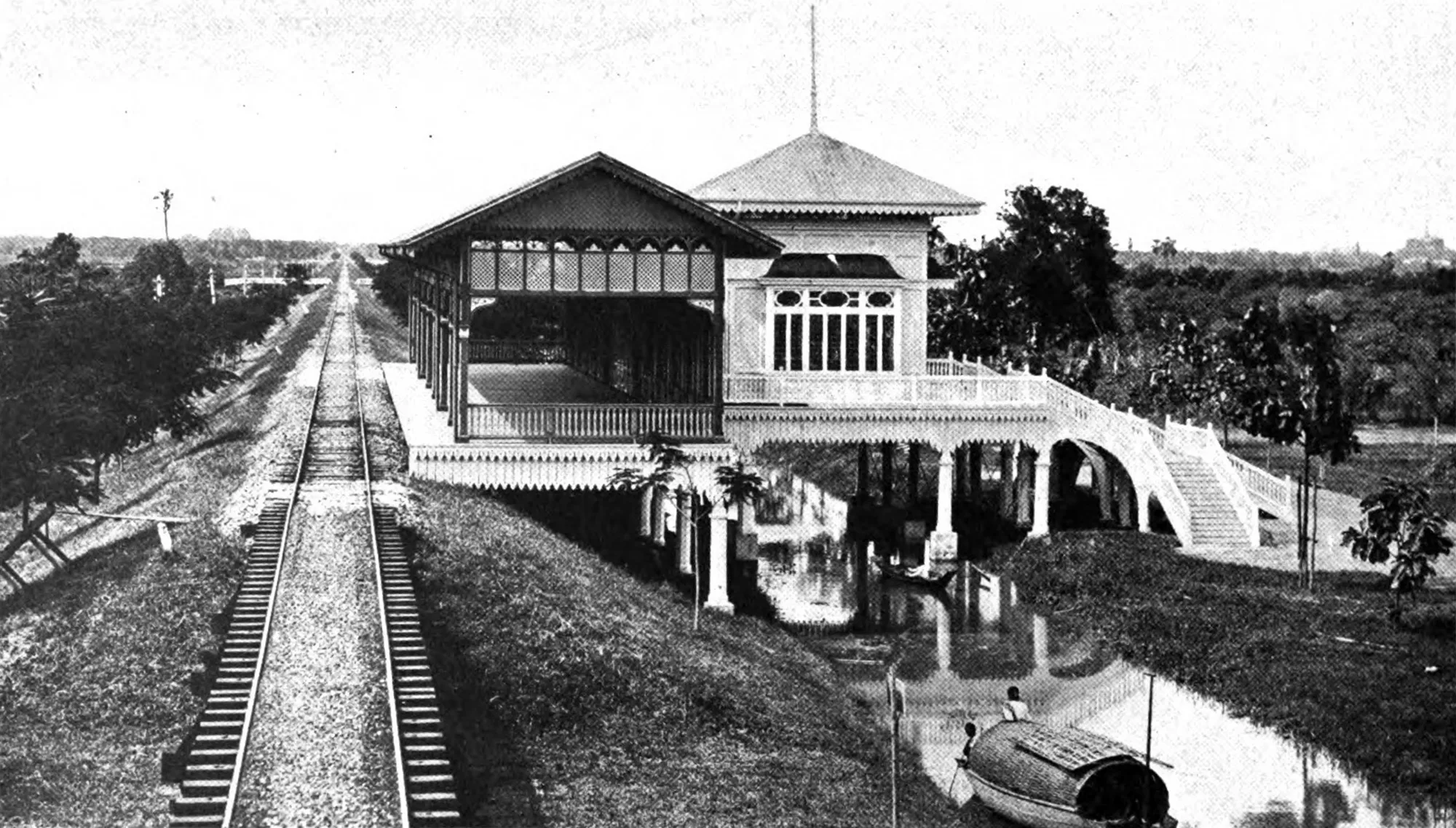
Pavilion on piles beside the railway line, Dusit District: an open latticed hall and a hip-roofed block topped by a spire overlook a canal, reached by an arched staircase; a covered boat lies in the foreground.G. P. Putnam's Sons — Wikimedia Commons, domaine public 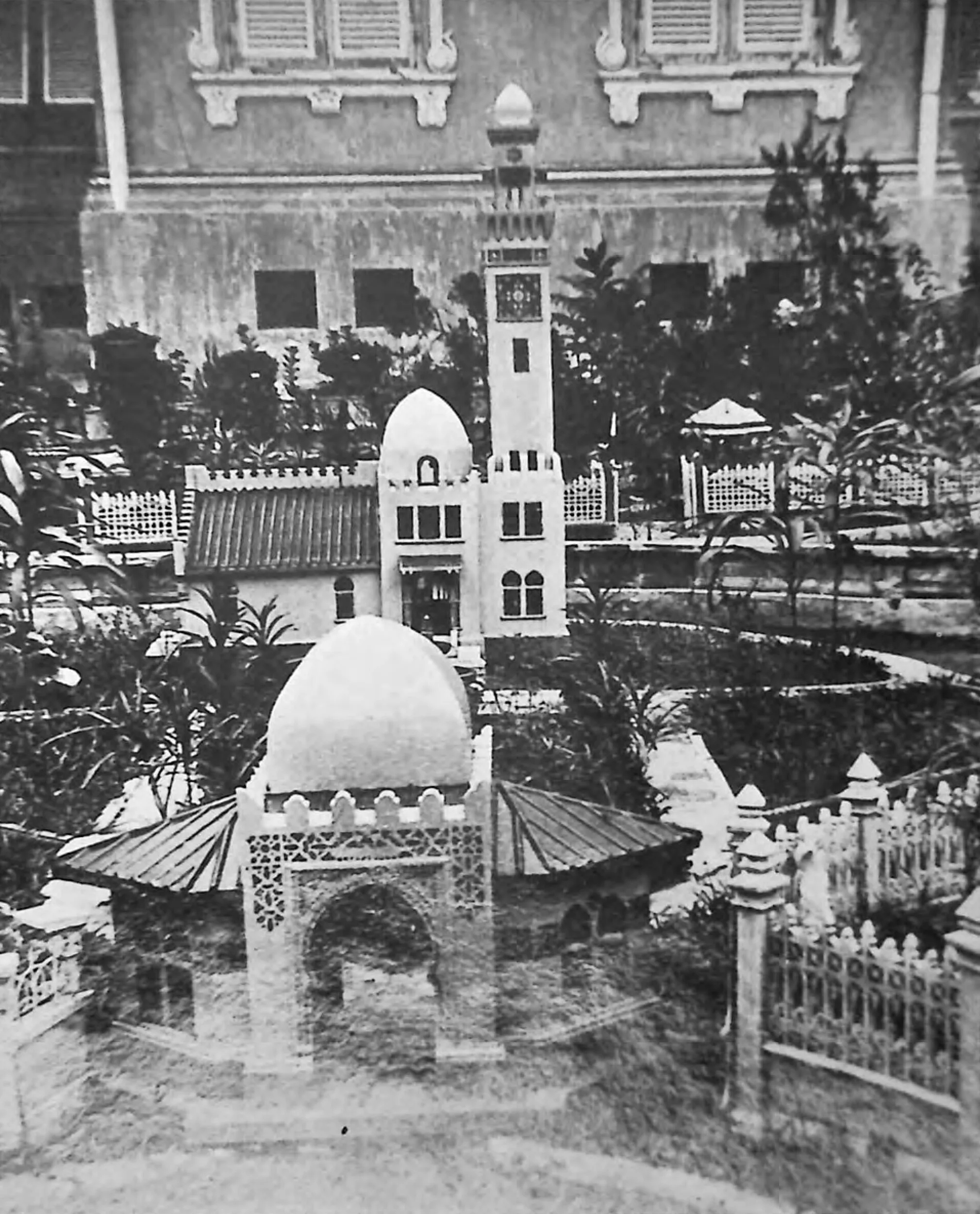
Old black-and-white photograph: in Dusit District, miniature buildings of Dusit Thani – domes, a clock tower, tiled roofs and openwork fences – arranged in a garden before the façade of a large building.Auteur inconnu — Wikimedia Commons, domaine public 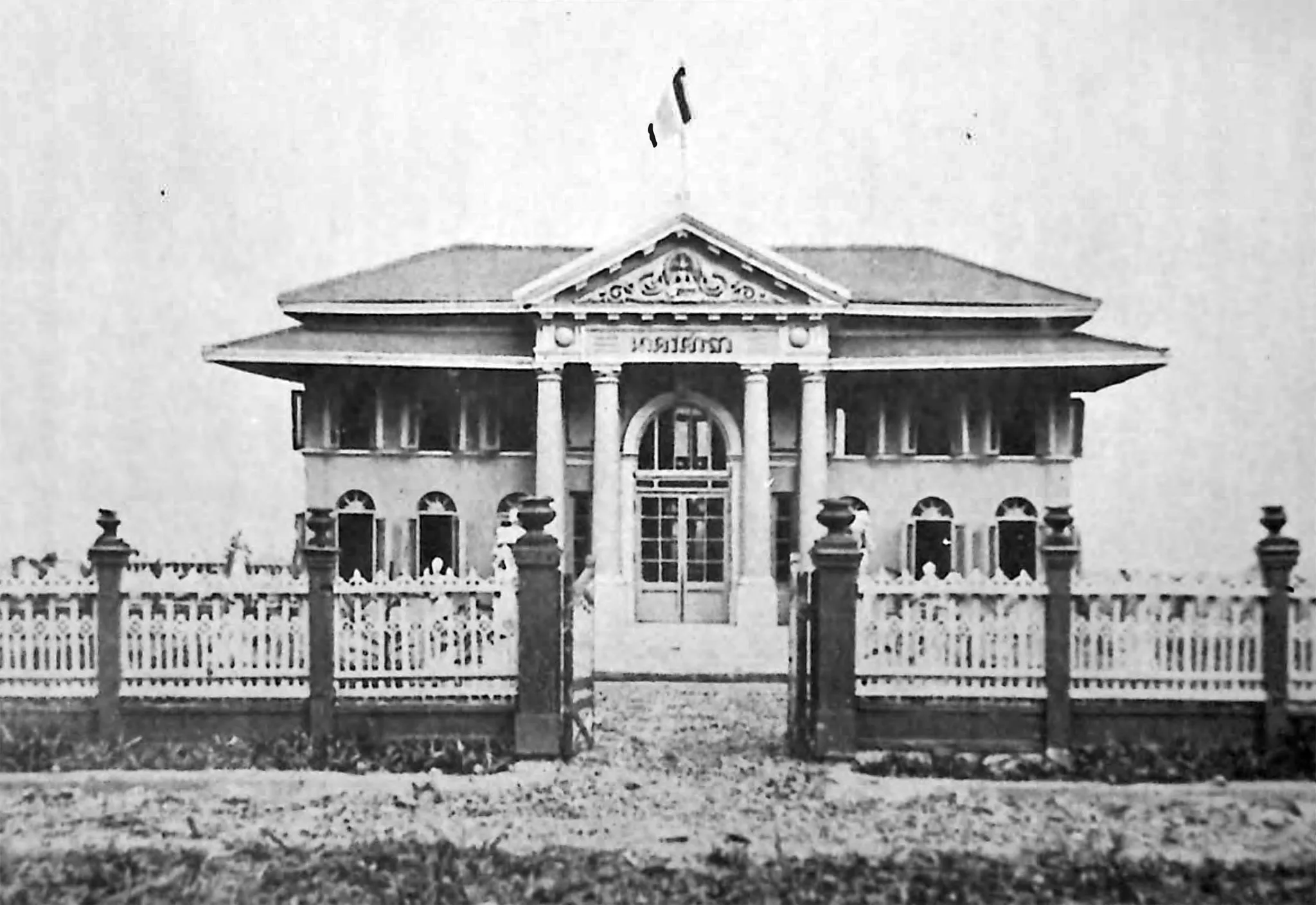
Early black-and-white view of a two-storey building in Dusit District: a columned portico beneath a carved pediment, a Thai inscription and a flag at the top, behind an openwork fence with urn-topped piers.Auteur inconnu — Wikimedia Commons, domaine public 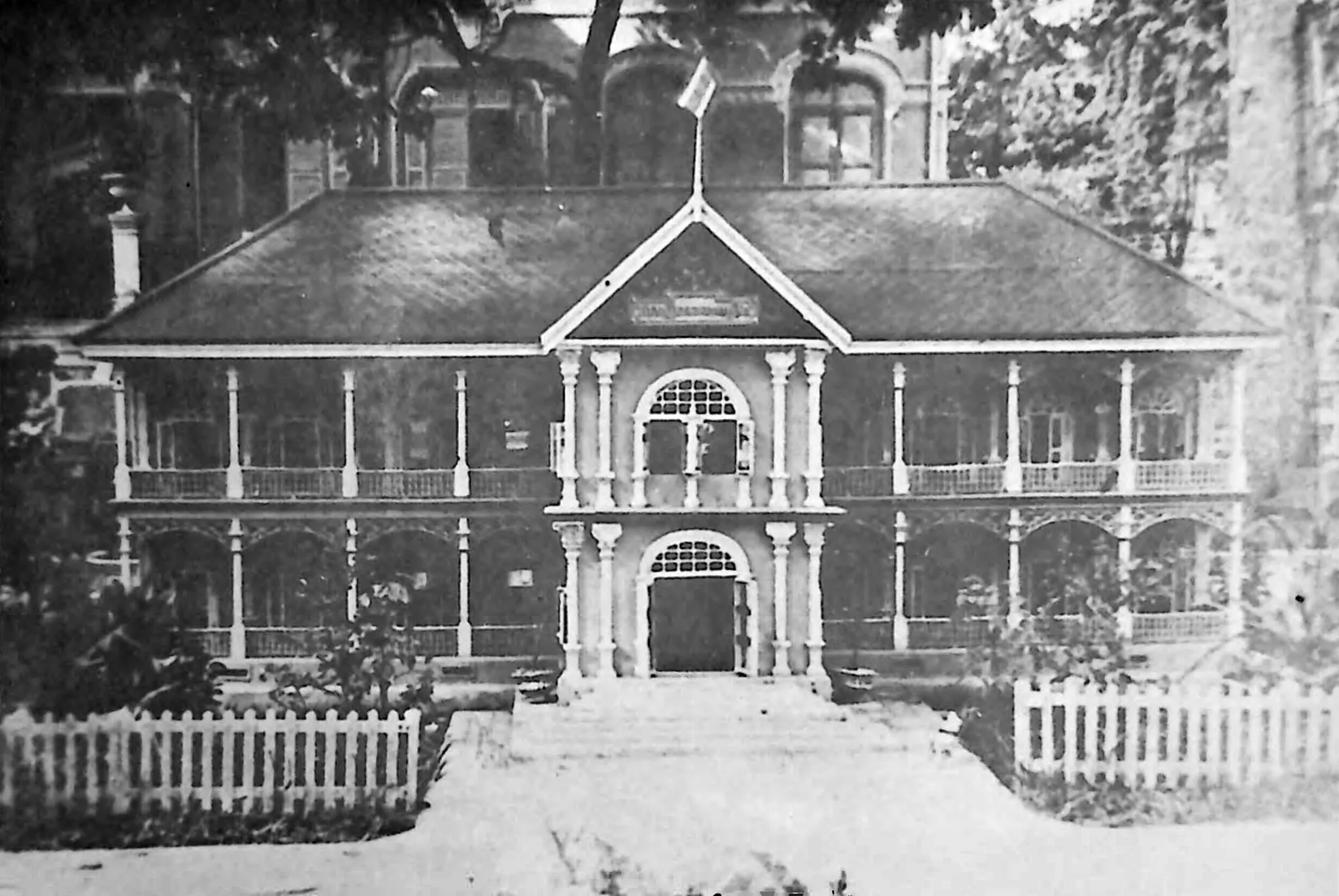
Dusit District: a two-storey pavilion lined with verandas of slender columns and balustrades, with a central pedimented bay and arched openings, a flagpole at the ridge and white picket fences before the path.Auteur inconnu — Wikimedia Commons, domaine public 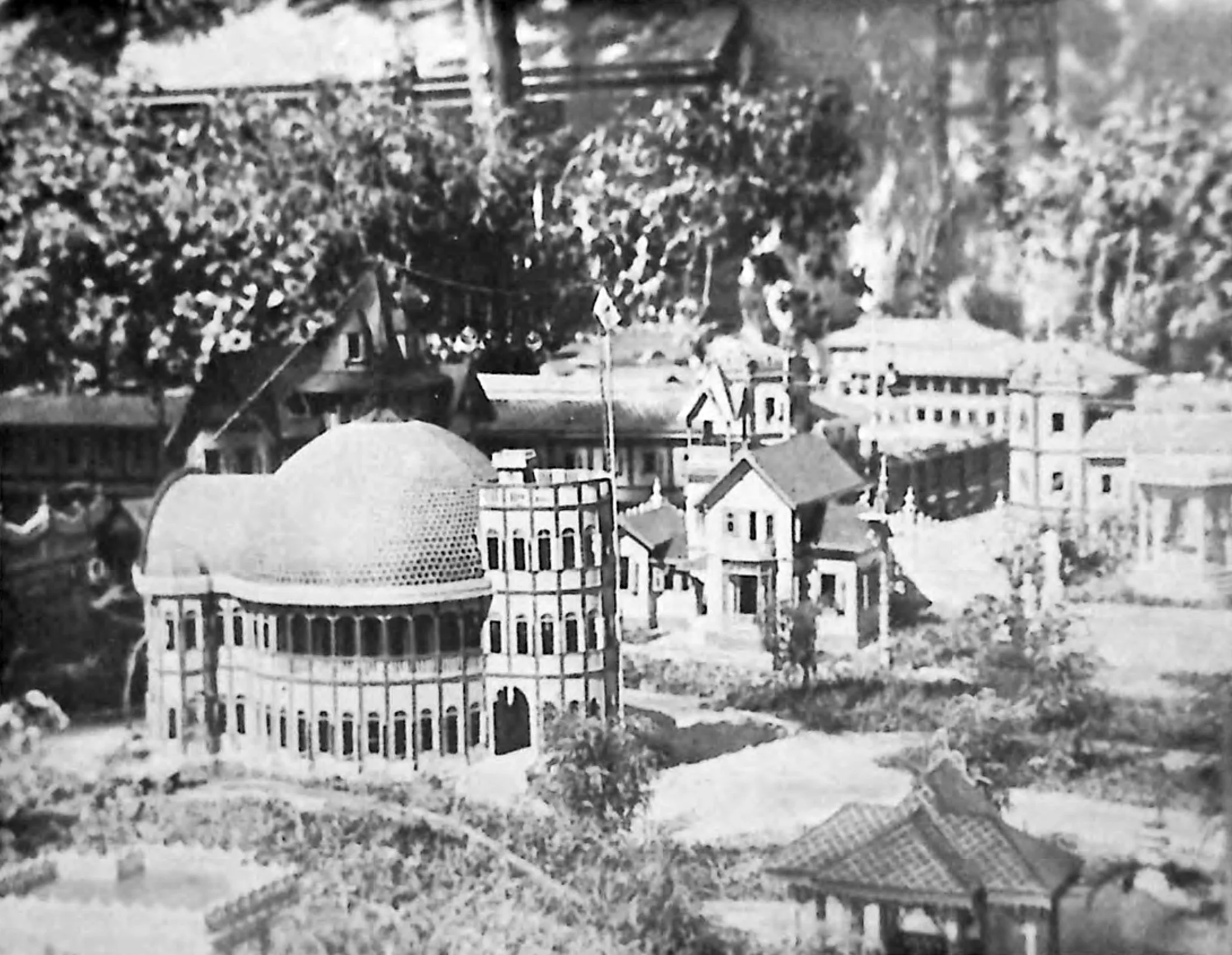
Old photograph of Dusit Thani, in Dusit District: models of a domed, arcaded building, European-style gabled houses and a pavilion with a hipped roof, set at the foot of tall trees.Auteur inconnu — Wikimedia Commons, domaine public 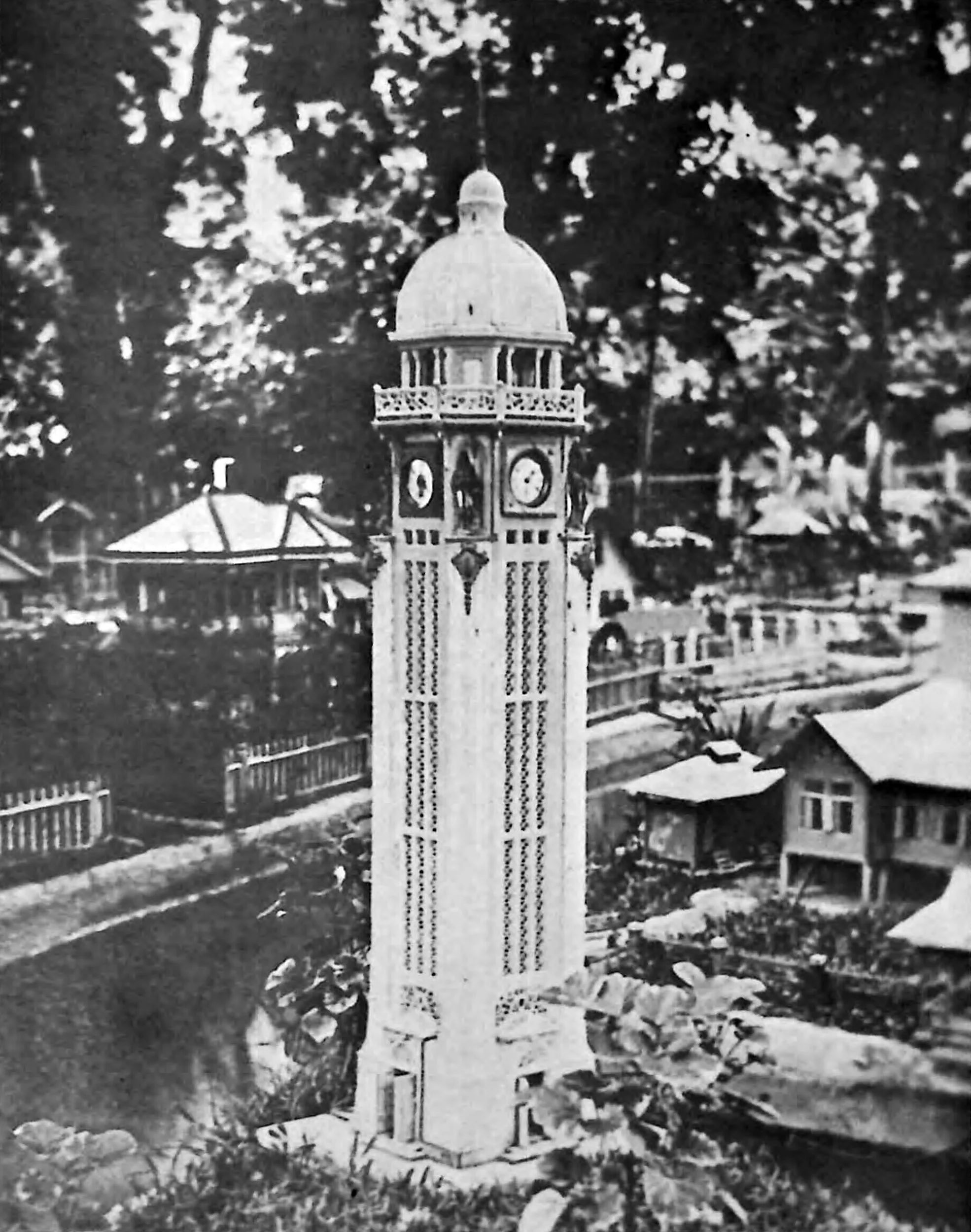
Old photograph of a scale-model clock tower, crowned by a dome and an openwork balcony, with pierced lattice walls, set among miniature stilt houses and fences, Dusit District.Auteur inconnu — Wikimedia Commons, domaine public 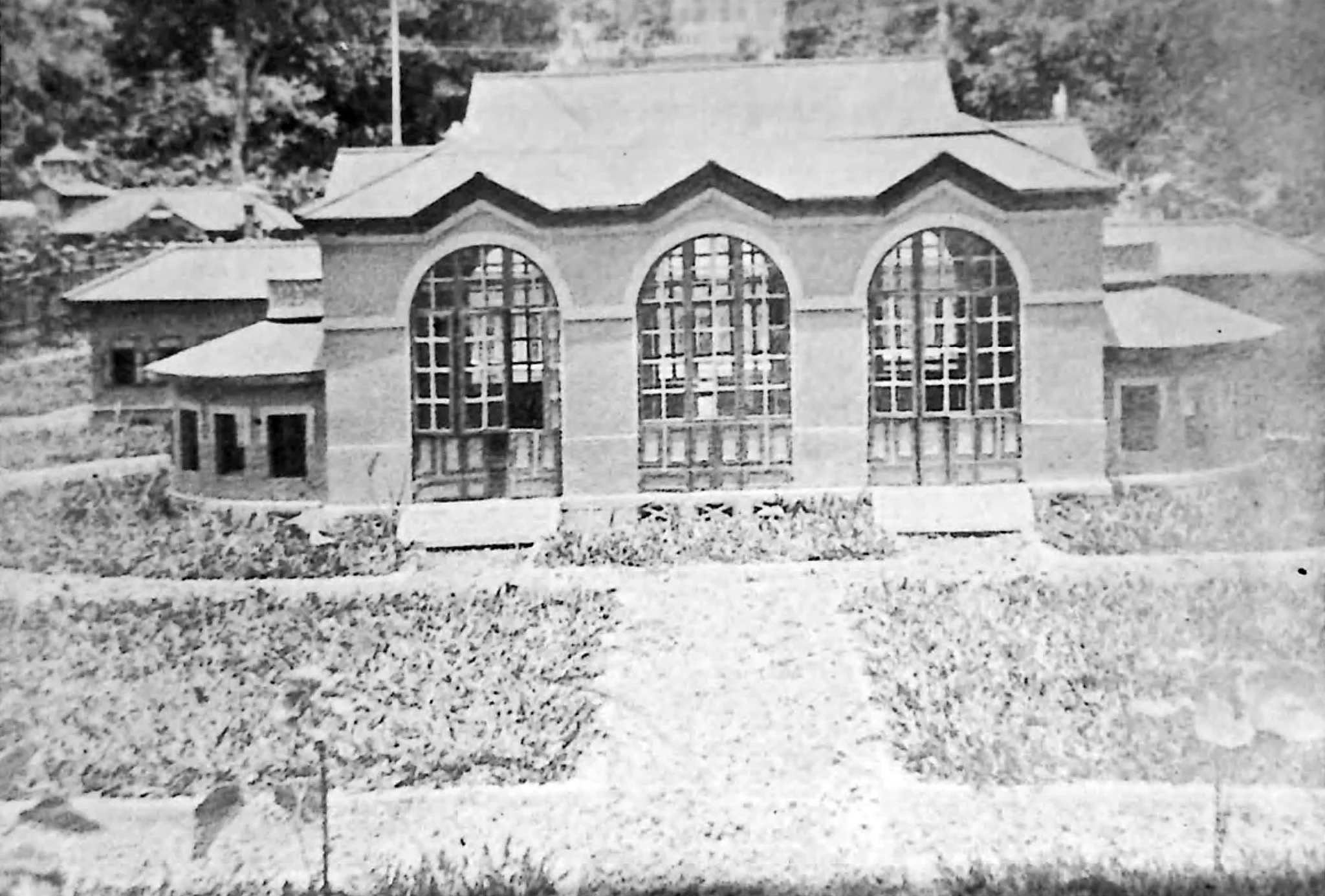
Dusit District: masonry pavilion opened by three tall arched bays with small panes, beneath a roof with scalloped eaves, flanked by low annexes, in front of flower beds and a lawn at the foot of a wooded hill.Auteur inconnu — Wikimedia Commons, domaine public 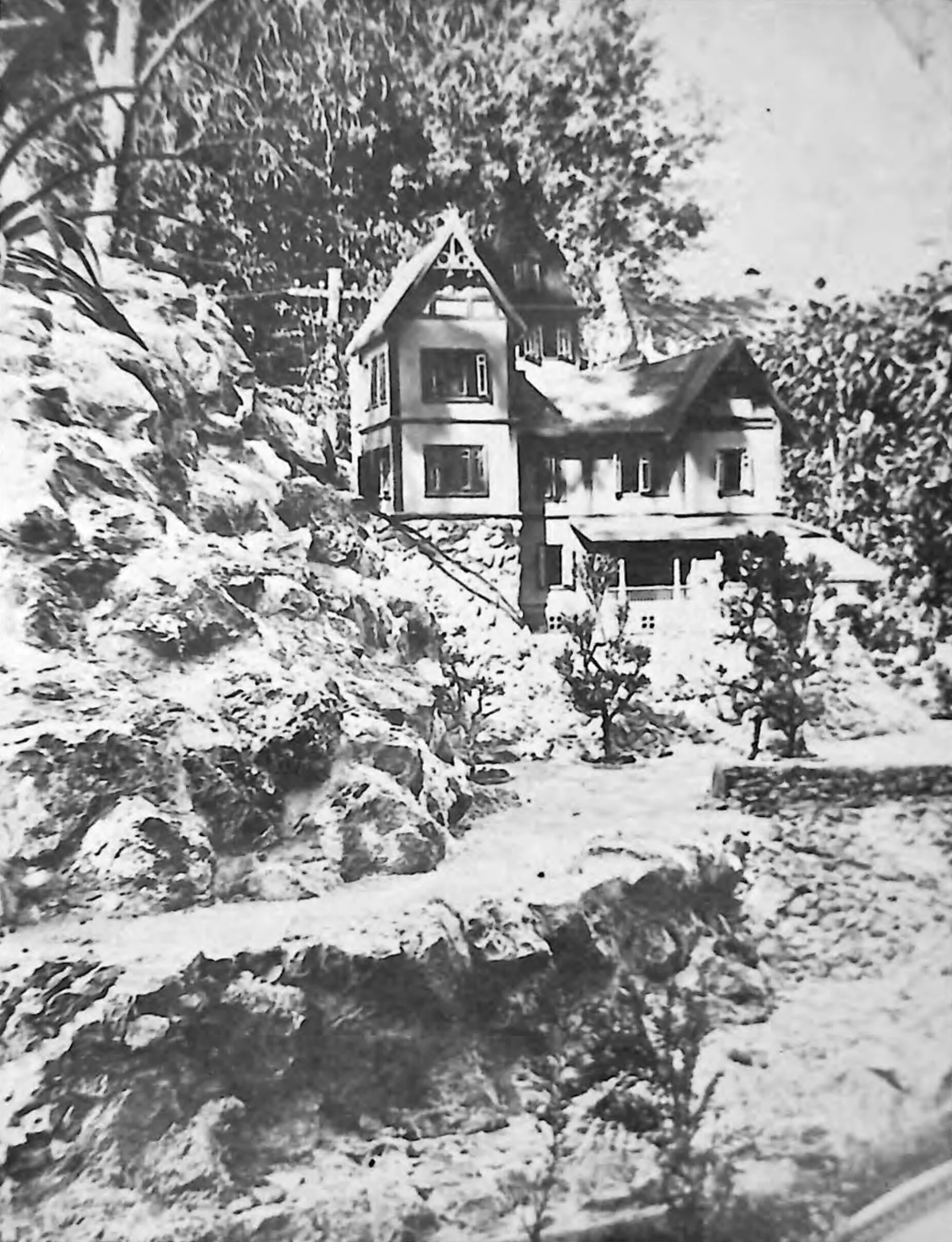
Dusit District, Dusit Thani: on a rocky slope beside a path, a European-style house with pointed gables, shuttered windows and a veranda, which the scale of the shrubs makes appear miniature.Auteur inconnu — Wikimedia Commons, domaine public 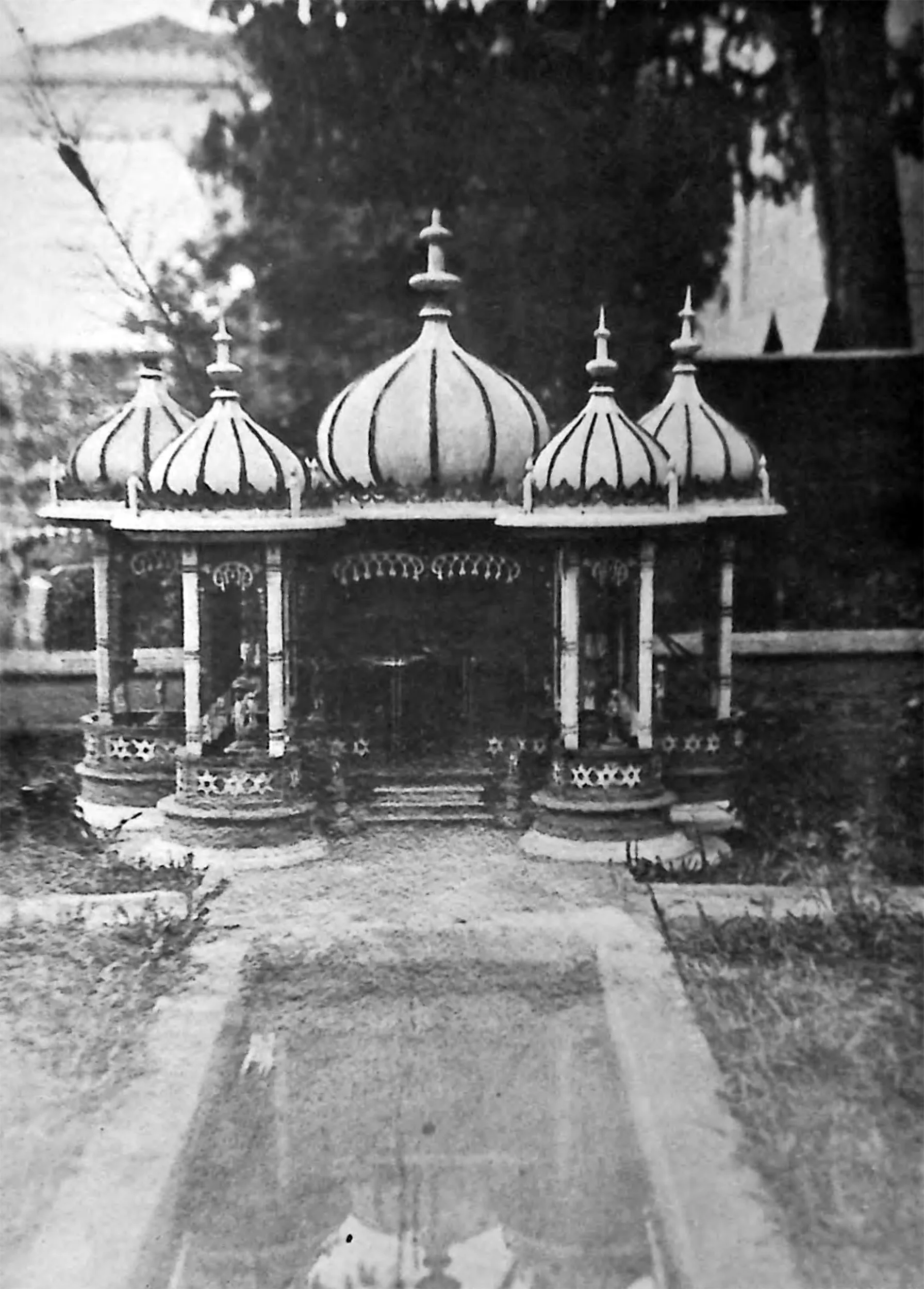
Dusit District: a miniature pavilion with five onion domes topped by finials, supported by slender columns and bases pierced with star motifs, at the end of a grass-edged path in front of a wall and trees.Auteur inconnu — Wikimedia Commons, domaine public 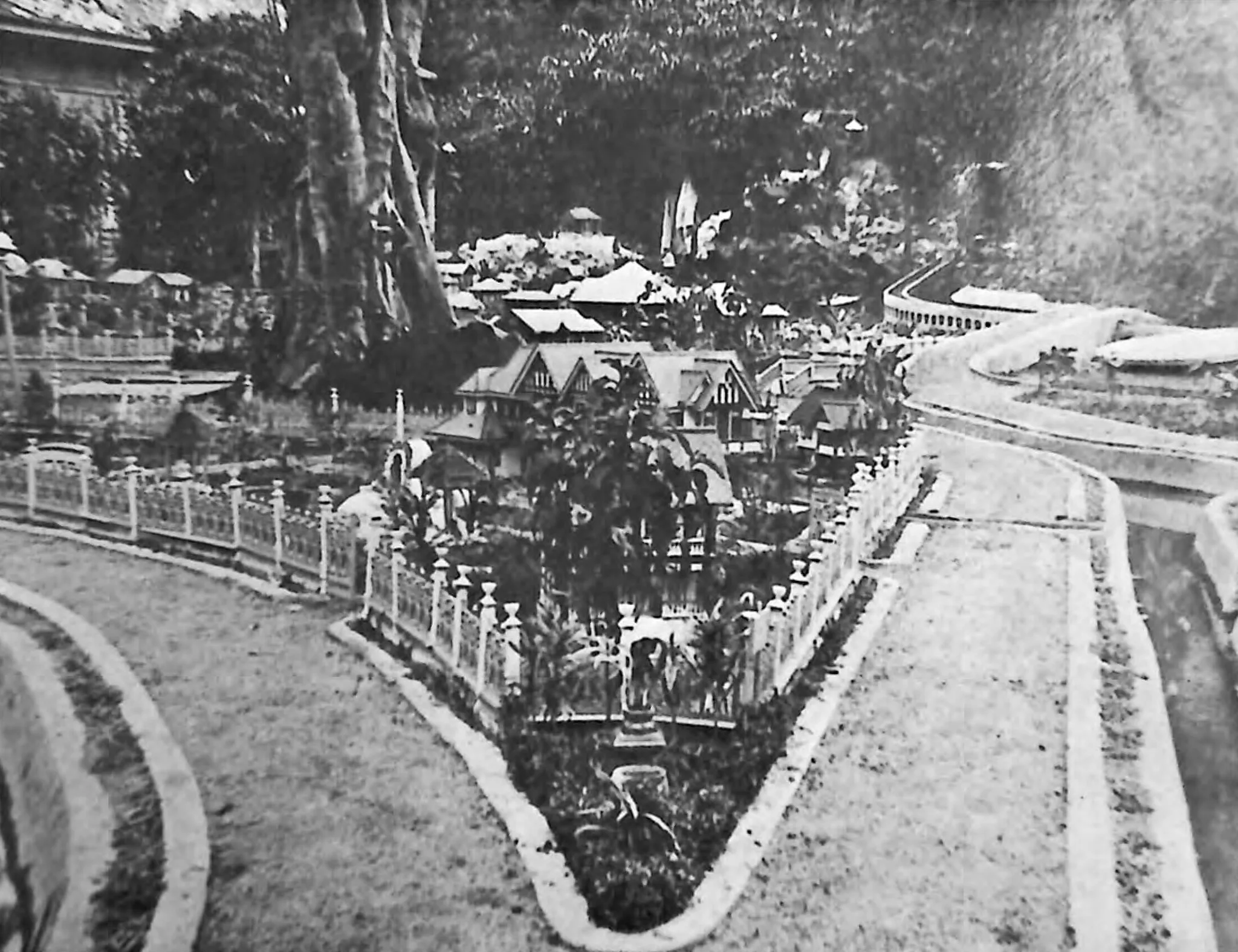
Dusit District: a high-angle view of a miniature town, with gabled houses, enclosures fenced by white balustrades, planted beds, curving paths and a canal lined with low walls, beneath the trunks of large trees.Auteur inconnu — Wikimedia Commons, domaine public 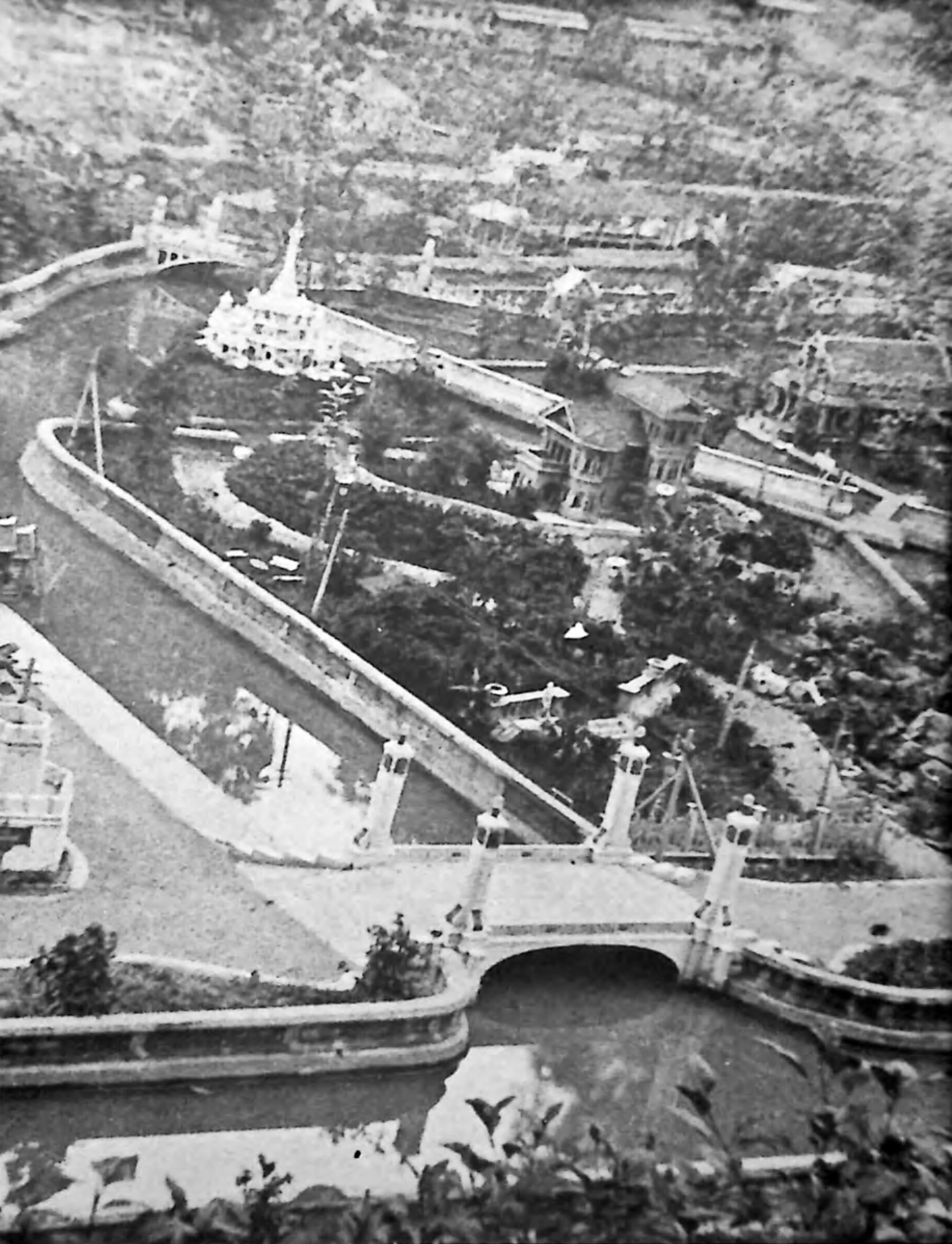
Early photograph of Dusit Thani, Dusit District: a miniature ensemble in which quay-lined canals, a bridge with lantern pillars, gardens and buildings in Thai and Western styles form a town in reduced scale.Auteur inconnu — Wikimedia Commons, domaine public 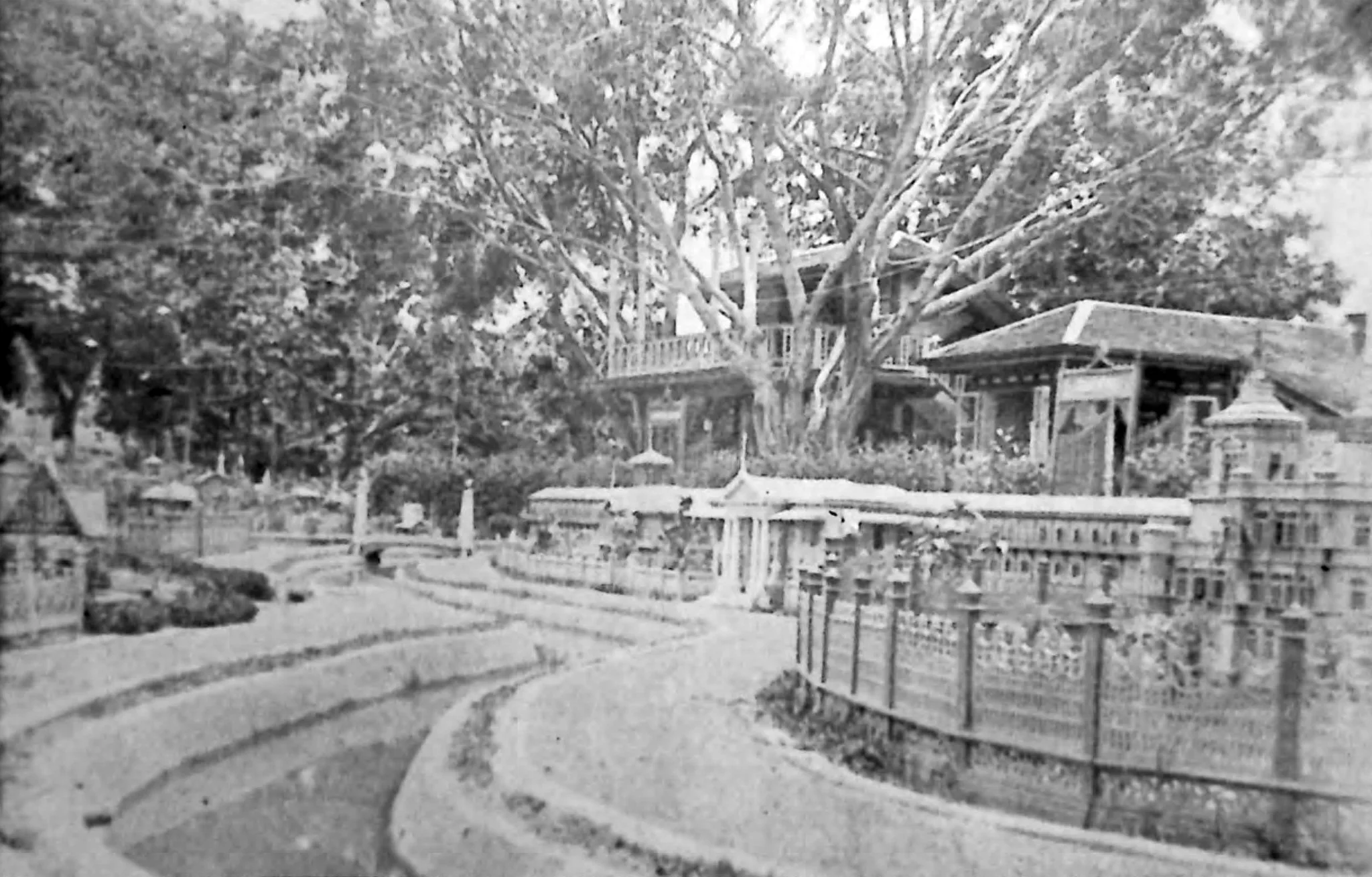
Old photograph of the miniature town of Dusit Thani, in Dusit District: small buildings, openwork fences and paths line a winding canal, in front of a full-size house with a balcony beneath tall trees.Auteur inconnu — Wikimedia Commons, domaine public 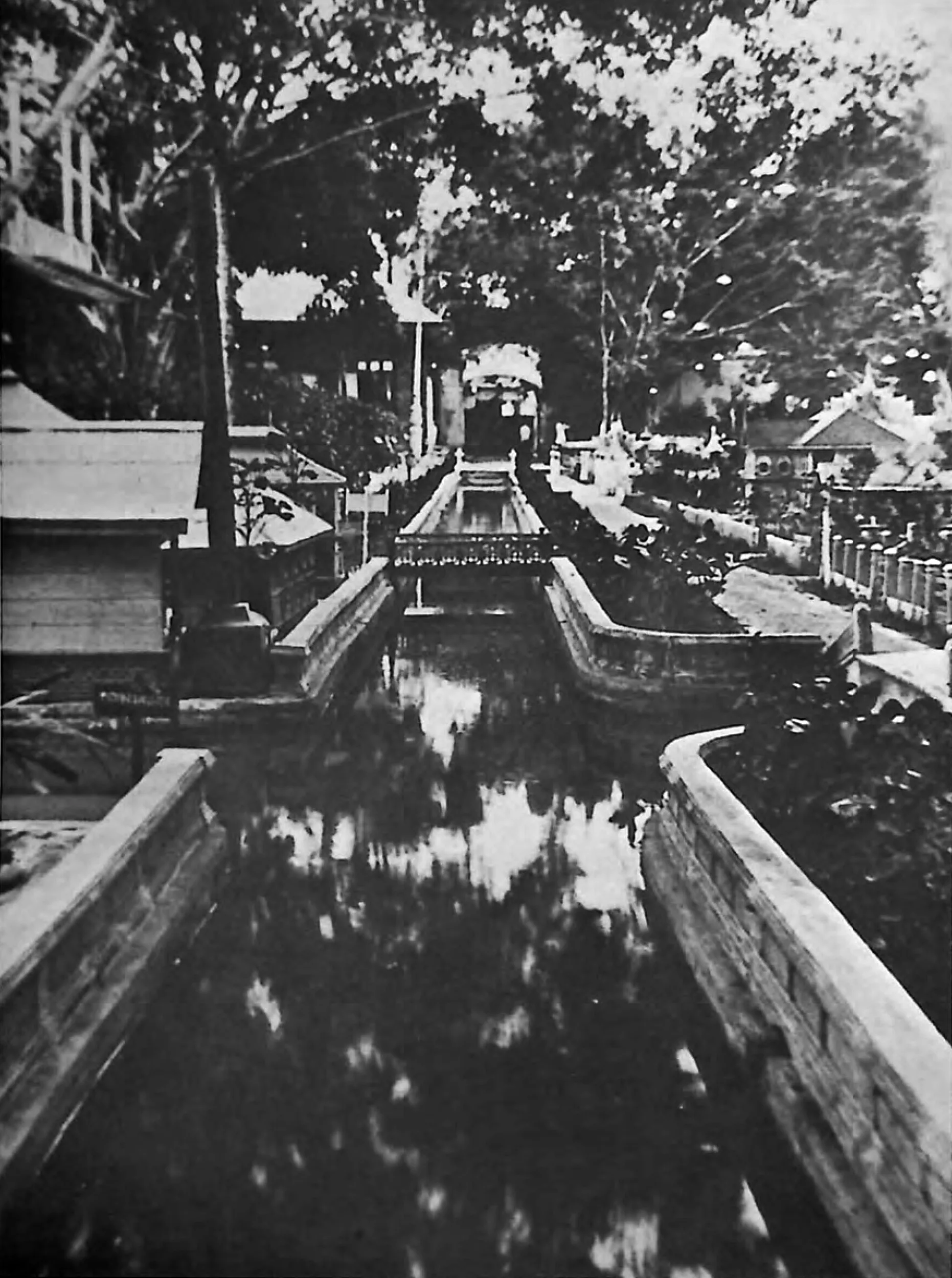
In Dusit District, a narrow canal with masonry parapets stretches beneath the trees, crossed by a small balustraded footbridge and lined with small-scale buildings with pitched roofs.Auteur inconnu — Wikimedia Commons, domaine public 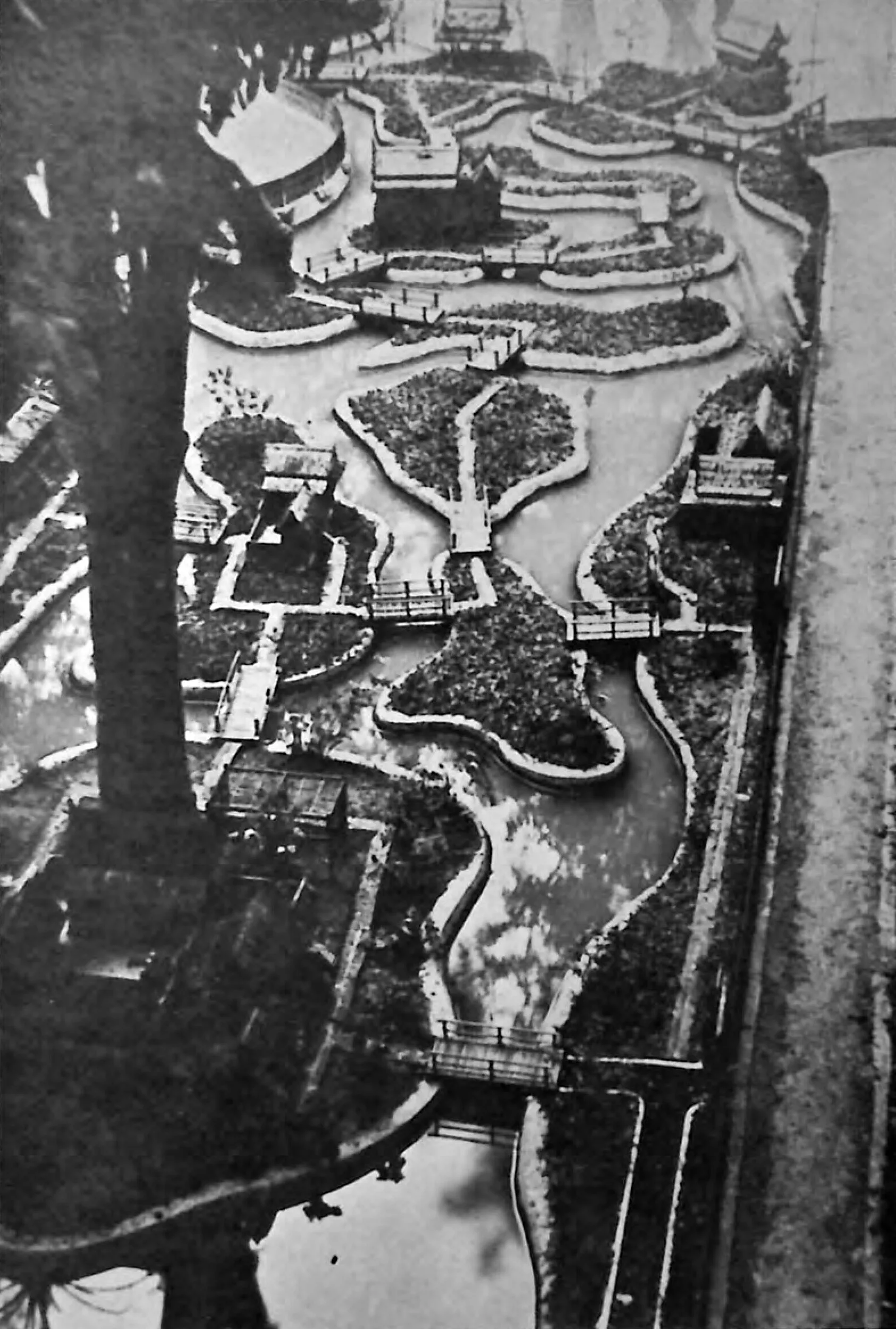
Early photograph of Dusit District taken from above: a miniature town laid out as planted islets with winding outlines, separated by canals, linked by small footbridges and dotted with traditionally roofed pavilions.Auteur inconnu — Wikimedia Commons, domaine public 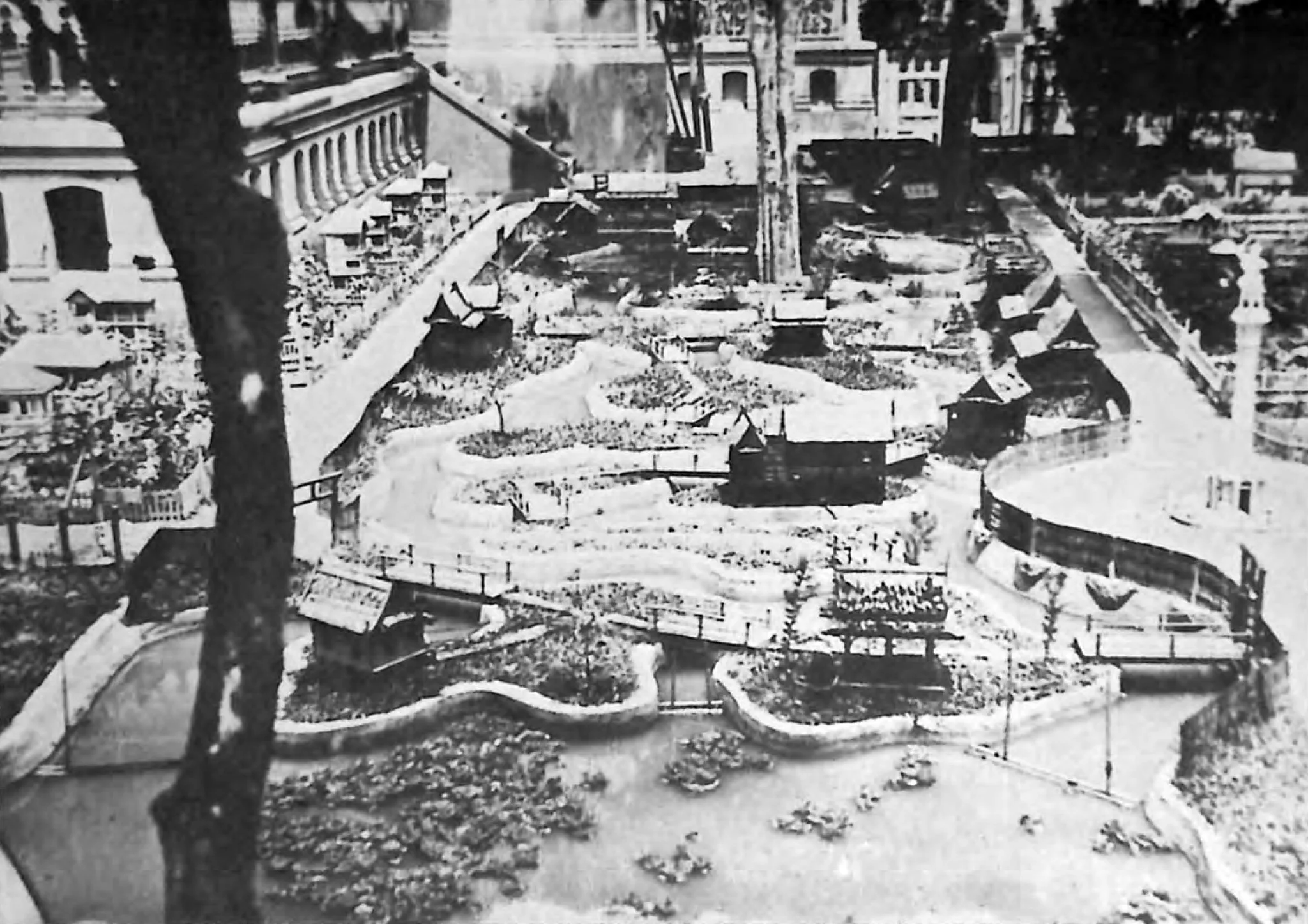
Early photograph of Dusit District showing the Dusit Thani miniature town: steep-roofed houses, bridges, canals and a pond with aquatic plants, laid out in a garden below an arcaded building.Auteur inconnu — Wikimedia Commons, domaine public 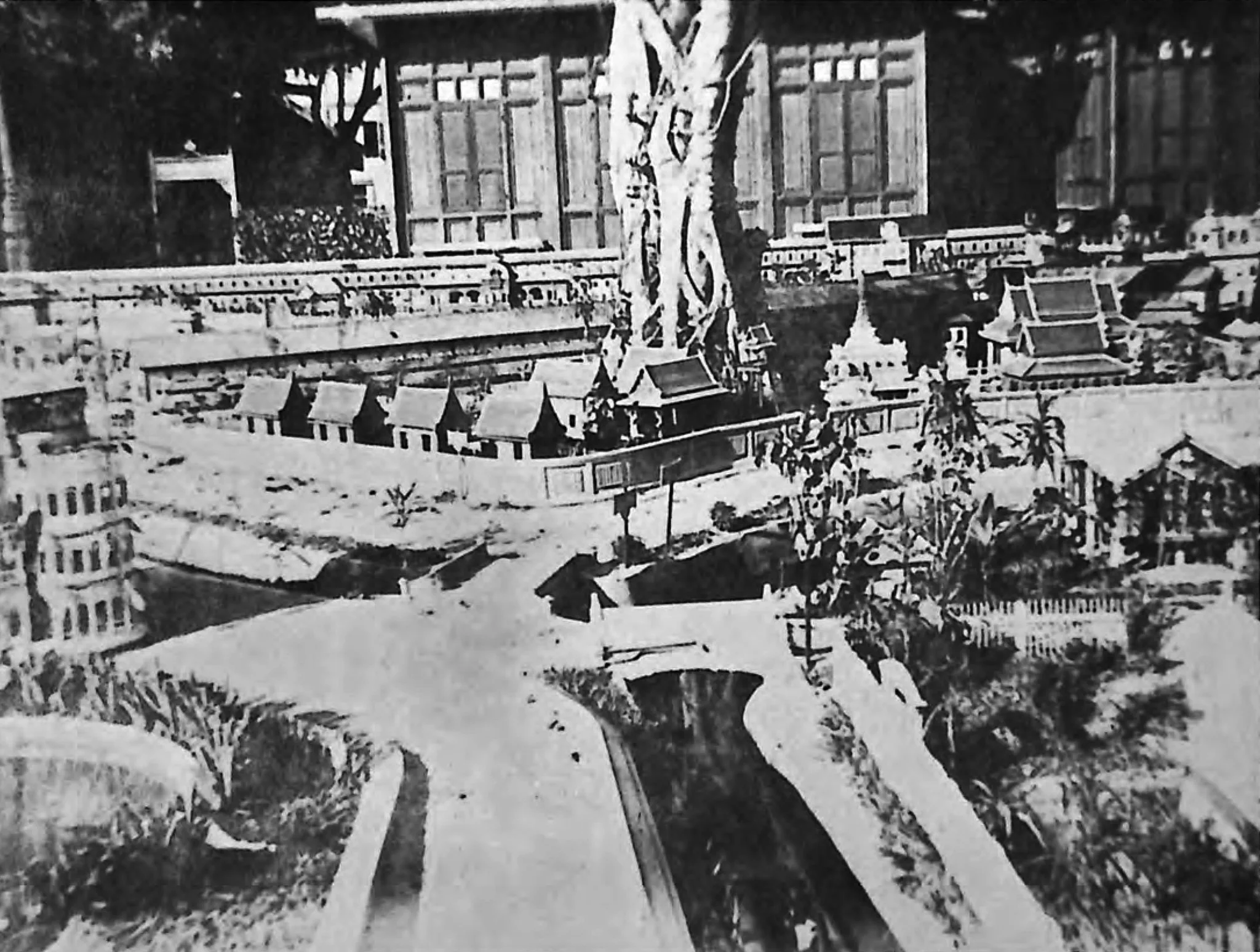
Miniature town photographed in Dusit District: pavilions with tiered roofs, rows of houses, an enclosing wall, canals and bridges in model form, set at the foot of a tree before a wooden building with shutters.Auteur inconnu — Wikimedia Commons, domaine public 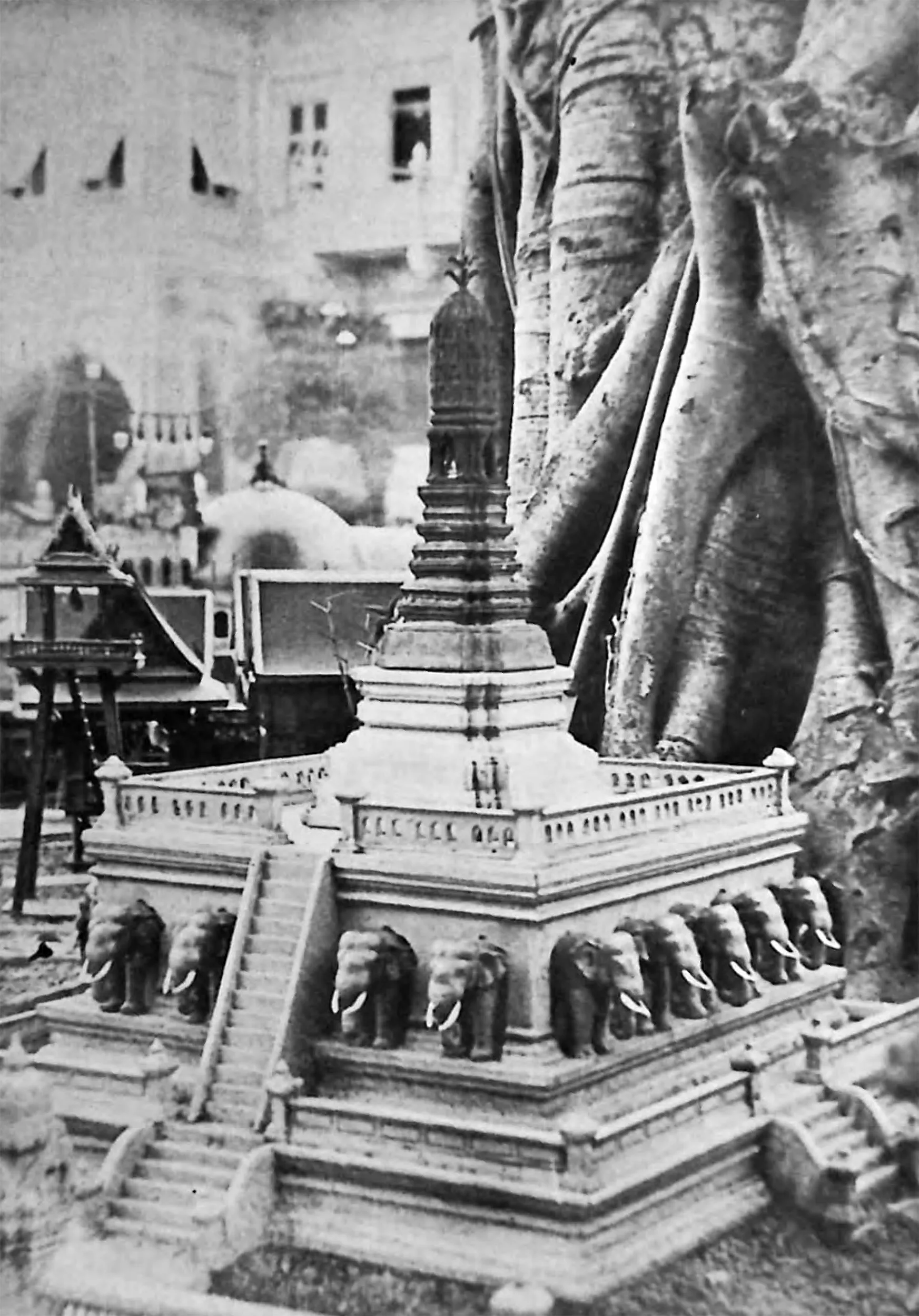
Old photograph of Dusit District: a model chedi on a square terrace with balustrades and staircases, its base decorated with elephants, set before the roots of a large tree and miniature pavilions.Auteur inconnu — Wikimedia Commons, domaine public 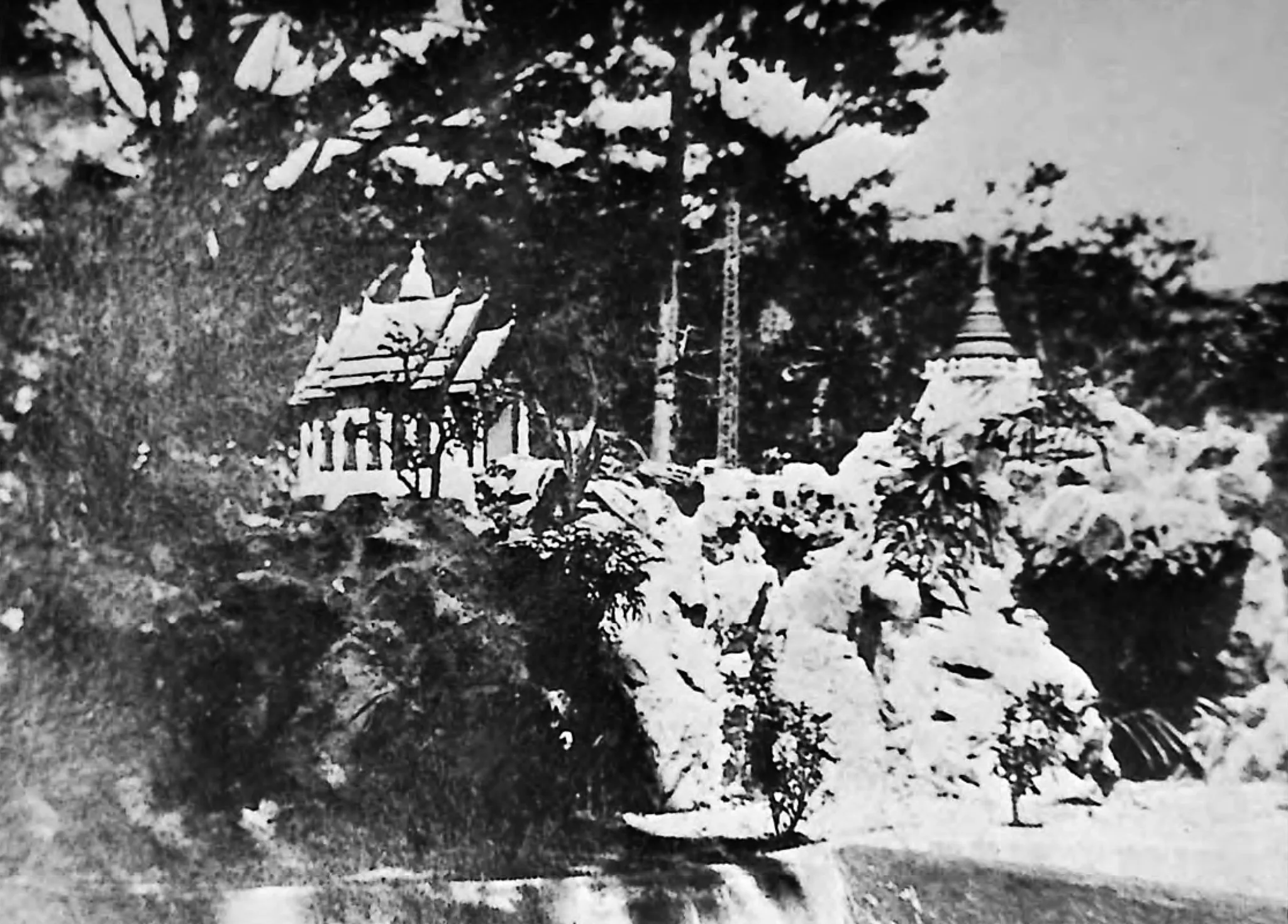
Dusit District: a small Thai-style pavilion with tiered roofs and a structure crowned by a pointed roof stand on an artificial rock planted with vegetation, in front of tall trees and a metal pylon.Auteur inconnu — Wikimedia Commons, domaine public 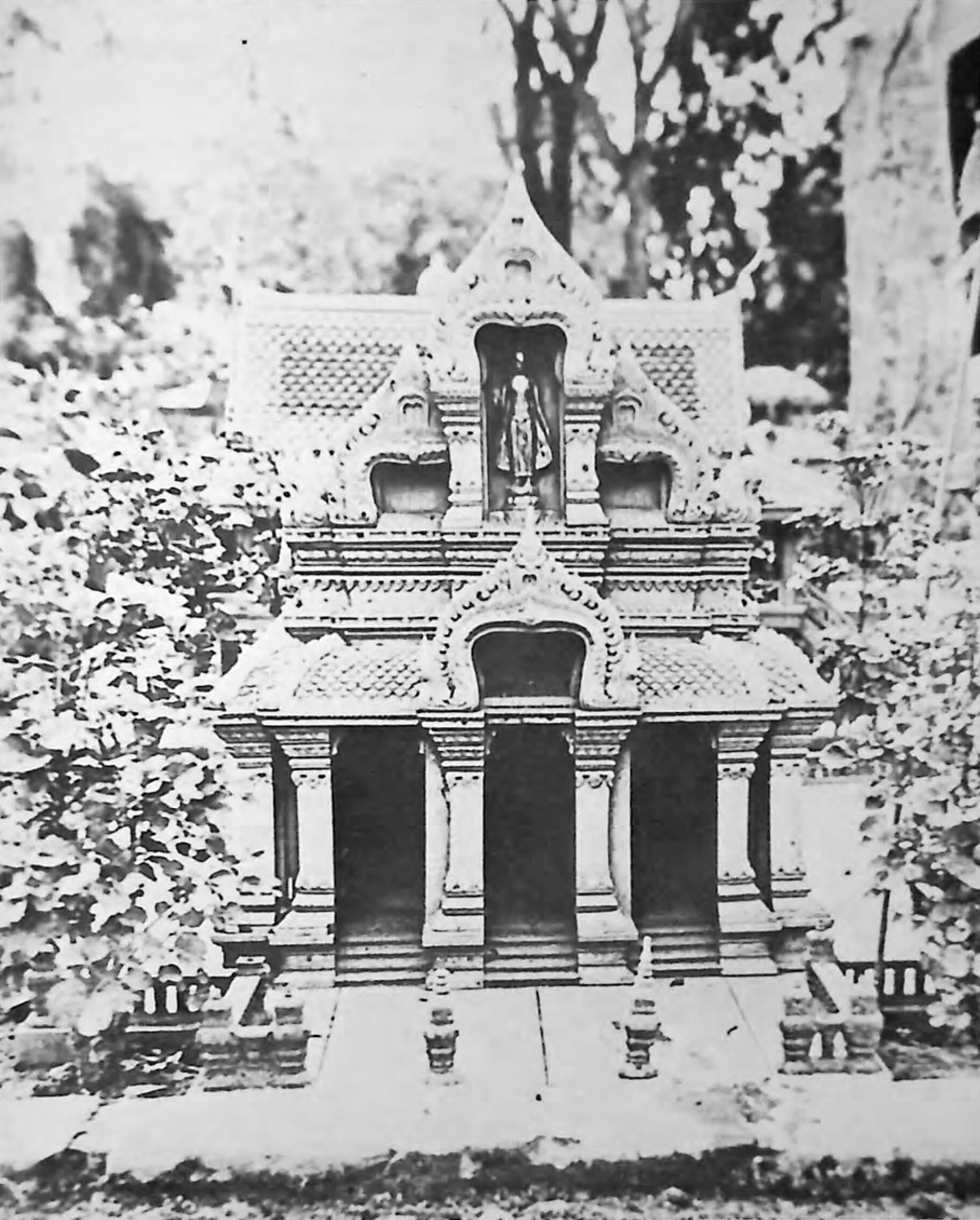
Dusit District: a miniature Thai-style structure with tiered tiled roofs, gables with flame-like ornament, a niche holding a standing figure and three openings on the façade, set in a wooded garden.Auteur inconnu — Wikimedia Commons, domaine public 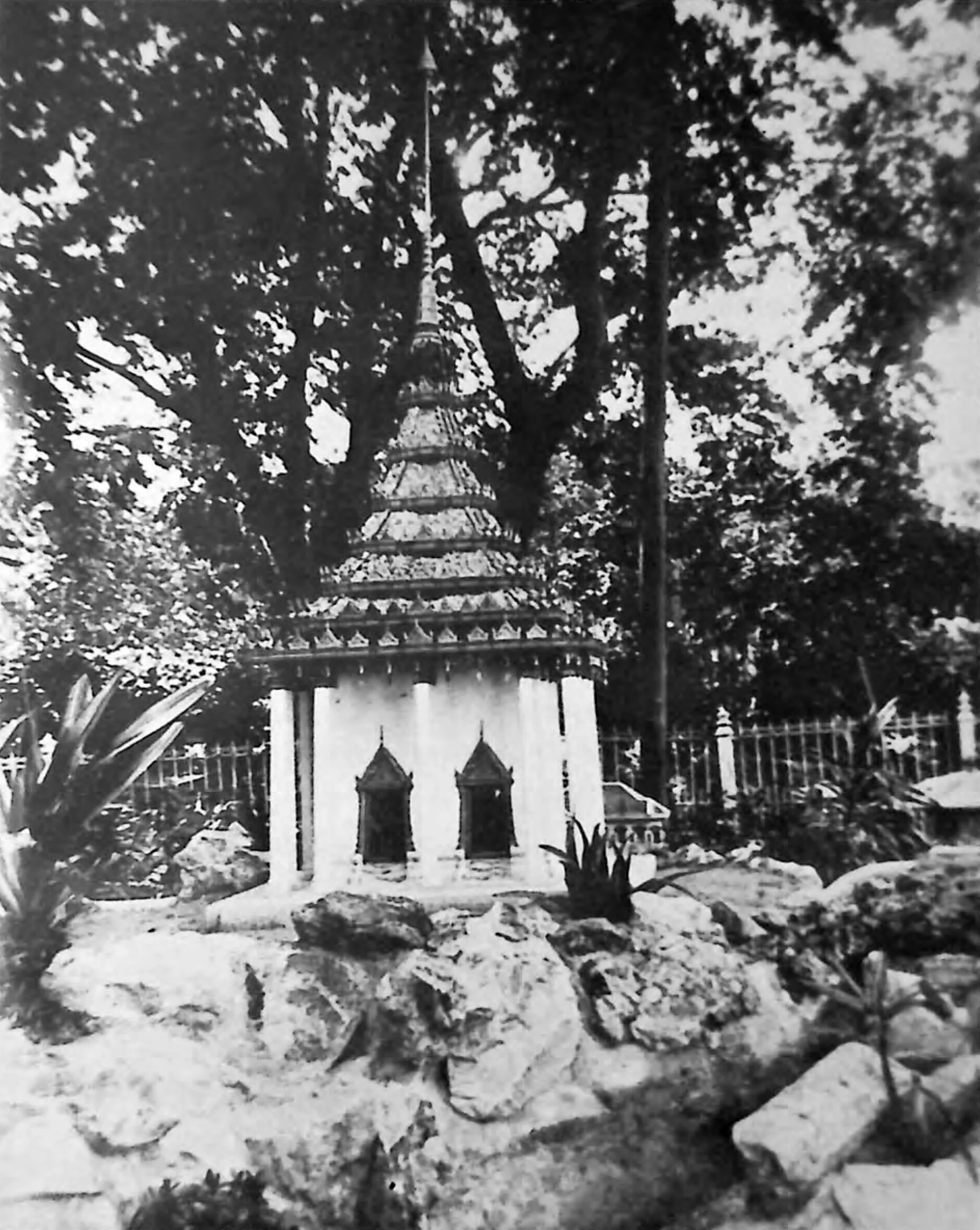
In Dusit District, a small pavilion with white walls, pierced by windows with pointed pediments, bears an ornate tiered roof and a tall spire; it stands on a rock garden, in front of railings and tall trees.Auteur inconnu — Wikimedia Commons, domaine public 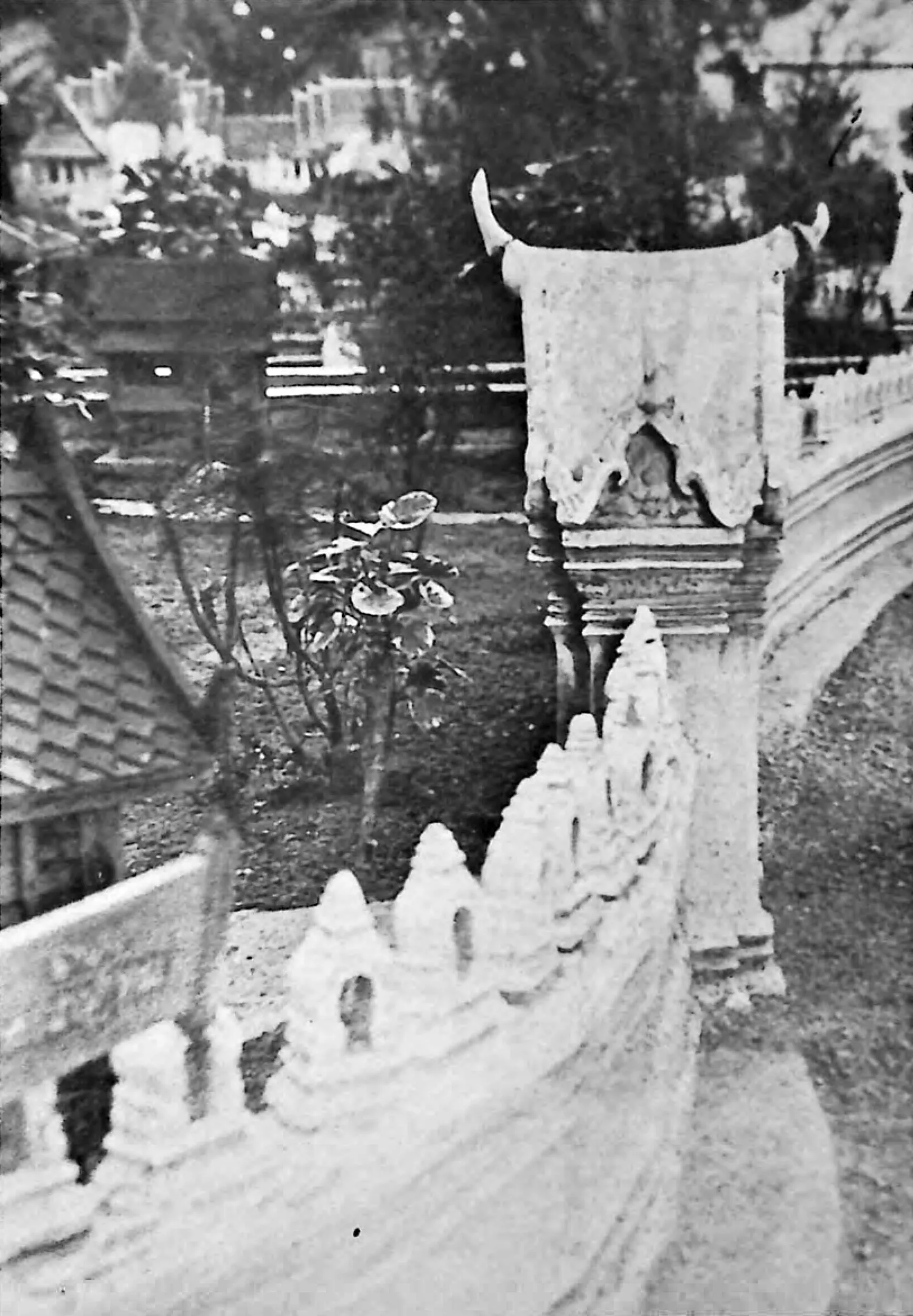
Dusit District: the balustrade of a curved bridge punctuated by pierced pinnacles, and a pier crowned with a gable bearing finials. In the background, a wooded garden, a tiled roof and buildings with tiered Thai roofs.Auteur inconnu — Wikimedia Commons, domaine public 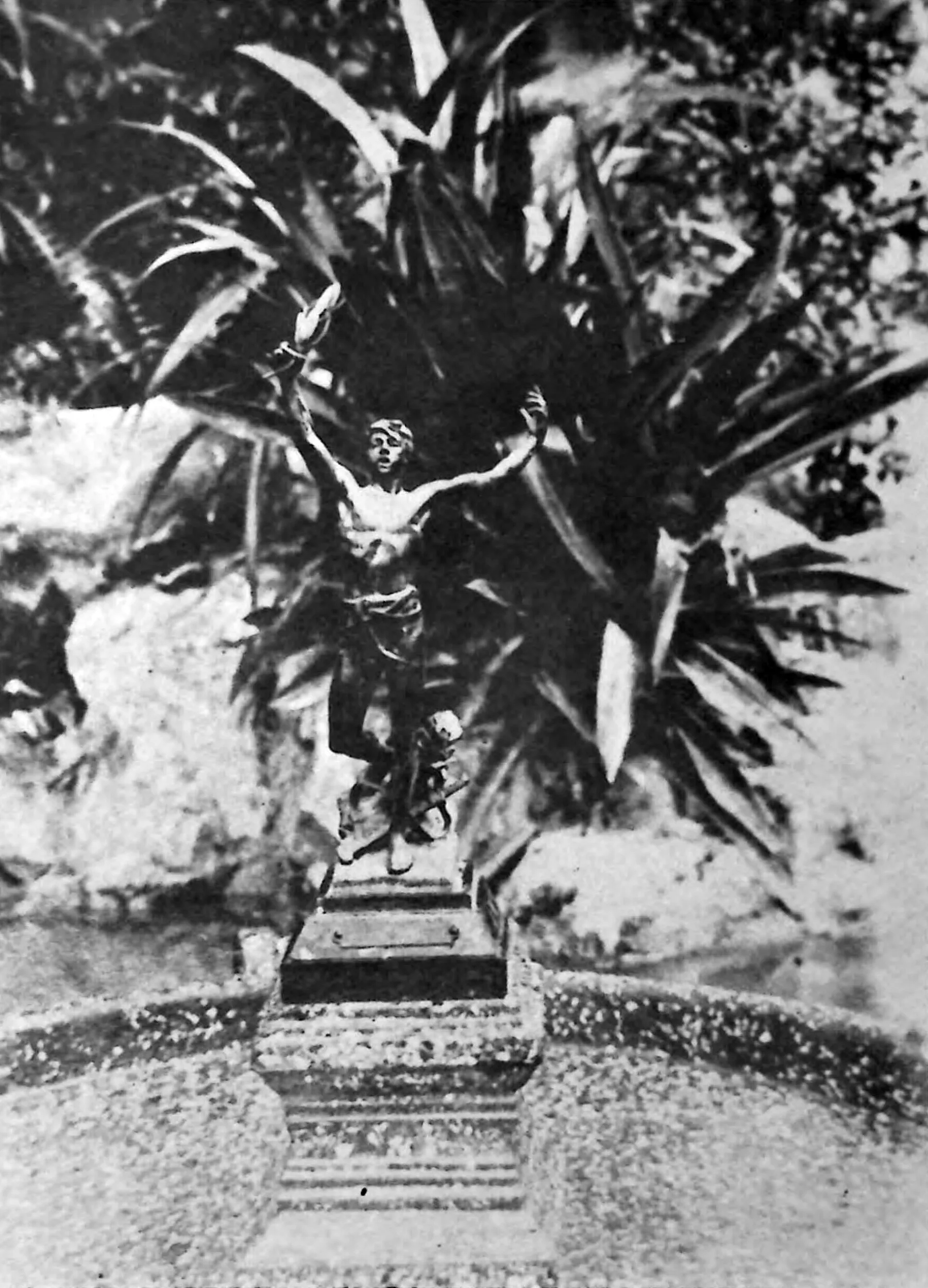
Old photograph of Dusit District: a statue of a bare-chested man, arms raised and one hand holding an object, stands on a stepped pedestal bearing a plaque, in front of a palm and a garden bed.Auteur inconnu — Wikimedia Commons, domaine public 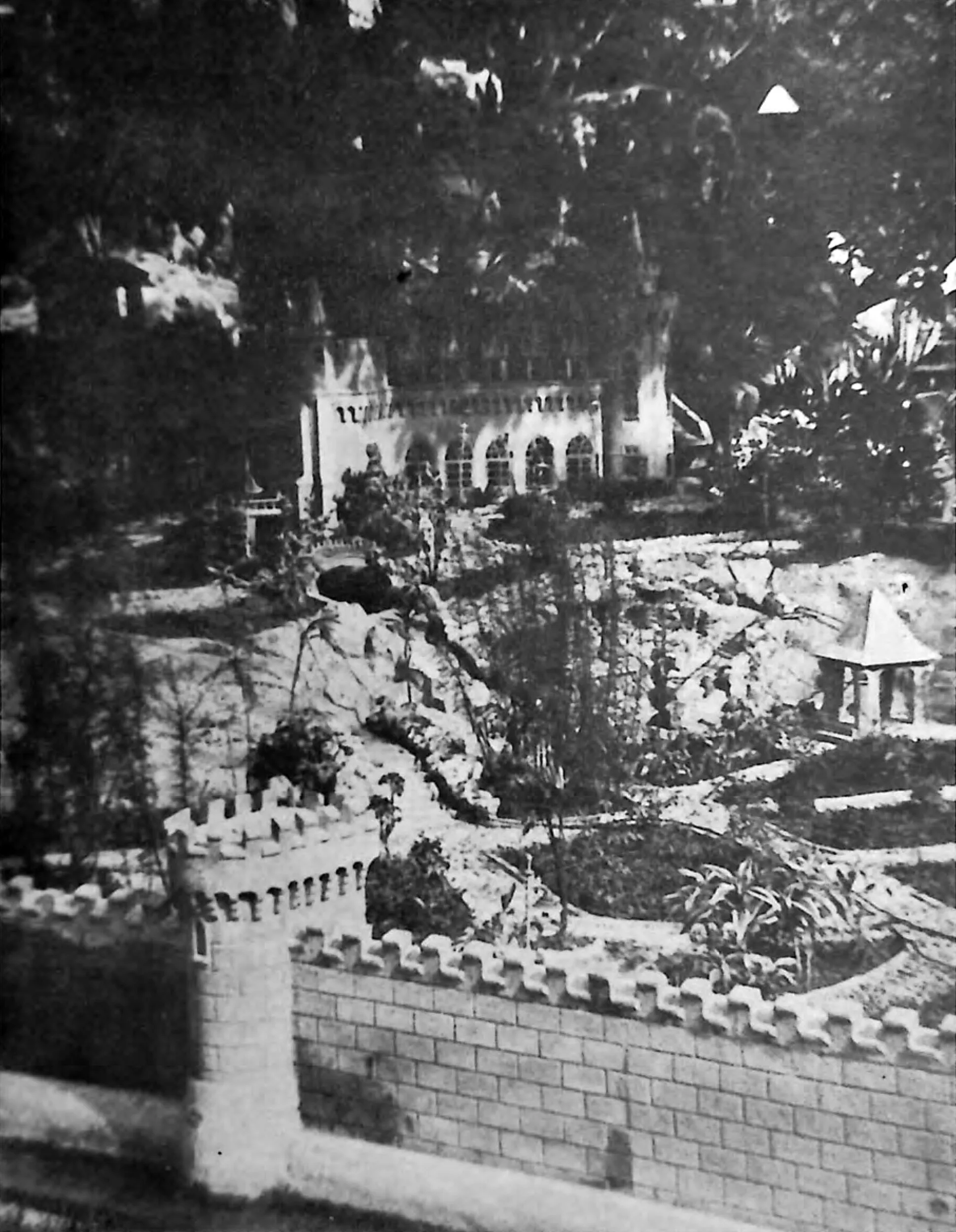
High-angle view of Dusit District: a crenellated wall with a corner tower borders a garden of winding paths, with a pavilion beneath a pyramidal roof and, behind, a building with arched windows under the trees.Auteur inconnu — Wikimedia Commons, domaine public 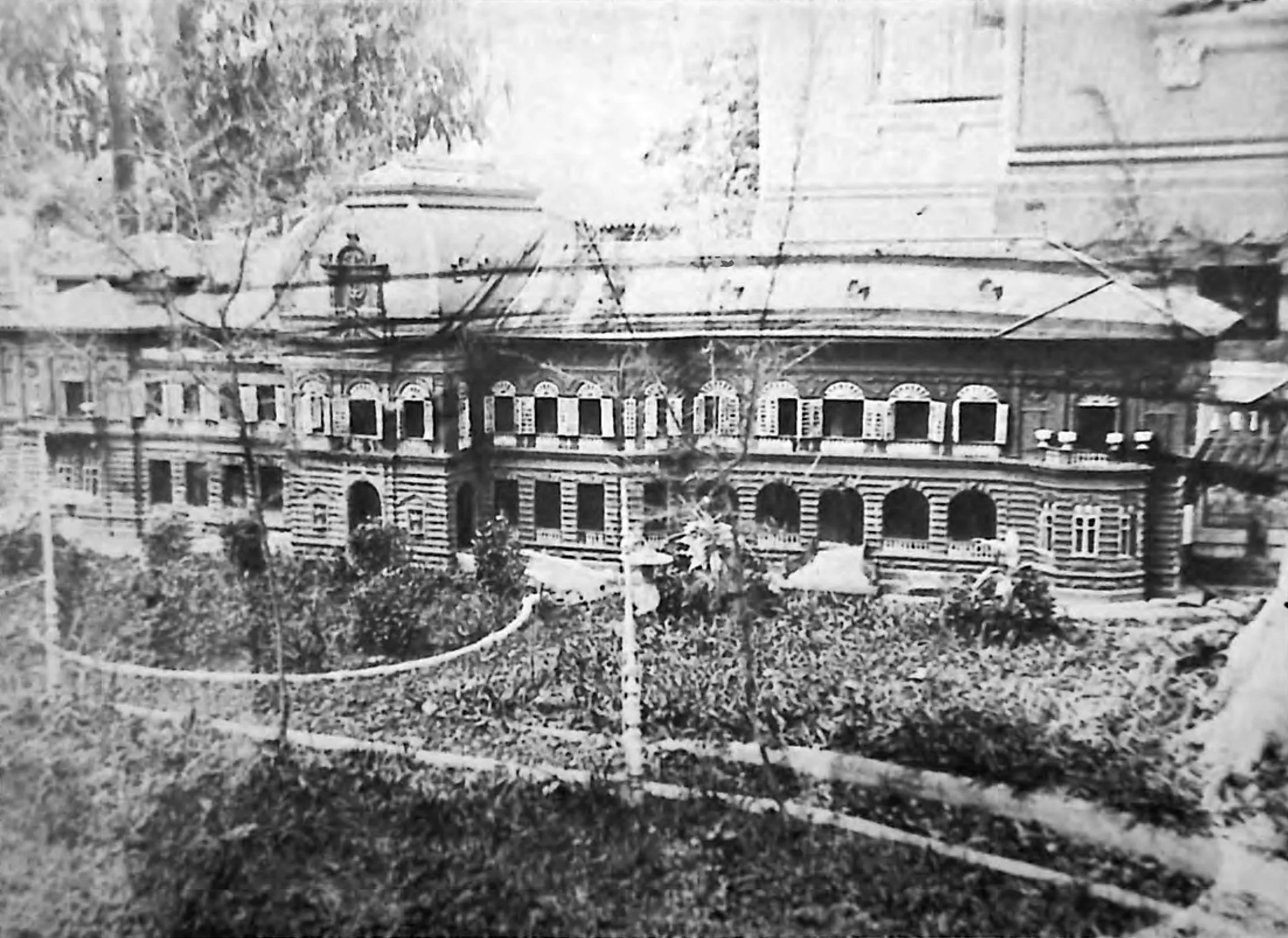
Dusit District: façade of a two-storey building with rusticated walls, arched shuttered windows and ground-floor arcades beneath an overhanging roof, in front of a planted garden edged with low railings.Auteur inconnu — Wikimedia Commons, domaine public 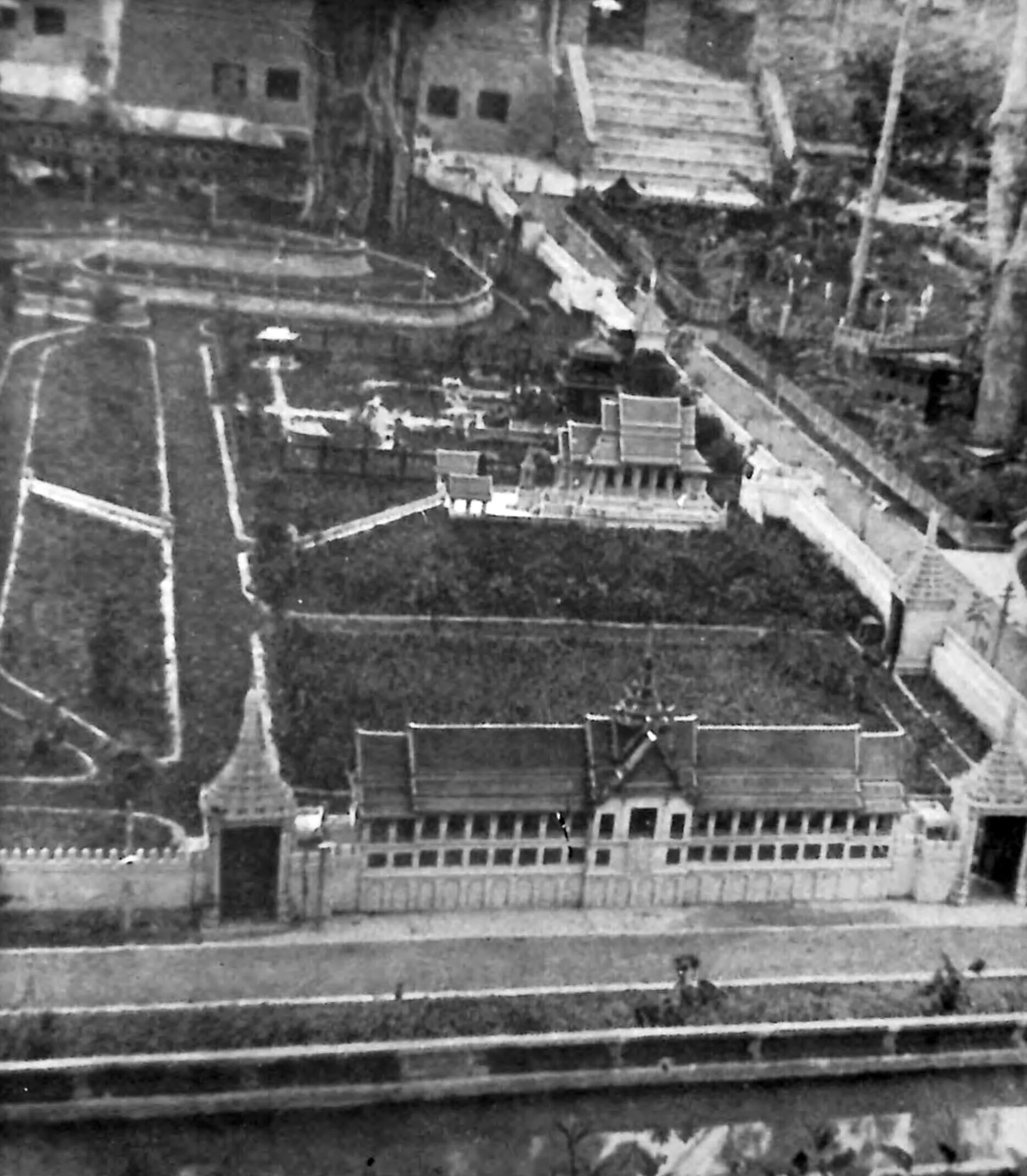
Bird’s-eye view of a miniature town in Dusit District: a long pavilion with tiered roofs behind a crenellated wall punctuated by roofed gateways, gardens laid out with paths, a canal in the foreground and further buildings set back.Auteur inconnu — Wikimedia Commons, domaine public 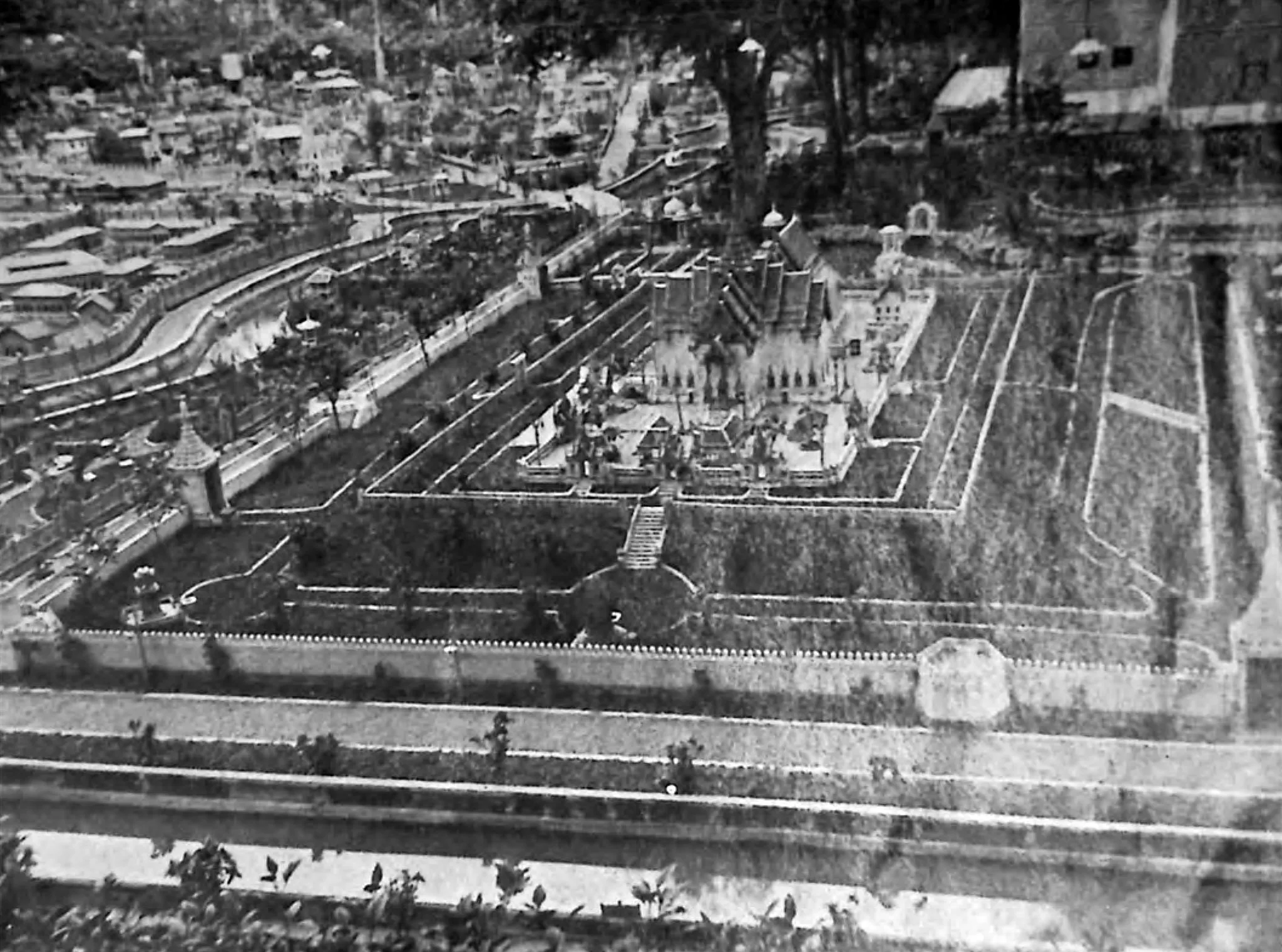
High-angle view of the miniature town of Dusit Thani, in Dusit District: an enclosure wall surrounds a religious complex with tiered roofs and terraced gardens, near a canal lined with rows of houses.Auteur inconnu — Wikimedia Commons, domaine public 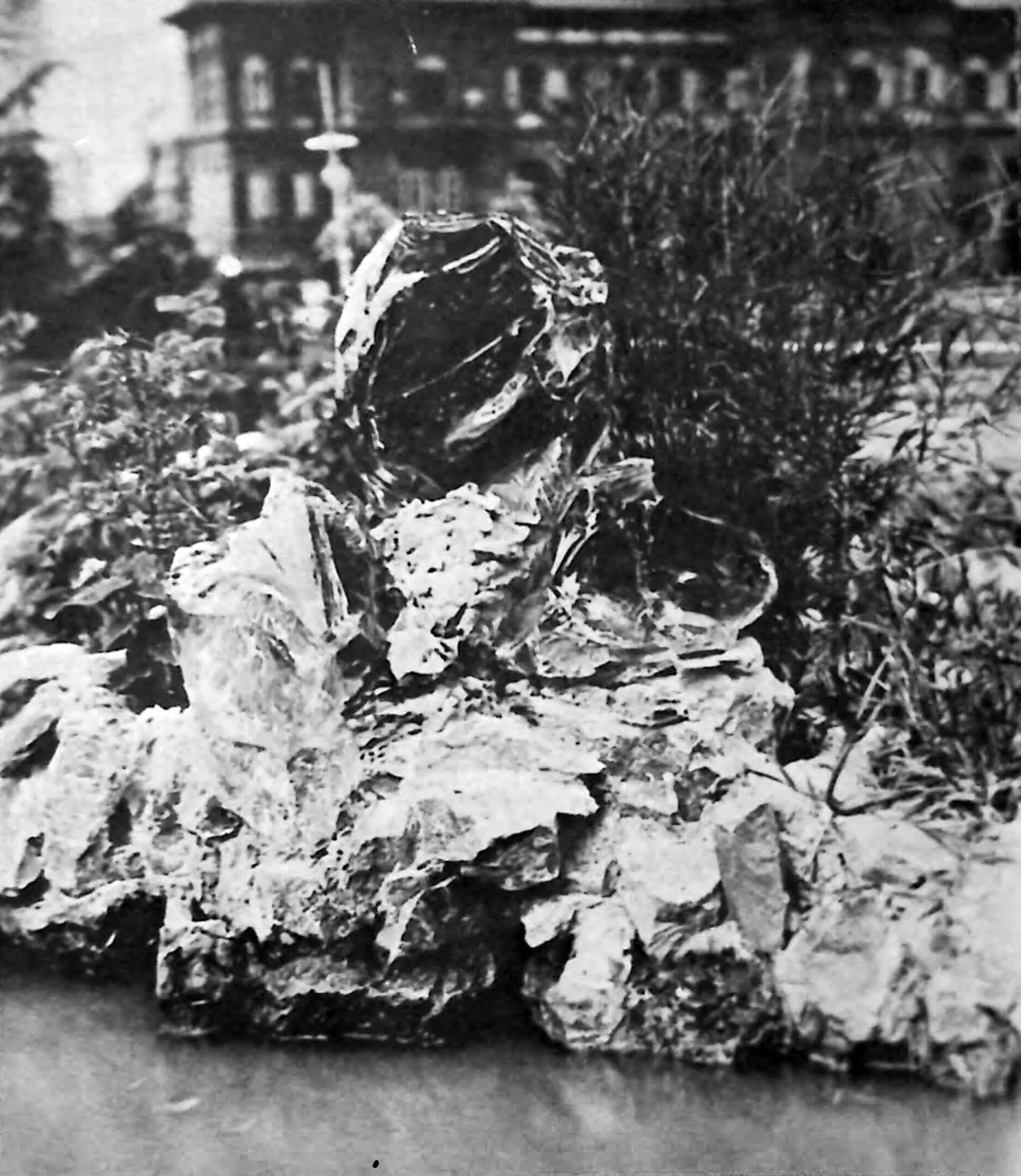
Black-and-white historical photograph of an ornamental rockery at the edge of a pond in the Dusit District; stones and vegetation fill the foreground, in front of a multi-storey façade pierced with windows.Auteur inconnu — Wikimedia Commons, domaine public 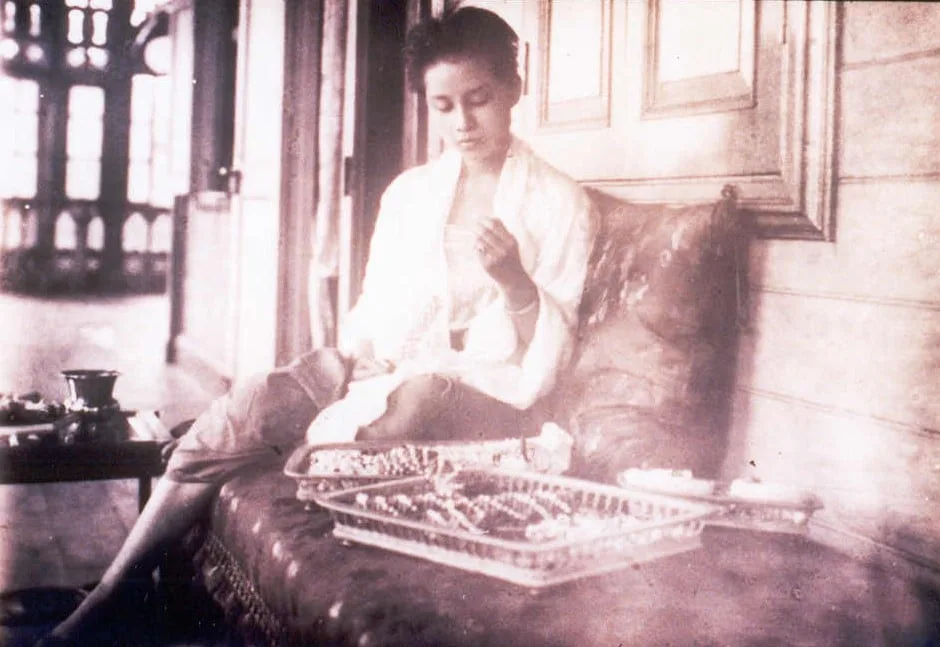
Old sepia-toned print, Dusit District: a young woman in a pale blouse, seated against a panelled wall, appears to be threading small items laid out in openwork trays; on the left, a veranda with ornate windows.Auteur inconnu — Wikimedia Commons, domaine public 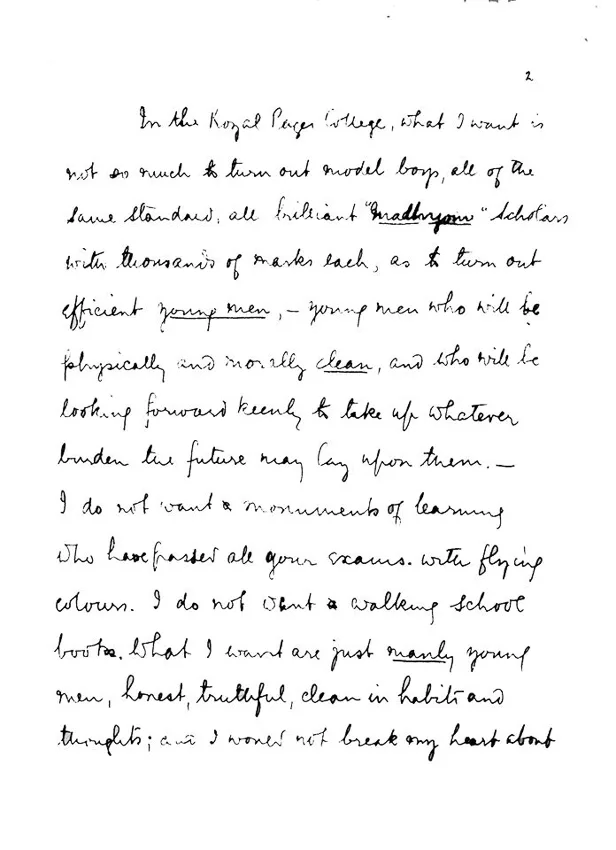
Handwritten page in English numbered 2, in black ink: the text sets out what the author expects of the Royal Pages College, to form honest young men rather than brilliant pupils. Document associated with Dusit District.King Vajiravudh — Wikimedia Commons, domaine public 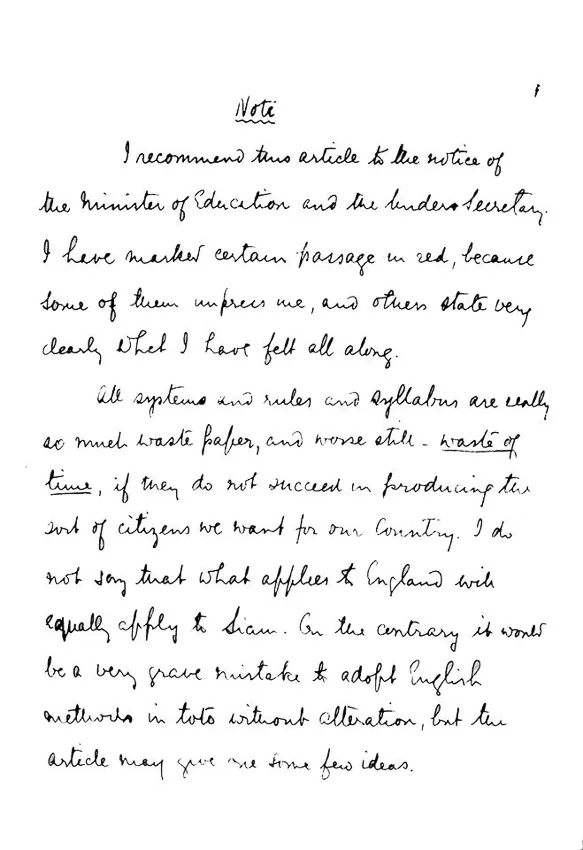
Handwritten note in English recommending an article to the Minister of Education and the Under Secretary; the text refers to school syllabuses, England and Siam. Archive document, Dusit District.King Vajiravudh — Wikimedia Commons, domaine public 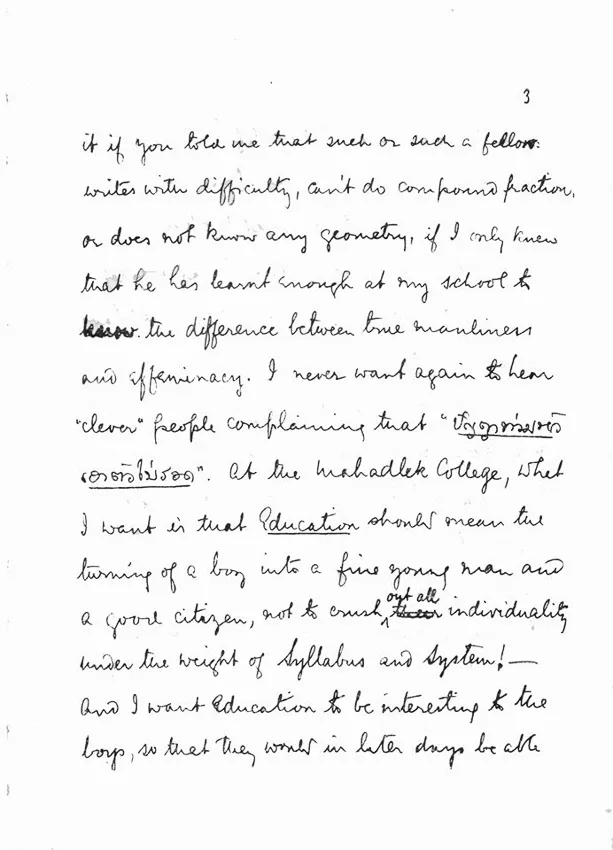
Handwritten page numbered 3, written in ink in English and including a phrase in Thai, discussing education at Mahadlek College; an archive document associated with Dusit District.King Vajiravudh — Wikimedia Commons, domaine public 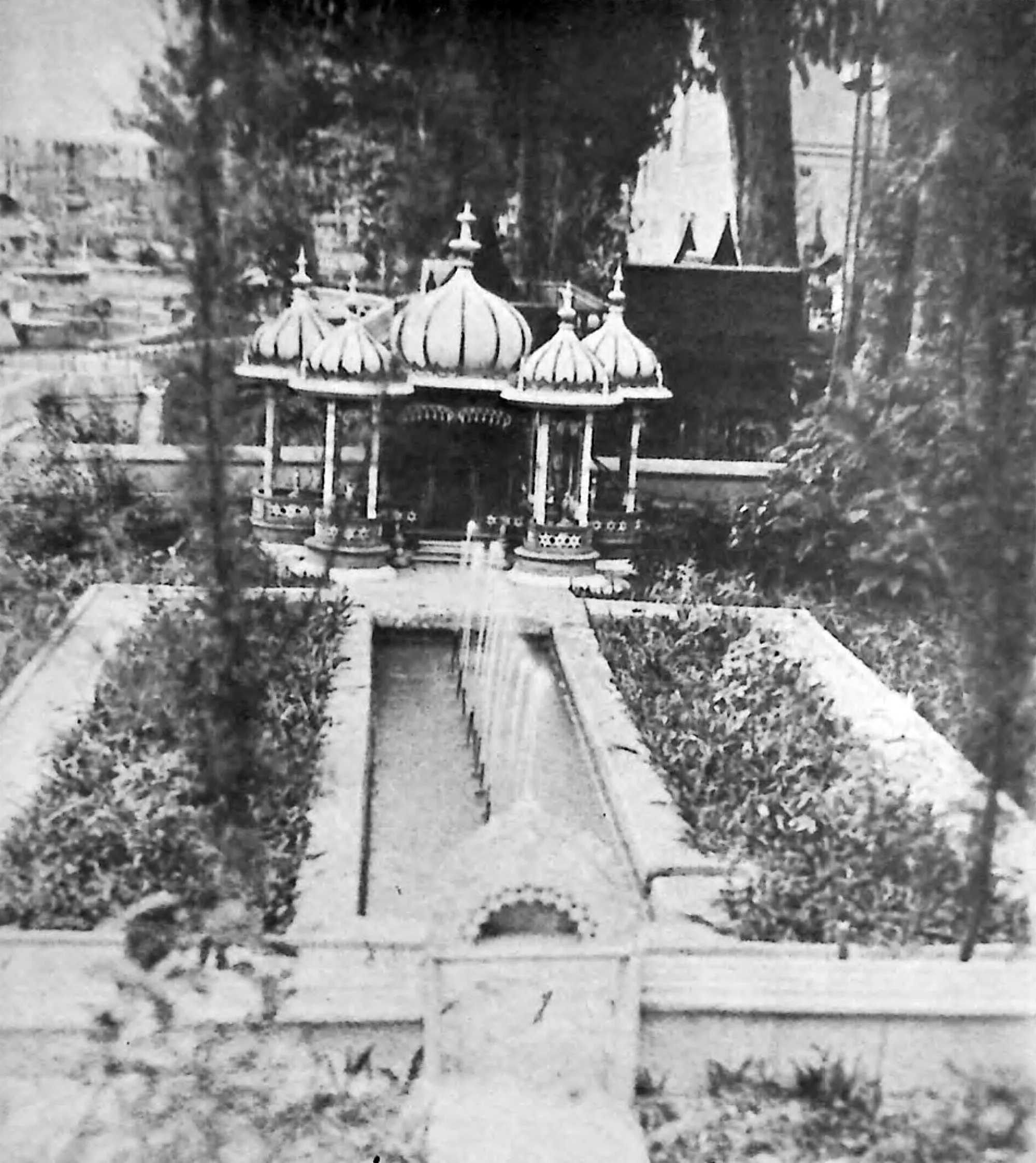
Dusit District: a pavilion with slender columns crowned by ribbed bulbous domes, fronted by a rectangular pool with fountain jets bordered by planted beds; in the background, Thai-style gabled roofs appear among the trees.Auteur inconnu — Wikimedia Commons, domaine public 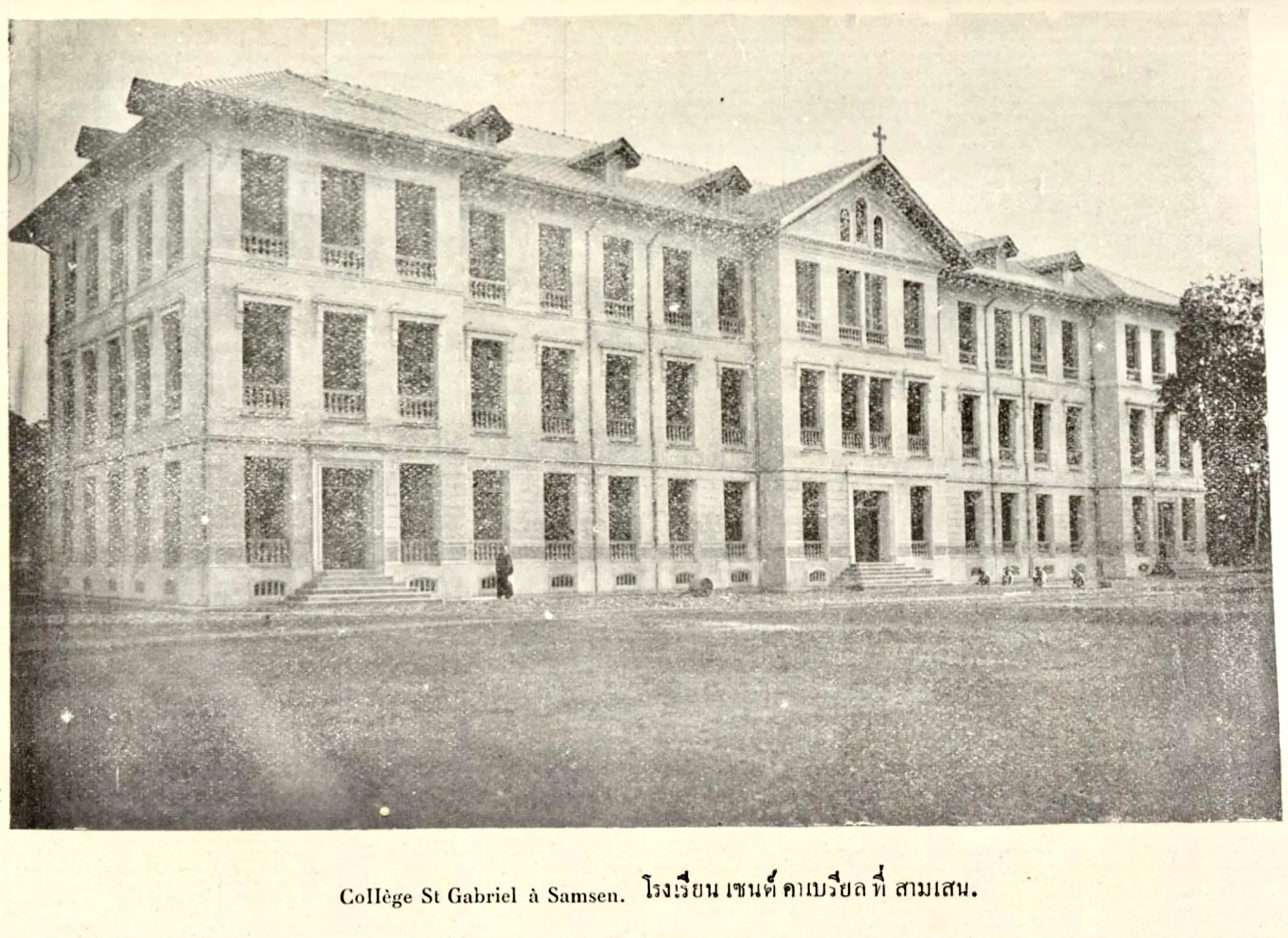
Dusit District: St Gabriel’s College at Samsen, a long Western-style three-storey building with dormers and a central pediment topped by a cross, facing a wide lawn. Printed caption in French and Thai.Auteur inconnu — Wikimedia Commons, domaine public 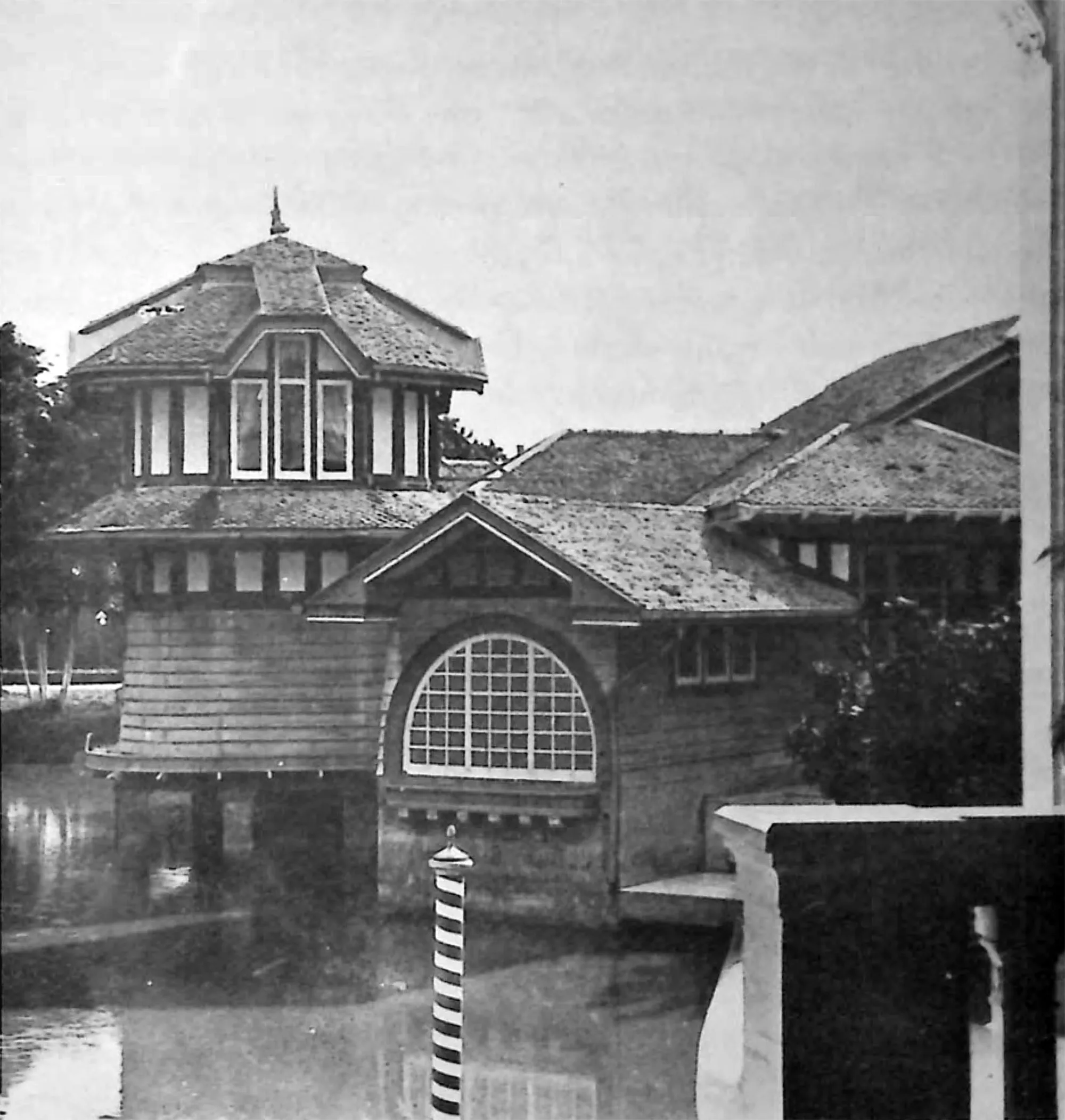
Dusit District: half-timbered wooden pavilion beside a stretch of water, with a tower crowned by a finial, a large semicircular window and a striped mooring post; a balustrade occupies the foreground.Auteur inconnu — Wikimedia Commons, domaine public 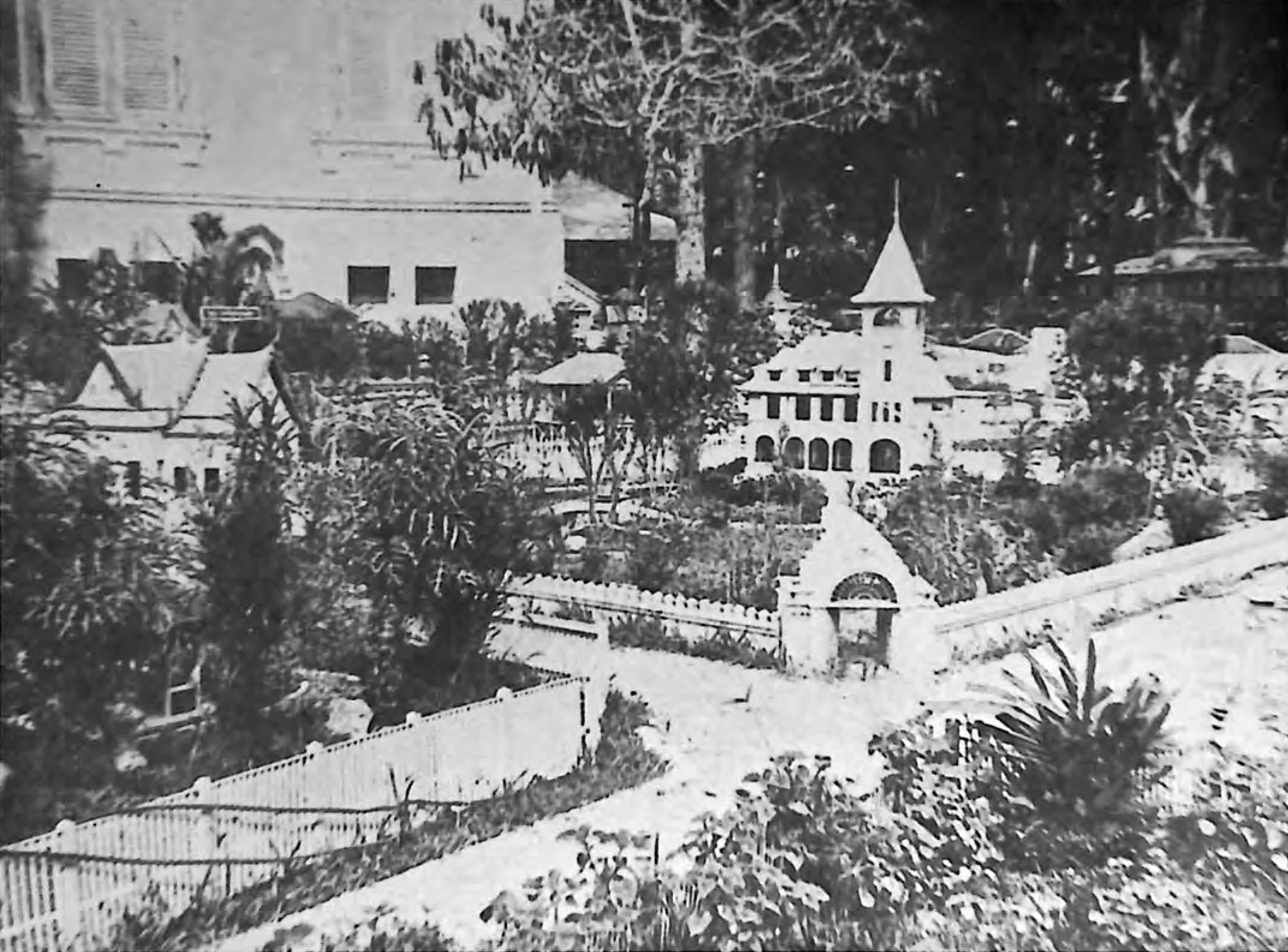
Dusit Thani, Dusit District: reduced-scale buildings, including a structure with a pointed tower and arcades, an arched gateway and white fences, arranged among vegetation in front of a large building.Auteur inconnu — Wikimedia Commons, domaine public 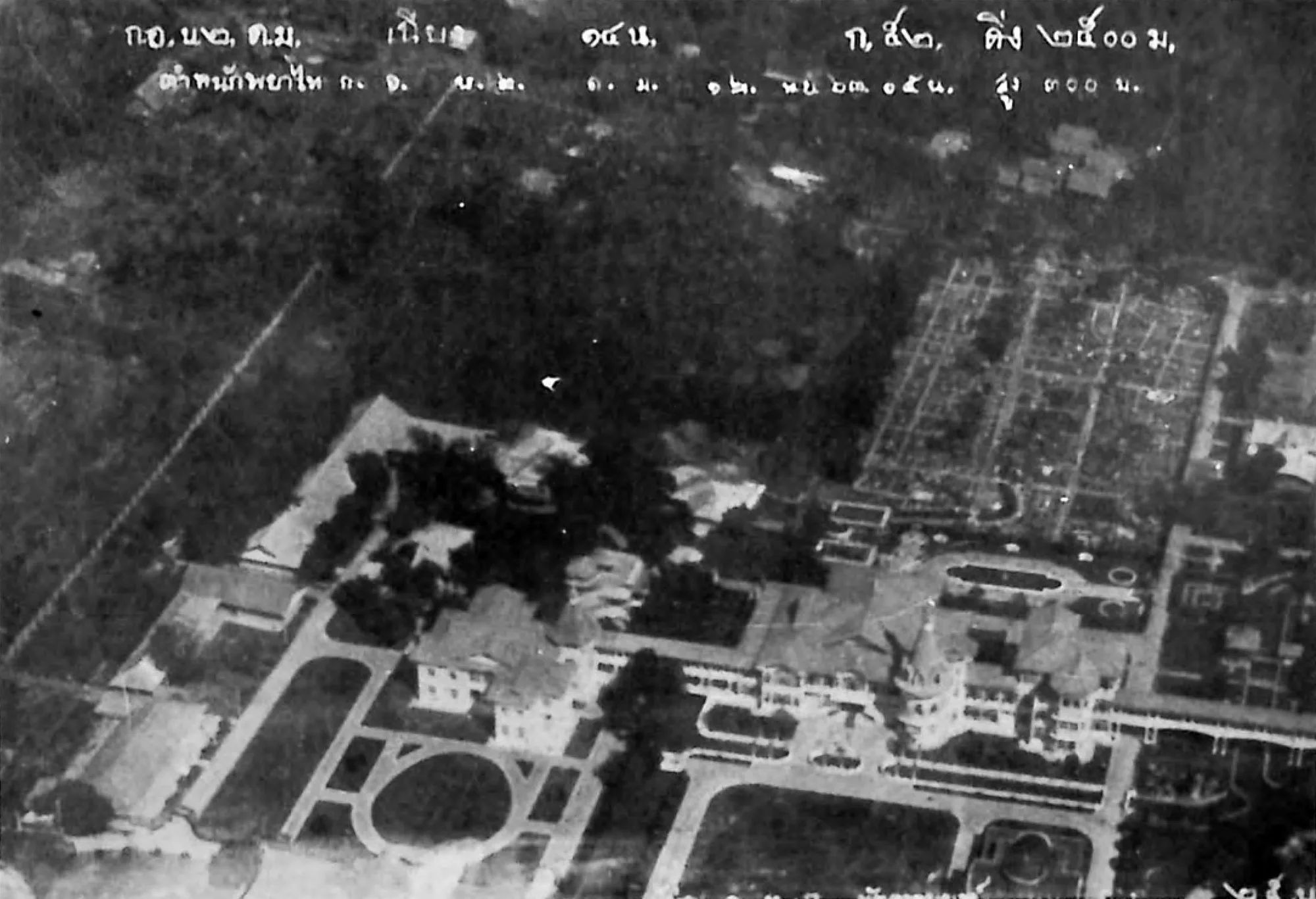
Early aerial photograph of Dusit District: a large galleried building with a pointed tower, surrounded by curving driveways, lawns and a garden laid out in plots. Handwritten Thai annotations at the top.Auteur inconnu — Wikimedia Commons, domaine public 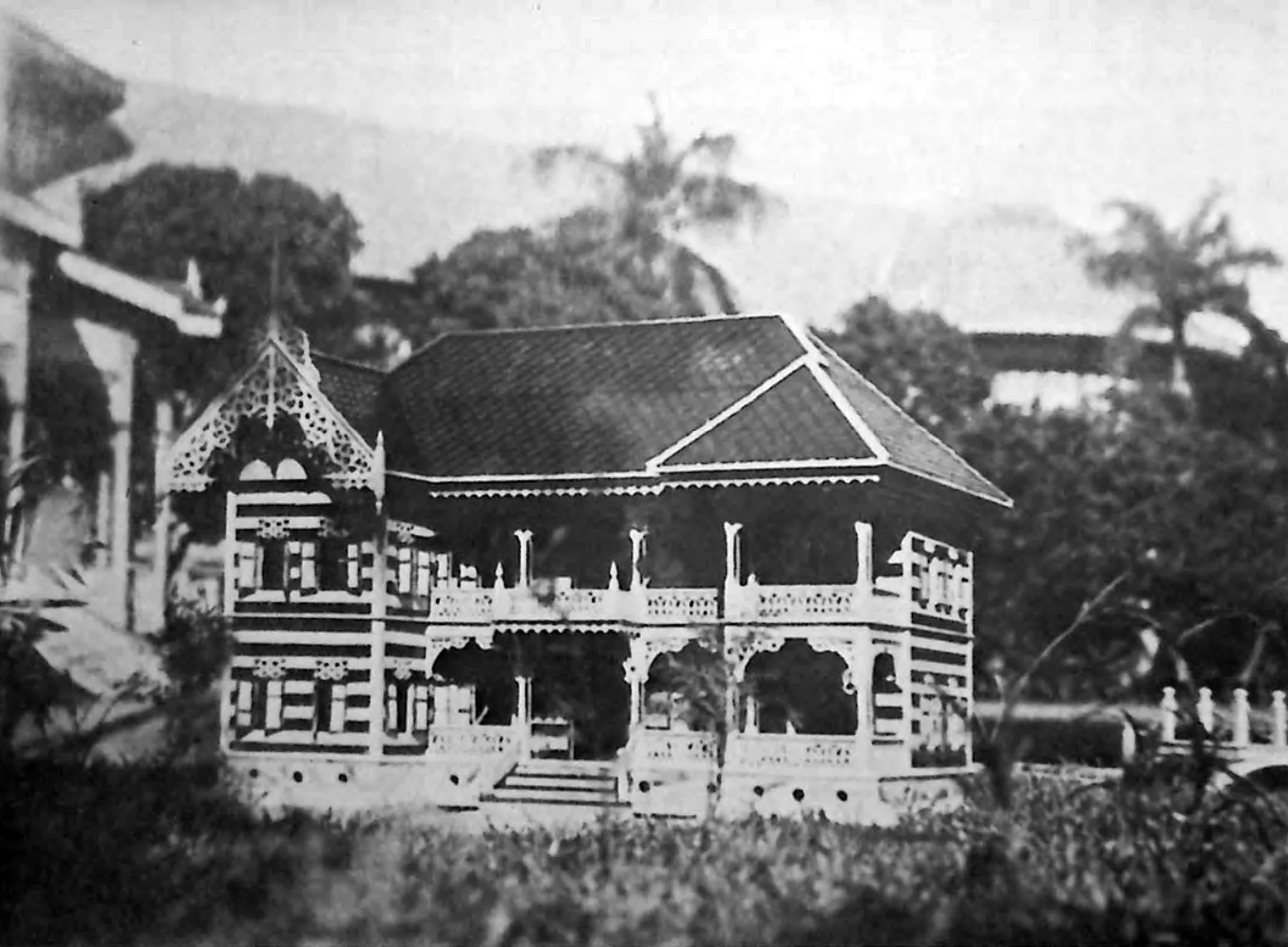
Two-storey pavilion in Dusit District, topped by a hipped roof and a gable decorated with pierced woodwork, with balustraded verandas and scalloped arches, amid palms and dense vegetation.Auteur inconnu — Wikimedia Commons, domaine public