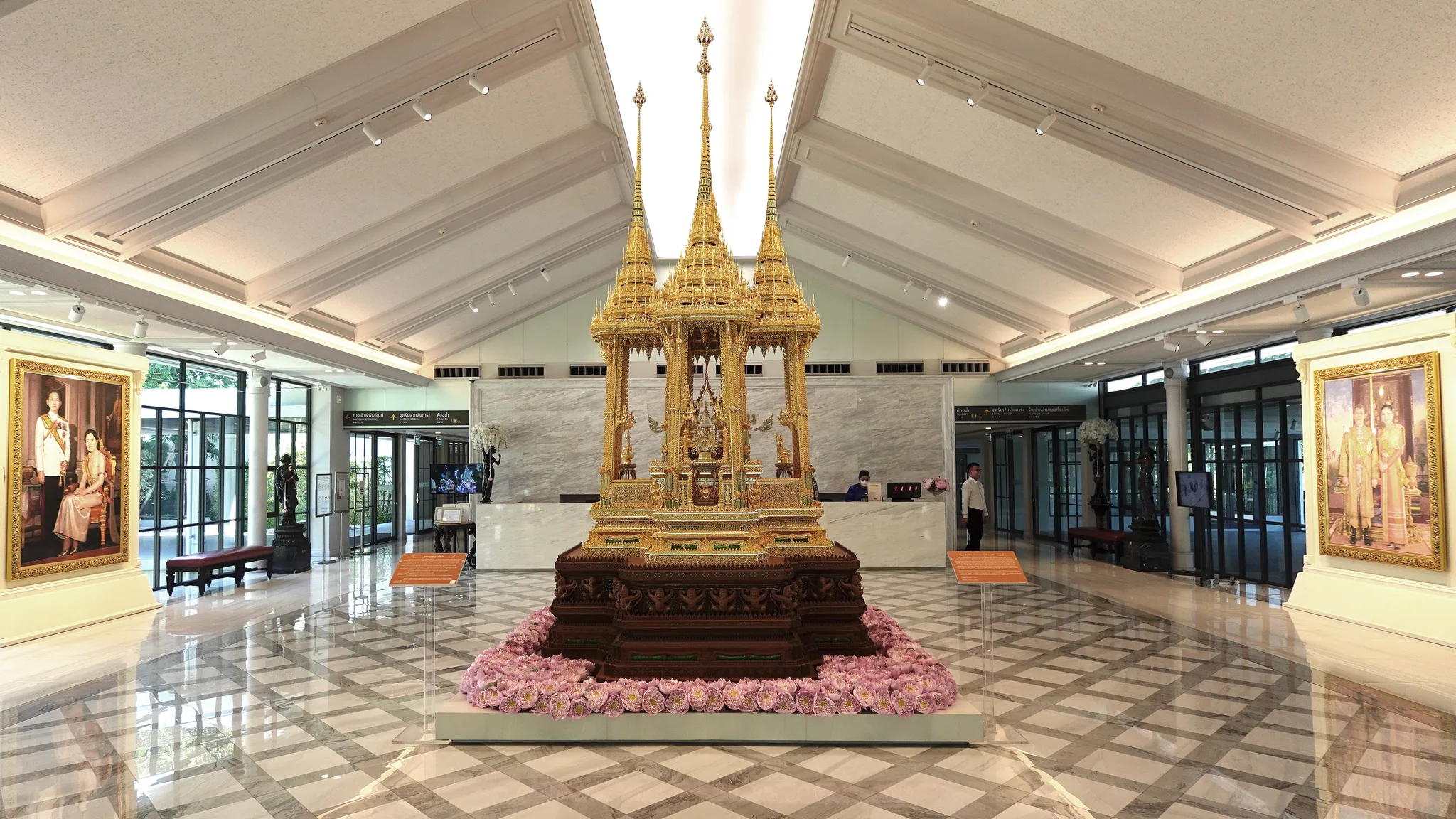
 Dans le hall du Musée des Arts du Royaume, une structure dorée à trois flèches repose sur un socle sculpté bordé de fleurs roses, entre deux portraits royaux encadrés, devant l’accueil et sous une charpente blanche.© Eric Monteil
- Destination
- Ayutthaya (Bang Pa-in)
- Heritage Family
- Crafts, materials and know-how
- Typology
- Museum
- Visit
- Available tours →
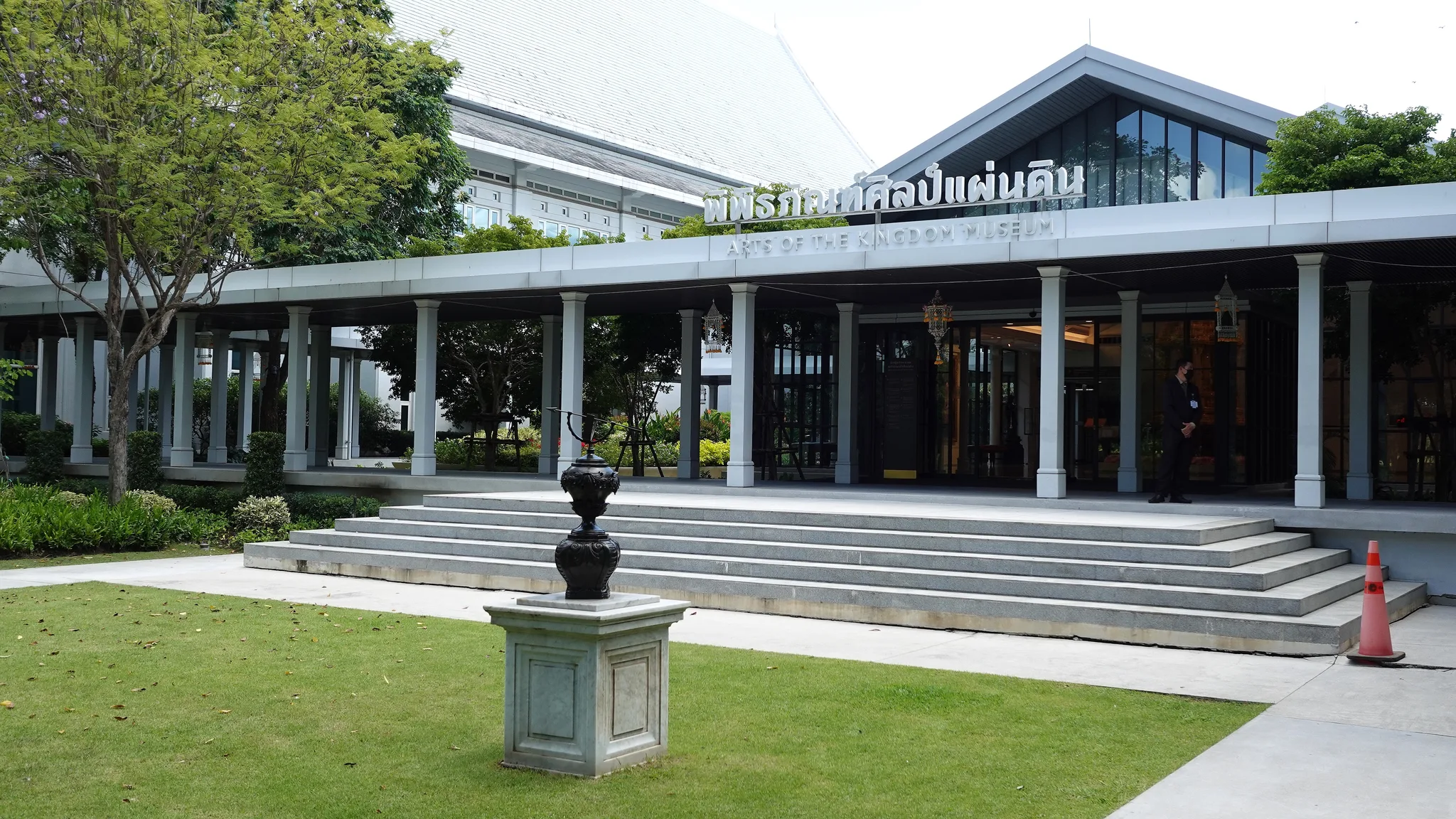
The Arts of the Kingdom Museum, at Koh Kerd in Bang Pa-in district, presents works made by the artisans of the Queen Sirikit Institute. Founded by Queen Sirikit, it is the showcase of a royal project launched in 1976: to give farming families a supplementary income through handicrafts and to save endangered techniques. First exhibited in Bangkok, in the Ananta Samakhom Throne Hall, the collections were moved after 2017 to a renovated and enlarged museum at the heart of an agricultural estate. Visitors can see thrones, scale models of royal barges, embroidered or carved screens and pieces of gold- and silversmithing.13
Key facts
- Destination
- Bang Pa-in
- Heritage Family
- Crafts, materials and know-how
- Typology
- Museum
- Places
- Phra Nakhon Si Ayutthaya
- Periods
- People
- Bhumibol Adulyadej
- Queen Sirikit
- Communities
- —
- Events
- Closure of the Ananta Samakhom Throne Hall
- Transfer of the Arts of the Kingdom exhibition to Koh Kerd
- Heritage
- Khon
- Niello ware (thom)
- Glossary
- Khon
- Rai
- Damascening
- Niello
- Beetle-wing marquetry
- Busabok
- Keywords
- —
- Date
- —
- Collections
- —
Practical info
Practical information about this site is taken from its Google Maps page. We advise you to check it before visiting.
- Address
- พิพิธภัณฑ์ศิลป์แผ่นดิน Koh Kerd, Tambon Ko Koet, Amphoe Bang Pa-in, Chang Wat Phra Nakhon Si Ayutthaya 13160
- Phone
- Website
An institution born of a royal project
The SUPPORT Foundation and the villages
The Arts of the Kingdom Museum stands in Koh Kerd sub-district, Bang Pa-in district, in the province of Phra Nakhon Si Ayutthaya. It presents objects of decorative art whose value lies in their execution, but also in the story of those who made them. That story begins in the Thai countryside, with a foundation created by Queen Sirikit (1932–2025), consort of King Bhumibol Adulyadej (1927–2016), who reigned as Rama IX.13
The SUPPORT Foundation (Foundation for the Promotion of Supplementary Occupations and Related Techniques) came into being on 21 July 1976. It pursues two linked aims. The first is social: to enable villagers to earn a supplementary income from handicrafts without giving up farming. The second concerns heritage: to preserve the arts and crafts that belong to Thai local knowledge. The foundation works on two levels. A regional strand brings together the SUPPORT centres and their members in the provinces. A central strand trains the most accomplished artisans: this is the Queen Sirikit Institute, whose works now fill the museum.14
The Queen Sirikit Institute, a school for artisans
The Queen Sirikit Institute grew out of a training centre set up in the second half of the 1970s within the grounds of Chitralada Palace in Bangkok. It trains skilled artisans, from elementary to the most advanced level. Its students do not come from the court workshops or from art schools. They are the children of poor farming families, sometimes landless, from remote rural regions. They arrive with no artistic training and learn to create their works ‘without model or mould’, starting from scratch.14
The museum carries this undertaking further. Queen Sirikit wished to exhibit the works of the artisans under her patronage and considered that they should be kept in a museum as ‘national treasures’. The royal institutions go further still, presenting the establishment as the only museum to display works created by members of the farming community. This claimed distinctiveness explains the tone of the place: visitors admire prestigious pieces, but also the journey of artisans who came from the villages.15
From Bangkok to Koh Kerd
An exhibition in the Ananta Samakhom Throne Hall
Before finding their home at Koh Kerd, the works of the Queen Sirikit Institute were shown in Bangkok, in the Ananta Samakhom Throne Hall, under the title ‘Arts of the Kingdom’. The present museum inherits this title. Displayed in one of the capital’s prestigious buildings, the pieces made by the Institute’s artisans were associated with the very setting of the monarchy.5
This display came to an end in 2017. The Ananta Samakhom Throne Hall opened for the last time on 30 September and closed from 1 October for works, with no reopening date. The exhibition closed with it. It was then announced that some of the objects would be shown at the Koh Kerd Royal Handicraft Centre, in Ayutthaya province. This departure from Bangkok opened a new chapter: the collections left a palace for a site linked to working the land and to the workshops.6
Transforming an existing museum
The Koh Kerd site already had a museum. It displayed photographs of royal activities and traditional handicrafts, and the architectural practice A49, commissioned for the new project, considered it under-used. The decision was taken to move the objects from the Ananta Samakhom Throne Hall there. The existing building was renovated to house the ‘Arts of the Kingdom’ exhibition, and a new wing was built alongside it.17
The architectural project dates from 2019. By spring 2020 the museum was already in place. The move also changed the status of the collections. Once presented as an exhibition within a palace, they became the core of an independent museum, attached to the Queen Sirikit Institute and the SUPPORT Foundation.17
A museum on an agricultural estate
The Koh Kerd Royal Handicraft Centre
The Arts of the Kingdom Museum stands within the grounds of the Koh Kerd Royal Handicraft Centre. The whole complex occupies an estate of about 2,000 rai, or some 320 hectares, of organically farmed agricultural land. Vegetables are grown there and plants are propagated for the community. The visitor therefore discovers not a museum isolated in a town, but an exhibition building set in the middle of an agricultural estate.17
This site should not be confused with the Bang Sai Royal Folk Arts and Crafts Centre, located in Chang Yai sub-district, Bang Sai district, in the same province. That centre also comes under the SUPPORT Foundation and has its own exhibition halls. Both places reflect the same policy, but only the one at Koh Kerd houses the Arts of the Kingdom Museum.18
Pavilions, courtyards and a new wing
The museum buildings are in the Thai architectural style. Green spaces and courtyards separate them, and trees and watercourses surround them. Visitors thus pass from one building to the next through gardens, which gives the visit its rhythm.17
The new wing has one to two storeys. It is roofed with vaulted ceilings, and its columns are set 15 metres apart, creating large volumes for displaying sizeable objects such as the thrones or the barge models. The architects adopted the principles of universal design, which aims to make a place accessible to all visitors, whatever their physical abilities.17
A guided visit
The display is organised around two groups. The first brings together a selection of key works (Highlight Collection) and the second archives (Archive Collection), all made by the artisans of the Queen Sirikit Institute. Audio guides, a presentation screen and touch screens accompany the visit. These tools provide information on the works and help visitors understand the techniques before examining the objects in detail.13
The skills on display
Gold, silver and enamel
A large part of the collections belongs to the working of precious metals. Gold and silver damascening, known as khram, consists of inlaying threads of precious metal into a metal base to draw a pattern. Gold and silver niello, or thom, works differently: the metal is engraved, then the hollows are filled with a black alloy that makes the design stand out against the gold or silver ground. Gold- and silversmithing completes this group.13
To these techniques is added enamel, referred to in Thai by the expression long ya si, literally ‘to apply the colour’, which lays vitrified colours on metal. These metal arts traditionally served the court, for ceremonial and regalia objects. Seeing them mastered by artisans from farming families gives the Queen Sirikit Institute’s project its full meaning.4
Wood, beetle wings, threads and fibres
The museum also presents humbler materials, worked to the same exacting standards. Woodcarving holds an important place, from the large narrative screen to carved wooden dolls. Beetle-wing marquetry uses the hard, shiny wing cases of certain beetles, cut and assembled to form surfaces with a metallic sheen.13
Thread and plant fibres form another group. Embroidery covers vast screens with mythological or literary scenes. Basketry is represented in two forms. The first is yan lipao basketry, woven from a climbing fern. The second is bamboo basketry whose patterns, known as khit, draw on a traditional decorative vocabulary. These rural techniques are not displayed as mere sideline crafts, but as arts in their own right, on a par with gold- and silversmithing.4
The long time of the workshop
Some pieces required considerable labour: more than a hundred artisans worked on them for nearly four years. These figures convey the ambition of the project, which entrusts whole teams with works comparable in scale to the commissions of the former royal workshops.4
The collections blend heritage and invention. Some pieces revive techniques from the Ayutthaya period, when the city was capital of the kingdom of Siam from the 14th to the 18th century. Others are creations of the reign of Rama IX. The museum thus shows age-old skills that continue to produce new works, not merely reproductions.10
Works for the court and the stage
Thrones, palanquins and barges
Several masterpieces take up the forms of royal ceremonial. The Phutthan throne in gold niello combines the most prestigious function with one of the most delicate techniques in the museum. The throne models include the Busabok Mala and a three-spired busabok throne. The busabok is a throne in the form of a small pavilion crowned by a tapering, spired roof. The Sivikakarn covered palanquin and the Suphannabhetra gilded litter recall the sovereign’s ceremonial journeys.5
The royal barges, which carried the king on the river during great processions, are represented by models. The most famous is that of the royal barge Si Suphannahong. The museum also displays ceremonial objects connected with the royal family, including a gold box in the shape of a mangosteen set with diamonds. Here the tropical fruit becomes a precious object, its form making the source of inspiration instantly recognisable.3
The Himavanta and the heroes of literature
Other works tell stories. An embroidered screen depicts the Himavanta forest, the mythical forest of Buddhist cosmology, lying at the foot of the Himalayas and inhabited by fabulous creatures. A large carved wooden screen combines this same setting with the tale of Sang Thong, a classic Thai story whose hero is a prince concealed beneath a humble guise. On the second floor, another embroidered screen illustrates Inao, a great drama of Thai court literature.5
The choice of these subjects is not merely decorative. With needle or chisel, the artisans of the Queen Sirikit Institute depict the myths and narratives that have long nourished mural painting, theatre and court poetry. Visitors thus rediscover the imaginative world of these arts, transposed into other materials.
Khon, a performing art
The site is not confined to the decorative arts. One building is devoted to khon, a masked dance drama of court tradition that stages the Ramakien, the Thai version of the Ramayana. The Arts of the Kingdom Museum is also a place where this art is learnt. Performances are sometimes given there, such as the episode Phiphek Sawamiphak, which portrays Phiphek, brother of the demon Thotsakan, and his siding with the hero Rama.11
The presence of khon extends the ambition of the exhibition halls. Masks, embroidered costumes and ornaments belong to the same crafts as the objects on display. By bringing works and performance together in one place, the site shows that these skills also serve a living art.
A museum in the life of the kingdom
National treasures and the sufficiency economy
The royal institutions present the museum’s works as ‘national treasures’, echoing Queen Sirikit’s wish. They also ascribe to it a role in transmission. By training artisans and displaying their work, the Queen Sirikit Institute is said to have kept alive artistic disciplines once threatened with extinction. This discourse makes the museum a place where heritage is still being produced, not merely preserved.15
The Arts of the Kingdom Museum also ranks among the royal projects that illustrate sustainable development according to the principles of the sufficiency economy. This development philosophy, formulated by King Bhumibol Adulyadej, advocates moderation and community self-reliance. The agricultural estate, the workshops and the exhibition halls are brought together there to illustrate a single model: living from the land while developing a craft.2
From digital access to tributes
The museum has also opened up to new audiences. In May 2020, during the Covid-19 pandemic, a selection of works was put online on its website and social media, allowing the collections to be discovered despite the closure of the premises. On 18 November 2022, on the occasion of the APEC summit held in Thailand, it welcomed the spouses of the leaders. The choice of this venue shows that the museum also serves as a showcase of Thai craftsmanship for foreign guests.2
The museum’s calendar follows that of the monarchy. Admission is free on royal birthdays. In November 2025, it was free throughout the month as a tribute to the memory of Queen Sirikit. The museum she had wanted for the artisans of her institute thus also became a place of remembrance for its founder.7
Understanding
The Arts of the Kingdom Museum is first and foremost the showcase of a social project: it presents the work of artisans from farming families, trained by the Queen Sirikit Institute in techniques once reserved for the court. Thrones, scale-model barges, embroidered screens, niello and basketry together form a collection intended as a body of ‘national treasures’. The museum is set on an agricultural estate and accompanied by a building devoted to khon, which brings together the land, the workshop and the stage. Its future remains closely tied to the monarchy that created it: free admission on royal birthdays, a tribute to its late founder, the hosting of guests at the APEC summit. The museum upholds a precise idea of heritage, which consists in passing on endangered skills while continuing to produce works. Without its founder, will this heritage remain above all bound to royal memory, or will it become the heritage of the artisans who created it?
Court arts, high-end craftsmanship and architecture under many influences: eight hours at the heart of Ayutthaya's artistic heritage.
- Khon
- Masked dance drama of the Thai court tradition, which stages the Ramakien.
- Rai
- Thai unit of land area, equivalent to 1,600 square metres.
- Damascening
- Metalworking technique, called khram in Thai, which consists of inlaying threads of precious metal into a metal base to form a pattern.
- Niello
- Technique, called thom in Thai, in which metal is engraved and the grooves filled with a black alloy that makes the design stand out against the gold or silver ground.
- Beetle-wing marquetry
- Decorative technique using elytra, the hard, shiny wings of certain beetles, cut and assembled to form surfaces with a metallic sheen.
- Busabok
- Thai throne in the form of a small pavilion, covered by a tapering spired roof.
- Himavanta
- Mythical forest of Buddhist cosmology, located at the foot of the Himalayas and inhabited by fabulous creatures.
- Sang Thong
- Classical Thai tale whose hero is a prince hidden beneath a humble appearance.
- Inao
- Major drama of Thai court literature, inspired by the Javanese Panji tales.
- Ramakien
- Thai version of the Ramayana, the Indian epic of the hero Rama.
- Royal project
- Development project launched on the initiative of the King or a member of the Thai royal family, often intended to improve the living conditions of rural populations.
- Royal barge
- Long, richly decorated ceremonial vessel used by the Thai monarchy to carry the King during solemn river processions.
- Enamel
- Coloured vitrified substance applied to metal; in Thai, the technique is called long ya si, literally ‘applying the colour’.
- Yan lipao
- Climbing fern whose stems are woven to produce a fine traditional Thai basketry.
- Khit
- Traditional Thai decorative patterns, used in particular in bamboo basketry.
- Sufficiency economy
- Development philosophy formulated by King Bhumibol Adulyadej, advocating moderation and community self-reliance.
Primary sources
- 1พิพิธภัณฑ์ศิลป์แผ่นดิน :: Museum Thailand, Museum Thailand ↗
Studies
- 2Ayutthaya's Arts of the Kingdom Museum set to welcome Apec leaders' spouses, The Nation Thailand, 2022 ↗
- 3Queen Mother's Royal Craft Project Now Available Online, Khaosod English, 2020 ↗
- 4พิพิธภัณฑ์ศิลป์แผ่นดิน เปิดแสดง "ศิลปะชิ้นเอก" ครบทุกช่องทางออนไลน์, Sarakadee Lite ↗
- 5วันเดียวเที่ยวบางปะอิน ชมงานศิลป์ เรียนรู้เรื่องโขนที่ "พิพิธภัณฑ์ศิลป์แผ่นดิน", Cheewajit ↗
- 6ปิดพระที่นั่งอนันตสมาคมตั้งแต่ 1 ตุลาคมนี้ และยังไม่มีกำหนดเปิด, Time Out Bangkok (Thai), 2017 ↗
- 7ผู้จัดการออนไลน์, "พิพิธภัณฑ์ศิลป์แผ่นดิน" เปิดให้เข้าฟรี ตลอดเดือนพฤศจิกายน 2568, MGR Online (Manager Online), 2025 ↗
- 8พิพิธภัณฑ์ศิลป์แผ่นดิน เปิดเข้าชม 'ฟรี' ตลอดเดือนพฤศจิกายน 2568, The Standard, 2025 ↗
- 9เปิดเส้นทาง "เกาะเกิดศิลป์ แผ่นดินสยาม" เที่ยวเพลิน เรียนรู้ศิลป์ไทยที่อยุธยา, Kapook ↗
- 10เที่ยวพิพิธภัณฑ์ศิลป์แผ่นดิน ชมงานศิลป์สุดวิจิตร, Thai Post ↗
- 11พิพิธภัณฑ์ศิลป์แผ่นดิน เปิดให้เข้าชมฟรี (ถึง 31 มกราคม 2569), Workpoint Today ↗
- 12พิพิธภัณฑ์ศิลป์แผ่นดิน เกาะเกิด อยุธยา แหล่งรวมศิลปหัตถกรรมประณีตศิลป์ไทย, MGR Online (Manager Online), 2022 ↗
Reference works
- 13Arts of the Kingdom Museum, Arts of the Kingdom Museum (page d'accueil : Current Exhibition, The Collection), Arts of the Kingdom Museum / Queen Sirikit Institute ↗
- 14Arts of the Kingdom Museum, About us – The Arts of the Kingdom Museum, Arts of the Kingdom Museum / Queen Sirikit Institute ↗
- 15Arts of the Kingdom, The Grand Palace / Bureau of the Royal Household ↗
- 16พิพิธภัณฑ์ศิลป์แผ่นดิน – สถาบันสิริกิติ์, Bureau of the Royal Household – The Grand Palace (royalgrandpalace.th) ↗
- 17A49, Arts of the Kingdom Museum, Bang Pa-in, Phra Nakhon Si Ayutthaya (fiche projet), A49 (Architects 49), 2019 ↗
- 18Appreciate the artisans of Bang Sai Royal Folk Arts and Crafts Center in Ayutthaya, TAT Newsroom (Tourism Authority of Thailand), 2017 ↗
Further reading
Contemporary views
Arts of the Kingdom Museum today
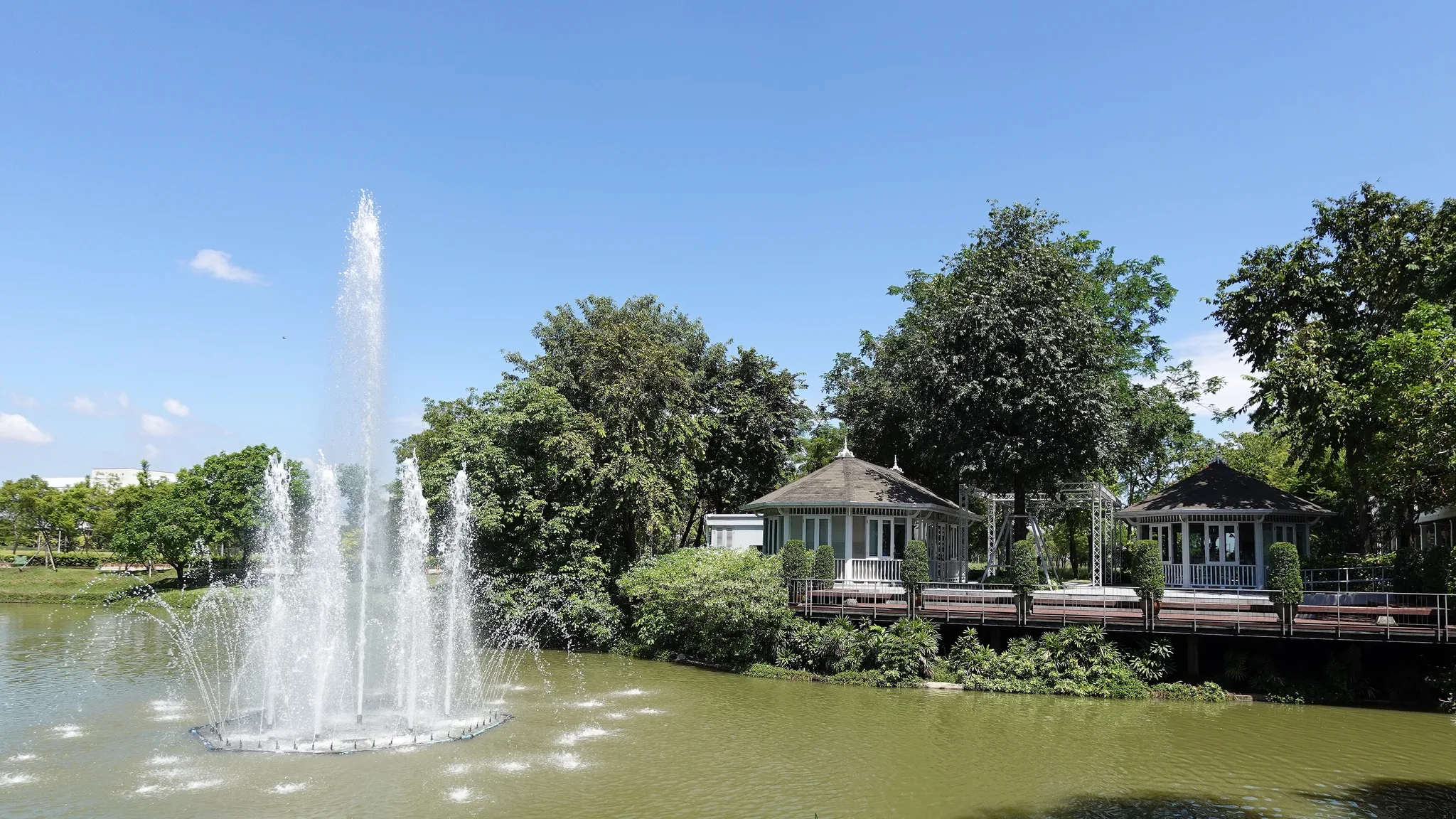
Aux abords du Musée des Arts du Royaume, un jet d’eau anime un bassin bordé d’arbres ; sur la rive, deux pavillons blancs à toit pyramidal encadrent une terrasse en bois, aménagement paysager des jardins du musée.© Eric Monteil 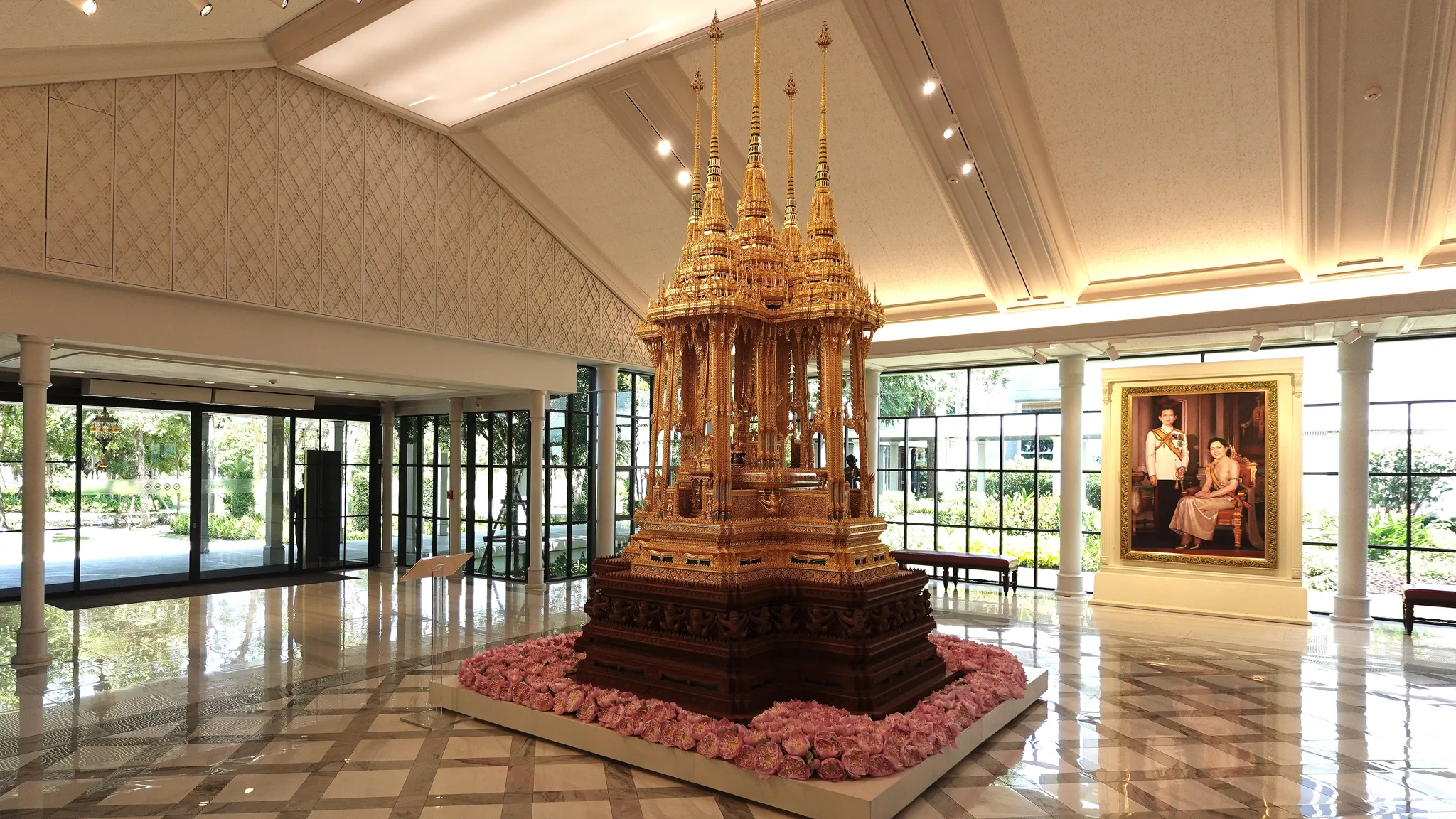
Dans le hall du Musée des Arts du Royaume, un pavillon ouvragé doré à cinq flèches repose sur un socle de bois sculpté bordé de fleurs roses. Sol de marbre, colonnes blanches et baies vitrées ouvrent sur le jardin.© Eric Monteil
Architecture and decoration
Explore the heritage
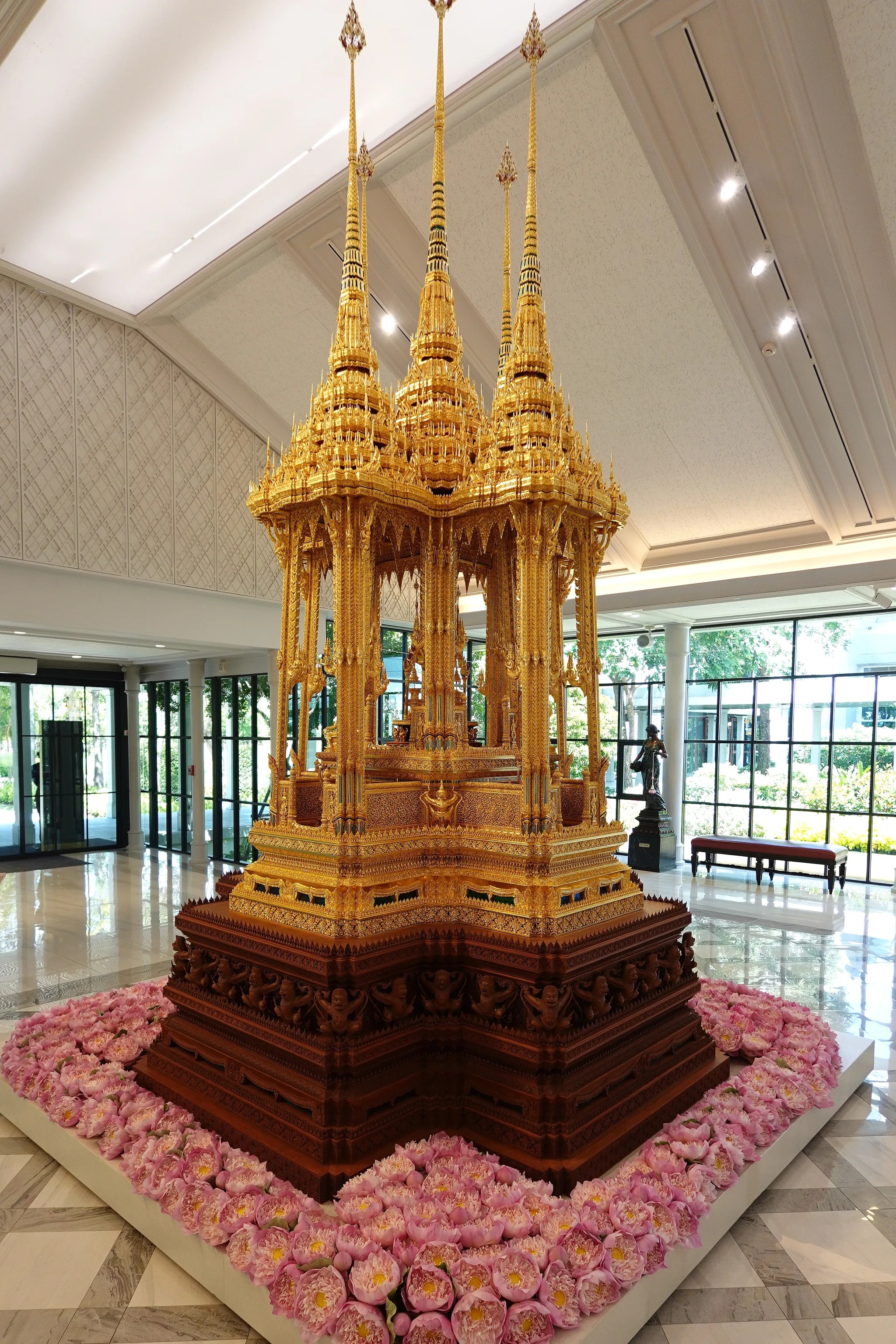
Dans le hall du Musée des Arts du Royaume, un pavillon doré à cinq flèches repose sur un socle de bois sculpté de figures porteuses, entouré d’une bordure de lotus roses.© Eric Monteil 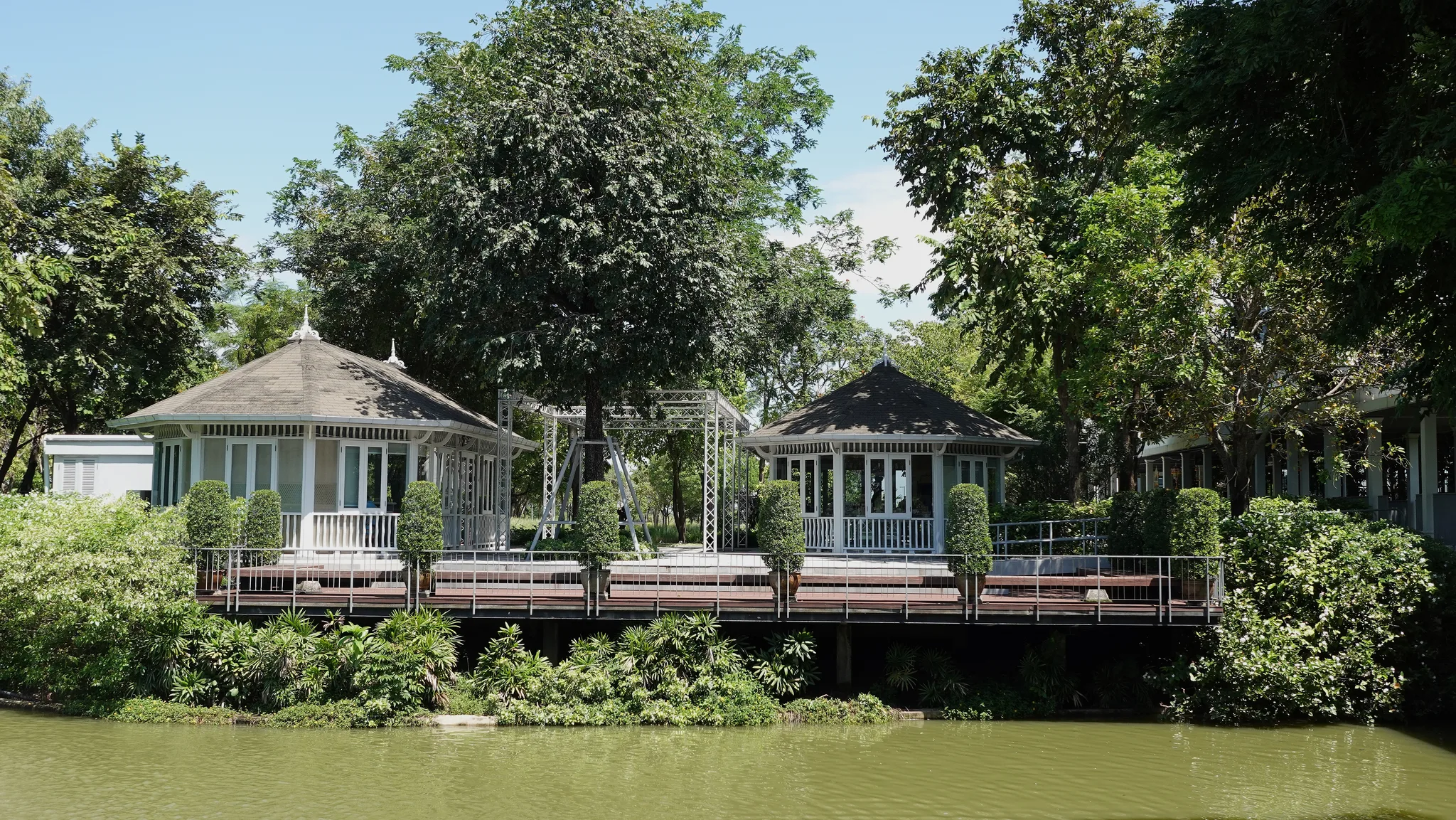
Au Musée des Arts du Royaume, deux pavillons octogonaux à boiseries blanches et toits pyramidaux coiffés d’épis se dressent sur une terrasse en bois surplombant un plan d’eau, encadrés d’arbres et d’arbustes taillés.© Eric Monteil