
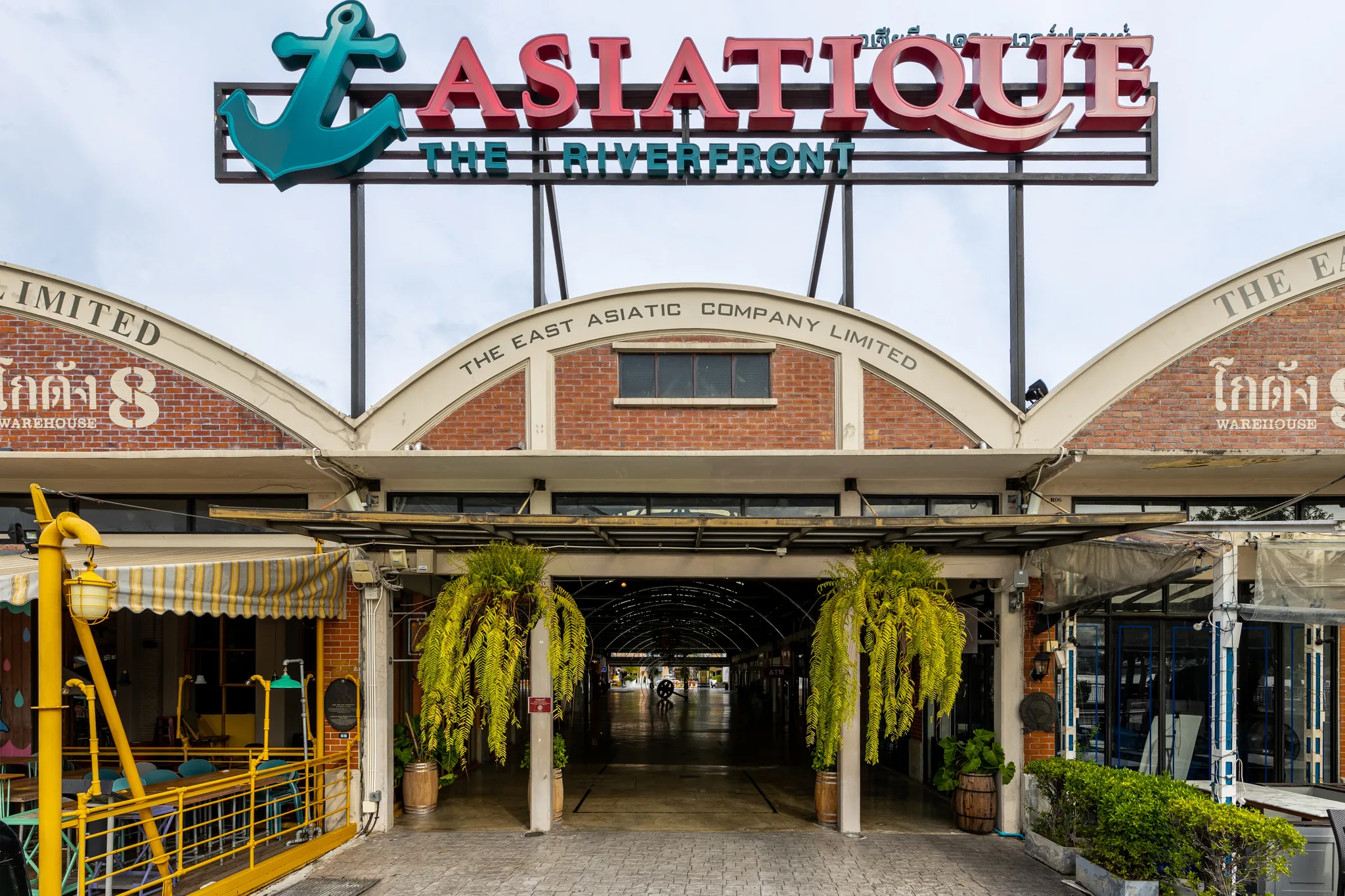
 At Asiatique The Riverfront, a covered walkway opens between brick warehouses with arched gables bearing the inscription ‘The East Asiatic Company Limited’, now occupied by terraces and shops.This Photo was taken by Supanut Arunoprayote . Feel free to use any of my images, but please mention me as the author and may send me a message. (สามารถใช้ภาพได้อิสระ แต่กรุณาใส่เครดิตผู้ถ่ายและอาจส่ง — Wikimedia Commons, CC BY 4.0
Rehabilitation & adaptive reuse
Asiatique The Riverfront
On the bank of the Chao Phraya in Bangkok, former warehouses of the East Asiatic Company, built on the grounds of a vanished monastery, have become a leisure complex that turns their history into a selling point.
Heritage family · Heritage in transition
- Destination
- Bangkok (Bang Kho Laem)
- Heritage Family
- Heritage in transition
- Typology
- Rehabilitation & adaptive reuse
- Visit
- Available tours →
Asiatique The Riverfront is a vast open-air shopping and leisure complex on the bank of the Chao Phraya River in Bangkok, set in the former docks of the East Asiatic Company, the Danish firm that had its trading post and port there. It illustrates the conversion of a port site in the Thai capital: rather than demolishing the warehouses, its developers kept them to house shops, restaurants and shows. The place layers three memories: that of a former monastery, that of a teak-trading post, and that of a leisure centre opened in 2012, which its operator now presents as living heritage.6
Key facts
- Destination
- Bang Kho Laem
- Heritage Family
- Heritage in transition
- Typology
- Rehabilitation & adaptive reuse
- Places
- Chao Phraya River
- Bangkok
- Periods
- People
- Hans Niels Andersen
- Rama III
- Rama V
- Communities
- —
- Events
- Fondation de l’East Asiatic Company
- Lancement du concept « Heritage Alive »
- Ouverture
- Transfert du Bouddha d’or au Wat Traimit
- Heritage
- Golden Buddha
- Glossary
- Wat
- Khwaeng
- Buddha image
- Royal monastery
- Principal image
- Keywords
- —
- Date
- —
- Collections
- —
Practical info
Practical information about this site is taken from its Google Maps page. We advise you to check it before visiting.
- Address
- 2194 ถ. เจริญกรุง Khwaeng Wat Phraya Krai, Khet Bang Kho Laem, Krung Thep Maha Nakhon 10120
- Phone
- Website
Before the port, a monastery on the riverbank
Wat Phraya Krai under Rama III
Before the quays and warehouses, the riverbank now occupied by Asiatique The Riverfront belonged to a Buddhist monastery, Wat Phraya Krai, also known as Wat Chotanaram. The temple has disappeared, but its name survives in that of the subdistrict (khwaeng) in which the site lies, within Bang Kho Laem district. It was during the reign of Rama III (1824–1851) that the monastery received its principal image. The image of Wat Phraya Krai was then entirely covered in stucco: it did not yet have the appearance that now earns it the name of the Golden Buddha.11
The monastery’s origins remain difficult to establish. One hypothesis attributes its founding to Phraya Krai Kosha, a high-ranking dignitary at the court of Rama III; another account emphasises its restoration, with the rank of royal monastery, by a nobleman named Phraya Shoduek Ratchasetthi (Boonma). There is nothing to decide between these two versions, which nonetheless agree in placing the temple’s rise in the same reign. The site was thus first a religious place, patronised by the court nobility, long before it became a place of commerce.10
Abandonment and the departure of the Golden Buddha
The monastery did not survive the reign of Rama V. Under Chulalongkorn (Rama V), it lost the patrons who had provided for its upkeep, fell into ruin and was then abandoned. The land, released from its religious function, was then leased to the East Asiatic Company, opening the site’s long period as a port.10
The statue, however, remained in place for several decades. It was not moved until 1935, to Wat Traimit, another Bangkok monastery, where it is now known as the Golden Buddha. This long stay links the ground of Asiatique The Riverfront to the history of the Golden Buddha, and recalls that the warehouses were built on land that had first been consecrated.11
The East Asiatic Company’s trading post
A Danish captain in the king’s service
The site’s history as a port begins with a sailor. Hans Niels Andersen, a Danish captain, arrived in Bangkok in 1873 aboard the brig Mars, a two-masted sailing ship. He settled there in 1879, after sailing on the Thoon Kramom, a ship belonging to King Chulalongkorn, which he had commanded. This link with the Siamese court would hold a lasting place in the memory of the site, down to the replica of the ship moored today in front of the warehouses.4
In 1884 Andersen founded the trading house Andersen & Co. in Bangkok, devoted to imports and forestry, in particular teak for export. The venture took root in a city that was opening up to European trade. In 1861 European diplomats and merchants had asked the king for new roads; Charoen Krung, which foreigners call New Road, is one of them. It was between this street and the river that the future trading post would be established.4
A company between Copenhagen and Bangkok
In March 1897 Andersen gave his business an entirely new scale by founding the East Asiatic Company in Denmark, with the backing of the Danish banker Isak Glückstadt. The new company had offices in Copenhagen and Bangkok. The Bangkok office took over the activities of Andersen & Co.: imports as well as forestry and the export of teak.3
Andersen remained bound to the kingdom that had welcomed him. From 1898 he was Siam’s first honorary consul in Copenhagen, a post he held until 1932. The company’s founder thus represented Siam in Denmark for more than three decades, while his warehouses rose on the Bangkok riverbank.
Quays and warehouses on the Chao Phraya
On the grounds of the former monastery, the company laid out a port: quays and warehouses lined up between the river and Charoen Krung, devoted to trade, notably in teak. Andersen organised the construction of the jetty and the warehouses. The oldest of the surviving buildings dates from 1907; it therefore belongs to the early years of the East Asiatic Company, barely a decade after its founding.1
This trading post bears witness to the maritime and commercial history of Bangkok in the late 19th and early 20th centuries. It is this history, rather than that of the monastery, that gives the present complex its name and that its managers would choose to highlight. The warehouses did indeed outlive the port activity that had brought them into being, and it is on them that the site’s conversion rests a century later.1
From warehouse to leisure complex
The gamble of conservation
In May 2011 the company TCC Land announced the renovation and conversion of the former docks. The approach chosen was to keep the warehouses and restore them to house shops, restaurants and performance venues, rather than clear the site to build anew. At the opening, this choice was hailed as a way of preserving part of Bangkok’s port history.6
The name chosen, Asiatique The Riverfront, refers directly to the land’s former occupant, the East Asiatic Company. From the outset it places the new complex in continuity with the Danish trading post, without mentioning the monastery that had preceded it.6
The 2012 opening
Asiatique The Riverfront opened on 27 April 2012. It was then described as a ‘festival market’ doubling as a ‘living museum’ – in other words, a festive marketplace conceived as a living museum, housed in restored warehouses. Management was entrusted to Riverside Masterplan Co., Ltd., a subsidiary of TCC Land. Built around shopping, dining and shows, the complex welcomes Bangkok residents and tourists alike.6
The old quay thus found an entirely new function: goods are no longer loaded there; instead, people stroll there in the evening by the river. Yet the place remains a commercial space, which in its own way extends the mercantile vocation of the original trading post.
The handover to Asset World Corporation
In 2019 management of the site passed to Asset World Corporation (AWC), a company founded in 2009 as First Destination Co., Ltd. by the TCC Group of the businessman Charoen Sirivadhanabhakdi, who is its majority shareholder. The complex thus remains within the orbit of the same group, but it is now run by a new team, which redefines the way the place tells its story.6
Reading the site today
The restored warehouses
What one sees first are the former port warehouses, lined up along the river and now occupied by restaurants.1
These buildings constitute the main material trace of the site’s history. Of the monastery, nothing remains standing; of the port activity, only these converted structures survive, the oldest of which dates back to 1907.1
Districts, promenade and Ferris wheel
The complex is organised into districts. The ‘Charoen Krung District’, on the street side, brings together the Calypso Cabaret theatres along with craft and souvenir shops. The ‘Waterfront District’, by the river, gathers the restaurants, an events space hosting concerts, festivals and New Year celebrations, and the Asiatique Sky Ferris wheel. A riverside promenade some three hundred metres long runs along the bank.6
Around sixty metres high, Asiatique Sky was billed at its opening as Thailand’s first giant Ferris wheel.1
The Sirimahannop, replica of a royal ship
Moored in front of the warehouses since 2020 is the Sirimahannop, a three-masted ship designed as a replica of the Thoon Kramom, the vessel of King Chulalongkorn that Andersen had commanded. This choice links the site to its founder and to the moment when the Danish captain formed his attachment to the Siamese court, even before the creation of his trading house.8
On the river, the ship makes visible an episode that the warehouses alone do not tell. It is not a relic but an evocation: a recent reconstruction, designed to give an image to the maritime history on which the identity of the place is founded.
Heritage staged
The ‘Heritage Alive’ concept
In October 2020 Asiatique The Riverfront reopened under a concept called ‘Heritage Alive’, whose official launch was announced for 15 October by AWC, then headed by Wallapa Traisorat. The reopening centred on three new features: the sailing ship Sirimahannop, a ‘Living Museum’ and an art festival. The site’s history, until then evoked mainly through the preservation of the warehouses and the name of the complex, became the explicit focus of its presentation.8
This heritage reinterpretation is driven first and foremost by the operator itself. It highlights the maritime and commercial history of the place, that of the East Asiatic Company and its founder, which serves as both narrative and identity for a leisure venue.7
Ever-changing attractions
The site has been transforming constantly ever since. On 24 March 2023 a ‘Disney100 Village’ was inaugurated there. On 29 July 2025 a ‘Fossil Park’ opened at the Hatch Dome, in partnership with the Ministry of Natural Resources and Environment. On 30 April 2026 the operator launched a new attraction, ‘Better World Better Future’, which includes a so-called 9D cinema.7
These attractions belong to a different register from the port history: they make the site an entertainment venue in constant renewal, whose offering changes from one season to the next. The 1907 warehouses form its enduring setting, while what they house is forever changing.
A memory to be qualified
Asiatique The Riverfront thus belongs to a heritage in flux, where historical value is read not in a fixed monument but in the reuse of old buildings. Its strength lies in the conservation of the warehouses, which keeps on the riverbank the trace of a European port of the late 19th and early 20th centuries, and in the link, recalled by the Sirimahannop, between the Danish company and the Siamese court.
This memory nonetheless remains selective. It favours the trading post at the expense of the monastery that preceded it and of the Golden Buddha that remained there until 1935, and it is told by the very party that operates the site commercially. Visitors to Asiatique The Riverfront therefore find a heritage narrative that is genuine but slanted, and all the more legible for those who know its forgotten layers.
Understanding
Asiatique The Riverfront is above all a place of many layers: the land of a vanished monastery, which long sheltered the statue now called the Golden Buddha; then the port of a Danish company founded by a captain with ties to the Siamese court; and finally a leisure complex opened in 2012. Its importance lies in the fact that its warehouses, preserved rather than demolished, keep on the bank of the Chao Phraya a tangible trace of Bangkok’s mercantile history. Yet this heritage lives under the hand of its operator, which has turned it into a concept, ‘Heritage Alive’, and keeps adding attractions foreign to that history, from the Disney village to the fossil park and the 9D cinema. Projects follow one another and the site is ceaselessly transformed, while the original monastery remains almost absent from the story offered to the public. Can a place whose memory is told by those who operate it still be recognised as a shared heritage?
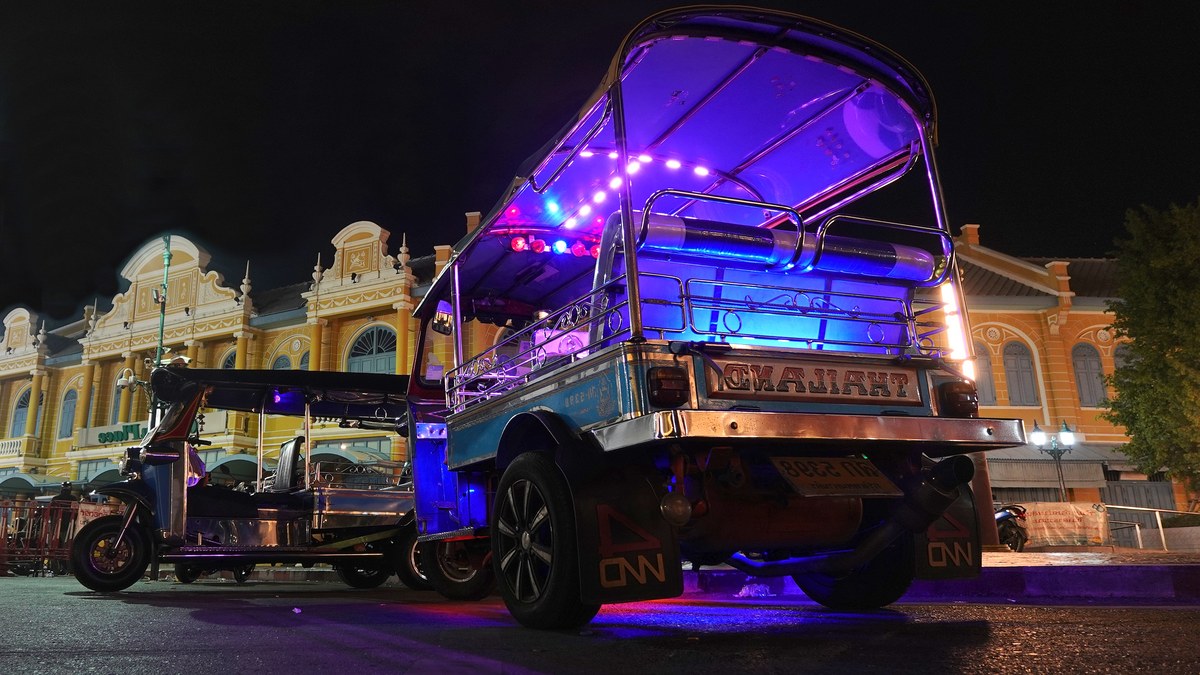
Bangkok from dusk to deep night, from the banks of the Chao Phraya to the neon of Chinatown and the jazz clubs.
- Wat
- Buddhist monastic complex that brings together, within a single enclosure, several religious buildings, monks’ quarters and ancillary buildings; the word does not refer to a single building.
- Khwaeng
- An administrative subdivision of Bangkok, ranking below the district (khet), the urban equivalent of the tambon in the provinces.
- Buddha image
- In Thai Buddhism, a devotional representation of the Buddha, most often a statue, venerated as an object of worship.
- Royal monastery
- In Thailand, a Buddhist monastery founded, restored or placed under the patronage of the king or the royal family, and holding a particular rank.
- Principal image
- In a Thai Buddhist monastery, the most important statue of the Buddha, around which worship is organised; it is generally installed in the monastery’s main building.
Studies
- 1Gary Boyle, Asiatique The Riverfront: Eat, shop, learn history, Bangkok Post, 2012 ↗
- 2Find the Perfect Gift at Asiatique - The Riverfront, Bangkok Post ↗
- 3Eggers-Lura, The Danes in Siam: Their Involvement in Establishing Siam's Modern Infrastructure (Journal of the Siam Society, vol. 81-2), The Siam Society, 1993 ↗
- 4The East Asiatic Company's 120th Anniversary, ScandAsia, 2004 ↗
- 5เอเชียทีค เดอะริเวอร์ฟร้อนท์ ฮอต! สวยเก๋น่าไป, Sanook.com ↗
Reference works
- 6Contributeurs Wikipédia, Asiatique, Wikipedia (en) ↗
- 7Asset World Corporation, AWC Heritage, Asset World Corp PCL ↗
- 8Asset World Corporation, Asiatique The Riverfront to reopen with three phenomenal experiences that will accentuate the new 'Heritage Alive' concept with launch of Sirimahannop Tall Ship, Asset World Corp PCL, 2020 ↗
- 9Asset World Corporation, Asiatique The Riverfront Destination Unveils "Better World Better Future", Asset World Corp PCL, 2026 ↗
- 10Contributeurs Wikipédia, Wat Phraya Krai subdistrict, Wikipedia (en) ↗
- 11Contributeurs Wikipédia, Golden Buddha (statue), Wikipedia (en) ↗
- 12Contributeurs Wikipédia, Asset World Corporation, Wikipedia (en) ↗
Further reading
Contemporary views
Asiatique The Riverfront today
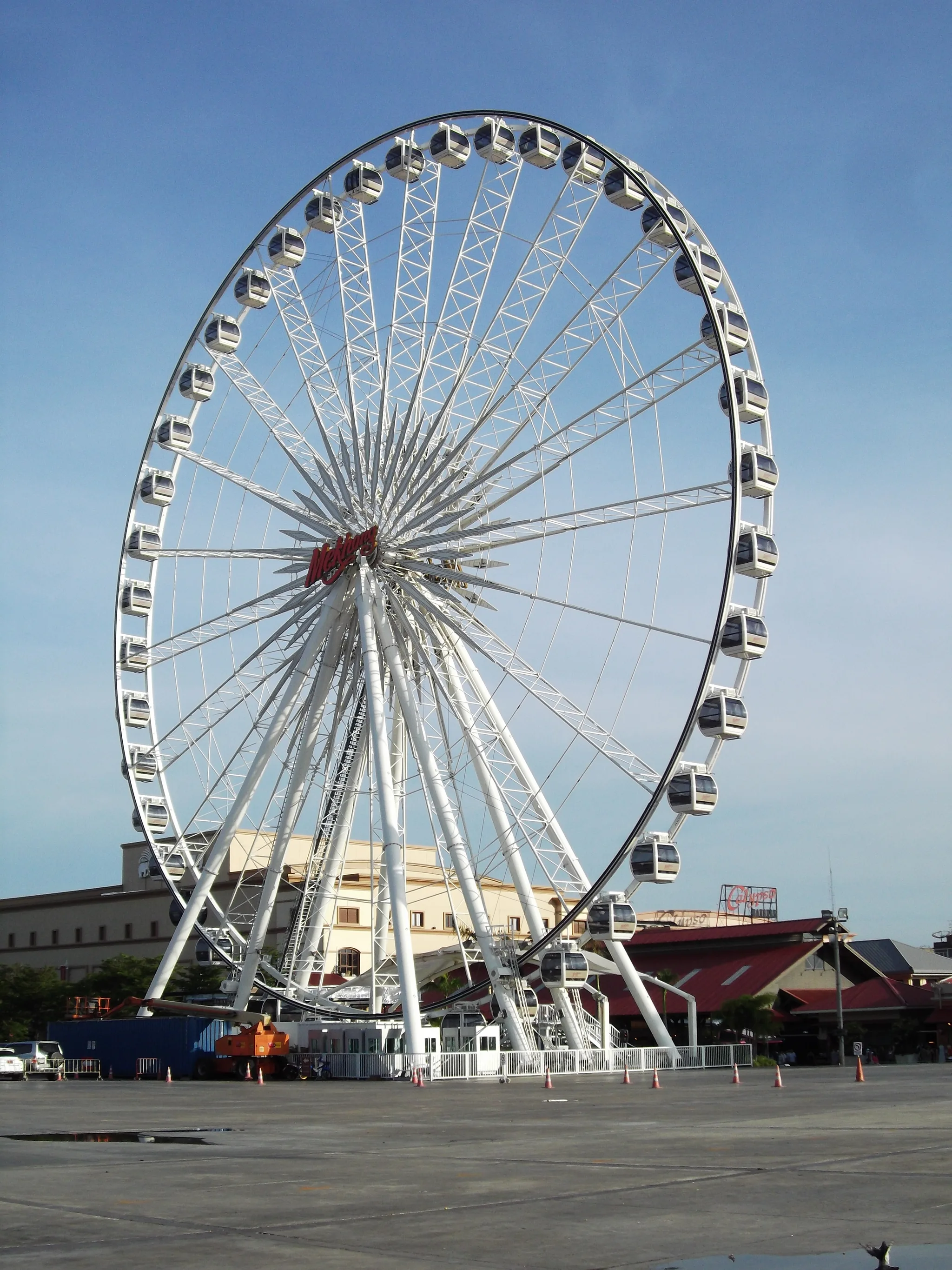
The white Ferris wheel of Asiatique The Riverfront, with enclosed gondolas and lattice spokes, rises above a concrete forecourt marked out with cones; behind it stand a cream-coloured building and red-roofed pavilions.กสิณธร ราชโอรส — Wikimedia Commons, CC BY-SA 4.0
Architecture and decoration
Explore the heritage
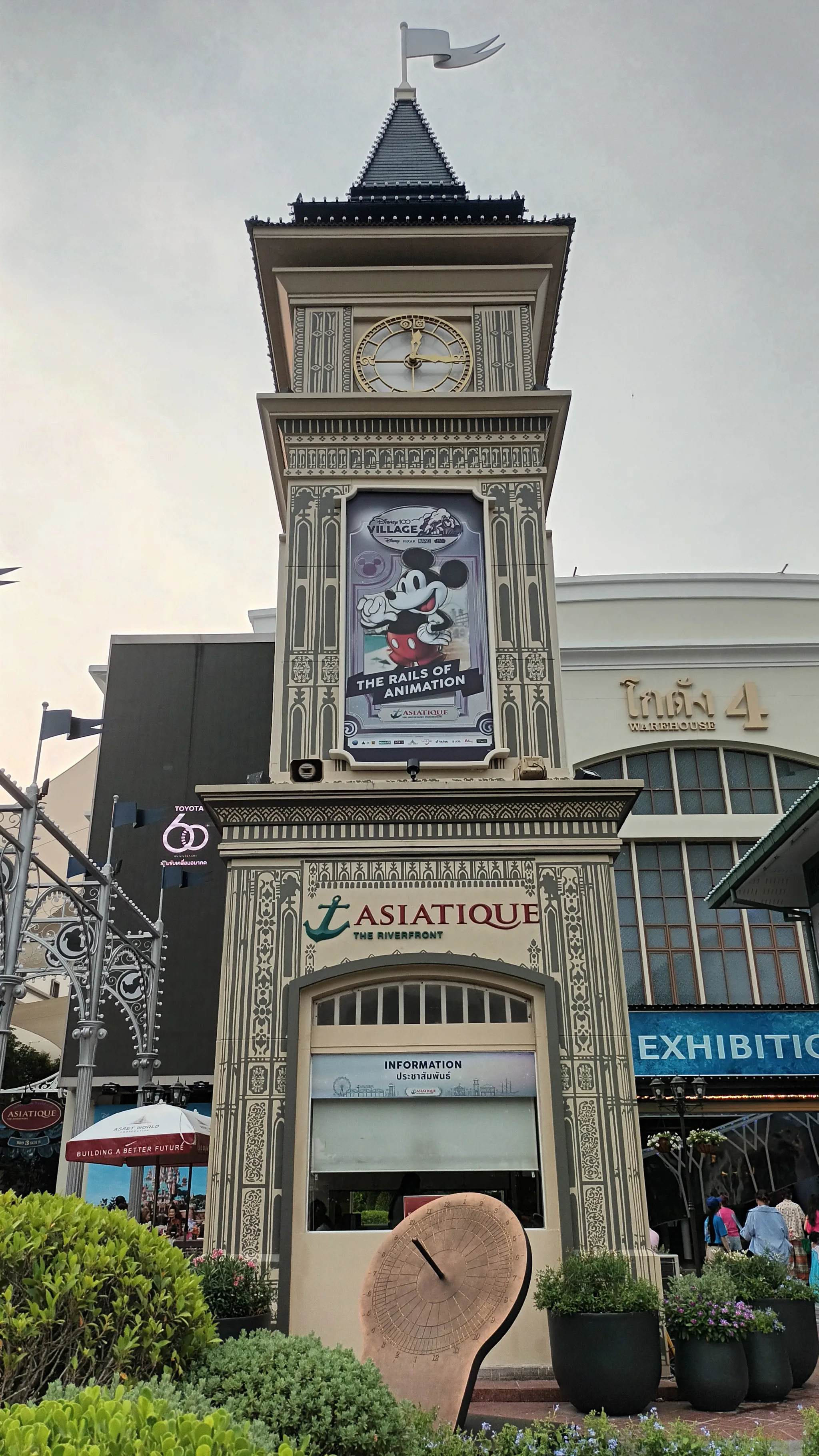
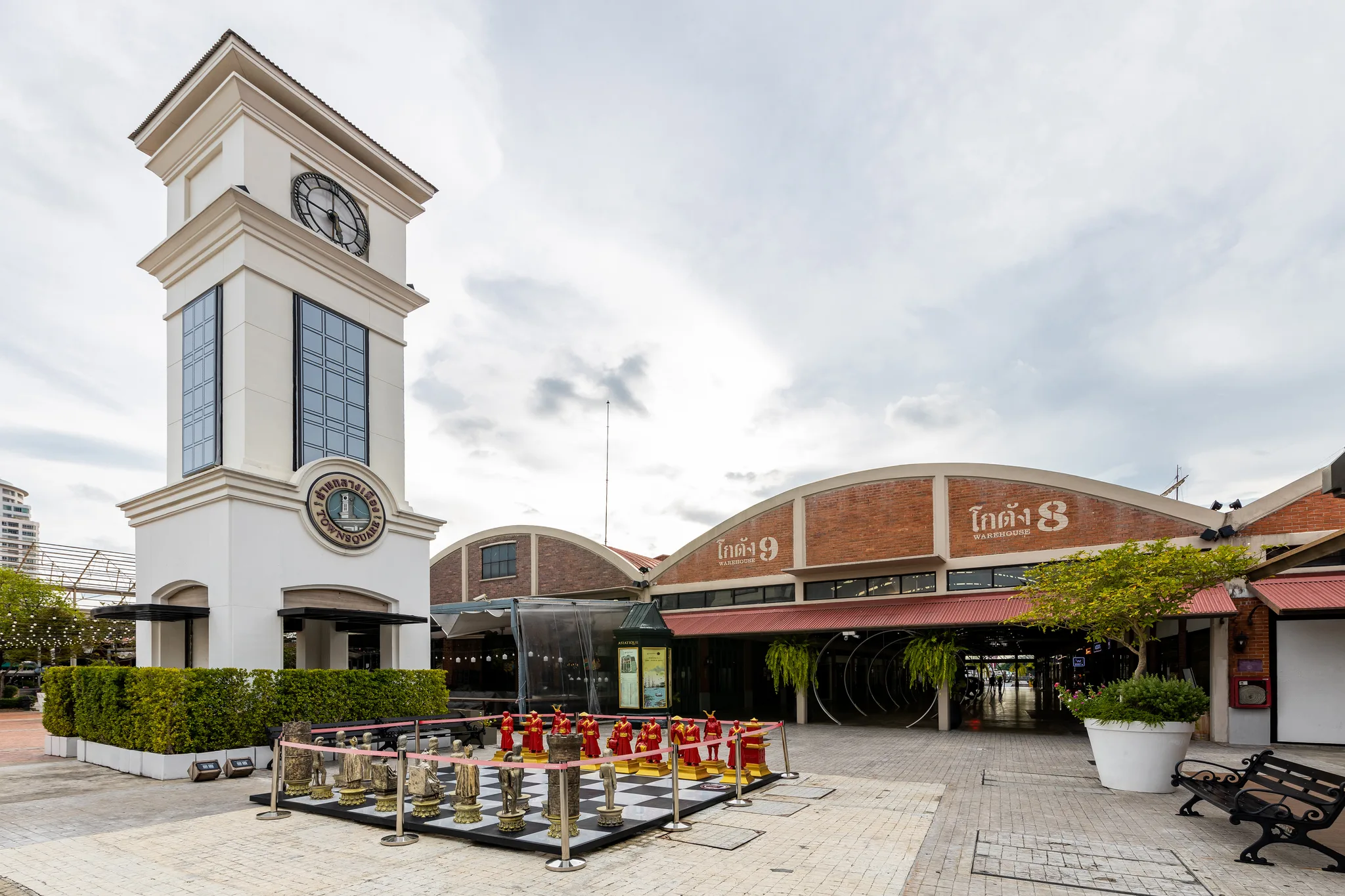
At Asiatique The Riverfront, a clock tower with painted decoration houses an information kiosk; a sundial and planting stand before it, in front of the arched façade of the Warehouse 4 building (โกดัง 4).Boonlert — Wikimedia Commons, CC0