
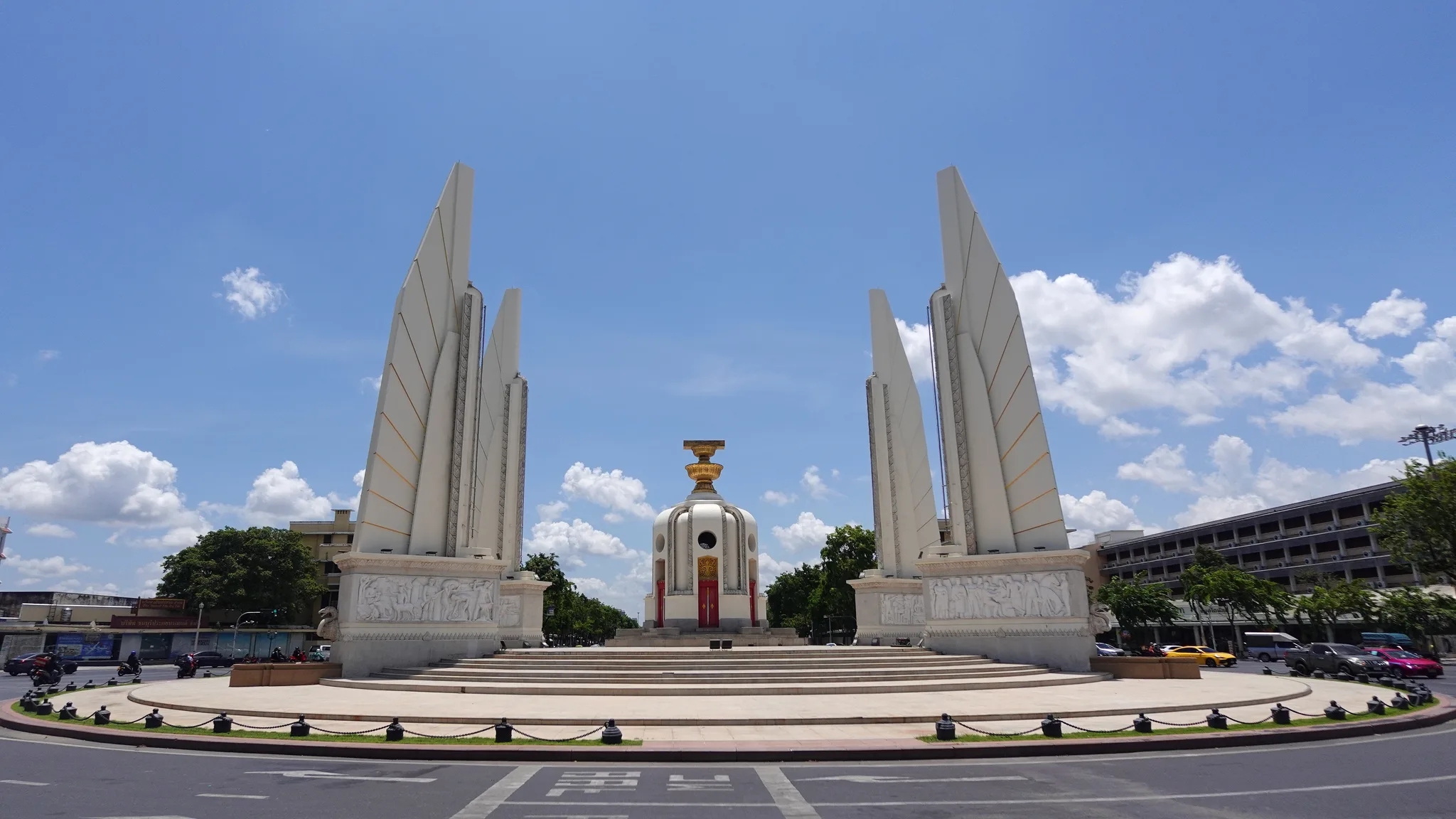
 The Democracy Monument stands at the centre of a roundabout: four white wings with bas-reliefs frame a turret with red doors crowned by a gilded ornament, set on a stepped circular platform.© Eric Monteil
Commemorative monument
Democracy Monument
Commissioned by the Phibun government to celebrate the end of absolute monarchy, the Democracy Monument, in the heart of Bangkok, has become the rallying point of the democratic movement and a still-live battleground of memory.
Heritage family · History, kingdoms and the making of Siam
- Destination
- Bangkok (Phra Nakhon)
- Heritage Family
- History, kingdoms and the making of Siam
- Typology
- Commemorative monument
- Visit
- Available tours →
Standing in the middle of a roundabout on Ratchadamnoen Klang Avenue, in central Bangkok, the Democracy Monument commemorates the change of regime of 24 June 1932, which brought absolute monarchy in Siam to an end. Commissioned in 1939 by the Phibun government and inaugurated the following year, it was meant to give the new regime the image of a modern capital; it also bears the stamp of the military power that had it built. Since the 1960s the democratic movement has claimed it as its own, up to the great protests of 2020. Around a sculpted Constitution set on an offering tray, four wings, reliefs and buried cannons make up a programme in which every measurement points back to the revolution.5
Key facts
- Destination
- Phra Nakhon
- Heritage Family
- History, kingdoms and the making of Siam
- Typology
- Commemorative monument
- Places
- Ratchadamnoen Avenue
- Periods
- People
- Plaek Phibunsongkhram
- Silpa Bhirasri
- Communities
- —
- Events
- Clôture et travaux d’entretien du Monument de la Démocratie (2026)
- Inauguration of the Democracy Monument (1940)
- 2020 Thai pro-democracy protests
- Granting of the first permanent constitution
- Foundation stone laying of the Democracy Monument (1939)
- Siamese revolution of 1932
- Heritage
- —
- Glossary
- Relic
- Samut thai
- Phan waen fa
- Buddhist calendar
- Phra khan
- Keywords
- —
- Date
- —
- Collections
- —
Practical info
Practical information about this site is taken from its Google Maps page. We advise you to check it before visiting.
- Address
- Thanon Ratchadamnoen Klang, Khwaeng Wat Bowon Niwet, Khet Phra Nakhon, Krung Thep Maha Nakhon 10200
Commemorating 24 June 1932
The end of absolute monarchy
On 24 June 1932 the Khana Ratsadon, the People’s Party, brought absolute monarchy in Siam to an end. In Thailand the event is commonly referred to as the “change of regime”, and the Constitution adopted that same year became the touchstone of the new political order. It is this founding moment that the Democracy Monument was designed to commemorate. Its Thai name, Anusawari Prachathipatai, literally means “monument of Democracy”: it celebrates not an abstract idea but the specific act by which the People’s Party sought to bring the country into the constitutional age.5
This intention governs the entire structure. The dimensions of the wings, the height of the sculpted Constitution, the number of cannons forming its enclosure and the scenes depicted at the foot of the wings all lead back to the date of 24 June 1932 and to those who made it. The monument thus presents itself as a political document as much as a work of public art: it can be read, element by element, as the official narrative of an event that its commissioners regarded as the birth certificate of the modern nation.
A commission from the Phibun government
The monument was not born in the momentum of 1932 but seven years later. In 1939 the government of Plaek Phibunsongkhram (1897–1964), known as Phibun, a military officer who had become Prime Minister in 1938, commissioned it. The ceremonial calendar itself echoed the date the structure celebrates: the foundation stone was laid on 24 June 1939, the anniversary of the change of regime, and work began in the weeks that followed. The inauguration took place exactly a year later, on 24 June 1940. Construction was entrusted to the firm Christiani & Nielsen (Siam) Ltd.15
This seven-year gap matters for understanding the monument. It does not fix the memory of 1932 as its protagonists had lived it, but as the government of 1939 wished to present it. Phibun had himself belonged to the 1932 movement he was commemorating, and the structure he commissioned closely bound homage to the revolution with the assertion of his own power. This dual nature, commemorative and political, runs through the whole history of the site to the present day.
A royal avenue as backdrop
The choice of site was not neutral. Ratchadamnoen Avenue was commissioned in 1899 by King Chulalongkorn (1853–1910), Rama V, fifth monarch of the Chakri dynasty, who was then reigning over Siam. The monument stands in the middle of a roundabout on its central section, Ratchadamnoen Klang, in Phra Nakhon district; its footprint is bounded to the north by Prachathipatai Road and to the south by Ban Dinso Road, with the avenue framing it to the east and west. The new regime thus planted its emblem on an axis laid out by the monarchy it had just transformed.5
Phibun saw this intersection as the centre of a Westernised capital. Ratchadamnoen Avenue was to become Bangkok’s “Champs-Élysées”, and the monument its “Arc de Triomphe”. The comparison illuminates the ambition of the project: to give the Siamese capital the urban signs of a great European city, with a monumental vista punctuated by a commemorative structure visible from afar. The Democracy Monument was intended to be both a site of memory and a centrepiece of the modernisation of Bangkok sought by the government.15
Designers and sculptor
A design with conflicting attributions
The author of the overall design has not been identified with certainty. One attribution names the architect Mew Aphaiwong. Another credits M.L. Pum Malakul, also presented as the designer of the Victory Monument, the other great commemorative monument erected in Bangkok in the same period. A third version, finally, names no individual and refers to the work of a team of architects from the Public Works Department and the Fine Arts Department, the Thai administration responsible for heritage.15
These versions differ, and nothing allows us to decide between them. The difficulty is not trivial: it touches on the way a state project of the late 1930s drew on both architects and government departments. The monument bears above all the signature of its commissioner, while the share of each of its designers remains a matter of debate.
A Florentine sculptor in the service of Siam
The reliefs, by contrast, have a clearly identified author: the sculptor Corrado Feroci (1892–1962), known in Thailand as Silpa Bhirasri, a name he adopted along with Thai nationality. Born in Florence and trained at the city’s Academy of Fine Arts, he taught sculpture there from 1914 to 1923. That year he won a competition organised by the Siamese government and left for Siam, where he spent most of his career; he died in Bangkok in 1962.3
Silpa Bhirasri was involved in the major public commissions of the period. After the reliefs of the Democracy Monument, he sculpted the Victory Monument in 1940, then the statue of Thao Suranari in Nakhon Ratchasima in 1943. His figurative art, steeped in the European academic tradition, gave bodies, gestures and faces to the official narrative of the change of regime. His birthday, 15 September, is today celebrated in Thailand as a day in his honour, a sign of the place he holds in the history of the country’s modern art.3
Reading the monument
A Constitution on an offering tray
At the centre of the ensemble, a round turret with a rounded top bears the principal element: a representation of the 1932 Constitution. It takes the form of a samut thai, the traditional Thai book made of a folded sheet, and rests on a phan waen fa, a footed, two-tiered offering tray. The tray is gilded. The sculpture is 3 metres high and weighs some 4 tonnes; it is described variously as copper and as bronze.1
The founding text of the new regime thus takes on the appearance of a familiar object of Thai culture, a traditional book presented on the tray used for offerings. The Constitution is not depicted as a modern document but integrated into a local visual vocabulary, at the summit of a structure whose overall composition, for its part, borrows from Western monumental architecture.
Wings, cannons and swords
Around the turret extends a raised terrace, reached by steps along its entire perimeter. Four flat wings, sometimes called “fins”, rise from it at the four cardinal points to a height of 24 metres; the radius of the base likewise measures 24 metres. At the foot of these wings run stucco reliefs, a plaster here modelled in high relief, that is, with strongly projecting figures. Fountain basins are set against the outer face of the wings.1
Other elements complete the programme. The enclosure surrounding the monument is made of 75 old cannons buried muzzle-down, their breeches protruding from the ground, and linked together by a chain. Six phra khan, sacred swords, are fixed to the doors of the central turret. The turret itself is not solid: the monument houses interior rooms, closed by wooden doors, which the public does not see but which lie at the heart of recent maintenance work.2
A programme in numbers
The monument’s measurements owe nothing to chance. The 24 metres of the wings and of the base radius refer to 24 June, the day of the change of regime. The 3 metres of the sculpted Constitution denote the month of June, the third month of the old Thai year, which began in April. The 75 cannons evoke the year 1932 as expressed in the Buddhist calendar then in use, and the chain linking them symbolises the unity of those who brought about the change of regime.15
This language of numbers makes the monument a kind of commemorative calendar: for those who know how to read it, the date of the revolution is inscribed in stone and metal, down to the enclosure itself. It has been described as the first and only modern Thai monument for which the rationale and symbolism of every element were carefully recorded. Such precision attests to the importance its commissioners attached to the legibility of their message.
An official narrative sculpted in stucco
The army in the foreground
The reliefs recount the action of the People’s Party, from the preparation of the change of regime to the intervention of the conspirators on 24 June 1932. One of the panels bears an explicit title: “Soldiers fighting for democracy”. The armed forces appear there both as the champions of democracy and as the embodiment of the Thai people, while civilians feature only as grateful beneficiaries of military heroism.15
This iconography has been read as expressing the viewpoint of the 1939 regime, dominated by the military, which claimed to govern in the name of the people. The sculpted narrative therefore shows not only the event of 1932: it states who, in the eyes of the Phibun government, was its true custodian. The democracy celebrated at the foot of the wings is a democracy led by the army, and the reliefs fix that image permanently at the centre of the capital.15
An instrument of legitimisation
The political context of the commission sheds light on this reading. During his first term, from 1938 to 1944, Phibun led a state that scholars have described as “semi-fascist”, oriented towards the modernisation of the country. The monument served as a legitimising discourse for the Prime Minister and his circle: by placing itself in continuity with the change of regime, the government of 1939 presented itself as its natural heir. The urban project of Bangkok’s “Champs-Élysées” served the same design, that of a regime which sought to be both modern and founded on the revolution.5
Hence the phrase that sums up the site’s fate: the Democracy Monument would be a “paradoxical relic of the 1930s dictatorship”, later reclaimed by the democratic movement. Conceived to legitimise an authoritarian government, it has become, over the decades, the symbol of those demanding greater freedoms. This reversal is what makes the monument so singular in the political history of Thailand.5
The site of democratic protest
A route through the city
From the 1960s onwards, the democratic movement made its own an urban route that sets out from Thammasat University, crosses the Sanam Luang esplanade, follows Ratchadamnoen Klang Avenue and ends at the Democracy Monument. The roundabout became the natural destination of processions, the place where people gathered and spoke out. The monument has thus served as a symbolic site for numerous pro-democracy rallies.1
This shift in meaning draws on the monument itself. The sculpted Constitution, set at the summit, offers protesters a ready-made emblem: by gathering at its foot, they appeal to the very text the structure celebrates, against the governments they oppose. The avenue conceived by Phibun as a showcase for the regime becomes the stage for opposition to it, and the state monument is transformed into a place of civic mobilisation.
The 2020 rallies
The year 2020 offers the most recent illustration. On 18 July several hundred people gathered at the foot of the monument at the call of the Free Youth group, to demand the dissolution of the House and the rewriting of the Constitution. That same day, the municipal authorities had placed potted plants and barriers around its base. At nightfall, the participants lit up the sculpted Constitution with the light of their phones. Some said they were keeping watch over the monument because they feared it might “disappear”. On 16 August at least 5,000 protesters gathered there.11
The movement grew in the autumn. On 14 October protesters forced the barriers, removed the plants placed at the foot of the monument, then marched towards Government House, the seat of government; clashes broke out with royalist groups. On 14 November others climbed the central turret and wrapped it in a banner covered with slogans. The monument was no longer merely the backdrop to the rallies: it had itself become something at stake, protected by the authorities and taken over by the protesters.14
A monument without status, under watch
Long-uncertain oversight
The Democracy Monument does not have the status of a registered historic monument. Maleebhon Kumkasem, director of the Fine Arts Department’s legal division, stated that neither this monument nor the Victory Monument was registered as a historic site, while pointing out that any renovation project had to be approved by her department. The structure thus finds itself in an intermediate position: it is not protected as heritage, yet it cannot be altered freely.10
In September 2018 the Treasury announced that sixteen Bangkok monuments, including the Democracy Monument, had no clearly established supervising authority; many had been built on land taken from the public highway, which falls under the Department of Highways. Sakchai Boonma, director of the Bangkok Metropolitan Administration’s city planning department, announced that his department would take charge of their maintenance, with any work on their structure requiring authorisation from the Fine Arts Department. In February 2020, during the renovation of a section of Ratchadamnoen Avenue, the Bangkok Metropolitan Administration gave assurances that the monument would not be touched; Ruengrab Thipthong, head of the Fine Arts Department’s monument protection team, reiterated that his department must be informed of any alteration and that decisions are taken jointly.6
A fence and works
In 2026 the Bangkok Metropolitan Administration erected a metal fence around the monument. In the face of public concern, it denied any intention of demolishing it and explained that the fence was to allow maintenance and inspection of the structure ahead of the construction of an underground railway line nearby. The announced works cover the repair of the wooden doors, the restoration of the interior rooms and the upgrading of the electrical and water systems, carried out with the Fine Arts Department; no completion date has been set.4
The strength of the reactions to this fence speaks to the place the monument occupies today. For part of the population, it is not merely a structure to be maintained but a material trace of 1932 whose very survival carries political weight, as the protesters of 2020 had already expressed. Caught between urban works, the absence of formal protection and the attachment of some of Bangkok’s residents, the Democracy Monument remains a place where the history of the change of regime continues to play out in the present.
Understanding
The Democracy Monument is first and foremost a tribute to the change of regime of 1932, conceived by the Phibun government to inscribe the revolution at the heart of Bangkok. Every measurement recalls the date of 24 June, and its reliefs give a version of the event in which the army plays the leading role. Yet its importance lies less in its form than in its use: built to legitimise an authoritarian power, it has become, since the 1960s, the rallying point for those demanding greater democracy. Today it is not registered as a historic monument, responsibility for it was clarified only in 2018, and every barrier or fence placed at its foot arouses concern, as in 2020 or during the works announced in 2026. Its physical survival has thus become a public question. Monument to a military regime or common property of those who invoke the Constitution: to whom will the meaning of this place belong tomorrow?
Rattanakosin, from the royal citadel of 1782 to the historic districts that shaped contemporary Bangkok.
- Relic
- Bodily remains of, or objects associated with, the Buddha or a holy figure, preserved and venerated.
- Samut thai
- Traditional Thai book made of a long sheet of paper folded concertina-style, on which texts and illustrations are written or painted.
- Phan waen fa
- Thai footed offering tray with two superimposed tiers, used to present precious or sacred objects.
- Buddhist calendar
- Dating system that counts years from the death of the Buddha; in Thailand, the Buddhist Era is 543 years ahead of the Christian Era.
- Phra khan
- Thai term for a sacred sword, an object of prestige and protection associated with royalty and ritual.
Primary sources
Studies
- 3Jean Marie Carey, Sculptor Silpa Bhirasri, born Corrado Feroci, died on 14 May 1962 in Bangkok, Italian Art Society, 2017 ↗
- 4City denies any plan to demolish Democracy Monument, Bangkok Post, 2026 ↗
- 5Democracy Monument: Ideology, Identity, and Power Manifested in Built Forms, ResearchGate ↗
- 6Act Now! Up to 16 Bangkok Monuments Unclaimed, Khaosod English, 2018 ↗
- 7Avenue Renovation Won't Affect Democracy Monument, Officials Say, Khaosod English, 2020 ↗
- 8คณะราษฎร และมรดกทางสถาปัตยกรรมที่ซ่อนนัยแห่งการเมือง, Sanook ↗
- 9อนุสาวรีย์ประชาธิปไตย, Sanook Travel ↗
- 10No victory in sight, The Nation (Thailand) ↗
- 11Hundreds rally for democracy, Bangkok Post, 2020 ↗
- 12Anti-government protesters flock to Democracy Monument, Bangkok Post, 2020 ↗
- 13Protesters Again Fill the Streets of Bangkok, The Diplomat, 2020 ↗
- 14AFP, Pro-democracy protesters scale Bangkok monument, Asia Times, 2020 ↗
Contemporary views
Democracy Monument today
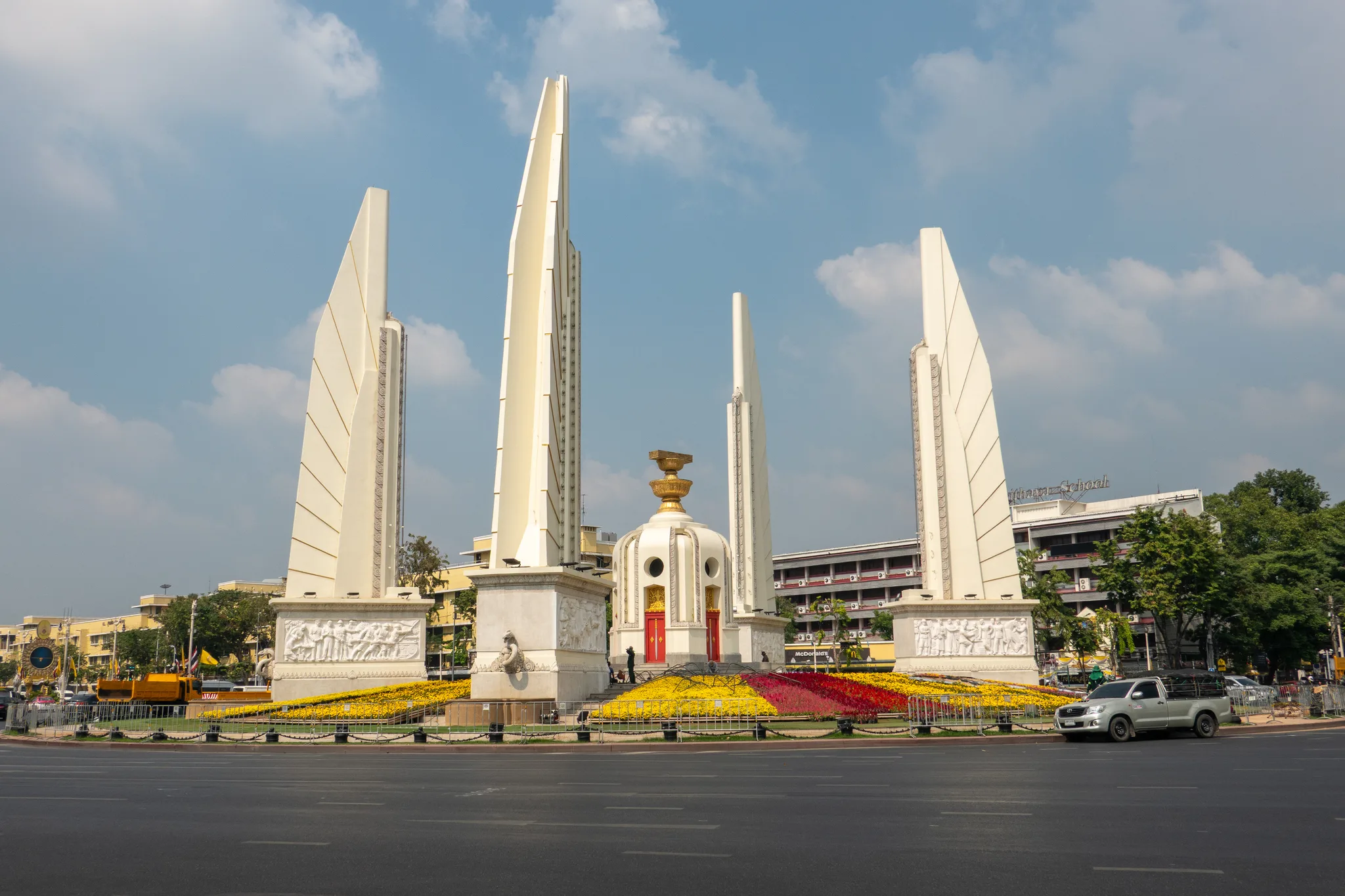
The Democracy Monument stands on a roundabout: four white wings with bas-reliefs surround a turret with red doors crowned by a golden tray, amid yellow and red flower beds and passing traffic.No(0)GoodNamesLeft — Wikimedia Commons, CC BY-SA 4.0 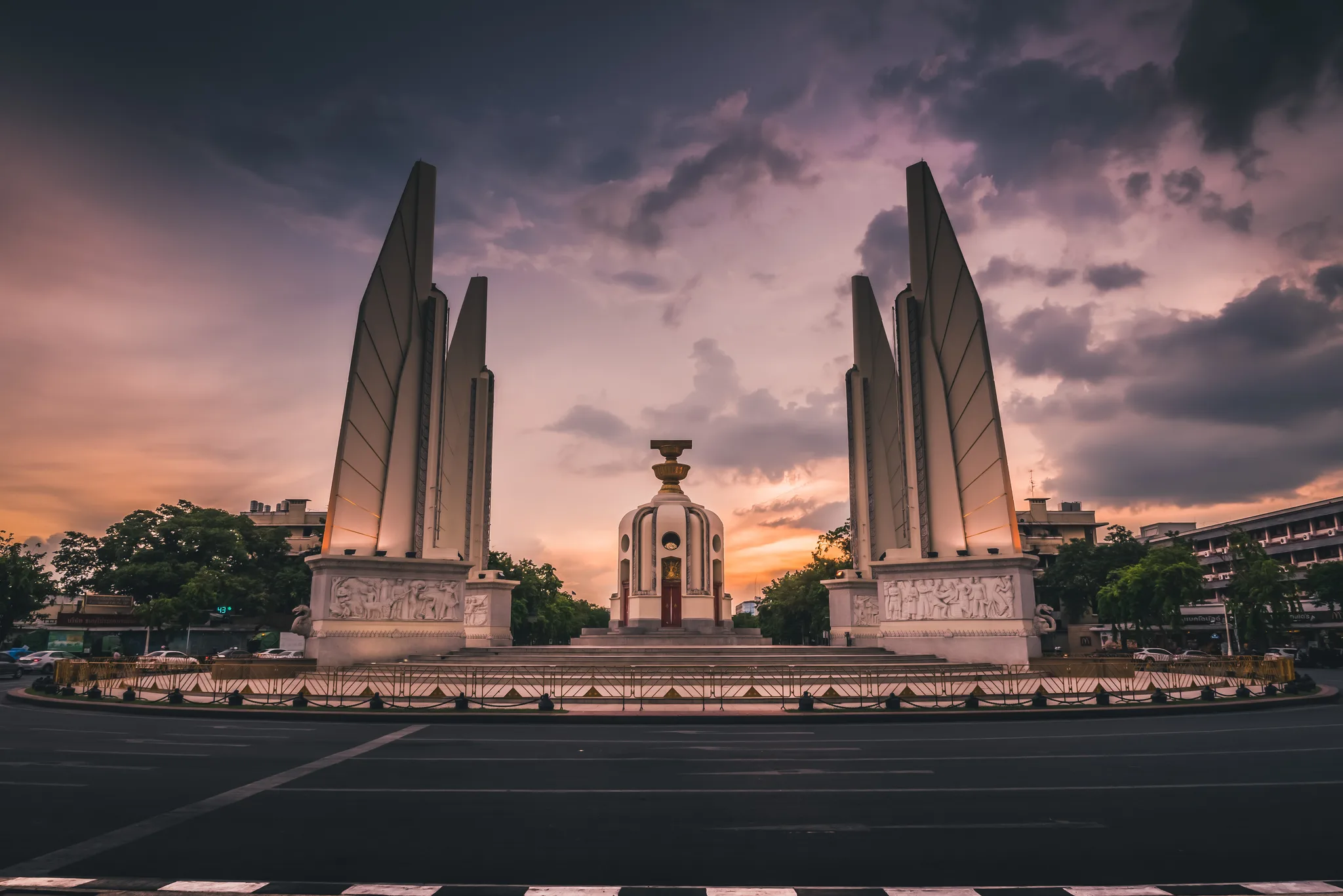
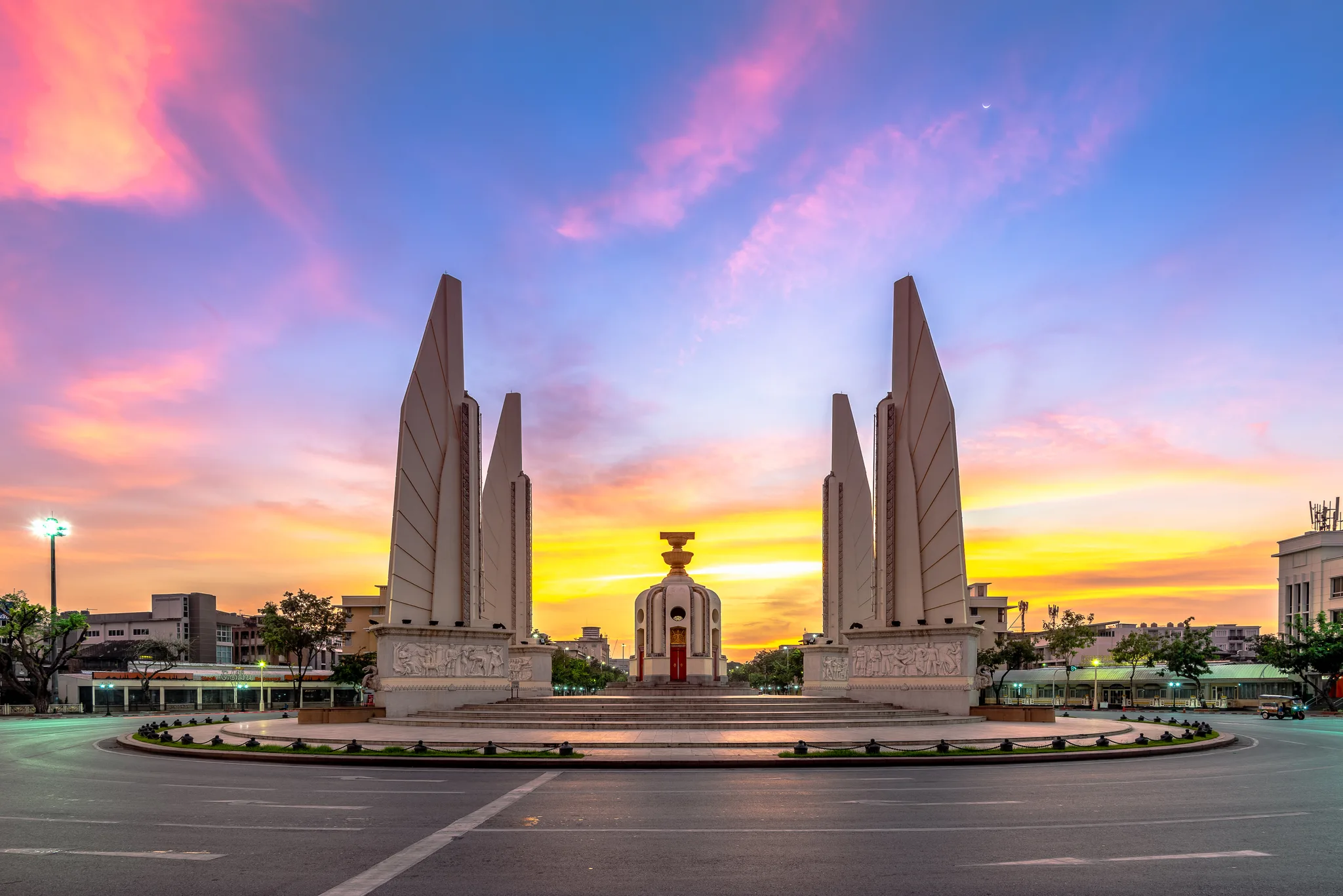
Democracy Monument stands at the centre of a roundabout: two pairs of white wings on bases decorated with bas-reliefs frame a central turret topped by a bowl, enclosed by a low railing.Preechar Bowonkitwanchai — Wikimedia Commons, CC BY-SA 4.0
Architecture and decoration
Explore the heritage
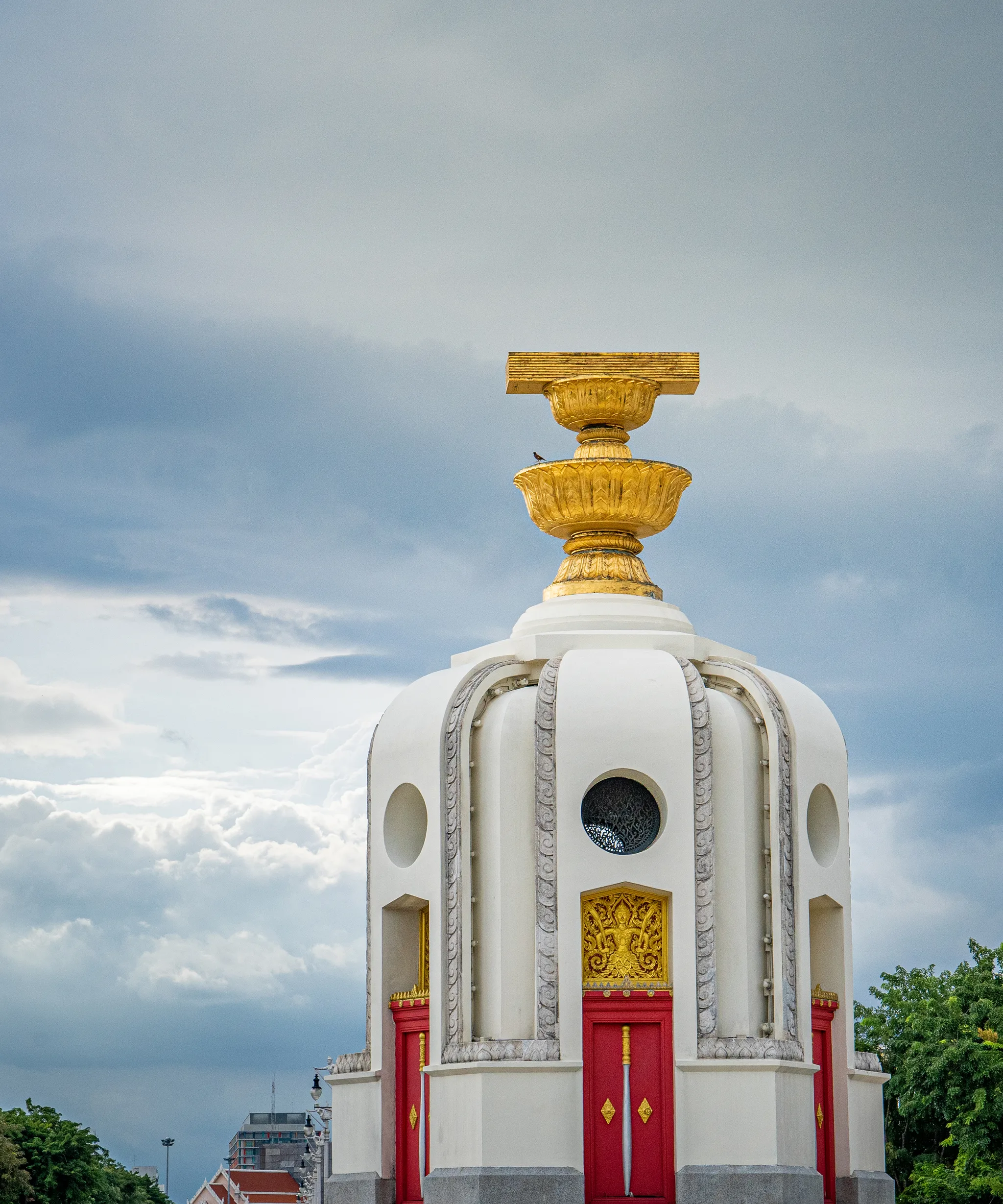
Upper section of the Democracy Monument: the white ribbed turret with ornamented bands carries two stacked gilded bowls and a gilded book; below, a golden panel depicts a deity above a red door decorated with a sword.Suntawut80 — Wikimedia Commons, CC BY-SA 4.0 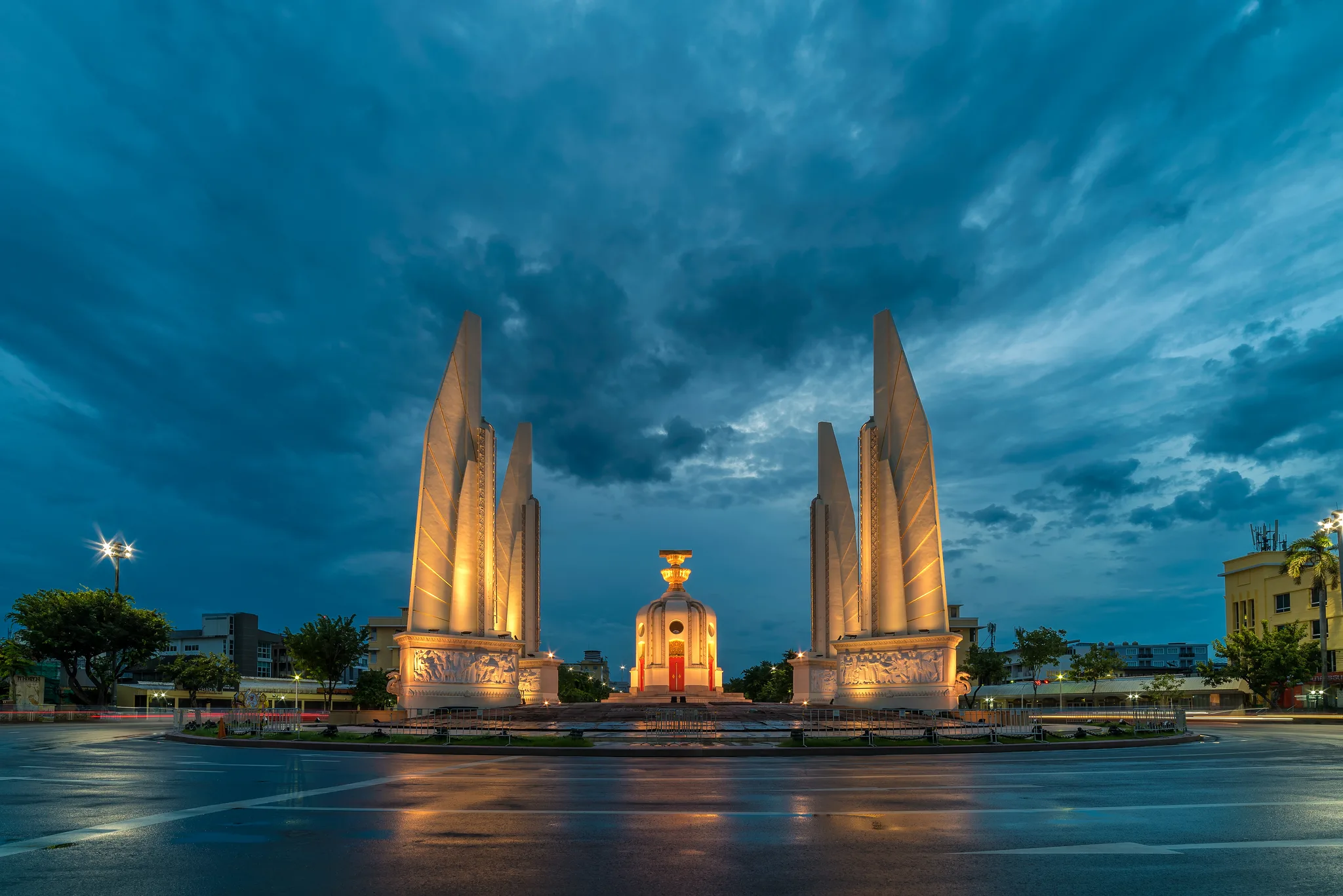
The Democracy Monument at dusk: two pairs of white wings decorated with bas-reliefs at their base frame the central turret with its red door, topped by a gilded ornament, at the centre of a broad roundabout.Nawit science — Wikimedia Commons, CC BY-SA 4.0
Archive
Memory of time passing
Historical images preserve the visual memory of places and of the ways they have changed.
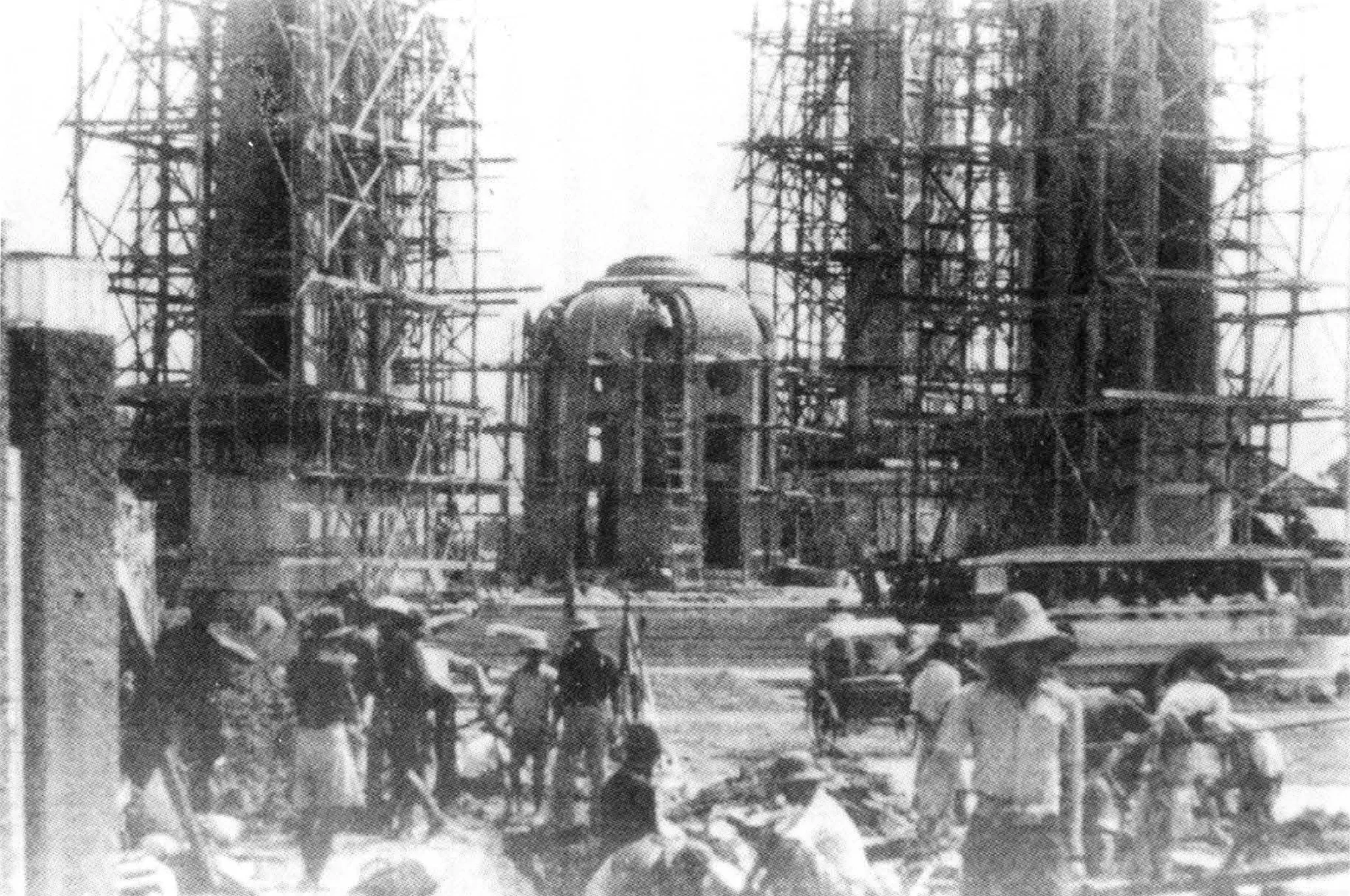
Archival photograph of the Democracy Monument building site: timber scaffolding encloses the upright wings around the central domed turret, while workers in hats labour in the foreground.Auteur inconnu — Wikimedia Commons, domaine public 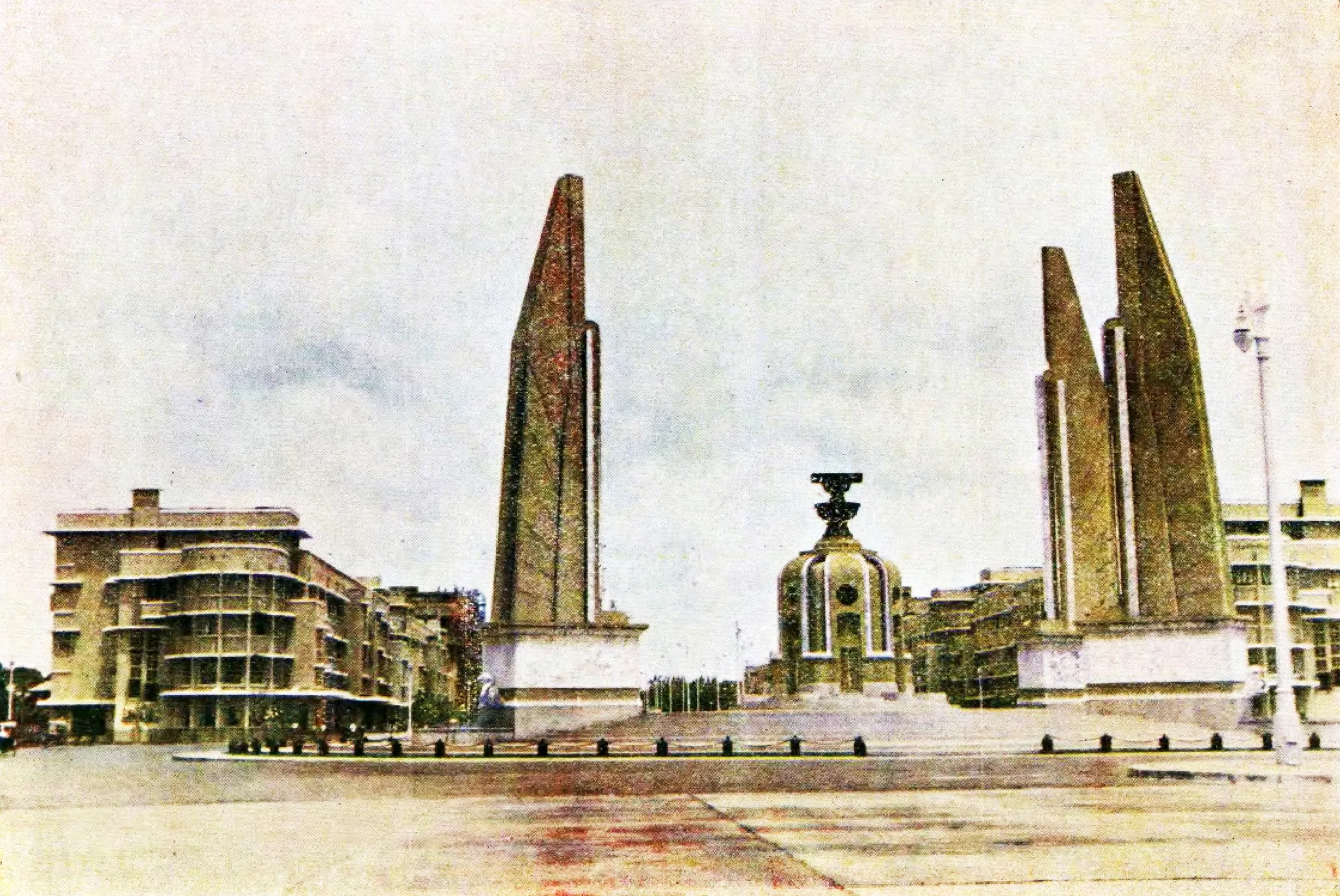
Old colour-tinted reproduction of the Democracy Monument: a central turret crowned by a sculpted ornament, flanked by tall wings on plinths, in front of buildings with curved façades and an almost empty roadway.Office of the Prime Minister — Wikimedia Commons, domaine public 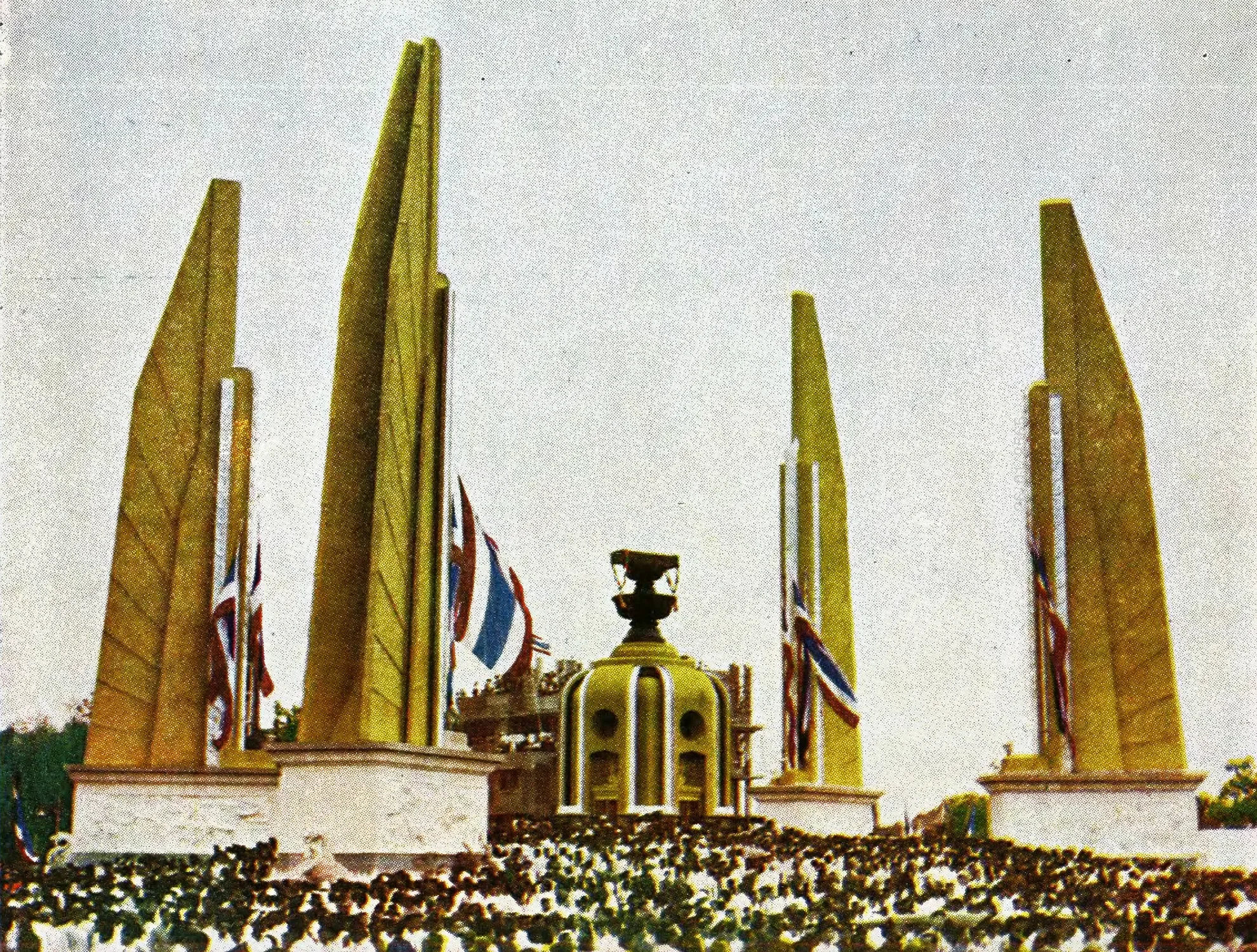
Early colour reproduction of the Democracy Monument: the four wings on their white plinths, dressed with Thai flags, frame the central turret topped by a tray bearing a vessel, before a crowd massed in the foreground.Office of the Prime Minister — Wikimedia Commons, domaine public 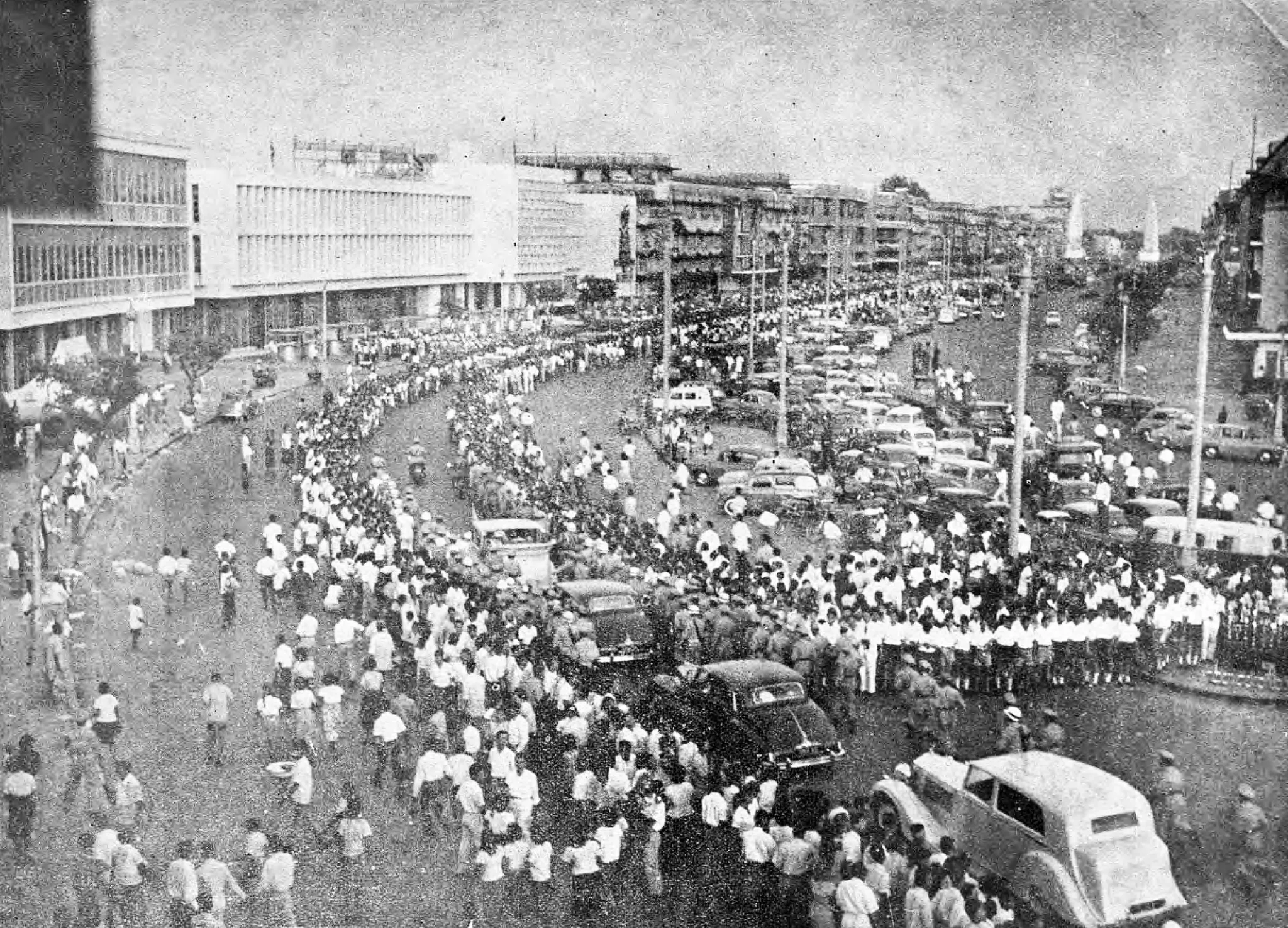
Black-and-white period photograph: a dense crowd in pale shirts fills the avenue leading to the Democracy Monument, whose wings rise in the distance, among stationary cars and ranks of uniformed men.Auteur inconnu — Wikimedia Commons, domaine public 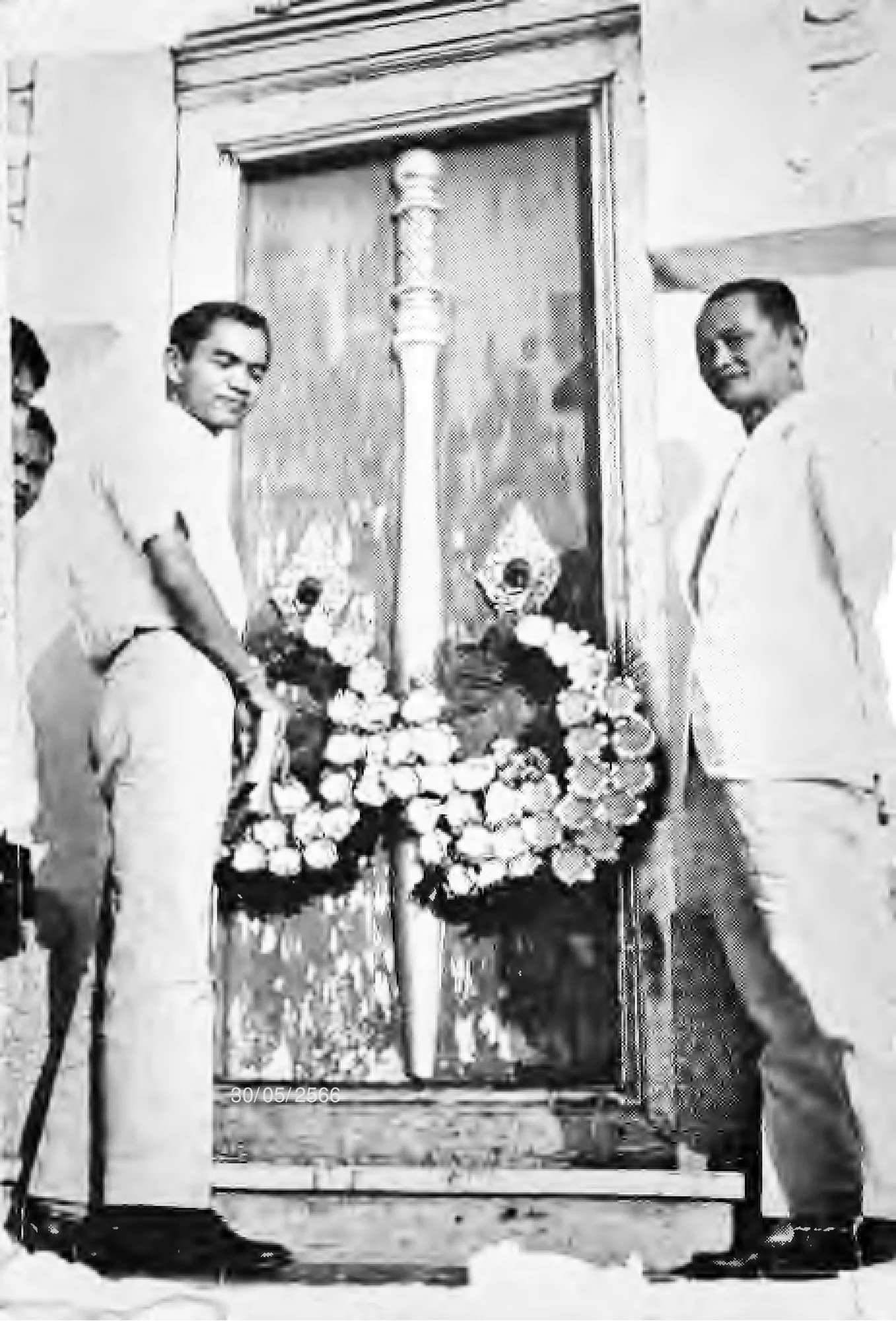
Black-and-white archive photograph: two men in light clothing stand on either side of two floral wreaths laid against a moulded panel of the Democracy Monument, decorated with a carved vertical element.Auteur inconnu — Wikimedia Commons, domaine public