
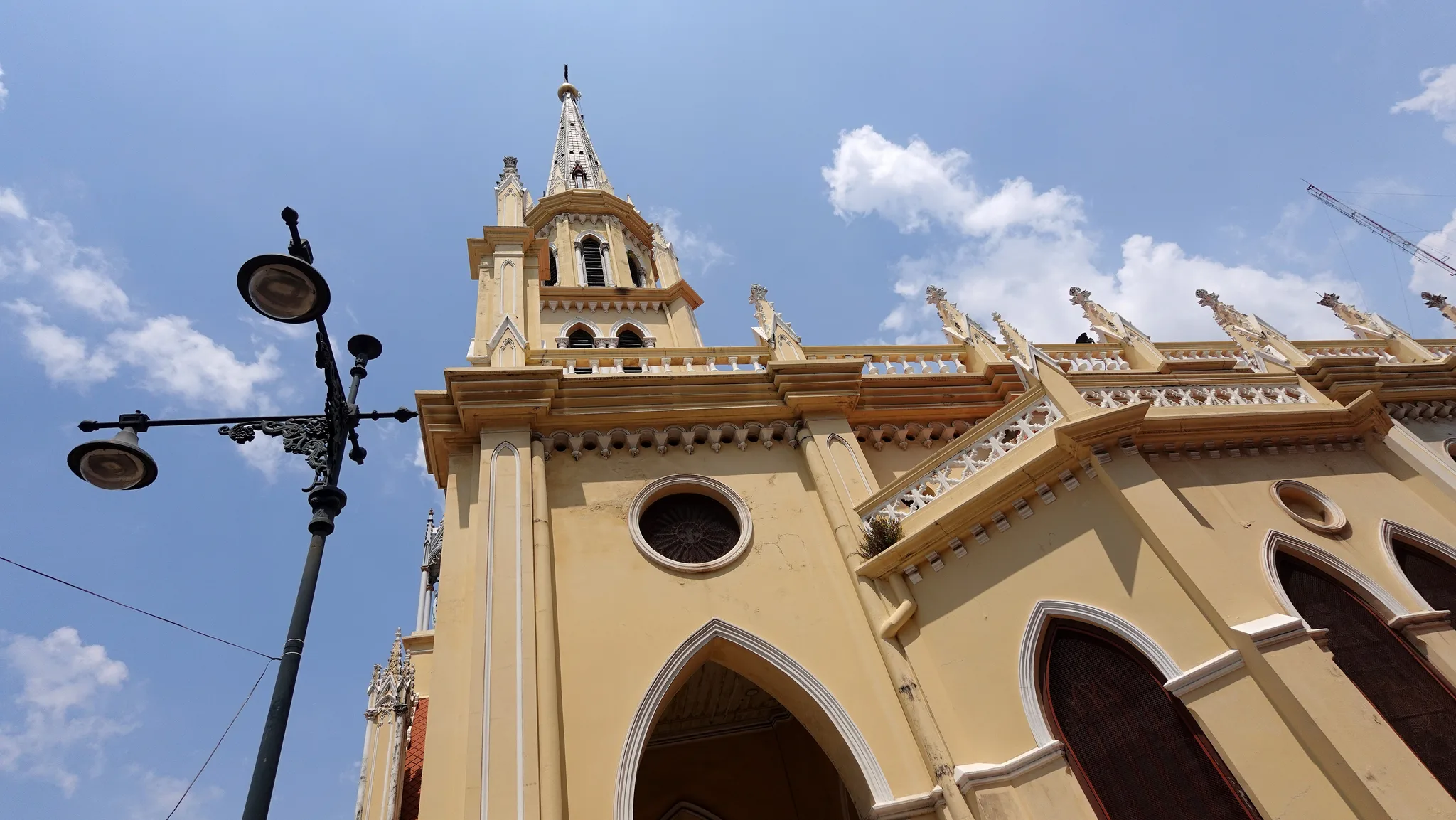
 The Holy Rosary Church seen from below: a spired bell tower, pinnacles, pierced balustrades, oculi and pointed-arch openings articulate the yellow neo-Gothic façade, beside a cast-iron street lamp.© Eric Monteil
Christian church
Holy Rosary Church
Born of a Portuguese Catholic community that settled in Talat Noi after the fall of Ayutthaya, twice rebuilt and then carefully restored, Father Desalles’s Neo-Gothic church now brings together a parish of many origins, facing the Chao Phraya.
Heritage family · Buddhism, religions and spiritualities
- Destination
- Bangkok (Samphanthawong)
- Heritage Family
- Buddhism, religions and spiritualities
- Typology
- Christian church
Holy Rosary Church is a Catholic parish church of the Archdiocese of Bangkok, in the Talat Noi quarter on the east bank of the Chao Phraya. Local people know it as Kalawar. It is among the oldest churches in Bangkok: its community descends from the Portuguese Catholics who settled there after the fall of Ayutthaya, and the place of worship was rebuilt twice before taking its present form at the end of the 19th century. Restored with respect for its original state and honoured with an architectural conservation award, this Neo-Gothic church, whose bell tower rises facing the river, is today home to a parish of many origins.5
Key facts
- Destination
- Samphanthawong
- Heritage Family
- Buddhism, religions and spiritualities
- Typology
- Christian church
- Places
- Chao Phraya River
- Periods
- People
- Jean-Baptiste Pallegoix
- Father Desalles
- Princess Maha Chakri Sirindhorn
- Communities
- Holy Rosary Church parish community
- Events
- Bénédiction de la deuxième église Notre-Dame-du-Rosaire (1839)
- Construction de l’église Notre-Dame-du-Rosaire (1891-1897)
- Incendie de l’église Notre-Dame-du-Rosaire (1864)
- Installation des catholiques portugais à Talat Noi (1769)
- Prix ASA de conservation architecturale décerné à l’église Notre-Dame-du-Rosaire (1987)
- Restauration de l’église Notre-Dame-du-Rosaire (1957)
- Heritage
- —
- Glossary
- Wat
- Chao Phraya
- Phraya
- Rattanakosin period
- Gothic Revival
- Bot
- Keywords
- —
- Date
- —
- Collections
- —
Practical info
Practical information about this site is taken from its Google Maps page. We advise you to check it before visiting.
- Address
- PGJ7+CF4, 1318 Thanon Yotha, Khwaeng Talat Noi, Khet Samphanthawong, Krung Thep Maha Nakhon 10100
- Phone
A Catholic church in Talat Noi
Two names for one place
Holy Rosary Church is one of the parishes of the Archdiocese of Bangkok, the jurisdiction of the Catholic Church to which the capital belongs. Its official Thai name, Wat Mae Phra Luk Prakham, means ‘church of Our Lady of the Rosary’: the word wat, which ordinarily denotes a Buddhist monastery, is used here to name a Christian church. The name was given when the second church built on the site was blessed, on 1 October 1839.1
Popular usage, however, settled on another. The Chinese population of the quarter went on calling it Wat Kalawar, and the building is still known as Bot Kalawar, the ‘Kalawar church’. The word is linked to the Portuguese Calvario, Calvary, the hill in Jerusalem where Christ was crucified. Each of the two names tells part of the history of the place: one dedicates the church to the Virgin Mary under the title of the Rosary, the other preserves a trace of the language of the first Portuguese faithful, kept alive by their Chinese neighbours.5
On the east bank of the Chao Phraya
The church stands in the Talat Noi quarter, which belongs to Samphanthawong District, on the east bank of the Chao Phraya, the river that runs through Bangkok. Its main façade faces the river.3
It is precisely on this bank, opposite, that Santa Cruz Church stands, another foundation of the Portuguese Catholics. Together with the Church of the Immaculate Conception, in Samsen, these two sanctuaries form the group of Bangkok’s three historic churches of Portuguese origin. Holy Rosary Church is also among the oldest churches of the Rattanakosin period.9
From Portuguese faithful to a 19th-century parish
A community that came after the fall of Ayutthaya
Before it was a building, the church was a community. In 1767 Ayutthaya, the former capital of the Kingdom of Siam, fell. In the years that followed, Portuguese Catholics settled in the area of present-day Talat Noi, and it is to their settlement, in 1769, that the history of the church is traced back.5
The step from community to first building is harder to follow. Some accounts begin the history of the church with the arrival of the faithful; others place the grant of the land and the construction of a first church in 1787. Accounts differ on the date of the foundation, but these two ways of dating it do not refer to the same event: one marks the settlement of the faithful, the other the birth of a place of worship.9
A clearer milestone appears in 1822. That year the church entered into communion with the Holy See, that is, with the authority of the Pope, and came under the authority of the local bishop.5
The second church, blessed by Bishop Pallegoix
The second church was blessed on 1 October 1839 by Bishop Jean-Baptiste Pallegoix, coadjutor bishop since 1833, that is, the assistant bishop destined to succeed the holder of the see. The ceremony took place on the day then kept as the feast of Our Lady of the Rosary, and it was on this occasion that the church received the name it still officially bears.1
This blessing gave the place its lasting religious identity. From then on the church was placed under the title of Our Lady of the Rosary.1
From fire to rebuilding
The building of 1839 did not survive the century. In 1864 a great fire led to the abandonment of the earlier church. A new construction later replaced a building worn down by time.6
The initiative came from a French priest, Father Desalles. His project opened the most visible chapter in the history of the site: that of the church seen today, the third raised for this community.3
Father Desalles’s church
A late 19th-century building project
Father Desalles designed the building and directed its construction himself, from 1891 to 1897. He was both its architect and its builder. His work replaced the dilapidated building the community had inherited.3
He adopted the Neo-Gothic style, which in the 19th century revived the forms of the medieval Gothic architecture of Europe, and a Latin-cross plan, in which the nave, longer than the transverse arm, traces a cross on the ground. The church thus belongs to the vocabulary of the European Catholic churches of its time.3
A façade dominated by the bell tower
Seen from the river, the church is read first through its façade. A tall bell tower, crowned with a spire — a tapering, pointed roof — and topped by a cross, is set into the centre of this façade, behind a high Gothic gable, the triangular upper part of the wall that closes off the roof.3
The portal takes the form of a pointed arch, an arch made of two curves meeting at a point. This shape recurs throughout the building: doors and windows repeat the same design.5
Stained glass, gilding and the rosary
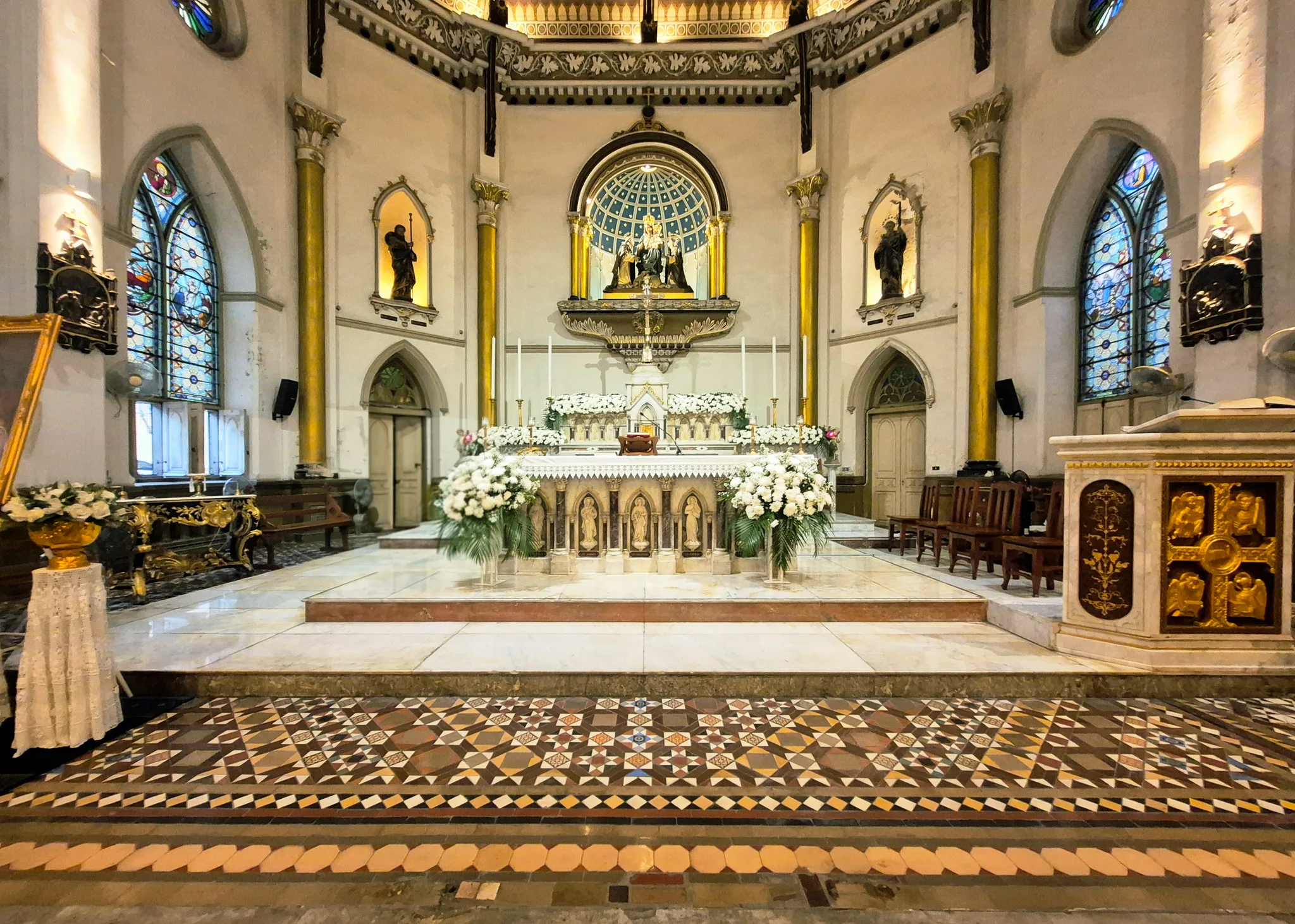
Inside, gilded arches give rhythm to the space and large stained-glass windows let in the light. These coloured windows depict biblical episodes and are reputed to be among the finest in Thailand.3
The decoration also bears the church’s dedication. Statues show the Virgin and Jesus handing the rosary to Saint Dominic and Saint Catherine. The rosary is a Catholic prayer in which a sequence of Hail Marys is recited while meditating on the life of Christ and the Virgin, with the help of a string of beads; the scene shows this prayer being given to two saints whom Catholic tradition associates with its spread. The image thus recalls to whom the church is dedicated.2
A parish devoted to the Virgin
The cult of Our Lady of the Rosary
Our Lady of the Rosary is the church’s titular, the holy figure to whom it is dedicated. Her feast is now celebrated on 7 October in the Catholic calendar; in 1839 it fell on 1 October, the day chosen to bless the second church.10
The devotion is older than the buildings. According to tradition, the first faithful had brought with them two venerated images: an Our Lady of the Rosary and a Dead Christ, that is, Christ depicted after his crucifixion.5
From the Portuguese to faithful from Indochina and Chinese speakers
The community that founded the church has not carried it alone to the present day. The descendants of the Portuguese gradually dispersed, and the church went through a period of decline. Other faithful took over: Vietnamese and Cambodian Catholics, displaced by the Indochina wars, adopted the church, alongside Chinese immigrants.8
Together with the Chinese-speaking faithful, these Catholics from Indochina now make up a large part of the parish. Holy Rosary Church thus illustrates how a parish founded by a European community became the place of worship of Asian populations from diverse backgrounds.8
Restoring the church and keeping it alive
Three restoration campaigns
In the 20th century, Father Desalles’s building underwent several campaigns of work. In 1957, for the church’s sixtieth anniversary, Father Amestoy, then parish priest, led a major restoration. Another followed from 1983 to 1989, under the direction of Father Prawit Phongwirachai, parish priest, and a final intervention took place in 1995.6
These restorations have one thing in common: they sought to preserve the original architecture and decoration as far as possible.3
Heritage recognition
This care was acknowledged. In 1987 the Association of Siamese Architects under Royal Patronage (ASA) awarded the church its architectural conservation award in the places of worship category, even as Father Prawit Phongwirachai’s major restoration was under way.3
The award recognises both the value of the building and the quality of the work carried out to preserve it.
An active parish today
Holy Rosary Church remains an active parish of the Archdiocese of Bangkok. Parish life brings together the clergy, religious, a parish council, and teachers and pupils connected with the parish.5
On 10 February 2013, Chinese New Year’s Day, Princess Maha Chakri Sirindhorn visited the church. She viewed the building, the sacred vestments and the liturgical objects, and spoke with the Archbishop of Bangkok, Francis Xavier Kriengsak Kovithavanij, as well as with the clergy, the religious, the parish council, the teachers and the pupils.7
Understanding
Holy Rosary Church is above all a parish: a Catholic community born of the settlement of Portuguese faithful on the banks of the Chao Phraya, which twice rebuilt its place of prayer, the third church receiving its Neo-Gothic form from Father Desalles. Its double name, official and popular, sums up a history made of Marian devotion, European presence and rootedness in a Bangkok quarter. Its value lies as much in the continuity of this community as in the quality of the building. Today, Catholics from Indochina and Chinese-speaking faithful make up a large part of those who keep it alive. The restorations chose to preserve the church as it was designed, and heritage recognition has endorsed that choice. The building therefore keeps the memory of a Portuguese community now dispersed. Can a church remain faithful to its Portuguese history when its future belongs to other memories?
- Wat
- Buddhist monastic complex that brings together, within a single enclosure, several religious buildings, monks’ quarters and ancillary buildings; the word does not refer to a single building.
- Chao Phraya
- Highest title of the Siamese nobility, held by senior dignitaries of the court.
- Phraya
- Rank of the Siamese court nobility, immediately below that of chao phraya; it precedes the dignitary’s title name.
- Rattanakosin period
- Period of Thai history that began with the founding of Bangkok as the capital by King Rama I at the end of the eighteenth century. It takes its name from Rattanakosin Island, the heart of the royal city.
- Gothic Revival
- Nineteenth-century architectural style that revives the forms of medieval European Gothic architecture, such as the pointed arch, the spire and stained glass.
- Bot
- Thai word, a shortened form of ubosot, denoting the ordination hall of a Buddhist monastery; in Thai it is also used to name a Christian place of worship.
Studies
Reference works
- 3โบสถ์วัดแม่พระลูกประคำ (กาลหว่าร์) – ASA Architectural Conservation Award 2530, Association of Siamese Architects under Royal Patronage (ASA) ↗
- 4ปูชนียสถานและวัดวาอาราม, Association of Siamese Architects under Royal Patronage (ASA) ↗
- 5Holy Rosary Church, Bangkok, Wikipedia (en) ↗
- 6โบสถ์กาลหว่าร์, Wikipedia (th) ↗
- 7วัดแม่พระลูกประคำ กาลหว่าร์, catholichaab.com ↗
- 8Holy Rosary Church, Lonely Planet ↗
- 9Holy Rosary Church Talat Noi Bangkok, Portugal Visitor ↗
- 107 ตุลาคม ระลึกถึงแม่พระแห่งลูกประคำ (Our Lady of the Rosary), Catholic Bishops' Conference of Thailand ↗
Contemporary views
Holy Rosary Church today
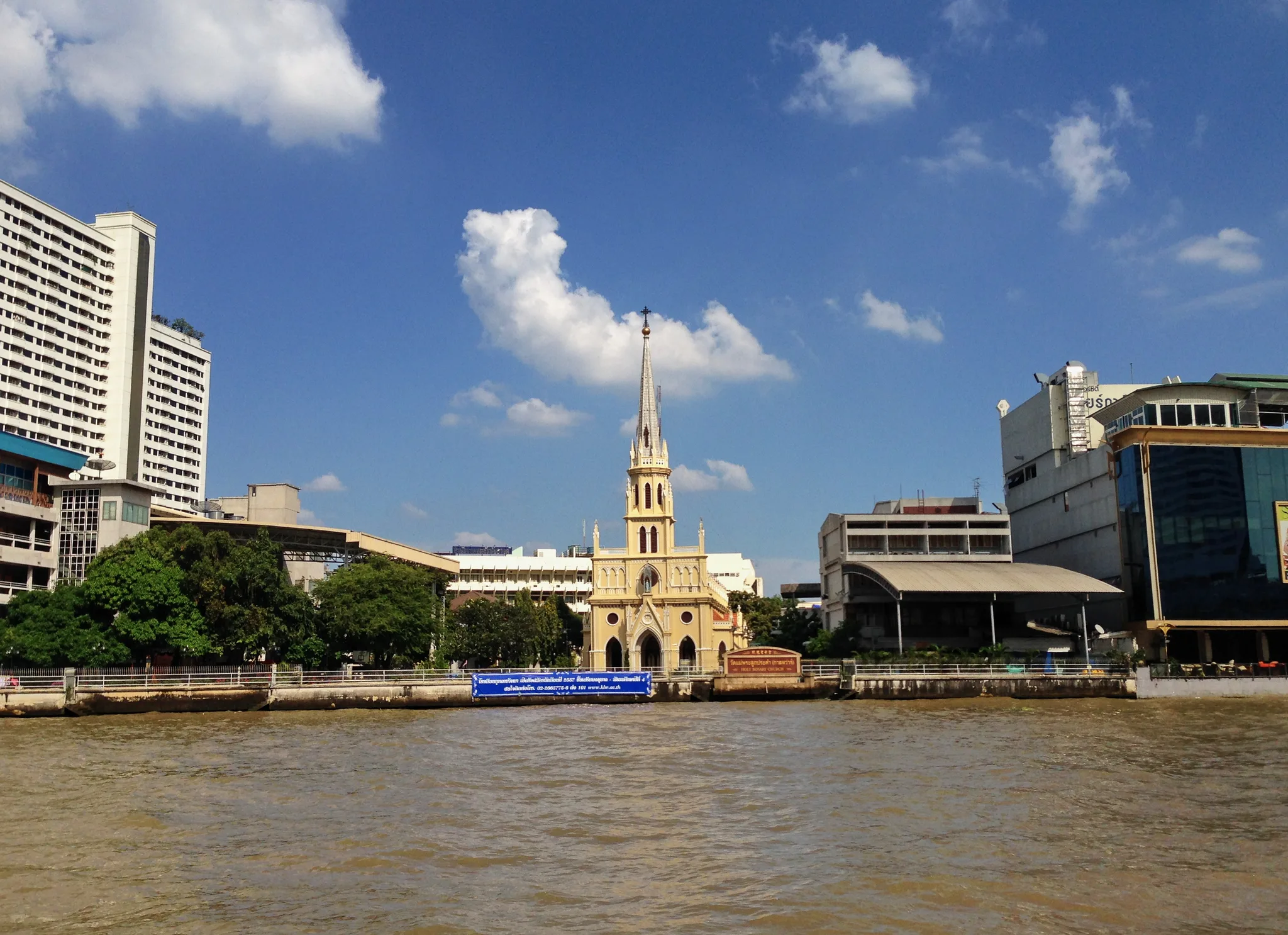
View from the river of Holy Rosary Church, Bangkok: its pale Neo-Gothic façade, pierced with pointed arches and topped by a spire, rises on the embankment between trees and modern buildings.trungydang — Wikimedia Commons, CC BY 3.0 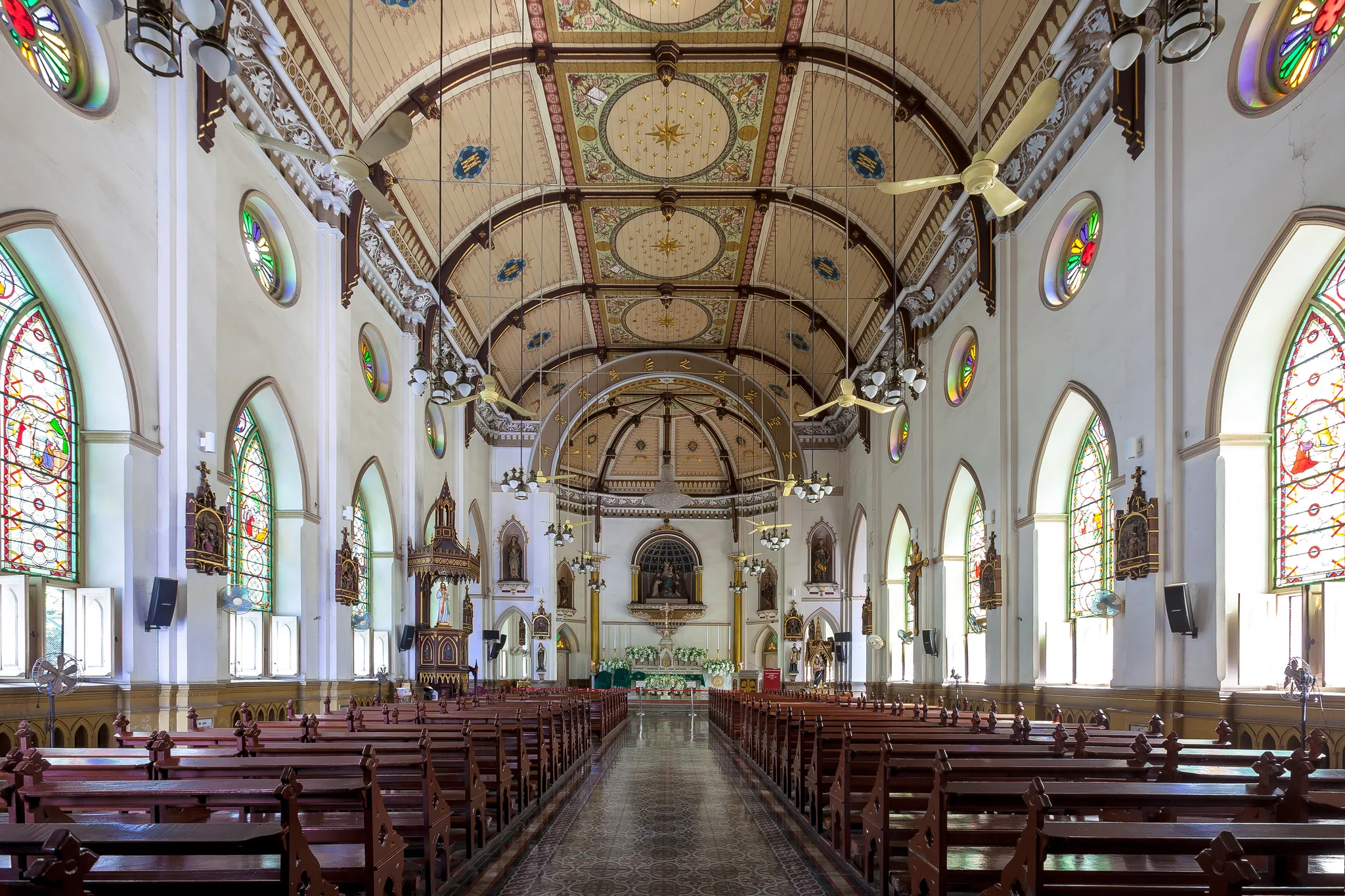
The nave of Holy Rosary Church, lined with carved wooden pews and pointed-arch windows filled with stained glass, leads to the chancel; the vaulted ceiling is decorated with painted motifs and gilded stars.This Photo was taken by Supanut Arunoprayote . Feel free to use any of my images, but please mention me as the author and may send me a message. (สามารถใช้ภาพได้อิสระ แต่กรุณาใส่เครดิตผู้ถ่ายและอาจส่ง — Wikimedia Commons, CC BY 4.0
Architecture and decoration
Explore the heritage
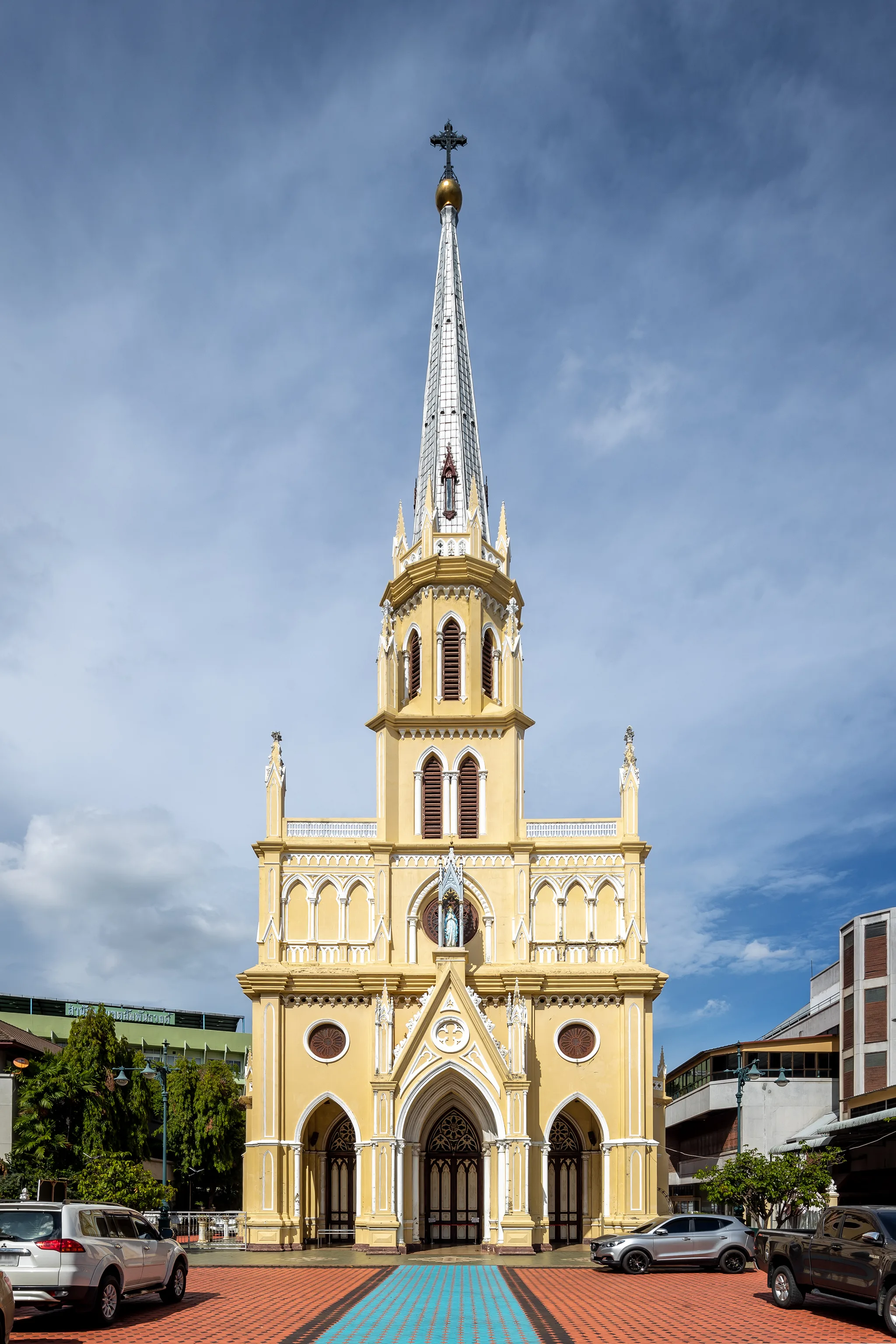
Neo-Gothic façade of Holy Rosary Church, dominated by a bell tower with a spire topped by a cross; a statue of the Virgin stands in the niche above the rose window, and three pointed-arch portals open onto the paved forecourt.This Photo was taken by Supanut Arunoprayote . Feel free to use any of my images, but please mention me as the author and may send me a message. (สามารถใช้ภาพได้อิสระ แต่กรุณาใส่เครดิตผู้ถ่ายและอาจส่ง — Wikimedia Commons, CC BY 4.0 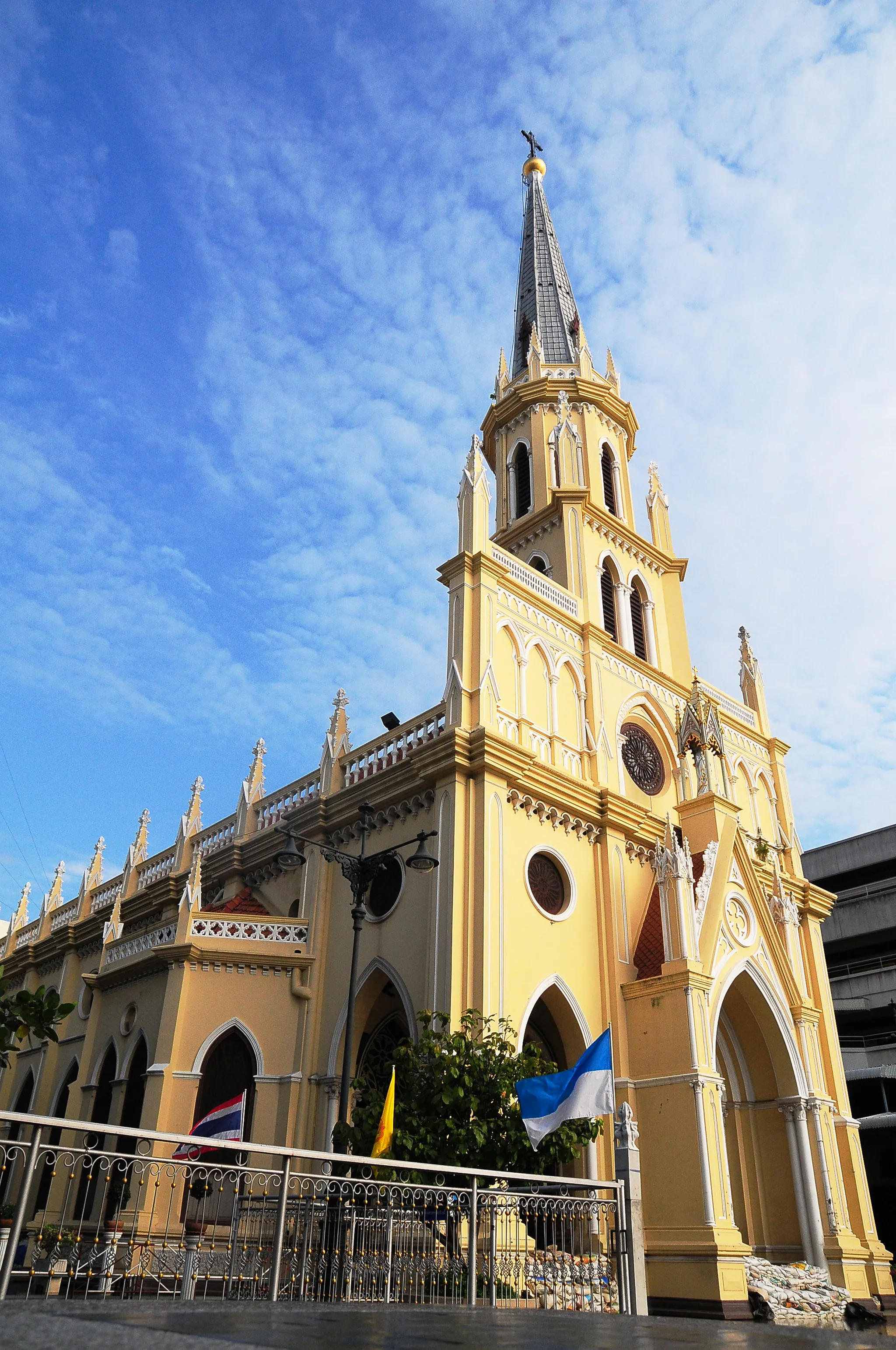
Yellow façade of Holy Rosary Church in the Gothic Revival style, with its spired bell tower, pinnacles, rose window and pointed arches; in front of the wrought-iron railing fly the Thai national flag and two other flags.Panyawat boontanom — Wikimedia Commons, CC BY-SA 3.0