
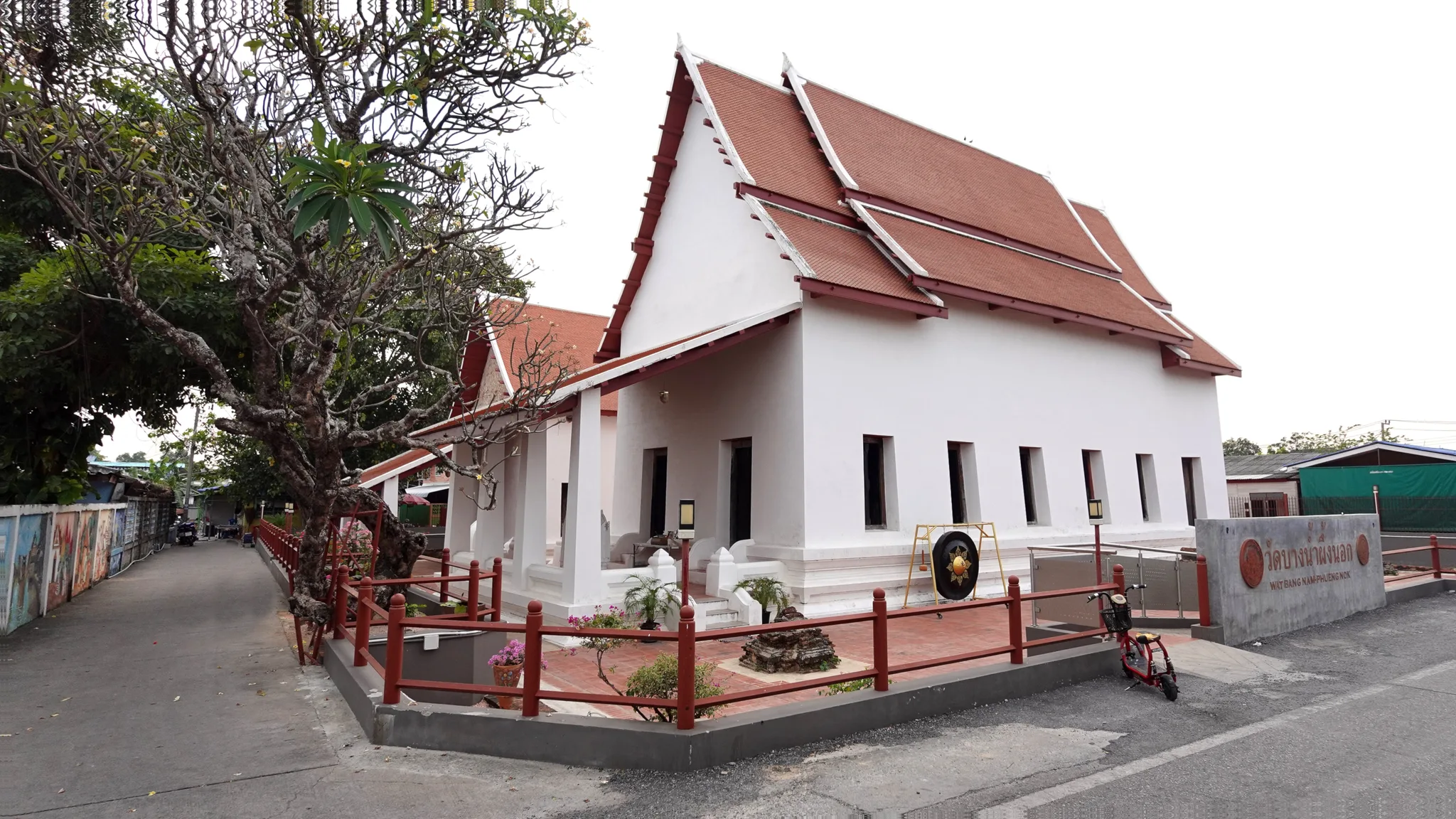
 Old Ordination Hall of Wat Bang Nam Phueng Nok: a white-walled building pierced by narrow windows, covered by a tiered roof of orange tiles, fronted by a pillared porch and enclosed by a red balustrade within which stands a gong.© Eric Monteil
Buddhist temple
Old Ordination Hall of Wat Bang Nam Phueng Nok
Standing apart from the riverside monastery, which was moved to the bank of the Chao Phraya, the old ordination hall of Bang Nam Phueng Nok preserves, together with the neighbouring vihan, the so-called ‘Dutch’ brick architecture and the great image of Luang Pho Yai.
Heritage family · Buddhism, religions and spiritualities
- Destination
- Samut Prakan (Phra Pradaeng)
- Heritage Family
- Buddhism, religions and spiritualities
- Typology
- Buddhist temple
- Visit
- Available tours →
The Bot Kao Wat Bang Nam Phueng Nok (Old Ordination Hall) is the former ubosot, the hall in which monks receive ordination, of a Buddhist monastery in the Bang Krachao loop, on the bank of the Chao Phraya, in Samut Prakan Province. Together with the neighbouring old vihan, it preserves the memory of the temple that preceded the present monastery, which was moved to the riverside in the 1960s. Attributed to the late Ayutthaya or early Rattanakosin period, long neglected, registered as a monument and then restored by the Fine Arts Department, it exemplifies a so-called ‘Dutch’ type of brick construction. It houses a large image of the Buddha in meditation and painted door and window panels.5
Key facts
- Destination
- Phra Pradaeng
- Heritage Family
- Buddhism, religions and spiritualities
- Typology
- Buddhist temple
- Places
- Chao Phraya River
- Samut Prakan
- Bang Krachao
- Wat Bang Nam Phueng Nok
- People
- Luang Pho Saiyut
- Communities
- Monastic community of Wat Bang Nam Phueng Nok
- Events
- Royal grant of wisungkhamsima to the new ordination hall of Wat Bang Nam Phueng Nok (1966)
- Restoration of the old ordination hall and old vihan of Wat Bang Nam Phueng Nok (2017)
- Heritage
- Luang Pho Yai of Wat Bang Nam Phueng Nok
- Glossary
- Wat
- Chao Phraya
- Phraya
- Ubosot
- Ayutthaya Period
- Rattanakosin period
- Keywords
- —
- Date
- —
- Collections
- —
Practical info
Practical information about this site is taken from its Google Maps page. We advise you to check it before visiting.
- Address
- MHMM+CQQ, Bang Kobua, Phra Pradaeng District, Samut Prakan 10130
A monastery in the Bang Krachao loop
On the banks of the Chao Phraya
Wat Bang Nam Phueng Nok stands in the Bang Krachao loop, in Phra Pradaeng District, on the bank of the Chao Phraya. Here the Chao Phraya traces a vast meander, still largely green and nicknamed the ‘green lung’. The monastery lies where the ferry from Bang Na comes in and is one of the main landing stages of the loop. Many visitors therefore arrive by river, before setting off on foot or by bicycle to explore the lanes and the nearby Bang Nam Phueng floating market.6
The monastery is a wat rat, that is, a temple of ordinary, non-royal status. It belongs to the Mahanikai order, one of the two great congregations of Theravada Buddhism in Thailand. What visitors first see on the riverbank, the new ubosot and a chedi (a bell-shaped reliquary monument), dates for the most part from the second half of the 20th century. The Bot Kao Wat Bang Nam Phueng Nok (Old Ordination Hall) belongs to another, older ensemble. Together with the old vihan, an assembly hall where the faithful gather before images of the Buddha, it forms a group of two buildings separate from those that animate the life of the monastery today.4
Honey and the legend of the two temples
The name of the monastery combines two Thai words. Bang denotes a waterside village or the waterway that serves it, and nam phueng means honey. The further term, Nok, means ‘outer’. It distinguishes this monastery from its neighbour, Wat Bang Nam Phueng Nai, the ‘inner’ temple. The two establishments thus form a pair, which local tradition links through a single foundation story.5
According to this story, Princess Sai Nam Phueng and Queen Suchada were travelling upriver by boat when honey gathered locally cured the queen’s daughter. In gratitude, Sai Nam Phueng is said to have founded Wat Bang Nam Phueng Nok, while Suchada is said to have founded the neighbouring temple, first called Wat Suchada. This legend provides no historical reference point. It does, however, show how the community linked its two monasteries to the name of the place and to the resource that characterised it.1
Origins that are hard to date
A late Ayutthaya temple
It is not known when or by whom the monastery was founded. In the absence of any foundation document, it is the architecture of the old ubosot and the old vihan that serves as a reference point. It leads to the construction being placed in the late Ayutthaya period, named after the former capital of the Siamese kingdom, around the last third of the 17th century. The temple is now commonly presented as more than three and a half centuries old, an age that rests on this stylistic dating.5
The history circulated by the monastery itself proposes a somewhat earlier origin, in the middle of the Ayutthaya period. It rests on a venerated image called Luang Pho Sukhothai. In Thailand, the word ‘image’ denotes a statue of the Buddha, and the title Luang Pho, ‘venerable father’, is applied both to the most honoured images and to respected monks. The two readings start from different clues, the style of the buildings for one, a surviving image for the other, and nothing today allows us to decide between them.7
Ayutthaya or Rattanakosin
The dating of the old ubosot itself remains under discussion. It is described as a building in the Ayutthaya style, but two hypotheses coexist: construction under Ayutthaya, or at the beginning of the Rattanakosin period, which opened after the fall of Ayutthaya and the transfer of the capital to Bangkok. The paintings on the panels, for their part, are attributed to the early Rattanakosin period, which places at least part of the decoration in this second period.2
The type of construction does not settle the question, since it was in use from the late Ayutthaya to the early Rattanakosin period and so covers both hypotheses. It is possible that a building founded in one era received its decoration in another. But no dated inscription, excavation report or published study currently fixes the chronology of the ubosot. The reader should therefore see the building as the work of a pivotal period, between the end of one kingdom and the beginnings of the next capital.4
Reading the architecture of the old buildings
The kra-thae-soe type, known as ‘Dutch’
The old ubosot and the old vihan are built of rendered brick. Their gable walls, that is, the triangular end walls, are built up in brick to the ridge, beneath a roof that overhangs them. This design is called kra-thae-soe in Thai; it is also known as Wilanda, ‘Dutch’, a name which, in common usage, associates it with the image of European buildings. It was widespread from the late Ayutthaya to the early Rattanakosin period.4
Visitors familiar with the temples of Bangkok will notice the difference. In the most common type, the gable is a decorated pediment framed by roof ornaments. Here, the masonry rises in a single unbroken mass and the silhouette remains solid and austere. It is this rarity that gives the group its interest: two neighbouring buildings preserve the same type, which allows it to be read on both an ordination hall and an assembly hall.4
The old vihan, a neighbouring witness
The old vihan is the better documented of the two buildings, and it sheds light on the reading of the whole ensemble. Its roof is a single unbroken structure, without a chofa, the curved finial that usually crowns the top of the gables, without bai raka, the serrated crest running along the bargeboards, and without hang hong, the pieces that terminate these bargeboards. The interior has no columns and forms a single hall, which the walls alone suffice to roof over.4
The decoration is concentrated on the pediment, modelled in stucco. It shows Narai, the Thai name of the Hindu god Vishnu, depicted with two arms and surrounded by peonies and foliage. Inside, two principal images occupy the altar. One makes the gesture of giving; the other that of victory over Mara, the hand reaching towards the ground to call the earth to witness against the demon who sought to prevent the Awakening. The mural paintings, now very faded, also include a scene of the victory over Mara, which makes this episode the dominant theme of the hall.4
The ubosot, Luang Pho Yai and the painted panels
The ubosot is the most sacred hall of a monastery, the only one in which ordinations may take place, because its ground is consecrated and marked out by boundary stones. That of Bang Nam Phueng Nok houses as its principal image a Buddha in meditation, seated with the hands resting one upon the other in the lap. The faithful call it Luang Pho Yai, the ‘great venerable father’. This image gives the building its religious identity and remains, to this day, at the heart of its ritual life.2
The painted decoration is seen above all on the leaves of the doors and windows. They are painted in distemper, a water-based paint bound with glue and applied to the wood, and depict deities in particular. These panels are associated with the early Rattanakosin period. The mural paintings of the hall, by contrast, have almost entirely faded. Before the restoration, the panels were in poor condition. Yet, together with Luang Pho Yai, they are the most precious element of the ubosot, for they preserve a decoration that the walls have lost.8
From the old temple to the riverside monastery
The move to the river
Wat Bang Nam Phueng Nok has not always been a riverside temple. The monastery was moved from its original site to the bank of the Chao Phraya, where its main buildings stand today. The old ubosot and the old vihan did not follow this move. They remained where the temple had first been founded and so became witnesses to the earlier state of the monastery.3
This transfer explains the particular situation of the Bot Kao Wat Bang Nam Phueng Nok (Old Ordination Hall). It is not a secondary building within a complex that stayed in place, but the remnant of an earlier monastery whose community settled elsewhere. The word kao, ‘old’, which its name bears, expresses precisely this gap between two ordination halls, one inherited, the other built for the present life of the monastery.
Luang Pho Saiyut’s new ubosot
The monk who led this change was Luang Pho Saiyut, a native of Song Khanong, ordained in 1936 at Wat Songtham Worawihan. Abbot of Bang Nam Phueng Nok from 1961, he had a new ubosot built on the riverbank. On 16 March 1966, the building received the royal grant of its consecrated ground, the wisungkhamsima. On this occasion Queen Rambai Barni (1904–1984), widow of King Prajadhipok, cut the cord of the luk nimit, the buried stone spheres that mark the sacred boundaries of the ubosot.3
The presence of a member of the royal family lent this consecration particular lustre for a temple of ordinary status. The following year, in 1967, the placing of the chofa on the roof of the new ubosot was commemorated by a medal struck during Luang Pho Saiyut’s abbacy. With this new building, the monastery’s ordination hall changed location: ordinations and major rites have since been held on the riverbank.3
Buildings left aside
Deprived of their principal function, the old ubosot and the old vihan were left abandoned for decades, without maintenance. The humid climate of the Bang Krachao loop wore away the render and erased the mural paintings, of which almost nothing remains in the ubosot. The buildings did not disappear, however: they remained standing, apart from the riverside monastery.5
Protection and restoration
A registered monument
The old ubosot is officially registered as an ancient monument by the Fine Arts Department, the Thai administration responsible for heritage. This registration places it under State protection and raises the building from the status of a neglected religious structure to that of a national monument. It recognises its value as a witness: a type of architecture that has become rare, early painted decoration and a venerated image, preserved together in a single building.2
The 2017 works and their consecration
In 2017, the Fine Arts Department restored the old ubosot and the old vihan. The works brought the long period of abandonment to an end and restored the coherence of the two buildings as an ensemble. This was not merely a technical intervention on walls and roofs: the restoration of the ubosot was celebrated by the monastic community as a religious event.4
A phutthaphisek ceremony, a rite of consecration in which monks charge images and devotional objects with sacred power, did indeed mark the completion of the works. The restored building thus became once more a place of ritual, rather than simply a monument to be visited. This link between heritage restoration and consecration shows that, for the community, the old ubosot never ceased to be a sacred space.2
An ordination hall in the present
Consecrating devotional objects
The ceremony celebrating the restoration shows the place of the old ubosot in present-day religious life. Effigies of Thao Wessuwan, a very popular guardian deity, and medals bearing the image of Luang Pho Yai were consecrated there. The victory candles were lit in the ubosot by Phra Khru Suphatthrakitchathon, Phra Khru being an ecclesiastical title, and the rite of invocation was led by Phra Achan Puen.2
These objects extend the presence of the principal image beyond the temple. The medal struck in 1967 for Luang Pho Saiyut’s new ubosot already belonged to this practice, and those of Luang Pho Yai take it up for the old hall. The meditating Buddha of the old ubosot, which no longer presides over ordinations, thus remains a figure of devotion whose image circulates among the faithful.3
A stop in Bang Krachao
Today the monastery welcomes visitors as well as its faithful. As the landing stage for the Bang Na ferry and a neighbour of the Bang Nam Phueng floating market, it attracts cyclists exploring the ‘green lung’ of Bang Krachao. For them, the Bot Kao Wat Bang Nam Phueng Nok (Old Ordination Hall) and the old vihan offer a different face of the place from the riverside monastery, with older and more austere buildings. On these two buildings one can read the brick architecture of the late Ayutthaya and early Rattanakosin periods.2
Understanding
The Bot Kao Wat Bang Nam Phueng Nok (Old Ordination Hall) is the heart of an earlier monastery, left in place when the community moved closer to the Chao Phraya. Together with the old vihan, it preserves a type of brick construction that has become rare, early painted panels and Luang Pho Yai, the meditating image that the faithful continue to honour. Its importance lies in this dual nature: a witness to a pivotal era between Ayutthaya and Rattanakosin, it also remains a place where devotional objects are consecrated. Now protected and restored by the Fine Arts Department, it no longer hosts ordinations, which take place in the riverside ubosot built in 1966. It now forms part of a Bang Krachao loop frequented by cyclists and visitors to the floating market, who see in it a monument more than a hall of ritual. Its future lies between these two perspectives, that of national heritage and that of local devotion. Does an ordination hall that no longer serves to ordain monks remain first and foremost a sacred place, or does it become above all the memory of a vanished monastery?
Bang Krachao, the "green lung" of Bangkok, between canals, Mon heritage, temples, biodiversity and sustainable initiatives.
- Wat
- Buddhist monastic complex that brings together, within a single enclosure, several religious buildings, monks’ quarters and ancillary buildings; the word does not refer to a single building.
- Chao Phraya
- Highest title of the Siamese nobility, held by senior dignitaries of the court.
- Phraya
- Rank of the Siamese court nobility, immediately below that of chao phraya; it precedes the dignitary’s title name.
- Ubosot
- Consecrated ordination hall of a wat: the ritually central building, marked out by sacred boundary stones, where monastic ordinations take place.
- Ayutthaya Period
- Era of Siamese history during which the kingdom had Ayutthaya as its capital, from 1351 until the fall of the city in 1767.
- Rattanakosin period
- Period of Thai history that began with the founding of Bangkok as the capital by King Rama I at the end of the eighteenth century. It takes its name from Rattanakosin Island, the heart of the royal city.
- Chofa
- Curved finial, often shaped like a bird’s beak, that crowns the apex of the gables of Thai roofs.
- Bai raka
- Row of serrated elements set along the barge boards of a Thai roof.
- Hang hong
- Upturned end at the base of the barge boards of a Thai roof.
- Ordination
- Ceremony by which a layperson is admitted as a novice or as a monk into the Buddhist community.
- Principal image
- In a Thai Buddhist monastery, the most important statue of the Buddha, around which worship is organised; it is generally installed in the monastery’s main building.
- Worawihan
- Title borne by certain royal temples in Thailand, indicating their rank in the hierarchy of royal monasteries.
- Wisungkhamsima
- A royal grant of the consecrated ground on which a monastery may build an ordination hall.
- Ancient monument
- In Thailand, a legal category (boran sathan) that places a building or site under State protection as heritage.
- Buddha image
- In Thai Buddhism, a devotional representation of the Buddha, most often a statue, venerated as an object of worship.
- Mahanikai
- One of the two main branches, or orders, of the Buddhist clergy of Thailand.
- Theravada
- A branch of Buddhism whose canonical texts are written in Pali.
- Chedi
- A bell-shaped reliquary monument, the Thai version of the Indian stupa.
- Reliquary
- A container intended to hold and protect one or more relics.
- Mara
- In Buddhism, the demon of illusion and desire who tried to prevent the Buddha from attaining Enlightenment.
- Awakening
- In Buddhism, the state of understanding and clarity reached at the end of the spiritual path, which frees one from ignorance and suffering.
- Kra-thae-soe
- Thai brick building type whose gable walls rise in masonry up to the ridge beneath an overhanging roof, without a decorated pediment. Also called Wilanda, 'Dutch', it was common from late Ayutthaya to early Rattanakosin.
- Luang Pho
- Thai honorific title meaning 'venerable father', given both to respected monks and to the most highly revered images of the Buddha.
- Luk nimit
- Stone spheres buried around an ubosot to mark the boundaries of its consecrated ground.
- Phra Khru
- Ecclesiastical title conferred on monks within the hierarchy of the Thai monastic community.
- Phutthaphisek
- Consecration rite during which monks imbue Buddha images and devotional objects with sacred power.
Primary sources
- 1บางน้ำผึ้ง, Sirindhorn Anthropology Centre (wiki communautaire) ↗
Studies
Reference works
- 4Contributeurs Wikipédia, วัดบางน้ำผึ้งนอก, Wikipédia en thaï ↗
- 5วัดบางน้ำผึ้งนอก บางกะเจ้า สมุทรปราการ ประวัติ ท่าเรือ แผนที่, Ceediz, 2017 ↗
- 6Wat Bang Nam Phueng Nok, Thailand Tourism Directory (Ministry of Tourism and Sports) ↗
- 7Wat Bang Nam Phueng Nok, ประวัติวัด – วัดบางน้ำผึ้งนอก, Google Sites ↗
- 8วัดบางน้ำผึ้งนอก ต.บางน้ำผึ้ง อ.พระประแดง สมุทรปราการ, Tour Wat Thai ↗
- 9Wat Bang Nam Phueng Nok, Tripniceday ↗
- 10HAH, File:Wat Bang Nam Phueng Nok 2.jpg, Wikimedia Commons, 2007 ↗

Contemporary views
Old Ordination Hall of Wat Bang Nam Phueng Nok today
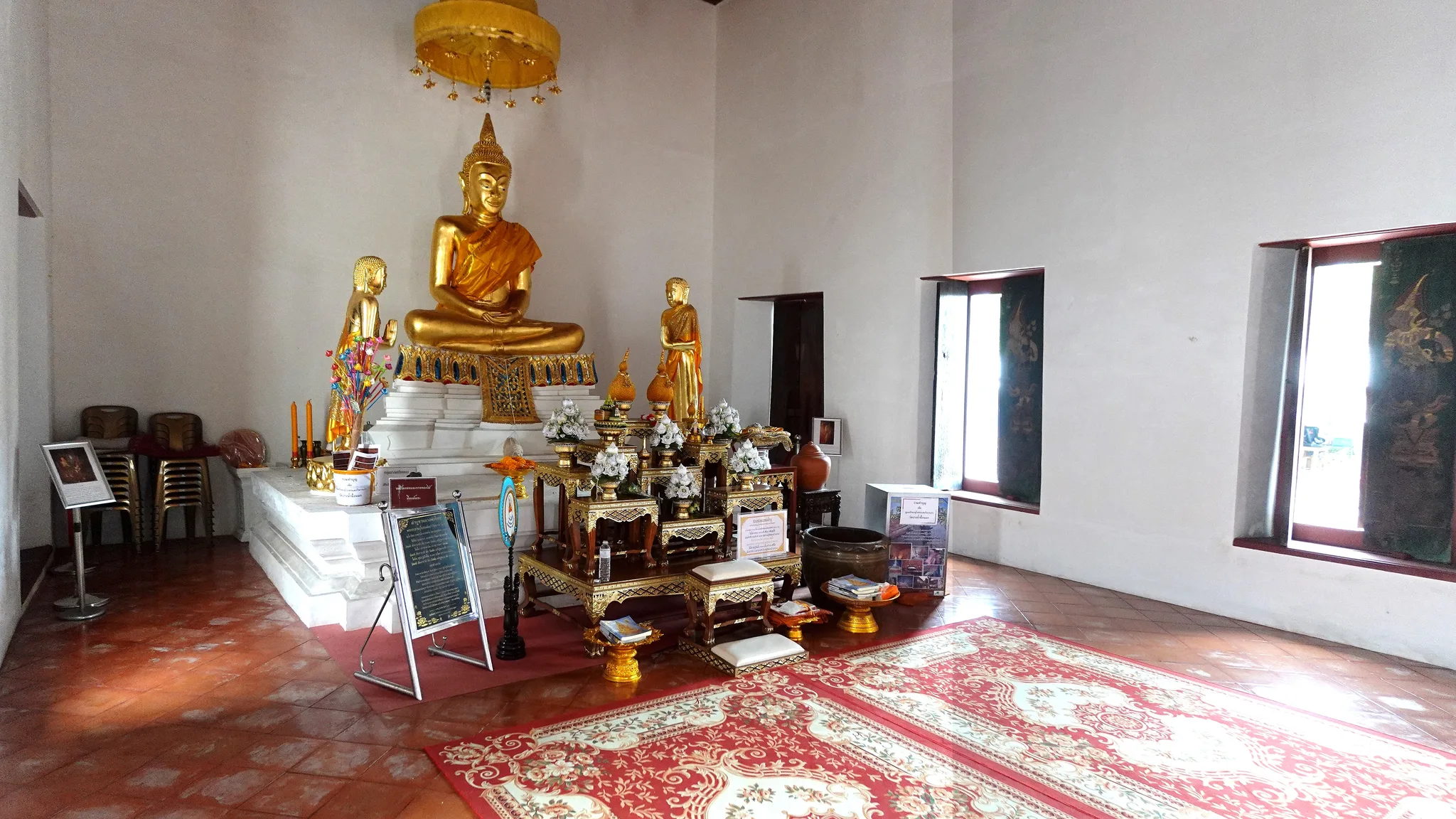
In Old Ordination Hall of Wat Bang Nam Phueng Nok, a gilded seated Buddha flanked by two standing disciples presides over an altar laid with offerings; the window shutters bear painted figures.© Eric Monteil
Architecture and decoration
Explore the heritage
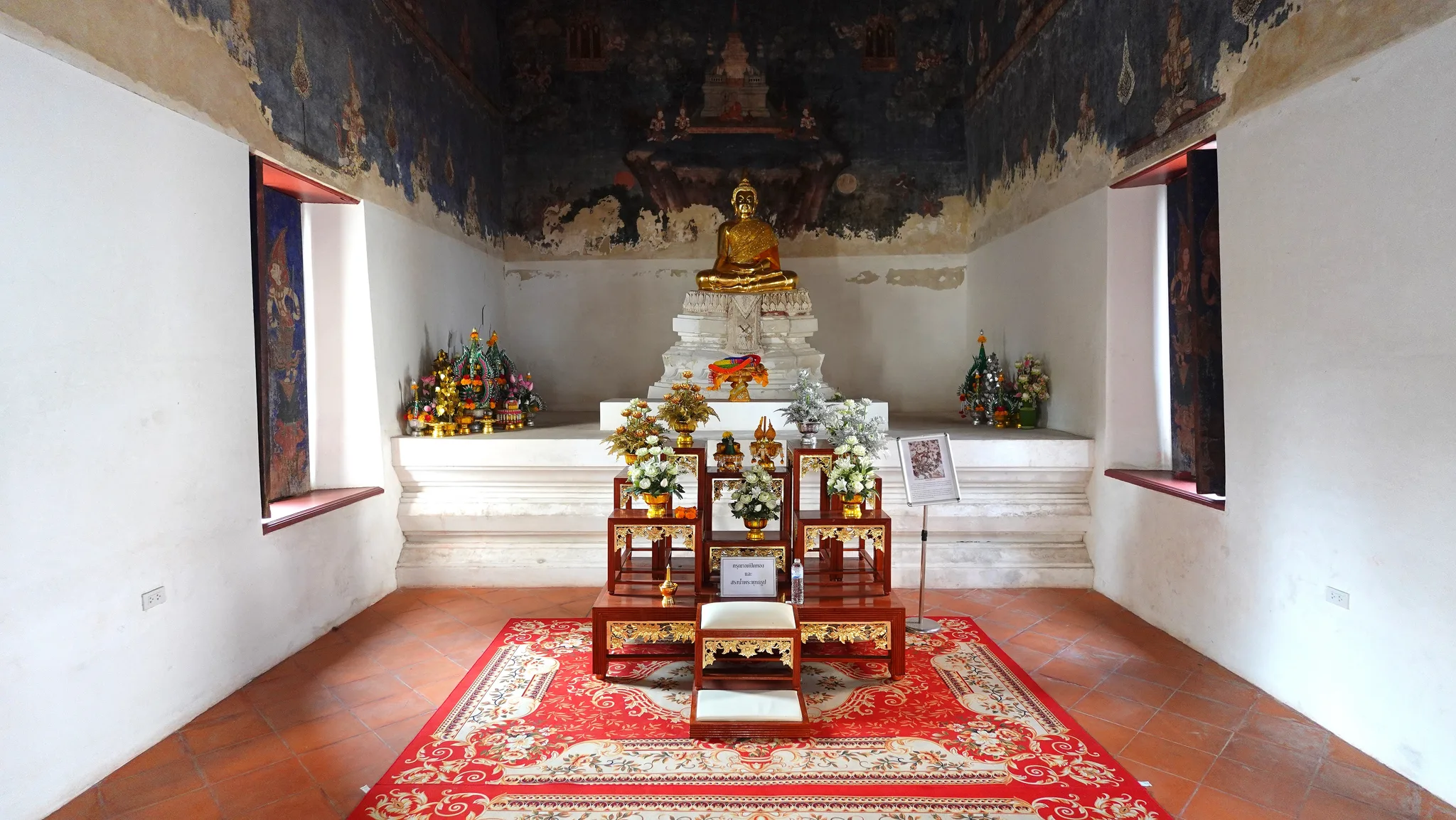
In Old Ordination Hall of Wat Bang Nam Phueng Nok, a gilded seated Buddha on a white base rises above a tiered altar laden with flowers, beneath dark blue wall paintings that are partly faded.© Eric Monteil 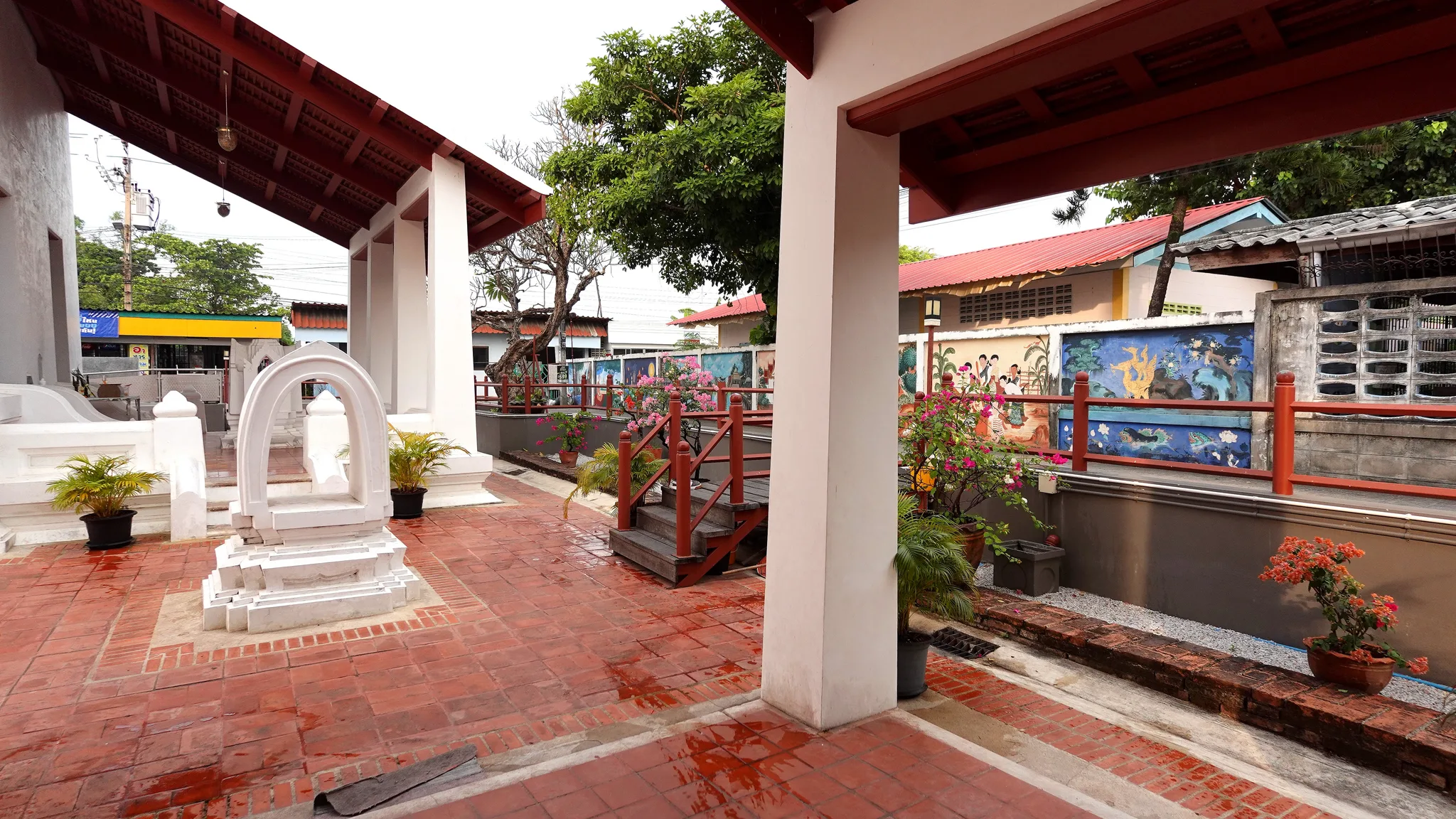
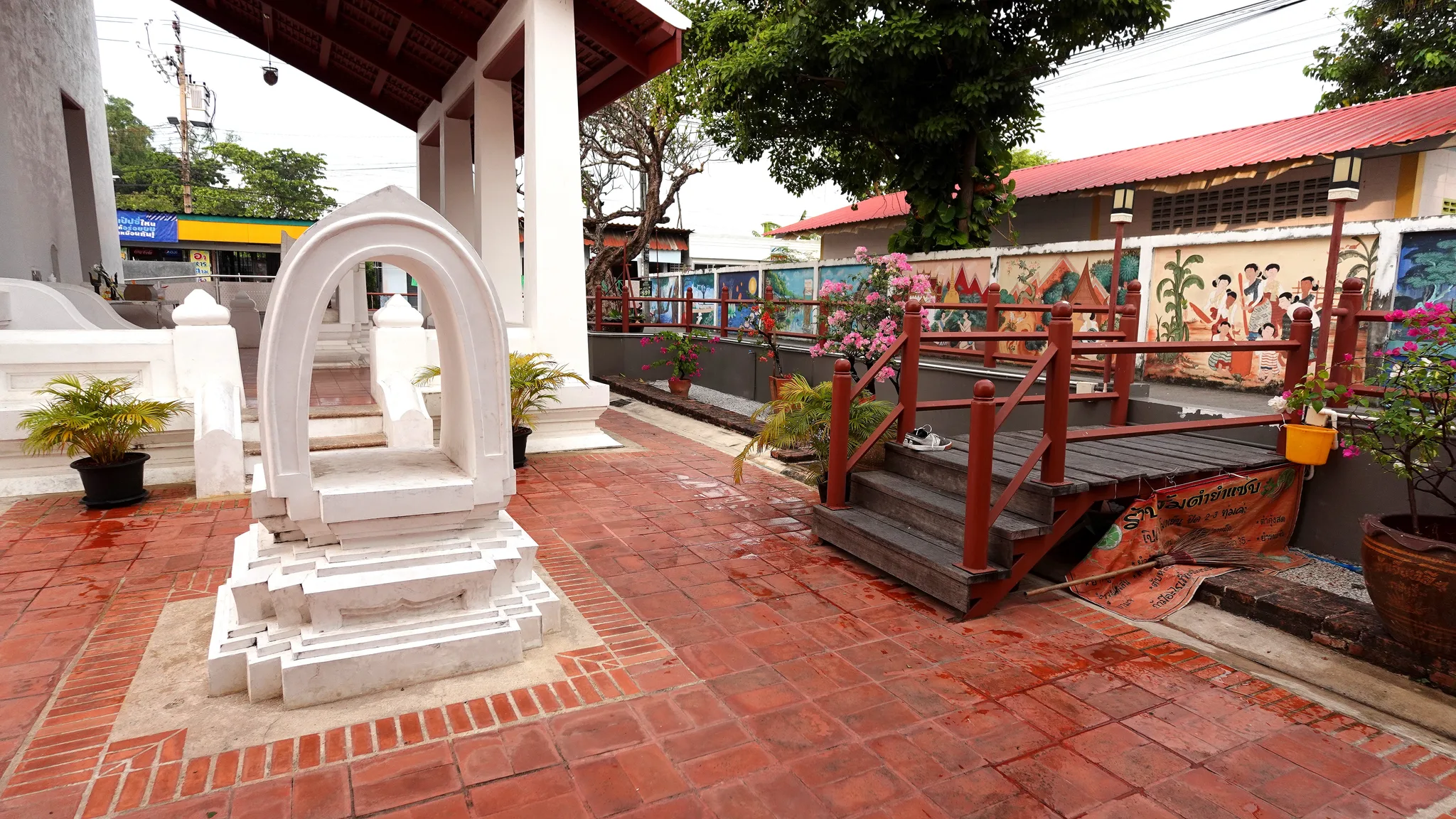
Old Ordination Hall of Wat Bang Nam Phueng Nok: white sema boundary stones on moulded bases, a gallery of whitewashed pillars beneath a red timber roof, and a brick-paved courtyard edged by a wooden stair and a mural-painted wall.© Eric Monteil