
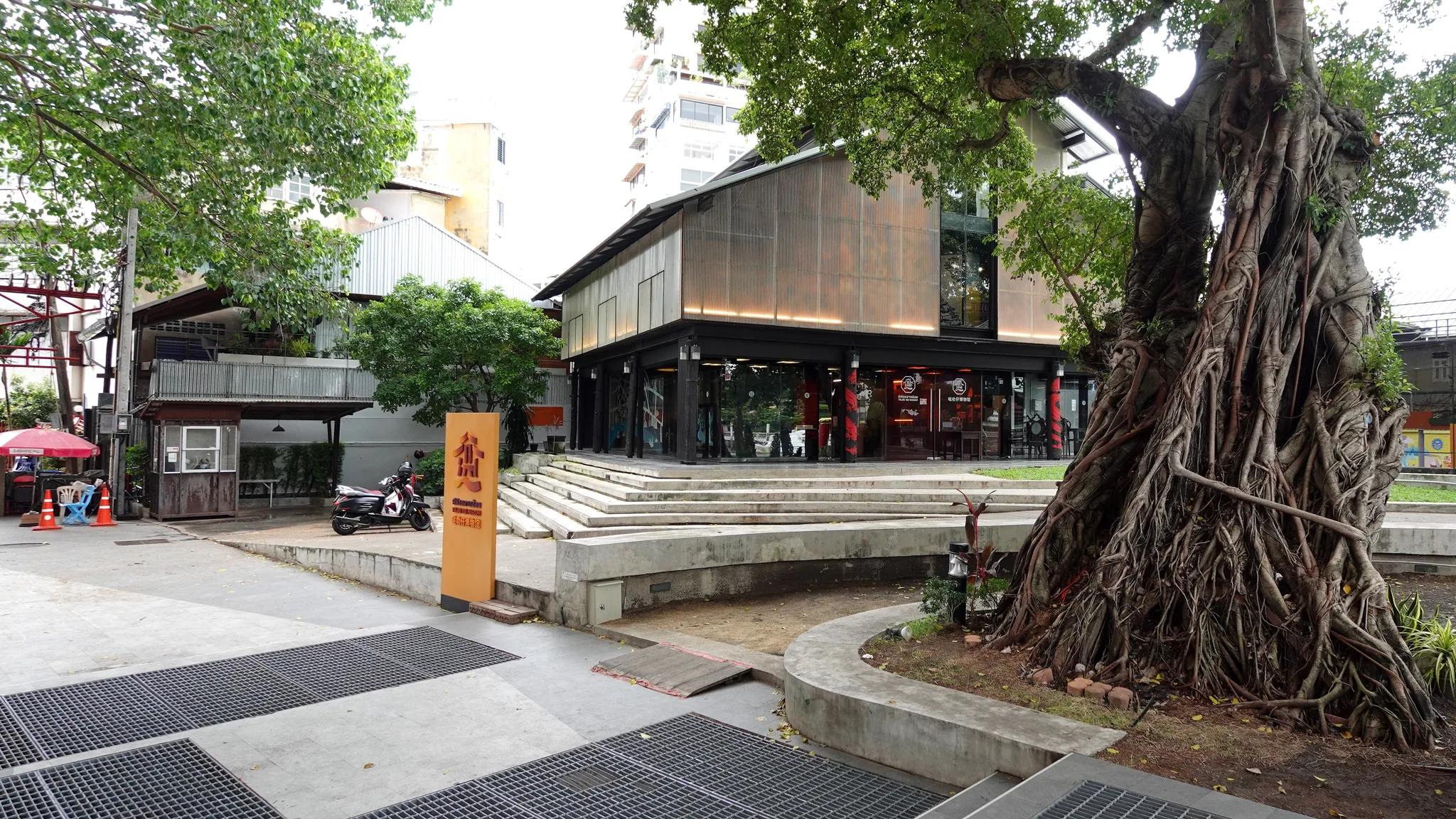
 Talad Noi Museum occupies a contemporary two-storey building clad in translucent panels, opening at ground level through glazed bays and red columns, facing a stepped concrete forecourt and an old fig tree with aerial roots.© Eric Monteil
- Destination
- Bangkok (Samphanthawong)
- Heritage Family
- Arts, aesthetics and creation
- Typology
- Museum
- Visit
- Available tours →
The Talad Noi Museum is a community museum of local history, set beside the Chao Phraya River in Talat Noi, the old Sino-Thai quarter of Bangkok. Opened in 2024 and run by the Treasury Department of the Ministry of Finance, it occupies the site of a former lathe workshop that had been left derelict. The site was turned into an exhibition space for the centenary of the economist Puey Ungphakorn, who had grown up in the neighbourhood. Its building echoes the form of the workshop and reuses its timber. Its displays tell the story of a community of Chinese artisans settled there since the founding of the capital, with its languages, its cuisines and its ancestors, amid a garden that opens onto the river.1
Key facts
- Destination
- Bangkok
- Heritage Family
- Arts, aesthetics and creation
- Typology
- Museum
- Places
- Chao Phraya River
- Samphanthawong
- Periods
- People
- Puey Ungphakorn
- Communities
- Talat Noi community
- Events
- Centenaire de Puey Ungphakorn (2016)
- Founding of Bangkok (1782)
- Inauguration du Musée de Talad Noi (2024)
- Litige sur le terrain du Musée de Talad Noi (2019)
- Heritage
- —
- Glossary
- Khlong
- Soi
- Sino-Thai
- Hokkien
- Teochew
- Hakka
- Keywords
- —
- Date
- —
- Collections
- —
Practical info
Practical information about this site is taken from its Google Maps page. We advise you to check it before visiting.
- Address
- พิพิธตลาดน้อย Soi Phanu Rangsi, Khwaeng Talat Noi, Khet Samphanthawong, Krung Thep Maha Nakhon 10100
- Phone
Talat Noi, a quarter born with the capital
A little market south of Sampheng
The Talad Noi Museum tells, first of all, the story of a neighbourhood. Talat Noi, whose name means ‘little market’, took shape on the east bank of the Chao Phraya River when King Rama I moved the capital of the kingdom there in 1782. Chinese families from Kudi Chin and from the banks of the khlong Bang Luang, a khlong being a canal, then settled a little to the south of Sampheng, the great Chinese market of the newly founded city. The new quarter grew up alongside this larger neighbour, from which it received part of its goods.12
Teochew-speaking residents, Teochew being one of the Chinese dialects spoken in the quarter, called it Tak-lak-kia (噠叻仔). The name referred precisely to the little market that received goods from Sampheng. The Thai name and the Chinese name thus say the same thing: Talat Noi did not begin as a centre, but as a secondary market, tied to the great market next door. Today the quarter belongs to Samphanthawong, the smallest of Bangkok’s districts, and it is its history that the museum has chosen to pass on.2
Woks, foundrymen and lathe workshops
Talat Noi was not merely a place of trade. Other old names for the quarter recall the work of its inhabitants: it was also known as the ‘wok workshop’ or the ‘house of the Chinese foundrymen’. These names point to a metalworking craft, from the casting of cooking utensils to the shaping of mechanical parts.2
The site now occupied by the museum belongs to this history. It once housed a large lathe workshop, where parts were made for boats, machinery and rice mills, the factories in which rice is processed. The building stands on the very spot where one of the trades that shaped Talat Noi’s identity was practised, and the exhibition it houses is, fittingly, about a community of artisans.2
From abandoned workshop to museum project
A state-owned plot at Phanu Rangsi pier
The land is state property, managed by the Treasury Department (กรมธนารักษ์), which comes under the Ministry of Finance. It lies alongside Phanu Rangsi pier, on the east bank of the Chao Phraya River, in Soi Phanu Rangsi, a soi being a lane. Among the workshops located there was that of Li Yun Chiang, a lathe workshop that had been in existence for nearly a century by 2019.3
After the workshop closed, the land was left derelict. A public plot, on the riverbank, at the heart of an old quarter, thus stood unused. It was this situation that paved the way for the project: to turn a neglected site into a place of exhibition and transmission, open to residents and the public alike.2
A tribute to Puey Ungphakorn
The project grew out of an anniversary. Puey Ungphakorn, born in 1916, an economist and educator, had spent his childhood in Talat Noi, where his family home stood. The centenary of his birth, on 9 March 2016, provided an occasion to honour him in the neighbourhood of his childhood. The Arsom Silp Institute of the Arts, which designed the site, describes him as a ‘master of truth, beauty and goodness’. The architects say they drew inspiration from one of his texts on the ‘quality of life’, which accompanies existence ‘from the mother’s womb to the funeral pyre’. They also cite his call for a welfare state, that is, a state that guarantees everyone protection throughout their lives.8
The project was launched in 2015. The following year, at the time of the centenary, the Treasury Department announced that it would lay the foundation stone of a memorial in Talat Noi. Chakkrit Parapuntakul was then head of the Treasury Department. The plan was to restore the former workshop as a local museum and exhibition space, in works estimated to take two years. The project took the name Puey Ungphakorn Art Garden (Talat Noi community museum).10
A disputed site, an open museum
The 2019 accusations
The work did not proceed without friction. In 2019, the project was publicly accused of having invoked a good cause to push other occupants off the land. The dispute concerned the division of the plot between the former tenant of the workshop and the future museum.3
Pongkwan Lassus, a member of the committee in charge of the Puey Ungphakorn centenary, then gave a public account of how the project had come about, and letters relating to the affair were made public.4
An agreement, then the 2024 opening
The matter was settled by an agreement accepted by all parties. The Treasury Department renewed the former tenant’s lease on part of the land and allocated another part to the project. The museum and its garden therefore occupy a portion of the original plot, next to the one the tenant continues to use.4
The Talad Noi Museum was officially opened on 6 March 2024, nearly nine years after the project was launched. It has around 250 m² of exhibition space.1
A building in memory of the workshop
The form and timber of the old workshop
The building echoes the form of the former workshop in order to preserve its identity. Its designers retained the original architectural character and reused the workshop’s timber. The Treasury Department nonetheless presents the whole as a new design, mindful of the site’s historical context. Visitors enter a building that recalls, in its silhouette and its materials, the lathe workshop that once occupied the site, without its being presented as a mere restored workshop.6
This choice makes the building the museum’s first exhibit. Even before the galleries, the timber structure evokes the world of artisanal work that the displays go on to describe. Reusing the original material physically extends the history of the place, rather than replacing it with architecture unconnected to it.
A design shared with the residents
The Arsom Silp Institute of the Arts designed the site together with the Treasury Department and the Talat Noi community. Designers, academics and residents took part in the project, and the residents are regarded as its co-producers. The museum is classed as a community museum, the kind of museum that tells the history of a community with the participation of its members.9
The museum presents a local history, that of the quarter’s economy, society and way of life, for visitors and residents alike.1
A garden on the Chao Phraya
The museum sits within a riverside garden, shaded by tall trees and crossed by a footpath. This garden is the first and only riverside garden in this old quarter, created on public land that had until then been left derelict.11
The site bears several names that reflect its dual purpose. It is called the Puey 100 Years Garden, in memory of the centenary, or Puey Park for the People. The site also serves as a space for relaxation, meeting and activities for residents and the public.5
The museum’s displays
On the ground floor, reception and coinage
The ground floor brings together the reception, a shop and a space set aside for temporary exhibitions and activities. The shop offers coin-related products and souvenirs, as well as community products. This level also serves as a learning centre on Thai coinage from different periods. It is also here that visitors register before going upstairs to the galleries.6
A community of Chinese artisans
The main exhibition, upstairs, is entitled ‘Talat Noi: A Community of Chinese Artisans of the Early Rattanakosin Era, a Land of Many Cultures’. The Rattanakosin era refers to the period that began with the establishment of the capital at Bangkok in 1782. The title takes up the two ideas on which the quarter’s history rests: a Chinese settlement that arrived with the new capital, and an identity forged by the work of artisans.6
The displays have also been presented under the title ‘The Legacy of the Past Still Shines’, in six sections, several of which appeal to different senses. This approach suits a history made of gestures, recipes and words as much as of dates.2
Languages, cuisines and ancestors
An area devoted to language and food presents the five dialect groups of Talat Noi’s Sino-Thai community: Hokkien, Teochew, Hakka, Cantonese and Hainanese. Through presentations of dishes, it shows how their cuisines have blended. This diversity gives the phrase ‘a land of many cultures’ its full meaning. The quarter, which the Teochew called Tak-lak-kia, was in fact a place where several Chinese communities lived side by side.2
The final section is devoted to the ancestors of Talat Noi. The displays thus close with the quarter’s founding families, those who settled south of Sampheng at the end of the 18th century.2
The Talad Noi Museum today
A public facility serving the neighbourhood
The Talad Noi Museum is a recent public facility, set on state land and run by the Treasury Department. Its mission is to raise awareness of the history, economy and society of Talat Noi. It is also meant to turn an unused public plot into a place of exhibition and transmission. It thus combines two functions: a museum that tells a story and a public space that residents can make their own.6
This dual purpose stems from its origins. Born of a tribute to an economist devoted to everyone’s quality of life, the site is intended to be open to all, on the riverbank. It was designed together with those whose story it tells.
Talat Noi, a neighbourhood turned destination
The museum is part of a neighbourhood undergoing rapid change. Since the 2010s, Talat Noi has been recast as a destination for cultural and heritage tourism. Cafés and galleries are opening there, and visitors come in large numbers. At the same time, the resident population remains small, elderly and declining.12
The Talad Noi Museum occupies a particular position in this context. It welcomes visitors who come to discover the neighbourhood, while having been designed with those who still live there. In a building that echoes the form of a workshop, it preserves the memory of the trades and families that made Talat Noi, just as the quarter is changing its face.
Understanding
The Talad Noi Museum is at once a tribute, a neighbourhood museum and a public garden. Born of Puey Ungphakorn’s centenary, it has given back to Talat Noi an abandoned state-owned plot beside the Chao Phraya. In a building that echoes the form of a lathe workshop, it tells the story of a community of Chinese artisans settled there since the founding of the capital. Its significance lies in this choice: to make the workplace itself a vehicle of memory, designed with the residents rather than for them. Its future is being played out in a fast-changing neighbourhood. Cafés, galleries and visitors are pouring in, while the ageing resident population is shrinking. The disputed division of the land in 2019 showed that turning a workplace into a place of memory also affects those who occupy it. When residents grow fewer, does a community museum remain the voice of a community, or does it become the story of a neighbourhood offered up to those who visit it?
Through Bangkok's creative districts, between street art, architecture, design and new uses of the city.
- Khlong
- Canal or waterway, natural or man-made, which long played a major role in transport, irrigation and the organisation of settlements and territories in Thailand.
- Soi
- Thai word for a lane or side street branching off a main road; soi are often numbered after the main street from which they branch.
- Sino-Thai
- Describes what stems from the blending of Chinese and Thai cultures, notably an architectural and urban tradition developed in Thailand by communities of Chinese origin.
- Hokkien
- Chinese group originating from the south of Fujian province, many of whose members emigrated to Southeast Asia, notably as merchants.
- Teochew
- Chinese dialect group originating from the Chaozhou area, in eastern Guangdong, southern China. It forms the largest component of the Chinese community in Thailand.
- Hakka
- A Chinese language and cultural group originating in southern China, part of which emigrated to Southeast Asia, notably to Thailand.
- Hainanese
- Chinese dialect group originating from the island of Hainan, in southern China, and one of the components of the Chinese diaspora settled in Thailand.
Primary sources
- 1พิพิธตลาดน้อย (fiche de la base de données des musées thaïlandais), Princess Maha Chakri Sirindhorn Anthropology Centre (SAC) ↗
Studies
Reference works
- 5พิพิธตลาดน้อย (site officiel), กรมธนารักษ์ (Treasury Department), ministère des Finances ↗
- 6เกี่ยวกับเรา - พิพิธตลาดน้อย, กรมธนารักษ์ (Treasury Department), ministère des Finances ↗
- 7พิพิธตลาดน้อย, Wikipedia (thaï) ↗
- 8สวนศิลป์ ป๋วย อึ๊งภากรณ์ (พิพิธภัณฑ์ชุมชนตลาดน้อย), Arsomsilp (สถาบันอาศรมศิลป์) ↗
- 9Park — PUEY Park for the People or Talad Noi Community Museum, Bangkok Metropolitan Administration (Invest Bangkok) ↗
- 10สวนศิลป์อาจารย์ป๋วย ตลาดน้อย, puey-ungpakorn.org, 2016 ↗
- 11สวนป๋วย 100 ปี เปลี่ยนโรงกลึงเก่าเป็นพื้นที่สาธารณะของชุมชน, The Active, Thai PBS ↗
- 12Contributeurs de Wikipédia, Talat Noi, Wikipedia (en) ↗
Contemporary views
Talad Noi Museum today
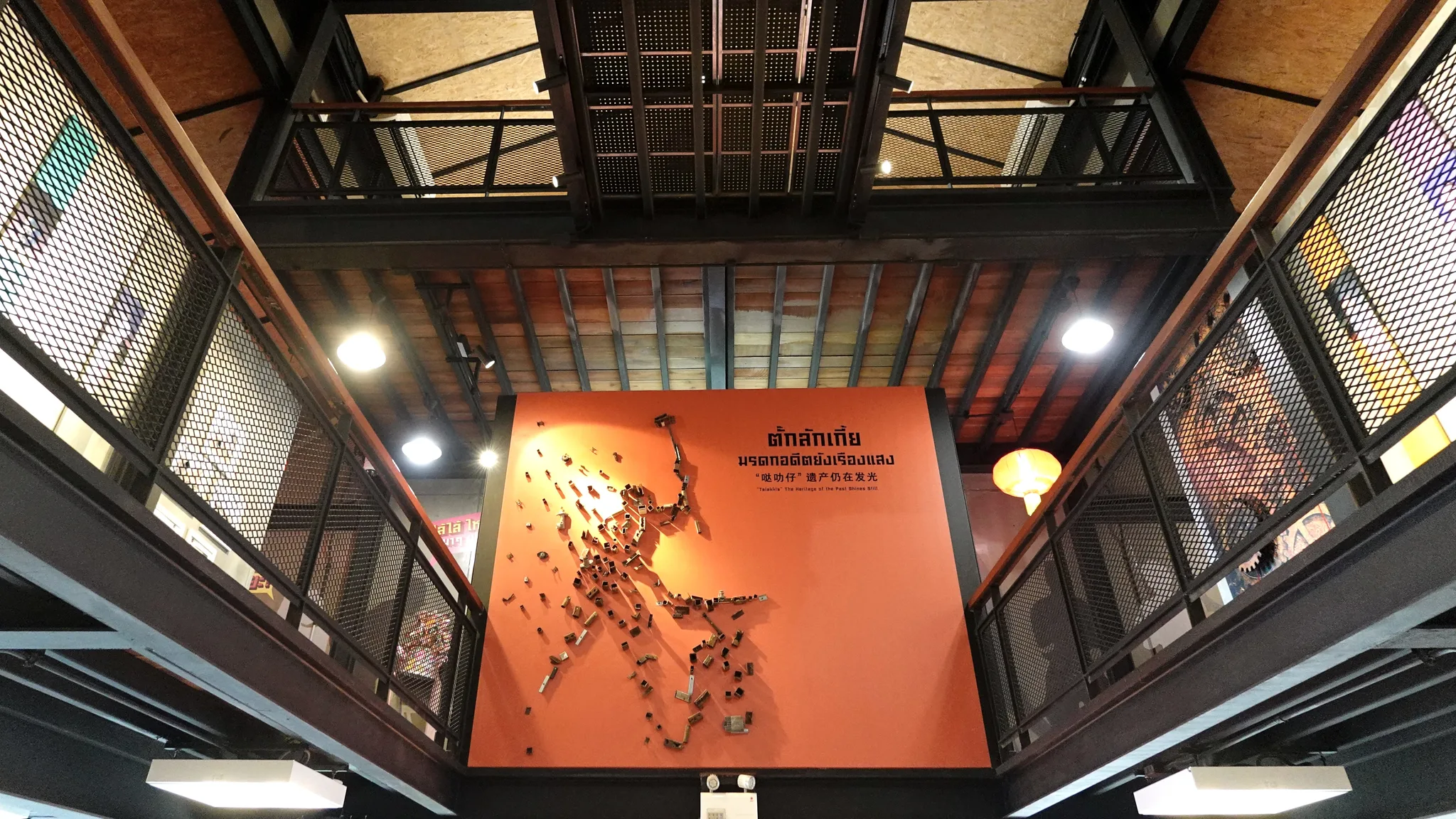
At Talad Noi Museum, the multi-level atrium combines a black metal structure, mesh railings and timber-plank ceilings. An orange panel titled in Thai, Chinese and English carries a composition of small metal pieces.© Eric Monteil
Architecture and decoration
Explore the heritage
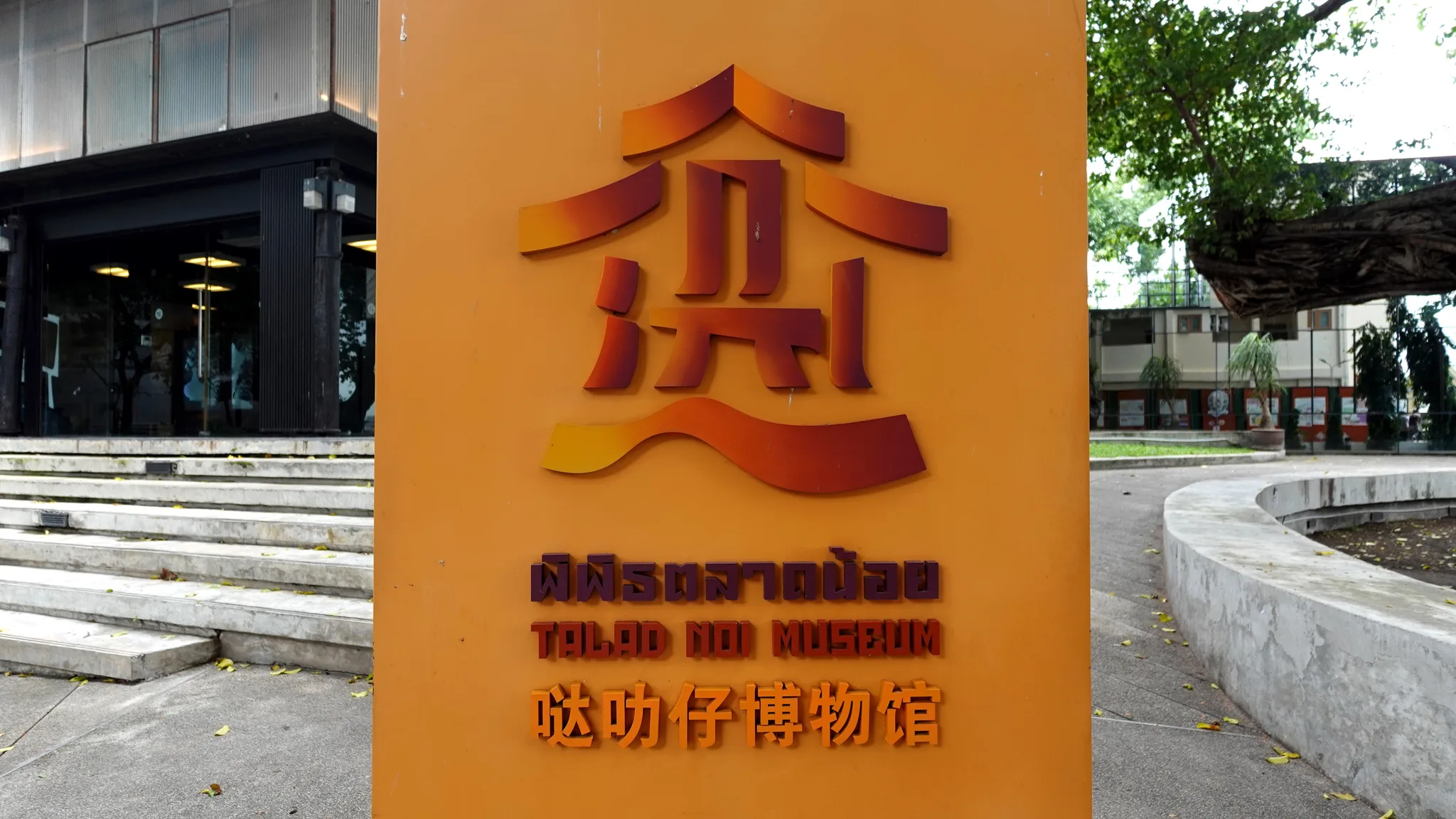
Entrance sign of the Talad Noi Museum: a relief logo sits above the museum’s name in Thai, English and Chinese. In the background are a glazed building, concrete steps and a curved bench around a tree.© Eric Monteil 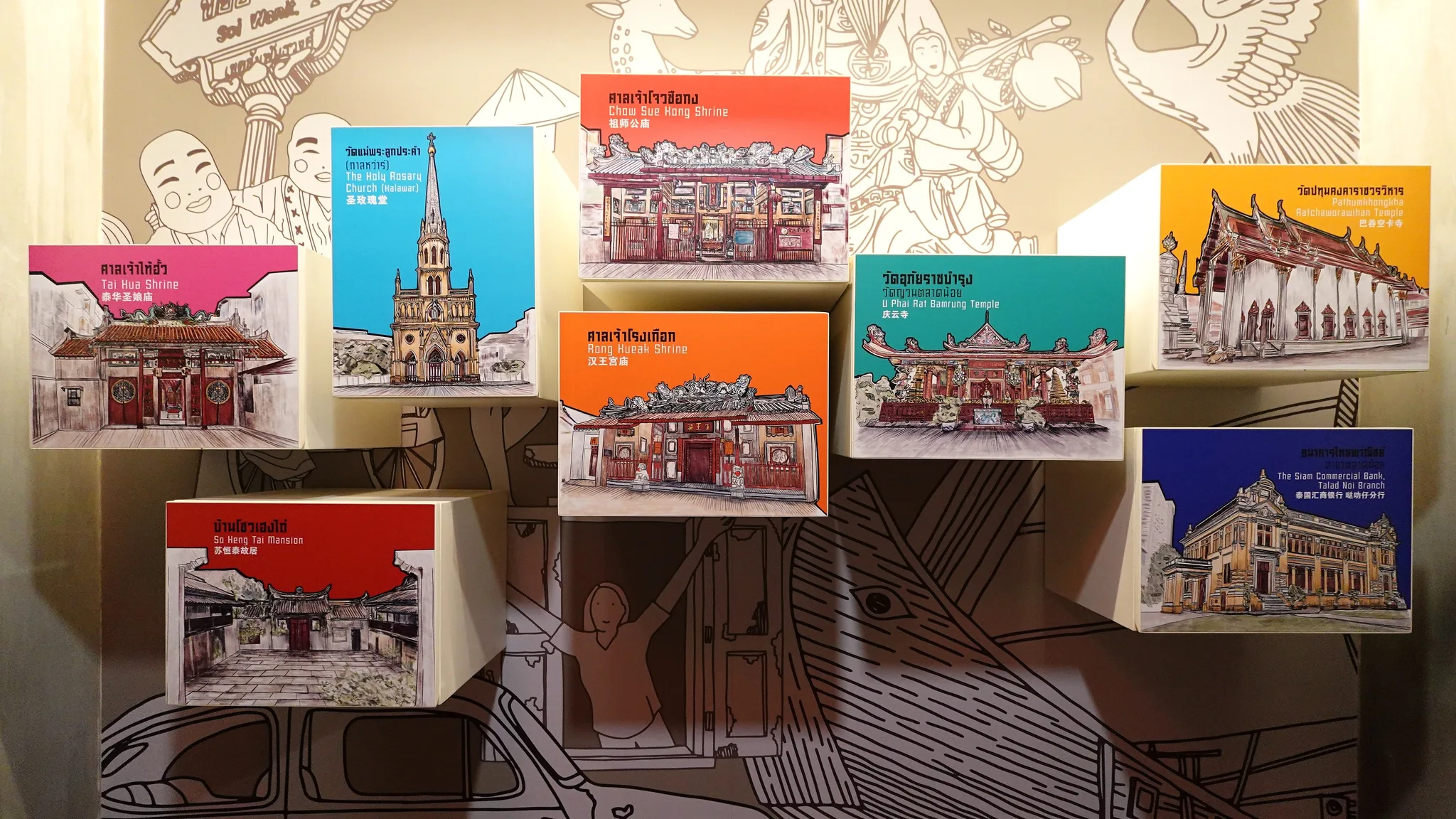
At the Talad Noi Museum, colourful illustrated blocks depict the neighbourhood’s buildings – Chinese shrines, Holy Rosary Church, temples, So Heng Tai Mansion, a bank – titled in Thai, English and Chinese, against a line-drawn mural.© Eric Monteil