
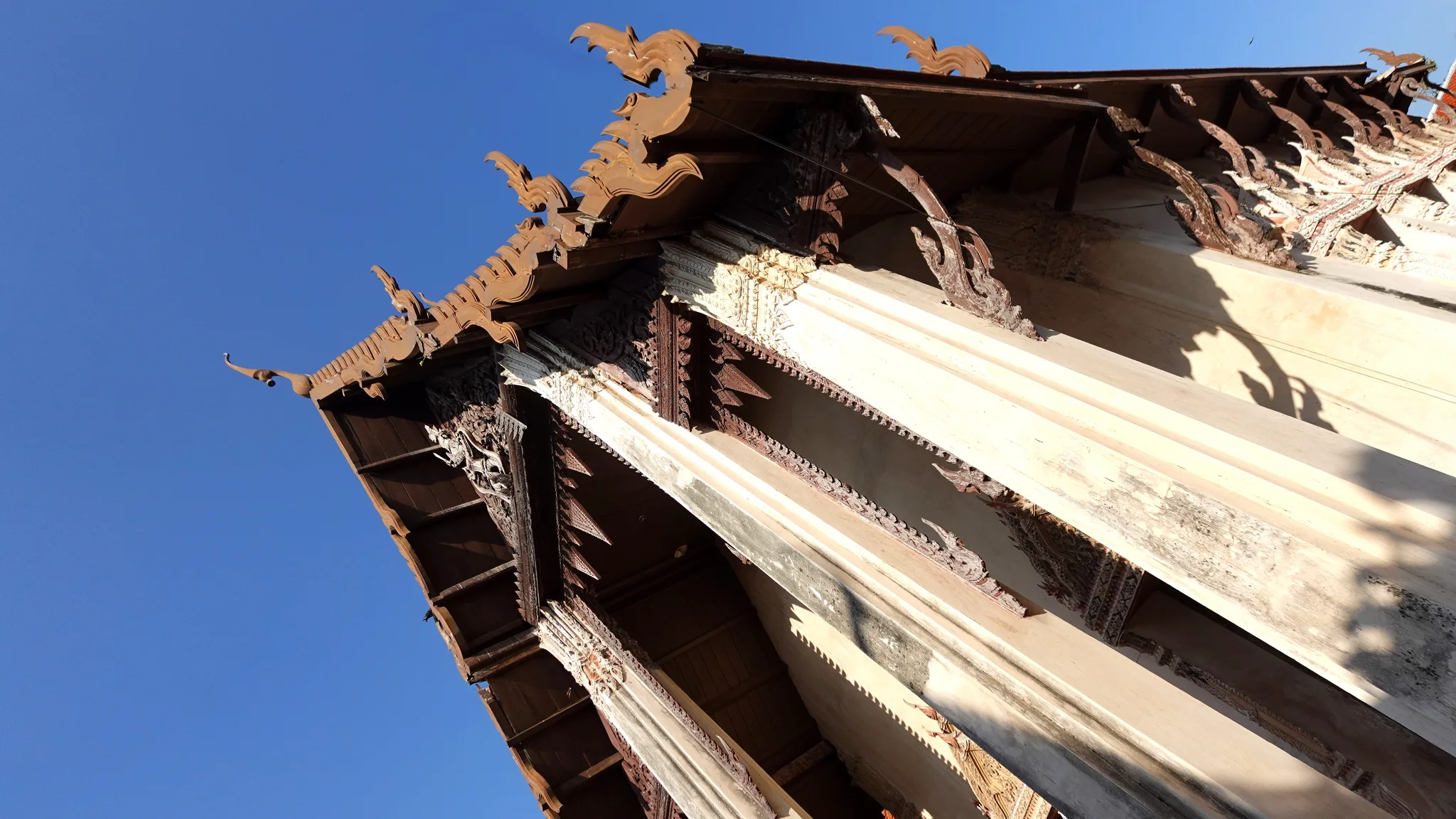
 At Wat Paket, a low-angle view shows the tiered roofs of a temple building, edged with wooden chofa and bai raka, and the carved brackets resting on tall, weathered white pillars.© Eric Monteil
Buddhist temple
Wat Paket
At the heart of Bang Krachao, a village monastery founded under Rama II preserves, in its old ubosot, the carved pediment and mural paintings of an art linked to the court of the early Rattanakosin period.
Heritage family · Buddhism, religions and spiritualities
- Destination
- Samut Prakan (Phra Pradaeng)
- Heritage Family
- Buddhism, religions and spiritualities
- Typology
- Buddhist temple
- Visit
- Available tours →
Wat Paket is a Theravāda Buddhist monastery in Bang Krachao, the great wooded meander of the Chao Phraya River facing Bangkok, in Samut Prakan province. Still an active village temple, it is associated with the movement to restore Buddhism led during the reign of Rama II, and local memory links it to one of the highest religious dignitaries of the capital. It owes its heritage value to its old ubosot, the hall in which ordinations take place, built at the beginning of the Rattanakosin period: a teak pediment depicting Narai on Garuda and mural paintings attributed to the court craftsmen.
Key facts
- Destination
- Phra Pradaeng
- Heritage Family
- Buddhism, religions and spiritualities
- Typology
- Buddhist temple
- Places
- Song Khanong
- Bang Krachao
- Periods
- People
- Rama II
- Rama III
- Somdet Phra Sangkharat Don
- Communities
- Ban Mai Song Khanong Community
- Events
- Construction of the old ubosot
- Construction of the new ubosot
- Foundation
- Heritage
- —
- Glossary
- Wat
- Tambon
- Bang
- Chao Phraya
- Phraya
- Soi
- Keywords
- —
- Date
- —
- Collections
- —
Practical info
Practical information about this site is taken from its Google Maps page. We advise you to check it before visiting.
- Address
- 24 หมู่ที่ 3, 16 Thanon Phetchahung, Tambon Song Khanong, Amphoe Phra Pradaeng, Chang Wat Samut Prakan 10130
A monastery of Bang Krachao
In the meander of the Chao Phraya
Wat Paket stands in the tambon of Song Khanong, in Phra Pradaeng district, on the land known sometimes as the peninsula, sometimes as the island, of Bang Krachao. This vast meander of the Chao Phraya, still largely green, lies on the bank opposite Bangkok. The monastery occupies a plot of just over a hectare, bordered by private land, on a soi, a service lane, which also bears the temple’s name and opens onto Thanon Phetchahung.3
The temple belongs to the Ban Mai Song Khanong community, which brings together two villages of the tambon. On the same soi lies Suan Pa Ket Nom Klao, a forest park owned by this community and reputed to be the first urban community forest in Thailand.1
Ta Ket’s road
The monastery was first called Wat Thanon Ket, ‘the temple of Ket’s road’. A local tradition explains this name through the figure of Ta Ket, ‘Grandfather Ket’, an inhabitant who is said to have been the first to dig or open the road leading to the temple. The name later became Wat Paket.2
This story belongs to the category of explanations that villagers give for their place names. It identifies the monastery by the path that led to it and by the man who had opened it.
From the founding to the ubosot
A temple of the Buddhist restoration
The founding of Wat Paket is linked to the reign of King Phra Phutthaloetla Naphalai, known as Rama II, the second sovereign of the Chakri dynasty, who reigned from 1809 to 1824. The temple is one of the creations of the movement to restore Buddhism that this king led throughout the kingdom. A village monastery opposite the capital thus forms part of a religious programme willed by royal power.2
Villagers place the founding around 1817, a date handed down by oral tradition. It is consistent with the reign of Rama II.1
Patriarch Don, builder or founder
Under the following reign, that of Rama III, the monastery received its ubosot. Its construction is attributed to Somdet Phra Sangkharat Don, the Supreme Patriarch, head of the kingdom’s monastic community, who resided at Wat Mahathat Yuwaratrangsarit in Bangkok. It is to this building that the temple owes most of its reputation as an old ensemble of the Rama III period.3
Local memory gives Patriarch Don a broader role still: tradition makes him the founder of the temple itself. The two versions agree on one point, the link between this village monastery and a very high religious dignitary of the capital; they differ on the nature of his involvement, the creation of the monastery or the construction of its ordination hall.1
Reading the old ubosot
A building of the early Rattanakosin period
The old ubosot belongs to early Rattanakosin art, named after the period that began with the founding of Bangkok as capital. On its front and rear façades stand large square pillars; their shafts taper towards the top, giving them a truncated-cone silhouette.3
The eye is then drawn to the pediment, the na ban, the triangular panel that closes the gable of the roof. It is of carved teak and, together with the interior paintings, ranks among the monument’s main points of interest.4
Narai on Garuda
The pediment depicts Narai, the Thai name for the god Vishnu, mounted on Garuda, the mythical bird that serves as his mount. The scene shows Garuda seizing nāga, the divine serpents of Indian mythology. Around the central group unfurl plant scrolls, coiled and leafy stems. The scene is also referred to as ‘Narai song Suban’, Suban being another name for Garuda.3
The carved pediment is among the features that make the old ubosot a witness to the art of the early Rattanakosin period.
The paintings of the royal craftsmen
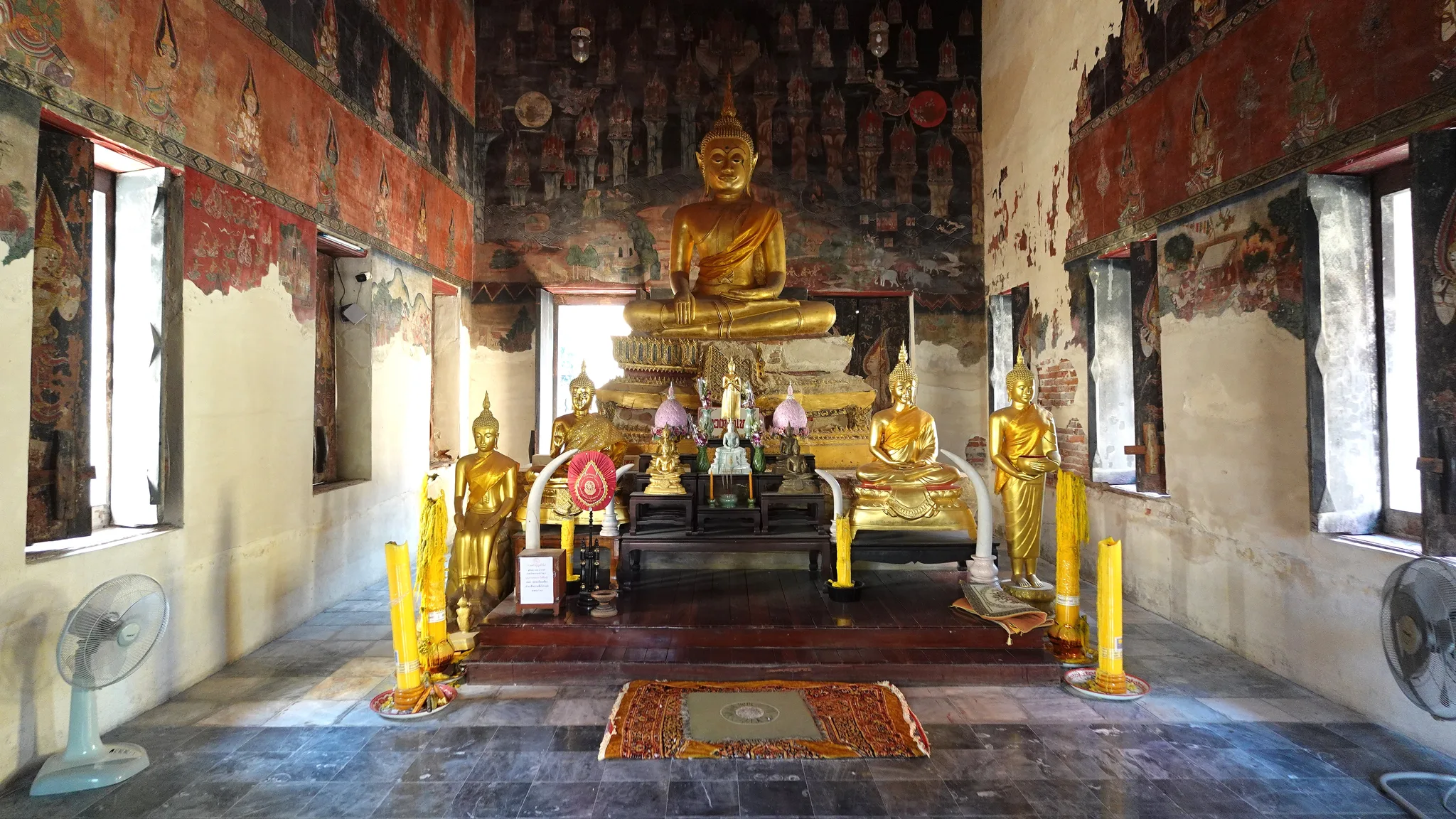
Inside, the walls are covered with paintings attributed to craftsmen of the Chang Sip Mu, the corps of the ‘ten crafts’ in the service of the court.3
The subjects belong to the great cycles of Thai Buddhist painting. They include the Victory over Māra, the moment when the future Buddha repels Māra, figure of temptation and death, on the night of his Awakening; the Buddha’s descent from the Tāvatiṃsa heaven, the paradise of the Thirty-Three gods; and the Thotsachat, the last ten previous lives of the Buddha, counted among the jātaka, the stories of his past existences. An assembly of deities, the thep chumnum, completes the ensemble. For lay worshippers and monks alike, these images tell the life of the Buddha and the virtues that his earlier existences exemplify.4
A transformed monastic complex
The new ubosot and the old one turned vihara
In 1970 a new ubosot was built, taking over the function of ordination hall. The old building was not abandoned: it has since served as a vihara, the hall that houses images of the Buddha and receives worshippers for prayer and ceremonies.
The new ubosot in turn houses a large principal Buddha statue. The two buildings, one old, the other from the second half of the 20th century, illustrate the temple’s two ages within the same precinct.
The setting of monastic life
Around the halls of worship lies the monastic space proper. The monks live in kuti, their dwellings, which here are traditional teak houses. The temple also has a recitation hall, the ho suat mon, in an old style and likewise decorated with mural paintings. The ho trai, the library in which the scriptures are kept, completes this group.
Other buildings serve the needs of the laity. The sala kan parian, the sermon hall built in 1982, receives worshippers who come to hear the monks’ teaching. The precinct also contains three rest pavilions, two funeral halls, a crematorium and a cemetery.
Luang Pho To, a venerated image
The temple also houses a vihara dedicated to Luang Pho To. The title Luang Pho, ‘venerable father’, is used in Thailand for a particularly revered statue of the Buddha, commonly referred to as an image. This one is a large Buddha in the posture of victory over Māra, seated, the right hand pointing towards the earth to call it to witness his Awakening.3
The villagers hold it in particular devotion.3
Wat Paket today
A stop in Bang Krachao
Wat Paket is an active temple, open to visitors every day. It is part of the Bang Krachao tourist circuit, where its interest lies in its early Rattanakosin art, its carved pediment and its paintings attributed to the royal craftsmen.3
Visitors entering the old ubosot, now a vihara, discover early Rattanakosin decoration attributed to the court craftsmen in a place that remains, above all, the monastery of a village community.
The ritual life of the community
The religious calendar continues to set the rhythm of temple life. In 2025 the monastery held a kathin samakkhi ceremony, the collective offering of robes to the monks at the end of the rains retreat, in which lay people take part together. This rite, like the funerals held within the precinct or the veneration of Luang Pho To, is a reminder that Wat Paket remains a place of practice for the people of Song Khanong.9
Understanding
Wat Paket is first and foremost the monastery of a community: here people are ordained, pray, listen to sermons, accompany the dead and venerate Luang Pho To. Yet its history rests on a link with the centre of the kingdom, since its founding is tied to Rama II’s religious programme and local memory associates its ubosot, or the entire temple, with Patriarch Don. The old ubosot, with its pediment of Narai on Garuda and its paintings attributed to the court craftsmen, is the material witness to that link. Today the temple stands in Bang Krachao, a meander that has stayed green opposite Bangkok, where the village community owns its own community forest. The temple thus welcomes both the village faithful and visitors on the Bang Krachao tourist circuit. What will Wat Paket be tomorrow: the religious heart of Song Khanong, or the heritage that the neighbouring metropolis comes to contemplate?
Bang Krachao, the "green lung" of Bangkok, between canals, Mon heritage, temples, biodiversity and sustainable initiatives.
- Wat
- Buddhist monastic complex that brings together, within a single enclosure, several religious buildings, monks’ quarters and ancillary buildings; the word does not refer to a single building.
- Tambon
- A Thai administrative subdivision grouping several villages, ranking below the district.
- Bang
- Thai word for a village or settlement established at the water’s edge, along a river or canal. It forms part of a great many place names in the central plain.
- Chao Phraya
- Highest title of the Siamese nobility, held by senior dignitaries of the court.
- Phraya
- Rank of the Siamese court nobility, immediately below that of chao phraya; it precedes the dignitary’s title name.
- Soi
- Thai word for a lane or side street branching off a main road; soi are often numbered after the main street from which they branch.
- Thanon
- Thai word meaning ‘street’ or ‘road’. Placed before a proper name, it forms the official name of a thoroughfare, often rendered in French as ‘rue’ and in English as ‘Road’.
- Ubosot
- Consecrated ordination hall of a wat: the ritually central building, marked out by sacred boundary stones, where monastic ordinations take place.
- Somdet
- A title conferred on monks of one of the highest ranks in the Thai monastic hierarchy.
- Supreme Patriarch
- Head of the Buddhist monastic community of Thailand, appointed by the king.
- Sangha
- The body of monks who reside in a monastery and live there according to religious discipline; in Buddhism it is called the sangha.
- Garuda
- Mythical bird from the Indian tradition, the mount of the god Vishnu. In Thailand, it is the emblem of the monarchy and of the State.
- Ordination
- Ceremony by which a layperson is admitted as a novice or as a monk into the Buddhist community.
- Viharn
- Assembly and devotional hall of a wat, used for ceremonies, teaching and the veneration of Buddha images; unlike the ubosot, it does not host monastic ordinations.
- Kuti
- Cell or dwelling of a Buddhist monk within the precinct of a monastery.
- Luang Pho
- Thai honorific title meaning 'venerable father', given both to respected monks and to the most highly revered images of the Buddha.
- Awakening
- In Buddhism, the state of understanding and clarity reached at the end of the spiritual path, which frees one from ignorance and suffering.
- Kathin
- Annual ceremony at which robes are offered to monks, after the rains retreat.
- Rattanakosin period
- Period of Thai history that began with the founding of Bangkok as the capital by King Rama I at the end of the eighteenth century. It takes its name from Rattanakosin Island, the heart of the royal city.
- Sala kan parian
- Pavilion of a Thai Buddhist monastery intended for the study of texts.
- Sala
- A pavilion for communal use, often open-sided, where people gather, rest or listen to sermons, particularly within monastery grounds.
- Narai
- Thai name of the Hindu god Vishnu, one of the major deities of Brahmanism, frequently depicted in Thai art riding Garuda.
- Narai song Suban
- Iconographic theme depicting Narai, that is Vishnu, riding Garuda, also called Suban; it often adorns the pediments of Thai religious buildings.
- Ho suat mon
- Chanting hall of a Thai monastery, where the monks gather for daily prayers and recitations.
- Ho trai
- Library of a Thai monastery, where the Buddhist scriptures are kept.
- Kathin samakkhi
- Kathin ceremony organised collectively by lay people, who jointly offer robes to the monks at the end of the rains retreat.
- Na ban
- Triangular pediment closing the roof gable of a Thai building, often of carved wood or stucco and decorated with religious or mythological motifs.
- Tāvatiṃsa
- Heaven of the Thirty-Three gods in Buddhist cosmology, presided over by Indra; the Buddha’s descent from this heaven is a common subject of Thai painting.
- Thotsachat
- The last ten previous lives of the Buddha before his final existence, told in the last ten jatakas and often painted in Thai temples.
- Jātaka
- Stories of the Buddha’s previous existences, during which he practises the virtues that lead to Awakening.
- Thep chumnum
- Assembly of the deities, a motif of Thai mural painting showing rows of celestial figures turned towards the Buddha.
Primary sources
- 1บ้านใหม่ทรงคนอง — วิกิชุมชน, ศูนย์มานุษยวิทยาสิรินธร (Sirindhorn Anthropology Centre) ↗
Reference works
- 2วัดป่าเกด, จังหวัดสมุทรปราการ (Samut Prakan Provincial Office) ↗
- 3เที่ยววัดป่าเกด พระประแดง ชมงานฝีมือช่างหลวง, ททท. ภูมิภาคภาคตะวันออก (Tourism Authority of Thailand, Eastern Region) — traveleastthailand.com ↗
- 4วัดป่าเกด — SMART DASTA, องค์การบริหารการพัฒนาพื้นที่พิเศษเพื่อการท่องเที่ยวอย่างยั่งยืน (DASTA) ↗
- 5สวนป่าเกดน้อมเกล้าฯ — SMART DASTA, องค์การบริหารการพัฒนาพื้นที่พิเศษเพื่อการท่องเที่ยวอย่างยั่งยืน (DASTA) ↗
- 6วัดป่าเกด, Wikipedia (thaï) ↗
- 7วัดป่าเกด, สมาคมการค้าพัฒนาการท่องเที่ยวจังหวัดสมุทรปราการ ↗
- 8วัดป่าเกด อำเภอพระประแดง จังหวัดสมุทรปราการ, temple.siamganesh.com ↗
- 9วัดป่าเกด — กฐินสามัคคี 68, DMC.tv, 2025 ↗
Contemporary views
Wat Paket today
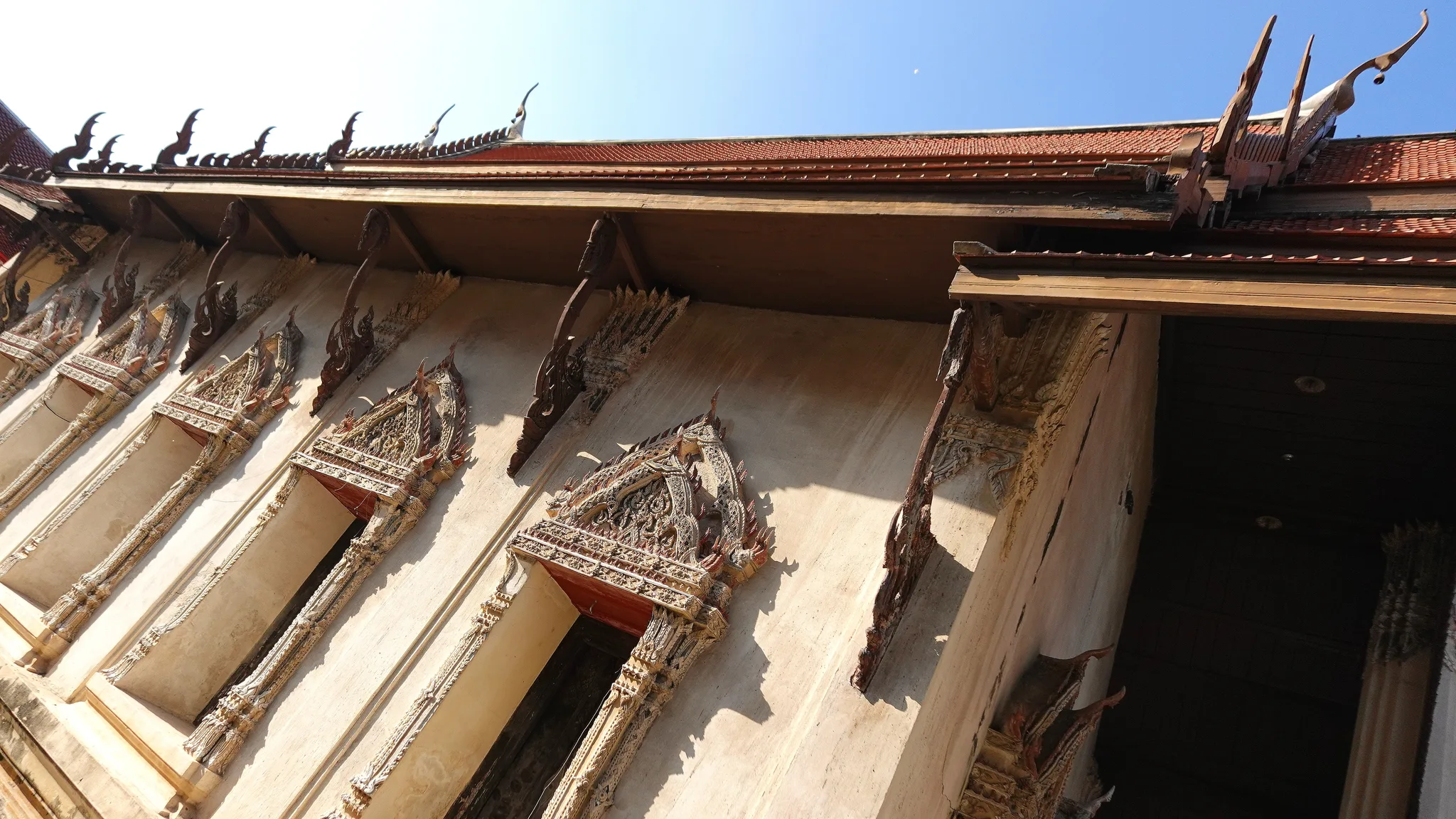
At Wat Paket, the side wall of the ubosot alternates windows crowned by ornate stucco pediments with carved wooden brackets supporting the eaves, beneath a red-tiled roof adorned with chofa and bai raka.© Eric Monteil 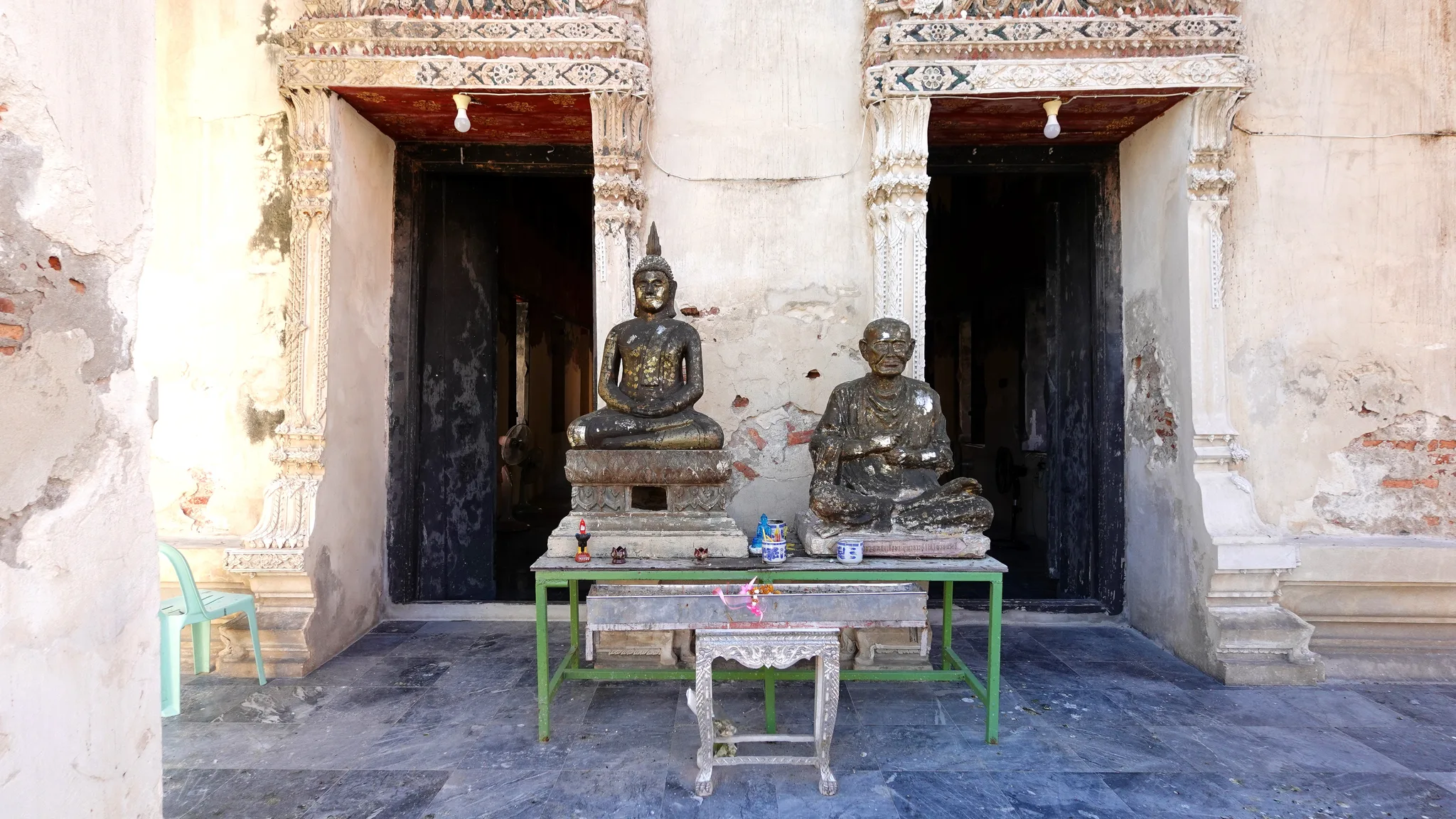
In front of the façade of Wat Paket, a seated Buddha and a statue of a monk rest on an offering table between two doorways with ornate stucco frames; the flaking render reveals the brickwork beneath.© Eric Monteil
Architecture and decoration
Explore the heritage
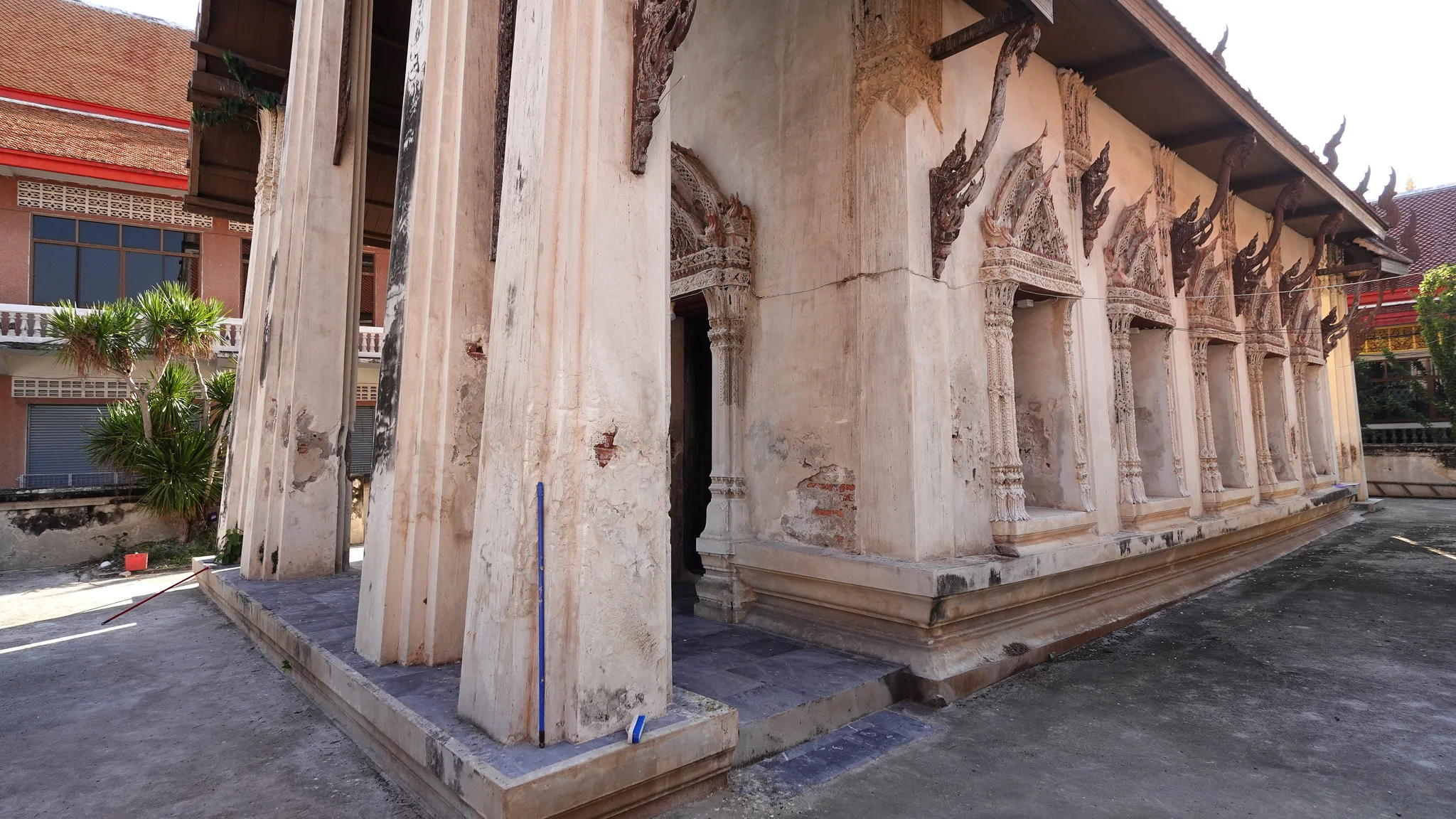
At Wat Paket, the side of a monastery building lines up windows framed by colonnettes and topped with carved pediments, beneath eaves supported by naga-shaped brackets; the flaking render reveals the brickwork.© Eric Monteil 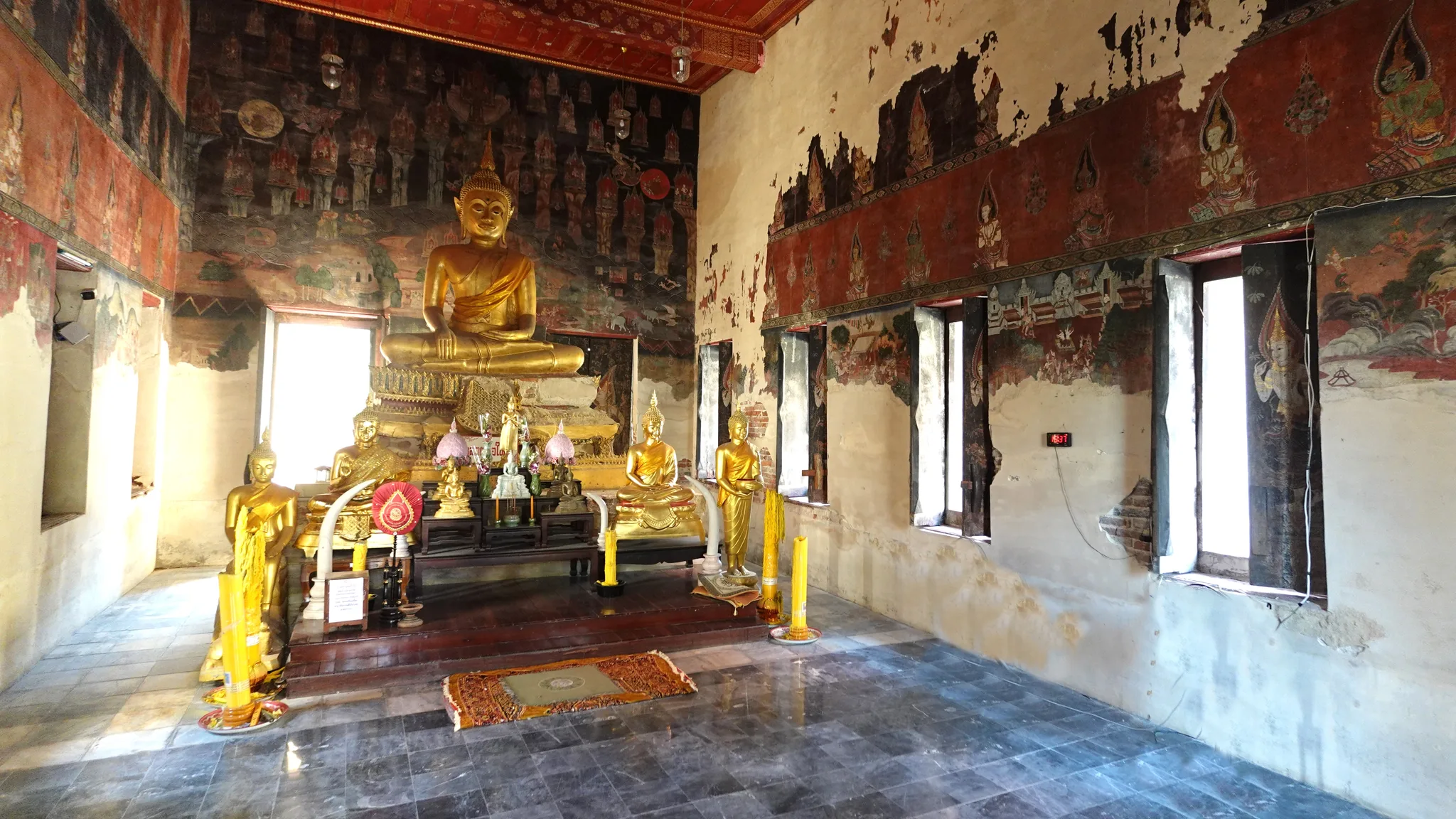
At Wat Paket, a large seated golden Buddha dominates the altar, flanked by standing and seated statues; the walls bear mural paintings of praying figures and scenes, partly flaking, above a floor of grey tiles.© Eric Monteil