
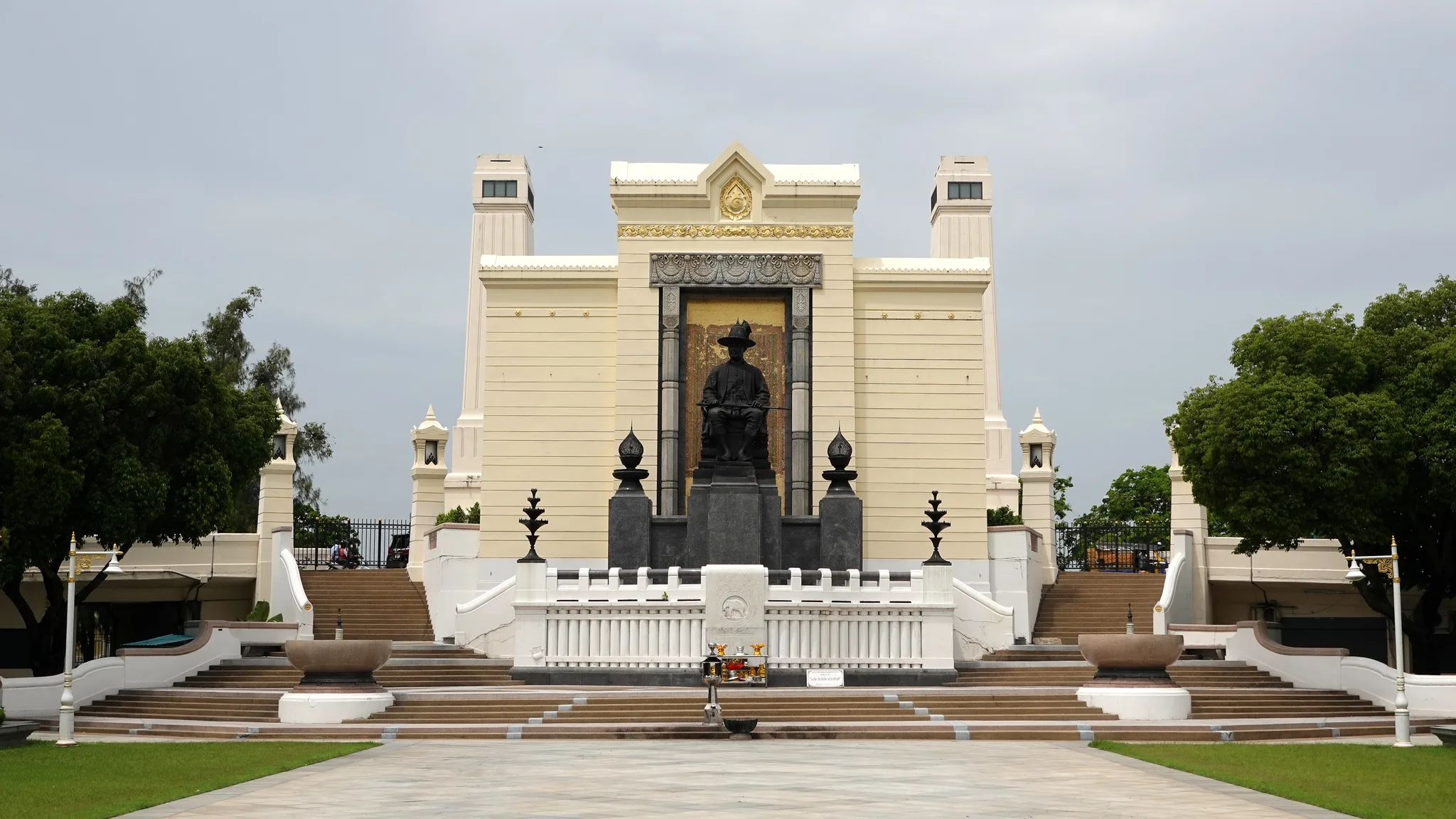
 The King Rama I Monument seen along the axis of its forecourt: the seated bronze statue stands out against a gilded backdrop, framed by a cream pavilion with towers, a white balustrade and two symmetrical flights of steps.© Eric Monteil
Commemorative monument
King Rama I Monument
At the foot of Memorial Bridge, the statue of the founder of the Chakri dynasty, conceived for Bangkok’s 150th anniversary, was unveiled by King Prajadhipok a few weeks before the end of absolute monarchy.
Heritage family · History, kingdoms and the making of Siam
- Destination
- Bangkok (Phra Nakhon)
- Heritage Family
- History, kingdoms and the making of Siam
- Typology
- Commemorative monument
- Visit
- Available tours →
The King Rama I Monument is the memorial raised in Bangkok to King Phra Phutthayotfa Chulalok, known as Rama I, founder of the Chakri dynasty, who established the capital there in 1782. Commissioned by King Prajadhipok for the city’s 150th anniversary, it was unveiled on 6 April 1932, a few weeks before the revolution that brought absolute monarchy to an end. Conceived as a single ensemble with the bridge it stands before, it presents the sovereign seated, in bronze, in a realistic Western-style portrait, against a marble wall with decoration of Thai and Khmer inspiration.13
Key facts
- Destination
- Phra Nakhon
- Heritage Family
- History, kingdoms and the making of Siam
- Typology
- Commemorative monument
- Places
- Chao Phraya River
- Memorial Bridge
- Periods
- People
- Prince Naris
- Rama Ier
- Prajadhipok (Rama VII)
- Silpa Bhirasri
- Communities
- —
- Events
- Founding of Bangkok (1782)
- Inauguration of the King Rama I Monument and Memorial Bridge (1932)
- Siamese revolution of 1932
- Heritage
- —
- Glossary
- Wat
- Soi
- Amulet
- Unalom
- Chakri Day
- Keywords
- —
- Date
- —
- Collections
- —
Practical info
Practical information about this site is taken from its Google Maps page. We advise you to check it before visiting.
- Address
- PFRX+767, Thanon Prajadhipok, Khwaeng Wang Burapha Phirom, Khet Phra Nakhon, Krung Thep Maha Nakhon 10200
The memorial to the first Chakri king
Honouring the founder of the capital
King Phra Phutthayotfa Chulalok holds a place apart in the country’s history: the first sovereign of the Chakri dynasty, he is also the one who, in 1782, moved the seat of the kingdom to Bangkok. The city he then founded bears the name Rattanakosin, and it was the anniversary of this foundation that the monument was meant to celebrate. To pay tribute to this king was therefore to pay tribute at once to a lineage and to a capital whose destinies had been bound together at the same moment.1
The monument pairs this founding figure with a bronze statue set at the entrance to a bridge spanning the Chao Phraya River. The eighteenth-century sovereign is thus associated with a twentieth-century piece of infrastructure, on the occasion of the 150th anniversary of the foundation.8
A name shared with the bridge
In Thai, the ensemble is commonly known as Pathom Borommarachanuson. A fuller name, Phra Borommarachanusawari Phra Bat Somdet Phra Phutthayotfa Chulalok, explicitly names the king being honoured. The name Pathom Borommarachanuson does not apply to the statue alone: it is also the official name of the bridge, which local people tend to call Saphan Phra Phutthayotfa, or more simply Saphan Phut, and which is known internationally as Memorial Bridge.12
This shared name is no accident of vocabulary. It reflects the very conception of the project, conceived from the outset as a whole in which the statue and the bridge together form a single memorial. To understand the King Rama I Monument, one must therefore always bear in mind the bridge that soars behind it.8
In line with the old city
The monument stands at the foot of Memorial Bridge, on the Bangkok bank, facing Thonburi on the opposite shore. It was placed in line with Tri Phet Road, between Wat Ratchaburana and Suankularb Wittayalai School. The statue looks towards Tri Phet Road and the city, with its back to the bridge.8
A project for the 150th anniversary
King Prajadhipok’s wish
The initiative came from King Prajadhipok, the seventh sovereign of the dynasty, known as Rama VII. As 1932 and the 150th anniversary of Rattanakosin approached, he wished to raise a lasting memorial to the first king. Rather than confine himself to a statue, he decided to build a bridge over the Chao Phraya River at the same time, uniting in a single gesture dynastic homage and the equipping of the capital.8
Responsibility for the works was from then on shared among several people. The bridge was entrusted to Prince Kamphaengphet Akkharayothin, charged with seeing the structure through to completion, its construction being carried out by the British firm Dorman Long. The statue and its setting fell to another team, gathered around a prince of the court and a sculptor.14
Prince Naris, designer of the ensemble
Prince Naris, whose full name was Narisara Nuwattiwong, was charged with designing the statue. A member of the royal family, he was then vice-president of the Ratchabandittayasapha, the Royal Institute, and headed its fine arts section. It was he who determined the design of the monument and then directed its execution.10
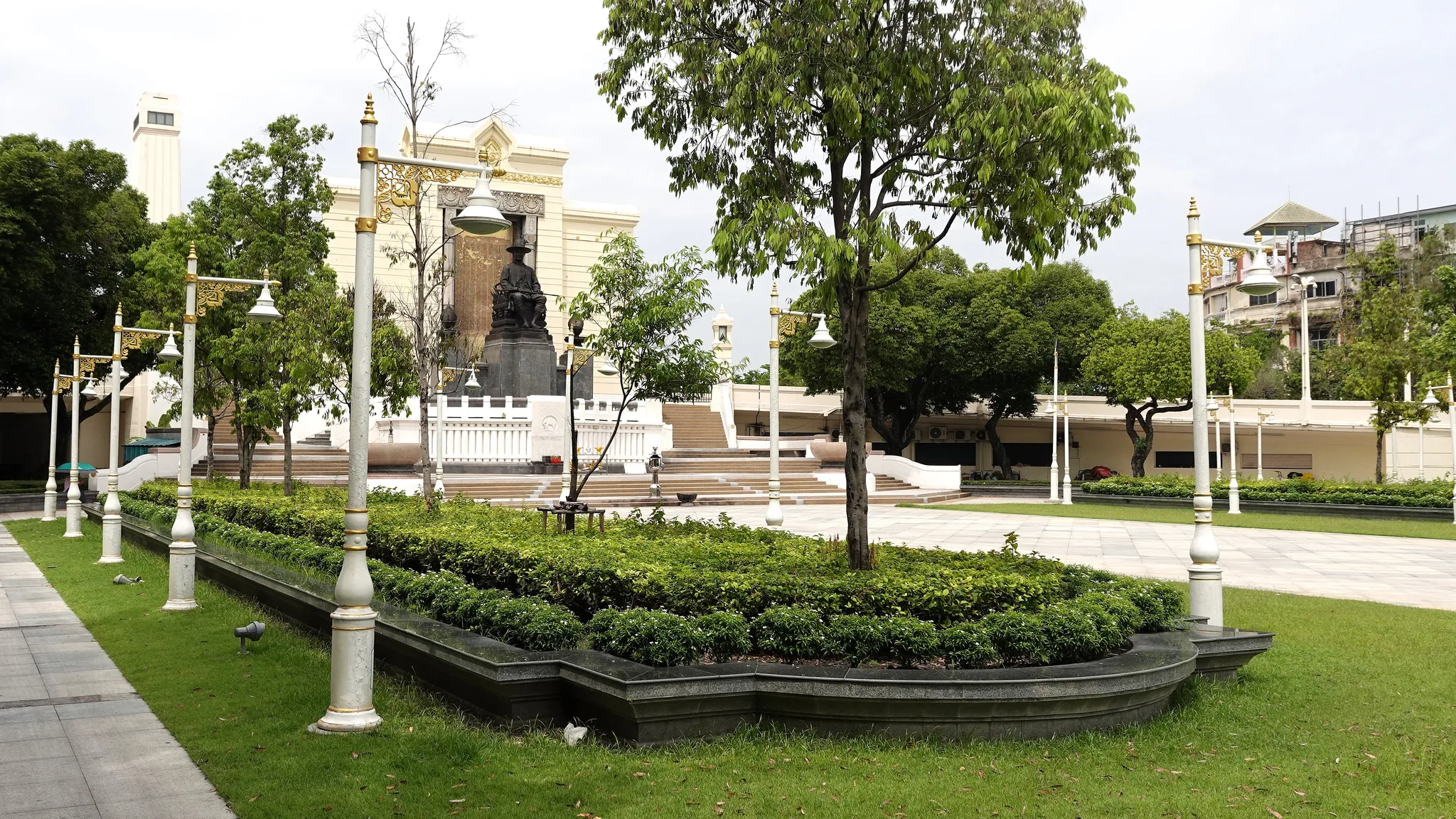
His conception went beyond the effigy alone. Prince Naris wished to set the statue in an open and dignified place, large enough to host a major ceremony of homage every year: the esplanade stretching out in front of the monument answers this brief. The memorial was thus conceived as much to be seen as to bring people together, as the setting for a civic and royal rite. The historian Nidhi Eoseewong counts the monument among the prince’s most important works.2
Corrado Feroci and the portrait of the king
King Prajadhipok first approved a sketch showing the sovereign seated. He then entrusted the modelling and the supervision of the casting to Corrado Feroci (1892–1962), a sculptor who had entered the service of the Siamese government in 1924 and was then working at the Silpakorn Sathan, the state art workshop. It was his first major commission in Siam. Feroci, later known by the Thai name Silpa Bhirasri, would become one of the great figures of art education in the country and would found Silpakorn University.3
Feroci first produced a plaster model. The account of his founder and assistant, Suk Yu-man, sheds light on how the portrait was built up: according to this testimony, the sculptor had previously fashioned a life-size model, whose face is said to have been cast from the royal effigy kept in the Ho Phra Bidon, and whose body is said to have been modelled on a man of powerful build. This account belongs to the realm of workshop recollection.3
Herein lies the novelty of the work. Its realistic approach, in the Western tradition, breaks with the idealisation that had until then governed the depiction of sacred and royal figures. The original model of the statue still exists: it is displayed in the sculpture prototype hall of the Fine Arts Department, housed in the former foundry, where it bears witness to the intermediate stage between the drawing approved by the king and the finished bronze.2
Reading the monument
The seated king, sword across his knees
The bronze statue stands some 4.60 metres high from base to top, and measures 2.30 metres wide at the base. The king is seated on a throne, dressed in full royal regalia. Both his hands rest on a sword laid across his knees.12
The seated pose, approved from the sketch stage, lends the portrait a calm gravity. The realism of the face and body, sought by Feroci, gives this image of authority a human presence that traditional representations did not aim for.
The marble wall and its surroundings
Behind the statue rises a marble wall hollowed by a deep, door-shaped niche against which the figure of the king stands out. The wall is flanked by two carved columns. Its pediment bears stucco garland decoration, surmounted by an unalom. An engraved marble plaque recounts the history of the monument’s construction.8
Around it, the life of the place can be read in its details. Offerings are laid at the foot of the statue, among lotus-shaped floral arrangements, and a fountain stands on either side. In front of the monument opens the broad esplanade sought by Prince Naris: it is this that makes the memorial a place of gathering and not merely an object to be glanced at in passing.8
A style between tradition and modernity
The monument belongs to a historicism that blends Thai and Khmer forms. This choice is in keeping with the Art Deco pylons of Memorial Bridge, so that the statue, its wall and the bridge answer one another rather than clash.2
This dialogue lies at the heart of the ensemble’s meaning. The realistic Western-style portrait, the decoration of Thai and Khmer inspiration and the Art Deco pylons of the bridge form a single whole.
1932, on the threshold of another era
The Chakri Day inauguration
The monument and the bridge were inaugurated on 6 April 1932 by King Prajadhipok. The date was not chosen at random: 6 April is Chakri Day, devoted to the memory of the dynasty founded by King Phra Phutthayotfa Chulalok. The programme of the ceremony, which began at 8.15 a.m., combined modern technology and royal ritual. The king operated an electric switch using a silver hammer presented by Dorman Long, then unveiled the statue.11
A photograph of the ceremony shows the sovereign sprinkling the statue with lustral water and anointing it. On the same morning, then, the king opened a bridge by means of an electric circuit and consecrated the image of his ancestor with ancient rites, and this juxtaposition sums up the ambition of the whole project.4
The last monument of absolute monarchy
A few weeks later, on 24 June 1932, a revolution brought absolute monarchy in Siam to an end. The monument thus turns out to be one of the last major commissions of a regime on the verge of disappearing, and the way it is read bears the lasting mark of this.13
The art historian Chatri Prakitnonthakan sees it as the last monument of absolute monarchy. He points out that, according to sources he considers reliable, King Prajadhipok intended to grant a constitution on 5 April 1932, on the very eve of the inauguration.4
Nidhi Eoseewong offers a related reading, though different in emphasis. He sees in the monument the expression of the monarchy’s restraint in its final years.5
The monument in today’s city
At the approach to a bridge still in service
The monument remains in its original position, at the foot of Memorial Bridge, which is still open to traffic. Since 2002, the bridge has come under the Department of Rural Roads. The ensemble inaugurated in 1932 has thus come through nearly a century without losing its original function: linking the two banks of the Chao Phraya River in the heart of the capital.14
Bangkok’s growth has, however, profoundly altered its surroundings. In 1983, the small Wongwian Lek roundabout on the Thonburi bank was removed. The following year, in 1984, the Phra Pok Klao Bridge opened alongside Memorial Bridge to relieve its traffic. The memorial of the 150th anniversary, still facing the old city, now stands within a busier traffic junction.15
A place of homage in a lively neighbourhood
Designed to host an annual ceremony of homage, the monument remains a place of devotion: the offerings and floral arrangements laid at its foot are a reminder that the statue is not merely a work of art but the image of a royal ancestor who is honoured. The esplanade sought by Prince Naris thus retains the purpose he gave it.2
Around it stretches the Saphan Phut neighbourhood, which takes its name from the bridge, with amulet markets set up near the structure. The Memorial Bridge pier, served by the Chao Phraya Express Boats, allows visitors to reach the site by water. The monument thus lives amid the daily exchanges of the city it commemorates, between traffic, trade and piety.13
Understanding
The King Rama I Monument is not merely a statue: it is a memorial conceived together with the bridge it stands before, in line with a street of the old city, to honour both the first Chakri king and the capital he founded. It brings together a realistic Western-style portrait, decoration drawn from Thai and Khmer traditions and an esplanade designed for collective homage. Inaugurated by King Prajadhipok on Chakri Day, it became, through the force of events, one of the last monumental gestures of absolute monarchy. Nearly a century later, it remains in place, surrounded by offerings, amid a traffic junction that the city has made ever busier around it and a neighbourhood alive with markets. Historians read in it, by turns, the end of a regime and the restraint of the monarchy. What does it mean, for the generations who cross Memorial Bridge every day, that a monument born to celebrate a foundation has become the witness to a rupture?
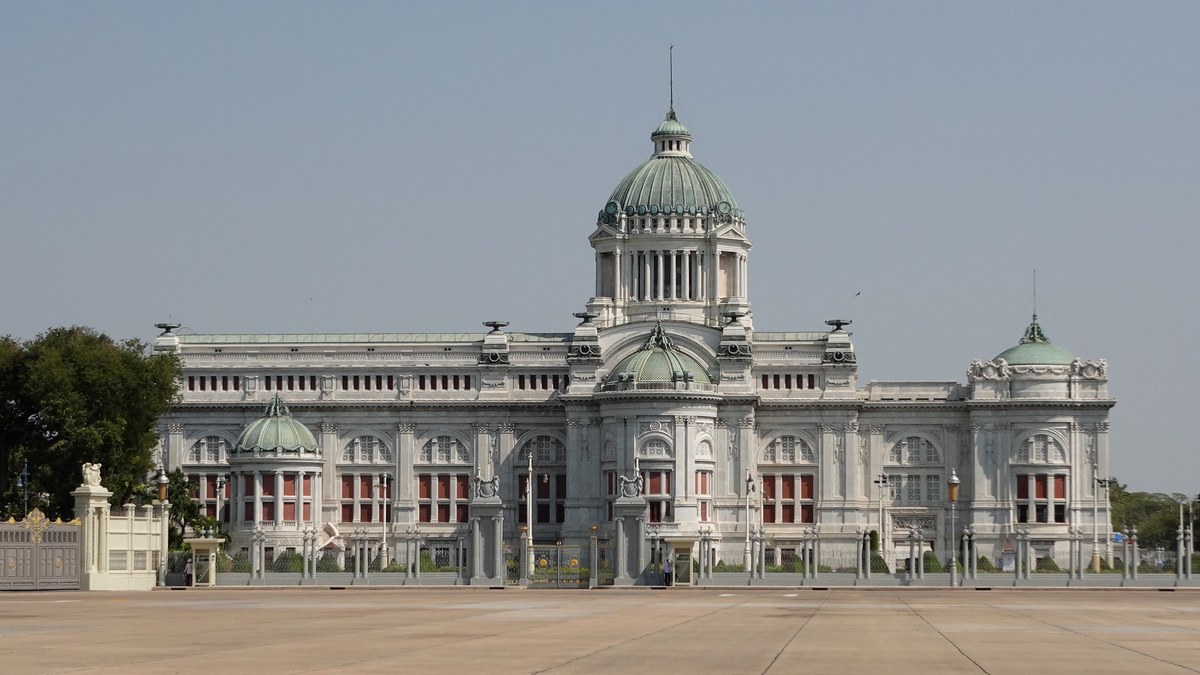
Rattanakosin, from the royal citadel of 1782 to the historic districts that shaped contemporary Bangkok.
- Wat
- Buddhist monastic complex that brings together, within a single enclosure, several religious buildings, monks’ quarters and ancillary buildings; the word does not refer to a single building.
- Soi
- Thai word for a lane or side street branching off a main road; soi are often numbered after the main street from which they branch.
- Amulet
- A small object worn or kept for its protective value.
- Unalom
- A spiral motif from the Buddhist tradition representing spiritual ascent towards Awakening; in Thai art, it often crowns decorative schemes and emblems associated with the monarchy.
- Chakri Day
- A Thai commemorative day held on 6 April, dedicated to the memory of the Chakri dynasty and its founder, King Rama I.
Studies
- 1Under the bridge, Bangkok Post, 2015 ↗
- 2ปฐมบรมราชานุสรณ์ ราชอนุสาวรีย์รัชกาลที่ 1, Bibliothèque de l'Université Sukhothai Thammathirat (STOU), 2024 ↗
- 3ศิลป์ พีระศรี กับงานเฉลิมพระนคร 150 ปี, Bibliothèque de l'Université Sukhothai Thammathirat (STOU), 2023 ↗
- 4Propos de Chatri Prakitnonthakan, ปฐมบรมราชานุสรณ์ อนุสาวรีย์สุดท้ายในระบอบสมบูรณาญาสิทธิราชย์, Silpa Wattanatham (silpa-mag.com) ↗
- 5Propos de Nidhi Eoseewong, พระบรมราชานุสาวรีย์รัชกาลที่ 1 ที่ "สะพานพุทธ", Silpa Wattanatham (silpa-mag.com) ↗
- 6Silpa Bhirasri, Thai Buddhist Art (Architecture) – Thai Culture series (notice biographique), Fine Arts Department, 2020 ↗
- 7"ศิลป์ พีระศรี" ผู้อยู่เบื้องหลังงานสร้างอนุสาวรีย์สำคัญของไทย, Thai PBS ↗
Reference works
- 8The King Rama I Monument, Tourism Authority of Thailand ↗
- 9พระปฐมบรมราชานุสรณ์เฉลิมพระเกียรติ (สะพานพุทธยอดฟ้าจุฬาโลกมหาราช), Bibliothèque de l'Université Silpakorn – ressources Rattanakosin ↗
- 109 มกราคม พ.ศ. 2472 พระบาทสมเด็จพระปกเกล้าเจ้าอยู่หัวเสด็จพระราชดำเนินวางศิลาฤกษ์สร้างปฐมบรมราชานุสรณ์, Office des arts et de la culture, Université Rajabhat Suan Sunandha ↗
- 11การเฉลิมพระนคร ๑๕๐ ปี – พระปฐมบรมราชานุสรณ์, Musée virtuel de l'Institut du roi Prajadhipok (KPI) ↗
- 12ปฐมบรมราชานุสรณ์, Wikipédia en thaï ↗
- 13Memorial Bridge (Bangkok), Wikipedia ↗
- 14สะพานพระพุทธยอดฟ้า, Wikipédia en thaï ↗
- 15Wongwian Yai, Wikipedia ↗
- 16List of crossings of the Chao Phraya River, Wikipedia ↗
- 17พิพิธภัณฑสถานแห่งชาติ ศิลป์ พีระศรี อนุสรณ์ – เกี่ยวกับเรา, Fine Arts Department – musée virtuel ↗
Contemporary views
King Rama I Monument today
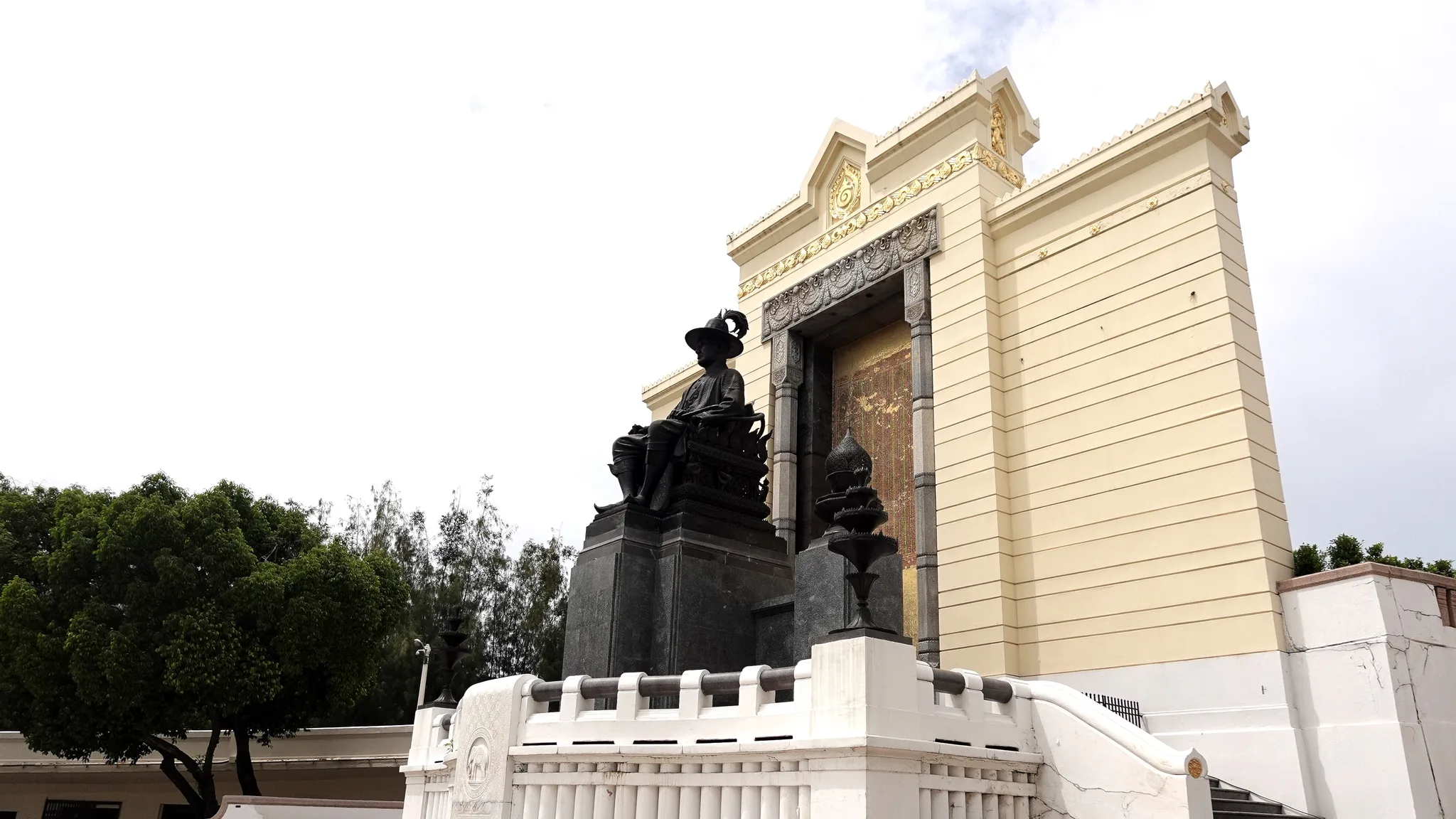
At the King Rama I Monument, the dark statue of the seated sovereign on his throne rises on a tall plinth before a cream portico with gilded decoration, above a white balustrade flanked by a lotus-bud ornament.© Eric Monteil 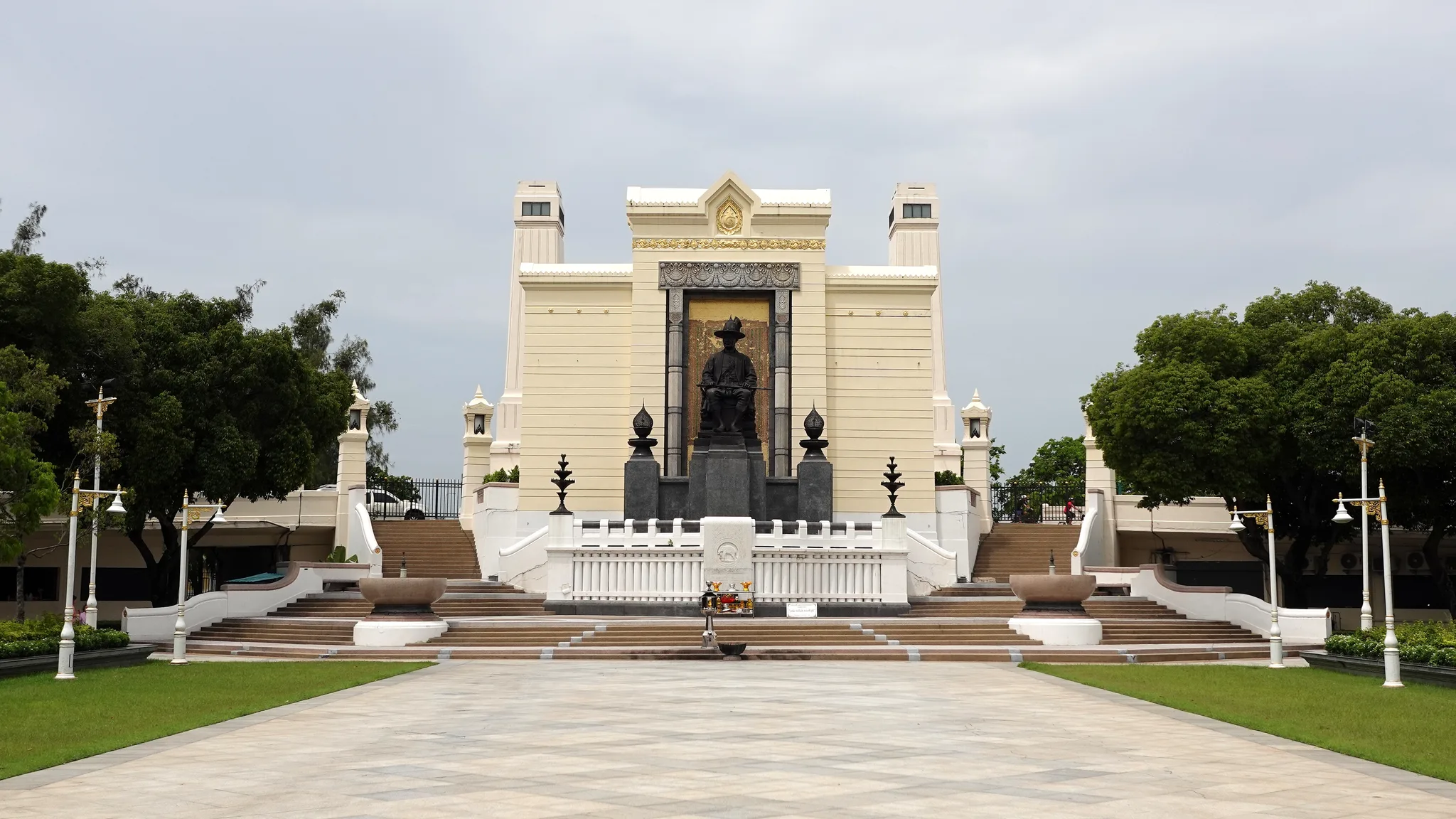
The King Rama I Monument seen along the axis of its forecourt: the seated statue, on a tall dark plinth, stands out against a gilded backdrop framed by columns, between two pale towers, above stairs and a white balustrade.© Eric Monteil
Architecture and decoration
Explore the heritage
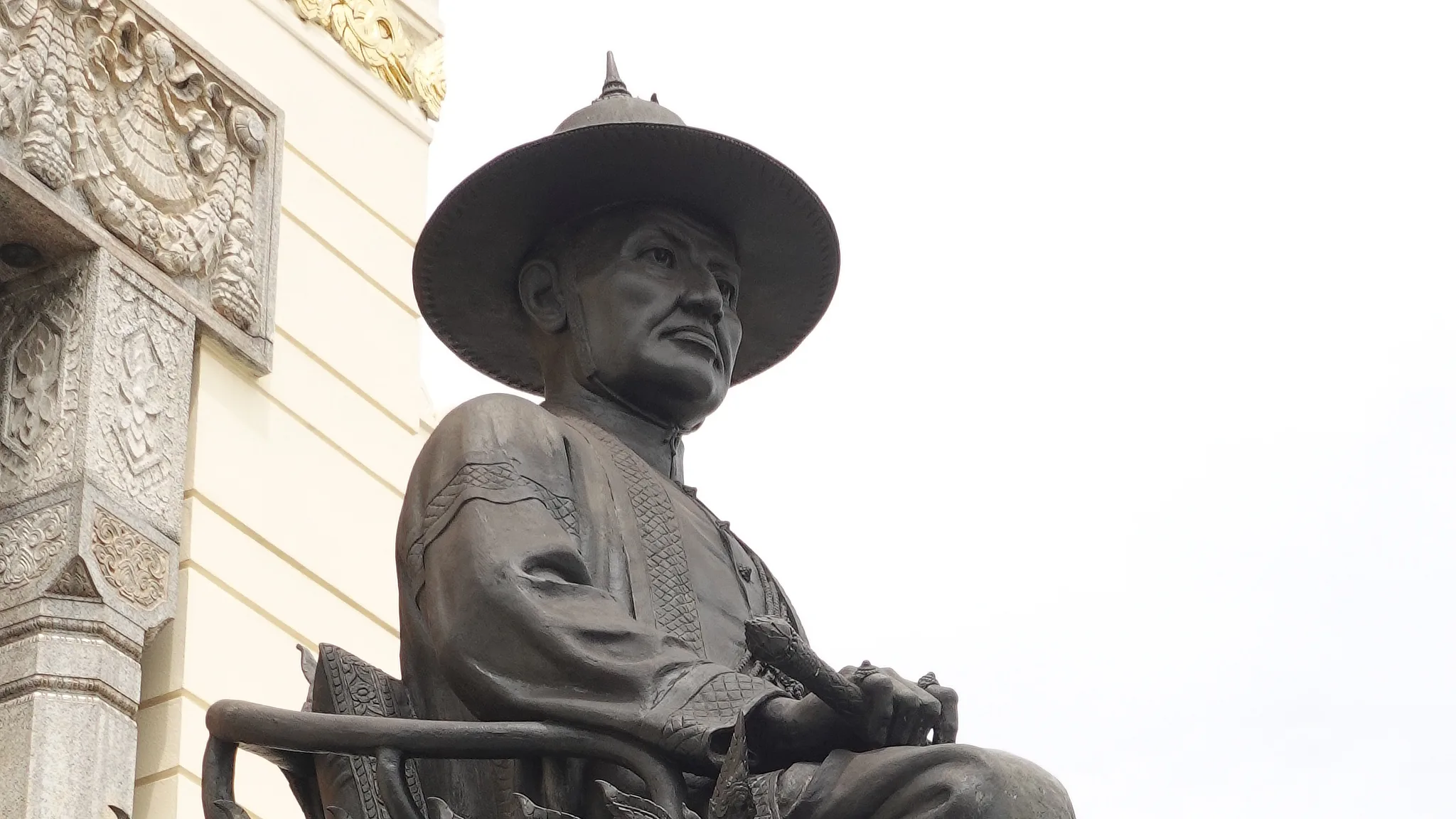
At the King Rama I Monument, the seated bronze statue wears a broad-brimmed hat topped with a point and a garment decorated with patterns; it holds a sword. On the left, a stone pillar carved with floral motifs.© Eric Monteil 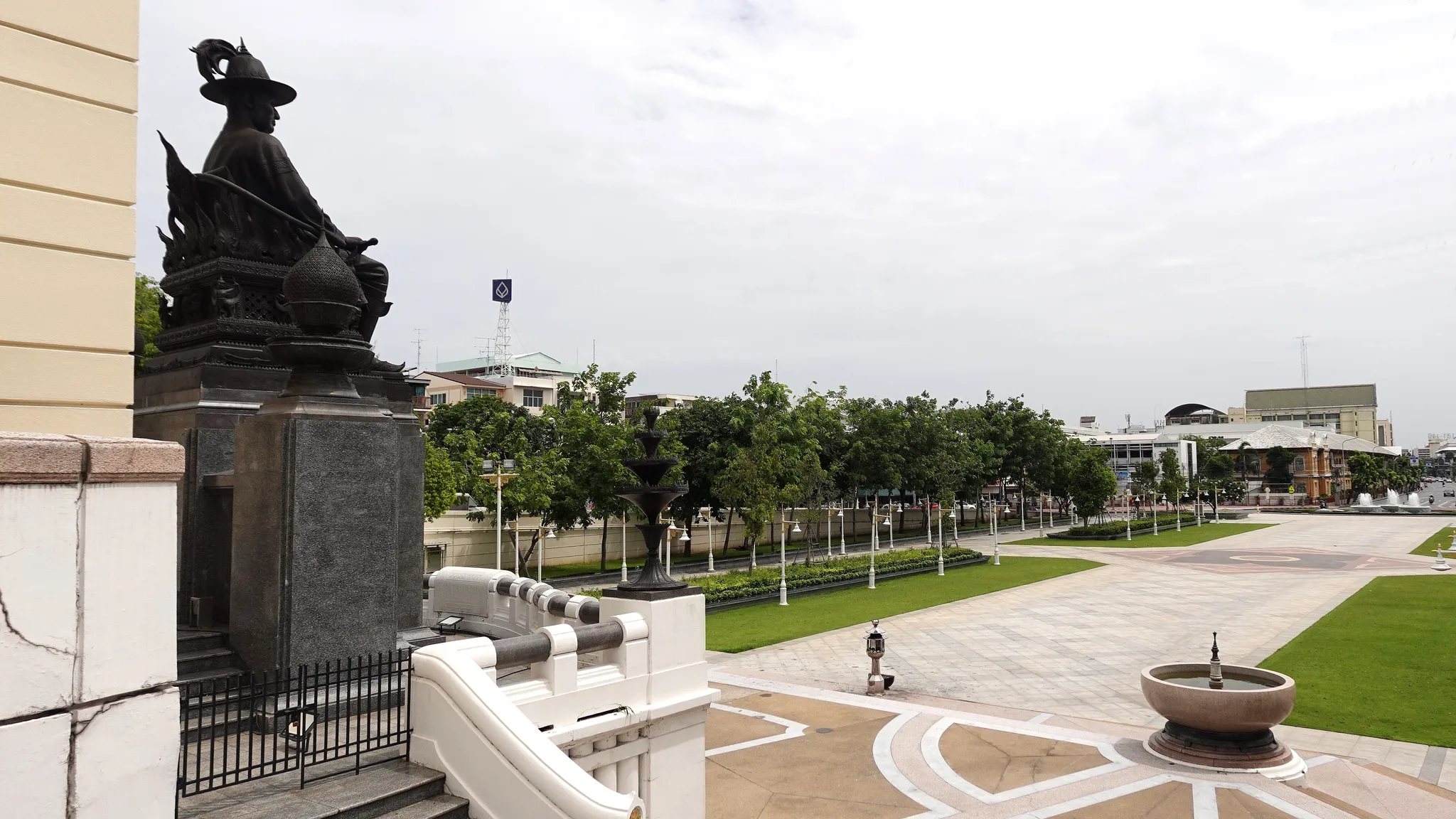
At the King Rama I Monument, the seated bronze statue rises above a white balustrade and a pillar topped with an ornament; below lie a patterned paved esplanade, lawns, a basin and tree-lined paths.© Eric Monteil