
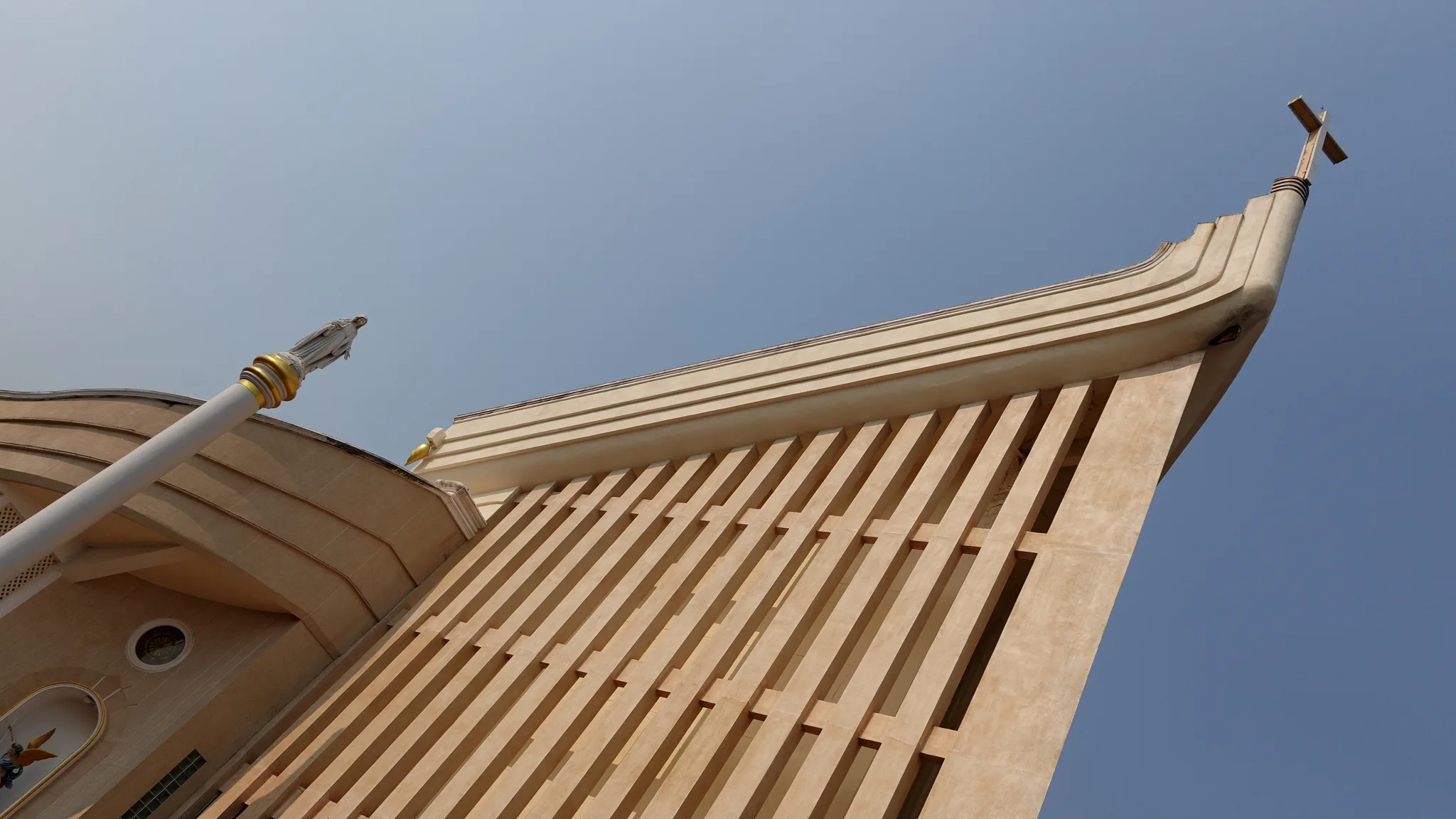
 Façade of St Michael the Archangel Cathedral in the Tha Rae Catholic Village, seen from a low angle: a lattice of slanting beige slats rises towards a tapering roof crowned with a cross. On the left, a column bears a white statue.© Eric Monteil
Community place
Tha Rae Catholic Village
Founded in 1884 by families from the far shore of Nong Han Lake, Tha Rae has become the seat of an archdiocese and the largest Catholic community in Thailand, renowned for its Christmas star procession.
Heritage family · Peoples, communities and cultural diversity
- Destination
- Sakon Nakhon (Mueang Sakon Nakhon)
- Heritage Family
- Peoples, communities and cultural diversity
- Typology
- Community place
- Visit
- Available tours →
Tha Rae Catholic Village, on the northern shore of Nong Han Lake in Sakon Nakhon Province, is home to the largest Catholic community in Thailand. Born in 1884, when a few Christian families led by a French missionary crossed the lake, the village gave its name to the Archdiocese of Thare and Nonseng, whose seat it houses. Its history tells of the Catholic mission in Isan, the arrival of peoples from Indochina and the forming of a close-knit community around its parish. Indochinese-inspired houses, a boat-shaped cathedral and the Christmas star procession make it today one of the most distinctive faces of north-eastern Thailand.14
Key facts
- Destination
- Mueang Sakon Nakhon District
- Heritage Family
- Peoples, communities and cultural diversity
- Typology
- Community place
- Places
- Nong Han Lake
- Sakon Nakhon
- Periods
- People
- Joseph Combourieu
- Xavier Guego
- Communities
- Tha Rae Catholic community
- Events
- Establishment of the Apostolic Vicariate of Thare
- Elevation of Thare and Nonseng to archdiocese
- Foundation of Tha Rae (1884)
- Heritage
- Sakon Nakhon Christmas Star Parade
- Glossary
- Buddha image
- Apostolic vicariate
- Subdistrict municipality
- Catechumen
- Ecclesiastical province
- Holy Year
- Keywords
- —
- Date
- —
- Collections
- —
Practical info
Practical information about this site is taken from its Google Maps page. We advise you to check it before visiting.
- Address
- 145 5 Tambon Tha Rae, เมือง Chang Wat Sakon Nakhon 47230
- Phone
A village born of a crossing
The Catholic mission reaches Isan
In the early 1880s, Catholicism was spreading into Isan, the north-east of present-day Thailand, from the left bank of the Mekong. In 1881, two missionaries of the Paris Foreign Missions Society, Constant Prodhomme and Xavier Guego, reached Ubon Ratchathani. A few years later, around 1885, a community of new Christians took shape at Ban Kham Koem, three or four kilometres from the town of Nakhon Phanom, and several priests came to settle there. These first Christian nuclei thus formed along the river and in the hinterland, around missionaries from Europe and faithful who often came from the opposite bank.9
It was within this movement that Tha Rae came into being. The village was not an isolated mission post: it belonged to a network of communities which, within a few decades, built up a local Church straddling Siam and Laos, and of which it would later become one of the centres.
The families of Nong Han Lake
The founding dates back to 1884, a date on which all accounts agree. The French missionary Xavier Guego, whom the inhabitants called ‘Keko’, led a few Catholic families who had been living in central Sakon Nakhon to the northern shore of Nong Han Lake. Some twenty families, around a hundred and fifty people, crossed the lake in a small boat and on bamboo rafts, then settled on the far shore, where the village stands today.5
These founders were some hundred and fifty Vietnamese Catholic immigrants fleeing persecution in French Indochina. At the outset, then, stood a small group of Christians in search of a place to live out their faith.11
The memory of the crossing remains at the heart of the village’s identity. It gives the present cathedral its shape.5
Joseph Combourieu and the parish school
A year after the founding, in 1885, the village received its first parish priest, Father Joseph Combourieu. His name remains linked to the school he opened a few years after his arrival.5
The institution has come through the century. It is the forerunner of Saint Joseph School, Tha Rae, which today takes pupils from nursery to the end of secondary school. The educational tradition does not stop at the village boundaries: young people from Tha Rae still leave to study at Catholic schools in Bangkok or abroad.17
From parish to seat of an archdiocese
From the Vicariate of Laos to the Vicariate of Thare
At the end of the 19th century, the Church reorganised its missions in the region. On 4 May 1899 the Apostolic Vicariate of Laos was created, a missionary territory entrusted by the Pope to a bishop who governs it in his name. The vicariate covered both north-eastern Thailand and Laos, and its seat was established at Ban Nonseng, or Nong Saeng, in Nakhon Phanom Province. Tha Rae was then merely one parish among others.12
On 21 December 1950, the vicariate was divided on either side of the border. The Thai part became the Apostolic Vicariate of Thare, which took its name from the village. Its first bishop, Claudius-Philippe Bayet, belonged to the Paris Foreign Missions Society. This change made Tha Rae the centre of a Church henceforth organised within Thailand alone.12
A Thai clergy at the head of the local Church
Three years later, in 1953, Michael Mongkhol On Prakhongchit became the vicariate’s first indigenous bishop.16
In 1960, the vicariate took the name of Thare and Nonseng, thus uniting the names of its two historic seats. On 18 December 1965 it was raised to the rank of archdiocese, that is, the principal diocese of an ecclesiastical province, governed by an archbishop. In 2020 its territory covered the provinces of Kalasin, Mukdahan, Nakhon Phanom and Sakon Nakhon, with some eighty parishes. Catholics form a small minority there, of the order of a few tens of thousands of faithful within a population of more than three million.16
Tha Rae remains the heart of this Church. It was in its cathedral that Mgr Anthony Weradet Chaiseri was consecrated Archbishop of Thare and Nonseng on 15 August 2020. The village where a few families had come ashore in 1884 has become the seat of the archdiocese.18
Reading the village and its buildings
Between the lake and the rice fields
Tha Rae lies north of Nong Han Lake, not far from the boundary of Nakhon Phanom Province, some twenty kilometres from the centre of Sakon Nakhon along the Sakon Nakhon–Nakhon Phanom road. Administratively, the village forms a subdistrict municipality within Mueang Sakon Nakhon District. It is now regarded as the old quarter of Sakon Nakhon.14
The landscape remains largely agricultural. Most inhabitants make their living from rice farming, and the lake the founders once crossed is now a place for leisurely outings: boats take visitors out on it and restaurants have opened along its shores. The village thus keeps a dual character, that of a rural Isan community and that of a small town whose architecture recalls other horizons.14
Indochinese-inspired houses
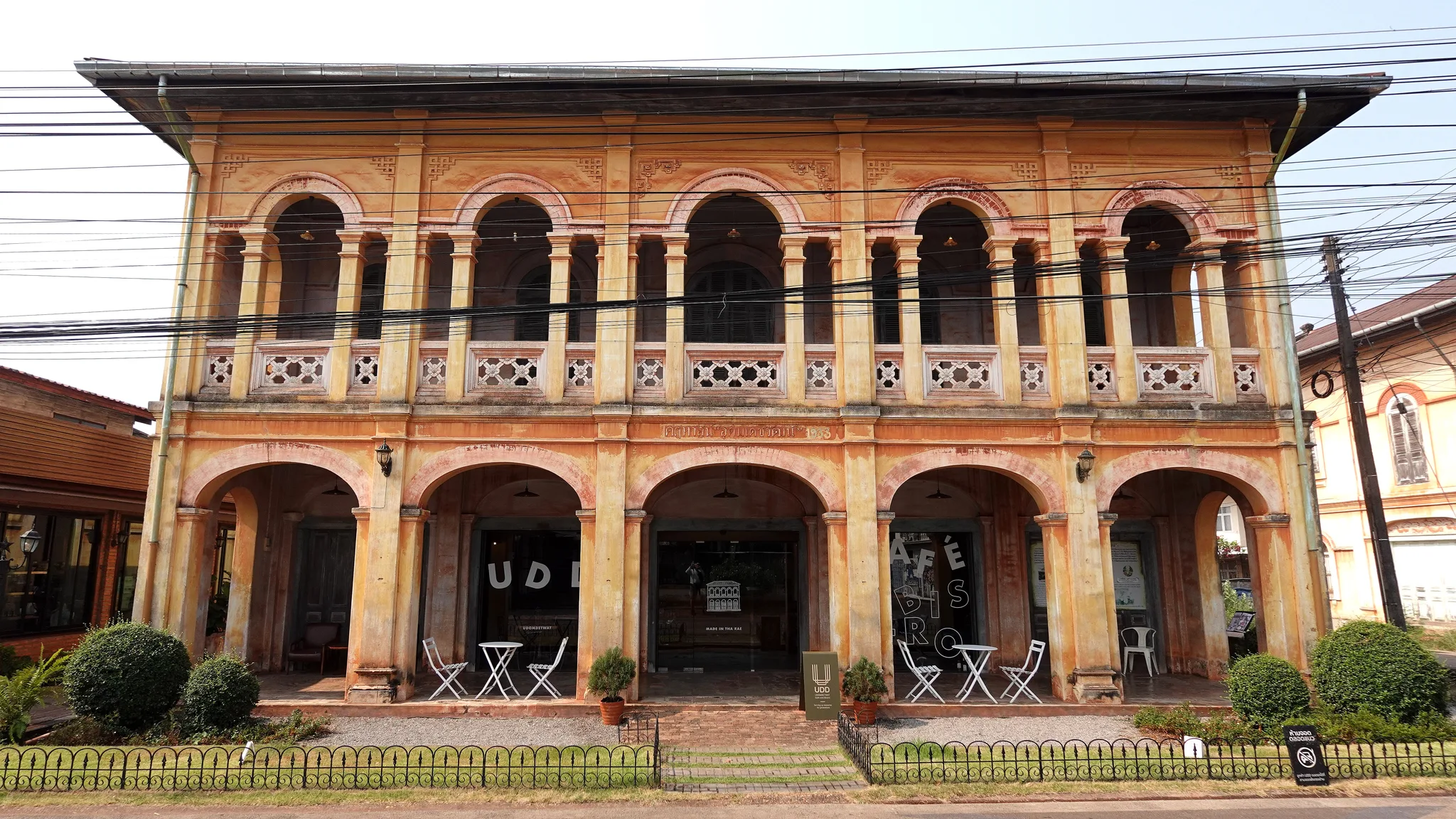
What strikes one first on walking the streets are the houses. Tha Rae ranks among the best-preserved European-style provincial centres in Thailand. Its French Indochinese-style houses stand out for their arcades, balconies and windows. Among these old buildings, several are in a Franco-Vietnamese style, and there is also a Franco-Vietnamese colonial mansion.11
This architectural vocabulary recalls the proximity of French Indochina, across the Mekong, and the Vietnamese origins of part of the population. This image of the old village now travels beyond the province: for the Thai film ‘Tha Rae: The Exorcist’, an old church was recreated for the sets.9
The Cathedral of St Michael the Archangel
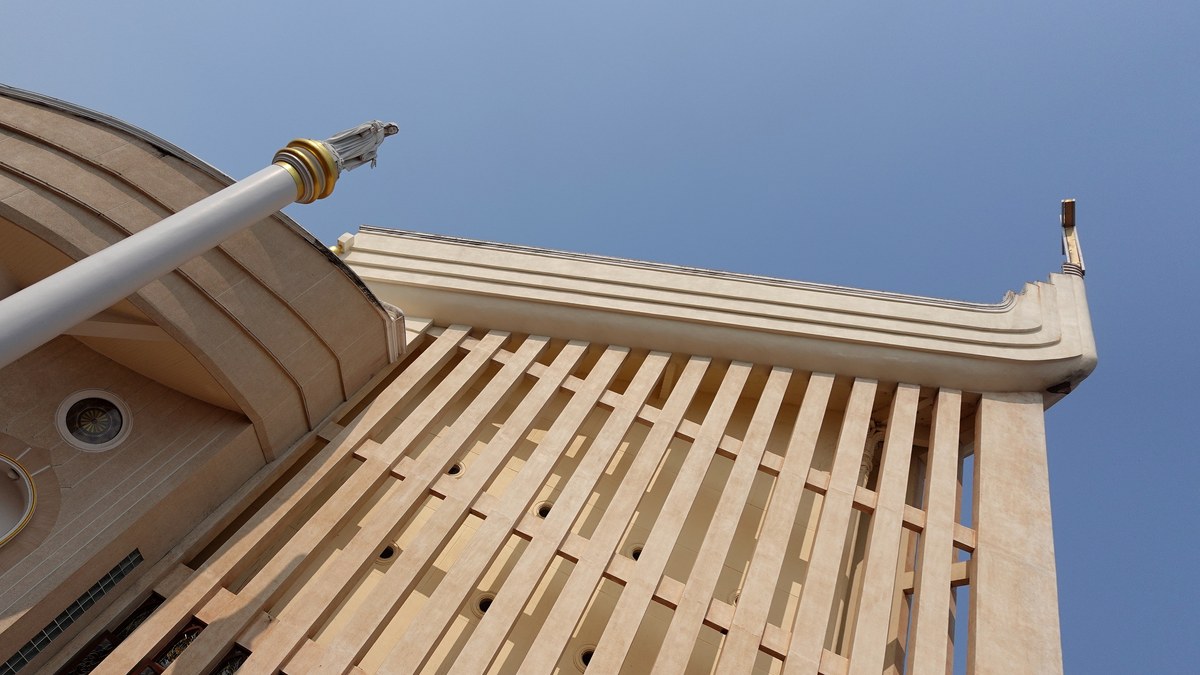
In Tha Rae stands the Cathedral of St Michael the Archangel, a Roman Rite church and seat of the Archdiocese of Thare and Nonseng. Its silhouette evokes a boat. The choice is not decorative: the form was intended in memory of the ancestors and their crossing of Nong Han Lake. The community’s principal monument thus inscribes the story of its founding in its very architecture.5
The cathedral is not the only place of worship. Tha Rae has four other, smaller churches. Yet St Michael’s remains the place most frequented by the elders. Its reach now extends beyond the local community: for the 2025 Holy Year, the jubilee year during which Catholics are invited to make pilgrimages to designated churches, the cathedral was among the jubilee churches.4
A community of many origins
Peoples brought together by the mission
Tha Rae had more than ten thousand Catholics in 2018 and some fifteen thousand around 2021, making it the largest Catholic settlement in a country where the members of this Church number around three hundred and eighty thousand. This population is heir to a long-standing mingling of peoples. It includes descendants of Vietnamese, Chinese, Lao and Thai people, as well as of regional groups such as the Nyo, the So and the Phu Thai.3
Several of these families originally shared a marginal position. Among them were uprooted populations, former slaves, and even people accused of being phi pop, malevolent spirits. Led by the French missionaries, these people from very diverse backgrounds formed the community.8
A faith in step with the days
Religion structures the village’s time. Every morning, at around six o’clock, the children go to Mass. On Saturday evenings, at around seven o’clock, there is an offering of flowers, and on Sundays the faithful go to church for confession and the sacraments. Over the course of the year, the four major celebrations of the Catholic calendar set the rhythm of community life.1
This practice is nonetheless part of a local culture that blends Catholic and Buddhist elements.2
An economy run by the community
Tha Rae’s cohesion can also be read in its economy. The village has no bank branch, public or private. A Catholic credit union, managed by a community committee, takes its place and holds considerable funds.7
The village was long known for the dog-meat trade. Some inhabitants claim that this business was highly lucrative and did not suffer from the 1997 financial crisis.7
The land of stars
The Star of Bethlehem in the village streets
The inhabitants call their village the ‘land of stars’ because of their Christmas celebrations. The star procession is inspired by the Star of Bethlehem, which, in the Gospel narrative, guided the Magi to the infant Jesus. For three days, houses are covered in decorations and thousands of spectators come to watch the parade. Floats bearing illuminated stars make their way through the village at nightfall, while boats decked with stars sail on Nong Han Lake.3
The festival mobilises the whole community. Priests, religious and volunteers take part in organising the Christmas programme. The procession began in 1982.2
From village festival to national event
Tha Rae is a secondary cultural tourism destination in Sakon Nakhon Province. During the health crisis, when visitors disappeared, the community rallied to bring them back.2
In 2025, the Tourism Authority of Thailand took a further step by including the procession, under the name Sakon Nakhon Christmas Star Parade, in the Signature Event Thailand programme. The festival was then presented as a five-day heritage festival, from 20 to 24 December, with the illuminated star floats setting off at six in the evening and returning at eight. The celebration born in a north-eastern parish now takes its place among Thailand’s cultural showcases.10
Understanding
Tha Rae Catholic Village is first and foremost a community: families of very diverse origins, often uprooted or kept on the margins, whom the Catholic mission brought together on the shores of Nong Han Lake and who made their parish the centre of their lives. From this the village has drawn a strong cohesion, visible in its daily religious practice, its school, its credit union, its Indochinese-inspired houses and its cathedral recalling the ancestors’ crossing. Now the seat of the Archdiocese of Thare and Nonseng, it is its centre. Today its star procession, sustained by the faithful themselves, has been raised by the Tourism Authority of Thailand to the rank of a national event. The village draws visitors whose return the community sought during the health crisis, and its image travels as far as the cinema. Its festival and its buildings are becoming a heritage shared beyond its inhabitants. Will Tha Rae remain first and foremost a village of the faithful, or will it become the Catholic face that Thailand chooses to show of itself?
Sakon Nakhon, between indigo, Khmer sanctuaries, Catholic heritage and the great landscapes of Isan.
- Buddha image
- In Thai Buddhism, a devotional representation of the Buddha, most often a statue, venerated as an object of worship.
- Apostolic vicariate
- A missionary jurisdiction of the Catholic Church, entrusted by the Pope to a bishop who governs it in his name, pending the possible establishment of a diocese.
- Subdistrict municipality
- In Thailand, the first tier of urban local government, established at subdistrict (tambon) level.
- Catechumen
- In Christianity, an adult receiving the religious instruction that prepares them for baptism.
- Ecclesiastical province
- A grouping of Catholic dioceses placed under the authority of a principal archdiocese, governed by an archbishop.
- Holy Year
- A jubilee year of the Catholic Church during which the faithful are invited to go on pilgrimage to designated churches.
- Phi pop
- In Isan beliefs, a malevolent spirit believed to possess the living; people accused of harbouring one could be cast out of their community.
Primary sources
- 1n.d., ประวัติบ้านท่าแร่, Ministère de la Culture – base de données culturelles (m-culture.in.th) ↗
Studies
- 2n.d., The Management of the Tha Rae Community, Sakon Nakhon Province as a Secondary Destination for Cultural Tourism, ResearchGate ↗
- 3n.d., Thailand's largest Catholic community marks Christmas with three-day procession in Tha Rae, known as 'Land of Stars', South China Morning Post ↗
- 4n.d., Catholics pray for the return of tourists, Bangkok Post ↗
- 5n.d., Thailand cave rescue draws attention to its thriving Catholic population, America Magazine, 2018 ↗
- 6n.d., Centuries-old Catholic Christmas festival in Thailand enters global spotlight, LiCAS.news, 2025 ↗
- 7n.d., 'ท่าแร่ สกลนคร' หมู่บ้านคนคาทอลิกมากสุดในไทย ที่ไม่ได้มีแค่เรื่องคนกินหมา, THE STANDARD ↗
- 8n.d., เที่ยว ท่าแร่ ตามแสงแห่ดาวไปชมตึกเก่าอินโดจีนฝรั่งเศส ชุมชนคาทอลิกที่ใหญ่ที่สุดในไทย, Sarakadee Lite ↗
- 9n.d., แกะรอยประวัติศาสตร์จากภาพยนตร์ ท่าแร่ ชุมชนคาทอลิกใหญ่สุดในไทย เก่าแก่กว่า 141 ปี, Sarakadee Lite ↗
Reference works
- 10TAT Newsroom, Sakon Nakhon Christmas Star Parade goes global stage, Tourism Authority of Thailand, 2025 ↗
- 11TAT Newsroom, Architecture in Isan – French Heritage on the Mekong River, Tourism Authority of Thailand, 2018 ↗
- 12n.d., Archdiocese of Tharae-Nongsaeng: History, UCA News ↗
- 13n.d., St. Michael the Archangel Cathedral, Tha Rae, Sakon Nakhon, Thailand, GCatholic.org ↗
- 14Contributeurs Wikipédia, Tha Rae, Wikipedia (EN) ↗
- 15Contributeurs Wikipédia, Roman Catholic Archdiocese of Thare and Nonseng, Wikipedia (EN) ↗
- 16Contributeurs Wikipédia, Aartsbisdom Thare en Nonseng, Wikipedia (NL) ↗
- 17Contributeurs Wikipédia, บ้านท่าแร่, Wikipedia (TH) ↗
- 18Contributeurs Wikipédia, Anthony Weradet Chaiseri, Wikipedia (EN) ↗
Further reading
Contemporary views
Tha Rae Catholic Village today
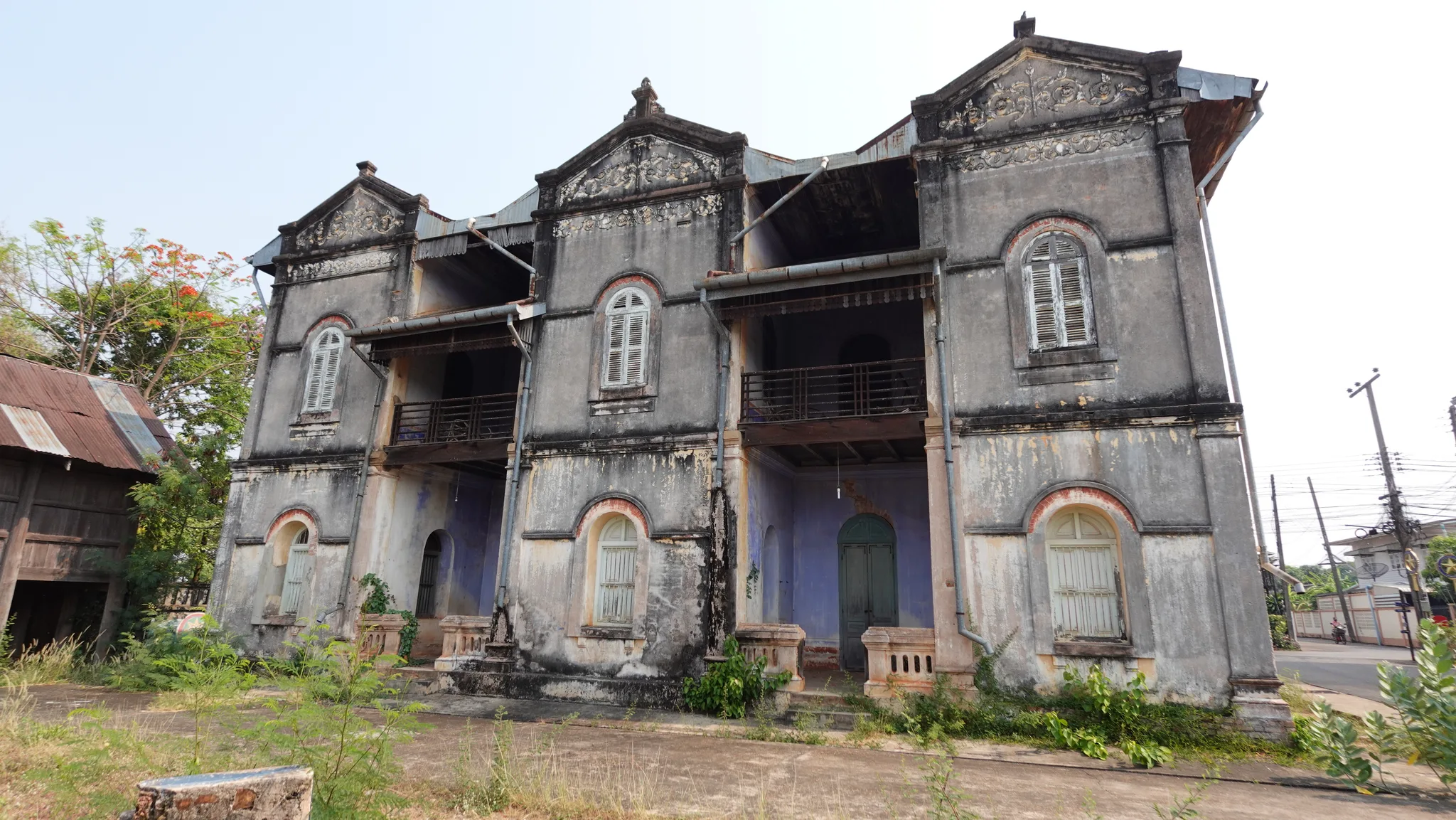
Au Village Catholique de Tha Rae, une demeure maçonnée à deux étages présente trois pignons à décor moulé, des fenêtres cintrées à persiennes et des loggias à balustrade ; l’enduit écaillé et la végétation témoignent de son état actuel.© Eric Monteil 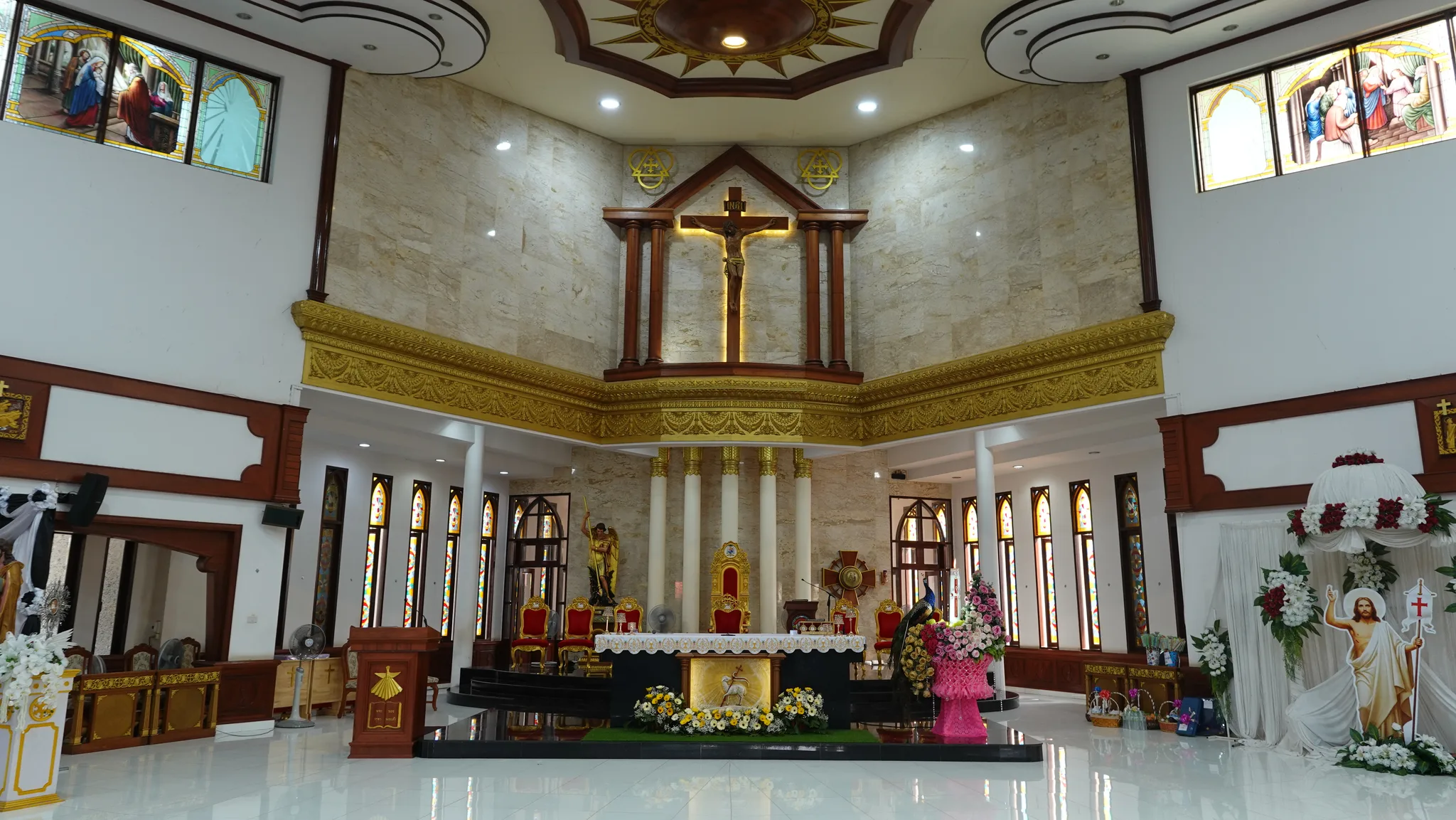
Le chœur de l’église du Village Catholique de Tha Rae réunit un autel orné de fleurs, un crucifix encadré de colonnes de bois, une frise dorée, une statue de saint Michel, un siège doré et des vitraux figurant des scènes bibliques.© Eric Monteil
Architecture and decoration
Explore the heritage
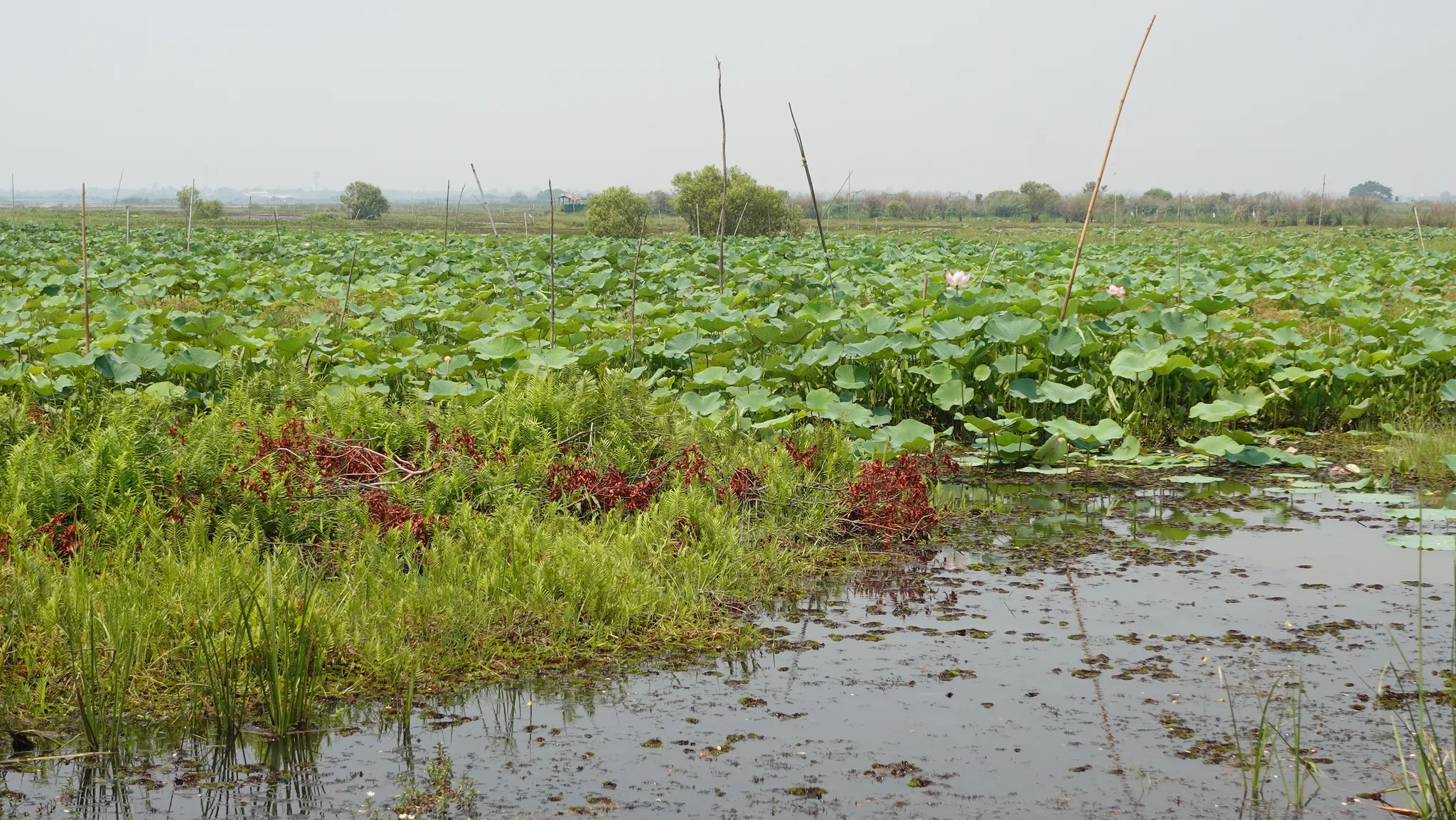
Zone humide au Village Catholique de Tha Rae : une nappe de feuilles de lotus, ponctuée de quelques fleurs roses et de perches de bambou, s’étend jusqu’à une ligne d’arbres ; fougères et plantes rougeâtres bordent l’eau au premier plan.© Eric Monteil 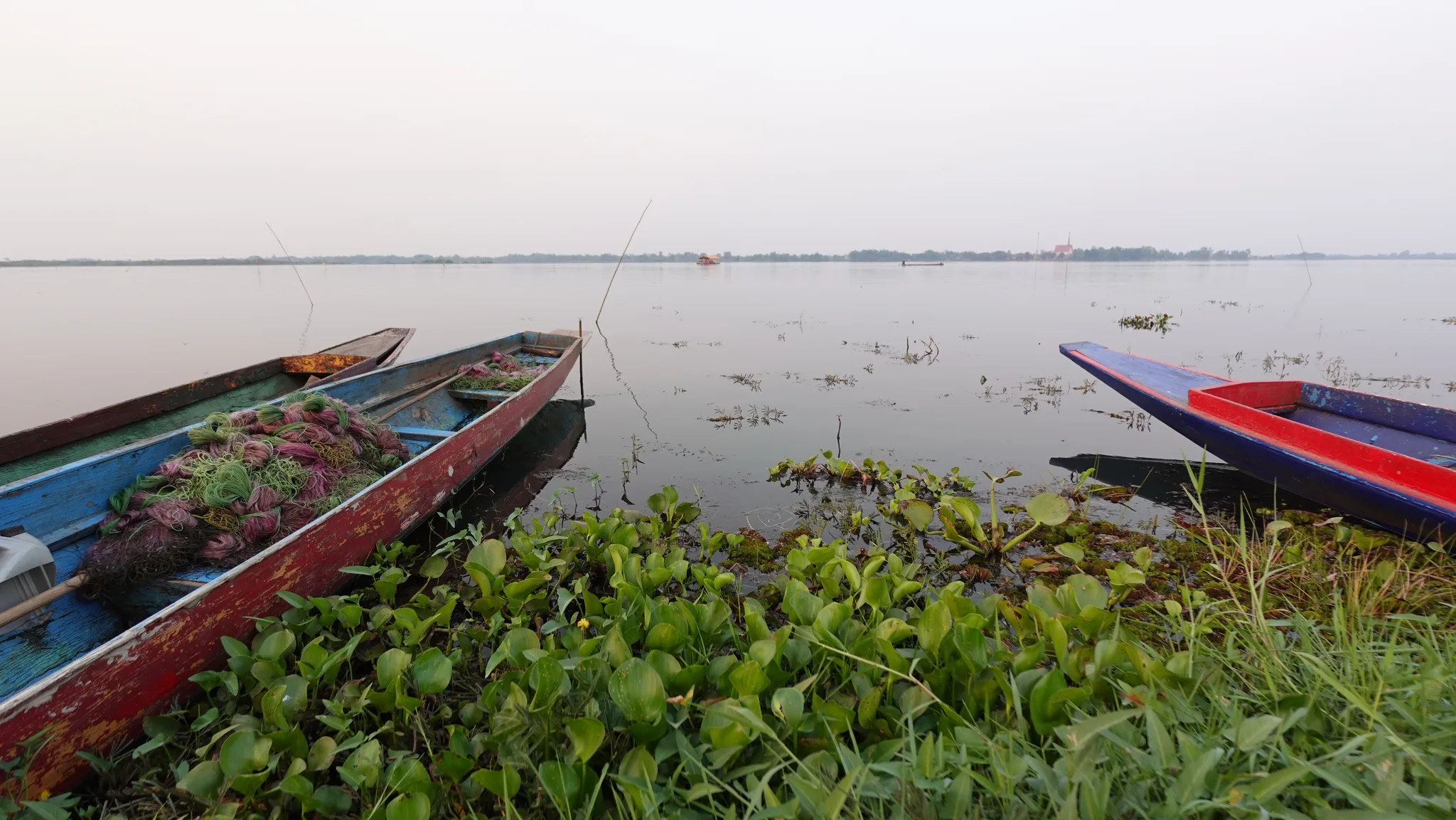
At the water’s edge near Tha Rae Catholic Village, painted wooden boats loaded with colourful nets rest among water hyacinths; in the distance, a line of trees and a few boats close the hazy horizon.© Eric Monteil