
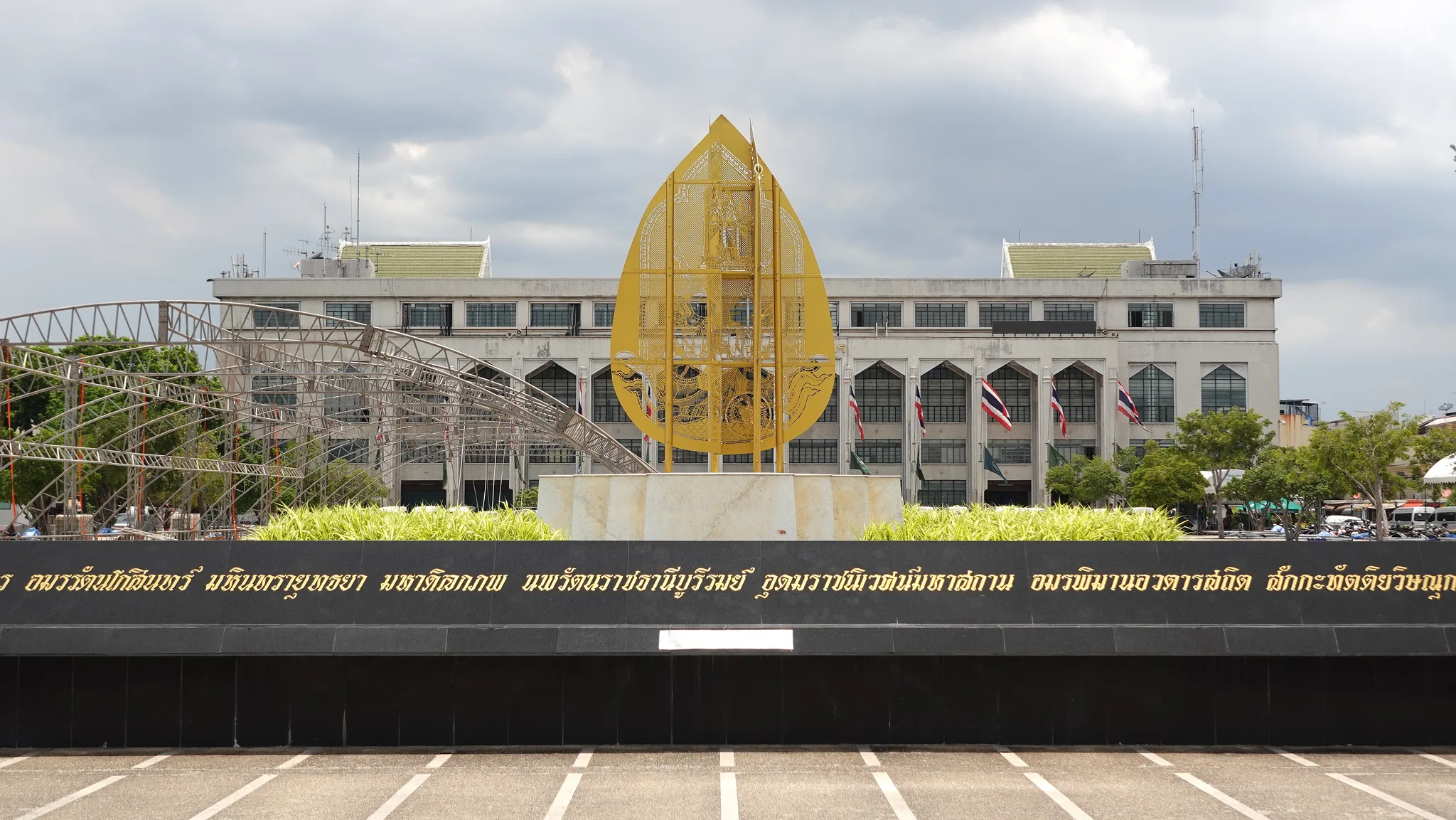
 In front of the white façade of the Bangkok City Hall, with its pointed-arch windows and Thai flags, stand a gilded leaf-shaped emblem on a plinth and a long black wall bearing a gold Thai inscription.© Eric Monteil
Civic & institutional building
Bangkok City Hall
Designed in the mid-1950s opposite the Giant Swing, Bangkok’s first city hall gave the modern municipal administration a Thai architecture, before being called upon to cede its role as headquarters to Din Daeng.
Heritage family · Architecture and built heritage
- Destination
- Bangkok (Phra Nakhon)
- Heritage Family
- Architecture and built heritage
- Typology
- Civic & institutional building
- Visit
- Available tours →
The Bangkok Metropolitan Administration City Hall is the first city hall of the Thai capital. It stands opposite the Giant Swing, in the historic district of Phra Nakhon. Commissioned in the mid-1950s by the Bangkok Municipality, it became in 1972 the seat of the Bangkok Metropolitan Administration, born of the merger with Thonburi. Its architect belonged to the Fine Arts Department, and the building exemplifies the so-called Applied Thai style, which adapts traditional forms to a modern institution. Its open galleries, its colonnade and its wings arranged around a courtyard form an ensemble now destined to become a city museum.18
Key facts
- Destination
- Bangkok
- Heritage Family
- Architecture and built heritage
- Typology
- Civic & institutional building
- Places
- The Giant Swing (Sao Chingcha)
- Wat Suthat Thepwararam Ratchaworamahawihan
- Phra Nakhon
- Periods
- People
- Aswin Kwanmuang
- Chadchart Sittipunt
- Mangkon Phromyothi
- Mom Chao Samai Chaloem Kridakorn
- Plaek Phibunsongkhram
- Communities
- —
- Events
- Bangkok Design Week 2026
- Merger of Bangkok and Thonburi municipalities (1972)
- Foundation stone laying (1956)
- Heritage
- —
- Glossary
- Khon
- Wat
- Wa
- Sala
- Chao Phraya
- Phraya
- Keywords
- —
- Date
- —
- Collections
- —
Practical info
Practical information about this site is taken from its Google Maps page. We advise you to check it before visiting.
- Address
- 173 Dinso Rd, Khwaeng Sao Chingcha, Khet Phra Nakhon, Krung Thep Maha Nakhon 10200
- Phone
- Website
In the heart of the old city
Facing the Giant Swing
The Bangkok Metropolitan Administration City Hall occupies a block in the district of Phra Nakhon, the historic heart of Bangkok. It lies in the sub-district named after Sao Chingcha, the Giant Swing, and its façade looks directly onto that monument. Opposite it, too, stands Wat Suthat Thepwararam, a wat, that is to say a Buddhist monastery. The seat of the city’s administration thus settled in one of the capital’s landscapes most steeped in memory, amid religious landmarks older than itself.6
One side of the building runs along Dinso Road. This street was cut in 1898–1899, during the reign of King Chulalongkorn (Rama V). The city hall takes its place within this already reshaped urban fabric, between the city of monasteries and the city of avenues.20
Names that tell a story
The building’s successive names sum up its history. Originally it was called Sala Thetsaban Nakhon Krung Thep, ‘hall of the municipality of the city of Bangkok’. It was designed for a municipality. Its current Thai name, Sala Wa Kan Krung Thep Maha Nakhon, translates as ‘hall of the Bangkok administration’. It reflects the change of status that took place in 1972, when the institution it houses became a metropolitan administration.2
A third name has taken hold more recently. It is commonly referred to as ‘City Hall 1’, or in Thai Sala Wa Kan Ko Tho Mo 1, to distinguish it from the second headquarters built at Din Daeng. This numbering alone says that the Sao Chingcha building is no longer the sole centre of municipal power, and that it is now conceived in relation to another.7
From market to municipal offices
Before the city hall, the site was a vast field of beaten earth where the Sao Chingcha market was held. The municipal administration arrived on the site during the Second World War. In 1941, the Bangkok Municipality left its offices on Krung Kasem Road to settle in the sub-district of Sao Chingcha. At first this was not a building designed for it. It began by refitting former commercial units (shophouses).1
To build a headquarters worthy of the name, the municipality first had to become owner of the land. The plot formed part of the Crown’s property. It therefore asked the government to seek royal consent for the Ministry of Finance to sell it the land. This procedure shows how the footprint of a modern institution was constituted at the centre of the old capital: through the acquisition of royal land, with the sovereign’s consent and the intervention of the State.1
A commission of the 1950s
A mayor short of space
General Mangkon Phromyothi, mayor of the Bangkok Municipality, judged the premises too cramped and launched the construction of a proper city hall. He entrusted the project to Mom Chao Samai Chaloem Kridakorn, ‘special architect’ of the Fine Arts Department (Krom Sinlapakon), the administration responsible for heritage and the arts.5
The design, carried out in 1955, was produced in haste. A model was presented to the government, which approved it. A municipal institution thus submitted its future headquarters to the central power: the construction of the city hall was as much a matter for the State as for the city.2
An architect between royal heritage and modern buildings
Samai Chaloem Kridakorn held the title of Mom Chao. Trained in France, he worked for the Fine Arts Department. His first work was the Sala Chalermkrung theatre, completed in 1933. He went on to sign a wide variety of projects, such as Phra Tamnak Phu Phing Ratchaniwet, a royal residence, or the monument to King Vajiravudh (Rama VI) placed in front of Lumphini Park.21
At the time he was designing the city hall, he was also directing the restoration of the rear group of the Chakri Maha Prasat, one of the great throne halls of the Grand Palace, between 1953 and 1960. The same architect was thus working simultaneously on a royal monument and on a modern administrative building. This twofold undertaking sheds light on the approach taken for the city hall: a building for contemporary use, whose vocabulary draws on the forms of traditional architecture.5
A foundation stone and a long-running building site
The foundation stone was laid on 24 June 1956, in the presence of Field Marshal Plaek Phibunsongkhram, then Prime Minister. The presence of the head of government underlines the political importance then attached to the capital’s headquarters. Yet the building did not rise all at once. Its construction proceeded in phases spread over several decades, so that the building visible today is the outcome of a long process.2
Part of the project never came into being. A tower was to serve as a lookout over the city, and its foundation piles had already been driven in when work was halted. Among architects, some regretted this lost landmark. Others were rather relieved that it would not overwhelm the Giant Swing. This debate clearly shows the difficulty of the project: how to assert the presence of a modern institution at the foot of ancient monuments without dominating them.6
Reading the architecture
The Applied Thai style
The city hall belongs to the so-called Applied Thai style (Thai prayuk), which transposes elements of traditional Thai architecture onto modern buildings, constructed with new techniques and for new programmes. The project falls within the conservative branch of this movement. It remains attached to older references while adopting the pared-back geometry characteristic of the 1950s.19
The triangular window surrounds are the most visible mark of this blend. They have been likened to the roof of nearby Wat Suthat Thepwararam, as if the municipal administration were taking up, in a simplified language, the gables of the neighbouring monastery. This is an interpretation, not an attested intention of the architect. It nonetheless helps in understanding how the building engages with its surroundings without copying religious forms. Its architectural identity is, moreover, reputed to be without equal among Bangkok’s buildings.6
A quadrangle around a courtyard
The plan devised by Samai Chaloem Kridakorn favours symmetry. The offices occupy interconnected wings that form a quadrangle around a central courtyard. A lawn extends in front. This arrangement gathers the departments into a continuous ensemble and gives the building a regular façade, turned towards the Giant Swing.5
The design clearly distinguishes the municipal council chamber, covered by a tall, broad roof. It later housed the Bangkok Metropolitan Council, the capital’s elected assembly. The height of its roof singles out the place of deliberation within the administrative ensemble. The original programme also included the municipality’s emblem: Indra, king of the gods in Hindu and Buddhist cosmology, riding Erawan, the celestial elephant that serves as his mount.5
Galleries and colonnade
What can be seen today is a three-storey building designed for the tropical climate. Wide balcony-like galleries shield the façades from sun and rain. A large open hall allows air to circulate. These features respond to the tropical climate and give the building a depth of shadow that softens its straight lines.18
A tall colonnade punctuates the whole, and it can be read as an expression of civic authority: visitors approaching the city hall pass a regular sequence of vertical supports, as before a prestigious public building. The columns, galleries and triangular surrounds thus bring together the monumental grammar of official buildings, attention to climate and Thai references.6
The seat of a metropolis
From municipality to metropolis
On 15 December 1972, the municipalities of Bangkok and Thonburi merged to form Krung Thep Maha Nakhon, administered by the Bangkok Metropolitan Administration. The Sao Chingcha building then became its city hall.3
This change altered the meaning of the building. Designed for a municipality, it became the seat of a metropolis.
The heart of the administration
Before the transfer, the Sao Chingcha city hall remained the decision-making centre of the Bangkok Metropolitan Administration. In 2022, some two thousand officials and employees worked there. The building then housed the most central functions: the finance department, the budget department, the governor’s secretariat, the secretariat of the Bangkok Metropolitan Council, the permanent secretariat, the department of strategy and evaluation, and the audit department.8
These departments fit onto a modest footprint. The Sao Chingcha site is about eight times smaller than that at Din Daeng. The historic headquarters therefore concentrates the metropolis’s high command, while a large part of the administration is spread elsewhere. This situation reveals both its prestige and its limits: it is the place of the governor and the council, but it can no longer bring the whole institution together.7
The stele of the city’s name
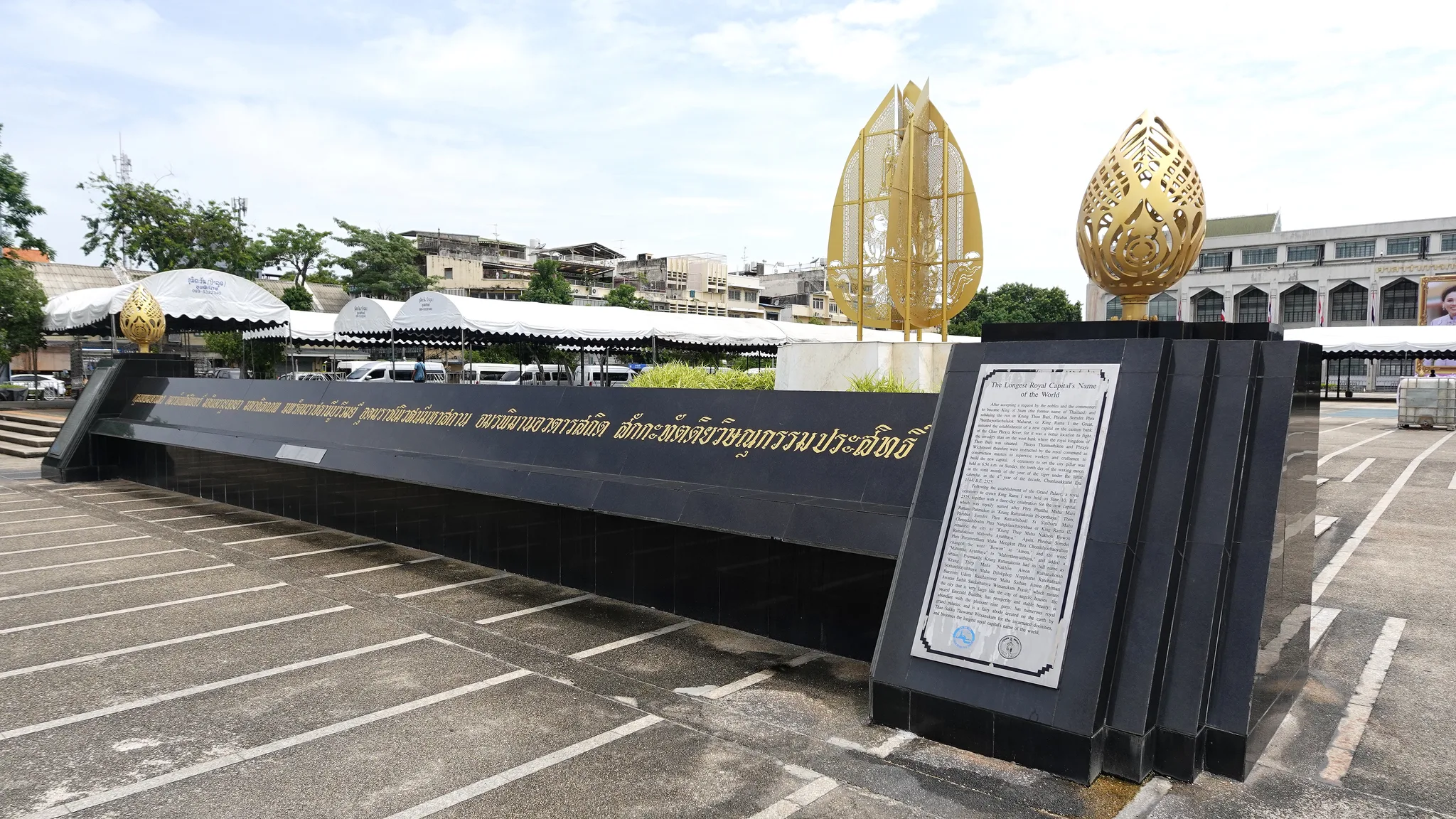
In front of the building, a black stone stele bears the full official name of the capital. This ceremonial name, which begins with Krung Thep Maha Nakhon, is recognised by Guinness World Records as the longest city name in the world. The stele was erected in 2002 for the 220th anniversary of Rattanakosin.18
Placed in front of the city hall, facing the Giant Swing, it links the seat of the administration to the very identity of the city. In front of the building there also stretches a large esplanade, Lan Khon Mueang, the ‘townspeople’s square’. Its name asserts a purpose: to offer residents an open space in front of their city hall.18
A headquarters set to change its role
Din Daeng, a second city hall
Construction of a second headquarters, in the district of Din Daeng, began in 1992 with the foundations of a thirty-seven-storey tower. For lack of funds, work stopped for nearly ten years. Between 2004 and 2011, a budget of 1,438 million baht was approved for the tower and the Council chamber, and work was completed in 2017. The Governor of Bangkok, Police General Aswin Kwanmuang, then inaugurated the new building. The Bangkok Metropolitan Council also obtained a building of its own, the Airawat Phatthana, built between 2004 and 2018, where it held its first session in 2019.4
The administration’s centre of gravity then began to shift. In June 2018, the meeting of department heads moved from City Hall 1 to Din Daeng. The same year, Aswin Kwanmuang abandoned the second and third towers planned at Din Daeng, and did not envisage turning the Sao Chingcha building into a museum. For a few years, therefore, the metropolis operated with two headquarters, the older one retaining its central departments.11
The plan for a city museum
The idea of giving the Dinso Road building a new life is long-standing. From around 2010, a project envisaged converting it into a museum and library devoted to the history of Bangkok. The idea gained fresh momentum in 2022, when Chadchart Sittipunt, elected governor that year, confirmed the transfer of the headquarters to Din Daeng. The Sao Chingcha site is to become a city museum and to house the departments responsible for culture, sport and tourism. Deputy Governor Chakkapan Phiewngam chairs the committee in charge of the operation.12
At the end of 2022, the Bangkok Metropolitan Administration anticipated some two years for the transfer and considered renaming the site ‘People Square’. The timetable became clearer in 2025: the renovation of the Thani Nopparat tower at Din Daeng was due to be completed on 31 December 2025, and the City Hall 1 departments were to move in several waves in February 2026.16
A square open to residents
While this change is being prepared, Lan Khon Mueang square hosts cultural events. In 2024, it hosted the Colorful Bangkok Expo, a week of art and culture bringing together an artists’ market, stages and an open-air cinema in front of the city hall’s façade.9
In 2026, it became the main venue in the Phra Nakhon district for Bangkok Design Week, an event devoted to design and creativity. These programmes show how the esplanade, long the antechamber of an administrative building, is beginning to serve as a cultural stage in the heart of the old city, even before the building itself changes function.10
Understanding
The Bangkok Metropolitan Administration City Hall is more than an office block. Built on former Crown land, at the foot of the Giant Swing and Wat Suthat Thepwararam, it gave the capital’s modern administration an architecture that claims kinship with Thai tradition. For decades, the city governed itself here: the mayor and then the governor, the elected council, the central departments, and before them a square named for the townspeople. This place is now on the point of losing what brought it into being. The role of headquarters is moving to Din Daeng, and the plan to make it a city museum, envisaged from around 2010 and revived in 2022, commits it to another life, already heralded by the exhibitions and festivals that take over its esplanade. The building is set to pass from the status of instrument of government to that of witness. Stripped of the power it was meant to embody, can a city hall still tell the people of Bangkok what it means to be a city?
Rattanakosin, from the royal citadel of 1782 to the historic districts that shaped contemporary Bangkok.
- Khon
- Masked dance drama of the Thai court tradition, which stages the Ramakien.
- Wat
- Buddhist monastic complex that brings together, within a single enclosure, several religious buildings, monks’ quarters and ancillary buildings; the word does not refer to a single building.
- Wa
- Traditional Siamese unit of length, equivalent to about two metres; twenty wa make one sen.
- Sala
- A pavilion for communal use, often open-sided, where people gather, rest or listen to sermons, particularly within monastery grounds.
- Chao Phraya
- Highest title of the Siamese nobility, held by senior dignitaries of the court.
- Phraya
- Rank of the Siamese court nobility, immediately below that of chao phraya; it precedes the dignitary’s title name.
- Sala wa kan
- Thai expression denoting the headquarters building of a public administration.
- Shophouse
- A narrow, deep urban house built in a row, whose ground floor serves as a shop and upper floor as living quarters, typical of the trading towns of South-East Asia.
- Mom Chao
- Modest princely rank of the Thai royal family, held by birth.
- Applied Thai
- A contemporary Thai architectural style that takes up and adapts forms from traditional Thai architecture.
- Prasat
- In Thai architecture, a building or canopy with tiered roofs crowned by a spire, a form reserved for sacred images and for royalty.
- Indra
- Deity of Vedic origin, king of the gods in the Hindu tradition and also present in Buddhist cosmology. In Thai iconography he is often shown riding the celestial elephant Erawan.
- Erawan
- Celestial elephant associated with Indra, known as Airavata in the Indian tradition. In Thai art he is frequently shown with three heads, although the traditions also describe other forms.
Studies
- 1ไขความลับ “ศาลาว่าการ กทม. เสาชิงช้า” อัตลักษณ์ที่ไม่เหมือนตึกใดใน กทม., Thansettakij (ฐานเศรษฐกิจ), 2022 ↗
- 2ย้อนตำนาน 66 ปี ศาลาว่าการ กทม. “เสาชิงช้า” ก่อนโบกมือลา สู่ “ดินแดง”, Krungthep Turakij (Bangkokbiznews), 2022 ↗
- 3ย้ายศาลาว่าการ กทม. ต่อยอด “พิพิธภัณฑ์เสาชิงช้า”, Prachachat Turakij, 2022 ↗
- 4ไขปม “ศาลาว่าการกทม.เสาชิงช้า” อัตลักษณ์ที่ไม่เหมือนตึกใดในกทม., Nation TV, 2022 ↗
- 5ไขความลับ “ศาลาว่าการ กทม. เสาชิงช้า” (relais Blockdit de Thansettakij), Thansettakij via Blockdit, 2022 ↗
- 6Tracing Bangkok’s Timeless Heart: A Journey Through Phra Nakhon, Sawasdee (Thai Airways), 2025 ↗
- 7ส่องแผนย้ายศาลาว่าการ กทม. จาก 'เสาชิงช้า' สู่ 'ดินแดง', Matichon, 2022 ↗
- 8BMA set to move HQ to Din Daeng, Bangkok Post, 2022 ↗
- 9Enjoy a week of art and culture at City Hall, Bangkok Post, 2024 ↗
- 105 Highlight Venues: Connecting Design and Humanity in Bangkok Design Week 2026, art4d, 2026 ↗
- 11‘อัศวิน’ ล้มโครงการ อาคารสูงทาวเวอร์ 2-3 แต่ไม่มีแผนยุบศาลาว่าการกทม. 1 เป็นพิพิธภัณฑ์, Matichon, 2018 ↗
- 12Chadchart confirms City Hall being relocated, Bangkok Post, 2022 ↗
- 13เปิด "ศาลาว่าการกทม. 2 ดินแดง" ฐานบัญชาการแก้ปัญหากทม. ของ ผู้ว่าฯ ชัชชาติ, Thansettakij (ฐานเศรษฐกิจ), 2022 ↗
- 14รู้จัก "อาคารไอราวัตพัฒนา" เปิดรับสมัครผู้ว่าฯ กทม.-สก. ครั้งแรก, Thai PBS, 2022 ↗
- 15Reshaping Bangkok (2), BK Magazine ↗
- 16BMA plots relocation, Bangkok Post, 2022 ↗
- 17ย้ายศาลาว่าการกทม.ไป ‘อาคารธานีนพรัตน์’ ทุกหน่วยงาน ก.พ.69, Naewna, 2025 ↗
Contemporary views
Bangkok City Hall today
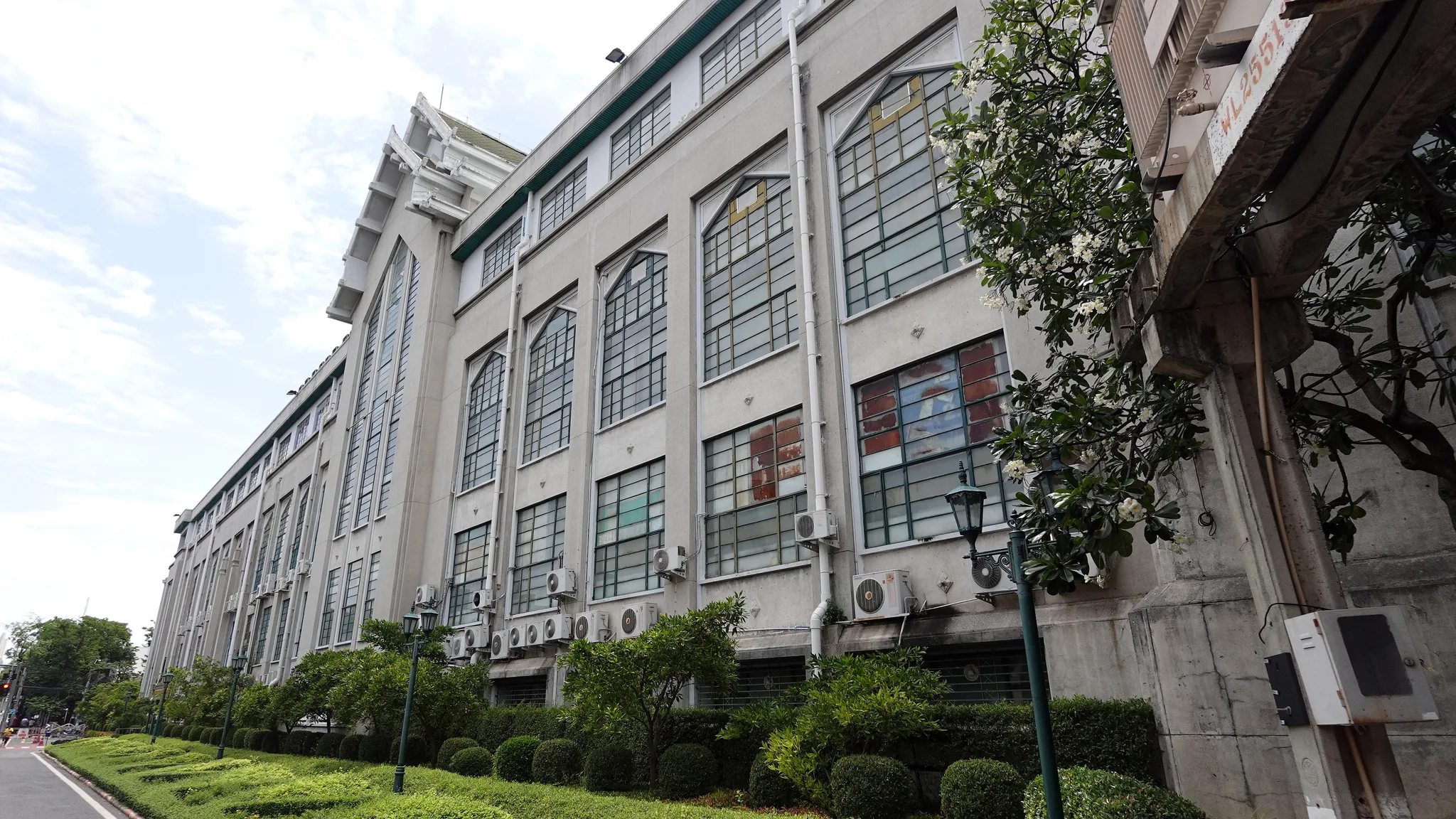
Along the Bangkok City Hall, the pale façade punctuated by pilasters opens through large small-paned glazed windows dotted with air-conditioning units; at its foot, a strip of clipped hedges and street lamps lines the road.© Eric Monteil 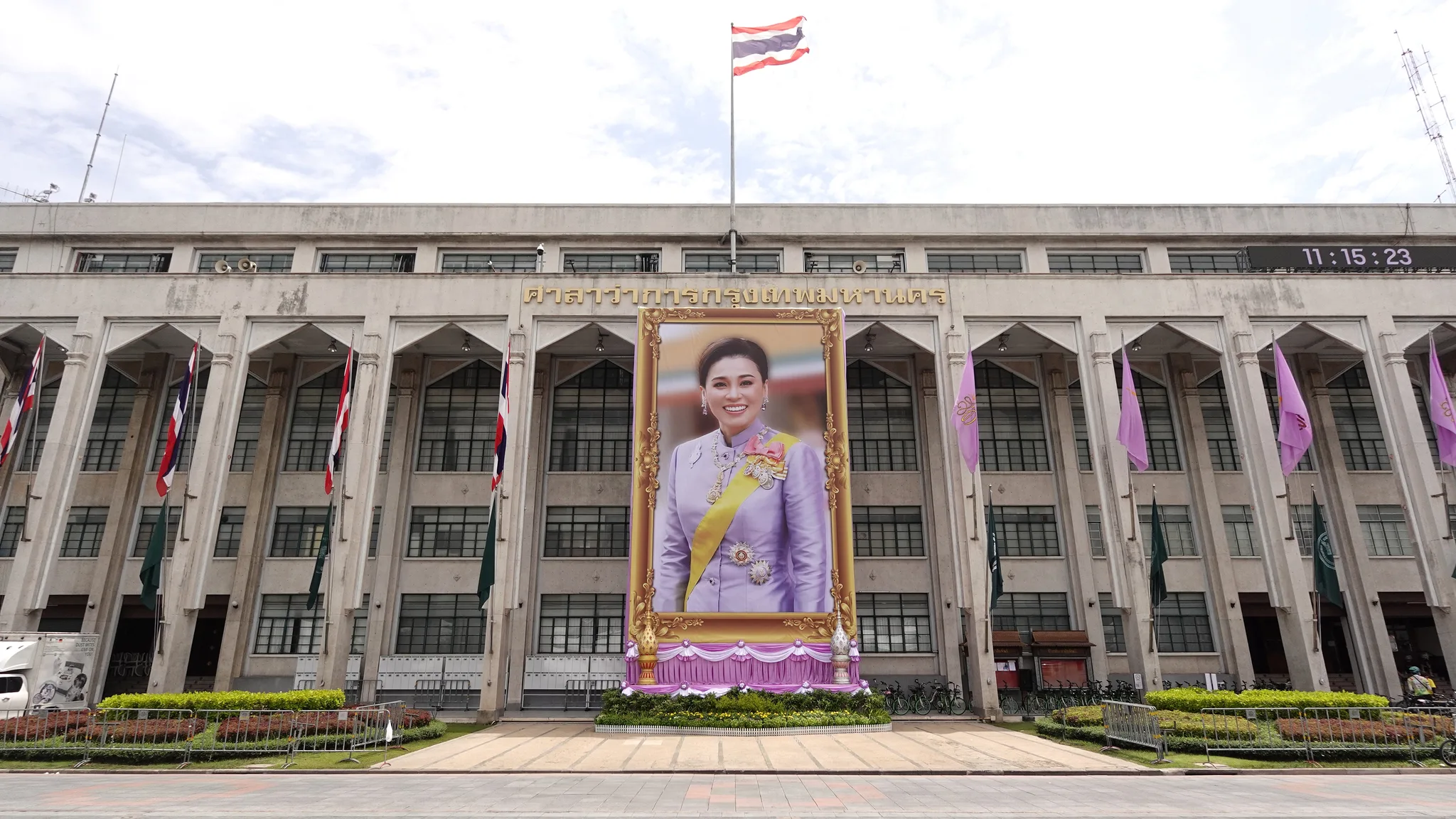
Facade of Bangkok City Hall, punctuated by pillars and tall windows, with its Thai inscription in gilded letters, a large portrait in a gilded frame, Thai and purple flags and flowerbeds.© Eric Monteil
Architecture and decoration
Explore the heritage
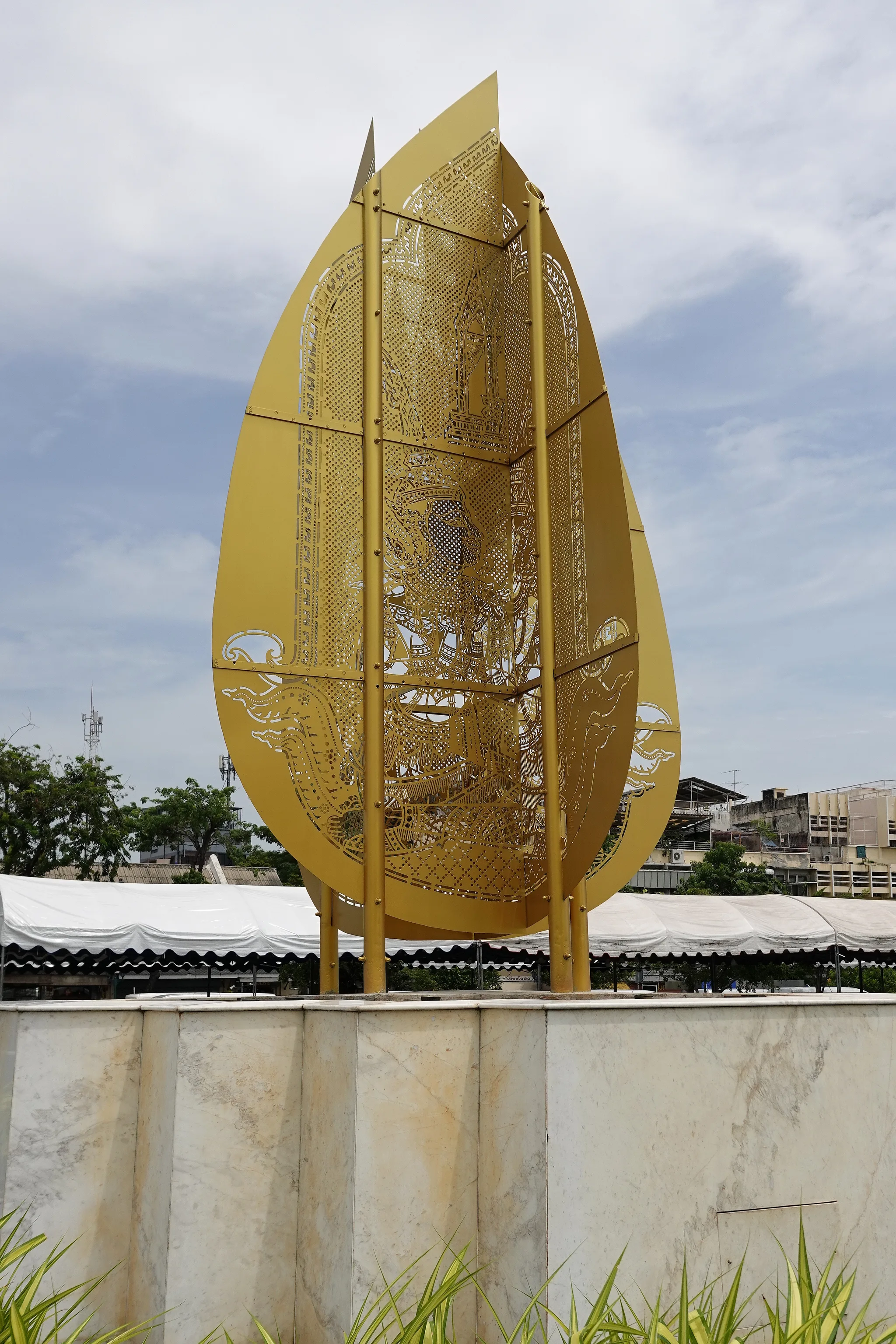
Gilded metal sculpture with leaf-shaped openwork panels, set on a marble plinth at Bangkok City Hall; the cut-outs depict a deity, a spired pavilion and wave motifs.© Eric Monteil 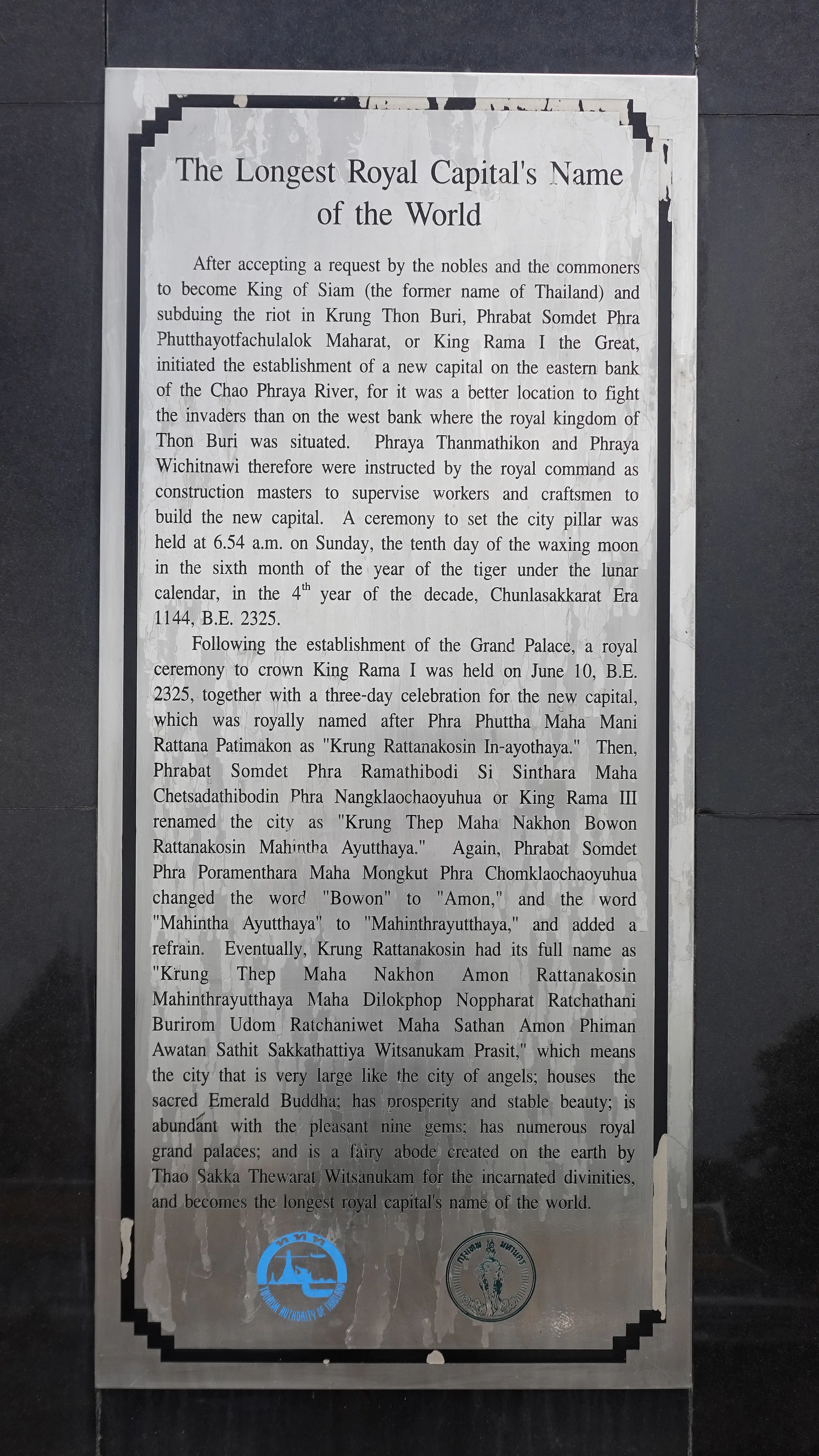
At the Bangkok City Hall, a metal plaque framed by a stepped border presents in English the full ceremonial name of Bangkok, with the emblems of the Tourism Authority of Thailand and the metropolitan administration.© Eric Monteil