
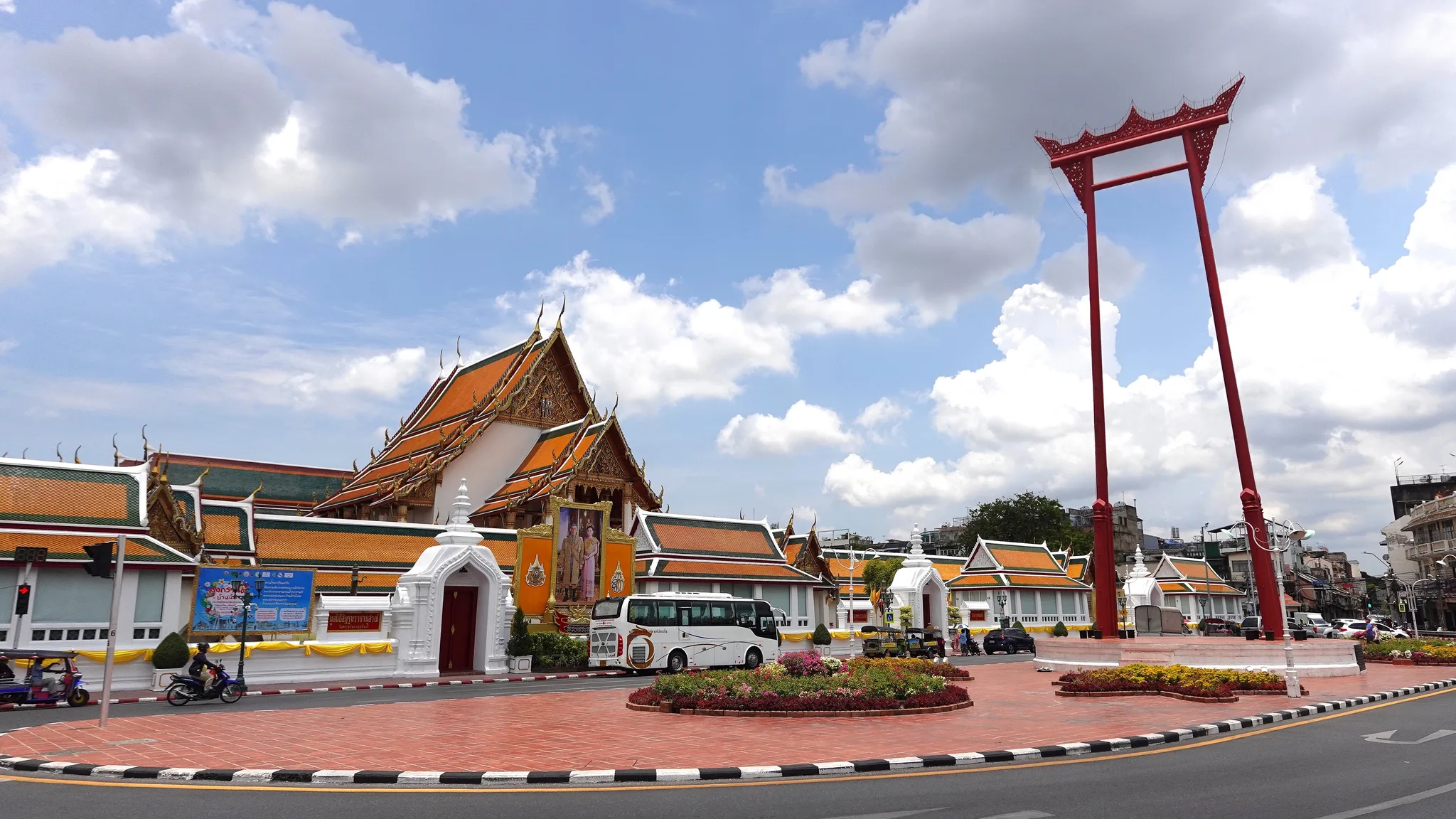
 Le portique rouge de Balançoire géante (Sao Chingcha) s’élève sur une place pavée ornée de massifs fleuris, face à un temple aux toits étagés orange et vert, ceint d’un mur blanc percé de portes, au bord d’une avenue fréquentée.© Eric Monteil
Sacred site & object
The Giant Swing (Sao Chingcha)
Erected at the end of the eighteenth century in front of Wat Suthat for a Brahmanical ceremony in honour of Shiva, Bangkok’s great red frame has lost its swinging rite but remains a sacred place, rebuilt several times.
Heritage family · Buddhism, religions and spiritualities
- Destination
- Bangkok (Phra Nakhon)
- Heritage Family
- Buddhism, religions and spiritualities
- Typology
- Sacred site & object
- Visit
- Available tours →
The Giant Swing (Sao Chingcha) is a great red timber frame standing in the historic heart of Bangkok, in front of the royal monastery of Wat Suthat. It matters because it bears witness to a little-seen side of court religion: it was built in the reign of Rama I for a royal swinging ceremony, performed by Brahmins in honour of the god Shiva. Abandoned in the twentieth century, the swinging left behind a protected monument, rebuilt entirely in teak at the beginning of the twenty-first century in accordance with Brahmanical rules. Today its two tall vermilion posts dominate one of the best-known landmarks of the capital.
Key facts
- Destination
- Bangkok
- Heritage Family
- Buddhism, religions and spiritualities
- Typology
- Sacred site & object
- Places
- Bangkok City Hall
- Devasathan
- Wat Suthat
- Phra Nakhon
- Rattanakosin Island
- Periods
- People
- Rama Ier
- Rama V
- Prajadhipok (Rama VII)
- Vajiravudh (Rama VI)
- Communities
- —
- Events
- Abandon du rite de balancement (1935)
- Classement de la Balançoire géante comme monument historique national (1949)
- Construction of the Giant Swing
- Reconstruction de la Balançoire géante (2006-2007)
- Remplacement des bois de la Balançoire géante (1920)
- Restauration de la Balançoire géante sous Rama V (1901)
- Heritage
- —
- Glossary
- Brahmin
- Wat
- Finial
- National historic monument
- Royal monastery
- Relic
- Keywords
- —
- Date
- —
- Collections
- —
Practical info
Practical information about this site is taken from its Google Maps page. We advise you to check it before visiting.
- Address
- QG22+PGF, Dinso Rd, แขวง บางขุนพรหม, Khet Phra Nakhon, Krung Thep Maha Nakhon 10200
A ritual frame in the heart of Bangkok
A swing for the gods
The Giant Swing (Sao Chingcha) stands in Bangkok, in Phra Nakhon district, in the form of two red-painted timber posts, more than twenty-one metres high and joined at the top. Its familiar silhouette should not mislead: this is not a piece of urban ornament but a ritual structure. It was built to host a royal ceremony during which officiants swung in honour of Shiva, one of the great gods of Hinduism. It therefore belongs to Brahmanism, the religion of the Brahmins, hereditary priests of the Hindu cult, as it was practised at the Siamese court, and not to Buddhism as such.8
The Thai name simply describes what one sees. Sao means ‘post’ or ‘pillar’, chingcha ‘swing’: Sao Chingcha is the ‘pillar of the swing’. The English name, Giant Swing, says the same thing, while the rite itself bore an equally concrete name in Thai, the ‘swinging ceremony’. These names have outlived the practice that gave rise to them: no one has swung at Sao Chingcha for decades, yet the frame remains, and with it the memory of a ceremony that brought together the monarchy, the Brahmins and an entire city.6
In front of Wat Suthat, on Rattanakosin Island
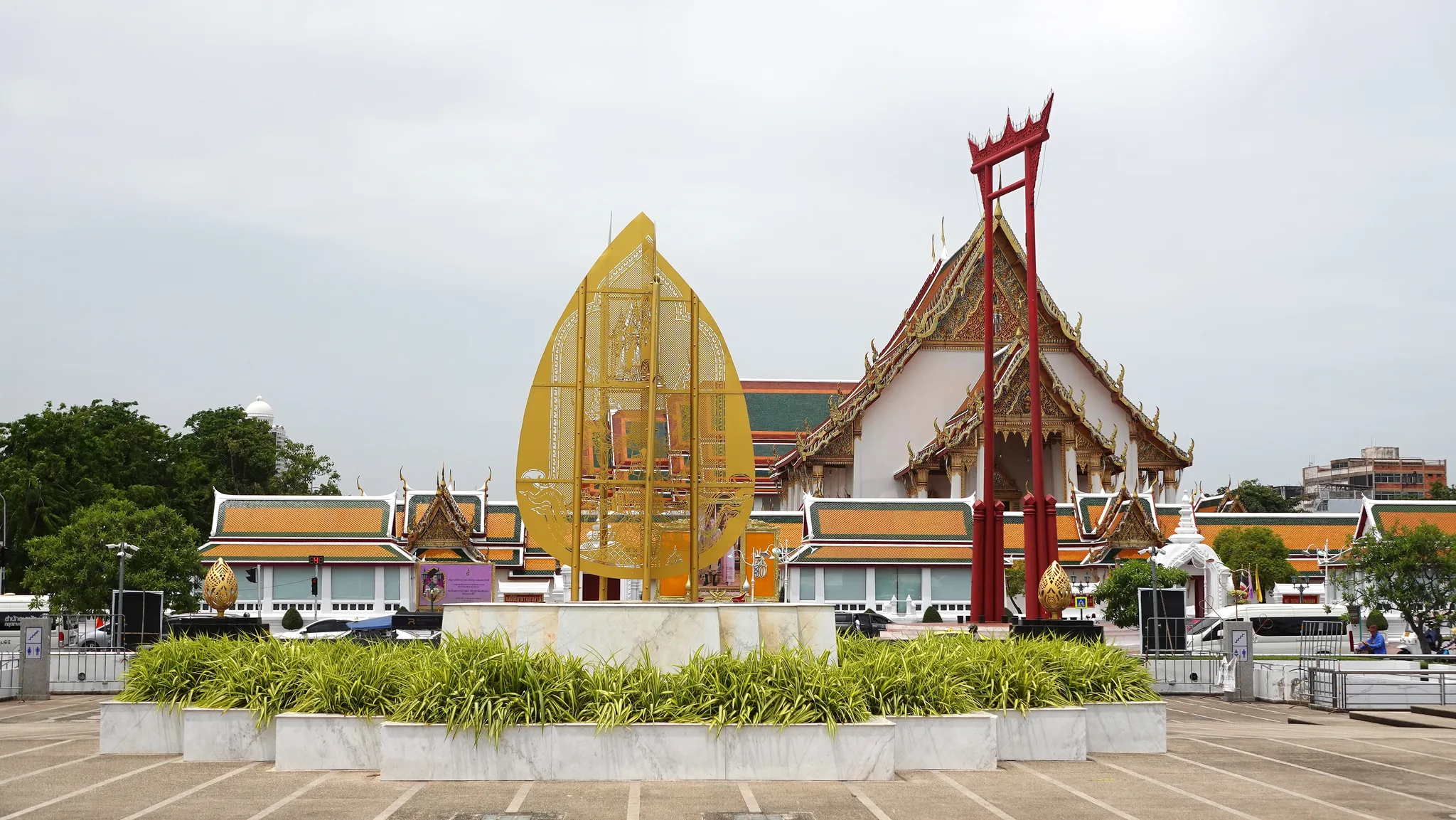
The frame rises on Dinso Road, directly in front of Wat Suthat Thepphawararam, on Rattanakosin Island, the historic core of Bangkok. This setting is essential to understanding the site. Wat Suthat is a first-class royal Buddhist monastery, standing immediately behind the swing; close by is the Devasathan, the royal Brahmin temple where the court Brahmins reside. Within a single space, the visitor thus has before them a great Buddhist sanctuary and the instruments of a Hindu cult, two religious traditions that long served the Thai monarchy together.6
Tradition holds that the site was chosen according to Brahmanical conceptions, at the ‘navel of the city’, that is, at its centre, measured between the western rampart, on the side of the Chao Phraya River, and Mahakan Fort. There is no need to take this account as a technical description of the foundation, but it shows the place that local memory grants the frame: not one monument among others, but a sacred anchoring point of the capital, set where the city symbolically found its middle.3
A royal foundation in the service of the court
The commission of Rama I
The construction of the frame dates back to the first years of the new capital, in the reign of King Rama I. The king ordered it to be erected in front of the site of Wat Suthat and entrusted the work to Phra Khru Sitthichai, known as Kratai.4
Accounts differ on the date of construction: 1784 in most versions, or 1786 according to another chronology, which places the founding of the Devasathan in 1784. This discrepancy does not alter the essential point: the frame and the neighbouring Brahmin temple belong to the same period.8
The court Brahmins
The officiants of the ceremony were the Brahmins of the royal court, today grouped within the Office of Royal Brahmins, attached to the Palace. Based at the Devasathan, they descend, according to tradition, from a lineage that came from Rameswaram, in Tamil Nadu, in southern India. Their presence is no mere curiosity: they once played a leading role at court, particularly at coronations.11
The swing makes this religious organisation visible. The king, protector of Buddhism, also relied on Hindu priests to perform some of the rites that marked the rhythm of the year and surrounded his person. The swinging rite thus bears witness to the long-standing coexistence, in Thai society, of Brahmanical and Hindu beliefs with Buddhism. On Dinso Road this coexistence takes material form: the frame of the cult of Shiva stands at the very threshold of a great royal Buddhist monastery, without either effacing the other.8
The Triyampawai, a ceremony for Shiva
From a rite of penance to a royal festival
The ceremony for which the frame was built is called Triyampawai-Tripawai and was commonly known as the ‘swing ceremony’. It was one of the twelve royal ceremonies that punctuated the court year. Its history is older than Bangkok: it was first practised as a period of penance and fasting at Sawankhalok and Phitsanulok, ancient cities of the north-central part of the country, before being placed under royal patronage and associated with the swinging that would make it famous.12
This shift from an austere observance to a public spectacle under royal patronage sheds light on the monument’s function. The Bangkok frame is not the invention of a rite, but the structure the new capital provided for an inherited ceremony, now written into the calendar of kingship.
Re-enacting a myth
The swinging was intended to delight Shiva. The two posts of the frame represent the mountains on either side of the ocean in the myth that the ceremony re-enacted. Many Thai popular traditions, however, offer their own explanations of the link between Shiva and the swing, which belong to tradition and legend.8
The proceedings involved three swing boards and twelve performers in all, known as naliwan. Their performance was spectacular and dangerous: several participants died after falling from the swing. This danger would weigh in its abandonment.8
The end of the swinging
Accounts differ on when the swinging ended: 1935 in most versions, after the Second World War in another. The reasons for its end are presented in different ways, and comparing them illuminates the context. A first explanation stresses the accidents: the end followed several fatal falls by participants. A second places it within the country’s political history, situating the abandonment in the reign of King Rama VII and linking it to the decline of the court Brahmins’ role after the 1932 revolution. A third points to a combination of factors, among them the cost of the ceremony, which had become too heavy a burden for the state after the Second World War, the effects of the war, the wear of the swing and injuries.11
These readings are not necessarily mutually exclusive, and none on its own settles the question. Together they sketch a turning point: a costly and perilous rite, upheld by a court religion whose weight was diminishing in a kingdom undergoing political transformation, loses its public raison d’être. The ceremony did not disappear for all that; it was the swinging, its most visible episode, that came to an end, leaving the frame without ritual use in the middle of the city.
A timber monument constantly renewed
Royal repairs
Exposed to the open air in Bangkok’s climate, a timber frame can endure only through regular repair. In the reign of King Rama V, a campaign of works was launched in 1901: the sovereign addressed a royal letter to Prince Naret Worarit and Chao Phraya Thewet Wongwiwat concerning the restoration. The tops of the uprights were then described as finials cut into a diamond point, set on two tiers of lotus-shaped mouldings.5
Less than twenty years later, in 1920, in the reign of King Rama VI, the timber was once again entirely rotten. It was replaced with pieces donated by a private company. The speed of this decay speaks to the monument’s fragility: what one sees at Sao Chingcha has never been a fixed object, but a structure periodically remade, whose permanence lies in the continuity of its form and use more than in the age of its materials.5
A national historic monument
After the swinging was abandoned, the frame changed status. On 22 November 1949 the Fine Arts Department (Krom Sinlapakon) registered it as a national historic monument, a decision published in the Royal Gazette. The swing, which had lost its public ritual function, thus became a heritage asset protected by the state.4
This protection went hand in hand with work to document it. In 1978 the monument was included in a survey of the ancient monuments and buildings of Rattanakosin Island; in 1987 the Fine Arts Department produced a detailed survey and plan of it.1
The 2006–2007 reconstruction
In 2004 the Bangkok Metropolitan Administration found the structure to be badly deteriorated and instructed its city planning department to prepare the complete replacement of the timbers, the posts and the entire framework. The diagnosis was clear: each of the main posts was made of three pieces about seven metres long, joined with tenons and pegs, and water seeped in through the joints, rotting the wood. The Bangkok Metropolitan Administration therefore asked the Fine Arts Department for permission to replace the posts entirely.10
From October 2006 to January 2007 the Fine Arts Department excavated and cleared the base of the monument in preparation for the restoration, with the Bangkok Metropolitan Administration funding the operation; the old posts were taken down. In 2007 a new structure was put in place, made from six great teak trunks from Phrae, in the north of the country, a wood often referred to as the ‘golden teak’ of that province. A three-day consecration ceremony in September marked the completion of the works.1
This reconstruction was not treated as a mere civil engineering project. Because the frame remains a sacred place, its repair and upkeep must follow Brahmanical rules. The structure seen today is therefore entirely new in its material, but it was raised and consecrated according to the cult for which it was conceived.3
Reading the frame on site
Two vermilion posts on a lotus base
Facing Wat Suthat, the structure rises 21.15 metres above its base. Two great timber posts, lacquered vermilion red, rise from a high circular masonry plinth and carry the upper crossbeam. At their foot, panels of pierced woodwork, that is, wood cut through with openwork motifs, clad the junction with the masonry. On each side, two shorter supporting posts, called sao takiap, flank and buttress the main uprights; their tops are carved in the form of a finial.3
The plinth takes the form of a lotus base, a moulded footing inspired by the flower. It is faced with white terrazzo, while the platform above it is paved with red terracotta tiles. Two steps give access to it on each side.4
The old timbers at the Bangkok National Museum
The visitor standing at the foot of the frame therefore does not see the historic timbers: those of the old structure, taken down during the reconstruction, are kept at the Bangkok National Museum. This division between site and museum reflects the very nature of the monument. On Dinso Road remains what gives it its value as use and symbol, an erected, consecrated and maintained form; in the museum are kept the material witnesses of its earlier history.6
This situation invites us to look at the swing as something other than a relic. What one contemplates is the latest state of a structure remade several times since its foundation, whose form, site and consecration have been passed on from one reconstruction to the next. The monument’s continuity lies in this transmission more than in the preservation of each piece of timber.
A sacred landmark in today’s city
The rite continues at the Devasathan
Although no one swings at Sao Chingcha any more, the Triyampawai ceremony has not disappeared. The court Brahmins still perform it at the Devasathan, the neighbouring royal Brahmin temple. The third day, once devoted to the swinging, is now taken up by another Brahmanical rite, during which swing boards are placed in holes. The gesture recalls the former episode without reproducing it: the object is present, the movement has gone.11
The frame thus remains linked to a living cult, even though it is no longer its stage. The ensemble formed by The Giant Swing (Sao Chingcha), Wat Suthat and the Devasathan preserves the religious arrangement intended by the court at the end of the eighteenth century: a royal Buddhist monastery, a temple of the Brahmins and, between them, the structure that served the most spectacular of their ceremonies. It is this interconnection, more than the frame in isolation, that gives the site its religious value.
A neighbourhood shaped by the swing
The frame long lent its name to the commercial life around it. The Sao Chingcha market was known for its brass jewellery imitating gold, called ‘Sao Chingcha gold’. The municipality demolished it in 1954, and Bangkok City Hall, built in 1973, now occupies the site of the former market. The immediate surroundings of the frame thus bring together, side by side, the seat of municipal government and the sanctuaries of the monarchy.9
Having become one of Bangkok’s best-known landmarks, the frame no longer hosts any public rite, yet it has not lost its sacred character: its latest reconstruction was carried out according to Brahmanical rules and consecrated by a ceremony. The monument thus stands between two statuses, that of urban emblem and that of ritual object.
Understanding
The Giant Swing (Sao Chingcha) is not merely the red silhouette photographed in front of Wat Suthat. It is the structure of a royal ceremony dedicated to Shiva and entrusted to the court Brahmins, a reminder that the Thai monarchy long relied on both Buddhism and a Hindu cult. Together with the neighbouring monastery and the Devasathan, it forms an ensemble in which one can read the religious organisation intended by the court from the founding of the capital. No one has swung there for decades, and the present structure, rebuilt in teak in 2007, retains no old timber. Yet it was rebuilt according to Brahmanical rules and consecrated, while the Triyampawai continues to be celebrated at the neighbouring temple in a form in which the swing boards are set in place without being used. The frame thus lives between two identities, urban emblem and ritual object. Does a monument whose rite has ceased but which is still consecrated remain a sacred place, or does it become first and foremost the symbol of a city?
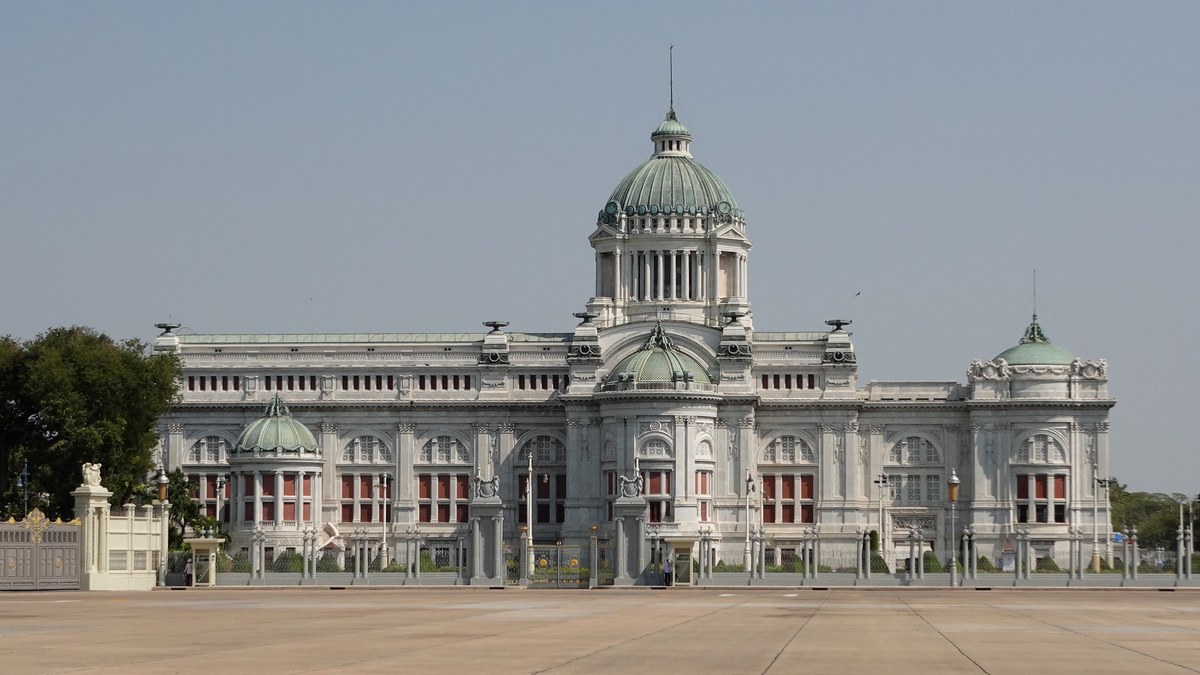
Rattanakosin, from the royal citadel of 1782 to the historic districts that shaped contemporary Bangkok.
- Brahmin
- In Thailand, an officiant heir to the Hindu tradition, attached to the court, who conducts or assists royal rites of Brahmanical origin alongside the Buddhist clergy.
- Wat
- Buddhist monastic complex that brings together, within a single enclosure, several religious buildings, monks’ quarters and ancillary buildings; the word does not refer to a single building.
- Finial
- Carved ornament, often shaped like a bud or flower, placed at the top of a pillar, pinnacle or roof.
- National historic monument
- Legal status granted by the State to a building recognised for its historical value, placing it under the protection of the heritage administration.
- Royal monastery
- In Thailand, a Buddhist monastery founded, restored or placed under the patronage of the king or the royal family, and holding a particular rank.
- Relic
- Bodily remains of, or objects associated with, the Buddha or a holy figure, preserved and venerated.
- Brahmanism
- The religion of the brahmins, hereditary priests of Hindu worship; in Thailand, its rites were long performed at the royal court alongside Buddhism.
- Triyampawai
- A royal Brahmanical ceremony performed by court brahmins in honour of Shiva, formerly accompanied by a swinging rite.
- Twelve royal ceremonies
- The set of ceremonies that marked the year of the Thai royal court according to the royal calendar.
- Sao takiap
- A shorter supporting post that flanks and braces a main post of a timber structure.
- Naliwan
- Performers of the swinging rite of the royal Brahmanical Triyampawai ceremony.
Primary sources
- 1เสาชิงช้า (base de données des sites archéologiques), Sirindhorn Anthropology Centre (ศูนย์มานุษยวิทยาสิรินธร) ↗
Studies
Reference works
- 6Contributeurs de Wikipédia, Giant Swing, Wikipedia (en) ↗
- 7Sao Ching-Cha, Lonely Planet ↗
- 8Triyampavai-Tripavai: The Swing Ceremony, Thailand Foundation ↗
- 9เสาชิงช้า – วิกิชุมชน, Sirindhorn Anthropology Centre (ศูนย์มานุษยวิทยาสิรินธร) ↗
- 10Contributeurs de Wikipédia, เสาชิงช้า, Wikipedia (th) ↗
- 11Contributeurs de Wikipédia, Devasathan, Wikipedia (en) ↗
- 12Contributeurs de Wikipédia, Triyampawai ceremony, Wikipedia (en) ↗
- 13Contributeurs de Wikipédia, Wat Suthat, Wikipedia (en) ↗
- 14Giant Swing, Atlas Obscura ↗
Contemporary views
The Giant Swing (Sao Chingcha) today
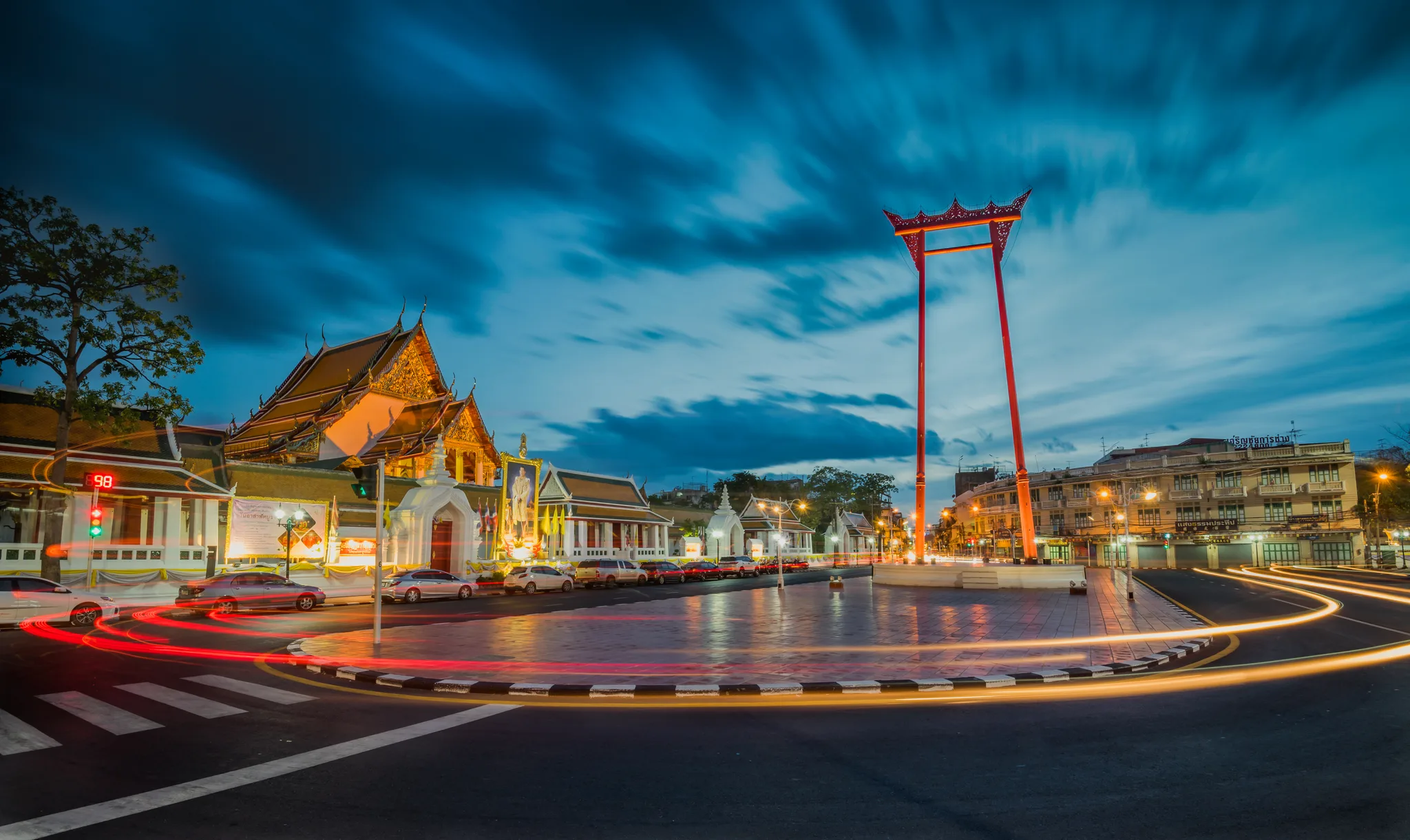
Au crépuscule, Balançoire géante (Sao Chingcha) dresse ses deux hauts piliers rouges, reliés par une traverse sculptée, au centre d’une place pavée ; à gauche, un temple aux toits étagés borde le carrefour.Nawit science — Wikimedia Commons, CC BY-SA 4.0 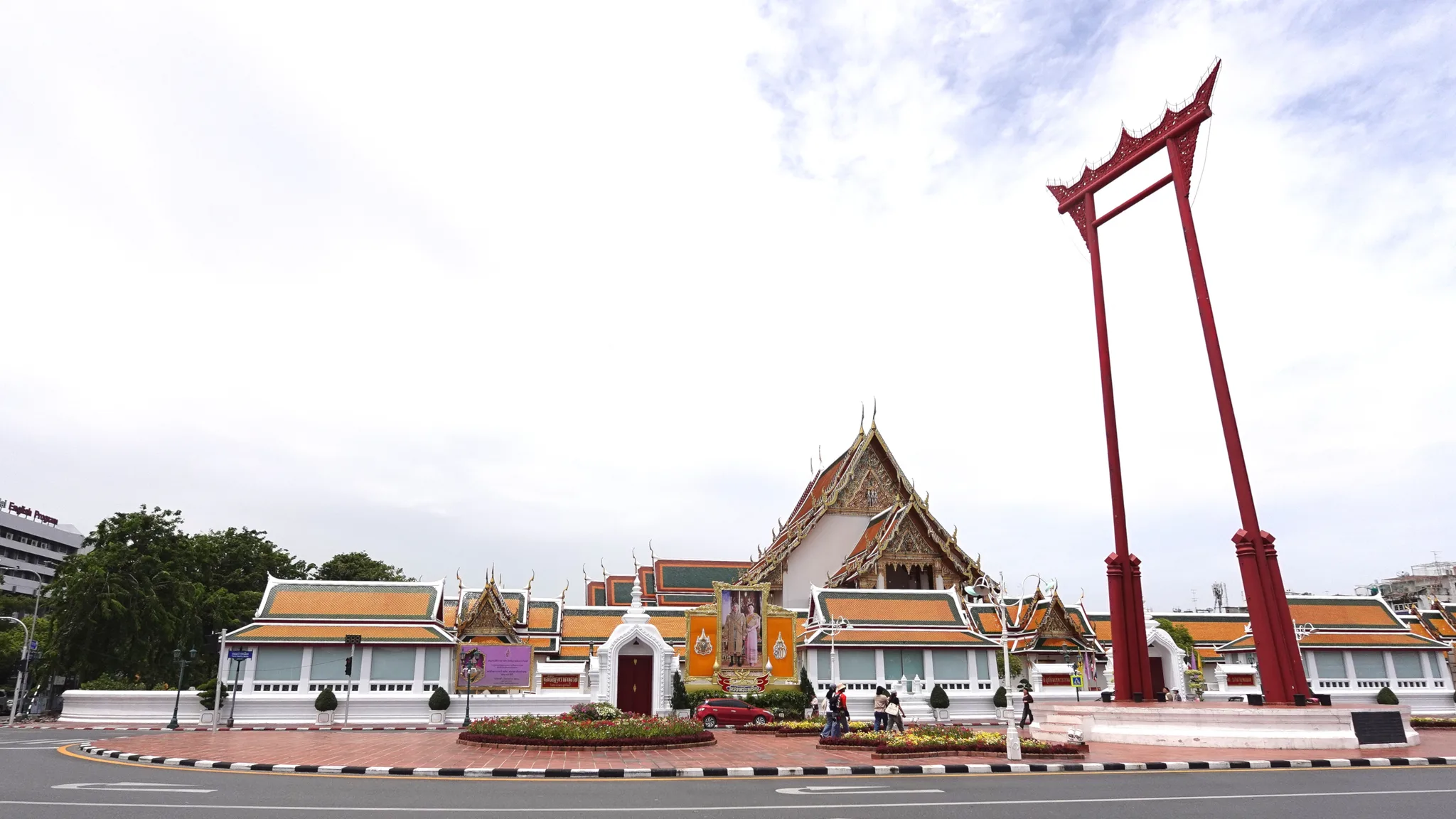
Le portique rouge de Balançoire géante (Sao Chingcha) se dresse sur un socle blanc au bord d’une place à parterres fleuris, devant l’enceinte blanche d’un temple aux toits étagés orange et verts ornés de pignons dorés.© Eric Monteil
Architecture and decoration
Explore the heritage
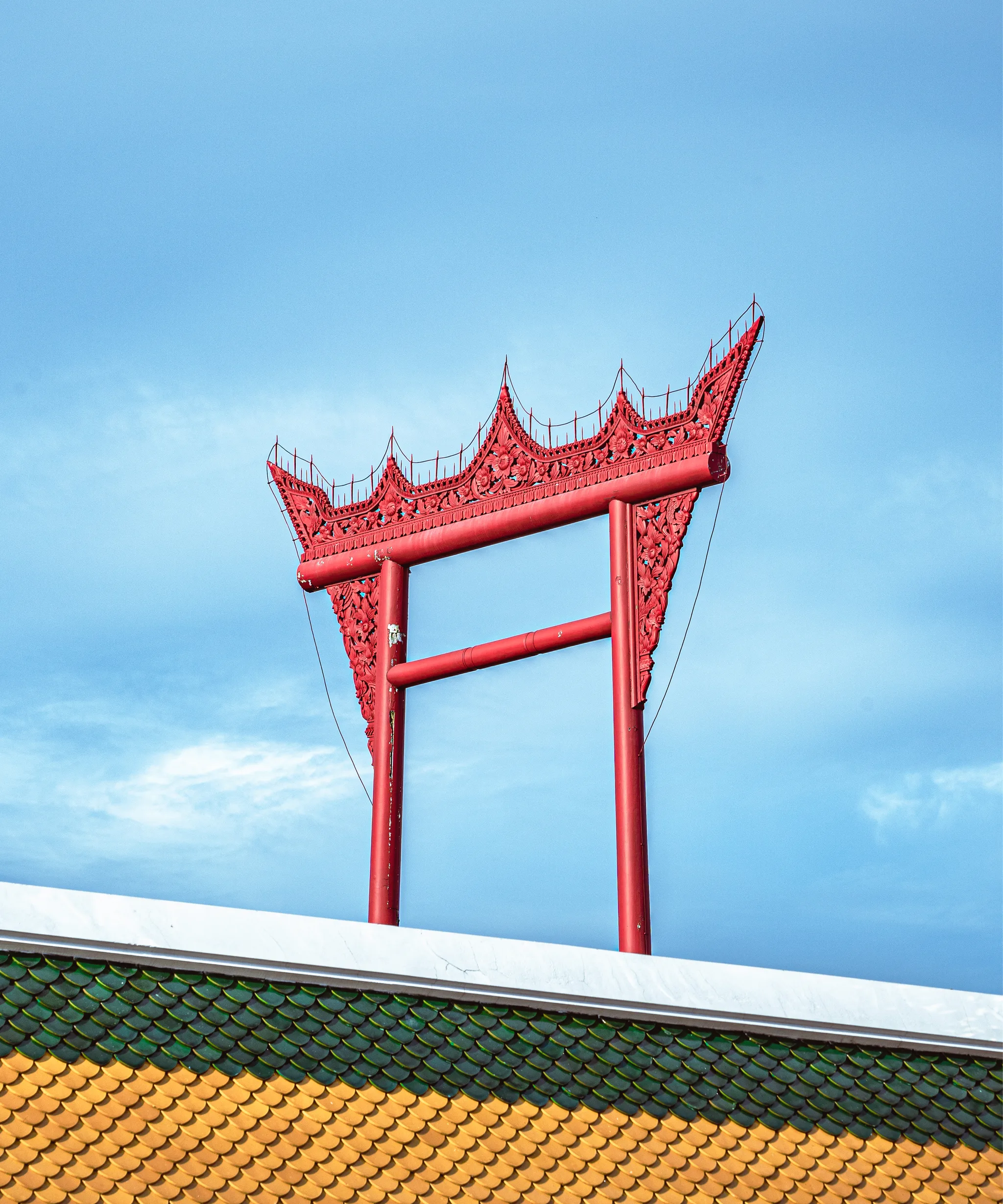
Les deux poteaux rouges de Balançoire géante (Sao Chingcha) portent une traverse ornée d’un décor ajouré de motifs végétaux, se détachant sur le ciel derrière un toit à tuiles vernissées vertes et orangées.Suntawut80 — Wikimedia Commons, CC BY-SA 4.0 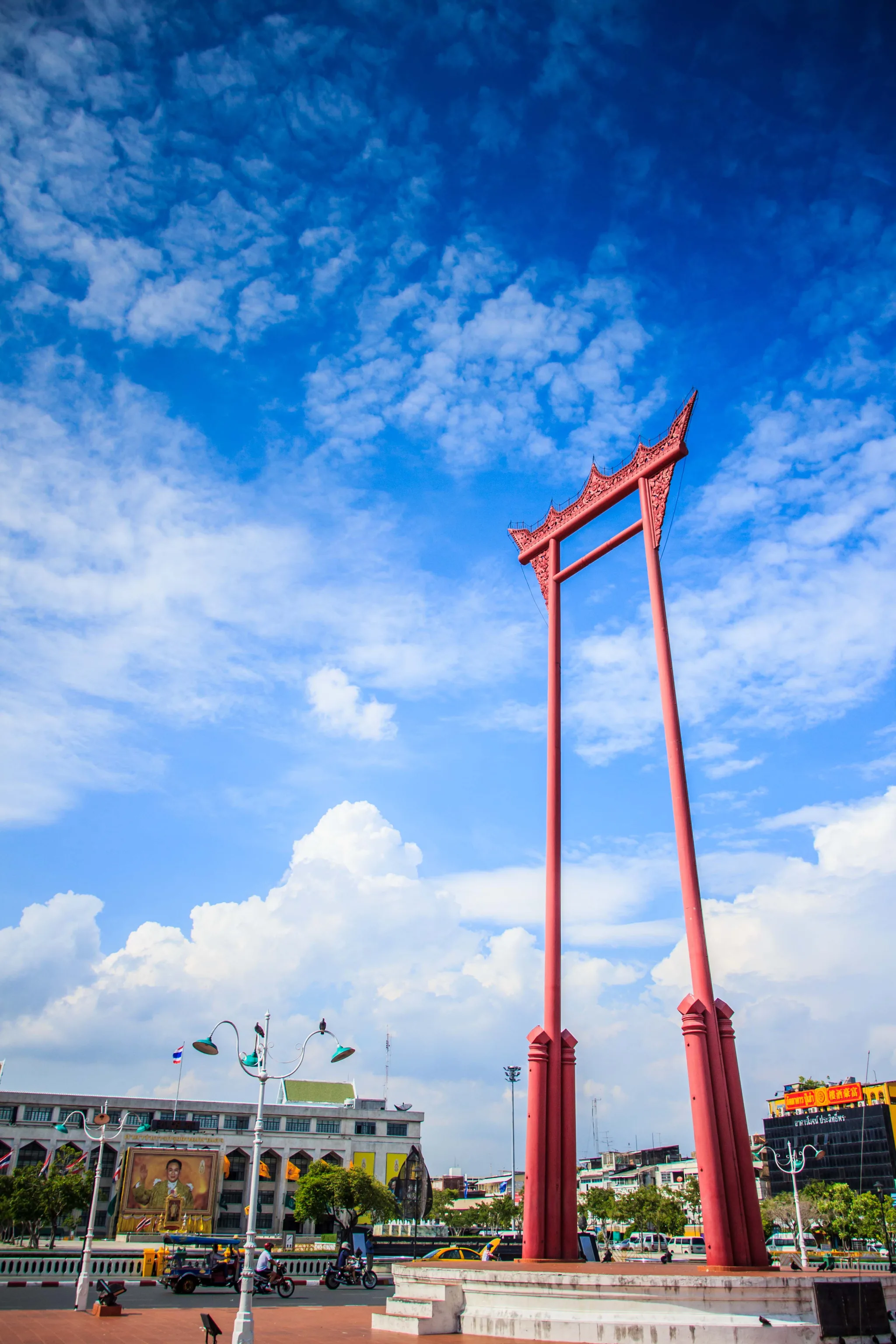
Balançoire géante (Sao Chingcha) : deux hauts piliers rouges reliés par une traverse sculptée à pignons ornés s’élèvent sur un socle blanc à degrés, au milieu d’un carrefour où circulent tuk-tuk et motos, devant un bâtiment administratif.IPhi044 — Wikimedia Commons, CC BY-SA 3.0
Archive
Memory of time passing
Historical images preserve the visual memory of places and of the ways they have changed.
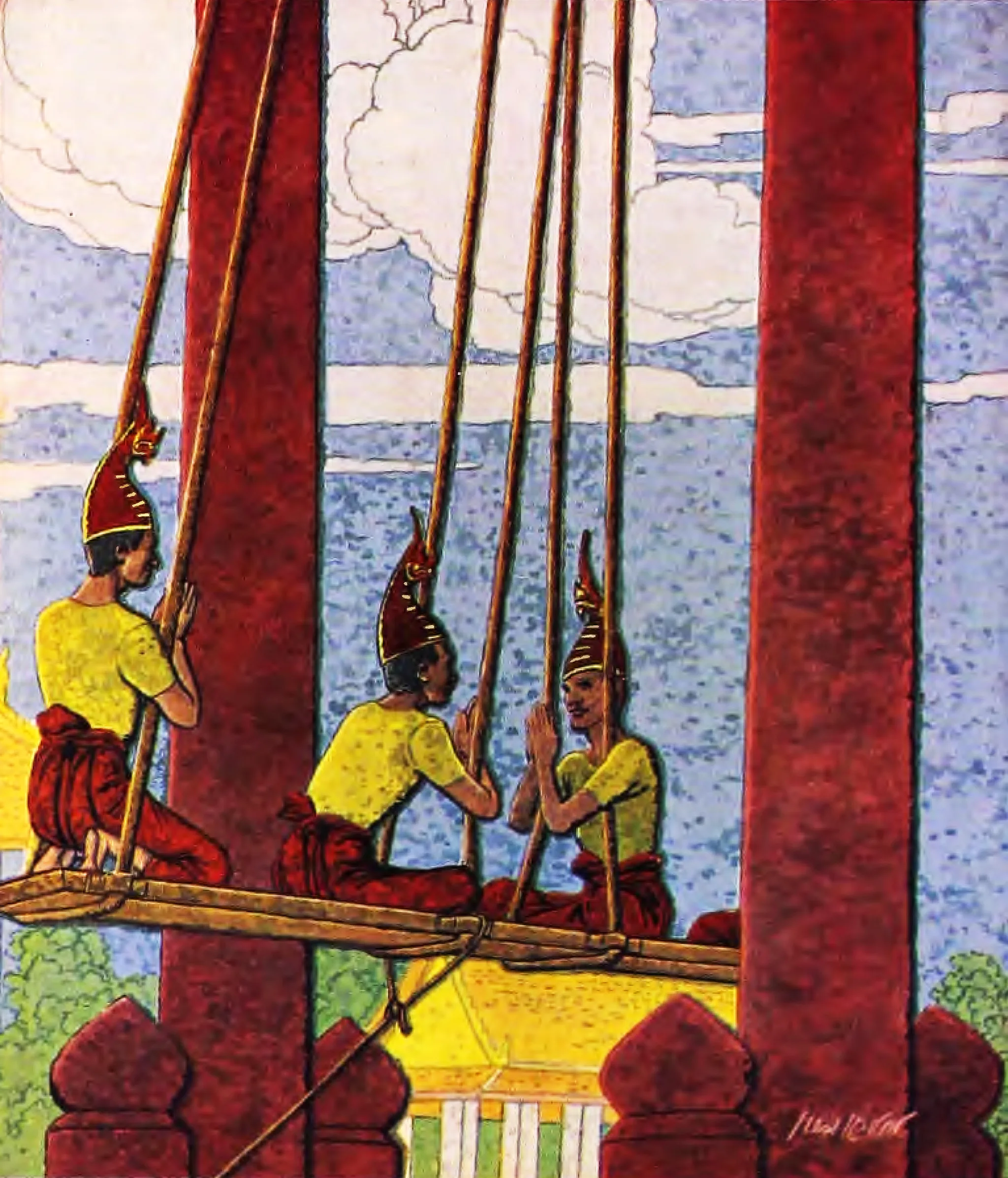
Illustration en couleur de Balançoire géante (Sao Chingcha) : trois hommes en tunique jaune et pagne rouge, coiffés de bonnets pointus, mains jointes, prennent place sur la planche de la balançoire entre ses piliers rouges, devant un toit doré.Hem Vejakorn — Wikimedia Commons, domaine public