
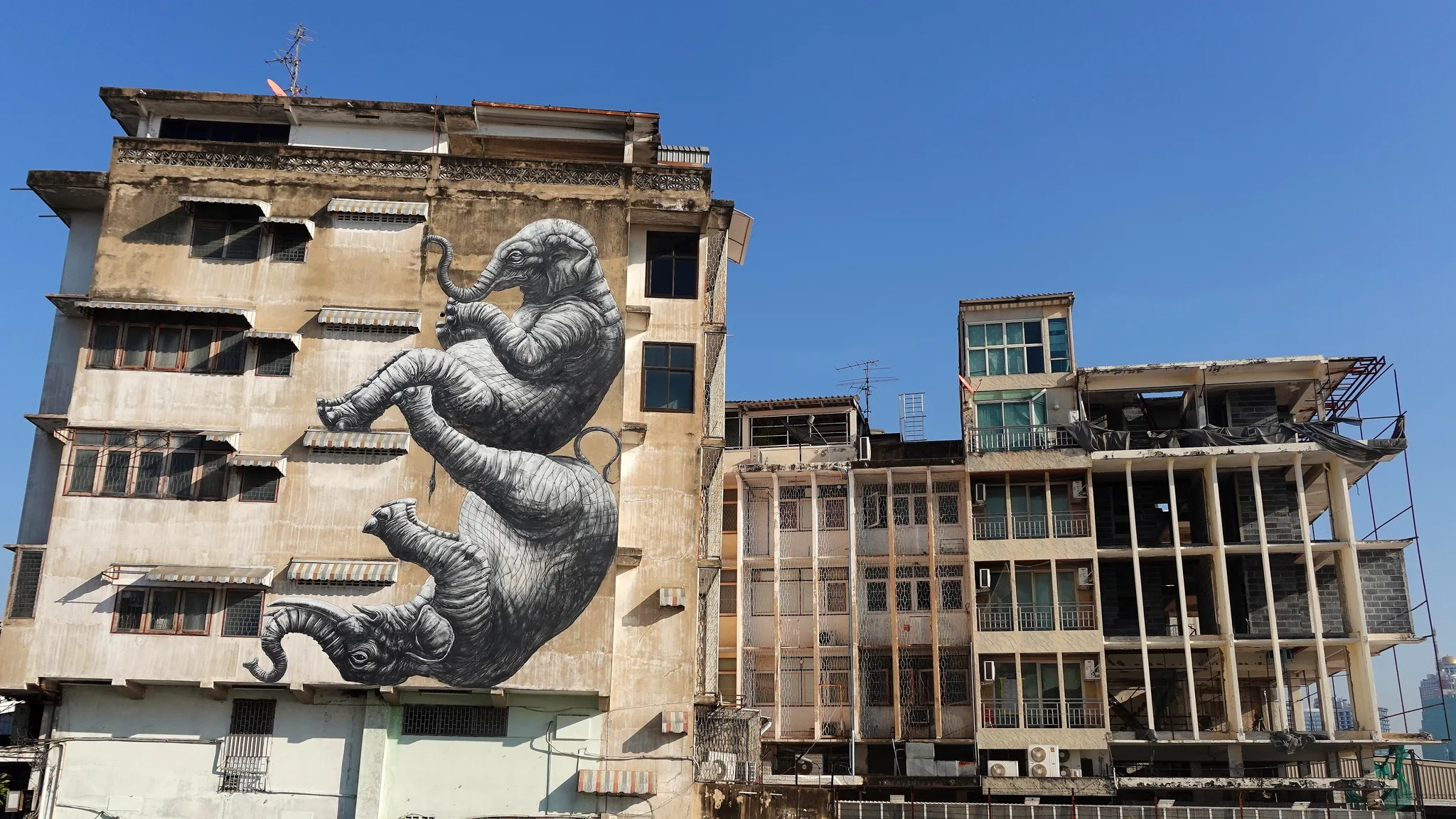
 Song Wat Street Art: on the gable of a building with striped window awnings, a large monochrome mural depicts two elephants entwined head to tail, beside residential buildings with caged balconies.© Eric Monteil
Public art & street art
Song Wat Street Art
Centred on the large murals of the 2016 Bukruk festival, the wall paintings of Song Wat Road have drawn attention to an old Bangkok trading street that is now undergoing a thorough transformation.
Heritage family · Arts, aesthetics and creation
- Destination
- Bangkok (Samphanthawong)
- Heritage Family
- Arts, aesthetics and creation
- Typology
- Public art & street art
- Visit
- Available tours →
Song Wat Street Art refers to the collection of murals lining Song Wat Road, in Bangkok’s Samphanthawong district, on the edge of Chinatown. The large murals created during the 2016 Bukruk festival make up the bulk of it. They drew attention to an underrated street, laid out on the initiative of King Chulalongkorn and long devoted to river and wholesale trade. These ephemeral works, which have no official boundary, now accompany the transformation of the neighbourhood. Their landmark remains a pair of black-and-white elephants, painted upside down by the Belgian artist ROA on a wall near the river.19
Key facts
- Destination
- Bangkok
- Heritage Family
- Arts, aesthetics and creation
- Typology
- Public art & street art
- Places
- Songwat Lane
- Chao Phraya River
- Samphanthawong
- Song Wat Road
- Periods
- People
- Aitch
- Rama V
- ROA
- Communities
- Made in Song Wat
- Events
- Bangkok Design Week
- Bangkok Design Week 2026
- Bukruk II Urban Arts Festival
- Awakening Song Wat
- Heritage
- —
- Glossary
- Wat
- Shophouse
- Sen
- Thanon
- Keywords
- —
- Date
- —
- Collections
- —
Practical info
Practical information about this site is taken from its Google Maps page. We advise you to check it before visiting.
- Address
- PGP5+XFP, Song Wat Rd, Khwaeng Samphanthawong, Khet Samphanthawong, Krung Thep Maha Nakhon 10100
A street born of trade
The “king’s drawing”
Song Wat Road (Thanon Song Wat) runs for a little over a kilometre through the Samphanthawong district. It links Ratchawong Pier, on the riverbank, with Charoen Krung Road. Its name translates as “king’s drawing”. A story handed down from generation to generation holds that King Chulalongkorn himself traced the street in pencil on a map. The anecdote belongs to tradition, but it preserves an established fact: the street was born of a royal initiative.9
The street was opened in two stages during the reign of Chulalongkorn. One section, from Chak Phet Road to what is now Yaowaphanit Road, was completed in 1892, followed by an extension to Charoen Krung Road in 1907.19
A hub of river and wholesale trade
Open to the river, Song Wat first became a hub of river trade and wholesale commerce. Its buildings were not merely shophouses, those narrow, terraced houses with shops opening onto the street: many also served as offices and warehouses. Indians, Chinese and Thais lived and traded there side by side. The street also saw the birth of major companies: CP Group and Bangkok Bank both started out there.1
In 2016, the artists of the Bukruk festival painted their murals on the walls of these buildings, some of them dilapidated. The street was underrated at the time.1
Bukruk 2016: the birth of a collection
A Thai–European street art festival
Bukruk is a Thai–European street art festival. After a first edition in 2013, the second was held from 24 to 29 January 2016. It offered murals in public spaces, exhibitions, meetings with the artists, a party night and a music festival. The artists came from Thailand, Spain, South Korea, the Netherlands, Greece and Japan, among other countries. Their works were spread across several old neighbourhoods near Charoen Krung Road: Bang Rak, Si Phraya, Surawong, Talat Noi and Song Wat.22
Song Wat is therefore just one stop on a wider route through the old trading quarters along the river. For the photographer Koen Olie, who photographs Bangkok’s street art, the two editions of Bukruk helped to make Thai street art respectable.21
Three giant murals at the eastern end
The large paintings of 2016 are concentrated at the eastern end of the street, near the Buddhist monastery of Wat Pathum Khongkha. Three giant murals by foreign artists were created there during the festival. ROA and the Romanian artist Aitch are among their creators.1
It is this small group of works that forms the core of Song Wat Street Art. It lies next to Talat Noi, another old neighbourhood where street art has also flourished.
Reading the walls
ROA’s elephants
Aitch’s floral mural
A collection with shifting outlines
Song Wat Street Art is neither a single work nor a site with official boundaries. The name denotes an open collection: more recent paintings have been added to the 2016 core, while some older works are fading away. Reading these walls therefore means picking out several successive layers rather than a fixed collection.
First come the large murals of the Bukruk festival, then the interventions linked to more recent events. During Bangkok Design Week 2026, for instance, the HUGS Songwat building received graffiti. Decorated manhole covers designed for the street, meanwhile, are set into the ground. The collection changes along with the street itself, and it is in this movement that it takes on its meaning.14
From mural to neighbourhood
A fresh look at an underrated street
ROA’s mural acted as a trigger. It drew attention to a street that had until then been underrated. The murals serve first and foremost as a photographic backdrop: people pose in front of them for selfies.2
In 2023, Time Out magazine ranked Song Wat Road among the forty “coolest” neighbourhoods in the world.19
From warehouses to cafés
In the wake of this attention, the street is changing. Cafés, galleries and perfume and fashion boutiques are moving into the former shophouses and warehouses. Song Wat is becoming a neighbourhood for shopping and leisure. Buildings constructed for trade and storage now welcome visitors who come to stroll, and the painted walls are blending into this new setting.20
This evolution has not, however, erased the everyday life of the street. The Thai authorities themselves present Talat Noi and Song Wat as lived-in neighbourhoods, and not merely as backdrops for street art: they contain old houses, shrines, workshops and contemporary art spaces. On this reading, the murals are one layer among others in a living neighbourhood.23
Song Wat today: a street brought to life by its people
Made in Song Wat: a local initiative
Part of the street’s cultural life is driven by Made in Song Wat, a local collective. It is led by Kiattiwat Srichanwanpen, founder of the PLAY Art House gallery. The collective organises workshops, including in heritage venues such as the Lao Pun Tao Kong shrine.8
These workshops connect contemporary creation with the street’s historic places.
Design and light
Bangkok Design Week, an event devoted to design, has made Song Wat one of its venues. In 2024, the “Songwat Lay Back” programme took place there. In 2026, “Merchants of Song Wat” offered a life-size board game and an installation at Tuk Khaek, a historic building on the street. This programme builds on the “Song Wat Identity Manhole Covers”, decorated manhole covers produced by an artist in collaboration with the Bangkok Metropolitan Administration. The same year, the HUGS Songwat building presented graffiti, a night-time video projection by the artist Phichaya Sriraphong and renovated pedestrian crossings.17
Light, too, has joined paint. From 8 to 17 August 2025, the Awakening Song Wat festival presented fourteen light and digital installations, spread along the street and visible in the evening. The invited artists included Pann Singharaj and Kamin Phakdurong.6
A street promoted by the authorities
In August 2025, the Ministry of Commerce announced its intention to make Song Wat a new Bangkok landmark. It draws on the “Old Soul, New Style” concept championed by the Minister of Commerce, Jatuporn Buruspat. The Samphanthawong District Office is to improve toilets, safety and traffic, and a map of the shops is to be published for visitors. A street first discovered thanks to artists is thus becoming a public tourism development project.6
Private players are also taking it up. SIAMJNK is behind a revitalisation project called “Song Wat 1” and has announced a programme, “Sen Song Wat Sang Mueang”, for Bangkok Design Week 2027. The 2016 murals preceded this broader movement.13
Understanding
Song Wat Street Art is not a monument but a living collection of paintings on the walls of an old trading street. It was born of a festival, Bukruk, which brought artists from several countries to the old riverside neighbourhoods. Its importance lies less in any individual work than in what it set in motion: a fresh look at a street laid out under Chulalongkorn, where some of the country’s major companies began. Yet these murals are fragile. They fade and disappear, while the street fills with cafés, galleries and boutiques. The Ministry of Commerce wants to make it a Bangkok landmark, private players are launching projects there, and design events follow one another. The Thai authorities, for their part, point out that Song Wat remains a lived-in neighbourhood, with its shrines and workshops. If ROA’s elephants in turn fade away, what will still make Song Wat a street of art rather than simply a fashionable neighbourhood?
Through Bangkok's creative districts, between street art, architecture, design and new uses of the city.
- Wat
- Buddhist monastic complex that brings together, within a single enclosure, several religious buildings, monks’ quarters and ancillary buildings; the word does not refer to a single building.
- Shophouse
- A narrow, deep urban house built in a row, whose ground floor serves as a shop and upper floor as living quarters, typical of the trading towns of South-East Asia.
- Sen
- In traditional Thai medicine, energy lines held to run through the body, on which traditional massage acts.
- Thanon
- Thai word meaning ‘street’ or ‘road’. Placed before a proper name, it forms the official name of a thoroughfare, often rendered in French as ‘rue’ and in English as ‘Road’.
Studies
- 1A lesser-known side of Chinatown, Bangkok Post ↗
- 2Why Song Wat Is Bangkok's Coolest Community to Visit Now, The Nation Thailand ↗
- 3These murals highlight Talad Noi's rise as Bangkok's hub of street art, BK Magazine ↗
- 415 awesome works of street art from Bangkok's Bukruk Festival, BK Magazine, 2016 ↗
- 54 HOURS in ทรงวาด, The Standard ↗
- 6Bangkok's Song Wat Road targeted as new tourist hotspot, Bangkok Post, 2025 ↗
- 7'Awakening Song Wat' brings art to the street, Bangkok Post, 2025 ↗
- 8Bangkok's Song Wat Road: A new tourist hotspot (visual story), Bangkok Post, 2025 ↗
- 9ถนนทรงวาด ใครเป็นคนวาด?, Sanook ↗
- 10ทรงวาด ถนนหลังไชน่าทาวน์ที่คนรุ่นใหม่กำลังเขียนใหม่, The Cloud, 2026 ↗
- 11Where to Eat, Drink, Play, and Stay in Song Wat, Guide Michelin ↗
- 12A Walk Through Song Wat, Thai PBS World ↗
- 13SIAMJNK Chinatown Song Wat charts a future rooted in history, The Nation Thailand ↗
- 14Bangkok Design Week 2026 ชวนสัมผัสพลังวัฒนธรรมทรงวาด-ตลาดน้อย ที่ HUGS Songwat, The People, 2026 ↗
- 15Kaweewat Siwanartwong, Merchants of Song Wat, Time Out Bangkok, 2026 ↗
- 16ล้ง 1919 - ถนนทรงวาด: ประวัติศาสตร์ที่หวนคืน, Spacebar ↗
Reference works
- 17Merchants of Song Wat – Bangkok Design Week 2026, Bangkok Design Week, 2026 ↗
- 183D Design Team – Songwat Lay Back (BKKDW 2024), Bangkok Design Week, 2024 ↗
- 19Contributeurs Wikipédia, Song Wat Road, Wikipedia ↗
- 20Song Wat Road: From Smelling Spices to Smelling Soaps, Cushman & Wakefield Thailand, 2026 ↗
- 21Koen Olie, Art on the Streets, art58koen.net ↗
- 22Bukruk Urban Arts Festival, Bangkok, Talkingthailand, 2016 ↗
- 23ตลาดน้อย และถนนทรงวาด, am2026thailand.go.th ↗
- 24Bukruk (บุกรุก): World-class art invades the beautiful streets of Charoen Krung, Readme.me ↗
Contemporary views
Song Wat Street Art today
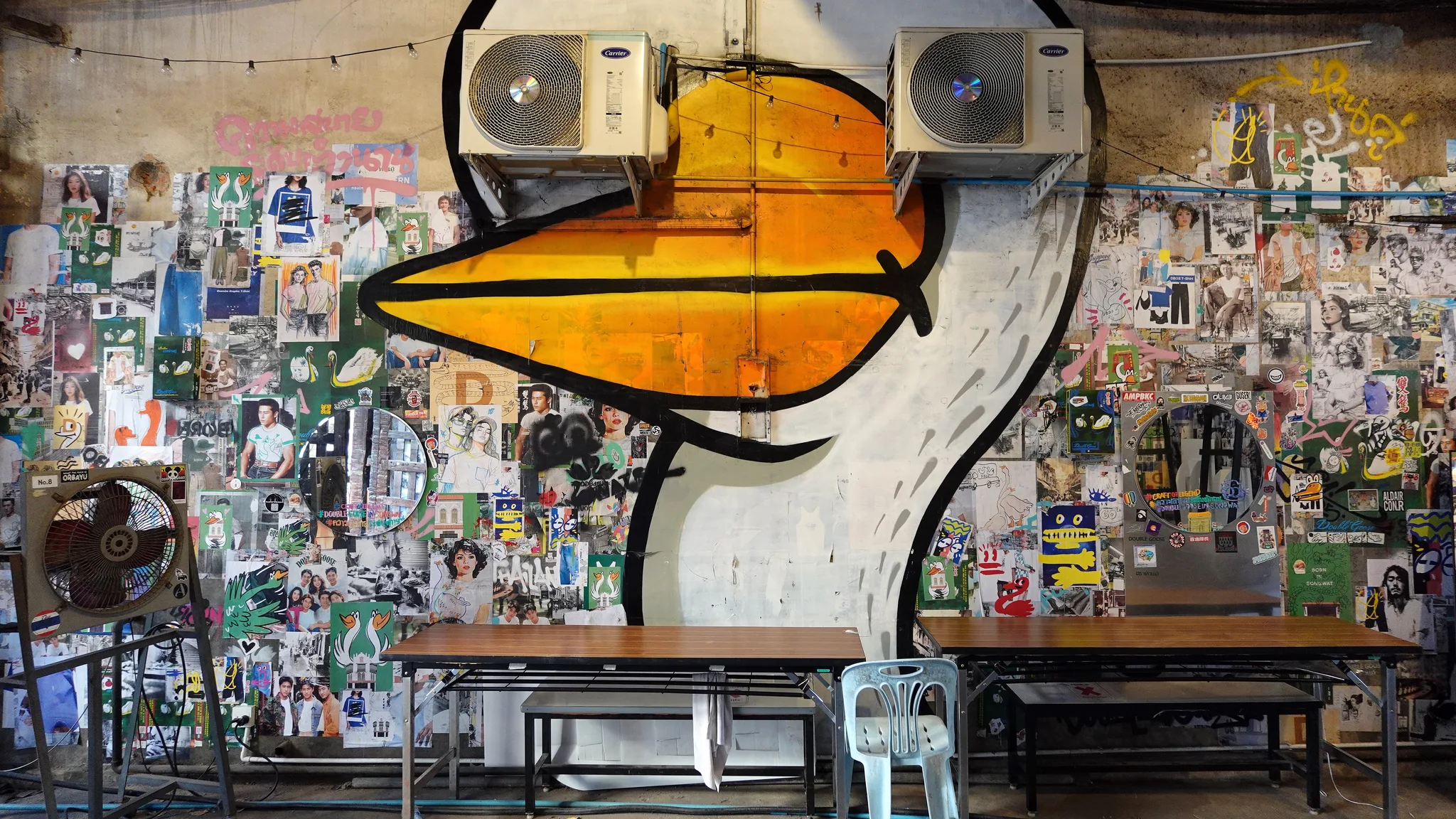
Song Wat Street Art: a mural of a stylised bird with an orange beak spreads between two air-conditioning units, on a wall covered with posters, photographs and stickers, in front of tables and a fan.© Eric Monteil 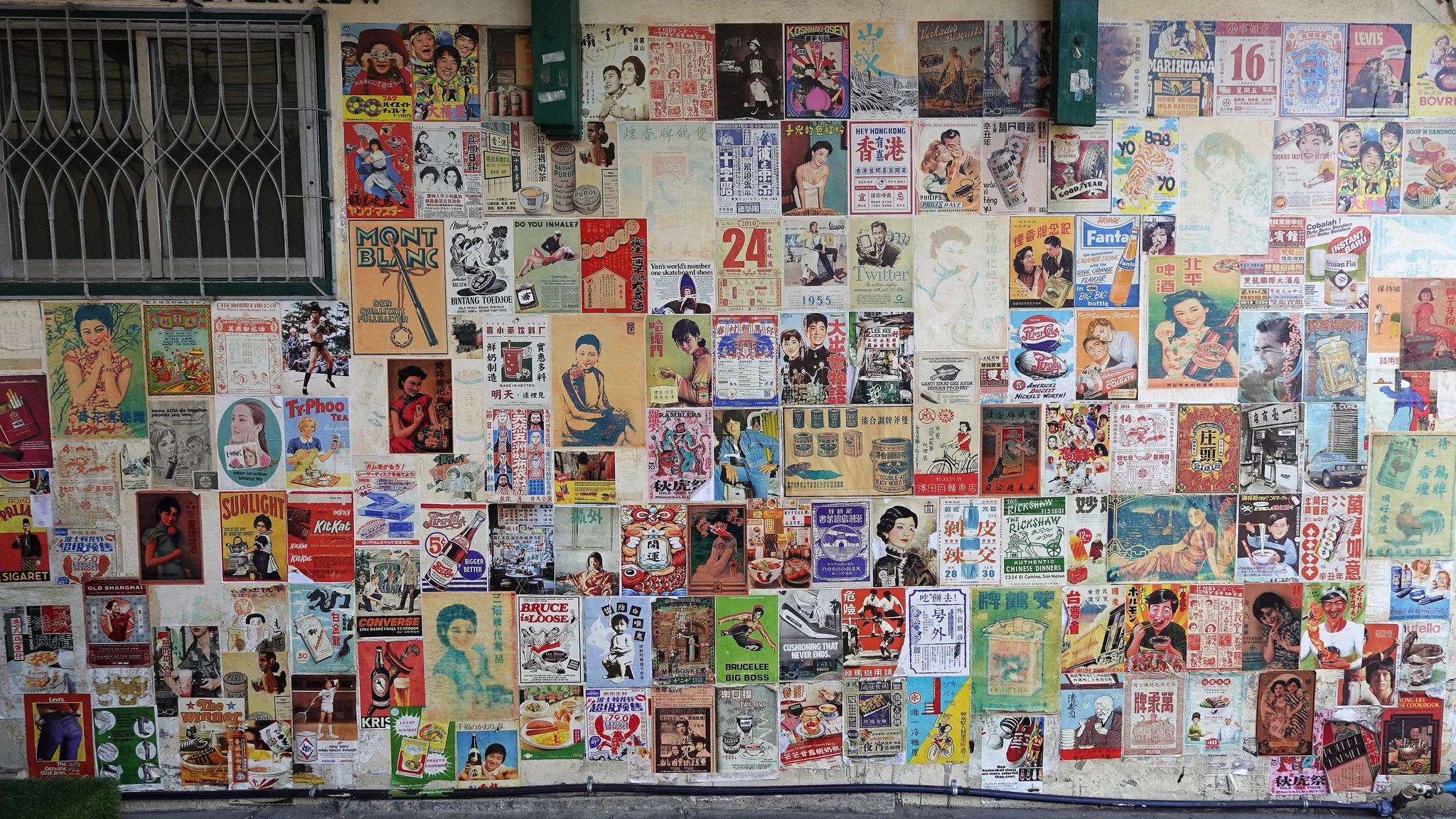
At Song Wat Street Art, an entire wall is papered with retro-style posters: product advertisements, portraits of women, and inscriptions in Chinese characters and English, forming a colourful collage along the street.© Eric Monteil
Architecture and decoration
Explore the heritage
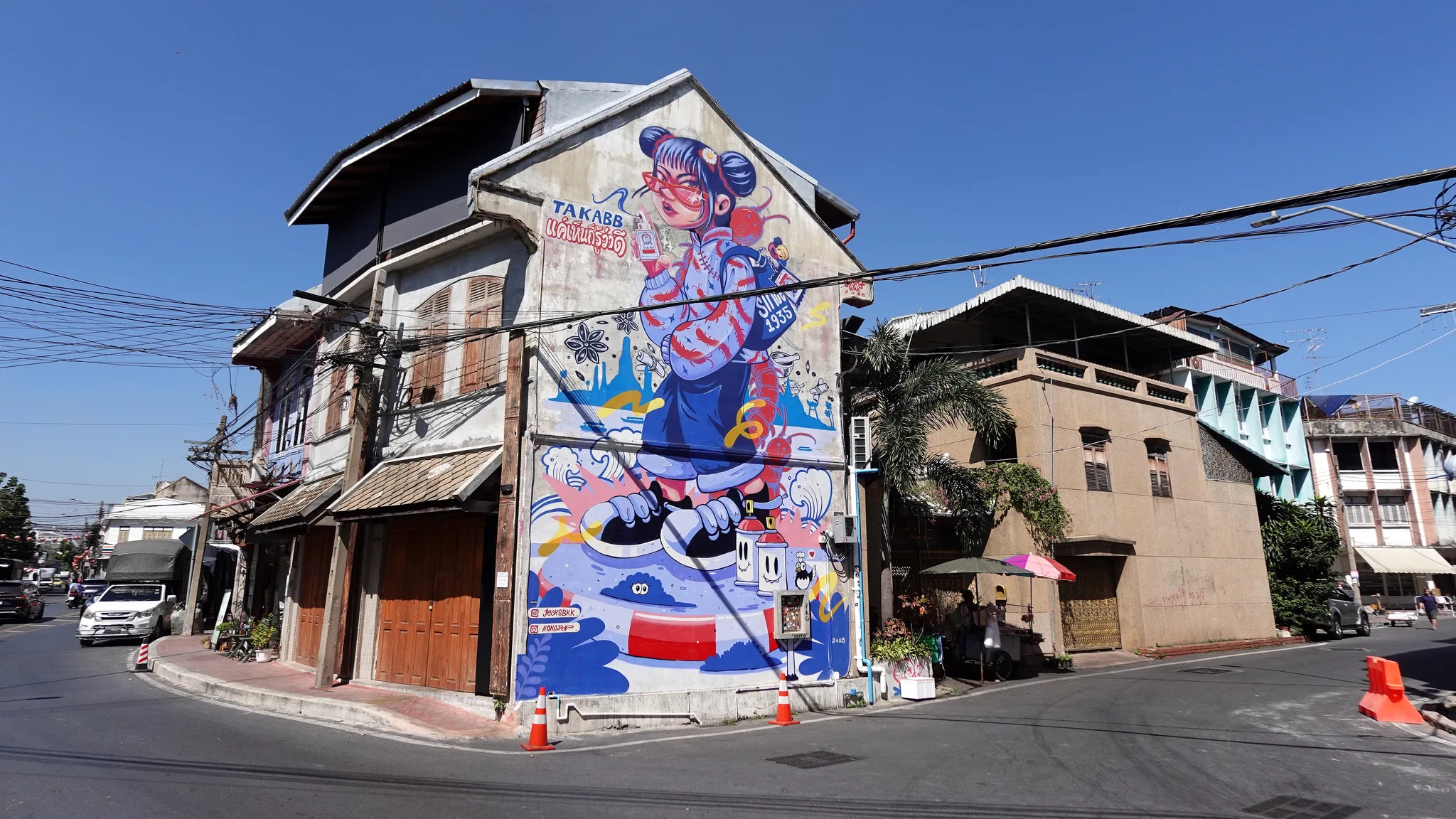
Song Wat Street Art: the gable of an old shophouse with wooden shutters bears a large mural signed “Takabb”, depicting a young woman in trainers surrounded by waves, flowers and a stylised chedi, at the corner of two streets.© Eric Monteil 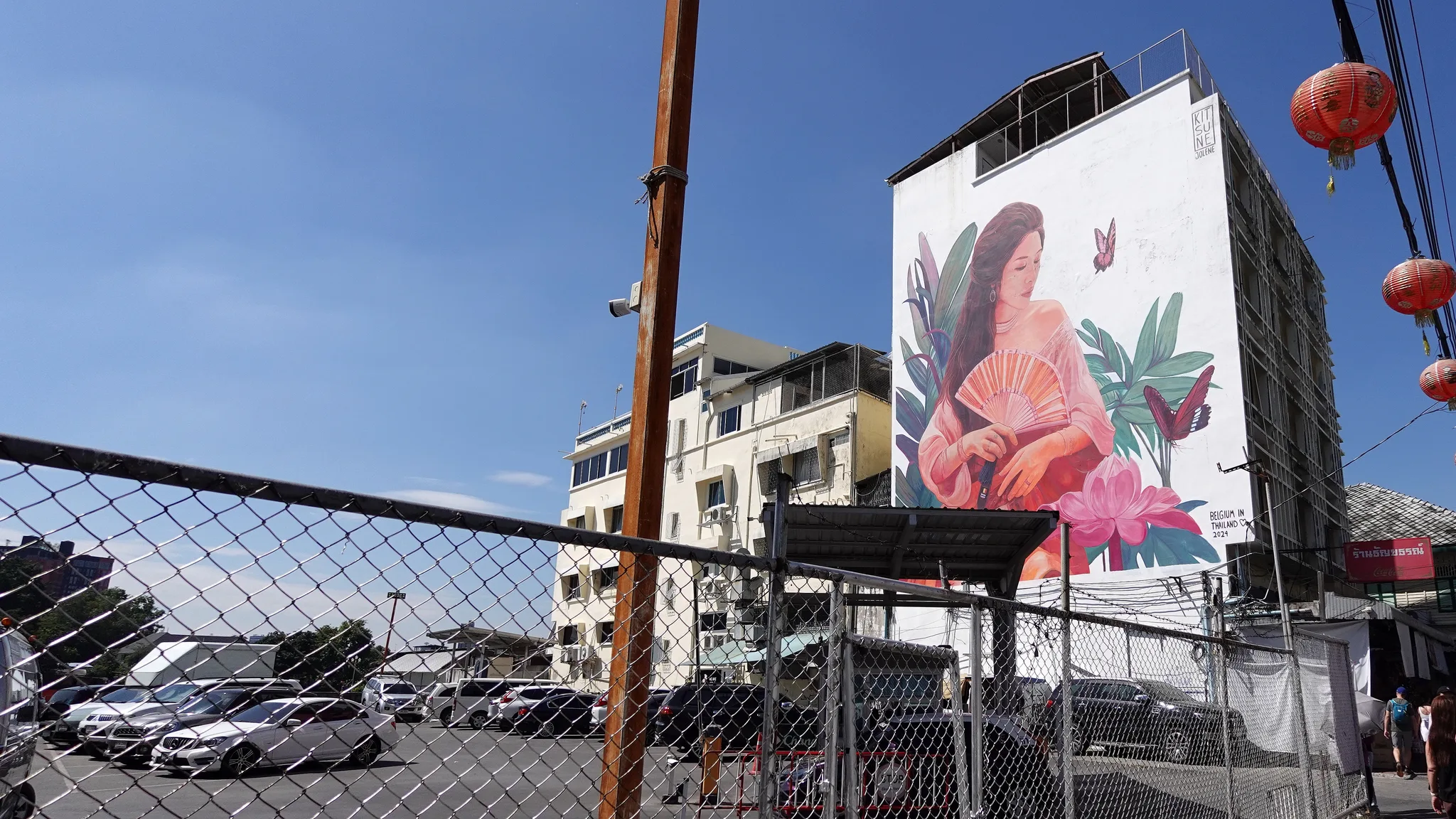
Song Wat Street Art: on the white gable of a building, a mural shows a woman in a pink dress holding a fan, surrounded by foliage, a pink flower and butterflies, above a car park lined with red lanterns.© Eric Monteil