
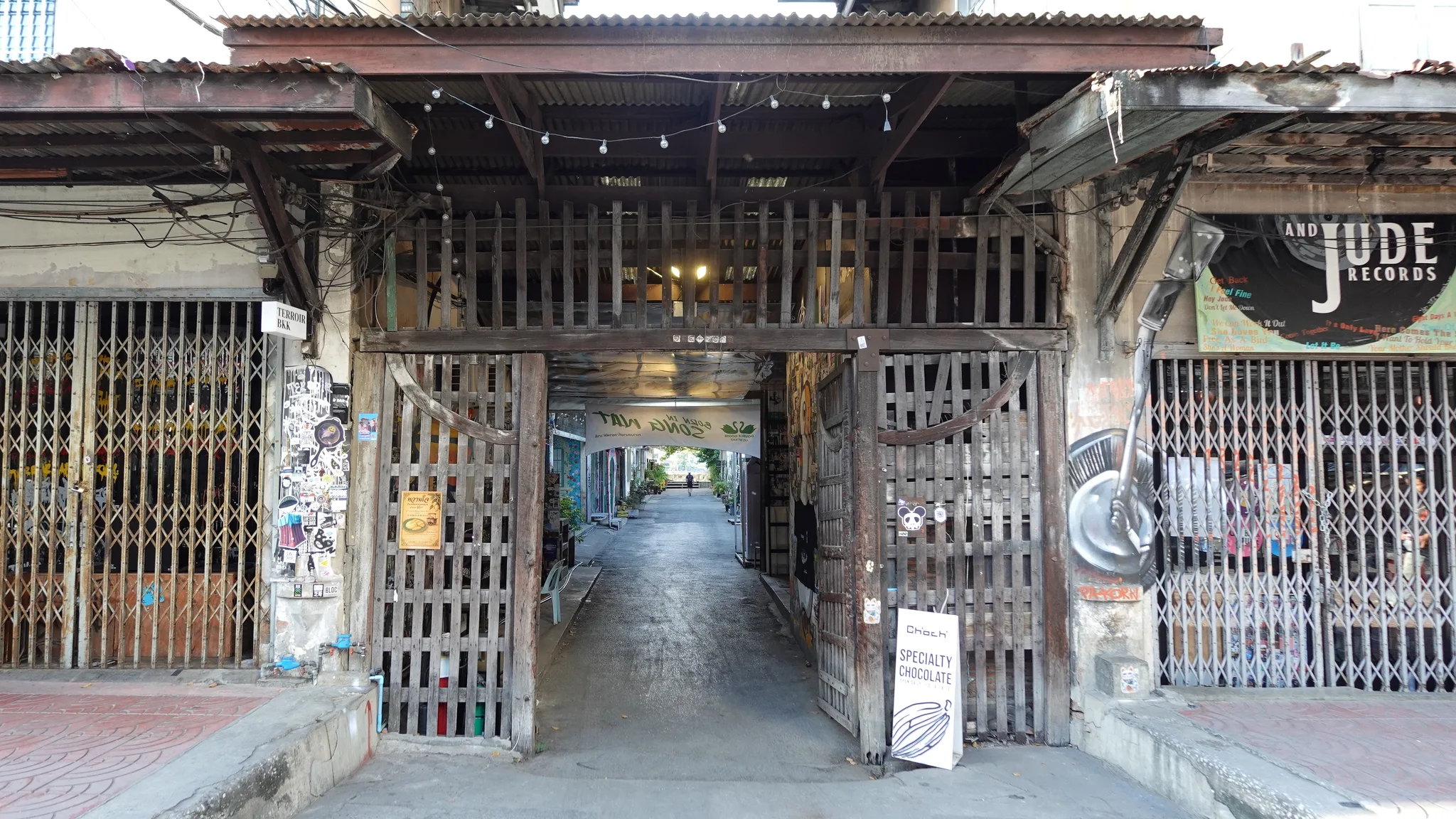
 At Songwat Lane, a weathered wooden lattice gateway beneath a corrugated metal canopy opens onto an alley lined with shops; on either side, shopfronts with folding grilles display signs and posters.© Eric Monteil
Rehabilitation & adaptive reuse
Songwat Lane
Opened under King Chulalongkorn between the Chao Phraya River and Chinatown, Bangkok’s street of wholesalers and warehouses is becoming a creative quarter driven by its residents.
Heritage family · Heritage in transition
- Destination
- Bangkok (Samphanthawong)
- Heritage Family
- Heritage in transition
- Typology
- Rehabilitation & adaptive reuse
- Visit
- Available tours →
Songwat Lane is a historic street in the Samphanthawong district of Bangkok. It runs alongside the Chao Phraya River on the edge of the capital’s Chinatown. Opened on the initiative of King Chulalongkorn at the turn of the twentieth century, it was for decades one of the gateways of the city’s river trade. Wholesalers, spice merchants and warehouse keepers received goods arriving by boat, and great merchant families of Chinese origin got their start here. Lined with century-old buildings that served at once as shops, offices and warehouses, it has been reinventing itself since the mid-2010s as a creative quarter, though its built heritage is not yet clearly protected.16
Key facts
- Destination
- Bangkok
- Heritage Family
- Heritage in transition
- Typology
- Rehabilitation & adaptive reuse
- Places
- Song Wat Street Art
- Chao Phraya River
- Samphanthawong
- Song Wat Road
- Periods
- People
- Rama IV (Mongkut)
- Rama V
- Communities
- Teochew Chinese community of Bangkok
- Made in Song Wat
- Events
- Bukruk II Urban Arts Festival
- Awakening Song Wat
- Opening
- Krung Rattanakosin Conservation and Development Master Plan (1982)
- Heritage
- —
- Glossary
- Wat
- Shophouse
- Trok
- Chao sua
- Sino-Western
- Keywords
- —
- Date
- —
- Collections
- —
Practical info
Practical information about this site is taken from its Google Maps page. We advise you to check it before visiting.
- Address
- ถนนทรงวาด แขวงสัมพันธวงศ์ และแขวงจักรวรรดิ เขตสัมพันธวงศ์ PGQ4+8QG, Khwaeng Chakkrawat, จักรวรรดิ Krung Thep Maha Nakhon 10100
- Phone
A street between the river and Chinatown
A route along the Chao Phraya
Songwat Lane runs for about a kilometre through the heart of old mercantile Bangkok. It starts at Ratchawong Road, near Ratchawong Pier, and heads east to the Khao Lam roundabout. There it meets Khao Lam Road and Charoen Krung Road, in the Talat Noi sub-district. Charoen Krung, the great avenue opened several decades earlier during the reign of Rama IV, thus marks the end of the street. Between these two ends, Songwat Lane follows the Chao Phraya River, almost parallel to Yaowarat, the main artery of Bangkok’s Chinatown, which is longer and more winding.16
This position between the river and the city shaped its entire history. On the Chao Phraya side, small streets and alleys link it to the quays. One of them, Song Soem Road, branches off and ends almost at once at a pier. At some twenty metres long, it is reputed to be the shortest road in Thailand. On the city side, the street adjoins the large Chinese community of Yaowarat, to which it remains closely tied. On the ground, the passages running down to the river recall that the street long served as the link between the boats and the city’s warehouses.16
A name from the king
The street’s name, Song Wat in Thai, translates as ‘drawn by the king’. It refers to King Chulalongkorn, known as Rama V, who initiated the road. According to tradition, he traced its route himself, by his own hand, in pencil on a map. This gesture is said to have given the street the name it still bears. The story has been handed down as a tale of the neighbourhood. It links the street lastingly to the person of the sovereign.16
The birth of a royal thoroughfare
After the Sampheng fire
The creation of the street is linked to the redevelopment of Sampheng, Bangkok’s old Chinese merchant quarter, after a great fire. The Siamese government then wished to extend roads and public services to a wider area, as far as Yaowarat. It also sought to relieve congestion in a very dense quarter and to support trade and facilities that were growing fast. The new road formed part of a network already taking shape. Charoen Krung had existed since the reign of Rama IV.16
This context explains the nature of the street. It was a road designed for a trading quarter, whose booming commerce it was meant to support. The royal gesture that tradition attaches to its name thus applies to a working street, intended for merchants.
Two sections, two dates
The road was built in 1892, under Rama V, in the aftermath of a great fire in Sampheng.16
The construction itself took place in two stages. A first section, completed in 1892, stopped at Trok Rong Krata, since renamed Yaowaphanit Road. The second ran from that point to Charoen Krung Road. It was completed in 1907 and gave the street its present form. Some fifteen years thus separate the partial opening of the road from its connection to the great avenue. Only from that date did the street link Ratchawong to Charoen Krung without interruption.16
The age of river trade
River access for the capital
Once open, the street became one of Bangkok’s main points of access to river transport. The alleys running down to the Chao Phraya led to the port. This was where the steamers docked that linked the capital with Chon Buri province and with Ban Don, in Surat Thani province, in the south of the country. Barges also plied between the coastal towns and Bangkok. The street thus stood at the outlet of a shipping network connecting the capital with its maritime provinces.16
The area became the main transit zone for seafood, vegetables, plants and herbs arriving by boat. Thanks to its position on the river, the quarter established itself more broadly as a key centre of import and export.16
Wholesalers, spices and warehouses
Both sides of the street are lined with shophouses, the narrow, terraced shop-houses that form the fabric of merchant quarters. They housed mainly wholesalers, whose business depended on goods arriving by boat. Songwat Lane was known for spices, rice and traditional warehousing. Old spice warehouses still survive on the riverbank.16
This wholesale trade left its mark on the buildings themselves. Many were not used only for selling: they also housed offices and warehouses, where cargoes were stored and traded. In its buildings, the street thus preserves the memory of an economy of storage and transit rather than of retail.1
Merchant families and communities
This activity also shaped a society. Closely linked to the Chinese and to Thais of Chinese descent, the street saw the rise of several great families of chao sua, a Thai term for trading magnates. Major present-day companies also got their start here. The street, moreover, adjoins the large Chinese community of Yaowarat.14
Yet the quarter was never homogeneous. Thai, Chinese and Muslim cultures mingle here, as the temples, shrines and mosques standing side by side still show today. Indian merchants also kept shops here. This mixture can be read in several of the street’s buildings, which make visible the communities to which it gave a shared place of work.13
Reading the street’s buildings
Merchant houses with many uses
Century-old buildings line both sides of Songwat Lane, and their interest lies above all in their diversity. Elsewhere in Bangkok, most of the old Sino-Western commercial buildings, which combine Chinese traditions with European forms, were simple shophouses. Here, the buildings display varied designs and also served as offices and warehouses. The visitor on foot comes across well-preserved wooden shophouses, buildings from the reign of Rama V and, on the riverbank, old spice warehouses.1
Words sometimes fail to describe these façades. They are called colonial by some, neoclassical by others, or else ‘Chinese colonial’ in style. These labels vary with the observer, but all of them refer to a merchant architecture borrowing from the European vocabulary for Chinese trading houses. In these shophouses, each floor had its own function.13
The Luang Kocha Itsahak Mosque
Among the street’s notable buildings, the Luang Kocha Itsahak Mosque recalls the Muslim presence in this Chinese quarter. It bears the name of its founder, Luang Kocha Itsahak, born Koet bin Abdullah, who served as a Malay interpreter at the Krom Tha Khwa. Built under Rama V, more than a century ago, it adopts a European, neoclassical style in keeping with the taste of the period, and stands out for its yellow colour.2
It is reputed to be the only mosque located within the Chinese community. This European-looking Muslim place of worship, surrounded by Chinese trading houses, offers a tangible image of the street’s composite character.2
Shrine, school and Indian building
Other landmarks punctuate the route. At the end of the street, the Indian Building, a former textile shop run by Indian merchants, bears witness to the quarter’s multicultural past. The Lao Pun Tao Kong shrine, a heritage site on the street, has served as a workshop space during events held by the Made in Song Wat collective.12
The street’s primary school also retains two elegant old buildings. One of them houses a local museum devoted to the history of Bangkok’s Chinatown. The memory of the quarter is thus passed on in one of its own buildings, amid the merchant houses whose story it tells.1
From warehouse to creative quarter
The end of a river economy
River freight ceased to be the main mode of trade, and Songwat Lane is no longer the trading centre it once was. Many shophouses were abandoned.13
The revival came first from within. A new generation of local families restored many of these neglected shophouses. The street then gradually shifted from traditional warehousing towards retail, food and culture. This model has one particular feature: it does not rely on heavy foot traffic.12
Street art and the first businesses
The turning point came in 2016. That year, at least three large street-art works were painted at the eastern end of the street during the Bukruk Urban Art Festival. Other murals, by Western artists, cover the walls of various buildings.1
The same year, Punpitcha Taychakhoonavudh, a businesswoman, set up on the street. She opened a hostel, Hostel Urby, a bar, the Barbon Bar, and a nail salon, the Abby Nail Salon. She advocates the ecological and sustainable preservation of historic buildings. Cafés, galleries and hostels followed. Then came perfume shops, independent fashion labels and restaurants, drawn in particular by the promotion of the street on social media. The shophouses where spices and rice were once stored now hold soaps, clothes and dining tables.7
Made in Song Wat, a residents’ collective
In 2022, as the pandemic receded, the ‘Made in Song Wat’ collective was born. It brings together young entrepreneurs, long-established shopkeepers and residents. Its founder, Kiattiwat Srichanwanpen, has always lived in the quarter. He also created PLAY art house, a venue devoted to art, and is now part of the area’s management team. According to him, the project began with around ten local businesses and, two years later, brought together more than sixty. For this second anniversary, the collective published the second volume of its Song Wat Guide Book, which lists more than sixty businesses and venues.18
The street also lives to the rhythm of regular events. Song Wat Week, whose 2024 edition took place from 7 to 10 November on the theme ‘Song Wat Cross’, and the annual light festival ‘Awakening Song Wat’ are among them. The exhibitions ‘Rao Wat I’, at PLAY art house, and then ‘Rao Wat II’, shown in October 2025 at the Rosewood Bangkok hotel with nine contemporary artists, offer an artist’s perspective on the street. These events also take over old sites, such as the Lao Pun Tao Kong shrine, transformed for the duration of an event into a workshop space.18
A heritage in transition
The commitment of the public authorities
The public authorities are also supporting this revival. The Ministry of Commerce and the Bangkok Metropolitan Administration have joined forces to revitalise Songwat Lane, presented as a shopping quarter more than a hundred years old. Their work covers landscaping, toilets, safety and the organisation of parking. The street’s revival rests on continuing cooperation between young residents, local businesses and the authorities, with the support of the Bangkok Metropolitan Administration.17
This recognition now extends beyond the country’s borders. In 2023, Time Out magazine included the street in its ranking of the world’s ‘coolest’ neighbourhoods, based on the votes of more than 12,000 people. The street has thus been placed on the international map of fashionable neighbourhoods.10
Protection that remains fragile
The cultural value of the street’s buildings is now being studied, but their protection remains fragile. The problems identified concern the place of these buildings on the official heritage lists and the lack of appropriate conservation guidelines and practices. Rehabilitation itself carries threats, in the absence of a framework to guide work on old façades and structures.6
The possible inclusion of the area in the Krung Rattanakosin conservation and development master plan has also been raised.6
Authenticity and sense of place
The conversion of shophouses into cafés and restaurants raises the question of authenticity. These conversions save abandoned buildings, but they change how they are used and who frequents them. The central question becomes one of sense of place: what remains of a trading street once the trade that gave rise to it has disappeared?6
The answers differ. For some, Songwat Lane is a street that moves forward without sacrificing its past, and a possible example of a historic riverside quarter able to keep its character. Others wonder how regeneration can be reconciled with preserving the sense of place. Between the families restoring their houses, the shopkeepers moving in and the residents organised into a collective, the street is still seeking a balance between mercantile memory and new life.6
Understanding
Songwat Lane is a trading street born of a royal decision. For decades, it linked the Chao Phraya to the warehouses and merchant families of Bangkok’s Chinatown. Its importance lies less in a single monument than in an ensemble: merchant houses, warehouses, a mosque, shrines and a school together tell the story of a port city where Chinese, Thais, Muslims and Indian merchants lived side by side. Since the river ceased to carry its economy, the street has been living a second life. Residents, new shopkeepers, artists and public authorities have brought into being a quarter of cafés, galleries and festivals. Yet the protection of its buildings remains loosely regulated, and their conversion raises the question of authenticity. The collective founded in 2022 shows that this revival is also driven by those who grew up on the street. When a street made for storing and trading goods becomes above all a place where people come to look and stroll, does its mercantile past remain what gives it meaning, or does it become no more than a backdrop?
Through Bangkok's creative districts, between street art, architecture, design and new uses of the city.
- Wat
- Buddhist monastic complex that brings together, within a single enclosure, several religious buildings, monks’ quarters and ancillary buildings; the word does not refer to a single building.
- Shophouse
- A narrow, deep urban house built in a row, whose ground floor serves as a shop and upper floor as living quarters, typical of the trading towns of South-East Asia.
- Trok
- Thai word for an alley, that is, a narrow passage between buildings, generally narrower than a soi.
- Chao sua
- Thai word for wealthy trading magnates, often of Chinese origin, who built their fortunes in wholesale trade and commerce.
- Sino-Western
- Architectural style combining Chinese building traditions with forms and ornament of European inspiration, particularly in commercial buildings.
Studies
- 1A lesser-known side of Chinatown, Bangkok Post ↗
- 2ทรงวาด - ตลาดน้อย, Matichon Weekly (มติชนสุดสัปดาห์) ↗
- 3“ถนนทรงวาด” เสน่ห์ 2 ยุค สวยคลาสสิกบนถนนสายประวัติศาสตร์สมัย ร.๕, MGR Online (ผู้จัดการออนไลน์), 2022 ↗
- 4ถนนทรงวาด ใครเป็นคนวาด?, Sanook ↗
- 5ล้ง 1919 - ถนนทรงวาด: ประวัติศาสตร์ที่หวนคืน, Spacebar ↗
- 6Chomkwan, The Regeneration of the Historic Area of Song Wat through the Adaptive Reuse of Heritage Buildings and the Sense of Place, Silpakorn University, Faculty of Architecture (Architectural Heritage Management and Tourism), 2024 ↗
- 7Bangkok's Song Wat Road Transformed Into Vibrant New Lifestyle Hub, BERNAMA, 2024 ↗
- 8BERNAMA, Bangkok's Song Wat Road transformed into vibrant new lifestyle hub, Sinar Daily, 2024 ↗
- 9Why Song Wat Is Bangkok's Coolest Community to Visit Now, The Nation Thailand ↗
- 10World's 40 coolest neighbourhoods, according to Time Out, Yahoo News, 2023 ↗
- 11Bao Tram, Ngoc Diep, Song Wat Road: Bangkok's best blend of old and new, VOV World, 2025 ↗
- 12Where to Eat, Drink, Play, and Stay in Song Wat, Bangkok's Hottest Neighborhood Right Now, Guide Michelin ↗
- 13Song Wat Road, Bangkok, Thai Airways, Royal Orchid Plus Newsletter, 2026 ↗
- 14วันวาน-วันนี้ ที่ “ทรงวาด” จากย่านการค้าสำคัญสู่ย่านชิคสุดคลาสสิก, MGR Online (ผู้จัดการออนไลน์), 2023 ↗
- 15รู้จัก 'ถนนทรงวาด' ย่านตึกเก่าสุดคลาสสิค พร้อม 4 จุดเช็กอินที่ไม่ควรพลาด, Komchadluek, 2023 ↗
Reference works
- 16Contributeurs Wikipédia, Song Wat Road, Wikipedia ↗
- 17Savor the Charm of the Old District! Song Wat Road A New Landmark on Thailand's Travel Map, THAILAND.GO.TH (gouvernement thaïlandais) ↗
- 18Rosewood Bangkok Presents "RAO WAT II: Walking the Road of Song Wat Through the Artists' Lens", Rosewood Hotels & Resorts (communiqué de presse), 2025 ↗
- 19Song Wat Road: From Smelling Spices to Smelling Soaps, Cushman & Wakefield Thailand, 2026 ↗
Contemporary views
Songwat Lane today
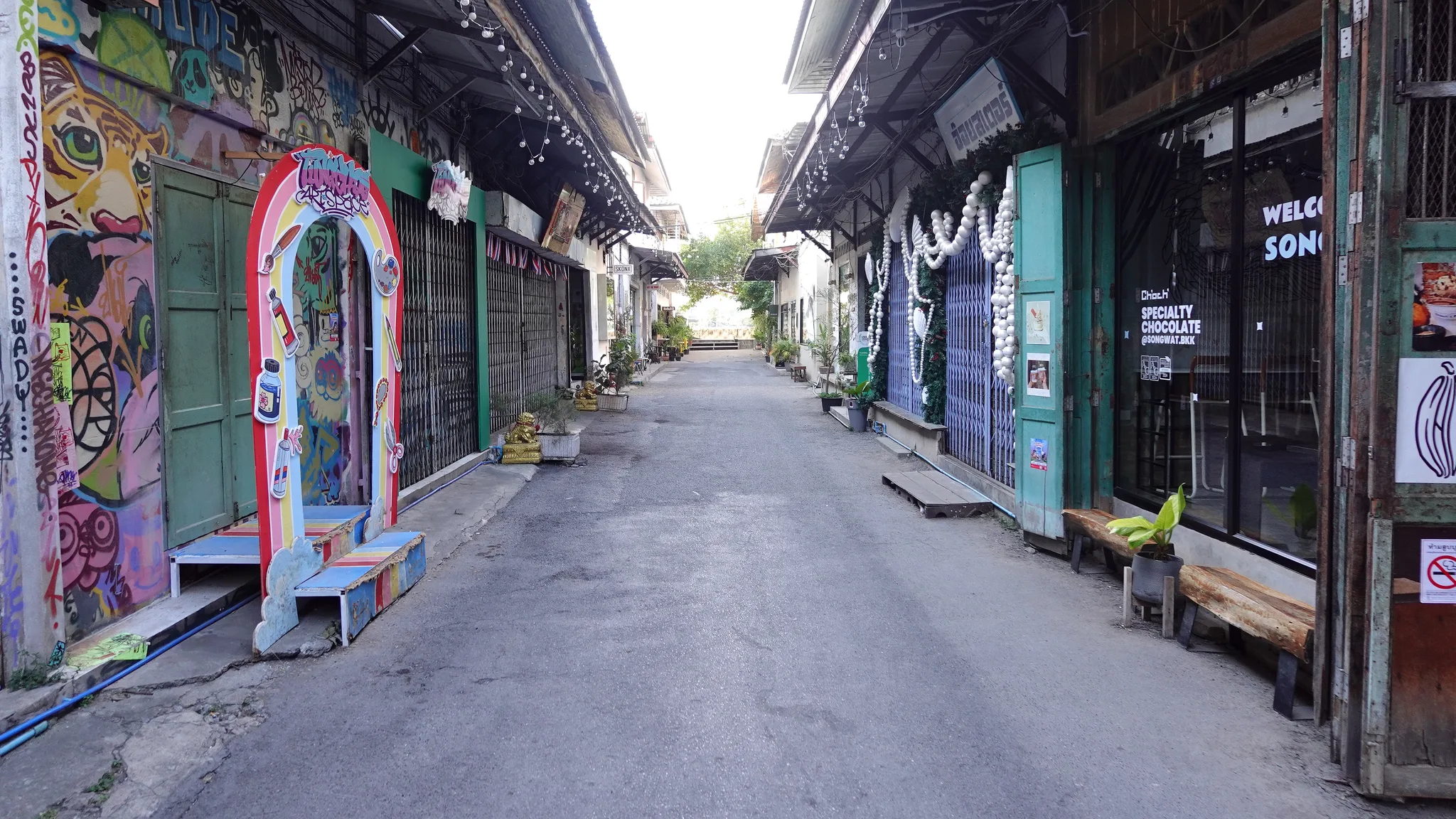
In Songwat Lane, a narrow alley runs between two rows of shophouses with old grilles and shutters, now decorated with murals, a decorative arch, string lights and shop windows, reflecting their adaptive reuse.© Eric Monteil 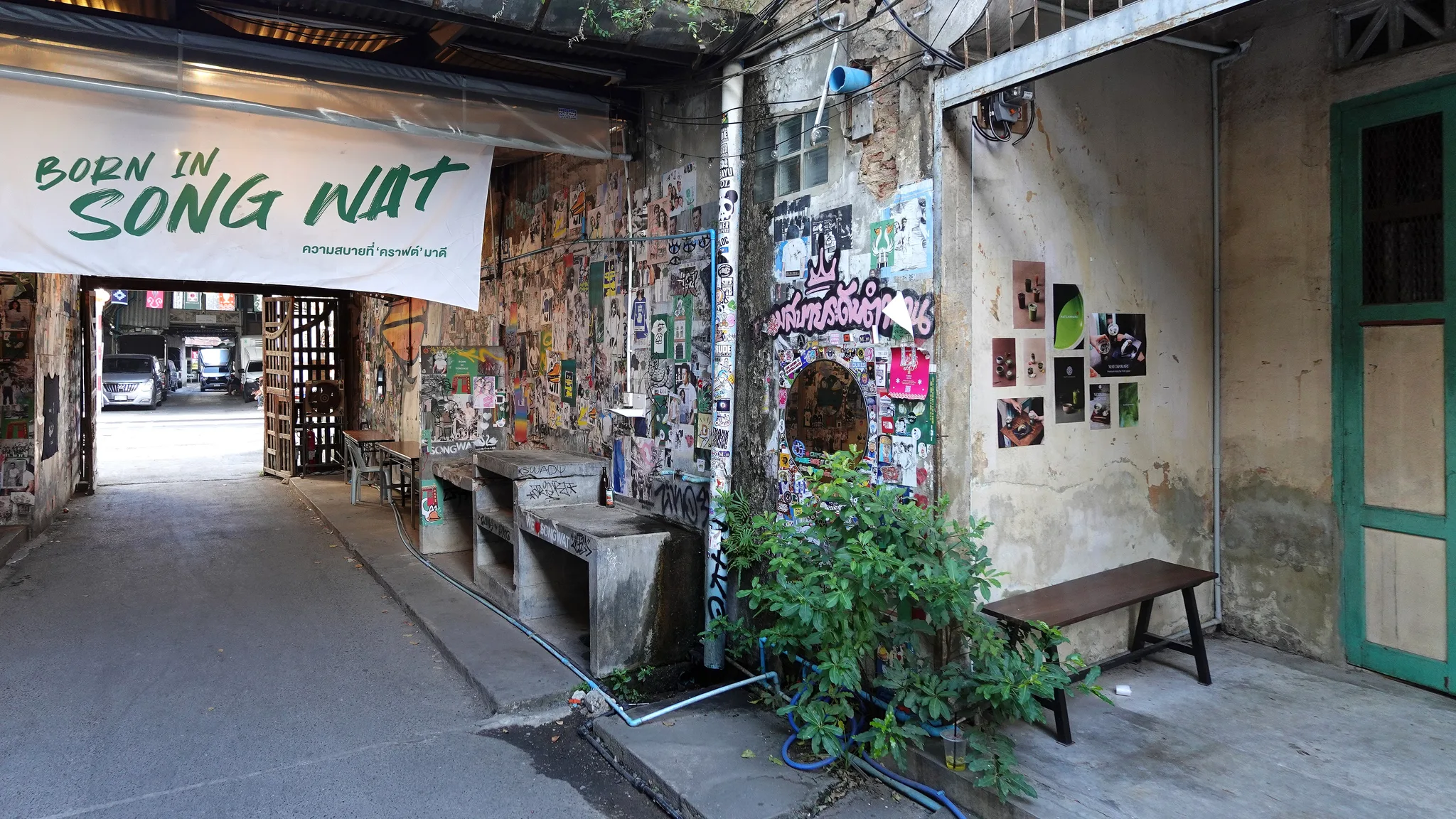
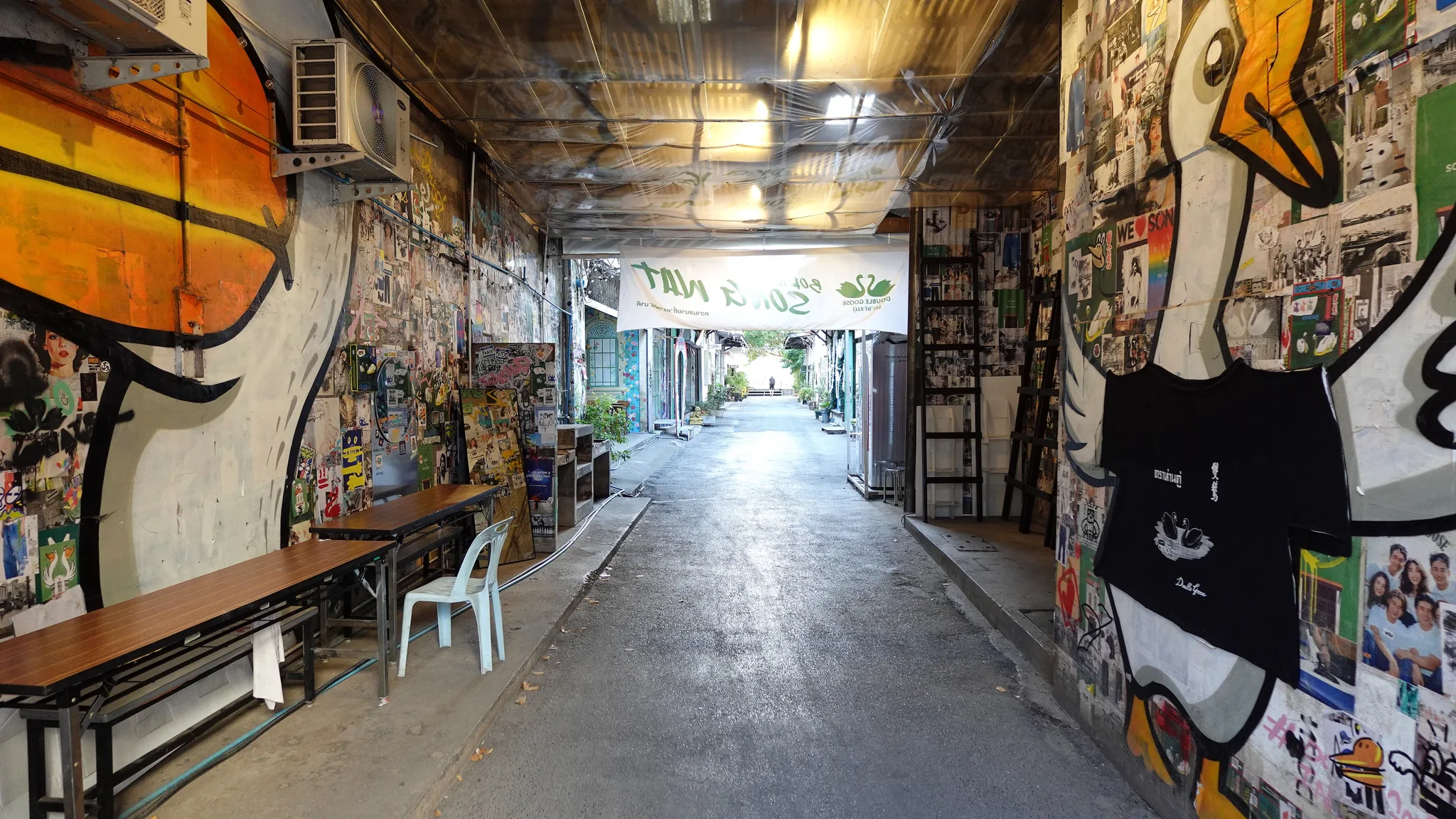
At Songwat Lane, a covered passageway opens onto the street: weathered walls plastered with stickers and posters, concrete counters, green plants and a wooden bench, beneath a ‘Born in Song Wat’ banner.© Eric Monteil
Architecture and decoration
Explore the heritage
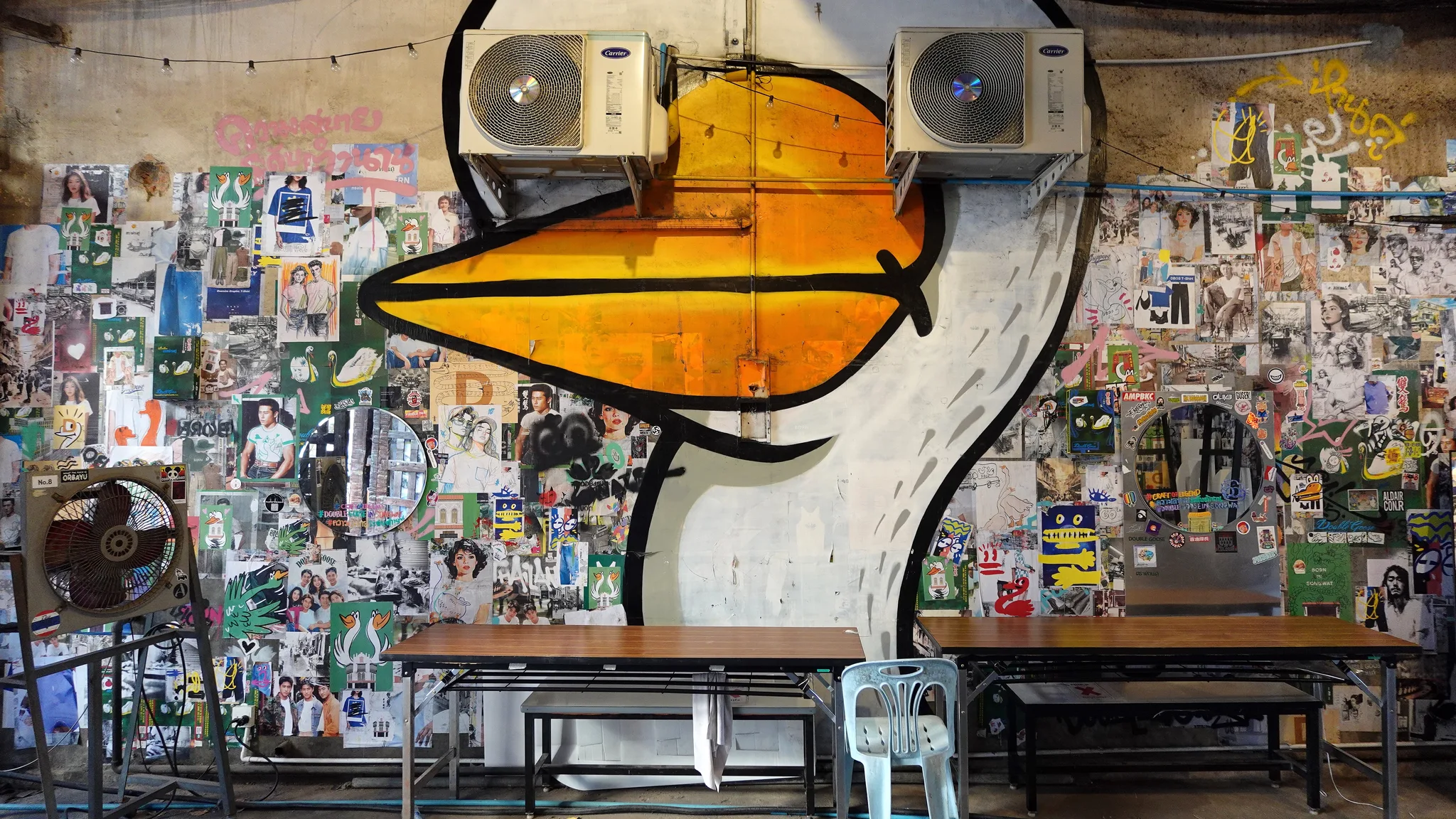
At Songwat Lane, a bare wall bears a mural of a bird with an orange beak, framed by collages of posters and stickers; air-conditioning units, a fan and folding tables reflect the reuse of the space.© Eric Monteil 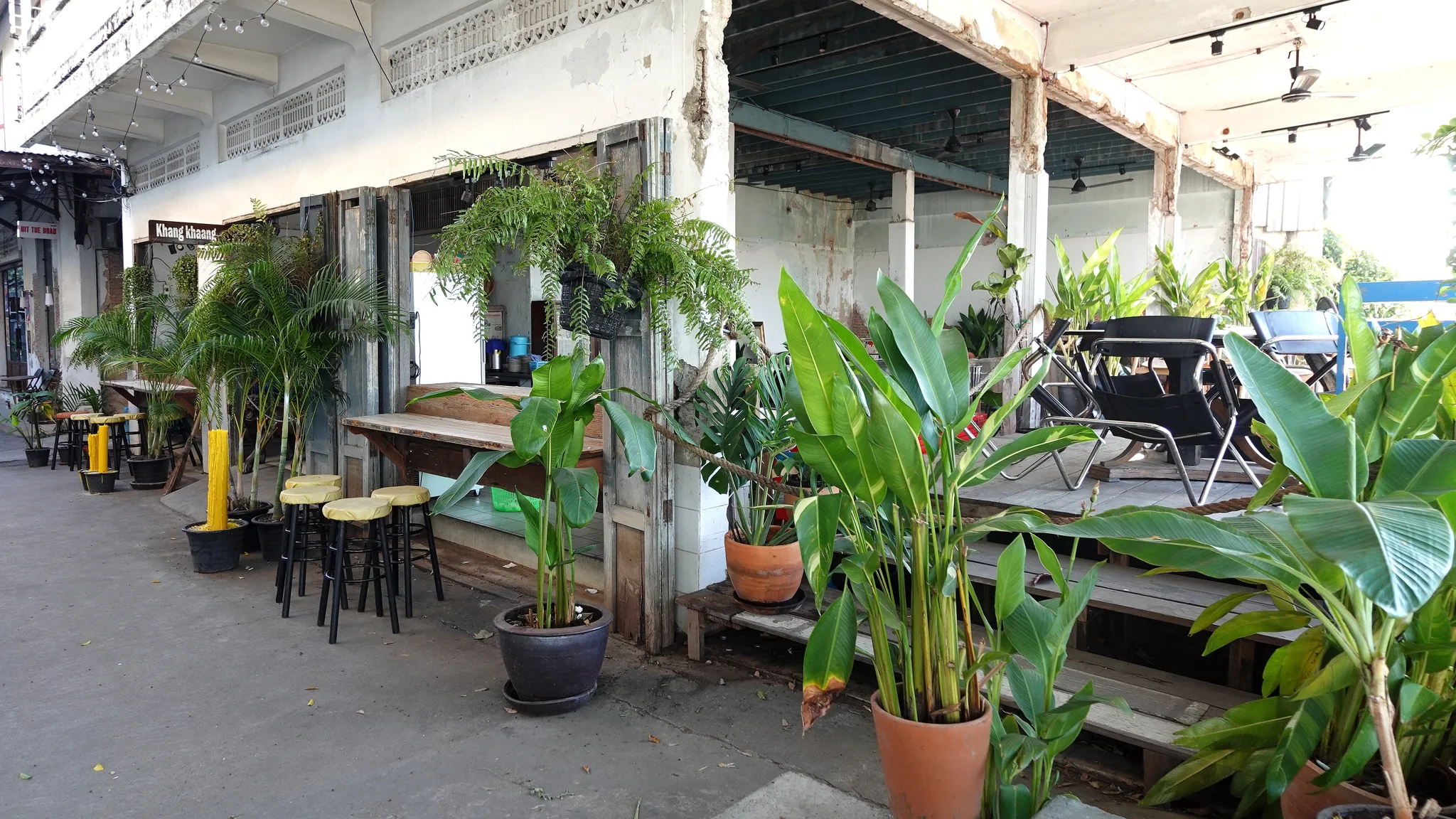
On Songwat Lane, the ground floor of a shophouse with peeling walls and pierced panels houses a café open to the street, with a wooden counter, old shutters, stools and potted plants.© Eric Monteil