
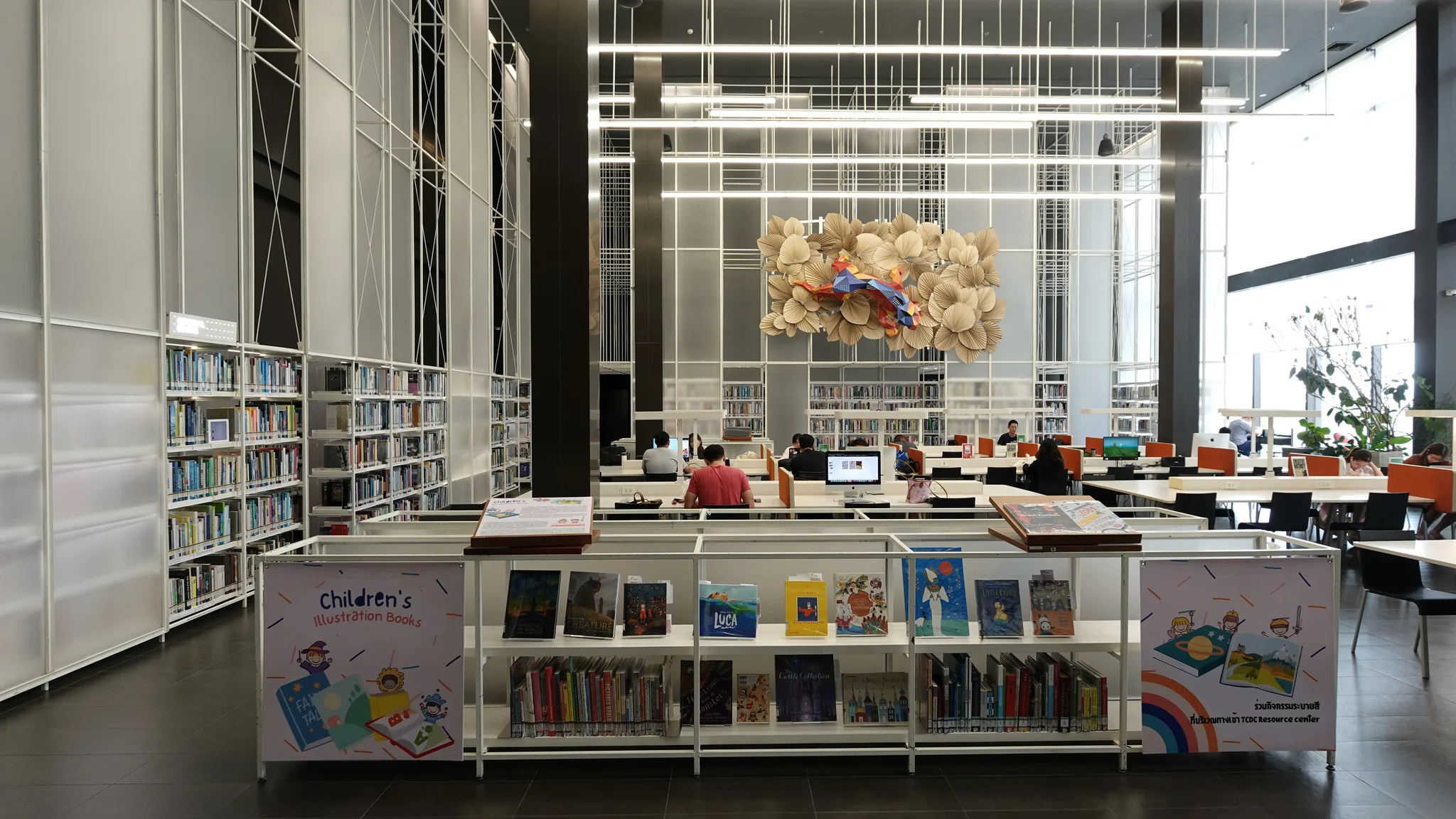
 At TCDC Bangkok (Thailand Creative & Design Center), the library sets out white shelving and work tables beneath a suspended flower-shaped sculpture; in the foreground, a display is devoted to children’s illustration books.© Eric Monteil
Cultural & creative centre
TCDC Bangkok (Thailand Creative & Design Center)
Born of a public policy in support of creativity, Thailand’s design centre found its home in 2017 in the Bang Rak Central Post Office, built under the People’s Party to give the State a modern image.
Heritage family · Arts, aesthetics and creation
- Destination
- Bangkok (Bang Rak)
- Heritage Family
- Arts, aesthetics and creation
- Typology
- Cultural & creative centre
- Visit
- Available tours →
TCDC Bangkok (Thailand Creative & Design Center) is the public resource centre that Thailand devotes to design and the creative industries. Born in the early 2000s of a State policy in support of creativity, it left a shopping centre in 2017 to move into the former Bang Rak Central Post Office, a building completed in the late 1930s, at a time when the People’s Party sought to give the State a modern image. This move links two histories: that of a public building and that of an institution which in 2018 became the Creative Economy Agency. A design library, a materials library and workshops now occupy the former mail and telegraph halls, beneath a monumental façade crowned with sculptures.19
Key facts
- Destination
- Bangkok
- Heritage Family
- Arts, aesthetics and creation
- Typology
- Cultural & creative centre
- Places
- Central Post Office
- Bang Rak
- Periods
- People
- Khuang Abhaiwongse
- Mew Aphaiwong
- Phra Sarot Rattananimman
- Silpa Bhirasri
- Thaksin Shinawatra
- Communities
- —
- Events
- Achèvement du Bureau Central de la Poste (1940)
- Reconversion du Bureau Central de la Poste (2017)
- Siamese revolution of 1932
- Establishment of the Creative Economy Agency (2018)
- Heritage
- —
- Glossary
- Neoclassicism
- Garuda
- Khon
- Buddha image
- Materials library
- Makerspace
- Keywords
- —
- Date
- —
- Collections
- —
Practical info
Practical information about this site is taken from its Google Maps page. We advise you to check it before visiting.
- Address
- Central Post Office, 1160 ถ. เจริญกรุง Khwaeng Bang Rak, Khet Bang Rak, Krung Thep Maha Nakhon 10500
- Phone
- Website
A post office for the modern State
A plot on Charoen Krung
The story of the site begins along Charoen Krung, which for more than a century and a half has been one of the city’s major commercial thoroughfares. It runs through Bang Rak. This is where the Central Post Office building stands, in Thai Akhan Praisani Klang, the ‘central postal building’, known in English as the Grand Postal Building; it is also called the Bang Rak Central Post Office, and the building ranks among the district’s major historic landmarks.18
The plot had first been home to the British legation. It then passed to the Post and Telegraph Department, the administration responsible for the kingdom’s mail and telecommunications, which established its headquarters there.18
Khuang Aphaiwong’s building project
Work began on 1 March 1935 and was completed on 11 August 1938. It was carried out under the authority of Khuang Aphaiwong, Director-General of the Post and Telegraph Department from 1935 to 1941, who had the building constructed. The plans were the work of the architect Phra Sarot Ratananimman, whose given name was Sarot Sukkhayang, and of the co-architect Mew Aphaiwong, also known as Chitrasen Aphaiwong, who was also responsible for the Dome Building of Thammasat University. The engineer H. Herman supervised the works. The building was inaugurated on 24 June 1940.9
These were years in which the country was undergoing profound political transformation. The People’s Party (Khana Ratsadon) raised public buildings in Bangkok intended to embody the new State. The Central Post Office belongs to this family of monuments. Its inauguration came a year after Siam took the name Thailand, in 1939.6
The heart of the nation’s communications
The Central Post Office was no mere counter where people came to buy stamps. Mail was received, sorted and forwarded there, but the building also housed the central telegraph office, the radio engineering division, a radio exchange, a satellite relay exchange and the telex exchange. As technologies evolved, from the letter to the telegram and then to satellite links, the building brought together under one roof the principal means by which the capital communicated with the rest of the country and with the wider world.20
It is this architecture, conceived to represent an administration, that TCDC Bangkok (Thailand Creative & Design Center) took over in 2017 to give it an entirely different purpose.
Reading the Bang Rak façade
Between Art Deco and the International Style
Seen from Charoen Krung, the Central Post Office building presents itself as a long horizontal volume whose façade exceeds a hundred metres in width, arranged on a T-shaped plan over four storeys and a basement. Its architectural language blends Art Deco, with its geometric lines and effects of symmetry, and the International Style, which favours clean volumes and pared-down ornament. It is also described as a modern building inspired by neoclassicism and functionalism.9
This blend reflects the People’s Party’s wish to project a modern and powerful image of the State. One symbolic reading sees in the six columns and the two wings of the façade an allusion to the six principles of the People’s Party, though the architects’ intention is not attested.18
Two Garuda atop the central projection
At the top of the central projection, the part of the façade that stands forward of the building line, two large statues of Garuda rise at the northern and southern corners. They are more than twice human height.8
These sculptures were made by students of the sculpture section of the Silpakorn school, under the direction of their teacher Silpa Bhirasri.8
A wartime legend
The Garuda also have their legend, drawn from oral tradition. During a bombing raid, a bomb is said to have fallen in front of the building without exploding. A rumour then spread: witnesses are said to have seen the two Garuda take flight to turn the bombs aside. When questioned, Khuang Aphaiwong is said to have replied in the press that protective objects had been placed in the building at the time of its construction.10
This account belongs to tradition, not to established history.
The birth of a design centre
A public policy for creativity
TCDC Bangkok (Thailand Creative & Design Center) arose from a decision by the government of Thaksin Shinawatra, then Prime Minister, who is presented as its founder. The dates given for its creation vary between 2003 and 2005, depending on whether one takes the government decision, the establishment of the institution or its opening to the public. It was in November 2005 that the centre opened its doors in Bangkok, and the institution itself has adopted this date, presenting 2025 as the twentieth anniversary of its first site.19
The centre was initially attached to the Office of Knowledge Management and Development, a public organisation under the supervision of the Office of the Prime Minister, of which it formed one of the divisions. Its official mission is to combine the excellence of Thai society and culture with contemporary knowledge and technology. The aim is to connect creators and help them devise products and services capable of finding their place in the global market: design is conceived there as an economic resource as much as a cultural one.19
Twelve years at the Emporium
From 2005 to 2017, the centre occupied the upper floors of the Emporium, a Bangkok shopping centre, over some 3,700 square metres. Its signage was designed by the agency Graphic49 Limited, with the practice Duangrit Bunnag Architect Limited as consultant.21
In April 2013, TCDC Chiang Mai opened its doors. A few years later, the Bangkok centre changed both scale and setting, leaving the shopping centre for a historic building.17
From post office to place of creativity
The 2017 move
Announced in the spring of 2017 after several months’ delay, the transfer to the Central Post Office was completed on 5 May 2017. The centre reopened that day with a three-day creative market combining a flea market, workshops and concerts, and admission was then free. The Charoen Krung building was converted to become the new home of TCDC Bangkok (Thailand Creative & Design Center), which thus moved from a shopping centre to a building steeped in history.5
The former Emporium space did not disappear, however. From 21 June 2017, it became the AIS Design Centre, the result of a collaboration between the telecommunications operator AIS and the centre. The parallel is striking: just as a telecommunications company was taking over the former design site, the design centre was settling into the building that had housed the State’s telegraph, radio and telex.4
A conversion by two practices
The conversion was designed by two practices, Shma Co. Ltd. and Department of Architecture Co., and completed in 2017. The centre now has a floor area of between 9,000 and 10,000 square metres, depending on the count, far more than at the Emporium.3
This choice gives the project a significance that goes beyond the question of square metres. An institution devoted to contemporary creativity has settled into a monument raised by the People’s Party in the late 1930s to give the State a modern image.
Library, materials library and workshops
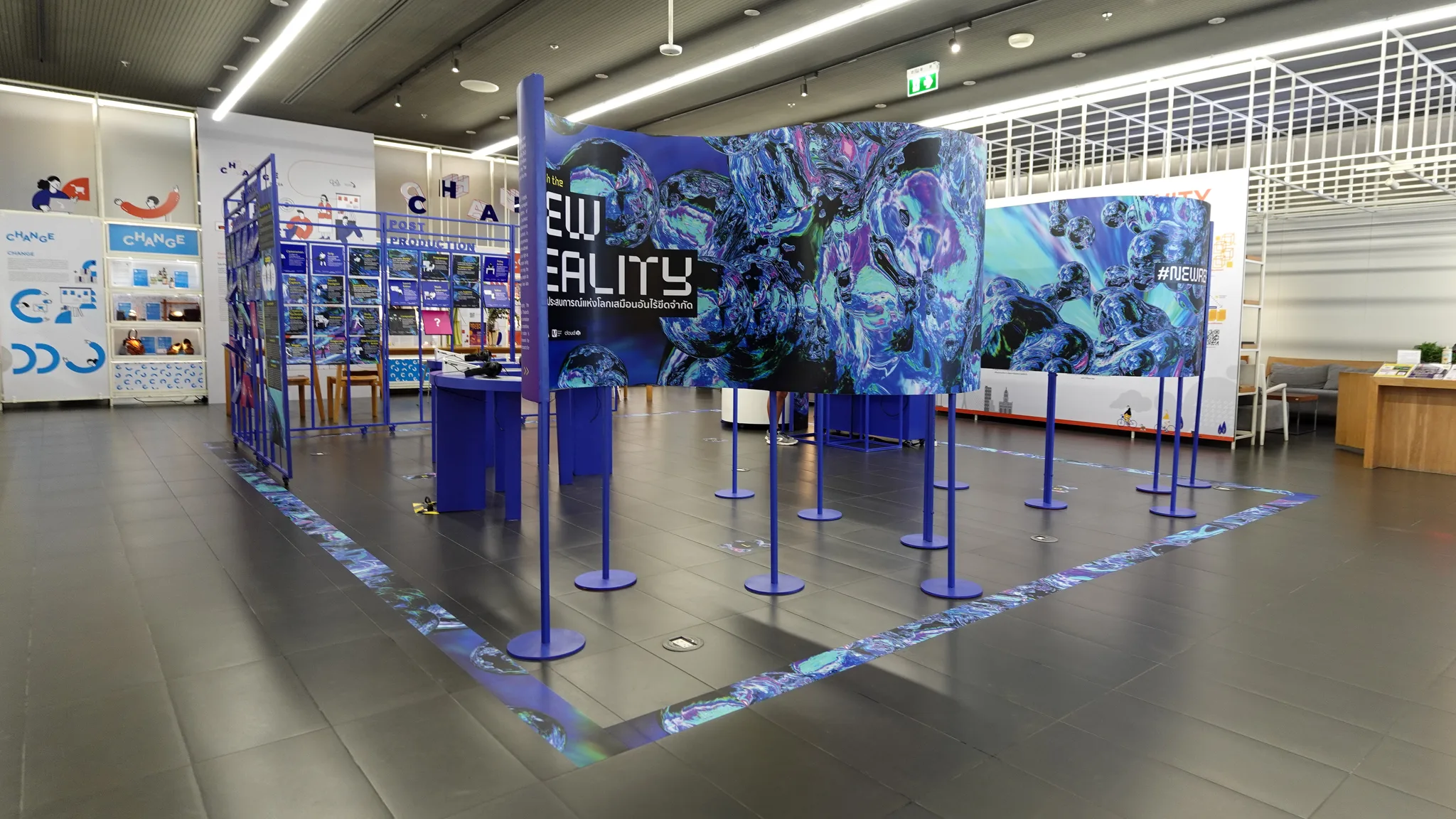
The architects organised the space around three main elements: a design library, a materials library, that is, a collection of material samples that designers and manufacturers can consult and handle, and a shared workspace. To these are added a makerspace, a communal workshop equipped for making prototypes, exhibition galleries, workshops, a support centre for creative businesses and a rooftop terrace. The renovated resource centre brings together several tens of thousands of books, magazines, newspapers and multimedia documents devoted to creative thinking and design.7
On the second floor, the Material & Design Innovation Center extends the materials library. It advises manufacturers and enables them to deposit their materials, in connection with the Material ConneXion database, which lists several thousand materials and physical samples. The Material Mapping: Bangkok programme links this collection to the city itself: it catalogues suppliers in more than ten commercial districts, among them Sampeng, Phahurat, Ban Mo, Sua Pa and Charoen Rat. Design appears here less as a museum object than as practical knowledge, rooted in the capital’s markets and workshops.16
An agency for the creative economy
From centre to public agency
On 14 August 2018, the entry into force of a royal decree transformed the centre into the Creative Economy Agency (Public Organization), under the supervision of the Office of the Prime Minister. The agency established its headquarters in the same building, and TCDC Bangkok became one of the main centres of a broader framework. The change of status reflected a change of ambition: the aim was no longer merely to offer resources to creators, but to promote and develop the country’s creative economy.13
The Creative Economy Agency works along three lines: talent, businesses and creative cities. It targets a wide range of cultural and creative industries, from gastronomy to sport and festivals, from tourism to music and books, from film and games to the arts, design and fashion. The Central Post Office thus became the headquarters of a public policy in which design is now only one branch among others.13
Charoen Krung, a creative district
In settling on Charoen Krung, the centre aims to make the area a ‘creative district’, bringing together residents, private businesses and the State. The Creative Economy Agency presents this development as one of its missions. Each year it organises Bangkok Design Week, a festival that brings together numerous partner organisations, designers and creative businesses, and attracts several hundred thousand visitors; Chiang Mai Design Week and Pakk Taii Design Week, in Songkhla, take up the same idea in the regions.1
The project did not win universal approval. At the 2017 reopening, some observers feared the gentrification of Bang Rak, that is, the transformation of an old, working-class neighbourhood to the benefit of wealthier residents and businesses, and BK Magazine responded with irony. This debate is a reminder that the arrival of an institution in a historic monument also affects the lives of those who live and work around it.6
A network of regional centres
The Bangkok centre no longer stands alone. Alongside TCDC Chiang Mai, opened in 2013, the Creative Economy Agency now has TCDC Khon Kaen, in the North-East, and TCDC Songkhla, in the South, and plans to open new centres in ten provinces. The model born at the Emporium, then installed in the Central Post Office, is thus spreading across the country.14
Within this network, the Bang Rak site retains a singular place. It is both the first centre and the agency’s headquarters. Visitors who consult a design book or a material sample there do so in a building where the kingdom’s mail was once sorted, beneath the two Garuda sculpted by Silpa Bhirasri’s students.
Understanding
TCDC Bangkok (Thailand Creative & Design Center) brings together two ages of Thai modernity. On the one hand, a public building raised in the late 1930s by the People’s Party to give the State a modern and powerful image, the heart of the country’s postal services and telecommunications. On the other, an institution born in the early 2000s to make design and creativity an economic resource, which in 2018 became a public agency responsible for the entire creative economy. Its importance lies in this encounter: contemporary knowledge housed in a monument whose Garuda and legend belong to the memory of Bang Rak. The future of the site is now being played out beyond its walls, in the project to make Charoen Krung a creative district, in a network of centres set to extend to many provinces, and in the face of fears of gentrification voiced as early as 2017. Can a building designed to represent the State fully become a place belonging to those who create and live in the neighbourhood?
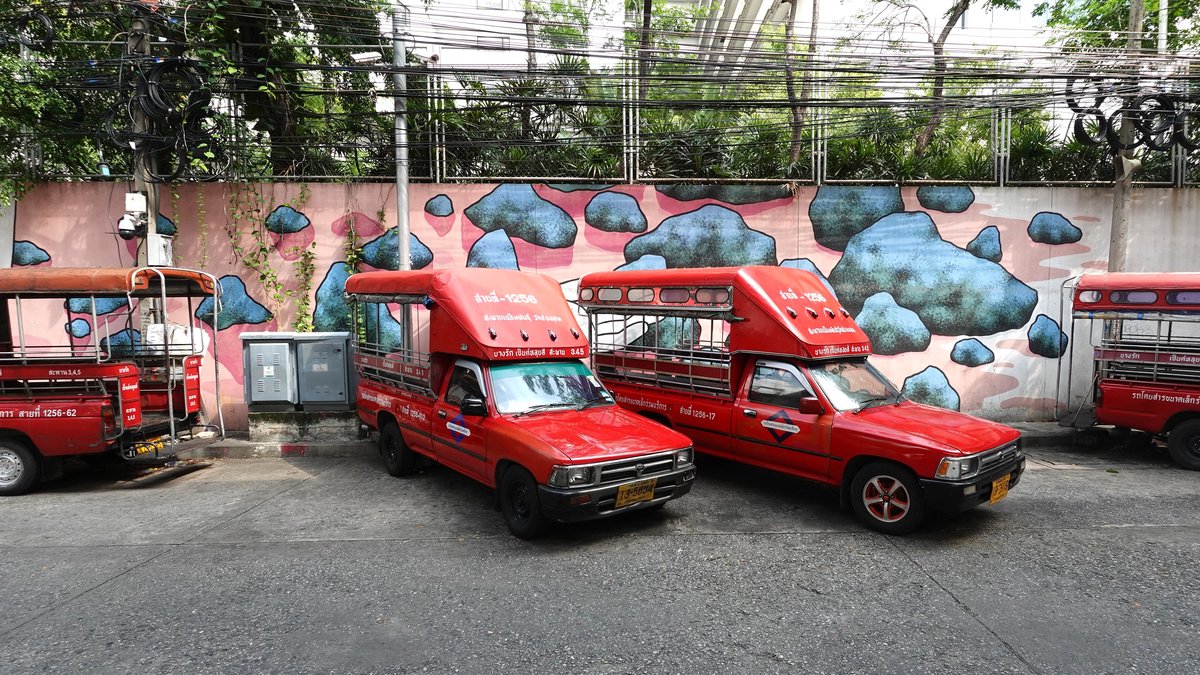
Through Bangkok's creative districts, between street art, architecture, design and new uses of the city.
- Neoclassicism
- Artistic and architectural movement drawing on the forms and principles of Graeco-Roman antiquity, which emerged in Europe in the 18th century.
- Garuda
- Mythical bird from the Indian tradition, the mount of the god Vishnu. In Thailand, it is the emblem of the monarchy and of the State.
- Khon
- Masked dance drama of the Thai court tradition, which stages the Ramakien.
- Buddha image
- In Thai Buddhism, a devotional representation of the Buddha, most often a statue, venerated as an object of worship.
- Materials library
- A collection of material samples made available to creators, designers and manufacturers, who can consult and handle them in order to select materials for their projects.
- Makerspace
- A collective workshop equipped with shared machines and tools, where users can design and make objects and prototypes themselves.
- Public organisation
- In Thailand, the status of an autonomous public body, established by royal decree under the 1999 Public Organisation Act, to carry out a public-service mission outside the central administration.
Studies
- 1Old quarters, new creativity, Bangkok Post, 2017 ↗
- 2Hubs of innovation, Bangkok Post ↗
- 3TCDC Goes Postal, Set to Reopen in Historic Building by River, Khaosod English, 2017 ↗
- 4Emporium TCDC Reborn as AIS Design Centre, Khaosod English, 2017 ↗
- 5PHOTOS: TCDC reopens at Grand Postal Building in Old Town, Coconuts Bangkok, 2017 ↗
- 6TCDC and the Bangkok 'Creative District', The Artling, 2017 ↗
- 7Department of Architecture Co., Thailand Creative and Design Center / Department of Architecture, ArchDaily, 2017 ↗
- 8เสา 6 ต้น 2 ปีก หน้าตึกไปรษณีย์กลาง บางรัก สถาปัตยกรรมแฝงหลัก 6 ประการของคณะราษฎร, The Standard ↗
- 9กาลครั้งนั้น ณ วันนี้...70 ปี ไปรษณีย์กลาง, Komchadluek ↗
- 10ย้อนรอยอดีตของ อาคารไปรษณีย์กลาง, Thairath ↗
- 11Postcards from Asia: Bangkok: Thailand Creative & Design Center, Core77 ↗
- 12Chomchon Fusinpaiboon, Modernisation of Building: The Transplantation of the Concept of Architecture from Europe to Thailand, 1930s–1950s, University of Sheffield, 2014 ↗
Reference works
- 13Creative Economy Agency – FAQ, Creative Economy Agency (Public Organization) ↗
- 14Annual Report 2024, Creative Economy Agency (Public Organization), Creative Economy Agency (Public Organization), 2024 ↗
- 15About – Bangkok Design Week, Creative Economy Agency (Public Organization) ↗
- 16Material & Design Innovation Center, Thailand Creative & Design Center (TCDC) ↗
- 17Thailand Creative & Design Center, Thailand Creative & Design Center, Bangkok, Thailand, Google Arts & Culture ↗
- 18Contributeurs Wikipédia, General Post Office (Bangkok), Wikipedia ↗
- 19Thailand Creative & Design Center / Creative Economy Agency (Thailand), Wikipedia ↗
- 20บางรัก – วิกิชุมชน, Princess Maha Chakri Sirindhorn Anthropology Centre ↗
- 21Graphic49 Limited, Thailand Creative & Design Center, SEGD ↗
Further reading
Contemporary views
TCDC Bangkok (Thailand Creative & Design Center) today
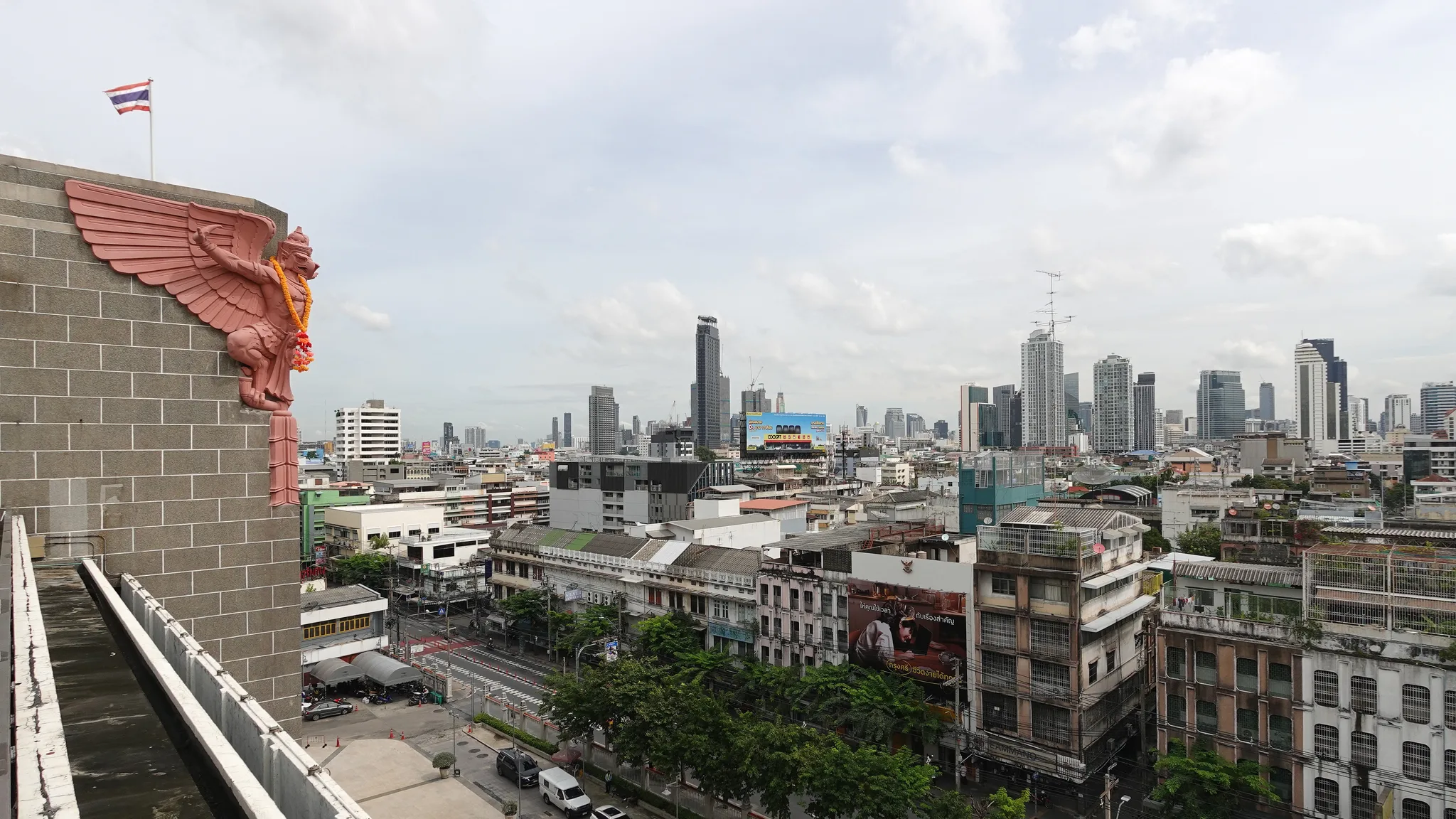
From the terrace of TCDC Bangkok (Thailand Creative & Design Center), a red garuda adorned with a marigold garland overlooks a tree-lined street, shophouses and a skyline of towers.© Eric Monteil 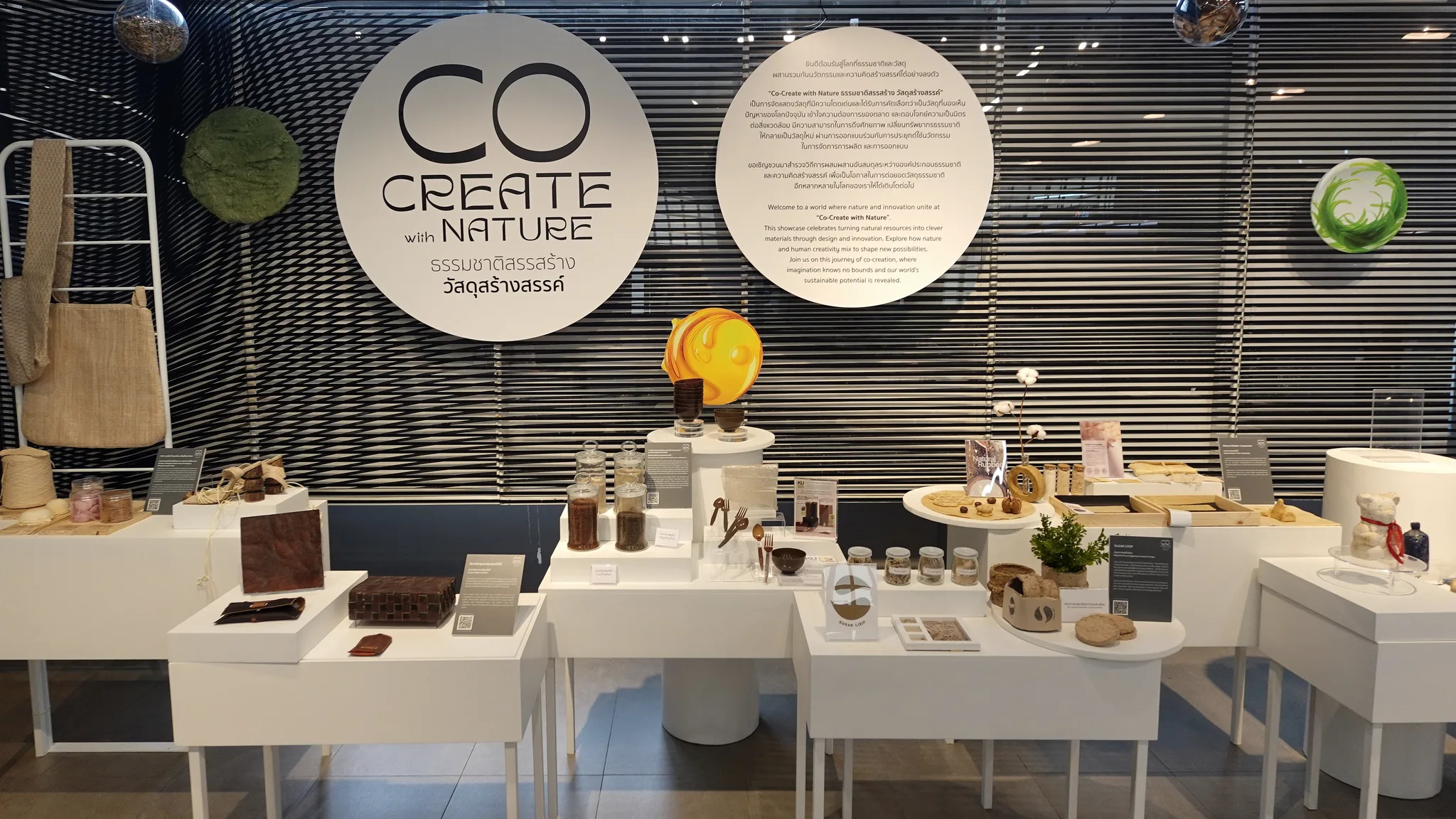
At TCDC Bangkok (Thailand Creative & Design Center), the “Co-Create with Nature” exhibition displays woven bags, leather objects, jars and utensils made from natural materials, with bilingual Thai and English panels.© Eric Monteil
Architecture and decoration
Explore the heritage
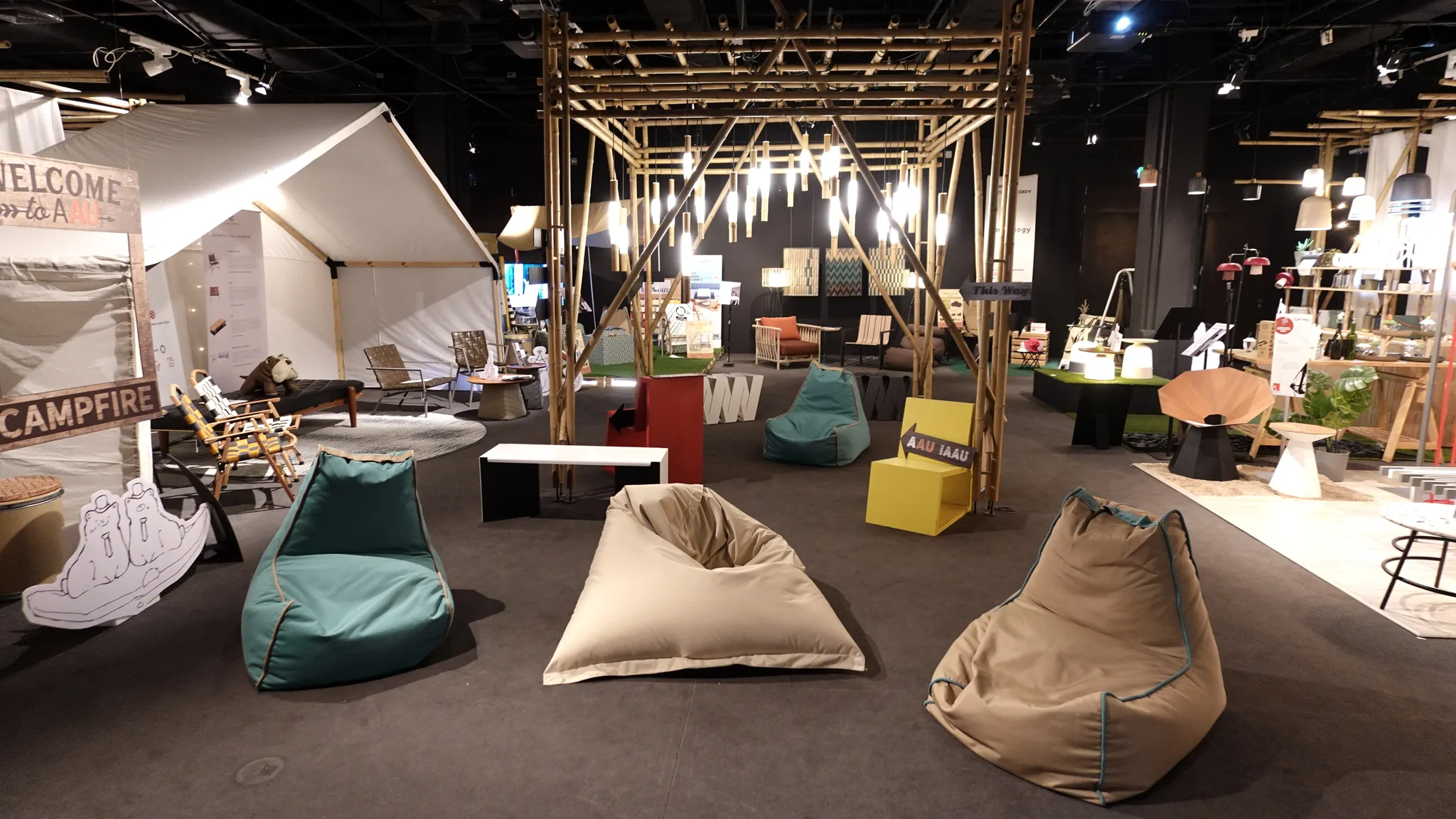
At TCDC Bangkok (Thailand Creative & Design Center), an exhibition of furniture and design objects: beanbags, chairs, a tent and a bamboo pergola fitted with pendant lights, beneath a dark technical ceiling.© Eric Monteil 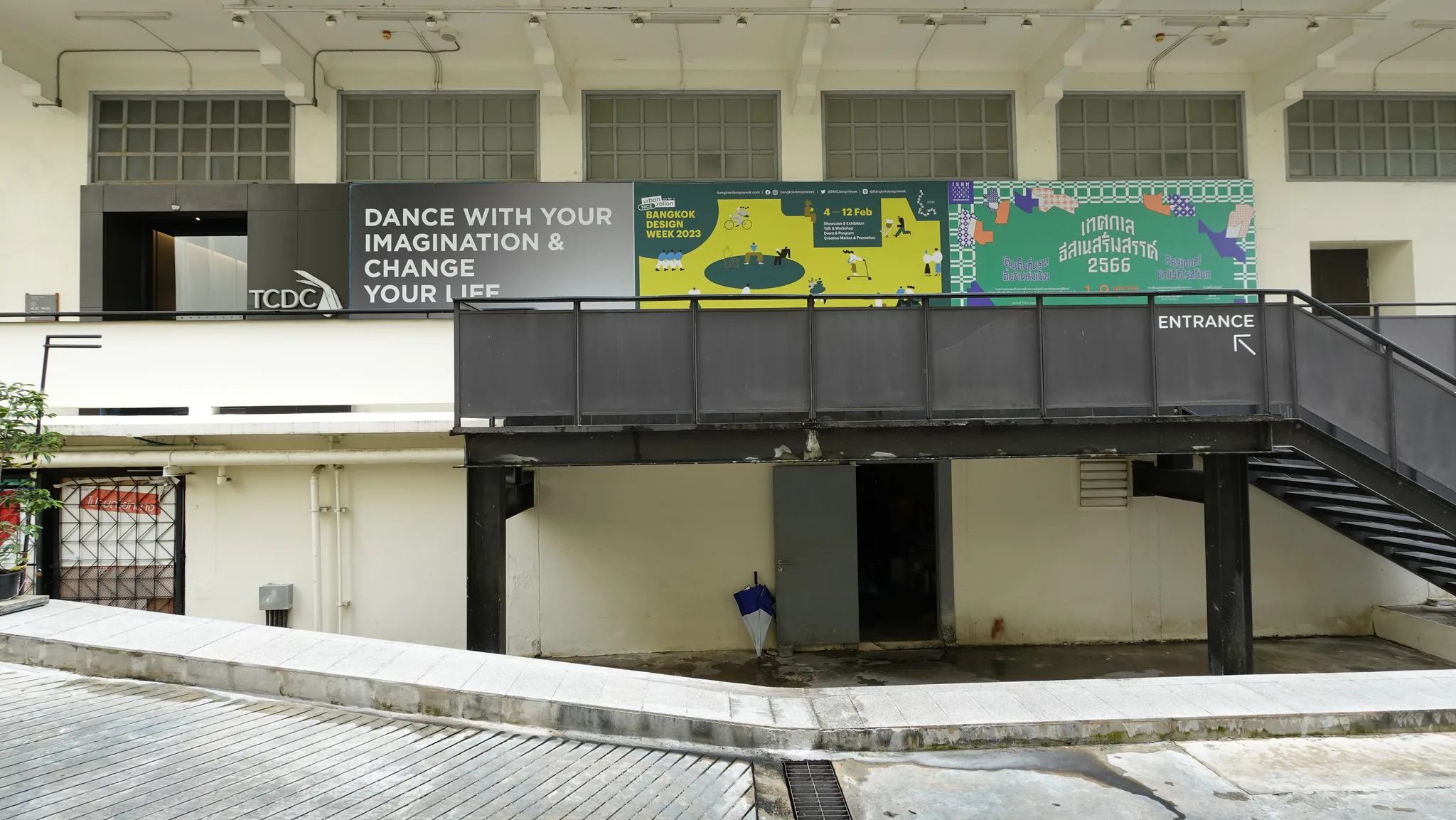
At TCDC Bangkok (Thailand Creative & Design Center), a black metal walkway and staircase marked “Entrance” run along a pale façade pierced by glass-block windows, beneath banners for Bangkok Design Week 2023.© Eric Monteil