
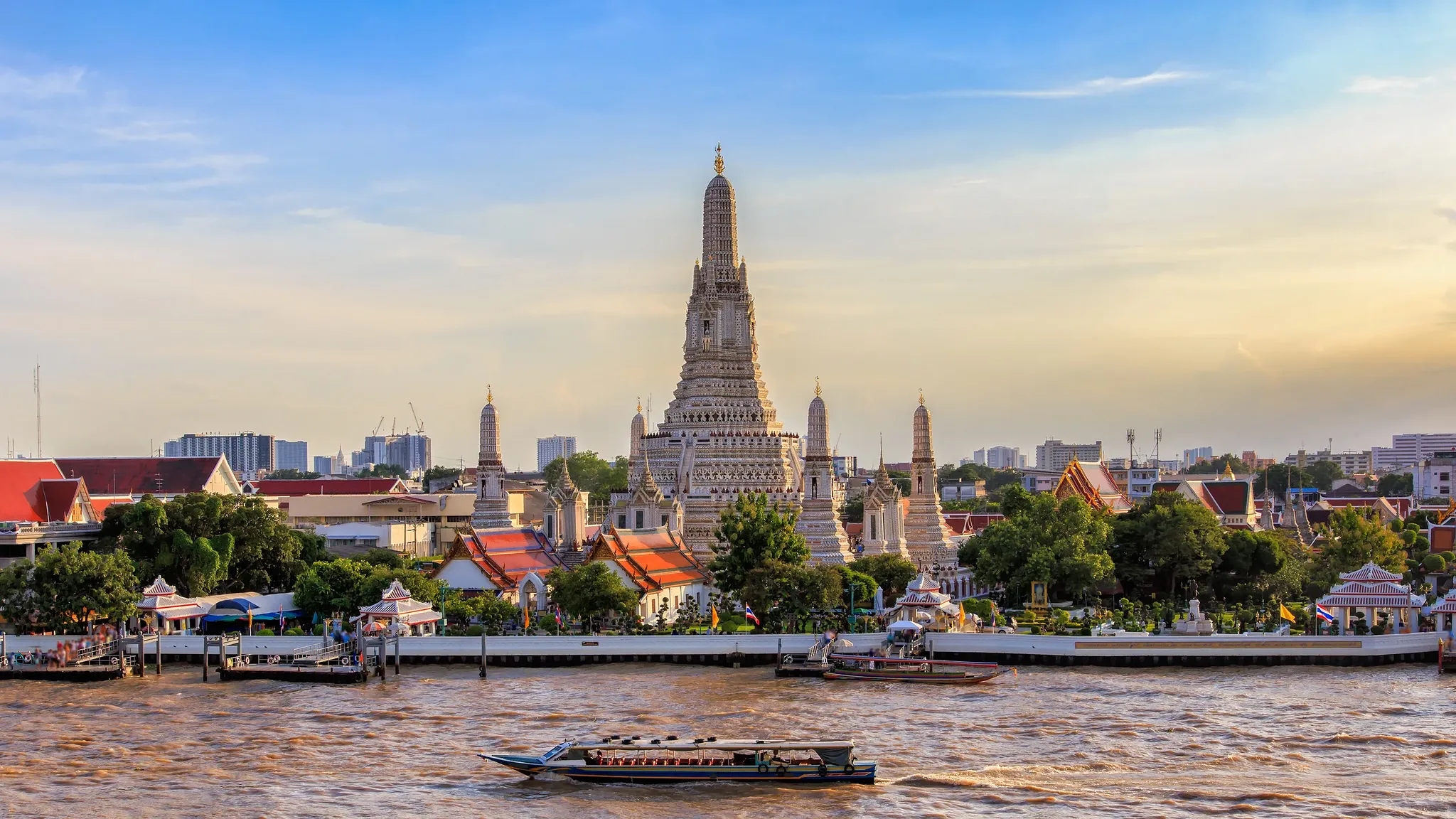
 Wat Arun on the bank of the Chao Phraya: the great central prang, surrounded by smaller prangs, rises above the red and orange roofs of the temple buildings, the riverside pavilions and the piers, against the city.© Jaruk
- Destination
- Bangkok (Bangkok Yai)
- Heritage Family
- Buddhism, religions and spiritualities
- Typology
- Buddhist temple
- Visit
- Available tours →
Wat Arun, the ‘Temple of Dawn’, is a royal Buddhist temple built on the west bank of the Chao Phraya, at Thonburi. Its history follows that of the monarchy. Enclosed within the palace of Taksin (1734–1782), it housed the Emerald Buddha. It then became a major building project of the Chakri kings: Rama III (1788–1851) laid the foundation stone of the great prang there in 1842, and the ashes of Rama II (1767–1824) rest in its ubosot. Classified as a first-class royal temple in 1915 and protected as an ancient monument since 1949, it is dominated by a central brick prang clad in coloured ceramics and surrounded by four corner prangs. This ensemble is often read as an image of the cosmos, and its silhouette has become an image of the country.
Key facts
- Destination
- Bangkok
- Heritage Family
- Buddhism, religions and spiritualities
- Typology
- Buddhist temple
- Places
- Chao Phraya River
- Bangkok Yai
- Thonburi
- People
- Rama Ier
- Rama II
- Rama III
- Rama IV (Mongkut)
- Rama V
- Taksin
- Communities
- Monastic community
- Events
- Construction of the great prang
- Fire of the ubosot
- Inclusion on the World Heritage Tentative List
- Restoration (2013–2017)
- Restoration under Rama II
- Restoration of the great prang under Rama V
- Heritage
- Emerald Buddha
- Glossary
- Wat
- Khlong
- Buddha image
- Prang
- Mondop
- Ubosot
- Keywords
- —
- Date
- —
- Collections
- —
Practical info
Practical information about this site is taken from its Google Maps page. We advise you to check it before visiting.
- Address
- 158 Thanon Wang Doem, Khwaeng Wat Arun, Khet Bangkok Yai, Krung Thep Maha Nakhon 10600
- Phone
A monastery older than its name
An undated foundation
No one knows who founded the monastery now known as Wat Arun. It is thought to have been established in the late sixteenth century, on the banks of the Khlong Lat, during the Ayutthaya period. A French map from the reign of King Narai is said to have already shown it, under the name Wat Chaeng.32
From Wat Chaeng to Wat Arun
The name Wat Chaeng was in use at the time of the 1820 festival, and Western travellers were still using it in the mid-nineteenth century. The present official name, Wat Arun Ratchawararam, was given by King Mongkut, Rama IV (1804–1868), replacing the earlier name Wat Arun Ratchatharam. According to another chronology, this name would date back to 1820, under Rama II.32
The legend of the dawn
The link with the dawn belongs to tradition. It is said that Taksin, the future king of Thonburi, arrived at the temple at daybreak in 1767 and renamed it after the dawn. From the outset, this story binds the temple to the figure of Taksin, whose reign opened a new chapter in its history.
The sanctuary of Taksin’s palace
A temple enclosed within the palace
In 1768 Taksin established his capital at Thonburi. The walls of his palace, pushed out as far as Khlong Nakhon Ban, then took in the temple, which no longer housed monks. The monastery thus changed in nature: it became a sanctuary enclosed within the king’s residence, with no monastic community. It was in this setting that the episodes of the reign still associated with it took place.14
The reception of the Emerald Buddha
The chief of these episodes was the arrival of the Emerald Buddha, a revered statue of the Buddha. After the capture of Vientiane by General Chakri, the future Rama I (1737–1809) and first king of the Chakri dynasty, it was brought to Thonburi and welcomed at Wat Chaeng with lengthy festivities. In Thai usage, such a statue is called an ‘image’. It remained on the west bank, in a pavilion built beside the temple, until the reign of Rama I; it then crossed the river to Wat Phra Si Rattanasatsadaram.15
Taksin, from ritual to tradition
The temple is also associated with a critical moment of the reign. In 1782, under attack from Phraya San, Taksin took monastic robes within the consecrated area of the temple. This area, marked out by boundary stones, surrounds the ubosot, the building in which ordinations are held and which houses the temple’s principal Buddha statue. It was thus at the ritual heart of the monastery that the king entered religious life.15
Taksin’s memory lives on in tradition. Tradition has it that the king meditated in the temple’s royal residence, and that the small viharn facing the great prang, the temple’s great central tower, preserves his meditation stool. These stories show how closely the figure of the king of Thonburi remains bound to the place.24
The great building campaign of the Chakri kings
The works of Rama I and Rama II
When the palace moved to the east bank, the temple regained its monastic vocation: Rama I provided it with monks’ cells and a community of monks. His successor, Prince Itsarasunthon, the second king of the Chakri dynasty under the name Rama II, in turn took an interest in it. Once king, he ordered the temple to be restored and enlarged in 1813. A great festival was held there in 1820. This was the first of the temple’s great royal building campaigns.33
Rama II also had the preparatory works and the foundations of the great prang begun; according to some historians, he may have directed its construction itself.
The prang of Rama III
The decisive campaign began under Rama III. On 2 September 1842 the king laid the foundation stone of the great prang, a new masonry structure enveloping the older, more modest prang: the tower seen today therefore encloses, within its mass, the one that preceded it. Royal orders then followed each stage of the work. One royal order announced that Rama III was to come and pour the metal for the casting of the naphasun, the trident intended for the summit of the prang; other orders provided for its gilding and installation. These instructions bear witness to the sovereign’s personal involvement in the project. Yet no festival marked the completion of the works before his death in 1851: the celebration of the monument is thought to have taken place under Rama IV.19
A site of dynastic memory
Under Rama IV, the temple also became a site of dynastic memory. The ashes of Rama II were placed in the base of the principal Buddha statue in the ubosot and offered for public veneration: the king who had restored the temple now rested there. By the end of the century, this site of memory was under threat. In 1895 the ubosot burned; Rama V (1853–1910) had the ashes rescued, and the restoration that followed amounted to a genuine reconstruction.13
Reading the prang and its temple
Five prangs and three groups
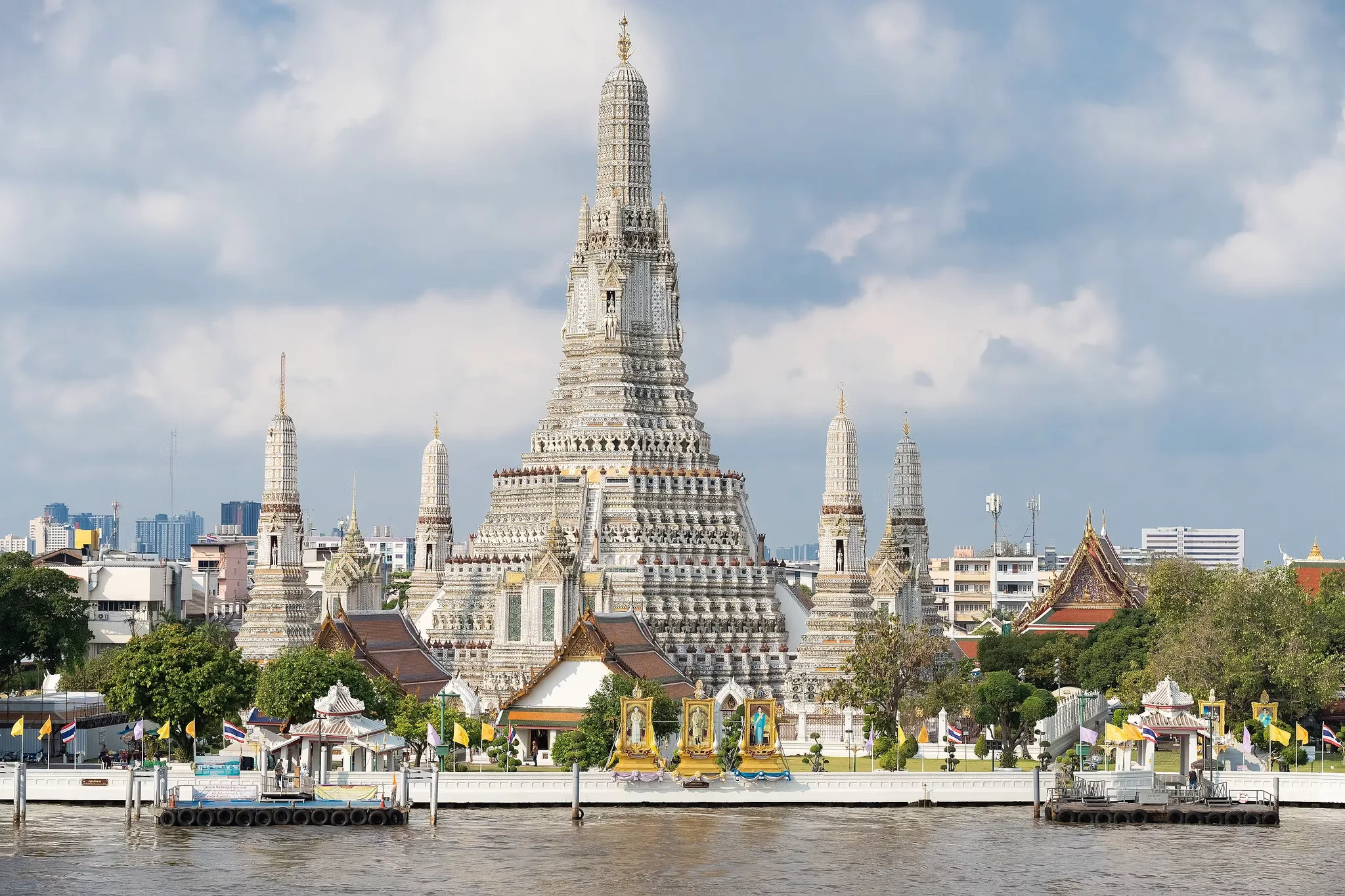
At the centre of the temple rises the largest prang of the Rattanakosin period. It is surrounded by four corner prangs and by four mondop, small pavilions each sheltering an image turned towards it, so that the central monument forms the heart of a group. Its structure is solid: a mass of brick and mortar with no inner chamber, which cannot be entered. It rises on three terraces on which one can walk around the monument. A plumb-line survey carried out in 1908–1909 gives it a height of about 67 metres.34
Yet the prang occupies only part of the temple. The area of worship comprises three groups set on parallel east–west axes: the prang, the ubosot with its principal Buddha statue, and the viharn. Between the ubosot and the viharn, a square mondop shelters a footprint of the Buddha.30
Ceramics and divine figures
Seen close up, the prang appears covered in dense decoration. It is clad in coloured glazed ceramics, broken and then assembled into flowers and patterns. This composite material combines shaped plaques, shards and shells, and gives the monument its colourful surface.
The sculpted decoration also makes room for the gods. In the niches of the great prang, Indra, the green-bodied god, rides Erawan, his three-headed white elephant; in those of the corner prangs, a mounted deity is identified as the wind god, Phra Phai, or, according to other readings, as the Sun or the Moon. The life of the Buddha, for its part, is told only in the four mondop placed at the cardinal points.31
An image of the cosmos
This arrangement lends itself to a cosmological reading. The central prang represents Mount Meru, the cosmic mountain at the centre of the universe in Buddhist cosmology. The corner prangs represent the four continents or, according to others, the Sattaparibhanda mountains, ranges that encircle Mount Meru. The group of five prangs thus forms an ordered image of the universe.36
A royal temple facing the river
A rank fixed in 1915
The temple’s rank was fixed in 1915. The regulations on royal temples, published that year in the Royal Gazette, the official journal, placed Wat Arun in the first class, in the ratchaworamahawihan category, which denotes a great temple built or restored by the sovereign in a personal capacity. This classification officially sealed the link between the temple and the monarchy.10
The royal kathin
This link is also expressed through rites, foremost among them the royal kathin, the annual ceremony of offering robes to monks made in the sovereign’s name, here presided over by the king and associated with a procession of royal barges. The Chakri kings are said to have come here by barge every year to preside over this ceremony. The barge procession was revived at the beginning of the Cold War.21
A silhouette turned emblem
The temple also owes its renown to its setting. Built on the west bank of the Chao Phraya, it reveals itself from the river. Sir John Bowring, head of a mission to Siam lodged at the temple in 1855, described it as the most conspicuous building on the bank. Some ten years later, the photographer John Thomson took views from the top of the temple that encompassed, on the opposite bank, the Grand Palace and Wat Pho. This silhouette has become an image of the country: the prang appears on a series of Bank of Thailand banknotes, and it serves as an element of the logo of the Tourism Authority of Thailand.4
Restoring and protecting
From Rama V to 2017
The great prang has undergone several restoration campaigns. Concerned about its condition as early as 1895, Rama V had its repair undertaken in 1908, under the direction of Phraya Ratchasongkhram, master builder of the project. The king regarded the monument as a memorial of the nation, which gave the restoration a significance reaching beyond the upkeep of a temple. An instruction drawn up for the works required that all old material still usable be kept, even if tarnished, even at the cost of setting old beside new: conservation took precedence over uniformity of appearance.20
Other campaigns followed. One of them, launched in 1967 for the bicentenary of the birth of Rama II, was marked in 1968 by King Bhumibol Adulyadej, Rama IX, placing the great crown on the summit of the prang, then under restoration; the choice of this anniversary linked the restoration to the memory of the king who had restored the temple. After the damage caused by the 2011 flood, including the fall of many decorative elements, the Fine Arts Department conducted a major campaign from 2013 to 2017, carried out by a private company under its supervision.39
The white prang controversy
This latest campaign sparked controversy. The prang that emerged white in 2017 divides opinion: for the temple and the Fine Arts Department, this shade corresponds to the original colour. Critics, among them the archaeologist Sayan Praicharnjit, former dean of the Faculty of Archaeology, denounce on the contrary an aesthetic loss which they attribute to the subcontracting of the work.23
Towards World Heritage
These restorations form part of a long-standing framework of protection. Since 1949 all the temple’s monuments have been registered on the list of ancient monuments, and the boundaries of the protected grounds were fixed in 2017. A new phase began in April 2025, when the great prang was inscribed on the World Heritage Tentative List, through a submission by the Thai National Committee for the World Heritage Convention: this is a preliminary step towards a possible nomination.9
Understanding
Wat Arun is a Buddhist monastery of probable antiquity, established on the banks of the Chao Phraya, whose history is intertwined with that of the Thai monarchy. Once the sanctuary of Taksin’s palace, then a temple restored and enlarged by the Chakri kings, it brings together a community of monks, an ubosot, a viharn and the great prang surrounded by four corner towers. The central monument, read as an ordered image of the universe, is only one of the poles of a religious complex in which the ashes of Rama II rest. A first-class royal temple, visible from the river, it has become an image of the country. Its future depends first and foremost on its conservation. Restoration campaigns have followed one another since the reign of Rama V, and the most recent, carried out after the 2011 flood, opened a debate on the appearance of the prang. The inscription of the great prang on the World Heritage Tentative List in 2025 opens a new chapter. How will the temple be able to remain a place of worship and memory while moving towards a possible World Heritage nomination?

From Thonburi to Rattanakosin: royal temples, the Grand Palace and the arts of Siam at the heart of historic Bangkok.
- Wat
- Buddhist monastic complex that brings together, within a single enclosure, several religious buildings, monks’ quarters and ancillary buildings; the word does not refer to a single building.
- Khlong
- Canal or waterway, natural or man-made, which long played a major role in transport, irrigation and the organisation of settlements and territories in Thailand.
- Buddha image
- In Thai Buddhism, a devotional representation of the Buddha, most often a statue, venerated as an object of worship.
- Prang
- Tower-sanctuary rooted in Khmer architectural tradition, later adopted and transformed in Siamese and Thai architecture; depending on the context, it serves a religious function or acts as a reliquary.
- Mondop
- Small sacred building or pavilion, often square in plan, which may house a sacred image, a Buddha footprint, relics, scriptures, ashes or another sacred object.
- Ubosot
- Consecrated ordination hall of a wat: the ritually central building, marked out by sacred boundary stones, where monastic ordinations take place.
- Viharn
- Assembly and devotional hall of a wat, used for ceremonies, teaching and the veneration of Buddha images; unlike the ubosot, it does not host monastic ordinations.
- Kathin
- Annual ceremony at which robes are offered to monks, after the rains retreat.
- Royal Kathin
- Form of the kathin in which the offering is made in the name of the sovereign.
- Naphasun
- Metal trident crowning the summit of a prang.
- Mount Meru
- Cosmic mountain at the centre of the universe in Buddhist and Hindu cosmologies.
- Traiphum
- Thai Buddhist cosmological text describing the three worlds and the universe ordered around Mount Meru.
- Ratchaworamahawihan
- Category of royal temple: a major wat with extensive buildings, built or restored by the sovereign in a personal capacity.
- Indra
- Deity of Vedic origin, king of the gods in the Hindu tradition and also present in Buddhist cosmology. In Thai iconography he is often shown riding the celestial elephant Erawan.
- Erawan
- Celestial elephant associated with Indra, known as Airavata in the Indian tradition. In Thai art he is frequently shown with three heads, although the traditions also describe other forms.
- Phra Phai
- God of the wind in Thai religious traditions, related to the Indian god Vayu. His identification in some architectural representations, notably at Wat Arun, is open to differing readings.
- Royal temple
- In Thailand, a Buddhist temple founded, restored or patronised by the king or the royal family, and graded according to an official hierarchy of ranks and categories.
- Ancient monument
- In Thailand, a legal category (boran sathan) that places a building or site under State protection as heritage.
- San
- In Thailand, a small shrine where worship is offered to a deity, a spirit or a protective figure.
- Ayutthaya period
- Period of Siamese history, from the mid-fourteenth century to 1767, during which the kingdom had Ayutthaya as its capital.
- Sangha
- The body of monks who reside in a monastery and live there according to religious discipline; in Buddhism it is called the sangha.
- Ordination
- Ceremony by which a layperson is admitted as a novice or as a monk into the Buddhist community.
- Rattanakosin period
- Period of Thai history that began with the founding of Bangkok as the capital by King Rama I at the end of the eighteenth century. It takes its name from Rattanakosin Island, the heart of the royal city.
- Buddhist cosmology
- Buddhist representation of the universe, organised around Mount Meru and made up of continents, oceans, mountain ranges and superimposed worlds.
- Four continents
- In Buddhist cosmology, the four lands set at the cardinal points around Mount Meru.
- Sattaparibhanda mountains
- In Buddhist cosmology, concentric mountain ranges that encircle Mount Meru.
- Royal Gazette
- Official journal of the Kingdom of Thailand, in which laws, decrees and official acts are published, including the listing of protected monuments.
- Royal barge
- Long, richly decorated ceremonial vessel used by the Thai monarchy to carry the King during solemn river processions.
- Footprint of the Buddha
- Object of worship representing the imprint of the Buddha’s foot, often decorated with symbolic signs, and venerated as an evocation of his presence.
Primary sources
- 1Karl Döhring, Buddhistische Tempelanlagen in Siam, Der indische Kulturkreis in Einzeldarstellungen (éd. A. Grünwedel, H. Stönner, K. Döhring), Verlag Asien, Berlin, 1916, Textband p. 7, 29, 99, 106, 200-202, 214, 267-268, ↗
- 2ONEP, service des relations publiques (reprises de Dailynews et du PRD/NBT), Communiqués de l'ONEP (สำนักงานนโยบายและแผนทรัพยากรธรรมชาติและสิ่งแวดล้อม) des 2 et 28 avril 2025 sur la liste indicative, onep.go.th, ข่าวสิ่งแวดล้อม, ONEP, 2025-04-02/2025-04-28 ↗
- 3John Thomson (photographe), John Thomson, négatifs au collodion humide de Bangkok pris du haut de Wat Arun (Wellcome Collection 19052i, 19056i, 19036i, 19038i ; vue apparentée 19042i), Wellcome Collection, fonds des négatifs de John Thomson, Wellcome Collection, Londres, 1865/1866 ↗
- 4Sir John Bowring, The Kingdom and People of Siam; with a Narrative of the Mission to that Country in 1855, John W. Parker and Son, West Strand, Londres, 1857, vol. I, p. 419-420 ; vol. II, planche face à la p. ↗
- 5กรมหลวงนรินทรเทวี (attribution), จดหมายเหตุความทรงจำ ของ กรมหลวงนรินทรเทวี (พ.ศ. ๒๓๑๐-๒๓๘๑), impression royale pour la crémation de พระเจ้าบรมวงศ์เธอ พระองค์เจ้าวาปีบุษบากร, วัดเทพศิรินทราวาส, 26 mars 1983 (reprend les états de 1908 et 1916), 1983, non paginé dans la transcription (localisation par ↗
- 6transmis par พระเทวโลก (แหยม วัชรโชติ), จดหมายเหตุโหร, ประชุมพงษาวดาร ภาคที่ ๘, หอพระสมุดวชิรญาณ ; โรงพิมพ์ไทย, Bangkok, 1917, p. 8-10 (scan djvu 24-26 ; djvu 17 = p. 1) ↗
- 7ธนาคารแห่งประเทศไทย (Bank of Thailand), ธนบัตรแบบ 5 (Banknote Series 5), page de la Banque de Thaïlande, History and Series of Banknote and Commemorative, Bank of Thailand ↗
- 8กรมศิลปากร (signataire : อนันต์ ชูโชติ, อธิบดีกรมศิลปากร) ; plan : กลุ่มวิชาการทะเบียนโบราณสถาน, กองโบราณคดี, ประกาศกรมศิลปากร เรื่อง กำหนดเขตที่ดินโบราณสถาน (วัดอรุณราชวราราม ราชวรมหาวิหาร), ลงวันที่ ๑๖ ตุลาคม พ.ศ. ๒๕๖๐, ราชกิจจานุเบกษา เล่ม ๑๓๔ ตอนพิเศษ ๓๒๓ ง, ๒๘ ธันวาคม ๒๕๖๐, หน้า ๓๐ (avec plan annexé), ราชกิจจานุเบกษา เล่ม ๑๓๔ ตอนพิเศษ ๓๒๓ ง, ราชกิจจานุเบกษา (สำนักเลขาธิการคณะรัฐมนตรี), 2017-12-28, p. 30 (texte) + plan annexé (1 feuille, 1:500) ↗
- 9กรมศิลปากร (signataire : พ.ท. รณสิทธิพิชัย, รักษาการในตำแหน่งอธิบดีกรมศิลปากร), ประกาศกรมศิลปากร เรื่องกำหนดบัญชีโบราณวัตถุสถาน (ลงวันที่ ๑๘ พฤศจิกายน ๒๔๙๒), ราชกิจจานุเบกษา ตอนที่ ๖๔ เล่ม ๖๖, ๒๒ พฤศจิกายน ๒๔๙๒, หน้า ๕๒๘๐-๕๒๘๔, ราชกิจจานุเบกษา เล่ม ๖๖ ตอนที่ ๖๔, ราชกิจจานุเบกษา (สำนักเลขาธิการคณะรัฐมนตรี), 1949-11-22, p. 5280-5284 (ligne de Wat Arun : p. 5283, n° ๒๘) ↗
- 10กระทรวงธรรมการ, พแนกกรมสังฆการี, ประกาศกระทรวงธรรมการ พแนกกรมสังฆการี เรื่องจัดระเบียบพระอารามหลวง (ประกาศณวันที่ ๓๐ กันยายน พระพุทธศักราช ๒๔๕๘), ราชกิจจานุเบกษา เล่ม ๓๒, วันที่ ๓ ตุลาคม ๒๔๕๘, น่า ๒๘๔-๒๙๖, ราชกิจจานุเบกษา เล่ม ๓๒, ราชกิจจานุเบกษา, 1915-10-03, p. 284-296 (critères : p. 285-286 ; liste de Bangk ↗
- 11compilation de la bibliothèque Vajirayana (préface), ประชุมพงศาวดาร ภาคที่ ๒๕ เรื่องสถานที่แลวัดถุซึ่งสร้างในรัชกาลที่ ๔, ประชุมพงศาวดาร, นายเซี้ยง กรรณสูตร (impression funéraire), โรงพิมพ์โสภณพิพรรฒธนากร, Bangkok, 1922, p. 63 ; p. 64 (en-tête) ; p. 70 (§ 11) ↗
- 12เจ้าพระยาทิพากรวงศ์ (ขำ บุนนาค), พระราชพงศาวดาร กรุงรัตนโกสินทร์ รัชชกาลที่ ๓ ฉะบับเจ้าพระยาทิพากรวงศ์, impression funéraire de ท่านผู้หญิงวงษานุประพัทธ์ (ตาด สนิทวงศ์), วัดเทพศิรินทราวาส, 17 mars 1938 ; โรงพิมพ์โสภณพิพรรฒธนากร, 1939-03-17, localisation par chapitre : ch. 68, 188, 257 ↗
- 13เจ้าพระยาทิพากรวงศ์ (ขำ บุนนาค), พระราชพงศาวดาร กรุงรัตนโกสินทร์ รัชชกาลที่ ๔ พ.ศ. ๒๓๙๔–๒๔๑๑ ฉะบับเจ้าพระยาทิพากรวงศ์, impression funéraire de คุณหญิงธรรมสารเนติ (อบ บุนนาค), วัดประยูรวงศาวาส, 17 février 1934 ; โรงพิมพ์พระจันทร์, Phra Nakhon, 1934, localisation par chapitre : ch. 7, 50, 213, 216 ↗
- 14anonyme (chronique de cour ; préambule daté CS 1157/1795) ; rassemblé par le Fine Arts Department, พระราชพงศาวดารกรุงธนบุรี ฉบับพันจันทนุมาศ (เจิม), ประชุมพงศาวดาร ภาคที่ ๖๕, กรมศิลปากร (rassemblement) ; โรงพิมพ์เดลิเมล์ (impression), Phra Nakhon — impression funéraire de พระยาสิริจุลเสวก (พัว จุลเสวก), 13 novembre 1937, 1937, p. 1-96 du volume (chronique) ; extraits p. 86-87, ↗
- 15เจ้าพระยาทิพากรวงศ์ (ขำ บุนนาค), rédigé en 1869 ; révisé et annoté par สมเด็จฯ กรมพระยาดำรงราชานุภาพ (1901), พระราชพงศาวดารกรุงรัตนโกสินทร์ รัชกาลที่ ๑ ฉบับเจ้าพระยาทิพากรวงศ์, กองวรรณคดีและประวัติศาสตร์ กรมศิลปากร, Bangkok, 6e impression (notes additionnelles du FAD), 1988, 174 p. (localisation par chapitre : ch. 1, 7, 21, ↗
- 16พระบาทสมเด็จพระจุลจอมเกล้าเจ้าอยู่หัว (Rama V), commentaire ; texte de base attribué à กรมหลวงนรินทรเทวี, พระราชวิจารณ์ จดหมายความทรงจำ ของพระเจ้าไปยิกาเธอ กรมหลวงนรินทรเทวี (เจ้าครอกวัดโพ) ตั้งแต่ จ.ศ. ๑๑๒๙ ถึง ๑๑๘๒, โรงพิมพ์บำรุงนุกูลกิจ, Bangkok, 1re impression R.S. 127, 1908, paragraphes numérotés § 66, 73-74, 80, 110, 120, 1 ↗
- 17กรมศิลปากร, กองโบราณคดี (สำนักโบราณคดี), วัดอรุณราชวราราม ราชวรมหาวิหาร ปีงบประมาณ ๒๕๕๖ (panneaux d'exposition, 15 planches), finearts.go.th/archae (rubrique นิทรรศการ), Fine Arts Department, 2013, planches 1-15 (fichiers detail_image 01 à 15) ↗
- 18Gouvernement royal thaï (thaigov.go.th), sur proposition du ministère des Ressources naturelles et de l'Environnement, สรุปผลการประชุมคณะรัฐมนตรี 8 เมษายน 2568 — 19. เรื่อง การนำเสนอแหล่งมรดกทางวัฒนธรรม “พระปรางค์ วัดอรุณราชวราราม อัตลักษณ์ แห่งกรุงรัตนโกสินทร์” เข้าสู่บัญชีรายชื่อเบื้องต้น (Tentative List) ของศูนย์มรดกโลก, สรุปผลการประชุมคณะรัฐมนตรี, สำนักนายกรัฐมนตรี / thaigov.go.th, 2025-04-08, point 19 ↗
- 19Administration royale (Krom Wang, Krom Mahatthai…) ; transcrits par la กองจดหมายเหตุแห่งชาติ pour I1, หมายรับสั่งและจดหมายเหตุรัชกาลที่ ๓ และรัชกาลที่ ๔ (สมุดไทยดำ) เกี่ยวกับวัดอรุณราชธาราม — transcriptions publiées en annexe de I1, I1, ประวัติวัดอรุณราชวราราม…, FAD, 1968, annexes p. 145-181, กรมศิลปากร, 1829/1856, I1 p. 145-181 ↗
- 20Rama V ; Phraya Ratchasongkhram (Kon Hongsakun) ; Conseil des ministres (เสนาบดีสภา), เอกสารรัชกาลที่ ๕ แฟ้มวัดอรุณฯ ๑๘ (อ. ๙/๒, อ. ๙/๔, อ. ๙/๘ ; ร. ๕ ศ. ๖ อ. ๙ ป. ๓), แผนกเอกสารสำคัญ กองจดหมายเหตุแห่งชาติ — extraits publiés dans I1, I1, p. 23-52, 91, 116, กรมศิลปากร (transcription, 1968), 1895/1909, I1 p. 24, 30-44, 91 n. 1, 116 ↗
Studies
- 21Matthew Phillips, Ancient Past, Modern Ceremony: Thailand's Royal Barge Procession in Historical Context, P. Lambert et B. Weiler (dir.), How the Past was Used: Historical Cultures, c. 750-2000 (Proceedings of the British Academy, 207), Oxford University Press for the British Academy, 2017, p. 201-230 ↗
- 22Pimpraphai Bisalputra, Ceramic Trade Between Early Qing China and Late Ayutthaya, 1644-1767, Journal of the Siam Society, vol. 105, The Siam Society Under Royal Patronage, 2017, p. 1-42 ↗
- 23Post Reporters, Fine Arts stands by Wat Arun stupa repair effort, Bangkok Post, Bangkok Post PCL, 2017-08-17 ↗
- 24Potprecha Cholvijarn, Meditation Manual of King Taksin of Thonburi, Journal of the Siam Society, vol. 110, pt. 1, The Siam Society Under Royal Patronage, 2022, p. 31-47 ↗
- 25Thailand National Committee on the World Heritage Convention, Phra Prang of Wat Arun Ratchawararam: The Masterpiece of Krung Rattanakosin, World Heritage Tentative Lists — ref. 6821 (State Party: Thailand), UNESCO World Heritage Centre, 2025-04-09 ↗
- 26The Nation (rédaction, non signé), The cosmos of Wat Arun, The Nation (Bangkok), rubrique Life, Nation Multimedia Group, 2014-02-12, article en ligne ↗
- 27Chris Baker, The Philosophical Constructs of Wat Arun by Chatri Prakitnonthakan [compte rendu], Journal of the Siam Society, vol. 102, The Siam Society Under Royal Patronage, 2014, p. 314-316 ↗
- 28มติชนออนไลน์ (déclaration d'Anan Chuchot, DG du FAD), กรมศิลป์ แจง จ้างเอกชนบูรณะพระปรางค์วัดอรุณฯ ทำตามระเบียบ-มติครม., Matichon Online, Matichon, 2017-08-25, article en ligne ↗
- 29อภิญญา แสงสิน (Apinya Sangsin), การศึกษาพุทธปรางค์ในสมัยพระบาทสมเด็จพระนั่งเกล้าเจ้าอยู่หัว, Mémoire de maîtrise (M.A. histoire de l'architecture), Université Silpakorn (= E13, second mémoire), มหาวิทยาลัยศิลปากร (Université Silpakorn), 2009, 279 p. ; section Wat Arun p. 109-132 (page imprimé ↗
- 30อนัสพงษ์ ไกรเกรียงศรี (Anaspong Kraikriengsri), การศึกษาสถาปัตยกรรมวัดอรุณราชวราราม, Mémoire de maîtrise (M.A. histoire de l'architecture), Université Silpakorn, มหาวิทยาลัยศิลปากร (Université Silpakorn), 1992, 270 p. (PDF scanné de ~296 vues ; page imprimée = ↗
- 31ภัทรวรรณ พงศ์ศิลป์ (Phatthrawan Phongsin), นักโบราณคดีชำนาญการ, กลุ่มวิจัยและพัฒนางานโบราณคดี กองโบราณคดี, ประติมากรรมพุทธประวัติ มณฑปทิศ พระปรางค์ วัดอรุณราชวราราม ราชวรมหาวิหาร, โครงการวิจัยประติมากรรมรูปบุคคล วัดอรุณราชวราราม ราชวรมหาวิหาร ปีงบประมาณ ๒๕๖๓, กรมศิลปากร, กองโบราณคดี, 2020-08, 10 diapositives (PDF) ↗
- 32กรมศิลปากร (Fine Arts Department), compilation ; recherche par l'équipe de la กองจดหมายเหตุแห่งชาติ dirigée par ประพัฒน์ ตรีณรงค์ ; révision par ธนิต อยู่โพธิ์ (directeur général du FAD) — d'après la préface, ประวัติวัดอรุณราชวราราม พร้อมด้วยแผนผัง ภาพปูชนียวัตถุสถาน และ ถาวรวัตถุ, คณะกรรมการพิจารณาแผนการบูรณะพระปรางค์วัดอรุณราชวราราม (éditeur commanditaire) ; impr. ห้างหุ้นส่วนจำกัด ศิวพร, Phra Nakhon, 1968-02-24, [๗] + 219 p. imprimées + planches (scan de 270 vue ↗
- 33พระเจ้าบรมวงศ์เธอ กรมพระยาดำรงราชานุภาพ (refonte de la version Thiphakorawong), พระราชพงษาวดาร กรุงรัตนโกสินทร รัชกาลที่ ๒, หอพระสมุดวชิรญาณ ; โรงพิมพ์ไทย ณ สพานยศเส, Bangkok, 1re éd. (préface du 1er mai 1916), 1916, localisation par chapitre : ch. 5, 56, 63, 84 ↗
- 34ศิริวรรณ เวชวิทย์ (Siriwan Wetchawit), พุทธปรางค์ในสมัยรัตนโกสินทร์ตอนต้น, Mémoire de maîtrise (M.A. histoire de l'architecture), Université Silpakorn, มหาวิทยาลัยศิลปากร (Université Silpakorn), 1991, section Wat Arun p. 300-374 (page imprimée = vue P ↗
- 35พัสตราภรณ์ แก่นพรม (Pastraporn Keanprom), รูปแบบพระปรางค์และสถาปัตยกรรมที่มียอดปรางค์ในรัชกาลที่ 4-6, หน้าจั่ว (NAJUA: Architecture, Design and Built Environment), no 11, Faculté d'architecture, Université Silpakorn, 2014, p. 226-253 ↗
- 36ชาตรี ประกิตนนทการ (Chatri Prakitnonthakan), สัญลักษณ์พระปรางค์วัดอรุณ ในไตรภูมิรัชกาลที่ 1 (2), มติชนสุดสัปดาห์, chronique « พื้นที่ระหว่างบรรทัด », Matichon, 2024-02-28, article en ligne (non paginé) ↗
- 37Thai PBS (rédaction, non signé), สื่อสังคมออนไลน์วิพากษ์บูรณะพระปรางค์วัดอรุณฯ หลังเป็นโทนสีขาวไร้กระเบื้องหลากสีโบราณ, Thai PBS News, Thai Public Broadcasting Service, 2017-08-16 ↗
- 38Boonlarp Poosuwan (บุญลาภ ภู่สุวรรณ), หลากมุมมองของสังคมต่อการบูรณปฏิสังขรณ์พระปรางค์วัดอรุณฯ เมื่อคุณค่าทางศิลปกรรมหายไป?, ThaiPublica, ThaiPublica, 2017-09-07 ↗
Reference works
- 39กรมศิลปากร, กลุ่มเผยแพร่และประชาสัมพันธ์, หนังสือการบูรณะพระปรางค์วัดอรุณราชวราราม ราชวรมหาวิหาร, finearts.go.th (ข่าวประชาสัมพันธ์), Fine Arts Department, 2019/2020, page web ↗
Further reading
Contemporary views
Wat Arun today
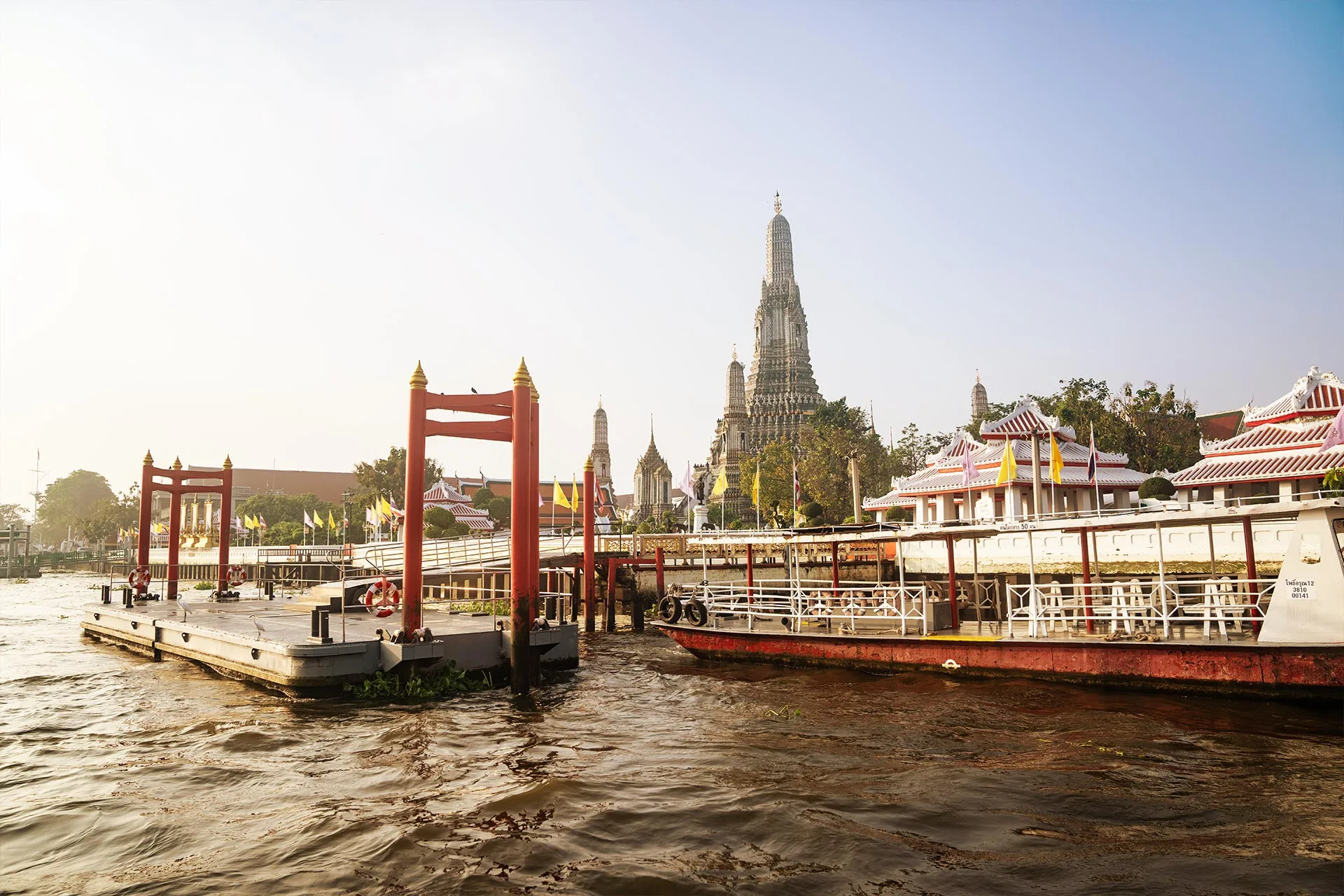
From the Chao Phraya, the central prang of Wat Arun and its smaller prangs rise behind the landing: a floating pier with red gateways, a moored boat and pavilions with red and white roofs decked with yellow flags.© Jaruk 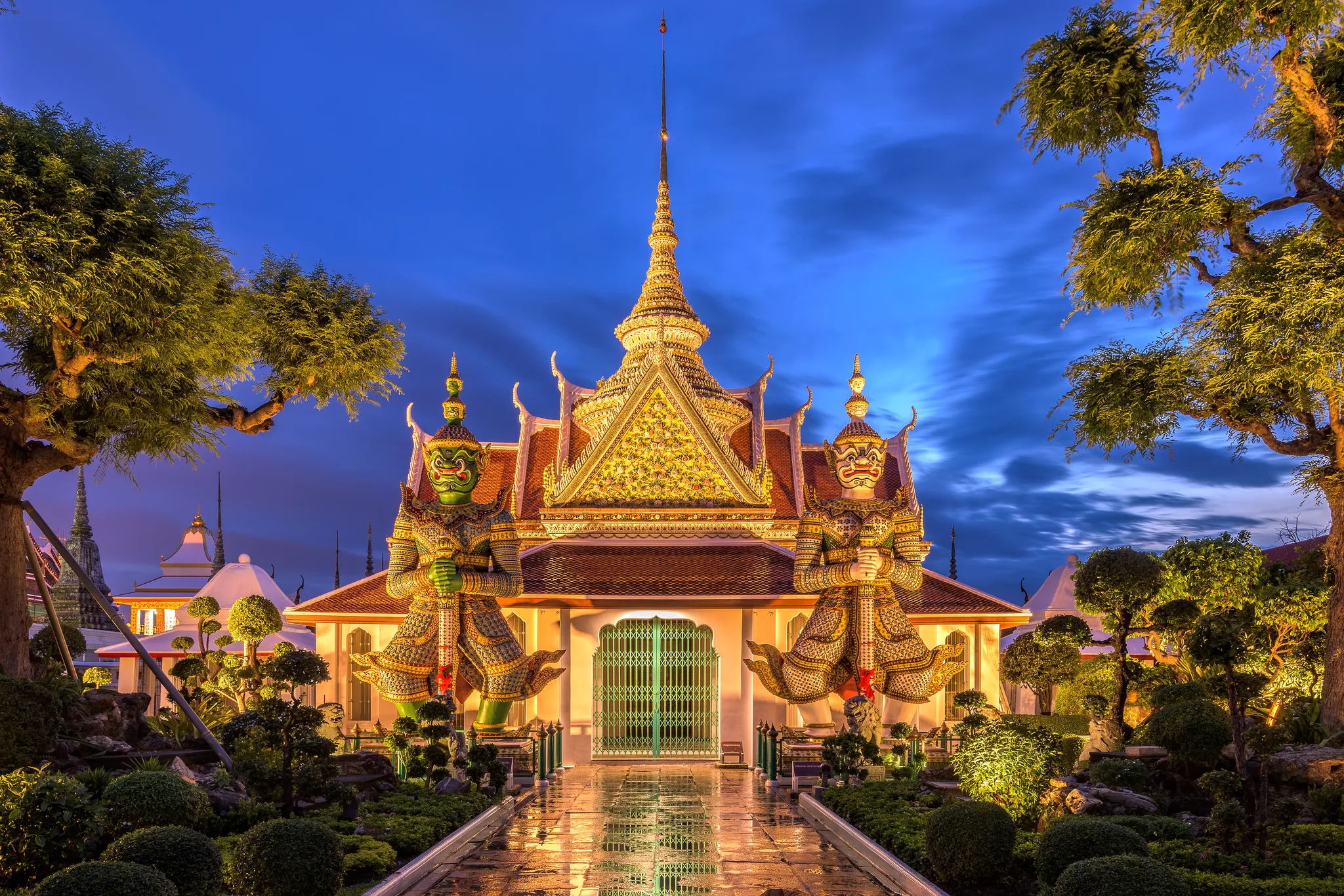
At Wat Arun, two guardian giant statues flank a latticed gate topped by a gilded gabled roof and a spire; the wet pathway, lined with clipped trees, reflects the evening illumination.© Jaruk
Architecture and decoration
Explore the heritage
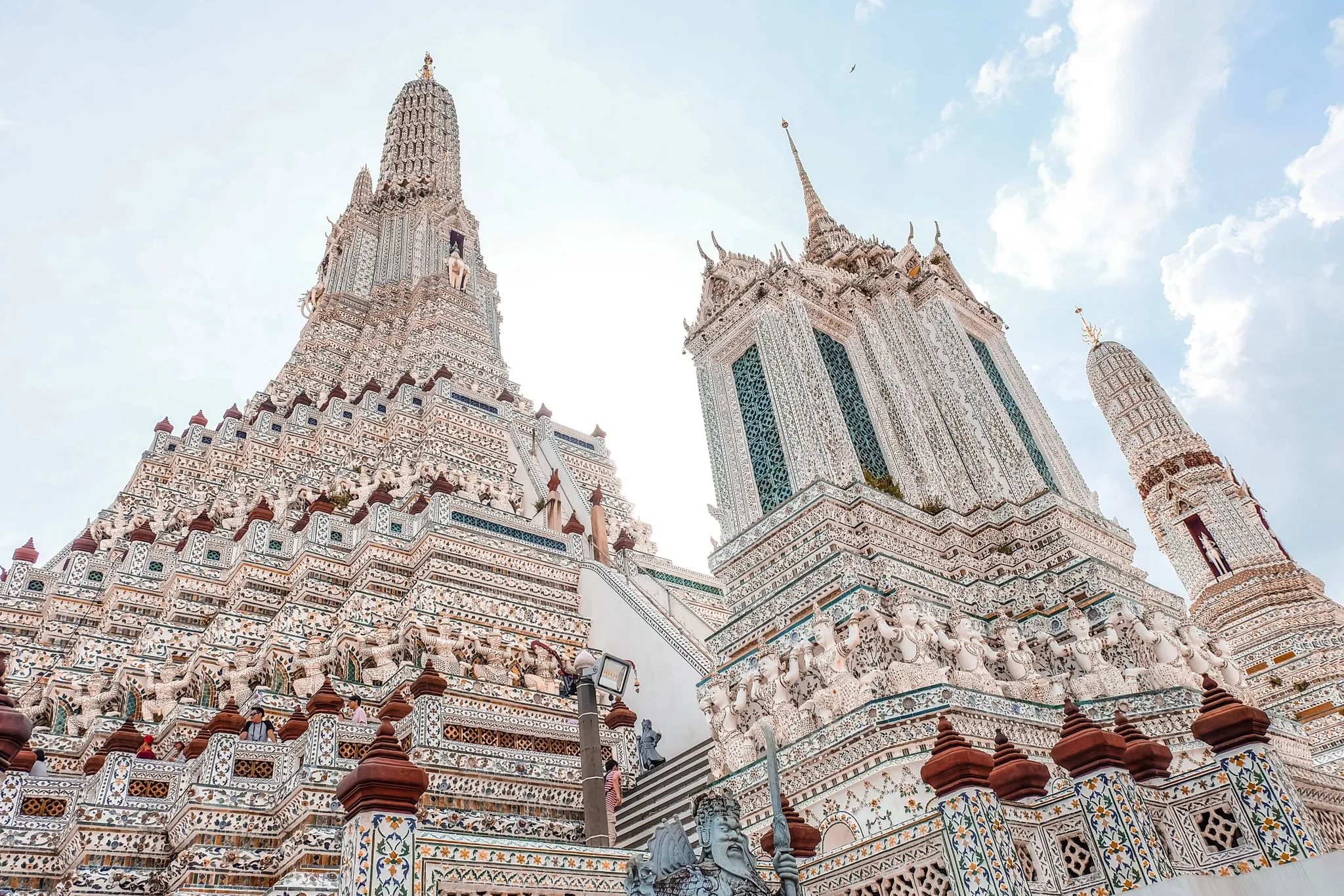
At Wat Arun, the central prang and the secondary prangs rise in tiers clad with fragments of porcelain in floral patterns; rows of sculpted figures adorn the registers, above a balustrade of painted tiles.© Jaruk 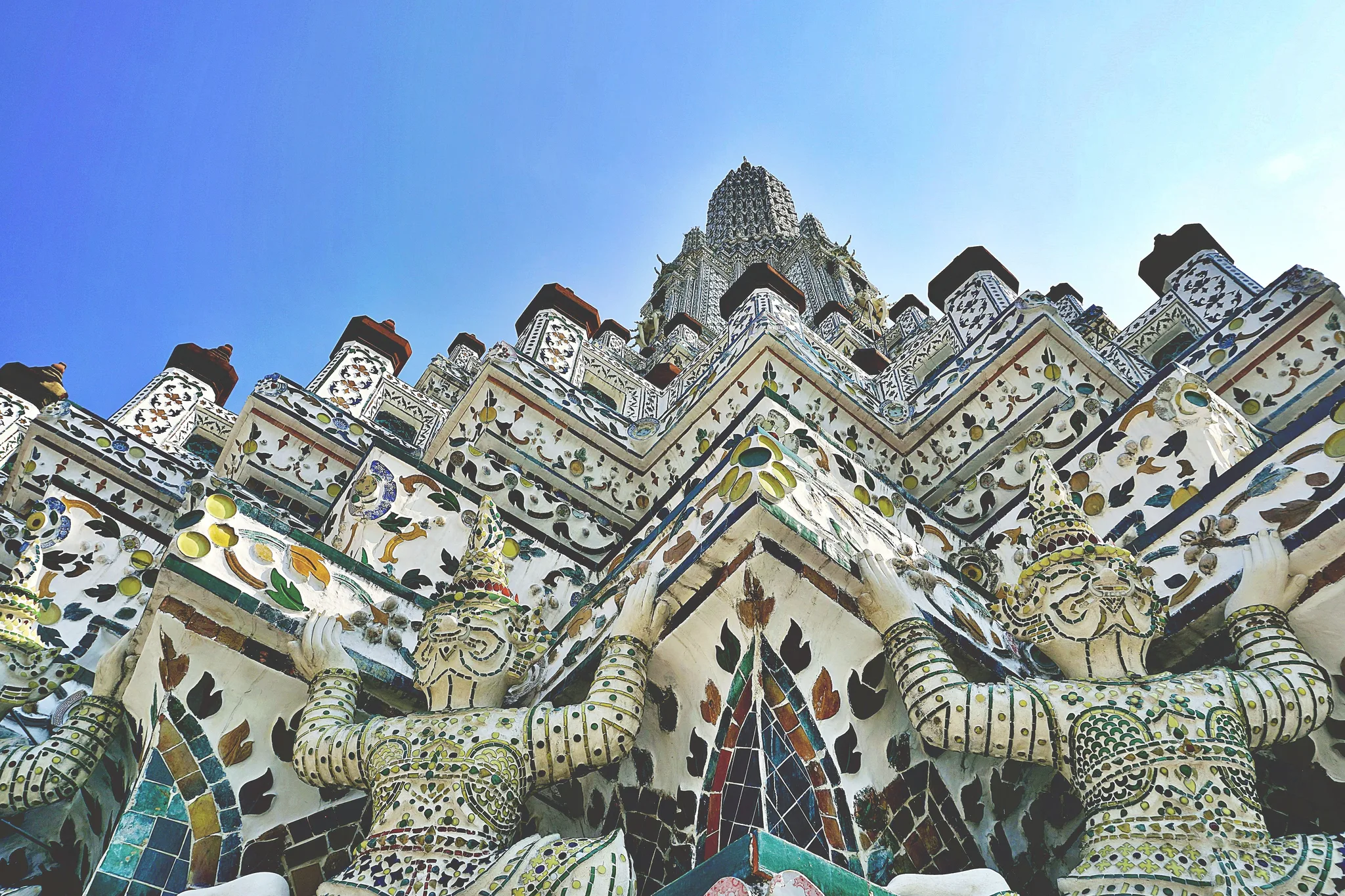
At Wat Arun, guardian figures appear to support the indented tiers of the prang, whose walls are inlaid with fragments of porcelain and ceramic forming colourful floral patterns.© Jaruk
Archive
Memory of time passing
Historical images preserve the visual memory of places and of the ways they have changed.
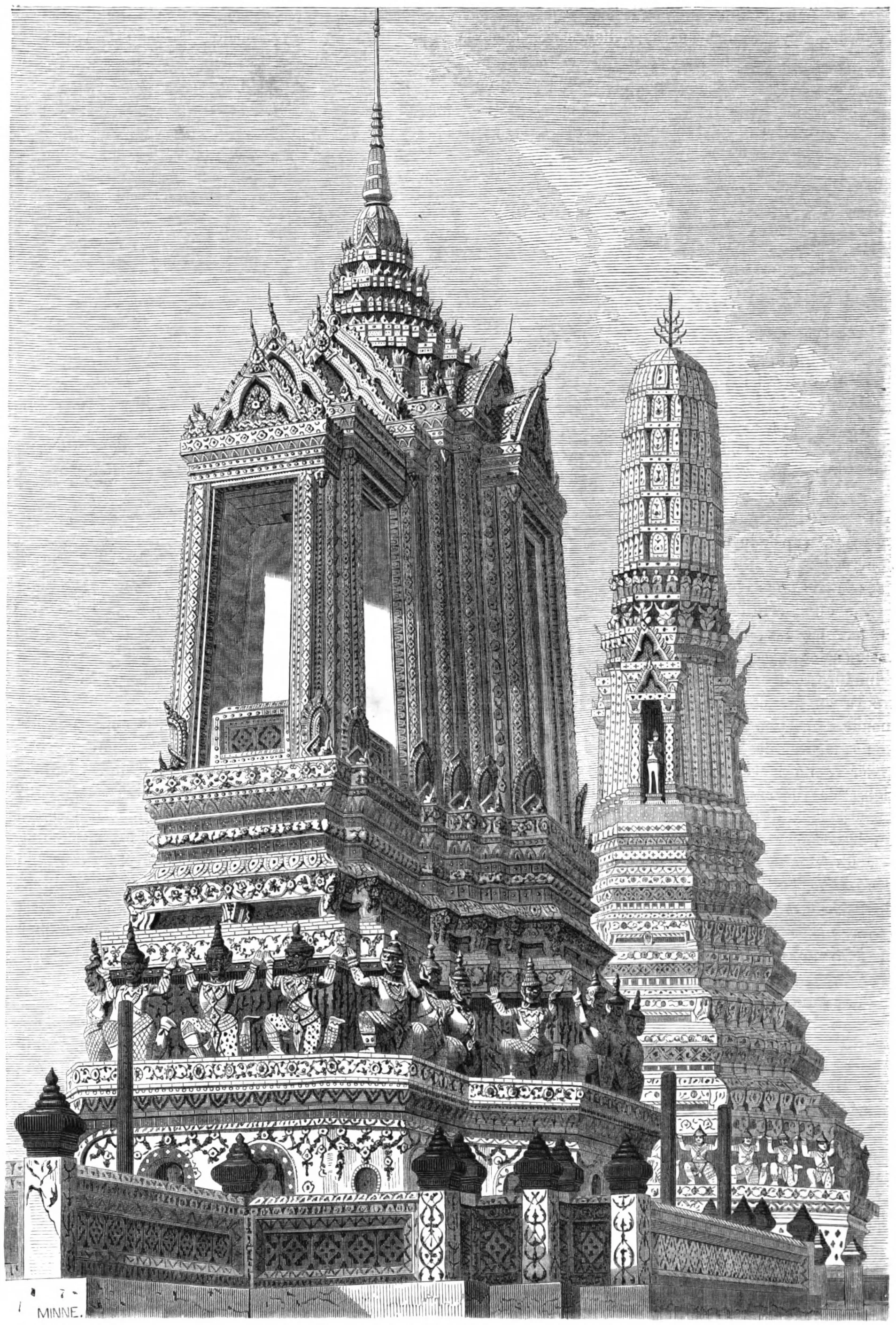
Engraving of Wat Arun showing a pavilion with a tiered roof and slender spire, its base supported by guardian figures, in front of a prang with inlaid decoration; a pierced balustrade punctuates the foreground.Étienne-Gabriel Bocourt — Wikimedia Commons, domaine public 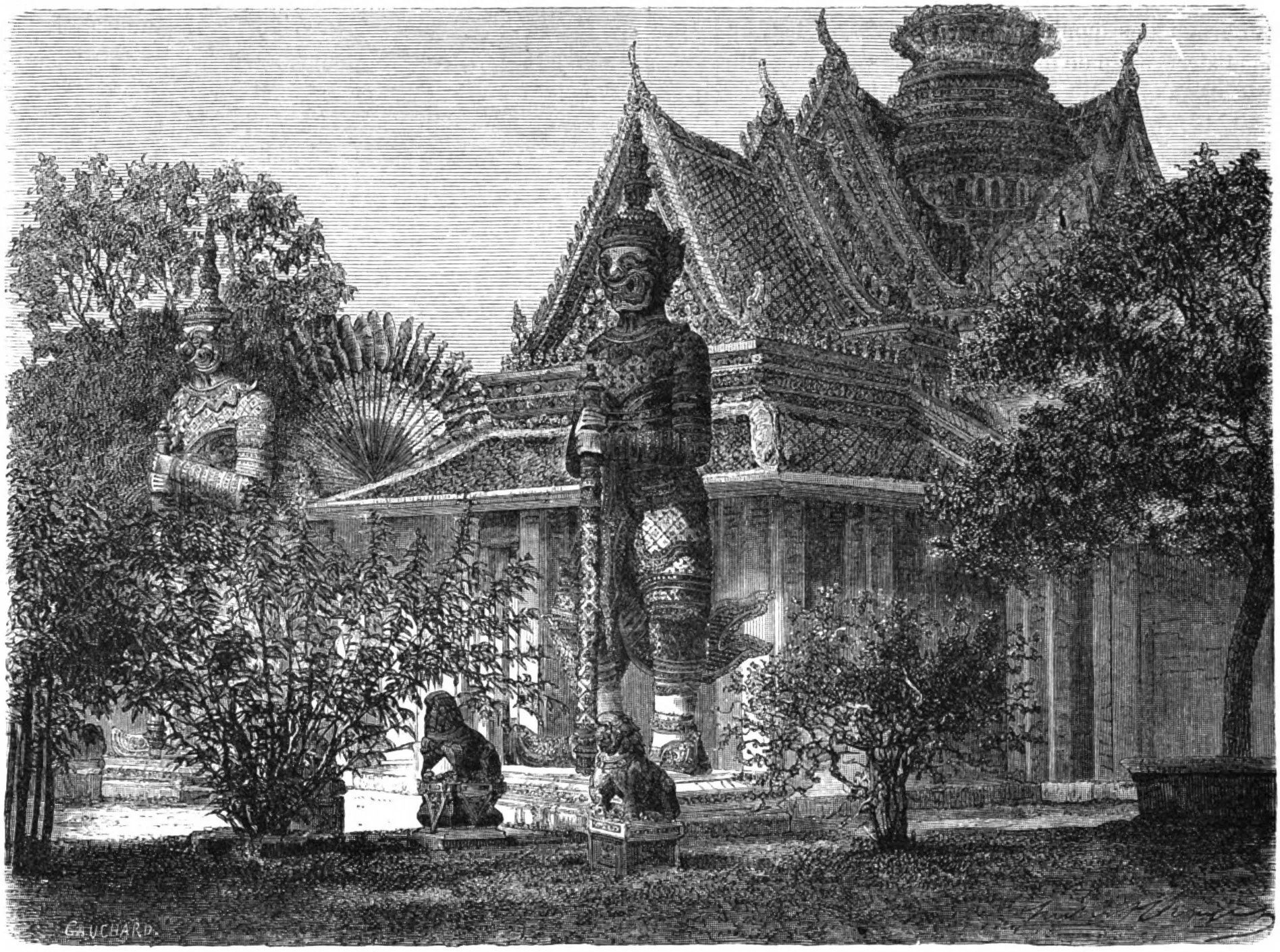
Black-and-white engraving of Wat Arun showing two giant guardians (yaksha) holding clubs before a building with tiered roofs and decorated gables, with stone lions, dense vegetation and the top of a prang.Hubert Clerget — Wikimedia Commons, domaine public 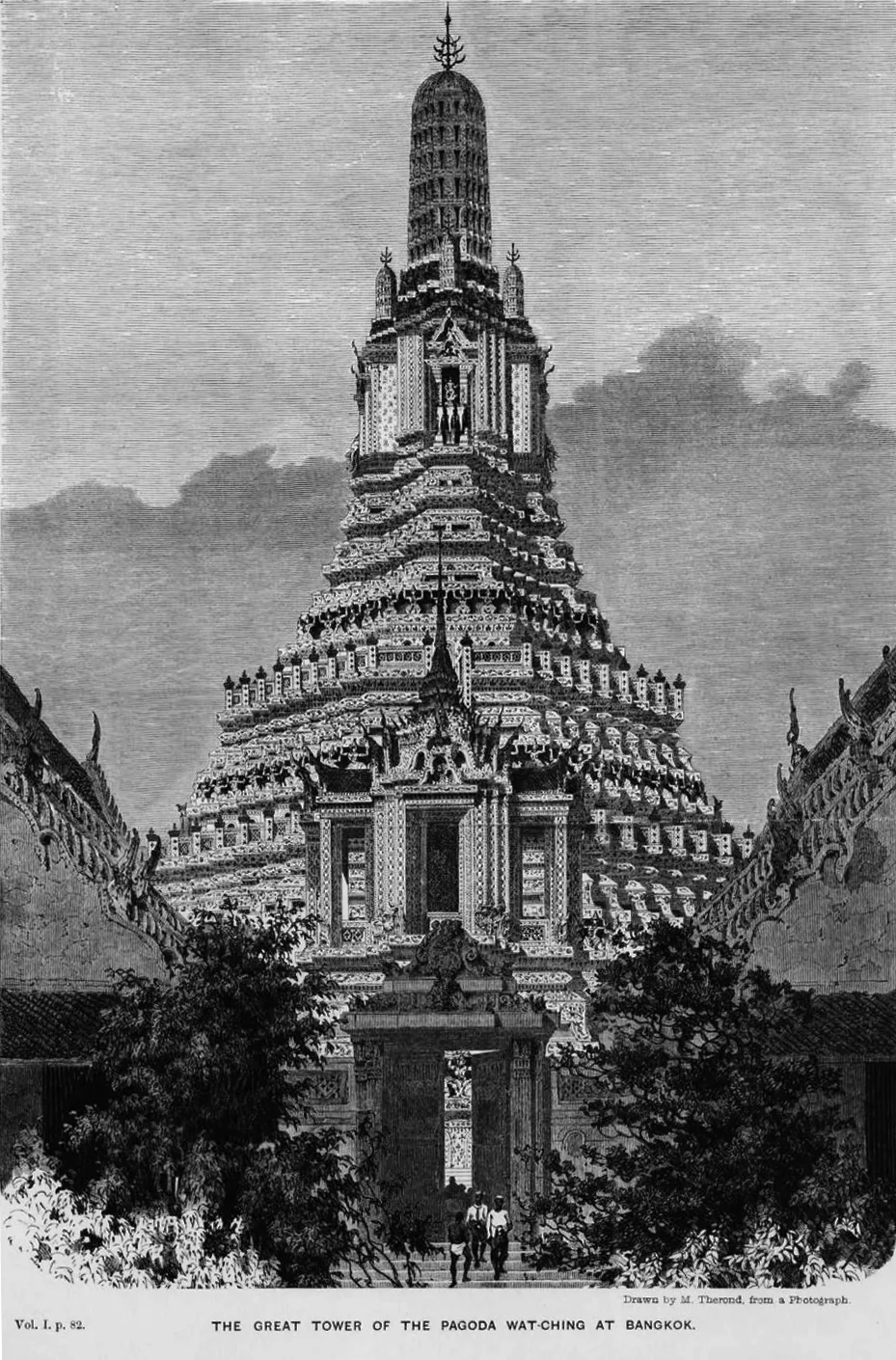
Engraving of the central prang of Wat Arun, with its tiered decoration, seen along the axis of a gateway and a stairway where three figures stand; the printed caption names it ‘the great tower of the pagoda Wat-Ching at Bangkok’.Henri Mouhot — Wikimedia Commons, domaine public 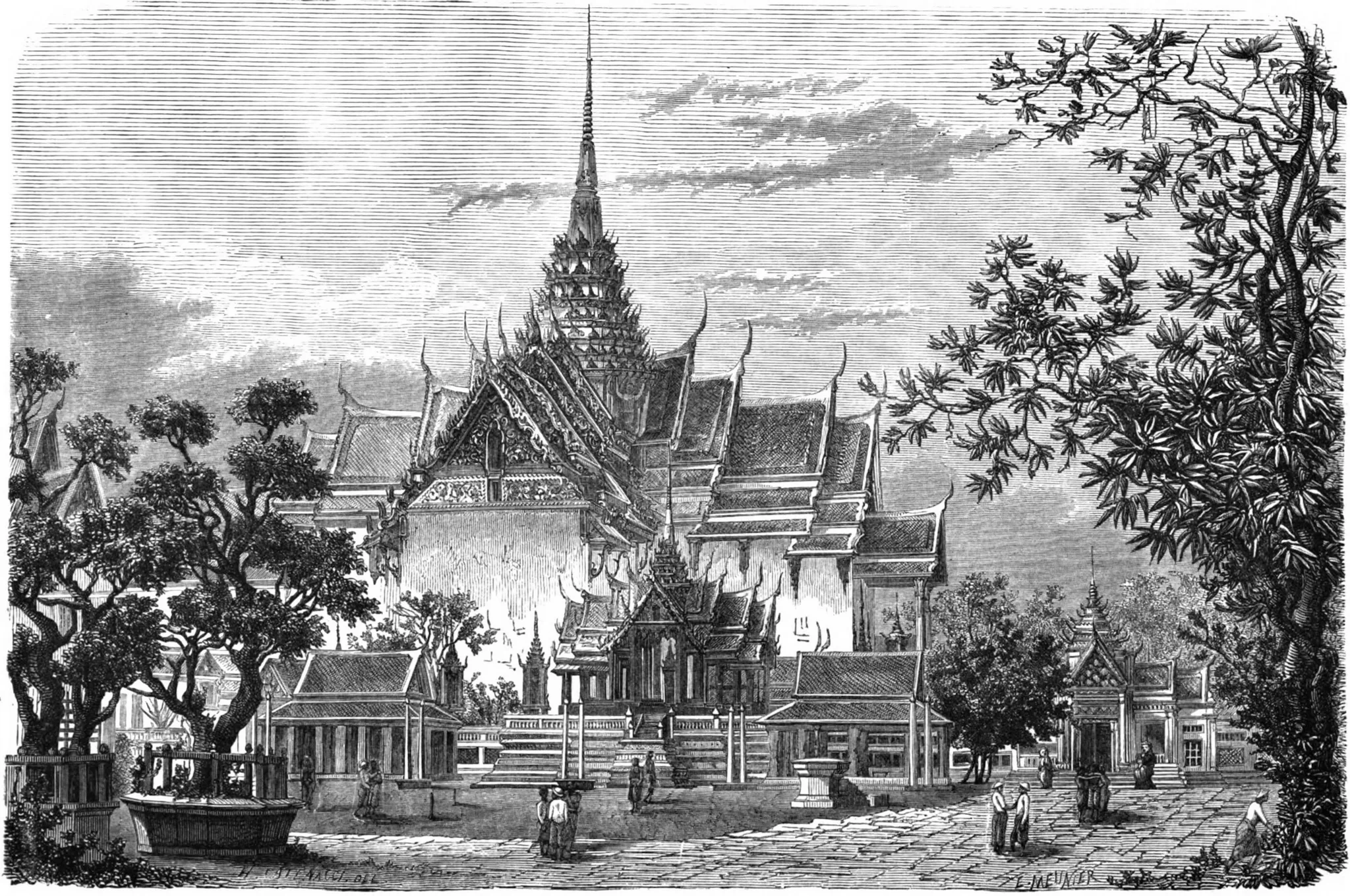
Engraving titled Wat Arun: a building with superimposed roofs, ornate gables and a tall tapering spire overlooks a paved courtyard, with a pavilion with tiered roofs before the stairway, ancillary buildings, trees and a few passers-by.Émile Théodore Therond — Wikimedia Commons, domaine public 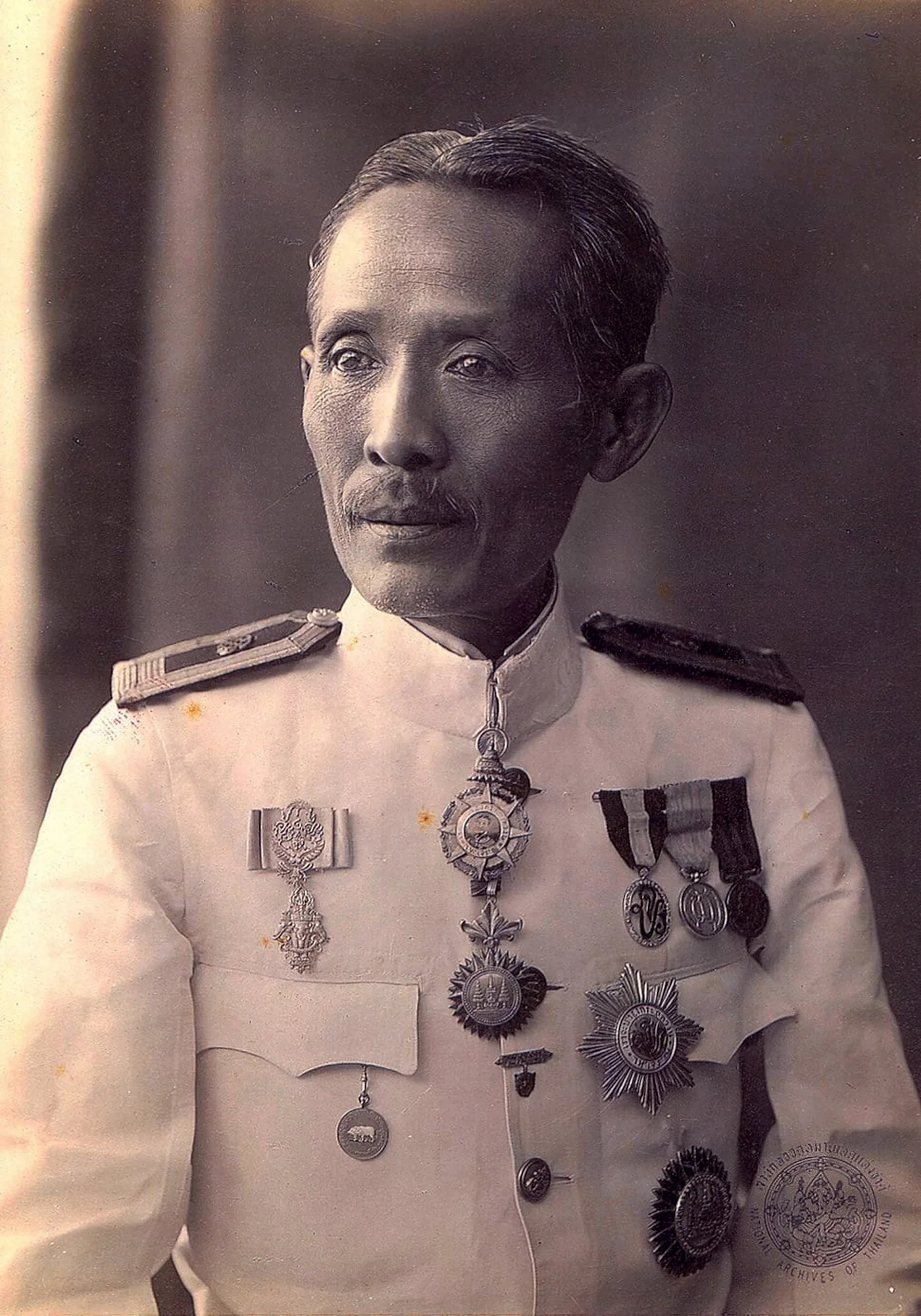
Early sepia-toned photographic portrait of Phraya Ratchasongkhram (Kon Hongsakul) in a white high-collared uniform with epaulettes, wearing orders and medals; National Archives of Thailand stamp at lower right.Auteur inconnu — Wikimedia Commons, domaine public 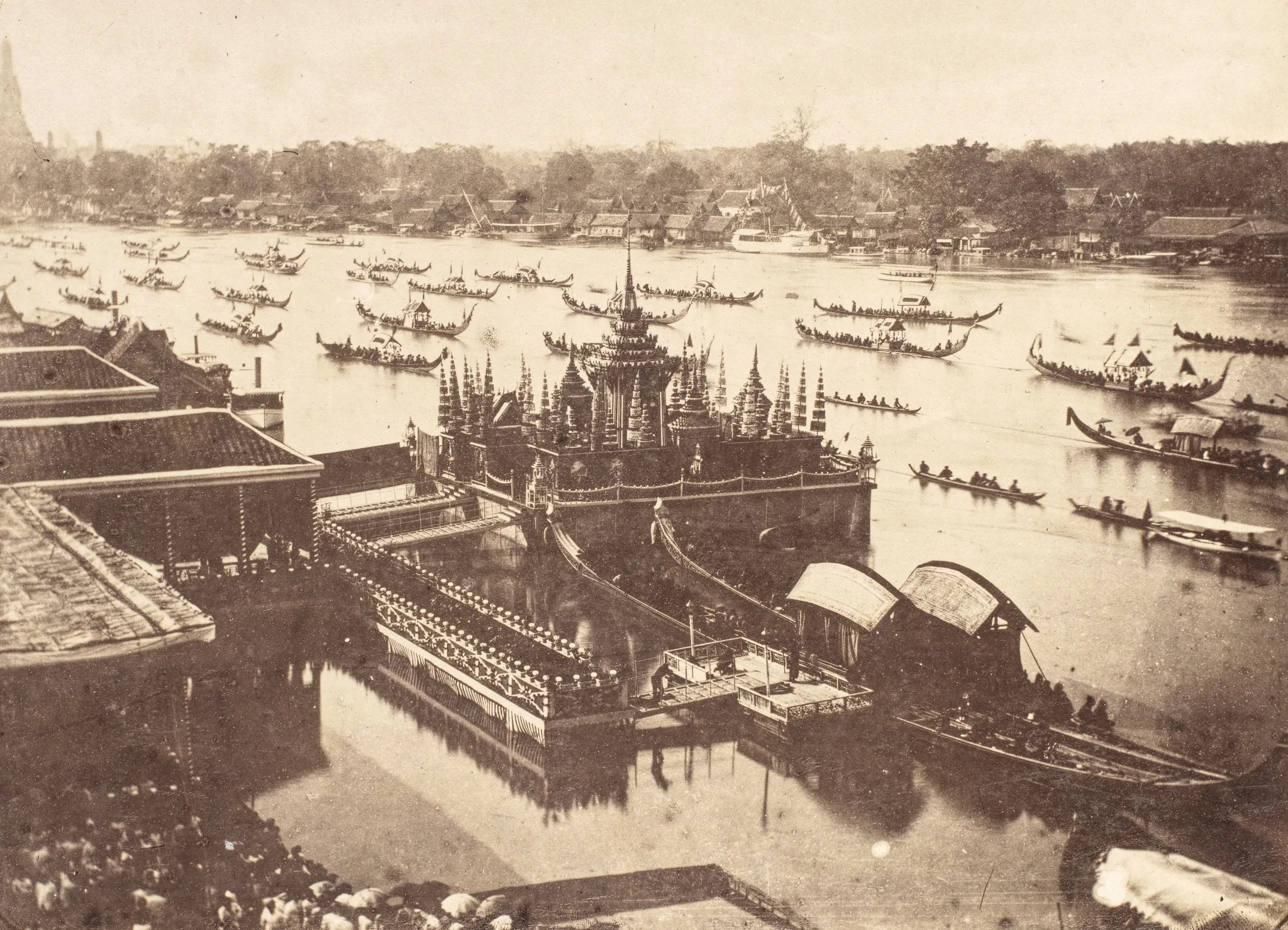
A ceremonial pavilion with multiple spires stands on a platform at the river’s edge, surrounded by long barges crowded with oarsmen; in the background, the bank lined with houses and, on the left, the prang of Wat Arun.Queen Savang Vadhana, the Queen of Siam. — Wikimedia Commons, domaine public 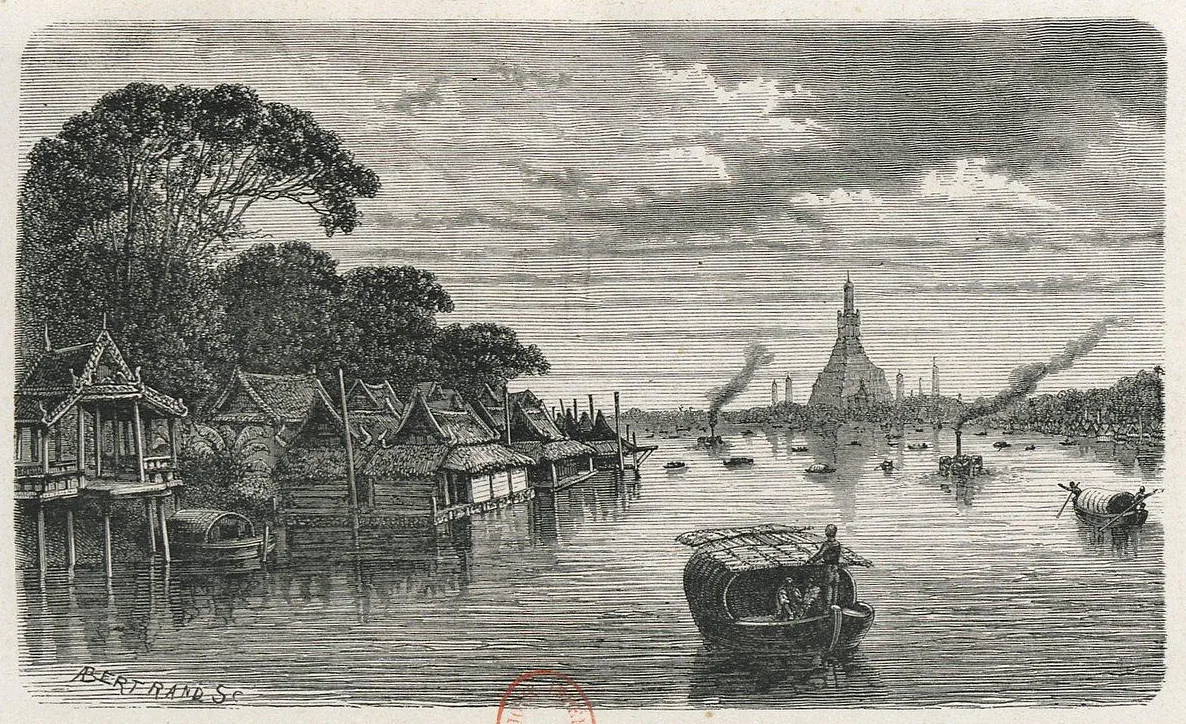
Engraving of the river in front of Wat Arun: the great prang, surrounded by smaller prangs, dominates the horizon; stilt houses with pointed roofs, covered boats and smoking steamboats enliven the waterway.Auteur inconnu — Wikimedia Commons, domaine public 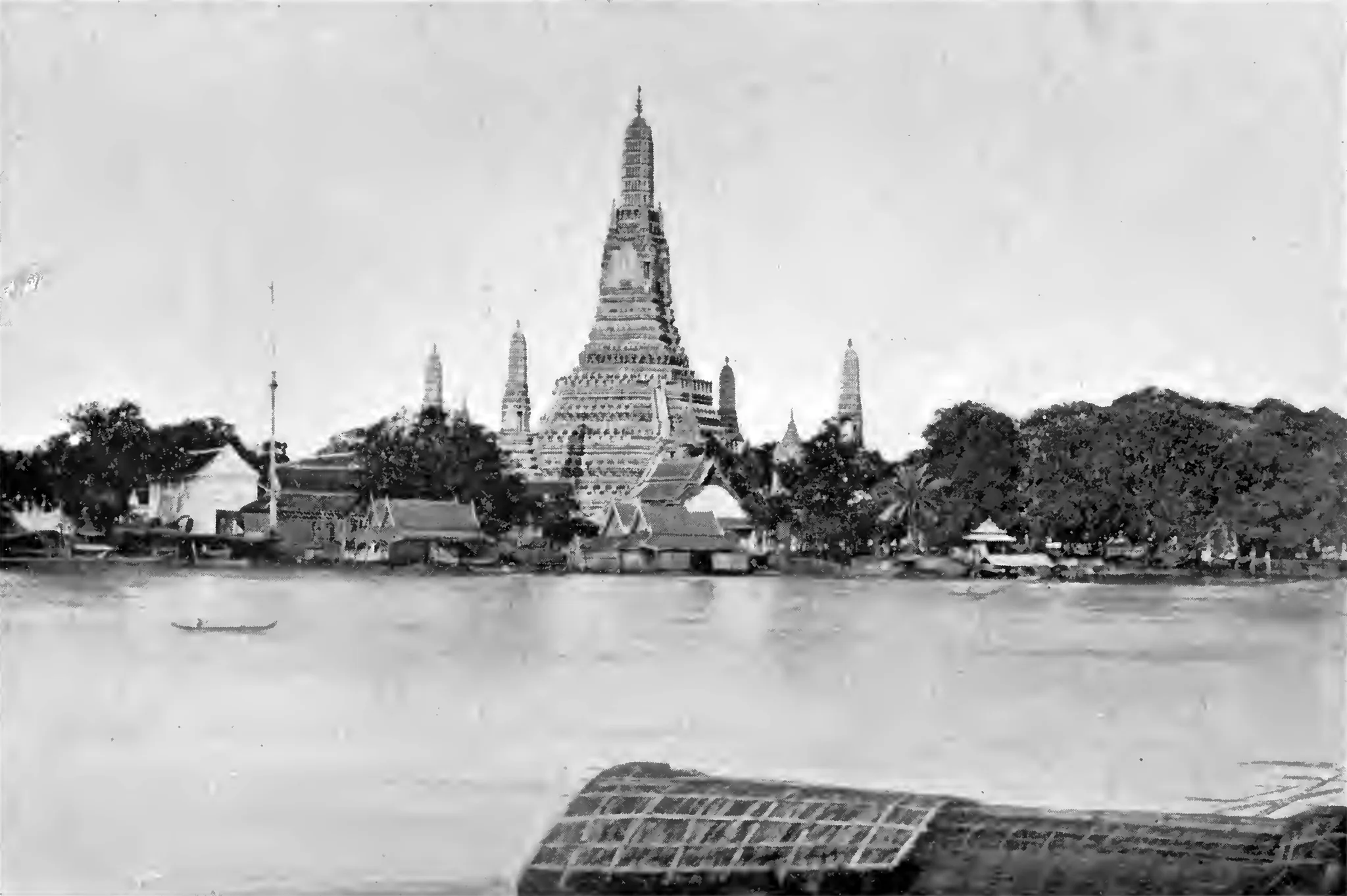
Early black-and-white reproduction: the central prang of Wat Arun, surrounded by smaller prangs, rises above a riverbank lined with trees and tile-roofed pavilions. In the foreground, the woven roof of a boat.Auteur inconnu — Wikimedia Commons, domaine public 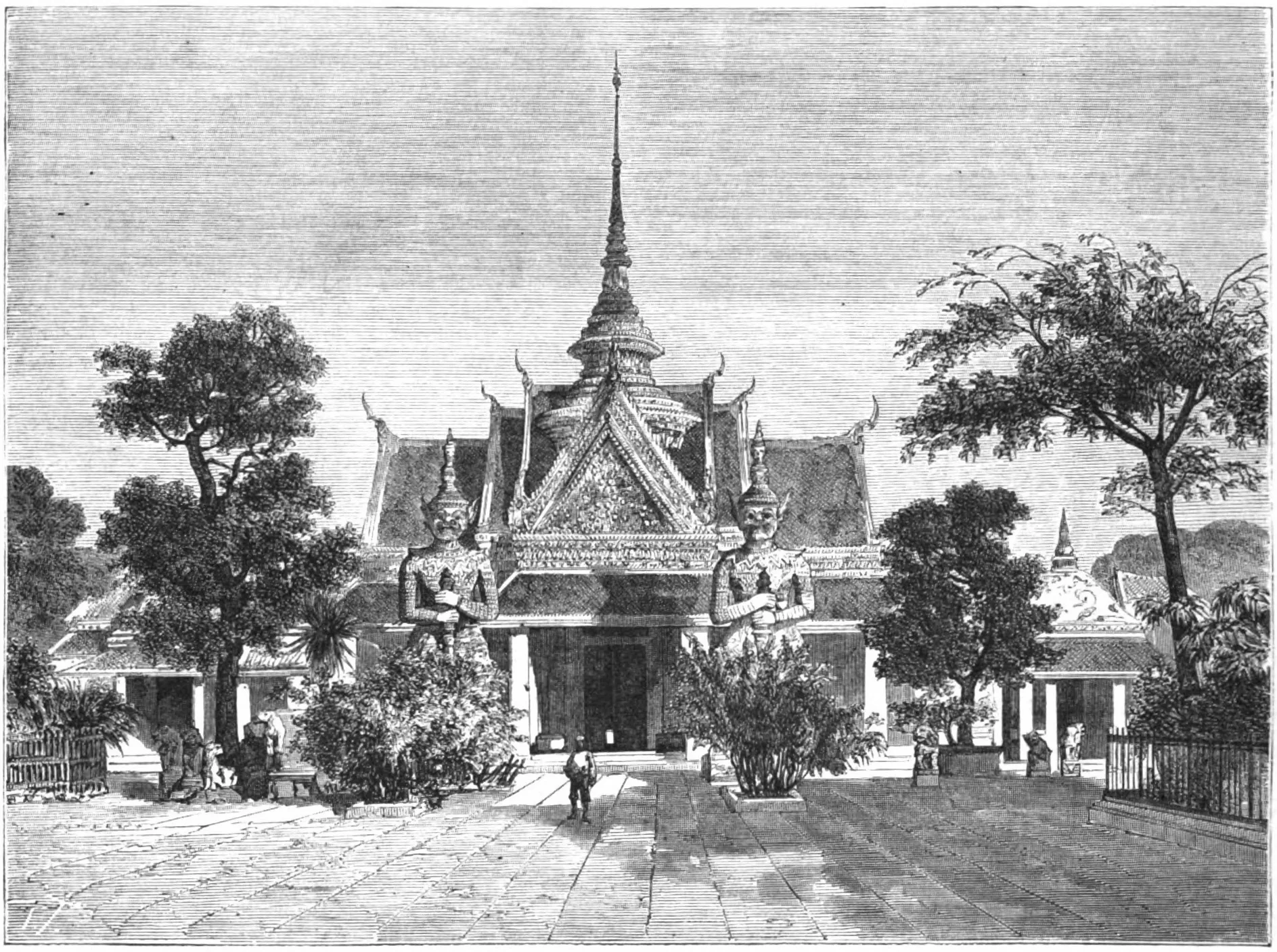
Engraving of Wat Arun showing an entrance pavilion with a carved pediment, crowned by a tiered spire and flanked by two statues of guardian giants. In the foreground are a paved courtyard, trees, small statues and a figure.Émile Théodore Therond — Wikimedia Commons, domaine public 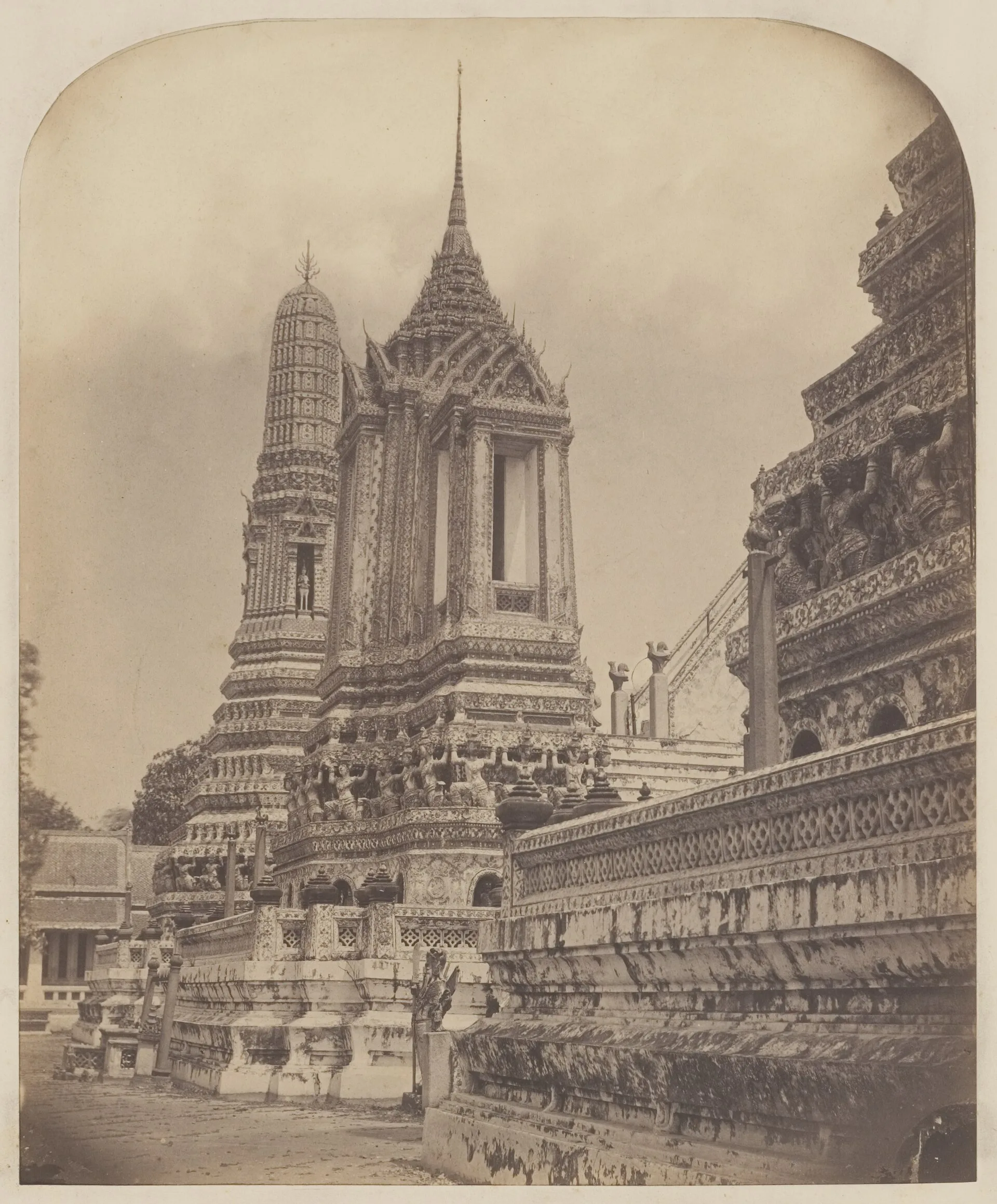
At Wat Arun, a pavilion with a tapering spire (mondop) and a secondary prang rise on bases with pierced balustrades; atlas figures support the terraces, which are entirely covered in inlaid decoration.Isidore van Kinsbergen — Wikimedia Commons, domaine public 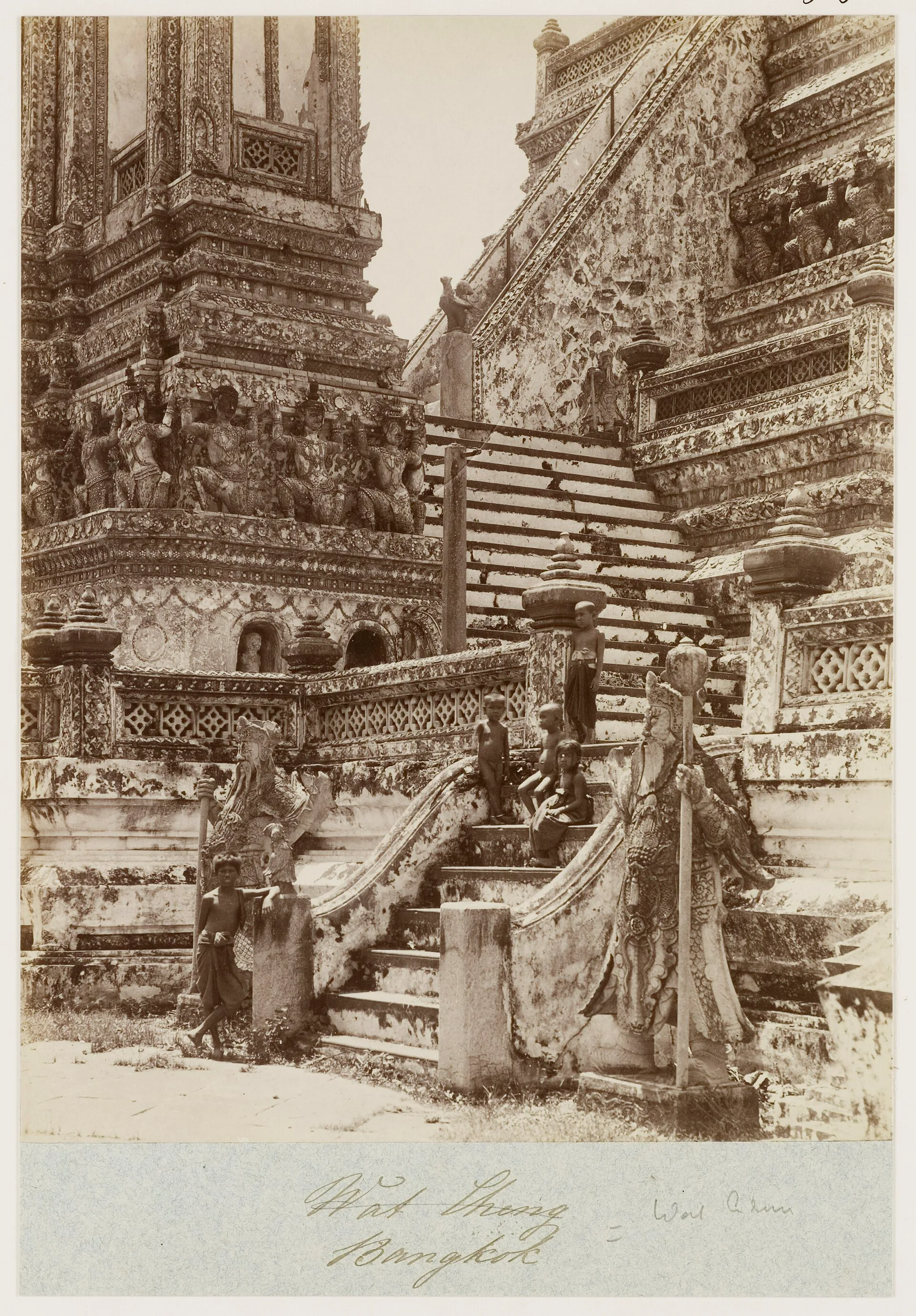
Old sepia photograph of Wat Arun: a steep staircase leads up towards the central prang, flanked by Chinese stone guardians; supporting figures and inlaid decoration adorn the terraces, while children pose on the steps.Lambert & Co., G.R. / Singapore — Wikimedia Commons, domaine public 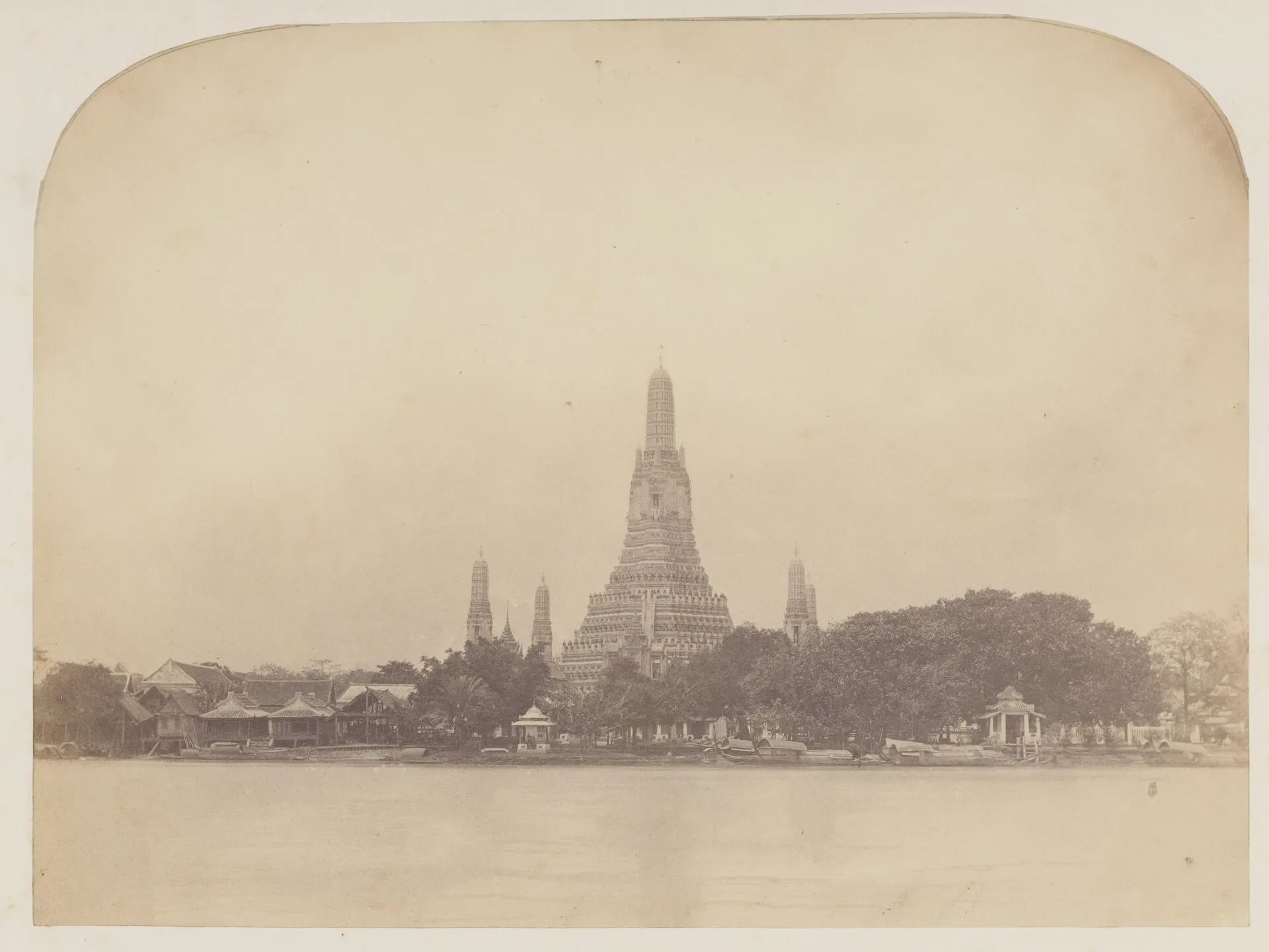
Old print with rounded upper corners showing Wat Arun from the Chao Phraya: the tiered central prang, flanked by secondary prangs, rises behind a bank lined with wooden houses, pavilions and moored boats.Isidore van Kinsbergen — Wikimedia Commons, domaine public 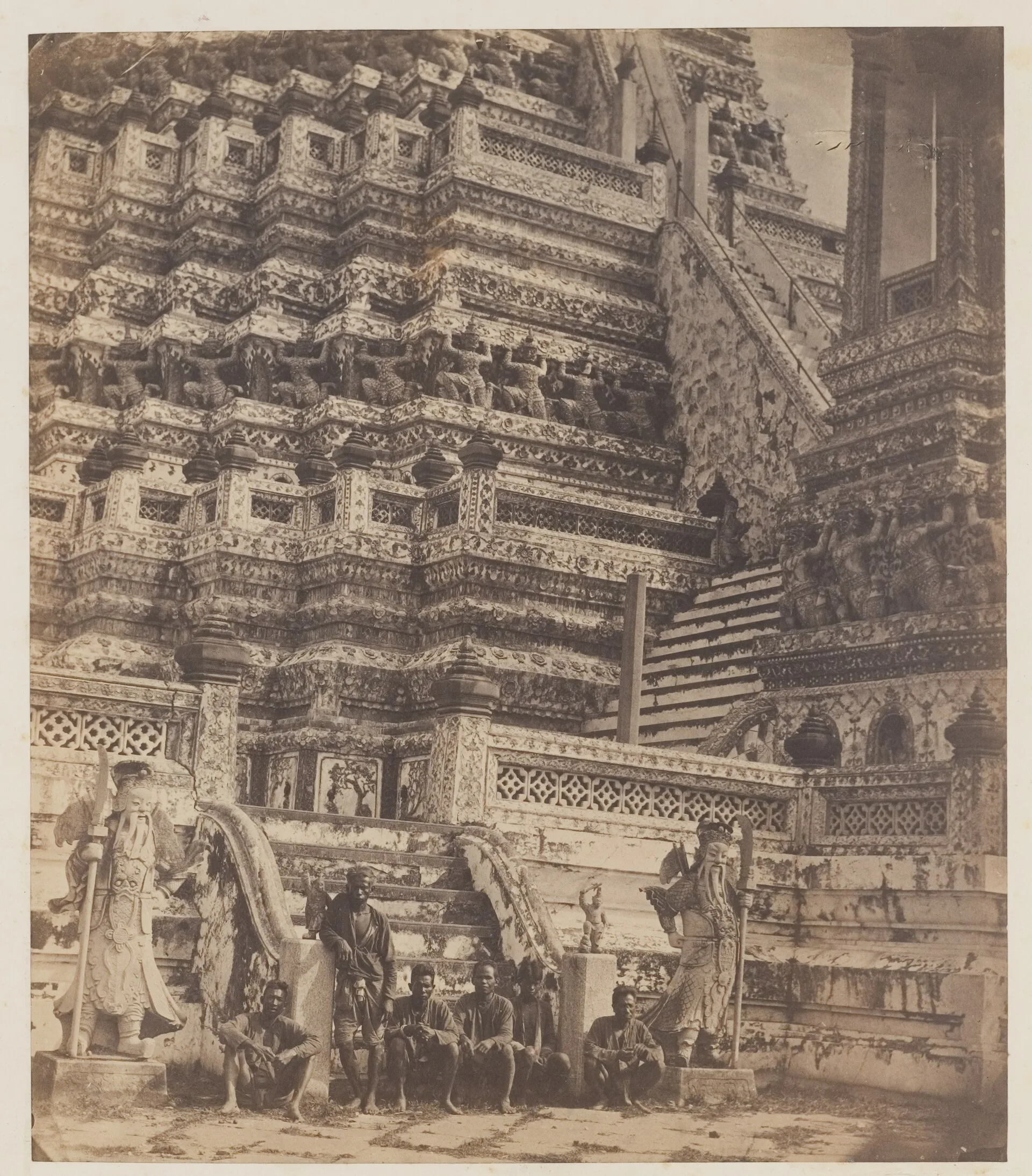
Foot of the central prang of Wat Arun: tiers with floral decoration, a row of caryatid figures supporting a level, steep staircases and pierced balustrades. Two Chinese guardian statues flank a staircase where a group of men are gathered.Isidore van Kinsbergen — Wikimedia Commons, domaine public 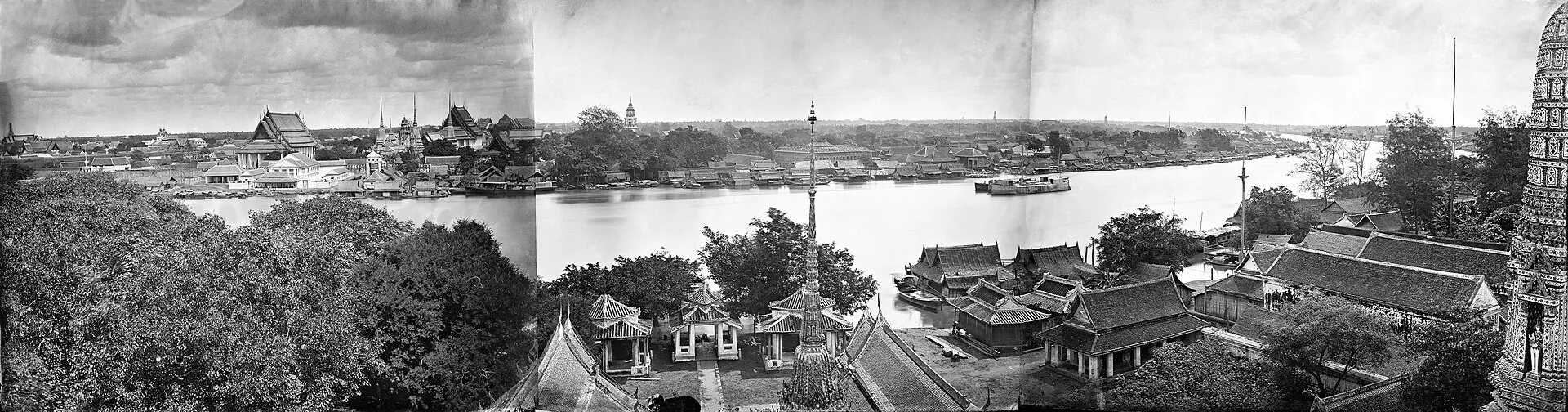
Black-and-white panoramic view, assembled from several prints, taken from a height at Wat Arun. In the foreground, pavilions and gabled temple roofs; beyond, the Chao Phraya, its floating houses and the opposite bank.John Thomson (1837-1921) — Wikimedia Commons, domaine public 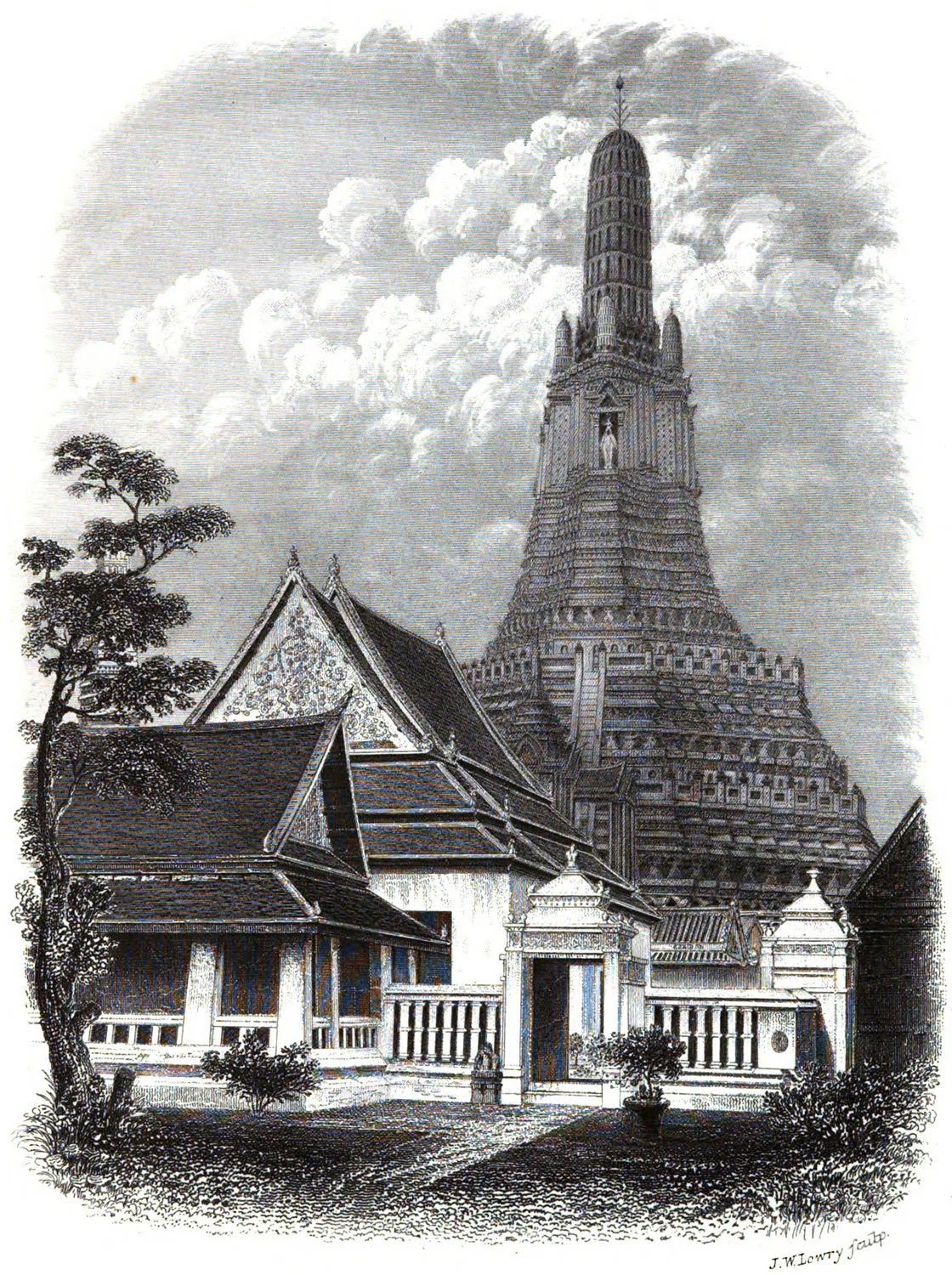
Engraving of Wat Arun: the central prang, decorated with a niche sheltering a statue and flanked by smaller spires, rises behind a building with an ornamented gable and tiered roofs, fronted by a balustraded wall pierced by a gateway.Joseph Wilson Lowry — Wikimedia Commons, domaine public 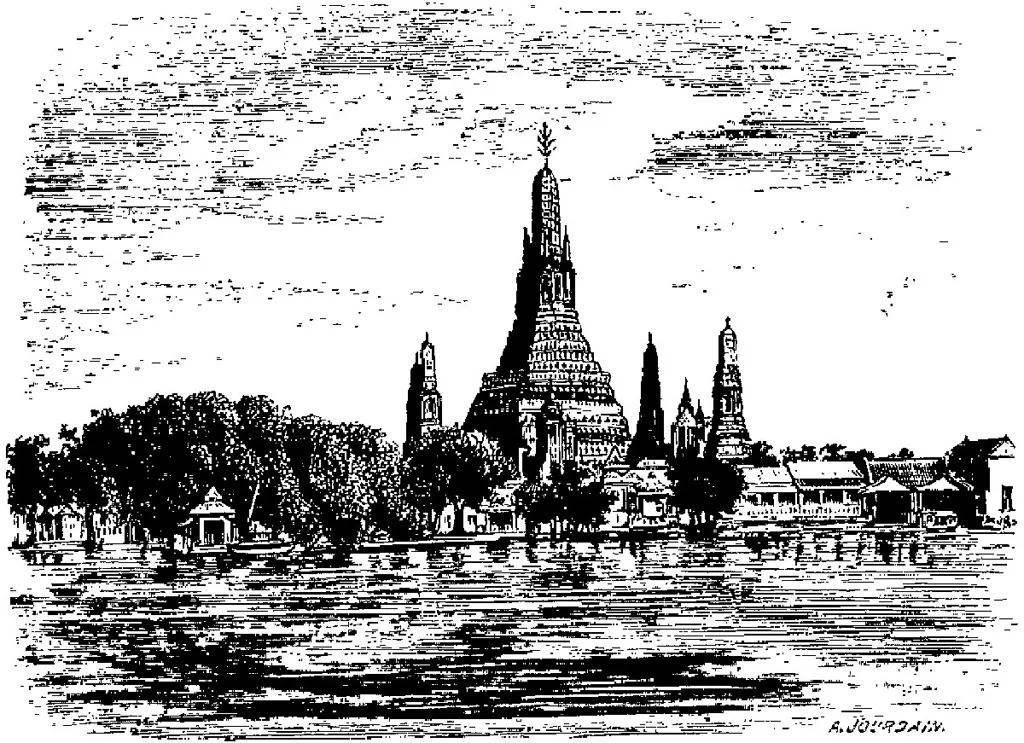
Engraving of Wat Arun seen from the river, signed A. Jourdain: the great tiered central prang rises above the smaller prangs, while pavilions, houses and trees line the bank above the water.A. Jourdain — Wikimedia Commons, domaine public 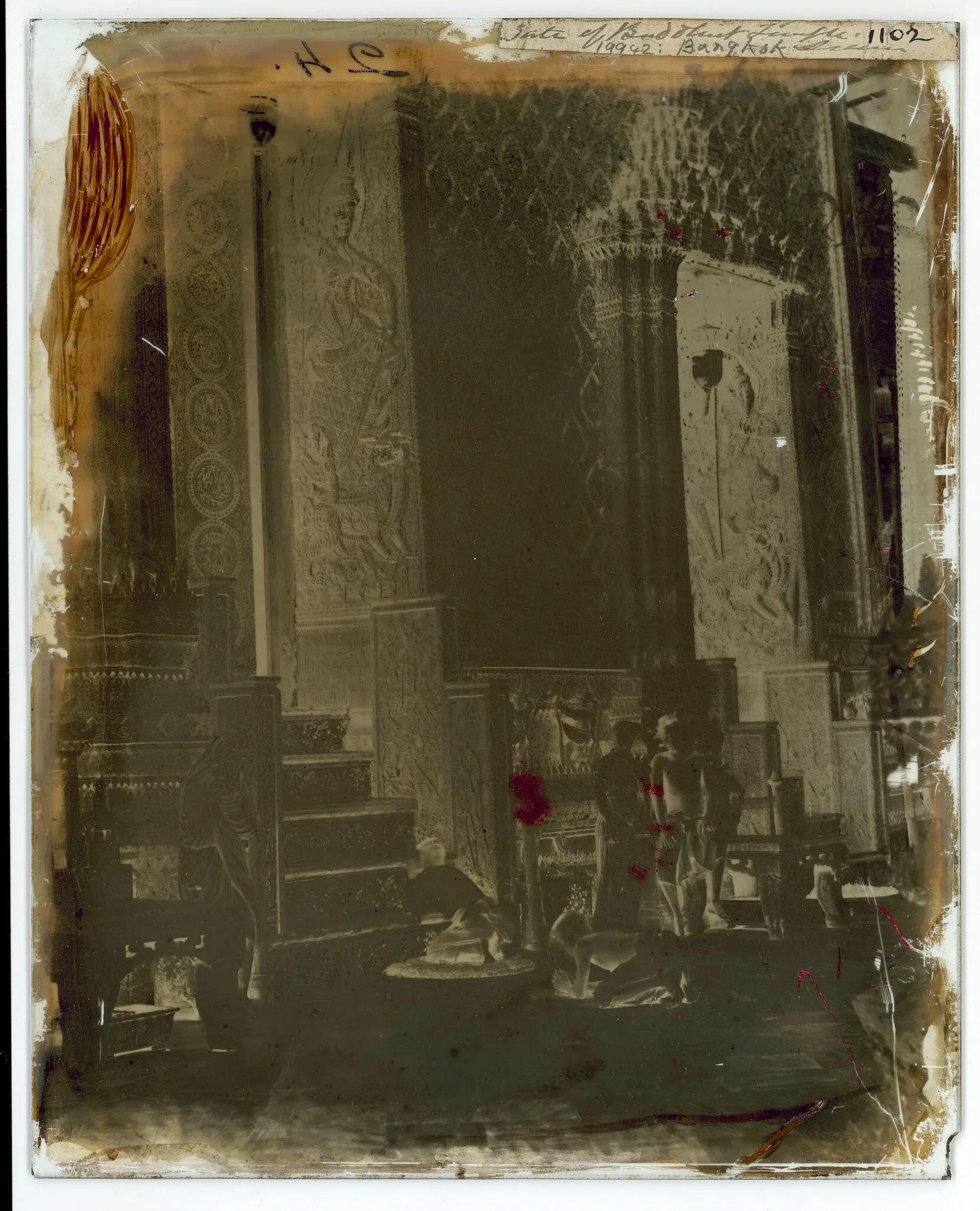
Wat Arun: verandah of a sanctuary, doorway with a carved frame and openwork crest, door leaves decorated with guardian figures, ornamented steps, people seated or standing. Early plate, stained and flaking.John Thomson — Wellcome Collection, domaine public 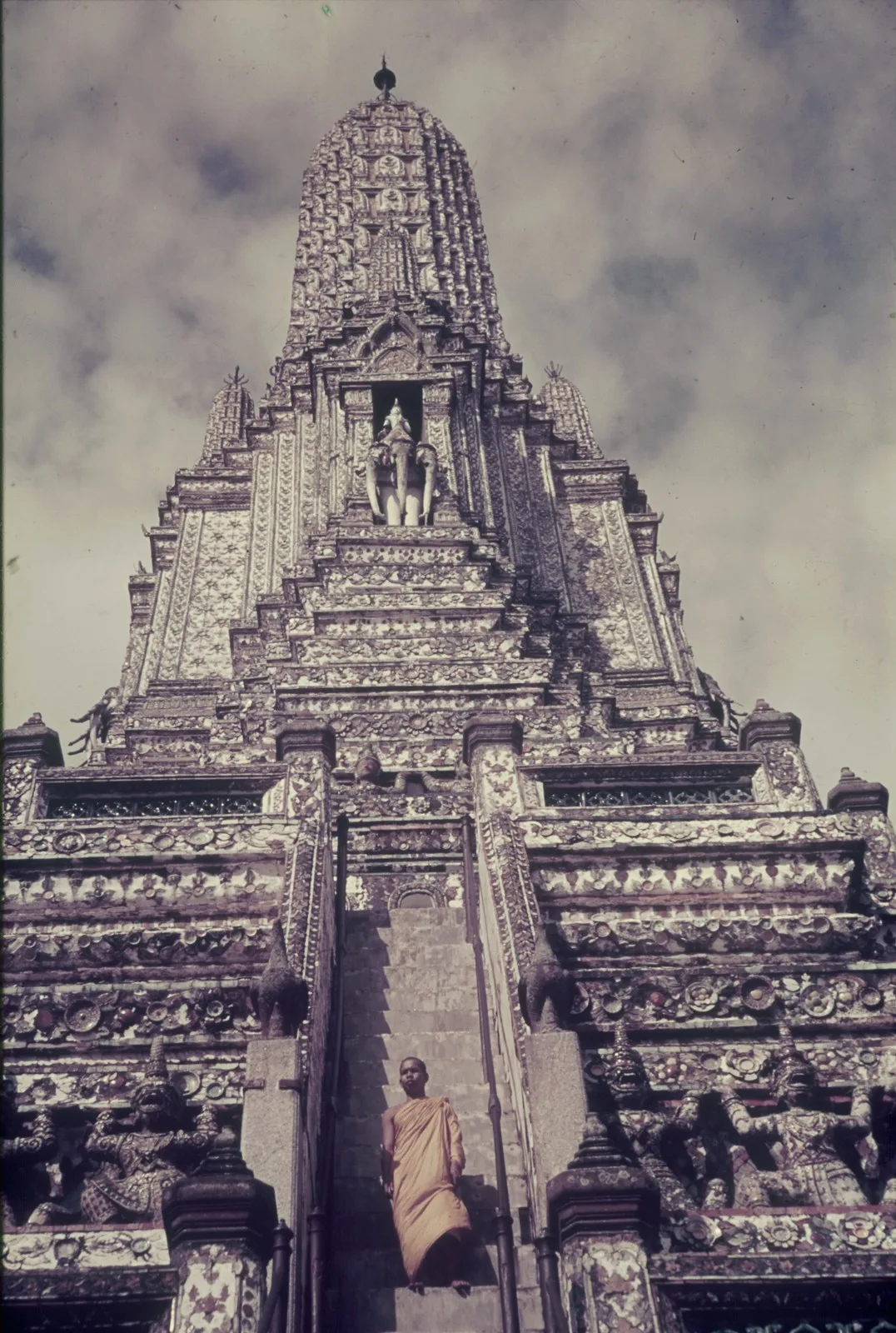
A monk descends the steep stairway of the central prang of Wat Arun. The ceramic and porcelain facing, the yaksha guardian figures at the base and the three-headed elephant in the upper niche are seen from a low angle.Grasser, Franz — Deutsche Fotothek (Europeana), domaine public