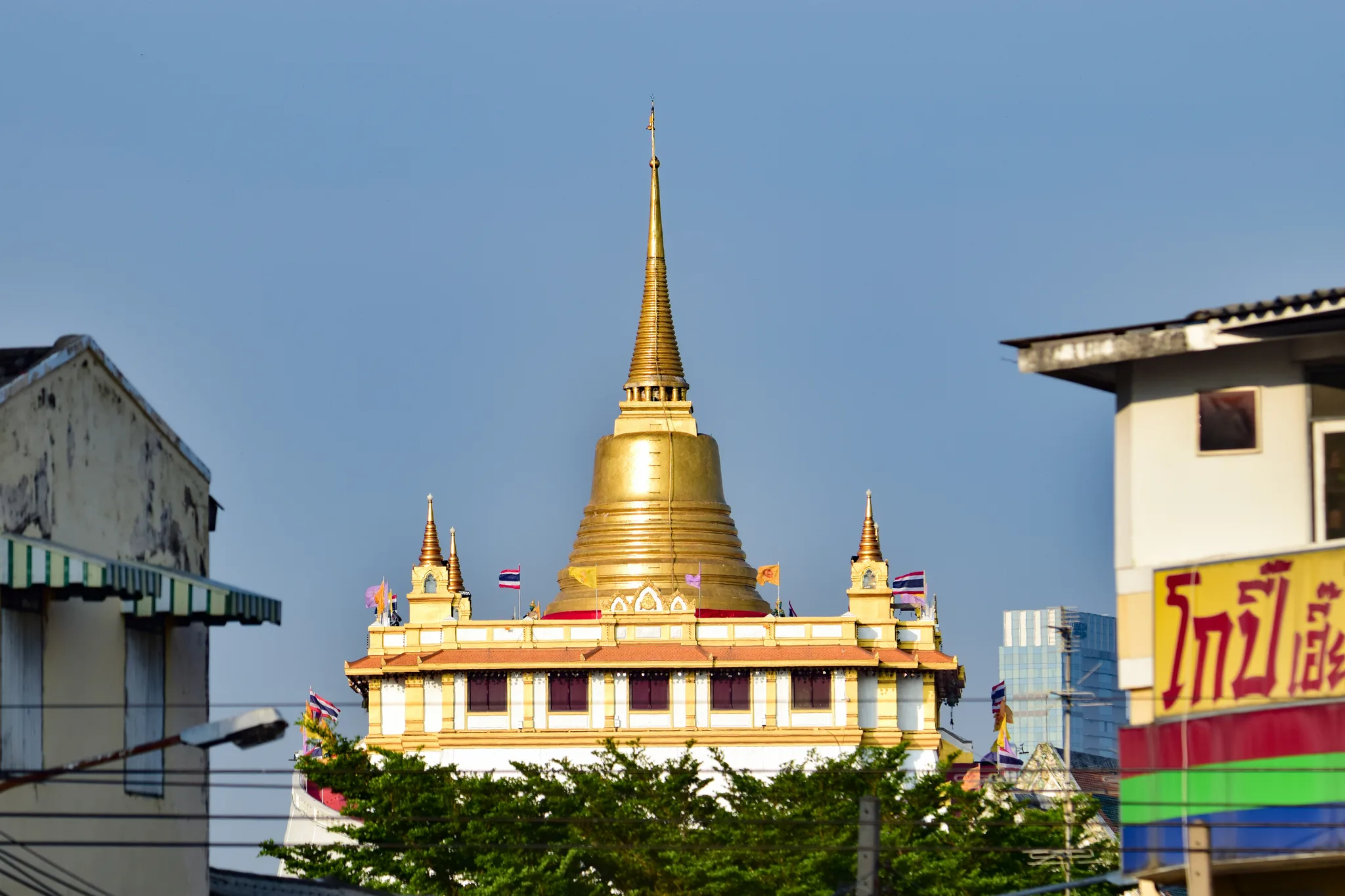
 The golden chedi of Wat Saket (Golden Mount Temple), surrounded by small pinnacles and flags, rises above a white and ochre terrace, seen over the trees from a street lined with houses, shop signs and power lines.กสิณธร ราชโอรส — Wikimedia Commons, CC BY-SA 4.0
- Destination
- Bangkok (Pom Prap Sattru Phai)
- Heritage Family
- Buddhism, religions and spiritualities
- Typology
- Buddhist temple
- Visit
- Available tours →
Wat Saket (Golden Mount Temple) is a royal Buddhist monastery in Bangkok, built on the banks of the old canals that once encircled the city. Its standing rests on a singular history. Refounded by the first king of the Chakri dynasty, it was for a long time the place to which the dead of epidemics were carried, before becoming, around an artificial mountain born of the collapse of a great royal building project, a sanctuary of relics of the Buddha and the setting for an annual festival. Its hill, the Phu Khao Thong, is crowned by a golden chedi.3
Key facts
- Destination
- Bangkok
- Heritage Family
- Buddhism, religions and spiritualities
- Typology
- Buddhist temple
- Places
- Khlong Maha Nak
- Khlong Rop Krung
- Pom Prap Sattru Phai
- People
- Rama Ier
- Rama II
- Rama III
- Rama IV (Mongkut)
- Rama V
- Tat Bunnag
- Communities
- Monastic community of Wat Saket
- Events
- Enshrinement of Buddha relics on the Golden Mount (1878)
- Collapse of the Wat Saket great prang project
- 1820 cholera epidemic in Bangkok
- Refoundation of Wat Saket under Rama I
- 1966 restoration of the Golden Mount
- Heritage
- Golden Mount Fair
- Glossary
- Wat
- Khlong
- Royal temple
- Ratchaworamahawihan
- Prang
- Chedi
- Keywords
- —
- Date
- —
- Collections
- —
Practical info
Practical information about this site is taken from its Google Maps page. We advise you to check it before visiting.
- Address
- 344 Thanon Chakkraphatdi Phong, Khwaeng Ban Bat, Khet Pom Prap Sattru Phai, Krung Thep Maha Nakhon 10100
A monastery refounded at the gates of the city
An Ayutthaya temple on the canal banks
Before it bore its present name, the monastery was called Wat Sakae. It was an old temple, already in existence in the Ayutthaya period. It stood apart from what would become the royal city. This location weighs on its entire history: outside the fortified walls, alongside the canals, the monastery would remain both close to power and on the margins of the city.3
The first king of the Chakri dynasty, Rama I, transformed this temple. He had it restored, so extensively that one may speak of a refounding of the whole monastery, and had canals dug around it. In 1783 the Khlong Maha Nak was opened; the monastery stood on the banks of this canal and of the Khlong Rop Krung, the encircling canal. During the season of high water, this area was then used for sung contests and sakrawa, duels of improvised poetry, in imitation of Ayutthaya. The monastery thus became part of a landscape of riverside pastimes conceived as a reminder of the old capital.1
The name Saket and General Chakri’s bath
It was after the digging of the Khlong Maha Nak that the temple took the name Wat Saket. The word means ‘washing the hair’, implicitly the royal hair. Tradition links the name to an episode predating the founding of the dynasty. General Chakri was returning from a campaign in Cambodia to put down the unrest troubling Thonburi, then the capital. He is said to have stopped at Wat Sakae to take a ritual bath, the phra krayasanan, before going on to the city where he was to be raised to the throne in 1782 as Rama I.3
This account belongs to the tradition of origins, and it is handed down as such.
The rank of a royal temple
This link with the Crown can still be read in the monastery’s status. Wat Saket (Golden Mount Temple) is a royal temple, a phra aram luang, that is, a monastery placed under the patronage of the sovereign. It belongs to the second class of these temples and holds the rank of ratchaworamahawihan, hence its full name, Wat Saket Ratchawora Mahawihan. Its monks belong to the Maha Nikaya monastic order.3
The monastery outside the walls, a place of the dead
Funerals away from the city
Located outside the fortified walls, the monastery became a frequent place for funerals. Wat Saket thus became one of the places to which the capital entrusted its dead.4
The cholera of 1820
This function took on dramatic proportions under King Rama II. In 1820 a cholera epidemic that had come from Penang, on the Malay Peninsula, struck the capital and claimed tens of thousands of lives. The bodies were carried outside the walls, to Wat Saket, but also to Wat Sangwet and Wat Choeng Lane, today Wat Bophit Phimuk. The monastery then became the main place where the victims were deposited.4
The epidemic of 1820 was not an isolated episode. Cholera returned every dry season, and this cycle repeated itself for decades, until the beginning of the reign of King Chulalongkorn, Rama V.4
The vultures of Wat Saket
Unable to cremate all the bodies, people left some of them in the open air within the monastery grounds. The corpses attracted vultures, which settled on the site for good. A photograph taken around 1900 still shows a nearby cement crematorium with vultures perched on its top: the scene did not belong only to the great epidemics; it was part of the monastery’s landscape at the turn of the twentieth century.4
This reality passed into the language. The expression ‘Raeng Wat Saket’, ‘the vultures of Wat Saket’, entered everyday speech, and it is often paired with ‘Pret Wat Suthat’, ‘the hungry ghosts of Wat Suthat’, named after another great royal monastery in Bangkok.4
From collapsed mountain to Golden Mount
Rama III’s great building project
In the course of the nineteenth century, the same monastery became the setting for a great royal building project. King Rama III had work begun there on a monument of very great size. He entrusted its direction to a high dignitary of the court, Somdet Chao Phraya Borom Maha Phichai Yat, whose personal name was Tat Bunnag. The project envisaged a prang, a tower-sanctuary with a slender silhouette, set on an indented base ‘with twelve angles’, that is, one in which each corner is cut into successive recesses that multiply the edges.7
A heap known as ‘the mountain’
The project ran up against the nature of the ground. Bangkok’s soft soil, saturated by the nearby canals, could not bear the weight of the construction. The foundations subsided several times, and the monument eventually collapsed while work was still under way. All that remained was a great heap of bricks and materials, which local people began to call ‘phu khao’, ‘the mountain’.4
This nickname lies at the origin of all that followed. What should have been a tower became a hill, and it was this hill, not the planned prang, that subsequent reigns would develop. The technical failure of Rama III’s reign thus fixed, without anyone intending it, the form of the monument that can be seen today.
Completion under Chulalongkorn
The hill remained unfinished under King Mongkut, Rama IV, and was completed only under Chulalongkorn.5
The project thus stretched over three reigns. The monument finally received an official name, Phra Borommabanphot, set by a royal proclamation published in the Royal Gazette (Ratchakitchanubeksa). But to local people it remains the Phu Khao Thong, the ‘Golden Mount’.5
The relics and the festival
A reliquary at Chulalongkorn’s wish
A hill crowned by a chedi, a solid reliquary monument, was waiting for relics. It was King Chulalongkorn who provided them. In 1878 he had relics of the Buddha kept at the Grand Palace transferred and deposited at the summit of the mount. Twenty years later, in 1898, a second deposit placed relics from India there. These two acts changed the meaning of the place: the monument born of a collapse became the monastery’s reliquary, an object of veneration for the whole city.1
The transformation is all the more striking because, in those same decades, the monastery was still associated with epidemics and vultures. From then on, Wat Saket (Golden Mount Temple) wore two faces: that of a place of death outside the walls and that of a sanctuary raised, quite literally, above the city.
Ngan Phu Khao Thong, the November festival
The relics gave rise to a festival. Its origin goes back to the deposit of 1878. The Ngan Phu Khao Thong, the Golden Mount Festival, is held every year in November, at the time of Loy Krathong, the full-moon festival when small floating offerings are set on the water. It lasts around seven to ten days.5
Its opening is religious. A candlelit procession climbs the hill to the chedi, which is wrapped in a long red cloth carried in procession. The gesture recalls the Hae Pha Khuen That at Wat Phra Mahathat in Nakhon Si Thammarat, in the south of the country, where a cloth is likewise carried up to the reliquary. At the foot of the mount, the festival then takes a secular turn, with its stalls, traditional games and fairground rides.4
The Bodhi tree and the gold leaf
The relationship between the monastery and the Crown also runs through a tree. In 1814 a Bodhi tree, of the species under which, according to Buddhist tradition, the Buddha attained Awakening, was planted in the monastery by a king’s own hand. The sovereign watered it with lustral water, water consecrated by monks, at Songkran, the Thai New Year, and this gesture became a royal tradition.2
The devotion of the faithful, for its part, is concentrated at the summit. Those who climb the mount come to venerate the relics and apply gold leaf there, a common act of offering in Thai temples. The Golden Mount is thus, day to day, as much a place of practice as a landmark in the urban landscape.10
Reading the site today
A hill and its golden chedi
The Phu Khao Thong takes the form of a steep-sided artificial hill, raised within the monastery grounds and crowned by a chedi. Photographs from the end of Chulalongkorn’s reign, including a colour postcard, already show it, with the encircling canal and the canal that branches off from it.4
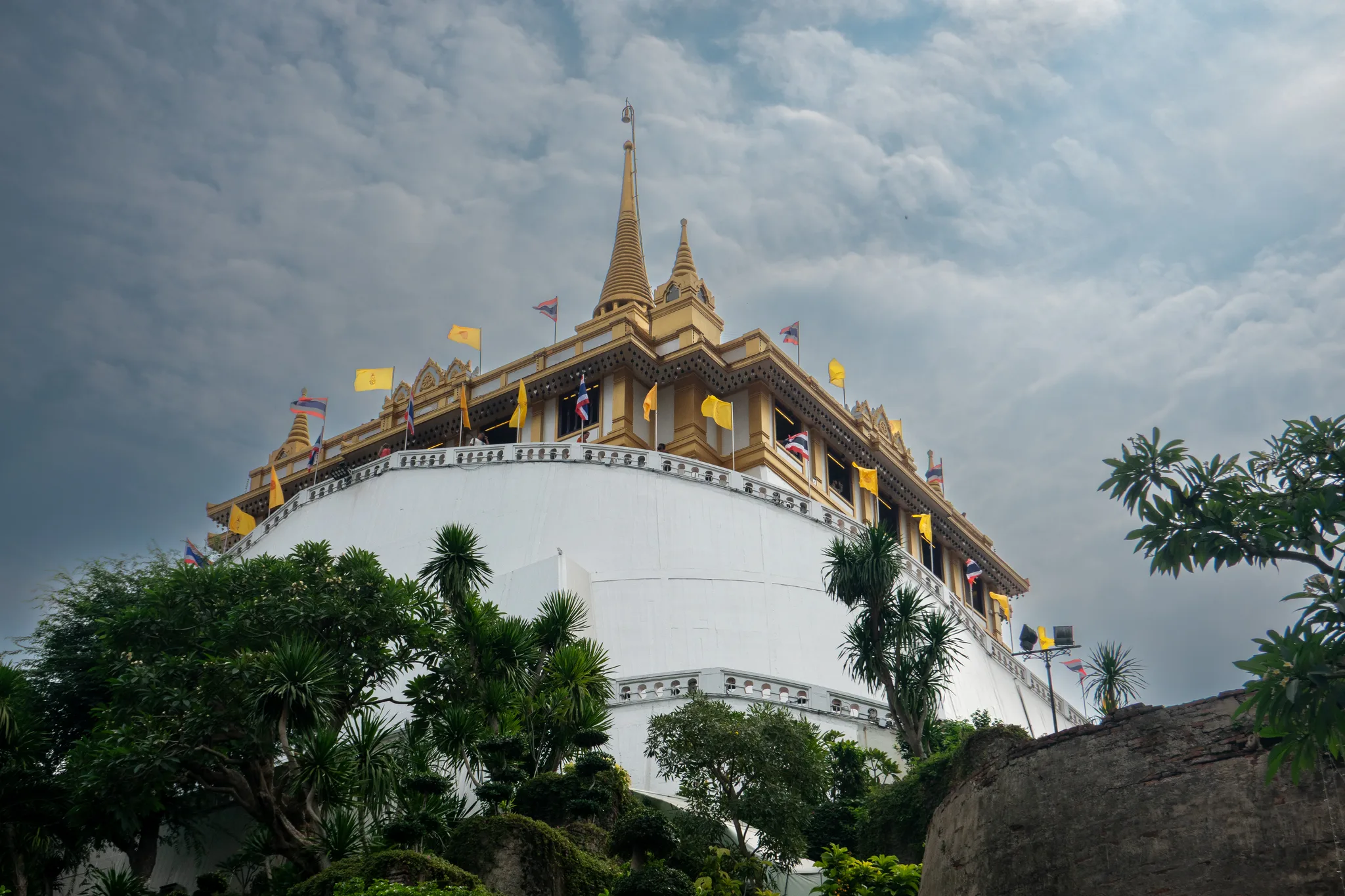
Its present appearance dates from 1966. That year, the Ministry of the Interior had the chedi clad in gold mosaic and four small chedis built around it. It is this state that can still be seen today. The monument as we see it is thus the product of three distinct moments: Rama III’s collapsed project, completion and consecration through the relics in the nineteenth century, and then the 1966 restoration.1
Ubosot and gateways
The mount is only one part of the monastery. At ground level, Wat Saket (Golden Mount Temple) has its ubosot, the ordination hall where monks receive their ordination and carry out the ritual acts of the community. It houses Buddha images, that is, statues, as well as mural paintings.10
The monastery’s gateways, the sum, caught the attention of a high religious authority. The Supreme Patriarch Somdet Phra Maha Samana Chao Krom Phraya Vajirananavarorasa, head of the kingdom’s monastic community, considered them of great beauty and worthy of serving as a model.7
A symbol of the city
The Phu Khao Thong has become one of the symbols of Bangkok and one of its most visited places. It is the best-known site in Pom Prap Sattru Phai district, and the monastery is regarded as an important temple, linked to the origins of the city. This renown rests on a history in which Rama I’s founding act, the memory of the epidemics, the failure of a royal building project and the consecration through relics are layered one upon another. All of it remains legible in the landscape: the canals of 1783, the hill born of the collapse, the golden summit of 1966.4
Understanding
Wat Saket (Golden Mount Temple) is first and foremost a living royal monastery, with its community of monks, its ordination hall, its rites and its faithful. Its importance lies in the depth of its history rather than in any single monument: an old temple refounded by the first king of the dynasty, a place outside the walls where the city long entrusted its dead, a collapsed royal building project that local people dubbed ‘the mountain’, then a reliquary consecrated by Chulalongkorn and celebrated every year in November. Today the golden hill is one of the symbols of Bangkok and one of its most frequented places, while the festival still combines homage to the relics with the popular fair. Yet the smooth image of the golden summit, fixed in 1966, tends to cover over the darker memory of the epidemics and the vultures that shaped the monastery and the language of the city’s inhabitants. Should the Golden Mount remain above all a sanctuary of relics, or also become the place where Bangkok remembers its dead?
Rattanakosin, from the royal citadel of 1782 to the historic districts that shaped contemporary Bangkok.
- Wat
- Buddhist monastic complex that brings together, within a single enclosure, several religious buildings, monks’ quarters and ancillary buildings; the word does not refer to a single building.
- Khlong
- Canal or waterway, natural or man-made, which long played a major role in transport, irrigation and the organisation of settlements and territories in Thailand.
- Royal temple
- In Thailand, a Buddhist temple founded, restored or patronised by the king or the royal family, and graded according to an official hierarchy of ranks and categories.
- Ratchaworamahawihan
- Category of royal temple: a major wat with extensive buildings, built or restored by the sovereign in a personal capacity.
- Prang
- Tower-sanctuary rooted in Khmer architectural tradition, later adopted and transformed in Siamese and Thai architecture; depending on the context, it serves a religious function or acts as a reliquary.
- Chedi
- A bell-shaped reliquary monument, the Thai version of the Indian stupa.
- Reliquary
- A container intended to hold and protect one or more relics.
- Relic
- Bodily remains of, or objects associated with, the Buddha or a holy figure, preserved and venerated.
- Awakening
- In Buddhism, the state of understanding and clarity reached at the end of the spiritual path, which frees one from ignorance and suffering.
- Ubosot
- Consecrated ordination hall of a wat: the ritually central building, marked out by sacred boundary stones, where monastic ordinations take place.
- Ordination
- Ceremony by which a layperson is admitted as a novice or as a monk into the Buddhist community.
- Buddha image
- In Thai Buddhism, a devotional representation of the Buddha, most often a statue, venerated as an object of worship.
- Royal monastery
- In Thailand, a Buddhist monastery founded, restored or placed under the patronage of the king or the royal family, and holding a particular rank.
- Gold sheet
- A thin sheet of gold that can be cut and stamped to depict a motif or an image.
- Sangha
- The body of monks who reside in a monastery and live there according to religious discipline; in Buddhism it is called the sangha.
- Ayutthaya Period
- Era of Siamese history during which the kingdom had Ayutthaya as its capital, from 1351 until the fall of the city in 1767.
- Phra krayasanan
- Royal ritual bath in Thai court ceremonial, performed as an act of purification.
- Loy Krathong
- Thai festival held at the full moon of the twelfth lunar month, usually in November, when small floating offerings are placed on the water.
- Songkran
- Traditional Thai New Year, celebrated in mid-April, marked by water-sprinkling rites and merit-making.
- Sakrawa
- Improvised, sung Thai poetic contest, traditionally performed from boats during the high-water season, in which participants answer one another in verse.
- Hae Pha Khuen That
- Thai rite in which a long cloth is carried in procession and taken up to a reliquary to wrap it, in homage to relics of the Buddha.
- Sum
- Ornamental entrance gateway set in the enclosure wall of a Thai monastery, often topped by a decorated crowning element.
- Supreme Patriarch
- Head of the Buddhist monastic community of Thailand, appointed by the king.
Studies
Reference works
- 3Contributeurs de Wikipédia, วัดสระเกศราชวรมหาวิหาร, Wikipedia (th) ↗
- 4Contributeurs de Wikipédia, Wat Saket, Wikipedia (en) ↗
- 5Contributeurs de Wikipédia, พระบรมบรรพต, Wikipedia (th) ↗
- 6Contributeurs de Wikipédia, Pom Prap Sattru Phai district, Wikipedia (en) ↗
- 7วัดสระเกศ, Bibliothèque Tha Phra, Université Silpakorn (base de données des temples) ↗
- 8วัดสระเกศราชวรมหาวิหาร (ภูเขาทอง), Rattanakosin Island Guide ↗
- 9Contributeurs de Wikipédia, Wat Bophit Phimuk, Wikipedia (en) ↗
- 10ภูเขาทอง วัดสระเกศ, Sanook! พีเดีย ↗
Further reading
Contemporary views
Wat Saket (Golden Mount Temple) today
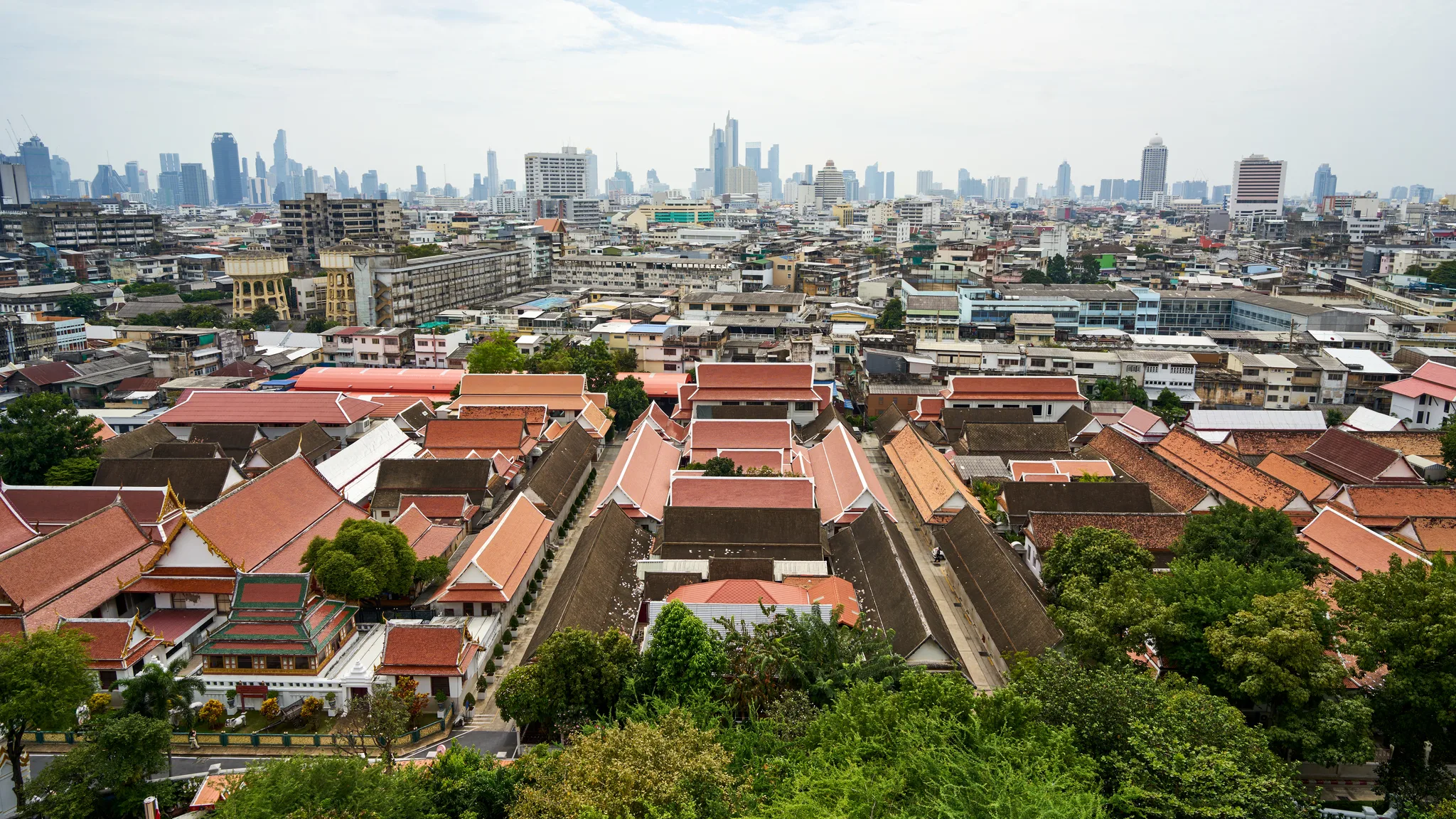
From Wat Saket (Golden Mount Temple), the view takes in the orange and brown tiled roofs of the monastery buildings, surrounded by greenery, then the dense urban fabric of Bangkok as far as the towers of the centre.Radek Kucharski — Wikimedia Commons, CC BY 2.0 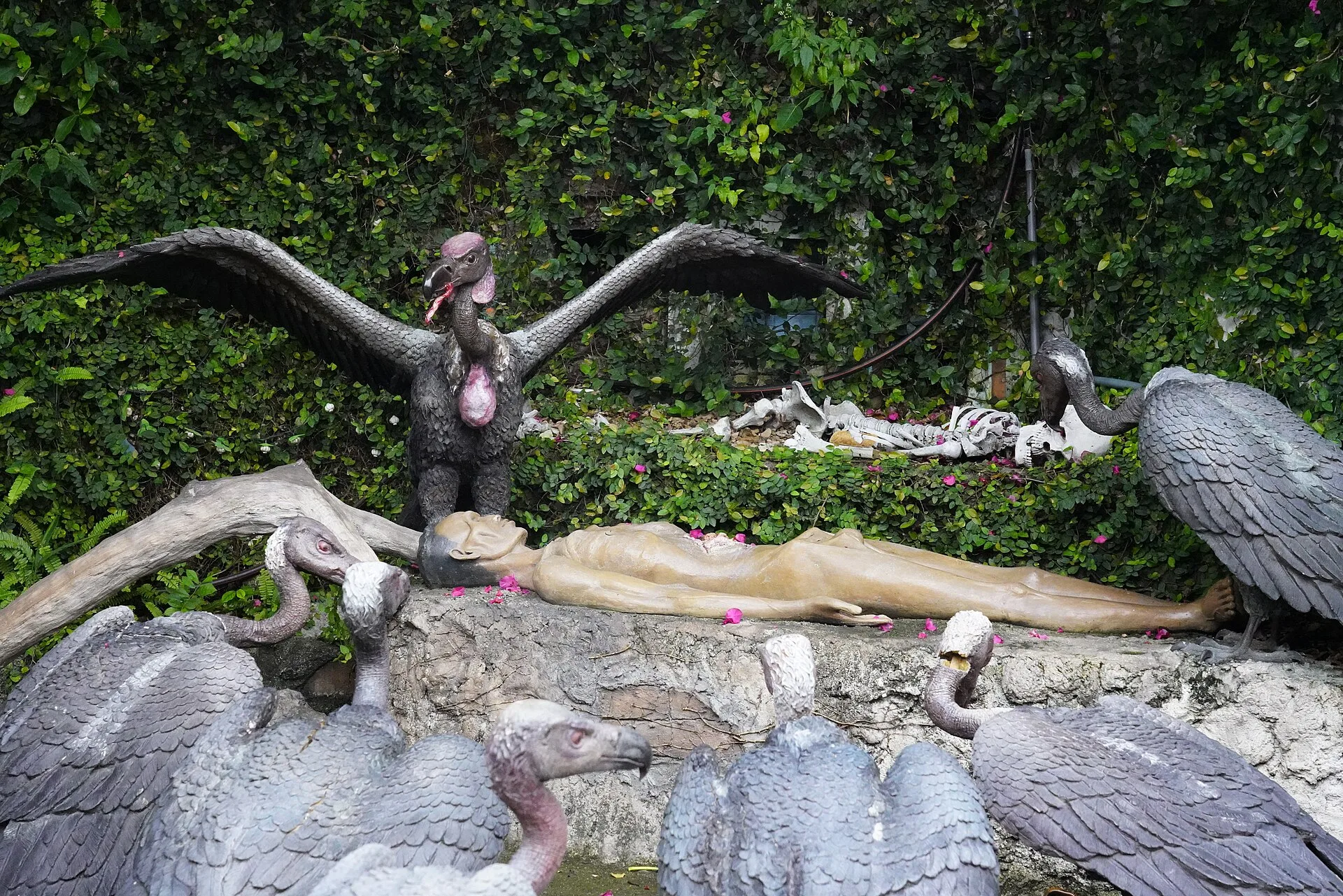
At Wat Saket (Golden Mount Temple), a sculptural group depicts vultures, one with wings outspread, around an emaciated human body lying on a low wall; a skeleton lies behind, amid ivy and bougainvillea petals.Satdeep Gill — Wikimedia Commons, CC BY-SA 4.0
Architecture and decoration
Explore the heritage
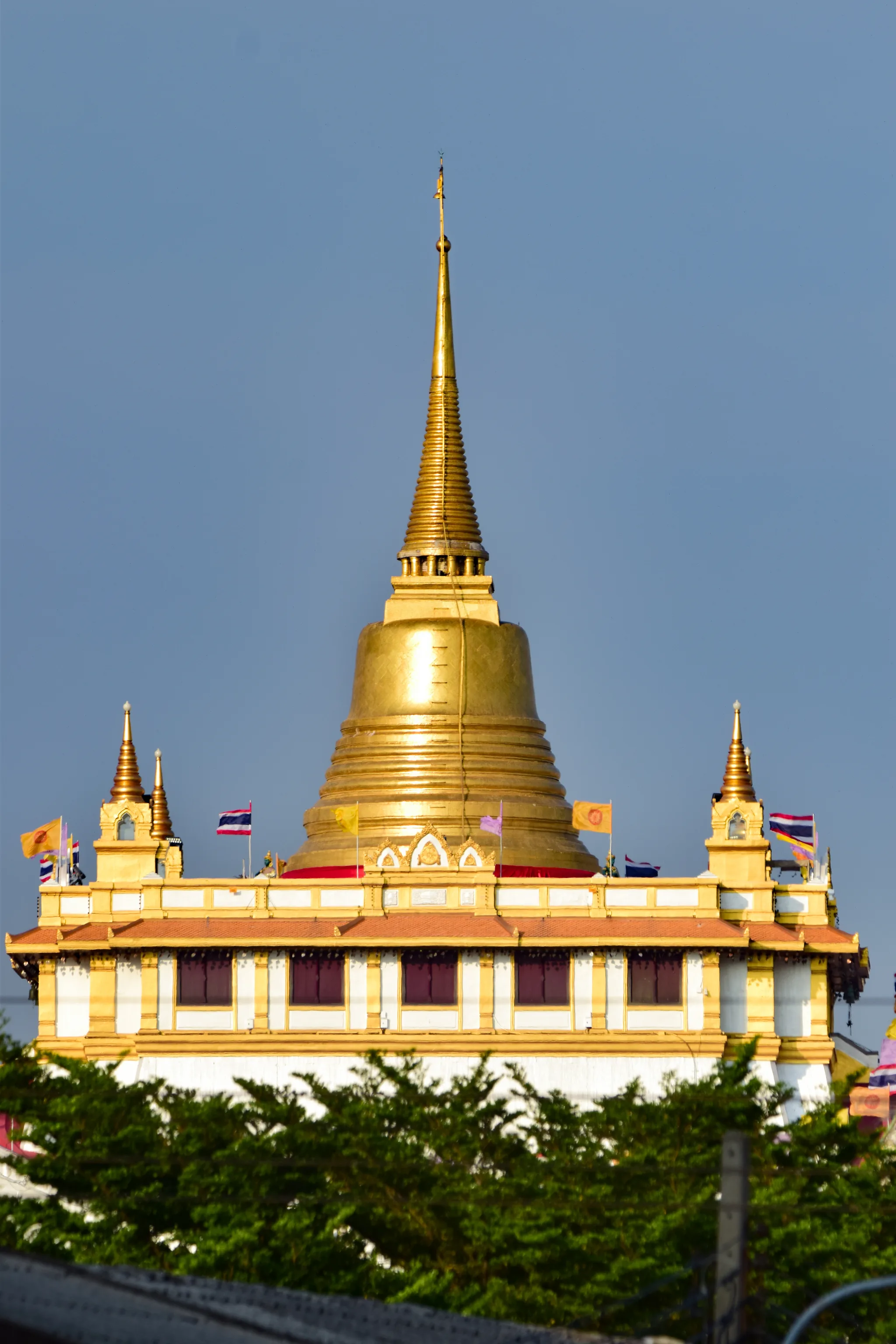
The bell-shaped golden chedi of Wat Saket (Golden Mount Temple) rises above a white and gold terrace flanked by small corner chedis, decorated with Thai national flags and yellow banners.กสิณธร ราชโอรส — Wikimedia Commons, CC BY-SA 4.0 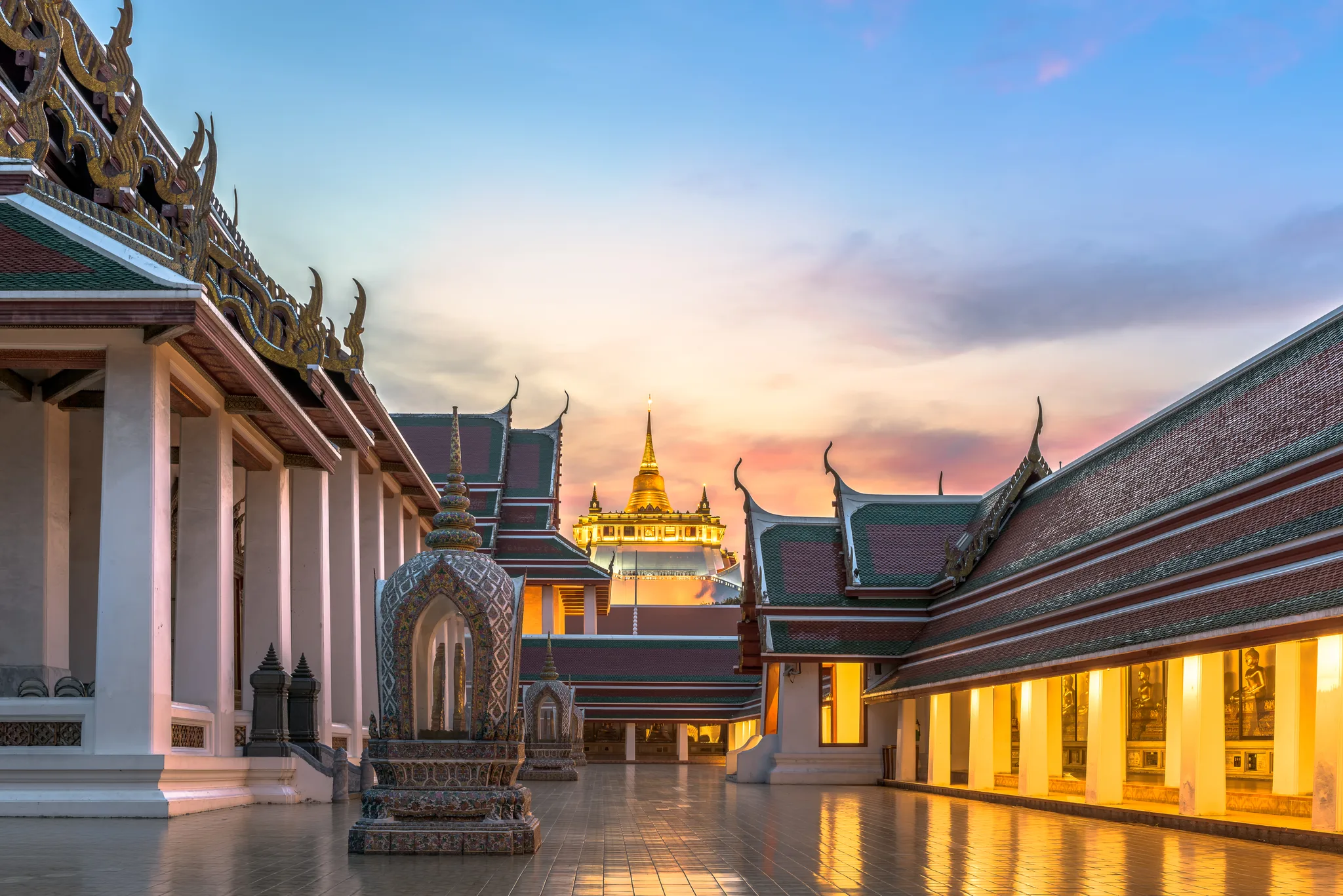
At dusk, the courtyard of Wat Saket (Golden Mount Temple) opens between the white-columned ubosot and a lit gallery housing Buddha statues; beyond, the illuminated golden chedi rises above the ornate roofs.BerryJ — Wikimedia Commons, CC BY-SA 4.0
Archive
Memory of time passing
Historical images preserve the visual memory of places and of the ways they have changed.
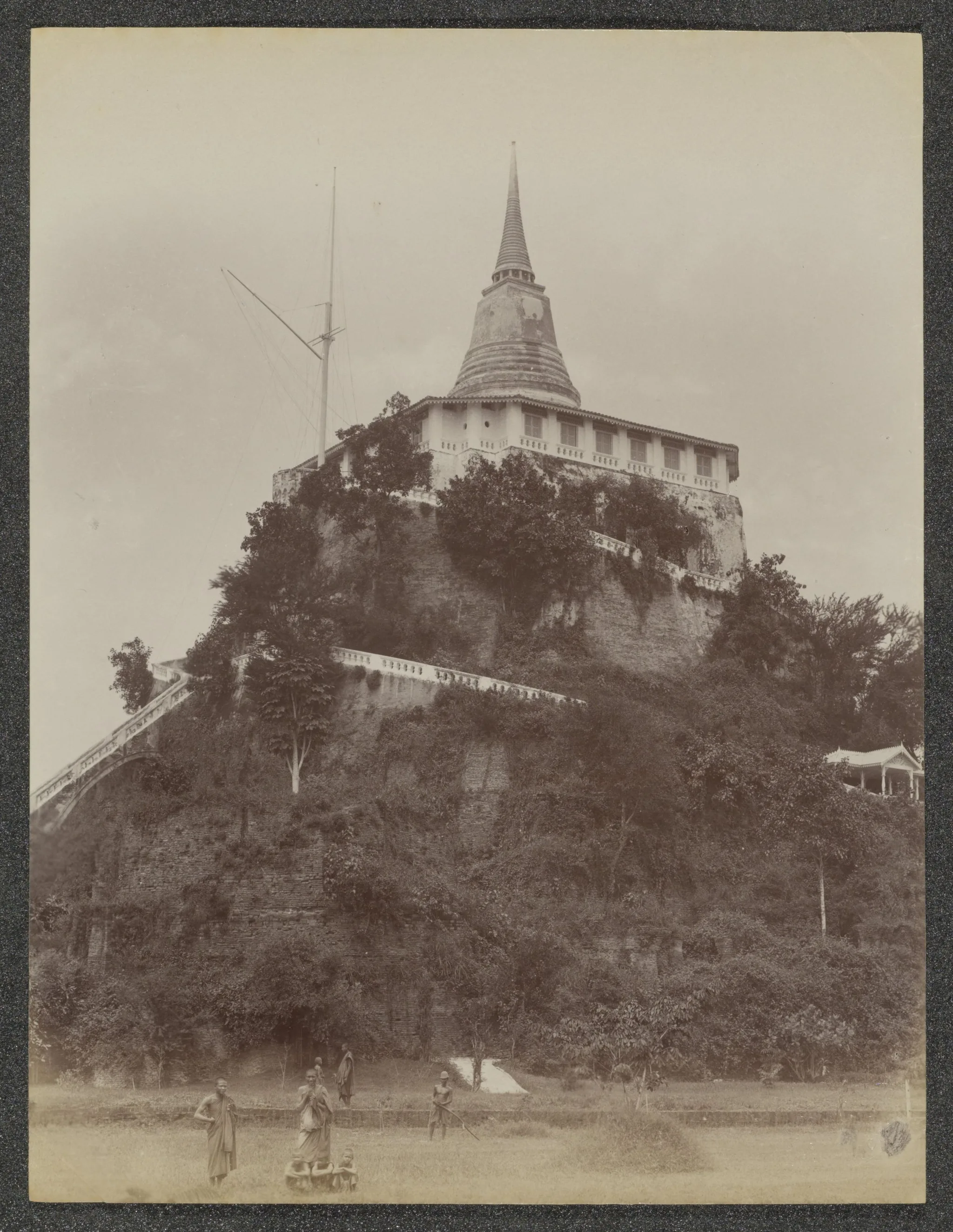
Sepia print showing Wat Saket (Golden Mount Temple): a white chedi with a ringed spire crowns a hill whose brick walls are overgrown with vegetation, encircled by a balustraded stairway; monks stand at its foot.Rijksmuseum — Wikimedia Commons, CC0 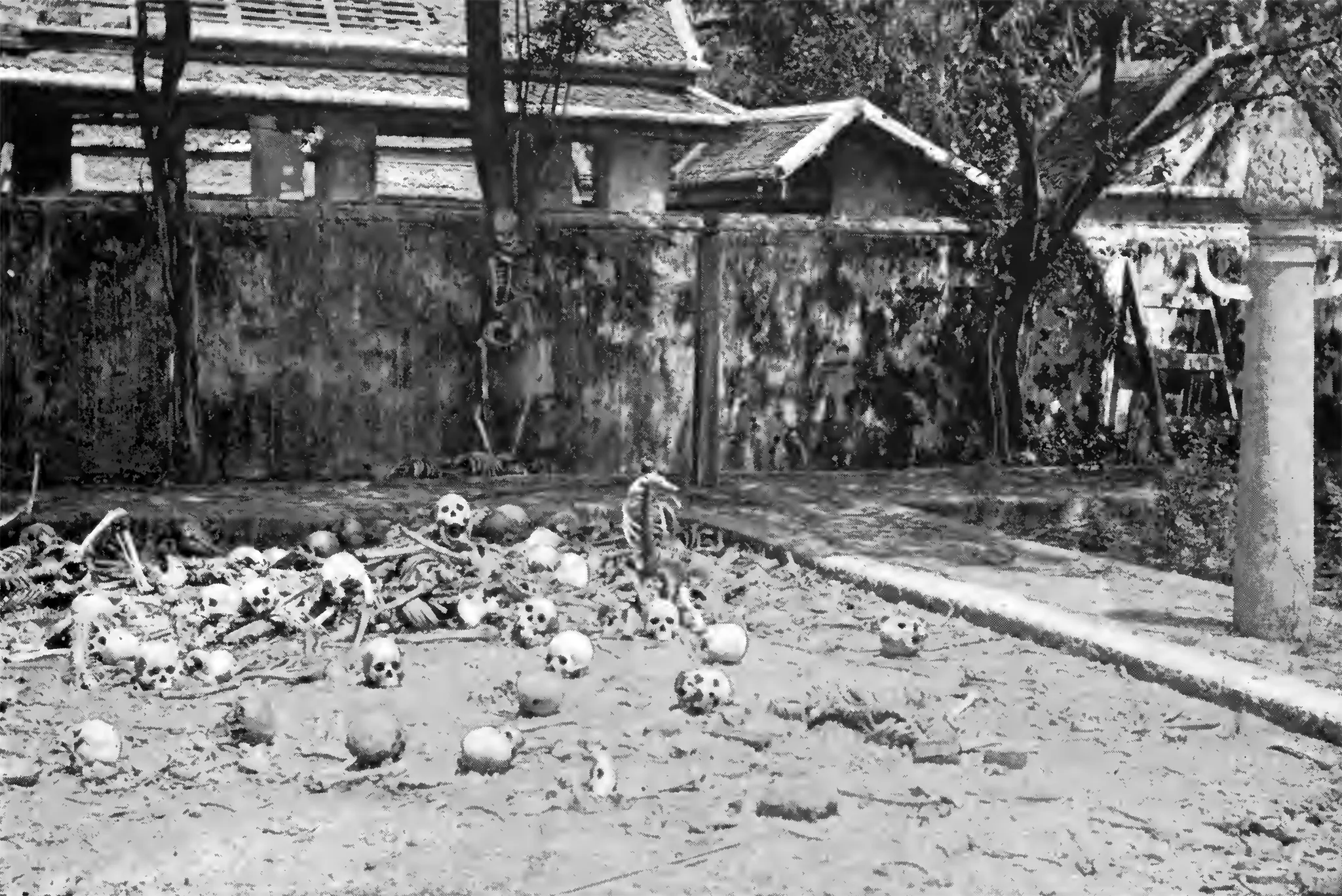
Courtyard of Wat Saket (Golden Mount Temple), where numerous human skulls and bones lie on the bare ground; behind, a skeleton against a wall overgrown with vegetation, tiled roofs and a column.Auteur inconnu — Wikimedia Commons, domaine public 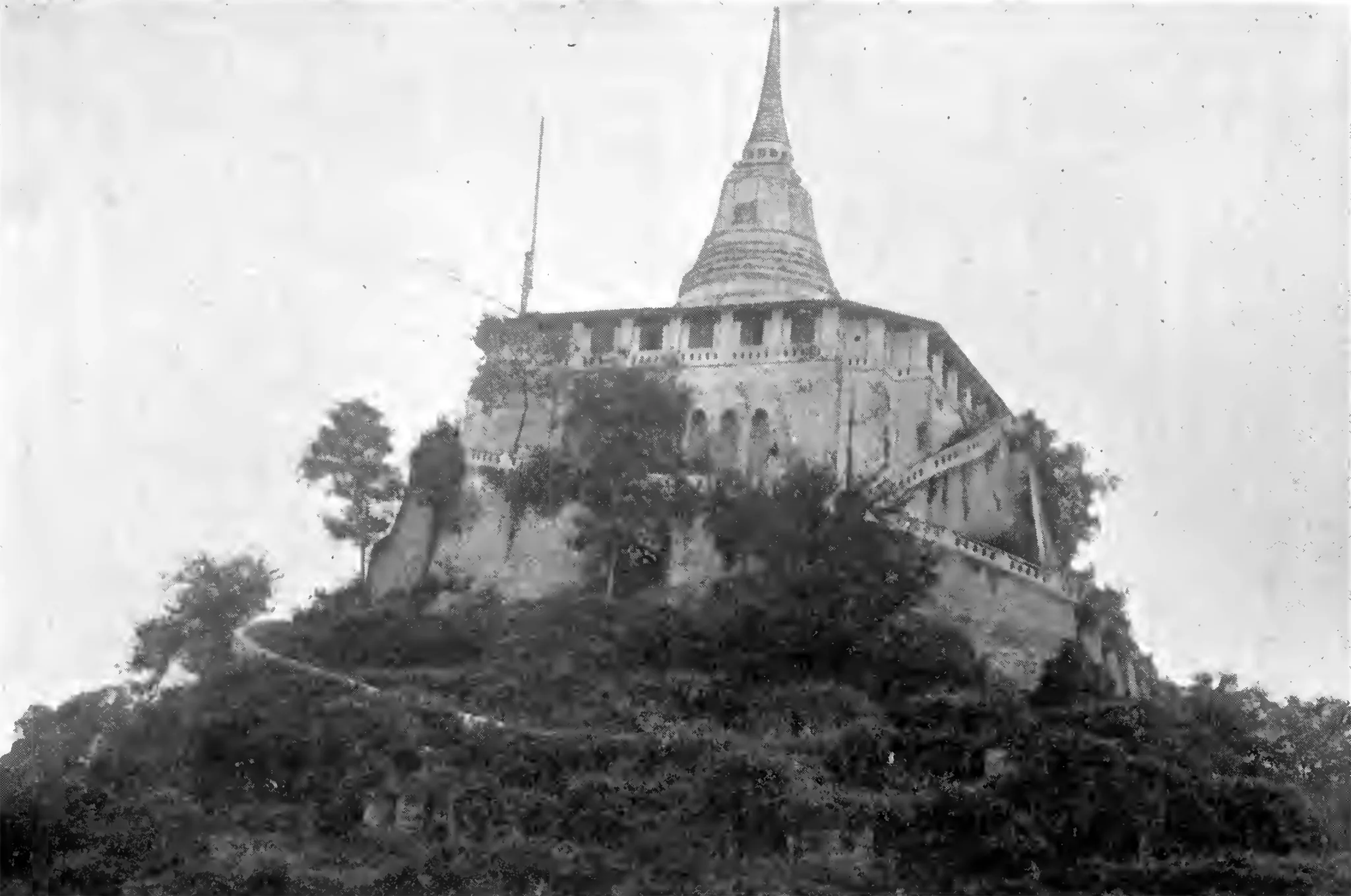
Low-angle view of Wat Saket (Golden Mount Temple): the hill, covered in vegetation and encircled by a winding path, supports a masonry terrace with arched niches and a balustrade, crowned by a bell-shaped chedi with a slender spire.Auteur inconnu — Wikimedia Commons, domaine public 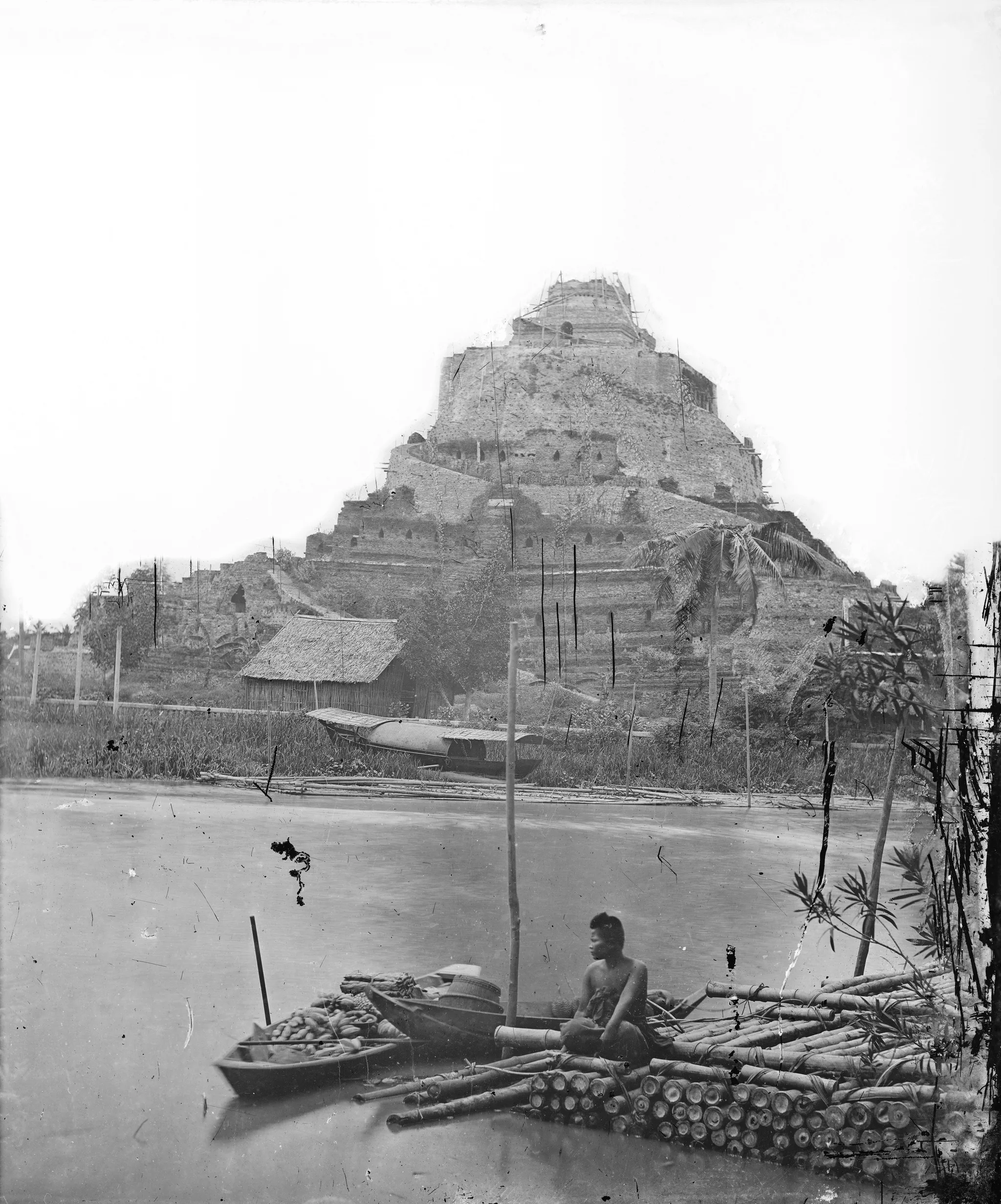
Early photograph of the mount of Wat Saket (Golden Mount Temple): a terraced brick mass with niches, a ramp and scaffolding. In the foreground, on the water, a person sits on a bamboo raft beside boats laden with fruit.Auteur inconnu — Wikimedia Commons, CC BY 4.0 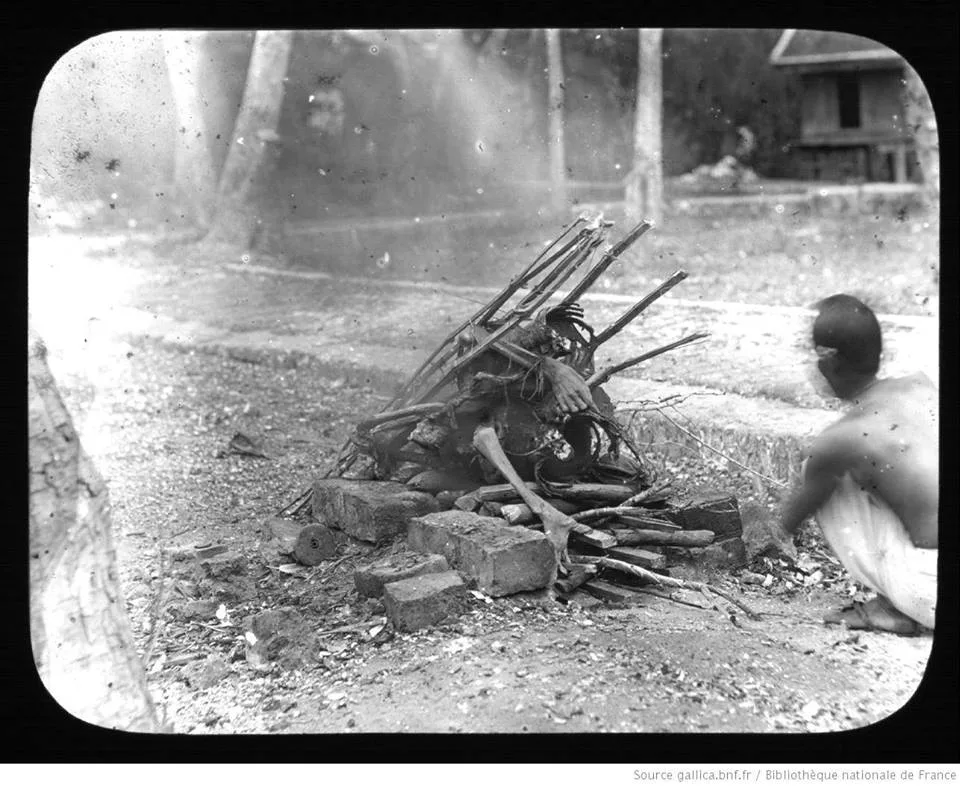
Black-and-white lantern slide: at Wat Saket (Golden Mount Temple), a wooden pyre set on bricks burns in the open air beside a crouching man; in the background, trees and a raised wooden building.Lucien Fournereau — Wikimedia Commons, domaine public 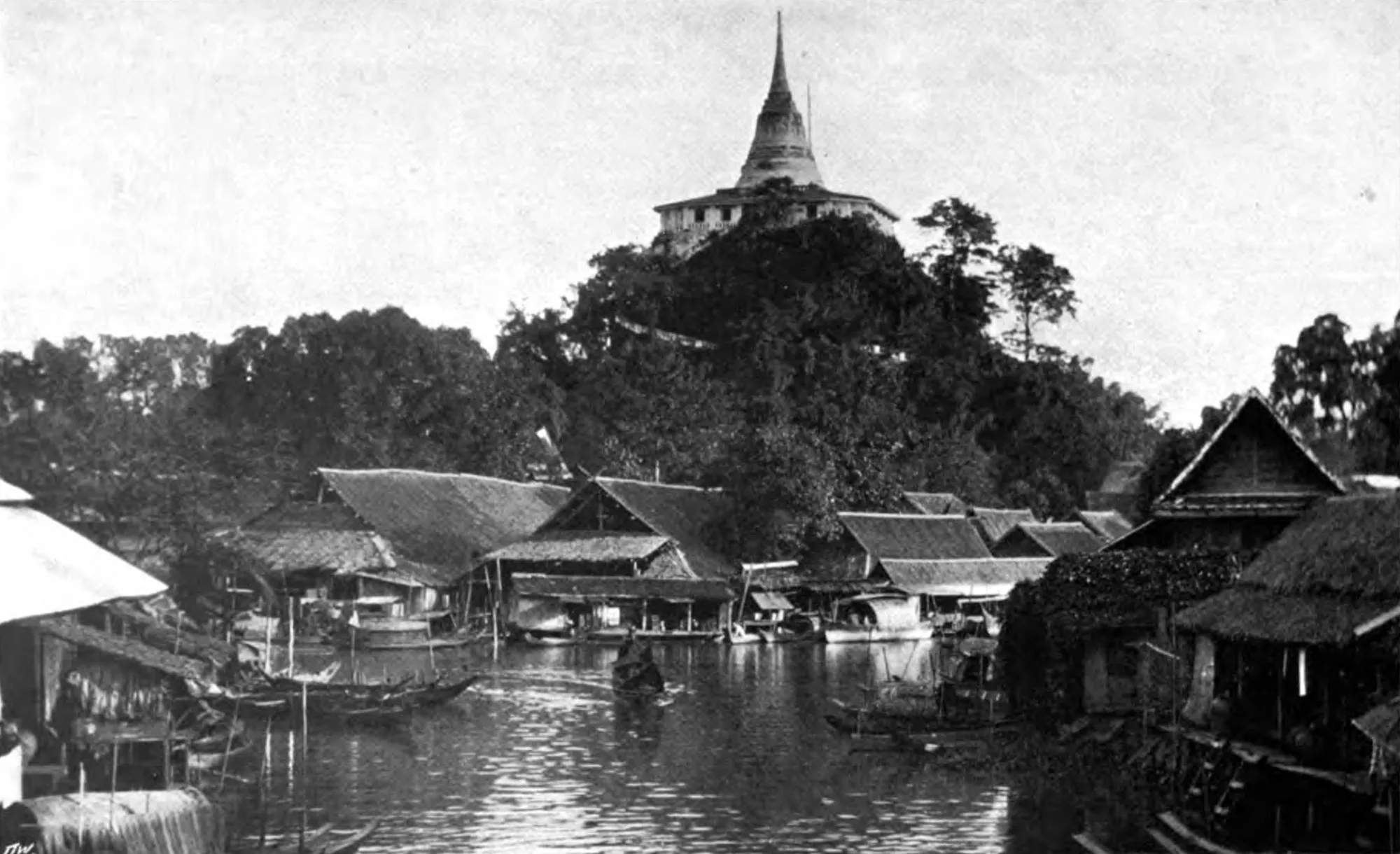
Early photograph of Wat Saket (Golden Mount Temple): the chedi rises above a tree-covered hill, beyond a canal where small boats pass between thatched-roof stilt houses.Auteur inconnu — Wikimedia Commons, domaine public 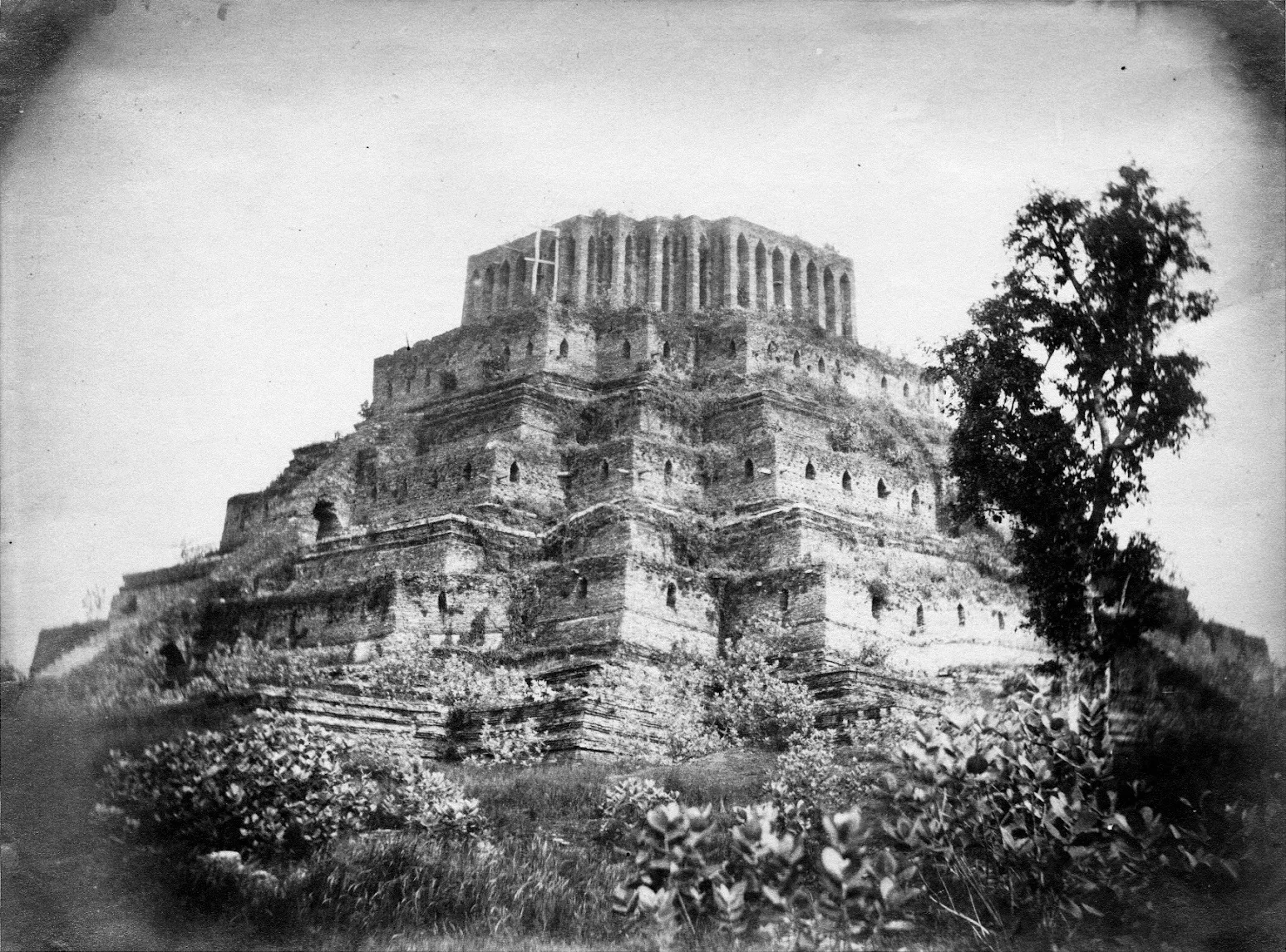
Early black-and-white print: at Wat Saket (Golden Mount Temple), a massive brick structure with stepped terraces, pierced by small arched niches and crowned with arcades, overgrown with vegetation.Auteur inconnu — Wikimedia Commons, domaine public 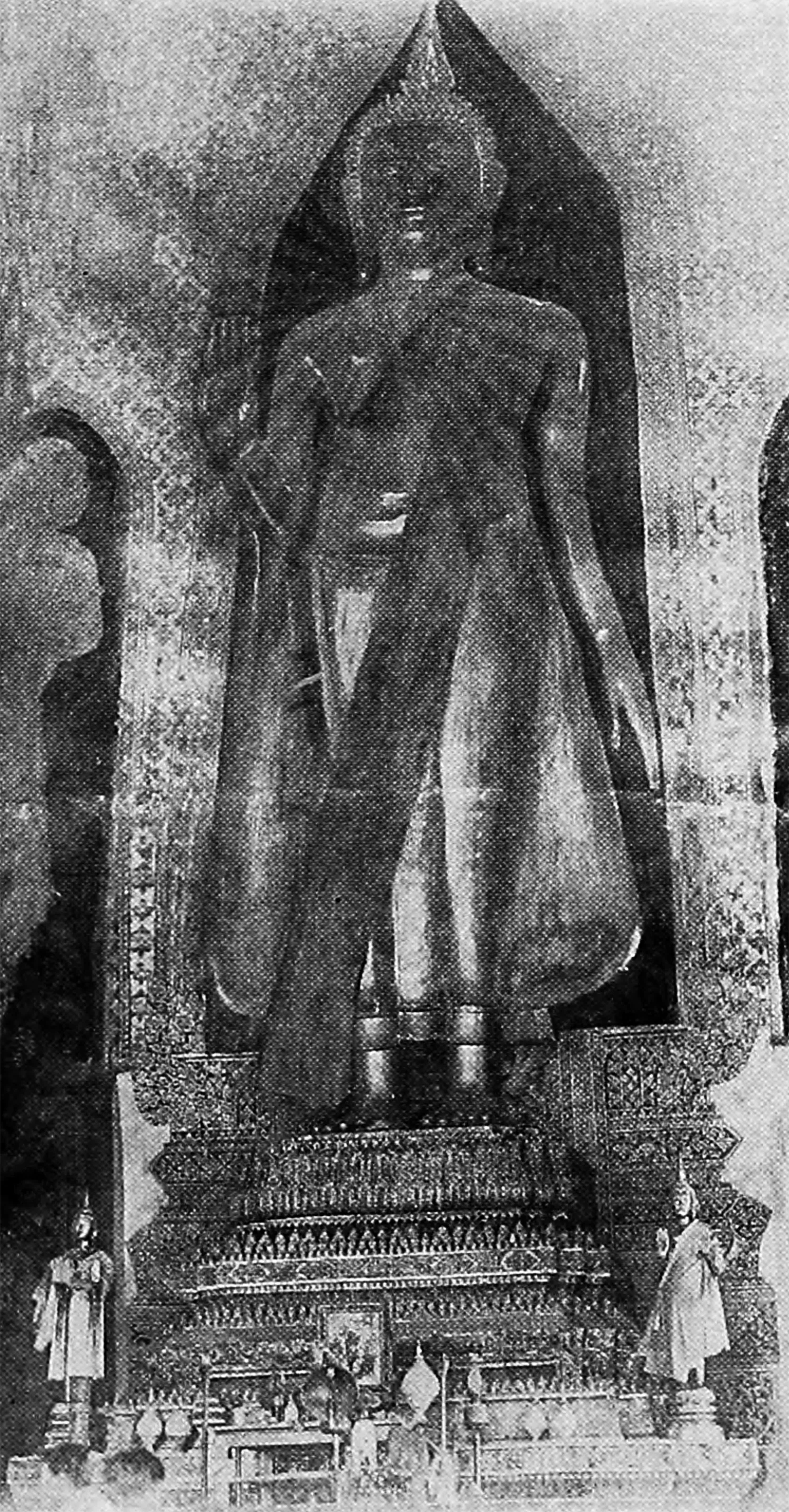
Black-and-white halftone reproduction of a large standing Buddha statue at Wat Saket (Golden Mount Temple), set in a niche on a decorated tiered base, flanked by two small standing figures and fronted by offering objects.Auteur inconnu — Wikimedia Commons, domaine public 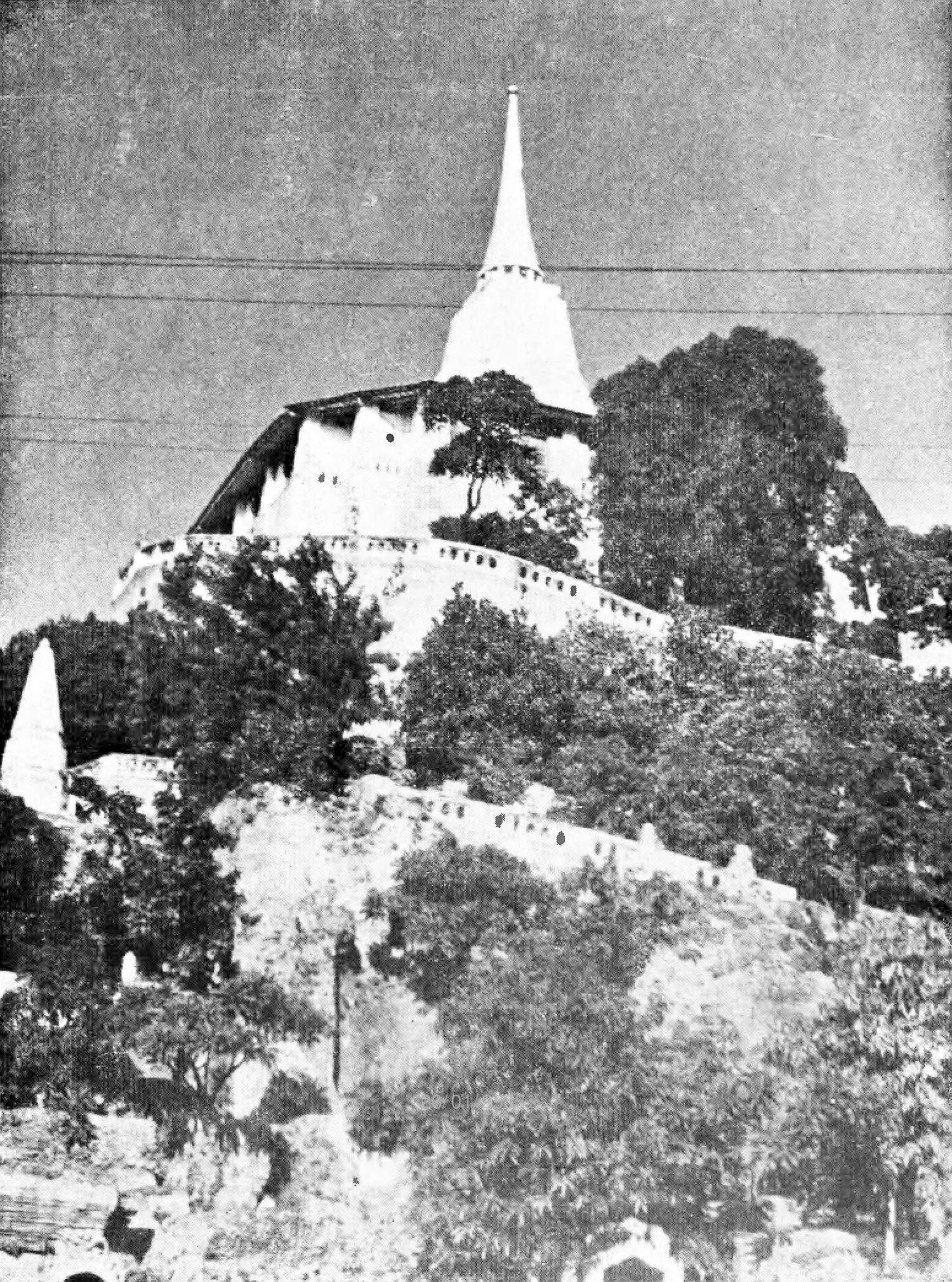
Wat Saket (Golden Mount Temple): the white chedi with its slender spire crowns the hill, whose terraces are lined with balustraded walls and covered with trees; a small white chedi stands on the left, beneath overhead wires.Office of the Prime Minister — Wikimedia Commons, domaine public