
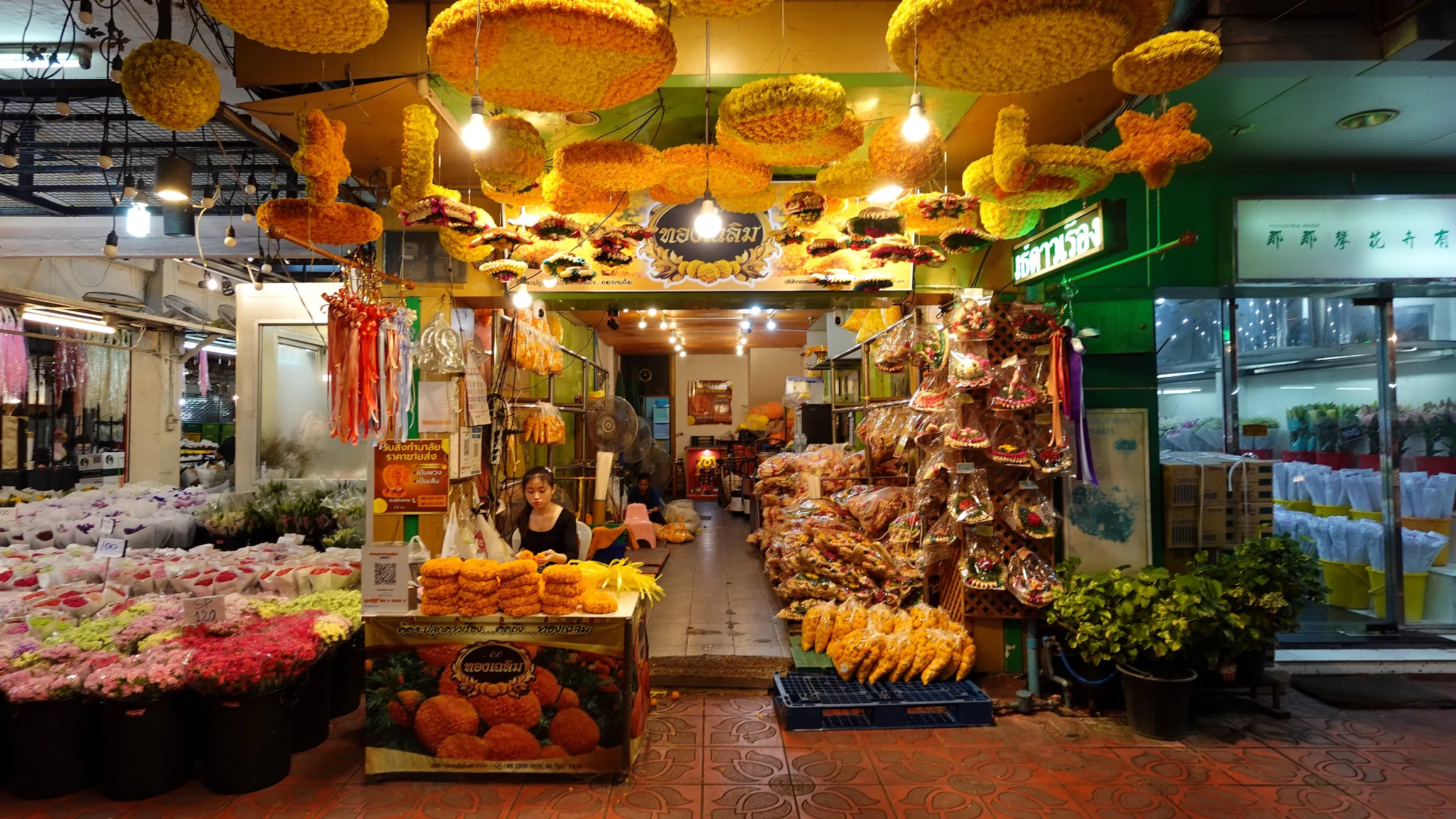
 At Pak Khlong Talat, a shop open onto the pavement displays marigold wreaths and ornaments hanging from the ceiling, wrapped garlands and floral cones, while buckets of roses and carnations line the entrance.© Eric Monteil
- Destination
- Bangkok (Phra Nakhon)
- Heritage Family
- Cities, territories and cultural landscapes
- Typology
- Market & urban centre
- Visit
- Available tours →
Pak Khlong Talat is Bangkok’s great flower market. It stretches along the eastern bank of the Chao Phraya River, on the edge of Rattanakosin Island, the historic centre of the capital. Residents regard it as a place of shared memory, for it supplies the flowers for the offerings, festivities and funerals of the entire city. A fish market in the 19th century, it was relocated, consolidated and then converted, before turning to flowers in the mid-20th century. Open day and night, it is a succession of market halls, shops and neon-lit stalls where jasmine garlands are woven.24
Key facts
- Destination
- Bangkok
- Heritage Family
- Cities, territories and cultural landscapes
- Typology
- Market & urban centre
- Places
- Chao Phraya River
- Rattanakosin Island
- Khlong Khu Mueang Doem
- Phra Nakhon
- Periods
- People
- Plaek Phibunsongkhram
- Rama Ier
- Rama V
- Taksin
- Communities
- Pak Khlong Talat vendors community
- Events
- Relocation of the Pak Khlong Talat fish market under Rama V
- Eviction of Pak Khlong Talat street vendors
- Opening of Yodpiman River Walk
- Consolidation of markets at Pak Khlong Talat under Phibun
- Heritage
- Flower garland making
- Glossary
- Khlong
- Wat
- Khwaeng
- Royal monastery
- San
- Soi
- Keywords
- —
- Date
- —
- Collections
- —
Practical info
Practical information about this site is taken from its Google Maps page. We advise you to check it before visiting.
- Address
- สน พระราชวัง ปาก คลองตลาด - วัดกัลยาณมิตร, Khwaeng Wang Burapha Phirom, Khet Phra Nakhon, Krung Thep Maha Nakhon 10200
A market born of a canal
The market at the mouth
Pak Khlong Talat means ‘the market at the mouth of the canal’. The name describes a location rather than a monument: a place of exchange set up where one of the city’s canals meets the Chao Phraya, the river that runs through Bangkok. This canal is the southern end of the Khlong Khu Mueang Doem, and it was at its mouth that, over little more than a century, fish merchants were followed by sellers of fruit, of vegetables and then of flowers. The name is transcribed into Latin script in several ways, Pak Khlong Talat, Pak Khlong Talad or Pak Klong Talat, but it always refers to the same complex.25
This complex is not a single building. It is a commercial quarter in which covered market halls, rows of shops and trading streets interlock, serving as both a wholesale and a retail market. Fruit, vegetables and goods for ritual use are still sold here, but it is as a flower market that the place has established itself in the life of Bangkok and in the affections of its inhabitants.22
A moat dug for the capital
The history of the quarter begins with that of its canal. King Taksin (1734–1782), who ruled the kingdom from Thonburi, on the western bank of the Chao Phraya, had it dug to extend his capital southwards along the eastern bank. It was then known as Khlong Nai or Khlong Khu Mueang. Under the reign of Rama I (1737–1809), founder of the Chakri dynasty, who moved the capital to the eastern bank, the canal was given the name Khlong Khu Mueang Doem, the ‘moat of the old city’.25
The names changed again under King Chulalongkorn (1853–1910), the fifth sovereign of the dynasty, also known as Rama V. The southern section became the Khlong Talat, the ‘market canal’, after the great market, both on land and on the water, established at its mouth. The northern section took the name Khlong Rong Mai, after the royal silk mill that stood there; it corresponds today to the Khlong Lot. By the end of the 19th century, then, the market was important enough to give its name to the canal that had brought it into being.25
On the edge of Rattanakosin Island
The market today occupies the khwaeng of Wang Burapha Phirom, in Phra Nakhon district, the administrative heart of the old city. It lies on the edge of Rattanakosin Island, the historic centre enclosed by canals and the river, where the Grand Palace and the great royal monasteries are concentrated. The market runs along the eastern bank of the Chao Phraya, near the Phra Phuttha Yodfa Bridge, which locals simply call Saphan Phut.24
Inland, the commercial quarter extends from Chakkraphet Road to Maha Rat Road. It surrounds several of the city’s long-established institutions: Wat Ratchaburana, a Buddhist monastery, and two renowned schools, Rajini School and Suankularb School. This proximity accounts for a good part of the place’s history: a popular market, pungent and noisy, set a few steps from the palace and the royal temples, has always been closely watched by those who governed the city.21
The days of the fish market
Origins that are hard to date
The age of the market remains an open question, and the accounts in circulation do not agree. Some trace the history of the site back to the Ayutthaya period, the former kingdom whose capital preceded Thonburi and Bangkok: it is said to have first been a riverside community living by trade. Others place its birth under the reign of Rama I, when Bangkok became the capital. A common explanation lies in the site itself: the junction of several canals would naturally have encouraged commerce.15
A more critical reading draws on place names. Under Rama V, the site lay in the tambon, that is to say the subdistrict, of Khlong Lot Talat Mai, literally the ‘new market’. For proponents of this reading, the name would show that the market was still recent at the end of the 19th century, rather than an old establishment inherited from the dynasty’s first reigns. Nothing today makes it possible to decide between these versions. Their coexistence shows above all how a place so familiar to residents has been credited with an antiquity that the names themselves sometimes seem to contradict.3
The fish landing
Whatever the date of its birth, at the beginning of the Rattanakosin era the market was a great fish market. Under Rama V it was also called Taphan Pla, the ‘fish landing’. Sea fish came from Tha Chin, in present-day Samut Sakhon province on the Gulf of Thailand, aboard rowing boats that reached the Chao Phraya by way of the mouth of the Khlong Bangkok Yai, a canal on the western bank. The market thus lived off the network of waterways that linked the capital to the coast.4
Alongside the fish, the ingredients of everyday cooking changed hands: kapi, a fermented shrimp paste, salt, chillies, shallots and garlic. A literary account preserves the memory of this period. In 1893, Khunying Khuean Phetsena, a lady of the Siamese nobility also known as Somchin Unhanan, composed the Nirat Paklat, a nirat, that is to say a travel poem in verse. In it, as she passes Khlong Talat, she mentions the lingering smell of fish, a detail that conveys the reality of the place better than any description.4
The deliberate removal under Rama V
That smell eventually became a problem. The market stood in the immediate vicinity of the Grand Palace, the royal residence, and the reign of Rama V saw the fish market moved to the tambon of Wua Lamphong, today’s Hua Lamphong area, further east. The nuisance caused by the smell so close to the palace is the reason most often given. Another explanation, put forward by a historian, emphasises the material conditions of the time: the city was already very densely built, and ice, then imported from Singapore, was in short supply for preserving the fish and limiting its odours.3
The departure of the fish did not empty the site. According to one account, a fruit and vegetable market previously located on the Thonburi bank was brought to the rear of the palace. The quarter thus changed function without losing its commercial calling. This first transformation set the tone for its entire history: at each stage, the market’s activity was reorganised by a decision handed down from those in power, which moved part of it away and installed something else.4
From consolidated markets to flowers
Consolidation under Phibun
In the mid-20th century, the market changed in scale. Field Marshal Plaek Phibunsongkhram (1897–1964), a soldier who became head of government and the dominant figure in Thai political life during this period, had the Tha Tian market, deemed unsightly for Wat Pho, the great neighbouring royal monastery, transferred to Pak Khlong Talat. He also had the Krom Phuthares fresh market consolidated there. The Yodpiman market was subsequently built as the centrepiece of the complex, which became the largest market in Phra Nakhon.1
Accounts differ on the arrival of fruit. In one version, the fruit and vegetable market from the Thonburi bank settled behind the palace as early as the reign of Rama V; in another, advanced by a historian and repeated in similar form by a specialist from the Lek-Prapai Viriyapan Foundation, it was Phibun who was responsible for transferring the fruit market located behind the palace. All agree, however, on one point: the role of flower market came only later. At this stage, Pak Khlong Talat was first and foremost the great food market of the old city, designed to clear the surroundings of the royal monuments.2
Orchids, jasmine and flowers from afar
The shift towards flowers took place gradually, from the late 1950s onwards. The 1960s are often described as the market’s golden age: the Yodpiman market, devoted to flowers, opened at that time, followed by the Songsoem Kaset Thai market, whose name is often rendered as ‘Thai agricultural market’. This boom went hand in hand with the economic development plans of the period, which were directed towards the countryside and encouraged the production of agricultural goods and their movement to the capital.5
The flowers arrived in stages. First came orchids from the orchards of Sam Phran, west of Bangkok. Then came jasmine for offerings, and pandanus and banana leaves, used to make ritual arrangements. Later still, the market took in flowers from the north of the country, and then from Europe. This progression traces the widening of the market’s horizons: initially reliant on the countryside near the capital, it gradually opened up to the kingdom’s distant regions, and then to imports.2
A market refocused on flowers
Specialisation then became more marked. Fruit and vegetable wholesalers turned to Talat Thai, a vast wholesale market on the outskirts of Bangkok, more accessible to lorries than the narrow streets of the old city. Pak Khlong Talat’s activity then refocused on flowers, although this shift cannot be dated precisely.24
The market did not, however, abandon its former functions. By day it still operates as a fresh market, with its fruit and vegetables; it is in the evening and at night that the flowers arrive. This layering is the visible result of more than a century of relocations and consolidations: each period has left a layer of activity, and together they now form a market of many uses, of which flowers have become the emblem.23
Reading the quarter today
A layout inherited from Chinese shophouses
The first feature one notices on site is the layout of the quarter. Its businesses are strung out lengthwise: shops follow one another along the river as far as Maha Rat Road, forming a linear settlement rather than a compact market square. This layout has a specific origin. The quarter grew out of a group of Chinese shophouses, those narrow, deep buildings whose ground floor serves as a shop and upper floor as living quarters, characteristic of the trading towns of South-East Asia.14
Businesses then spread outwards step by step from this core, following the streets and the riverbank. To read the market, then, is to recognise beneath the stalls and awnings the framework of these rows of shops, which continues to organise the movement of buyers and goods. The large market halls built in the 20th century were slotted into this fabric without erasing it.14
Several markets side by side
Pak Khlong Talat in fact brings together several adjoining markets, often counted as four. The oldest of the large complexes is the Yodpiman market, which traders simply call Talat Yot. Within it, a genuine ‘market within the market’ has formed along Soi Rong Ya, a lane renamed Soi Empire: it begins at the Nanaphan flower shop and continues to the foot of the Phra Phuttha Yodfa Bridge.25
The Songsoem Kaset Thai market, for its part, does not touch the river. Surrounded by streets, it faces Chakkraphet Road and extends to Ban Mo Road, in the area known as Saowapha. Another market comes under the Market Organisation, the public body responsible for managing markets in the capital. Finally, behind the market, the Yodpiman River Walk, a three-storey colonial-style building, houses restaurants, cafés, banks and shops; it is now considered part of Pak Khlong Talat. These components, of different periods and status, together make up what residents refer to by a single name.24
Day, night and dawn
Pak Khlong Talat is open twenty-four hours a day, but its rhythm changes as the hours pass. By day, people do their shopping as they would at a fresh market. In the evening, flowers arrive by the lorryload, local or imported, such as roses from Holland. The market is at its busiest before dawn, when florists and resellers come to stock up before opening their own stalls elsewhere in the city.9
What one sees then explains residents’ attachment to the place. Under the neon lighting, the rows of stalls overflow with cut flowers, and hands weave garlands of fresh flowers on the spot. The ‘Pak Khlong Talat’ sign at the entrance to the quarter serves as a landmark for visitors. Yet the spectacle of the market is not a stage set: it is the visible extension of night-time work that supplies, every day, the flowers the city needs.19
Offering flowers and merchant memory
What is bought for the rites
The flowers sold at Pak Khlong Talat serve first and foremost for rites. Jasmine is bought for offerings placed before buddhas, the statues of the Buddha venerated in temples and homes. Floral arrangements also accompany baisri, ritual constructions of banana leaves and flowers, as well as the wai khru ceremony, the homage paid by pupils to their teachers. They adorn funerals, weddings and receptions, and feature in religious offerings as well as in traditional crafts.22
The market thus links agricultural production to the moments that mark the personal and religious lives of the city’s inhabitants. It also follows more recent calendars: in the run-up to Valentine’s Day, the price of roses can double. Florists from all over the city come to buy wholesale here to sell on elsewhere, and street vendors stock up here too. A large share of the flowers seen in Bangkok on an altar, at a ceremony or on a street corner have passed through its stalls.23
Merchant families
The market is also a community. Families have traded here for several generations, and some vendors have been present for more than half a century. Their skill, which consists of choosing flowers, keeping them fresh and assembling them into garlands or arrangements, is passed on in situ, from one stall to the next and from one generation to the next.20
It is this human continuity that makes Pak Khlong Talat a place of shared memory for the people of Bangkok, rather than merely the spectacle of a picturesque market. The vendors themselves put this identity forward when they saw their working conditions upended in the 2010s. The value of the place lies as much in the people who keep it alive as in its buildings or its history.8
The shrine of the founding king
In the lane separating the Yodpiman River Walk from the Yodpiman market stands a san, a small shrine where a protective figure is worshipped. This one is dedicated to King Phra Phutthayotfa Chulalok, that is to say Rama I. It is said to have existed for more than fifty years.6
Its presence is explained by a local tradition: the land is said once to have belonged to a private royal estate. The explanation is far from certain, but it reveals how the traders picture their quarter, as a space placed under the protection of the dynasty’s founder and linked to the neighbouring palace. Amid the stalls, this shrine is a reminder that the market is not only a place of commerce: people pray here, leave offerings here, and the flowers sold here sometimes find their first use a few metres from their stall.19
A quarter in transition
From concession to River Walk
The 21st century opened a new phase, this time driven by private actors. In 2010, the Yodpiman group bought the Yodpiman flower market, then obtained a thirty-year concession to operate the Pak Khlong market. Its chairman, Chaleo Preekran, head of the Talat Yodpiman company, championed a ‘community mall’ project, a neighbourhood shopping centre on the riverfront. The project met with strong resistance in the quarter.7
The Yodpiman River Walk opened in 2016 in a former warehouse and converted shophouses. It gave the quarter a new face, geared towards strolling, dining and leisure customers. At the same time, Wanchai Thanomsak, director of city planning at the Bangkok Metropolitan Administration, spoke of a feasibility study conducted with the Market Organisation and the Crown Property Bureau to renovate the landscape of Rattanakosin Island, Pak Khlong Talat included. The market thus became a stake in the planning of the entire old city.16
2016: the street cleared
That same year, the Bangkok Metropolitan Administration launched an urban ‘beautification’ policy intended to clear the pavements. At Pak Khlong Talat, it set 28 February as the deadline for vacating. Wallop Suwandee, chief adviser to the Governor of Bangkok, then counted more than 1,400 vendors, only a small minority of whom occupied areas where street trading was permitted. Street traders were forced to move back inside the market halls.11
The rule was strictly enforced against the backdrop of the National Council for Peace and Order, the military junta then in power. The vendors protested and refused to cooperate; Sujitra Traisaksri, a trader who became their spokeswoman, denounced the risk of the market losing its identity. After July 2016, sales plummeted. The street lost much of its night-time bustle, while the covered market, with its rented pitches, remained active. Some displaced vendors moved to the New Pak Khlong Talat Market, a recently built market. In 2017, an announced clearance of vendors in the rest of the city was revised in the face of criticism, a sign that the case of Pak Khlong Talat had carried weight beyond the quarter.8
Festivals and new visitors
In response to this rupture, other ways of bringing the quarter to life emerged. Art interventions and festivals, including Bangkok Design Week, have taken over the market with the participation of the Faculty of Architecture at Silpakorn University. In 2026, a first Bangkok Flower Festival is scheduled at the Yodpiman River Walk, followed by a Bangkok Art Walk in the streets of the quarter.13
These initiatives are seen as a response to the 2016 policy, but they also open a debate on gentrification, that is to say the gradual replacement of working-class uses by more affluent visitors, and on the ‘festivalisation’ of a workplace. Other transformations are less conspicuous, such as the arrival of Chinese companies in the flower trade, which predates the 2016 policy. Traffic remains a point of friction between businesses, the Bangkok Metropolitan Administration and the municipal police. The market that supplied the city with flowers is also becoming a place people visit.13
Understanding
Pak Khlong Talat is neither a monument nor a mere place of trade: it is a commercial quarter shaped by more than a century of decisions handed down by the palace, then the state, then private companies, which relocated, consolidated and specialised it. Its value lies in what it does every night, supplying the whole city with the flowers for its offerings, its festivities and its funerals, and in the merchant families who have passed this work down for several generations. That is why the people of Bangkok regard it as a place of shared memory. Since 2016, the clearing of the pavements has drained the street of much of its night-time bustle, while the River Walk, the festivals and the renovation projects for Rattanakosin Island are turning the quarter towards strolling and leisure. The vendors speak of a risk of losing their identity, others of a revival. If the market becomes first and foremost a place to visit rather than a place to buy what one needs for prayer, what will remain of what made Pak Khlong Talat a living heritage?
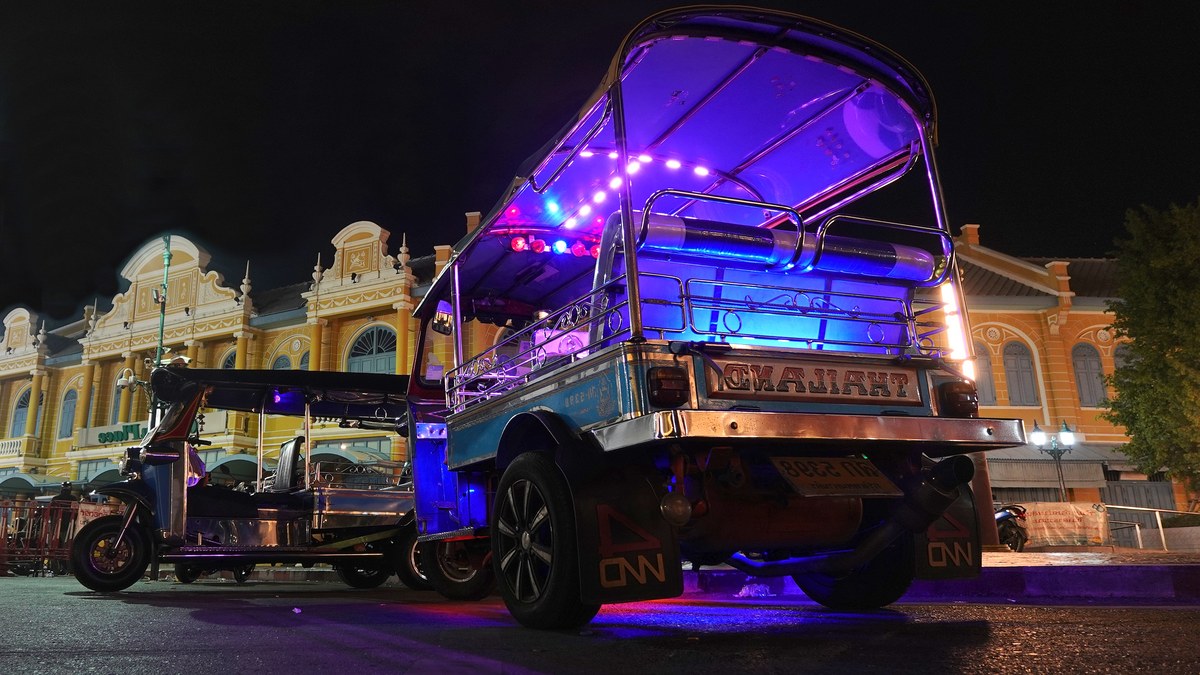
Bangkok from dusk to deep night, from the banks of the Chao Phraya to the neon of Chinatown and the jazz clubs.
- Khlong
- Canal or waterway, natural or man-made, which long played a major role in transport, irrigation and the organisation of settlements and territories in Thailand.
- Wat
- Buddhist monastic complex that brings together, within a single enclosure, several religious buildings, monks’ quarters and ancillary buildings; the word does not refer to a single building.
- Khwaeng
- An administrative subdivision of Bangkok, ranking below the district (khet), the urban equivalent of the tambon in the provinces.
- Royal monastery
- In Thailand, a Buddhist monastery founded, restored or placed under the patronage of the king or the royal family, and holding a particular rank.
- San
- In Thailand, a small shrine where worship is offered to a deity, a spirit or a protective figure.
- Soi
- Thai word for a lane or side street branching off a main road; soi are often numbered after the main street from which they branch.
- Tambon
- A Thai administrative subdivision grouping several villages, ranking below the district.
- Shophouse
- A narrow, deep urban house built in a row, whose ground floor serves as a shop and upper floor as living quarters, typical of the trading towns of South-East Asia.
- Baisri
- A Thai ritual arrangement made of folded banana leaves and flowers, used as an offering during ceremonies.
- Wai khru
- A Thai ceremony in which pupils pay homage to their teachers and express their gratitude, presenting them with offerings.
- Kapi
- A fermented and salted shrimp paste, a staple condiment of Thai cuisine.
- Nirat
- A Thai poetic genre in verse, a travel account in which the author describes the places passed and often expresses longing for a loved one or the home left behind.
- Pandanus
- A tropical plant with long, ribbon-like, fragrant leaves, used in South-East Asia in cooking, basketry and ritual arrangements.
- Ayutthaya period
- Period of Siamese history, from the mid-fourteenth century to 1767, during which the kingdom had Ayutthaya as its capital.
- Rattanakosin period
- Period of Thai history that began with the founding of Bangkok as the capital by King Rama I at the end of the eighteenth century. It takes its name from Rattanakosin Island, the heart of the royal city.
- Royal temple
- In Thailand, a Buddhist temple founded, restored or patronised by the king or the royal family, and graded according to an official hierarchy of ranks and categories.
Studies
- 1ปริศนาโบราณคดี : "ดอกไม้กับมนุษย์" ฟื้นตำนาน(ก่อนปิด) "ปากคลองตลาด" (1), Matichon Weekly (มติชนสุดสัปดาห์) ↗
- 2ปริศนาโบราณคดี : "ดอกไม้กับมนุษย์" ฟื้นตำนาน(ก่อนปิด) "ปากคลองตลาด" (จบ), Matichon Weekly (มติชนสุดสัปดาห์) ↗
- 3"ดอกไม้กับมนุษย์" ฟื้นตำนาน (ก่อนปิด) "ปากคลองตลาด", Matichon Online (มติชน) ↗
- 4ปากคลองตลาด จากตลาดปลาสู่แหล่งขายดอกไม้ชื่อดัง!, Silpa Wattanatham (ศิลปวัฒนธรรม) ↗
- 5เรื่องเล่าของแม่ ปากคลองตลาด และสังคมพระนครในยุคจอมพลสฤษดิ์, The Standard ↗
- 6มติชน เปิดมุมลับ 'ปากคลองตลาด' แวะทุกศาล เปิดเกร็ดปวศ. ถอดรหัสมูเตลู, Matichon via LINE Today ↗
- 7Uneasy Neighbours, Bangkok Post (Asia Focus) ↗
- 8Identity of Pak Khlong Talat flower market 'at risk', Bangkok Post ↗
- 9Explore Pak Khlong Talad: Bangkok's Vibrant Flower Market, The Nation Thailand ↗
- 10Vending in Public Space: The Case of Bangkok, WIEGO ↗
- 11Kannika Angsuthonsombat, Bangkok Street Vending Ban 2016, WIEGO ↗
- 12Pavarit Chaweeint, การจัดระเบียบหาบเร่แผงลอยพื้นที่ปากคลองตลาด เขตพระนคร กรุงเทพมหานคร / Organization of Street Vendors at Pak Khlong Talat Market, Phra Nakhon District, Bangkok, Siam University (MPA), 2018 ↗
- 13Catalyzing Change: The Impact of Festivals on Bangkok's Pak Khlong Flower Market, ResearchGate ↗
- 14Pak Khlong Talat: The Settlement and Expansion Pattern of Stores, the Case of Flower Market Neighbourhood, Bangkok, Thailand, ResearchGate ↗
- 15ปากคลองตลาด: จากตลาดปลาสู่การเป็นตลาดดอกไม้, ThaiJO (TCI) – revue de sciences sociales, Kasetsart University ↗
- 16"ยอดพิมานริเวอร์ วอล์ค" ตลาดดอกไม้ในตึกริมน้ำ ปั้นโกดังเก่าเป็นแลนด์มาร์กแห่งใหม่เกาะกรุงรัตนโกสินทร์, MGR Online (ผู้จัดการออนไลน์), 2016 ↗
- 17Experience Bangkok's blooms in a whole new way at Bangkok Flower Festival, Time Out Bangkok, 2026 ↗
- 18Bangkok Art Walk เดินเสพศิลป์กลางปากคลองตลาด, Time Out Bangkok (TH), 2026 ↗
- 19ตระเวนเที่ยวย่านปากคลองตลาด พื้นที่แห่งความสุขที่ละลานไปด้วยมวลหมู่ดอกไม้, BLT Bangkok ↗
Reference works
- 20ปากคลองตลาด - วิกิชุมชน, Princess Maha Chakri Sirindhorn Anthropology Centre (ศูนย์มานุษยวิทยาสิรินธร) ↗
- 21ชุมชนปากคลองตลาด, Silpakorn University Library – Rattanakosin resource ↗
- 22Pak Khlong Talad – Bangkok's Flower Heartbeat, am2026thailand.go.th (site gouvernemental thaïlandais) ↗
- 23ตลาดกลางคืน ปากคลองตลาด, DASTA – CBT Thailand ↗
- 24Pak Khlong Talat, Wikipedia (en) ↗
- 25ปากคลองตลาด, Wikipedia (th) ↗
Further reading
Contemporary views
Pak Khlong Talat Flower Market today
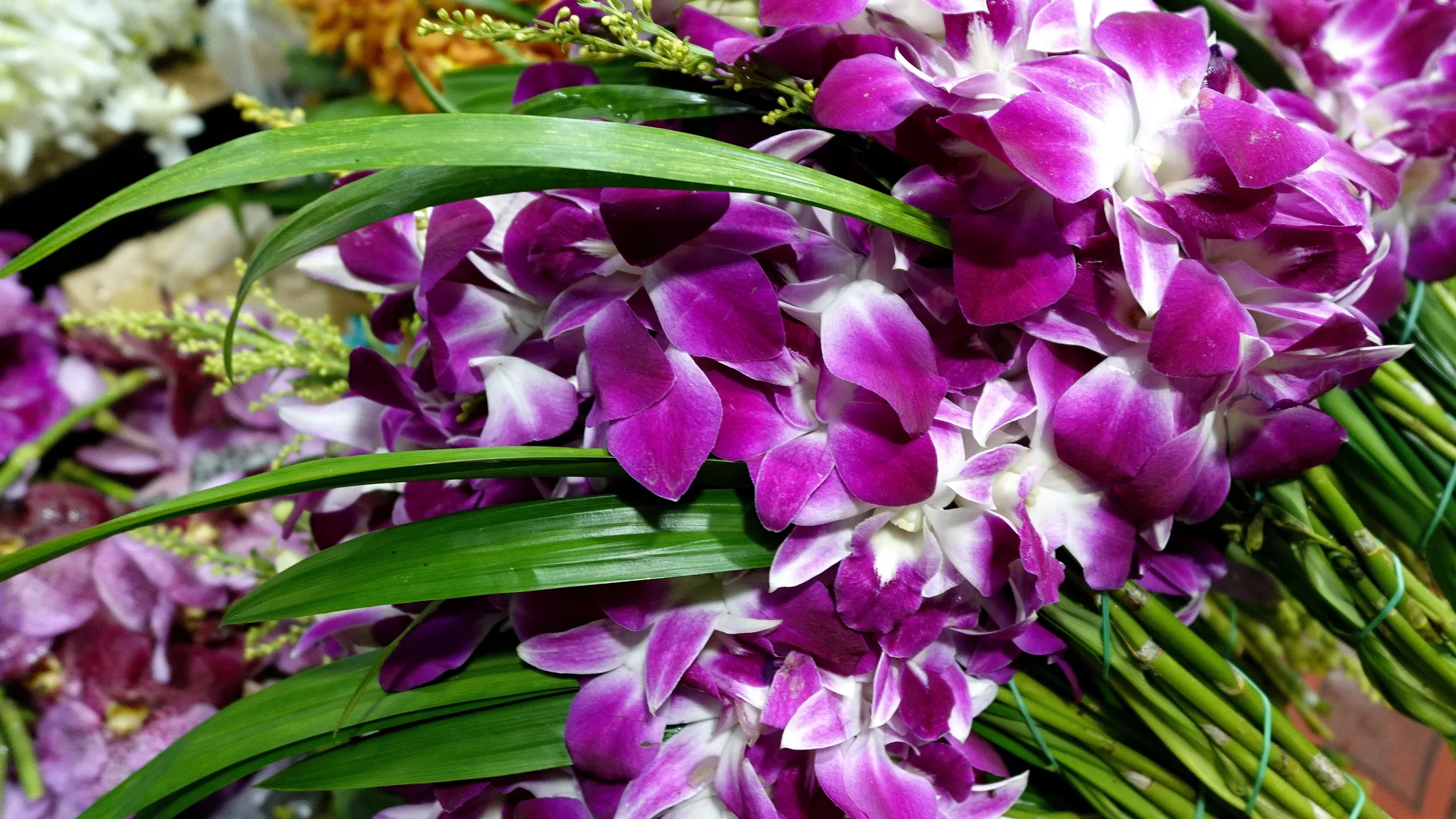
At Pak Khlong Talat, purple and white orchids are displayed in bunches, their stems bound with green ties and set off by long pandan leaves, alongside other cut flowers offered for sale.© Eric Monteil 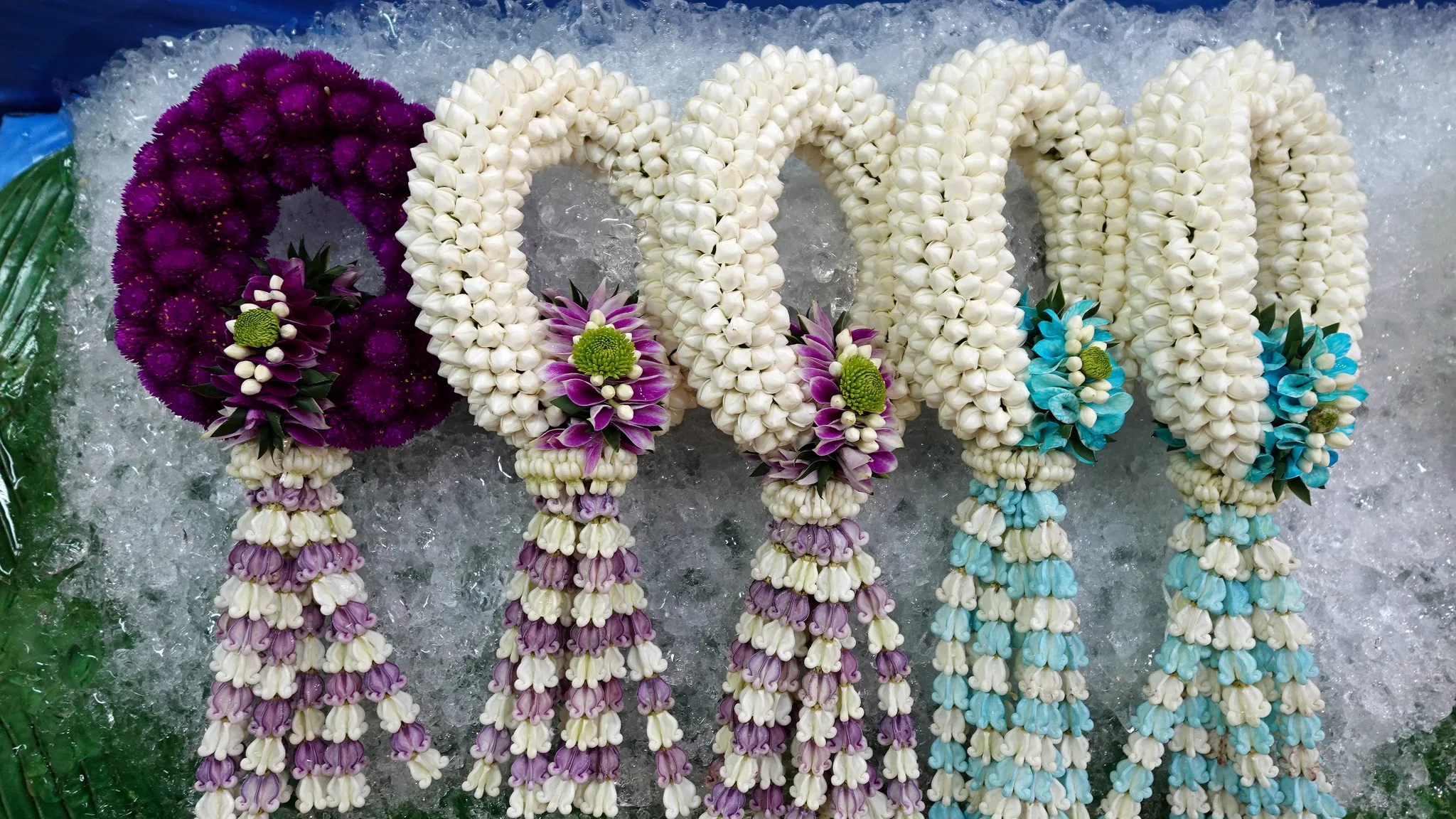
At Pak Khlong Talat, phuang malai garlands of jasmine buds, one made of purple globe amaranth, finished with white, mauve or blue pendants, are displayed on crushed ice that keeps them fresh.© Eric Monteil
Architecture and decoration
Explore the heritage
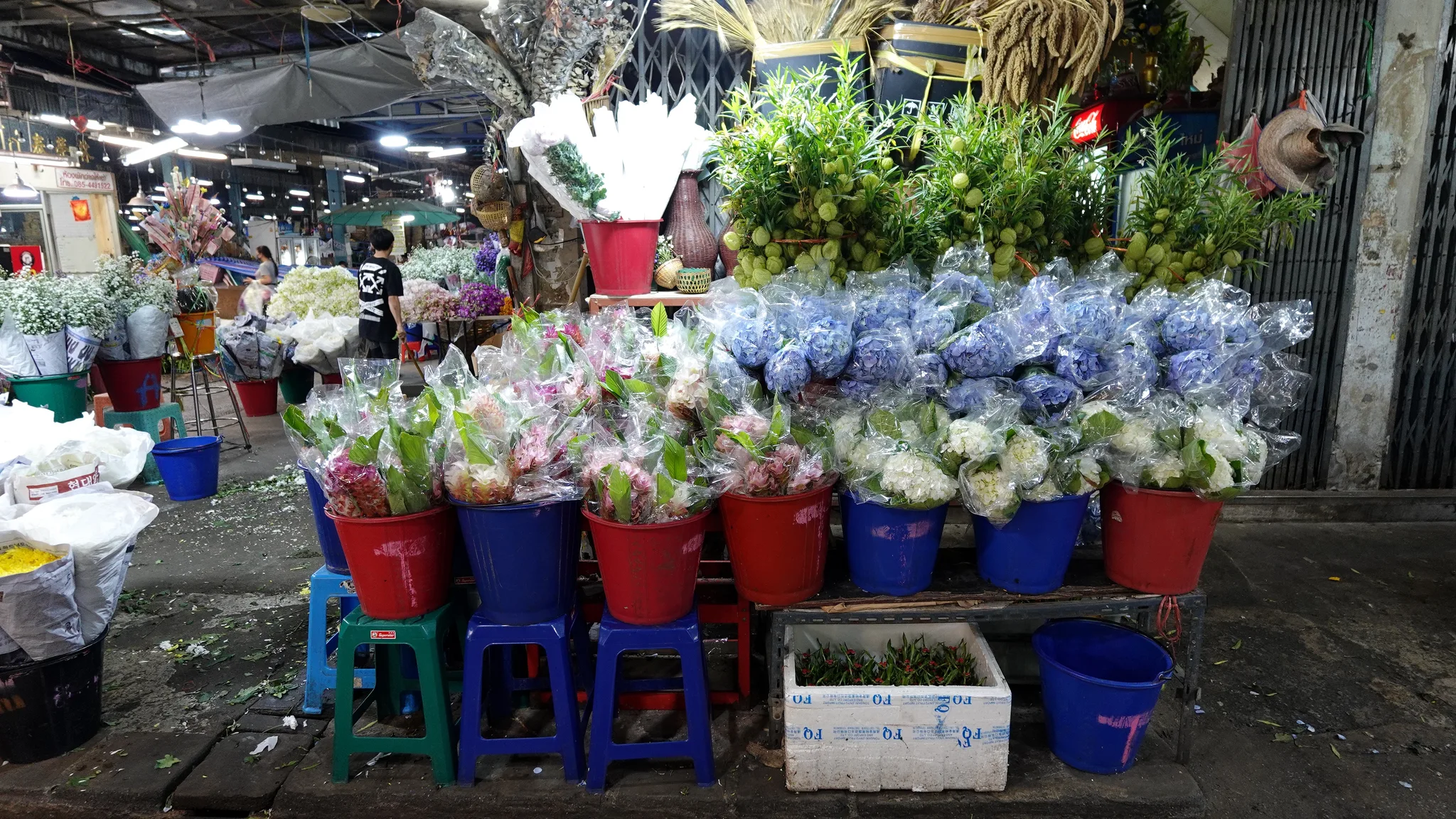
At Pak Khlong Talat, a night-time stall displays plastic-wrapped bouquets of hydrangeas, roses and foliage, arranged in buckets on stools, in front of a covered hall lit by fluorescent lights.© Eric Monteil 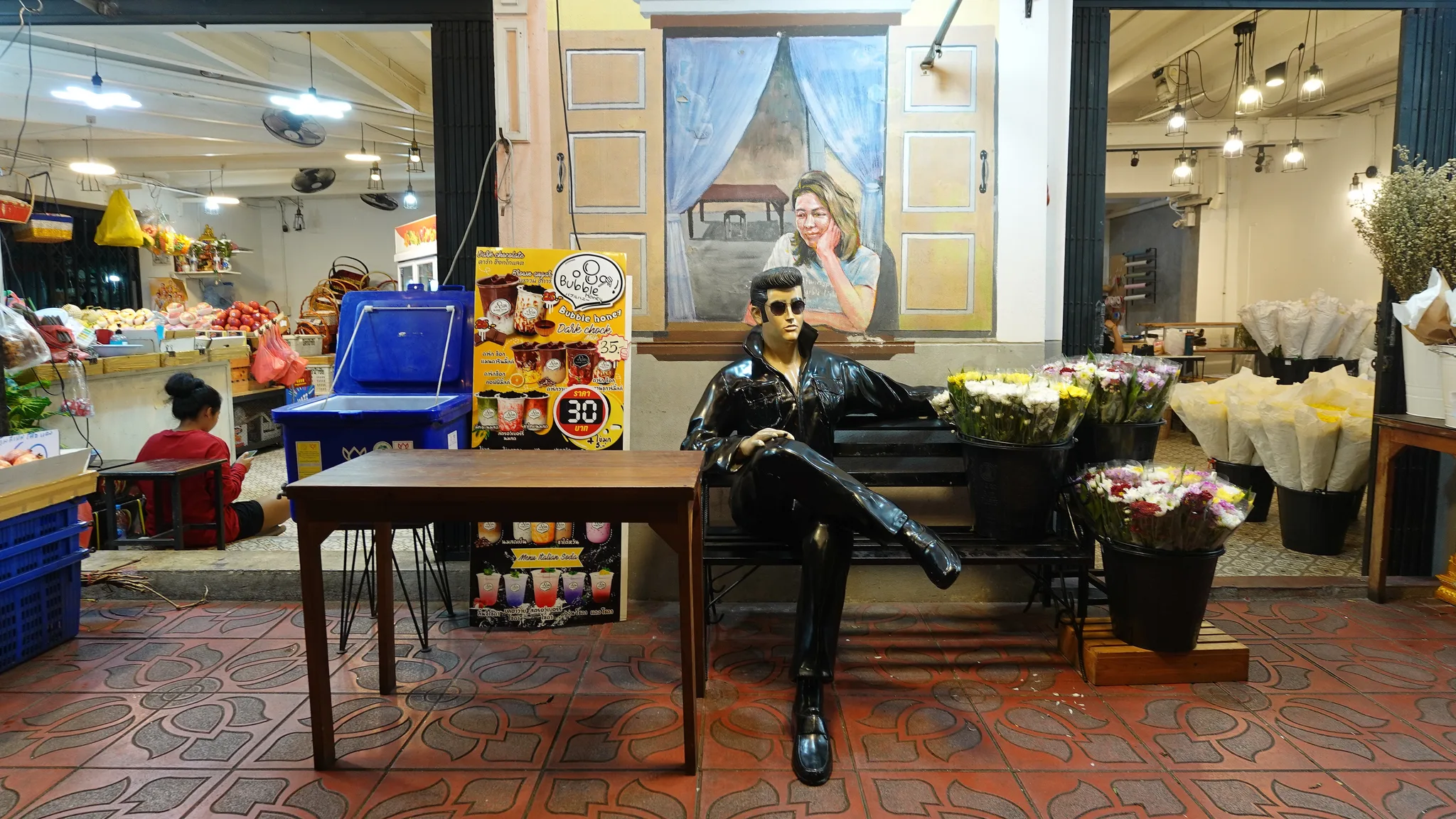
In front of the open shopfronts of Pak Khlong Talat, a statue of a man in a black jacket on a bench and a mural of a woman at a window sit alongside buckets of flowers, wrapped bouquets and a fruit stall, on a patterned tiled floor.© Eric Monteil