
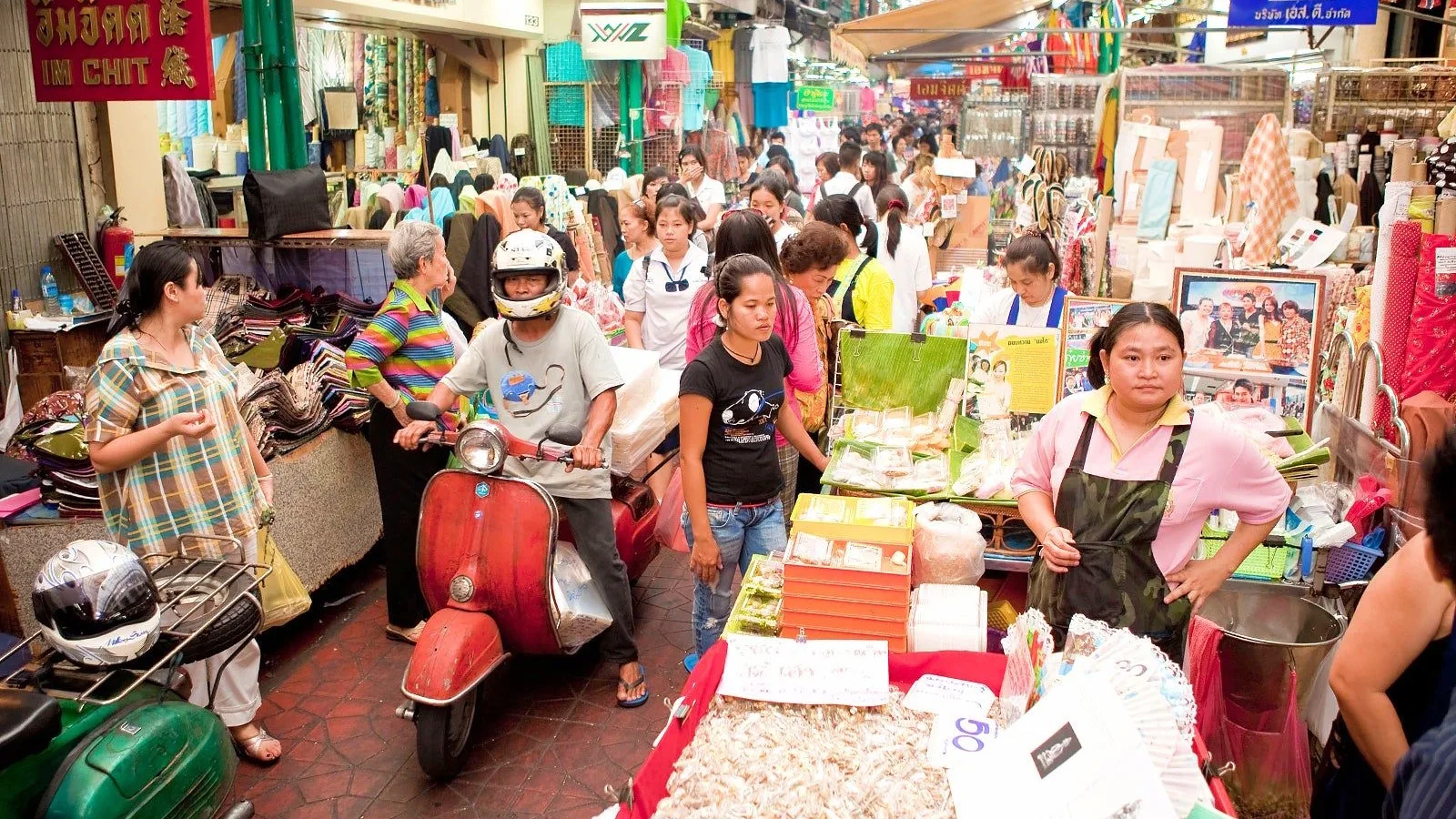
 In a covered lane of Sampheng Market (Chinatown), a scooter edges its way through shoppers, between shops of rolled fabrics, haberdashery stalls and bilingual Thai and Chinese signboards.© Eric Monteil
- Destination
- Bangkok (Samphanthawong)
- Heritage Family
- Cities, territories and cultural landscapes
- Typology
- Market & urban centre
- Visit
- Available tours →
Sampheng Market (Chinatown) is a market lane in Bangkok, a little over a kilometre long, and the commercial district through which it runs. It is the first nucleus of the capital’s Chinese quarter and one of its oldest centres of trade. Its history begins in 1782, when the Chinese community settled on the future site of the Grand Palace was moved to marshy land. A great market in the nineteenth century, a disreputable place of pleasure around 1900, it remains today a well-known wholesale market, a narrow pedestrian alley lined with shophouses.15
Key facts
- Destination
- Bangkok
- Heritage Family
- Cities, territories and cultural landscapes
- Typology
- Market & urban centre
- Places
- Chao Phraya River
- Samphanthawong
- Sampheng
- Periods
- People
- Rama Ier
- Communities
- Teochew Chinese community of Bangkok
- Events
- Construction of Yaowarat Road
- Founding of Bangkok (1782)
- Ratchawong Road fire (2022)
- Relocation of the Teochew merchants to Sampheng (1782)
- Heritage
- —
- Glossary
- Soi
- Wat
- Buddha image
- Shophouse
- Khwaeng
- Wang
- Keywords
- —
- Date
- —
- Collections
- —
Practical info
Practical information about this site is taken from its Google Maps page. We advise you to check it before visiting.
- Address
- ถนน จักรวรรดิ Khwaeng Chakkrawat, เขต จักรวรรดิ์, Krung Thep Maha Nakhon 10100
- Phone
A lane and its quarter
A commercial artery in the old city
Sampheng Market (Chinatown) refers first of all to a lane: a narrow, pedestrian-only alley lined with shophouses, from which numerous side passages branch off. Around it extends a commercial district that bears the same name. The lane is not simply one street among others in Chinatown: it is its historic backbone, the line around which Bangkok’s Chinese quarter first took shape before spreading towards Yaowarat.15
The district lies in Chakkrawat subdistrict (khwaeng), within Samphanthawong District, near Yaowarat and Ratchawong Road. It extends as far as Saphan Han, Phahurat and Wang Burapha, in Phra Nakhon District. The thoroughfare starts from the Talat Noi neighbourhood. The busiest stretch runs between Ratchawong Road, which cuts across the lane, and Chakkraphet Road. The route has scarcely changed in a century: maps from a hundred years ago already trace the same line.5
Layered names
Several names refer to this same route. The common Thai name, สำเพ็ง, is also written สามเพ็ง, which accounts for the transcriptions Sampheng or Sampeng. On street signs and in official usage, however, the lane is called Soi Wanit 1, sometimes Wanit 1 Road. The change stems from a government notice that renamed ‘Sampheng Road’ as ‘Wanit Road’, from a Thai word meaning ‘commerce’. This renaming is linked to a policy of asserting Thai national identity. Usage did not follow: everyone still speaks of Sampheng.11
Within the lane itself, other names survive. The stretch between Saphan Han and Chakkrawat Road bears the name Trok Hua Met. Old maps, above all, know nothing of ‘Wanit 1’: they divide the route into sections and passages designated by a series of names in Chinese characters. This layering of place names – Thai, administrative and Chinese – sums up the history of the place, at once the quarter of a community from China and a street in a Thai capital.11
The riddle of a name
Reading the name in the landscape
Where does the word Sampheng come from? The hypotheses are many, and no answer prevails: there is no decisive evidence in favour of any one of the explanations put forward. Several of them look for the answer in the former landscape. The first links the name to a nearby temple and canal called Sam Pheng, whose name is said to have been shortened in the pronunciation of the Chinese residents. The temple certainly exists: today’s Wat Pathum Khongkha was formerly called Wat Sampheng.1
Other readings start from the lie of the land. ‘Sam Phaen’, the ‘three plots’, would evoke ground divided into three by two canals, the one that ran north of Wat Sampheng and that of Wat Sam Pluem. ‘Sam Phraeng’, the ‘three forks’, would refer to another feature of the site. A final, more unexpected hypothesis sees in it the name of a fern, the lamphaeng, whose leaves resemble those of basil. All these explanations have in common that they anchor the name in a territory of canals and low-lying land that predates the trading town.1
Historical readings at odds
A second group of hypotheses looks to the languages of the region. One connects Sampheng with a Mon word meaning ‘lord’ or ‘dignitary’. It is attributed to the historian Sujit Wongthes, who infers from it that Mon people lived on the site before the arrival of the Chinese. Jit Phumisak, for his part, is associated with another line of enquiry, that of the Khmer samphali, meaning ‘procuress’ or ‘madam’.16
A simpler explanation, put forward by Khun Wichitmatra, makes the name the trace of three people called Pheng who are said to have lived there. Nothing allows us to decide between these readings, which reveal above all how each projects onto the name an idea of the quarter: a land of canals, an ancient lordship, a place of carnal commerce or a community of neighbours.5
A word turned insult
In everyday language, the name has also taken on a pejorative meaning. In Thai, ‘สำเพ็ง’ is used as an insult for a prostitute, and the expression ‘Sampheng woman’ is known in this sense.17
The birth of a trading quarter
1782: making way for the Grand Palace
The history of the quarter begins with that of Bangkok. In 1782, Rama I founded a new capital on the east bank of the Chao Phraya. The land chosen for the Grand Palace was then occupied by Chinese, led by Phraya Racha Setthi, the title borne by the head of the Chinese community. The king ordered their relocation to clear the site for the royal residence.2
These residents were resettled between two canals: that of Wat Sam Pluem, now Wat Chakkrawat, and that of Wat Sampheng, now Wat Pathum Khongkha. These two Buddhist monasteries, together with Wat Samphanthawong, also known as Wat Ko, still serve as landmarks for locating the old quarter.7
A path through the marshes
A brick town in a city of water
By around 1785, the lane already formed the heart of the Chinese quarter. The contrast with the rest of Bangkok was then striking. The capital was above all a city of canals and floating houses. Sampheng was the exception: Chinese merchants built brick houses there, standing on the ground.13
Trade dealt at first in imported goods, and warehouses rose nearby to store them. The lane is considered one of the first commercial centres of the Rattanakosin period, which began with the founding of Bangkok.15
The great market of the nineteenth century
The goods of a port
In the nineteenth century, Sampheng was described as the largest land-based market in the city. There one could find imported fruit, silks, tea, soap, medicines, glassware, gold, knives and iron tools, goods from China. Paper articles and ritual offerings, dried goods and salted fish were also sold there.6
This variety reveals the market’s dual function. It supplied the capital with imported goods, but it also served the daily and religious life of the Chinese community, which found there its familiar foodstuffs and the objects of its rites.
Fire, an ever-present threat
The density of the quarter had its downside. The tightly packed houses, built of bamboo and roofed with vetiver grass, frequently burned. The phenomenon was so familiar that it passed into the language. In the world of Thai boxing betting, the expression ‘ไฟไหม้สำเพ็ง’, ‘Sampheng fire’, denotes the unexpected defeat of a favourite, which ruins the punters at a stroke.7
The image conveys the suddenness and scale of the losses that a fire could cause in a quarter where goods, dwellings and shops were crammed together. It is also a reminder that the memory of Sampheng rests not only on its walls but on the words it has left in everyday Thai.
Trade by day, pleasures by night
At the end of the nineteenth century, the quarter was associated with gambling, opium and prostitution. The Briton Smyth, then living in Siam, spoke of it with contempt. A photograph from 1909 clearly shows this dual nature: Sampheng appears in it both as a commercial district and as a place of nightlife, with its brothels, gambling houses and opium dens.13
This reputation did not eclipse commercial activity, which remained the bedrock of the quarter’s life. The trading town and the pleasure town then shared the same lanes, a few steps from the temples that had bordered the quarter since its founding.
A lane in modern Chinatown
The rise of Yaowarat
Between the late nineteenth century and the twentieth century, Yaowarat Road, laid out later than the lane, overtook it in size and importance. Sampheng did not decline for all that. The lane remained prosperous.13
Popular usage, attached to the old name, has made this renaming a matter of street signs rather than of memory.
The calendar of Chinese festivals
The quarter remains shaped by the calendar of the Chinese community. The Lantern Festival, Qingming – known as Cheng Meng in Thailand – the Moon Festival and above all Chinese New Year are celebrated there.13
Market and ritual life thus echo each other from one end of the place’s history to the other.
The market today
A wholesale market in a narrow lane
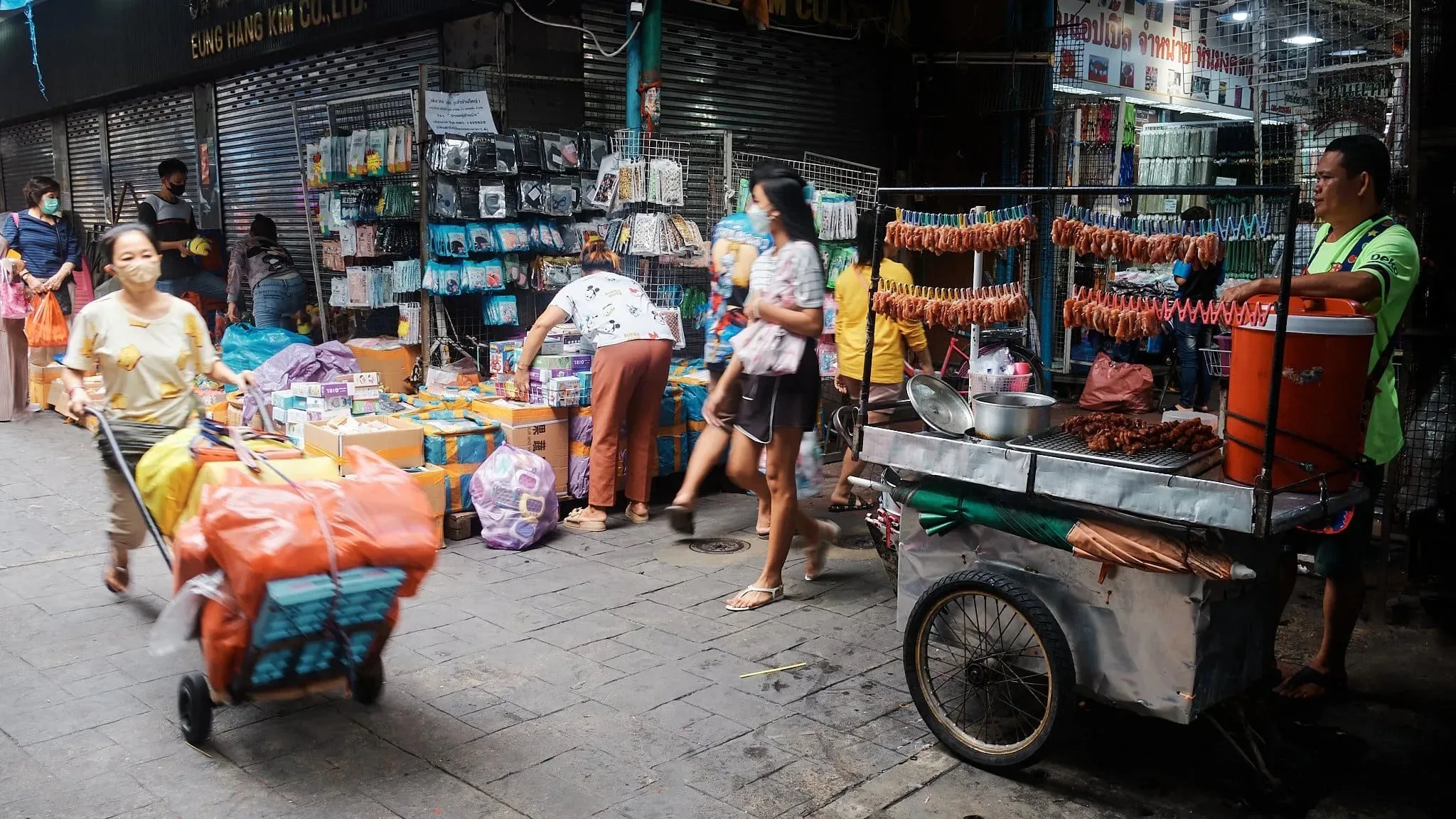
Sampheng Market (Chinatown) is today one of Bangkok’s major wholesale markets, and it also sells retail. The lane remains pedestrianised, lined with shophouses, those narrow terraced houses combining a shop on the ground floor with storeys above. On sale are gift items, accessories, clothing, hats, watches, dolls, toys and food. Traders come to stock up in bulk, private shoppers to look for good prices.5
The lane also retains an organisation by specialities and landmarks. Rope and string shops cluster between Yaowaphanit and Song Sawat roads; a fabric shop, Kikuya, serves as a landmark for regulars.14
A trade shaken by online sales
The market’s endurance does not rule out difficulties. In 2019, the press reported the weakest trading at Sampheng in half a century, a slowdown shared with other Bangkok markets. The cause put forward was the rise of online commerce, which draws some of the customers and resellers away from the alleys where they once came to stock up.15
For a place born a market and still one, this competition strikes at the very heart of its function. The lane weathered the arrival of Yaowarat and the transformations of the city in the twentieth century without losing its role; remote selling raises a question of a different kind, since it makes it less necessary for buyers to travel to the shops.
The return of fires
Fire, which left such a mark on the nineteenth century, remains a danger. Several fires have struck the area in recent years: in January 2018, a four-storey commercial building; in August 2021, a building behind Wat Chakkrawat; in February 2022, a building used as a toy warehouse.9
On 26 June 2022, another fire broke out on Ratchawong Road, near the pier of the same name. Several shophouses were destroyed and the fire left people dead and injured. Its presumed cause was the explosion of a transformer belonging to Bangkok’s electricity company, and the tangle of electrical cables helped the fire spread from one building to the next.8
Understanding
Sampheng Market (Chinatown) is first and foremost the trace of a founding decision: by moving the Chinese community to build the Grand Palace, the monarchy gave rise, beside a path through the marshes, to the first nucleus of the Chinese quarter of its new capital. For more than two centuries, the lane has kept its commercial function, passing from the great market of imports to the wholesale market of today. Its very name, laden with hypotheses and an insulting meaning, tells how the city regarded this quarter of traders from China. The present, however, raises new questions. Online selling reduces the need to come and buy in person, and repeated fires recall the fragility of densely packed buildings, saturated with goods and cables. If buyers one day stop thronging there, what will remain of Sampheng: a living market lane, or merely the memory of the place where Bangkok learned to trade?
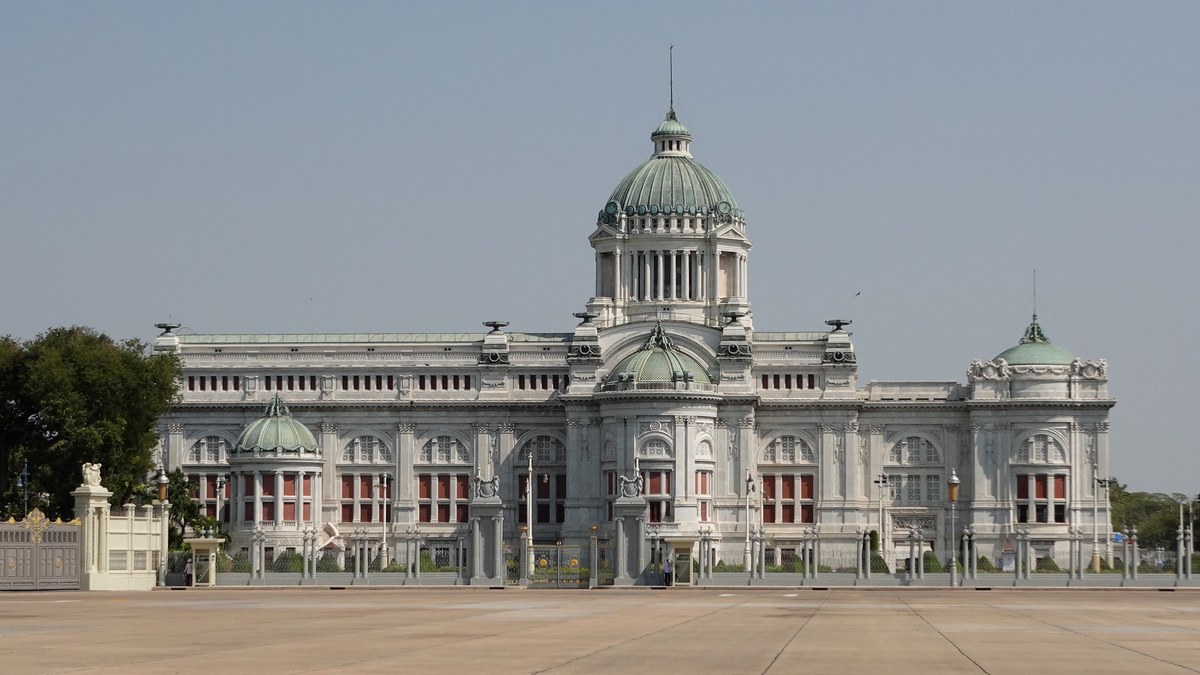
Rattanakosin, from the royal citadel of 1782 to the historic districts that shaped contemporary Bangkok.
- Soi
- Thai word for a lane or side street branching off a main road; soi are often numbered after the main street from which they branch.
- Wat
- Buddhist monastic complex that brings together, within a single enclosure, several religious buildings, monks’ quarters and ancillary buildings; the word does not refer to a single building.
- Buddha image
- In Thai Buddhism, a devotional representation of the Buddha, most often a statue, venerated as an object of worship.
- Shophouse
- A narrow, deep urban house built in a row, whose ground floor serves as a shop and upper floor as living quarters, typical of the trading towns of South-East Asia.
- Khwaeng
- An administrative subdivision of Bangkok, ranking below the district (khet), the urban equivalent of the tambon in the provinces.
- Wang
- Thai word for a palace, particularly the residence of a prince or a member of the royal family.
- Trok
- Thai word for an alley, that is, a narrow passage between buildings, generally narrower than a soi.
- Rattanakosin period
- Period of Thai history that began with the founding of Bangkok as the capital by King Rama I at the end of the eighteenth century. It takes its name from Rattanakosin Island, the heart of the royal city.
- Phraya Racha Setthi
- Siamese noble title held by the head of the Chinese community, who represented it before the royal authorities.
- Qingming
- Chinese ancestral festival, held in spring, during which families visit graves to tend them and leave offerings there. In Thailand it is called Cheng Meng.
Primary sources
- 1non précisé, สำเพ็ง (fiche communauté), Sirindhorn Anthropology Centre (SAC), Wikicommunity ↗
Studies
- 2non précisé (d'après Buppha Khummanon), สืบต้นกำเนิดสำเพ็ง จากศูนย์การค้ายุคแรกสมัยรัตนโกสินทร์ สู่ย่านสีเทา-โสเภณี, Silpa Wattanatham (Matichon), 2023 ↗
- 3non précisé, สำเพ็ง เป็นภาษามอญ? สำรวจความเป็นมาของชื่อที่มีหลายข้อสันนิษฐาน, Silpa Wattanatham (Matichon) ↗
- 4non précisé, Chronique sur Sampheng (rubrique Prachachuen), Matichon ↗
- 5non précisé, "สำเพ็ง" ย่านการค้าสำคัญของกรุงเทพฯ จากอดีตสู่ปัจจุบัน, Matichon, 2022 ↗
- 6Na Chat Prachachuen, สำเพ็ง : รู้ไปโม้ด, Khaosod ↗
- 7non précisé, Article sur l'histoire des incendies de Sampheng et l'expression « ไฟไหม้สำเพ็ง », TNN Thailand ↗
- 8non précisé, Reportage sur l'incendie de Sampheng (juin 2022), MGR Online, 2022 ↗
- 9non précisé, Article sur Sampheng et ses incendies successifs, MGR Online, 2022 ↗
- 10non précisé, Bilan de l'incendie de Sampheng, The Standard, 2022 ↗
- 11non précisé, ตรอกรอบซอยวานิช 1 เส้นเลือดใหญ่ของชาวจีนโพ้นทะเล, Urban Creature ↗
- 12non précisé, Article sur Sampheng et l'origine de son nom, Gotomanager (Manager) ↗
- 13non précisé, Cover story (commerces de la rue Wanit 1), Gotomanager (Manager) ↗
- 14non précisé, Article sur des adresses de Sampheng (repère Kikuya), Sanook ↗