
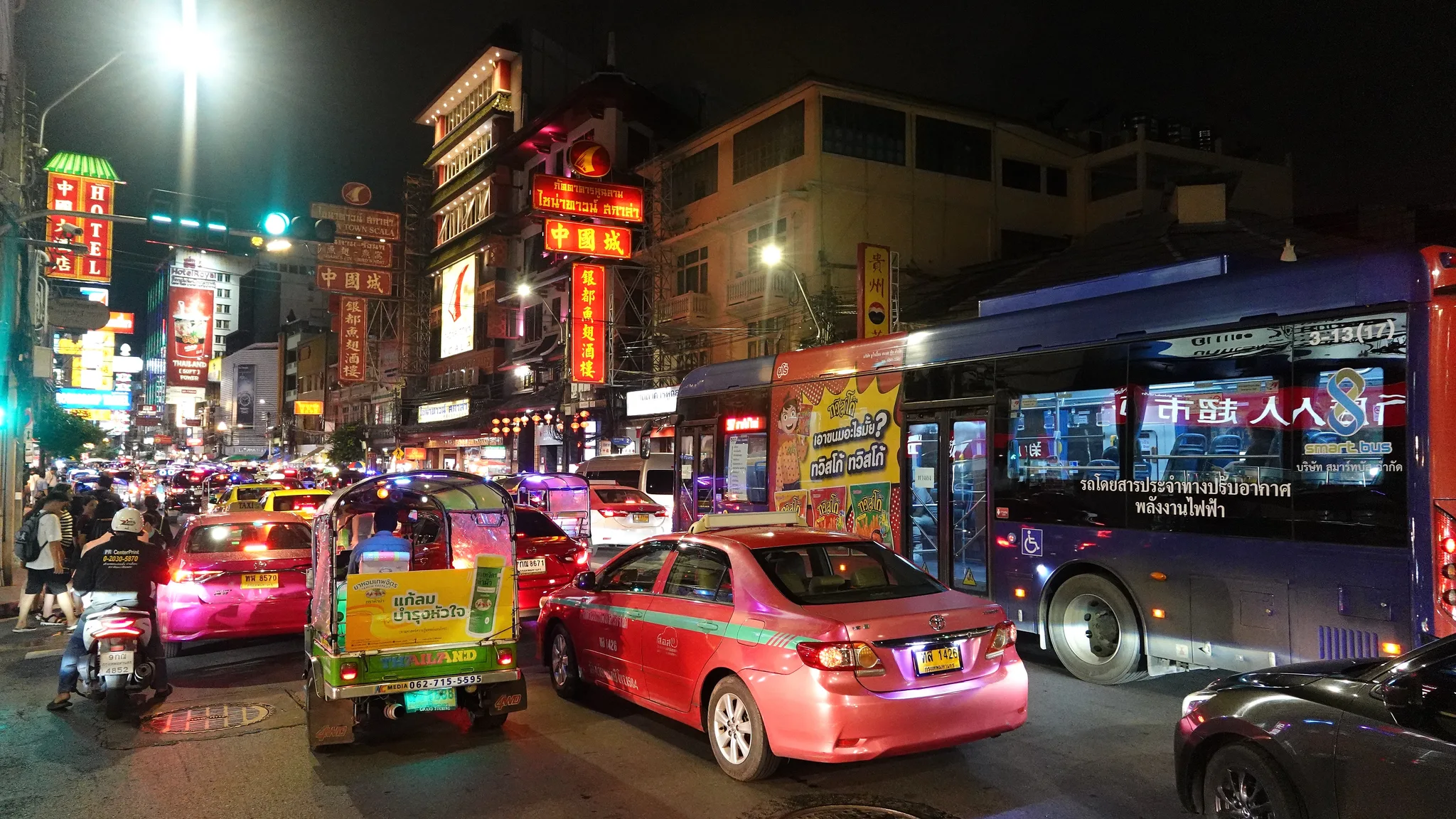
 Chinatown Night Market: dense traffic of taxis, tuk-tuks, motorbikes and an electric bus flows beneath the red, illuminated vertical signs in Chinese and Thai characters that line the street at night.© Eric Monteil
- Destination
- Bangkok (Samphanthawong)
- Heritage Family
- Gastronomy and food cultures
- Typology
- Dining & street food
- Visit
- Available tours →
The Chinatown Night Market refers to the street food that takes over Yaowarat Road, the main artery of Bangkok’s Chinese quarter, in the evening. It matters because it keeps alive, out in the open street, a food culture bound up with a merchant quarter that grew from the settlement of a Chinese community. Its history begins with the relocation of that community to Sampheng at the end of the 18th century. It continues with a road cut through during the reign of Chulalongkorn, and then with a market that became an emblem of the city and was defended in the face of municipal policies. In the evening, stalls line both sides of the roadway, between jewellers’ shops and restaurants.
Key facts
- Destination
- Bangkok
- Heritage Family
- Gastronomy and food cultures
- Typology
- Dining & street food
- Places
- Sampheng
- Samphanthawong
- Periods
- People
- Rama Ier
- Rama V
- Communities
- Teochew Chinese community of Bangkok
- Events
- Construction of Yaowarat Road
- Bangkok street vendor ban (2017)
- Pedestrianisation of Yaowarat Road (2019)
- Heritage
- —
- Glossary
- Soi
- Wat
- San
- Buddha image
- Teochew
- Bib Gourmand
- Keywords
- —
- Date
- —
- Collections
- —
Practical info
Practical information about this site is taken from its Google Maps page. We advise you to check it before visiting.
- Address
- 148 Maha Chak Rd, Khwaeng Chakkrawat, Khet Samphanthawong, Krung Thep Maha Nakhon 10100
A street at the heart of the Chinese quarter
A name in common use for an evening cuisine
The Chinatown Night Market has neither market hall nor enclosure. The name, common among foreign visitors, refers to the night-time street food of Yaowarat Road, in Bangkok’s Samphanthawong district. It gathers under a single label the stalls set up in the evening along the roadway and the restaurants that line the street. To understand this market, then, is to understand a street, and the quarter of which it has become the centre.17
Yaowarat and the surrounding streets
Bangkok’s Chinese quarter first grew up around Sampheng, on the east bank of the Chao Phraya. Its heart then shifted to Yaowarat Road, which became its main artery, to the point that its name is often used for the whole quarter. The Thai press readily describes it as ‘Bangkok’s Chinatown’. Yet the quarter extends well beyond this one street. It also takes in Charoen Krung, Mangkon, Song Wat, Songsawat, Ratchawong and Chakkrawat roads; in Sampheng, as on Charoen Krung, shops and stalls likewise multiply at night and at weekends.12
At one end, Yaowarat Road opens onto the Odeon Circle, which keeps the name of a former cinema. The Chinatown Gate was erected there in 1999, marking the entrance to this network of shopping streets. The evening market belongs to this dense urban fabric, where each street has its own history but where Yaowarat concentrates the bustle and the gaze of visitors.12
From Sampheng to Yaowarat Road
The Teochew settled in Sampheng
The history of the quarter begins with a relocation. In 1782, General Chakri became king under the name Rama I. He then had the Teochew Chinese community settled in Sampheng, on the east bank of the Chao Phraya, downstream from the city centre. This merchant quarter became the focal point of the Chinese presence in Bangkok.12
Before Yaowarat Road was cut through, life in the quarter revolved around Sampheng Lane, now called Wanit 1, which then served as the main street.13
Fires and new roads under Chulalongkorn
In the second half of the 19th century, this density became a danger. The quarter suffered numerous fires, and the destruction paved the way for new roads during the reign of Chulalongkorn, known as Rama V. Song Wat Road was thus laid out in 1892, after a great fire in Sampheng.12
At the end of 1891, the king ordered the construction of several roads, including Yaowarat Road. The works lasted from 1892 to 1900. The new road is about one and a half kilometres long and some twenty metres wide. With it, the quarter changed scale: alongside the merchant lane of Sampheng came a broad thoroughfare open to traffic, which would become the new centre of gravity of Chinese life in Bangkok.11
From ‘Yuppharat’ to ‘young king’
The road was first named Yuppharat, before being renamed Yaowarat, a name meaning ‘young king’. Popular usage has given it other names. It is called the ‘road of gold’, on account of the jewellers’ shops that line it, and the ‘dragon road’. These nicknames express what the street has become: a place of commerce identified with the Chinese community that brings it to life.11
A quarter of trade and dining
Gold, banking and commerce
The Chinese quarter established itself as a centre of commerce, finance and banking. Jewellers, restaurants and shops stand side by side, and the ‘road of gold’ recalls the weight of the jewellery trade in its identity. Street food is part of this whole: it is not an isolated activity but one of the forms of trade that keep the street alive.9
This continuity explains the place of the evening market. For the visitor, moreover, the line between shop, restaurant and stall remains blurred: you order on the pavement, sit at a table set out in front of a stall, or leave with a takeaway dish.
Teahouses, hotels and gambling dens
Yaowarat Road has not always been associated first and foremost with food. In the past it was home to restaurants, hotels and teahouses, but also to brothels and gambling dens. It was a street of pleasure as much as of commerce, where people came to eat, to stay and to be entertained. Today it is above all its street food that makes its reputation, to the point of making it one of the world’s great centres of the practice.8
The street is also a place of festivity: Chinese New Year is celebrated there on a grand scale. This festive role is a reminder that the street is not merely a backdrop for visitors: it remains the public space of a quarter that asserts its identity there.11
In the evening, the street becomes a market
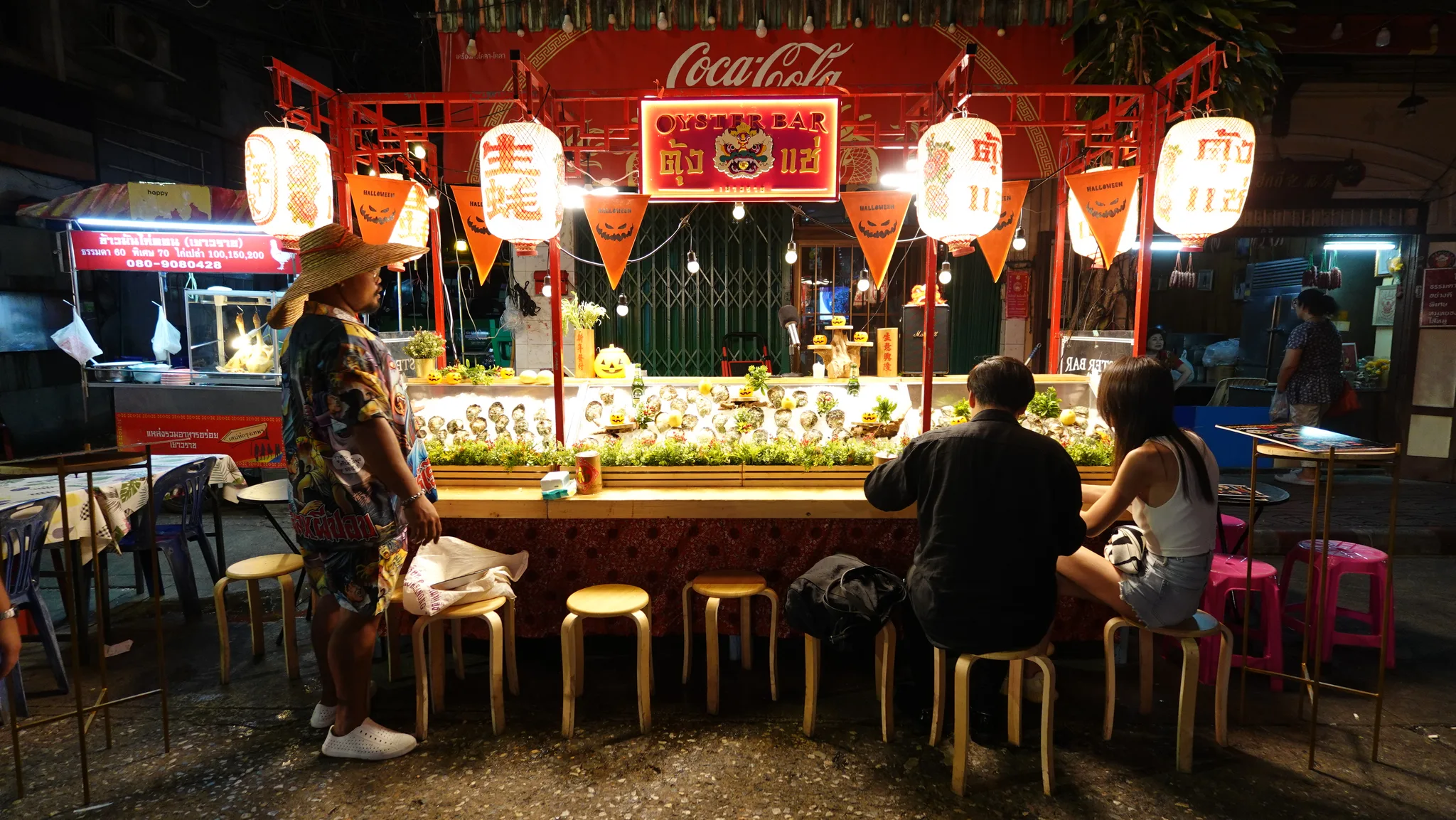
Stalls on both sides of the roadway
As evening falls, street-food stalls line both sides of Yaowarat Road. In 2019, barriers and cones marked out on each side a passage where customers could order or wait, in the midst of the traffic. This coexistence of cars, vendors and diners gives the market its character: it does not set up apart from the city, but in the very flow of the street.7
People eat takeaway, or seated at the tables of restaurants and on the pavement. The offering mixes Thai, Chinese and European cuisine. At the end of 2019, the section given over to pedestrians, some six hundred metres long, was lined with nearly two hundred renowned restaurants. This figure gives an idea of the density of the place, where the mobile evening stalls come on top of the restaurants.7
Addresses recognised by the Michelin Guide
Yaowarat’s cuisine has won the recognition of food critics. The Michelin Guide has awarded a Bib Gourmand to several establishments in the quarter. Guay Jub Ouan Pochana, on Yaowarat Road, is thus known for its kuay chap. Khao Phad Pu Chang Phueak, also called Woeng Nakhon Kasem, is renowned for its crab fried rice, and Lim Lao Ngow is on neighbouring Song Sawat Road.16
The guide has also awarded a Michelin Plate to two other eateries, Nai Ek Roll Noodles and Pa Tong Go Savoey. These distinctions show that the quarter’s street food is also recognised by food critics.16
Street food and the city’s rules
The ban announced in April 2017
In April 2017, the Bangkok Metropolitan Administration announced a ban on street vendors throughout the capital. Yaowarat and Khao San, another street much frequented by visitors, were among the places affected. The measure directly threatened the evening market, whose very existence depends on occupying the roadway.5
A few days later, the Bangkok Metropolitan Administration reversed its position. Street food remained permitted on certain stretches of Yaowarat and Khao San, regarded as tourist hubs and treated as exceptions to the policy of clearing out vendors. Vallop Suwandee, chairman of the Bangkok governor’s advisers and the driving force behind this policy, announced in return stricter rules and an end to round-the-clock service.2
Some vendors acknowledged part of the problem. Wuttipong Kasemongpanit, one of the dozens of traders on the street, admitted at the time that the vendors’ negative image had led to the ban. He nevertheless saw street food as a major attraction that had to be preserved. The episode shows how far the market’s survival now hinges on a balance between municipal tolerance and the tourist value attributed to the street.4
Training vendors, regulating space
Also in 2017, Yaowarat Road was chosen as a pilot zone for a programme designed to improve the quality of street food. Vendors attended a one-day training course on the law, hygiene and waste management. This training was the condition of their right to sell on the street for a fixed period: selling became a regulated authorisation rather than a mere occupation of space.4
The Bangkok Metropolitan Administration marks out the selling area and requires vendors to clean their pitches. Its officers patrol the street and issue warnings to those who break the rules. The evening market thus keeps its place, but at the price of a new discipline that turns a spontaneous practice into a regulated activity.4
A street given back to pedestrians in 2019
In December 2019, the Bangkok Metropolitan Administration turned Yaowarat Road into a pedestrian street to support tourism, with the backing of the Tourism Authority of Thailand. The Deputy Governor of Bangkok, Sakoltee Phattiyakul, announced the measure, which also covered Silom and Khao San roads. The stretch concerned ran from the Chalermburi intersection to the Ratchawong intersection.15
On the first weekend, from 13 to 15 December, one lane in each direction was reserved for vendors on the Friday and Saturday evenings, from 7 pm to midnight. On the Sunday, the whole street, together with the lane Soi Plaeng Nam, was closed to traffic. The operation was to be repeated every weekend. The city no longer merely tolerates the market: it adapts the street to support tourism.15
A renown that reaches beyond Thailand
Bangkok, capital of street food
At the time the vendor ban was announced, Bangkok had just been ranked the world’s best city for street food for two years running by the American network CNN. This paradox sheds light on the 2017 debate: the city was seeking to discipline its pavements at the very moment when its street food was earning it international renown. The exceptions granted to Yaowarat reflect this tension, since the street was spared precisely because it attracts visitors.5
From the street to the ‘Rockstar’ video
In 2024, Yaowarat Road appeared in the music video for LISA’s song ‘Rockstar’. This appearance further heightened the quarter’s profile in the media. The Thai press seized the occasion to retrace the history of the street, from its construction under Chulalongkorn to its role as a major centre of commerce.8
This fresh attention confirms a development already under way. The street, once a space of trade and entertainment for Bangkok’s Chinese community, is now also an image, broadcast far beyond Thailand. The evening market is its most visible face: it is what visitors come in search of, and it is around the market that the street’s future is being played out.
Understanding
The Chinatown Night Market is not a monument: it is a way of occupying a street. On Yaowarat Road, cut through at the end of the 19th century in the heart of a merchant quarter that grew from the settlement of the Teochew in Sampheng, the evening stalls carry forward a long history of commerce, restaurants and teahouses. Their value lies less in any setting than in the gestures of the vendors and the crowd that throngs between the tables. Today this existence depends on municipal rules: in 2017, the Bangkok Metropolitan Administration announced a ban on vendors before making Yaowarat an exception in the name of tourism; it then trained the traders and opened the street to pedestrians. International recognition, from gastronomic rankings to a singer’s music video, further sharpens this focus on visitors. If Yaowarat’s cuisine now owes its place on the street to its tourist value, does it remain the expression of a quarter, or is it becoming a spectacle laid on for those who pass through it?
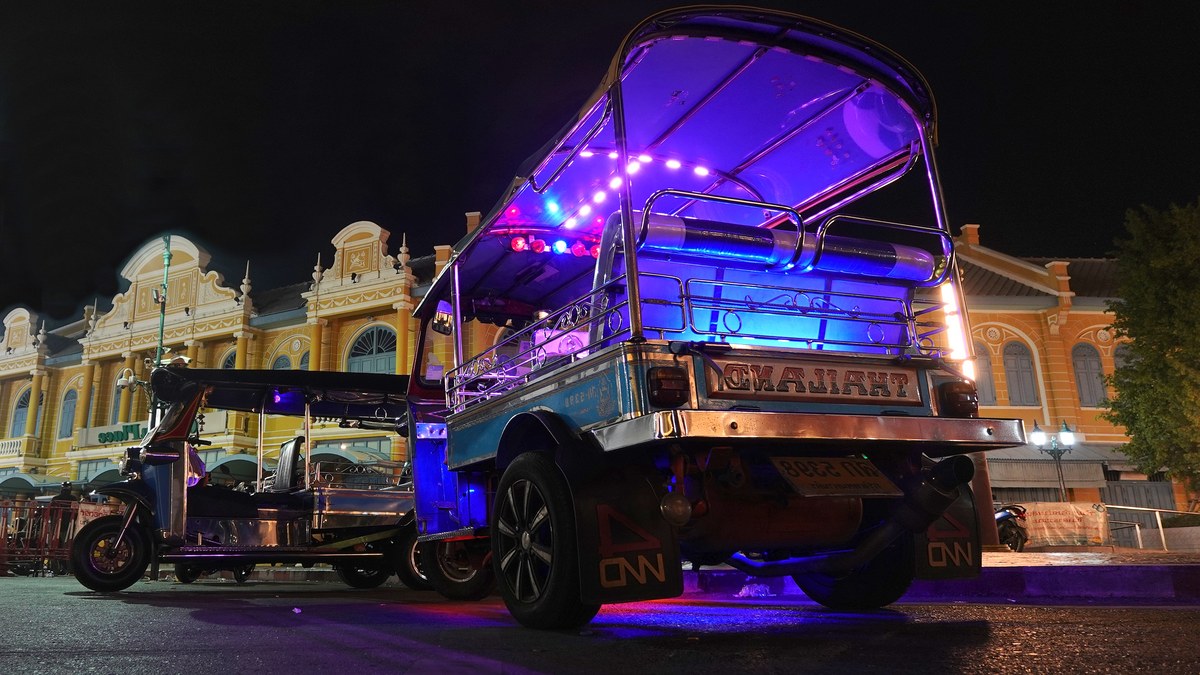
Bangkok from dusk to deep night, from the banks of the Chao Phraya to the neon of Chinatown and the jazz clubs.
- Soi
- Thai word for a lane or side street branching off a main road; soi are often numbered after the main street from which they branch.
- Wat
- Buddhist monastic complex that brings together, within a single enclosure, several religious buildings, monks’ quarters and ancillary buildings; the word does not refer to a single building.
- San
- In Thailand, a small shrine where worship is offered to a deity, a spirit or a protective figure.
- Buddha image
- In Thai Buddhism, a devotional representation of the Buddha, most often a statue, venerated as an object of worship.
- Teochew
- Chinese dialect group originating from the Chaozhou area, in eastern Guangdong, southern China. It forms the largest component of the Chinese community in Thailand.
- Bib Gourmand
- Michelin Guide distinction that indicates a good-quality establishment offering food at a moderate price.
- Kuay chap
- Soup of Teochew Chinese origin made with rolled rice noodles, served in a peppery broth, often with pork and pork offal.
- Michelin Plate
- Michelin Guide mention indicating an establishment that serves good food, without awarding it a star or a Bib Gourmand.
Studies
- 1Silom, Khao San, Yaowarat roads to become 'walking streets', Bangkok Post, 2019 ↗
- 2Khao San, Yaowarat skirt BMA's ban on street food, Bangkok Post, 2017 ↗
- 3BMA gives reprieve to 2 street food roads, Bangkok Post, 2017 ↗
- 4The word on the street food, Bangkok Post, 2017 ↗
- 5BMA bans all street food across Bangkok this year, The Nation (Thailand), 2017 ↗
- 6No, the street food on Khao San and Yaowarat is not going anywhere. But the rest of Bangkok…, BK Magazine, 2017 ↗
- 7Yaowarat Walking Street – paradise for street food lovers, Pattaya Mail, 2019 ↗
- 8ประวัติ “เยาวราช” ย่านการค้าระดับโลกของไทย ฉากสำคัญที่ปรากฏในซิงเกิล “Rockstar” ของ “ลิซ่า”, MGR Online (ผู้จัดการออนไลน์), 2024 ↗
- 9"เยาวราช" จากดาวเด่น พื้นที่เศรษฐกิจสำคัญ สู่ MV เพลง ROCKSTAR ของ LISA ทำเลที่ไม่เคยหลับใหล, Thairath (ไทยรัฐ), 2024 ↗
- 10เปิดประวัติ "ถนนเยาวราช" ความจริงแล้วมีอีกชื่อที่ถูกลืมไป, LINE Today, 2024 ↗
Reference works
- 11Contributeurs Wikipédia, Yaowarat Road, Wikipedia ↗
- 12Contributeurs Wikipédia, Chinatown, Bangkok, Wikipedia ↗
- 13Contributeurs Wikipédia, Samphanthawong district, Wikipedia ↗
- 14Contributeurs Wikipédia, Song Wat Road, Wikipedia ↗
- 15TAT Newsroom, BMA turns Yaowarat, Silom, Khao San roads into ‘walking streets’ this December, Tourism Authority of Thailand, 2019 ↗
- 165 Incredible Street Food Stalls in Yaowarat’s Chinatown, MICHELIN Guide ↗
- 17Chinatown Night Market Bangkok (Hours, Mondays, What to Eat), Visit Thailand Today ↗
Further reading
Contemporary views
Chinatown Night Market today
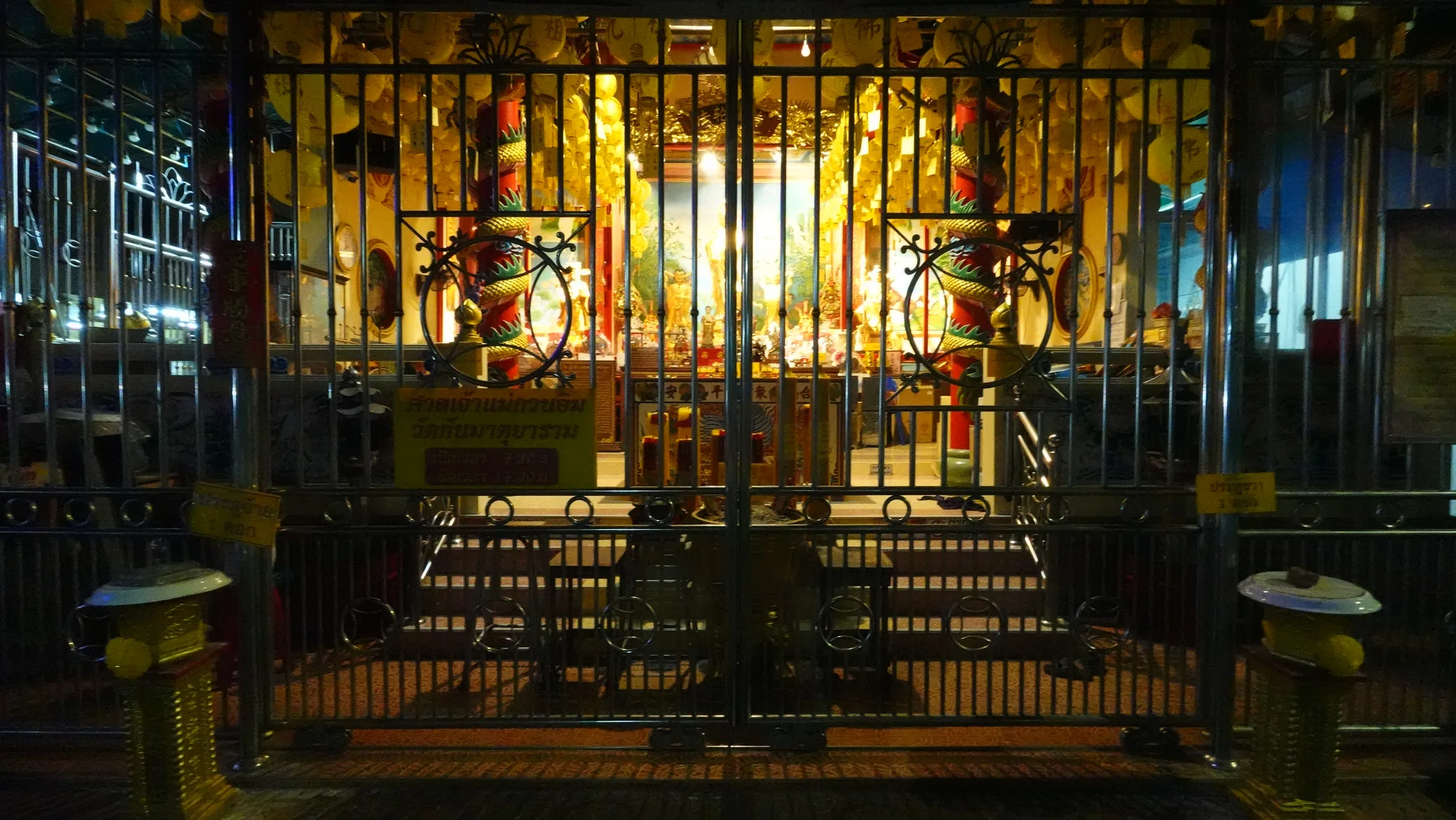
At Chinatown Night Market, a Chinese shrine is visible behind its closed gates: red columns entwined with dragons, hanging yellow lanterns and an altar lined with statues, marked by a sign in Thai.© Eric Monteil 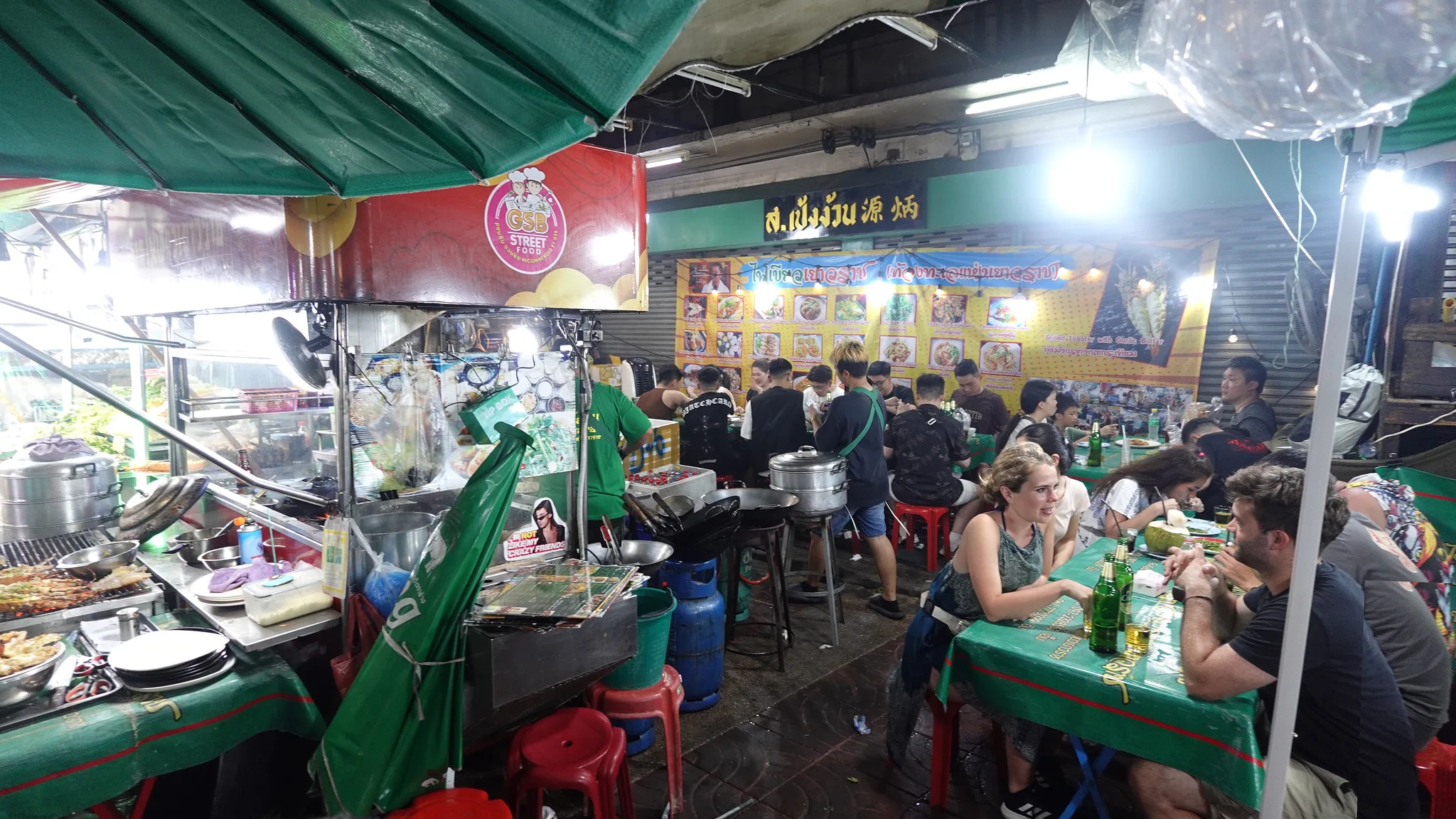
At Chinatown Night Market, a stall equipped with grills, woks and pots faces tables covered with green cloths where customers dine on plastic stools, in front of a signboard illustrated with dishes.© Eric Monteil
Architecture and decoration
Explore the heritage
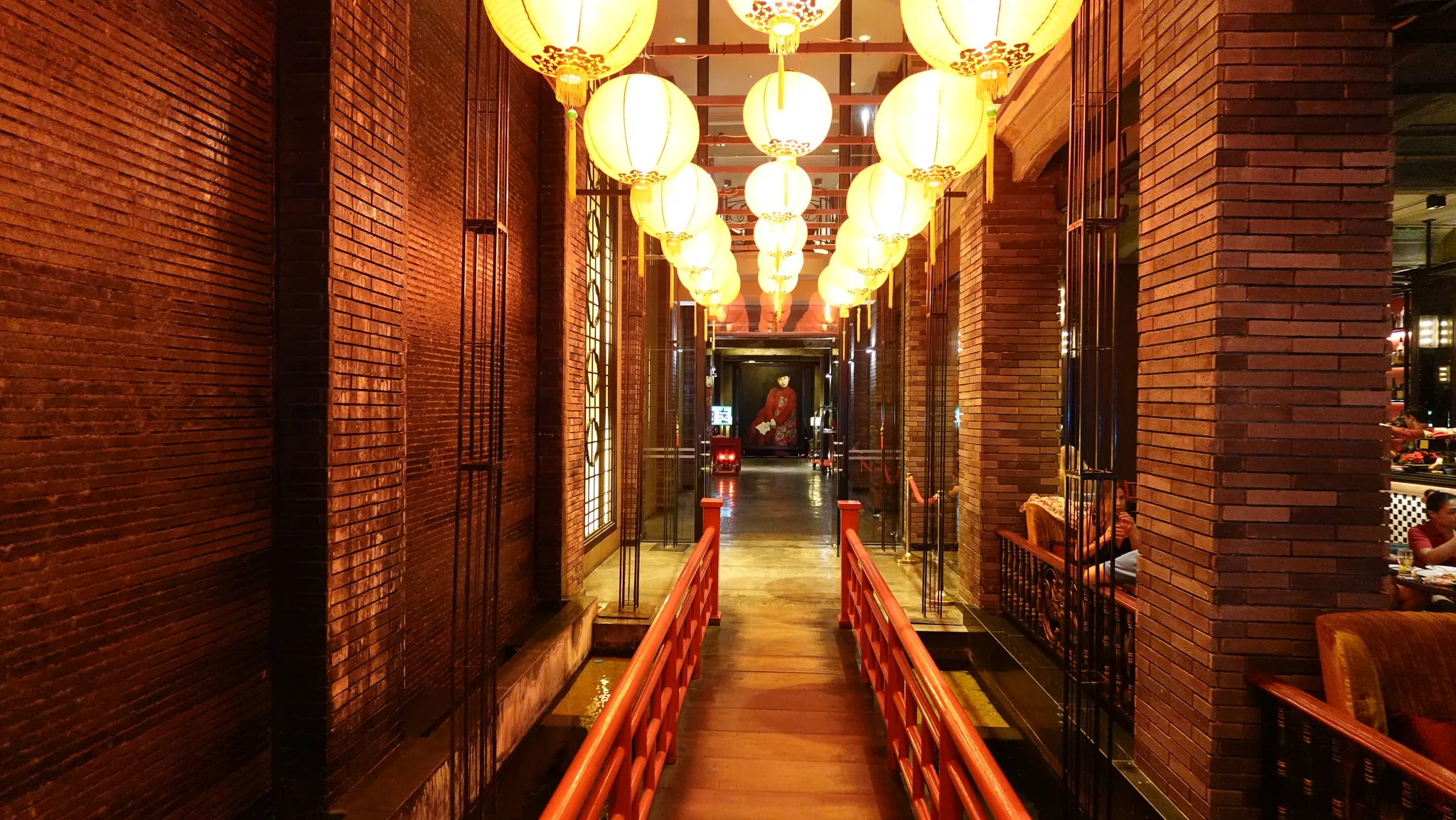
At Chinatown Night Market, a footbridge with red railings crosses a pool between brick pillars, beneath a row of yellow lanterns; on the right, diners sit at tables and a large portrait in red dress stands at the far end.© Eric Monteil 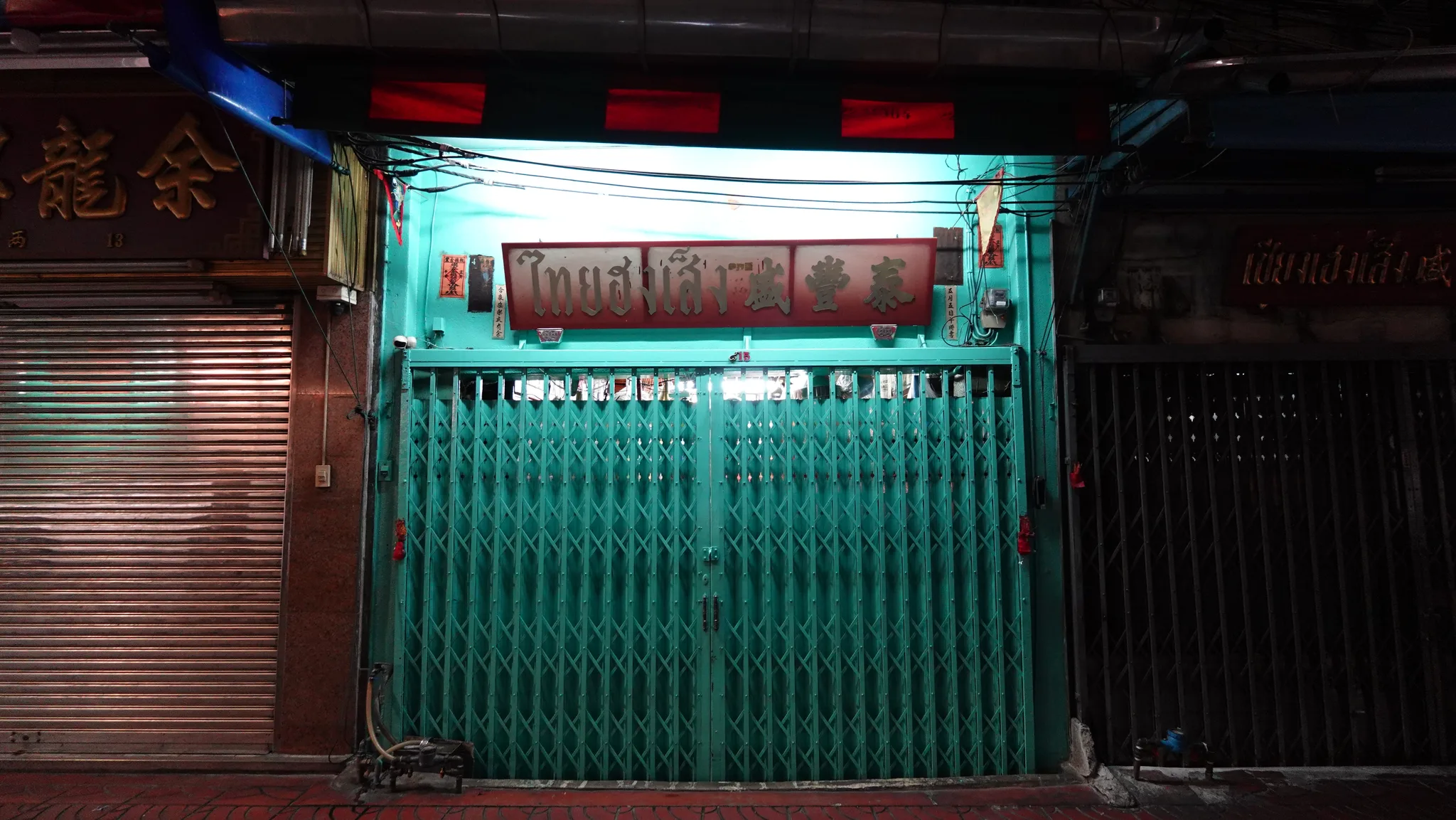
At Chinatown Night Market, a shop closed for the night: a pale green concertina gate, a red sign in Thai and Chinese characters, flanked by the metal shutters of neighbouring businesses.© Eric Monteil