
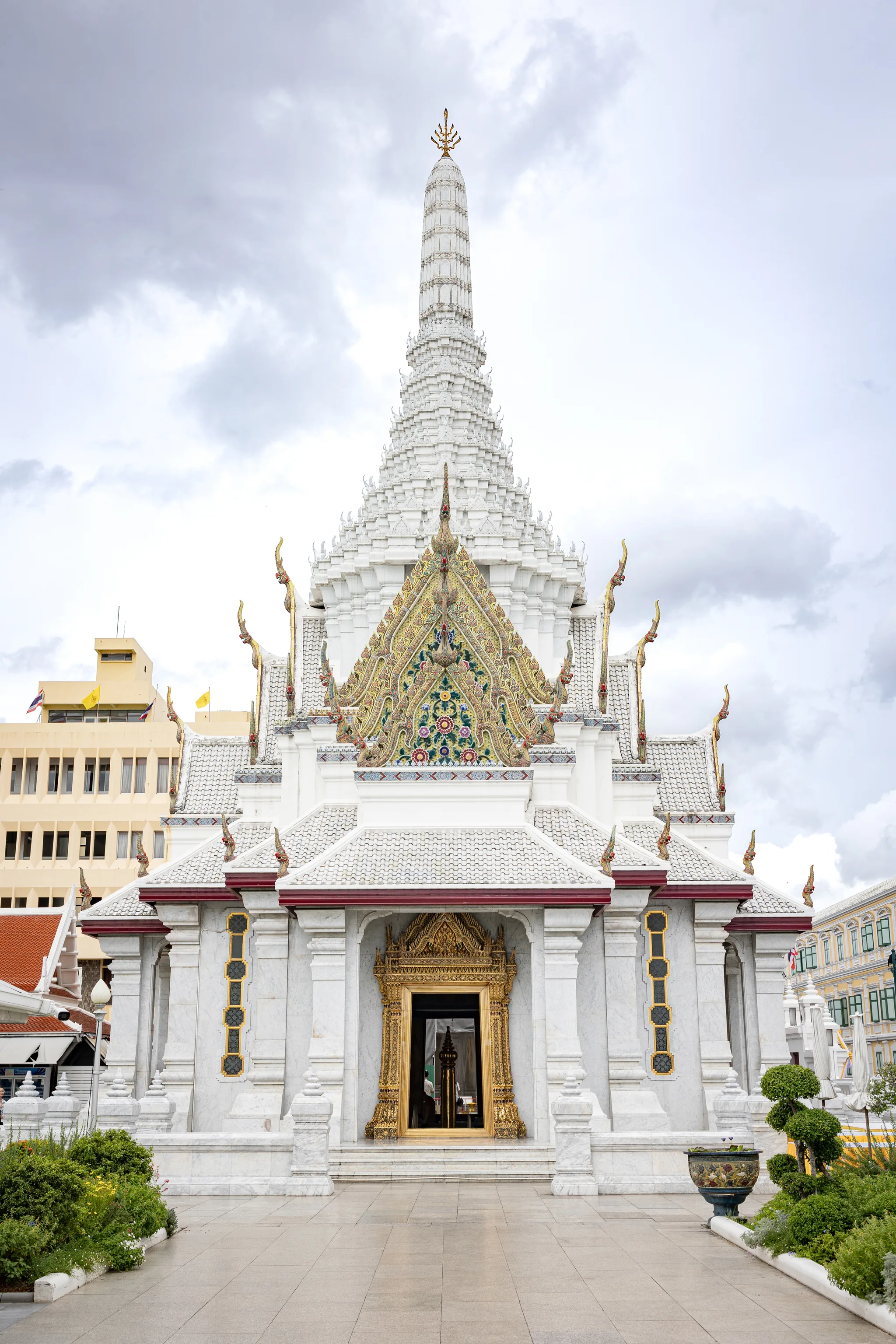
 Le mondop de marbre blanc du Pilier de la ville de Bangkok s’élève en flèche à gradins au-dessus de toits superposés ; son fronton doré à motifs floraux et sa porte encadrée d’or s’ouvrent sur un pilier visible à l’intérieur.Mastertongapollo — Wikimedia Commons, CC BY-SA 4.0
Commemorative monument
Bangkok City Pillar Shrine
Planted in 1782 to found the new capital and later renewed under Mongkut, Bangkok’s pillar, together with its five guardian deities, remains the living spiritual heart of the city.
Heritage family · History, kingdoms and the making of Siam
- Destination
- Bangkok (Phra Nakhon)
- Heritage Family
- History, kingdoms and the making of Siam
- Typology
- Commemorative monument
- Visit
- Available tours →
The Bangkok City Pillar Shrine houses the lak mueang, the foundation pillar of the Thai capital, together with five protective deities of the city. It marks the spot where King Rama I had this pillar raised in 1782, at the founding of Rattanakosin, the new capital. It has since been regarded as the spiritual centre of the city and of the country. Renewed under King Mongkut, who had a new horoscope of the city drawn up, restored for the capital’s bicentenary and registered as a historic monument, it remains a much-frequented place of worship, at the corner of Sanam Luang, opposite the Grand Palace.10
Key facts
- Destination
- Rattanakosin Island
- Heritage Family
- History, kingdoms and the making of Siam
- Typology
- Commemorative monument
- Places
- The Grand Palace of Bangkok
- Sanam Luang
- Phra Nakhon
- Periods
- People
- Bhumibol Adulyadej
- Rama Ier
- Rama IV (Mongkut)
- Communities
- —
- Events
- Registration of the Bangkok City Pillar Shrine as a historic site (1975)
- Erection of the new City Pillar by King Mongkut (1852)
- Founding of Bangkok (1782)
- Restoration of the Bangkok City Pillar Shrine for the Bangkok Bicentennial
- Heritage
- Bangkok Foundation Anniversary Ceremony
- Glossary
- Lak Mueang
- San
- Wat
- Baisri
- Songkran
- Chaiyaphruek
- Keywords
- —
- Date
- —
- Collections
- —
Practical info
Practical information about this site is taken from its Google Maps page. We advise you to check it before visiting.
- Address
- Lak Muang Rd, Khwaeng Phra Borom Maha Ratchawang, Khet Phra Nakhon, Krung Thep Maha Nakhon 10200
- Phone
- Website
The pillar of a new capital
Boundary stone and heart of the city
In Thai, lak mueang means ‘pillar’ or ‘boundary stone of the city’, and san denotes a shrine, a small temple dedicated to spirits or deities. Bangkok’s San Lak Mueang is therefore, first and foremost, the home of a pillar, planted on the spot where the capital was founded and held ever since to be its point of origin. Custom dictates that such a pillar be raised in an auspicious place before a city is founded. The pillar thus does not merely commemorate the founding: it is one of its acts. It is presented as the spiritual centre of Bangkok and, beyond that, of the entire country.2
A second ensemble stands alongside the pillar: a shrine dedicated to five guardian deities of the city. The site thus brings together two forms of protection. On the one hand, a founding object, tied to a precise moment in history. On the other, tutelary figures to whom people pray for the safety and prosperity of the city. This dual nature makes the Bangkok City Pillar Shrine at once a place of memory, bound up with the birth of the capital, and a place of everyday devotion, where people come each day to leave offerings.10
21 April 1782: the founding of Rattanakosin
On Sunday 21 April 1782, King Phra Phutthayotfa Chulalok, known as Rama I, ordered the royal ceremony for the raising of the pillar. This rite accompanied the founding of the new capital, Rattanakosin, which then received the name Krung Rattanakosin In Ayothaya. The ceremony took place in the morning, at a carefully appointed hour. It is on this very moment that the city’s horoscope depends, that is, the astrological chart drawn up for the moment of its founding. The city was thus born at once of a political act, a rite and a reckoning of the stars.10
This date has never left Bangkok’s calendar. Every 21 April, the anniversary of the founding is still celebrated at the shrine. Each year, then, the pillar links the present-day city to the act of its founder.10
At the corner of Sanam Luang
The shrine occupies the south-eastern corner of Sanam Luang, the vast open ground of the old city, opposite the Grand Palace. It neighbours Wat Phra Si Rattana Satsadaram, the Temple of the Emerald Buddha, and lies within the precinct of the Ministry of Defence close by. This location is no accident. The pillar stands in contact with the royal residence, the great Buddhist sanctuary of the palace and an arm of the state administration.2
To the visitor, the shrine therefore appears as one stop among the great monuments of the old city. To the faithful, however, it marks above all the point where the city was founded. It is this position, rather than the scale of its buildings, that gives the place its importance.
From the first pillar to the second
The pillar of Rama I
The pillar raised in 1782 is carved from chaiyaphruek wood, a species of Cassia. Its exterior is clad in a precious wood that Thai calls kaen chan, and it ends in a top shaped like a lotus bud. Like any wooden object, it suffered the wear of time. By the mid-19th century, some seventy years after it was set in place, the original pillar had deteriorated.10
Replacing such an object is no mere matter of maintenance. The pillar is the material embodiment of the capital’s founding. The reigning king therefore chose not to settle for a repair: he remade the pillar and, with it, the city’s horoscope.
Mongkut and the city’s new horoscope
King Mongkut, Rama IV, had a new pillar raised in 1852. He was not simply replacing a worn object. He also decided to remake the city’s horoscope, for the prosperity of his people. The new astrological chart was placed inside the new pillar itself, in its top. By renewing the horoscope, the king repeated the founding act of 1782 and gave the capital a fresh starting point.4
The 1852 pillar is built differently from the first. Its core, the central part that gives it its strength, is of teak. This is clad in plates of chaiyaphruek, the same wood as Rama I’s pillar. The ornate top houses the city’s horoscope, and the whole stands more than five metres tall.3
Two pillars in a single shrine
The king had the old pillar removed from the ground, but he did not have it destroyed. The 1782 pillar was preserved, and the two pillars now stand together in the same shrine. Visitors thus find themselves before two objects side by side. The pillar with the lotus-bud top is the founding pillar; the one with the ornate top is Mongkut’s, which contains the new horoscope.2
Their coexistence reads like a history of the place in miniature. The first recalls the moment of Bangkok’s birth, the second a sovereign’s will to renew that birth.
The guardians of the city
Five protective deities
Beside the pillar stands the shrine of the guardian deities, the San Thepharak. It houses five protective figures of the city: Phra Suea Mueang, Phra Song Mueang, Phra Kan Chai Si, Chao Pho Chetakhup and Chao Pho Ho Klong. These deities have been associated with the shrine since the reign of Rama I.8
Their presence completes the meaning of the pillar. The pillar marks the city’s origin, while the guardians watch over it day by day. The faithful move from one to the others in the course of their visit.
Phra Suea Mueang, a figure in gilded bronze
Among these five deities, Phra Suea Mueang is represented by an image, that is, a statue, in gilded bronze. It depicts a figure standing on an octagonal base, wearing a pointed crown and holding a lotus flower in the right hand. Standing and crowned, the deity appears as a protector keeping watch over the city.11
The gathering of the five guardians in a single place, a few steps from the pillar, makes the shrine a complete ensemble of protection: a point of foundation and a divine guard, set at the centre of the old city.
A shrine in the keeping of the state
From the military to war veterans
In the 20th century, the shrine came under administrative authority. In 1937, the Ministry of Defence became responsible for it. In 1948, in the aftermath of the Second World War, the ministry entrusted its keeping to the War Veterans Organization of Thailand. The organisation assigned its upkeep to a special unit, the City Pillar Shrine Office.10
This arrangement still exists. The City Pillar Shrine Office manages the site, oversees devotion and organises the services offered to the faithful, within the precinct of the Ministry of Defence.10
A historic monument
On 21 May 1975, the Fine Arts Department, the Thai administration responsible for heritage, registered the shrine as a historic site. This recognition added to the religious value of the place without replacing it. The pillar remains an object of worship, but it also became a monument that the state undertakes to protect.10
This protection did not freeze the site. A few years later, the approach of the capital’s bicentenary led to the shrine being restored and embellished.
The bicentenary restoration
In 1982, Bangkok celebrated two hundred years since the founding of Rattanakosin. On this occasion, King Bhumibol Adulyadej, Rama IX, ordered the restoration and embellishment of the Bangkok City Pillar Shrine. Accounts differ: the work either began as early as 1980, in preparation for the jubilee, or took place between 1982 and 1986.2
This work formed part of a wider movement. For the same bicentenary, pillar shrines were created elsewhere in the country. In Ayutthaya, the former capital, a pillar shrine was built for the 1982 celebration and then inaugurated by Rama IX in 1987.13
Stories and readings of the city’s destiny
A prophecy and the Burmese wars
The raising of the pillar is accompanied by a story handed down by tradition. A prophecy is said to have been pronounced at the moment of the founding, and it is said to have been fulfilled in the conflicts with Burma, in particular the Nine Armies’ War of 1785–1786. This conflict broke out barely three years after the founding of the capital. It turns the founding moment into an episode fraught with threat, which collective memory has linked to the pillar.1
This story shows how the pillar is understood. It is seen not merely as a commemorative marker, but as an object bound up with the city’s destiny. The events of its history, and above all its trials, find an explanation in it.
The astrological chart of a capital
This reading of destiny also runs through astrology, which holds a large place in the pillar’s history. The astrologer Theeranan has offered an interpretation of the chart drawn up for the hour at which the pillar was set in place in 1782. He notes an Aries ascendant, that is, the sign rising on the horizon at that instant, and associates it with a ‘very masculine’ city, oriented towards the profession of arms.9
In this reading, the new horoscope of 1852 appears as a successful attempt to alter the capital’s destiny. This is an astrological interpretation, not a historical fact. Yet it sheds light on how Mongkut’s act may be understood today: to remake the horoscope is to act upon the city’s future through ritual.9
A living place of worship
Every 21 April, the anniversary of the founding
Every year, on 21 April, ceremonies are held at the shrine according to Brahmanic tradition. These ceremonies mark the anniversary of Bangkok’s founding, and the state takes part in them. In 2018, for the 236th anniversary, a deputy prime minister presided over the bouang suang, the ceremony of offerings to the deities.5
Thus the founding rite of 1782 lives on in an official celebration. The presence of members of the government gives the ceremony a national dimension, while the offerings recall that the pillar remains, above all, a sacred object.
Offerings and everyday wishes
Outside this date, the shrine lives to the rhythm of daily devotion, widely followed by residents and visitors alike. The City Pillar Shrine Office organises its course. It provides offering tables and baisri, ritual arrangements of offerings, and makes its activities known to the public. The faithful can follow a five-stage devotional route, held to attract good fortune.2
The requests are highly varied. Childless couples come to ask for fertility, other worshippers for prosperity. At Songkran, the Thai New Year, the shrine is one of the places people visit to secure luck for the year. This fervour is part of the vogue for mutelu, the body of good-luck practices that enjoy wide popularity in Thailand today. The founding pillar has thus also become a place for personal wishes.6
Along the paths of the old city
The shrine also holds a place in the discovery of the old city. King Mongkut’s University of Technology Thonburi has made it the starting point of an educational walking route leading to the Giant Swing, Sao Ching Cha. This route links places that represent the power of the state, religion and the life of the people.15
The pillar marks the origin of the capital. The Bangkok City Pillar Shrine, still honoured by the faithful, is also a place where one learns the history of Bangkok.
Understanding
The Bangkok City Pillar Shrine is no ordinary monument: it guards the point from which the capital is held to derive its existence. Two pillars, the founding pillar and Mongkut’s, stand there alongside five guardian deities. Around them, worshippers gather each day to ask for luck, children or prosperity. Its importance lies in this continuity: every 21 April, the city returns to its origin, and the state itself renews the offerings there. Today, the site is at once a protected historic monument, a place of worship managed by a war veterans’ organisation, a stop on the educational routes of the old city and one of the high places of the vogue for mutelu. These uses draw a wide public, but they also lend the pillar more varied, more personal meanings, sometimes far removed from the founding rite. In a metropolis that never stops changing, does the fervour for individual good fortune extend the meaning of the pillar, or is it gradually turning it into something else?
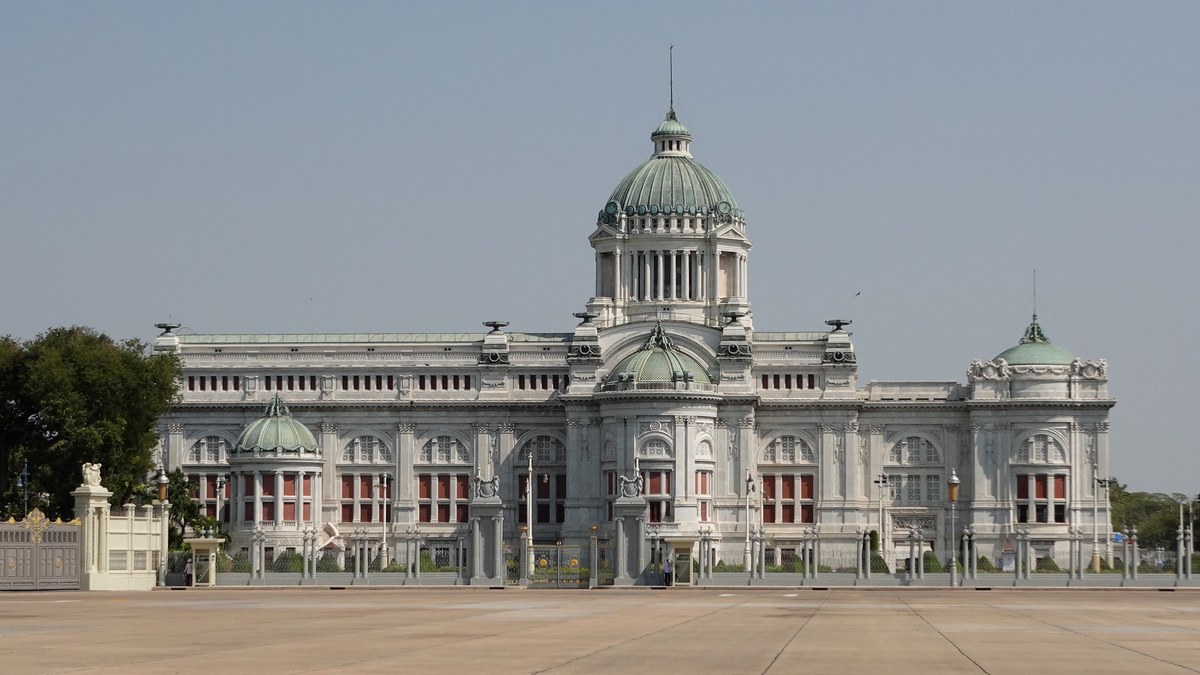
Rattanakosin, from the royal citadel of 1782 to the historic districts that shaped contemporary Bangkok.
- Lak Mueang
- Foundation pillar of a Thai city, erected when the city is founded and regarded as the seat of its guardian spirit; it is housed in a dedicated shrine.
- San
- In Thailand, a small shrine where worship is offered to a deity, a spirit or a protective figure.
- Wat
- Buddhist monastic complex that brings together, within a single enclosure, several religious buildings, monks’ quarters and ancillary buildings; the word does not refer to a single building.
- Baisri
- A Thai ritual arrangement made of folded banana leaves and flowers, used as an offering during ceremonies.
- Songkran
- Traditional Thai New Year, celebrated in mid-April, marked by water-sprinkling rites and merit-making.
- Chaiyaphruek
- Thai name for trees of the genus Cassia, meaning ‘tree of victory’ and regarded as auspicious. Their wood is used for ritual objects.
- Kaen chan
- Thai term for a precious wood, the heartwood of the tree called chan, used to clad or craft prestige objects.
- Mutelu
- The set of good-luck beliefs and practices (wishes, offerings, amulets, divination) widespread in contemporary Thailand.
Studies
- 1Bangkok’s City Pillar Shrine anchors the spiritual heart of the city, The Nation Thailand ↗
- 2In-Depth Guide to Worshipping at Bangkok City Pillar Shrine: 5 Key Spots to Boost Your Fortune for 2026, Thairath English ↗
- 3ชวนกันมาพากันมู(เตลู) - ศาลหลักเมืองกรุงเทพมหานคร, Khaosod ↗
- 4เปิดประวัติ "เสาหลักเมือง" - ไขข้อข้องใจเหตุใดจึงมี 2 ต้น, Spring News ↗
- 5รองนายกฯ ทำพิธีบวงสรวง ครบรอบ 236 ปี วันคล้ายวันสถาปนาองค์พระหลักเมือง, JS100, 2018 ↗
- 6Best Bangkok shrines and sacred sites for Songkran luck, Time Out Bangkok ↗
- 7ประวัติ ศาลหลักเมือง – มหาศรัทธาความนับถือในแผ่นดิน, National Geographic Thailand ↗
- 8เทพารักษ์ 5 องค์ ที่ศาลหลักเมือง คือเทพองค์ใดบ้าง?, Silpa-Mag (ศิลปวัฒนธรรม) ↗
- 9เจาะลึกโหรไทย : เมื่อดวงเมืองชูทหารเริงอำนาจ, The 101 World ↗
Reference works
- 10Office of City Pillar Shrine (สำนักงานกิจการศาลหลักเมือง), History of The City Pillar Shrine / ประวัติศาลหลักเมือง, Bangkok City Pillar Shrine (War Veterans Organization of Thailand) ↗
- 11Office of City Pillar Shrine, ศาลเทพารักษ์ (pages des divinités gardiennes), Bangkok City Pillar Shrine ↗
- 12Office of City Pillar Shrine, ขั้นตอนการสักการะ (How to worship), Bangkok City Pillar Shrine ↗
- 13Lak Mueang - The City Pillar shrine, Ayutthaya Historical Research (ayutthaya-history.com) ↗
- 14Contributeurs Wikipédia, ศาลหลักเมืองกรุงเทพมหานคร, Wikipedia (th) ↗
- 15เดินเท้าท่องเที่ยว ย่านเก่ากรุงเทพฯ ศาลหลักเมือง-วัดราชประดิษฐ์-เสาชิงช้า, Office of General Education, King Mongkut's University of Technology Thonburi ↗
Contemporary views
Bangkok City Pillar Shrine today
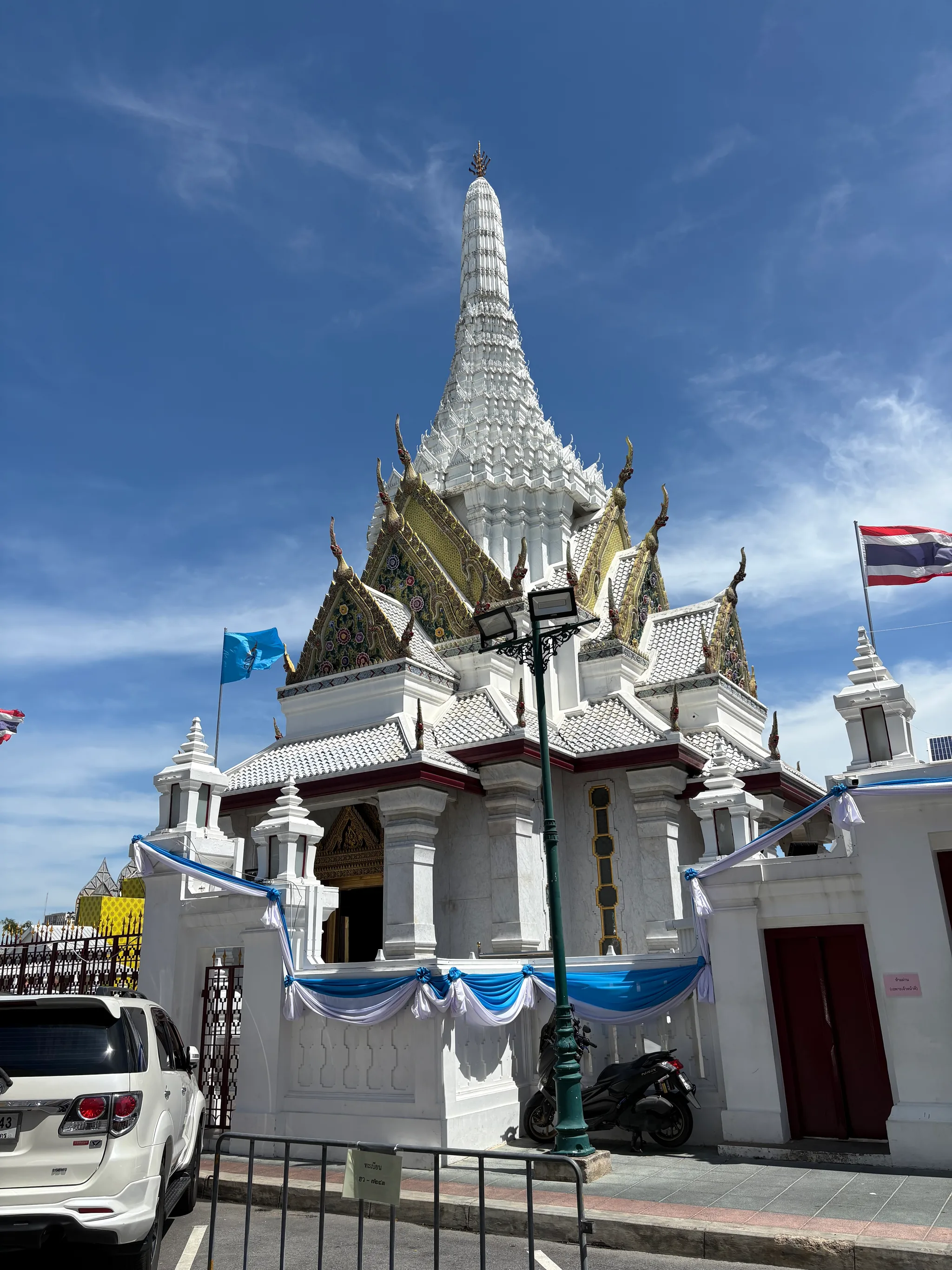
Le Pilier de la ville de Bangkok dresse sa flèche blanche à gradins au-dessus de toits superposés aux pignons dorés ornés de mosaïques ; draperies bleues et blanches et drapeaux décorent l’enceinte.Chainwit. — Wikimedia Commons, CC BY 4.0 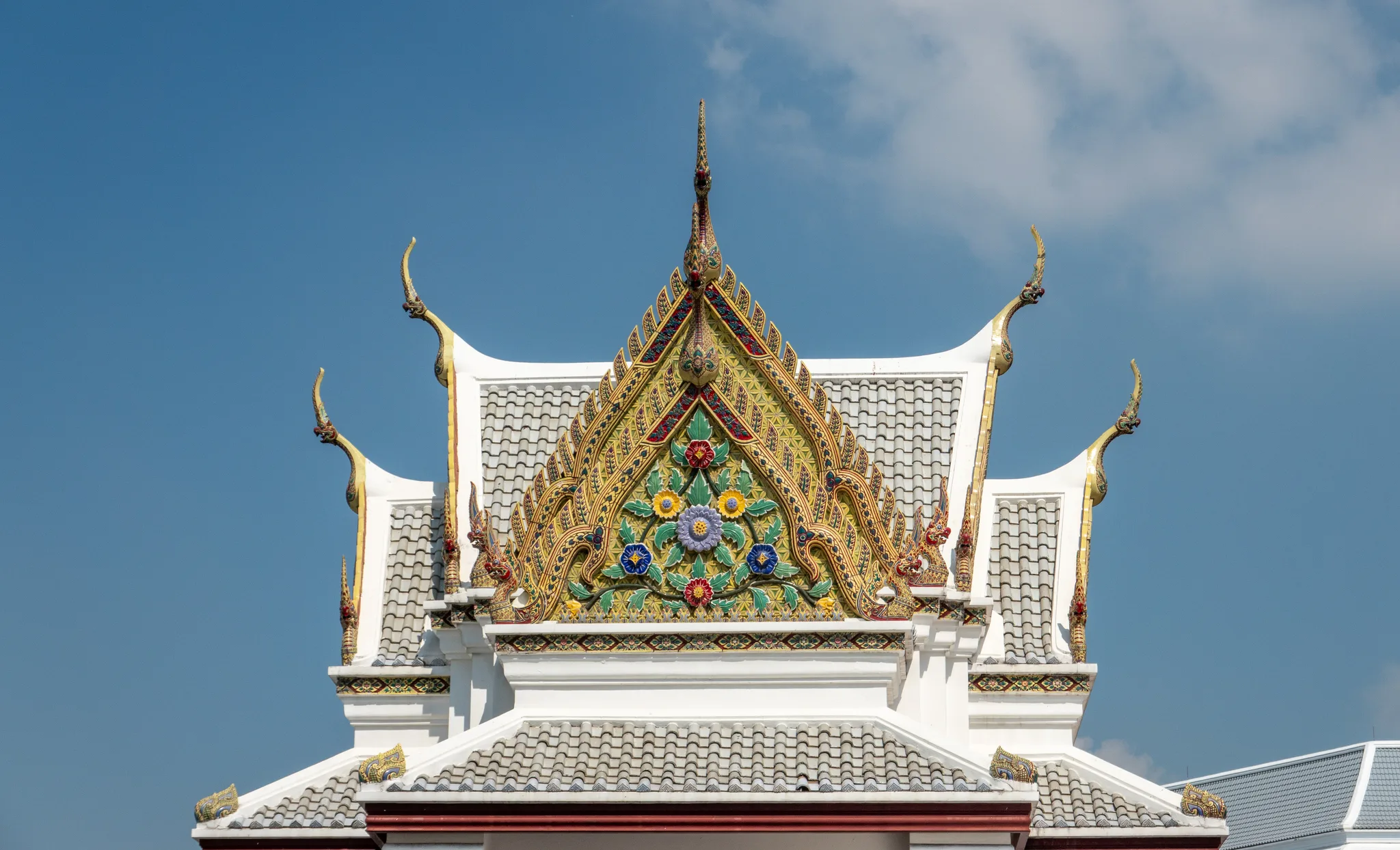
Au Pilier de la ville de Bangkok, le fronton du toit étagé est orné de fleurs en céramique colorée sur fond doré, encadré de nagas et de chofa dorés, au-dessus de tuiles grises et de murs blancs.No(0)GoodNamesLeft — Wikimedia Commons, CC BY-SA 4.0
Architecture and decoration
Explore the heritage
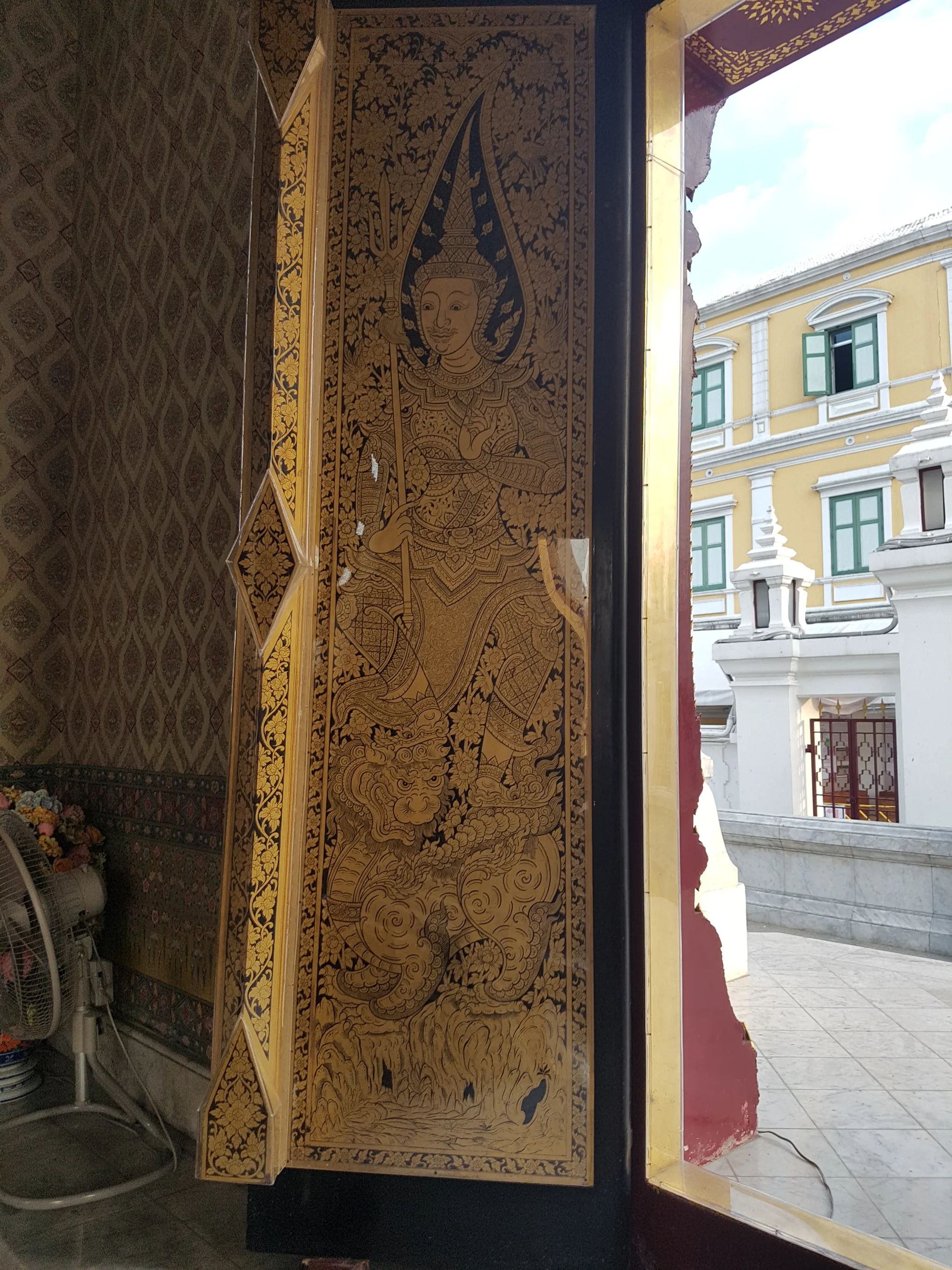
Au Pilier de la ville de Bangkok, un vantail laqué noir et or figure un gardien couronné tenant un trident, debout sur un lion, dans un décor floral ; par la porte ouverte apparaissent la cour dallée et un bâtiment jaune.Iudexvivorum — Wikimedia Commons, CC0 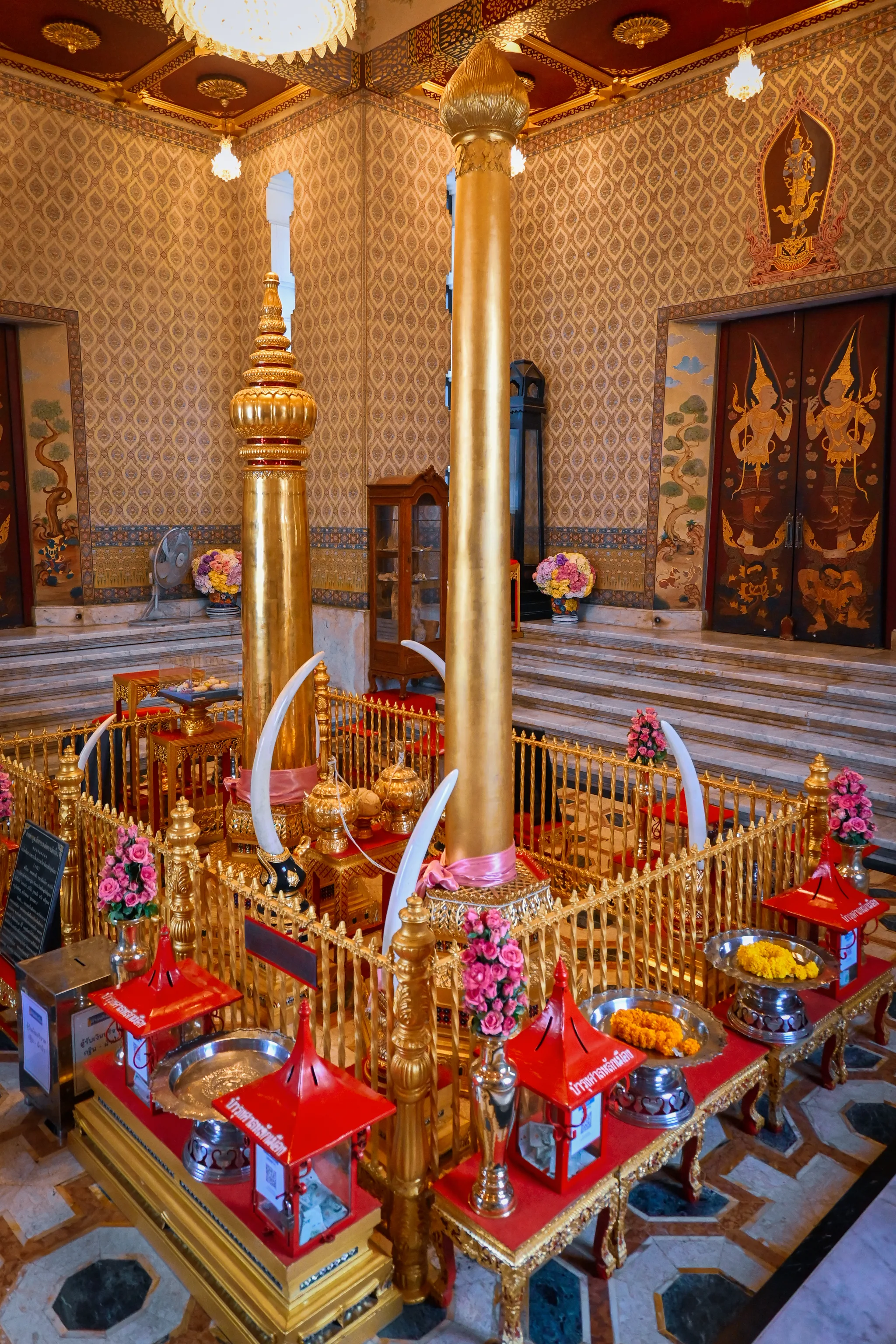
Au centre du Pilier de la ville de Bangkok, deux piliers dorés, l’un coiffé d’un bouton de lotus, se dressent dans un enclos à balustrade dorée garni de défenses blanches, de guirlandes de soucis et de troncs à offrandes rouges.ProtoplasmaKid — Wikimedia Commons, CC BY-SA 4.0