
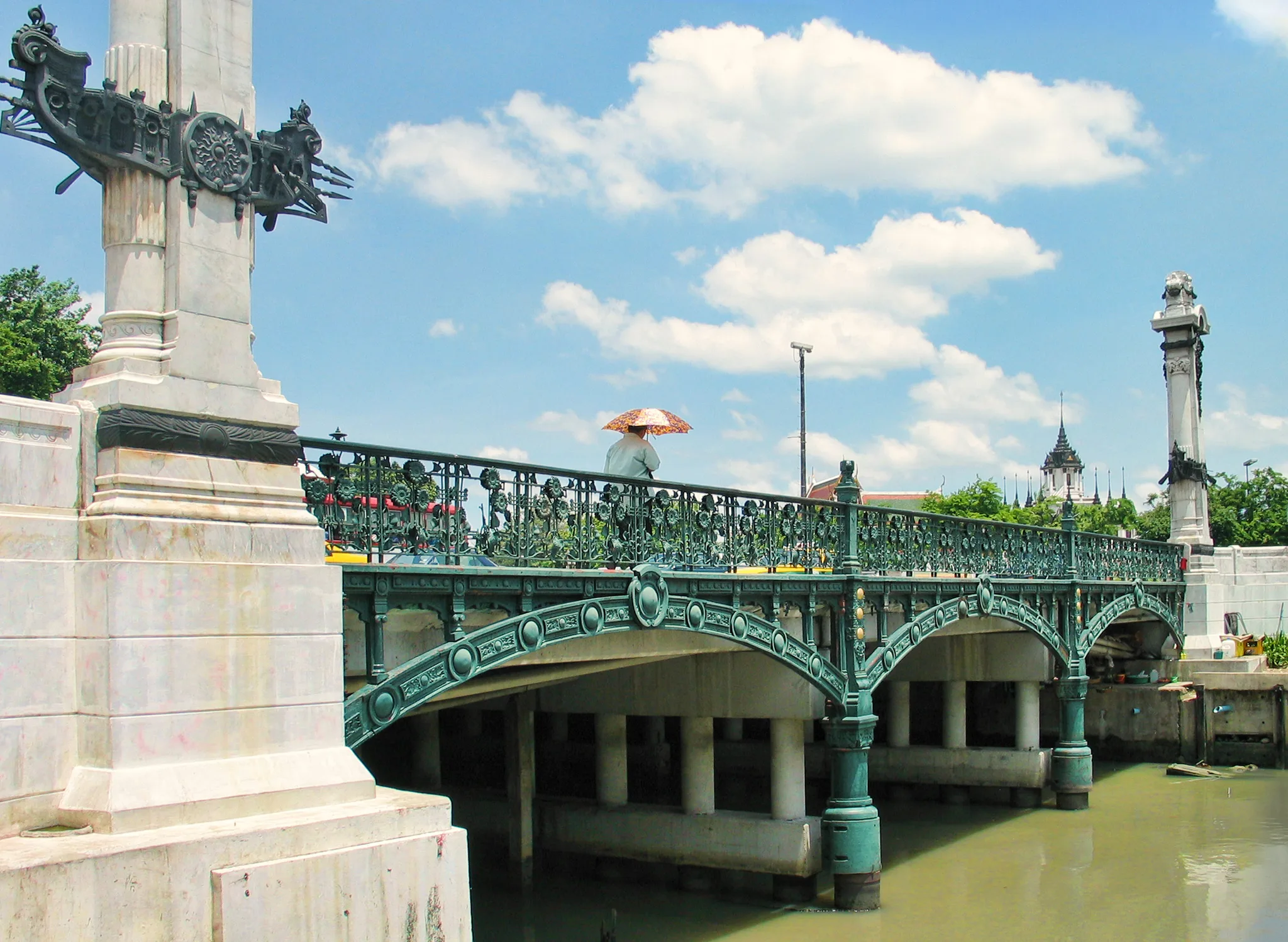
 Phan Fa Lilat Bridge spans a canal on green metal arches with an openwork railing, framed by white stone pillars bearing dark metal ornaments; a pedestrian with a parasol crosses the deck.Hdamm — Wikimedia Commons, CC BY-SA 3.0
State building & infrastructure
Phan Fa Lilat Bridge
Built for Chulalongkorn’s royal avenue and widened at the request of Bhumibol Adulyadej, the Phan Fa Lilat Bridge is an ornate bridge of cast iron and marble, still open to traffic, spanning the moat of Bangkok’s old city.
Heritage family · History, kingdoms and the making of Siam
- Destination
- Bangkok (Phra Nakhon)
- Heritage Family
- History, kingdoms and the making of Siam
- Typology
- State building & infrastructure
- Visit
- Available tours →
The Phan Fa Lilat Bridge carries Ratchadamnoen Avenue, Bangkok’s great ceremonial thoroughfare, over the canal that encircles the old city. King Chulalongkorn had it rebuilt to give the avenue a crossing worthy of its scale, and gave it a name that evokes the passage of the sovereign. It replaced an earlier iron arch bridge and has been widened several times, notably in 1994 at the initiative of King Bhumibol Adulyadej, who insisted that its sculpted forms be preserved. Registered as a historic monument and still used by heavy traffic, it is distinguished by its cast-iron balustrades with sunflower motifs and its marble columns adorned with bronzes.
Key facts
- Destination
- Bangkok
- Heritage Family
- History, kingdoms and the making of Siam
- Typology
- State building & infrastructure
- Places
- Mahakan Fort
- Khlong Ong Ang
- Khlong Rop Krung
- Ratchadamnoen Avenue
- Phan Phiphop Lila Bridge
- Periods
- People
- Bhumibol Adulyadej
- Rama V
- Communities
- —
- Events
- Widening (1994)
- Reconstruction under Rama V
- Heritage
- —
- Glossary
- Khlong
- Wat
- Royal Gazette
- National historic monument
- Rattanakosin period
- Saphan
- Keywords
- —
- Date
- —
- Collections
- —
Practical info
Practical information about this site is taken from its Google Maps page. We advise you to check it before visiting.
- Address
- ถนน ราชดำเนินกลาง Banglamphu QG44+F7P, Khwaeng Bang Khun Phrom, Khet Phra Nakhon, Krung Thep Maha Nakhon 10100
A bridge over the old city’s moat
Crossing Khlong Bang Lamphu
The Phan Fa Lilat Bridge carries Ratchadamnoen Avenue over Khlong Bang Lamphu. In Thai, the word khlong means a canal, and this is no ordinary canal: it forms a section of Khlong Rop Krung, the canal that encircles the old city and traces its outer moat. The waterway changes its name from one stretch to the next, and the section the bridge spans is sometimes called Khlong Ong Ang. Whichever name is used, the bridge stands on the edge of Rattanakosin Island, the historic heart of the capital, bounded by this belt of water.11
To cross the bridge, then, is to leave the old city for the districts beyond its moat. The site also touches on the capital’s former defensive system. At the foot of the bridge stands Mahakan Fort, one of the fourteen forts built during the reign of King Rama I, and one of the two that still survive in Bangkok. Within a few dozen metres, the moat, the fort and the bridge thus make visible two moments in the city’s history: the fortified capital of the late eighteenth century, and then the city of grand avenues laid out in the late nineteenth century.8
A hinge on Ratchadamnoen Avenue
Ratchadamnoen Avenue is the ceremonial axis conceived by King Chulalongkorn, fifth sovereign of the Chakri dynasty, also known as Rama V. Work on cutting it began in 1899. The bridge marks one of its hinges: it separates the central section of the avenue, Ratchadamnoen Klang, from its outer section, Ratchadamnoen Nok. It is here that the avenue turns north, towards the Royal Plaza.11
The structure belongs to a series. It forms a pair with the Phan Phiphop Lila Bridge, which spans the inner section of the avenue, Ratchadamnoen Nai, and these two royally named bridges, together with the Makkhawan Rangsan Bridge, punctuate the whole length of the axis. For anyone travelling along Ratchadamnoen from the old city, the Phan Fa Lilat Bridge is the last of these thresholds before leaving the city walls.12
A name for the king’s passage
It was King Chulalongkorn who named the bridge. Saphan Phan Fa Lilat, in which saphan means ‘bridge’, translates as ‘the bridge where the king passes through the heavens’; more literally, it denotes the bridge over which the ‘Lord of the Sky’ – that is, the sovereign – advances in majesty. The name of the twin bridge, Phan Phiphop Lila, carries the same idea: both evoke the passage, the procession of the king. In everyday usage, people simply say ‘Phan Fa Bridge’.12
These names express the bridge’s original purpose. Before it was a piece of traffic infrastructure, the bridge was part of the setting of a route designed for the passage of the sovereign.
From iron arch to royal bridge
A first iron bridge
Before the present structure, an older bridge already crossed the canal at this point. It was an iron arch bridge, comparable to the Norarat Sathan Bridge at Bang Lamphu, and it was located at the time in relation to Wat Phrom Surin, a nearby Buddhist monastery (wat). Who built it, and when, is unknown, for its construction left no known written record. Its existence shows that the crossing point is older than the avenue: King Chulalongkorn did not create a crossing, but transformed an existing one to suit his urban project.3
King Chulalongkorn’s commission
The cutting of Ratchadamnoen Avenue changed the scale of the site. King Chulalongkorn had the bridge rebuilt so that it would be large and beautiful, worthy of the avenue it was to carry. The new structure received a complete decorative scheme, from the balustrades to the columns marking its ends, and the sovereign named it himself.9
This commission was part of a broad movement. During Chulalongkorn’s reign, nearly one hundred and seventy bridges were built in Bangkok, with a peak between 1888 and 1903. The Phan Fa Lilat Bridge stands out within this body of work for its place on the royal axis and the richness of its decoration. Yet it did not originally have the appearance it has today: it was widened in successive stages.4
A date missing from the archives
The exact year in which the present bridge was built is not known. The works were never announced in the Royal Gazette, the kingdom’s official journal, in which the acts of the Siamese government were published. In the absence of a date of its own, neighbouring structures provide points of reference: the avenue was cut from 1899, the twin Phan Phiphop Lila Bridge was begun in 1902 on the orders of the same king, and the Makkhawan Rangsan Bridge was opened on 1 November 1903.3
The Phan Fa Lilat Bridge belongs to this same campaign of works linked to the royal avenue, though it is impossible to say precisely when it was completed.
Reading the decoration
Cast-iron balustrades and ornamented arches
The bridge’s decoration first reveals itself at pedestrian level. On either side of the carriageway run cast-iron balustrades – iron poured into moulds, a technique that allows openwork motifs to be reproduced in series. Their design incorporates clusters of sunflowers.9
The care taken does not stop at what can be seen from the avenue. Beneath the deck, the arched girders that carry the carriageway are decorated too. This attention to the structure itself answers King Chulalongkorn’s wish for a large and beautiful bridge: the structure is not merely a support for the road, but is meant to be seen from every side.9
The marble columns and their bronzes
At both ends of the bridge stand marble columns. The marble is carved, and applied bronzes organise their decoration from top to bottom. At the top hang festoons and pendants, which Thai tradition calls fueang uba – garlands and clusters of suspended ornaments. The capital takes up the sunflower of the balustrades, linking the columns to the rest of the bridge in a shared vocabulary.9
Halfway up appear figures of old European ships. This is the most unusual detail of the whole: on a bridge whose name celebrates the passage of the king, the eye falls upon vessels from Europe, set at the heart of a decoration of marble and bronze. These columns mark the entrance to and exit from the bridge, making it a clearly defined threshold for passer-by and procession alike.9
Foreign craftsmanship, a Thai accent
The structures of this period in Bangkok were designed almost entirely by foreign craftsmen, who discreetly incorporated elements of Thai art into them. This observation concerns the buildings of the era as a whole rather than this bridge alone, but it sheds light on how its decoration may be read. The sunflowers, festoons and European ships form a repertoire from elsewhere, placed in the service of a royal structure whose name, for its part, belongs wholly to the language of the Siamese court.9
The Phan Fa Lilat Bridge thus bears witness to the way in which the monarchy of Chulalongkorn’s reign appropriated foreign forms and techniques – cast iron, marble and bronze – to build its own settings for royal display.
Widening without erasing
The bridge and the new boulevard
In the twentieth century, the avenue crossing the bridge changed its appearance. In 1939, the transformation of Ratchadamnoen into a boulevard began with the expropriation and demolition of properties lying within forty metres of the avenue, on the stretch between the Phan Phiphop Lila Bridge and the Phan Fa Lilat Bridge.13
The bridge followed suit. Designed for a royal avenue and its processions, it now had to carry growing motor traffic, and it was widened several times. Each widening raised the same question: how to get more cars across a structure whose value lies largely in its design and decoration.3
King Bhumibol Adulyadej’s request
In 1994, King Bhumibol Adulyadej, ninth sovereign of the Chakri dynasty (Rama IX), asked the Bangkok Metropolitan Administration, the authority that governs the capital, to widen the bridge’s carriageway. He himself established a starting fund for the works, financed from his personal purse. His request was not limited to traffic: the king pointed out that the bridge was an artistic and historic heritage asset, already registered as a national historic monument by the Fine Arts Department, the body responsible for the country’s monuments, and he insisted that its sculpted forms be preserved exactly as they were.10
The Bangkok Metropolitan Administration then widened the bridge by seven metres on each side, over a length of about twenty-five metres, and the carriageway increased to thirteen lanes. The bridge crossed today is therefore an old structure enlarged, its forms reproduced at the express request of the sovereign. Roughly a century after King Chulalongkorn’s commission, another king of the same dynasty intervened on the bridge, this time to protect it as much as to adapt it.5
A protected monument on an avenue of gatherings
The bridge is registered as a historic monument by the Fine Arts Department, and its management falls to the Bangkok Metropolitan Administration. It belongs to a group of seventeen old Bangkok bridges, built during the reigns of Rama IV to Rama VI, which are registered as monuments while remaining open to traffic. This dual status is what makes it distinctive: the bridge is protected like a monument, yet it wears like a road.5
Ratchadamnoen Avenue is also a place of gatherings, and the bridge has borne the consequences. After gatherings that had damaged several registered monuments on the avenue, including the Phan Fa Lilat Bridge and its twin, Phan Phiphop Lila, the Fine Arts Department sent officials, engineers, craftsmen and architects to the site, led by its deputy director-general, Khemchat Thepchai, to inspect the affected structures. The episode shows that the protection of the bridge is played out not only in restoration works, but also in the political life of the avenue it carries.7
The bridge in today’s city
At the foot of Mahakan Fort
The Phan Fa Lilat Bridge remains first and foremost a major thoroughfare: its thirteen lanes link the old city to the districts beyond its moat. Yet its immediate surroundings preserve the city’s older layers. Mahakan Fort, at the foot of the bridge, is now surrounded by a public garden.1
The fort site is also a place where people live. The Pom Mahakan community has lived there since the early Rattanakosin era, the period that began with the establishment of the capital at Bangkok in the late eighteenth century. The late-nineteenth-century royal bridge thus stands alongside an older fort and an inhabited neighbourhood whose history goes back to the founding of the city.1
A pier and exhibition venues
The canal spanned by the bridge has not lost all its role in transport. Phan Fa Lilat Pier, at the foot of the structure, is the terminus of the Khlong Saen Saep express boats, a waterway service still in operation. The bridge thus stands at the meeting point of two networks: the canals and the avenues.14
The surroundings of the bridge are also home to recent cultural venues. On Ratchadamnoen Klang, the Rattanakosin Exhibition Hall presents the history of the Rattanakosin era in nine exhibition rooms. Visitors leaving it will find, a few steps away, one of the structures that give substance to that history: a bridge commissioned by one king, named for his passage, and later preserved by another.14
Understanding
The Phan Fa Lilat Bridge is at once a work of engineering and a fragment of Bangkok’s royal staging. King Chulalongkorn wanted it to be worthy of Ratchadamnoen Avenue and named it for the passage of the sovereign; its cast-iron balustrades, marble columns and bronzes speak of a moment when the Siamese monarchy appropriated forms from Europe. Set on the moat of the old city, near Mahakan Fort, it links the old walled city to the districts that have spilled beyond it. Today it carries thirteen lanes, sees the Khlong Saen Saep boats pass at its foot and remains exposed to the gatherings that animate the avenue. The 1994 widening showed that it could be enlarged without abandoning its design. Should the Phan Fa Lilat Bridge remain first and foremost the bridge of royal passage that its name proclaims, or become above all the bridge of everyone who crosses the city?
Rattanakosin, from the royal citadel of 1782 to the historic districts that shaped contemporary Bangkok.
- Khlong
- Canal or waterway, natural or man-made, which long played a major role in transport, irrigation and the organisation of settlements and territories in Thailand.
- Wat
- Buddhist monastic complex that brings together, within a single enclosure, several religious buildings, monks’ quarters and ancillary buildings; the word does not refer to a single building.
- Royal Gazette
- Official journal of the Kingdom of Thailand, in which laws, decrees and official acts are published, including the listing of protected monuments.
- National historic monument
- Legal status granted by the State to a building recognised for its historical value, placing it under the protection of the heritage administration.
- Rattanakosin period
- Period of Thai history that began with the founding of Bangkok as the capital by King Rama I at the end of the eighteenth century. It takes its name from Rattanakosin Island, the heart of the royal city.
- Saphan
- Thai word meaning ‘bridge’, found in the names of many bridges in Thailand.
- Fueang uba
- Thai term for a decorative motif of festoons and pendants, that is, garlands and clusters of hanging ornaments.
Primary sources
Studies
- 3ประวัติสะพานผ่านฟ้า เผย 4 ข้อน่ารู้สะพานเก่าแก่ของกรุงเทพฯ (repris de Silpa Watthanatham, septembre 2541/1998), Silpa Watthanatham (silpa-mag.com), 1998 ↗
- 4Kittipong Pruksachat (กิตติพงษ์ พฤกษชาติ), สะพานในกรุงเทพฯ สมัยรัชกาลที่ 5, Chulalongkorn University ↗
- 5Rom Bunnag (โรม บุนนาค), รู้ยังอยู่ไหนบ้าง! ๑๗ สะพานสวยงามสร้างสมัย ร.๔ ร.๕ ร.๖ ขึ้นทะเบียนเป็นโบราณสถาน ยังใช้อยู่ในปัจจุบัน!!, MGR Online, 2017 ↗
- 6Rom Bunnag (โรม บุนนาค), ๙ สะพานข้ามคลองโอ่งอ่าง บางแห่งสร้างมาแต่สมัย ร.๕!, MGR Online, 2018 ↗
- 7ยกราชดำเนินเป็นโบราณสถานชุมนุมเสียหายผิดกม., Komchadluek ↗
- 8ท่องราชดำเนินชม "3 สะพานคลาสสิก", MGR Online ↗
Reference works
- 9สะพานผ่านฟ้าลีลาศ — ศูนย์ข้อมูลเกาะรัตนโกสินทร์, Bibliothèque de l'Université Silpakorn (Tha Phra), Rattanakosin Island Information Center ↗
- 10โครงการ ขยายผิวจราจรสะพานผ่านฟ้าลีลาศ, Office of the Royal Development Projects Board (RDPB) ↗
- 11Phan Fa Lilat Bridge, Wikipedia (en) ↗
- 12Phan Phiphop Lila Bridge, Wikipedia (en) ↗
- 13Ratchadamnoen Avenue, Wikipedia (en) ↗
- 14Rattanakosin Exhibition Hall, Museum Thailand ↗
Contemporary views
Phan Fa Lilat Bridge today
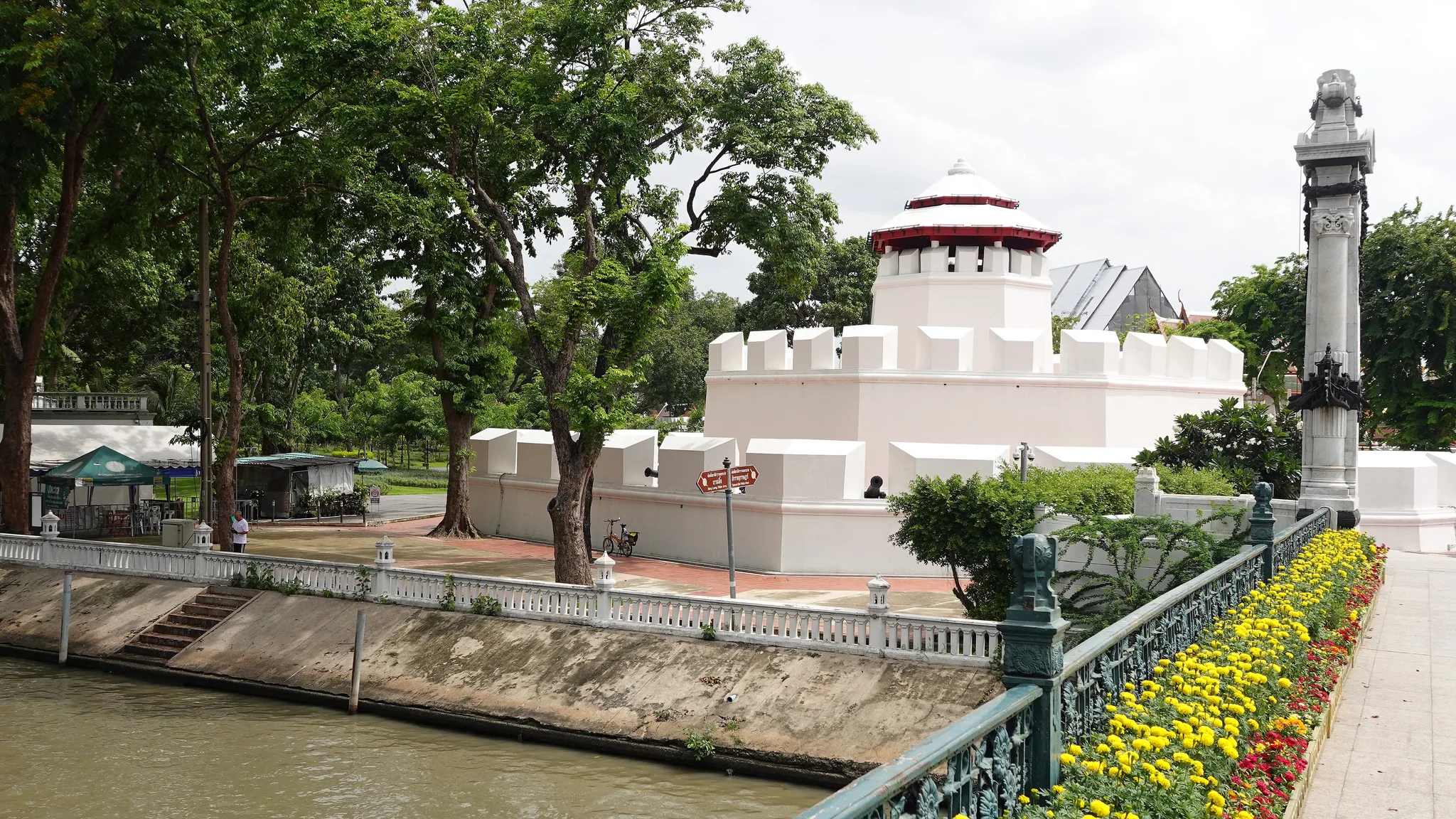
Phan Fa Lilat Bridge, with its green-painted wrought-iron railing, flower boxes and tall ornamental column, spans the canal opposite Mahakan Fort, a white crenellated bastion surrounded by trees.© Eric Monteil 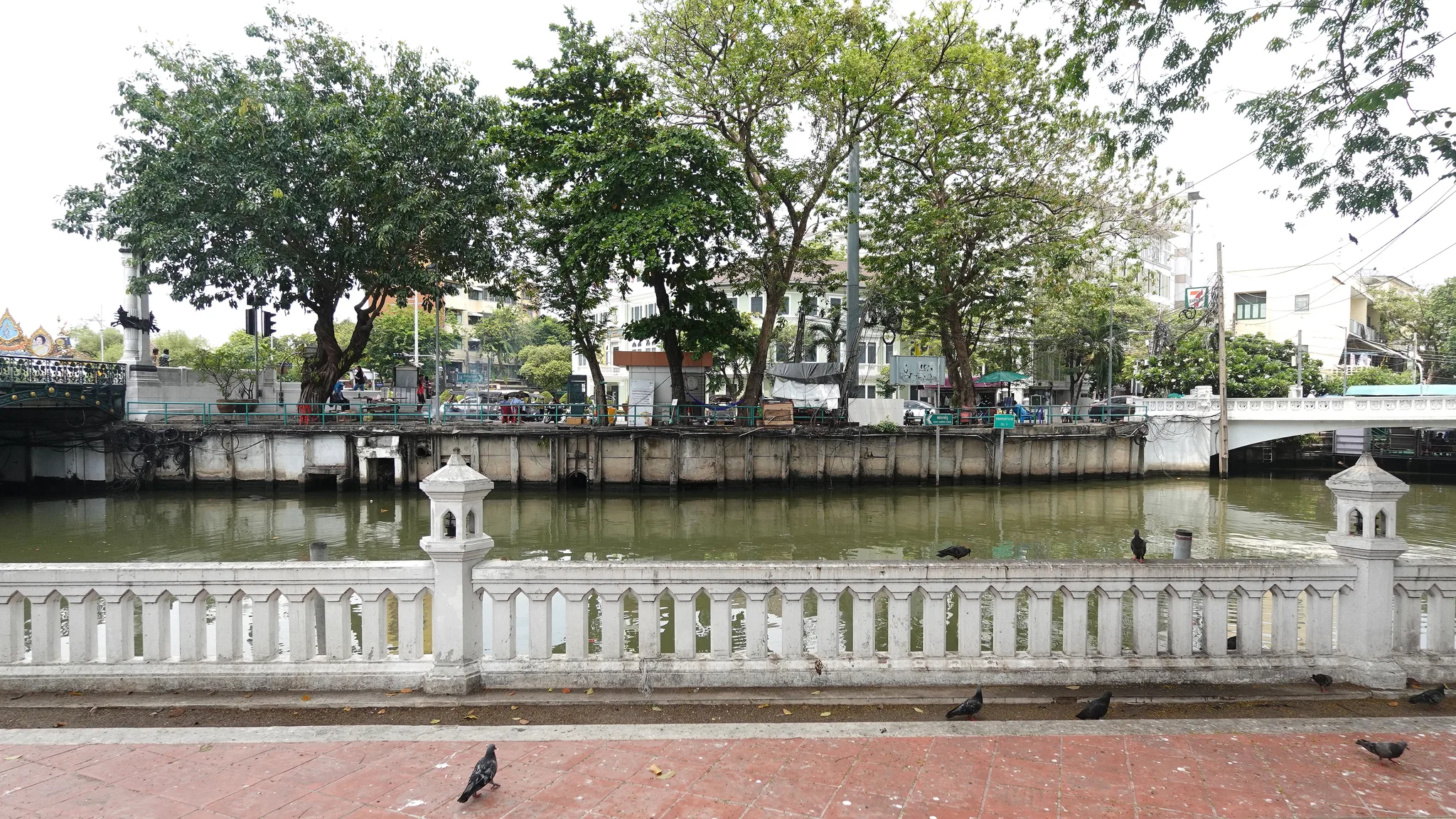
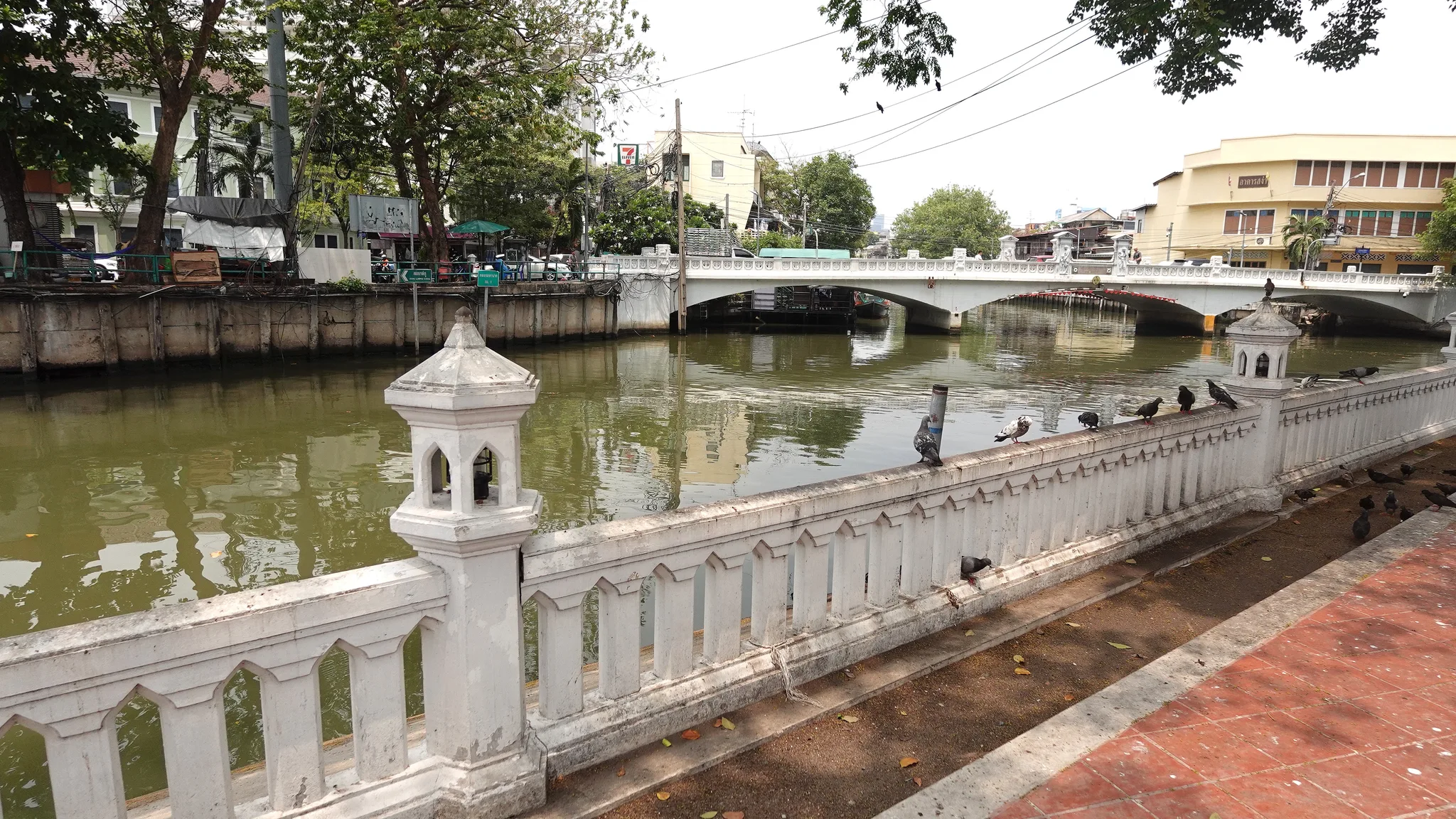
Near the Phan Fa Lilat Bridge, a tiled pavement and a white balustrade with pillars run along the canal; on the opposite bank, trees, a concrete quay and buildings line the water, crossed on the right by a bridge with a white balustrade.© Eric Monteil
Architecture and decoration
Explore the heritage
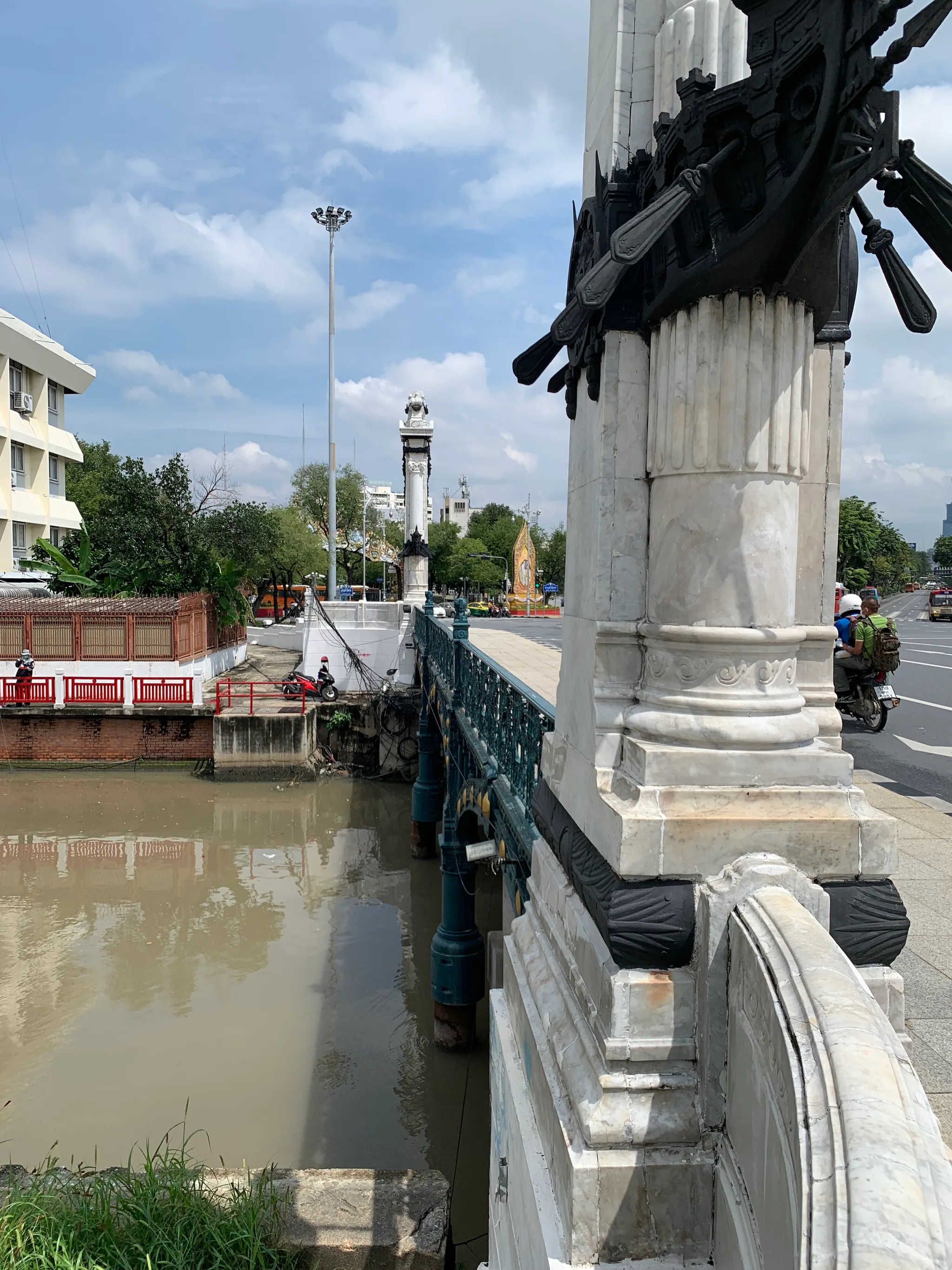
In the foreground, a fluted white marble pillar of Phan Fa Lilat Bridge, crowned with dark metal ornament; beyond, the dark green cast-iron railing runs along the canal to the opposite pillar, beside a busy avenue.Chainwit. — Wikimedia Commons, CC BY 4.0 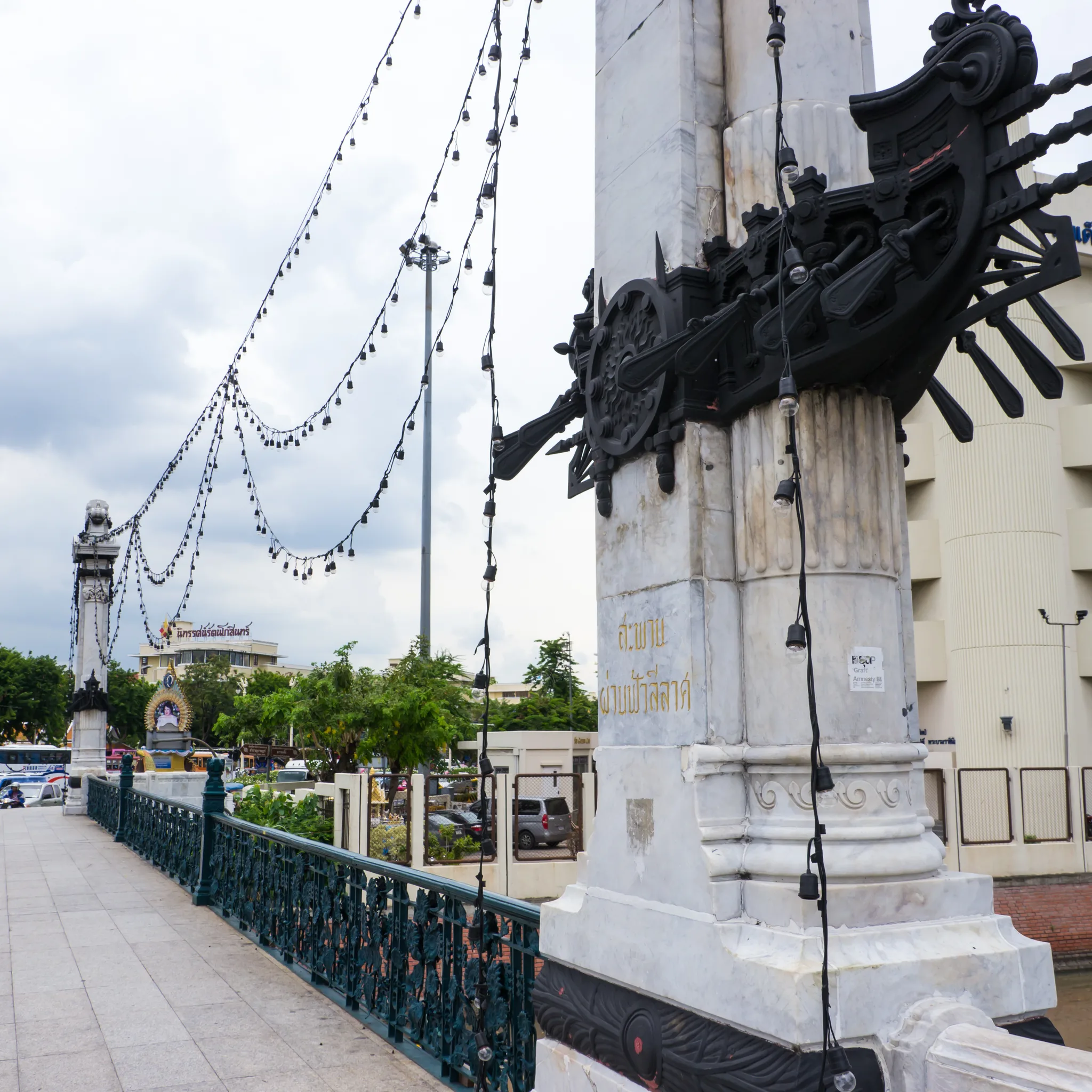
On Phan Fa Lilat Bridge, a white marble pillar bearing the bridge’s name in gilded Thai lettering is topped by a black metal ornament shaped like an oared boat; an openwork railing and strings of light bulbs line the pavement.CKasa — Wikimedia Commons, CC BY-SA 3.0