
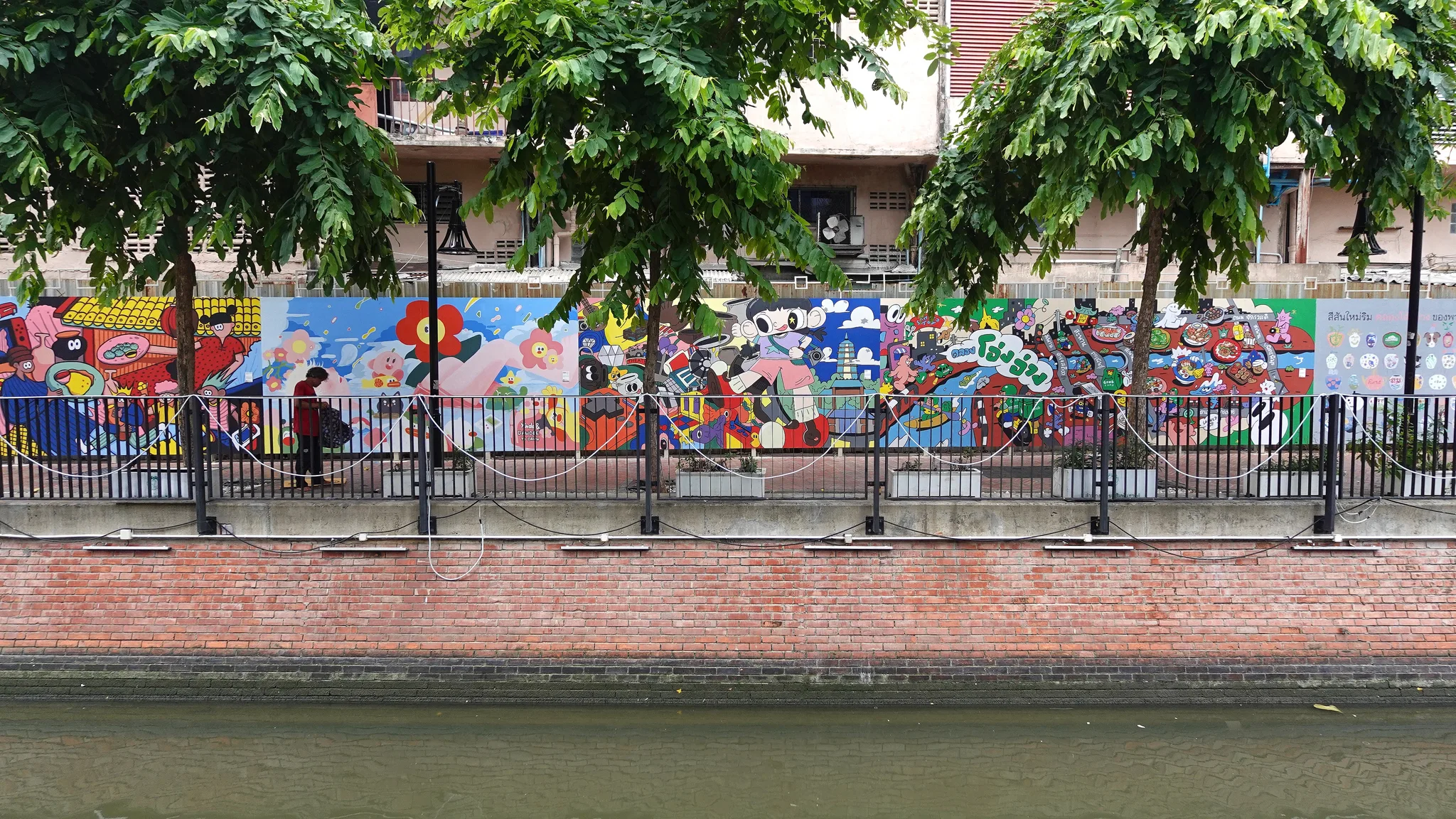
 Khlong Ong Ang Street Art: a continuous mural of brightly coloured figures and motifs runs along the canal promenade, lined with trees, railings and planters, above the brick embankment.© Eric Monteil
Public art & street art
Khlong Ong Ang Street Art
On the banks of a moat dug in 1783 and long buried beneath a market, murals painted since 2020 tell the story of Bangkok’s old town and its communities.
Heritage family · Arts, aesthetics and creation
- Destination
- Bangkok (Samphanthawong)
- Heritage Family
- Arts, aesthetics and creation
- Typology
- Public art & street art
- Visit
- Available tours →
Khlong Ong Ang Street Art refers to the body of murals and street-art works that, since 2020, have covered the façades and walls lining both banks of khlong Ong Ang, in the heart of Bangkok’s old town. It grew out of the redevelopment of the canal by the Bangkok Metropolitan Administration, which brought back to light a waterway long hidden beneath a market, and this transformation was recognised with a UN-Habitat award. Painted on the banks of a moat dug at the founding of the capital, amid Indian, Chinese and Thai neighbourhoods, it tells the story of the place and of those who live there. An open-air gallery, it gains new walls with each passing festival.15
Key facts
- Destination
- Bangkok
- Heritage Family
- Arts, aesthetics and creation
- Typology
- Public art & street art
- Places
- Alex Face Mural Art
- Khlong Ong Ang
- Khlong Rop Krung
- Phra Nakhon
- Samphanthawong
- Periods
- People
- Rama Ier
- Communities
- —
- Events
- Asian Townscape Award 2020 for Khlong Ong Ang
- Digging of Khlong Rop Krung (1783)
- Poed Ko Rattanakosin Festival 2024
- Ong Ang Water & Colour Festival 2024
- Khlong Ong Ang redevelopment
- Heritage
- —
- Glossary
- Khlong
- Wat
- Rattanakosin period
- Loy Krathong
- Krathong
- National historic monument
- Keywords
- —
- Date
- —
- Collections
- —
Practical info
Practical information about this site is taken from its Google Maps page. We advise you to check it before visiting.
- Address
- PGW3+7F6, Samphanthawong, Bangkok 10100
A moat of the royal capital
Rama I’s second moat
The history of Khlong Ong Ang Street Art begins long before the first murals, with the canal that serves as their setting. In 1783, during the reign of Rama I, khlong Rop Krung was dug — khlong is the Thai word for a canal — as the city’s second moat. Some three and a half kilometres long, about twenty metres wide and two and a half metres deep, it traces an arc that leaves the Chao Phraya in the north, at Bang Lamphu, and rejoins the same river in the south, a little upstream of Wat Chakkrawat.28
The canal did not bear a single name. It changed from one stretch to the next: khlong Bang Lamphu in the north, khlong Saphan Han, khlong Wat Choeng Len and finally, for the last section running down to the river, khlong Ong Ang. It was on the banks of this final stretch, among merchant houses and old bridges, that painters came to work more than two centuries later.13
Jars, basins and official names
The name Ong Ang preserves the memory of a trade. It combines two Thai words, ong, the jar, and ang, the basin, and recalls the trade in earthenware jars, basins, pots and pottery carried on here by Mon and Chinese merchants. These vessels came from workshops set up in other quarters of the city or arrived from China from the beginning of the Rattanakosin era, the period that opened with the founding of Bangkok as capital.13
The names were later fixed by the state. The 1941 Canal Preservation Act divided the waterway in two and reserved the name khlong Ong Ang for the section extending towards Wat Bophit Phimuk. On 7 December 1982, to mark the capital’s bicentenary, the Council of Ministers adopted the official name khlong Rop Krung for the whole course, from Bang Lamphu to Ong Ang. The canal has also been registered along its entire length as a national historic monument by the Fine Arts Department. Common usage, for its part, has kept other landmarks: Saphan Lek, the “iron bridge”, the everyday name of the Damrong Sathit Bridge, and Saphan Han, which refers to another bridge and the area around it.14
Between two districts and three neighbourhoods
Today khlong Ong Ang forms the administrative boundary between two of Bangkok’s districts, Phra Nakhon and Samphanthawong. This position as a border explains why it is attributed sometimes to one, sometimes to the other, when in reality it belongs to both banks. It runs through an old commercial quarter whose identity rests on the closeness of different communities.12
Along its banks meet Phahurat, the neighbourhood of the Indian community, Sampheng, that of the Chinese community, and Sam Yot. This proximity is no mere backdrop: it supplies the murals with much of their subject matter. When the artists painted the canal walls, it was the daily life of this neighbourhood and the mingling of its Thai, Chinese and Indian communities that they chose to make visible.19
A canal hidden beneath a market
Saphan Lek Market
For decades, khlong Ong Ang all but vanished from the city. Saphan Lek Market had spread out over it, and its stalls, known for toys, video games and cameras, covered the canal entirely between the Phanu Phan Bridge, at the end of Yaowarat Road, and the end of Charoen Krung Road. Several hundred shops were crammed in there. The area was run-down and densely built up, even though the banks still retained a great many houses more than a century old.17
Residents still remember that time. Chananaya Singhto, a fruit seller who has been trading on the canal bank for some thirty years, recalls that household waste water was discharged into it untreated and that the stallholders’ tarpaulins and parasols made it impossible to see the opposite bank.3
Giving the canal back to the city
In the late 2010s, the Bangkok Metropolitan Administration set about clearing the canal and redeveloping its banks. By 2018 the structures that had covered it were already gone, and khlong Ong Ang hosted the Loy Krathong festival, during which small floating offerings, the krathong, are set upon the water. The landscaping was completed in early 2019, and the transformation became most visible in 2020.18
The works concerned the water as much as the banks. The water was cleaned up, the banks were lined with concrete and the historic bridges restored. On both banks, lit, brick-paved walkways were laid out, together with a few gardens, and the municipal department installed new manhole covers for the old town. Accounts differ as to the length of the Ong Ang stretch: about 750 metres, 1.5 kilometres or 1.826 kilometres. It was along these newly cleared walls, long invisible behind the stalls, that the street art would emerge.21
The birth of an open-air gallery
Painting walls to open a street
In October 2020, Thai street artists painted the walls lining the canal. Their work had a specific purpose: to publicise the new pedestrian street, whose opening was announced for the evening of Loy Krathong, 30 October. The murals were thus painted to herald the opening of the pedestrian street.24
The site opened to the public in the autumn of 2020. By March 2021, five months after its transformation into a street-art venue and weekend night market, visitors were coming in large numbers. Khlong Ong Ang Street Art is therefore inseparable from the redevelopment from which it sprang.3
Telling the neighbourhood’s story on its façades
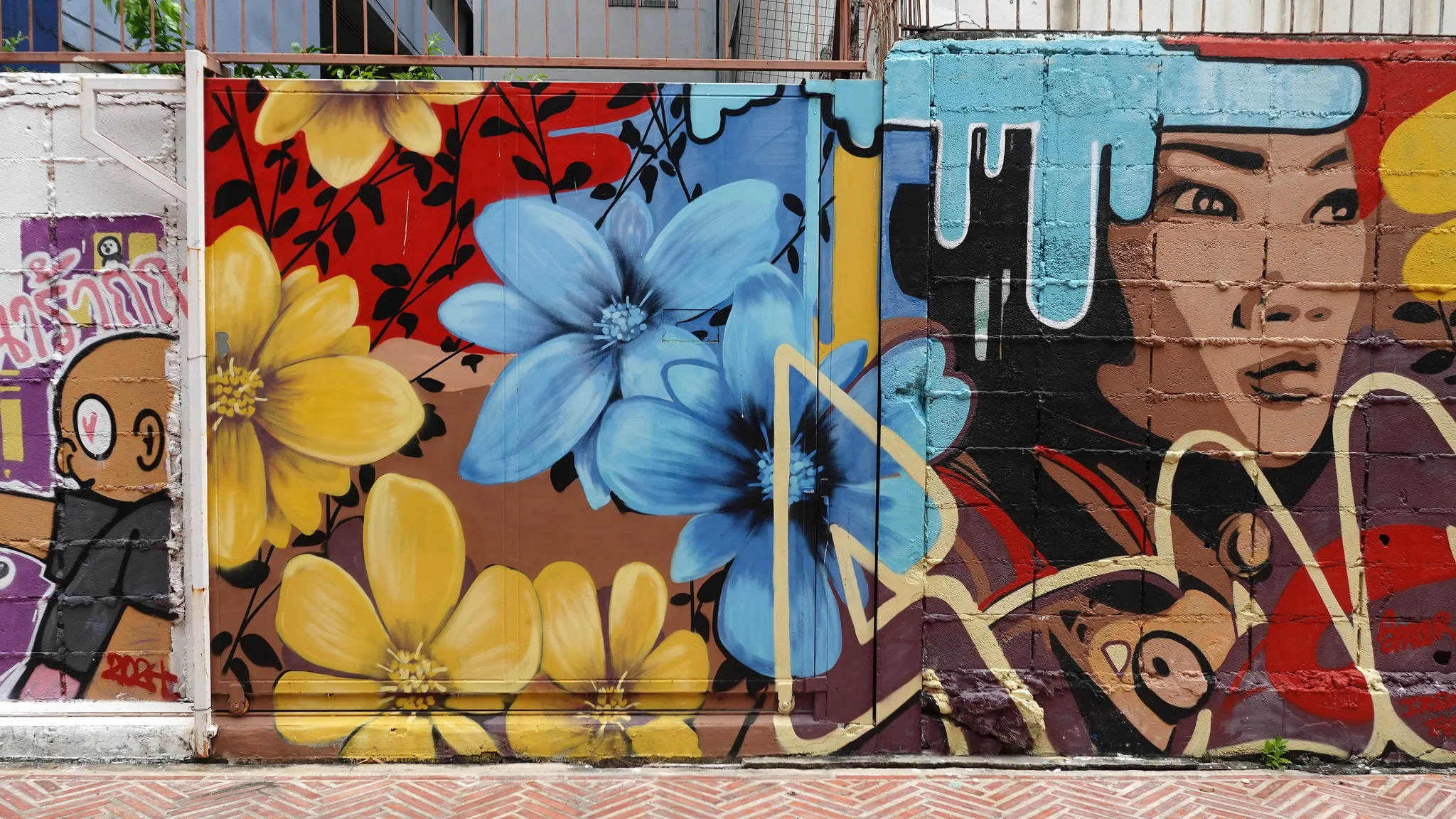
The murals cover the walls of both banks. They return readily to the old life of Bangkok along the water and to the history of the waterside communities. Each artist keeps their own style, yet the whole reads as an illustrated chronicle of the neighbourhood, which strollers discover as they walk from one bridge to the next.15
The same spirit can be found in the neighbouring lanes. Near Saphan Han, on the Phahurat side, a lane has been repainted with figures from the community: an Indian dancer, a lion dancer, an Indian cloth merchant, a Muslim woman. This project, linked to Diwali, the Hindu festival of lights, and supported by the paint manufacturer Nippon Paint, showcases the community’s diversity.26
Art at ground level
The canal’s art is not confined to the walls. At five spots around khlong Ong Ang, manhole covers have been decorated with motifs representing the identity of the neighbourhood’s communities. One of them, at the Saphan Lek bridge, bears the word sawasdee, “hello”, greeting visitors.11
New manhole covers were created for the old town during the redevelopment. Visitors who come on weekdays, when the market is not set up, can thus follow a discreet trail, their eyes now on the façades, now on the paving.23
Recognition and its repercussions
The UN-Habitat award
In mid-March 2021, the redevelopment of khlong Ong Ang received the Asian Townscape Award 2020, in the category of landscape improvement projects, conferred by the UN-Habitat Regional Office for Asia and the Pacific in Fukuoka. The canal was one of six places in Asia honoured that year, alongside projects from Japan, South Korea, China, Nepal and Malaysia. The jury cited the improvement of the landscape, but also the place given to art and culture, safety and the residents’ quality of life.1
The Governor of Bangkok, Police General Aswin Kwanmuang, announced the news himself on his Facebook page, and the Prime Minister, General Prayut Chan-o-cha, sent his congratulations to the Bangkok Metropolitan Administration. More precisely, it was the Bangkok Metropolitan Administration’s City Planning and Urban Development Department, which carried out the project, that received the award.1
A model for other canals
The government at once presented khlong Ong Ang as an example for other places to follow. The Bangkok Metropolitan Administration undertook the same approach on several of the capital’s canals, among them khlong Bangkok Yai, khlong Phadung Krung Kasem, khlong Khu Mueang Doem, khlong Lat Phrao and khlong Chong Nonsi.2
The canal of jars and basins thus became a point of reference.
Reservations about the canal’s new face
The transformation was not received without debate. Before the award was presented, some felt that cosplay, graffiti and kayaking had nothing to do with the neighbourhood’s way of life. The UN-Habitat accolade largely silenced these doubts.23
Yet the question they raised remains at the heart of the site. The murals were conceived to tell the story of the neighbourhood’s long-standing communities; at the same time, they draw a new public, who come to photograph them, stroll or paddle. The gentrification of the neighbourhood may sever Khlong Ong Ang Street Art from its bond with the community.
A living gallery
Weekends by the water
Accessible at all times, Khlong Ong Ang Street Art takes on a different face every weekend. From Friday to Sunday, from late afternoon into the evening, the banks become a pedestrian street and a night market: music, food and craft stalls, kayak hire for paddling along the canal between the murals. Cosplayers are welcome.1
The Covid-19 pandemic brought this life to a halt. On 15 October 2021, the pedestrian street reopened, but with shortened hours, from 3 pm to 8 pm, to comply with the curfew then in force; kayaking and photographing the murals resumed at the same time.25
A backdrop for the city’s festivals
Since at least 2018, khlong Ong Ang has hosted Loy Krathong, and the festival is now held there against the backdrop of the murals. In 2024, the Governor of Bangkok, Chadchart Sittipunt, described it as one of the first places to have hosted Loy Krathong, together with local traders, with the aim of reviving the local economy.9
The canal also hosts Songkran, the Thai New Year. From 13 to 15 April 2024, the festivities there combined visits to the murals, discovery of the neighbourhood’s multicultural history, kayaking and the morning offering of food to monks. Street art thus takes its place in the calendar of the major Thai festivals, which bring the painted walls a constantly renewed public.5
New walls, new voices
The ensemble is not fixed. In 2024, the Poed Ko Rattanakosin art festival, on the theme “Phra Nakhon On Ong Ang: Han Na Khao Khlong”, added six murals along the second phase of the redevelopment, in the Sam Yot area. These works, in an accessible contemporary style, together tell the story of the banks and remained in place after the festival. One of them depicts the iron bridge, the Damrong Sathit Bridge, and recalls that Prince Damrong Rajanubhab’s first palace stood on this spot, and not only at Wang Woradit, on Lan Luang Road.6
From 13 to 15 November 2024, during Loy Krathong, the Ong Ang Water & Colour Festival, opened by Chadchart Sittipunt, added a 120-metre wall on which artists interpret the history of the canal. An installation there projects onto a large wall krathong drawn by more than twenty Thai artists, while others create portraits on the spot. The organisers stress that many talented artists lack places to show their work and that the canal is open to them free of charge. These successive additions regularly renew the whole of the banks of khlong Ong Ang.8
Understanding
Khlong Ong Ang Street Art is not a single work but a landscape: murals, decorated manhole covers, repainted lanes, a promenade and the festivals that bring it to life. It owes its existence to a canal dug at the founding of the capital, then forgotten beneath a market, which the city brought back to light. Its significance lies in this connection: the paintings tell the story of the Indian, Chinese and Thai communities that made their living from these banks, at the very moment when the banks are changing in use. The site now thrives on renewal, with new walls added festival after festival and a model taken up on other canals in Bangkok. Yet this success has given rise to reservations: some have seen in the kayaks, the cosplay and the graffiti a staging alien to the life of the neighbourhood. Between the memory of local residents and the appeal to visitors, the murals carry an identity that they are also helping to transform. Is telling a neighbourhood’s story on its walls enough to preserve its soul, or will these images become the only memory of a canal whose inhabitants will have changed?
Through Bangkok's creative districts, between street art, architecture, design and new uses of the city.
- Khlong
- Canal or waterway, natural or man-made, which long played a major role in transport, irrigation and the organisation of settlements and territories in Thailand.
- Wat
- Buddhist monastic complex that brings together, within a single enclosure, several religious buildings, monks’ quarters and ancillary buildings; the word does not refer to a single building.
- Rattanakosin period
- Period of Thai history that began with the founding of Bangkok as the capital by King Rama I at the end of the eighteenth century. It takes its name from Rattanakosin Island, the heart of the royal city.
- Loy Krathong
- Thai festival held at the full moon of the twelfth lunar month, usually in November, when small floating offerings are placed on the water.
- Krathong
- A small floating offering traditionally made of folded banana leaves and decorated with flowers, candles and incense sticks, which is placed on the water, notably during the Loy Krathong festival.
- National historic monument
- Legal status granted by the State to a building recognised for its historical value, placing it under the protection of the heritage administration.
- Songkran
- Traditional Thai New Year, celebrated in mid-April, marked by water-sprinkling rites and merit-making.
- Mon
- A people of mainland Southeast Asia, settled notably in Burma and Thailand, speaking a Mon-Khmer language, whose culture has shaped the history and Buddhism of the region.
- Sawasdee
- A Thai greeting, used to say both hello and goodbye.
Studies
- 1Bangkok canal wins Asian landscape improvement award, The Nation Thailand, 2021 ↗
- 2More Bangkok canals being spruced up to improve people's quality of life, The Nation Thailand, 2021 ↗
- 3Visitors flock to Klong Ong Ang, Bangkok Post, 2021 ↗
- 4Bangkok wins UN-Habitat award for canal renovation project, Pattaya Mail, 2021 ↗
- 5สงกรานต์ คลองโอ่งอ่าง เลาะเลียบคลอง ชมสตรีทอาร์ต ประวัติศาสตร์พหุวัฒนธรรม, Bangkok Biz News (กรุงเทพธุรกิจ), 2024 ↗
- 66 พิกัดสตรีทอาร์ตชุดใหม่ริมคลองโอ่งอ่าง เฟส2 เปิดประวัติสามยอด, Bangkok Biz News (กรุงเทพธุรกิจ), 2024 ↗
- 7มองเมืองเลียบเลาะ 'ริมคลองโอ่งอ่าง' ย้อนย่านผ่านภาพ 'ศิลปะบนผนังตึก', Daily News (เดลินิวส์), 2024 ↗
- 8โหมโรงเทศกาลลอยกระทง 67 คลองโอ่งอ่างคึกคัก ชูอัตลักษณ์ย่าน มัดรวม 2 งาน อัดแน่นอาร์ตสตรีท, Voice TV, 2024 ↗
- 9สวพ.FM91, "ผู้ว่าฯ ชัชชาติ" เปิดงาน เทศกาลลอยกระทง 67 คลองโอ่งอ่าง, LINE Today, 2024 ↗
- 10"กระทงลอยฟ้า" สร้างคลองโอ่งอ่างคึกคักกระตุ้นเศรษฐกิจชุมชนวันลอยกระทง, The Thai Press, 2024 ↗
- 11หนีความคึกคักช่วงสุดสัปดาห์ไปเดินชมฝาท่อ-สตรีทอาร์ตคลองโอ่งอ่างในวันธรรมดา, BLT Bangkok, 2021 ↗
- 12คลองโอ่งอ่าง จะไปต่อ (อี)ท่าไหน…, The Active – Thai PBS, 2022 ↗
- 13คลองโอ่งอ่าง แลนด์มาร์กลอยกระทง, ศิลปวัฒนธรรม (Silpa Wattanatham), 2023 ↗
- 14เปิดตำนานคลองโอ่งอ่าง ก่อนเปลี่ยนโฉมหน้า!, MGR Online, 2018 ↗
- 15เนรมิต "คลองโอ่งอ่าง" โฉมใหม่ ชมภาพสตรีทอาร์ตสุดไฉไลกลางกรุง, MGR Online, 2020 ↗
- 16ปลุกตำนาน 230 ปี 'คลองโอ่งอ่าง' ภาพจำครั้งใหม่ในฐานะแหล่งท่องเที่ยว, Isranews, 2021 ↗
- 17พลิกโฉม "คลองโอ่งอ่าง" แลนด์มาร์คร่วมสมัย, Komchadluek, 2021 ↗
- 18ปลุกชีวิตเวนิสตะวันออก การกลับมาของ คลองโอ่งอ่าง และย่านสะพานหัน, Sarakadee Lite, 2020 ↗
- 19คลองโอ่งอ่าง จากคลองเก่าสู่ย่านศิลปะกลางกรุง, The Cloud (readthecloud.co) ↗
Reference works
- 20TAT Newsroom, Bangkok won 2020 Asian Townscape Awards for Klong Ong Ang renovation project, Tourism Authority of Thailand, 2021 ↗
- 21TAT Newsroom, Award-winning Khlong Ong Ang Walking Street isn't your average walking street, Tourism Authority of Thailand, 2021 ↗
- 22Khlong Ong Ang Canal: New Landmark of Bangkok, Public Relations Department (Thailand), 2021 ↗
- 23The changing nature of Klong Ong Ang, Thailand NOW, 2022 ↗
- 24'คลองโอ่งอ่าง' โฉมใหม่! กับผลงานภาพวาด Street Art พร้อมเปิดตัว 30 ต.ค.นี้, Chillpainai, 2020 ↗
- 25คลองโอ่งอ่าง กลับมาเปิดแล้ว! ถนนคนเดิน พายเรือคายัค ถ่ายภาพสตรีทอาร์ท เริ่ม 15 ต.ค. 64, Chillpainai, 2021 ↗
- 26มาชมการระเบิดสีสันกับงานสตรีทอาร์ตใหม่ล่าสุด เพิ่มชีวิตย่านพาหุรัด-คลองโอ่งอ่าง กับเทศกาล Diwali, Art of TH ↗
- 27Khlong Ong Ang, Wikipedia (en) ↗
- 28คลองโอ่งอ่าง, วิกิพีเดีย (th) ↗
Contemporary views
Khlong Ong Ang Street Art today
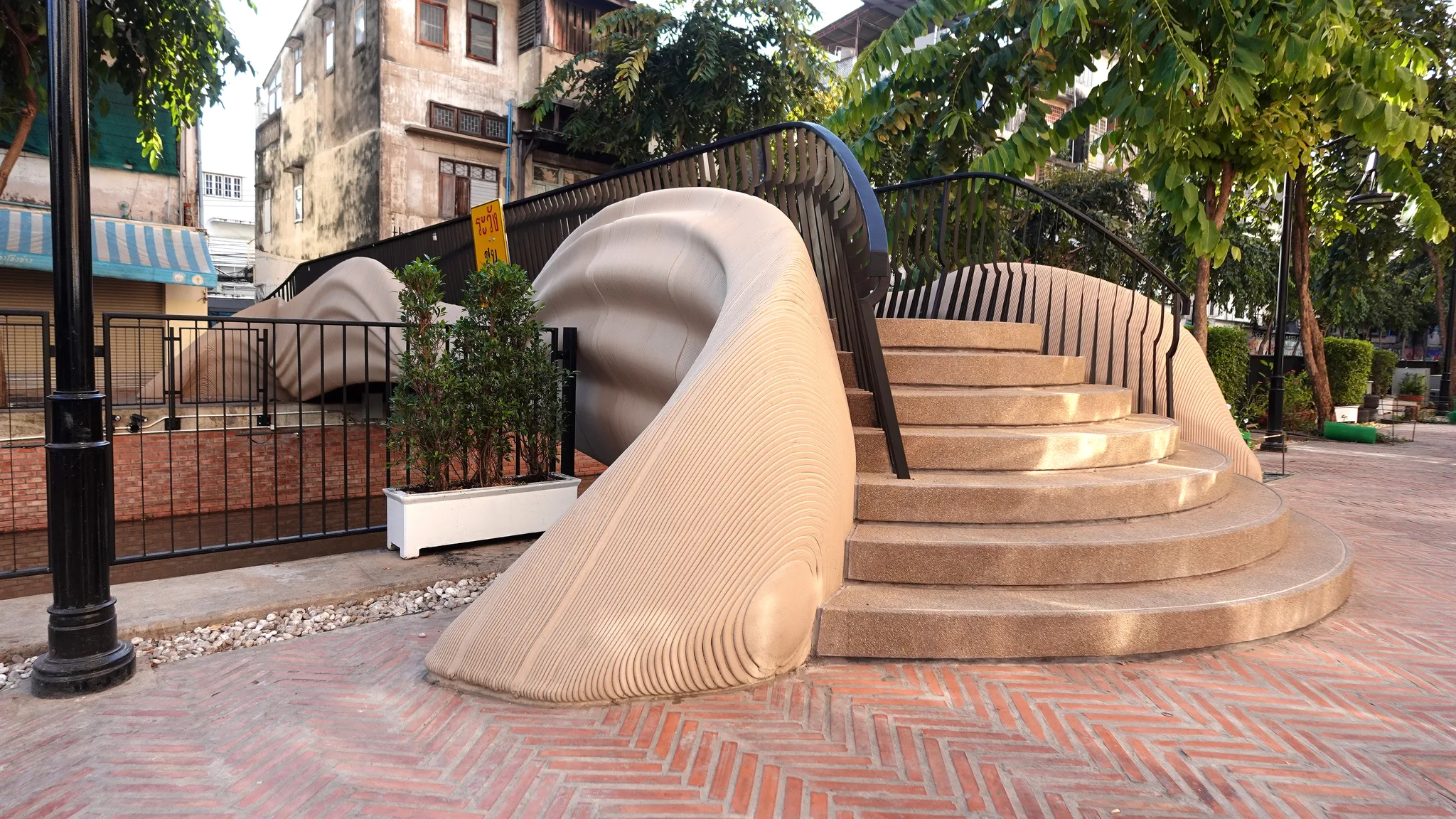
At Khlong Ong Ang Street Art, a footbridge crosses the canal: its parapets, sculpted in undulating layers, frame a rounded terrazzo staircase, set amid herringbone brick paving, metal railings, trees and old façades.© Eric Monteil 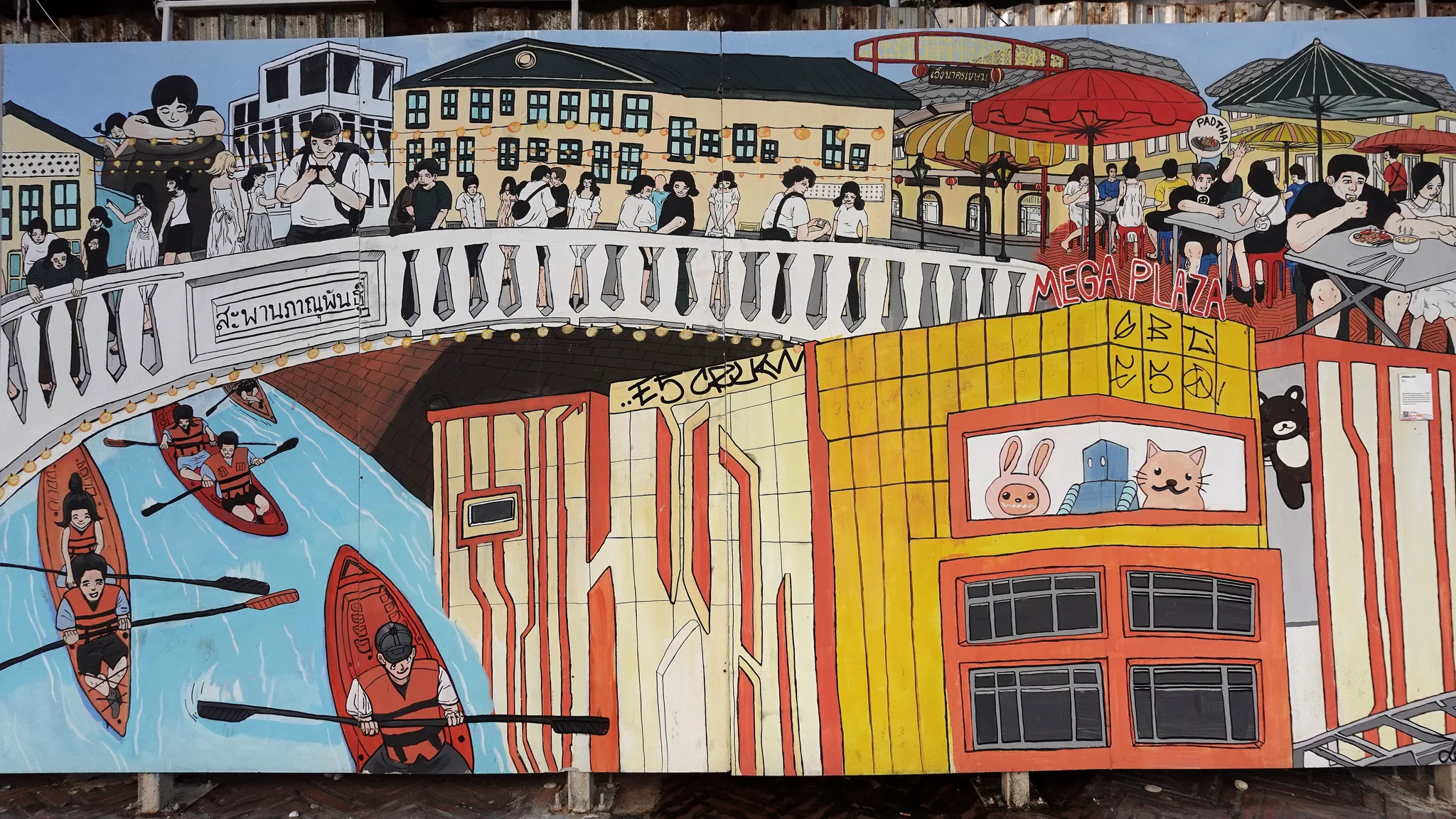
Painted on panels, this mural of Khlong Ong Ang Street Art depicts the lively neighbourhood: kayakers in orange life jackets on the canal, strollers on a balustraded bridge, terraces under red parasols and a ‘Mega Plaza’ sign.© Eric Monteil
Architecture and decoration
Explore the heritage
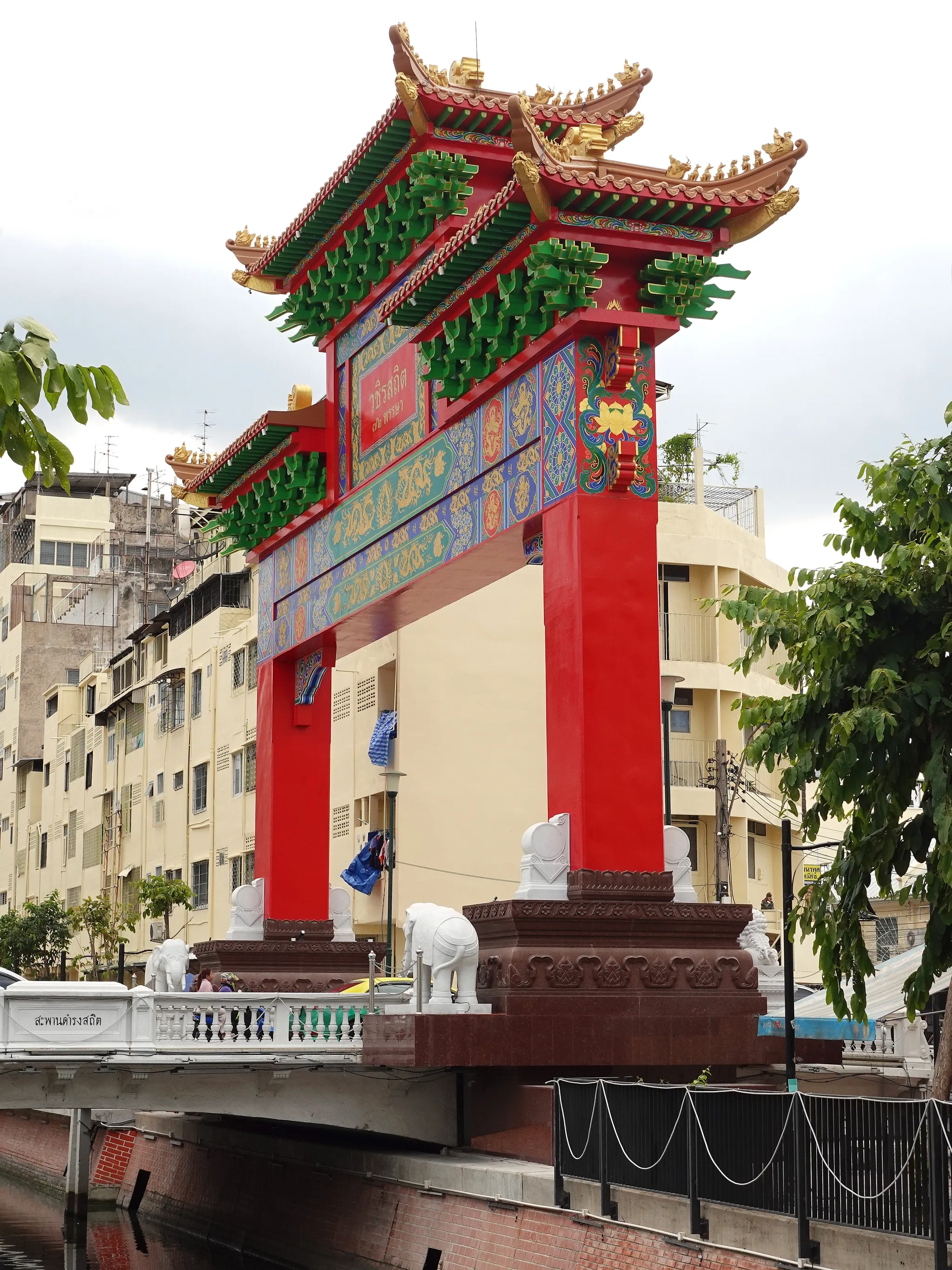
Near Khlong Ong Ang Street Art, a monumental Chinese-style gate, with red pillars, green brackets and painted friezes, rises above the canal beside a white bridge guarded by carved elephants.© Eric Monteil 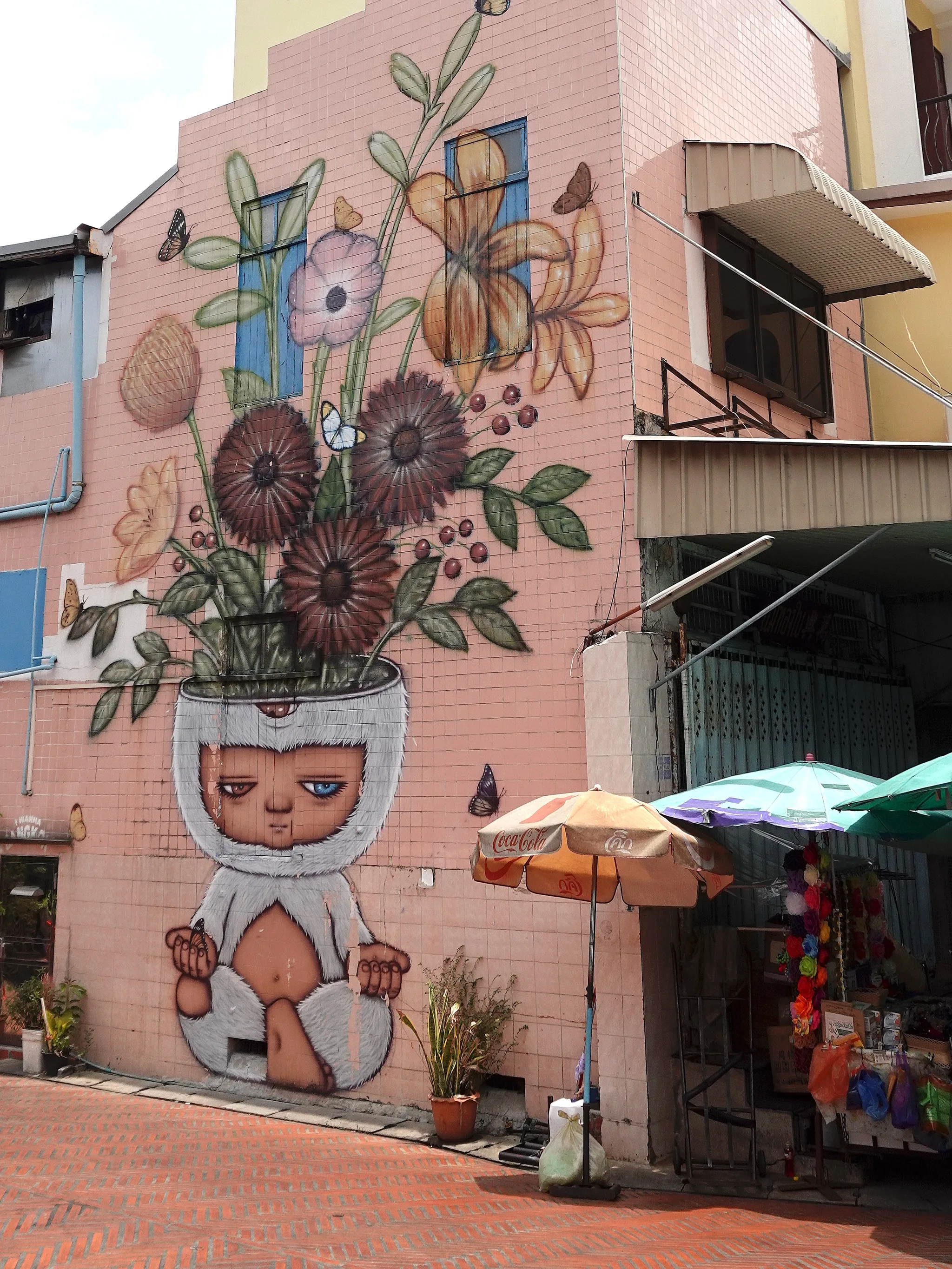
Khlong Ong Ang Street Art: on the pink tiled gable of a building, a mural shows a child with odd-coloured eyes dressed in fur, its head bearing a bouquet of flowers and butterflies, above brick paving and a stall.© Eric Monteil