
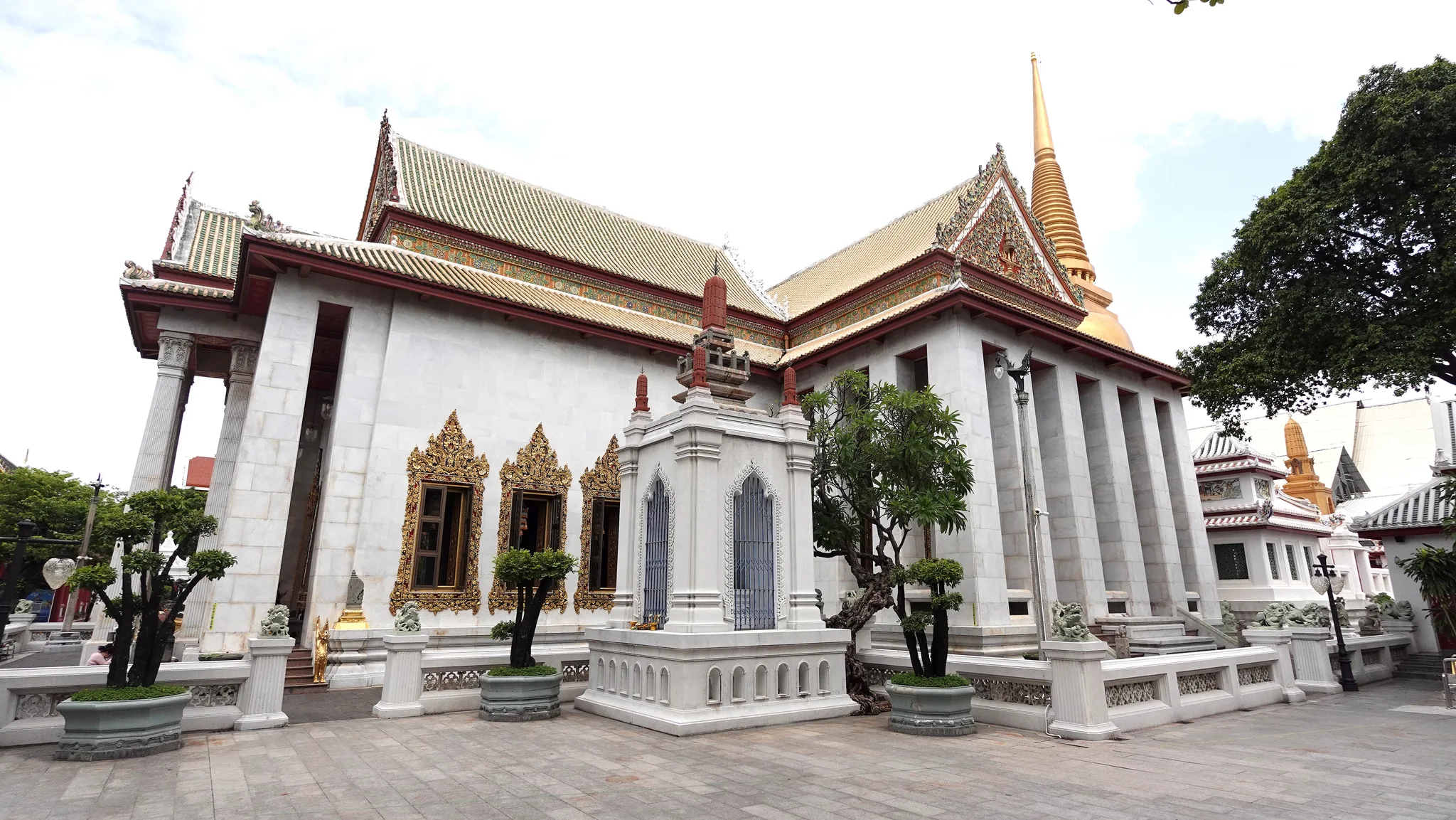
 At Wat Bowonniwet Vihara, a worship hall with white-clad walls and square columns carries tiered roofs of glazed tiles; gilded window frames, a boundary marker shrine and a gilded chedi complete the ensemble.© Eric Monteil
Buddhist temple
Wat Bowonniwet Vihara
Founded by a viceroy and later led by Prince Mongkut, this Bangkok monastery became the home of the Thammayut order, the setting for princely ordinations and the resting place of two kings.
Heritage family · Buddhism, religions and spiritualities
- Destination
- Bangkok (Phra Nakhon)
- Heritage Family
- Buddhism, religions and spiritualities
- Typology
- Buddhist temple
- Visit
- Available tours →
Wat Bowonniwet Vihara is a royal Buddhist monastery in Bangkok, belonging to the Thammayut order, a movement of monastic reform that arose within Theravada Buddhism. It owes its importance to Prince Mongkut, the future King Rama IV, who led it as a monk for fourteen years and made it the home of that movement. Founded by a viceroy during the reign of Rama III, the monastery went on to become a place of study, the residence of several Supreme Patriarchs and the place where princes of the Chakri dynasty are ordained. It holds the ashes of two kings. Its ubosot houses a bronze statue brought from Phitsanulok and murals by Khrua In Khong, a pioneer of perspective in Thai painting.6
Key facts
- Destination
- Bangkok
- Heritage Family
- Buddhism, religions and spiritualities
- Typology
- Buddhist temple
- Places
- Phra Sumen Road
- Rattanakosin Island
- Phra Nakhon
- Periods
- People
- Bhumibol Adulyadej
- Khrua In Khong
- Maha Vajiralongkorn
- Vajirananavarorasa
- Rama III
- Rama IV (Mongkut)
- Communities
- Communauté monastique
- Events
- Arrivée du prince Mongkut au Wat Mai (1836)
- Dépôt des cendres de Bhumibol (2017)
- Fondation du Mahamakuta Rajavidyalaya (1893)
- Fondation du Wat Mai par le vice-roi
- Royal funeral of King Bhumibol Adulyadej
- Réunion du Wat Mai et du Wat Rangsi Sutthawat
- Heritage
- Phra Phuttha Chinnasi
- Glossary
- Wat
- Viharn
- Khlong
- Somdet
- Wang
- Buddha image
- Keywords
- —
- Date
- —
- Collections
- —
Practical info
Practical information about this site is taken from its Google Maps page. We advise you to check it before visiting.
- Address
- 248 Thanon Phra Sumen, Khwaeng Wat Bowon Niwet, Khet Phra Nakhon, Krung Thep Maha Nakhon 10200
- Phone
A viceroy’s foundation
Wat Mai, the “new temple”
Wat Bowonniwet Vihara stands in the north-east of Rattanakosin Island, the historic heart of Bangkok, just inside the old city wall, on the bank of Khlong Banglamphu, on Phra Sumen Road. It came into being during the reign of King Rama III (1788–1851), on the initiative of that reign’s viceroy, Somdet Phra Bowonratchao Maha Sakdiphonlasep (1785–1832). This prince bore the title of Wang Na, the “Front Palace”, after the residence attached to his office.2
The monastery was at first given a very simple name, Wat Mai, the “new temple”. The viceroy had it built on the spot where Chao Chom Manda Noi, the mother of Princess Darawadi, his principal consort, had been cremated. The name by which the monastery is known today comes from the Pali pavara and nivesa, which the community renders as “monastery of the Excellent Abode”; in everyday use it is shortened to Wat Bowon.2
Two accounts of a beginning
To lead the new community, the viceroy called upon a monk from Wat Mahathat, Phra Thep Moli (Sin), who became the first abbot of Wat Mai. Yet this first chapter takes up little room in the history the monastery tells of itself. The community dates the start of its history to 1836, with the arrival of Prince Mongkut, whom it counts as its first abbot.2
The two accounts are not mutually exclusive: one records the physical foundation by the viceroy, the other the moment when the place received the calling that would make its name. This choice says much about how Wat Bowonniwet Vihara understands itself: less as one princely foundation among many than as the home of a prince-monk and of the religious movement he launched.
A statue from Phitsanulok
In 1829 the viceroy had a bronze statue kept at Wat Phra Si Rattana Mahathat in Phitsanulok brought to Wat Mai. This Buddha image — in Thailand, the word “image” denotes a consecrated statue — bears the name Phra Phuttha Chinnasi. It became the monastery’s principal statue and was installed in the ubosot, the hall in which monks are ordained.1
The Northern Chronicle links this statue to a group of three images, together with Phra Phuttha Chinnarat and Phra Si Satsada, said to have been commissioned by King Si Thammatraipidok. This account belongs to tradition and does not fix an established date. Above all, it sheds light on the prestige of the image: by bringing it to his foundation, the viceroy endowed a brand-new temple with an object of veneration that tradition associates with a line of illustrious images.1
Prince Mongkut’s monastery
A prince-monk at the head of Wat Mai
The history of Wat Mai changed course in 1836. The monastery had no abbot when Prince Mongkut (1804–1868) settled there, then a monk under the monastic name Vajirañāṇo. King Rama III asked him to take charge of it. Mongkut remained a monk for twenty-seven years in all, fourteen of them at the head of the monastery, before ascending the throne in 1851 as Rama IV.6
This long abbacy turned a recent foundation into a central place in the religious life of the kingdom. A future sovereign lived, studied and governed a community of monks there for nearly fifteen years. The monastery bears a lasting imprint of it: it was from this period onwards that it became the seat of monastic reform, of textual study and, later, of princely ordinations.
The home of the Thammayut order
Mongkut came to Wat Mai with a project in hand. In 1833, three years earlier, he had launched a movement of monastic reform, the Thammayut (Dhammayuttika Nikaya). By taking charge of the monastery, he gave this movement a place and a community, and Wat Mai became its centre.10
The bond has never been broken: Wat Bowonniwet Vihara still presents itself today as a first-class royal monastery of the Thammayut tradition, that is, as one of the temples of the highest rank among those under the patronage of the Crown. This dual allegiance, to religious reform and to royal patronage, explains the rest of its history. Several of its abbots would be leading figures of the order, and the royal family would continue to send its princes there.6
The Printing House
Within the precinct, Mongkut had a building constructed in which he installed a press. He lived there as a monk and printed texts in the Ariyaka script. The small lodging still bears the name “Printing House”.12
The place remained devoted to study after Mongkut left for the throne. Prince Vajirañāṇavarorasa (1860–1921), the monastery’s future abbot and future Supreme Patriarch, lived there as a novice, and used the same press as the one employed to print the Tipitaka, the Buddhist canon, under the Fifth Reign, that of King Chulalongkorn (1853–1910). From one reign to the next, print thus accompanied the life of the monastery.7
Reading the ubosot
The paintings of Khrua In Khong
The interior walls of the ubosot bear paintings attributed to Khrua In Khong, a monk-painter, and dated to around 1840, during Mongkut’s abbacy. Khrua In Khong is regarded as the first Thai artist to have applied techniques from the West to mural painting: perspective, which conveys depth of space, and chiaroscuro, which models volumes through the play of light and shade.3
The departure is not merely one of technique. At Wat Bowonniwet Vihara, as at Wat Borom Niwat, his paintings set aside the narratives one would usually expect on a temple’s walls, such as the previous lives of the Buddha. In this respect these schemes count among the milestones in the history of Thai painting: the decoration of an ordination hall becomes the setting for a new way of depicting the world.4
Riddles of the Dhamma
In the upper part of the walls, sixteen panels, as many as the ubosot has doors and windows, depict Western figures. They illustrate “riddles of the Dhamma” (pritsana tham), images to be deciphered that refer to the teaching of the Buddha, the Dhamma. Their subject is the virtue of the Three Jewels, that is, the Buddha, his teaching and the Sangha, the community of monks.14
The visitor who looks up therefore sees not a story to follow from panel to panel, but scenes to be interpreted. The idea that this programme was conceived while Mongkut was leading the monastery is put forward by the history the community has devoted to its own past. It remains a hypothesis, presented as such, which would link the decoration of the ubosot to the reforming circle gathered around the prince-monk.14
A monastery of patriarchs and learning
Two monasteries united
The present complex has not always formed a single monastery. Its grounds unite two former foundations once separated by a canal: Wat Mai to the north and Wat Rangsi Sutthawat to the south. They were merged during the reign of King Vajiravudh, Rama VI (1881–1925).6
This merger gave Wat Bowonniwet Vihara its present extent, within which one can distinguish the ubosot, which houses the principal statue and the murals, a gilded chedi, a reliquary monument holding relics and royal ashes, and the quarters where the monks live. The name Wat Mai remains attached to the northern part, that of the viceroy’s foundation and of Mongkut’s abbacy.
Abbots who became Supreme Patriarchs
After Mongkut, the monastery continued to be governed by monks of the first rank. Several of its abbots rose to the office of Supreme Patriarch, the head of the kingdom’s Buddhist clergy. Prince Pavares Variyalongkorn (1809–1892) held it in the second half of the 19th century. Prince Vajirañāṇavarorasa received it at the beginning of the 20th century, after leading the monastery for thirty years; he died at Wat Bowonniwet Vihara in 1921. Chuen Navavongs, in religion Vajirañāṇavongs, was Supreme Patriarch from 1945 to 1958.11
The line continues into recent times. Somdet Phra Nyanasamvara (Charoen Suvaḍḍhano) (1913–2013), the nineteenth Supreme Patriarch, was also attached to the monastery; he died in 2013, at the age of one hundred. From one generation to the next, the monastery founded by a viceroy has thus supplied the Thai clergy with several of its highest leaders.
A school for monks and laypeople
On 1 October 1893, King Chulalongkorn and Prince Vajirañāṇavarorasa founded Mahamakuta Rajavidyalaya, an educational institution open to monks and laypeople alike. The institution introduced written examinations and awards a qualification of its own, the Parian Mahamakut.7
This foundation extends, on the scale of a school, the attention to study and the written word already present in the days of Mongkut’s Printing House. It also brings together, once again, the sovereign and the abbot of the monastery in a shared undertaking, just as Rama III and Mongkut had been when the prince arrived at Wat Mai.
The temple of the Chakri kings
Fifteen days in the robe
The monastery holds a special place in the religious patronage of the Chakri dynasty, the reigning royal family. Many princes and several kings have studied and stayed there as monks. A custom has become established, regarded as traditional within the royal family: ordination takes place at Wat Phra Kaew, the Temple of the Emerald Buddha, after which the new monk spends fifteen days at Wat Bowonniwet Vihara.9
King Bhumibol Adulyadej, Rama IX (1927–2016), followed this path in 1956. Crown Prince Vajiralongkorn (born 1952), now king as Rama X, followed it in turn: ordained on 6 November 1978 at Wat Phra Kaew, he resided for fifteen days at the monastery under the monastic name Vajiralongkornno. Each royal generation thus returns, for the space of a retreat, to the monastery that Mongkut led before he reigned.13
The ashes of two kings
Wat Bowonniwet Vihara is also a place of royal interment. The ashes of King Vajiravudh and those of King Bhumibol are enshrined in the base of Phra Phuttha Chinnasi, the principal statue of the ubosot. Bhumibol’s ashes were deposited in 2017; from 29 October, the faithful flocked to the monastery to pay their respects.1
The statue that the viceroy had brought from Phitsanulok for his foundation has thus become the reliquary of two sovereigns. The monastery, to which the dynasty sends its princes to experience monastic life, also holds the memory of its kings. It remains today a community of monks of the Thammayut order and, since 2017, a place of national devotion.
Understanding
Wat Bowonniwet Vihara is first and foremost a community of monks, founded by a viceroy and then transformed by a prince who became its abbot. Mongkut gave the Thammayut order a home there, and that choice shaped everything that followed: abbots who became Supreme Patriarchs, a printing house, a school open to monks and laypeople, and, in the ubosot, paintings that renewed the way the world was depicted on a temple’s walls. Since then, the Chakri dynasty has sent its princes there for their monastic retreat, and two kings rest there. Since Bhumibol’s ashes were deposited in 2017, the monastery has also drawn crowds of the faithful who come to pay their respects, and its role as a site of royal memory has grown alongside its monastic life and its place in the history of religious reform. A seat of religious reform turned dynastic sanctuary: will Wat Bowonniwet Vihara be seen in future first and foremost as the home of a community of monks, or first and foremost as a site of memory for the monarchy?
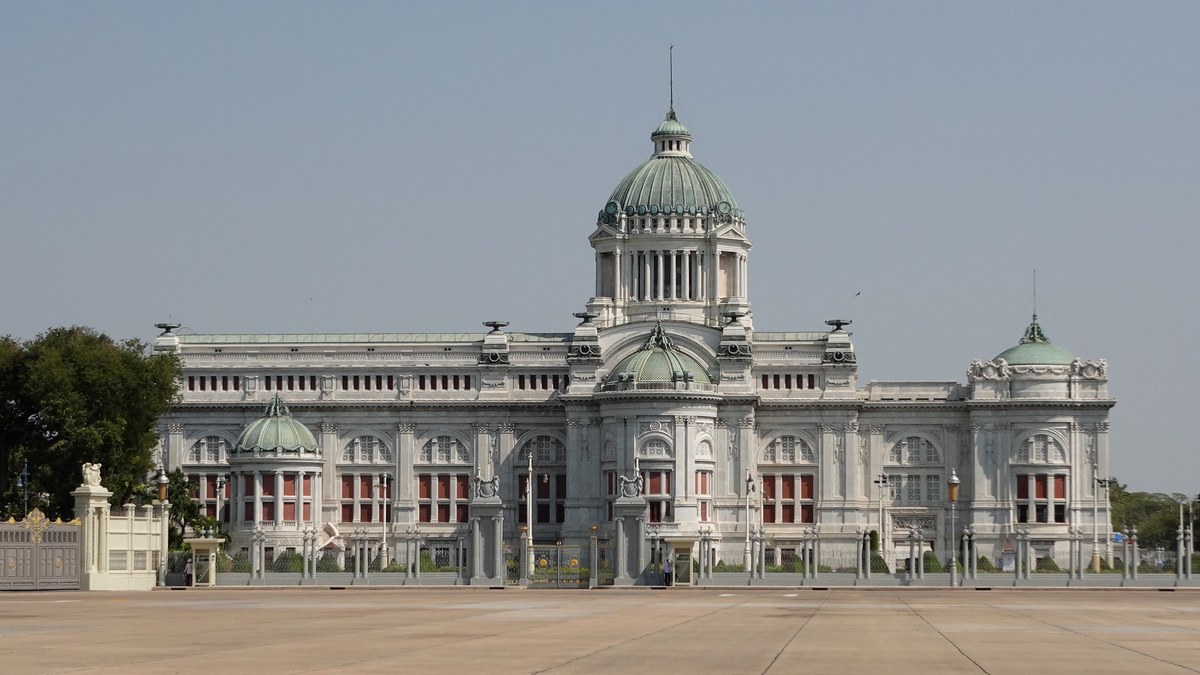
Rattanakosin, from the royal citadel of 1782 to the historic districts that shaped contemporary Bangkok.
- Wat
- Buddhist monastic complex that brings together, within a single enclosure, several religious buildings, monks’ quarters and ancillary buildings; the word does not refer to a single building.
- Viharn
- Assembly and devotional hall of a wat, used for ceremonies, teaching and the veneration of Buddha images; unlike the ubosot, it does not host monastic ordinations.
- Khlong
- Canal or waterway, natural or man-made, which long played a major role in transport, irrigation and the organisation of settlements and territories in Thailand.
- Somdet
- A title conferred on monks of one of the highest ranks in the Thai monastic hierarchy.
- Wang
- Thai word for a palace, particularly the residence of a prince or a member of the royal family.
- Buddha image
- In Thai Buddhism, a devotional representation of the Buddha, most often a statue, venerated as an object of worship.
- Ubosot
- Consecrated ordination hall of a wat: the ritually central building, marked out by sacred boundary stones, where monastic ordinations take place.
- Ordination
- Ceremony by which a layperson is admitted as a novice or as a monk into the Buddhist community.
- Thammayut
- Reformed Thai Buddhist monastic order, founded in the 19th century by the future King Rama IV, which advocates strict observance of monastic discipline.
- Dhamma
- Buddhist doctrine, that is, the teaching of the Buddha.
- Sangha
- The body of monks who reside in a monastery and live there according to religious discipline; in Buddhism it is called the sangha.
- Supreme Patriarch
- Head of the Buddhist monastic community of Thailand, appointed by the king.
- Theravada
- A branch of Buddhism whose canonical texts are written in Pali.
- Pali
- The language of the canonical texts of Theravada Buddhism.
- Royal monastery
- In Thailand, a Buddhist monastery founded, restored or placed under the patronage of the king or the royal family, and holding a particular rank.
- Tipitaka
- Canon of the scriptures of Theravada Buddhism, written in Pali and divided into three ‘baskets’: monastic discipline, discourses of the Buddha and the Abhidhamma.
- Chedi
- A bell-shaped reliquary monument, the Thai version of the Indian stupa.
- Reliquary
- A container intended to hold and protect one or more relics.
- Relic
- Bodily remains of, or objects associated with, the Buddha or a holy figure, preserved and venerated.
- Wang Na
- Customary title of the vice-king (uparat) of Siam, taken from the name of the Front Palace, his official residence. The office was abolished during the reign of King Chulalongkorn.
- Ariyaka
- Script devised in the 19th century in the circle of the monk-prince Mongkut to write Pali, inspired by the Latin alphabet.
- Pritsana tham
- ‘Riddles of the Dhamma’: allegorical images to be deciphered, conveying a point of the Buddha’s teaching in figurative form.
- Three Jewels
- In Buddhism, the set formed by the Buddha, his teaching (Dhamma) and the community of monks (Sangha), in which the faithful take refuge.
- First-class royal monastery
- The highest of the three classes of royal monasteries in Thailand, reserved for the most important temples under the patronage of the Crown.
Studies
- 1The final resting place, Bangkok Post, 2017 ↗
- 2พระเทพโมลี (สิน) เจ้าอาวาส “วัดบวรนิเวศวิหาร” เมื่อแรกสถาปนา, ศิลปวัฒนธรรม (Silpa Watthanatham) ↗
- 3Research Highlights. Miraculous Amalgams: The In Khong Style Murals, Journal of the Siam Society (ThaiJO) ↗
- 4M. Paul, The Murals of Khrua In Khong: Enlightenment is Happening Everywhere, Journal of the Siam Society (ThaiJO) ↗
- 5Long Live His Majesty the King, Pattaya Mail ↗
Reference works
- 6Wat Bowonniwet Vihara, History – Wat Bowonniwet Vihara, Wat Bowonniwet Vihara (watbowon.org) ↗
- 7Wat Bowonniwet Vihara, Abbots of Wat Bowonniwet Vihara, Wat Bowonniwet Vihara (watbowon.org) ↗
- 8วัดบวรนิเวศราชวรวิหาร, Wikipedia (th) ↗
- 9Wat Bowonniwet Vihara, Wikipedia (en) ↗
- 10Dhammayuttika Nikaya, Wikipedia (en) ↗
- 11Contributeurs Wikipédia, Supreme Patriarch of Thailand, Wikipedia (en) ↗
- 12Vajirananavarorasa, Wikipedia (en) ↗
- 13Vajiralongkorn, Wikipedia (en) ↗
- 14วัดบวรนิเวศวิหาร, Silpakorn University Library, Tha Phra (thapra.lib.su.ac.th) ↗
- 15Mahamakut Buddhist University ; Ariyavongsagatanana (Amborn Ambaro), Wikipedia (en) ↗
Contemporary views
Wat Bowonniwet Vihara today
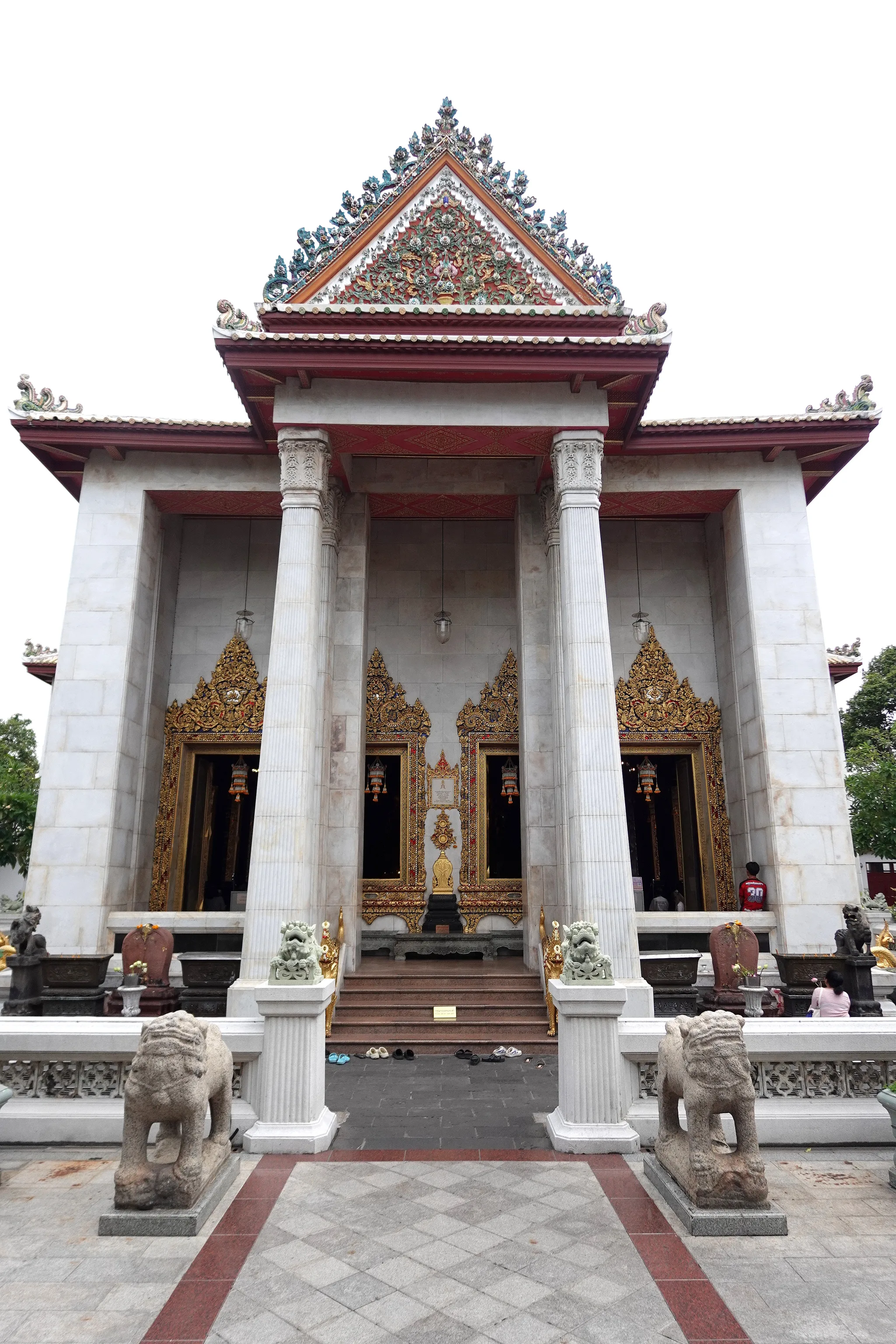
The portico of this building at Wat Bowonniwet Vihara combines fluted columns and white marble cladding with a pediment adorned with floral ceramics. Stone lions guard the entrance, where shoes are left at the foot of the steps.© Eric Monteil 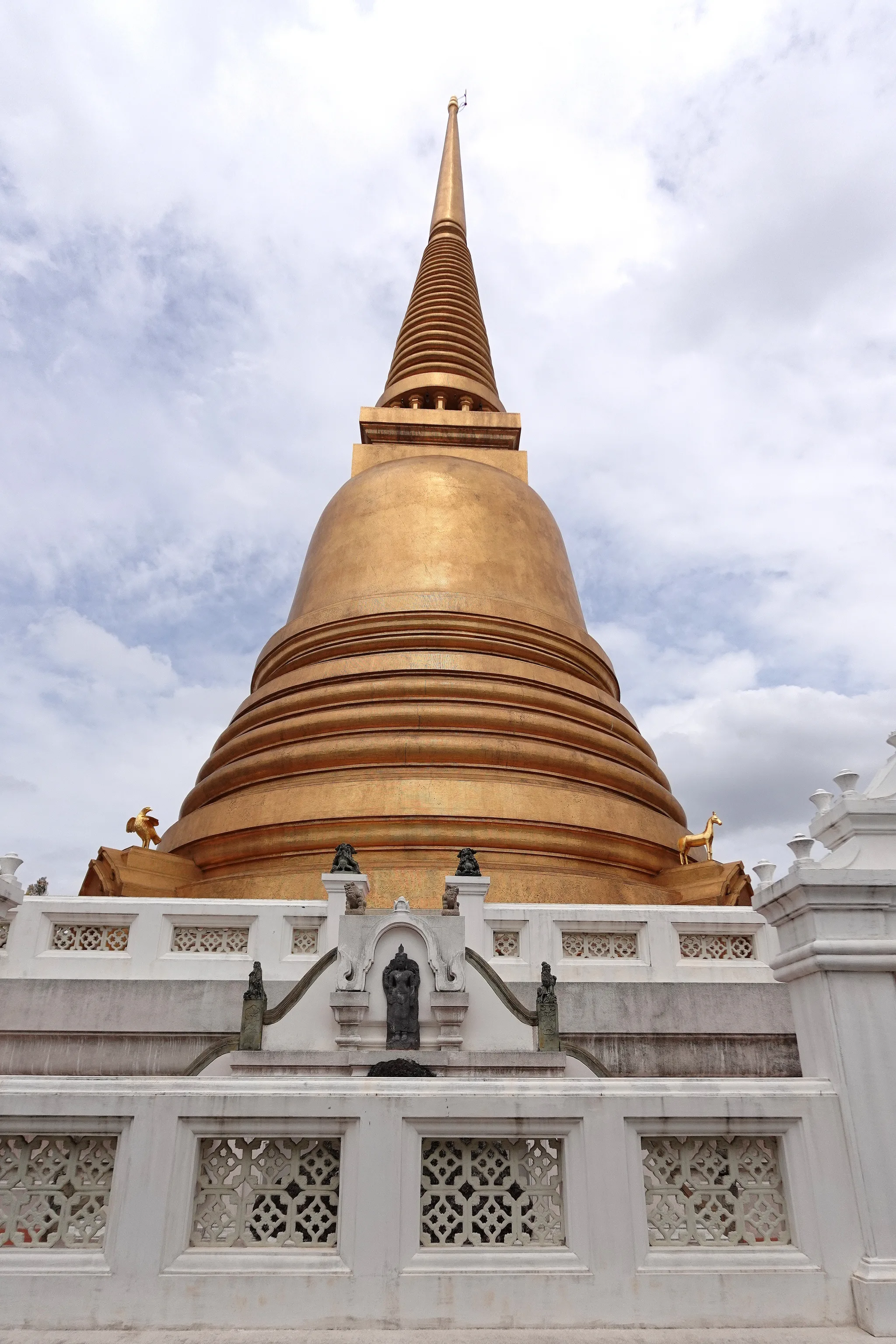
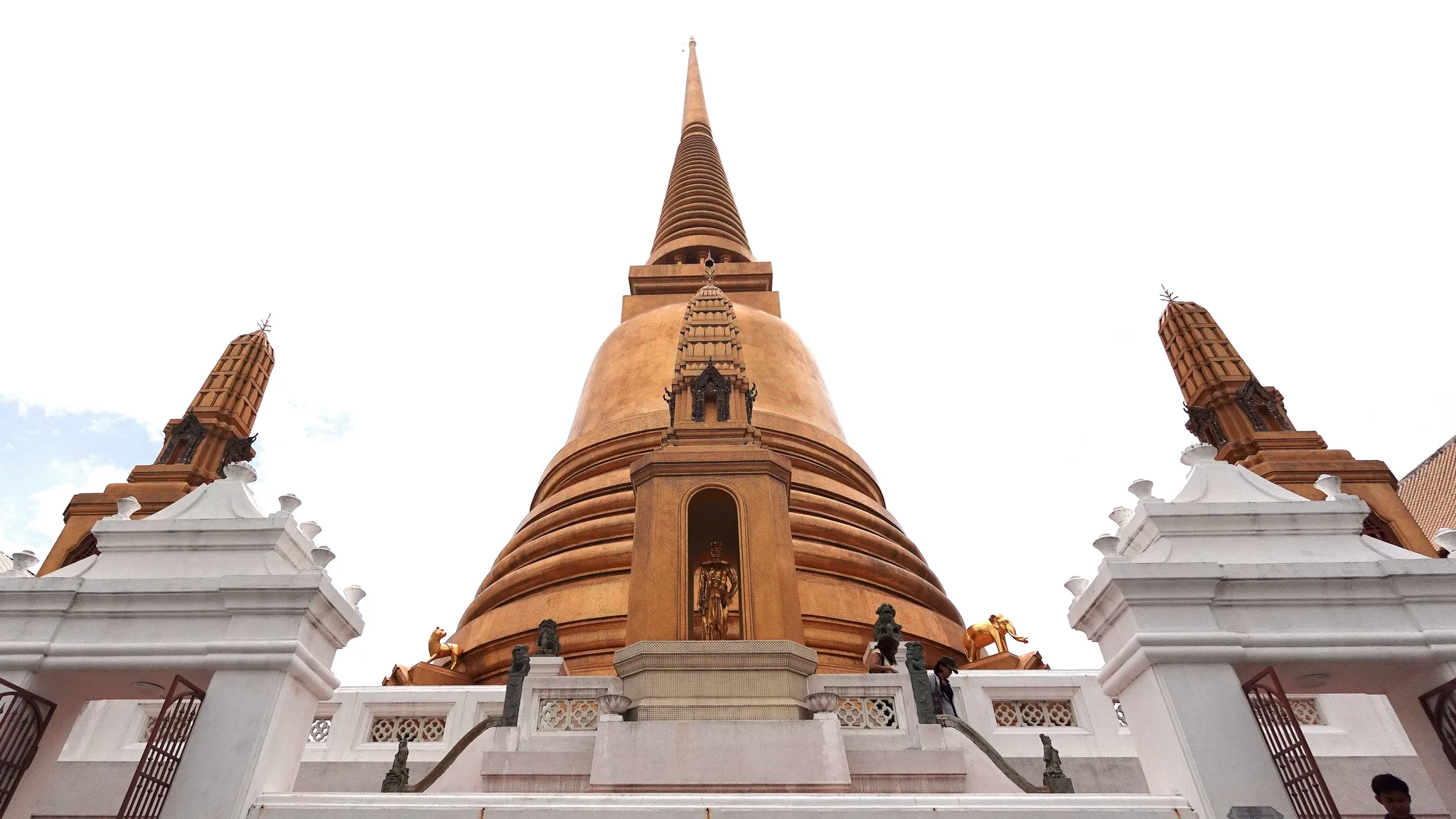
The large golden chedi of Wat Bowonniwet Vihara rises above white terraces with pierced balustrades; gilded animal figures, guardian lions and a dark statue set in a niche adorn its base.© Eric Monteil
Architecture and decoration
Explore the heritage
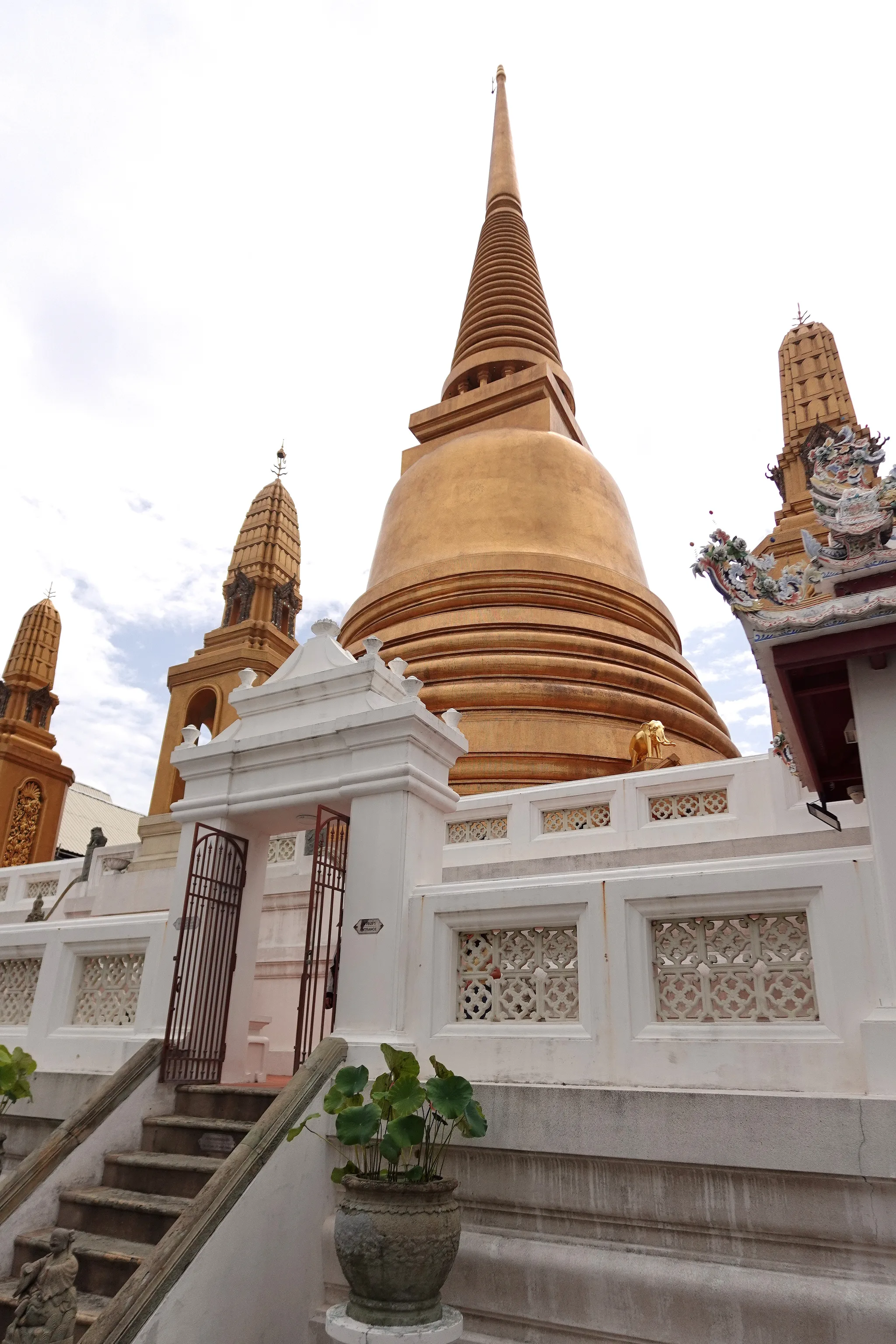
At Wat Bowonniwet Vihara, the golden chedi with its ringed spire rises above a terrace enclosed by a white balustrade with pierced panels, reached by a staircase and a grilled gateway, between golden turrets.© Eric Monteil 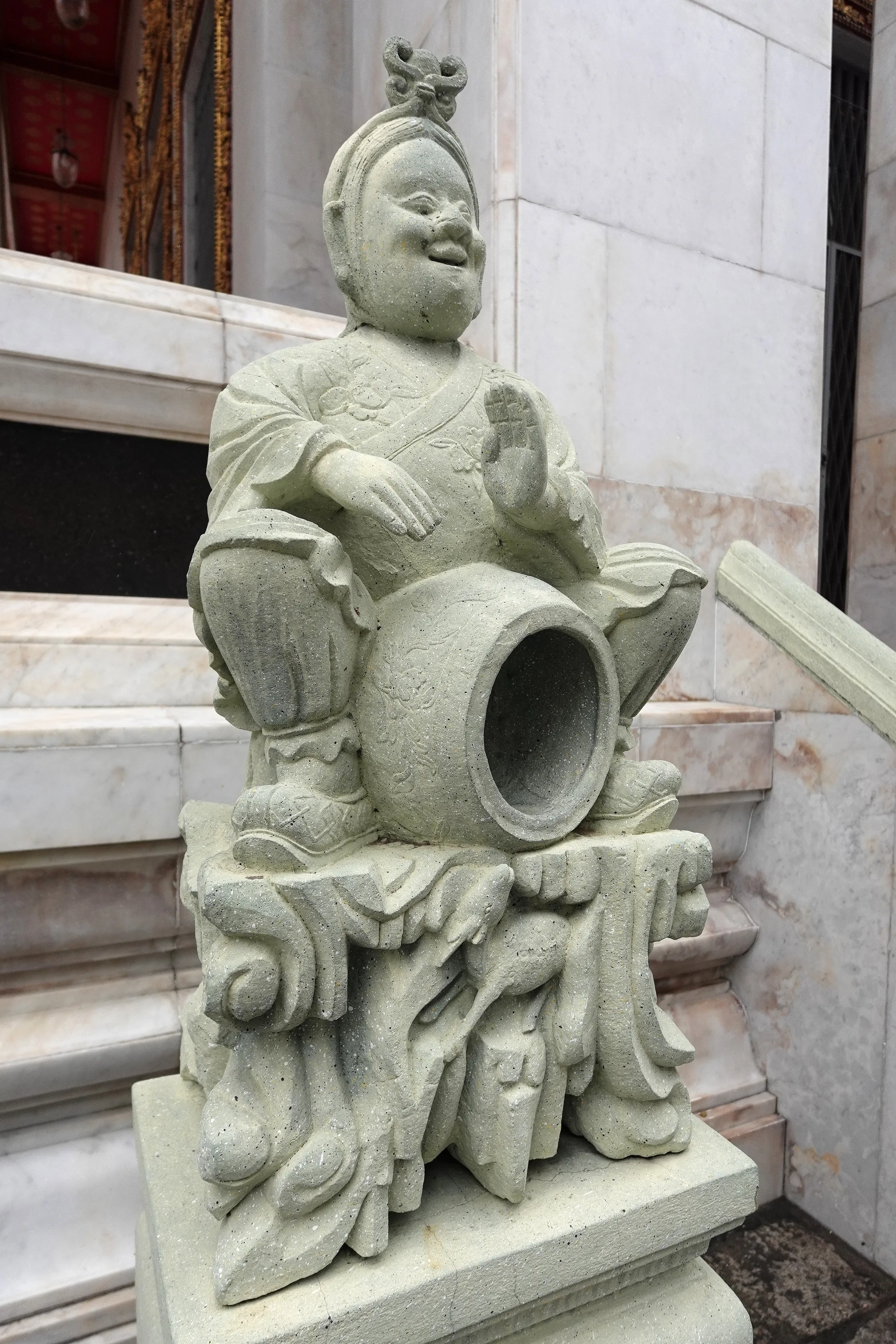
At Wat Bowonniwet Vihara, a Chinese-style stone statue depicts a smiling figure with a knotted topknot, seated behind an open jar on a base carved with rocks, in front of marble-clad steps and walls.© Eric Monteil