
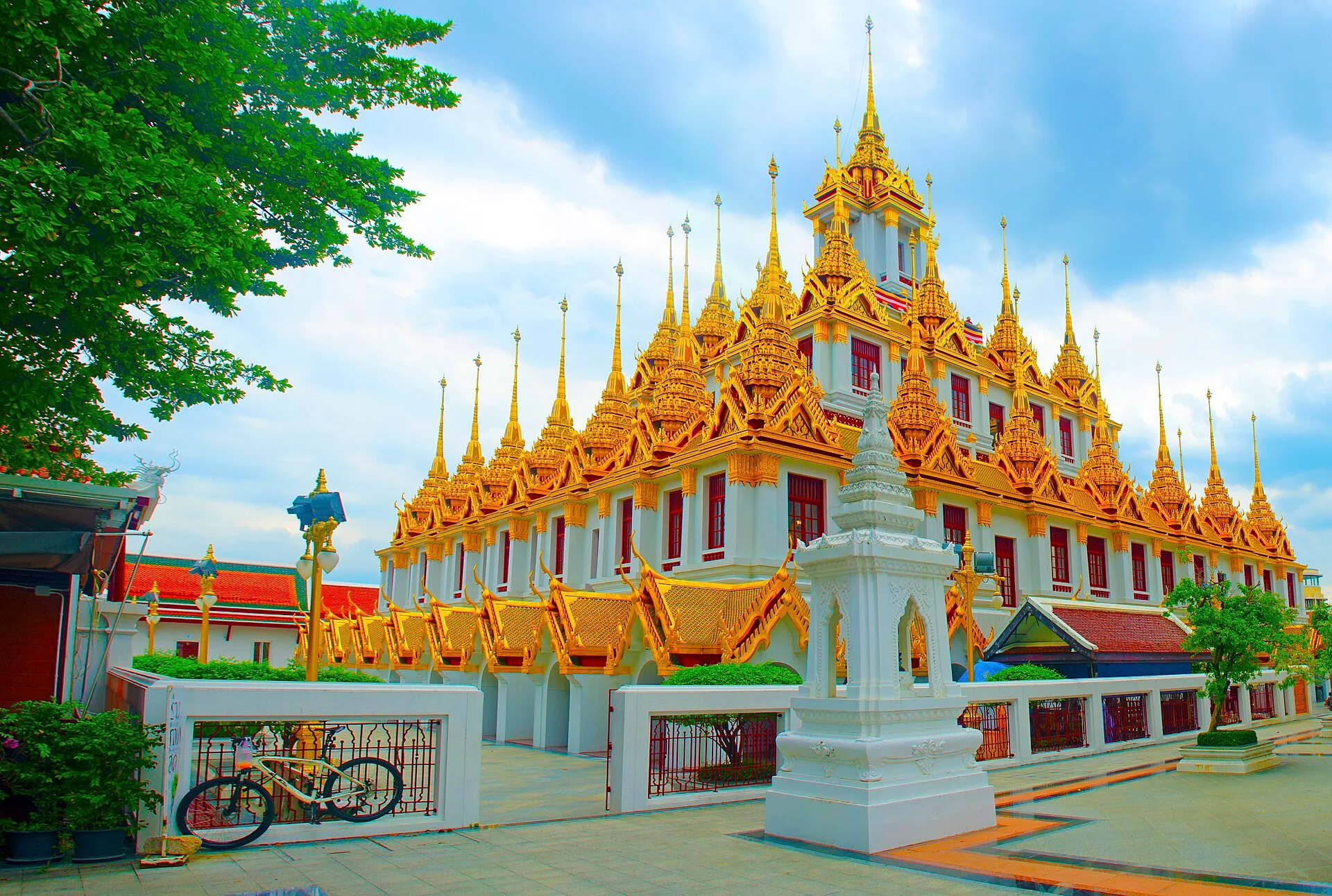
 At Wat Ratchanatdaram (Loha Prasat), the tiered building with white walls and red windows bristles with gilded spires; in the foreground, a small white openwork structure and a railing border the paved forecourt.Rangan Datta Wiki — Wikimedia Commons, CC BY-SA 4.0
Buddhist temple
Wat Ratchanatdaram (Loha Prasat)
Founded in 1846 by King Nangklao for his granddaughter, the monastery is arranged around a ‘metal castle’ inspired by Buddhist texts, completed only in the 20th century and reinterpreted several times since.
Heritage family · Buddhism, religions and spiritualities
- Destination
- Bangkok (Phra Nakhon)
- Heritage Family
- Buddhism, religions and spiritualities
- Typology
- Buddhist temple
- Visit
- Available tours →
Wat Ratchanatdaram Worawihan (Loha Prasat) is a royal Buddhist monastery in Bangkok, founded in 1846 by King Nangklao, Rama III (1788–1851), in honour of his granddaughter, Princess Somanass Waddhanawathy. It owes its distinctiveness to its principal monument, the Loha Prasat or ‘metal castle’. In place of a conventional chedi, the king had a structure raised of a type known from Buddhist texts and the chronicles of Sri Lanka, whose ancient models have since disappeared. Left unfinished at its founder’s death, then completed and restored in stages over more than a century, this building of seven levels and thirty-seven spires can be seen today from Ratchadamnoen Avenue.7
Key facts
- Destination
- Phra Nakhon
- Heritage Family
- Buddhism, religions and spiritualities
- Typology
- Buddhist temple
- Places
- Ratchadamnoen Avenue
- Periods
- People
- Awut Ngoenchuklin
- Chao Phraya Yommarat (Bunnak)
- Princess Somanass Waddhanawathy
- Rama III
- Rama V
- Sarit Thanarat
- Communities
- Communauté monastique de Wat Ratchanatdaram
- Events
- Demolition of Sala Chaloem Thai (1989)
- Foundation of Wat Ratchanatdaram (1846)
- Krung Rattanakosin Conservation and Development Master Plan (1982)
- Restauration des flèches du Loha Prasat en cuivre noirci (1997-2007)
- Restauration et achèvement du Loha Prasat (1963)
- Restauration et dorure des flèches du Loha Prasat (2012)
- Heritage
- —
- Glossary
- Wat
- Rattanakosin period
- Chedi
- Relic
- Prasat
- Reliquary
- Keywords
- —
- Date
- —
- Collections
- —
Practical info
Practical information about this site is taken from its Google Maps page. We advise you to check it before visiting.
- Address
- 2 Maha Chai Rd, Khwaeng Wat Bowon Niwet, Khet Phra Nakhon, Krung Thep Maha Nakhon 10200
- Phone
A royal foundation for a princess
King Nangklao’s project
In 1846 King Nangklao, third sovereign of the Chakri dynasty and better known as Rama III, ordered the foundation of a new wat, that is, a Buddhist monastery bringing together buildings for worship and living quarters for the monks. The site chosen was a former orchard near Mahakan Fort and the Phan Fa Lilat Bridge, on the edge of the royal city. The monastery thus came into being early in the Rattanakosin period, which takes its name from the island on which the capital stands. The king and the princess for whom the temple was intended laid the foundation stone together: from the outset, the gesture bound the foundation to one particular member of the royal family.1
The design was entrusted to Chao Phraya Yommarat (Bunnak), a high dignitary of the court who held the highest title of the Siamese nobility. He drew up the overall plan and directed the construction of the main buildings: the ubosot, the hall in which monks are ordained; the vihara, an assembly hall where the faithful gather before images of the Buddha; and the sala kan parian, a pavilion set aside for the study of texts. These buildings form the ordinary setting of a royal monastery. From the very beginning, however, the project also provided for a centrepiece of an altogether different kind.2
A granddaughter raised in rank
The monastery’s name bears the mark of its dedicatee. It refers to the ‘phra ratchanatda’, the royal descendant in whose honour the temple was founded. The Thai word can mean either a granddaughter or a niece, which explains why translations waver between the two. Princess Somanass Waddhanawathy (1834–1852) was in fact the daughter of Prince Lakkhananukhun, himself a son of Rama III: she was therefore the king’s granddaughter.9
By birth she held the title of Mom Chao, a modest princely rank, and it was under this title that she received the temple. Rama III raised her to the higher rank of Phra Ong Chao, a sign of the particular favour she enjoyed with him. Her fate remained bound up with the court: in 1851 she married the new king, Mongkut, Rama IV (1804–1868), and became queen, only to die the following year, barely eighteen years old. The monastery that bears her name has thus outlived her by more than a century and a half.9
A new kind of chedi
In a Thai monastery, the chedi is the solid monument, often intended to house relics, that marks the sacred heart of the complex. Here Rama III set aside the customary form. The temple’s principal monument was to be the Loha Prasat, literally the ‘metal castle’, a tiered structure bristling with spires. It serves as chedi and reliquary, while the ubosot and the vihara fulfil the ritual and communal functions. This division of roles clarifies how the site should be read: the Loha Prasat is neither a palace nor a hall of worship, but the equivalent of a stupa, conceived from a model drawn from the texts.6
The legacy of the metal castles
Models known from narratives
Buddhist tradition knows of two earlier Loha Prasats. The first dates back to the time of the Buddha: it is attributed to Visakha, a laywoman counted among his most devoted disciples, and tradition describes it as a two-storey building with a thousand chambers, crowned by a golden spire. The second was raised at Anuradhapura, the ancient royal capital of Sri Lanka, by King Dutthagamani (whose reign is traditionally dated from 161 to 137 BC), with a roof covered in copper plates. It was this metal covering that gave the building type its name.1
The reference account is found in the Mahavamsa, the great Pali chronicle that traces the history of Buddhism and of the kings of Sri Lanka. Neither of these two buildings survives, which is why the Bangkok Loha Prasat is often presented as the only one still standing. In choosing this model, Rama III placed his foundation in a lineage known from texts rather than from the observation of an actual building: the architecture was meant to give form to a description.4
Seven levels around a shaft
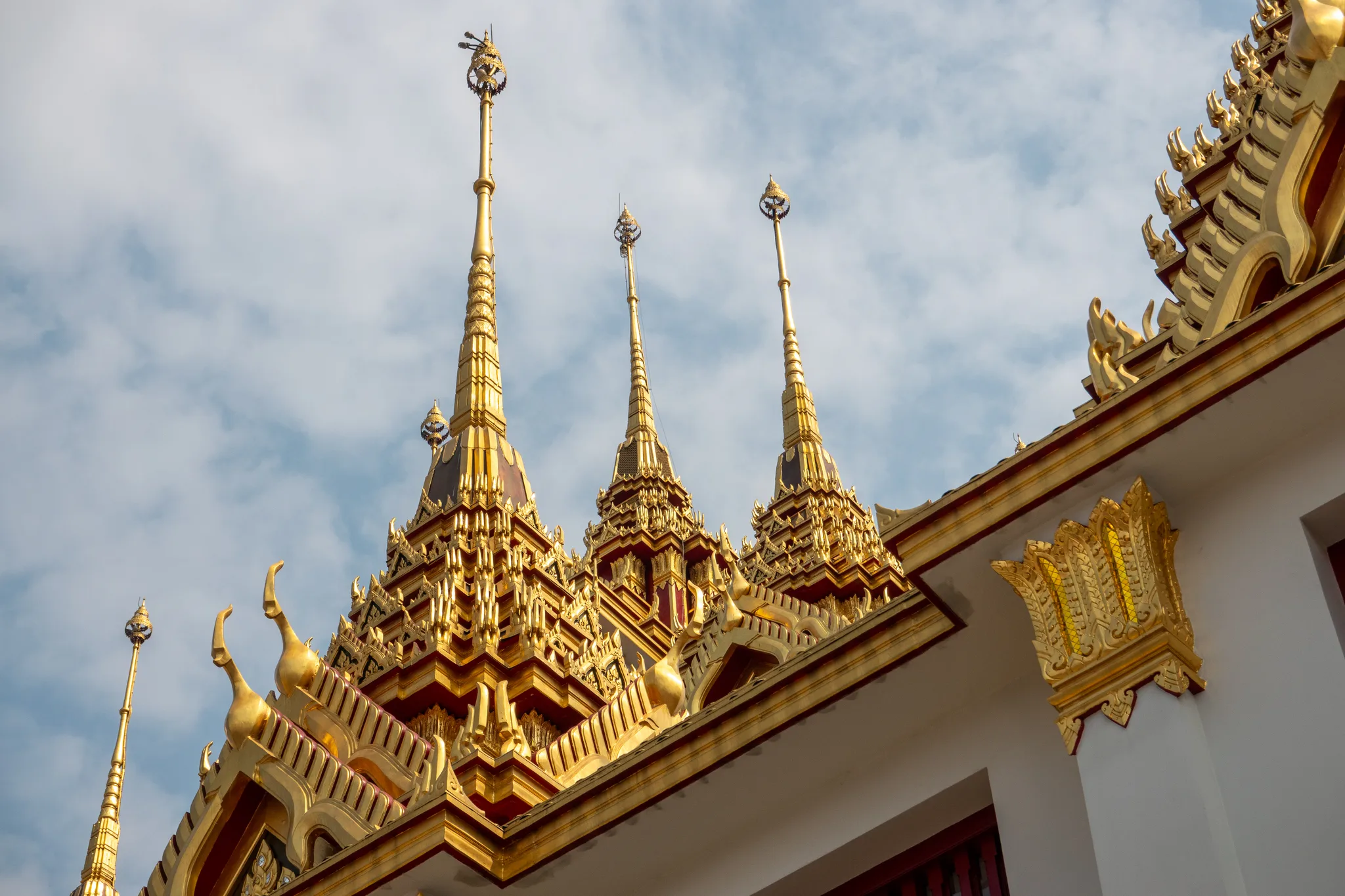
The Loha Prasat appears as a tiered mass of seven levels, crowned by thirty-seven spires. The number is not accidental: it is linked to the thirty-seven bodhipakkhiyadhamma, the qualities that Buddhist teaching describes as leading to Awakening. The building can therefore also be read as an image of the spiritual path, each spire corresponding to one of these qualities.6
Its internal arrangement follows the same vertical logic. The centre of the building is a hollow shaft around which the levels are arranged, and relics of the Buddha are kept on the seventh and topmost floor. The visitor who climbs thus draws nearer to the most sacred point of the monument. On the upper levels, small masonry pavilions known as mandapa punctuate the terraces, surmounted by chat, the tiered parasols that in Thai art signal rank or a sacred presence.6
A century to complete the building
Momentum interrupted
Work on the Loha Prasat was not finished when Rama III died in 1851. The princess to whom it was dedicated died the following year, and the reign of King Mongkut has left no record of work on the building. From then on the monument remained in abeyance for decades, to the point that the Thai cultural press could describe it as a temple whose construction refused to come to an end.5
The revival came from within the monastery. Under King Chulalongkorn, Rama V (1853–1910), the abbot Phra Prasitsutakhun (Daeng Khemathatto) repeatedly sought royal permission to restore the building, as and when funds allowed. Work began at the top: the floors were relaid, the masonry and red rendering of the mandapa were redone, and the chat were installed. The lowest level, by contrast, was not taken in hand at that time. Ongoing maintenance was carried out between 1901 and 1909. The same sovereign gave a name to the principal Buddha image kept at the monastery: Phra Buddha Setthamuni.12
Completion in the 20th century
The completion of the Loha Prasat is associated with a major restoration carried out in 1963 under the abbot Phra Ratchapanyasophon (Suk Punyaramsi), with the support of Field Marshal Sarit Thanarat (1908–1963), then Prime Minister. The building then acquired the appearance by which it would be known for a generation: red-rendered masonry and mandapa painted white.5
Another chronology, however, places the end of the work somewhat later, between 1967 and 1976, and attributes it to the Department of Public and Municipal Works. The two versions disagree on the date, but they describe the same reality: a monument commissioned by a king in the mid-19th century and finished more than a hundred years after its foundation, by the modern state. For some Thai critics, the building as completed does not fully match the grandeur of the Loha Prasat described in the Mahavamsa, and is closer to a recent creation than to a heritage handed down intact.4
The successive colours of the Loha Prasat
Blackened copper, 1996 to 2007
At the end of the 20th century, the monument’s appearance changed once again. In 1996 the architect Awut Ngoenchuklin, later honoured as a National Artist in architecture, designed metal roof coverings and roof ornaments for the Loha Prasat in black-patinated copper. A project to restore the thirty-seven spires followed the next year, with an explicit aim: to clad them in blackened copper so that the building would at last live up to its name of ‘metal castle’.5
The work lasted eleven years and was completed in 2007. That same year, panels recounting the history of the building were installed in its galleries, making the monument as much a place of explanation as of devotion. The red and white of 1963 thus gave way to a dark, metallic silhouette, justified by reference to the copper roof of the Anuradhapura model.4
Gold and the founder’s intention
A few years later, another reading prevailed. It was argued that Rama III had wanted gilded spires, on the basis of a depiction of the Loha Prasat painted in the vihara of the Reclining Buddha at Wat Pho, one of Bangkok’s great royal monasteries. This argument remains a proposal resting on a painted image, not a historical certainty. It nonetheless justified a new major restoration, begun in 2012, aimed at gilding the thirty-seven spires.4
The succession of colours, red and white, then black, then gold, sums up the questions raised by the monument. In 1996 the aim was fidelity to the name and to the textual model; from 2012 onwards, supposed fidelity to the founder’s design. Each campaign of work thus offers its own answer to one and the same question: what was the Loha Prasat meant to look like, given that Rama III never saw it completed?
The Loha Prasat in today’s city
The cinema that hid the temple
For much of the 20th century, the monument remained almost invisible from the great avenue nearby. In 1940, under the government of Plaek Phibunsongkhram (1897–1964), then Prime Minister, construction began on the Sala Chaloem Thai, a cinema built on the corner of Ratchadamnoen Avenue and Maha Chai Road. It opened on 10 February 1949 and, for decades, entirely blocked the view of the Loha Prasat.10
Attitudes towards the area changed in the 1980s. In 1982, on the occasion of the Rattanakosin bicentenary, the government launched a programme to conserve the historic sites of Rattanakosin Island. A few years later, on 20 March 1989, the Sala Chaloem Thai was demolished by decision of the Cabinet, precisely because it concealed the temple and its monument. The decision placed the enhancement of religious heritage above a modern amenity that had left its mark on the life of the city.10
A royal forecourt on Ratchadamnoen
The cleared site now accommodates the Mahajetsadabadin Royal Pavilion, used to receive state guests, together with a memorial dedicated to Rama III. The monastery’s founder is thus honoured at the foot of the monument he had commissioned. Opposite the former site of the cinema, the Queen’s Gallery, an art museum, has been open since 2003, completing this group of culturally oriented venues.10
Since the cinema’s removal, Wat Ratchanatdaram Worawihan (Loha Prasat) can be seen in full from Ratchadamnoen Avenue. The Loha Prasat remains there what it was in Rama III’s design: the monastery’s principal chedi and the reliquary that houses relics of the Buddha at its summit. Around it, the ubosot and the vihara continue to fulfil their functions, and the panels installed in the galleries in 2007 tell visitors the eventful history of the building. The long-hidden monument has become one of the landmarks of the religious and royal landscape of old Bangkok.10
Understanding
The monastery is first and foremost a royal and family foundation: a king honours his granddaughter there, arranges around her a complete set of buildings for worship and study, and places at its heart a reliquary whose form derives from texts rather than from any visible model. Its value lies in this ambition, rare in Bangkok, to bring a legendary building into existence, and in the long history of its incompleteness. For the Loha Prasat never had a form fixed by its founder. Abbots, governments and architects have in turn completed and reinterpreted it, in red and white, in blackened copper, then in gold, each in the name of a different fidelity, to the ancient name or to Rama III’s supposed wishes. Cleared since 1989 and showcased on Ratchadamnoen Avenue, it now belongs as much to the landscape of the state as to the life of the monastery. What constitutes the authenticity of such a monument: the design of the one who willed it, or the work of those who completed it?
Rattanakosin, from the royal citadel of 1782 to the historic districts that shaped contemporary Bangkok.
- Wat
- Buddhist monastic complex that brings together, within a single enclosure, several religious buildings, monks’ quarters and ancillary buildings; the word does not refer to a single building.
- Rattanakosin period
- Period of Thai history that began with the founding of Bangkok as the capital by King Rama I at the end of the eighteenth century. It takes its name from Rattanakosin Island, the heart of the royal city.
- Chedi
- A bell-shaped reliquary monument, the Thai version of the Indian stupa.
- Relic
- Bodily remains of, or objects associated with, the Buddha or a holy figure, preserved and venerated.
- Prasat
- In Thai architecture, a building or canopy with tiered roofs crowned by a spire, a form reserved for sacred images and for royalty.
- Reliquary
- A container intended to hold and protect one or more relics.
- Ubosot
- Consecrated ordination hall of a wat: the ritually central building, marked out by sacred boundary stones, where monastic ordinations take place.
- Viharn
- Assembly and devotional hall of a wat, used for ceremonies, teaching and the veneration of Buddha images; unlike the ubosot, it does not host monastic ordinations.
- Stupa
- A Buddhist monument of Indian origin intended to house relics.
- Awakening
- In Buddhism, the state of understanding and clarity reached at the end of the spiritual path, which frees one from ignorance and suffering.
- National Artist
- Honorary title conferred by the Thai state since 1985 on leading creators in fields such as the visual arts, the performing arts or literature, in recognition of their body of work.
- Reclining Buddha
- Depiction of the Buddha lying on his right side, his head supported by his hand or a cushion, most often evoking his passing into parinirvana.
- Royal monastery
- In Thailand, a Buddhist monastery founded, restored or placed under the patronage of the king or the royal family, and holding a particular rank.
- Worawihan
- Title borne by certain royal temples in Thailand, indicating their rank in the hierarchy of royal monasteries.
- Ordination
- Ceremony by which a layperson is admitted as a novice or as a monk into the Buddhist community.
- Pali
- The language of the canonical texts of Theravada Buddhism.
- Phra ratchanatda
- Thai term for a royal female descendant, referring to either a granddaughter or a niece of the king.
- Loha Prasat
- Type of multi-tiered Buddhist building bristling with spires, whose name means ‘metal castle’. It is known from Buddhist texts and the chronicles of Sri Lanka.
- Bodhipakkhiyadhamma
- The set of thirty-seven qualities that Buddhist teaching describes as leading to Awakening.
- Chao Phraya
- Highest title of the Siamese nobility, held by senior dignitaries of the court.
- Sala kan parian
- Pavilion of a Thai Buddhist monastery intended for the study of texts.
- Mom Chao
- Modest princely rank of the Thai royal family, held by birth.
- Phra Ong Chao
- Princely rank of the Thai royal family, higher than that of Mom Chao.
- Mahavamsa
- Great chronicle in Pali recounting the history of Buddhism and of the kings of Sri Lanka.
- Chat
- Tiered parasol that signals, in Thai art, rank or a sacred presence.
Studies
- 1ศุกร์ (สุข) ละวัด : วัดราชนัดดารามวรวิหาร (วัดราชนัดดา), Nation TV ↗
- 2วัดราชนัดดารามวรวิหาร “พระราชนัดดา” พระองค์ใดในรัชกาลที่ 3 ?, Silpa-Mag (ศิลปวัฒนธรรม) ↗
- 3วัดราชนัดดาราม วัดต้องสาป สร้างสมัยรัชกาลที่ 3 ก่อสร้างค้างคานานนับร้อยปี, Silpa-Mag (ศิลปวัฒนธรรม) ↗
- 4โลหะปราสาทกับความรู้สึกที่เพิ่งสร้าง : จากคัมภีร์มหาวงษ์ วัดต้องสาป, มติชนสุดสัปดาห์ (Matichon Weekly) ↗
Reference works
- 5โลหะปราสาท วัดราชนัดดารามวรวิหาร, Wikipedia (th) ↗
- 6วัดราชนัดดารามวรวิหาร, Wikipedia (th) ↗
- 7Wat Ratchanatdaram, Wikipedia (en) ↗
- 8Wat Ratchanatdaram Worawihan, Digital Thai Temples Project ↗
- 9Somanass Waddhanawathy, Wikipedia (en) ↗
- 10Sala Chaloem Thai, Wikipedia (en) ↗
- 11Queen Sirikit Gallery, Wikipedia (en) ↗
- 12สถาปัตยกรรมทรงคุณค่า โลหะปราสาท องค์แรกและองค์เดียวของไทย, MThai Travel ↗
Contemporary views
Wat Ratchanatdaram (Loha Prasat) today
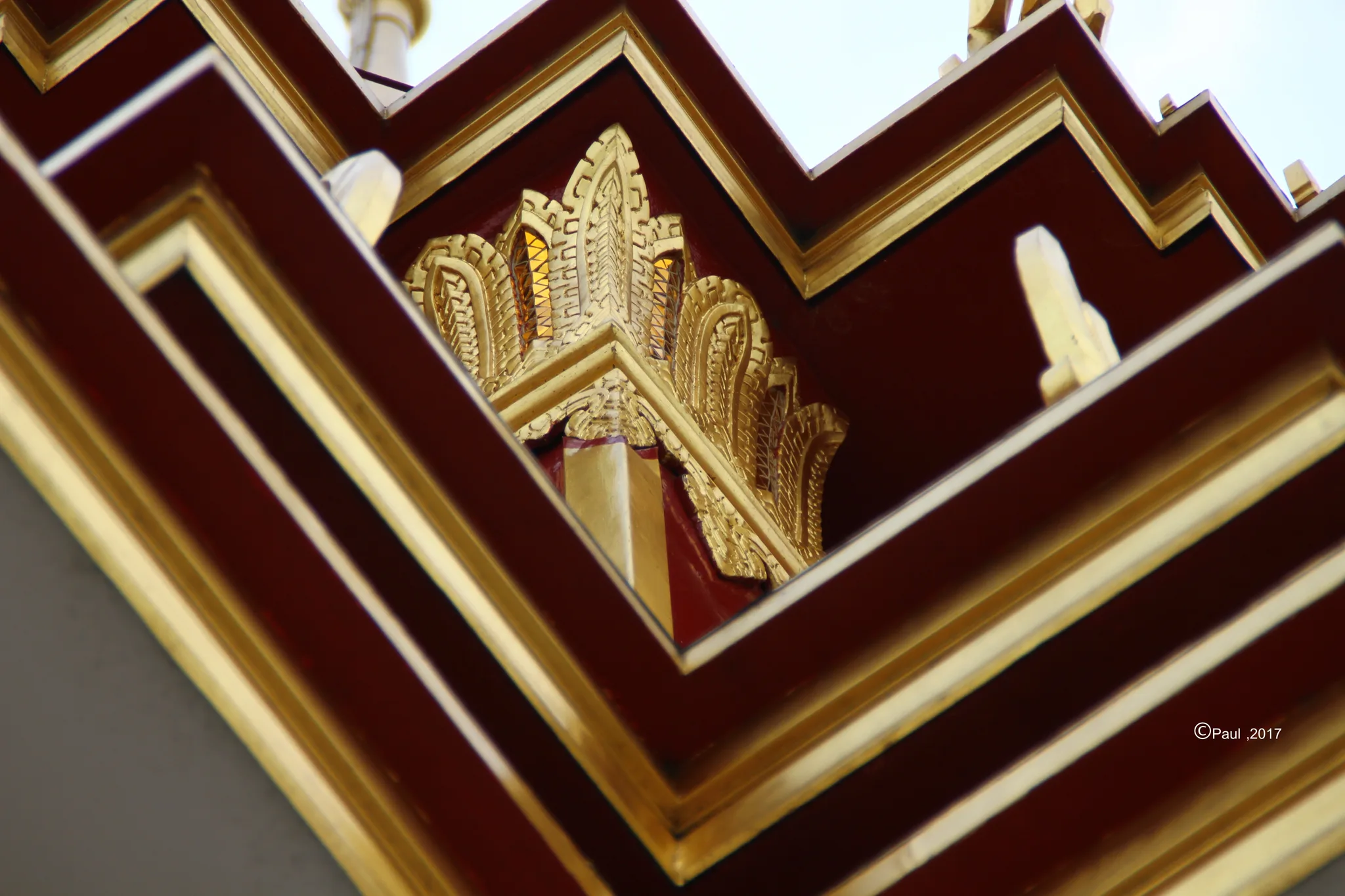
At Wat Ratchanatdaram (Loha Prasat), stacked stepped cornices lacquered in red and edged with gilded mouldings; at the corner, an openwork gilded flame-shaped ornament crowns a pillar, while small gilded finials punctuate the edges.Pattharapol louhuraikul — Wikimedia Commons, CC BY-SA 4.0 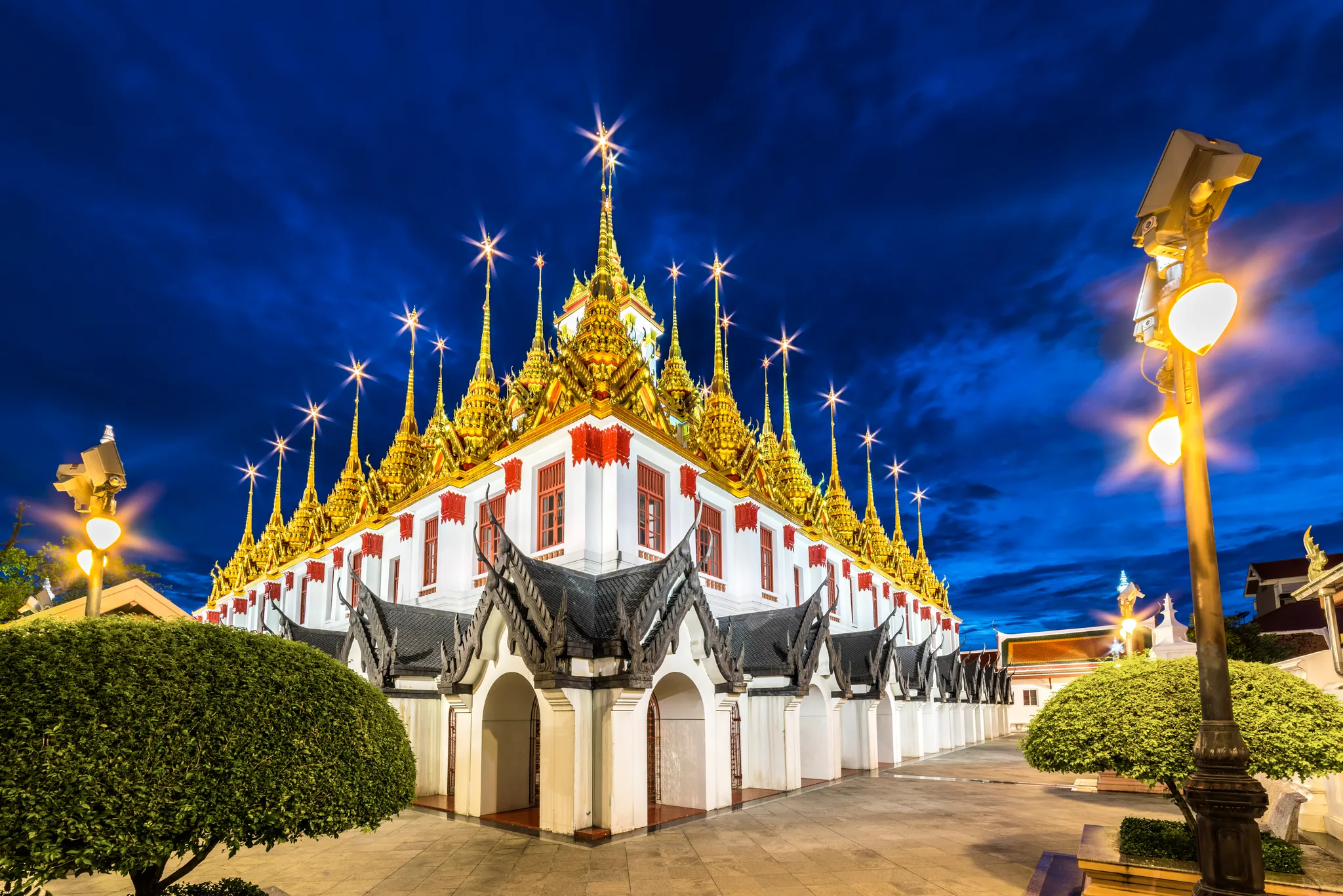
Wat Ratchanatdaram (Loha Prasat) lit at dusk: white walls with red windows, tiers of gilded spires and an arcaded gallery beneath dark gabled roofs, set in a paved courtyard lined with clipped shrubs.BerryJ — Wikimedia Commons, CC BY-SA 4.0
Architecture and decoration
Explore the heritage
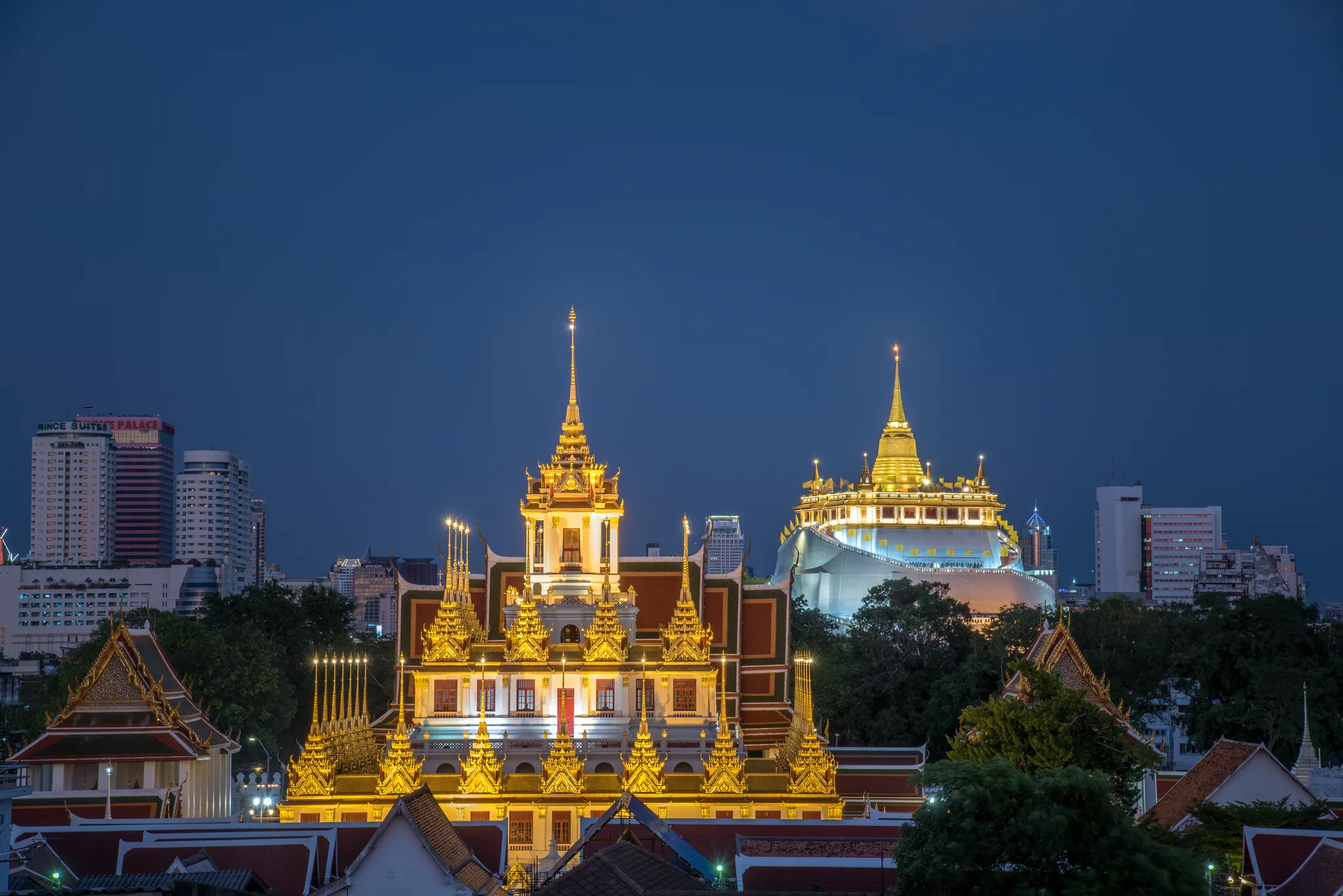
At dusk, Wat Ratchanatdaram (Loha Prasat) appears illuminated above the monastery roofs, its tiers bristling with golden spires; behind it stand a gilded chedi on a mound and the city’s tower blocks.Nawit science — Wikimedia Commons, CC BY-SA 4.0 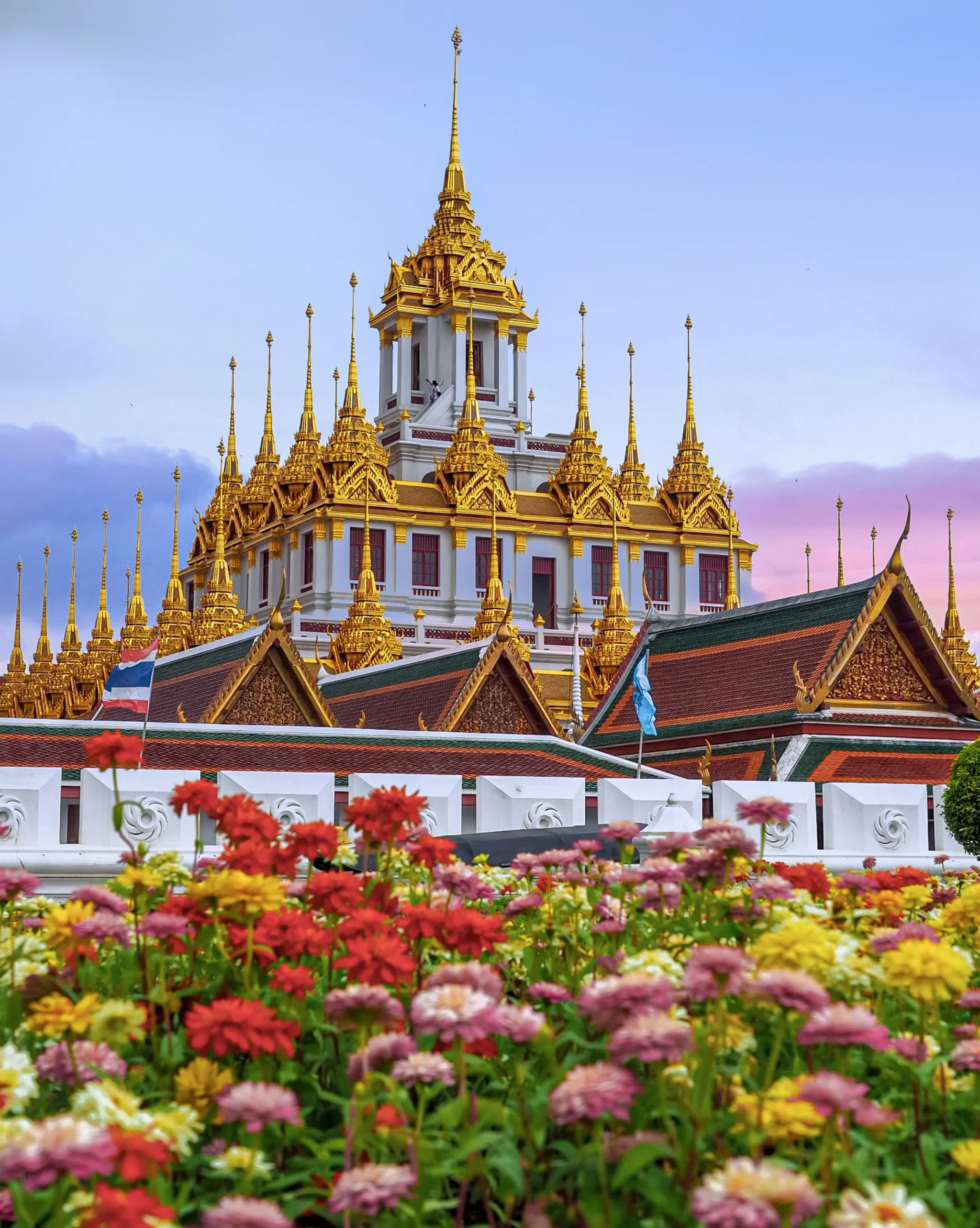
At Wat Ratchanatdaram (Loha Prasat), the tiered white building bristles with gilded spires; in front of it rise roofs of red and green tiles with gilded gables, a white wall decorated with rosettes and a bed of flowers.Athichitra — Wikimedia Commons, CC BY-SA 4.0