
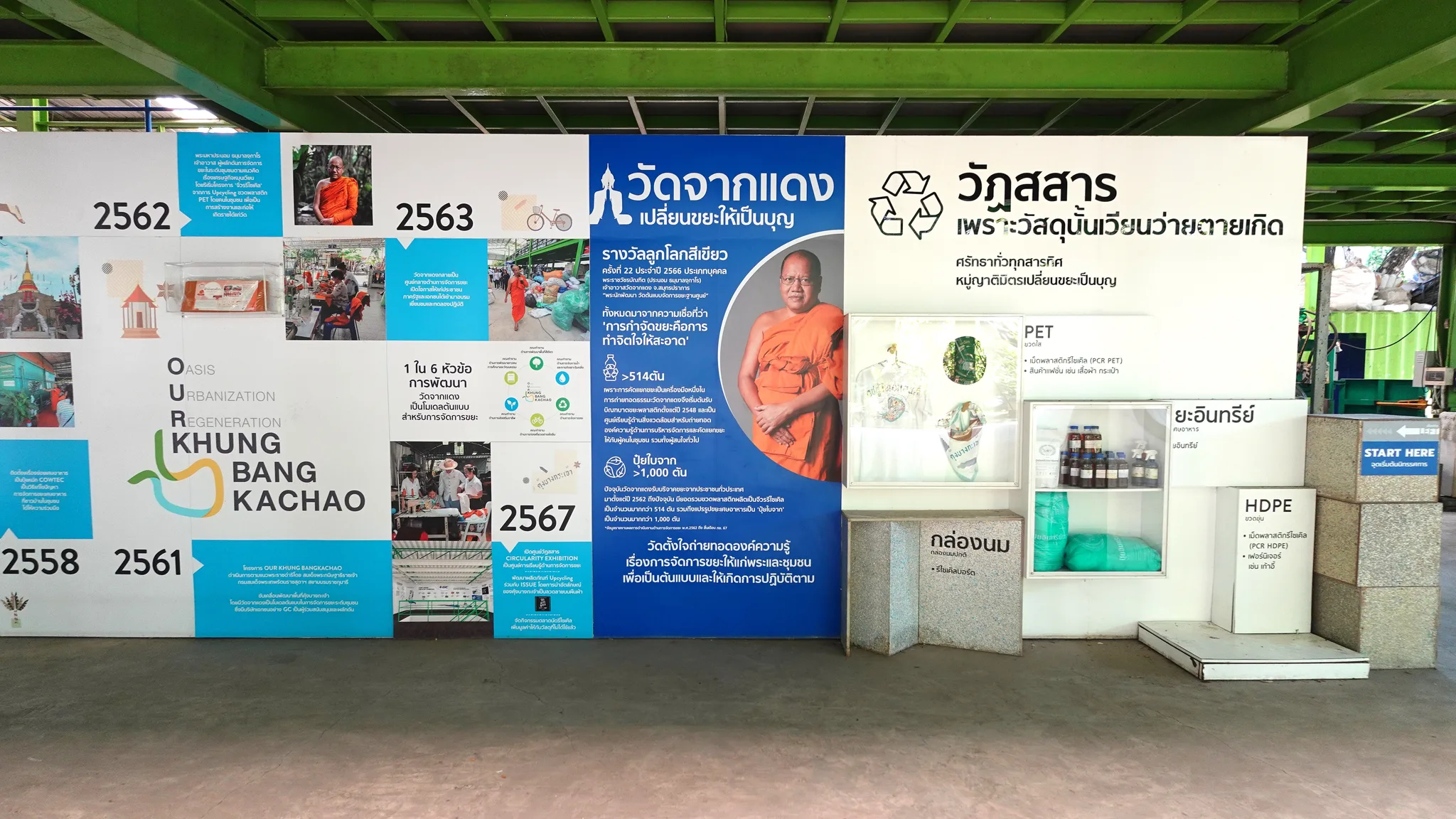
 Au Centre de Recyclage des Plastiques du Wat Chak Daeng, des panneaux en thaï présentent une frise datée et le portrait d’un moine en robe safran, tandis que des vitrines exposent des objets liés au tri du PET et du HDPE.© Eric Monteil
- Destination
- Samut Prakan (Phra Pradaeng)
- Heritage Family
- People and nature
- Typology
- Buddhist temple
- Visit
- Available tours →
The Wat Chak Daeng Temple Plastic Recycling Center is the waste-sorting and processing workshop of a Buddhist monastery in Samut Prakan province, near Bangkok. It matters because it has turned the plastic bottle into an offering: donated by the faithful, it becomes the thread of monks’ robes. The project began in the mid-2000s, when a monk set out to rid the temple of the waste cluttering it. It later expanded with a foundation and industrial partners. Today visitors find sorting bins, a bottle press, fabrics and saffron robes.
Key facts
- Destination
- Phra Pradaeng
- Heritage Family
- People and nature
- Typology
- Buddhist temple
- Places
- Chao Phraya River
- Samut Prakan
- Bang Krachao
- Periods
- People
- Phra Maha Pranom Dhammalangkaro
- Communities
- Entreprise communautaire de Wat Chak Daeng
- Communauté monastique de Wat Chak Daeng
- Events
- Lancement de la campagne de collecte de bouteilles de Wat Chak Daeng
- Mise au point de la nano-robe
- Heritage
- —
- Glossary
- Wat
- Khlong
- Royal temple
- Ordination
- Sangha
- Ubosot
- Keywords
- —
- Date
- —
- Collections
- —
Practical info
Practical information about this site is taken from its Google Maps page. We advise you to check it before visiting.
- Address
- 16 Moo 6, Phetchahung Road, Tambon Song Khanong, Amphoe Phra Pradaeng, Samut Prakan 10130
- Phone
- Website
A monastery on the bend of the Chao Phraya
An island of greenery near Bangkok
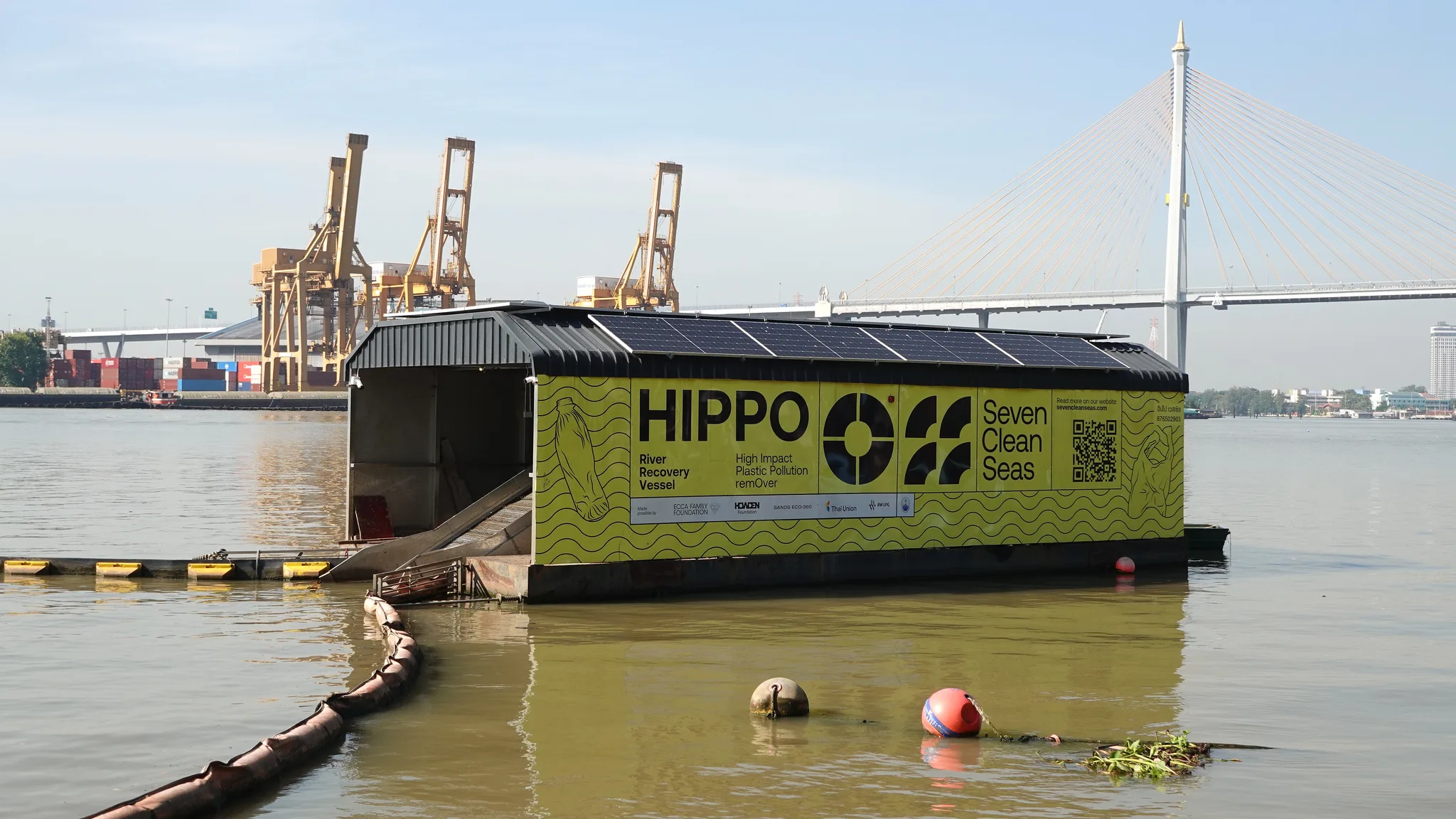
Wat Chak Daeng stands in Phra Pradaeng district, Samut Prakan province, on the banks of the Chao Phraya, near the Khlong Lat Pho canal and the Bhumibol Bridge. Here the river forms a wide loop enclosing a landscape of orchards and coconut groves, Khung Bang Krachao. The temple community describes this meander as a stomach-shaped island and presents it as the last great green lung close to the capital. The Chaipattana Foundation, which runs a programme to protect the area, likewise speaks of the ‘green lung of Bangkok’. To the west, the monastery is bordered by the Khlong Chak Daeng canal, which shares its name.14
The temple covers some two and a half hectares amid coconut palms. Its waterside position has shaped its recent history. Every tide deposits in front of it whatever the Chao Phraya carries: bottles, plastic bags, branches, pieces of glass. The unspoilt landscape of Bang Krachao thus also receives waste it does not itself produce. It was from this contrast that the project which made the temple known far beyond its province began.11
A common temple and its buildings
Wat Chak Daeng is a wat ratsadon, a ‘common temple’, that is, a monastery that is not one of the royal temples. It belongs to the Mahanikai order, one of the two main branches of the Buddhist clergy in Thailand. The community dates its official existence to the late eighteenth century: around 1787, the temple received the wisungkhamsima, the royal grant of the consecrated ground on which an ordination hall may be built. The date remains approximate, but it places the monastery among the older foundations on this bank of the river.14
The oldest datable building is the ubosot, the ordination hall in which ordinations and the major rites of the monastic community are held. Built in 1858 and restored in 1961, this elongated building measures nearly eight metres by twenty-four; its pediment is decorated with blue-and-white ceramics. The monks live in kuti, individual or shared lodgings, of which the temple has three. The principal image, that is, the most venerated Buddha statue in the monastery, is called Luang Pho Hin. It is housed in the wihan, the worship hall open to the faithful, having been found during excavations carried out around the old ubosot.15
A vocation for teaching
Before it became associated with recycling, Wat Chak Daeng was a monastery of study. It houses the Bodhiyalai Institute and a centre devoted to the Abhidhamma, the part of Buddhist teaching that analyses the mind and phenomena. The monks follow the official examination curricula of the Sangha, the community of Buddhist monks, and lay people can attend weekend classes on the Abhidhammatthasangaha, a classic manual summarising this doctrine. This tradition of study sheds light on how recycling would come to be conceived at the temple: as a subject to be taught as much as a task to be done.13
From waste to the birth of a centre
A monk faced with a cluttered compound
In 2005, a monk settled at Wat Chak Daeng to teach and to manage it: Phra Maha Pranom Dhammalangkaro (born 1965). A native of Nakhon Ratchasima province, ordained in 1986, he trained in Thailand and then in Burma, at Amarapura and Yangon, and reached the sixth level of the Pali examinations, Pali being the language of the canonical texts of Theravada Buddhism. It was thus a specialist in doctrinal teaching who arrived at the temple. He found a compound full of waste.19
Rather than simply having this waste removed, Phra Maha Pranom set about sorting and managing it on site. By 2019 he had been doing so for more than thirteen years. Over those years his role changed: first in charge of managing the monastery, he became its abbot and received the title of Phra Ratchawatcharabandit. This career closely ties the history of the recycling centre to that of one man and to his religious authority within the community.4
From compost to systematic sorting
The work began with everyday waste. Food scraps and vegetables from the temple kitchen were turned into compost, and the rubbish brought in by the tides was collected in front of the monastery. The monks then looked for ways to give new value to what they gathered. Sorting gradually extended to many materials: plastic bags, food cartons, glass bottles, polystyrene, paper, cardboard, aluminium cans. Some of the paper and glass is sold on to be recycled elsewhere.11
The temple equipped itself accordingly. It bought two shredders to break down the dead leaves of its wooded compound, and set up a large sorting warehouse and a composting machine for food waste. Over the years, the monastery thus became a religious site that doubled as a complete waste-management centre. But it was one material in particular, the plastic of bottles, that would give the project its new dimension.9
From bottle to monastic robe
A campaign launched around 2018
Around 2018, the temple launched a campaign to collect bottles for making monks’ robes. The initiative grew as partners came on board. The petrochemical company PTT Global Chemical visited the temple and joined the project, which became part of the ‘Our Khung Bang Krachao’ programme launched that same year by the Chaipattana Foundation for the area within the river bend. The act of sorting, born of a local problem, thus joined a broader effort to protect Bang Krachao.2
The idea rests on a simple choice: to transform the most visible waste into the most symbolic object of monastic life. The robe, traditionally offered by lay people to monks, becomes the destination of the collected bottles. The plastic no longer leaves the temple’s circle for an anonymous recycling chain; it returns as cloth, worn by the very people who sorted it.
From PET to fabric
Only PET, the clear plastic of water and drinks bottles, is used to make the fabrics. The caps, made of a different plastic, high-density polyethylene, are set aside. The bottles are cleaned and pressed into blocks before being turned into yarn. These synthetic fibres are then woven with cotton to produce a cloth in the saffron colours of monastic robes.3
How many bottles does it take to clothe a monk? The figures put forward vary, and the variation lies chiefly in what is being counted. A sign at the temple states that fifteen one-and-a-half-litre bottles are enough for one robe, that is, a piece of cloth about two metres long. But a Thai monk’s attire is a trai chiwon, a set of three pieces comprising the lower robe, the upper robe and the large outer robe folded over the shoulder. For a complete set, estimates rise to around sixty bottles, or about a kilogram of plastic. These discrepancies reflect less a contradiction than the difficulty of translating a length of cloth into a number of objects.18
The nano-robe and the masks of 2020
The process evolved. In 2019, after three years of trials, Phra Maha Pranom developed a ‘nano-robe’ combining recycled plastic, cotton and zinc oxide nanoparticles. The monk, then, did not merely take up an existing technique: he sought to improve the cloth itself, blending religious learning with textile experimentation.6
In March 2020, at the start of the Covid-19 epidemic, the temple adapted its production and made masks from recycled fabric. The monk Chamnanwej Sutthiyano wore one of these masks and inscribed a Buddhist formula on it, turning a sanitary object into a vehicle of religious protection. The episode shows the adaptability of a workshop able to respond to a new need within a few weeks, while keeping the link between recycled material and the religious word.7
Recycling as religious practice
Giving a bottle, making merit
At the heart of the project lies the notion of merit, the benefit accumulated through virtuous acts that shapes the religious practice of Buddhist lay people. Giving a bottle to the temple is presented as a meritorious act, and the robe woven from these bottles can then be offered to monks, renewing one of the oldest gifts in the tradition. The company OCC, indeed, named its initiative ‘Waste into Merit’, under the supervision of Arjan Suwan Rojana, the project’s manager.22
The faithful have several ways of taking part. They can drop their bottles off at the temple, send them by post or, from six or seven large bags upwards, request a collection in the surrounding area. The temple asks them to remove caps and labels, cut off the neck ring and flatten the bottles. Companies also contribute: in 2021, PTT Global Chemical invited the public to donate bottles on the occasion of Asalha Bucha, the festival commemorating the Buddha’s first sermon, and the firm Gunkul Engineering handed over a batch of bottles to the temple. Despite these contributions, the faithful’s demand for recycled robes exceeds the quantities collected.17
Teaching the dhamma through waste
For Phra Maha Pranom, this work belongs to the Buddha’s teaching. He aims to use the problem of waste to pass on the dhamma, Buddhist doctrine, starting from a reality familiar to everyone. Sorting, the care given to a bottle before it is donated, the passage from refuse to cloth become opportunities to speak of attentiveness, responsibility and detachment. The monastery of study thus extends into a workshop.5
This teaching is also practised beyond the compound. The temple organises clean-up days on the Chao Phraya; one of them brought together more than a hundred people aboard boats. The river, which once carried waste to the monastery’s door, becomes the setting for a collective effort in which monks and lay people come together around a shared task.18
A community economy
The community enterprise and its artisans
Making and selling the robes is not directly the monks’ business. Financial matters are entrusted to the Wat Chak Daeng community enterprise, a local body that involves residents in the project. Among its core members is Nirut Anathamsombat, a former owner of a monastic robe factory, whose experience of the trade has supported the transition from plastic to cloth. Volunteer seamstresses assemble the robes, and the project provides a source of income for people with disabilities.3
The workshop produces more than robes. It also makes cloth bags, blankets, yellow polo shirts, T-shirts and blue sarongs with traditional patterns, as well as furniture. In 2019, the temple also produced Thai fabrics presented as eco-friendly. It makes amulets too, the phra khrueang, small sacred images that the faithful carry on their person. Recycled material thus enters both everyday clothing and devotional objects.4
Industry and foundation
The project relies on a network of partners. PTT Global Chemical is one of its main supporters, and the Chaipattana Foundation has included it in its programme for Khung Bang Krachao, which brings together some thirty companies. The retail group Central Tham has also joined. Other companies, such as Gunkul Engineering and OCC, contribute through occasional donations of bottles.4
These alliances have given the centre a visibility far greater than that of a provincial common temple. They have also helped make the Wat Chak Daeng Temple Plastic Recycling Center an example cited abroad. The ocean conservation organisation Ocean Conservancy has praised its practical contribution to the fight against plastic pollution and its role in raising public awareness.5
The centre today
What can be seen on site
Visitors find a monastery where religious spaces and workspaces sit side by side. Near the ubosot with its ceramic-decorated pediment and the wihan of Luang Pho Hin, an area is set aside for unloading donated bottles. Further on, baskets and bins are used for sorting, a press compacts the bottles into tight bales, and a large warehouse holds the materials awaiting processing. A sign recalls that fifteen bottles are needed for one robe.4
This coexistence is what makes the place unique. Nothing clearly separates the world of prayer from that of waste: the monks who study the Abhidhamma are also those who sort, and the faithful who come to make an offering often bring bags of bottles. The centre can be understood only within the monastery that houses it.
An ongoing activity
The volumes handled quickly reached a considerable scale. In September 2019, the temple estimated that it had diverted some forty tonnes of plastic from waste since the campaign began. By early 2020, at least eight hundred sets of robes had been produced, and the temple was receiving some fifteen tonnes of bottles each month.2
The activity did not stop after these years of intense media attention. Bottle donations continued in 2021 and beyond, driven by corporate campaigns and by the faithful. Wat Chak Daeng is now presented as a model of the contemporary temple, at once a religious centre and a complete waste-management centre, whose abbot, Phra Maha Pranom, continues to combine the study of doctrine with work on material.10
Understanding
The Wat Chak Daeng Temple Plastic Recycling Center cannot be understood without the monastery that houses it: a common temple in Bang Krachao, with its monks, its teaching of doctrine and its faithful. Sorting, pressing and weaving become opportunities for teaching, and the donated bottle joins the very ancient tradition of offerings to monks. It is this union of ecological gesture, religious merit and community work that makes the place distinctive, far more than technical prowess alone. Its future depends on forces it does not control on its own: the waste the Chao Phraya continues to bring, the companies that supply bottles and support the project, a demand for robes that already exceeds collection, and the green landscape of the river bend that the temple claims as its setting. Can a robe woven from plastic become, for generations to come, a sign of monastic life as rich in meaning as the cloth of old?
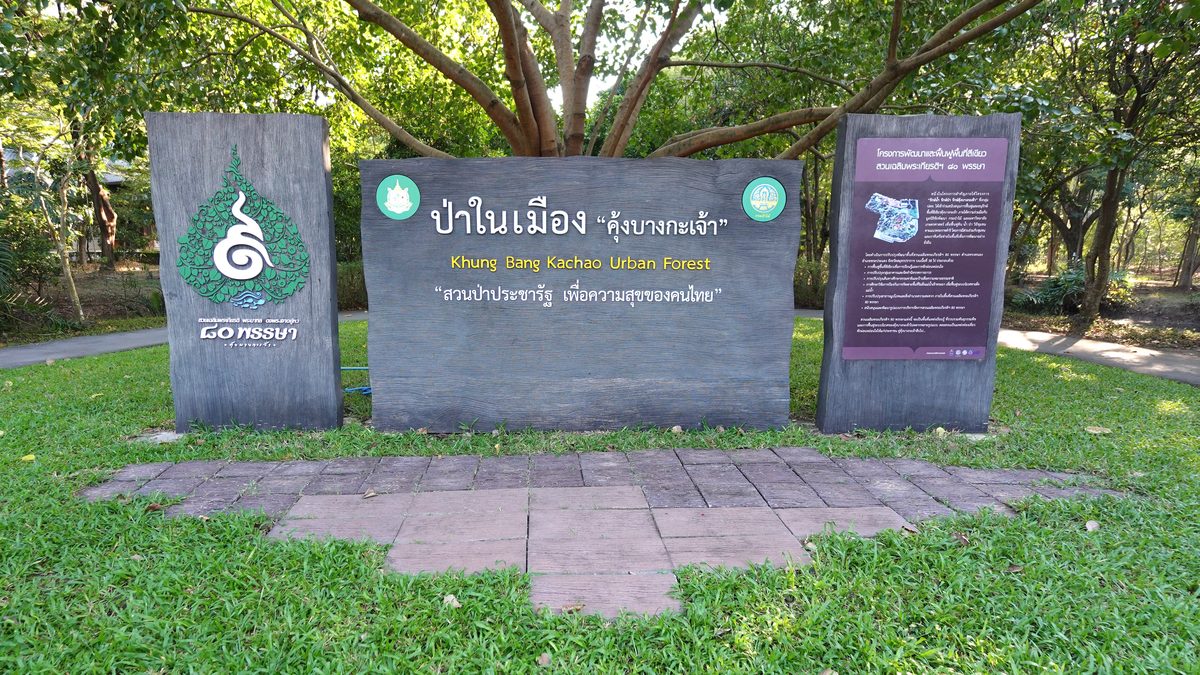
Bang Krachao, the "green lung" of Bangkok, between canals, Mon heritage, temples, biodiversity and sustainable initiatives.
- Wat
- Buddhist monastic complex that brings together, within a single enclosure, several religious buildings, monks’ quarters and ancillary buildings; the word does not refer to a single building.
- Khlong
- Canal or waterway, natural or man-made, which long played a major role in transport, irrigation and the organisation of settlements and territories in Thailand.
- Royal temple
- In Thailand, a Buddhist temple founded, restored or patronised by the king or the royal family, and graded according to an official hierarchy of ranks and categories.
- Ordination
- Ceremony by which a layperson is admitted as a novice or as a monk into the Buddhist community.
- Sangha
- The body of monks who reside in a monastery and live there according to religious discipline; in Buddhism it is called the sangha.
- Ubosot
- Consecrated ordination hall of a wat: the ritually central building, marked out by sacred boundary stones, where monastic ordinations take place.
- Kuti
- Cell or dwelling of a Buddhist monk within the precinct of a monastery.
- Buddha image
- In Thai Buddhism, a devotional representation of the Buddha, most often a statue, venerated as an object of worship.
- Amulet
- A small object worn or kept for its protective value.
- Wat ratsadon
- A Thai Buddhist monastery that does not belong to the category of royal temples; it is also called a ‘people’s temple’.
- Mahanikai
- One of the two main branches, or orders, of the Buddhist clergy of Thailand.
- Wisungkhamsima
- A royal grant of the consecrated ground on which a monastery may build an ordination hall.
- Abhidhamma
- The part of Buddhist teaching that analyses the mind and phenomena.
- Dhamma
- Buddhist doctrine, that is, the teaching of the Buddha.
- Pali
- The language of the canonical texts of Theravada Buddhism.
- Theravada
- A branch of Buddhism whose canonical texts are written in Pali.
- Merit
- In Buddhism, the benefit accumulated through virtuous acts, which structures the religious practice of lay people.
- Trai chiwon
- The garment of a Thai Buddhist monk, made up of three pieces: the under-robe, the upper robe and the large outer cloak folded over the shoulder.
- Asalha Bucha
- A Buddhist festival commemorating the Buddha’s first sermon.
Studies
- 1The perils of plastic, Bangkok Post (via PressReader), 2019 ↗
- 2This Temple Recycles Plastic Bottles Into Monk Robes, Khaosod English, 2019 ↗
- 3Bottling for Buddhism, Bangkok Post ↗
- 4From humble plastic bottles to highly desirable monks' robes, Bangkok Post ↗
- 5Buddhist temple recycles plastic bottles into monks' robes, CBC News, 2020 ↗
- 6Samut Prakan monk makes 'nano-robes' from recycled plastic bottles, Thai PBS World ↗
- 7AFP, Thai monks make virus masks from recycled plastic, The Jakarta Post, 2020 ↗
- 8'จีวร วัดจากแดง' เครื่องนุ่งห่มพระสงฆ์ที่ทำจากขวดพลาสติก, The Standard ↗
- 9แนวคิดวัดสมัยใหม่ของ 'วัดจากแดง' ศูนย์กลางศาสนาและศูนย์จัดการขยะครบวงจร, National Geographic Thailand ↗
- 10GC ชวนทำบุญวันอาสาฬหบูชา "บริจาคขวดน้ำพลาสติก ทำจีวรรีไซเคิล", MGR Online (Manager), 2021 ↗
- 11จีวรรีไซเคิล จากขยะพลาสติก สู่ผ้านุ่งห่มแห่งธรรมะที่รักษ์โลก, ESG Universe ↗
- 12เซ็นทรัล ทำ x วัดจากแดง : การแก้ปัญหาสิ่งแวดล้อมและการว่างงานด้วยขยะพลาสติก, Readthecloud ↗
- 13สถาบันโพธิยาลัย วัดจากแดง...'วัดปริยัติ-วัดปฏิบัติ', Komchadluek ↗
Reference works
- 14Wat Chak Daeng, ประวัติ วัดจากแดง, watchakdaeng.com, 2017 ↗
- 15Contributeurs Wikipédia, วัดจากแดง, Wikipédia en thaï ↗
- 16Wat Chak Daeng, ประวัติเจ้าอาวาสวัดจากแดง พระราชวัชรบัณฑิต (ประนอม ธมฺมาลงฺกาโร), watchakdaeng.com, 2020 ↗
- 17Wat Chak Daeng, จัดส่งขวดพลาสติกมาร่วมบุญ ทางพัสดุไปรษณีย์, watchakdaeng.com, 2020 ↗
- 18Luke Duggleby (photographies), Phra Mahapranom Dhammalangaro: From Waste to Robes, Climate Heroes ↗
- 19Meet the Monk, Who Recycles Plastic into Robes, Sacred Groves ↗
- 20Samut Prakarn's Wat Chak Daeng Recycles Plastic Bottles Into Monk Robes, Thailand Construction ↗
- 21Gunkul Engineering PCL, GUNKUL Donated PET Bottles to Wat Chak Daeng, Samutprakarn, Gunkul, 2021 ↗
- 22OCC PCL, OCC Transforms Waste into Merit: Turning Plastic Bottles into Monk Robes, OCC ↗
- 23Wat Chak Daeng, วัดจากแดง นำ ขวดพลาสติก ผลิต ผ้าไทยรักษ์โลก ช่วยลดขยะ ได้ถึง 15 ตันต่อเดือน (ข่าวสามมิติ), watchakdaeng.com, 2019 ↗
- 24Wat Chak Daeng, วัดจากแดง อ.พระประแดง จ.สมุทรปราการ (page d'accueil), watchakdaeng.com ↗
Further reading
Contemporary views
Wat Chak Daeng Temple Plastic Recycling Center today
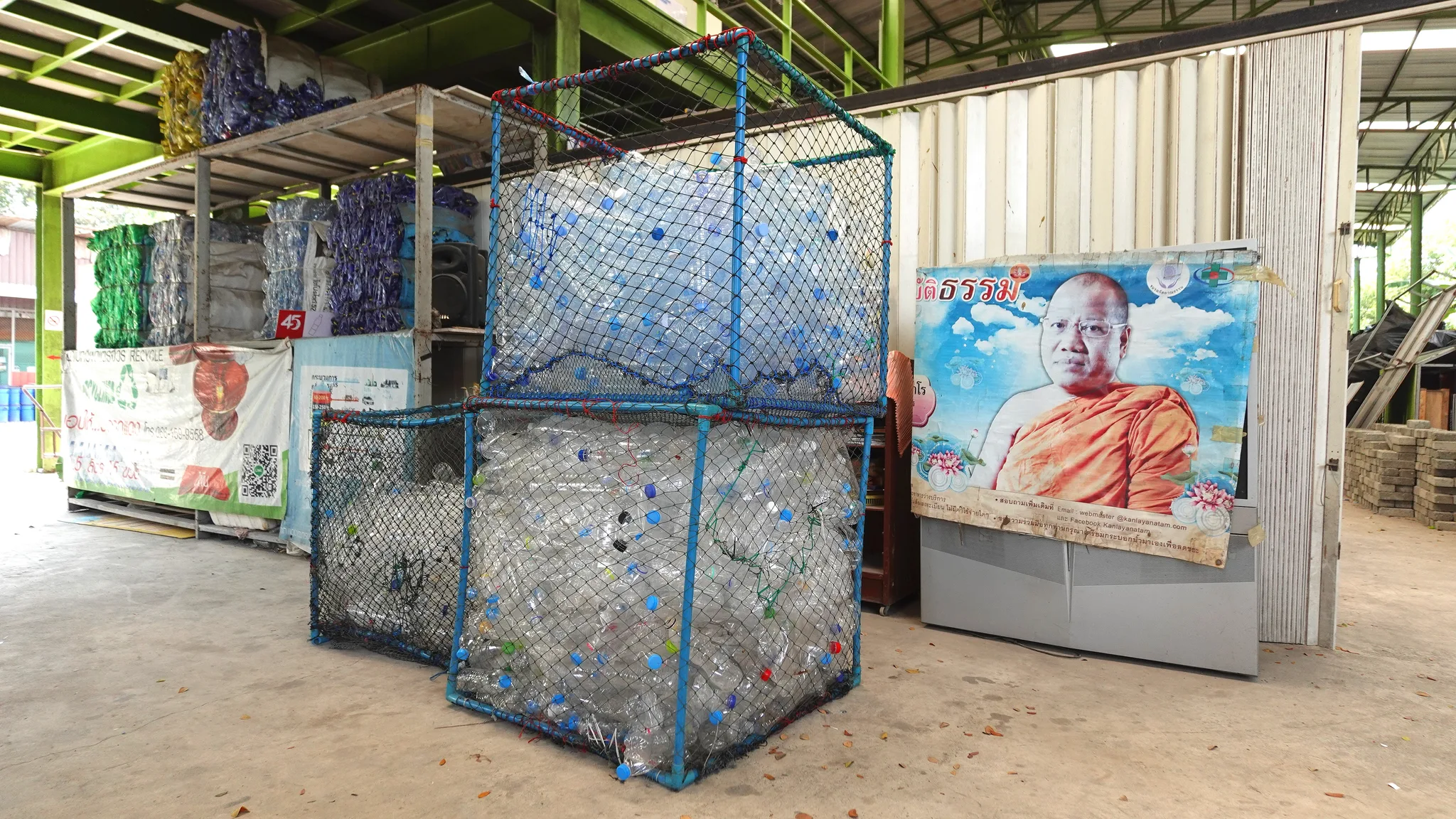
Sous la charpente métallique du Centre de Recyclage des Plastiques du Wat Chak Daeng, des cages grillagées collectent les bouteilles en plastique, tandis que des ballots triés s’empilent sur des étagères.© Eric Monteil 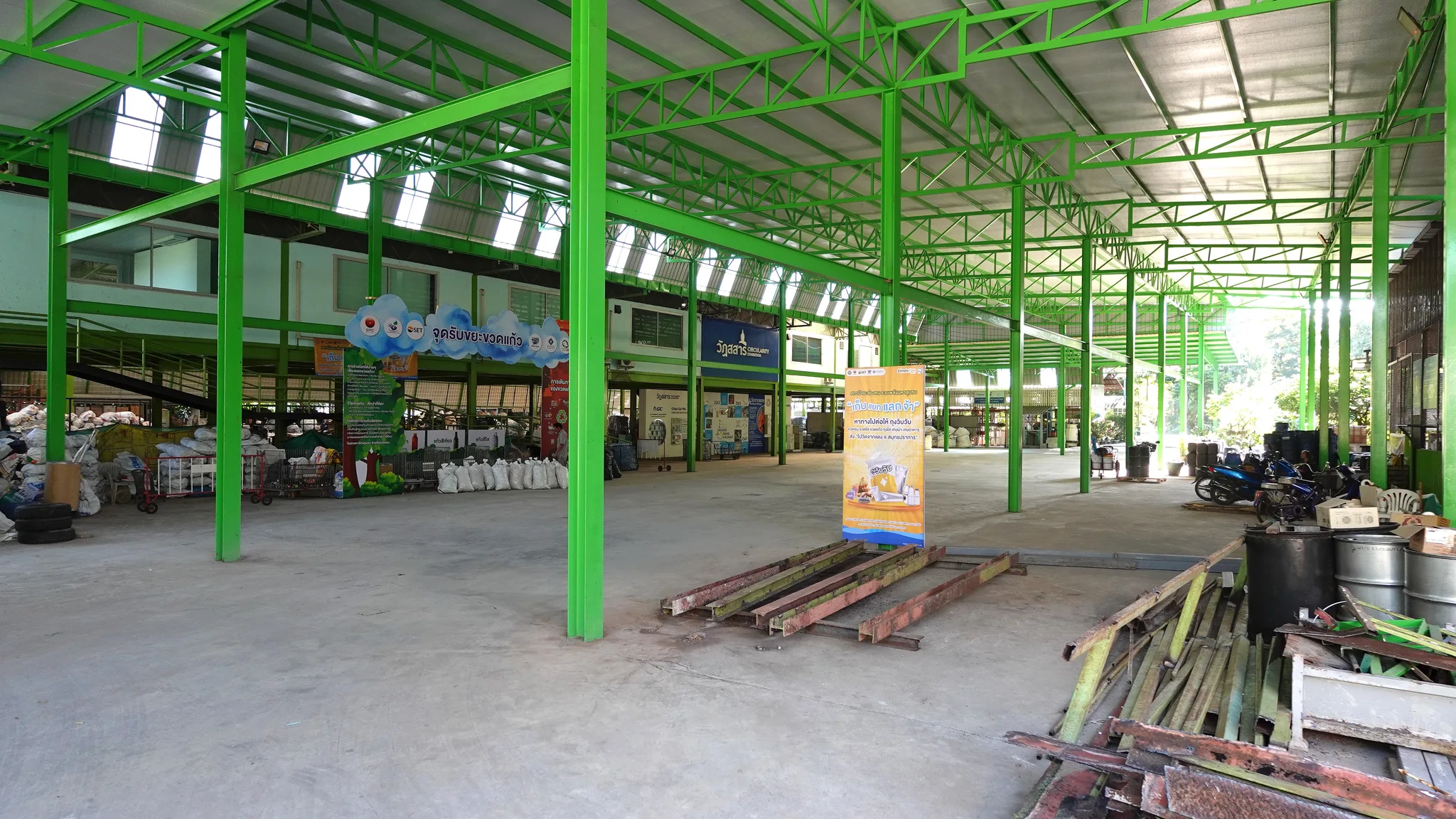
Au Centre de Recyclage des Plastiques du Wat Chak Daeng, un vaste hangar à charpente métallique verte abrite les sacs de matériaux collectés, des chariots et des panneaux d’information en thaï ; au premier plan, des pièces de métal et de bois en attente.© Eric Monteil
Architecture and decoration
Explore the heritage
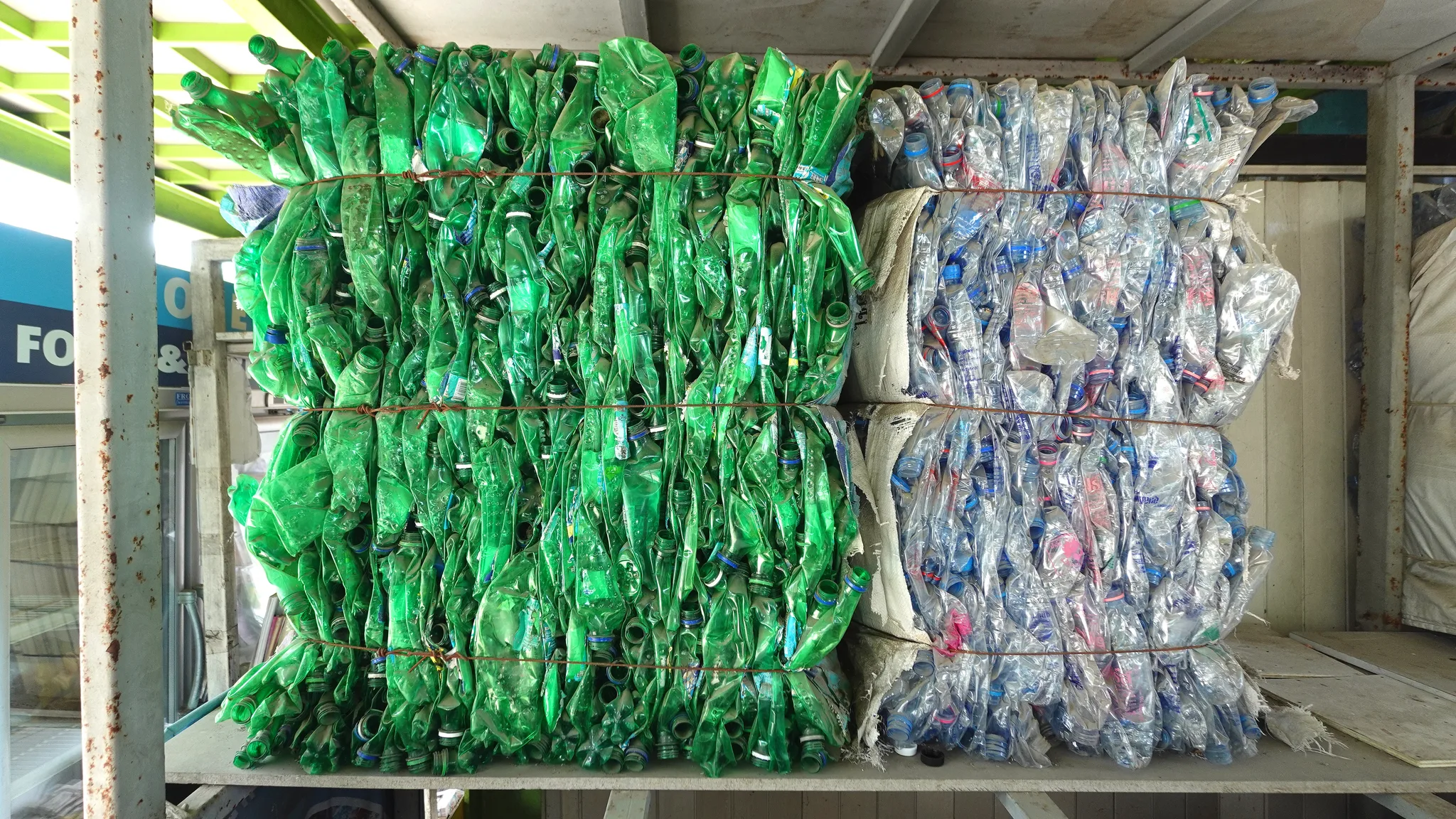
Au Centre de Recyclage des Plastiques du Wat Chak Daeng, les bouteilles usagées sont triées par couleur, vertes d’un côté, transparentes de l’autre, puis compressées et ficelées en balles stockées sur des étagères métalliques.© Eric Monteil 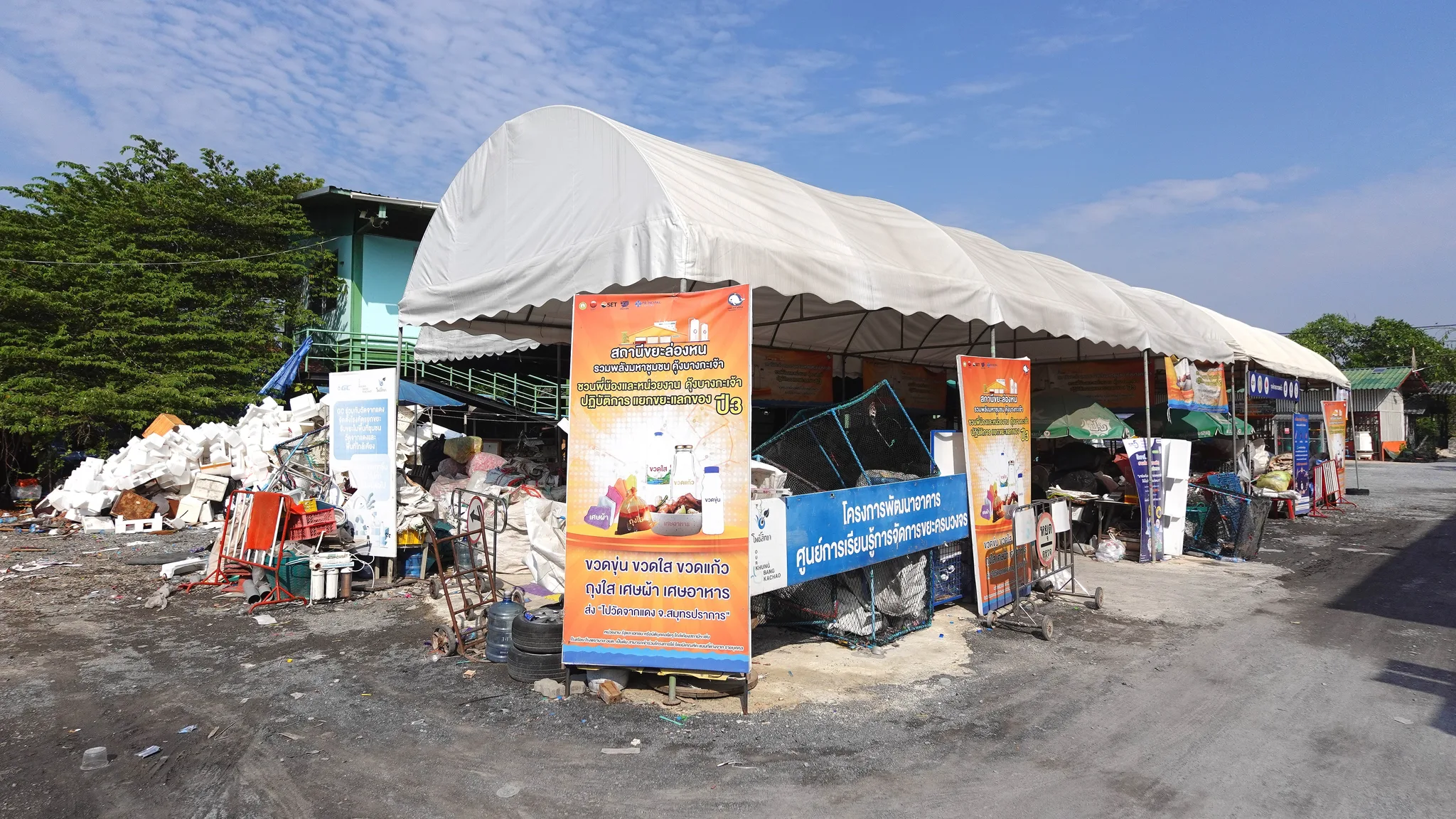
Au Centre de Recyclage des Plastiques du Wat Chak Daeng, une longue tente blanche abrite les points de collecte signalés par des banderoles en thaï ; blocs de polystyrène, sacs et bacs grillagés montrent le tri des déchets.© Eric Monteil