
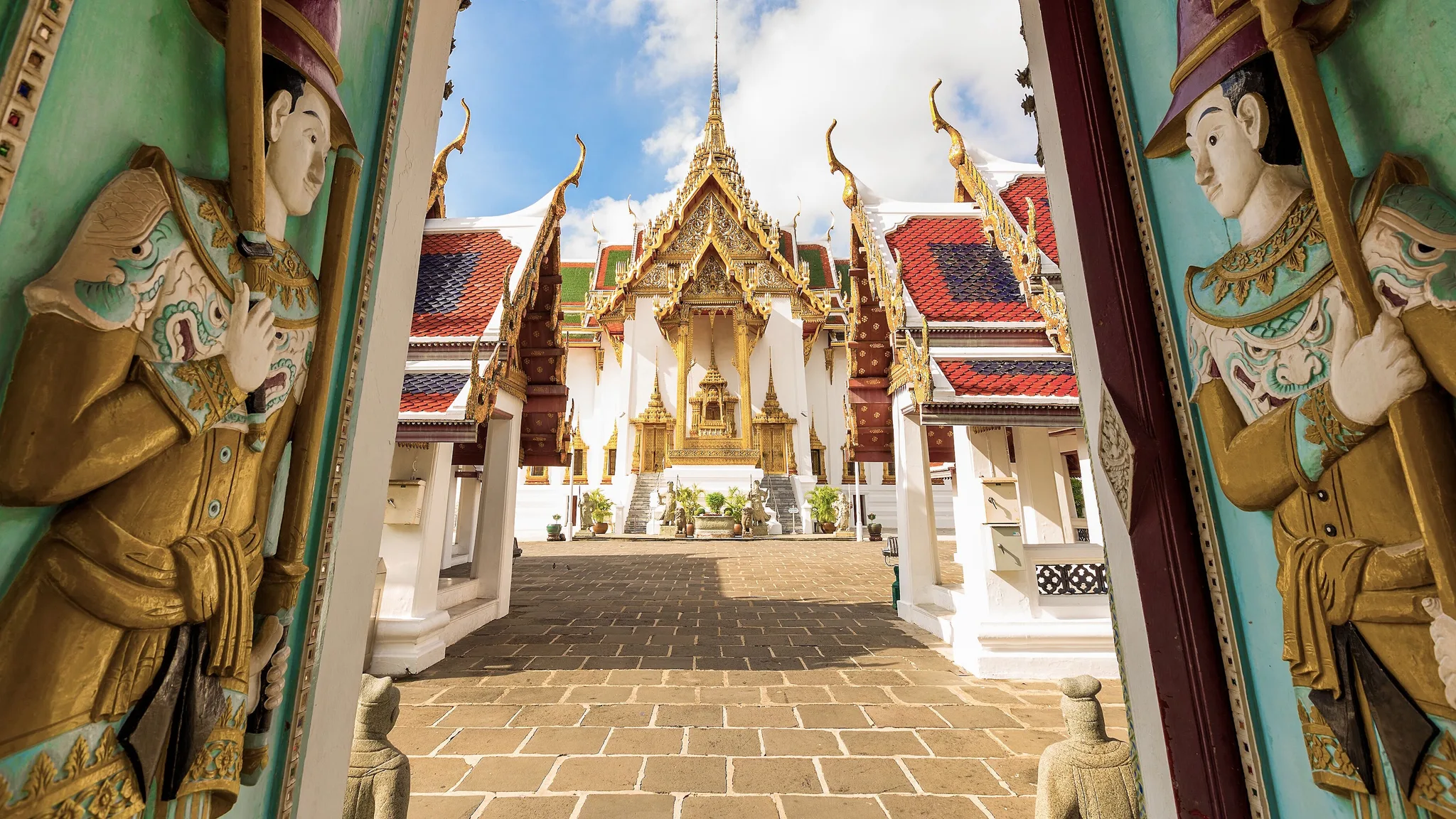
 Dusit Maha Prasat Throne Hall appears on the axis of a doorway whose leaves bear painted guardians on a green ground. Beyond the paved courtyard, its white and gilded façade, crowned by a spire, is framed by pavilions with red roofs.© Internet
Palace & royal residence
Dusit Maha Prasat Throne Hall
Built in the late eighteenth century on the site of Bangkok’s first throne hall, the Dusit Maha Prasat Throne Hall has passed from a place of audience to the place where the kings and queens of the Chakri dynasty lie before their cremation.
Heritage family · Architecture and built heritage
- Destination
- Bangkok (Phra Nakhon)
- Heritage Family
- Architecture and built heritage
- Typology
- Palace & royal residence
- Visit
- Available tours →
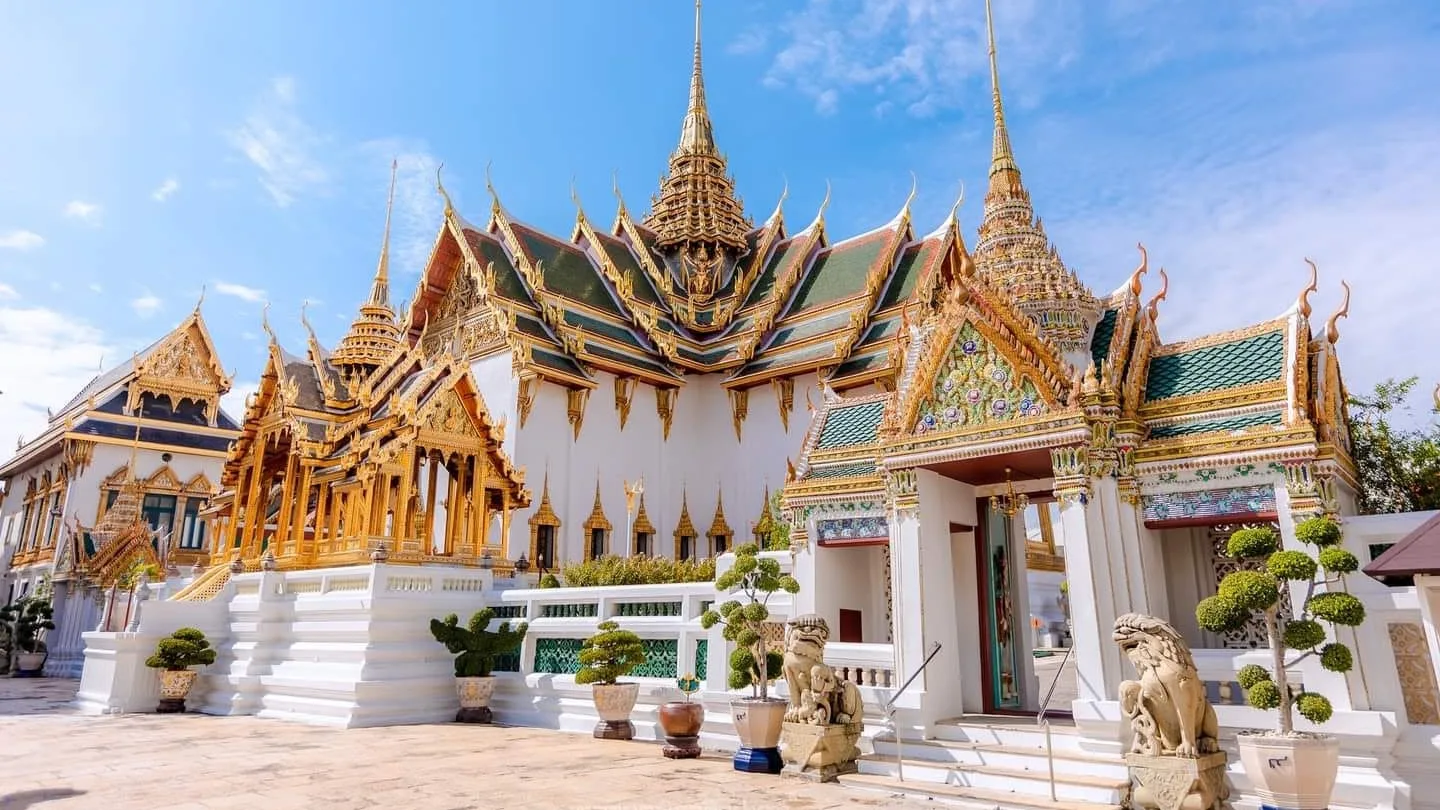
The Dusit Maha Prasat Throne Hall is one of the great royal halls of the Grand Palace in Bangkok. It is also the hall in which the kings and queens of the Chakri dynasty lie between their death and their cremation. King Rama I had it built in the late eighteenth century, on the site of the first throne hall of the new capital. It served at first for audiences and government, then became the setting for royal funerals, up to those of King Bhumibol and Queen Mother Sirikit. Its cruciform plan, its high base and its spire make it a model of the royal architecture of the first Chakri reign.3
Key facts
- Destination
- Phra Nakhon
- Heritage Family
- Architecture and built heritage
- Typology
- Palace & royal residence
- People
- Bhumibol Adulyadej
- Maha Vajiralongkorn
- Rama Ier
- Rama III
- Rama IV (Mongkut)
- Vajiravudh (Rama VI)
- Communities
- —
- Events
- Construction of the Dusit Maha Prasat Throne Hall
- Lying in state of Rama I (1809)
- Royal funeral of King Bhumibol Adulyadej
- Royal funeral of Queen Mother Sirikit
- Fire of the Amarinthraphisek Maha Prasat Throne Hall
- Sangkhayana under Rama III
- Heritage
- —
- Glossary
- Prasat
- Phra thinang
- Tusita
- Busabok
- Buddha image
- Awakening
- Keywords
- —
- Date
- —
- Collections
- —
Practical info
Practical information about this site is taken from its Google Maps page. We advise you to check it before visiting.
- Address
- พระที่นั่งจักรีมหาปราสาท 202 Thanon Maha Rat, Khwaeng Phra Borom Maha Ratchawang, Khet Phra Nakhon, Krung Thep Maha Nakhon 10200
- Phone
A throne hall at the heart of the Grand Palace
The principal building of the Phra Maha Prasat group
The Dusit Maha Prasat Throne Hall belongs to the Grand Palace in Bangkok (Phra Borom Maha Ratchawang), the palace of the kings of the Chakri dynasty. It stands in the Middle Court of the palace, on its western side. It lies to the west of the Chakri Maha Prasat, another throne hall adjoining it, with which it should not be confused. It is the principal building of a group known as Phra Maha Prasat. This group also includes the Phra Thinang Phiman Rattaya, built to the south, behind the hall, and linked to it by a gallery, as well as the Aphorn Phimok Prasat pavilion.8
Its Thai name, Phra Thinang Dusit Maha Prasat, signals its status at once. The term phra thinang denotes a building reserved for the sovereign, a royal hall or pavilion. The term prasat describes a building of royal honour, recognisable by its roof crowned with a spire. This spire signifies rank. Phra Phutthayotfa Chulalok, first king of the Chakri dynasty, known as Rama I, thus raised his audience hall to the rank of prasat by crowning it with a spire. In the hierarchy of the palace buildings, the very form of the roof therefore expresses the dignity of the hall.4
The Tusita heaven, abode of the future Buddha
The first word of the name, Dusit, refers to the Tusita heaven. In Buddhist tradition, this is one of the celestial paradises, the one in which the future Buddha dwells before his final birth on earth.14
The name has taken on a particular meaning since the hall began to receive royal remains. A symbolic reading draws the two together: to lay a king’s body in a hall bearing the name of the Tusita heaven would amount to evoking the abode of a future Buddha. This reading rests on the conception of the Buddha-king (phuttharacha). It is an interpretation of the hall’s name and use, not a feature of its architecture.14
The foundation under the first Chakri reign
After the fire in the first throne hall
The history of the hall begins with a destruction. On its site there first stood the Phra Thinang Amarinthraphisek Maha Prasat, the first throne hall of Rattanakosin. Struck by lightning, this building was entirely destroyed by fire. The king decided to rebuild on the same spot. Accounts differ: he ordered the construction of the new hall in 1789 according to some, in 1790 according to others.5
The destroyed hall had been the first throne hall of the capital. The Dusit Maha Prasat Throne Hall is thus among the oldest buildings of the Grand Palace. It is regarded as the oldest and most important hall of the palace, and as a model of the royal architecture of the first Chakri reign.2
The memory of the palaces of Ayutthaya
To build his hall, Rama I looked to the palaces of Ayutthaya, the former capital of the kingdom. Accounts differ, however, as to the precise model. According to some, the hall was built as tall and as large as the Phra Thinang Suriyamarin, or “Suriyat Amarin”, of the royal palace of Ayutthaya, built on a cruciform plan with equal arms and crowned by a central spire, the very plan the Bangkok hall reproduces. According to others, the model is the Phra Thinang Sanphet Maha Prasat, another great hall of the palace of Ayutthaya.2
There is nothing to decide between these two halls. The disagreement concerns the precise building that served as the example, not the principle.
Governing and keeping vigil over the dead
Under Rama I, the hall served first of all for governing. There the king gave his audiences and dealt with the affairs of the kingdom. From this first reign, it also took on another function. The king had the bodies of high-ranking princesses of his court laid there before their funerals, notably Chaofa Krom Phraya Thepsudawadi and Chaofa Krom Phra Sisudarak.9
On the death of Rama I, his own remains were laid in the hall he had built. This act founded a custom: the kings who succeeded him would in turn lie in the Dusit Maha Prasat Throne Hall. The throne hall of one reign thus became the place where homage is paid to departed sovereigns. Throughout the nineteenth century, the two functions coexisted. The hall remained a place of the court before its funerary use became its principal function.
Court usage, from Rama III to Rama VI
Rama III: a residence and a council
Under King Nangklao, Rama III, the Phra Maha Prasat group served as a residence. The king was then having the Phra Maha Monthien, another group of royal halls in the Grand Palace, restored. During the works, he took up residence in the group of the Dusit Maha Prasat Throne Hall and held his audiences there.6
Rama III also gathered monks there for a sangkhayana, that is, an assembly charged with revising the Tipitaka, the canon of scriptures of Theravada Buddhism. The same place thus served both for audiences and for religious work.6
Rama IV and Rama VI: the ceremonial of the porches
King Mongkut, Rama IV, regulated the use of the hall during ceremonies with precision. Each of the porches at the ends of the arms of the cross was assigned a function. The north, east and west porches served as audience halls for the men of the court, the south porch for the women. The cruciform plan thus served to separate the groups of the court according to fixed rules. The king also had a throne niche, the Phra Banchon Busabok Mala, built in the middle of the south wall.6
To the north, the hall has a particular porch, the mukh det, which projects outwards and is used for royal appearances. Another busabok mala throne is installed there. In 1911, King Vajiravudh, Rama VI, gave a public audience from this throne in the north porch. At the beginning of the twentieth century, then, the hall was still a place where the sovereign showed himself to his subjects. It was not yet devoted chiefly to the memory of departed kings.2
Reading the architecture
A cruciform plan on a high base
The hall follows a cruciform plan with equal arms, known in Thai as chaturamukh, literally “four-faced”. The four arms extend from a common centre, above which the spire rises. To the north, the porch for royal appearances projects beyond this regular plan. The building is of rendered brick masonry and has only a single storey. The height of the building comes from its roof and its base, not from superimposed storeys.5
This base is nearly three metres high. Its mouldings combine two traditional profiles. The first, the lion’s paw (than sing), is a moulding whose shape recalls a lion’s foot. The second, the choeng bat, is a double plinth with profiles rounded like a bowl. The base raises the hall and those who stand within it.5
The spire and the roof decoration
The roof culminates in a prasat-type spire, the mark of royal rank. It bears the classic decoration of Thai roofs: chofa, bai raka, hang hong and nak sadung.5
It is often presented as the only building of purely Thai style in the Grand Palace, in a palace where other buildings have adopted different forms. This judgement presupposes a stylistic distinction between the buildings of the palace. It accords with the view that makes the hall a model of the royal architecture of the first Chakri reign.5
Thrones and insignia of kingship
The mother-of-pearl throne beneath the nine-tiered umbrella
At the centre of the hall stands the principal throne, the Phra Ratcha Banlang Pradap Muk, inlaid with mother-of-pearl. It was used for audiences held indoors. It is surmounted by a white nine-tiered umbrella, the insignia of sovereignty. Beneath this umbrella, since the reign of Rama IV, an image of Phra Kampuchat, the deity who guards the nine-tiered royal umbrella, has been installed. The throne is thus placed under the protection of a deity and beneath the very emblem of kingship.2
In the east arm, a state bed, likewise inlaid with mother-of-pearl, is used during ceremonies. Together, they show that the hall is not merely an architectural volume: its furnishings fix the places where the king sits, appears and receives.4
Two busabok mala thrones, to the north and to the south
The hall’s two busabok mala thrones face each other at either end of the north–south axis. The one in the north porch serves for public appearances, when the king shows himself to those outside. The one to the south is the throne niche created under Rama IV, in the middle of the wall. The first turns the sovereign towards the outside world; the second places him within the inner space of the court.2
One of these thrones recalls that of King Narai, sovereign of Ayutthaya, in his palace at Lopburi.4
The hall of royal funerals
The urn, the pedestal and the farewell
The custom founded on the death of Rama I has become the principal function of the hall. The bodies of kings, queens and high-ranking members of the royal family lie in state here. The body is placed in a funerary urn, the kot, set on a decorated pedestal, the bencha. The king’s remains are placed in the west porch. Queen Rambai Barni, consort of King Prajadhipok, Rama VII, also lay here. Together with the neighbouring Phra Thinang Phiman Rattaya, the hall forms the principal venue for state funerals.19
The time spent in the hall ends on the morning of the cremation. A farewell service is held there before the funeral procession leaves the palace. The hall is thus both the place where the deceased is watched over and the place from which they depart. The Bureau of the Royal Household organises the ceremonies held there.17
The mourning for King Bhumibol
The funeral of King Bhumibol Adulyadej, Rama IX, demonstrated the role of the hall in the life of the nation. After his death in 2016, the king’s body lay in state there for a year. Daily rites were performed there during the first hundred days. From the fifteenth day, the public was admitted to come and pay their respects. Up to 30,000 people a day then queued to pay their respects.15
On 28 February 2017, a Kong Tek ceremony, a Chinese Buddhist funerary rite, was held in the hall, presided over by King Maha Vajiralongkorn, Rama X, son and successor of the late king. Around the king’s body, the hall thus welcomed several of the religious traditions present in Thailand.15
The funeral of Queen Mother Sirikit
The hall once again hosted royal funerals in 2025. Queen Sirikit, consort of King Bhumibol and later Queen Mother, died on 24 October 2025. The ceremonies began in the hall two days later. From 9 November 2025, the public was admitted each day to pay their respects before the urn. As in 2016, the hall received both the rites of the court and the homage of the people.11
The Queen Mother’s cremation is scheduled for the end of 2026. The announced programme provides for a merit-making ceremony in the hall, followed by the transfer of the urn to the crematorium at Sanam Luang. Further ceremonies are then to take place in the hall, before the relics are placed in the Chakri Maha Prasat. Between these great periods of mourning, the hall remains on the official visitor route of the Grand Palace.10
Understanding
The Dusit Maha Prasat Throne Hall sums up in a single building the history of the monarchy established in Bangkok. Rama I built it on the model of the halls of Ayutthaya, to govern and to receive. His successors held audiences there, gathered monks there and showed themselves to the people there. From his first reign, it was also the place where the dead of the royal family were watched over. Over the generations, this function has become the principal one: the hall of power is today the one where kings and queens lie before their cremation. The funerals of King Bhumibol and then of Queen Mother Sirikit drew crowds of visitors there every day. It also remains on the palace’s visitor route. The same place thus serves national mourning, the rites of the court and the discovery of heritage. Between a site of dynastic memory, a sacred space and a visited monument, what meaning will the hall hold for the generations who have not lived through these great periods of mourning?
Rattanakosin, from the royal citadel of 1782 to the historic districts that shaped contemporary Bangkok.
- Prasat
- In Thai architecture, a building or canopy with tiered roofs crowned by a spire, a form reserved for sacred images and for royalty.
- Phra thinang
- Thai term denoting a hall or pavilion reserved for the sovereign, notably a throne hall.
- Tusita
- In Buddhist cosmology, the heaven where bodhisattvas dwell before their final earthly birth.
- Busabok
- Thai throne in the form of a small pavilion, covered by a tapering spired roof.
- Buddha image
- In Thai Buddhism, a devotional representation of the Buddha, most often a statue, venerated as an object of worship.
- Awakening
- In Buddhism, the state of understanding and clarity reached at the end of the spiritual path, which frees one from ignorance and suffering.
- Theravada
- A branch of Buddhism whose canonical texts are written in Pali.
- Relic
- Bodily remains of, or objects associated with, the Buddha or a holy figure, preserved and venerated.
- Busabok mala
- Throne in the form of a small pavilion topped by a spire, framing the person of the sovereign during audiences or royal appearances.
- Chofa
- Curved finial, often shaped like a bird’s beak, that crowns the apex of the gables of Thai roofs.
- Bai raka
- Row of serrated elements set along the barge boards of a Thai roof.
- Hang hong
- Upturned end at the base of the barge boards of a Thai roof.
- Nak sadung
- Ornament in the form of a naga serpent decorating the lower slopes of a Thai roof.
- Naga
- Mythical serpent of the Hindu and Buddhist traditions, common in the decoration of Thai architecture.
- Nine-tiered royal umbrella
- White umbrella of nine superimposed tiers, the supreme emblem of the sovereignty of the King of Thailand.
- Phra Kampuchat
- Guardian deity of the nine-tiered royal umbrella.
- Kot
- Funerary urn in which the body of a king or a high-ranking member of the royal family is placed.
- Bencha
- Decorated pedestal on which the royal funerary urn is placed.
- Buddha-king
- Conception of kingship that likens the figure of the sovereign to that of a being on the path to Awakening, or even to a future Buddha.
- Sangkhayana
- Assembly of monks convened to recite, revise and establish the text of the Buddhist scriptures of the Pali canon.
- Tipitaka
- Canon of the scriptures of Theravada Buddhism, written in Pali and divided into three ‘baskets’: monastic discipline, discourses of the Buddha and the Abhidhamma.
- Mukh det
- Projecting porch of a royal hall, intended for the sovereign’s appearances before his subjects.
- Lion’s-paw base
- Base moulding in Thai architecture whose profile recalls the foot of a lion.
- Choeng bat
- Moulded plinth in Thai architecture, often doubled, with profiles rounded like those of an alms bowl.
- Mother-of-pearl inlay
- Decorative art consisting of inlaying pieces of mother-of-pearl into a ground, often black lacquer, to adorn furniture and objects.
- Kong Tek
- Chinese Buddhist funerary rite performed for the deceased.
Primary sources
- 1Plan of the Grand Palace (plan_eng), The Grand Palace / Bureau of the Royal Household ↗
Studies
- 2non indiqué dans l'extrait, Artistic elements of the Dusit Maha Prasat Throne Hall: Arts and beliefs about the monarch, Humanities, Arts and Social Sciences Studies (HASSS), ThaiJO, doi:10.69598/hasss.25.1.261632 ↗
- 3M.R. Naengnoi Saksri ; Khaisaeng Sukhawat[...] (nom tronqué), Dusit Maha Prasat Throne Hall (พระที่นั่งดุสิตมหาปราสาท), Damrong Journal, Silpakorn University (ThaiJO) ↗
- 4Document PDF du Fine Arts Department sur les palais royaux de Bangkok (section « The Grand Palace »), Fine Arts Department, Bangkok ↗
- 5เปิด "พระที่นั่งดุสิตมหาปราสาท" ที่ประดิษฐานพระบรมศพ "ในหลวง" ในพระบรมโกศ, Khaosod, 2016 ↗
- 6อ่านประวัติ "พระที่นั่งดุสิตมหาปราสาท" สถานที่ประดิษฐานพระบรมศพมหากษัตราธิราชแห่งราชจักรีวงศ์, Matichon, 2016 ↗
- 7อ่านประวัติ "พระที่นั่งดุสิตมหาปราสาท" สถานที่ประดิษฐานพระบรมศพมหากษัตราธิราชแห่งราชจักรีวงศ์, Khaosod (Sentang Sedtee), 2016 ↗
- 8พระที่นั่งดุสิตมหาปราสาท สถาปัตย์แห่งพระราชศรัทธา, Post Today, 2025 ↗
- 9พระที่นั่งดุสิตมหาปราสาท ประวัติความเป็นมาของพระที่นั่งสำคัญในราชสำนักไทย, Silpa Wattanatham (silpa-mag.com), 2025 ↗
- 10Queen Sirikit cremation schedule confirmed for December, The Thaiger ↗
- 11A Year of Commemoration: Everything you need to know about Queen Sirikit's Royal Funeral and Thailand's mourning period, Friday Bangkok, 2025 ↗
- 12Inside the royal crematorium of King Bhumibol, ASEAN News Today, 2017 ↗
Reference works
- 13พระที่นั่งในหมู่พระมหาปราสาท, Silpakorn University Library (ressource Rattanakosin) ↗
- 14พระที่นั่งดุสิตมหาปราสาท (exposition en ligne), Sukhothai Thammathirat Open University Library ↗
- 15Death and funeral of Bhumibol Adulyadej, Wikipedia ↗
- 16Death and funeral of Sirikit, Wikipedia ↗
- 17Thai royal cremation ceremony, Wikipedia ↗
- 18Phra Kampuchat, Wikipedia ↗
- 19Grand Palace, Wikipedia ↗
Further reading
Contemporary views
Dusit Maha Prasat Throne Hall today
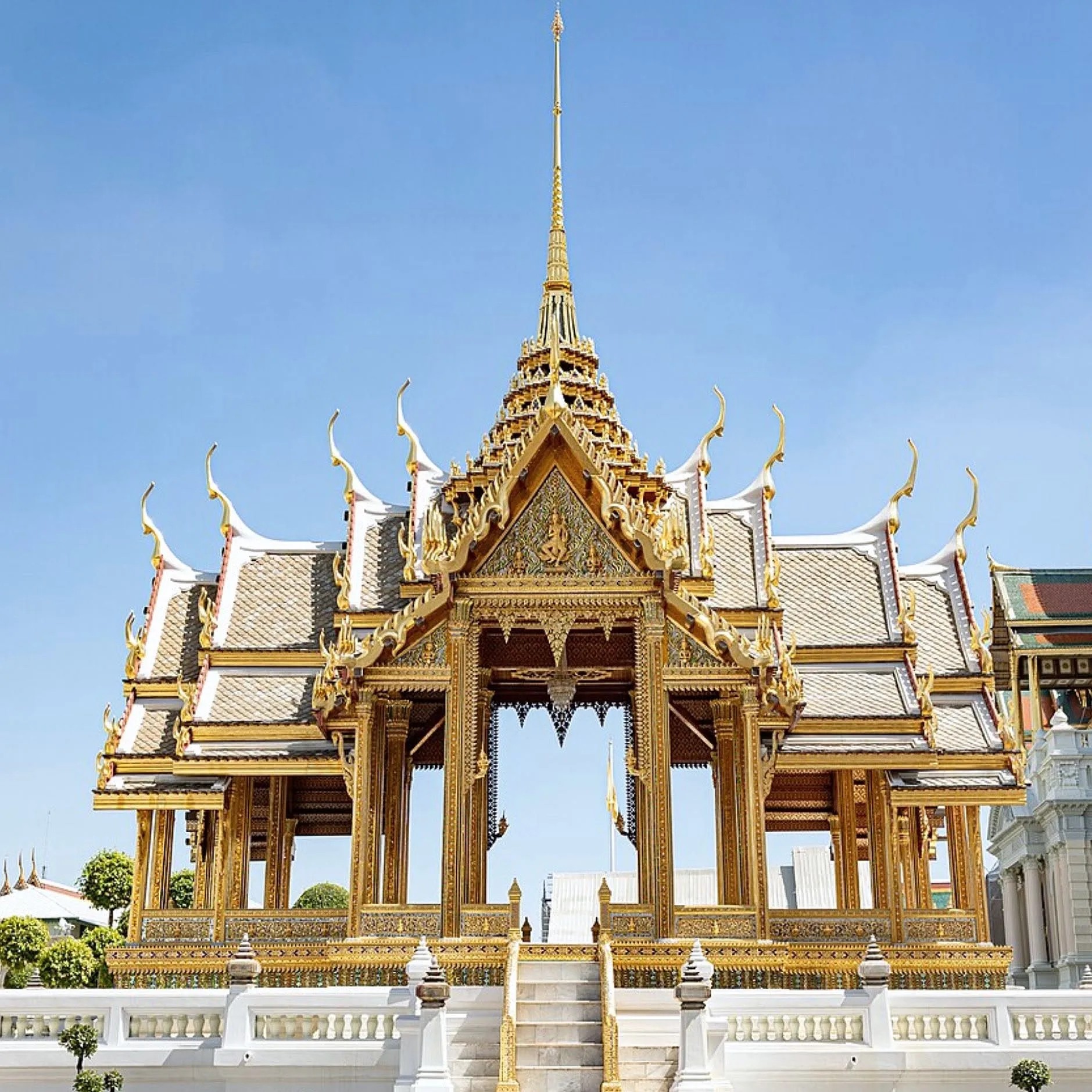
Frontal view of an open pavilion at the Dusit Maha Prasat Throne Hall: gilded columns, tiered roofs with chofa, a pediment adorned with a deity and a slender spire, on a white balustraded terrace reached by a central staircase.© Internet 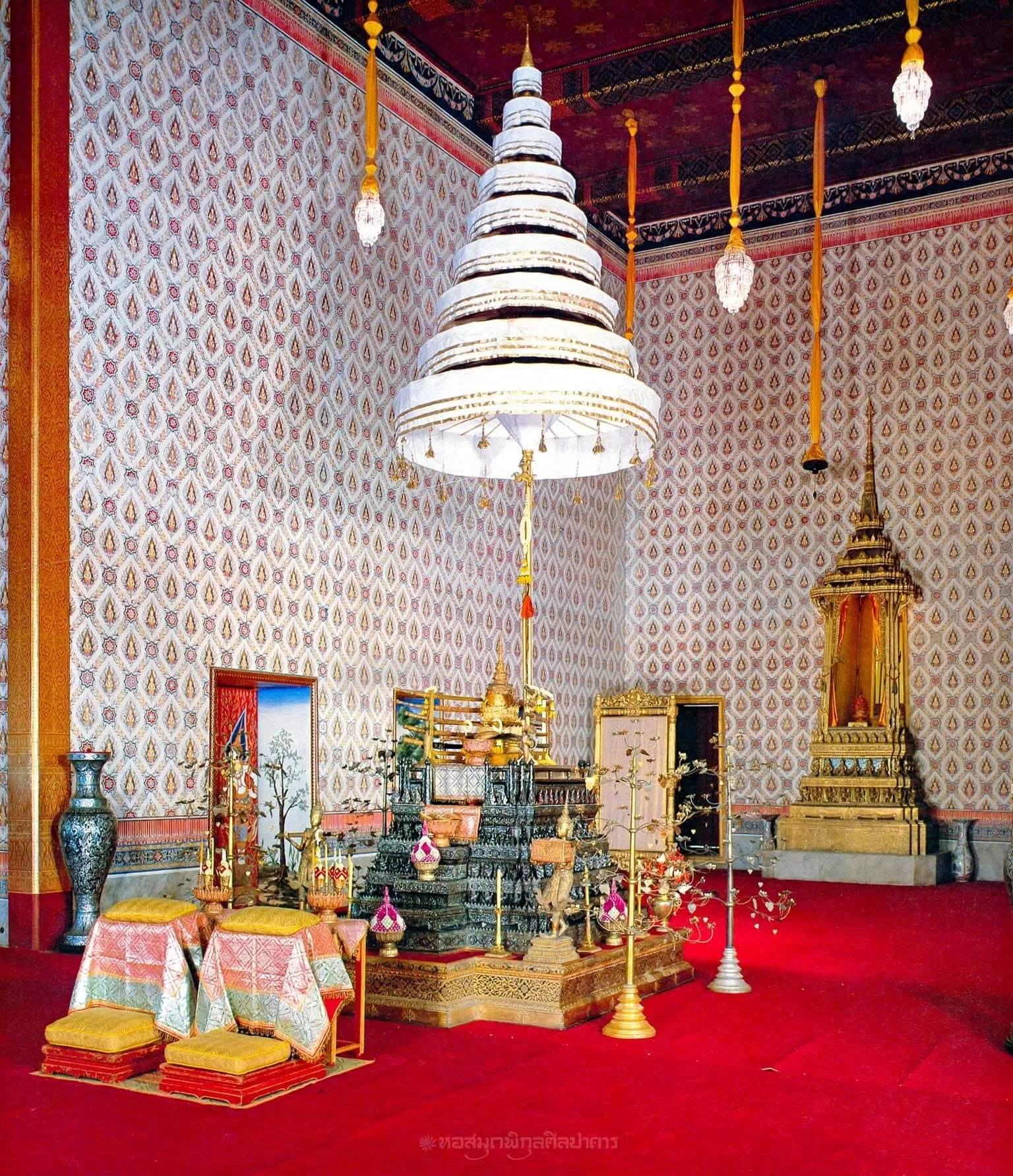
In the Dusit Maha Prasat Throne Hall, a dark tiered throne with inlaid decoration stands beneath a tiered white parasol; to the right, a gilded spired pavilion stands out against floral-patterned walls, above a red-carpeted floor.© Internet
Architecture and decoration
Explore the heritage
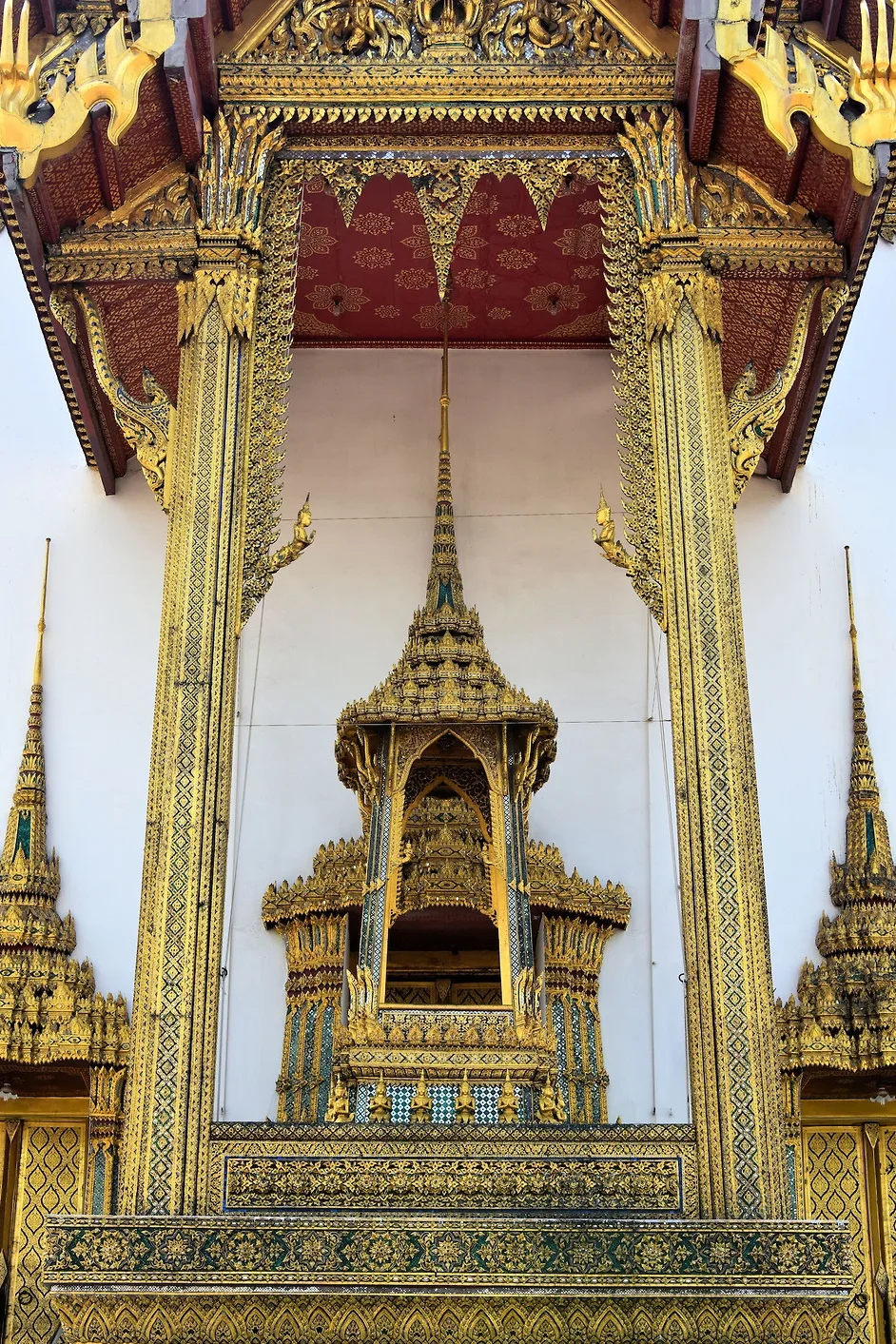
Dusit Maha Prasat Throne Hall: a gilded pavilion with a tiered roof and slender spire stands between two tall pillars inlaid with glass mosaic, beneath a red ceiling scattered with gilded floral motifs and carved brackets.© Eric Monteil 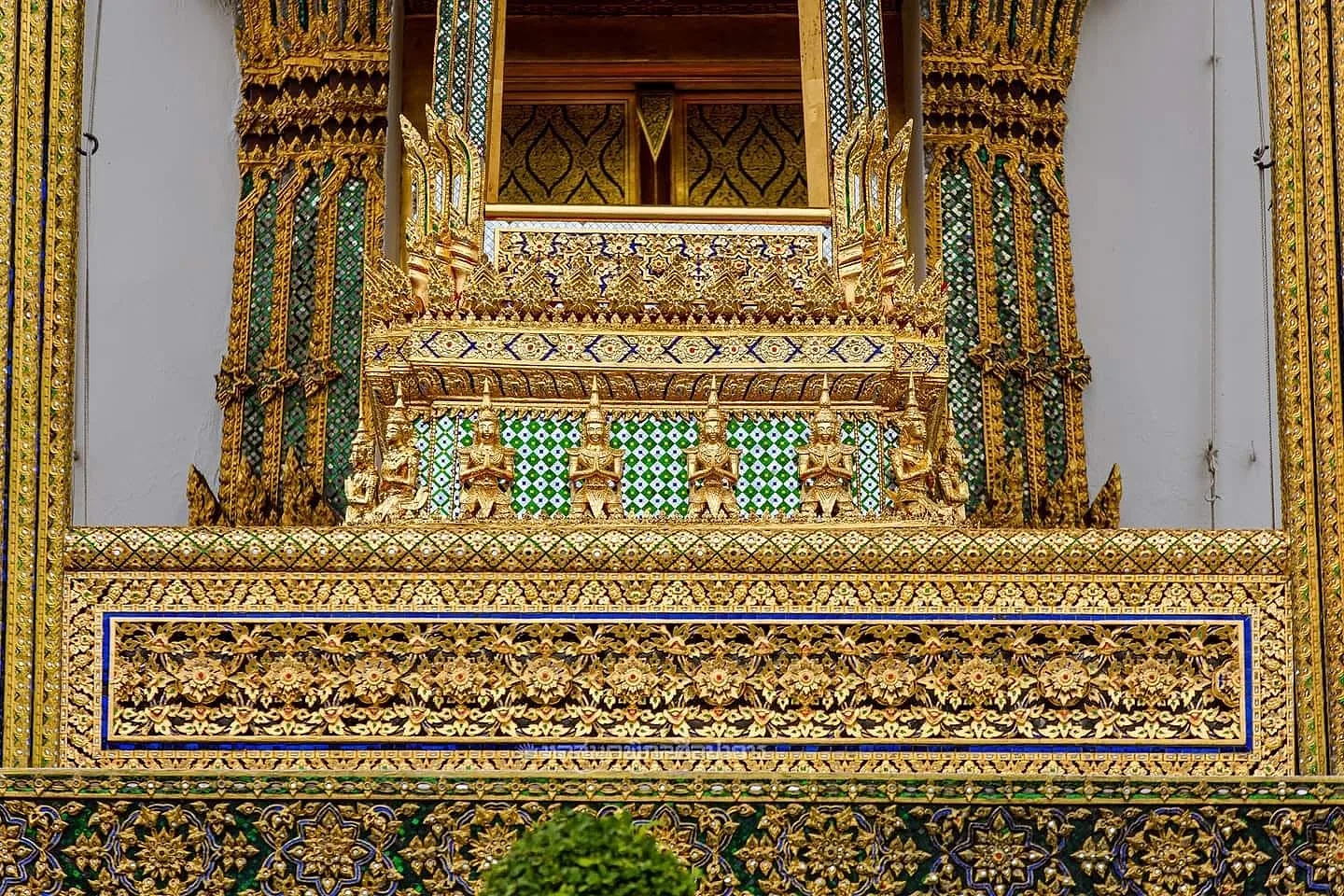
Façade detail of the Dusit Maha Prasat Throne Hall: a gilded pavilion lined with small figures in an attitude of prayer, set against green and white glass mosaic, rests on a broad panel of gilded floral scrollwork edged in blue.© Internet
Archive
Memory of time passing
Historical images preserve the visual memory of places and of the ways they have changed.
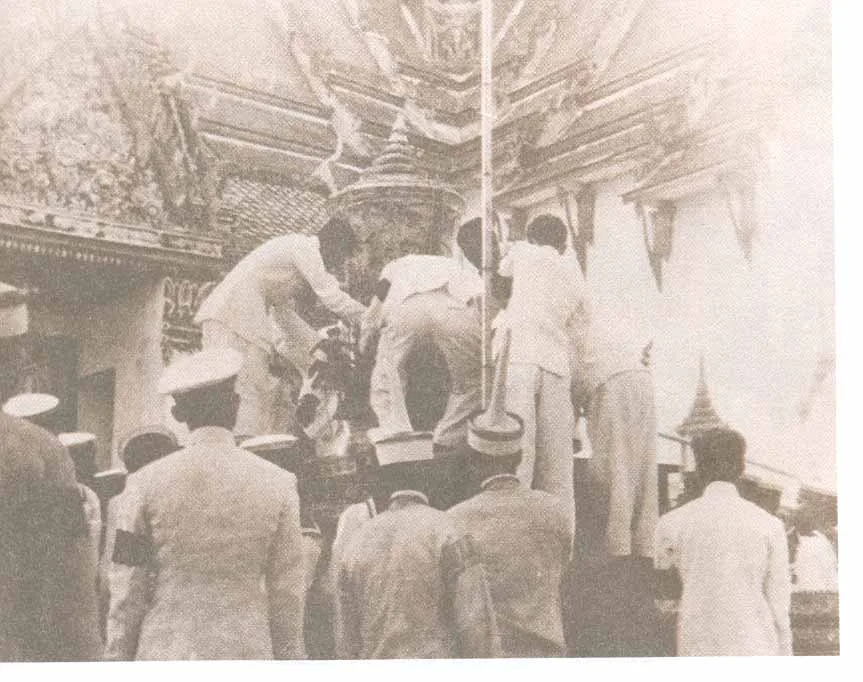
Before the decorated gables and tiered roofs of the Dusit Maha Prasat Throne Hall, men in white attire standing on a chariot assemble a tall ceremonial urn, watched by officers in uniform and peaked caps.Auteur inconnu — Wikimedia Commons, domaine public