
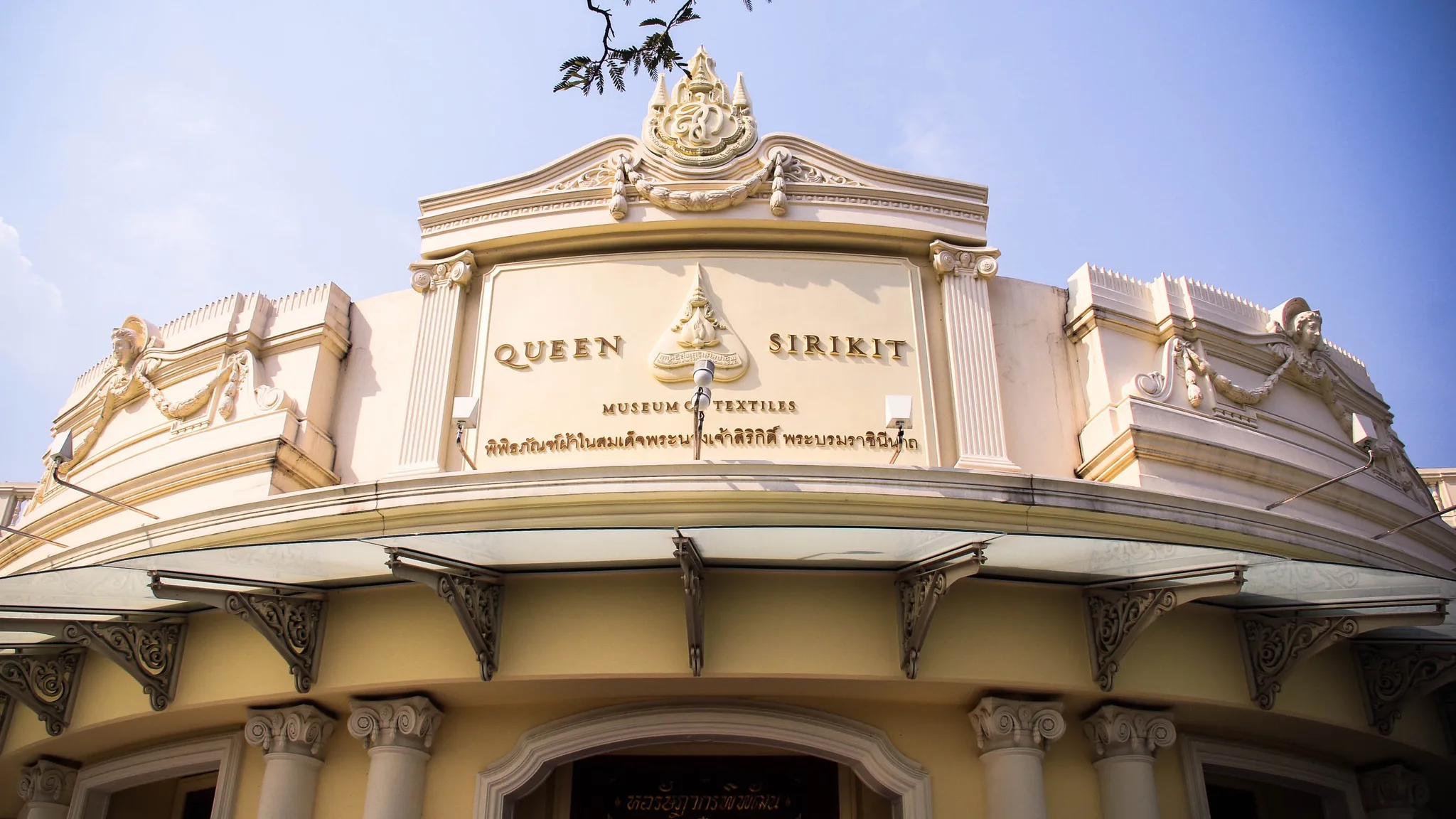
 Entrance façade of the Queen Sirikit Museum of Textiles: a pediment topped by a crowned monogram, inscriptions in English and Thai, Ionic pilasters and columns, and pierced brackets supporting a glass canopy.© Internet
- Destination
- Bangkok (Phra Nakhon)
- Heritage Family
- Arts, aesthetics and creation
- Typology
- Museum
- Visit
- Available tours →
The Queen Sirikit Museum of Textiles is the museum of textiles and dress located within the precincts of the Grand Palace in Bangkok. It owes its existence to the wish of Queen Sirikit, who had devoted a large part of her work to supporting the country’s weavers and artisans. Opened in 2012 in an administrative building constructed under King Chulalongkorn and long occupied by the Ministry of Finance, it conserves and displays court textiles, the Queen’s wardrobe and the Thai dress she helped to create. It also houses Thailand’s first textile conservation laboratory.8
Key facts
- Destination
- Phra Nakhon
- Heritage Family
- Arts, aesthetics and creation
- Typology
- Museum
- Periods
- People
- Bhumibol Adulyadej
- Pierre Balmain
- Rama V
- Queen Sirikit
- Communities
- —
- Events
- Creation of the Queen Sirikit Museum of Textiles
- Heritage
- Khon
- Glossary
- Khon
- Thai national costume of royal fashion
- Twelve-year cycle
- Keywords
- —
- Date
- —
- Collections
- —
Practical info
Practical information about this site is taken from its Google Maps page. We advise you to check it before visiting.
- Address
- The Grand Palace, Na Phra Lan Rd, Khwaeng Phra Borom Maha Ratchawang, Khet Phra Nakhon, Krung Thep Maha Nakhon 10200
- Phone
- Website
An administrative building within the royal precinct
The Grand Palace, royal residence and seat of government
The Queen Sirikit Museum of Textiles occupies a building that was not built for it. It stands within the precincts of the Grand Palace in Bangkok, in Phra Nakhon district. Originally, the palace also housed the kingdom’s ministries. Only one ministry is still located within the precinct.1
The museum building belongs to this generation of ministerial buildings. It stands in the outer court of the palace, along the north wall, between the Wisetchaisri Gate and the Wimanthewet Gate. The Wisetchaisri Gate is now the visitors’ entrance to the Grand Palace: passing through it, one finds the museum on the right.5
The Ho Ratsadakon Phiphat in the reign of Chulalongkorn
The building bears the Thai name Ho Ratsadakon Phiphat, rendered in English as the Ratsadakorn-bhibhathana Building. It was erected during the reign of King Chulalongkorn, fifth monarch of the Chakri dynasty, also known as Rama V. It is an administrative building of the late nineteenth century.8
The date of its construction is not agreed upon. Accounts differ: according to some, the building was constructed in 1870; according to others, it was established by Chulalongkorn on 4 June 1873.8
Decades in the service of Finance
For many decades, the Ho Ratsadakon Phiphat housed the offices of the Ministry of Finance, in other words the Royal Treasury. By 2003, it stood vacant.9
Nothing in this administrative history destined it for fabrics and costumes. It was the work of a queen, pursued for decades beyond the palace walls among rural artisans, that would give it its present purpose.
From the SUPPORT Foundation to the museum project
Queen Sirikit and the weavers of the provinces
Queen Sirikit (1932–2025), consort of King Bhumibol Adulyadej, founded the SUPPORT Foundation in 1976, an organisation intended to encourage the production of traditional Thai crafts.10
The museum’s curator, Alisa Saisavetvaree, traces the origin of this undertaking to a visit by the Queen to Na Wa district, in Nakhon Phanom province. There the Queen noticed the silk wrap-around skirts, lengths of cloth wound around the waist, worn by the local people. In her account, it was from this attention paid to an everyday garment that the ambition was born to support the weavers and to make their work known.3
The gift of 2003
In 2003, Queen Sirikit asked to use the former Finance building, then vacant, to house a textile museum. King Bhumibol Adulyadej granted her the building. The project thus brought together two legacies: that of a building constructed under Chulalongkorn, and that of the work the Queen had carried out among artisans since the creation of the SUPPORT Foundation.8
The museum describes itself as the gift of Queen Sirikit and the SUPPORT Foundation to the Thai people. It aims to preserve the Thai textile arts for future generations.10
A complete refurbishment
To accommodate the museum, the interior of the building was entirely refurbished. Behind the nineteenth-century walls were installed a new entrance hall, exhibition galleries, storerooms designed for the conservation of fabrics, an education workshop, a specialist library and a lecture hall. The visitor route extends over two floors.9
The most significant facility is a conservation and restoration laboratory, that is, a workshop where objects are stabilised, cleaned and repaired to slow their deterioration. It is the first laboratory of its kind devoted to textiles in Thailand. Its creation shows that the project was not limited to display: conservation is also part of its mission.9
The opening and purpose of the museum
An inauguration in 2012
The Queen Sirikit Museum of Textiles opened its doors in 2012, the year of the Queen’s eightieth birthday. The official opening ceremony was presided over by Princess Maha Chakri Sirindhorn, then the museum’s principal adviser. The inauguration thus formed part of the celebrations for the Queen, whose work the museum carries forward.2
The first visitor route comprised four galleries. The first presented more than a dozen designer outfits worn by the Queen, cut from fabrics hand-woven by members of the SUPPORT Foundation. The second was devoted to the Thai national costumes created on the Queen’s initiative. The last two, through multimedia presentations, told the story of the SUPPORT Foundation’s work. From the very beginning, then, the visitor moved from the Queen’s clothing to the work of the artisans who had supplied its fabrics.2
A mission embracing the whole of Asia
The museum’s mission extends beyond Thailand alone. It has set itself the task of collecting, exhibiting and conserving the textiles of South-East Asia, South Asia and East Asia, both historic and contemporary, and of serving as a resource centre for anyone wishing to learn about them. The emphasis, however, is on the textiles of the Thai royal court and on those associated with Queen Sirikit.9
The museum aims to be both a place of knowledge about court textiles and regional textiles, and a gateway to the history of dress in Thailand. At its opening, it was attached to the SUPPORT Foundation, under the Queen’s royal patronage, of which it formed a division. This institutional link reflects the continuity between the support given to weavers and the showcasing of their art within the palace precinct.2
A queen’s wardrobe and the national dress
The Thai dress of royal fashion
At the heart of the collections is the Thai dress of royal fashion (chut thai phra ratcha niyom), a set of eight styles of outfit created by Queen Sirikit as Thai national dress. The museum dates them to 1960, and a gallery has been devoted to them since the opening in 2012.2
These eight outfits, worn by the Queen herself, show how a garment inspired by court traditions was designed to become a reference costume.
Thai fabrics and Western tailoring
The other major group is the Queen’s Western-style wardrobe. For her official outfits, the Queen had garments of European cut made from Thai fabrics, notably those of the weavers supported by the SUPPORT Foundation. Her official outfits thus served to promote the country’s weaving.4
The French couturier Pierre Balmain played a central role in this approach. According to the museum’s curator, the Queen entrusted him with Thai fabrics for her official wardrobe in order to make them known. In 2016, the exhibition ‘Fit for a Queen’ traced their twenty-two years of collaboration. The outfits shown in 2025 span several decades, from 1960 to 2000.3
The costumes of khon
The museum is not confined to court dress. In 2016, the exhibition ‘Dressing Gods and Demons: Costumes for Khon’ was devoted to khon. It presented its origins and history, together with costumes, masks and jewellery, both old and recent.
The modern costumes on display had been created for the revival of this art, undertaken on the Queen’s initiative. Queen Sirikit’s work on behalf of textiles thus extended to the costumes of this art.
Conserving, studying and passing on
Diplomatic gifts between Siam and the United States
The museum’s conservation work is illustrated by the project ‘Great and Good Friends: Historic Gifts between the Kingdom of Thailand and the United States of America’, an online exhibition devoted to the gifts exchanged between Siam and the United States. It includes a letter from King Mongkut addressed to the American President Buchanan on 14 February 1861, a Japanese-style sword in gold niello, that is, decorated with black inlay, a gold niello cup with silver mounts dated 1931, a woven reed mat adorned with the astrological sign of the dog, and a gold ceremonial robe.11
In 2017, these objects were treated at the Smithsonian Institution’s Museum Support Center in Suitland, Maryland. The textile conservator Julia Brennan presented the treatment of the gold ceremonial robe at a gathering held at the Smithsonian Institution in December 2017.11
Learning through the eye and the hand
Education holds an important place in the project. The education workshop, the specialist library and the lecture hall welcome visitors who come as much to learn as to look. In 2016, for the Queen’s seventh twelve-year cycle, that is, her eighty-fourth birthday, the museum opened new exhibitions and an activity room where visitors can touch objects similar to those on display.
The museum also makes several hundred textile and metal objects, as well as virtual exhibitions, available on the Google Arts & Culture platform, which offer a tour of both floors of the building.10
The museum today
The exhibitions of 2025
In 2025, the visitor route is organised around two major exhibitions that take up the institution’s two main threads. Opened on 16 August 2025, ‘ชุดไทย : จากราชสำนักสู่ราชนิยม’ (‘Thai Dress: From the Court to Royal Fashion’) presents the eight outfits of the Thai dress of royal fashion worn by the Queen. A second exhibition brings together her Western-style outfits cut from Thai fabrics, from 1960 to 2000.7
These two groups sum up what the museum seeks to convey: the way in which a queen made Thai weaving an element of royal representation, both in a national dress and in an international wardrobe.
A tribute during the mourning period
Queen Sirikit, who had become the Queen Mother, died in 2025. From 27 October 2025, admission to the museum became free in tribute to the late Queen, for the period of mourning. The place she had wished for was thus transformed into a place of remembrance, where the public comes to see the clothes she wore and the fabrics she supported.5
The museum is open every day. It is reached from Tha Chang pier, served by the Chao Phraya Express Boat, and then through the Wisetchaisri Gate of the Grand Palace. The former Royal Treasury building is thus today one of the first buildings that visitors to the palace encounter.6
Understanding
The Queen Sirikit Museum of Textiles is first and foremost the continuation of a body of work: that of a queen who supported rural weavers, had her official outfits cut from their fabrics and designed a national dress drawn from court traditions. By housing this memory in a former Finance building of the Grand Palace, the museum connects the administrative history of the kingdom, royal dress and the work of artisans, while setting itself a broader mission of studying and conserving the textiles of Asia. With the death of the Queen Mother in 2025 and the free admission granted during the mourning period, the place has changed in nature: it no longer celebrates a living sovereign, but has become a place of remembrance. Yet its laboratory, its storerooms and its educational activities are designed to outlast this tribute. Will the museum remain above all a witness to Queen Sirikit, or will it become the place where the story of fabrics, and of those who weave them, is told for its own sake?

From Thonburi to Rattanakosin: royal temples, the Grand Palace and the arts of Siam at the heart of historic Bangkok.
- Khon
- Masked dance drama of the Thai court tradition, which stages the Ramakien.
- Thai national costume of royal fashion
- Set of eight models of women’s dress created at Queen Sirikit’s initiative, inspired by court traditions, to give Thai women a national costume suited to different occasions.
- Twelve-year cycle
- Period of twelve years corresponding to the cycle of zodiac animals; in Thailand, the completion of a cycle, such as the seventh at the age of eighty-four, is marked by celebrations, notably for royal birthdays.
Primary sources
- 1Bangkok tourist attractions, Secretariat of the House of Representatives / Parliament of Thailand, 2018 ↗
Studies
- 2Woven into the fabric of society, Bangkok Post, 2012 ↗
- 3A tribute to Her Majesty's legacy, Bangkok Post, 2025 ↗
- 4พิพิธภัณฑ์ผ้าใน สมเด็จพระนางเจ้าสิริกิติ์ฯ เปิดให้ประชาชนชื่นชมฉลองพระองค์, THE STANDARD, 2025 ↗
- 5พิพิธภัณฑ์ผ้าในสมเด็จพระนางเจ้าสิริกิติ์ฯ เปิดให้เข้าชมฟรี ตั้งแต่ 27 ต.ค. 68 เป็นต้นไป, MGR Online (ผู้จัดการออนไลน์), 2025 ↗
- 6พิพิธภัณฑ์ผ้าในสมเด็จพระนางเจ้าสิริกิติ์ พระบรมราชินีนาถ เปิดให้ "เข้าชมฟรี" 27 ต.ค. 68 เป็นต้นไป, Thairath, 2025 ↗
- 7ชวนชม พิพิธภัณฑ์ผ้าในสมเด็จฯ หอรัษฎากรพิพัฒน์ ใกล้วัดพระแก้ว, TrueID Travel, 2025 ↗
Reference works
- 8Queen Sirikit Museum of Textiles, About Us – History: The Museum and Its Historic Building, Queen Sirikit Museum of Textiles ↗
- 9Queen Sirikit Museum of Textiles, Asia-Europe Foundation (ASEF) – culture360 ↗
- 10Queen Sirikit Museum of Textiles, Queen Sirikit Museum of Textiles – partner page, Google Arts & Culture ↗
- 11Queen Sirikit Museum of Textiles, Conserving Diplomacy, Google Arts & Culture ↗
- 12Queen Sirikit Museum of Textiles, Textile Research Centre (TRC), Leiden ↗
- 13Queen Sirikit Museum of Textiles, Museum Thailand ↗
- 14Queen Sirikit Museum of Textiles, Wikipedia ↗
Further reading
Contemporary views
Queen Sirikit Museum of Textiles today
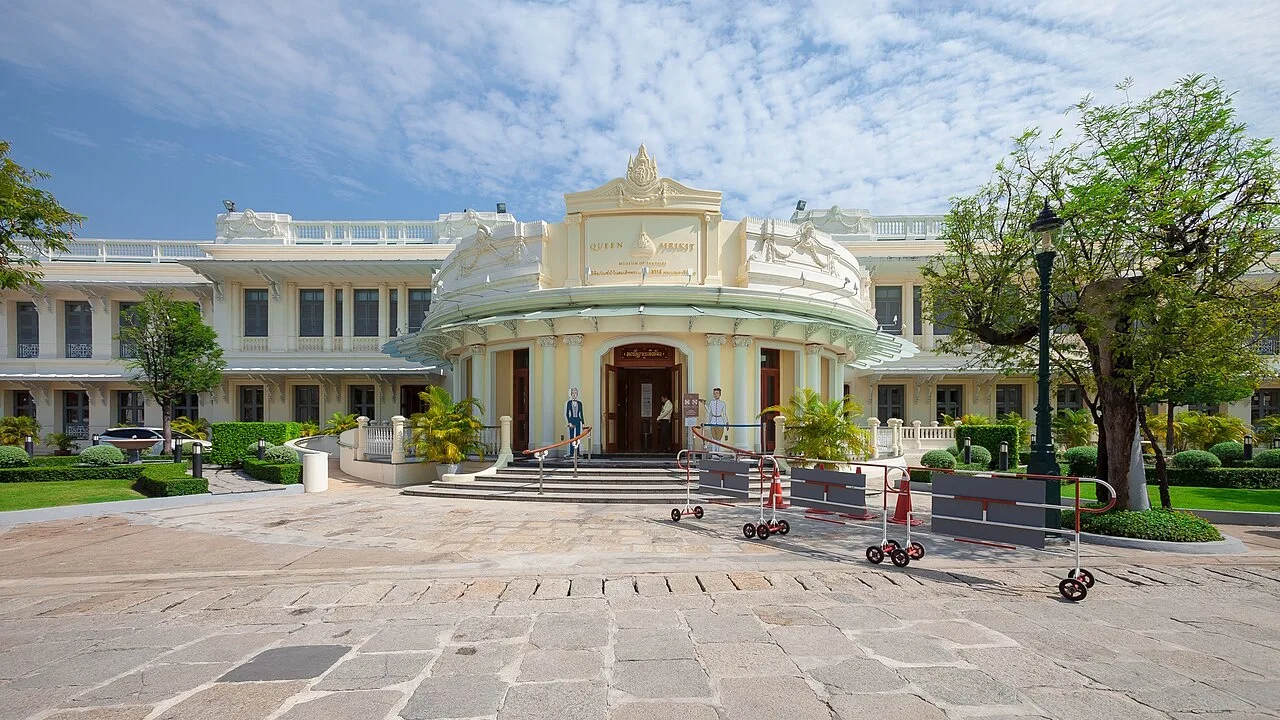
The rounded entrance pavilion of the Queen Sirikit Museum of Textiles, crowned by an ornate pediment, opens onto a paved forecourt lined with clipped hedges; mobile barriers and cardboard figures frame the visitors’ entrance.© Internet 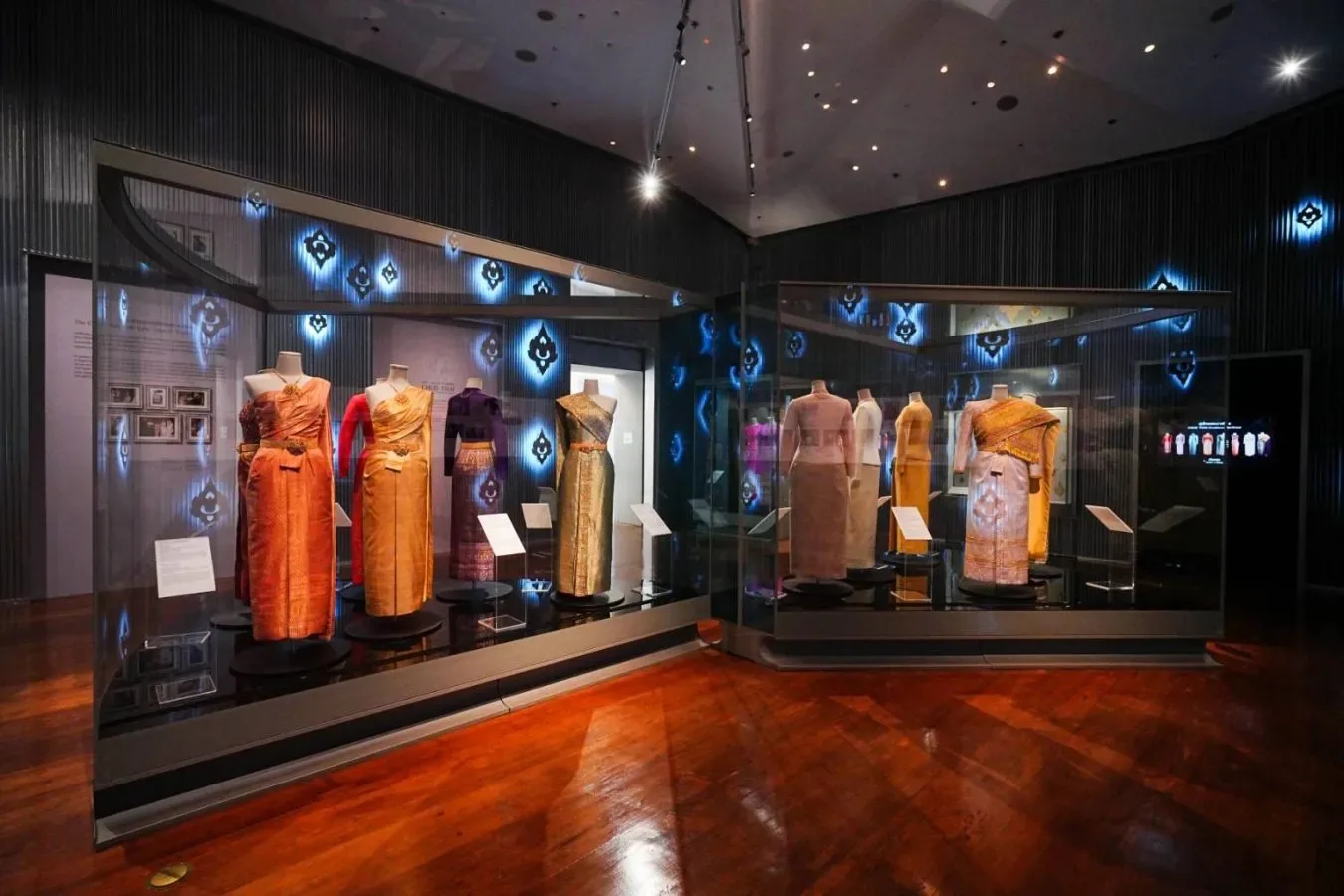
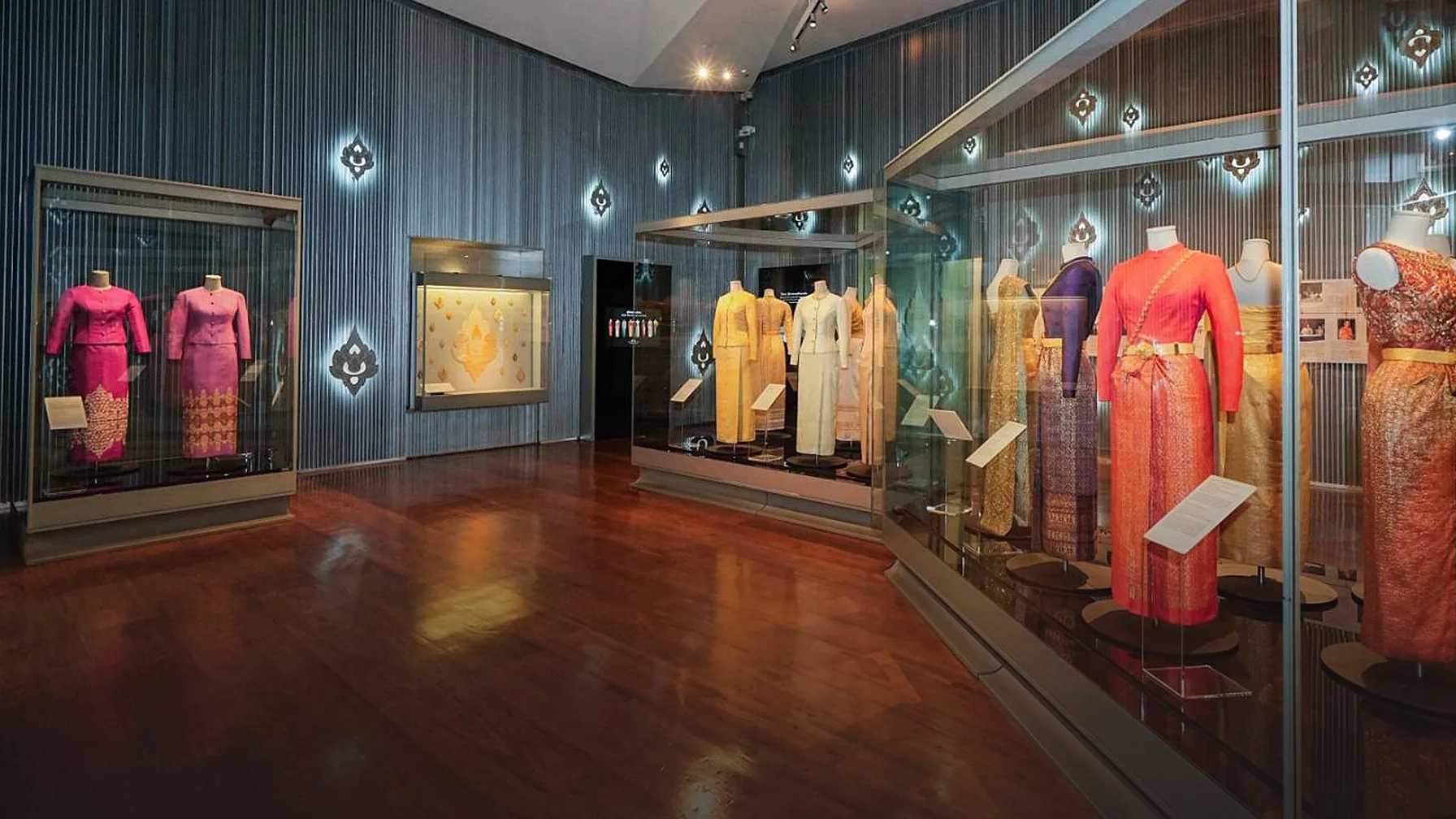
At the Queen Sirikit Museum of Textiles, two display cases present women’s silk outfits in orange, gold, purple and pink on mannequins, with labels, against dark walls decorated with illuminated blue motifs.© Eric Monteil
Architecture and decoration
Explore the heritage
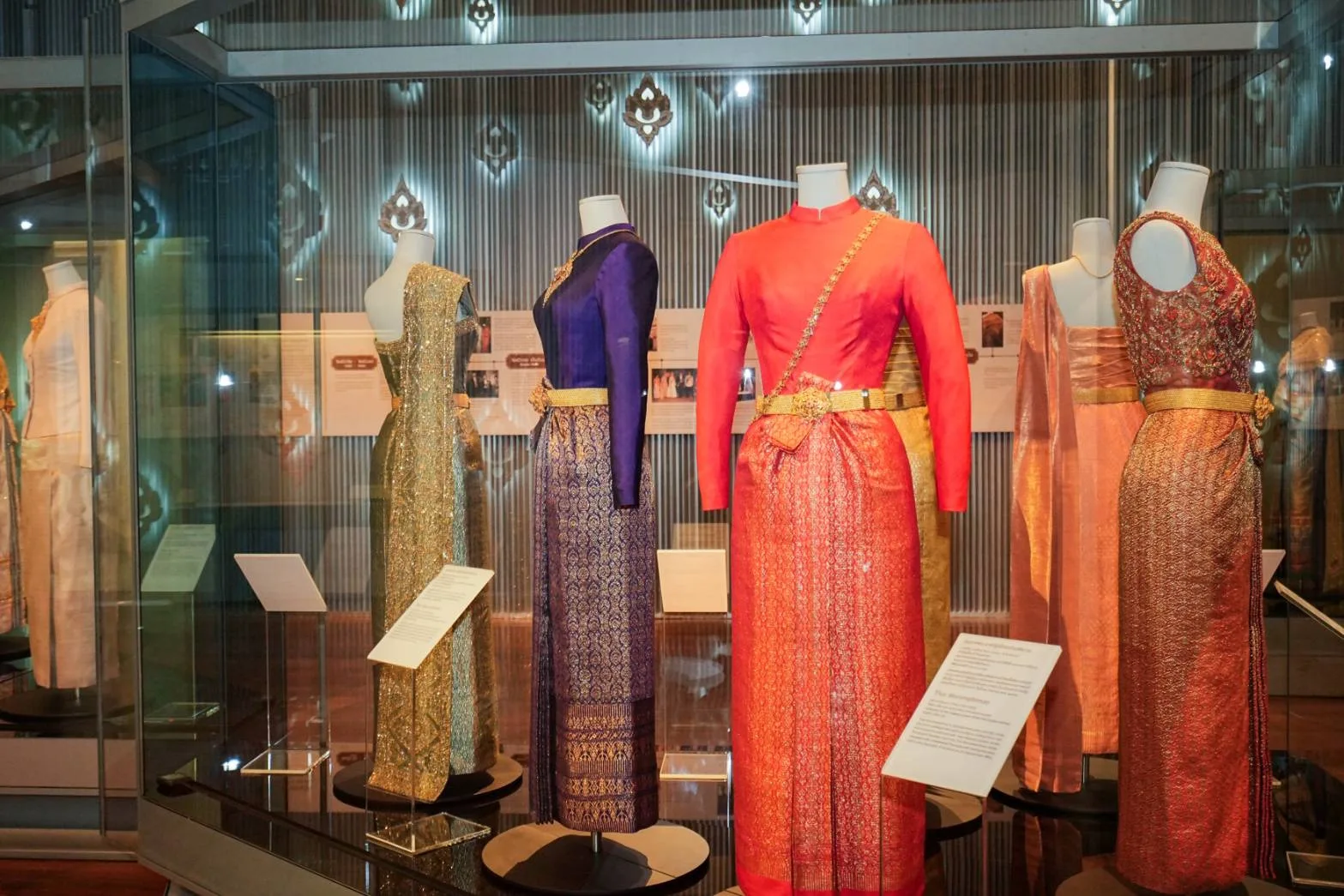
At the Queen Sirikit Museum of Textiles, a lit display case brings together Thai outfits in gold-brocaded silk, with golden belts and chains, set against a backdrop of ornamental motifs and explanatory panels.© Internet 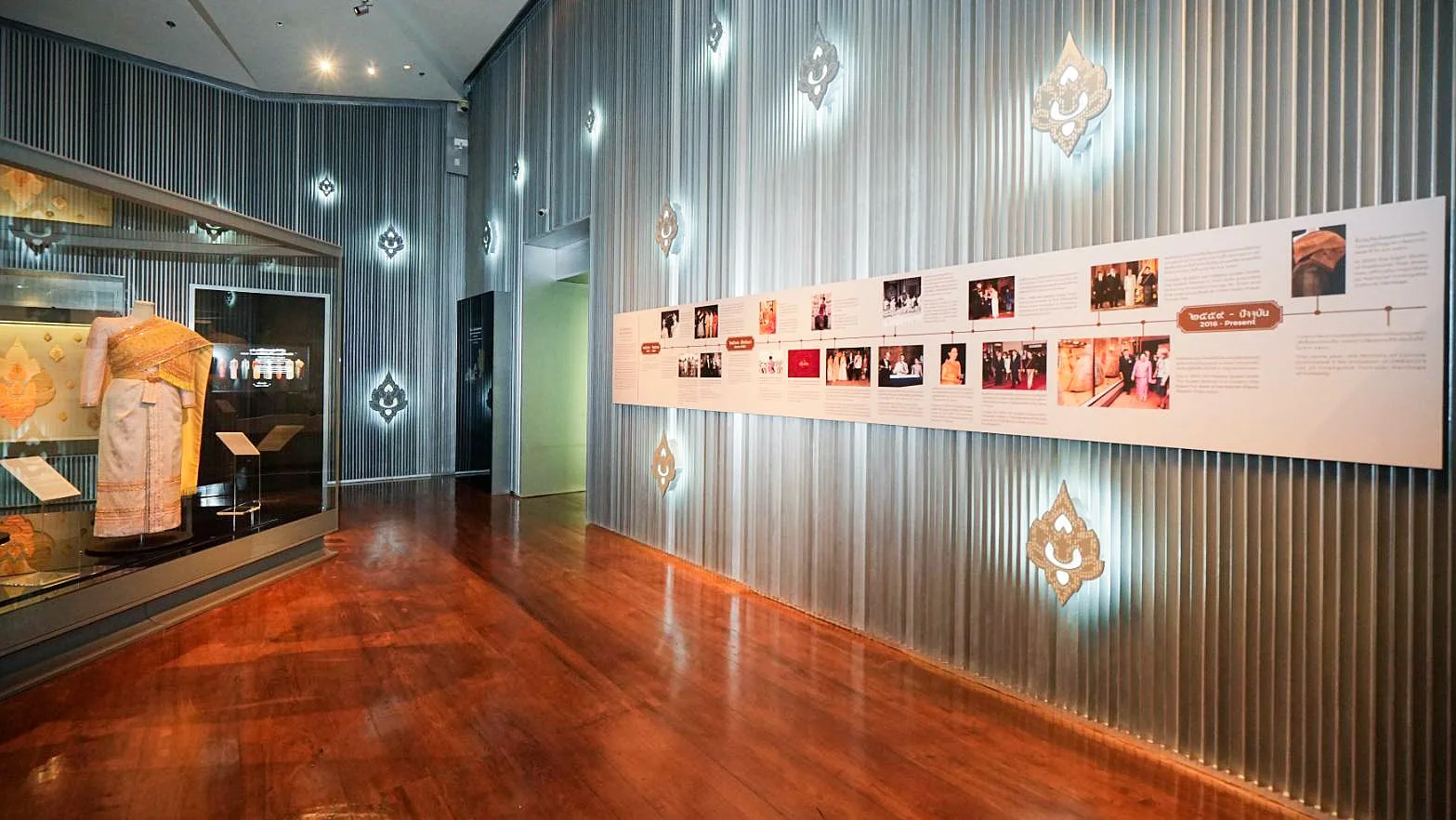
At the Queen Sirikit Museum of Textiles, a display case presents a pale costume with a golden sash opposite an illustrated photographic timeline, set against pleated metal walls punctuated by illuminated Thai floral motif sconces.© Internet