
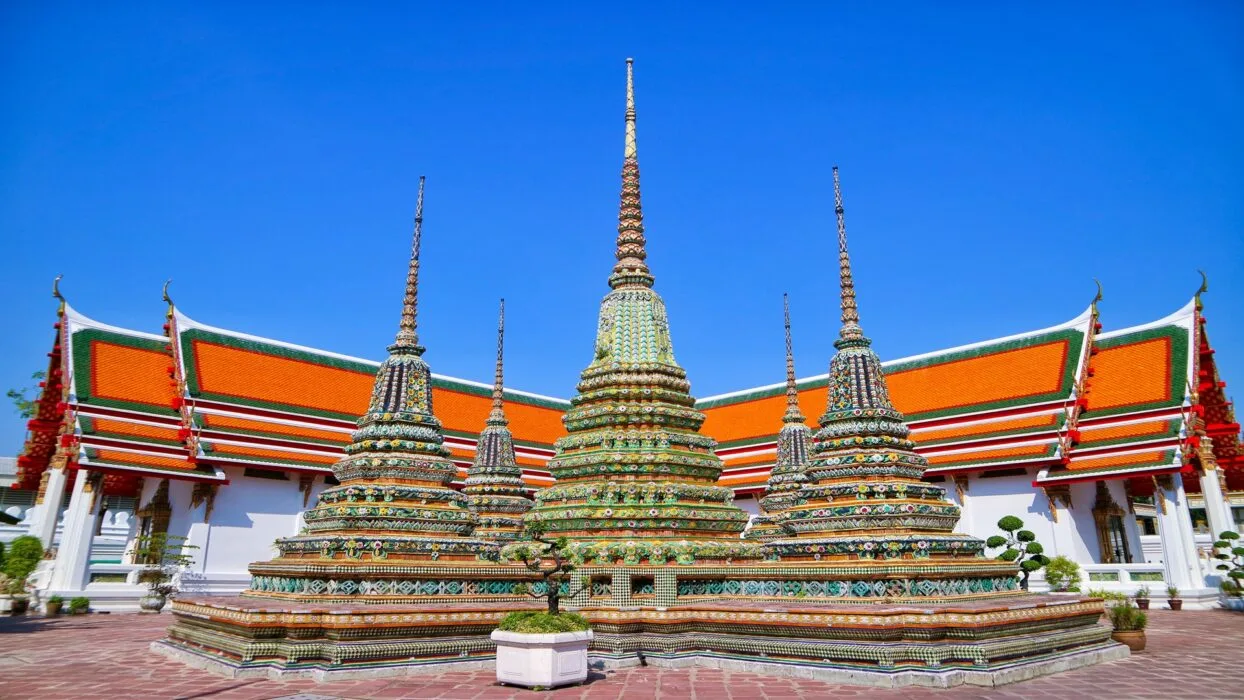
 At Wat Pho, five chedis clad in fragments of polychrome ceramic rise from a single platform, in front of white-walled buildings with orange and green tiled roofs. Clipped shrubs in pots punctuate the paved courtyard.© Agoda
Buddhist temple
Wat Pho
Founded in the Ayutthaya period and later refounded by the first kings of the Chakri dynasty, the royal monastery of Wat Pho brings together worship, dynastic memory and the transmission of knowledge, from inscriptions on stone to traditional massage.
Heritage family · Buddhism, religions and spiritualities
- Destination
- Bangkok (Phra Nakhon)
- Heritage Family
- Buddhism, religions and spiritualities
- Typology
- Buddhist temple
- Visit
- Available tours →
Wat Pho, whose full name is Wat Phra Chetuphon Wimon Mangkhalaram Rajwaramahawihan, is a royal Buddhist monastery in Bangkok, lying just south of the Grand Palace. The principal temple of the first sovereign of the Chakri dynasty, part of whose ashes it preserves, it ranks among the royal temples of the highest grade. Born of a sanctuary from the Ayutthaya period, restored when the new capital was founded and then extensively rebuilt in the 19th century, it has become a place of learning as much as of worship. Its stone inscriptions are on UNESCO’s Memory of the World Register, and the temple remains associated with traditional Thai massage as well as with its immense Reclining Buddha.11
Key facts
- Destination
- Bangkok
- Heritage Family
- Buddhism, religions and spiritualities
- Typology
- Buddhist temple
- Places
- —
- People
- Phetracha
- Rama Ier
- Rama III
- Rama IV (Mongkut)
- Communities
- Monastic community
- Events
- Inscription of the Epigraphic Archives on the Memory of the World Register
- Inscription of Nuad Thai on the Representative List of the Intangible Cultural Heritage
- Restoration under Rama I
- Restauration sous Rama III
- Heritage
- Nuad Thai
- Epigraphic Archives
- Bouddha couché
- Glossary
- Wat
- Ubosot
- Buddha image
- Viharn
- Mondop
- Royal monastery
- Keywords
- —
- Date
- —
- Collections
- —
Practical info
Practical information about this site is taken from its Google Maps page. We advise you to check it before visiting.
- Address
- 2 Thanon Sanam Chai, Khwaeng Phra Borom Maha Ratchawang, Khet Phra Nakhon, Krung Thep Maha Nakhon 10200
- Phone
- Website
A royal monastery at the heart of Rattanakosin
An enclosure in two parts
Wat Pho occupies a vast enclosure on Rattanakosin Island, the historic heart of Bangkok, immediately south of the Grand Palace. It is bounded by four roads: Thai Wang Road to the north, Sanam Chai Road to the east, Setthakan Road to the south and Maharat Road to the west. Following its enlargement in the 19th century, the complex covers some nine hectares, making Wat Pho one of the great monastic enclosures of the old city.11
Like every wat – that is, any Buddhist monastic complex combining places of worship with living quarters for monks – Wat Pho is divided into two distinct areas. A high white wall running along Chetuphon Road separates the sacred zone, known as the Phutthawat, devoted to worship and to the great religious buildings, from the zone where the monks live, the Sanghawat. This division still shapes a visit today: the public moves through the area of worship, while the monastic community keeps its own quarter, set apart.11
A rank bound to the Crown
The temple’s rank derives from its royal history. Wat Pho is a royal monastery of the first rank and heads the list of six temples placed in the highest grade of first-class royal temples. It was the most important temple of the reign of King Rama I (1737–1809), first sovereign of the Chakri dynasty, who made Bangkok his capital and the monastery his own temple. This closeness to the Crown, both spatial and symbolic, sheds light on most of the choices that have shaped the site.11
The temple’s successive names
The temple’s names preserve the traces of its successive states. ‘Wat Pho’ is the shortened form of its former name, Wat Photaram, meaning ‘temple of the Bodhi Tree’, the tree beneath which, according to Buddhist tradition, the Buddha attained Enlightenment. The present official name, given in the 19th century, opens with ‘Chetuphon’, which refers to the Jetavana, a monastery closely associated with the life of the Buddha in Buddhist texts. For many visitors, finally, Wat Pho remains simply the ‘Temple of the Reclining Buddha’, after the most celebrated work it houses.11
From an Ayutthaya sanctuary to the temple of Rama I
A first temple under Phetracha
The history of the site begins before the founding of Bangkok. A temple named Wat Photharam was established at a time when Ayutthaya, further north, was the capital of the Siamese kingdom, during the reign of King Phetracha (1632–1703). Its foundation dates from between the late 17th and the early 18th century, within the years of that sovereign’s reign. When the Rattanakosin period opened, after the destruction of Ayutthaya by Burmese armies in 1767 and the establishment of the court on the site of Bangkok, the temple was probably half in ruins.5
Rama I’s works
Renewal came from the new regime. Once settled in the Grand Palace, Rama I took note of two old temples lying on either side of his residence: Wat Salak, now Wat Mahathat, to the north, and Wat Photharam to the south. In 1788 he entrusted the restoration of the latter to the nobles of the Department of the Ten Crafts. This first campaign lasted a little over seven years. A great celebration was held in 1801, and the king then gave the temple a new name, Wat Phra Chetuphon Vimolmangklavas. The old Ayutthaya sanctuary became the principal temple of the dynasty’s founder.5
During these years Rama I had Buddha images – that is, in Thai usage, statues – brought together at Wat Pho, taken from abandoned temples in Ayutthaya, Sukhothai and other ancient sites. The temple thus received works from the kingdom’s former capitals, which the wars had left without a community to tend them. Among these additions are reported to have been the remains of an immense Buddha image from Wat Phra Si Sanphet, the royal temple of Ayutthaya, destroyed by the Burmese in 1767, which are said to have been incorporated into one of Wat Pho’s buildings.11
The king’s ashes in the ubosot
The bond between the temple and the person of the king is seen above all in the ubosot, the ordination hall where the principal rites of the monastic community take place. Its principal image, the Phra Buddha Deva Patimakorn, rests on a pedestal beneath which part of the ashes of Rama I were placed. Wat Pho is therefore not merely a temple restored by the sovereign: it keeps a part of his mortal remains and links his memory to the worship of the Buddha. According to tradition, the finest craftsmen of the Royal Palace and elsewhere, specialists in the arts and monks are said to have taken part in this restoration, as they later did in that of his successor.5
The refoundation of Rama III
The great works of 1832
The Wat Pho that one walks through today is, for the most part, the work of another reign. In 1832 King Rama III (1788–1851), third sovereign of the Chakri dynasty, who reigned from 1824 to 1851, launched a campaign of renovation and enlargement on an altogether different scale from the previous one. The works lasted more than sixteen years. Most of the present buildings date from this campaign, so that the visitor discovers above all a mid-19th-century monastery, built on the foundations of an older temple.5
Rama III did not content himself with repairs: he reshaped the enclosure. He enlarged or created the south vihara and the west vihara – a vihara being the hall where the faithful come to venerate Buddha images – the Missakawan Park, the Phra Mondop and a teaching hall. The Phra Mondop, a pavilion intended to house sacred texts, serves as a library; its walls bear drawings of constellations taken from astrological texts. Elsewhere in the temple, paintings illustrate folk tales. These choices herald the ambition that distinguishes Rama III’s reign at Wat Pho: to make the monastery a place where the decoration itself teaches.11
The Reclining Buddha of the west vihara
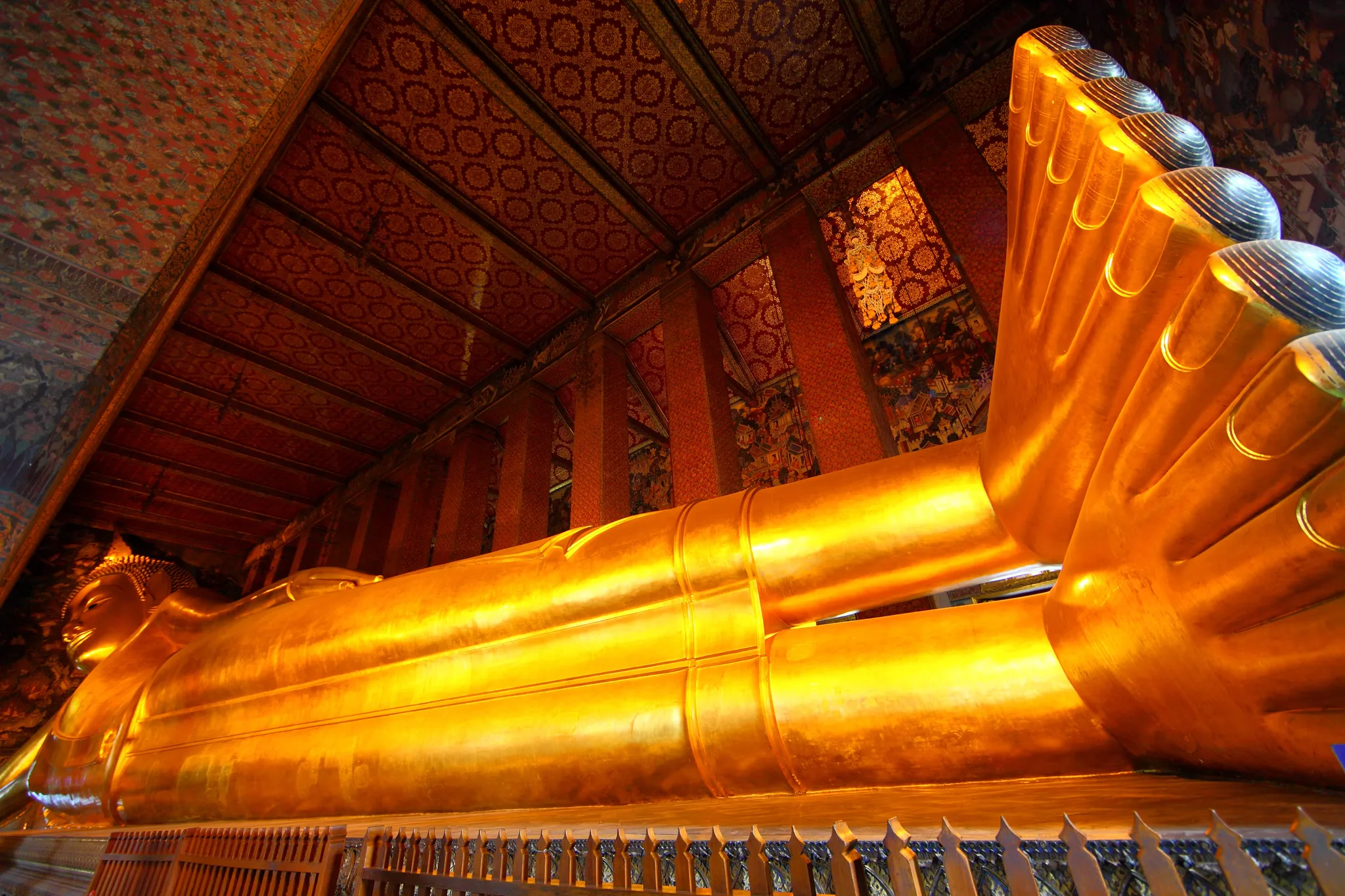
Wat Pho’s best-known work belongs to this campaign. The Reclining Buddha, made around 1832 under Rama III, occupies the west vihara, a chapel built for it. It measures about 46 metres in length and 15 metres in height, and its surface is entirely covered in gilded lacquer. Its dimensions are such that the building seems barely able to contain it: the visitor discovers it piece by piece, walking alongside the statue from one end of the hall to the other. The eyes and the soles of the feet are said to be inlaid with mother-of-pearl. Through its size and fame, this image eventually gave the temple its most common name.11
After Rama III, a temple maintained
The following reigns altered the complex little. King Mongkut, or Rama IV (1804–1868), fourth sovereign of the dynasty, gave the temple the name Wat Phra Chetuphon Vimolmangklararm, from which the present official form derives. He also had a fourth great chedi – a slender reliquary monument – raised alongside those already standing, and made a few minor alterations.11
In the 20th century a restoration was carried out ahead of Bangkok’s bicentenary, celebrated in 1982. No major works have taken place since, only limited repairs. Maintenance, however, never stops: it is often funded by the faithful, whose donations sustain the monastery just as much as the royal legacy does. Wat Pho thus remains a working temple, supported by its community, rather than a monument frozen in the state its founders gave it.11
An encyclopaedia carved in stone
A university for the public
Rama III wished to make Wat Pho ‘a university for the public’. He had ancient and contemporary texts gathered, then had them engraved on stone tablets set into the walls and pillars of the temple. This programme, carried out between 1831 and 1841 with Thai scholars, was accompanied by a decisive gesture: the king opened the temple to all. Wat Pho thus became a place where anyone could come to read and learn, which is why it is often described as Thailand’s ‘first university’.1
Knowledge engraved
These inscriptions now form a body of 1,431 texts in the Thai language and script, a figure established by a digital inventory that replaced the earlier count of 1,360 pieces. They are fixed to the walls and columns of the covered galleries surrounding the temple and are most often accompanied by drawings, paintings or sculptures that illuminate their content. The visitor therefore encounters them not in an archive room but along the way, built into the very architecture of the monastery.8
Their content extends far beyond the religious sphere. They fall into eight fields: history, medicine, health, customs, literature, proverbs, lexicography and Buddhism. There are also texts on local administration and on how to examine elephants, horses, cats or cattle, as well as writings on astrology and poetry. The whole brings together Thai and Asian knowledge drawn from more than five centuries of commercial, political and cultural exchange. By having them engraved in a royal temple open to all, Rama III placed this secular knowledge under the protection of the religious site.1
International recognition and conservation
The value of these texts has been recognised by UNESCO’s Memory of the World Programme, devoted to documentary heritage. In 2008 most of the inscriptions were entered on the Asia-Pacific regional register; on 27 May 2011, at the meeting of the International Advisory Committee held in Manchester, the ‘Epigraphic Archives of Wat Pho’ joined the international register. This inscription was followed by the introduction of a conservation management plan and the production of educational materials, carrying into the present day the educational mission intended by Rama III.8
The stones nonetheless remain exposed. In 2008 some inscriptions had been damaged by humidity, rain and contact with visitors; the temple was undertaking their restoration with the help of the Fine Arts Department of Thailand, a task made difficult by their dispersal across the whole site. The ensemble remains in good condition, but more than a million foreign visitors pass through it every year.3
Traditional medicine and massage
A centre of medical teaching
Among the knowledge engraved under Rama III, medicine holds a special place, and it is medicine that today accounts for much of the temple’s renown. By the mid-19th century Wat Pho was already a centre for the teaching of medicine; texts and illustrations devoted to massage feature among the monastery’s inscriptions and decoration. This tradition has continued in modern form with a private school of Thai medicine, founded in the late 1950s and still active within the temple precinct. The place of worship thus remains a place of learning, in the most concrete sense of the term.11
International recognition
This continuity gained international recognition in 2019, when UNESCO’s Intergovernmental Committee, meeting in Bogotá, inscribed nuad thai, traditional Thai massage, on the Representative List of the Intangible Cultural Heritage of Humanity. Nuad thai seeks to restore the body’s balance by acting on the sen, lines of energy running through it, using the hands, elbows, knees and feet, as well as hot herbal compresses. The nomination had been put forward by the Department of Cultural Promotion of the Ministry of Culture, with the participation of the Department of Thai Traditional and Alternative Medicine.9
The choice of venue for the official announcement is telling: it was at Wat Pho, a centre for learning massage, that the inscription was made public, in the presence, among others, of the director of its school, Preeda Tangtrongchitr. The temple that Rama III intended as a school open to all is thus associated with two UNESCO recognitions, one for the texts engraved in its galleries, the other for a practice that is still taught there.2
Understanding
Wat Pho is a working Buddhist monastery, linked to the Chakri dynasty, and a place of learning. Restored by Rama I, who made it his temple and part of whose ashes it keeps, it owes most of its present appearance to Rama III. He reshaped the enclosure and opened it to all, having texts on history, medicine, literature and Buddhism engraved in its galleries. Worship, monastic life and the transmission of knowledge have thus shared the same space since the 19th century. Today the inscriptions, recognised by UNESCO, remain exposed to humidity, rain and contact with very large numbers of visitors. The temple’s upkeep depends largely on the donations of the faithful, and traditional massage is still taught there. The temple thus remains a living place, not a frozen monument. What will Wat Pho represent for future generations: first and foremost a temple, a school or a witness to the heritage of humanity?

From Thonburi to Rattanakosin: royal temples, the Grand Palace and the arts of Siam at the heart of historic Bangkok.
- Wat
- Buddhist monastic complex that brings together, within a single enclosure, several religious buildings, monks’ quarters and ancillary buildings; the word does not refer to a single building.
- Ubosot
- Consecrated ordination hall of a wat: the ritually central building, marked out by sacred boundary stones, where monastic ordinations take place.
- Buddha image
- In Thai Buddhism, a devotional representation of the Buddha, most often a statue, venerated as an object of worship.
- Viharn
- Assembly and devotional hall of a wat, used for ceremonies, teaching and the veneration of Buddha images; unlike the ubosot, it does not host monastic ordinations.
- Mondop
- Small sacred building or pavilion, often square in plan, which may house a sacred image, a Buddha footprint, relics, scriptures, ashes or another sacred object.
- Royal monastery
- In Thailand, a Buddhist monastery founded, restored or placed under the patronage of the king or the royal family, and holding a particular rank.
- Royal temple
- In Thailand, a Buddhist temple founded, restored or patronised by the king or the royal family, and graded according to an official hierarchy of ranks and categories.
- Ayutthaya period
- Period of Siamese history, from the mid-fourteenth century to 1767, during which the kingdom had Ayutthaya as its capital.
- Memory of the World
- UNESCO programme devoted to the preservation of and access to documentary heritage; it maintains international and regional registers of documents deemed of major significance.
- Reclining Buddha
- Depiction of the Buddha lying on his right side, his head supported by his hand or a cushion, most often evoking his passing into parinirvana.
- Sen
- In traditional Thai medicine, energy lines held to run through the body, on which traditional massage acts.
- Monastic enclosure
- An enclosed space, usually surrounded by walls, that brings together the places of worship and the living quarters of a monastic community.
- Bodhi Tree
- Sacred fig tree under which, according to Buddhist tradition, the Buddha attained Enlightenment; it is venerated as a symbol of that event.
- Awakening
- In Buddhism, the state of understanding and clarity reached at the end of the spiritual path, which frees one from ignorance and suffering.
- Department of the Ten Crafts
- Royal Siamese department grouping court artisans specialised in traditional arts and crafts, responsible for major construction and decoration works.
- Ordination
- Ceremony by which a layperson is admitted as a novice or as a monk into the Buddhist community.
- Sangha
- The body of monks who reside in a monastery and live there according to religious discipline; in Buddhism it is called the sangha.
- Gilded lacquer
- A coating combining a layer of lacquer with gold leaf, used to cover and protect statues, objects and architectural elements.
- Chedi
- A bell-shaped reliquary monument, the Thai version of the Indian stupa.
- Reliquary
- A container intended to hold and protect one or more relics.
- Nuad Thai
- Traditional Thai massage, which aims to restore the body’s balance by working on the sen using the hands, elbows, knees, feet and hot herbal compresses.
- Intangible cultural heritage
- Practices, knowledge, expressions and skills passed down from generation to generation and recognised by communities as part of their cultural heritage.
- Phutthawat
- The sacred area of a Thai wat, devoted to worship and containing the main religious buildings, distinct from the monks’ residential area.
- Sanghawat
- The area of a Thai wat where the monks live, separate from the space devoted to worship.
- Rattanakosin period
- Period of Thai history that began with the founding of Bangkok as the capital by King Rama I at the end of the eighteenth century. It takes its name from Rattanakosin Island, the heart of the royal city.
Primary sources
- 1Thai National Committee on Memory of the World Programme of UNESCO, Memory of the World Register – The Epigraphic Archives of Wat Pho (Thailand), Ref N° 2010-16 (dossier de candidature), UNESCO, 2010 ↗
Studies
Reference works
- 5Wat Pho, History – Wat Phra Chetuphon Wimon Mangkhalaram Rajwaramahawihan, Wat Pho (watpho.com) ↗
- 6Wat Pho, Thailand celebrates Wat Pho as UNESCO Memory of the World [27.05.2012], Wat Pho (watpho.com), 2012 ↗
- 7Wat Phra Chetuphon Vimolmangklararm Rajwaramahaviharn, Dhammathai.org ↗
- 8Epigraphic Archives of Wat Pho, UNESCO – Programme Mémoire du monde ↗
- 9Decision of the Intergovernmental Committee: 14.COM 10.B.37, UNESCO – Patrimoine culturel immatériel, 2019-12 ↗
- 10The Rise of Rattanakosin Era: A Study of Magnificent Architecture of Royal Temples, The Siam Society under Royal Patronage ↗
- 11Wat Pho, Wikipedia (anglais) ↗
Further reading
Contemporary views
Wat Pho today
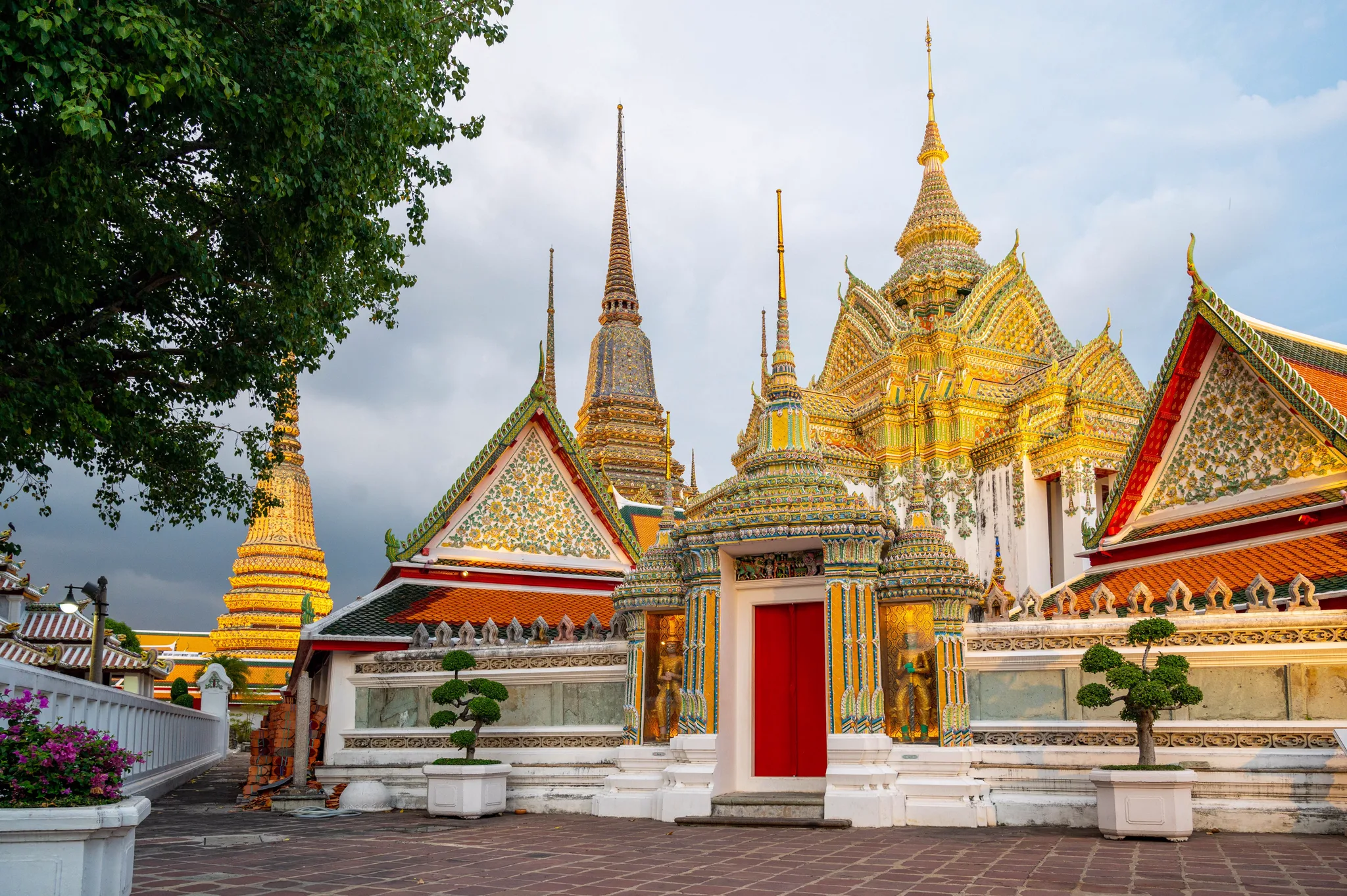
At Wat Pho, a gateway with red doors flanked by guardian figures opens in a low wall between pavilions with mosaic gables; beyond rise gilded roofs and chedis, with clipped trees in pots on the paved forecourt.© Pexels 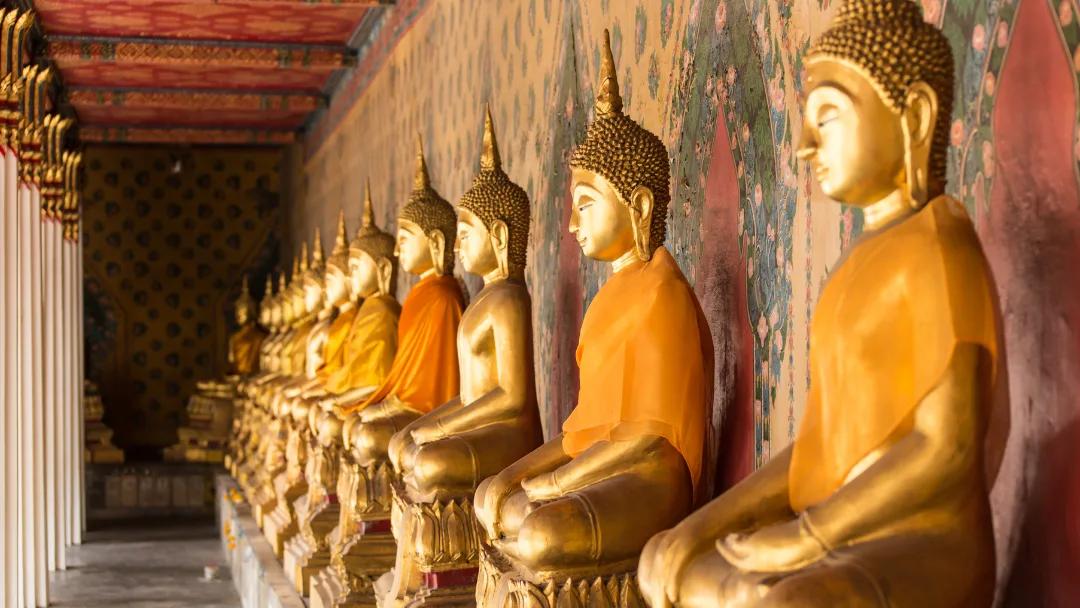
In a gallery at Wat Pho, seated Buddha statues, gilded and some draped in orange cloth, are lined up on their pedestals against walls with painted floral decoration, beneath an ornate red ceiling.© Novotel Bangkok Platinum.
Architecture and decoration
Explore the heritage
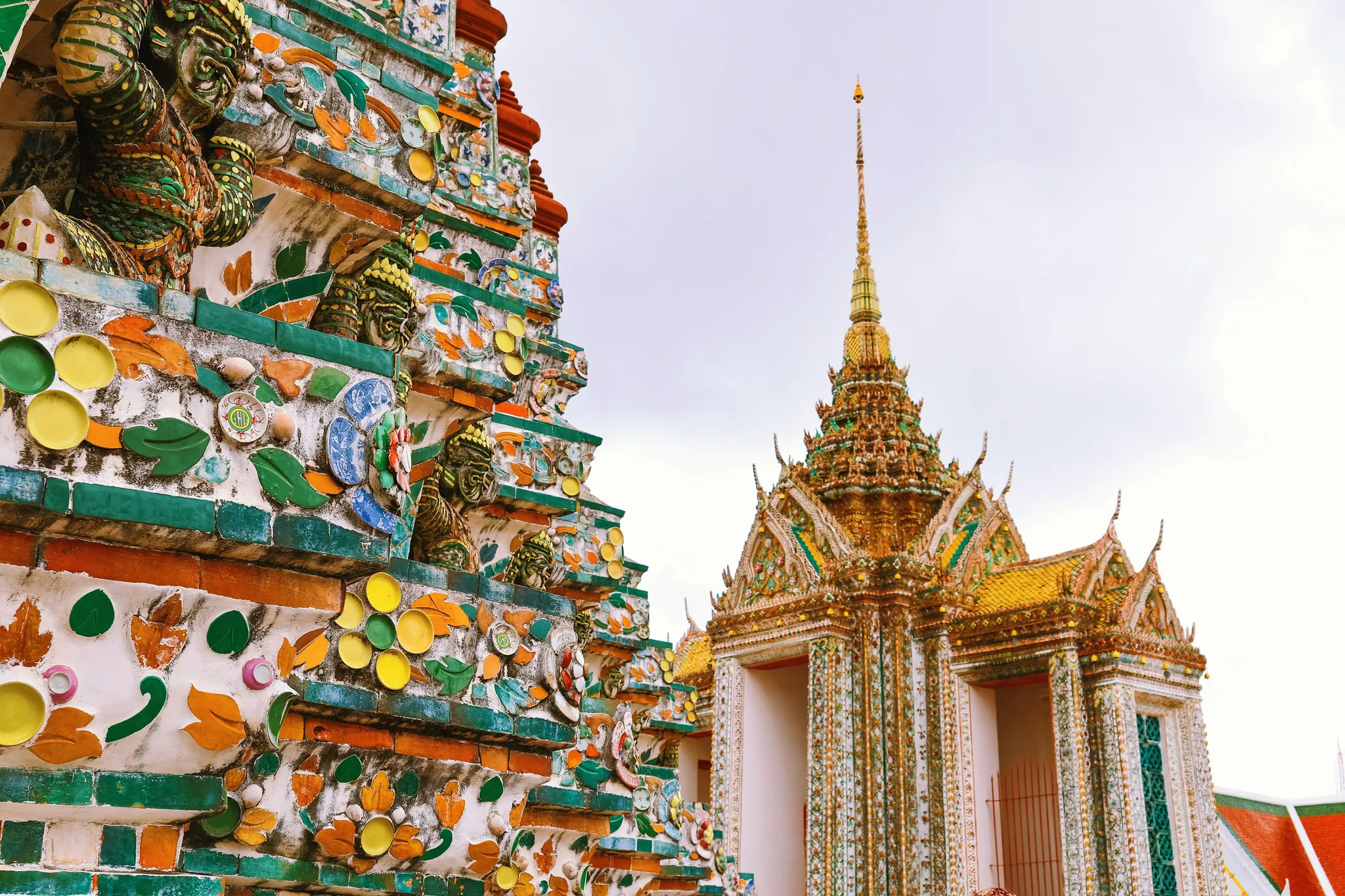
At Wat Pho, tiers covered with flowers and leaves made of coloured ceramic fragments are supported by guardian figures. On the right, a pavilion with stacked gables and a gilded spire bears mosaic decoration.© Pexels 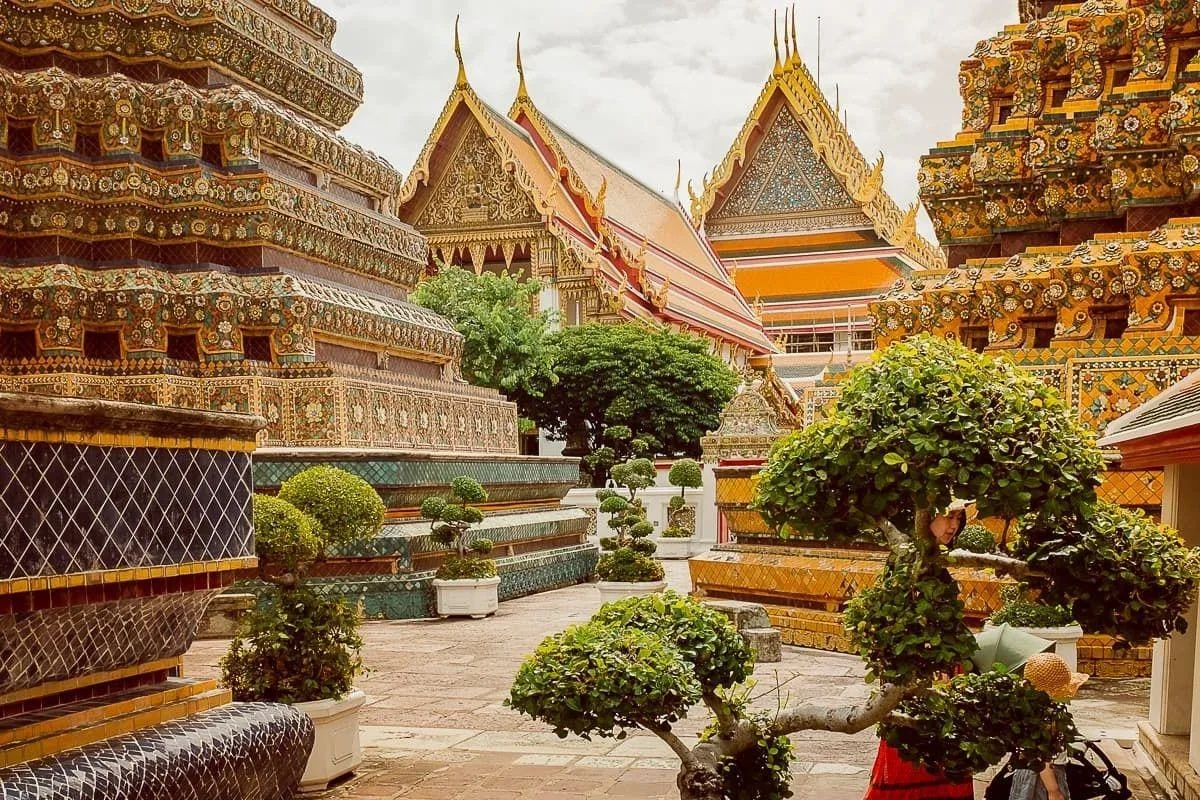
At Wat Pho, the bases of the chedis are clad in ceramic mosaics with floral motifs; in the background, pavilions with gilded gables and orange and green roofs rise behind clipped potted trees.© Shanti Lodge
Archive
Memory of time passing
Historical images preserve the visual memory of places and of the ways they have changed.
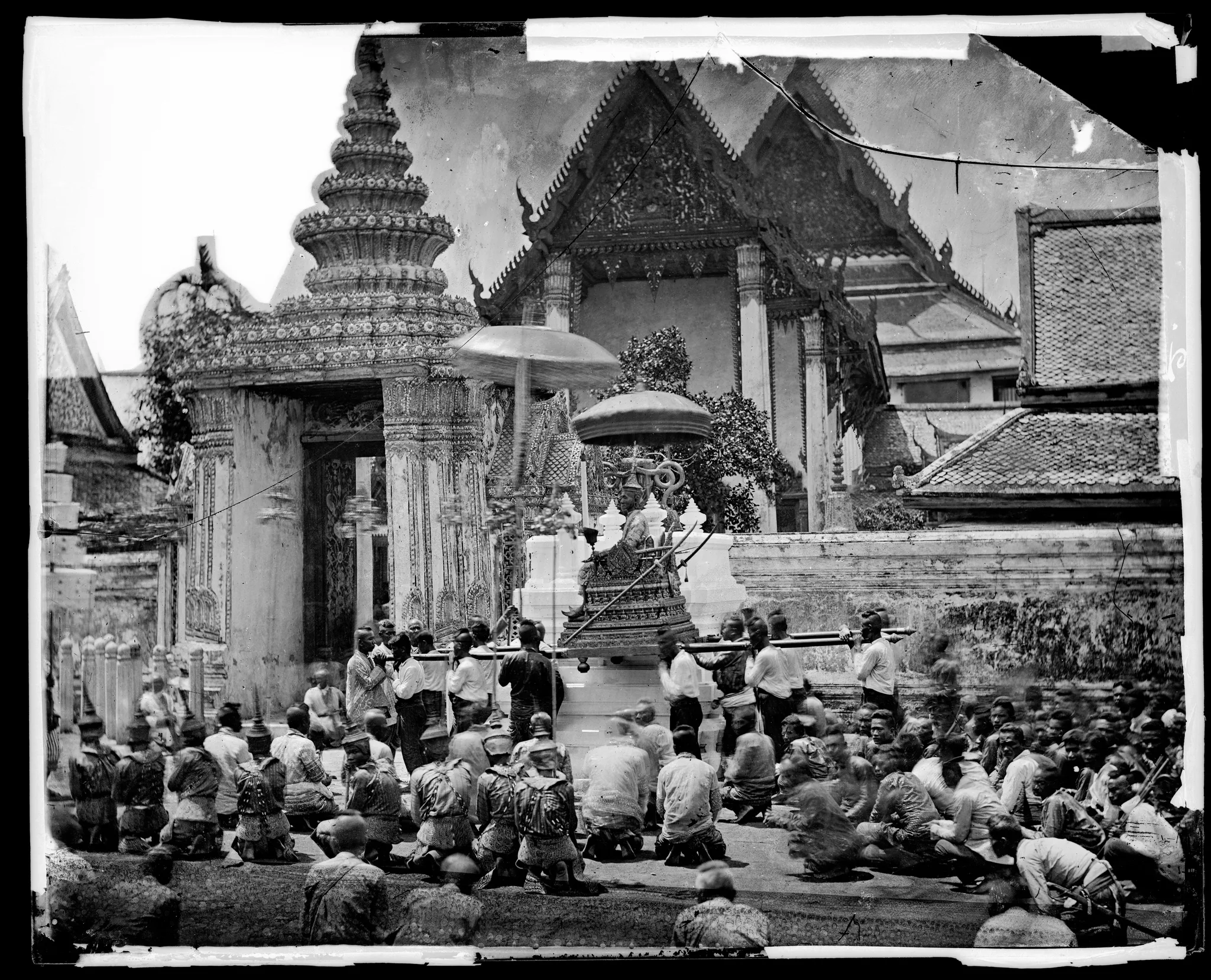
At Wat Pho, a palanquin sheltered by parasols is carried before a gateway crowned by a tiered spire and a building with carved gables; bearers, helmeted guards and a kneeling gathering fill the courtyard.Auteur inconnu — Wikimedia Commons, CC BY 4.0 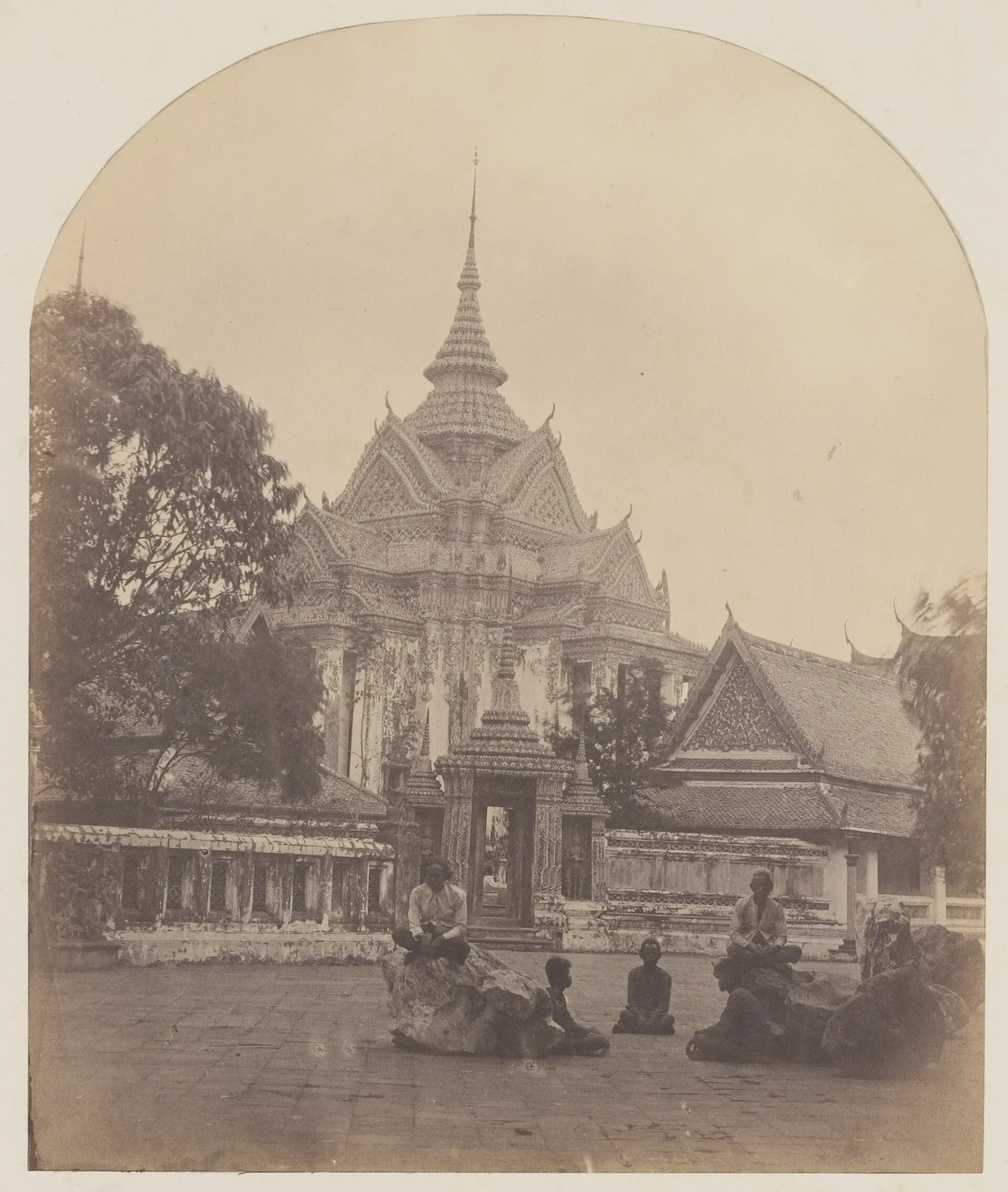
Old arch-topped photograph showing a building at Wat Pho crowned by a richly decorated tiered spire, preceded by a crowned gateway. In the foreground, five people sit in the paved courtyard among rocks.Isidore van Kinsbergen — Wikimedia Commons, domaine public 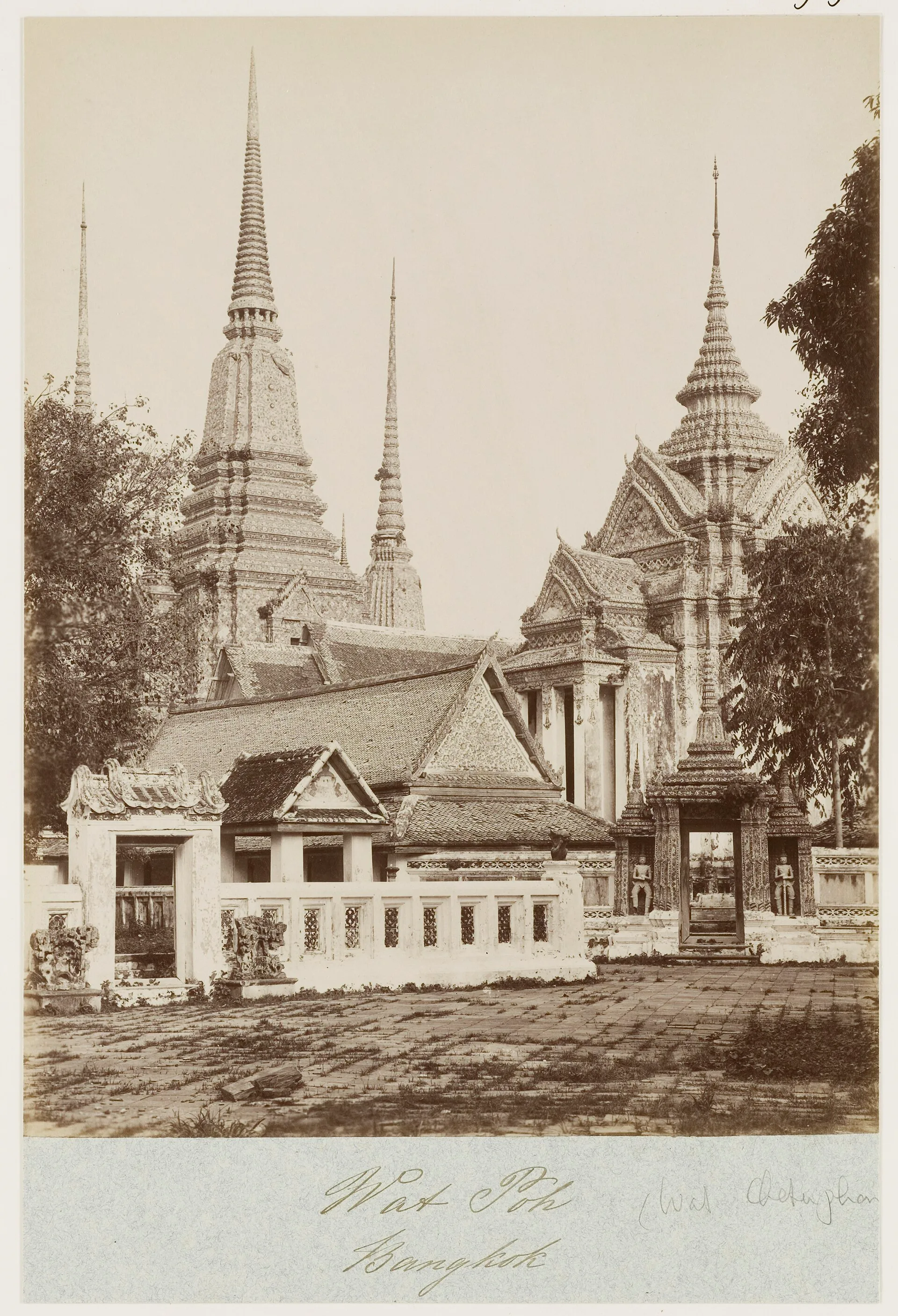
Early print showing a paved courtyard at Wat Pho, Bangkok: behind a pierced balustrade and a gateway flanked by two stone guardians rise tall chedis with inlaid decoration and a pavilion with a tiered roof.Lambert & Co., G.R. / Singapore — Wikimedia Commons, domaine public 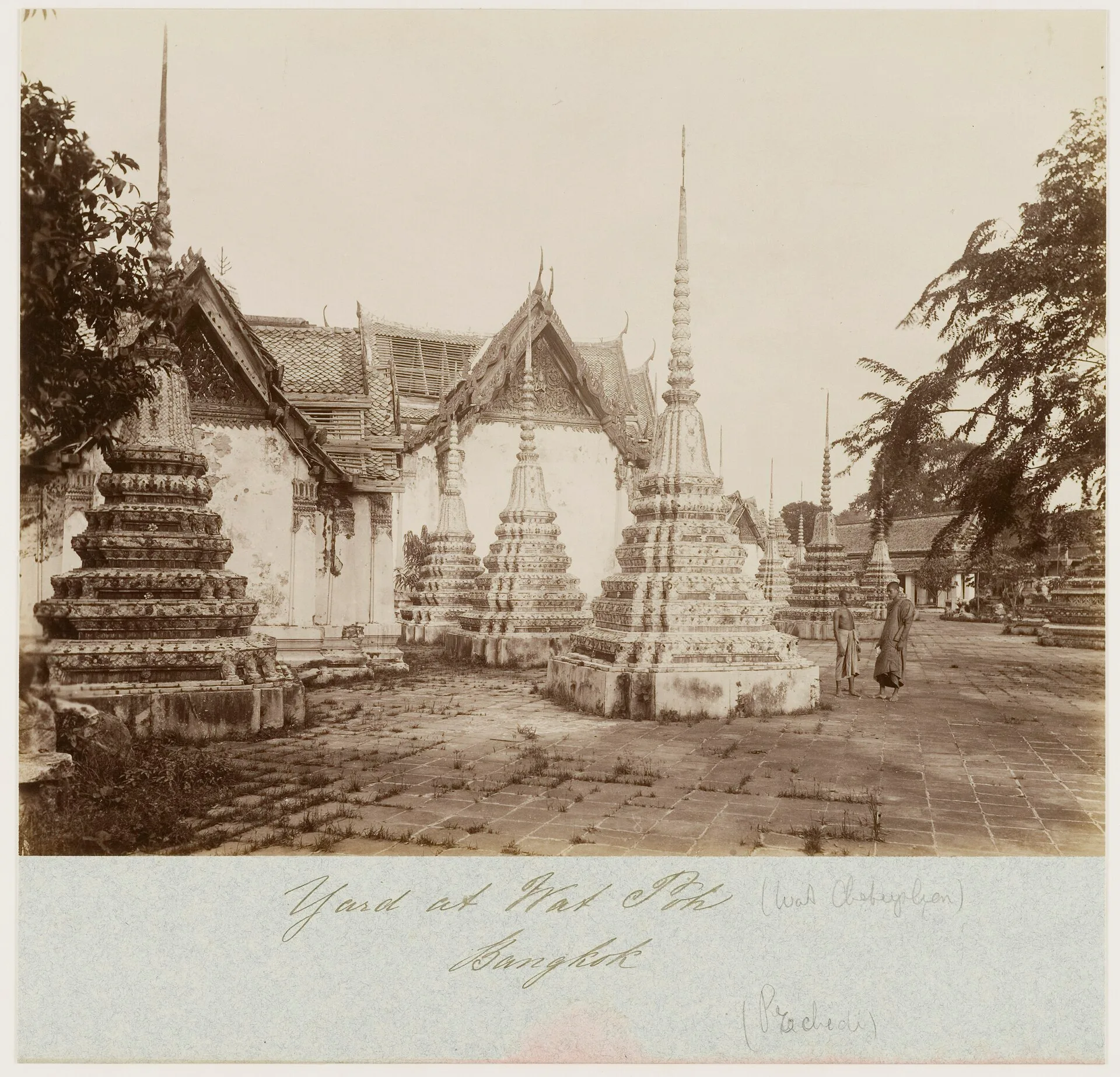
Paved courtyard of Wat Pho in Bangkok: decorated chedis with indented tiers stand before buildings with carved gables and tiered tile roofs; two figures, one a monk in robes, stand among them. Mounted print with handwritten caption.Lambert & Co., G.R. / Singapore — Wikimedia Commons, domaine public 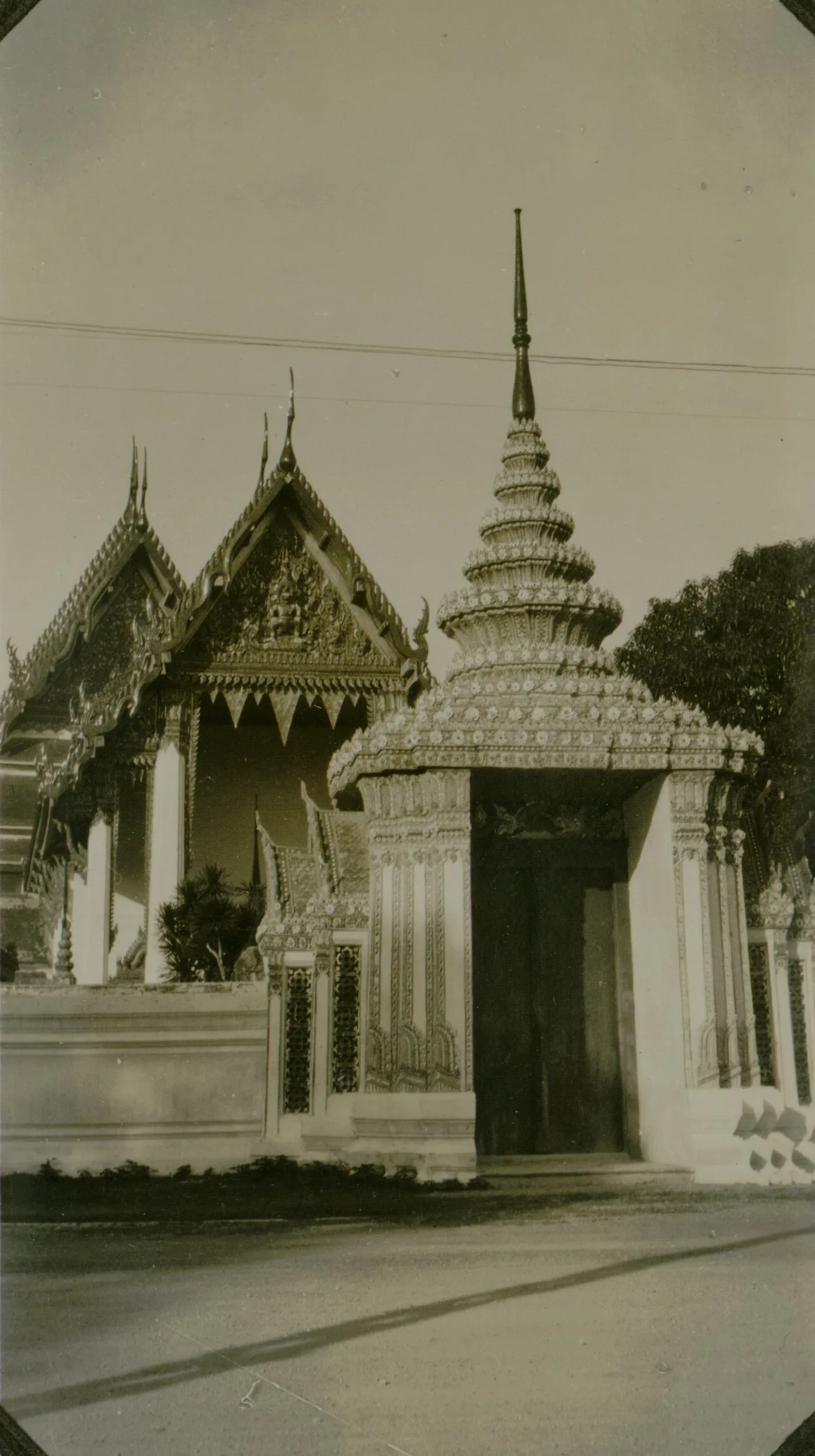
Enclosure gate of Wat Pho topped by a tiered spire covered in floral decoration, set in a wall with latticed windows; behind it, the carved gables of a temple building, adorned with chofa, rise above the wall.Auteur inconnu — Wikimedia Commons, CC BY 4.0 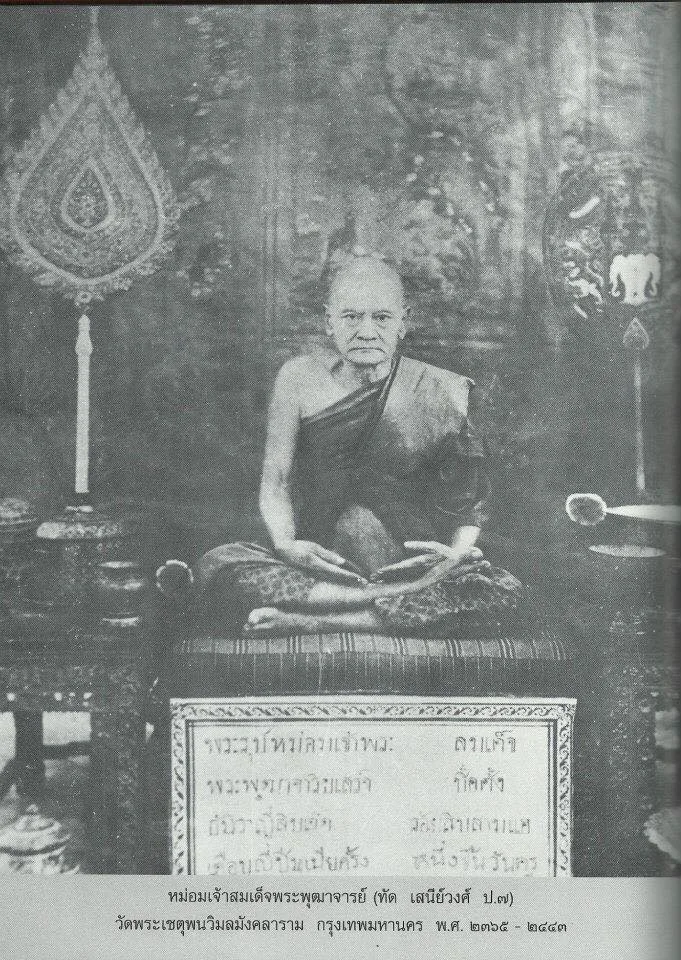
Old portrait of Mom Chao Somdet Phra Phutthachan (Thad), associated with Wat Pho: the monk, robe over the left shoulder, sits on a dais between two ceremonial fans, before a panel inscribed in Thai.Auteur inconnu — Wikimedia Commons, domaine public 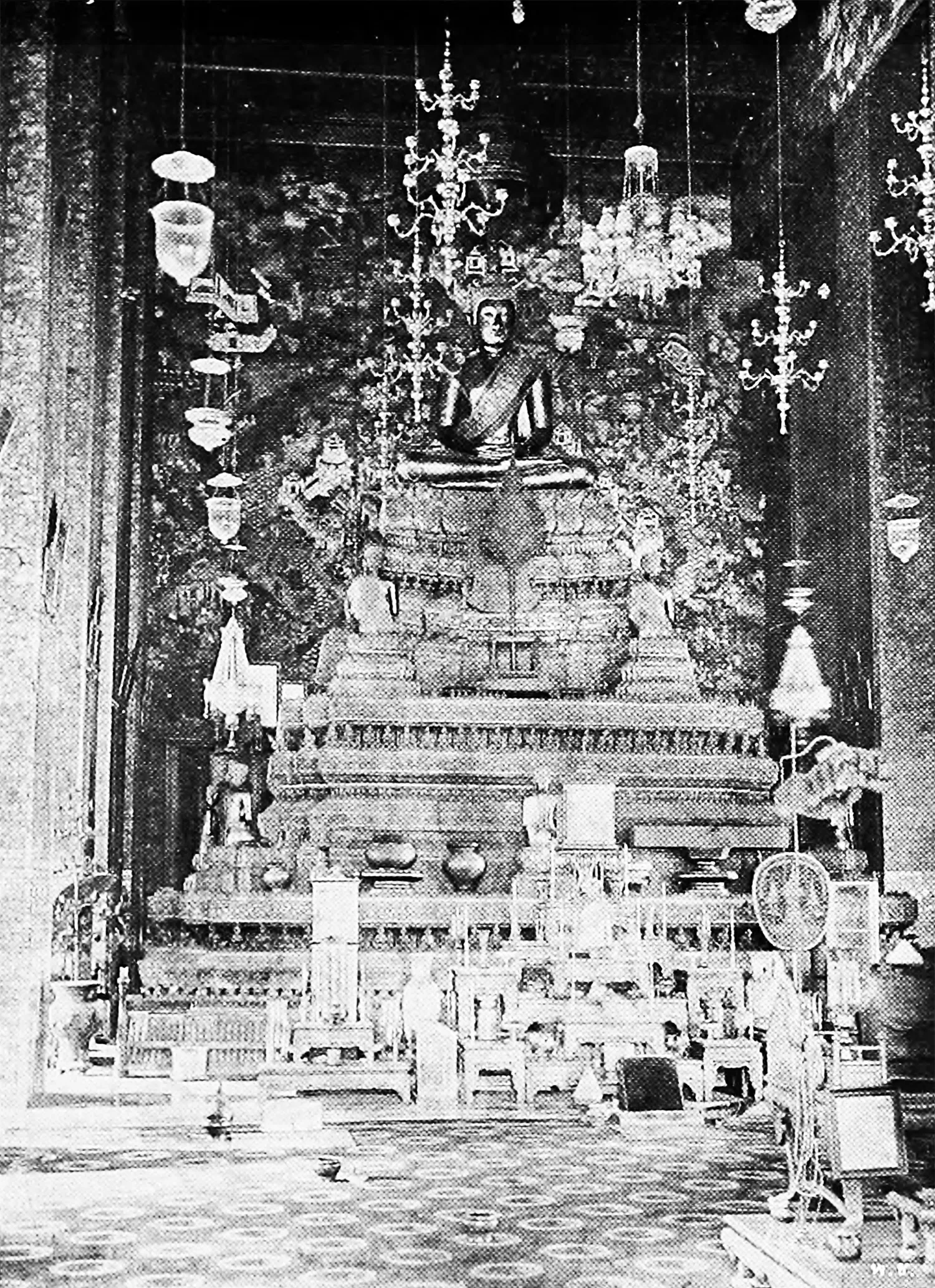
Printed reproduction showing the altar of a sanctuary at Wat Pho: a seated Buddha crowns an ornate tiered pedestal, flanked by smaller figures, in front of offering tables, chandeliers, candelabra and a ceremonial fan.Auteur inconnu — Wikimedia Commons, domaine public 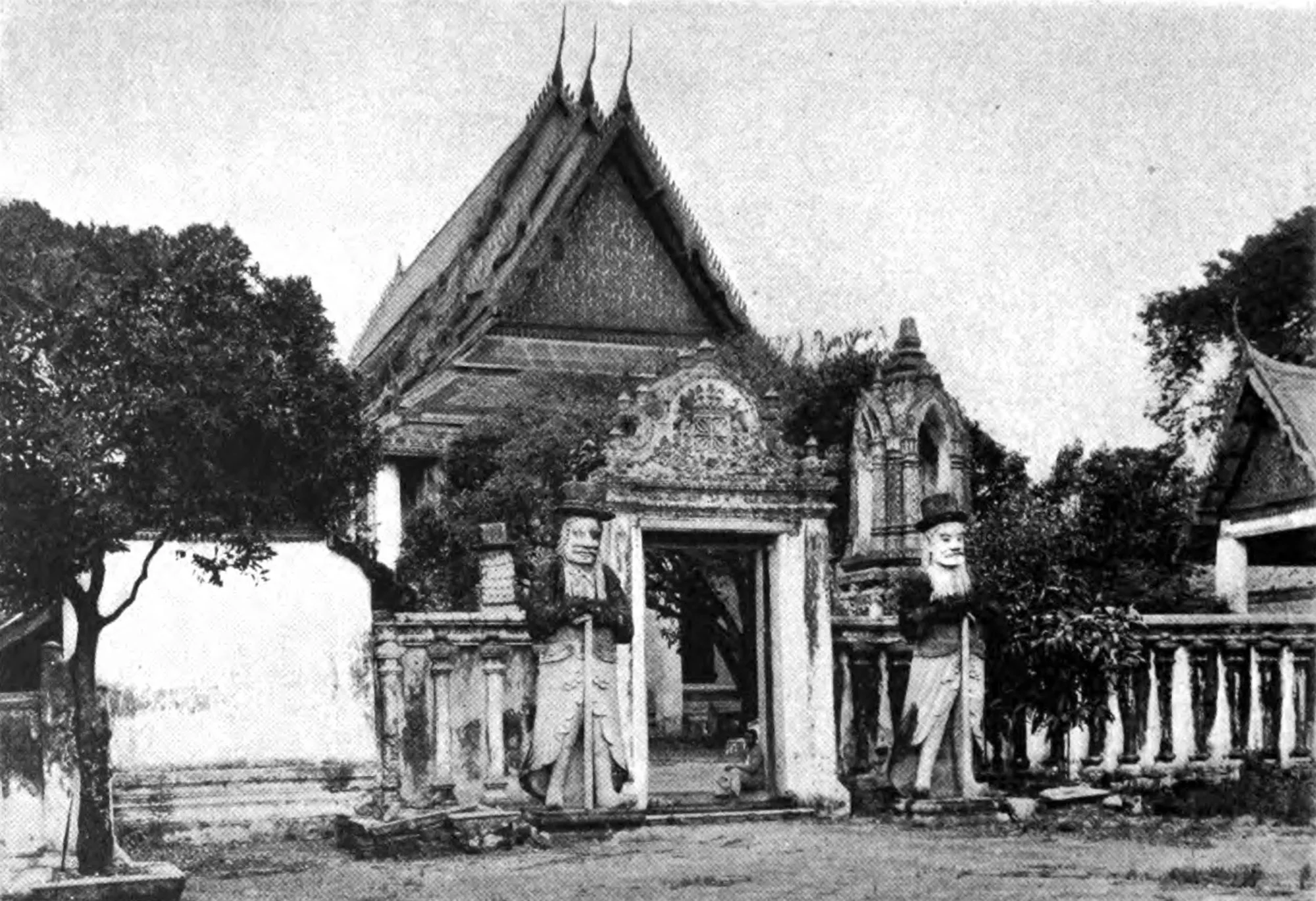
At Wat Pho, a gateway crowned by a carved pediment opens in a balustraded wall, guarded by two statues of bearded figures wearing hats; behind rises the ornate gable of a temple building.G. P. Putnam's Sons — Wikimedia Commons, domaine public 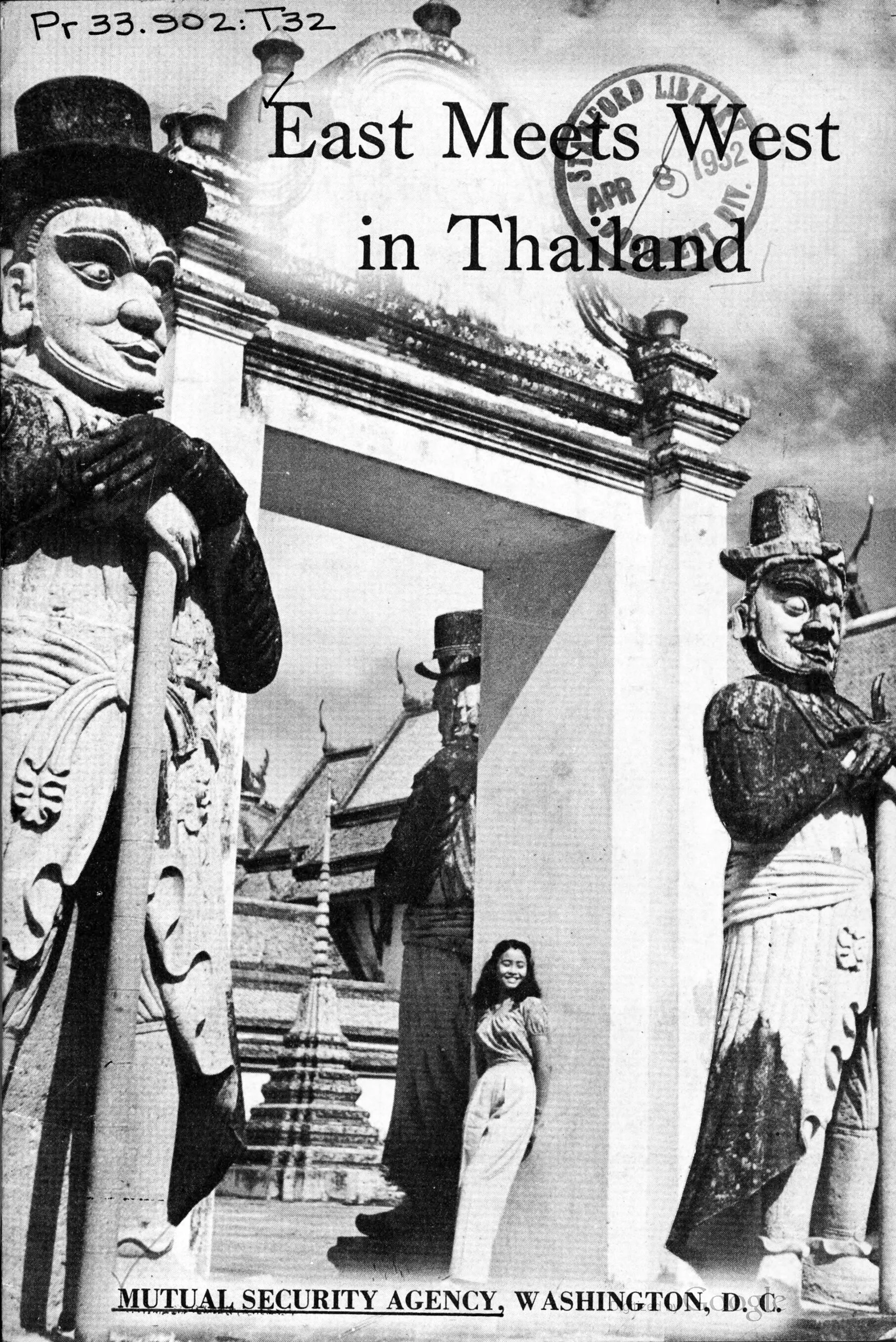
Cover of the brochure ‘East Meets West in Thailand’: at Wat Pho, guardian statues wearing top hats flank a masonry gateway opening onto roofs and a chedi; a young woman poses in the doorway.Mutual Security Agency — Wikimedia Commons, domaine public 
Seated hermit statue at Wat Pho, wearing a tall conical cap, hands joined before the chest and legs crossed, surrounded by vegetation; a grainy old black-and-white photograph.Auteur inconnu — Wikimedia Commons, domaine public 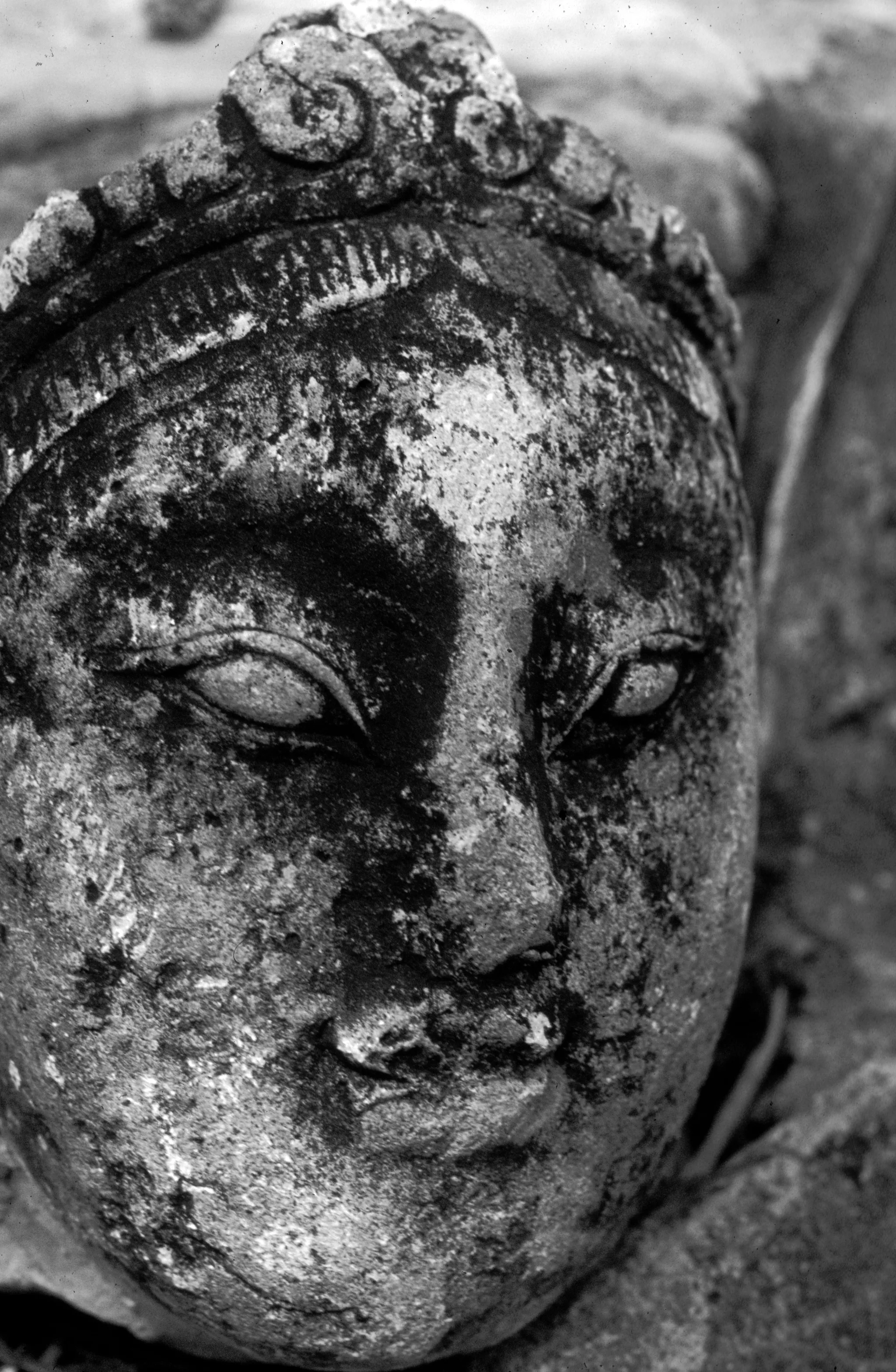
Carved stone head at Wat Pho, seen close up: the lowered eyelids, the ridged headband and the headdress adorned with scrolls bear traces of erosion and lichen that mottle the surface of the face.H. Grobe — Wikimedia Commons, CC BY 3.0 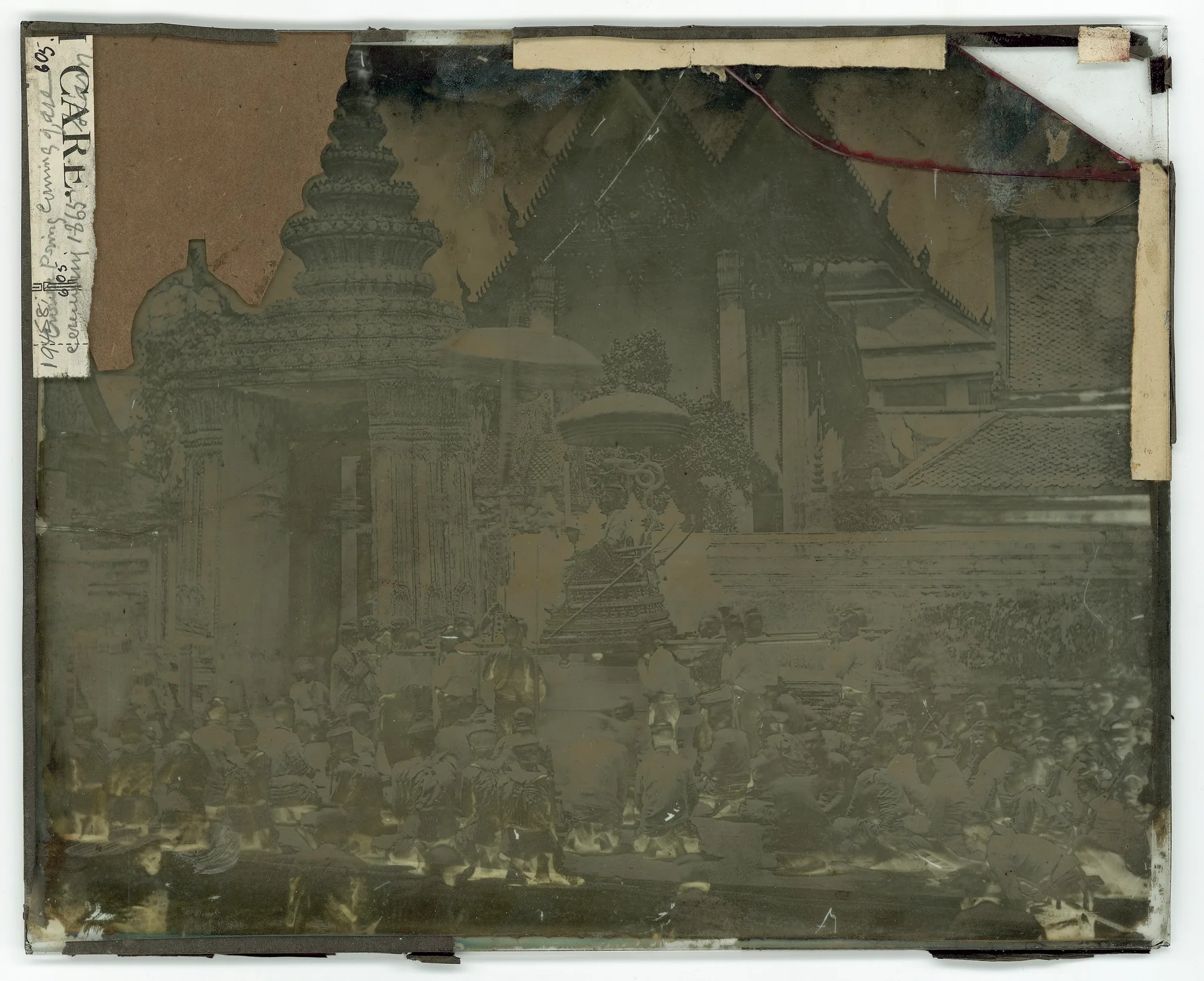
At Wat Pho, a seated or kneeling crowd surrounds a figure carried on a palanquin beneath parasols, before a tiered spired gateway and the gables of a building with layered roofs. The plate bears handwritten labels and strips of tape.Auteur inconnu — Wikimedia Commons, CC BY 4.0 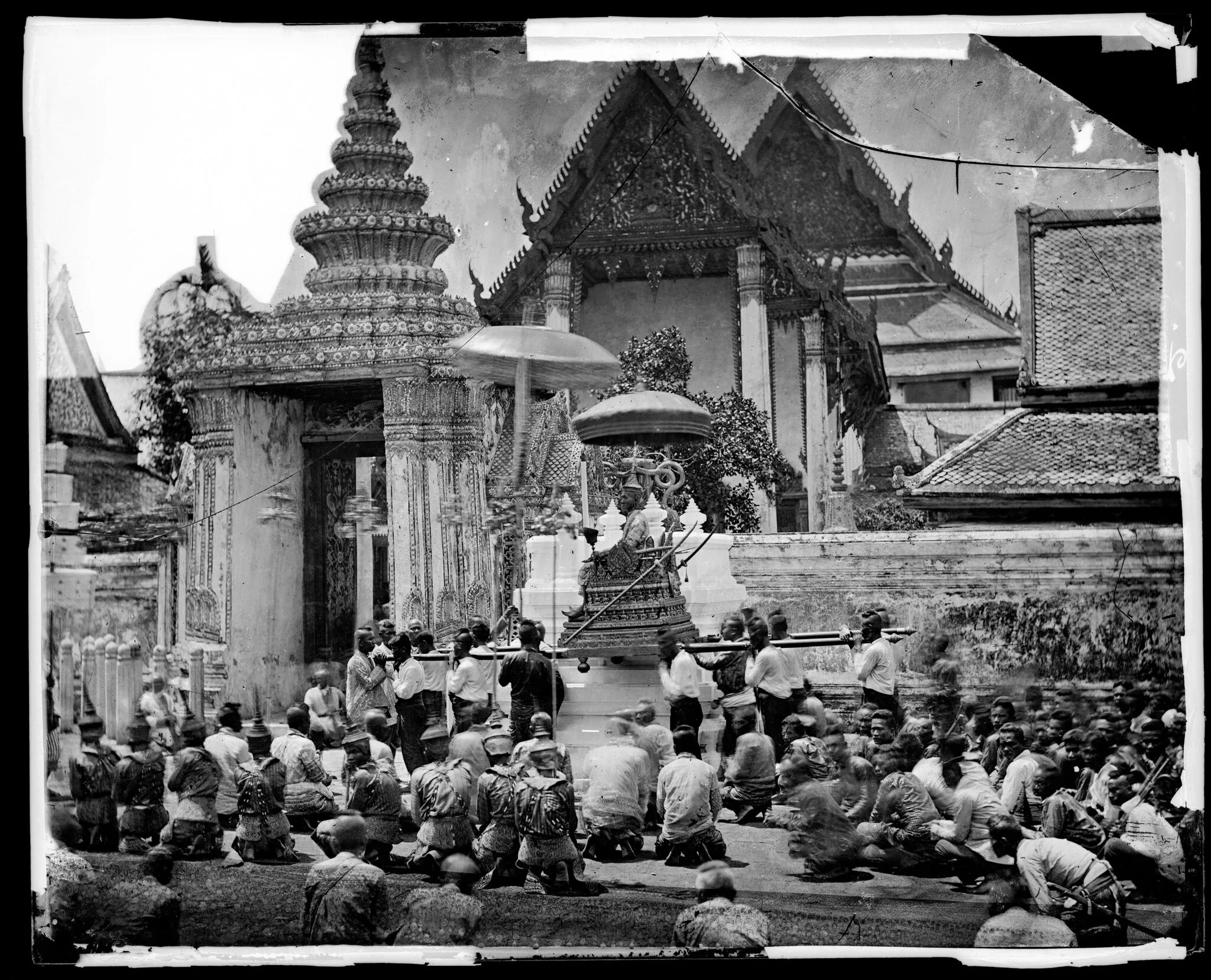
Before a gateway with a tiered spire roof and a pavilion with a carved pediment at Wat Pho, bearers carry an ornate palanquin beneath parasols, while a crowd and helmeted soldiers crouch on the ground.John Thomson — Wellcome Collection, domaine public 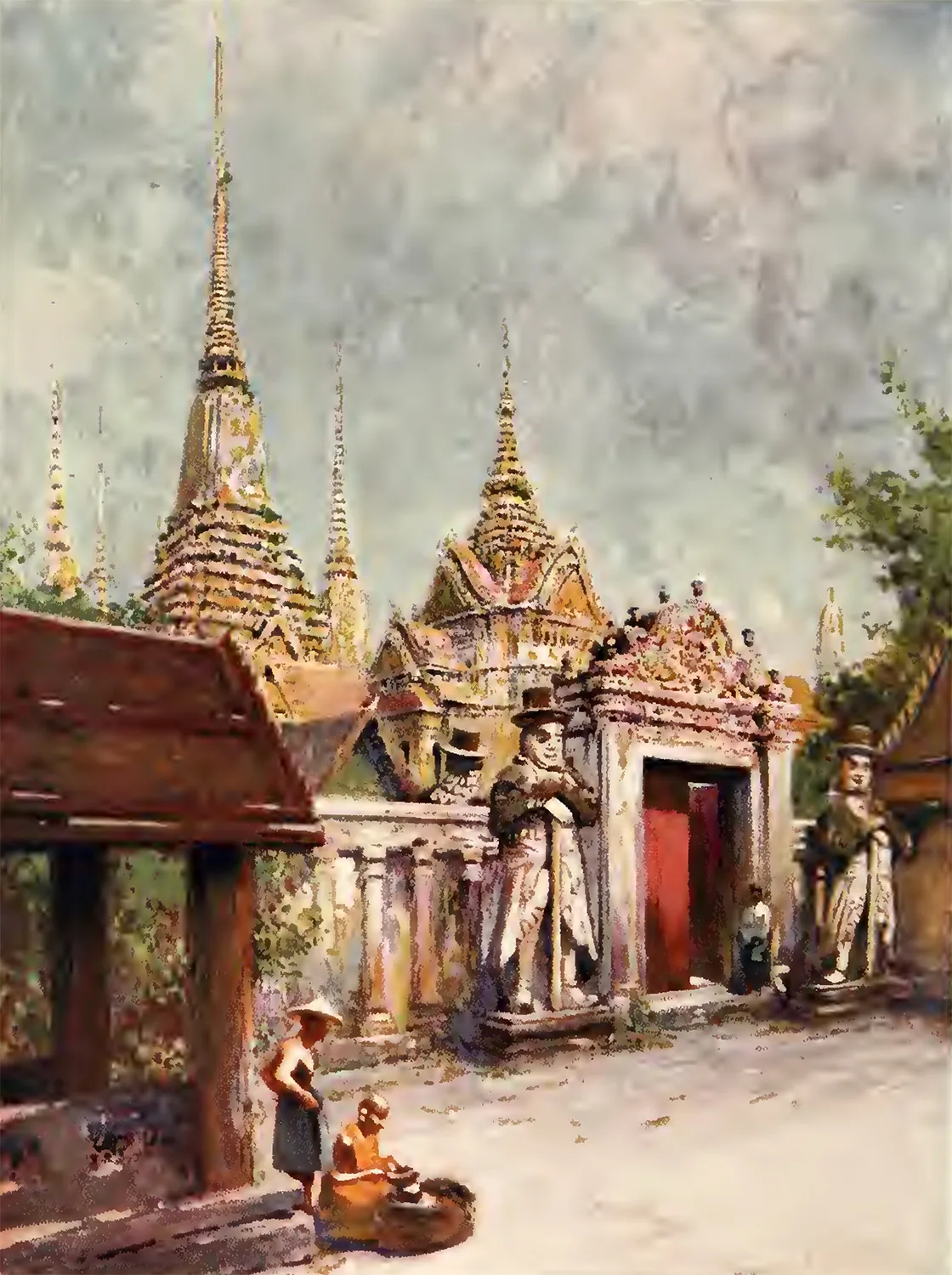
Colour illustration of Wat Pho: a red gateway, flanked by two statues of hatted guardians, opens in the enclosure wall beneath tall slender chedis; in the foreground, a monk in a saffron robe sits near a wooden pavilion.Edwin Arthur Norbury — Wikimedia Commons, domaine public 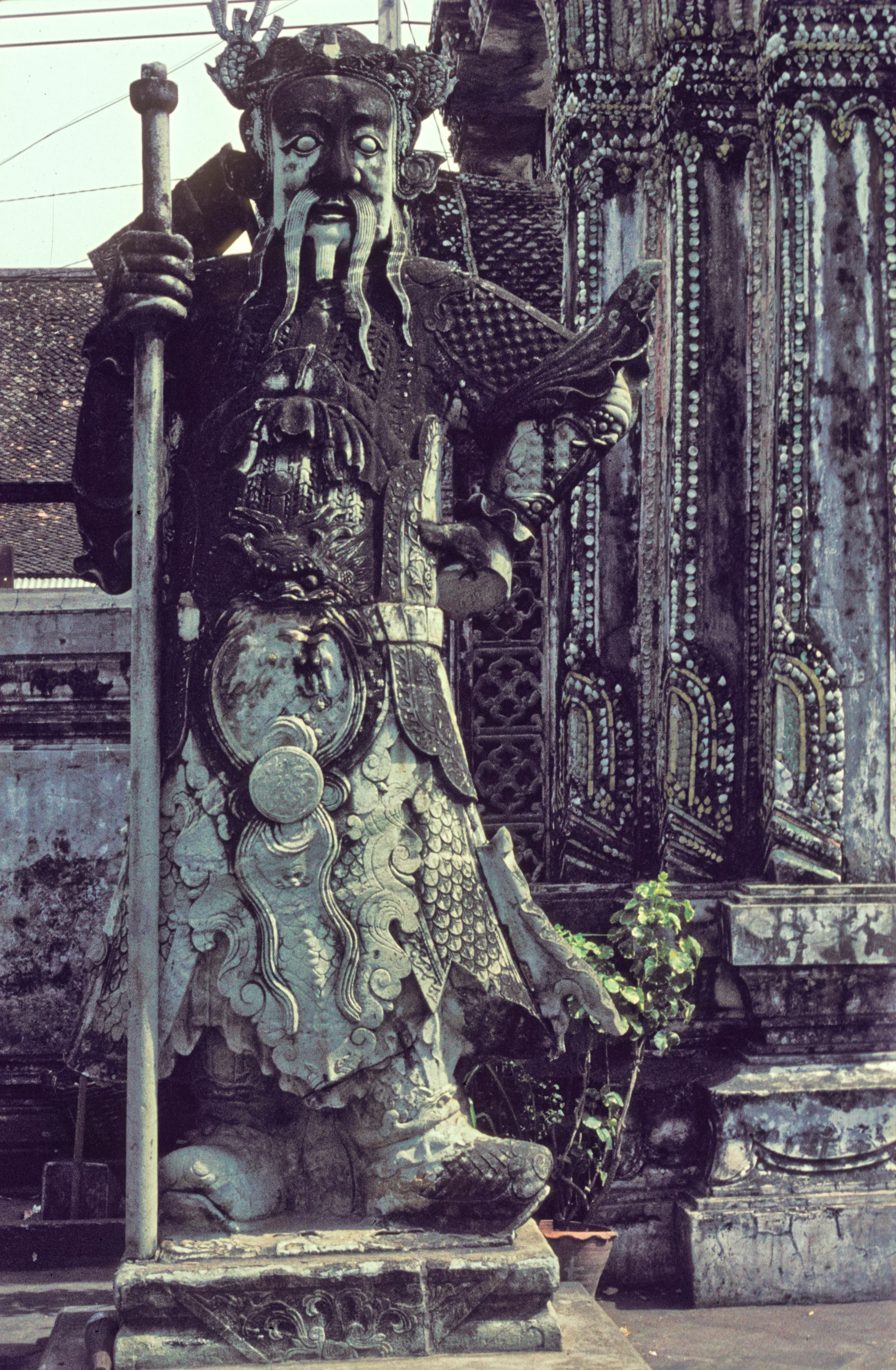
At Wat Pho, a Chinese-style stone guardian statue, bearded and wearing a headdress, holds a long staff; behind it stand a pillar decorated with porcelain fragments and an openwork screen, on an old colour slide.H. Grobe — Wikimedia Commons, CC BY 3.0 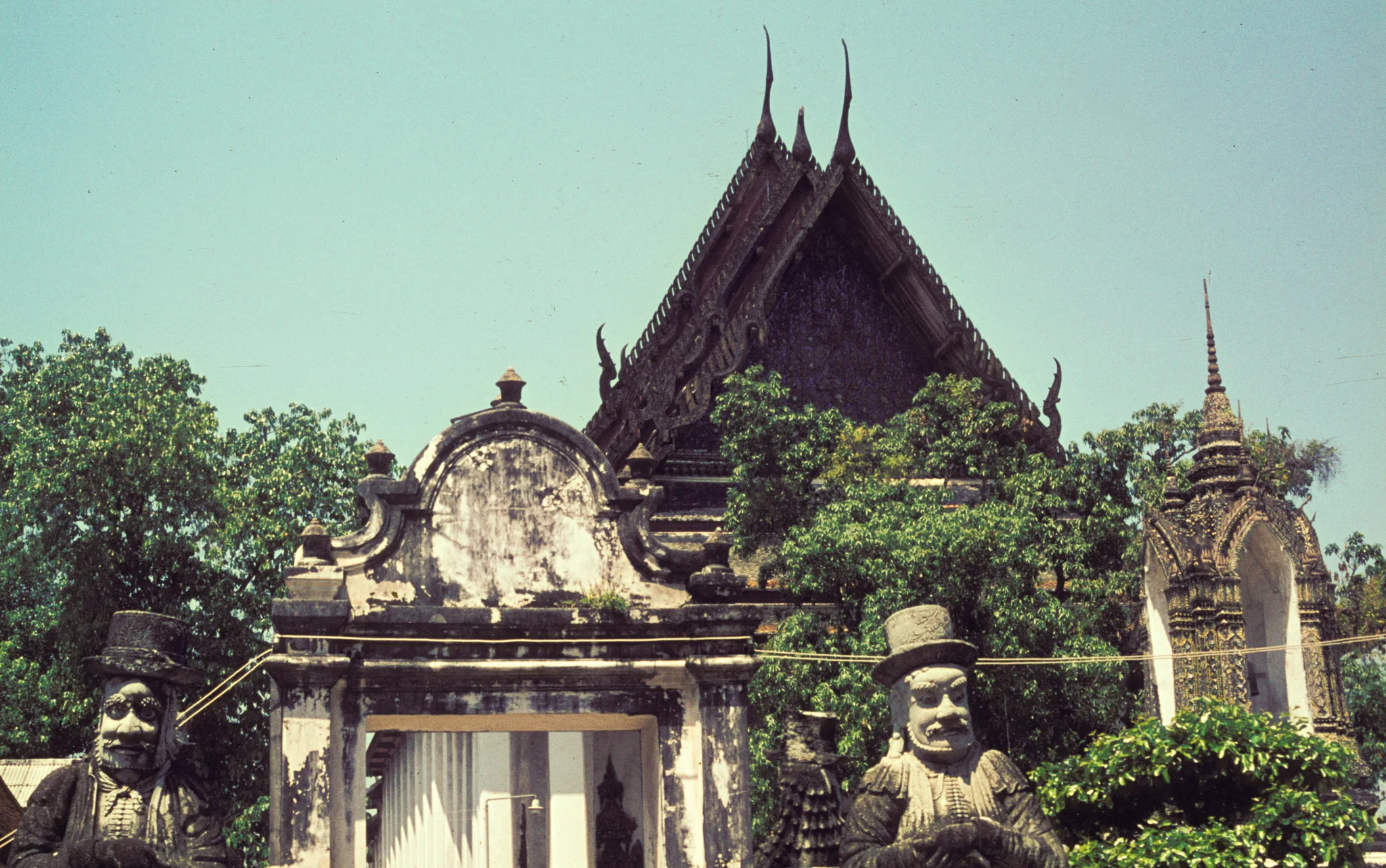
At Wat Pho, two stone guardian statues wearing hats flank a gateway with a curved pediment and weathered render; behind rise a carved gable with chofa finials and, to the right, a niche topped by a spire.H. Grobe — Wikimedia Commons, CC BY 3.0